
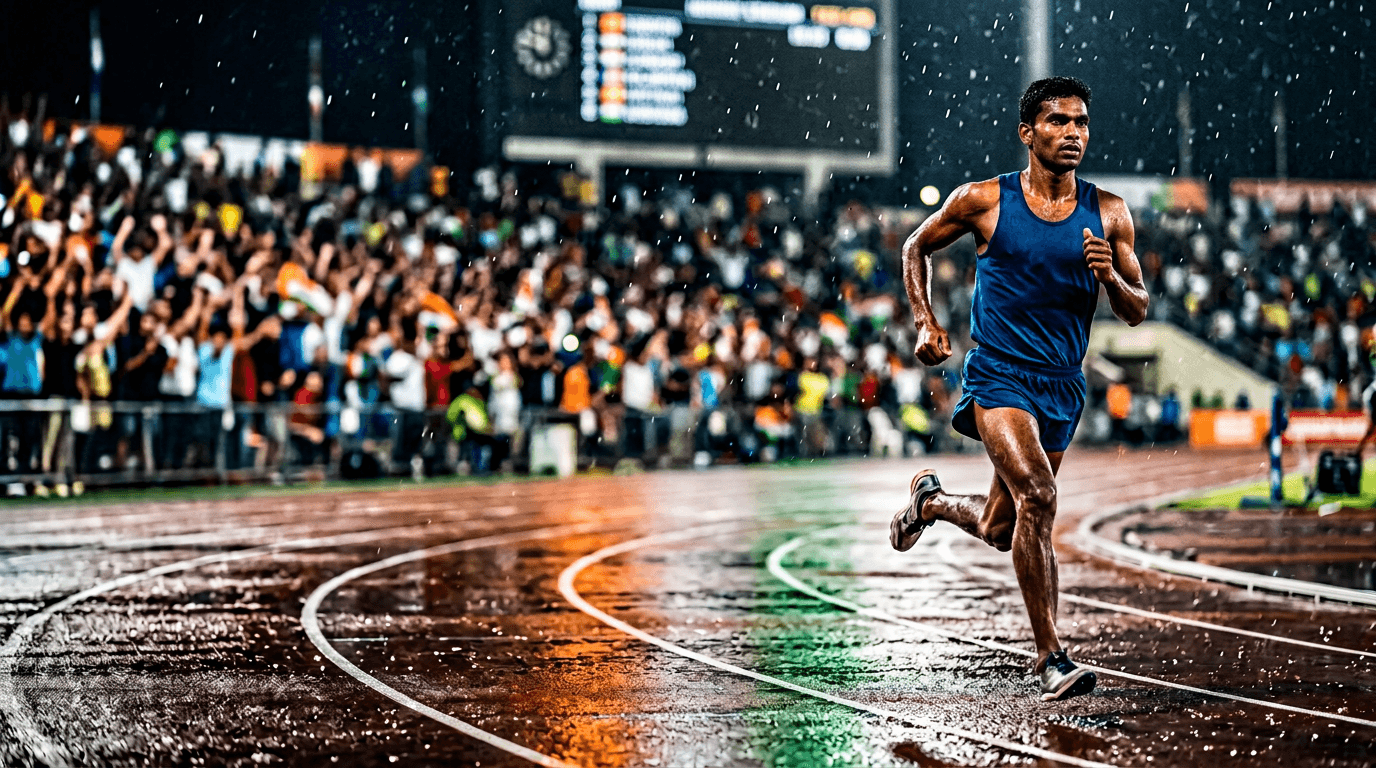
Rain had turned the Glasgow track dark and slippery by the final lap of the men’s 10,000m on 28 July 2026. The leading runners had spent more than 24 laps measuring one another, saving energy, waiting for someone else to blink first.
Then an Indian athlete found space on the outside, changed gears and crossed the line in 27:49.78. The gold went to Australia’s Ky Robinson in 27:48.93, but the silver carried a larger story: it was India’s first Commonwealth Games medal in the men’s 10,000m.
That runner was Gulveer Singh—a 28-year-old Naib Subedar from Uttar Pradesh whose first reason for running had little to do with medals. He wanted to join the Indian Army. The sport came later; the ambition grew faster than almost anyone expected.
Gulveer Singh at a Glance
| Detail | Information |
|---|---|
| Full name | Gulveer Singh |
| Date of birth | 1 June 1998 |
| Age in August 2026 | 28 |
| Hometown | Sirsa village, near Atrauli, Aligarh district, Uttar Pradesh |
| Profession | Long-distance runner; Naib Subedar in the Indian Army |
| Main events | 3,000m, 5,000m, 10,000m, mile and road races |
| Early sporting route | Indian Army, Army Sports Institute and Sports Authority of India national camp |
| International training | Colorado Springs, USA; reports have linked his recent programme with coach Scott Simmons |
| Major 2026 result | Commonwealth Games silver in 10,000m and bronze in 5,000m |
| Major 2025 result | Asian Athletics Championships gold in both 5,000m and 10,000m |
The Glasgow Race That Changed the Conversation
A 10,000m final is rarely won in the opening kilometre. It is a race of restraint, positioning and nerve, especially when rain makes the bends uncertain and the pack refuses to give anyone a free lead.
Gulveer did not need his personal best in Glasgow. He needed judgement. His 27:49.78 was slower than his Indian record of 27:00.22, yet it delivered something a fast solo race cannot: a Commonwealth Games medal against a deep field on a difficult night.
Four days later, he returned for the 5,000m final and took bronze in 13:24.95. He edged Kenya’s Cornelius Kemboi by only 0.04 seconds, becoming the first Indian track-and-field athlete to win two individual medals at a single Commonwealth Games.
The two medals matter for different reasons. The 10,000m silver ended India’s wait for a men’s medal in that event; the 5,000m bronze became India’s first Commonwealth Games medal in that distance too.
From Sirsa Village to the Indian Army
Before international meets, altitude camps and race lights, there were village roads and farmland tracks around Sirsa in Aligarh district. Gulveer has said that running began as preparation for Army recruitment, not as a childhood plan to become an elite athlete.
That detail changes how his story reads. Many young athletes discover a sport through school competitions or a local academy. Gulveer’s entry point was more practical: secure a place in the Army, build a stable future and do whatever the physical test required.
He joined the Indian Army in 2018 and was posted with The Grenadiers. The uniform gave him structure, but it also introduced him to a world he had barely known existed—formal races, coaches, training cycles, recovery and the international calendar.
In a widely reported interview, Gulveer explained that he truly learned competitive running only after joining the Army. He later moved through the Army Sports Institute and the Sports Authority of India national-camp system, where raw endurance became a craft.
How Structured Coaching Changed Everything
Natural stamina can win a village run. It cannot, by itself, survive 25 tactical laps against international athletes.
At the Army Sports Institute, Gulveer gained access to formal coaching and a routine built around more than mileage. Track work, strength training, recovery, pacing and race analysis gradually became part of the job. His early development came through the Army Sports Institute, while his later overseas work has included Colorado Springs training under Scott Simmons.
The shift is visible in the way he races now. He does not simply run hard from the gun; he holds position, reads surges and retains enough speed for the final lap. That is learned behaviour.
His rise also shows why sports systems matter. Talent may appear on a dusty road, but elite performance usually needs a coach, a safe place to train, nutrition, medical support, travel opportunities and patience from institutions that understand long-term development.
The Khelo India Lesson: Without Rewriting His Story
It would be easy to call Gulveer a “Khelo India athlete” because his success fits the spirit of India’s youth-sport programmes. It would also be inaccurate without proof.
The verified trail is different: village running, Indian Army recruitment, Army Sports Institute, the SAI national camp, federation support and high-performance exposure abroad. That is Gulveer’s story, and it does not need borrowed labels.
Still, his journey offers a useful lesson for the Khelo India generation. A young runner from a small town may not need a famous surname or an instant viral moment; he or she needs early identification, qualified coaching and enough support to stay in the sport after the first promising race.
Khelo India can help create those pathways. Gulveer’s career shows what happens when talent eventually reaches a serious performance system—and why the next athlete should not have to wait years to reach one.
Career Timeline
| Year | Moment | Why it mattered |
|---|---|---|
| 2018 | Joined the Indian Army | Competitive running became a serious possibility after entry into the Army system. |
| 2022 | Federation Cup bronze in 10,000m, Calicut | His first senior podium; a turning point after several years of learning the sport. |
| 2023 | Asian Athletics Championships bronze in 5,000m, Bangkok | His first continental medal. |
| 2023 | Asian Games bronze in 10,000m, Hangzhou | He ran 28:17.21 for a personal best and announced himself on a bigger stage. |
| 2024 | Broke Indian records in the 5,000m and 10,000m | The times began to move from national promise to international relevance. |
| February–March 2025 | Record sequence in Boston and California | He ran 7:38.26 for 3,000m short track, 12:59.77 for 5,000m short track and 27:00.22 for 10,000m. |
| May 2025 | Asian Championships double gold, Gumi | Gold in 10,000m and 5,000m turned him into Asia’s leading male distance runner. |
| September 2025 | World Championships, Tokyo | He placed 16th in the 10,000m final and missed the 5,000m final by 0.19 seconds in the heats. |
| March–May 2026 | Road and mile milestones | He ran 59:42 at the NYC Half and won the Men’s 1 Mile Pro race at the Music City Track Carnival in 3:55.63. |
| July–August 2026 | Commonwealth Games double, Glasgow | Silver in 10,000m and bronze in 5,000m made Indian athletics history. |
Records That Need a Little Context
A good Gulveer Singh profile should separate outdoor marks, short-track marks and road-race performances. They are all impressive, but they are not interchangeable.
His 27:00.22 in the 10,000m at The TEN in California on 29 March 2025 remains the Indian national record. He missed the 2025 World Championships automatic standard of 27:00.00 by just 0.22 seconds—a tiny gap over 25 laps.
His 13:03.93 at the LA Track Fest in May 2026 is the outdoor Indian 5,000m record. The faster 12:59.77 came on a short track in Boston in February 2025; it made him the first Asian man to break 13 minutes in that format and set an Asian short-track record.
| Event | Best mark | Context |
|---|---|---|
| 3,000m | 7:34.49 | Indian national record, Budapest, 2025 |
| 5,000m outdoor | 13:03.93 | Indian national record, LA Track Fest, 2026 |
| 5,000m short track | 12:59.77 | Asian short-track record and Indian record, Boston, 2025 |
| 10,000m | 27:00.22 | Indian national record, The TEN, California, 2025 |
| Mile | 3:55.63 | Won the Men’s 1 Mile Pro race at the Music City Track Carnival, 2026 |
| 25km road | 1:12:06 | Tata Steel World 25K Kolkata, 2025 |
| Half marathon | 59:42 | Personal best at NYC Half, 2026; not eligible for national-record ratification because of the course configuration |
The half-marathon footnote is a good reminder that sport has rules beyond the stopwatch. Gulveer’s 59:42 made him the first Indian to run under one hour for the distance, but the point-to-point New York course was not eligible for an official national record.
From Asian Medals to a Global Test
His first senior medal came at the 2022 Federation Cup: 10,000m bronze in Calicut. A year later, he took 5,000m bronze at the Asian Athletics Championships in Bangkok and then added Asian Games bronze in the 10,000m at Hangzhou.
The Hangzhou time—28:17.21—was a personal best at the time. It also revealed something more useful than a medal table: Gulveer could stay composed in a championship race, where pace changes and contact can disrupt even fit runners.
By Gumi 2025, he had evolved from contender to favourite. He won the 10,000m in 28:38.63 and then the 5,000m in 13:24.77, a championship-record performance. The times were tactical rather than record-chasing; the medals were the target.
Tokyo later provided a tougher but valuable lesson. Gulveer finished 16th in the World Championships 10,000m final in 29:13.33, then missed the 5,000m final by 0.19 seconds after running 13:42.34 in the heats. That is not failure—it is evidence of how narrow the margin becomes at world level.
Why His Racing Style Works
Gulveer’s best championship races have a pattern. He stays calm through the early laps, refuses to chase every move and keeps enough composure for the last kilometre.
At Gumi, he waited until the final lap to break clear in the 10,000m. In Glasgow, he used patience again—first for silver in the rain, then for bronze in a 5,000m decided by hundredths of a second.
That does not mean he is only a kicker. The 27:00.22 national record and 13:03.93 outdoor 5,000m record show that he can run fast in paced races too. The encouraging part is his range: he can chase a clock in California, win a tactical Asian final in Korea and handle Commonwealth Games pressure in Glasgow.
Editorial observation: Indian distance running has often celebrated hard workers who can endure. Gulveer adds another quality to that picture—he makes decisions late in races without looking hurried. That is the difference between fitness and championship craft.
What Changed Between 2023 and 2026
| Area | Earlier marker | Later marker | What the change suggests |
|---|---|---|---|
| 10,000m | 28:17.21 at the 2023 Asian Games | 27:00.22 national record in 2025 | A reduction of 76.99 seconds in under two years. |
| 5,000m outdoor | 13:18.92 national record in 2024 | 13:03.93 national record in 2026 | Nearly 15 seconds faster at a distance where improvements are hard won. |
| Championship level | Federation Cup bronze in 2022 | Asian double gold and Commonwealth double in 2025–26 | Better race management, not only faster PBs. |
| Range | Track specialist | Mile, 25km and half-marathon performances added | His aerobic base now supports several race formats. |
| Competitive exposure | Domestic and Asian meets | US circuit, World Championships and Commonwealth Games | More experience against deeper international fields. |
10 Facts About Gulveer Singh
- He did not begin by chasing Olympic glory. Running first helped him prepare for Army recruitment.
- His 2022 Federation Cup bronze was his first senior podium. It came years after he entered the Army system.
- He won Asian Games bronze in the men’s 10,000m at Hangzhou in 2023. His time was 28:17.21.
- He became the first Asian man to run a sub-13-minute 5,000m on a short track. The mark was 12:59.77 in Boston in February 2025.
- He went within 0.22 seconds of the automatic 10,000m entry standard for the 2025 World Championships. His 27:00.22 Indian record was agonisingly close to 27:00.00.
- He won both distance titles at the 2025 Asian Athletics Championships. His 5,000m gold in 13:24.77 set a championship record.
- He missed the 2025 World Championships 5,000m final by 0.19 seconds. Small margins can teach large lessons.
- His 59:42 at the NYC Half Marathon was historic but not an official national record. The course did not meet World Athletics record-eligibility rules.
- He ran 3:55.63 to win the Men’s 1 Mile Pro race at the Music City Track Carnival in May 2026.
- At Glasgow 2026, he won two individual track medals in one Commonwealth Games. No Indian athlete had done that before.
Did You Know?
The fastest race is not always the most valuable race.
Gulveer’s 10,000m personal best is 27:00.22, but his Commonwealth Games silver came in 27:49.78. The Glasgow time was slower by almost 50 seconds, yet it demanded a different kind of excellence: coping with rain, reacting to rivals and delivering a finish when medals—not records—were on the line.
That distinction is useful for young runners. A stopwatch can measure speed; it cannot fully measure judgement under pressure.
What Young Athletes Can Learn
1. Start where you are
Gulveer did not begin at a famous academy. He began with accessible roads and a practical goal. A modest starting point does not limit where disciplined work can lead.
2. Seek coaching early, then respect the process
Raw talent needs direction. The Army Sports Institute and SAI system helped turn his endurance into a training plan, while later international exposure expanded his racing knowledge.
3. Do not confuse a personal best with a finished career
The 2025 World Championships offered a sharp reminder: an Indian record does not automatically guarantee a world final. Gulveer returned from that experience and produced his best championship result in Glasgow.
4. Learn to race, not only to run fast
A runner can set a PB in a paced meet and still struggle in a tactical final. Gulveer’s Asian and Commonwealth medals came because he combined fitness with patience, positioning and a finishing response.
5. Keep facts honest
Young athletes do not need inflated biographies. Gulveer’s verified story—village roads, Army service, structured support and steady improvement—is powerful precisely because it is real.
Frequently Asked Questions
Who is Gulveer Singh?
Gulveer Singh is an Indian long-distance runner and a Naib Subedar in the Indian Army. He competes mainly in the 5,000m and 10,000m, while also racing on the road and in middle-distance events such as the mile.
Where was Gulveer Singh born?
He was born on 1 June 1998 and comes from Sirsa village near Atrauli in Aligarh district, Uttar Pradesh.
What medals did Gulveer Singh win at the 2026 Commonwealth Games?
He won silver in the men’s 10,000m in 27:49.78 and bronze in the men’s 5,000m in 13:24.95. Those results made him the first Indian track-and-field athlete to win two individual medals at one Commonwealth Games.
What are Gulveer Singh’s major national records?
As of August 2026, he owns Indian marks in the 3,000m, 5,000m outdoor and 10,000m. His short-track 5,000m mark of 12:59.77 is also an Asian record.
Did Gulveer Singh set the Indian half-marathon record in New York?
He ran 59:42 at the NYC Half Marathon in March 2026, the first sub-60-minute half marathon by an Indian. The performance is a personal best, but it cannot be ratified as an official national record because the course is not record-eligible under World Athletics rules.
Is Gulveer Singh a Khelo India athlete?
This should not be claimed without a primary source. The publicly documented pathway for Gulveer is through the Indian Army, Army Sports Institute, SAI national camp and federation-supported high-performance training.
Who coaches Gulveer Singh?
His development has included Army Sports Institute coaching. More recently, he has trained in Colorado Springs under Scott Simmons as part of India’s overseas middle- and long-distance programme.
A Balanced View of What Comes Next
Gulveer Singh has changed the ceiling for Indian men’s distance running, but the global standard remains unforgiving. His 2025 World Championships results made that clear: he was close enough to the final to feel it, yet still had ground to make up.
Glasgow offered a stronger sign than a fast time alone. He beat pressure, weather and experienced international opponents in two separate championship races. The next phase will be about repeating that composure against deeper global fields and continuing to lower the gap between Indian records and world-medal pace.
For now, his biography is not a fairy tale about instant discovery. It is a story of a runner who entered sport for a job, found coaching after joining the Army and kept adding layers to his game until the world began paying attention. India’s next distance runner may come from a Khelo India camp, an Army unit, a school track or a village road. Gulveer has shown that the route can start anywhere—but it cannot end without serious support and serious work.
Sources and Fact-Checking References
- World Athletics athlete profile: Gulveer Singh
- Olympics.com: Gulveer Singh—India’s top long-distance runner
- Athletics Federation of India: 10,000m national record, 27:00.22
- Athletics Federation of India: 2026 national-inter-state start list confirming 5,000m outdoor NR, 13:03.93
- Olympics.com: Asian Athletics Championships 2025 results
- World Athletics: Tokyo 2025 men’s 10,000m final
- Olympics.com: Commonwealth Games 2026 athletics results
- Olympics.com: NYC Half Marathon 2026 and the record-eligibility explanation
For future updates, recheck the World Athletics profile, AFI results and official competition result pages before changing record tables or adding new medals.