
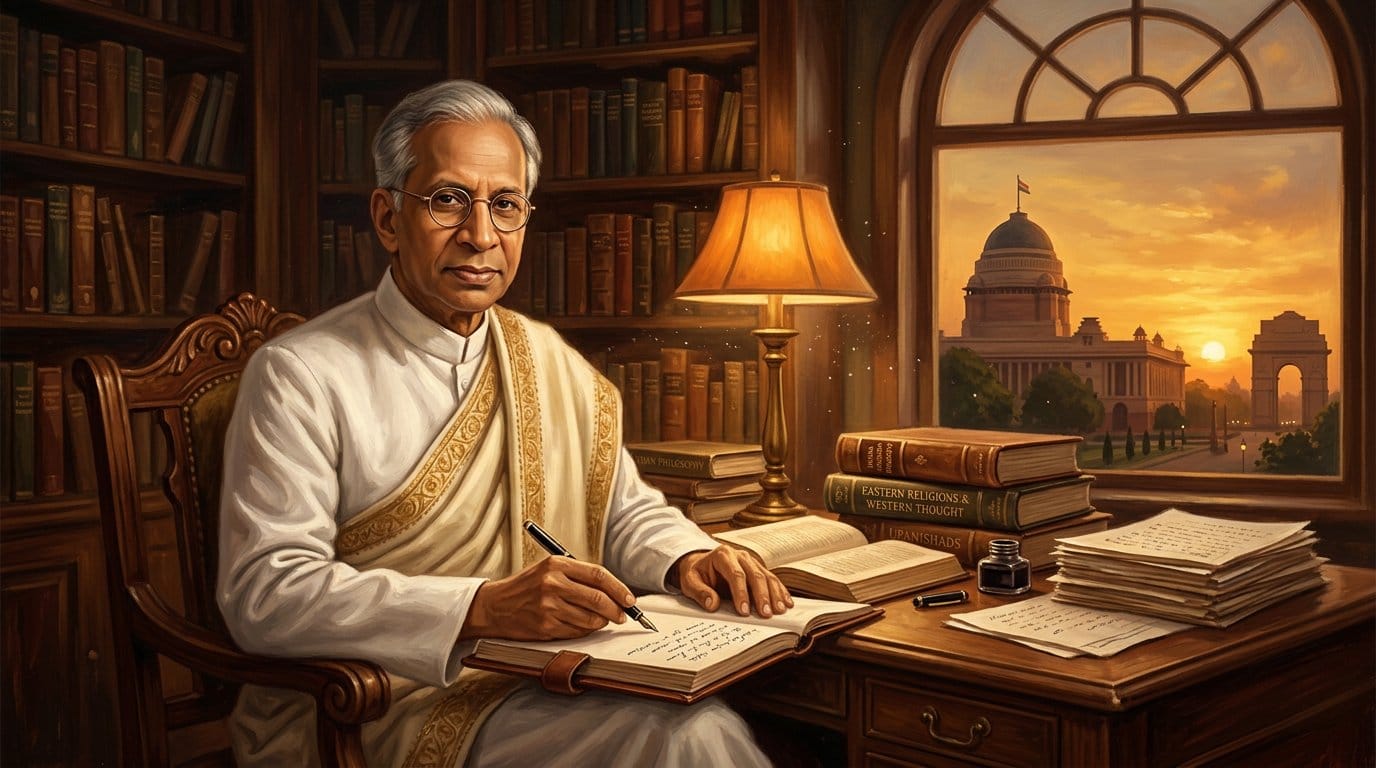
In 1921, students at Mysore University stopped the whole town in its tracks. Their professor was moving to Calcutta, so they dragged a carriage onto the street, covered it in flowers, and made him ride it to the railway station. He hadn’t won them a trophy or a championship. He’d simply taught them to think.
That professor was barely into his thirties. In the decades after, he’d collect a knighthood, a string of Nobel nominations, and the job of explaining India’s soul to the West — before coming home to become the second President of the country.
He also handed every teacher in India a free holiday in September. That one gesture stuck, and it still lands on the same date every year.
1. A Carriage Full of Flowers
Let’s sit with that 1921 scene for a minute, because it tells you everything about the man before he had any titles.
Here was a village boy from Tiruttani, raised in a family that could barely afford his school fees, being honored like royalty by students who owed him nothing. That’s not the kind of respect you buy. That’s the kind you earn by making philosophy feel less like a textbook and more like a mirror.
The carriage ride took him to a bigger stage at Calcutta University. But notice what the students remembered: not his degrees, not his future fame — just a teacher who made them curious.
That’s the thread we’ll follow through this entire story.
2. Quick Info: Dr. Sarvepalli Radhakrishnan at a Glance
| Attribute | Detail |
|---|---|
| Full name | Sarvepalli Radhakrishnan |
| Born | 5 September 1888, Tiruttani (Madras Presidency, now Tamil Nadu) |
| Parents | Sarvepalli Veeraswami (father), Sitamma (mother) |
| Family | Telugu Brahmin household; married Sivakamu; six children — five daughters, one son |
| Education | Voorhees College, Vellore; Madras Christian College (MA, Philosophy) |
| Teaching posts | Presidency College, Madras; University of Mysore; King George V Chair, Calcutta University |
| Oxford years | Spalding Professor of Eastern Religions and Ethics (1936–1952); Fellow of All Souls College |
| Leadership roles | VC, Andhra University (1931–36); VC, Banaras Hindu University (1939–48); Chancellor, Delhi University (1953–62) |
| Public roles | Constituent Assembly; UNESCO delegate; Ambassador to the Soviet Union; first Vice President; second President |
| Famous books | Indian Philosophy; An Idealist View of Life; Eastern Religions and Western Thought; The Bhagavadgita |
| Major awards | Bharat Ratna (1954); Order of Merit (1963); Sahitya Akademi Fellowship (1968); Templeton Prize (1975) |
| Died | 17 April 1975, Chennai |
| Legacy | His birthday, 5 September, is celebrated every year as Teachers’ Day |
3. The Boy Who Studied on Borrowed Books
September 5, 1888. A temple town called Tiruttani, sitting close to the Tamil Nadu–Andhra Pradesh border, welcomed its newest resident into the world.
His father, Sarvepalli Veeraswami, worked as a modest revenue official under a local zamindar. Money never came easy in that house. His mother, Sitamma, ran the home on that thin income, and the family’s ambition for the boy was simple: make him a priest.
The boy had other ideas.
He went to school in Tirupati first, then to Voorhees College in Vellore. At seventeen, he moved to Madras Christian College, where philosophy found him through a happy accident — a cousin who’d just finished the subject handed over his old textbooks. Free books, no strings attached.
There’s something quietly poetic about that. The man who’d one day be called one of India’s greatest philosophers didn’t pick philosophy. It picked him, through secondhand pages and a cousin’s kindness.
He repaid the favour by finishing his Master’s in Philosophy while still a teenager. Scholarships carried him the entire way — his family’s money never once stretched far enough to cover his education.
4. A Philosopher Is Born — Without a PhD
Here’s a detail most people get wrong: the “Dr.” in his name didn’t come from a doctorate.
Radhakrishnan earned an MA, not a PhD. The title came later, from universities around the world lining up to hand him honorary degrees — Oxford included. He was, by any measure, the rare scholar whose reputation outran his paperwork.
The Madras Christian College years shaped him in a deeper way, though. Studying in a missionary-run institution, he watched Indian thought get dismissed by Western teachers who’d barely read it. It stung.
His own words capture that moment: “The challenge of Christian critics impelled me to make a study of Hinduism and find out what is living and what is dead in it.” He wasn’t angry about it. He was curious — and then determined.
That turn made him a defender of Indian philosophy against what he called “uninformed Western criticism.” He’d spend the next fifty years showing the world that Indian thought could stand beside the Greeks, the Germans, and everyone else.
Around the same time, family life began quietly. He married Sivakamu at sixteen, an arranged marriage that lasted decades and produced six children — five daughters and a son named Sarvepalli Gopal, who’d grow up to be a respected historian himself.
5. The Teacher’s Teacher: Mysore to Calcutta
He started teaching in 1909 at Presidency College in Madras, fresh out of his master’s. Classrooms suited him. Students who arrived bored left arguing about ideas — that was his signature move.
After a stint at the University of Mysore, the big offer arrived. In 1921, Calcutta University created the King George V Chair of Mental and Moral Science and handed it to a young man from a temple town. He held that chair from 1921 to 1931, then returned to it again in 1937 when Calcutta called him back.
His students loved him because he refused to lecture down at them. He’d pull philosophy out of the clouds and tie it to everyday choices — why you believe what you believe, why doubt matters, why both matter at once.
That’s the professor those Mysore students sent off with a flower-decked carriage. Honestly, after reading about his classroom style, you understand why they did it.
6. Books That Put India on the World’s Syllabus
Radhakrishnan wrote like he taught — clearly, patiently, with an eye on the reader sitting at the back.
His first book, The Philosophy of Rabindranath Tagore, came out in 1918. Then came the heavyweight: Indian Philosophy, published in two volumes in 1923 and 1927. That work became a standard text in universities across the world, the first serious door many Western students walked through to meet Indian thought.
The 1929 Hibbert Lectures at Oxford turned into An Idealist View of Life in 1932. Eastern Religions and Western Thought followed in 1939, and in 1948 he produced a translation of the Bhagavadgita with a commentary that’s still cited.
| Book | Year | Why It Matters |
|---|---|---|
| The Philosophy of Rabindranath Tagore | 1918 | His first book; set the pattern of interpreting Indian thought for modern readers |
| Indian Philosophy (2 volumes) | 1923, 1927 | Became a standard global reference text |
| An Idealist View of Life | 1932 | Based on his 1929 Oxford Hibbert Lectures |
| Eastern Religions and Western Thought | 1939 | Examined how East and West shaped each other’s ideas |
| The Bhagavadgita | 1948 | Translation and commentary still widely quoted |
Notice the pattern: every major book was a bridge. He wasn’t writing for scholars only. He was writing for anyone willing to sit down and listen.
7. Oxford, All Souls and a Knighthood
Oxford called first in 1929, inviting him to lecture on comparative religion at Harris Manchester College. The invitation became a habit.
In 1931, King George V knighted him for his services to education — from that point he was formally “Sir” Sarvepalli Radhakrishnan. India’s independence would later give him an easy reason to drop the title, and he did.
That same year, 1931, he became Vice-Chancellor of Andhra University, a role he held until 1936. It’s easy to miss how unusual this man’s career was: he was simultaneously a British knight, an Indian education administrator, and a voice on the League of Nations Committee for International Cooperation.
In 1936 came the crown jewel. Oxford created the Spalding Professorship of Eastern Religions and Ethics specifically for him, and he was elected a Fellow of All Souls College — a rare honour for any scholar, let alone an Indian in the 1930s.
The Nobel committee noticed too. He was nominated for the Nobel Prize in Literature in 1936, again in 1937, and repeatedly through the following decades — 16 Literature nominations in all, plus 11 for the Peace Prize. He never won. The nominations themselves tell you how loudly his voice carried.
In 1938, he was elected a Fellow of the British Academy — a distinction that placed him among Britain’s most eminent scholars, and a striking honour for an Indian in those years. At that point, the village boy from Tiruttani had become one of the most decorated academics alive.
8. Back Home: BHU and the Freedom Years
While Britain honoured him, India kept calling him back. In 1939, Madan Mohan Malaviya personally asked Radhakrishnan to take over as Vice-Chancellor of Banaras Hindu University. He served there until January 1948, steering the institution through the final, stormy years of the freedom struggle.
Then came the machinery of nation-building. He was elected to the Constituent Assembly in 1946, joining the men and women who would go on to draft India’s Constitution after independence.
Between 1946 and 1952, he represented India at UNESCO, where he argued that the world’s cultures should learn from each other rather than compete. It was the same bridge-building instinct he’d brought to philosophy, now applied to geopolitics.
9. From Classroom to Kremlin: The Diplomat
Here’s a career move you don’t see every day: a philosophy professor appointed Ambassador to the Soviet Union.
That’s what happened in 1949. For three years, until 1952, Radhakrishnan represented newly independent India in Moscow. Independent India chose to send a thinker rather than a career diplomat to a superpower — someone who could explain the country’s spiritual and intellectual traditions to a society built on a very different worldview.
It worked better than anyone expected. His calm, erudite presence gave India a dignified voice in the Cold War’s early chaos.
By 1952, he’d proven himself in three careers at once — teaching, writing, diplomacy. The fourth act was about to begin.
10. Vice President, Then President
In 1952, Radhakrishnan became the first Vice President of India, a post he held for a full decade.
One of his duties was presiding over the Rajya Sabha, where debates could turn ugly fast. His solution was pure Radhakrishnan: when tempers flared, he’d quote a Sanskrit verse and let the room fall quiet. It usually worked, and parliamentarians who fought each other all day found themselves sharing an embarrassed smile.
He also served as Chancellor of Delhi University from 1953 to 1962, keeping one foot in education even while running the Upper House.
Then came the ultimate honour. In 1962, he was elected the second President of India, following Rajendra Prasad. His five-year term ran through some of independent India’s roughest weather — the 1962 war with China, the 1965 war with Pakistan, and the death of Jawaharlal Nehru in 1964.
A lesser figure might have leaned on ceremony and stayed quiet. Radhakrishnan chose differently. He accepted only ₹2,500 of his ₹10,000 monthly presidential salary, quietly routing the rest to the Prime Minister’s National Relief Fund. Month after month, for five years.
That’s not a headline he ever wanted. It’s just how he was.
11. The Day He Gave Teachers a Holiday
In 1962, soon after he became President, his students and friends made a request that would have flattered anyone: allow us to celebrate your birthday, 5 September, in a grand way.
His reply has become one of the most quoted lines in Indian education history.
“Instead of celebrating my birthday, it would be my proud privilege if 5 September is observed as Teachers’ Day.”
He believed, in his own words, that “teachers should be the best minds in the country.” So he took the most personal thing a public figure has — his birthday — and handed it to the profession he loved most.
Sixty-four years later, every school in India still marks 5 September as Teachers’ Day. Students who have no idea who he was will still thank their teachers on that date. That’s a legacy most presidents, philosophers, and Nobel laureates would trade their medals for.
12. 10 Unknown Facts About Dr. Sarvepalli Radhakrishnan
- “Dr.” was honorary. He never earned a formal doctorate — universities including Oxford awarded him honorary degrees, and the title simply stuck.
- He was a knight. Knighted in 1931, he was addressed as “Sir” until independence, then quietly stopped using it.
- Married at sixteen. His marriage to Sivakamu was arranged, and it lasted for life.
- His father wanted him to be a priest. Education, not priesthood, turned out to be his calling.
- Scholarships paid for everything. His family never had the money; merit carried him through.
- His first book was about Tagore. The Philosophy of Rabindranath Tagore (1918) started his writing career.
- 27 Nobel Prize nominations. Sixteen came for Literature, eleven for Peace, spread over decades. He never won.
- He calmed Parliament with Sanskrit. As Rajya Sabha chairman, he’d defuse angry debates with verses.
- He kept only 25% of his presidential salary. The remaining ₹7,500 went to the PM’s National Relief Fund every month.
- He gave away his entire Templeton Prize. The 1975 award money went fully to Oxford University.
13. Did You Know?
- Oxford University created the Radhakrishnan Chevening Scholarships and the Radhakrishnan Memorial Award in his memory — an Indian teacher, remembered in a British institution.
- He was the first person ever to receive the Sahitya Akademi Fellowship (1968), the highest honour India’s literary academy can give.
- His son, Sarvepalli Gopal, became a celebrated historian and wrote his father’s biography — a son documenting his father for history.
- He died on 17 April 1975 in Chennai — the same year the Templeton Prize reached him, a few months before his death — and under five months before Teachers’ Day would be marked for the 14th time.
14. What We Can Learn From His Life
Poverty is a starting point, not a verdict. Scholarships and borrowed books built a mind that Oxford would later court. Nobody needs a rich beginning to become something.
Answer criticism with study, not anger. When Western scholars dismissed Indian thought, he didn’t rage — he read, researched, and wrote the definitive rebuttals. The books outlived the arguments.
Titles are borrowed; character is owned. He held more titles than most people could list, yet his most quoted decision was giving away his birthday.
Give credit away. He could have enjoyed a grand birthday celebration. He turned it into a national thank-you note to teachers. Generosity, it turns out, compounds.
Money is a tool, not a scoreboard. A reduced salary, a donated prize — he treated wealth as something to redirect, not hoard.
Stay curious across careers. Teacher, author, ambassador, legislator, president — the through-line was always the same: explain things clearly, serve where you’re placed.
15. FAQ
Why is Teachers’ Day celebrated on 5 September? Because that’s the birth anniversary of Dr. Sarvepalli Radhakrishnan. In 1962, when his students wanted to celebrate his birthday, he asked that the day be observed as Teachers’ Day instead.
Was Radhakrishnan the first President of India? No. He was the second President (1962–1967). He did, however, hold another “first” — he was India’s first Vice President (1952–1962).
Did Dr. Radhakrishnan have a PhD? He never earned a formal doctorate. The “Dr.” came from honorary degrees conferred by universities like Oxford.
What are his most famous books? Indian Philosophy (1923, 1927), An Idealist View of Life (1932), Eastern Religions and Western Thought (1939), and his translation of the Bhagavadgita (1948).
Why did he stop being called “Sir”? He was knighted by Britain in 1931. After India’s independence, he dropped the title to align with the country’s new identity.
How many times was he nominated for the Nobel Prize? He received 27 Nobel Prize nominations in total — 16 for Literature and 11 for Peace — but never won.
When and where did he die? He died on 17 April 1975 in Chennai, at the age of 86.
16. The Final Word
Was he a great president? Historians still disagree. His critics argue his idealism was too gentle for the rough business of politics, and that a philosopher-statesman is a luxury a young nation can’t always afford.
But here’s the thing. Walk into any school in India on 5 September, and you’ll see the answer to every debate about his worth. A nation that pauses once a year to thank its teachers — because one man chose to give his birthday away — is a nation that remembers where it came from.
Sarvepalli Radhakrishnan didn’t just teach philosophy. He lived it, wrote it, carried it into embassies and presidential palaces, and finally placed it at the feet of every teacher in the country.
Decades on, the pattern repeated itself — another son of the south, the scientist-president APJ Abdul Kalam, would end up quoted in classrooms across the country. Some traditions simply refuse to fade.
Some men collect titles. He collected a holiday for the people who shape every other career.
“Teachers should be the best minds in the country.” He said it, and then he proved it by example. Sixty-four years on, India still agrees with him — one September morning at a time.
17. Related Articles
Want to read more from DealKart Market? These pieces sit naturally alongside this one:
- APJ Abdul Kalam Biography: Life, Career, Records and Legacy — another South Indian president whose words still echo in classrooms
- Mahatma Gandhi Biography: The Man Who Led India’s Freedom Struggle — the freedom movement Radhakrishnan lived through
- First Independence Day of India: 10 Untold Secrets (1947) — the birth of the nation he helped build
- Subhas Chandra Bose Biography — the other towering figure of the freedom years
- Tamil Nadu Guide: History, Culture and Travel — Tiruttani, his birthplace, lies in this state
- Andhra Pradesh Guide: History, Culture and Travel — his Telugu roots run along this border region
18. Sources & References
Every fact covered here was cross-checked against the references below. All links were verified working on 22 August 2026.
✅ Livemint — Teachers’ Day 2024: 7 Interesting Facts About Dr Sarvepalli Radhakrishnan (verified working)
✅ NDTV — Why Do We Celebrate Teachers’ Day On September 5? (verified working)
✅ Hindustan Times — Interesting Facts About Sarvepalli Radhakrishnan (verified working)
✅ Times of India — Teachers’ Day: Facts About Dr Sarvepalli Radhakrishnan (verified working)
✅ Britannica — Sarvepalli Radhakrishnan (verified working)
Note: Two official pages were tested and found broken (404) on 22 August 2026 — the former-president profile on `india.gov.in` and `presidentofindia.gov.in`. They’ve been left out deliberately so this article never points readers to dead links.