
APJ Abdul Kalam Biography Introduction
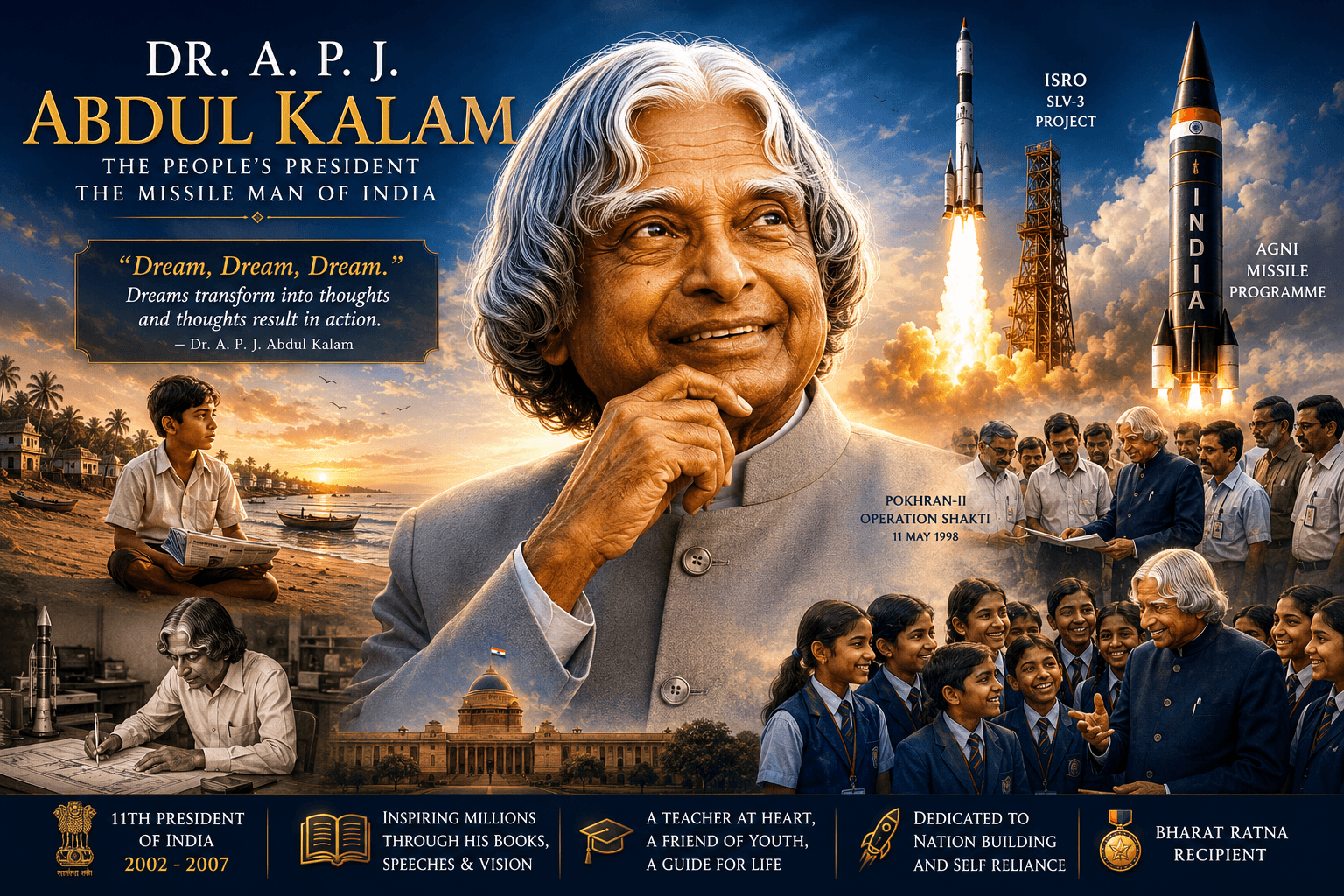
APJ Abdul Kalam Biography is the inspiring story of India’s Missile Man and the 11th President of India.Popularly known as the “Missile Man of India,” he played a crucial role in strengthening the country’s missile and space programmes through his outstanding contributions to DRDO and ISRO.
Born into a humble family in Rameswaram, Tamil Nadu, Kalam’s inspiring journey from selling newspapers as a young boy to becoming the President of India is a powerful example of hard work, determination, and lifelong learning. His leadership in projects such as the SLV-3 satellite launch vehicle, the Integrated Guided Missile Development Programme, and Pokhran-II made him one of India’s greatest scientific icons.
Beyond science and politics, Dr. Kalam dedicated his life to inspiring students and encouraging young people to dream big. His speeches, books, and vision for a developed India continue to motivate millions around the world. Even after his passing on 27 July 2015, his legacy lives on through his ideas, achievements, and unwavering commitment to the nation.
Quick Facts
Full Name: Avul Pakir Jainulabdeen Abdul Kalam
Popularly Known As: Missile Man of India
Date of Birth: 15 October 1931
Birthplace: Rameswaram, Tamil Nadu, India
Parents: Jainulabdeen Marakayar and Ashiamma
Education: St. Joseph’s College, Tiruchirappalli; Madras Institute of Technology
Profession: Aerospace Scientist, Author, President of India
Organizations: DRDO, ISRO
President of India: 2002–2007
Awards: Bharat Ratna, Padma Vibhushan, Padma Bhushan
Date of Death: 27 July 2015
Place of Death: Shillong, Meghalaya, India
APJ Abdul Kalam Biography: Early Life Childhood & Family
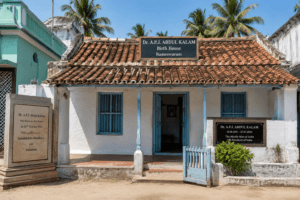
Dr. A.P.J. Abdul Kalam was born on 15 October 1931 in Rameswaram, Tamil Nadu, into a humble Tamil Muslim family. His father, Jainulabdeen Marakayar, was a boat owner and imam at the local mosque, while his mother, Ashiamma, was a caring homemaker known for her generosity.
Although the family had limited financial resources, they valued honesty, discipline, education, and hard work. To support his family, young Kalam distributed newspapers before and after school. These early experiences taught him responsibility, perseverance, and self-confidence.
Growing up in the peaceful town of Rameswaram, surrounded by people of different religions and cultures, Kalam developed deep respect for unity, compassion, and national service. His childhood played a vital role in shaping the values that later made him one of India’s most admired scientists and leaders.
🎓 Education and Academic Journey
Dr. A.P.J. Abdul Kalam believed that education was the foundation of success. Despite growing up in a humble family in Rameswaram, Tamil Nadu, he remained dedicated to learning from an early age. His determination, hard work, and passion for science helped him overcome financial challenges and achieve academic excellence.
Kalam completed his schooling at Schwartz Higher Secondary School in Ramanathapuram. He later earned a Bachelor of Science (B.Sc.) in Physics from St. Joseph’s College, Tiruchirappalli, in 1954. Although he enjoyed physics, he realized that his true passion was engineering and aerospace technology.
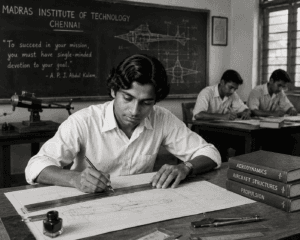
To follow his dream, he joined the Madras Institute of Technology (MIT), Chennai, where he studied Aeronautical Engineering. During his time at MIT, he worked on aircraft design projects and impressed his professors with his dedication and technical skills. These experiences laid the foundation for his future career in India’s space and defence programmes.
After completing his engineering degree in 1960, Dr. Kalam began his professional journey at the Defence Research and Development Organisation (DRDO), marking the beginning of an extraordinary career that would transform India’s scientific and technological landscape.
Key Educational Milestones
School: Schwartz Higher Secondary School, Ramanathapuram
B.Sc. Physics: St. Joseph’s College, Tiruchirappalli (1954)
Aeronautical Engineering: Madras Institute of Technology (MIT), Chennai (1960)
“Education gives you wings to fly. Dreams become reality only through knowledge, discipline, and hard work.” – Dr. A.P.J. Abdul Kalam
🚀 Joining ISRO and India’s Space Programme
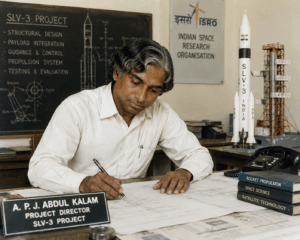
After joining the Defence Research and Development Organisation (DRDO), Dr. A.P.J. Abdul Kalam moved to the Indian Space Research Organisation (ISRO) in 1969. His career reached a new milestone when he became the Project Director of the Satellite Launch Vehicle-3 (SLV-3) programme.
Under his leadership, India successfully launched the Rohini satellite into orbit on 18 July 1980 using the indigenously developed SLV-3 launch vehicle. This historic achievement made India one of the few countries capable of launching satellites with its own technology.
Dr. Kalam’s dedication, leadership, and innovative thinking helped strengthen India’s space programme and inspired countless young scientists across the country.
Key Achievements
✅Joined ISRO in 1969
✅Project Director of SLV-3
✅Successfully launched Rohini Satellite (18 July 1980)
✅Helped India achieve indigenous satellite launch capability
✅Strengthened India’s space technology and research
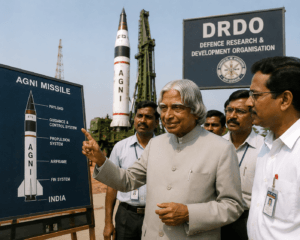
🛡️ DRDO and the Agni Missile Programme
After achieving success at ISRO, Dr. A.P.J. Abdul Kalam returned to the Defence Research and Development Organisation (DRDO) in 1982. He became the chief architect of India’s Integrated Guided Missile Development Programme (IGMDP), a landmark initiative that strengthened the nation’s defence capabilities.
Under his leadership, India successfully developed several indigenous missile systems, including Agni, Prithvi, Akash, Trishul, and Nag. These achievements earned him the title “Missile Man of India.”
Dr. Kalam believed that a strong and self-reliant defence system was essential for national security. His vision, leadership, and dedication transformed India’s missile technology and inspired future generations of scientists.
Key Achievements
➡️Returned to DRDO in 1982
➡️Led the Integrated Guided Missile Development Programme (IGMDP)
➡️Played a major role in developing Agni, Prithvi, Akash, Trishul, and Nag missiles
➡️Earned the title “Missile Man of India”
➡️Strengthened India’s indigenous defence technology
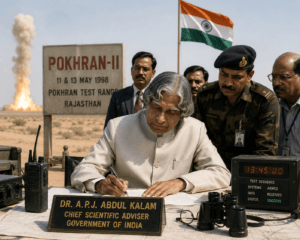
☢️ Pokhran-II Nuclear Tests
In May 1998, India successfully conducted the Pokhran-II nuclear tests in the Pokhran Test Range, Rajasthan. Dr. A.P.J. Abdul Kalam, serving as the Chief Scientific Adviser to the Government of India, worked closely with scientists and defence experts to ensure the success of this historic mission.
The operation was carried out with exceptional secrecy and precision. The successful nuclear tests demonstrated India’s advanced scientific capabilities and strengthened the nation’s strategic defence. Dr. Kalam’s leadership, technical expertise, and dedication made him one of the key figures behind this milestone in Indian history.
Following the success of Pokhran-II, Dr. Kalam earned widespread respect both in India and internationally. His contributions further established him as one of India’s greatest scientists and national leaders.
Key Highlights
📅 Conducted in May 1998
📍 Location: Pokhran Test Range, Rajasthan
👨🔬 Chief Scientific Adviser to the Government of India
🇮🇳 Played a key role in the success of Pokhran-II
🛡️ Strengthened India’s strategic defence capabilities
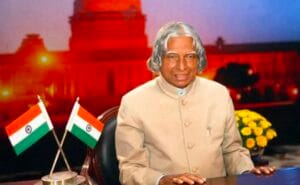
🇮🇳 President of India
Dr. A.P.J. Abdul Kalam was elected as the 11th President of India in 2002. During his five-year tenure, he earned immense respect and affection from people across the country because of his simplicity, humility, and dedication to public service.
Unlike many leaders, Dr. Kalam regularly interacted with students, encouraging them to dream big, work hard, and contribute to the nation’s development. His inspiring speeches and vision for “Developed India 2020” motivated millions of young people to pursue education, innovation, and scientific excellence.
Although he held the nation’s highest constitutional office, Dr. Kalam remained humble and approachable throughout his presidency. His leadership style made him one of the most beloved Presidents in Indian history.
Key Highlights
➡️ 🇮🇳 11th President of India
➡️ 📅 Served from 2002 to 2007
➡️ ❤️ Popularly known as the People’s President
➡️ 🎓 Inspired millions of students across India
➡️ 🌍 Promoted Vision 2020 for a developed India
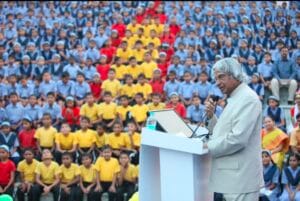
👨🏫 Inspiring Students and Young Minds
After completing his term as President, Dr. A.P.J. Abdul Kalam devoted most of his time to interacting with students across India. He visited schools, colleges, universities, and educational institutions, sharing his vision for a developed and self-reliant India.
He encouraged every student to dream big, work hard, and never give up. His speeches focused on innovation, science, technology, leadership, and moral values. Dr. Kalam believed that education was the most powerful tool to transform society and build a stronger nation.
His famous quote, “Dream, dream, dream. Dreams transform into thoughts and thoughts result in action,” continues to inspire millions of young people worldwide.
Key Highlights
✅ 🎓 Visited thousands of schools and colleges
✅ 🌍 Inspired millions of students worldwide
✅ 📚 Promoted education, innovation, and scientific thinking
✅ 💡 Encouraged youth to dream big and serve the nation
✅ ❤️ Remembered as India’s greatest teacher and mentor

📚 Books Written by Dr. A.P.J. Abdul Kalam
Apart from being a distinguished scientist and the 11th President of India, Dr. A.P.J. Abdul Kalam was also a renowned author. Through his books, he shared his life experiences, scientific vision, leadership principles, and dreams for India’s future.
His writings encourage readers to believe in themselves, pursue knowledge, and contribute to society with honesty and dedication. Many of his books have become bestsellers and are widely read by students, educators, professionals, and civil service aspirants.
Popular Books by Dr. A.P.J. Abdul Kalam
📘 Wings of Fire – His inspiring autobiography.
📗 Ignited Minds – A vision for empowering India’s youth.
📙 India 2020 – A roadmap for transforming India into a developed nation.
📕 My Journey – Personal stories and life lessons.
📓 Turning Points – Experiences from his presidency and public life.
These books continue to inspire millions of people to dream big, work hard, and build a better future.
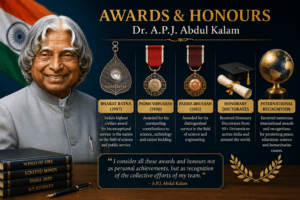
🏅 Awards & Honours
Dr. A.P.J. Abdul Kalam’s extraordinary contributions to science, technology, education, national security, and public service earned him numerous prestigious awards and honours throughout his lifetime. His achievements were recognized not only by the Government of India but also by universities, scientific organizations, and institutions across the world.
His dedication to the nation’s development, leadership in India’s missile and space programmes, and commitment to inspiring young minds made him one of the most respected personalities in modern Indian history. These honours reflect the immense respect he received for his vision, humility, and lifelong service to humanity.
🇮🇳 Bharat Ratna (1997)
The Bharat Ratna, India’s highest civilian award, was conferred on Dr. A.P.J. Abdul Kalam in 1997 for his exceptional contributions to science, engineering, defence technology, and nation-building. Receiving this prestigious honour before becoming President highlighted his remarkable impact on India’s scientific and technological progress.
🥈 Padma Vibhushan (1990)
In 1990, Dr. Kalam received the Padma Vibhushan, India’s second-highest civilian award. This honour recognized his outstanding leadership in defence research, missile development, and strategic scientific programmes that significantly strengthened India’s national security.
🥉 Padma Bhushan (1981)
Dr. Kalam was awarded the Padma Bhushan in 1981 for his significant contributions to aerospace engineering, space research, and missile technology. His work with ISRO and DRDO established him as one of India’s leading scientists.
🎓 Honorary Doctorates
More than 40 universities in India and around the world awarded Dr. Kalam Honorary Doctorate (Doctor of Science) degrees. These honours recognized his outstanding achievements in science, innovation, education, leadership, and humanitarian service.
🌍 International Recognition
Dr. Kalam’s influence extended far beyond India. He received numerous international awards and recognitions for promoting science, education, peace, and global cooperation. His speeches and books continue to inspire students, scientists, and leaders worldwide.
Several institutions, scholarships, innovation centres, and educational programmes have also been named in his honour, ensuring that his legacy continues to inspire future generations.
Conclusion
Dr. A.P.J. Abdul Kalam’s awards and honours represent much more than personal achievements—they symbolize his lifelong commitment to science, education, innovation, and nation-building. Despite receiving the country’s highest honours, he remained humble, approachable, and dedicated to inspiring young people. His remarkable legacy continues to motivate millions around the world to dream big, work hard, and serve society with integrity.
💔 Death & Final Journey
On 27 July 2015, Dr. A.P.J. Abdul Kalam travelled to the Indian Institute of Management (IIM) Shillong to deliver a lecture on “Creating a Livable Planet Earth.” While addressing the students, he suddenly collapsed due to a cardiac arrest.
He was immediately taken to Bethany Hospital in Shillong, where doctors declared him dead. His passing deeply saddened the entire nation, and millions of people paid tribute to the beloved scientist, teacher, and former President.
The Government of India accorded him a full state funeral. His mortal remains were taken to Rameswaram, Tamil Nadu, where he was laid to rest with full military honours. Leaders, scientists, students, and citizens from across the country gathered to pay their final respects.
Even in his final moments, Dr. Kalam was doing what he loved most—inspiring young minds through education and knowledge.
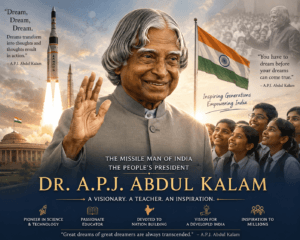
🌍 APJ Abdul Kalam Biography Legacy
Dr. A.P.J. Abdul Kalam’s legacy extends far beyond his achievements in science, technology, and public service. He is remembered as a visionary leader, an inspiring teacher, and a humble human being who dedicated his life to the progress of India. His contributions to the nation’s space programme, missile development, education, and innovation continue to influence generations of scientists, students, and leaders.
Popularly known as the “People’s President,” Dr. Kalam believed that the youth of India held the key to the country’s future. Through his books, speeches, and interactions with students, he inspired millions to dream big, work hard, and contribute to society with honesty and determination.
His vision of transforming India into a developed nation continues to motivate young minds across the world. Schools, universities, research institutions, scholarships, and innovation centres proudly carry his name, ensuring that his ideals and values live on.
Even today, Dr. A.P.J. Abdul Kalam remains a timeless symbol of knowledge, humility, patriotism, and service to humanity. His life teaches us that with dedication, perseverance, and a strong vision, anyone can achieve greatness and make a lasting impact on society.
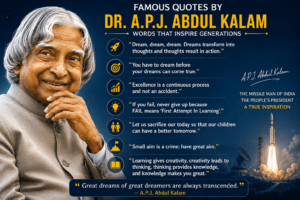
💬 Famous Quotes by Dr. A.P.J. Abdul Kalam
Dr. A.P.J. Abdul Kalam’s words continue to inspire millions of people around the world. His quotes encourage us to dream big, work hard, embrace knowledge, and serve society with dedication. These timeless messages remain a guiding light for students, professionals, entrepreneurs, and future leaders.
Inspirational Quotes
“Dream, dream, dream. Dreams transform into thoughts and thoughts result in action.”
“You have to dream before your dreams can come true.”
“Excellence is a continuous process and not an accident.”
“If you fail, never give up because FAIL means ‘First Attempt In Learning’.”
“Let us sacrifice our today so that our children can have a better tomorrow.”
“Small aim is a crime; have great aim.”
“Learning gives creativity, creativity leads to thinking, thinking provides knowledge, and knowledge makes you great.”
Final Message
Dr. A.P.J. Abdul Kalam’s thoughts continue to inspire generations to dream fearlessly, work with determination, and contribute towards building a better India and a better world.
📝APJ Abdul Kalam Biography Conclusion
Dr. A.P.J. Abdul Kalam’s life is a remarkable example of dedication, perseverance, humility, and service to the nation. From his humble beginnings in Rameswaram to becoming India’s Missile Man and the 11th President of India, his journey continues to inspire millions across the world.
Through his pioneering contributions to ISRO, DRDO, the Agni Missile Programme, and the Pokhran-II nuclear tests, Dr. Kalam played a vital role in strengthening India’s scientific and technological capabilities. Beyond his achievements in science and public service, he devoted his life to inspiring students, promoting education, and encouraging young people to dream big and work hard for a better future.
His books, speeches, and timeless words of wisdom continue to motivate generations to pursue knowledge, innovation, and excellence. Dr. Kalam’s vision of a developed India, his unwavering commitment to education, and his love for the youth remain an enduring source of inspiration.
Although Dr. A.P.J. Abdul Kalam passed away on 27 July 2015, his legacy lives on in the hearts of millions. He will always be remembered as a visionary scientist, an inspiring teacher, a humble leader, and one of India’s greatest sons.
“Dream, dream, dream. Dreams transform into thoughts and thoughts result in action.” – Dr. A.P.J. Abdul Kalam
👉 Also Read: Ratan Tata Biography: Life, Education, Career & Legacy
👉 Also Read: Ratan Tata Biography
👉 Read Next: Ratan Tata Biography – Life, Education, Career & Legacy
📖 Sources & References
The information in this article has been compiled from trusted and publicly available sources, including official government websites, scientific organizations, biographies, and published books.
Official Sources
President of India – https://presidentofindia.nic.in�
DRDO – https://www.drdo.gov.inhttps://www.drdo.gov.in�
ISRO – https://www.isro.gov.inhttps://www.isro.gov.in�
Bharat Ratna Awards – https://awards.gov.in�
Reference Books
✅ Wings of Fire – Dr. A.P.J. Abdul Kalam
✅ Ignited Minds
✅ India 2020
✅ My Journey
✅ Turning Points
✅ Image Credits
Historical photographs sourced from publicly available archival and educational references where applicable.
📢 Share Your Thoughts
We hope this biography of Dr. A.P.J. Abdul Kalam inspired you to dream big, work hard, and contribute positively to society.
If you found this article informative, please share it with your friends and family. Feel free to leave your thoughts or favorite quote by Dr. Kalam in the comments below.
👉 Explore more inspiring biographies, technology articles, and educational content on DealKart Market.
Thank you for reading!