
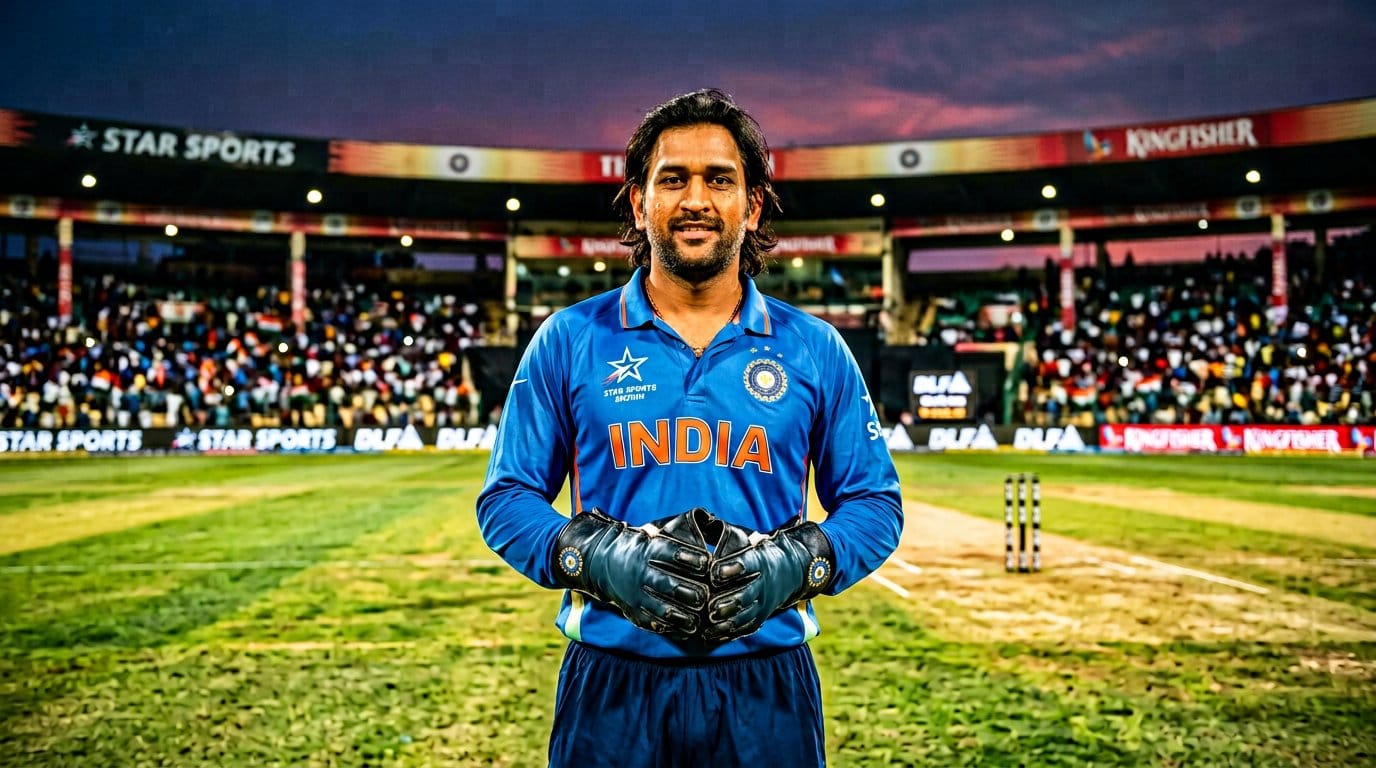
Ms dhoni biography
In 2001, a lanky teenager in a railway uniform stood on the platform at Kharagpur, punching tickets on the night trains to Kolkata. Government job, fixed salary, pension at the end of it — by the standards of a middle-class household in small-town India, that was the entire dream. Cricket, at that point, was just something he played on Sundays with a tennis ball.
MS Dhoni at a Glance — Quick Info Table
| Field | Details |
|---|---|
| Full name | Mahendra Singh Dhoni |
| Born | 7 July 1981 (age 45) |
| Birthplace | Ranchi, Bihar (now Jharkhand) |
| Nicknames | Mahi, Captain Cool, Thala |
| Role | Wicketkeeper-batter, former India captain |
| Batting / bowling | Right-hand bat / right-arm medium |
| ODI debut | 23 December 2004 vs Bangladesh, Chittagong |
| Test debut | 2 December 2005 vs Sri Lanka, Chennai |
| T20I debut | 1 December 2006 vs South Africa, Johannesburg |
| International career | 2004 – 2020 |
| Matches, all formats | 538 (90 Tests, 350 ODIs, 98 T20Is) |
| Runs, all formats | 17,266 |
| Captaincy record | 332 international matches, 178 wins |
| ICC trophies as captain | 3 — T20 WC 2007, ODI WC 2011, Champions Trophy 2013 |
| IPL team | Chennai Super Kings (2008–2015, 2018–present) |
| IPL titles as captain | 5 (2010, 2011, 2018, 2021, 2023) |
| Wife | Sakshi Singh Dhoni (married 4 July 2010) |
| Daughter | Ziva Singh Dhoni (born 6 February 2015) |
| Major awards | Rajiv Gandhi Khel Ratna 2007–08, Padma Shri 2009, Padma Bhushan 2018 |
| Net worth | Estimates vary — roughly ₹250 crore to ₹1,000+ crore |
From Ranchi Streets to Railway Uniforms
Dhoni grew up in the Shyamali neighbourhood of Ranchi, a city that back then sat in Bihar and had zero history of producing international cricketers. His father, Pan Singh, worked with MECON; his mother, Devki Devi, ran the house. Nobody in the family had touched a serious cricket bat.
The boy, however, was mad about sport. He kept goal for his school football team — that’s where the reflexes come from, if you ask anyone who watched him then — and played badminton well enough to be picked for district trials. Cricket entered the picture almost by accident, through tennis-ball matches on the open grounds of Ranchi.
Here’s the part most people don’t know. The famous helicopter shot wasn’t designed in any academy. It was born on dusty tennis-ball wickets where bowlers sprayed the ball around, and a teenager figured out that a strong bottom-hand swing could clear the streetlights. Years later, the same swing would clear the Wankhede boundary.
School ended, college at St. Xavier’s came and went, and the options in front of him were ordinary ones. In 2001, he took a job as a travelling ticket examiner at Kharagpur railway station in West Bengal — a transferable, unglamorous government post.
He’d finish night shifts, catch a couple of hours of sleep, and head to the grounds to play for the Railways team. His colleagues remember a quiet boy who never complained about the uniform or the hours. They also remember that he batted like someone who had a plane to catch.
There’s a photo of him from those years that still does the rounds on social media — a thin young man with a moustache, standing in that railway uniform. Every time I see it, I think about how almost everyone who met him then saw cricket as a detour, not the destination. Including, possibly, himself.
The Debut Nobody Remembers
The break came in 2004, and it came through the back door. Dhoni was picked for the India A tour of Kenya, where he clubbed a century and, more importantly, caught the eye of the national selectors with his sheer audacity. Nobody had seen an Indian keeper bat like that.
The senior call-up followed fast. On 23 December 2004, at Chittagong against Bangladesh, he walked out for his ODI debut and was run out for a duck.
Try to sit with that for a second. The greatest finisher Indian cricket has ever produced — run out without scoring on his very first day. If someone had written that script, no studio would have bought it.
What happened next is the part people forget. The team management didn’t bench him. Instead, they told him to stop curbing his instincts, and the dam broke. In the second ODI against Pakistan at Visakhapatnam on 5 April 2005 — his fifth international innings — he smashed 148 off just 123 balls. The helicopter shot, that weird bottom-handed whip, arrived in front of a stunned national audience.
Then came Jaipur, 31 October 2005. Chasing 299 against Sri Lanka, he produced an unbeaten 183 off 145 deliveries — still the highest score by a wicketkeeper in ODI history, close to two decades later. That knock didn’t just win the match; it gave Indian cricket its first real finisher since Kapil Dev.
The Test debut had come a month earlier, on 2 December 2005 against Sri Lanka in Chennai. His first Test hundred followed in January 2006 — 148 against Pakistan at Faisalabad, on a pitch doing plenty, when the series was on the line.
Looking back, 2005 was the hinge. In twelve months he went from a railway employee who happened to play cricket to the most exciting wicketkeeper-batter on the planet.
The Captaincy Gamble of 2007
The 2007 ODI World Cup in the West Indies was a disaster for India — out in the group stage, players fighting with the coach, the whole system in chaos. In that wreckage, the selectors did something strange. For the inaugural T20 World Cup in South Africa, they handed the captaincy to a 26-year-old who had never led India before.
That gamble was Dhoni.
He walked into a squad of rookies — Rohit Sharma, Joginder Sharma, a teenage Virat Kohli — and basically told them to play like they had nothing to lose. Which they didn’t. What followed was a blur of impossible matches: the bowl-out against Pakistan in the group stage, the semi-final where Yuvraj Singh hit six sixes in an over off Stuart Broad.
And then the final. Johannesburg, 24 September 2007, India vs Pakistan, and the game down to the last over with Pakistan needing 13.
Here’s the moment that tells you everything about the man. With Misbah-ul-Haq well set and the stadium screaming, Dhoni tossed the ball to Joginder Sharma — a bowler who’d been carted around all evening — and told him to bowl the slower one. Misbah scooped it to short fine leg. Sreesanth held the catch.
India had won a World Cup. And a new, eerily calm captain had announced himself. I remember watching that final as a kid and being confused about why the Indian captain looked so bored while everyone else lost their minds. It would take me years to understand that the boredom was the superpower.
World Cup Glory on Home Soil: 2011
Between 2007 and 2011, Dhoni built a team. He backed misfits like Gautam Gambhir and Virat Kohli before they were stars, defended bowlers after bad spells, and absorbed losses so his players didn’t have to. In December 2009, India reached the No. 1 ranking in Test cricket for the first time in their history — under his captaincy.
But the real prize was the one at home. The 2011 World Cup, in India, 28 years after Kapil’s miracle at Lord’s.
The final on 2 April 2011 at the Wankhede is now part of Indian folklore, so let me just hit the notes that matter. Chasing 275, India were wobbling at 114 for 3. Gambhir was rebuilding with Kohli, and everyone expected Yuvraj — the tournament’s player of the tournament — to walk in next.
Dhoni sent himself in at No. 5 instead. A captain promoting himself ahead of the tournament’s best player, in a World Cup final, at home, with the whole country watching. If that goes wrong, it’s the end of him.
It went right. He took his time against Muttiah Muralitharan, milked the spinners, and then, with 4 needed off 11 balls, launched Nuwan Kulasekara into the stands. The six that ended the final. The longest six of his life, maybe, given what it meant.
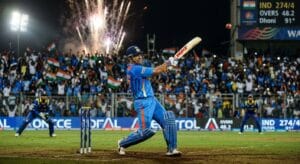
India’s first World Cup win on home soil. And the only men’s World Cup final in history to end with a six.
Ask anyone in Chennai, Mumbai, or Ranchi where they were that night and you’ll get a story. That’s what he gave the country — not just a trophy, but a memory everyone got to own.
The Only Captain With All Three ICC Trophies
Two years later, in June 2013, came the set-completion. The Champions Trophy final at Edgbaston against England, a rain-truncated 20-over chase, India defending 129. England needed 19 off the last two overs with power hitters at the crease.
Ishant Sharma turned the match in the 18th over, taking two wickets in consecutive balls, and then Ashwin held his nerve in the final over as India won by five runs. Dhoni, as ever, stood behind the stumps and let the bowlers own the moment.
That trophy made him the only captain in cricket history to win all three ICC white-ball events — the 2007 T20 World Cup, the 2011 ODI World Cup, and the 2013 Champions Trophy. Nobody else has done it. Not Clive Lloyd, not Ricky Ponting, not anyone.
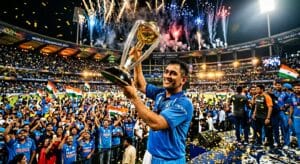
He also captained India in a record 332 international matches — the most by any captain in the history of the sport — and won 178 of them. Those numbers alone would be enough for any hall of fame.
Test Farewell at the MCG
Then came the one that broke everyone’s heart. On 30 December 2014, after the Boxing Day Test at the Melbourne Cricket Ground, in the middle of a series in Australia, Dhoni announced his retirement from Test cricket. No press conference. A simple statement released to the board.
The timing was pure Dhoni — an ambush, delivered politely. He’d been under pressure about India’s overseas record, yes. But he left at 33, still averaging 38, still keeping superbly, on his own terms.
His Test numbers deserve respect: 4,876 runs in 90 matches, six hundreds, a highest score of 224 against Australia at Chennai in 2013 — still the highest Test score by an Indian wicketkeeper — and 256 catches plus 38 stumpings behind the stumps.
Virat Kohli took over at Sydney in the next Test and scored a century there. Somewhere in that handover, the changing of the guard felt almost designed. Dhoni had a habit of leaving at the exact moment the team no longer needed him to stay.
Dhoni’s IPL Empire at CSK
If international cricket made Dhoni a legend, the IPL made him a religion. He joined Chennai Super Kings at the league’s birth in 2008 and captained the franchise through every one of its five titles — the longest-serving captain the league has known.
The numbers are staggering for a T20 league. Ten finals. Five titles — 2010, 2011, 2018, 2021, 2023 — including the two-year ban in 2016–17 that saw CSK exiled, only for them to return and win the title in their comeback season. No captain has led his team to more IPL finals, and his five trophies are the joint-most in the league alongside Rohit Sharma.
Chepauk, CSK’s home ground, treats him like royalty — they call him Thala, which means “boss” in Tamil. When he walks out, 40,000 people lose their minds. When he bats, even at 44, the stadium holds its breath.
He stepped down as captain before IPL 2024, handing over to Ruturaj Gaikwad, though he ended up leading the side again in 2025 after Gaikwad fractured his elbow mid-season. That year was rough — CSK finished last with four wins — and Dhoni managed 196 runs in 13 innings, though his strike rate of 135.17 was actually right around his career norm.
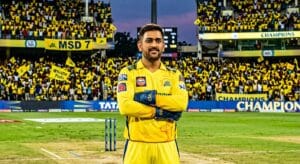
Injury has shadowed 2026. A calf problem that kept resurfacing — and then a thumb injury on top of it — ruled him out of the entire season. Chennai’s CEO confirmed in February that Dhoni would play in 2026 — “He will play, he will play” — but the matches came and went without him. Reports say he told Gaikwad to run the team entirely his own way, a statement that reads like a man preparing his exit. As of August 2026, no retirement announcement has been made. His return, if it happens, might come in IPL 2027 for a farewell at Chepauk.
The franchise has clearly started planning for after him — they traded in Sanju Samson ahead of the 2026 auction and invested heavily in uncapped wicketkeeping options. The empire, it seems, is quietly arranging its own succession.
The Last Dance: 2019–2020
His final years in blue were bittersweet. The 2019 World Cup ended in the semi-final at Manchester against New Zealand — India needed 25 off the last 10 balls, and Dhoni, on 50, was run out by a Martin Guptill direct hit.
That run-out still haunts Indian cricket. For a year afterward, every second of that chase was replayed, re-litigated, and mourned. But here’s the thing nobody says out loud: he kept India in that chase for so long that the country genuinely believed he’d pull it off. At 38. With a team full of younger stars.
On 15 August 2020, Independence Day, he announced his retirement from international cricket with a simple Instagram post — a photograph and a small caption thanking fans. No drama. No farewell tour. He’d retired from Tests in 2014, and now the white-ball chapter closed the same quiet way.
He finished with 17,266 international runs, 16 centuries, 634 catches, and a world-record 195 stumpings — the most by any wicketkeeper the game has ever seen.
Life After International Cricket
Retirement didn’t mean disappearing. Dhoni stayed in the public eye, but on his own schedule.
The farm in Ranchi got more of his time — he genuinely enjoys being there, driving tractors, checking on the land. He’s said more than once that the farm is where his head clears. His motorcycle collection is famous; so is his ability to vanish from the news cycle for weeks at a time.
There’s a lesser-known side too. He’s an honorary Lieutenant Colonel in the Indian Army, and in 2015 he did an actual parachute jump with the Parachute Regiment — a celebrity doing a photo op, sure, but also a 34-year-old jumping out of a plane with commandos.
In 2025, he added a completely unexpected line to his CV: DGCA-certified Remote Pilot. He completed the training with Chennai-based Garuda Aerospace, the company he endorses, becoming one of the few international sports icons holding a Remote Pilot licence. The instructors posted about it; the internet did what the internet does.
Business-wise, his portfolio includes sportswear (Seven), athlete management (Rhiti Sports), a production company run with his wife Sakshi, and endorsements too numerous to count. Net worth estimates swing wildly depending on the source — anywhere from roughly ₹250 crore to past ₹1,000 crore when you count business stakes. Take those figures with salt; nobody outside his circle knows the real number.
Career Statistics at a Glance
| Format | Matches | Runs | Highest | Average | 100s / 50s | Sixes | Catches / Stumpings |
|---|---|---|---|---|---|---|---|
| Tests | 90 | 4,876 | 224 | 38.09 | 6 / 33 | 78 | 256 / 38 |
| ODIs | 350 | 10,773 | 183* | 50.57 | 10 / 73 | 229 | 321 / 123 |
| T20Is | 98 | 1,617 | 56 | 37.60 | 0 / 2 | 52 | 57 / 34 |
| All formats | 538 | 17,266 | 224 | 44.96 | 16 / 108 | 359 | 634 / 195 |
And his captaincy record, the one that defines him:
| Format | Matches as captain | Wins |
|---|---|---|
| Tests | 60 | 27 |
| ODIs | 200 | 110 |
| T20Is | 72 | 41 |
| Total | 332 | 178 |
He also led India in a record 200 ODIs as captain — more than any Indian before or since.
Dhoni vs Other Indian Captains
| Captain | ICC trophies as captain | Details |
|---|---|---|
| MS Dhoni | 3 | T20 WC 2007, ODI WC 2011, Champions Trophy 2013 |
| Rohit Sharma | 2 | T20 WC 2024, Champions Trophy 2025* |
| Kapil Dev | 1 | ODI World Cup 1983 |
| Sourav Ganguly | 0 | Two WC finals as captain, no trophy |
| Rahul Dravid | 0 | Reached the 2023 WC final, lost |
| Virat Kohli | 0 | No senior ICC trophy across his captaincy |
That single column tells the story. One man, three trophies, and a gap that every other captain in Indian history has spent decades trying to close.
*Champions Trophy 2025 refers to the tournament held in 2025 (as of this biography’s publication date, August 2026).
10 Unknown Facts About MS Dhoni
- He was a football goalkeeper first. His reflexes behind the stumps came from keeping goal for his school team — he only took up wicketkeeping so he’d get picked for the cricket XI.
- He worked as a TTE at Kharagpur railway station from 2001 to 2003. He often played for the Railways team straight after night shifts.
- His ODI debut was a duck — run out. On 23 December 2004 against Bangladesh, he was run out for zero in his first international innings.
- The helicopter shot was born on tennis-ball grounds in Ranchi, not in any coaching academy. It was a street-cricket solution that became a trademark.
- His 195 international stumpings are a world record — the most by any wicketkeeper in cricket history.
- He’s the only captain ever to win all three ICC white-ball trophies. No one else in world cricket has completed the set.
- His 224 against Australia at Chennai (2013) is still the highest Test score by an Indian wicketkeeper.
- He’s an honorary Lieutenant Colonel in the Indian Army and completed a real parachute jump with the Parachute Regiment in 2015.
- He became a DGCA-certified Remote Pilot (drone pilot) in 2025 through Garuda Aerospace — a hobby he turned into a formal licence at 44.
- After the 2011 World Cup win, he skipped the big-city celebrations and headed back to Ranchi, spending the night quietly with family. He’s never liked the circus around his own life.
Did You Know?
The 2011 World Cup final is the only men’s ODI World Cup final in history to end with a six — Dhoni’s winning hit off Nuwan Kulasekara.
Also worth a double take: he averaged 50.57 in ODIs across 10,773 runs. No full-time wicketkeeper with 10,000 ODI runs has ever averaged higher.
What We Can Learn From MS Dhoni
Patience is a strategy, not a virtue. He spent years punching railway tickets before his first India cap. The delay didn’t waste him; it built him. Most people quit months before their breakthrough because they’ve been told they’re late.
Pressure is a habit you train. The “Captain Cool” face wasn’t magic. It came from routines, from deliberately slowing his breathing, from deciding that panic was a choice. You can practice calm the way you practice a cover drive.
Put the scoreboard before your own numbers. He batted at six and seven for years, finishing chases instead of building centuries. He has 16 international hundreds — modest for his talent, enormous for his role. He chose team over stats on purpose.
Reinvent or rust. The 2004 dasher became the 2011 match-winner, then the 2020 mentor, then a 44-year-old IPL finisher. Every phase of his career, he changed his game before the game changed him.
Know when to leave. Test retirement mid-series at 33. International retirement on his own date. Handing CSK’s captaincy to Gaikwad before he had to. Leaving early on your own terms beats leaving late on someone else’s.
Small roots keep you real. The Ranchi farm, the motorcycles, the refusal to perform celebrity for cameras — he never let the stage convince him he was the story. The cricket was the story.
Frequently Asked Questions
1. When did MS Dhoni retire from international cricket?
He retired from Tests on 30 December 2014, and from ODIs and T20Is on 15 August 2020. He hasn’t retired from the IPL as of August 2026.
2. Is MS Dhoni playing in IPL 2026?
Chennai’s CEO confirmed in February 2026 that he would play that season, but a calf injury that kept resurfacing — plus a thumb injury in May — kept him out of the entire campaign. No retirement announcement has been made.
3. How many ICC trophies did Dhoni win as captain?
Three: the 2007 T20 World Cup, the 2011 ODI World Cup, and the 2013 Champions Trophy. No other captain has won all three.
4. How many runs did Dhoni score in international cricket?
17,266 runs across 538 matches — 4,876 in Tests, 10,773 in ODIs, and 1,617 in T20Is.
5. What is MS Dhoni’s net worth?
Estimates vary widely, from roughly ₹250 crore to over ₹1,000 crore when his business stakes are included. Exact figures aren’t public.
6. Why is Dhoni called Captain Cool?
Because of his famously unreadable expression under pressure. He finished World Cup finals, last-over heists, and run chases without ever looking rattled.
7. Who is MS Dhoni’s wife and daughter?
His wife is Sakshi Singh Dhoni, married on 4 July 2010. Their daughter, Ziva, was born on 6 February 2015 and is often seen cheering from the stands at IPL matches.
8. How many IPL titles has Dhoni won with CSK?
Five — 2010, 2011, 2018, 2021, and 2023 — from ten finals, both records for a captain in the league.
9. What is the helicopter shot?
A short-arm pull Dhoni developed in tennis-ball cricket in Ranchi, using a powerful bottom-hand swing to hit full-length balls over midwicket. He made it famous against Pakistan in 2005.
10. What is Dhoni doing now?
Splitting time between his Ranchi farm, his businesses, his role as a mentor around CSK, and his newer pursuits — he became a DGCA-certified Remote Pilot (drone pilot) in 2025 through Garuda Aerospace.
Closing Thoughts: A Balanced Opinion
Let me be honest about both sides, because blind worship does no one any favours.
The criticism against Dhoni is real. India never won a Test series in Australia, England, or South Africa under him — his overseas record as Test captain is the one dent in the trophy cabinet. His finishing powers visibly declined in his final seasons. And the 2019 World Cup semi-final run-out will always carry a “what if” that no number of trophies can fully erase. Some fans also feel he milked the IPL farewell for years, keeping a spot that younger keepers could have used.
Now the other side. He is the only captain in cricket history with all three ICC white-ball trophies. He captained more international matches (332) than any captain in the history of the game. He holds the world record for stumpings. He won five IPL titles with a franchise that treats loyalty like a covenant. And he did all of it with a temperament that India had never seen in a leader — calm where others panicked, silent where others shouted, decisive where others hesitated.
The honest verdict: he wasn’t perfect, but he was unique. Indian cricket had great players before him and will have great players after him. It may never again have a leader who finished a World Cup with a six and then went home to his farm without a single press conference about it.
Whatever happens in IPL 2027 — a farewell at Chepauk or a quiet retirement notice on social media — the story is already complete. We’re just waiting for the final page, and so is he, probably.
He walked into a squad of rookies — Rohit Sharma, Joginder Sharma, a teenage Virat Kohli
More Biographies You’ll Love
- Rohit Sharma Biography 2026: Career, Records & Net Worth
- Virat Kohli Biography: Records, Career & Achievements
- Ajinkya Rahane: Cap 278, Signing Off
- Vaibhav Suryavanshi: The Bihar Boy Who Rewrote IPL History
Sources & References