
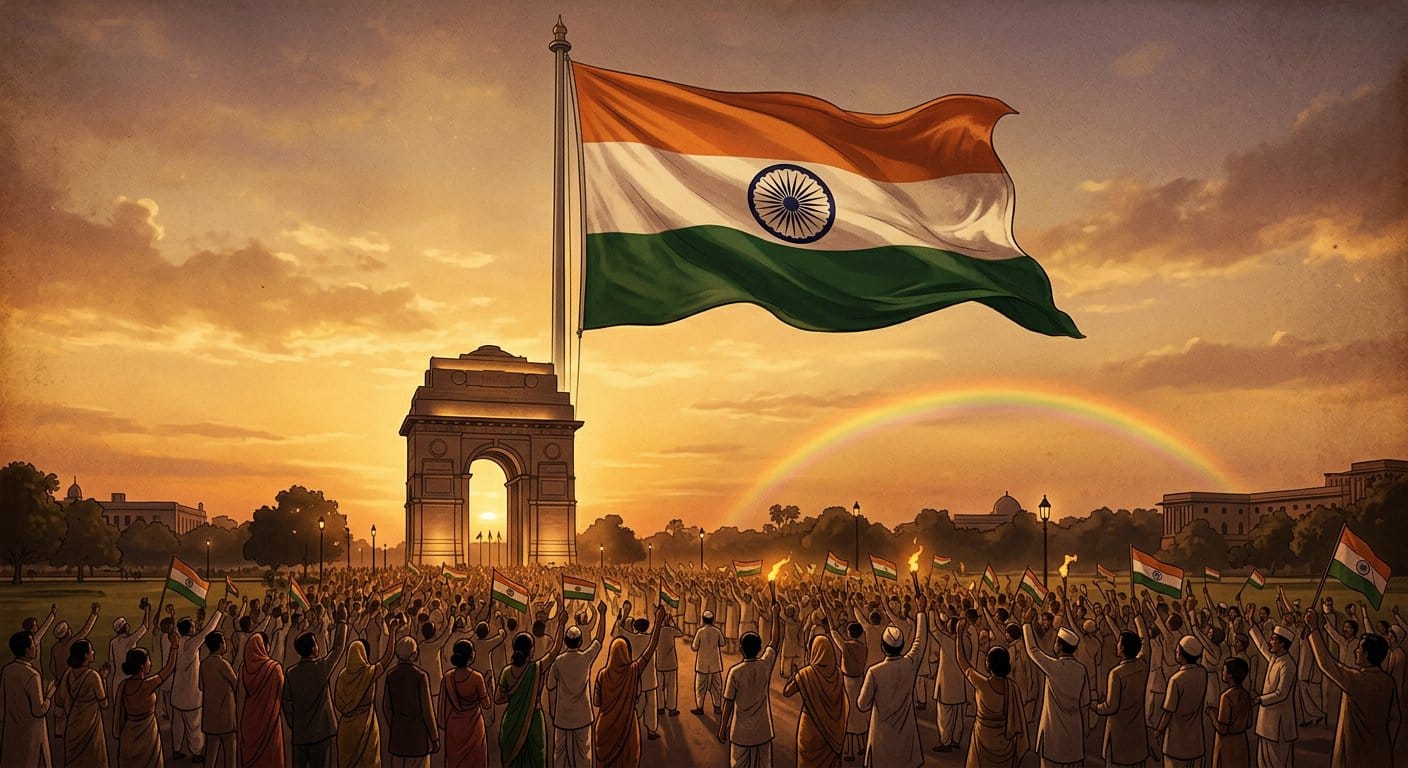
It’s the most replayed image of Indian freedom — a Prime Minister atop the ramparts of the Red Fort, the tricolor snapping in the Delhi wind, crores of citizens watching. There’s just one problem with that picture.
On 15 August 1947, that ceremony didn’t happen. Nehru didn’t raise the flag at the Red Fort on India’s first Independence Day — he did it the next morning, on 16 August. The real first Freedom Day unfolded through a midnight parliament session, a hurried swearing-in, and a dusty afternoon near India Gate where, according to witnesses, a rainbow appeared out of nowhere.
As India marks its 80th Independence Day today, it’s worth rewinding to the original — a day that was half celebration, half administrative scramble, and nothing like the polished telecast we get every year.
Digging through official records — Press Information Bureau accounts, Constituent Assembly records, newspaper reports from that week — turns up surprises even for people who think they know this story. Some of what we’re taught about 15 August 1947 is simply wrong.
Why 15 August? The Astrologers Said No
The date of India’s freedom wasn’t chosen by Indians at all. It was picked — rather abruptly — by the man sent to end British rule, Lord Louis Mountbatten, the last Viceroy.
His original deadline was June 1948. But with communal violence spreading and the Congress and the Muslim League refusing to agree on anything, Mountbatten decided the transfer of power couldn’t wait another year. Pressed during discussions about when exactly the British would leave, he reached for a date that meant something to him personally — 15 August, the second anniversary of Japan’s surrender in World War II, which he had overseen as Supreme Allied Commander in Southeast Asia.
Astrologers pushed back. Several considered 15 August 1947 inauspicious; the stars, they argued, were wrong for a nation’s birth. The fix was a very Indian compromise — the Constituent Assembly began its session at 11 pm on 14 August, so freedom would arrive in the gap between two dates, in the sacred window around midnight.
That’s why Nehru’s words were timed to land at that exact moment: “At the stroke of the midnight hour, when the world sleeps, India will awake to life and freedom.”
The journey to that midnight had begun ninety years earlier, with the revolt of 1857 — if you haven’t read how that night in Meerut changed everything, it’s worth a read before you continue.
The Midnight Hour: What Actually Happened in Parliament
Minutes before midnight on 14 August 1947, members of the Constituent Assembly rose to take a pledge. The room — today’s Central Hall of Parliament — was packed with leaders who had spent years in British jails.
Then Nehru delivered the speech history remembers as “Tryst with Destiny.” “Long years ago we made a tryst with destiny,” he began, “and now the time comes when we shall redeem our pledge — not wholly or in full measure, but very substantially.”
At midnight, the Indian Independence Act came into force. Two new dominions — India and Pakistan — legally came into being, and British India ceased to exist.
The flag moment deserves more attention than it usually gets. The new national flag was presented to the assembly by Hansa Mehta — a Gandhian and women’s rights activist — on behalf of the women of India, and it went up over the Council House (now Parliament Bhavan) as the clock struck twelve.
That flag was barely three weeks old. The Constituent Assembly had adopted the tricolor with the Ashoka Chakra only on 22 July 1947, replacing the spinning wheel that had sat at its centre until then.
Morning of the 15th: An Oath, a Flag and a Renamed Palace
The celebrations didn’t pause for sleep. On the morning of 15 August, Nehru was sworn in as independent India’s first Prime Minister, with his cabinet taking oaths alongside him. Mountbatten stayed on — not as Viceroy, but as independent India’s first Governor-General.
Yes, that means at the precise moment of freedom, the constitutional head of free India was still a British naval officer.
The Viceroy’s House was renamed Government House, and at 10:30 am the new tricolor went up over its central dome. A small ceremony compared to what followed, but symbolically enormous — a building designed to project imperial power now flew the flag of the republic-to-be.
One detail about that first cabinet that deserves a mention: it had exactly one woman. Rajkumari Amrit Kaur — a princess who gave up royalty for the freedom movement — took charge of the Health portfolio.
The Afternoon Ceremony Near India Gate — and the Rainbow
Here’s where the myth breaks.
Ask most Indians where Nehru hoisted the flag on the first Independence Day, and they’ll say the Red Fort. The Press Information Bureau’s own account says otherwise: the first public flag salutation ceremony happened on the afternoon of 15 August 1947 near the War Memorial Arch — the monument we call India Gate.
Nehru unfurled the tricolor at Princess Park, against a clear blue sky. Then, according to accounts from the day, something strange happened — a rainbow appeared on the horizon, carrying the same colours as the new flag. The assembled crowd reportedly fell silent, then erupted.
The Red Fort moment came the next morning. Nehru reached the fort at 8:30 am on 16 August 1947, raised the flag over the ramparts, and invoked Netaji Subhas Chandra Bose’s wartime cry of “Chalo Dilli” — Bose’s dream, he reminded everyone, had been to hoist the flag of freedom atop Delhi’s Red Fort.
Only from 15 August 1948 did the Red Fort ceremony become the annual tradition it is today. Every Independence Day broadcast you’ve ever watched, in other words, is a tradition born one day late and one monument away.
Where Was Gandhi? The Man Who Refused to Celebrate
The most striking absence that day belonged to the man most responsible for the freedom movement itself. Mahatma Gandhi wasn’t in Delhi. He was in Calcutta, in the Beliaghata neighbourhood, trying to stop Hindu-Muslim rioting with the only weapon he trusted — his own body.
While the capital lit up, Gandhi spent 15 August in prayer and fasting. No speeches, no flag, no celebration. He could not, he explained, rejoice a freedom that had arrived divided.
It’s a detail that reframes the whole day. The country’s biggest moment of joy was also one of its deepest wounds — Partition had just sliced through Punjab and Bengal, and the migrations and massacres were only beginning.
India on the Morning of Freedom: A Snapshot
Quick Info: The Nation at Midnight (15 August 1947)
| Detail | Figure |
|---|---|
| Moment of independence | Midnight between 14–15 August 1947 |
| First Prime Minister | Jawaharlal Nehru (sworn in 15 August 1947) |
| First Governor-General | Lord Mountbatten (first Indian GG only in June 1948) |
| National flag adopted | 22 July 1947 |
| Population | ~34 crore |
| Literacy rate | ~12% |
| Life expectancy | ~32 years |
| Gold price (10 g) | ₹88.62 |
| Petrol | 27 paise per litre |
| Delhi–Bombay flight | ₹140 |
| Bombay 2BHK rent | ₹40–50 per month |
| Rupee peg | ₹1 = 1 shilling 6 pence |
Read that table twice. The India that woke up free on 15 August 1947 was largely poor, rural and unlettered — a country with over 560 princely states still to be stitched together and a border that hadn’t even been published yet.
That last point deserves emphasis. The Radcliffe Line, the boundary that actually divided India and Pakistan, was announced only on 17 August 1947 — two days after freedom. Millions celebrated Independence Day not knowing which country they were standing in.
1947 vs 2026: The Same Country, a Different Universe
| Indicator | India in 1947 | India in 2026 |
|---|---|---|
| Gold price (10 g) | ₹88.62 | ₹1,51,595 (as on 14 Aug 2026) |
| Literacy | ~12% | ~81% (2023–24 national survey) |
| Life expectancy | ~32 years | ~72 years |
| Population | ~34 crore | ~141 crore |
| Head of state | British Governor-General | President elected by Parliament and the states |
| Status | Dominion under the British Crown | Sovereign republic (since 26 Jan 1950) |
Some of these gaps feel almost unreal. Gold has multiplied more than 1,700 times — RBI and PIB data shows ₹88.62 per 10 grams in 1947 against ₹1,51,594.68 on 14 August 2026. Literacy has climbed from roughly one in eight Indians to more than four in five.
The political change matters more than the numbers. For nearly three years after freedom, India remained a “dominion” — technically under the British Crown, with a British Governor-General at the helm. The republic arrived only on 26 January 1950, when the Constitution took effect and Rajendra Prasad became the first President.
Freedom, in other words, was a beginning — not the finished product many imagine it was.
10 Unknown Facts About India’s First Independence Day
- The Red Fort hoisting didn’t happen on 15 August. Nehru raised the flag there on 16 August 1947, at 8:30 am. The Red Fort tradition on Independence Day itself began only in 1948.
- The date was chosen by a British admiral — for a war reason. Mountbatten picked 15 August because it marked Japan’s surrender in World War II in 1945.
- Astrologers called the date inauspicious. Hence the midnight workaround — freedom was born in the gap between 14 and 15 August.
- The flag was handed over by a woman, on behalf of all women. Hansa Mehta presented the new tricolor to the Constituent Assembly “on behalf of the women of India.”
- A rainbow gatecrashed the first hoisting. During the 15 August afternoon ceremony near India Gate, a rainbow in the tricolour’s shades appeared on the horizon.
- Independent India’s first head of state was British. Mountbatten served as Governor-General till 21 June 1948; C. Rajagopalachari was the first — and only — Indian to hold the post before the republic began.
- Gandhi fasted through the celebrations. He spent 15 August 1947 in prayer in Calcutta, mourning Partition.
- The border arrived two days late. The Radcliffe Line was announced on 17 August 1947.
- Free India had no official anthem and no official stamp. “Jana Gana Mana” was adopted only on 24 January 1950, and independent India’s first stamp came on 21 November 1947 — carrying the words “Jai Hind.”
- Everything cost what now sounds fictional. Gold at ₹88.62 per 10 grams, petrol at 27 paise a litre, a Delhi–Bombay flight for ₹140, and a Bombay two-bedroom home at ₹40–50 a month.
Did You Know?
Pakistan celebrates its Independence Day on 14 August, even though the Indian Independence Act created both dominions on 15 August. The transfer-of-power ceremony in Karachi was held on the 14th — and that date also fell on 27th Ramadan, whose eve, Laylat al-Qadr, is considered sacred.
The “Jai Hind” stamp of November 1947 — three-and-a-half annas, blue, showing the tricolor flying in the clouds — was meant for foreign correspondence. Clean copies are prized by collectors to this day.
Frequently Asked Questions
Where did Nehru hoist the flag on 15 August 1947?
At Princess Park near India Gate (the War Memorial Arch area) in New Delhi, during the afternoon. The Red Fort hoisting followed the next morning, on 16 August 1947.
Is 2026 the 79th or the 80th Independence Day?
It’s the 80th. India completes 79 full years of independence this year, and since the 1947 celebration counts as the first, 15 August 2026 is the 80th Independence Day.
Why do we celebrate Independence Day on 15 August?
Mountbatten, the last Viceroy, chose 15 August — the anniversary of Japan’s 1945 World War II surrender — and the British Parliament’s Indian Independence Act fixed that date for the transfer of power. The Act was introduced on 4 July 1947 and passed within a fortnight.
Who was the head of state on the first Independence Day?
Lord Mountbatten, as Governor-General of the Dominion of India. The first Indian Governor-General, C. Rajagopalachari, took over only in June 1948.
Did India have a national anthem on 15 August 1947?
Not officially. “Jana Gana Mana” was popular and frequently sung, but it was formally adopted as the national anthem on 24 January 1950.
Why didn’t Gandhi attend the first Independence Day celebrations?
He was in Calcutta, fasting and praying to stop communal riots. He declined to celebrate a freedom that had come divided.
What did gold and petrol cost in 1947?
Gold cost ₹88.62 per 10 grams — about ₹1,51,595 for the same weight today. Petrol was 27 paise a litre.
Why the First Freedom Day Still Matters
Honestly? I went into this expecting a ceremonial story — speeches, flags, photographs. What I found instead was a day that feels strikingly modern: a government running on no sleep, a border not yet drawn, riots burning hundreds of miles away, and one leader who chose fasting over fireworks.
That mixture is the real lesson of 15 August 1947. Freedom didn’t arrive finished — it arrived as a responsibility. Literacy at 12 percent, life expectancy at 32, a map still being sketched. What Indians built on that raw material — a republic, a Constitution, eighty straight Independence Days — may be the bigger achievement of the two.
So today, as the Prime Minister’s salute goes up from the Red Fort, spare a thought for the original day. The one at Princess Park. The one with the rainbow.
Happy 80th Independence Day. 🇮🇳
Related Articles on DealKart Market
- The Revolt of 1857: The Night Meerut Refused to Stay Silent — the uprising that planted the seed of 1947
- Neeraj Chopra: The Boy Who Taught a Nation to Dream in Metres — modern India’s flag-bearer on the world stage
- Prashant Kishor Biography: Age, Family, Wife, Career, Jan Suraaj Party — the strategist reshaping Indian politics
- Captain Cool’s Untold Story: MS Dhoni Biography 2026 — 3 World Cups, 5 IPL titles
- Gulveer Singh Biography 2026: India’s New Distance-Running Star — carrying India’s tricolour forward, one race at a time
Sources
- Economic Times — India’s first Independence Day flag hoisting was not at Red Fort
- Indian Heritage Forum — The Story of the Indian Flag and First Stamps of Independent India
- The Hindu — Date with destiny: Why August 15 was chosen
- Smile Foundation — Why was 15 August 1947 chosen as Independence Day?
- Jagran Josh — Why was 15 August chosen as India’s Independence Day?
- Free Press Journal — Why Pakistan celebrates on 14 August and India on 15 August
- Moneycontrol — India at 80: Gold from ₹88.62 (1947) to ₹1,51,594.68 (2026)
- CNBC TV18 — Time Travel: A glimpse into life in India in 1947
- Financial Express — When gold was ₹8.8 per gram and a Delhi–Mumbai flight cost ₹140
- India Times — The First Postage Stamp of Independent India (21 November 1947)
- NDTV — Independence Day 2026: Why Do We Celebrate on August 15