
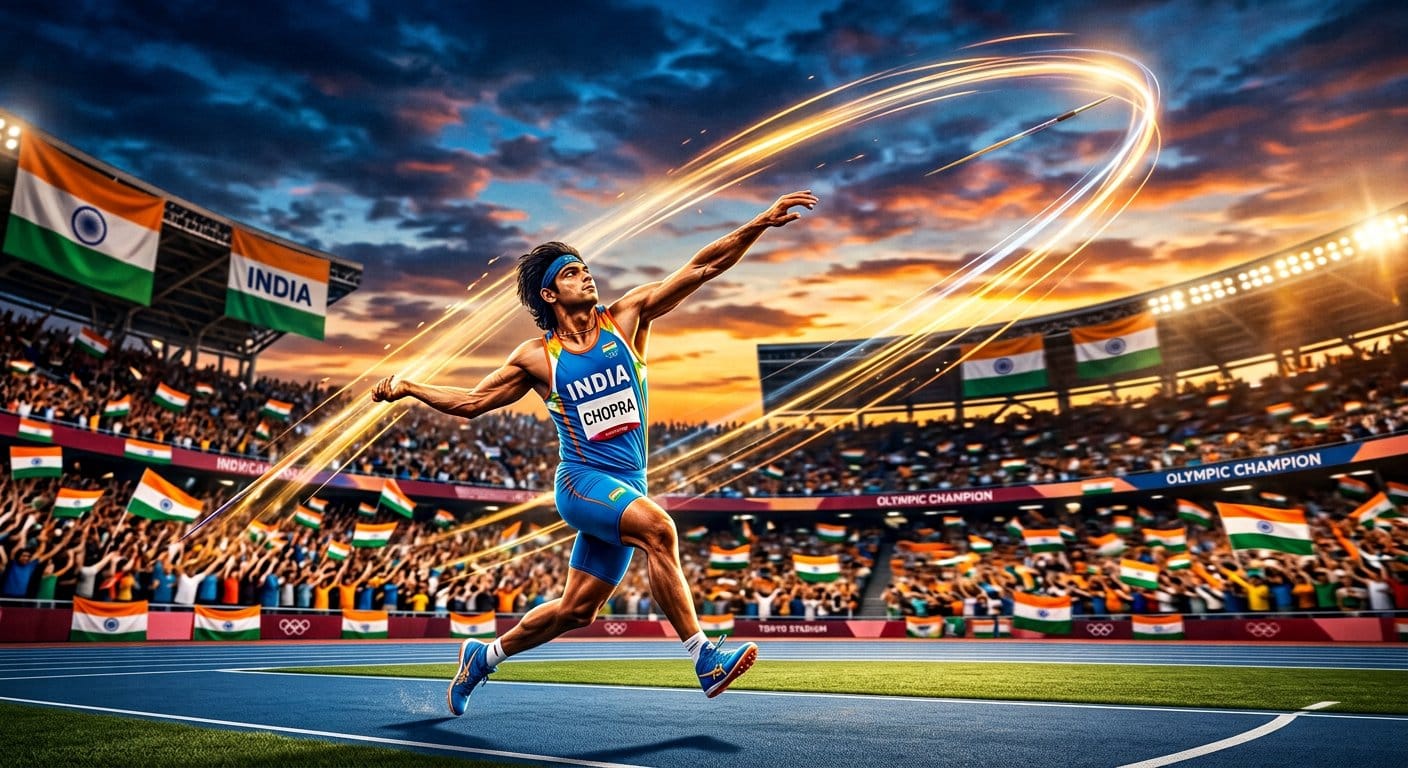
The remarkable story of Neeraj Chopra — from a Haryana village to Olympic gold.
Somewhere in the stands of a Tokyo stadium, on the evening of 7 August 2021, a million hearts stopped together. A 23-year-old from a village most of India couldn’t find on a map had just picked up a javelin. His name hadn’t been famous for long. After one furious run-up, one violent release, the spear flew 87.58 metres into the Tokyo night — and a country of 1.4 billion people finally had an Olympic gold in track and field. That single throw didn’t just change Neeraj Chopra’s life. It rewired what Indians believed was possible in sport.
Before that night, India had won individual Olympic gold exactly once in 121 years, and it took a shooter and a steady nerve. No Indian had ever stood on an athletics podium at the Games. Then this farmer’s son from Haryana went and ended a century of waiting with one swing of his arm.
Here’s where things stand as of 5 August 2026: Neeraj is fresh off a silver medal at the Glasgow Commonwealth Games — his second CWG podium — and just weeks away from a blockbuster Diamond League meeting in Lausanne. He’s rebuilding after the longest injury layoff of his career. This is very much an ongoing story.
This isn’t a story about medals alone, though there are plenty. It’s about a teenager who nearly chose boxing, a boy who shed twenty kilos to find his true calling, and an athlete who keeps rewriting his own record books. Let me walk you through it properly.
Quick Info Table
| Attribute | Detail |
|---|---|
| Full name | Neeraj Chopra |
| Date of birth | 24 December 1997 |
| Birthplace | Khandra village, Panipat district, Haryana |
| Event | Men’s javelin throw |
| Height | 1.78 m |
| Personal best | 90.23 m (Indian record, Doha Diamond League, 16 May 2025) |
| Olympic medals | Gold (Tokyo 2020, 87.58 m) & Silver (Paris 2024, 89.45 m) |
| World Championships | Gold (Budapest 2023), Silver (Oregon 2022) |
| Army rank | Subedar; Honorary Lieutenant Colonel (Territorial Army) |
| Major awards | Arjuna (2018), Khel Ratna (2021), Padma Shri (2022), Param Vishisht Seva Medal (2022) |
| Latest result | Silver, Commonwealth Games 2026 (Glasgow) — 85.83 m, season best |
| Next competition | Lausanne Diamond League, 21 August 2026 |
The Start of Everything
Khandra is a quiet farming village roughly seventy kilometres from Panipat, and in 1997 nobody there was thinking about athletics. Neeraj arrived on 24 December as a chubby, active kid who loved wrestling and kabaddi. His father runs a small agricultural business; his mother looked after the home. There was nothing about his childhood that screamed “future Olympic champion.”
School changed the direction of his life. A cousin spotted his raw strength at a local sports meet and pushed him toward athletics. Here’s the funny part — young Neeraj first tried the 100-metre sprint and the high jump, with modest results. A coach eventually handed him a javelin, almost as an afterthought, and something clicked. He threw it surprisingly far on his very first attempt.
That initial spark didn’t instantly turn him into a star. In fact, his parents had another sport in mind entirely — they once suggested boxing, seeing it as a more realistic path. Neeraj politely ignored the idea and kept chasing the spear. At sixteen, he was overweight and slow; a strict routine soon dropped twenty kilos from his frame. The discipline hurt, but it built the athlete the world knows today.
The Weight That Almost Held Him Back
It’s hard to picture now, but the Olympic champion was once too heavy to throw properly. His early coaches remember a teenager who relied on brute power rather than technique. The transformation took years of running, gym work, and hundreds of thousands of throws.
What pulled him through? A stubborn refusal to quit. His mother once joked that even as a boy he wouldn’t let go of anything he’d decided on. That quality — call it grit, call it stubbornness — would define his entire career.
From Village Fields to World Stage
Neeraj’s first real breakthrough came in 2016, and it was a shock to everyone except him. At the World Under-20 Championships in Bydgoszcz, Poland, he won gold with a throw of 86.48 metres. That distance wasn’t just a win — it set a world junior record. An eighteen-year-old from Haryana had just announced himself to the global stage.
The trophies started stacking up quickly after that. He claimed gold at the South Asian Games in Guwahati in 2016, then at the Asian Championships in Bhubaneswar in 2017. By 2018, he was unstoppable — gold at the Commonwealth Games in Gold Coast with 86.47 metres, and gold at the Asian Games in Jakarta with 88.06 metres.
The Injury That Almost Ended It
Right when his star was rising, life threw him a curveball. In early 2019, a serious elbow injury forced him under the surgeon’s knife. He missed most of that season, and doubts crept in. Could he come back at the same level?
He answered in 2021. With the world watching and the pandemic delaying the Games by a year, Neeraj arrived in Tokyo in the best shape of his career. Nobody knew it yet, but history was about to be written.
The Tokyo Miracle
7 August 2021. The Olympic men’s javelin final. Neeraj was calm, almost unnervingly so, while the rest of India sat glued to their screens. His second throw — 87.58 metres — put him on top. Then the pressure game began.
In javelin, the lead can vanish in seconds if a rival throws big. That night, no one could catch him. The crowd waited through six rounds, and with every passing attempt the gold looked more certain. When the final spear landed, Neeraj sank to his knees, grabbed an Indian flag, and wept.
That throw made him the first Indian ever to win an Olympic gold in athletics. It was also India’s only gold of the entire Tokyo Games. Even Prime Minister Modi called to congratulate him personally. For weeks, his face was everywhere — newspapers, television, village walls, street murals.
A Nation’s Emotional Outpouring
Back home, the scenes were unforgettable. Villagers in Khandra set off firecrackers and danced in the streets. His mother performed rituals in the family temple. Schoolchildren across the country suddenly wanted to try javelin.
What struck me most about that night was the sheer surprise in people’s reactions. Indians knew how to celebrate cricket and shooting, but a track-and-field gold felt foreign, almost impossible. Neeraj didn’t just win a medal — he gave an entire generation a new dream to chase.
Silver in Paris and the Rise of a Rival
Every gold-medal story needs a worthy challenger, and Neeraj found one in Pakistan’s Arshad Nadeem. On 8 August 2024, at the Paris Olympics, the two produced one of the greatest javelin duels in history.
Nadeem threw a staggering 92.97 metres — an Olympic record — and Neeraj responded with a season-best 89.45 metres. It wasn’t enough for gold, but it was a silver to be proud of. Neeraj became only the fifth Indian to win two individual Olympic medals, joining names like Norman Pritchard, Sushil Kumar, P.V. Sindhu and Manu Bhaker.
The result sparked plenty of debate in India. Some called it a disappointment; wiser voices pointed out that an Olympic silver is a lifetime achievement for most athletes. Neeraj himself took it in stride, congratulating Nadeem and vowing to come back stronger.
2023 – The World Championship Crown
Between his two Olympic appearances, Neeraj claimed the one title that had eluded him — a World Championship gold. At Budapest in August 2023, he threw 88.17 metres to top the podium. Only a year earlier at Oregon, he’d settled for silver behind Anderson Peters of Grenada. This time, he finished the job.
Later that same year, he retained his Asian Games crown in Hangzhou with 88.88 metres, and even led a historic India 1-2 in javelin as Kishore Jena took silver behind him. Two major golds in a single year, despite a nagging groin injury — that’s the mark of a true champion.
Crossing the Magical 90-Metre Mark
For years, the 90-metre line stood as an invisible wall in Neeraj’s career. Critics whispered that he couldn’t cross it. On 16 May 2025, at the Doha Diamond League, he silenced every one of them.
His throw measured 90.23 metres — a new Indian record and his first ever beyond ninety. Only twenty-five men in the entire history of the sport have done it. Even though he finished second in that meet, the milestone meant more than gold. He’d finally toppled the barrier that had haunted him since Stockholm in 2022, when he’d stopped at 89.94 metres.
The run continued through a busy 2025 season. He won the Potch Invitational in South Africa, claimed back-to-back wins at the Paris Diamond League and the Ostrava Golden Spike, and then won the inaugural Neeraj Chopra Classic in Bengaluru — a competition named in his honour. His streak of finishing in the top two stretched to an incredible twenty-six events.
The Streak That Finally Broke
Every streak has an ending. At the World Championships in Tokyo in September 2025, Neeraj finished eighth with a best of 84.03 metres, his first time outside the top two in twenty-six competitions. A lower-back problem clearly bothered him. It was a humbling moment, but perhaps a necessary one.
That injury proved more serious than anyone guessed. It kept him out of elite competition for the better part of eight months — the longest enforced break of his career. For someone who’d spent nearly a decade competing relentlessly, the silence was deafening. The doubt, the rehab, the slow road back — all of it tested his patience like nothing else ever had.
A Life in the Indian Army
Many Indians don’t realise that Neeraj’s day job involves serving the nation. He joined the Indian Army in 2016 and currently holds the rank of Subedar. His service earned him the Param Vishisht Seva Medal in 2022.
In October 2025, the Defence Minister formally conferred on him the honorary rank of Lieutenant Colonel in the Territorial Army. For a young man who once dreamed of wrestling in village pits, this is a remarkable journey — from school sports meet to an officer’s uniform.
Why the Army Matters to Him
Neeraj has said repeatedly that the Army gave him structure and stability. It provided training facilities, financial security, and a family of fellow athletes. In return, he’s become one of the most recognisable faces of the Indian military — a true soldier-athlete.
Awards That Shine Bright
The list of honours Neeraj has collected reads like a national sporting hall of fame:
| Year | Award | Reason |
|---|---|---|
| 2018 | Arjuna Award | Commonwealth & Asian Games golds |
| 2021 | Major Dhyan Chand Khel Ratna | Olympic gold, India’s top sporting honour |
| 2022 | Padma Shri | Contribution to sport |
| 2022 | Param Vishisht Seva Medal | Service in the Indian Army |
These aren’t just medals on a shelf. Each one represents a stage in a career that kept climbing even when the body wanted to quit.
The Comeback and Where He Stands Today
Let’s be honest about the recent past. Since his 2023 Asian Games gold, Neeraj has landed on the podium at nearly every major event, but the top step has often slipped away. And 2026 began quietly — he was still nursing that back, watching from the sidelines while the rest of the world threw further and further.
His return came at the Doha Diamond League in June 2026. After a slow start and two fouls, he managed a season-opening 85.69 metres to finish fourth. Not a podium, sure — but the throw comfortably booked his Commonwealth Games spot, which was the whole point. For a man returning from eight months out, simply competing was the win.
Then came Glasgow. At the Commonwealth Games on 31 July 2026, Neeraj threw a season-best 85.83 metres to take silver. Sri Lanka’s Rumesh Pathirage — the new force in world javelin — won gold with 89.75 metres. The moment felt sweeter than the colour suggested: fellow Indian Yash Vir Singh grabbed bronze with a personal best of 85.41 metres, marking the first time two Indians shared a javelin podium at the Games. Even the defending champion Arshad Nadeem was eliminated after just three throws, finishing ninth.
Neeraj called it “my season’s best” and admitted he was still happy with the comeback. But the real test is still ahead. On 21 August 2026, he lines up at the Lausanne Diamond League against arguably the deepest javelin field in history — Pathirage, Nadeem, reigning world champion Keshorn Walcott, Anderson Peters, Thomas Röhler, and more. That meet is his dress rehearsal for the Asian Games in Japan later in the season, where he’ll look to defend his continental crown.
So has he plateaued? I’d argue no — the field simply caught up. His personal best keeps rising, and he remains one of the most consistent throwers on the planet. The bigger threat is his body; recurring back and groin troubles keep interrupting his rhythm. At twenty-eight, with his best throws possibly still ahead, Neeraj’s story is far from finished.
Ten Facts Most People Don’t Know
- He once tried boxing — his family suggested it, and he refused.
- He lost about twenty kilograms in his teenage years to transform his body.
- His 2016 junior world record throw of 86.48 metres still stands as a U20 milestone.
- He’s broken his own national record at least seven times since 2016.
- His previous personal best before the 90.23 metres was 89.94 metres, set in Stockholm in June 2022.
- He’s only the 25th man in history to breach the 90-metre mark.
- His mother and father initially had no idea how big the Tokyo achievement was.
- He’s one of only five Indians to win two individual Olympic medals.
- The Neeraj Chopra Classic, launched in 2025, is a major competition named after him.
- He’s a serving Indian Army officer who balances sport and national service.
Did You Know?
Neeraj’s Tokyo gold was India’s only gold medal of the entire 2020 Olympic Games? And that the throw which ended a 121-year wait was his second attempt of the final? He led from that moment onward and never gave it up.
Here’s another one — the 90.23-metre throw in Doha came in a competition he didn’t even win. He finished second that day, yet the throw became the defining moment of his 2025 season.
And one more from the comeback: at the 2026 Commonwealth Games, Neeraj’s silver came in only his second competition back from an injury layoff — while the defending champion Arshad Nadeem crashed out in ninth. That’s what a champion’s return looks like.
What We Can Learn From Neeraj
Patience beats raw talent. Neeraj wasn’t instantly brilliant. He spent years perfecting technique after shedding the weight that held him back. Success, for him, was a slow grind.
Injuries are setbacks, not endings. He’s fought through elbow surgery, groin trouble, and countless niggles. Each time, he returned stronger. Persistence, not perfection, carried him.
Rivals make you better. His battles with Arshad Nadeem and Anderson Peters pushed him to new distances. Competition, when embraced, elevates everyone.
Duty grounds you. The Army kept him humble and focused. Having a purpose beyond personal glory — serving the nation — gave his career deeper meaning.
Comebacks are made of patience. Months on the sideline, and he returned to win a Commonwealth medal in just his second competition back. Healing, he proved, can be as athletic as throwing.
Frequently Asked Questions
1. When and where was Neeraj Chopra born?
He was born on 24 December 1997 in Khandra village, Panipat district, Haryana.
2. What is Neeraj Chopra’s personal best throw?
90.23 metres, set at the Doha Diamond League on 16 May 2025 — an Indian national record.
3. Did Neeraj Chopra win an Olympic gold?
Yes. He won gold at Tokyo 2020 with 87.58 metres, India’s first Olympic gold in athletics.
4. Who beat Neeraj Chopra at the Paris 2024 Olympics?
Pakistan’s Arshad Nadeem won gold with an Olympic record of 92.97 metres; Neeraj took silver with 89.45 metres.
5. How many Olympic medals does Neeraj Chopra have?
Two — a gold from Tokyo 2020 and a silver from Paris 2024.
6. Is Neeraj Chopra in the Indian Army?
Yes. He holds the rank of Subedar and was given the honorary rank of Lieutenant Colonel in the Territorial Army in 2025.
7. Which awards has Neeraj Chopra received?
The Arjuna Award (2018), Major Dhyan Chand Khel Ratna (2021), Padma Shri (2022), and the Param Vishisht Seva Medal (2022).
A Balanced Closing Opinion
Neeraj Chopra isn’t just India’s greatest javelin thrower — he might be its most transformative athlete in a century. That single Tokyo night didn’t merely fill a medal count; it changed how a nation sees itself on the track. Young kids in small towns now believe a spear and hard work can carry them to Olympic glory.
Yet it’s worth remembering he’s human. He’s lost, he’s injured, he’s finished eighth at a World Championship. Those moments don’t diminish him; they make him relatable. A champion who stumbles and keeps standing is far more inspiring than one who never falls.
The next chapter of his career is being written right now. Lausanne on 21 August, then the Asian Games in Japan — these will tell us whether the old Neeraj is fully back or reinventing himself. Either way, he’s already done something no Indian athlete in any sport has ever matched — he made an entire nation weep with joy over a throw of eighty-seven metres. That’s a legacy no medal count can measure.
&
References
- Olympics.com — “The Neeraj Chopra record set: Know the javelin ace’s greatest hits”
olympics.com - Olympics.com — “Neeraj Chopra wins silver medal at Paris 2024 Olympics javelin throw”
olympics.com - Encyclopedia Britannica — “Neeraj Chopra” (biography)
britannica.com - India Today — “After CWG silver, Neeraj Chopra faces steep test ahead of Asian Games 2026”
indiatoday.in - Hindustan Times — “Neeraj Chopra, India’s javelin ace, wins silver at Commonwealth Games 2026”
hindustantimes.com - The Indian Express — “Neeraj Chopra in CWG 2026 Javelin Final” (live coverage)
indianexpress.com - Rediff Sports — “Neeraj Chopra’s 2026 CWG Silver: A Triumph Over Injury”
rediff.com - Open Magazine / ANI — “Neeraj Chopra Returns From Injury With 85.69m Throw at Doha Diamond League”
openthemagazine.com - The Economic Times (ANI) — “India’s ‘golden boy’ Neeraj Chopra’s stellar 2025”
economictimes.indiatimes.com