

Introduction:
The 2026 Commonwealth Games weren’t supposed to happen in Glasgow. When Australia’s Victoria state pulled out of hosting duties, the future of the entire event looked genuinely uncertain for a while. Glasgow stepped in, took stock of what was actually affordable, and built a smaller Games around that reality.
The result is the 23rd edition of the Commonwealth Games — scheduled from 23 July to 2 August 2026 — running across eleven days with 10 sports, 215 medal events, and athletes from 74 nations and territories. It is the second time Glasgow has hosted, after the 2014 edition. This time, the scale is deliberately smaller.
The sports on offer are athletics, swimming,boxing, cycling, gymnastics, judo, netball, lawn bowls, weightlifting, and 3×3 basketball. Para sports remain part of the programme. What isn’t there is just as notable — wrestling, badminton, hockey, cricket, shooting, table tennis, and squash have all been dropped from the schedule.
For India, that list of absences matters. Those are precisely the sports where Indian athletes have historically collected the bulk of their Commonwealth medals. Without them, India’s medal count will depend heavily on athletics, boxing, weightlifting, judo, and para sports — areas where the country has genuine strength but far less historical dominance.
Whether the smaller format works is a question this edition will answer in real time. The argument for it is straight forward — major Games don’t have to cost a fortune to matter. Glasgow 2026 is testing that argument directly.
Information has been checked against official Glasgow 2026
and Commonwealth Sport sources.
Quick Facts About the 2026 Commonwealth Games
Why Are the 2026 Commonwealth Games Different?
The short answer is money — and the longer answer is also money.
When Victoria, Australia, pulled out of hosting duties citing rising costs, the Commonwealth Games faced an uncomfortable question: could the event survive without a wealthy, infrastructure-heavy host? Glasgow answered that by saying yes — but only if the format changed.
Instead of building new venues, Glasgow is using what already exists. Scotstoun Stadium, Tollcross International Swimming Centre, the Sir Chris Hoy Velodrome — all of them are established world-class facilities that need no construction, no major upgrades, and no post-Games white elephant problem.
The sports programme reflects that same logic. Ten sports. 215 medal events. A shorter schedule. Cricket, wrestling, badminton, hockey, shooting, table tennis, and squash are all out. That’s not a small list — those are events that historically drove large chunks of viewership and medal tables for major nations.
Whether athletes and fans accept a smaller Games as still being the real thing is the question Glasgow 2026 is quietly answering, one day at a time.
Sports Included in the 2026
Commonwealth Games
Ten sports. That’s it. By Commonwealth Games standards, that is a notably short list — the smallest programme the event has run in over thirty years.
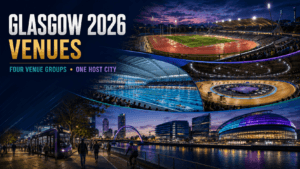
The reasoning is straightforward. Glasgow wasn’t building new venues. It was working with what already existed — Scotstoun Stadium, Tollcross International Swimming Centre, the Sir Chris Hoy Velodrome, Emirates Arena, and the Scottish Event Campus. The sports selected were the ones those venues could actually host, at the standard required, without additional construction.
That logic ruled out a long list of disciplines — wrestling, badminton, hockey, shooting, cricket, table tennis, squash — sports that needed facilities Glasgow either didn’t have or couldn’t justify building for a single event.
What remains is a programme of 215 medal events across 11 days. Six of the ten sports include integrated para competitions — meaning para athletes compete within the same schedule, not in a separate event attached to the side.
Fewer sports doesn’t automatically mean a lesser Games. It does mean a different one. Whether that difference matters is something Glasgow 2026 will settle by the time the closing ceremony ends on 2 August.
Sports at the 2026 Commonwealth Games
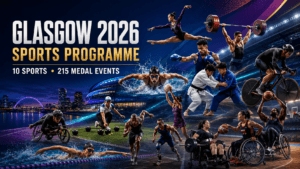
Ten sports. 215 medal events.Six disciplines with integratedpara competition. Here is thefull breakdown.
*Para sports are fully integrated into the competition schedule,
not held as separate events.
Highlights of the Sports Programme
Athletics is where most eyes will be. Scotstoun Stadium hosts the sprints, middle distance, field events, and para athletics — and with the track in good shape and a competitive field expected, it is likely to produce the most-watched moments of the Games.
Swimming at Tollcross International Swimming Centre has a history of fast times. The pool has hosted world-class competition before, and the 2026 programme includes freestyle, backstroke, butterfly, breaststroke, medley, and para swimming events. Times will be watched closely.
Boxing tends to generate noise at Commonwealth Games in a way most other sports don’t. India, England, Australia, and Scotland traditionally send strong squads, and with no shortage of genuine medal prospects across weight categories, the boxing schedule usually runs close to capacity crowds.
Weightlifting is where India has historically done serious damage to the medal table. With para powerlifting also included, Indian lifters will be targeting multiple podium finishes across weight categories — and based on recent form, that expectation isn’t unrealistic.
Track Cycling at the Sir Chris Hoy Velodrome is worth watching for the speed alone. The venue is one of the best indoor cycling tracks in the world. Artistic Gymnastics runs alongside it — a sport that tends to draw casual viewers who weren’t planning to watch gymnastics and end up staying for an hour.
The para sport integration is worth noting specifically. Wheelchair 3×3 Basketball, Para Athletics, Para Swimming, Para Track Cycling, Para Lawn Bowls, and Para Powerlifting all sit within the main competition schedule — not as an add-on, but as part of the actual Games. Six disciplines in total. That’s not a token inclusion. It’s a meaningful one.
Glasgow 2026 is smaller than what came before. But smaller doesn’t mean thin — the sports that made the cut are genuinely competitive, and most of them will deliver close finishes and real medal drama. That’s usually enough.
Sports Removed From the 2026 Commonwealth Games
The list of what isn’t at Glasgow 2026 is almost as long as the list of what is.
Wrestling, badminton, hockey, shooting, cricket, table tennis, squash — all gone. For fans of those sports, and for nations that traditionally relied on them for medals, that’s a significant absence. Not a minor administrative decision. A real change to what the Games look and feel like.
The reason wasn’t performance or popularity. None of these sports were dropped because they lacked interest or competitive depth. They were dropped because Glasgow stepped in on short notice after Victoria, Australia pulled out — and Glasgow worked with what it had. The venues available could host ten sports comfortably. Beyond that, costs and logistics became difficult to justify.
That context matters. This wasn’t a deliberate decision to reshape the Commonwealth Games. It was a practical response to an unexpected situation. The sports that made it through are the ones that fit — not necessarily the ones anyone would have chosen if starting from scratch.
For athletes in the removed sports, the consequences are real. A Commonwealth Games medal is a career milestone in many of these disciplines. Missing one edition doesn’t end a career, but it does remove a window that won’t come back for four years — assuming those sports return at the next edition, which is not yet confirmed.
Sports Not Included in
Glasgow 2026
Ten sports made the final programme. These ten did not — and for athletes in each of them, that absence has real
consequences.
*Sports removal was primarily driven by venue availability and budget constraints following Glasgow’s late appointment as host city. Whether these sports return for the next edition has not yet been confirmed.
What Does this Mean for India?
India’s Commonwealth Games record is built on a specific
set of sports. Remove those sports, and the medal count changes — significantly. At Birmingham 2022, India finished fourth on the overall medal table with 61 medals — 22 gold, 16 silver, 23 bronze. A large portion of those came from wrestling, badminton, hockey, table tennis, squash, and shooting. None of those sports are in Glasgow.
That’s not a small adjustment. That’s a fundamental shift in where India’s medals come from. The sports that remain — athletics, swimming, boxing, weightlifting, judo, cycling, gymnastics, lawn bowls, netball, and 3×3 basketball — represent a very different challenge for Indian athletes. Some of these are areas where India has genuine strength. Others are events where India has historically struggled to reach the podium at all.
Where India Can Still Win Medals:
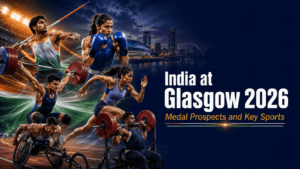
Boxing has been consistent for India at the Commonwealth Games. Nikhat Zareen, Mary Kom’s successors, and a strong junior pipeline give India real medal prospects across multiple weight categories. Weightlifting has delivered before. Mirabai Chanu’s gold at Birmingham set a high standard. With para powerlifting also included, India has multiple genuine podium opportunities in this discipline.
Athletics is where India’s best chance for a headline moment sits. Neeraj Chopra’s success has opened doors and raised expectations for Indian track and field. Several Indian para athletes have also been performing at world-class levels, making para athletics another realistic medal source.
Judo is a discipline where India has developed quietly over the years. Not a guaranteed medal sport, but not an impossible one either.
Where India Will Struggle:
Swimming, cycling, gymnastics, lawn bowls, netball, and 3×3 basketball are areas where India’s representation has historically been limited. These sports haven’t been part of India’s Commonwealth medal strategy in the past, and one edition isn’t likely to change that pattern dramatically.
The Honest Assessment:
India’s final medal tally at Glasgow 2026 will almost certainly be lower than Birmingham 2022. That isn’t a failure — it’s arithmetic. The sports where India wins medals aren’t in the programme. The ones that are require different athletes, different preparation, and in some cases, a different kind of competitive culture that takes years to build.
What Glasgow 2026 does offer India is a chance to test depth in sports that don’t always get Commonwealth spotlight. Athletes in boxing, athletics, and weightlifting have an opportunity to perform without the weight of a 61-medal expectation sitting over the whole team. Lower expectations. Genuine competition. Real medals on offer. That’s not the worst situation to be in.
Why Were These Sports Removed?
The official answer is venue availability and budget. The fuller answer involves a chain of events that started in July 2023 and ended with Glasgow hosting a significantly smaller Games than anyone originally planned.
How It Started:
Victoria, Australia, was supposed to host the 2026 Commonwealth Games. The state had won the bid, announced ambitious plans, and begun early preparations. Then, in July 2023, the Victorian government pulled out — citing cost projections that had reportedly ballooned to over AUD 6 billion.
The Commonwealth Games Federation was left without a host less than three years before the event.
Glasgow stepped in. Not because it was the obvious choice, but because it was a practical one. The city had hosted the Games in 2014, still had the venues, and could deliver an event within a realistic budget. The catch was that the Games would have to fit what Glasgow already had — not what a new host might have built.
The Real Reason Sports Were Cut:
Glasgow’s existing venues can comfortably host ten sports at Commonwealth Games standard. Wrestling needs a specific facility. Badminton requires a large indoor arena with precise court layouts. Hockey needs an artificial pitch to an international standard. Shooting requires a dedicated range with strict safety requirements. Cricket needs multiple grounds and weeks of scheduling.
None of those facilities existed in a form Glasgow could use without significant investment. Significant Investment was exactly what this edition was trying to avoid.
The decision wasn’t sport by sport. It was practical:
here are the venues we have, here are the sports they can host, here is the programme. Everything else was, effectively, out by default.
Was It the Right Decision?
That depends on what you think the Commonwealth Games is for.
If the Games exist primarily as a financial exercise that must balance its books, Glasgow 2026 makes complete sense. No new construction, no cost overruns, no white elephant stadiums sitting empty five years later.
If the Games exist to provide a global platform for the widest possible range of Commonwealth athletes, then cutting ten sports — including disciplines where India, Pakistan, South Africa, and other major nations have real depth — is a meaningful loss that affects real careers.
Both of those positions are defensible. The Commonwealth Games Federation chose the first one.
Whether future editions restore the removed sports depends largely on who hosts next — and what budget they’re willing to commit. That host hasn’t been announced yet.
The sports are gone for 2026. After that, nothing is certain.
Competition Schedule and Key Dates
Eleven days. Four venues. 215 medal events. Here is how Glasgow 2026 is structured.
India’s Medal Tally at Glasgow 2026
As of 29 July 2026 (Day 6), India have won 12 medals — two golds, seven silvers and three bronze. Weightlifting has been India’s biggest contributor, accounting for seven of those twelve medals.
*Medal tally updated as of 29 July 2026. Athletics competition continues through 1 August. Boxing finals yet to be held.
India Medal Winners — Glasgow 2026
*Table updated as of 29 July 2026. Boxing finals and remaining athletics events yet to conclude. More medals expected.
Top Athletes to Watch
Para Sports at Glasgow 2026
Six para disciplines. All integrated into the main competition schedule — not a separate event.
Opening Ceremony Highlights
The Glasgow 2026 Commonwealth Games officially opened on
23 July 2026 at The Hydro. Organisers described it as the first Commonwealth Games Opening Ceremony to be staged inside an arena of this kind, giving the production a more intimate atmosphere than the traditional stadium format.
The show opened with Sir Chris Hoy travelling through Scotland in the TARDIS to collect King Charles III and Queen Camilla. The sequence passed through locations including Loch Ness, Edinburgh Castle, the Highlands and Balmoral before arriving in Glasgow.
Scottish music and culture shaped much of the ceremony. Nessie appeared during the production, massed pipes and drums performed Flower of Scotland, and artists including Nathan Evans and Saint PHNX took part in a segment inspired by the Glasgow phrase “meet me under the clock.”
Athletes from 74 nations and territories joined the Parade of Nations, with Gabon and Togo making their first Commonwealth Games appearances. The ceremony also reunited all 74 decorated King’s Batons before King Charles III officially declared the Games open.
Venue: The Hydro, Glasgow
Host Country: Scotland, United Kingdom
&
Closing Ceremony Details
The Glasgow 2026 Closing Ceremony is scheduled for
2 August 2026 at The Hydro, bringing the eleven-day sporting event to an end. Glasgow rock band Simple Minds will headline the show.
The announced line-up also includes Cammy Barnes, BEMZ, Sandi Thom, Elephant Sessions and Shereen Cutkelvin, who is expected to take part in the ceremonial flag handover. Australian singer Delta Goodrem will return to the Commonwealth Games stage twenty years after appearing at Melbourne 2006.
The programme will celebrate the athletes, volunteers, sporting moments and communities that shaped Glasgow 2026. As the ceremony has not yet taken place, some creative elements are still being kept secret.
| Category | Details |
|---|---|
| Date | 2 August 2026 |
| Venue | The Hydro, Glasgow |
| Headline Performer | Simple Minds |
| Ticket Categories | £50, £75 and £95, subject to availability |
Mascot, Motto and Official Branding
Official Mascot: Finnie
Finnie, a Glaswegian unicorn, is the official mascot of Glasgow 2026. The unicorn was chosen partly because it is Scotland’s national animal, while the name refers to Glasgow’s famous Finnieston Crane.
The mascot was developed using ideas from 76 children representing 24 Glasgow schools. Finnie is presented as energetic, welcoming and playful—the official “hype-master” who supports athletes from every nation and sport.
Motto and Brand Language
Official Glasgow 2026 material does not clearly identify “More Than Medals” as the official motto. The phrase most consistently used in the official branding is:
The public community campaign is called “All In”, encouraging schools, charities, sports clubs and community organisations to participate in Games-related activities.
Official Logo Design
Glasgow-based agency LOOP designed the visual identity. The logo combines the Commonwealth Sport celebration mark with three recognised Glasgow symbols:
- The Finnieston Crane
- The Clyde Arc, also known as the Squinty Bridge
- The River Clyde
The colour palette draws inspiration from Glasgow’s waterfront, connecting the city’s industrial history with its modern cultural identity.
Records That Could Be Broken
Several Commonwealth Games records had already fallen by 29 July 2026. South African swimmer Chad le Clos became the most decorated male athlete in Commonwealth Games history after winning his 19th medal.
Duncan Scott set a Games record of 1:56.38 in the men’s 200m individual medley. Nigeria’s Esther Nworgu broke the Commonwealth Games Para powerlifting record twice, while Folashade Oluwafemiayo and Rita Ferdinand produced world-record lifts.
Malaysian weightlifter Mohamad Aniq also set Games records in the men’s 60kg clean and jerk and total categories.
Records Still Under Threat
More records may fall in athletics and track cycling. Swimming and cycling regularly produce new marks because controlled venues, equipment improvements and advances in sports science can influence performance.
Older athletics records will be harder to remove. Steve Cram’s men’s 800m Commonwealth Games record of 1:43.22, for example, has stood since Edinburgh 1986.
How Glasgow Prepared for the Games
Glasgow had a short preparation window after being formally confirmed as host in October 2024. Instead of attempting to rebuild a full-scale Commonwealth Games from the beginning, the city developed its plan around venues and operational experience retained from Glasgow 2014.
Competition was concentrated across four established venue groups located within an eight-mile corridor. This reduced construction requirements, simplified transport and allowed organisers to work with facilities already familiar with international sporting competition.
Major Preparation Work
- A new athletics track at Scotstoun Stadium
- Refurbished seating at Tollcross International Swimming Centre
- General facility improvements at competition venues
- Recruitment and training of thousands of volunteers
- Transport planning within the compact venue corridor
- More than 1,000 expected Games-time employment opportunities
The city’s previous experience of hosting the 2014 Commonwealth Games played an important role. Many venues, transport links and operational systems already existed, allowing Glasgow to prepare within a much shorter period.
Sustainability and Cost-Saving Measures
Glasgow 2026 avoided building new major stadiums. Existing venues were reused, and competition was concentrated within a relatively small part of the city.
Main Cost-Saving Measures
- Reusing venues originally used for Glasgow 2014
- Concentrating competitions within an eight-mile corridor
- Encouraging public transport, walking and cycling
- Avoiding unnecessary stadium construction
- Limiting the sports programme to ten sports
- Reducing operational waste and transport emissions
- Improving facilities that can continue serving local communities
Organisers describe this approach as a possible blueprint for a lighter, place-based Commonwealth Games model.
The core sporting competition does not rely on a broad public funding guarantee, although separate public support has been provided for areas such as city activities and possible security contingencies.
Broadcasting and Live Streaming
In India and the wider subcontinent, Sony Pictures Networks India holds the official broadcasting partnership. Indian viewers can watch coverage through the Sony Sports Network, with digital streaming available through Sony LIV.
| Region | Official Broadcaster or Platform |
|---|---|
| India and Subcontinent | Sony Sports Network and Sony LIV |
| United Kingdom | TNT Sports, HBO Max and Channel 5 highlights |
| Australia | Seven Network |
| New Zealand | Sky New Zealand and TV3 |
| Canada | CBC and beIN SPORTS |
| United States | beIN SPORTS |
| Caribbean | RushSports |
| South Africa | SABC and SuperSport |
| Europe | Warner Bros. Discovery platforms |
In the United Kingdom, every competition session is available live through HBO Max, alongside TNT Sports television coverage.
Ticket Information
Approximately 500,000 tickets were made available across sporting sessions and ceremonies. Tickets are sold through the official Glasgow 2026 ticket portal on a first-come, first-served basis, and availability differs by session.
| Ticket Category | Starting Price |
|---|---|
| Adult Non-Medal Session | From £17 |
| Adult Medal Session | From £26 |
| Concession Ticket | From £12 |
| Opening Ceremony | £45 to £195 |
| Closing Ceremony | £50, £75 and £95 |
| Booking Fee | No additional booking fee |
Children, accessible-ticket customers and people aged 66 or above may qualify for concession pricing. Tickets are provided as PDF files or through Apple and Google digital wallets.
Ticket prices and availability may change. Visitors should confirm the latest information through the official Glasgow 2026 ticket portal.
Interesting Facts About the 2026 Commonwealth Games
- Glasgow is hosting the Commonwealth Games for the second time after 2014.
- It is only the third city in Games history to host the competition twice.
- The Opening Ceremony was the first Commonwealth Games ceremony staged inside an arena of this kind.
- All 74 nations and territories received their own King’s Baton and decorated it to represent their culture.
- Finnie, the official mascot, was developed using ideas from 76 children across 24 Glasgow schools.
- Glasgow 2026 has the largest integrated Para sport programme in Commonwealth Games history.
- The edition also features the largest Swimming and Track Cycling programmes in Games history.
- The Commonwealth Mile returns to the athletics programme for the first time since 1966.
- The medals are the first in Commonwealth Games history to include both braille and tactile design features.
- The next Commonwealth Games will be held in Amdavad, India, in 2030, marking the centenary edition.
Frequently Asked Questions
1. When are the 2026 Commonwealth Games being held?
The Games run from 23 July to 2 August 2026 in Glasgow, Scotland.
2. How many sports are included?
The programme contains ten sports, including six integrated Para sport disciplines.
3. How many medal events are there?
Glasgow 2026 includes 215 medal events.
4. How many nations and territories are participating?
Athletes represent 74 Commonwealth nations and territories.
5. Who is the official Glasgow 2026 mascot?
Finnie, a Glaswegian unicorn, is the official mascot of the Games.
6. Where are the Opening and Closing Ceremonies held?
The Opening Ceremony took place at The Hydro on 23 July 2026. The Closing Ceremony is scheduled at the same venue on 2 August 2026.
7. Why are cricket, wrestling and badminton absent?
The smaller sports programme was shaped by budget limitations, available venues and Glasgow’s short preparation period.
8. Where can viewers watch the Games in India?
Coverage is available through Sony Sports television channels and the Sony LIV streaming platform.
9. How much do Glasgow 2026 tickets cost?
Concession tickets begin at £12, while adult sporting-session tickets begin at £17. Prices vary according to the sport and session.
10. Who designed the Glasgow 2026 medals?
Glasgow-based artist and designer Militsa “Milly” Milenkova designed the medals.
11. What is special about the medals?
The medals use a Reuleaux triangle shape and include braille and tactile accessibility features.
12. Which city will host the next Commonwealth Games?
Amdavad, India, will host the Centenary Commonwealth Games in 2030.
Final Thoughts
Glasgow 2026 is not trying to be the largest Commonwealth Games ever staged. Its importance lies elsewhere—in testing whether an international multi-sport competition can remain meaningful without new stadiums, an oversized programme or an unmanageable budget.
The model has clear limitations. Several popular sports are missing, and nations such as India have lost many of their traditional medal opportunities.
Yet the event has also introduced the largest Para sport programme in Games history, reused established venues and placed financial control at the centre of its delivery model.
Whether this becomes the model for future hosts will depend on the final cost, athlete experience, public response and long-term effect on Glasgow.
Official References and Sources
The information in this article was checked against official
Glasgow 2026, Commonwealth Sport, and Scottish Government sources.
- Glasgow 2026 — Official Games Overview
Official dates, host city, athlete numbers, nations, sports,
venues, and delivery model. - Glasgow 2026 — Official Sports Programme
Official list of the ten sports and six integrated Para sports.
- Glasgow 2026 — Official Competition Schedule
Daily competition dates, sessions, sports, and medal events.
- Glasgow 2026 — Official General FAQs
Official answers about dates, sports, participating teams,
venues, ceremonies, mascot, and tickets.
- Glasgow 2026 — Official Venues Information
Venue list, sports hosted at each location, upgrades,
and the use of existing facilities.
- Glasgow 2026 — Official Medal Table
Current country rankings and gold, silver, bronze,
and total medal counts.
- Glasgow 2026 — Official Medal Design
Medal designer, Reuleaux triangle shape, braille,
tactile features, and medal-event numbers.
- Glasgow 2026 — Meet Finnie, the Official Mascot
Official information about Finnie, the Glaswegian unicorn mascot.
- Glasgow 2026 — Official Logo and Visual Identity
Meaning of the integrated logo and Commonwealth Sport
celebration mark.
- Glasgow 2026 — Official Opening Ceremony Report
Opening Ceremony at The Hydro, Parade of Nations,
cultural performances, and official declaration.
- Glasgow 2026 — Official Closing Ceremony Details
Closing Ceremony date, venue, performers,
Simple Minds headline appearance, and ticket categories.
- Commonwealth Sport — Official Global Broadcast Partners
Official television and streaming partners for India,
the United Kingdom, Australia, Canada, and other regions.
- Glasgow 2026 — Official Ticket Portal
Current ticket availability for sports sessions
and the Closing Ceremony.
- Glasgow 2026 — Official Ticket Prices and Payment FAQs
Adult, concession, medal-session, and non-medal-session prices.
- Glasgow 2026 — Sustainability and Story of Change
Existing venues, carbon reduction, inclusion,
legacy, and the financially responsible Games model.
- Scottish Government — Glasgow 2026 Economic Impact
Official Scottish Government information about the projected
economic benefit and Games-related business opportunities.
- Commonwealth Sport — Amdavad 2030 Host Confirmation
Official confirmation that Amdavad, India, will host
the 2030 Centenary Commonwealth Games.
Last checked: 29 July 2026.
Schedules, medal tables, ticket availability, and results may change.
Readers should check the official Glasgow 2026 website for live updates.
Important Disclaimer
This article is intended for general informational purposes.
Competition schedules, athlete entries, match timings, results,
medal tables, broadcasting details, ticket prices and ticket
availability may change during the Games.
Readers should confirm live information through the official
Glasgow 2026 and Commonwealth Sport websites. This website is
not affiliated with, endorsed by, or sponsored by the Glasgow
2026 Commonwealth Games or Commonwealth Sport.