
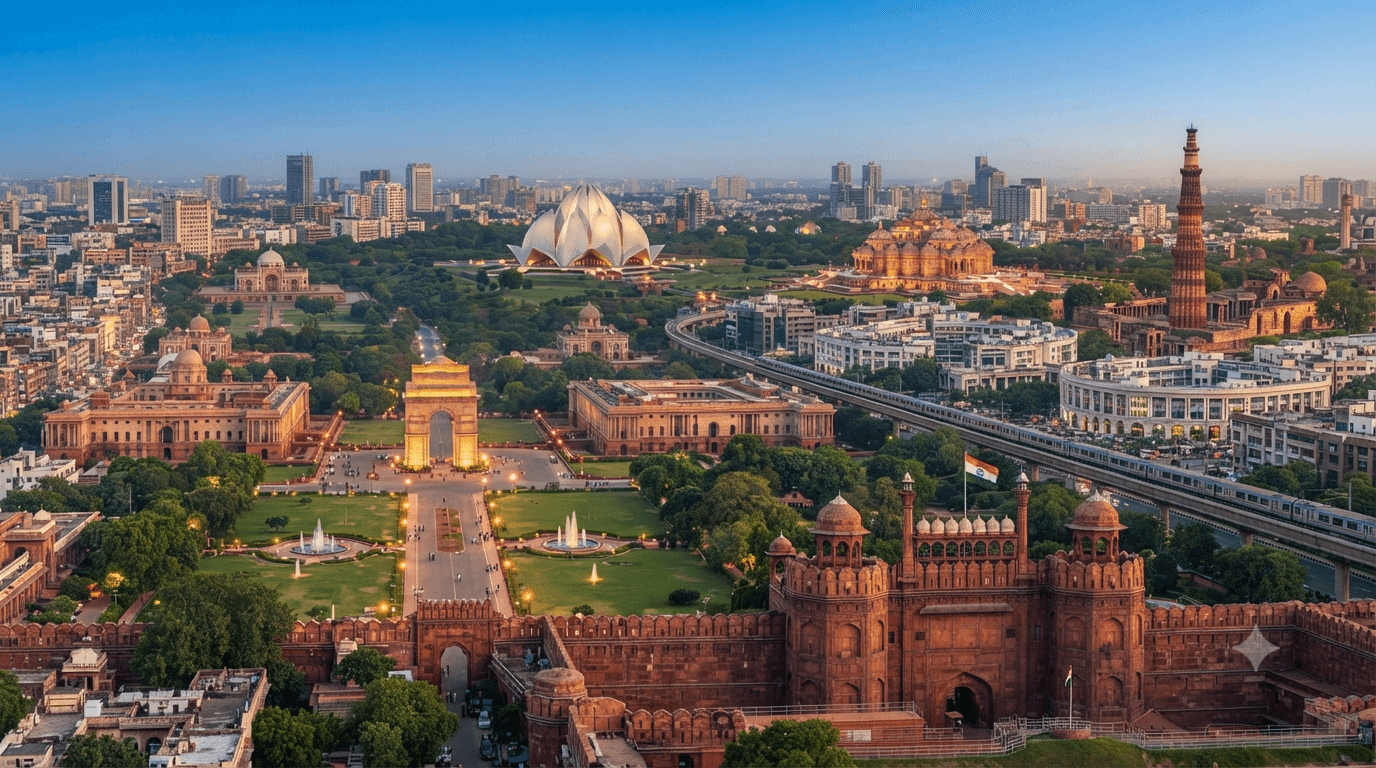
The Heart of India:
A Complete Guide to the National Capital Territory
Delhi, officially known as the National Capital Territory (NCT) of Delhi, is the political, administrative, and cultural heart of India. Home to the nation’s Parliament, the President’s Residence, the Supreme Court, and numerous central government institutions, Delhi holds a unique place in the country’s governance and history. It is one of India’s most visited destinations, attracting millions of domestic and international tourists every year with its magnificent historical monuments, vibrant markets, world-class museums, diverse cuisine, and modern infrastructure.
Situated along the banks of the Yamuna River in northern India, DL beautifully blends thousands of years of history with contemporary urban development. From the grandeur of the Mughal Empire to the architectural legacy of the British Raj and the rapid transformation into a global metropolitan city, Delhi reflects the evolution of Indian civilization across different eras.
The city has witnessed the rise and fall of several powerful dynasties, making it one of the oldest continuously inhabited regions in the world. Ancient legends associate Delhi with Indraprastha, the capital of the Pandavas described in the Mahabharata, while archaeological discoveries reveal evidence of settlements dating back many centuries. Over time, rulers including the Delhi Sultanate, the Mughals, and the British shaped the city’s political, cultural, and architectural identity.
Today, DL serves as a major center for government, commerce, education, healthcare, information technology, tourism, media, fashion, and international diplomacy. The city is home to prestigious educational institutions, renowned hospitals, vibrant cultural centers, and one of the largest metro rail networks in the world. It also hosts embassies of countries from across the globe, making it an important diplomatic hub.
Delhi’s cultural diversity is one of its greatest strengths. People from every Indian state and many countries live, work, and study here, creating a unique blend of languages, traditions, festivals, cuisines, and lifestyles. Whether exploring UNESCO World Heritage Sites, shopping in traditional bazaars, enjoying street food in Chandni Chowk, or visiting modern commercial districts, every part of Delhi offers a distinct experience.
The National Capital Territory is also recognized for its excellent transportation network, international airport, extensive metro connectivity, well-developed road infrastructure, and growing economy. These factors have established Delhi as one of India’s leading metropolitan regions and a gateway for travelers from around the world.
For tourists, students, professionals, entrepreneurs, and history enthusiasts alike, Delhi provides an unforgettable journey through India’s glorious past and dynamic present. This comprehensive guide explores every important aspect of Delhi, including its history, geography, climate, administration, economy, culture, famous attractions, festivals, food, education, transportation, shopping destinations, travel tips, and much more.
Introduction
Delhi, the National Capital Territory (NCT) of India, is one of the country’s most significant administrative, historical, and cultural destinations. Located in northern India along the western bank of the Yamuna River, Delhi serves as the seat of the Government of India and plays a vital role in national politics, governance, diplomacy, trade, education, tourism, and economic development.
Covering an area of approximately 1,484 square kilometers, Delhi is bordered by Haryana on three sides and Uttar Pradesh to the east. The city has grown from an ancient settlement into one of the world’s largest metropolitan regions while preserving its remarkable historical heritage. Today, Delhi is a unique blend of centuries-old monuments, modern skyscrapers, bustling markets, green parks, world-class infrastructure, and diverse communities.
Delhi’s history stretches back thousands of years. According to the Mahabharata, the region was once known as Indraprastha, the legendary capital of the Pandavas. Over the centuries, DL became the capital of several powerful kingdoms and empires, including the Delhi Sultanate, the Mughal Empire, and later British India. Each ruling dynasty left behind magnificent architectural landmarks that continue to attract visitors from around the world.
As India’s capital, Delhi houses several important national institutions, including the Parliament of India, Rashtrapati Bhavan, the Supreme Court of India, various Union Ministries, foreign embassies, and international organizations. This makes DL not only the political center of India but also a major hub for diplomacy and international relations.
The state is also recognized as an educational and research powerhouse. Prestigious institutions such as the University of Delhi, Jawaharlal Nehru University (JNU), Jamia Millia Islamia, and the Indian Institute of Technology Delhi (IIT Delhi) attract students from across India and abroad. The city is equally known for its advanced healthcare facilities, leading research centers, thriving startup ecosystem, and expanding information technology sector.
Culture is one of Delhi’s greatest strengths. People from every Indian state have made Delhi their home, creating a vibrant multicultural society where numerous languages, traditions, festivals, and cuisines coexist harmoniously. Whether it is celebrating Diwali, Eid, Christmas, Guru Nanak Jayanti, Durga Puja, or Chhath Puja, DL reflects the spirit of India’s unity in diversity.
Tourism is another major pillar of Delhi’s identity. Visitors can explore iconic landmarks such as the Red Fort, Qutub Minar, Humayun’s Tomb, India Gate, Lotus Temple, Akshardham Temple, Jama Masjid, and many other historical and cultural attractions. The city’s museums, art galleries, gardens, shopping markets, and food streets further enhance its appeal as a world-class travel destination.
The state also boasts one of the largest metro rail systems in the world, an extensive road network, and the Indira Gandhi International Airport, ensuring seamless connectivity with major cities across India and the globe. These modern transportation facilities, combined with rapid urban development, continue to strengthen Delhi’s position as a leading global metropolis.
Today, DL stands as a symbol of India’s rich heritage, democratic values, economic progress, and cultural diversity. It offers visitors an extraordinary experience where ancient history and modern development exist side by side, making it one of the most fascinating destinations in the country.
Delhi on India Map
Delhi is strategically located in the northern part of India and serves as the country’s National Capital Territory (NCT). Although it is one of India’s smallest administrative regions by area, DL holds immense national importance because it houses the country’s central government and major constitutional institutions. Its central location in North India has made it an important political, commercial, transportation, and cultural hub for centuries.
Situated on the western bank of the Yamuna River, Delhi shares its borders with the state of Haryana on the north, west, and south, while Uttar Pradesh lies to its east across the river. This advantageous geographical position has historically connected northern India with the Gangetic Plains, Rajasthan, Punjab, and the Himalayan region, making Delhi a gateway to many parts of the country.
DL lies at an average elevation of about 216 meters (709 feet) above sea level. The city’s landscape consists of fertile plains, the Yamuna floodplain, and the ancient Delhi Ridge, which forms the northern extension of the Aravalli Range. The Delhi Ridge plays a crucial role in maintaining the city’s ecological balance by acting as a green lung and helping reduce pollution levels.
The geographical coordinates of Delhi are approximately 28.6139° North latitude and 77.2090° East longitude. Its location places it within the subtropical climatic zone, resulting in hot summers, a monsoon season, pleasant autumn months, cool winters, and a short spring season. These seasonal variations significantly influence agriculture, tourism, and daily life in the region.
Delhi’s location has contributed greatly to its economic growth and national connectivity. The city is connected to almost every major Indian destination through an extensive network of national highways, expressways, railway lines, metro rail corridors, and the Indira Gandhi International Airport. This outstanding transportation infrastructure has transformed DL into one of South Asia’s most important commercial and travel gateways.
From an administrative perspective, Delhi is divided into multiple districts and municipal zones, each contributing to the city’s governance and urban development. The National Capital Region (NCR), which includes neighboring cities such as Gurugram, Noida, Ghaziabad, Faridabad, and Greater Noida, further enhances Delhi’s regional significance by creating one of the largest urban agglomerations in the world.
Key Location Highlights
- Region: Northern India
- Administrative Status: National Capital Territory (NCT)
- Latitude: 28.6139° N
- Longitude: 77.2090° E
- Average Elevation: Approximately 216 meters (709 feet)
- River: Yamuna River
- Bordering States: Haryana and Uttar Pradesh
- Physiographic Feature: Delhi Ridge (Northern extension of the Aravalli Range)
- National Capital Region: Includes Delhi, Gurugram, Noida, Ghaziabad, Faridabad, Greater Noida, and surrounding urban centers
Delhi’s strategic location has shaped its historical importance, strengthened its economic development, facilitated international diplomacy, and established it as India’s foremost political and administrative center. Its excellent connectivity and geographical advantages continue to support its rapid urban expansion and global prominence.
Quick Facts About Delhi
Delhi, officially known as the National Capital Territory (NCT) of Delhi, is the capital of India and one of the country’s most important administrative, political, economic, and cultural regions. Despite being one of the smallest Union Territories by area, Delhi has developed into one of the world’s largest metropolitan regions and serves as the headquarters of the Government of India. Its rich historical legacy, modern infrastructure, global connectivity, and multicultural population make it one of the most influential cities in South Asia.
The following table provides a quick overview of the most important facts about Delhi.
| Feature | Details |
|---|---|
| Official Name | National Capital Territory (NCT) of Delhi |
| Capital City | New Delhi |
| Administrative Status | Union Territory with Legislature |
| Formation | 1 November 1956 (Union Territory); National Capital Territory Act, 1991 |
| Area | 1,484 sq km |
| Population (2011 Census) | 16,787,941 |
| Estimated Population | More than 33 million (NCT & NCR urban region estimates vary) |
| Official Languages | Hindi, English, Punjabi, Urdu |
| State Animal | Nilgai (Blue Bull) |
| State Bird | House Sparrow |
| State Tree | Jamun (Syzygium cumini) |
| State Flower | Alfalfa (Medicago sativa) |
| Number of Districts | 11 |
| Number of Lok Sabha Seats | 7 |
| Number of Rajya Sabha Seats | 3 |
| Legislative Assembly Seats | 70 |
| Highest Point | Bhatti Mines Area (Delhi Ridge) |
| Major River | Yamuna River |
| Climate | Composite Climate (Hot Summer, Monsoon, Cool Winter) |
| Time Zone | Indian Standard Time (IST) – UTC +5:30 |
| Vehicle Registration Code | DL |
| Major Airport | Indira Gandhi International Airport |
| UNESCO World Heritage Sites | Red Fort, Qutub Minar, Humayun’s Tomb |
The state is often referred to as the Gateway to Northern India because of its strategic location and excellent transportation network. It serves as a major center for governance, diplomacy, education, healthcare, trade, tourism, information technology, media, and finance. The city also hosts Parliament House, Rashtrapati Bhavan, the Supreme Court of India, and the headquarters of numerous national and international organizations.
With its unique combination of ancient heritage, Mughal architecture, British-era landmarks, modern urban planning, and world-class public infrastructure, Delhi continues to be one of India’s most dynamic and globally connected metropolitan regions.
History of Delhi
Delhi’s history spans more than three thousand years, making it one of the oldest continuously inhabited cities in the world. Throughout different periods, the city has served as the capital of powerful kingdoms, mighty empires, and modern India. Every era has contributed to Delhi’s remarkable cultural, political, and architectural heritage, transforming it into a living museum of Indian civilization.
According to the ancient Indian epic Mahabharata, the state was originally known as Indraprastha, the magnificent capital of the Pandavas. Archaeological excavations around Purana Qila have revealed evidence of ancient settlements, leading many historians to associate this region with the legendary city described in the epic. Although historical evidence does not conclusively prove the connection, Indraprastha remains an important part of Delhi’s cultural identity.
Following the decline of the Mahabharata period, several regional dynasties ruled the Delhi region. Among the earliest historically documented rulers were the Tomara Rajputs, who established their kingdom during the eighth and ninth centuries. King Anangpal Tomar is credited with founding the city of Lal Kot, which became one of Delhi’s earliest fortified settlements. The Tomaras laid the foundation for Delhi’s emergence as a significant political center in northern India.
During the twelfth century, the Chauhan dynasty, led by the famous ruler Prithviraj Chauhan, expanded Delhi’s influence by strengthening Lal Kot and constructing an extended fortification known as Qila Rai Pithora. Prithviraj Chauhan became one of northern India’s most celebrated warrior kings due to his resistance against foreign invasions.
A turning point in Delhi’s history came in 1192 CE, when Muhammad Ghori defeated Prithviraj Chauhan in the Second Battle of Tarain. This victory paved the way for Muslim rule in northern India. Soon afterward, Qutb-ud-din Aibak, Ghori’s trusted general, established the Delhi Sultanate in 1206 CE, marking the beginning of nearly three centuries of Sultanate rule.
The DL Sultanate consisted of five successive dynasties:
- Mamluk (Slave) Dynasty
- Khalji Dynasty
- Tughlaq Dynasty
- Sayyid Dynasty
- Lodi Dynasty
These rulers transformed DL into one of Asia’s most influential political and economic centers. During this period, magnificent monuments such as the Qutub Minar, Alai Darwaza, Siri Fort, Tughlaqabad Fort, Firoz Shah Kotla, and numerous mosques, reservoirs, and educational institutions were constructed. Many of these monuments continue to stand today as remarkable examples of Indo-Islamic architecture.
The Sultanate period also witnessed the expansion of trade, literature, art, and urban planning. Delhi became a major center for Persian culture, Islamic scholarship, and administrative innovation, attracting scholars, merchants, travelers, and craftsmen from across Central Asia and the Middle East.
The political stability established during the Delhi Sultanate laid the groundwork for the rise of the Mughal Empire, which would later elevate Delhi into one of the world’s greatest imperial capitals.
The Mughal era began in 1526 CE, when Babur defeated Ibrahim Lodi in the First Battle of Panipat, bringing an end to the Delhi Sultanate. Although Babur established Mughal authority over northern India, it was during the reigns of later emperors, particularly Humayun, Akbar, Jahangir, Shah Jahan, and Aurangzeb, that Delhi flourished as one of the most magnificent imperial capitals in the world.
One of the most significant developments during the Mughal period occurred under Emperor Shah Jahan, who shifted the imperial capital from Agra to Delhi in 1638 CE. He founded the grand city of Shahjahanabad, now known as Old Delhi, which became the political and cultural center of the Mughal Empire. Shahjahanabad was carefully planned with impressive palaces, gardens, markets, mosques, and fortified walls that reflected the wealth and architectural brilliance of the empire.
Among Shah Jahan’s greatest contributions was the construction of the magnificent Red Fort (Lal Qila), completed in 1648. Built using red sandstone, the fort became the official residence of the Mughal emperors and remains one of India’s most iconic historical monuments. Today, it is a UNESCO World Heritage Site and serves as the venue where the Prime Minister of India hoists the national flag and addresses the nation every year on Independence Day.
Another architectural masterpiece of the Mughal period is the Jama Masjid, one of India’s largest and most impressive mosques. Completed in 1656, it continues to function as an important place of worship while attracting visitors from around the world because of its remarkable architecture and historical significance.
The Mughal rulers also developed beautiful gardens, caravanserais, markets, libraries, educational institutions, and water management systems that transformed Delhi into a prosperous commercial and cultural center. The famous Chandni Chowk market, designed by Shah Jahan’s daughter Jahanara Begum, became one of Asia’s busiest trading centers and continues to be one of Delhi’s most vibrant marketplaces.
However, the Mughal Empire gradually weakened after the reign of Aurangzeb. Repeated invasions, internal conflicts, regional uprisings, and economic challenges reduced imperial authority. In 1739, the Persian ruler Nadir Shah invaded Delhi, looted immense wealth, and caused widespread destruction. Later, repeated invasions by Ahmad Shah Durrani further weakened Mughal control over the city.
By the early nineteenth century, Mughal authority had become largely symbolic, while the British East India Company steadily expanded its influence across northern India. Following the Indian Rebellion of 1857, the British formally ended the Mughal Empire by exiling the last emperor, Bahadur Shah Zafar, to Rangoon (present-day Yangon, Myanmar). This marked the end of more than three centuries of Mughal rule and the beginning of direct British administration over Delhi.
Under British rule, DL underwent another major transformation. In 1911, during the Delhi Durbar, King George V announced the transfer of the capital of British India from Calcutta (Kolkata) to Delhi. The new imperial city, New Delhi, was designed by renowned British architects Sir Edwin Lutyens and Sir Herbert Baker. Wide avenues, administrative buildings, government offices, and monumental structures such as Rashtrapati Bhavan, Parliament House, North Block, South Block, and India Gate were constructed, giving New Delhi its distinctive architectural identity.
New DL was officially inaugurated in 1931 and became the administrative center of British India. Following India’s independence on 15 August 1947, Delhi became the capital of the Republic of India. Since then, it has developed into the country’s foremost political, administrative, economic, educational, and cultural center while preserving its extraordinary historical legacy. The coexistence of ancient monuments, Mughal architecture, colonial buildings, and modern infrastructure makes DL one of the world’s most historically significant capitals.
Geography of Delhi
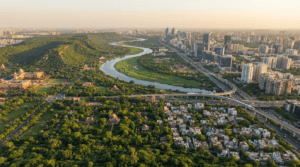
The state is strategically located in northern India and occupies a unique geographical position that has significantly influenced its historical development, political importance, economic growth, and urban expansion. The National Capital Territory (NCT) covers an area of approximately 1,484 square kilometers, making it one of India’s smallest administrative regions by area. Despite its relatively small size, Delhi has evolved into one of the world’s largest metropolitan regions and serves as the core of the National Capital Region (NCR).
The city is situated on the western bank of the Yamuna River, one of northern India’s most important rivers and a major tributary of the Ganga. The Yamuna flows from north to south through the eastern part of Delhi, providing fertile floodplains that have supported human settlements for thousands of years. Historically, access to the river contributed to the growth of ancient civilizations, trade routes, agriculture, and urban development.
Delhi is bordered by the state of Haryana on its northern, western, and southern sides, while Uttar Pradesh lies to the east across the Yamuna River. This strategic location places Delhi at the crossroads of northern India, connecting the Indo-Gangetic Plain with Rajasthan, Punjab, the Himalayan region, and central India. As a result, Delhi has remained an important center for commerce, transportation, administration, and cultural exchange for centuries.
One of Delhi’s most distinctive geographical features is the Delhi Ridge, which forms the northern extension of the ancient Aravalli Range, one of the oldest mountain systems in the world. The Ridge stretches across different parts of the city and acts as Delhi’s “green lungs” by improving air quality, supporting biodiversity, preventing soil erosion, and helping regulate the local climate. Several protected forests and biodiversity parks have been established along the Ridge to conserve its ecological importance.
The terrain of Delhi mainly consists of alluvial plains formed by the Yamuna River, interspersed with rocky outcrops of the Delhi Ridge. The fertile floodplains support agriculture in some peripheral areas, while the elevated Ridge provides natural drainage and ecological balance. Over the decades, rapid urbanization has transformed much of the landscape into residential, commercial, industrial, and institutional zones.
Delhi experiences a composite climate, characterized by extremely hot summers, a southwest monsoon season, pleasant autumns, cool winters, and a brief spring. Summer temperatures frequently exceed 45°C, while winter temperatures occasionally fall below 5°C. These seasonal variations influence agriculture, water availability, tourism, energy consumption, and daily life throughout the year.
The city’s natural vegetation originally consisted of tropical thorn forests, dry deciduous forests, grasslands, and riverine ecosystems. Although rapid urban growth has reduced natural habitats, several protected green spaces continue to preserve Delhi’s biodiversity. Important ecological areas include the Delhi Ridge forests, Yamuna Biodiversity Park, Aravalli Biodiversity Park, Sanjay Van, Asola Bhatti Wildlife Sanctuary, and numerous city parks and gardens.
Delhi also faces significant environmental challenges, including air pollution, groundwater depletion, urban flooding, waste management, and pressure on natural ecosystems due to population growth and rapid urban expansion. In response, various government agencies have implemented large-scale afforestation programs, biodiversity conservation initiatives, rainwater harvesting projects, river rejuvenation efforts, and sustainable urban planning measures to improve environmental quality.
Key Geographical Features
- Region: Northern India
- Total Area: 1,484 sq km
- Average Elevation: Approximately 216 meters (709 feet)
- Latitude: 28.6139° N
- Longitude: 77.2090° E
- Major River: Yamuna River
- Mountain Feature: Delhi Ridge (Northern extension of the Aravalli Range)
- Neighboring States: Haryana and Uttar Pradesh
- Climate Type: Composite Climate
- Physiographic Regions: Yamuna Floodplain, Alluvial Plains, Delhi Ridge
Delhi’s geography has played a defining role in shaping its history, economy, transportation network, environmental diversity, and urban development. Its strategic location, fertile river basin, ancient ridge system, and excellent connectivity continue to make Delhi one of India’s most influential and dynamic metropolitan regions.
Climate of Delhi
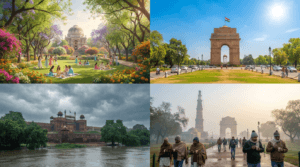
Delhi experiences a composite climate, characterized by extreme seasonal variations throughout the year. The city witnesses scorching summers, a humid monsoon season, pleasant autumn months, cold winters, and a short spring. These changing climatic conditions influence agriculture, tourism, public health, water resources, transportation, and the daily lifestyle of millions of residents.
Being located in the northern plains of India, Delhi does not experience the moderating influence of the sea. As a result, temperatures fluctuate significantly between summer and winter. The presence of the Yamuna River and the Delhi Ridge also plays an important role in shaping the city’s local weather patterns and ecological balance.
Summer begins in April and continues until June, with May and June being the hottest months of the year. During this period, daytime temperatures frequently range between 40°C and 45°C, while heatwave conditions occasionally push temperatures beyond 46°C. Hot, dry winds known as Loo blow across the region during the afternoon, making outdoor activities challenging. Residents generally prefer to stay indoors during peak afternoon hours due to the intense heat.
The Southwest Monsoon usually arrives in late June or early July and lasts until September. During this season, Delhi receives most of its annual rainfall, averaging around 700–800 millimeters each year. Rainfall helps lower temperatures and replenishes groundwater resources, but periods of heavy rain sometimes lead to waterlogging, traffic congestion, and localized flooding in low-lying areas.
Autumn arrives during October and November, bringing pleasant weather with clear skies, comfortable temperatures, and lower humidity. This period is considered one of the best seasons for sightseeing, outdoor activities, and cultural festivals. Major celebrations such as Dussehra, Diwali, and Guru Nanak Jayanti are observed during these months, attracting large numbers of visitors.
Winter extends from December to February and is marked by cool temperatures, dense morning fog, and occasional cold waves originating from the Himalayan region. Minimum temperatures sometimes fall below 5°C, while daytime temperatures generally remain between 15°C and 22°C. Dense fog during December and January may disrupt road, rail, and air transportation, particularly during the early morning hours.
A brief spring season occurs during March, when the weather remains pleasant with moderate temperatures and blooming vegetation. This short transitional period is widely appreciated for its comfortable climate before the onset of the hot summer months.
Delhi has witnessed noticeable climatic changes over recent decades due to rapid urbanization, population growth, and environmental pressures. Rising temperatures, increasing frequency of heatwaves, declining groundwater levels, and deteriorating air quality have become significant concerns. Government agencies are implementing various environmental initiatives, including afforestation, rainwater harvesting, green building practices, pollution control measures, and sustainable urban planning to mitigate the impact of climate change.
| Season | Months | Average Temperature | Key Characteristics |
|---|---|---|---|
| Summer | April – June | 30°C – 45°C | Extremely hot, dry weather, heatwaves, Loo winds |
| Monsoon | July – September | 25°C – 35°C | Heavy rainfall, high humidity, occasional flooding |
| Autumn | October – November | 18°C – 30°C | Pleasant weather, clear skies, festive season |
| Winter | December – February | 5°C – 22°C | Cold mornings, dense fog, cool days |
| Spring | March | 18°C – 30°C | Mild temperatures, blooming vegetation |
Delhi’s diverse climate adds to the city’s unique character by offering distinctly different experiences throughout the year. While summers can be intense and winters chilly, the pleasant weather during autumn and spring makes these seasons ideal for tourism, heritage walks, cultural events, and outdoor exploration.
Districts of Delhi
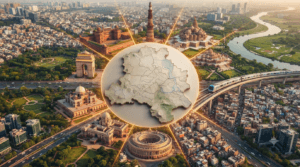
The National Capital Territory (NCT) of Delhi is administratively divided into 11 districts to ensure efficient governance, public administration, law enforcement, urban planning, revenue management, and the delivery of government services. Each district is headed by a District Magistrate (DM) or Deputy Commissioner (DC), who oversees administrative functions, disaster management, land records, elections, and coordination among various government departments.
Although Delhi covers a relatively small geographical area, its districts differ significantly in terms of population density, historical importance, economic activity, educational institutions, industrial development, residential neighborhoods, and commercial centers. Some districts are known for their historic monuments, while others have emerged as major hubs for business, education, information technology, and modern urban development.
The district administration plays a crucial role in implementing government welfare schemes, maintaining law and order in coordination with the Delhi Police, conducting elections, issuing official certificates, managing land revenue, and responding to emergencies. Each district is further divided into subdivisions and administrative units to facilitate efficient governance.
The following table provides an overview of the 11 districts of Delhi.
| District | Headquarters | Notable Features |
|---|---|---|
| Central Delhi | Daryaganj | Connaught Place, Chandni Chowk (part), government offices, commercial centers |
| East Delhi | Preet Vihar | Residential colonies, educational institutions, Akshardham Temple nearby |
| New Delhi | Connaught Place | Parliament House, Rashtrapati Bhavan, India Gate, central government institutions |
| North Delhi | Alipur | Educational institutions, historic areas, agricultural outskirts |
| North East Delhi | Nand Nagri | Densely populated residential neighborhoods |
| North West Delhi | Kanjhawala | Rural villages, industrial areas, educational institutions |
| Shahdara | Shahdara | Historic settlements, commercial markets, residential areas |
| South Delhi | Saket | Affluent residential localities, shopping malls, heritage monuments |
| South East Delhi | Defence Colony | Lotus Temple, commercial complexes, educational institutions |
| South West Delhi | Kapashera | Indira Gandhi International Airport, diplomatic and residential zones |
| West Delhi | Rajouri Garden | Shopping destinations, residential colonies, business establishments |
Delhi’s districts collectively represent a unique blend of ancient heritage and modern urbanization. The New Delhi district serves as India’s administrative and political center, housing the Parliament, Rashtrapati Bhavan, Supreme Court, and numerous Union Government offices. Central Delhi preserves the city’s historic commercial significance through landmarks such as Connaught Place and parts of Chandni Chowk, while South Delhi is renowned for its upscale residential neighborhoods, educational institutions, shopping malls, and historical monuments.
Several districts have developed into important educational and healthcare hubs, hosting prestigious universities, research institutions, multispecialty hospitals, and technology centers. Industrial estates, wholesale markets, logistics facilities, and business parks located across various districts significantly contribute to Delhi’s economy and employment opportunities.
With continuous urban expansion and the growth of the National Capital Region (NCR), Delhi’s district administration continues to evolve by adopting digital governance, smart city initiatives, improved public services, modern infrastructure, and sustainable urban planning. These efforts help maintain efficient administration while addressing the needs of one of the world’s largest metropolitan populations.
Government and Administration of Delhi
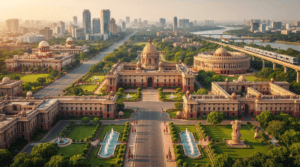
Delhi has a unique administrative structure that distinguishes it from both Indian states and other Union Territories. Officially known as the National Capital Territory (NCT) of Delhi, it functions under a special constitutional framework established by the 69th Constitutional Amendment Act, 1991, which inserted Article 239AA into the Constitution of India. This arrangement provides Delhi with a Legislative Assembly and a Council of Ministers while reserving certain powers for the Central Government because Delhi is the national capital.
The President of India administers the National Capital Territory through the Lieutenant Governor (LG), who serves as the constitutional head of Delhi. The Lieutenant Governor is appointed by the President and represents the Union Government in the administration of the National Capital Territory. The LG exercises specific powers in matters reserved for the Central Government and works in coordination with the elected government.
The elected government of Delhi is headed by the Chief Minister, who serves as the head of the Council of Ministers. The Chief Minister and the Council of Ministers are collectively responsible for the administration of subjects assigned to the Legislative Assembly. These include sectors such as education, health, transport, tourism, agriculture, social welfare, public works, and several other state-level administrative functions.
However, unlike a full-fledged state, Delhi’s Legislative Assembly does not have legislative authority over public order, police, and land. These three important subjects remain under the jurisdiction of the Central Government through the Lieutenant Governor and the Ministry of Home Affairs. The Delhi Police functions under the Ministry of Home Affairs, Government of India, rather than the Government of NCT of Delhi.
The Legislative Assembly of Delhi consists of 70 elected Members of the Legislative Assembly (MLAs) who are chosen through direct elections held every five years unless dissolved earlier. The Assembly debates legislation, approves budgets, discusses public issues, and monitors the functioning of the elected government through various legislative procedures.
The judicial system in Delhi is headed by the High Court of Delhi, which was established in 1966. The High Court exercises jurisdiction over the National Capital Territory and hears civil, criminal, constitutional, and administrative cases. Below the High Court, various district courts handle local judicial matters across different districts.
Local governance within Delhi is managed through multiple civic bodies responsible for urban administration and public services. These institutions oversee sanitation, waste management, roads, parks, primary education, public health facilities, property taxation, and urban development within their respective jurisdictions.
Major Administrative Institutions
- Constitutional Status: National Capital Territory (NCT)
- Constitutional Provision: Article 239AA
- Administrative Head: Lieutenant Governor
- Head of Government: Chief Minister
- Legislature: Delhi Legislative Assembly
- Assembly Strength: 70 Members
- High Court: High Court of Delhi
- Police Administration: Ministry of Home Affairs, Government of India
- National Parliament Representation:
- Lok Sabha – 7 Seats
- Rajya Sabha – 3 Seats
Delhi’s governance model reflects the balance between national interests and local self-governance. As the capital of the world’s largest democracy, the city accommodates the country’s highest constitutional institutions while simultaneously managing the civic needs of millions of residents. This unique administrative framework enables Delhi to function both as India’s national capital and as a rapidly developing metropolitan region with its own elected government.
Economy of Delhi
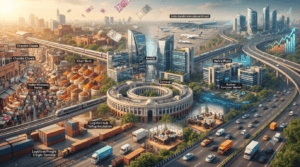
Delhi has one of the largest and most diversified economies in India, making it a major center for commerce, finance, information technology, retail, tourism, education, healthcare, and government administration. As the National Capital Territory (NCT) of India, Delhi benefits from its strategic location, world-class infrastructure, highly skilled workforce, and strong connectivity with other parts of the country. The city’s economy is predominantly service-oriented, with the services sector contributing the largest share to its Gross State Domestic Product (GSDP).
The National Capital Region (NCR), which includes Delhi and neighboring cities such as Gurugram, Noida, Ghaziabad, Faridabad, and Greater Noida, forms one of the largest economic regions in South Asia. This integrated metropolitan area has attracted substantial domestic and foreign investment, resulting in rapid industrialization, technological innovation, and urban development.
The services sector is the backbone of Delhi’s economy, contributing more than 80% of its Gross State Domestic Product. Government administration, banking, finance, insurance, information technology, telecommunications, hospitality, education, healthcare, media, and professional services collectively generate significant employment and economic output. Being the seat of the Government of India, Delhi also hosts numerous ministries, public sector organizations, foreign embassies, multinational corporations, and international institutions.
Trade and commerce have been integral to Delhi’s economy for centuries. Traditional wholesale markets such as Chandni Chowk, Khari Baoli, Sadar Bazaar, Nehru Place, Azadpur Mandi, and Ghazipur Market continue to play a vital role in domestic and international trade. Azadpur Mandi is recognized as one of Asia’s largest wholesale fruit and vegetable markets, while Khari Baoli is famous as one of the world’s largest spice markets.
Delhi has also emerged as an important hub for information technology, startups, fintech, e-commerce, digital services, and innovation. The presence of modern business districts, technology parks, incubation centers, research institutions, and highly qualified professionals has encouraged the growth of technology-based enterprises. Many multinational companies operate regional or national headquarters within Delhi and the surrounding NCR.
Manufacturing remains an important component of Delhi’s economy despite the dominance of the service sector. Industries including textiles, garments, leather products, electrical equipment, printing, pharmaceuticals, electronics, food processing, plastics, and engineering goods contribute to industrial production and employment. Several industrial estates support small and medium-sized enterprises (SMEs), which form the backbone of local manufacturing.
Tourism is another major contributor to Delhi’s economy. Millions of domestic and international tourists visit the city every year to explore its UNESCO World Heritage Sites, historical monuments, museums, religious places, shopping destinations, cultural festivals, and culinary attractions. Hospitality, transportation, retail trade, handicrafts, and entertainment industries generate substantial revenue through tourism-related activities.
Delhi is also a leading center for education and healthcare. Prestigious universities, research institutions, hospitals, and medical tourism facilities attract students and patients from across India and abroad. These sectors create significant employment opportunities while strengthening Delhi’s position as a knowledge and healthcare hub.
Major Economic Sectors
- Government Administration
- Banking and Financial Services
- Information Technology (IT)
- Business Process Outsourcing (BPO)
- E-commerce and Startups
- Retail and Wholesale Trade
- Tourism and Hospitality
- Education and Research
- Healthcare and Medical Services
- Manufacturing and Small Industries
- Media and Entertainment
- Logistics and Transportation
The Government of Delhi continues to promote sustainable economic growth through infrastructure development, digital governance, startup support, skill development, public transportation expansion, smart city initiatives, environmental sustainability, and investment-friendly policies. These efforts have strengthened Delhi’s reputation as one of India’s most dynamic economic centers and an important contributor to the national economy.
Culture and Traditions of Delhi
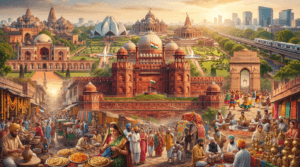
Delhi is one of India’s most culturally diverse cities, where centuries of history, migration, and social integration have created a vibrant multicultural society. As the National Capital Territory of India, Delhi welcomes people from every state and union territory, making it a melting pot of languages, religions, customs, cuisines, art forms, and traditions. This remarkable diversity has shaped Delhi into a city where ancient heritage coexists harmoniously with modern lifestyles.
The cultural identity of Delhi has evolved through the influence of numerous dynasties, including the Tomaras, Chauhans, Delhi Sultanate, Mughals, and the British. Each period contributed unique architectural styles, literary traditions, music, cuisine, clothing, festivals, and artistic expressions. Even today, these historical influences are visible in Delhi’s monuments, markets, museums, performing arts, and everyday life.
Hindi is the most widely spoken language in Delhi, while English serves as an important language for education, business, and administration. Punjabi and Urdu are also commonly spoken due to historical migration and cultural heritage. In addition, people from different parts of India speak Bengali, Tamil, Telugu, Marathi, Gujarati, Malayalam, Kannada, Odia, Assamese, and several other regional languages, reflecting the city’s cosmopolitan character.
Delhi celebrates festivals from almost every region of India with great enthusiasm. Festivals such as Diwali, Holi, Dussehra, Eid-ul-Fitr, Eid-ul-Adha, Christmas, Guru Nanak Jayanti, Durga Puja, Chhath Puja, Lohri, Baisakhi, Janmashtami, and Ganesh Chaturthi bring together people from different communities in an atmosphere of unity and mutual respect. Cultural fairs, music festivals, food festivals, and exhibitions are organized throughout the year, further enriching Delhi’s cultural landscape.
Traditional performing arts continue to play an important role in Delhi’s cultural life. Classical dance forms such as Kathak, Bharatanatyam, Odissi, Kuchipudi, and Manipuri are regularly performed at cultural institutions and auditoriums. Hindustani classical music, Sufi music, Ghazals, Qawwalis, folk performances, theatre productions, and contemporary art events attract audiences from across the country and abroad.
Delhi is also known for its literary heritage and intellectual traditions. The city hosts numerous book fairs, literary festivals, academic conferences, and cultural discussions every year. Institutions such as the Sahitya Akademi, National School of Drama (NSD), Sangeet Natak Akademi, Lalit Kala Akademi, and the India International Centre contribute significantly to the promotion of literature, performing arts, visual arts, and cultural research.
The city’s traditional attire reflects its multicultural society. While modern western clothing is widely worn, traditional Indian garments such as sarees, salwar kameez, kurta-pajama, sherwani, lehenga, and Punjabi suits remain popular during festivals, weddings, religious ceremonies, and cultural celebrations.
Delhi’s street markets, handicrafts, traditional jewelry, carpets, textiles, pottery, brassware, leather goods, and handmade artifacts represent the artistic skills of craftsmen from across India. Popular shopping destinations such as Chandni Chowk, Dilli Haat, Janpath Market, Sarojini Nagar, and Khan Market showcase both traditional craftsmanship and contemporary fashion.
Cultural Highlights
- Multicultural population representing every Indian state
- Rich Mughal, Sultanate, and British heritage
- Diverse languages including Hindi, English, Punjabi, and Urdu
- Grand celebrations of national, regional, and religious festivals
- Classical music, dance, theatre, and literary traditions
- Renowned museums, art galleries, and cultural institutions
- Traditional handicrafts, textiles, jewelry, and artisan markets
- A harmonious blend of heritage and modern urban culture
Delhi’s culture reflects the true spirit of India’s “Unity in Diversity.” The city’s ability to preserve its historical legacy while embracing modern ideas has made it one of the country’s most dynamic cultural capitals. Whether through festivals, performing arts, literature, architecture, cuisine, or everyday life, Delhi continues to celebrate the rich traditions that have shaped its identity for centuries.
Festivals of Delhi
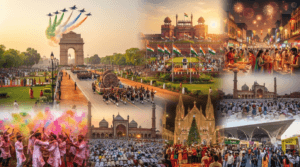
Delhi is a city where festivals are celebrated with extraordinary enthusiasm, reflecting the cultural diversity and religious harmony of India’s National Capital Territory. As people from every state and union territory have made Delhi their home, the city witnesses the celebration of almost every major Indian festival with equal joy and participation. These festivals strengthen social unity, preserve cultural traditions, and attract tourists from across the country and around the world.
The festive season in Delhi begins with celebrations such as Lohri and Makar Sankranti in January. Lohri is especially popular among the Punjabi community, where people gather around bonfires, sing traditional folk songs, perform energetic Bhangra and Gidda dances, and distribute sweets made from sesame seeds, jaggery, and peanuts. Makar Sankranti marks the transition of the Sun into Capricorn and is celebrated with prayers, charitable activities, and traditional foods.
Republic Day, celebrated on 26 January, holds special significance in Delhi as the city hosts India’s grand national parade along Kartavya Path. The event showcases the country’s military strength, cultural diversity, technological achievements, and patriotic spirit through colorful tableaux, marching contingents, and aerial displays by the Indian Armed Forces.
One of the most vibrant festivals in Delhi is Holi, the Festival of Colors, celebrated during March. Families, friends, and communities come together to apply colorful powders, splash water, exchange sweets, sing traditional songs, and enjoy festive gatherings. Parks, residential colonies, and community centers organize Holi celebrations filled with music, dance, and cultural performances.
The holy month of Ramadan concludes with Eid-ul-Fitr, one of the most significant festivals for Delhi’s Muslim community. Historic areas such as Jama Masjid, Chandni Chowk, and Nizamuddin come alive with prayers, illuminated streets, delicious traditional cuisine, and bustling evening markets. Eid-ul-Adha is also celebrated with religious devotion and community gatherings across the city.
Janmashtami, commemorating the birth of Lord Krishna, is celebrated with devotional singing, temple decorations, and cultural programs. Prominent temples including ISKCON Temple and Birla Mandir attract thousands of devotees who participate in midnight prayers and spiritual events.
During September and October, Delhi celebrates Ganesh Chaturthi, Navratri, and Durga Puja with immense devotion. Beautifully decorated Durga Puja pandals are established by Bengali communities across the city, while Garba and Dandiya dance events organized during Navratri attract participants from various cultural backgrounds.
Dussehra marks the victory of Lord Rama over Ravana and symbolizes the triumph of good over evil. Large Ramlila performances are organized throughout Delhi, culminating in the burning of giant effigies of Ravana, Meghnad, and Kumbhakarna. These celebrations attract thousands of spectators every year.
Diwali, the Festival of Lights, is among the grandest celebrations in Delhi. Homes, markets, temples, offices, and public buildings are decorated with oil lamps, candles, colorful lights, rangoli designs, and flowers. Families worship Goddess Lakshmi, exchange gifts and sweets, and celebrate with cultural traditions that symbolize prosperity, happiness, and the victory of light over darkness.
Other important festivals celebrated in Delhi include Guru Nanak Jayanti, Christmas, Buddha Purnima, Mahavir Jayanti, Chhath Puja, Baisakhi, and Independence Day. The city also hosts numerous cultural festivals, book fairs, food festivals, music concerts, handicraft exhibitions, and international events throughout the year.
Major Festivals Celebrated in Delhi
- Republic Day
- Holi
- Ramadan and Eid-ul-Fitr
- Eid-ul-Adha
- Janmashtami
- Ganesh Chaturthi
- Navratri
- Durga Puja
- Dussehra
- Diwali
- Guru Nanak Jayanti
- Christmas
- Lohri
- Makar Sankranti
- Baisakhi
- Chhath Puja
- Buddha Purnima
- Mahavir Jayanti
- Independence Day
Delhi’s festivals beautifully represent the spirit of unity in diversity, where people from different religions, cultures, and linguistic backgrounds participate in each other’s celebrations with mutual respect and enthusiasm. This vibrant festive atmosphere remains one of the defining characteristics of India’s national capital.
Famous Food of Delhi
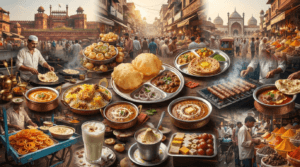
Delhi is widely regarded as one of India’s greatest culinary destinations, offering an extraordinary blend of traditional recipes, royal Mughlai cuisine, Punjabi flavors, North Indian specialties, and popular street food. Over centuries, rulers, traders, migrants, and communities from different parts of India have contributed to the city’s rich gastronomic heritage. Today, Delhi’s food culture reflects its multicultural identity, where authentic regional cuisines coexist with modern cafés, fine-dining restaurants, and vibrant street food markets.
The city’s culinary traditions have been significantly influenced by the Mughal Empire, which introduced rich gravies, aromatic spices, slow-cooked meats, kebabs, and biryanis. Following the Partition of India in 1947, Punjabi refugees further enriched Delhi’s cuisine by popularizing dishes such as butter chicken, dal makhani, tandoori chicken, stuffed parathas, and creamy curries. Over time, migrants from every Indian state brought their own regional specialties, making Delhi one of the most diverse food capitals in Asia.
Street food is an inseparable part of Delhi’s identity. Bustling markets such as Chandni Chowk, Karol Bagh, Connaught Place, Lajpat Nagar, Sarojini Nagar, and INA Market attract food lovers with hundreds of stalls serving freshly prepared delicacies. These markets remain popular among both residents and tourists seeking authentic local flavors at affordable prices.
One of Delhi’s most iconic dishes is Chole Bhature, consisting of spicy chickpea curry served with deep-fried fluffy bread. Another favorite is Paratha, especially the stuffed varieties available at the famous Paranthe Wali Gali in Old Delhi. Stuffings commonly include potato, paneer, cauliflower, radish, mixed vegetables, and lentils, accompanied by pickles, yogurt, and chutneys.
Delhi is equally famous for its delicious street snacks. Gol Gappe (Pani Puri), Aloo Tikki, Papdi Chaat, Dahi Bhalla, Raj Kachori, and Kachori are enjoyed throughout the city. These snacks combine spicy, tangy, sweet, and savory flavors, creating a unique culinary experience that attracts visitors from across the world.
The city is also renowned for its Mughlai delicacies such as Butter Chicken, Seekh Kebabs, Shami Kebabs, Chicken Biryani, Nihari, and Mutton Korma. Restaurants in areas like Jama Masjid and Old Delhi have preserved traditional recipes that have been passed down through generations.
No visit to Delhi is complete without tasting its famous desserts. Jalebi, Rabri, Kulfi Falooda, Gajar Ka Halwa, Kheer, and Gulab Jamun are among the city’s most loved sweets. During winter, hot jalebis served with creamy rabri become a favorite treat among locals and tourists alike.
Delhi’s beverage culture is equally diverse. Traditional drinks such as Lassi, Masala Chai, Badam Milk, and refreshing seasonal juices remain popular, while modern cafés serve specialty coffee, mocktails, and international beverages to cater to changing lifestyles.
Popular Foods of Delhi
| Dish | Description |
|---|---|
| Chole Bhature | Spicy chickpea curry served with deep-fried bread |
| Stuffed Paratha | Flatbread stuffed with vegetables, paneer, or lentils |
| Butter Chicken | Creamy tomato-based chicken curry |
| Dal Makhani | Slow-cooked black lentils with butter and cream |
| Seekh Kebabs | Minced meat grilled on skewers |
| Chicken Biryani | Aromatic rice cooked with spices and chicken |
| Gol Gappe | Crispy hollow puris filled with flavored water |
| Aloo Tikki | Crispy potato patties served with chutneys |
| Papdi Chaat | Popular street snack with yogurt and chutneys |
| Jalebi with Rabri | Traditional sweet dessert |
| Kulfi Falooda | Indian frozen dessert with vermicelli |
| Lassi | Traditional yogurt-based drink |
Delhi’s food culture perfectly reflects the city’s history, diversity, and hospitality. Whether enjoying authentic Mughlai cuisine in the narrow lanes of Old Delhi, savoring spicy street food at bustling markets, or dining in world-class restaurants, visitors experience a remarkable culinary journey that makes Delhi one of India’s finest food destinations.
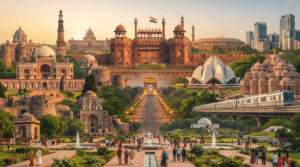
Famous Tourist Places in Delhi (Part 1)
Delhi is one of India’s most visited tourist destinations, offering a remarkable blend of ancient heritage, Mughal architecture, colonial landmarks, modern attractions, museums, gardens, religious sites, and vibrant markets. As the capital of India, Delhi attracts millions of domestic and international visitors every year who come to explore its rich history, diverse culture, and iconic monuments. Several of its landmarks are recognized as UNESCO World Heritage Sites, while others serve as important symbols of India’s democracy, spirituality, and architectural excellence.
Due to the large number of attractions, Delhi’s tourist destinations can be broadly categorized into historical monuments, religious places, museums, gardens, shopping areas, and modern entertainment hubs. Whether visitors are interested in history, architecture, photography, food, shopping, or cultural experiences, Delhi offers something for every traveler.
Top Tourist Attractions in Delhi
| Tourist Place | Highlights |
|---|---|
| Red Fort | UNESCO World Heritage Site, Mughal architecture, Independence Day celebrations |
| Qutub Minar | World’s tallest brick minaret, UNESCO World Heritage Site |
| India Gate | National war memorial and popular evening attraction |
| Humayun’s Tomb | UNESCO World Heritage Site and inspiration for the Taj Mahal |
| Lotus Temple | Bahá’í House of Worship famous for its lotus-shaped architecture |
| Akshardham Temple | Magnificent Hindu temple complex with exhibitions and musical fountain |
| Jama Masjid | One of India’s largest and most historic mosques |
| Rashtrapati Bhavan | Official residence of the President of India |
| Raj Ghat | Memorial dedicated to Mahatma Gandhi |
| Purana Qila | Historic fort associated with ancient Indraprastha |
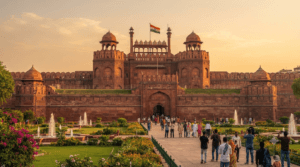
Red Fort
The Red Fort (Lal Qila) is one of Delhi’s most iconic landmarks and a UNESCO World Heritage Site. Built by Emperor Shah Jahan in 1648 using red sandstone, the fort served as the principal residence of the Mughal emperors for nearly two centuries. Its magnificent walls, elegant palaces, Diwan-i-Aam, Diwan-i-Khas, Rang Mahal, and beautiful gardens showcase the brilliance of Mughal architecture. Every year on 15 August, the Prime Minister of India hoists the national flag from the Red Fort and addresses the nation.
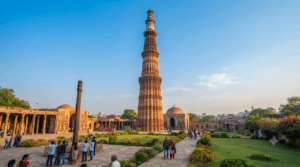
Qutub Minar
Standing at approximately 72.5 metres, the Qutub Minar is the tallest brick minaret in the world and another UNESCO World Heritage Site. Construction began in 1192 under Qutb-ud-din Aibak and was completed by his successors. The monument features intricate carvings, Quranic inscriptions, and Indo-Islamic architectural elements. The surrounding Qutub Complex includes the Iron Pillar, Alai Darwaza, Alai Minar, and the Quwwat-ul-Islam Mosque, making it one of Delhi’s most significant archaeological sites.
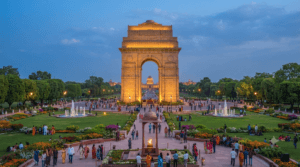
India Gate
India Gate is a 42-metre-high war memorial built to honor thousands of Indian soldiers who lost their lives during the First World War and the Third Anglo-Afghan War. Designed by British architect Sir Edwin Lutyens, the monument has become one of Delhi’s most recognizable landmarks. The beautifully landscaped lawns surrounding India Gate are popular gathering spots for families, while the illuminated monument creates a spectacular view during the evening. Nearby, the National War Memorial further commemorates the sacrifices of Indian armed forces personnel.
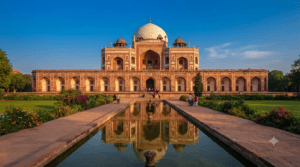
Humayun’s Tomb
Constructed in the 16th century by Empress Bega Begum in memory of Emperor Humayun, Humayun’s Tomb is regarded as one of the finest examples of Mughal architecture. It was the first major garden tomb built on the Indian subcontinent and later inspired the architectural design of the Taj Mahal. The monument’s symmetrical gardens, elegant domes, intricate carvings, and Persian-inspired
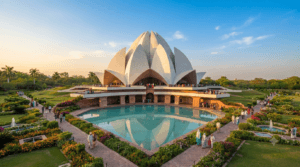
Lotus Temple
The Lotus Temple, completed in 1986, is one of Delhi’s most recognizable architectural landmarks and serves as the Bahá’í House of Worship for the Indian subcontinent. Designed by Iranian architect Fariborz Sahba, the temple resembles a blooming white lotus with 27 marble petals arranged in clusters. The structure symbolizes purity, peace, and unity among all religions.
Unlike many places of worship, the Lotus Temple welcomes people of every faith without discrimination. Visitors gather inside its spacious prayer hall for silent meditation and reflection, as no religious rituals or sermons are conducted. Surrounded by landscaped gardens and tranquil water pools, the temple has become one of the most visited attractions in the world, admired for both its spiritual atmosphere and innovative architecture.
Akshardham Temple
The Swaminarayan Akshardham Temple, inaugurated in 2005, is one of the largest Hindu temple complexes in the world. Built from intricately carved pink sandstone and white marble, the monument showcases India’s rich artistic, spiritual, and cultural heritage.
The temple complex includes magnificent sculptures, beautifully landscaped gardens, exhibitions on Indian civilization, a giant-screen theater, a cultural boat ride depicting India’s ancient achievements, and the spectacular Sahaj Anand Water Show, which combines light, sound, music, and fountains. Akshardham attracts millions of visitors annually and stands as one of Delhi’s finest examples of modern temple architecture.
Jama Masjid
The Jama Masjid is one of India’s largest and most magnificent mosques. Commissioned by Emperor Shah Jahan and completed in 1656, the mosque is constructed from red sandstone and white marble. It can accommodate more than 25,000 worshippers during major religious gatherings.
Its grand courtyard, elegant domes, towering minarets, and intricate calligraphy reflect the excellence of Mughal architecture. Visitors who climb the southern minaret are rewarded with panoramic views of Old Delhi, including the bustling streets of Chandni Chowk and the nearby Red Fort.
Rashtrapati Bhavan
Rashtrapati Bhavan is the official residence of the President of India and one of the largest presidential residences in the world. Designed by renowned British architect Sir Edwin Lutyens, the building was completed in 1929 and originally served as the residence of the Viceroy of British India.
The magnificent structure features impressive domes, grand halls, elegant corridors, and the world-famous Mughal Gardens (now known as Amrit Udyan), which are opened to visitors during the annual public viewing season. Rashtrapati Bhavan symbolizes the dignity, democratic values, and constitutional heritage of the Republic of India.
Raj Ghat
Raj Ghat is the national memorial dedicated to Mahatma Gandhi, the Father of the Nation. Situated on the banks of the Yamuna River, the memorial marks the site where Gandhi was cremated on 31 January 1948.
The simple black marble platform bears the words “Hey Ram,” believed to be Gandhi’s final utterance. Beautiful gardens, peaceful surroundings, and eternal flames create an atmosphere of serenity, making Raj Ghat an important destination for visitors, dignitaries, and world leaders paying tribute to Mahatma Gandhi.
Purana Qila
Purana Qila (Old Fort) is one of Delhi’s oldest surviving forts and is traditionally associated with the ancient city of Indraprastha, mentioned in the Mahabharata. The existing fort was expanded during the reigns of Humayun and Sher Shah Suri in the 16th century.
The massive gateways, thick defensive walls, ancient mosque, archaeological museum, and scenic lake make Purana Qila a popular destination for history enthusiasts. Evening sound-and-light shows narrate the fascinating history of Delhi through captivating visual presentations.
Lodhi Garden
Lodhi Garden is one of Delhi’s most beautiful urban parks, spread across approximately 90 acres in the heart of the city. The garden is home to magnificent tombs dating back to the 15th and 16th centuries, including the tombs of Sikandar Lodi, Mohammed Shah, Shisha Gumbad, and Bara Gumbad. These monuments beautifully blend Sayyid and Lodi architectural styles.
Today, Lodhi Garden is a favorite destination for morning walkers, joggers, photographers, birdwatchers, and nature lovers. Its lush green lawns, flowering plants, artificial ponds, and shaded pathways provide a peaceful escape from the busy city life while preserving Delhi’s medieval heritage.
National Museum
The National Museum, established in 1949, is one of India’s largest and most prestigious museums. Located on Janpath, it houses an extraordinary collection of more than 200,000 artifacts representing over 5,000 years of Indian history.
Its galleries display treasures from the Indus Valley Civilization, ancient sculptures, coins, manuscripts, textiles, paintings, jewelry, Buddhist relics, decorative arts, and archaeological discoveries. The museum offers visitors a comprehensive understanding of India’s cultural, artistic, and historical evolution.
National Rail Museum
The National Rail Museum showcases the fascinating history and technological development of Indian Railways. Spread across a large open campus, the museum displays historic steam locomotives, diesel engines, electric locomotives, royal railway coaches, vintage carriages, signaling equipment, and railway memorabilia.
A miniature toy train ride allows visitors to explore the museum grounds, making it especially popular among families and children. Interactive galleries explain the evolution of railway transportation and its contribution to India’s economic and social development.
Jantar Mantar
Built in 1724 by Maharaja Sawai Jai Singh II of Jaipur, Jantar Mantar is an astronomical observatory featuring massive masonry instruments used to study celestial movements and measure time with remarkable accuracy.
The observatory consists of several scientific instruments designed to calculate planetary positions, determine local time, and observe astronomical events. It stands as an outstanding example of India’s scientific achievements during the early eighteenth century.
Dilli Haat
Dilli Haat is a unique open-air cultural marketplace that showcases the handicrafts, handlooms, folk art, and traditional cuisine of different Indian states. Artisans from across the country display handmade textiles, pottery, jewelry, paintings, wood carvings, bamboo crafts, leather products, and decorative items.
The food court offers authentic regional dishes representing nearly every Indian state, allowing visitors to experience India’s incredible culinary diversity in a single location. Cultural performances, folk dances, music festivals, and craft exhibitions are regularly organized at Dilli Haat.
Connaught Place
Connaught Place (CP) is one of Delhi’s most famous commercial, financial, and entertainment districts. Designed by British architect Robert Tor Russell, its elegant Georgian-style architecture features circular colonnades surrounding landscaped parks and bustling marketplaces.
The area is home to premium retail stores, restaurants, cafés, cinemas, bookstores, hotels, and corporate offices. Nearby attractions include Central Park, Janpath Market, and Palika Bazaar, making Connaught Place one of Delhi’s busiest tourist and shopping destinations.
Chandni Chowk
Founded by Jahanara Begum, the daughter of Emperor Shah Jahan, Chandni Chowk is one of the oldest and busiest markets in India. Its narrow lanes are filled with centuries-old shops selling jewelry, textiles, spices, dry fruits, books, electronics, wedding attire, and traditional Indian sweets.
The market is equally famous for its legendary street food, including Paranthe Wali Gali, Jalebi, Chole Bhature, Daulat Ki Chaat, and numerous Mughlai delicacies. Chandni Chowk offers visitors an unforgettable glimpse into Delhi’s vibrant commercial and cultural heritage.
Garden of Five Senses
The Garden of Five Senses is a beautifully landscaped park designed to stimulate all five human senses through artistic landscaping, sculptures, flowering gardens, waterfalls, bamboo courts, themed pathways, and open-air art installations.
The garden regularly hosts cultural festivals, food events, flower exhibitions, and music performances, making it a popular recreational destination for families, photographers, and nature enthusiasts.
National Zoological Park
The National Zoological Park, popularly known as the Delhi Zoo, was established in 1959 near the historic Purana Qila. Spread over approximately 176 acres, it is one of India’s largest and best-maintained zoological parks. The zoo houses more than a thousand animals and birds representing numerous species from India and around the world.
Visitors can observe majestic Royal Bengal Tigers, Asiatic Lions, Indian Rhinoceroses, Asian Elephants, Leopards, Hippopotamuses, Giraffes, Zebras, White Tigers, crocodiles, reptiles, and a wide variety of colorful birds. The zoo plays an important role in wildlife conservation, captive breeding, environmental education, and public awareness about biodiversity.
Agrasen Ki Baoli
Agrasen Ki Baoli is a remarkable historical stepwell located in the heart of New Delhi. Measuring approximately 60 metres long and 15 metres wide, the structure consists of 108 stone steps leading to the water reservoir below.
Although its exact origin remains uncertain, the baoli is traditionally associated with the legendary King Agrasen and was later rebuilt during the medieval period. Today, its impressive stone arches, symmetrical design, and mysterious atmosphere make it a favorite destination for photographers, filmmakers, and history enthusiasts.
Hauz Khas Complex
The Hauz Khas Complex is a unique heritage site that combines medieval Islamic architecture with modern urban culture. Developed during the reign of Alauddin Khalji, the complex includes an ancient water reservoir, mosque, madrasa, pavilions, tombs, and the mausoleum of Firoz Shah Tughlaq.
Adjacent to the historical monuments lies the vibrant Hauz Khas Village, known for its cafés, restaurants, boutiques, art galleries, and nightlife. This blend of heritage and contemporary lifestyle makes Hauz Khas one of Delhi’s most distinctive tourist destinations.
Safdarjung’s Tomb
Built in 1754, Safdarjung’s Tomb is the magnificent mausoleum of Safdarjung, the Nawab of Awadh. Constructed from red sandstone and marble, the monument represents the final phase of Mughal architecture before the decline of the empire.
Its beautifully landscaped Charbagh gardens, elegant domes, ornamental gateways, and symmetrical layout resemble Humayun’s Tomb, making it one of Delhi’s finest late Mughal monuments and an excellent example of eighteenth-century architecture.
ISKCON Temple
The ISKCON Temple, also known as the Sri Sri Radha Parthasarathi Temple, is one of Delhi’s most visited Hindu temples. Dedicated to Lord Krishna and Radha, the temple is renowned for its devotional atmosphere, beautiful idols, spiritual discourses, and daily bhajan and kirtan performances.
The complex also houses the Vedic Cultural Centre, exhibitions on the Bhagavad Gita, vegetarian restaurants, bookstores, and educational programs, attracting devotees and tourists from around the world.
Birla Mandir (Laxminarayan Temple)
The Laxminarayan Temple, popularly known as Birla Mandir, was inaugurated in 1939 by Mahatma Gandhi. Dedicated to Lord Vishnu (Narayan) and Goddess Lakshmi, the temple is one of Delhi’s most prominent places of worship.
Constructed with marble and red sandstone, the temple features beautifully carved shrines, gardens, fountains, and halls depicting scenes from Hindu mythology. It welcomes devotees from all communities and remains especially crowded during Janmashtami and Diwali celebrations.
Adventure Island
Located in Rohini, Adventure Island is one of Delhi’s leading amusement parks, offering a wide range of thrilling rides, water attractions, family entertainment, and recreational activities. The park features roller coasters, splash rides, children’s attractions, themed zones, live performances, and food courts.
Situated adjacent to Metro Walk Mall, Adventure Island is a popular weekend destination for families, children, and tourists seeking entertainment beyond Delhi’s historical attractions.
Tourist Highlights at a Glance
| Attraction | Specialty |
|---|---|
| National Zoological Park | Wildlife conservation and family recreation |
| Agrasen Ki Baoli | Historic stepwell and architectural landmark |
| Hauz Khas Complex | Medieval monuments and modern cafés |
| Safdarjung’s Tomb | Late Mughal architecture |
| ISKCON Temple | Spiritual and cultural center |
| Birla Mandir | Famous Hindu temple |
| Adventure Island | Amusement and entertainment park |
This completes the Famous Tourist Places in Delhi section, covering Delhi’s most important historical monuments, religious landmarks, museums, gardens, markets, cultural attractions, and recreational destinations that collectively make the National Capital one of India’s premier tourism hubs.
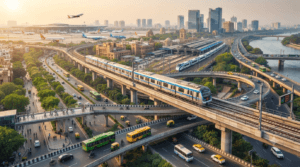
Transport in Delhi
Delhi has one of the most advanced and well-connected transportation systems in India. As the National Capital Territory (NCT) and the center of the National Capital Region (NCR), the city serves as a major hub for road, rail, air, and metro connectivity. An extensive transport network enables millions of residents, commuters, and tourists to travel efficiently within the city and to other parts of the country.
The Delhi Metro is the backbone of the city’s public transportation system. Operated by the Delhi Metro Rail Corporation (DMRC), it is one of the largest and most modern metro networks in the world. Covering Delhi and neighboring cities such as Noida, Gurugram, Ghaziabad, Faridabad, and Bahadurgarh, the metro provides fast, safe, and environmentally friendly travel. Modern stations, air-conditioned coaches, digital ticketing, and excellent connectivity have made the Delhi Metro a model for urban transit in India.
The Delhi Transport Corporation (DTC) and cluster bus services operate one of the country’s largest city bus networks. Thousands of buses connect residential areas, commercial centers, educational institutions, industrial zones, and government offices. In recent years, Delhi has expanded the use of electric buses to promote sustainable urban transportation and reduce air pollution.
Road transportation plays a vital role in Delhi’s connectivity. The city is linked by a network of national highways and expressways, including the Delhi–Mumbai Expressway, Delhi–Meerut Expressway, Delhi–Noida Direct (DND) Flyway, Yamuna Expressway, and the Eastern and Western Peripheral Expressways. Major arterial roads such as Ring Road and Outer Ring Road help facilitate the movement of traffic across the capital.
Delhi is also one of India’s most important railway hubs. Major railway stations include New Delhi Railway Station, Old Delhi Railway Station, Hazrat Nizamuddin Railway Station, Anand Vihar Terminal, and Delhi Sarai Rohilla Railway Station. These stations provide regular train services connecting Delhi with all regions of India, including major metropolitan cities, state capitals, pilgrimage destinations, and tourist centers.
Air connectivity is provided through the Indira Gandhi International Airport (IGI Airport), one of the busiest airports in South Asia. The airport operates domestic and international flights to hundreds of destinations worldwide and serves as a major aviation hub for India. Modern terminals, cargo facilities, metro connectivity, and world-class passenger services contribute to its international reputation.
Other popular modes of transport in Delhi include auto-rickshaws, taxis, app-based cab services, e-rickshaws, cycle-rickshaws, rental bicycles, and two-wheelers. These options provide convenient last-mile connectivity and support daily commuting across different parts of the city.
Major Transport Facilities in Delhi
| Mode of Transport | Major Facilities |
|---|---|
| Metro Rail | Delhi Metro covering Delhi and NCR |
| City Buses | DTC and Cluster Bus Services |
| Railways | New Delhi, Old Delhi, Hazrat Nizamuddin, Anand Vihar, Delhi Sarai Rohilla |
| Airport | Indira Gandhi International Airport |
| Highways | Delhi–Mumbai Expressway, DND Flyway, Delhi–Meerut Expressway, Yamuna Expressway |
| Local Transport | Auto-rickshaws, taxis, e-rickshaws, app-based cabs, cycle-rickshaws |
Delhi continues to strengthen its transportation infrastructure through metro expansion, electric mobility, intelligent traffic management, expressway development, and sustainable urban transport initiatives. These efforts have enhanced connectivity, reduced travel time, and reinforced Delhi’s position as one of India’s most accessible and well-connected metropolitan cities.
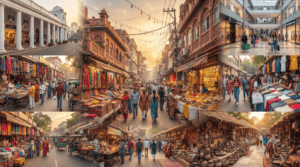
Shopping in Delhi
Delhi is one of India’s premier shopping destinations, offering an exceptional blend of traditional bazaars, modern shopping malls, luxury boutiques, handicraft markets, wholesale trade centers, and vibrant street markets. Whether visitors are looking for ethnic wear, designer fashion, jewelry, electronics, books, handicrafts, antiques, home décor, or delicious street food, Delhi provides shopping experiences to suit every budget and preference.
Shopping has been an integral part of Delhi’s history for centuries. During the Mughal era, markets such as Chandni Chowk flourished as major commercial centers attracting traders from across Asia. Today, these historic bazaars continue to thrive alongside modern retail complexes, making Delhi one of the country’s most diverse shopping hubs.
Chandni Chowk remains one of Delhi’s most famous shopping destinations. Its narrow streets are lined with thousands of shops selling textiles, bridal wear, jewelry, spices, dry fruits, books, electronics, traditional sweets, and household goods. The market is also renowned for its authentic street food and centuries-old trading establishments.
Connaught Place is among the city’s most popular commercial districts, featuring branded stores, bookstores, cafés, restaurants, handicraft shops, and lifestyle outlets. Nearby Janpath Market is especially famous for affordable clothing, artificial jewelry, handicrafts, souvenirs, leather products, and Tibetan artifacts, attracting both domestic and international tourists.
Dilli Haat offers a unique shopping experience by bringing together artisans from different states of India. Visitors can purchase authentic handloom products, paintings, pottery, bamboo crafts, wood carvings, traditional jewelry, textiles, carpets, and regional handicrafts directly from craftsmen. Cultural performances and regional food stalls further enhance the experience.
Fashion enthusiasts often visit Sarojini Nagar Market, Lajpat Nagar Central Market, Karol Bagh, and Kamla Nagar for trendy clothing, footwear, accessories, cosmetics, and budget-friendly shopping. These bustling markets are particularly popular among students, young professionals, and bargain hunters.
For luxury shopping, Delhi offers premium destinations such as Khan Market, Select CITYWALK, DLF Promenade, DLF Emporio, Ambience Mall, and Pacific Mall. These malls house leading Indian and international fashion brands, fine-dining restaurants, multiplex cinemas, entertainment zones, and lifestyle stores.
Delhi is also an important wholesale trading center. Sadar Bazaar is one of Asia’s largest wholesale markets for household goods, toys, stationery, cosmetics, and gift items, while Khari Baoli is internationally recognized as one of the world’s largest wholesale spice markets. These markets play a vital role in supplying products across India.
Popular Shopping Destinations in Delhi
| Shopping Destination | Famous For |
|---|---|
| Chandni Chowk | Textiles, jewelry, spices, street food |
| Connaught Place | Branded stores, restaurants, cafés |
| Janpath Market | Handicrafts, souvenirs, clothing |
| Dilli Haat | Handlooms, handicrafts, regional products |
| Sarojini Nagar | Affordable fashion and accessories |
| Lajpat Nagar | Ethnic wear, fabrics, footwear |
| Karol Bagh | Clothing, electronics, jewelry |
| Khan Market | Luxury shopping and premium brands |
| Select CITYWALK | International fashion and lifestyle brands |
| Sadar Bazaar | Wholesale household goods |
| Khari Baoli | Wholesale spices and dry fruits |
Delhi’s shopping culture beautifully combines centuries-old traditions with modern retail experiences. From bustling heritage markets and artisan bazaars to luxury malls and international brands, the city offers an unforgettable shopping experience that reflects its rich cultural diversity and vibrant commercial heritage.
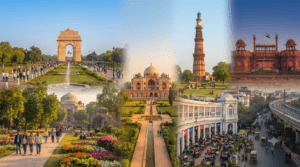
Best Time to Visit Delhi
Delhi can be visited throughout the year, but the best time to visit is from October to March, when the weather is pleasant, comfortable, and ideal for sightseeing, outdoor activities, shopping, and cultural events. During these months, temperatures remain moderate, making it easier for tourists to explore the city’s historical monuments, gardens, museums, markets, and religious sites without the discomfort of extreme heat.
Each season offers a unique experience for visitors. While winter is the most popular tourist season due to its cool climate and festive atmosphere, spring showcases blooming flowers and colorful gardens. The monsoon season brings occasional rainfall and lush greenery, whereas summer is characterized by high temperatures and dry weather.
Winter (October to March)
Winter is considered the peak tourist season in Delhi. Daytime temperatures generally range between 10°C and 25°C, creating ideal conditions for sightseeing and outdoor exploration. Popular attractions such as the Red Fort, India Gate, Qutub Minar, Humayun’s Tomb, Lotus Temple, Akshardham Temple, and Chandni Chowk receive large numbers of visitors during this period.
The winter months are also known for numerous festivals, cultural events, exhibitions, food festivals, and shopping fairs. Pleasant evenings make it enjoyable to explore markets, parks, and illuminated monuments. However, visitors should carry warm clothing, as temperatures may occasionally fall below 5°C during cold waves.
Summer (April to June)
Summer in Delhi is characterized by hot and dry weather, with temperatures often ranging between 30°C and 45°C. The city experiences intense sunshine and hot winds known as Loo, especially during May and June.
Although sightseeing during the afternoon can be challenging, travelers can still visit museums, shopping malls, art galleries, and indoor attractions. Early morning and evening hours are more suitable for visiting outdoor monuments. Lightweight cotton clothing, sunscreen, sunglasses, hats, and adequate hydration are essential during this season.
Monsoon (July to September)
Delhi receives moderate rainfall during the southwest monsoon season. Temperatures generally range between 25°C and 35°C, while intermittent showers bring temporary relief from the summer heat.
The city’s parks and gardens become greener, creating attractive landscapes for photography and nature walks. However, occasional waterlogging and traffic congestion may occur after heavy rainfall. Visitors are advised to carry umbrellas, raincoats, and waterproof footwear while traveling during the monsoon months.
Seasonal Travel Guide
| Season | Months | Temperature | Travel Experience |
|---|---|---|---|
| Winter | October – March | 10°C to 25°C | Best season for sightseeing, festivals, and shopping |
| Summer | April – June | 30°C to 45°C | Suitable for indoor attractions and early morning visits |
| Monsoon | July – September | 25°C to 35°C | Green landscapes with occasional rainfall |
Travel Tips by Season
- October to March: Carry light woolen clothing for evenings and early mornings.
- April to June: Wear cotton clothes, stay hydrated, and avoid afternoon outdoor activities.
- July to September: Carry an umbrella or raincoat and wear comfortable waterproof footwear.
- Book hotel accommodations in advance during the winter tourist season, especially around major festivals and national holidays.
- Visit popular monuments early in the morning to avoid crowds and enjoy pleasant weather.
Overall, October to March remains the most favorable period to visit Delhi due to its comfortable climate, vibrant festivals, cultural events, and excellent conditions for exploring the city’s historical landmarks, bustling markets, gardens, museums, and architectural masterpieces.
How to Reach Delhi
Delhi is one of the best-connected destinations in India and serves as the country’s primary transportation hub. As the National Capital Territory (NCT), it enjoys excellent connectivity by air, rail, road, and metro, making travel convenient for domestic and international visitors. Modern infrastructure, an extensive public transport system, and its strategic location in northern India enable millions of travelers to reach Delhi every year.
By Air
Delhi is served by the Indira Gandhi International Airport (IGI Airport), located in the southwestern part of the city. It is one of the busiest and largest airports in Asia, handling millions of passengers annually.
The airport offers direct domestic flights to almost every major Indian city, including Mumbai, Bengaluru, Hyderabad, Chennai, Kolkata, Ahmedabad, Jaipur, Lucknow, Srinagar, Kochi, and Guwahati. It also operates direct international flights to destinations across Asia, Europe, North America, Australia, Africa, and the Middle East.
Passengers can easily travel from the airport to different parts of Delhi using the Delhi Metro Airport Express Line, airport buses, taxis, app-based cab services, and private vehicles.
By Train
Delhi is one of India’s largest railway junctions and is connected to every region of the country through an extensive railway network operated by Indian Railways.
Major railway stations include:
- New Delhi Railway Station (NDLS) – The busiest railway station in the city.
- Old Delhi Railway Station (DLI) – One of the oldest railway terminals in India.
- Hazrat Nizamuddin Railway Station (NZM) – Important hub for long-distance trains.
- Anand Vihar Terminal (ANVT) – Serves eastern and northeastern routes.
- Delhi Sarai Rohilla Railway Station (DEE) – Connects several northern and western destinations.
Premium trains such as Vande Bharat Express, Rajdhani Express, Shatabdi Express, Duronto Express, and numerous Superfast Express trains connect Delhi with major cities across India.
By Road
Delhi has an outstanding road network connected through several national highways and modern expressways. Luxury buses, state transport buses, private coaches, taxis, and self-drive vehicles operate regular services from neighboring states and major Indian cities.
Important road connections include:
- National Highway 44 (NH-44)
- National Highway 48 (NH-48)
- National Highway 9 (NH-9)
- Delhi–Mumbai Expressway
- Delhi–Meerut Expressway
- Yamuna Expressway
- Eastern Peripheral Expressway
- Western Peripheral Expressway
Interstate bus services operate from major terminals such as Maharana Pratap ISBT (Kashmere Gate), Anand Vihar ISBT, and Sarai Kale Khan ISBT.
By Metro
The Delhi Metro provides one of the easiest and fastest ways to travel within Delhi and the National Capital Region (NCR). It connects important railway stations, the airport, business districts, educational institutions, residential areas, shopping centers, and major tourist attractions.
The metro also extends to neighboring cities including Noida, Greater Noida, Ghaziabad, Gurugram, Faridabad, and Bahadurgarh, making regional travel highly convenient.
Connectivity Overview
| Mode | Major Facilities |
|---|---|
| Air | Indira Gandhi International Airport with domestic and international flights |
| Rail | New Delhi, Old Delhi, Hazrat Nizamuddin, Anand Vihar, Delhi Sarai Rohilla |
| Road | National Highways, Expressways, Interstate Bus Terminals |
| Metro | Delhi Metro connecting Delhi and NCR |
Delhi’s excellent multimodal transportation system ensures smooth and convenient access from every part of India and many international destinations. Whether traveling by air, train, road, or metro, visitors can easily reach the capital and explore its historical landmarks, cultural attractions, commercial centers, and modern infrastructure.
Travel Tips for Visiting Delhi
Delhi is a vibrant destination that combines centuries-old heritage with modern urban development. As one of India’s busiest metropolitan cities, planning your visit carefully can help you enjoy a comfortable, safe, and memorable travel experience. Whether you are visiting historical monuments, shopping in bustling markets, exploring museums, or experiencing Delhi’s diverse cuisine, following a few practical travel tips will make your journey more enjoyable.
The ideal time to explore outdoor attractions is during the cooler months from October to March, when the weather is pleasant and suitable for sightseeing. During the summer season, it is advisable to begin your sightseeing early in the morning or later in the evening to avoid extreme daytime heat.
The Delhi Metro is the fastest, most economical, and reliable mode of transportation within the city. It connects major tourist attractions, shopping districts, railway stations, and the airport. Purchasing a metro smart card can help reduce waiting time and make daily travel more convenient.
While exploring popular markets such as Chandni Chowk, Sarojini Nagar, Janpath, and Karol Bagh, visitors should keep personal belongings secure because these places are often crowded. Carrying only essential valuables and remaining aware of your surroundings helps ensure a safe shopping experience.
Delhi offers a wide variety of delicious street food. To enjoy local specialties safely, choose food from clean, well-established vendors with good hygiene standards. Drinking bottled or purified water is recommended, particularly during the summer months.
Many historical monuments and museums require entry tickets, and some attractions remain closed on specific weekdays. Visitors should check opening hours and ticket information in advance to avoid inconvenience. Booking tickets online, where available, can also help save time during peak tourist seasons.
Comfortable walking shoes are recommended because many heritage sites, museums, gardens, and markets involve considerable walking. Lightweight clothing is suitable during warmer months, while jackets or sweaters are useful during winter mornings and evenings.
Respecting local customs, religious traditions, and photography guidelines is important when visiting temples, mosques, gurudwaras, churches, and other places of worship. Some religious sites require visitors to remove footwear or cover their heads before entering.
Essential Travel Tips
- Visit between October and March for the most comfortable weather.
- Use the Delhi Metro for quick, affordable, and convenient transportation.
- Carry a reusable water bottle and stay hydrated, especially during summer.
- Wear comfortable footwear for sightseeing and walking tours.
- Keep valuables secure in crowded markets and tourist areas.
- Prefer licensed taxis or trusted app-based cab services for local travel.
- Check monument opening hours and weekly closure schedules before visiting.
- Purchase tickets online whenever possible to avoid long queues.
- Taste Delhi’s famous street food only from clean and reputed vendors.
- Respect local traditions and follow photography rules at religious and heritage sites.
- Carry a valid photo identification document while traveling.
- Keep emergency contact numbers and hotel details easily accessible.
By following these simple travel tips, visitors can explore Delhi safely and comfortably while enjoying its magnificent monuments, cultural diversity, vibrant markets, delicious cuisine, and world-famous hospitality. Proper planning allows travelers to experience the very best of India’s National Capital Territory.
Interesting Facts About Delhi
Delhi is one of the world’s oldest continuously inhabited cities and has served as the political, cultural, and economic center of northern India for centuries. Its remarkable blend of ancient heritage and modern development makes it one of the most fascinating destinations in the country. From UNESCO World Heritage Sites and magnificent Mughal monuments to modern infrastructure and vibrant markets, Delhi offers countless unique experiences for visitors.
Fascinating Facts About Delhi
- Delhi has been the capital of several powerful kingdoms and empires, including the Delhi Sultanate, the Mughal Empire, and modern India.
- The city is believed to have been rebuilt or re-established several times throughout history, giving rise to the popular phrase “Seven Cities of Delhi.”
- New Delhi became the capital of British India in 1911, replacing Kolkata, and officially began functioning as the capital in 1931.
- Delhi is home to three UNESCO World Heritage Sites—the Red Fort, Qutub Minar, and Humayun’s Tomb.
- The Delhi Metro is one of the largest and most advanced metro rail networks in the world, serving millions of passengers every day.
- Chandni Chowk, established during the reign of Mughal Emperor Shah Jahan, remains one of India’s oldest and busiest marketplaces.
- The Lotus Temple is one of the most visited religious monuments in the world and welcomes people of all religions without discrimination.
- The Indira Gandhi International Airport is among India’s busiest airports and serves as a major international aviation hub.
- Delhi houses the Parliament of India, Rashtrapati Bhavan, the Supreme Court of India, and numerous central government ministries.
- Raj Ghat is the memorial dedicated to Mahatma Gandhi, attracting visitors from across the world.
- The city celebrates festivals of different religions and communities, reflecting India’s rich cultural diversity and spirit of unity.
- Delhi is famous for its vibrant street food, including Chole Bhature, Parathas, Chaat, Kebabs, Butter Chicken, and Jalebi.
- The National Capital Region (NCR) surrounding Delhi includes major urban centers such as Noida, Gurugram, Faridabad, and Ghaziabad, making it one of India’s largest metropolitan regions.
- Delhi is home to prestigious educational institutions, museums, research organizations, diplomatic missions, and cultural centers from around the world.
- Every year, millions of domestic and international tourists visit Delhi to experience its historical monuments, heritage sites, museums, markets, gardens, and architectural landmarks.
Quick Facts at a Glance
| Fact | Details |
|---|---|
| National Capital | Capital of India |
| UNESCO Sites | Red Fort, Qutub Minar, Humayun’s Tomb |
| Historic Identity | One of the world’s oldest continuously inhabited cities |
| Famous Market | Chandni Chowk |
| Largest Urban Transit | Delhi Metro |
| Major Airport | Indira Gandhi International Airport |
| Memorial | Raj Ghat |
| Metropolitan Region | National Capital Region (NCR) |
Delhi beautifully preserves its rich historical legacy while embracing rapid modernization. Its remarkable architecture, multicultural society, vibrant traditions, world-class infrastructure, and national significance continue to make it one of India’s most iconic and influential cities.
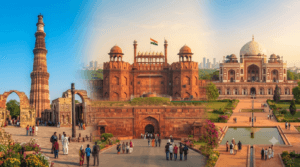
UNESCO World Heritage Sites in Delhi
Delhi is home to three UNESCO World Heritage Sites, each representing a significant chapter in India’s rich architectural, cultural, and historical heritage. These monuments showcase the brilliance of medieval Indian architecture, Mughal engineering, and Indo-Islamic artistic traditions. Recognized by UNESCO for their outstanding universal value, these landmarks attract millions of visitors from around the world every year.
Red Fort
The Red Fort (Lal Qila) was built by Mughal Emperor Shah Jahan between 1638 and 1648 after he shifted his capital from Agra to Delhi. Constructed using magnificent red sandstone, the fort served as the political and ceremonial center of the Mughal Empire for nearly two centuries.
Today, the Red Fort is one of India’s most iconic monuments. Every year on 15 August, the Prime Minister of India hoists the national flag from its historic ramparts and addresses the nation. UNESCO recognized the Red Fort as a World Heritage Site in 2007.
Qutub Minar
The Qutub Minar is the world’s tallest brick minaret, standing approximately 72.5 meters (238 feet) high. Construction began in 1192 under Qutb-ud-din Aibak and was later completed by Iltutmish, with subsequent additions by later rulers.
The Qutub complex includes several historically significant structures such as the Quwwat-ul-Islam Mosque, the famous Iron Pillar, Alai Darwaza, and Alai Minar. UNESCO designated Qutub Minar and its monuments as a World Heritage Site in 1993.
Humayun’s Tomb
Built in 1570, Humayun’s Tomb was commissioned by Empress Bega Begum, the wife of Mughal Emperor Humayun. It was the first grand garden-tomb built in the Indian subcontinent and inspired the architectural design of the later Taj Mahal.
The monument beautifully combines Persian and Mughal architectural styles with symmetrical gardens, water channels, and elegant domes. UNESCO inscribed Humayun’s Tomb as a World Heritage Site in 1993 due to its exceptional architectural and historical significance.
UNESCO World Heritage Sites at a Glance
| UNESCO Site | Year of UNESCO Inscription | Significance |
|---|---|---|
| Red Fort | 2007 | Mughal imperial fort and national symbol |
| Qutub Minar and its Monuments | 1993 | Tallest brick minaret and early Indo-Islamic architecture |
| Humayun’s Tomb | 1993 | First grand Mughal garden tomb and inspiration for the Taj Mahal |
These three UNESCO World Heritage Sites reflect Delhi’s extraordinary historical legacy and architectural excellence. Together, they preserve the city’s glorious past and continue to serve as symbols of India’s rich cultural heritage, attracting historians, architects, researchers, and tourists from across the globe.
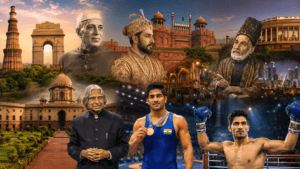
Famous Personalities of Delhi
Delhi has been home to numerous distinguished personalities who have made remarkable contributions to politics, literature, science, sports, music, business, social reform, arts, and public service. As the capital of India, the city has nurtured influential leaders, renowned scholars, celebrated artists, and internationally recognized achievers whose work has shaped the nation’s history and global reputation.
Dr. A. P. J. Abdul Kalam (Former President of India)
Although born in Tamil Nadu, Dr. A. P. J. Abdul Kalam spent many of his most influential years in Delhi while serving as the 11th President of India (2002–2007). Known as the “Missile Man of India,” he played a vital role in India’s missile and space programs and inspired millions through his vision for education, innovation, and youth empowerment.
Arvind Kejriwal
Arvind Kejriwal has served as the Chief Minister of Delhi and is known for introducing various reforms in education, healthcare, public services, and governance. His leadership has significantly influenced Delhi’s administrative and urban development in recent years.
Virat Kohli
One of the world’s finest cricketers, Virat Kohli was born and raised in Delhi. He has represented India in all formats of international cricket and captained the Indian national team across multiple formats. Known for his exceptional batting skills, consistency, and leadership, Kohli is regarded as one of the greatest batsmen in modern cricket.
Shah Rukh Khan
Shah Rukh Khan, popularly known as the “King of Bollywood,” was born in New Delhi. After completing his education in Delhi, he began his acting career before becoming one of the most successful and globally recognized actors in Indian cinema.
Mirza Ghalib
The legendary Urdu and Persian poet Mirza Ghalib spent much of his life in Delhi during the nineteenth century. His timeless poetry, literary brilliance, and philosophical writings continue to influence generations of readers and scholars across the world.
Sushma Swaraj
Sushma Swaraj, one of India’s most respected political leaders, represented Delhi in Parliament and served as the Minister of External Affairs of India. She was widely admired for her dedication to public service and her compassionate assistance to Indian citizens across the globe.
Kapil Dev
Former Indian cricket captain Kapil Dev, although born in Chandigarh, built an important part of his cricketing career in Delhi. He led India to its historic 1983 Cricket World Cup victory, inspiring generations of Indian cricketers.
Notable Personalities at a Glance
| Personality | Field | Contribution |
|---|---|---|
| Dr. A. P. J. Abdul Kalam | Science & Public Service | Former President and renowned aerospace scientist |
| Arvind Kejriwal | Politics | Chief Minister of Delhi and governance reforms |
| Virat Kohli | Sports | International cricketer and former Indian captain |
| Shah Rukh Khan | Cinema | Globally acclaimed Bollywood actor |
| Mirza Ghalib | Literature | Legendary Urdu and Persian poet |
| Sushma Swaraj | Politics | Former External Affairs Minister |
| Kapil Dev | Sports | Led India to the 1983 Cricket World Cup victory |
Delhi continues to inspire generations through the achievements of its remarkable personalities. Their contributions in governance, literature, sports, science, arts, and public service have strengthened Delhi’s reputation as one of India’s leading centers of excellence, creativity, and national leadership.
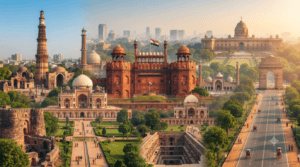
Architecture and Historical Monuments of Delhi
The state is often referred to as the “City of Monuments” because it possesses one of the richest collections of historical structures in the world. The city’s architecture reflects more than a thousand years of history, showcasing the artistic excellence of the Delhi Sultanate, Mughal Empire, British colonial administration, and modern India. From magnificent forts and grand tombs to elegant temples and colonial-era buildings, Delhi’s monuments represent a remarkable blend of different architectural styles.
Mughal Architecture
The Mughal period gave the state some of its most iconic monuments. Structures such as the Red Fort, Humayun’s Tomb, and Jama Masjid are celebrated for their impressive red sandstone construction, white marble decorations, intricate carvings, spacious courtyards, ornamental gardens, and elegant domes.
Humayun’s Tomb introduced the concept of the grand Mughal garden-tomb, which later inspired the design of the Taj Mahal. The Red Fort served as the imperial residence of Mughal emperors and remains one of India’s most important historical landmarks.
Delhi Sultanate Architecture
The Delhi Sultanate introduced early Indo-Islamic architecture, combining Indian craftsmanship with Persian and Central Asian influences. The Qutub Minar Complex, Alai Darwaza, Quwwat-ul-Islam Mosque, and the famous Iron Pillar demonstrate exceptional engineering and artistic achievements.
These monuments feature beautifully carved sandstone, Arabic inscriptions, geometric designs, arches, and decorative motifs that continue to attract historians, architects, and tourists from around the world.
Colonial Architecture
During British rule, New Delhi was planned by renowned architects Sir Edwin Lutyens and Sir Herbert Baker. This period produced magnificent government buildings characterized by wide avenues, grand domes, sandstone facades, classical columns, and beautifully landscaped gardens.
Notable examples include:
- Rashtrapati Bhavan
- Parliament House
- North Block
- South Block
- India Gate
Together, these landmarks form the administrative heart of modern India and represent one of the finest examples of colonial urban planning.
Modern Architecture
The state also showcases remarkable examples of contemporary architecture. The Lotus Temple, designed in the shape of a blooming lotus flower, is admired for its innovative engineering and symbolizes peace, unity, and harmony. The Akshardham Temple combines traditional Indian temple architecture with modern construction techniques, featuring intricate stone carvings, majestic domes, beautifully landscaped gardens, and cultural exhibitions.
Major Historical Monuments in Delhi
| Monument | Architectural Style | Historical Importance |
|---|---|---|
| Red Fort | Mughal | Former imperial residence and UNESCO World Heritage Site |
| Qutub Minar | Indo-Islamic | World’s tallest brick minaret and UNESCO World Heritage Site |
| Humayun’s Tomb | Mughal | First grand Mughal garden tomb and UNESCO World Heritage Site |
| Jama Masjid | Mughal | One of India’s largest mosques |
| India Gate | Colonial | National war memorial |
| Rashtrapati Bhavan | Colonial | Official residence of the President of India |
| Lotus Temple | Modern | Iconic Baháʼí House of Worship |
| Akshardham Temple | Contemporary Indian | Cultural and spiritual landmark |
Delhi’s extraordinary architectural heritage reflects the rise and evolution of multiple civilizations over centuries. Its magnificent monuments continue to preserve the city’s historical legacy while attracting millions of visitors, historians, architects, and researchers from across the globe.
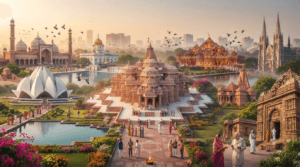
Religious Places in Delhi
The state is one of India’s most spiritually diverse cities, where people of different religions have lived together for centuries. The city is home to magnificent Hindu temples, Islamic mosques, Sikh gurdwaras, Christian churches, Jain temples, and Baháʼí places of worship, reflecting its rich cultural heritage and tradition of religious harmony. These sacred sites are not only important pilgrimage destinations but also remarkable examples of architecture, history, and art.
Akshardham Temple
The Swaminarayan Akshardham Temple is one of Delhi’s most visited religious landmarks. Opened in 2005, the temple is renowned for its intricately carved sandstone and marble architecture, beautifully landscaped gardens, musical fountain, exhibitions on Indian culture, and spiritual atmosphere. It attracts millions of devotees and tourists every year.
Lotus Temple
The Lotus Temple is the Baháʼí House of Worship in New Delhi. Designed in the shape of a blooming lotus flower, it welcomes people of all religions without discrimination. The temple is admired for its peaceful environment, modern architecture, and emphasis on unity, prayer, and meditation.
Jama Masjid
Built by Mughal Emperor Shah Jahan between 1650 and 1656, the Jama Masjid is one of the largest and most magnificent mosques in India. Constructed with red sandstone and white marble, it can accommodate thousands of worshippers and remains one of Delhi’s most significant Islamic landmarks.
Gurudwara Bangla Sahib
Gurudwara Bangla Sahib is one of the most revered Sikh shrines in India. Dedicated to Guru Har Krishan Sahib Ji, the eighth Sikh Guru, it is famous for its golden dome, holy sarovar (sacred pond), community kitchen (Langar), and humanitarian services. Thousands of devotees visit the gurdwara daily regardless of religion or nationality.
Birla Mandir (Laxminarayan Temple)
The Laxminarayan Temple, popularly known as Birla Mandir, was inaugurated in 1939 and dedicated to Lord Vishnu (Narayan) and Goddess Lakshmi. The temple is known for its impressive architecture, beautifully maintained gardens, and vibrant celebrations during major Hindu festivals.
ISKCON Temple
The ISKCON Temple Delhi, dedicated to Lord Krishna and Radha, is one of the city’s most prominent spiritual centers. The temple hosts daily prayers, devotional music, Bhagavad Gita lectures, cultural programs, and major celebrations during Janmashtami and other Vaishnav festivals.
Sacred Religious Places in Delhi
| Religious Place | Religion | Significance |
|---|---|---|
| Akshardham Temple | Hinduism | Grand cultural and spiritual complex |
| Lotus Temple | Baháʼí Faith | House of Worship open to all religions |
| Jama Masjid | Islam | One of India’s largest mosques |
| Gurudwara Bangla Sahib | Sikhism | Sacred shrine of Guru Har Krishan Sahib Ji |
| Birla Mandir | Hinduism | Famous temple dedicated to Lakshmi and Narayan |
| ISKCON Temple | Hinduism | Major center of Krishna devotion |
Delhi’s religious landmarks symbolize the city’s enduring tradition of unity in diversity. Their architectural beauty, spiritual significance, and welcoming atmosphere continue to attract pilgrims, historians, architects, and tourists from around the world, making Delhi one of India’s most important centers of faith and cultural harmony.
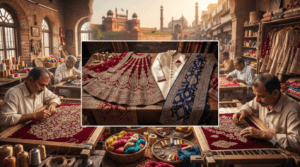
GI-Tagged Products of Delhi
The state is internationally recognized as a major center for trade, craftsmanship, textiles, jewelry, and traditional food. While the National Capital Territory has comparatively fewer Geographical Indication (GI) products than many larger states, it is renowned for preserving centuries-old artisan traditions and distinctive products that represent its rich cultural heritage. These products reflect Delhi’s historic markets, skilled craftsmanship, and culinary legacy.
Delhi Blue Pottery
Delhi Blue Pottery is one of the city’s traditional handicrafts, known for its elegant floral motifs, geometric patterns, and vibrant blue glaze. Skilled artisans create decorative plates, bowls, tiles, vases, and ornamental items using techniques that blend Persian, Mughal, and Indian artistic influences. These handcrafted products are admired for their beauty and craftsmanship.
Traditional Zardozi Embroidery
The state has long been a center for Zardozi embroidery, an intricate craft that uses gold and silver metallic threads to decorate garments, bridal wear, home furnishings, and ceremonial textiles. The city’s artisans continue to preserve this centuries-old embroidery tradition, producing luxurious handcrafted creations that are appreciated across India and abroad.
Mughal-Style Jewelry
Delhi’s jewelers are renowned for creating traditional Kundan, Meenakari, and Polki jewelry inspired by Mughal artistry. These handcrafted ornaments are widely used for weddings, festivals, and special occasions and are available in historic markets such as Chandni Chowk and Dariba Kalan.
Traditional Delhi Sweets
The state is famous for its rich culinary heritage, particularly traditional sweets prepared using age-old family recipes. Popular delicacies include Jalebi, Ghevar, Sohan Halwa, Karachi Halwa, and a variety of milk-based desserts that remain an integral part of festive celebrations and local food culture.
Handicrafts and Souvenirs
Markets such as Dilli Haat, Janpath, and Chandni Chowk showcase handcrafted souvenirs, brassware, wooden carvings, marble artifacts, handwoven textiles, leather goods, and decorative items produced by artisans from Delhi and various regions of India. These products reflect the city’s role as a national center for arts and crafts.
Traditional Products Associated with Delhi
| Product | Category | Specialty |
|---|---|---|
| Blue Pottery | Handicraft | Decorative glazed ceramic art |
| Zardozi Embroidery | Textile Craft | Gold and silver thread embroidery |
| Kundan & Meenakari Jewelry | Jewelry | Traditional Mughal-inspired ornaments |
| Traditional Delhi Sweets | Food | Historic recipes and festive delicacies |
| Handcrafted Souvenirs | Handicrafts | Brass, wood, marble, leather, and textiles |
Although DL has a limited number of officially registered GI products compared to many Indian states, its centuries-old craftsmanship, traditional markets, exquisite embroidery, jewelry, handicrafts, and culinary heritage continue to preserve the city’s unique cultural identity. These timeless traditions make Delhi an important destination for art lovers, shoppers, historians, and cultural enthusiasts.
Note: DL has relatively few officially registered Geographical Indication (GI) products. The products above represent traditional crafts and specialties associated with Delhi, and readers should verify the latest GI registrations with the official GI Registry of India for the most current information.
Education and Universities in Delhi
The state is one of India’s leading centers for education, research, and innovation. The city is home to some of the country’s most prestigious universities, colleges, research institutions, schools, and professional training centers. Every year, students from across India and around the world come to Delhi to pursue higher education in engineering, medicine, law, management, humanities, science, commerce, and technology.
The National Capital Territory has a well-developed educational infrastructure that includes central universities, state universities, deemed universities, private institutions, and nationally recognized research organizations. These institutions play a vital role in producing skilled professionals, researchers, scientists, civil servants, entrepreneurs, and industry leaders.
University of Delhi (DU)
Established in 1922, the University of Delhi (DU) is one of India’s most prestigious public universities. It consists of numerous affiliated colleges offering undergraduate, postgraduate, and doctoral programs in arts, science, commerce, law, engineering, management, and social sciences. The university is known for its academic excellence, research, and vibrant student life.
Jawaharlal Nehru University (JNU)
Founded in 1969, Jawaharlal Nehru University (JNU) is internationally recognized for its research, higher education, and interdisciplinary studies. It offers postgraduate and doctoral programs in social sciences, international relations, languages, life sciences, engineering, and various other disciplines.
Indian Institute of Technology Delhi (IIT Delhi)
Established in 1961, IIT Delhi is one of India’s premier engineering and technology institutions. It offers world-class education and research in engineering, computer science, artificial intelligence, management, design, and applied sciences. The institute has produced numerous innovators, entrepreneurs, and global technology leaders.
All India Institute of Medical Sciences (AIIMS New Delhi)
Founded in 1956, AIIMS New Delhi is India’s premier medical institution for education, healthcare, and biomedical research. It is internationally recognized for its excellence in medical teaching, advanced patient care, and scientific research.
Jamia Millia Islamia (JMI)
Established in 1920, Jamia Millia Islamia is one of India’s leading central universities. It offers high-quality education in engineering, architecture, law, media studies, education, humanities, social sciences, commerce, and management.
Other Prominent Educational Institutions
- Indraprastha Institute of Information Technology Delhi (IIIT-Delhi)
- Guru Gobind Singh Indraprastha University (GGSIPU)
- National Law University, Delhi (NLU Delhi)
- Indian Agricultural Research Institute (IARI)
- National Institute of Fashion Technology (NIFT Delhi)
Major Universities and Institutions in Delhi
| Institution | Established | Specialization |
|---|---|---|
| University of Delhi | 1922 | Higher Education and Research |
| Jawaharlal Nehru University | 1969 | Research and Interdisciplinary Studies |
| IIT Delhi | 1961 | Engineering and Technology |
| AIIMS New Delhi | 1956 | Medical Education and Healthcare |
| Jamia Millia Islamia | 1920 | Multidisciplinary Higher Education |
| GGSIP University | 1998 | Professional and Technical Education |
DL continues to lead India’s educational landscape through its outstanding universities, world-class research institutions, and academic excellence. With its strong focus on innovation, scientific research, professional education, and skill development, the city remains one of the country’s most important destinations for higher learning.
Healthcare and Medical Facilities in Delhi
DL has one of the most advanced healthcare systems in India, offering high-quality medical services through a network of government hospitals, private hospitals, specialty institutes, medical colleges, research centers, and diagnostic laboratories. As the National Capital Territory, Delhi serves as a major healthcare hub, attracting patients from across India and neighboring countries for specialized treatment.
The city provides comprehensive healthcare services in cardiology, oncology, neurology, orthopedics, nephrology, pediatrics, organ transplantation, emergency medicine, and advanced surgical procedures. Modern medical infrastructure, experienced healthcare professionals, and state-of-the-art technology have made Delhi a leading destination for medical care and medical tourism.
All India Institute of Medical Sciences (AIIMS)
AIIMS New Delhi is India’s premier medical institution and one of the country’s most respected hospitals. Established in 1956, it provides world-class healthcare, medical education, and biomedical research. AIIMS is renowned for its highly specialized treatment, advanced surgical procedures, and cutting-edge research across multiple medical disciplines.
Safdarjung Hospital
Safdarjung Hospital is one of the largest government hospitals in India. It offers affordable healthcare services across numerous specialties, including emergency medicine, surgery, orthopedics, cardiology, pediatrics, and obstetrics. The hospital also functions as an important teaching institution for medical education.
Lok Nayak Hospital
Lok Nayak Hospital, commonly known as LNJP Hospital, is one of Delhi’s major government hospitals. It provides comprehensive healthcare services, trauma care, emergency treatment, and specialized medical facilities for thousands of patients every day.
Sir Ganga Ram Hospital
Sir Ganga Ram Hospital is among Delhi’s leading multi-specialty private hospitals. It is recognized for excellence in cardiology, oncology, gastroenterology, nephrology, organ transplantation, and minimally invasive surgery. Patients from across India and abroad seek treatment at this internationally respected institution.
Indraprastha Apollo Hospital
Indraprastha Apollo Hospital is one of India’s leading private healthcare institutions. Equipped with advanced medical technology, it offers specialized treatment in cardiology, neurology, oncology, orthopedics, liver transplantation, kidney transplantation, and robotic surgery.
Major Hospitals in Delhi
| Hospital | Type | Specialty |
|---|---|---|
| AIIMS New Delhi | Government | Medical education, research, and super-specialty healthcare |
| Safdarjung Hospital | Government | Multi-specialty healthcare |
| Lok Nayak Hospital (LNJP) | Government | Emergency and tertiary care |
| Sir Ganga Ram Hospital | Private | Advanced multi-specialty treatment |
| Indraprastha Apollo Hospital | Private | Super-specialty and organ transplantation |
| Ram Manohar Lohia (RML) Hospital | Government | Multi-specialty healthcare |
Delhi’s healthcare infrastructure continues to expand through modern hospitals, medical research institutions, digital healthcare initiatives, and specialized treatment centers. Its commitment to quality medical care, innovation, and public health has established the city as one of India’s foremost healthcare destinations.
Sports and Stadiums in Delhi
The state has established itself as one of India’s leading sporting destinations, hosting numerous national and international tournaments across a wide range of disciplines. The city offers world-class sports infrastructure, modern stadiums, training academies, and sports complexes that support the development of athletes from the grassroots to the international level. Delhi has also played a significant role in promoting cricket, hockey, football, badminton, athletics, wrestling, tennis, and shooting.
The city gained global recognition after successfully hosting the 2010 Commonwealth Games, which led to the development and modernization of several international-standard sports venues. Today, these facilities continue to host major sporting events and training programs.
Arun Jaitley Stadium
Formerly known as Feroz Shah Kotla Stadium, the Arun Jaitley Stadium is one of India’s oldest and most iconic cricket venues. It serves as the home ground of the Delhi cricket team and has hosted numerous Test matches, One Day Internationals (ODIs), T20 Internationals, and Indian Premier League (IPL) matches.
Jawaharlal Nehru Stadium
The Jawaharlal Nehru Stadium is the largest sports stadium in the state and was extensively renovated for the 2010 Commonwealth Games. It hosts football matches, athletics competitions, opening and closing ceremonies of major sporting events, concerts, and cultural programs.
Major Dhyan Chand National Stadium
Named after hockey legend Major Dhyan Chand, this stadium is one of India’s premier hockey venues. It has hosted international hockey tournaments, including events during the 2010 Commonwealth Games, and remains an important center for the promotion of field hockey.
Indira Gandhi Indoor Stadium
The Indira Gandhi Indoor Stadium is among the largest indoor sports arenas in India. It hosts national and international competitions in badminton, gymnastics, wrestling, cycling, volleyball, martial arts, and other indoor sports.
Dr. Karni Singh Shooting Range
The Dr. Karni Singh Shooting Range is an internationally recognized shooting facility that has hosted several national and international shooting championships. It is equipped with modern training facilities for rifle, pistol, and shotgun events.
Major Sports Venues in Delhi
| Stadium | Primary Sport | Importance |
|---|---|---|
| Arun Jaitley Stadium | Cricket | International cricket venue and IPL matches |
| Jawaharlal Nehru Stadium | Football & Athletics | Largest stadium in Delhi |
| Major Dhyan Chand National Stadium | Hockey | Premier hockey venue |
| Indira Gandhi Indoor Stadium | Indoor Sports | Multi-purpose indoor arena |
| Dr. Karni Singh Shooting Range | Shooting | International-standard shooting facility |
The state continues to strengthen its sporting culture through modern infrastructure, athlete development programs, national championships, and international sporting events. With its outstanding stadiums and training facilities, the city remains one of India’s foremost centers for sports excellence.
Conclusion
Delhi, the National Capital Territory of India, is a remarkable destination where history, culture, governance, education, commerce, and modern development come together seamlessly. From ancient settlements and magnificent Mughal monuments to modern infrastructure and world-class institutions, Delhi reflects the journey of India through centuries of civilization and progress.
The city offers an extraordinary blend of heritage and innovation. Visitors can explore iconic landmarks such as the Red Fort, Qutub Minar, Humayun’s Tomb, India Gate, Lotus Temple, and Akshardham Temple while also enjoying vibrant shopping markets, diverse culinary experiences, cultural festivals, museums, gardens, and entertainment hubs. Delhi’s efficient metro network, international airport, educational institutions, healthcare facilities, and thriving economy further strengthen its position as one of India’s most important metropolitan cities.
As the political and administrative center of the country, Delhi is home to the Parliament of India, Rashtrapati Bhavan, the Supreme Court, diplomatic missions, and numerous national institutions. At the same time, its multicultural population, religious harmony, artistic traditions, and welcoming hospitality make it one of the most diverse and inclusive cities in the world.
Whether you are a history enthusiast, spiritual traveler, food lover, student, business professional, or tourist, Delhi offers unforgettable experiences for every visitor. Its unique combination of ancient heritage, architectural brilliance, cultural richness, and modern urban development ensures that every journey through the capital leaves lasting memories.
With its timeless monuments, vibrant traditions, excellent connectivity, educational excellence, and global significance, Delhi continues to stand proudly as the Heart of India and remains one of the country’s most fascinating destinations to explore.
Related Articles
- Arunachal Pradesh
- Assam
- Bihar
- Chhattisgarh
- Goa
- Gujarat
- Haryana
- Himachal Pradesh
- Jharkhand
- Karnataka
- Kerala
- Madhya Pradesh
- Maharashtra
- Manipur
- Meghalaya
- Mizoram
- Nagaland
- Odisha
- Punjab
- Rajasthan
- Sikkim
- Tamil Nadu
- Telangana
- Uttar Pradesh
- Uttarakhand
- West Bengal
- Sonam Wangchuk
- Netaji Subhas Chandra Bose
- Mahatma Gandhi
- Dr. A. P. J. Abdul Kalam
- Ratan Tata
References
- Delhi Tourism – Government of NCT of Delhi
- Department of Tourism, Government of NCT of Delhi
- Archaeological Survey of India (ASI)
- UNESCO World Heritage Centre
- Delhi Metro Rail Corporation (DMRC)
- Airports Authority of India – Indira Gandhi International Airport
- Incredible India – Ministry of Tourism, Government of India
- Office of the Registrar General & Census Commissioner, India
- National Portal of India