
About Uttarakhand
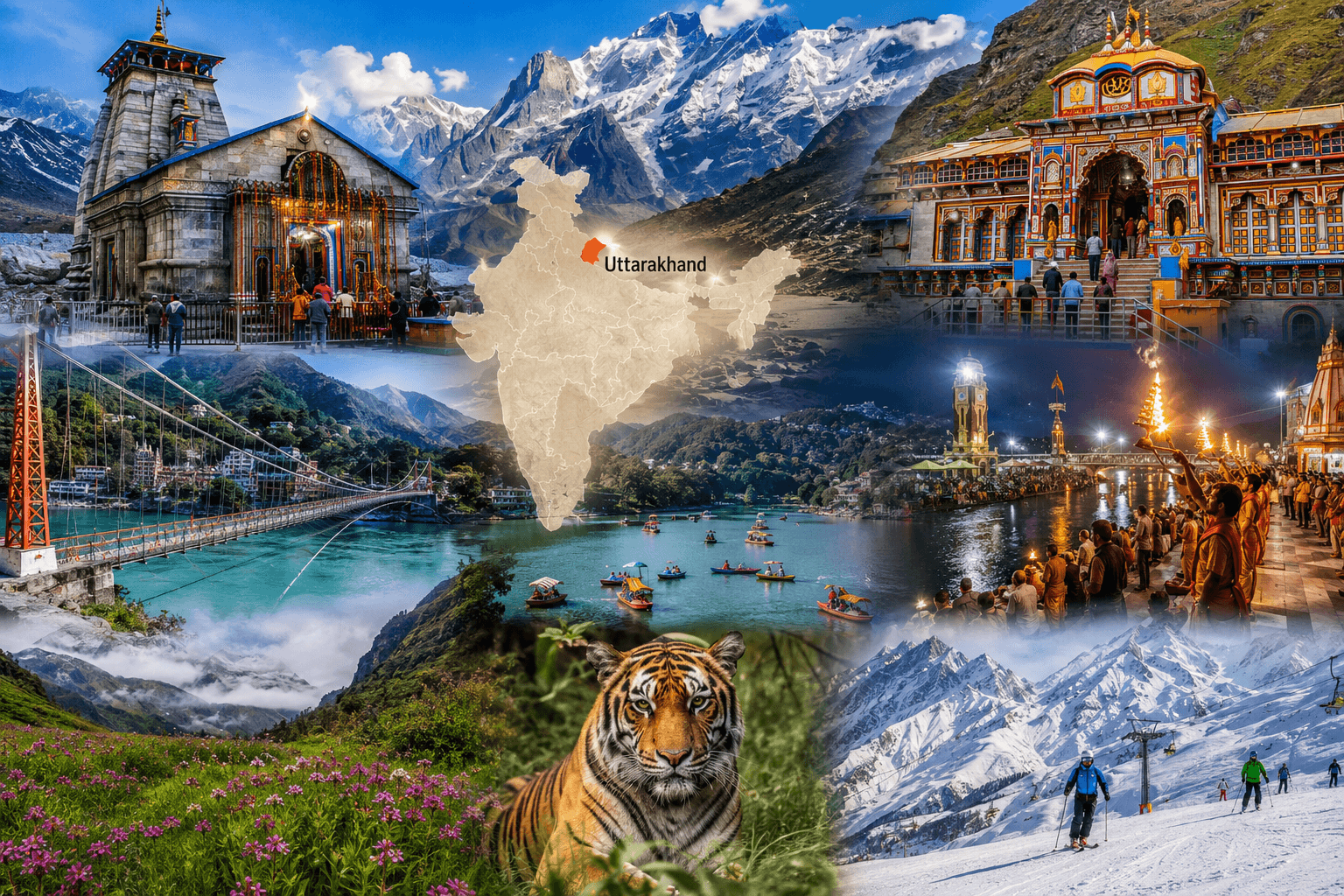
Uttarakhand, popularly known as the “Land of Gods (Devbhoomi)”, is a beautiful state in northern India, famous for its Himalayan mountains, sacred temples, rivers, forests, wildlife, and adventure tourism. It was carved out of Uttar Pradesh on 9 November 2000 and became the 27th state of India.
The state shares its borders with Himachal Pradesh to the northwest, Uttar Pradesh to the south, Tibet (China) to the north, and Nepal to the east. Dehradun serves as the winter capital, while Bhararisain (Gairsain) is the summer capital. Dehradun is also the state’s largest city.
Uttarakhand covers an area of approximately 53,483 square kilometres, making it one of India’s major Himalayan states. Most of the state is mountainous and covered by the Garhwal and Kumaon Himalayan ranges. The famous rivers Ganga and Yamuna originate in Uttarakhand, making it one of the holiest regions in Hinduism.
The state is home to some of India’s most sacred pilgrimage destinations, including Kedarnath, Badrinath, Gangotri, and Yamunotri, collectively known as the Char Dham Yatra. Other major attractions include Haridwar, Rishikesh, Nainital, Mussoorie, Jim Corbett National Park, Valley of Flowers National Park, and Auli.
Uttarakhand is blessed with rich biodiversity, snow-covered peaks, alpine meadows, glaciers, waterfalls, and dense forests. The state is also a leading destination for trekking, river rafting, skiing, camping, wildlife safaris, yoga, meditation, and spiritual tourism.
The economy of Uttarakhand is driven by tourism, agriculture, horticulture, hydropower, pharmaceuticals, education, and forest-based industries. The state is also recognised for its environmental conservation efforts and sustainable tourism initiatives.
With its breathtaking natural beauty, spiritual significance, and adventure opportunities, Uttarakhand is one of India’s most popular travel destinations.
Quick Facts
| Category | Details |
|---|---|
| State | Uttarakhand |
| Formation | 9 November 2000 |
| Capital (Winter) | Dehradun |
| Capital (Summer) | Bhararisain (Gairsain) |
| Largest City | Dehradun |
| Area | 53,483 sq km |
| Official Language | Hindi |
| Second Official Language | Sanskrit |
| Nickname | Devbhoomi (Land of Gods) |
| Famous For | Char Dham, Himalayas, Adventure Tourism & Yoga |
India Map with Uttarakhand Highlighted
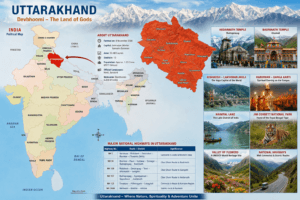
Uttarakhand is located in northern India in the central Himalayan region. It was formed on 9 November 2000 after being separated from Uttar Pradesh. The state covers an area of approximately 53,483 square kilometres and shares international borders with Tibet (China) to the north and Nepal to the east.
Within India, Uttarakhand is bordered by Himachal Pradesh to the northwest and Uttar Pradesh to the south. Its strategic location in the Himalayas makes it one of India’s most important states for tourism, spirituality, biodiversity, and water resources.
The state is divided into two major cultural and geographical regions:
- Garhwal
- Kumaon
The world-famous rivers Ganga and Yamuna originate from glaciers in Uttarakhand, making it one of the holiest regions in Hinduism. The state is also home to the sacred Char Dham pilgrimage circuit—Yamunotri, Gangotri, Kedarnath, and Badrinath.
Its location amidst the Himalayas makes Uttarakhand a leading destination for trekking, mountaineering, skiing, rafting, yoga, wildlife tourism, and eco-tourism.
Quick Facts
| Feature | Details |
|---|---|
| Location | Northern India |
| International Borders | Tibet (China) & Nepal |
| Neighbouring States | Himachal Pradesh & Uttar Pradesh |
| Major Regions | Garhwal & Kumaon |
| Famous For | Char Dham, Himalayas & Adventure Tourism |
Political Map of Uttarakhand
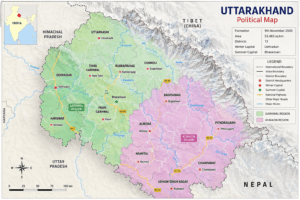
The political map of Uttarakhand displays the state’s 13 districts, district headquarters, state boundaries, neighbouring states, and international borders. Located in the northern Himalayan region of India, Uttarakhand is divided into two major administrative and cultural regions: Garhwal and Kumaon.
The state has Dehradun as its winter capital and Bhararisain (Gairsain) as its summer capital. Dehradun is also the largest city and an important educational, administrative, and commercial centre.
Garhwal Region (7 Districts)
- Dehradun
- Haridwar
- Tehri Garhwal
- Pauri Garhwal
- Rudraprayag
- Chamoli
- Uttarkashi
Kumaon Region (6 Districts)
- Almora
- Nainital
- Bageshwar
- Champawat
- Pithoragarh
- Udham Singh Nagar
Uttarakhand shares borders with Himachal Pradesh to the northwest, Uttar Pradesh to the south, Tibet (China) to the north, and Nepal to the east. The political map also highlights major cities such as Dehradun, Haridwar, Rishikesh, Nainital, Haldwani, Almora, Rudrapur, Pithoragarh, and Srinagar (Garhwal).
The map is useful for understanding the state’s administrative divisions, district boundaries, transport network, and planning travel across Uttarakhand.
Political Map at a Glance
| Category | Details |
|---|---|
| Total Districts | 13 |
| Winter Capital | Dehradun |
| Summer Capital | Bhararisain (Gairsain) |
| Largest City | Dehradun |
| Administrative Regions | Garhwal & Kumaon |
| International Borders | Tibet (China) & Nepal |
| Neighbouring States | Himachal Pradesh & Uttar Pradesh |
| Major Cities | Dehradun, Haridwar, Rishikesh, Nainital & Haldwani |
History of Uttarakhand
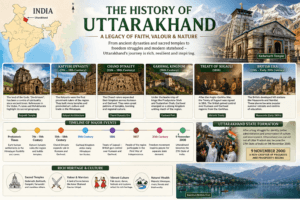
Uttarakhand has a rich and ancient history dating back thousands of years. Often referred to as “Devbhoomi” (Land of Gods), the region has been mentioned in sacred Hindu scriptures such as the Vedas, Mahabharata, Ramayana, Skanda Purana, and Kedarkhand. It has long been a centre of spirituality, pilgrimage, and learning.
During the ancient period, the region was inhabited by tribes such as the Kunindas, Katyuris, and Khasas. The Kuninda Kingdom flourished between the 2nd century BCE and 3rd century CE, promoting trade and culture across the Himalayan region.
Between the 7th and 11th centuries, the Katyuri Dynasty ruled large parts of present-day Uttarakhand from Baijnath (Katyur Valley). They built numerous temples and played a significant role in spreading Hindu culture and architecture throughout the region.
The Chand Dynasty ruled the Kumaon region from the 11th to the 18th century, with Almora as its capital. During the same period, the Garhwal Kingdom, ruled by the Parmar (Panwar) Dynasty, flourished with Srinagar (Garhwal) as its capital.
In the early 19th century, the Gorkhas of Nepal invaded and occupied parts of Uttarakhand. After the Anglo-Nepalese War (1814–1816), the Treaty of Sugauli (1816) transferred much of the region to the British East India Company. The British later developed hill stations such as Mussoorie, Nainital, and Ranikhet, which became important administrative and tourist centres.
After India’s independence in 1947, Uttarakhand remained part of Uttar Pradesh. Due to geographical, cultural, and developmental differences, a separate statehood movement gained momentum during the 1990s. Following years of peaceful protests and public support, Uttarakhand was officially created as the 27th state of India on 9 November 2000, initially named Uttaranchal.
In January 2007, the state’s official name was changed from Uttaranchal to Uttarakhand, reflecting its historical and cultural identity.
Today, Uttarakhand is internationally recognised for its Char Dham pilgrimage, Himalayan heritage, adventure tourism, wildlife conservation, and environmental significance, while continuing to preserve its rich historical and spiritual legacy.
History at a Glance
| Period | Historical Significance |
|---|---|
| Ancient Period | Mentioned in Vedas, Mahabharata & Ramayana |
| Kuninda Kingdom | 2nd Century BCE – 3rd Century CE |
| Katyuri Dynasty | 7th – 11th Century |
| Chand Dynasty | 11th – 18th Century (Kumaon) |
| Garhwal Kingdom | Parmar (Panwar) Dynasty |
| British Rule | 1816–1947 |
| State Formation | 9 November 2000 |
| Renamed | Uttaranchal to Uttarakhand (2007) |
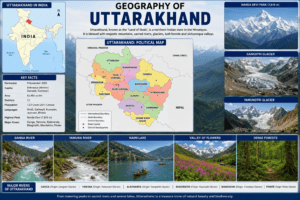
Geography of Uttarakhand
Uttarakhand is one of India’s most scenic Himalayan states, renowned for its snow-covered mountains, glaciers, rivers, forests, valleys, lakes, and rich biodiversity. Located in northern India, the state covers an area of approximately 53,483 square kilometres and is divided into two geographical regions: Garhwal in the west and Kumaon in the east.
The state is bordered by Tibet (China) to the north, Nepal to the east, Himachal Pradesh to the northwest, and Uttar Pradesh to the south. Its strategic location in the central Himalayas makes Uttarakhand one of India’s most environmentally significant states.
The Himalayan mountain ranges dominate most of the state’s landscape. Some of India’s highest peaks, including Nanda Devi (7,816 m), Kamet (7,756 m), Chaukhamba, Trisul, Kedarnath Peak, and Panchachuli, are located in Uttarakhand. Nanda Devi is the highest mountain entirely within India.
Uttarakhand is also known as the “Land of Rivers”, as several major rivers originate from its glaciers. The Ganga begins at Gangotri Glacier as the Bhagirathi River, while the Yamuna originates from the Yamunotri Glacier. Other important rivers include the Alaknanda, Mandakini, Pindar, Kosi, Ramganga, Kali (Sharda), Saryu, and Tons.
The state is home to numerous glaciers, including the Gangotri Glacier, Pindari Glacier, Milam Glacier, Sunderdhunga Glacier, and Khatling Glacier, which are vital sources of freshwater for northern India.
Uttarakhand’s forests cover nearly 45% of the state’s geographical area and include oak, deodar, pine, rhododendron, fir, spruce, and alpine vegetation. These forests support diverse wildlife and contribute significantly to environmental conservation.
The state also boasts beautiful lakes such as Naini Lake, Bhimtal, Sattal, Naukuchiatal, Roopkund, Hemkund, and Deoria Tal, making it one of India’s premier destinations for nature tourism.
With its towering Himalayan peaks, sacred rivers, glaciers, forests, and breathtaking landscapes, Uttarakhand is rightly regarded as one of the most geographically diverse and naturally beautiful states in India.
Geography at a Glance
| Category | Details |
|---|---|
| Area | 53,483 sq km |
| Highest Peak | Nanda Devi (7,816 m) |
| Major Regions | Garhwal & Kumaon |
| Major Rivers | Ganga, Yamuna, Alaknanda, Bhagirathi & Ramganga |
| Famous Glaciers | Gangotri, Pindari, Milam & Khatling |
| Forest Cover | Around 45% |
| Famous Lakes | Naini Lake, Bhimtal, Sattal & Naukuchiatal |
| Major Mountain Range | Himalayas |
Districts of Uttarakhand
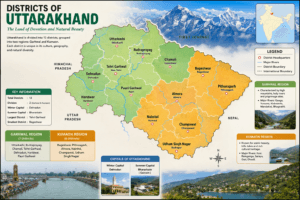
Uttarakhand is administratively divided into 13 districts, which are grouped into two major geographical and cultural regions: Garhwal and Kumaon. Each district has its own administrative headquarters and is known for its unique natural beauty, religious significance, wildlife, agriculture, and tourism.
The Garhwal Region consists of Dehradun, Haridwar, Tehri Garhwal, Pauri Garhwal, Rudraprayag, Chamoli, and Uttarkashi. This region is famous for the Char Dham pilgrimage, Himalayan peaks, sacred rivers, national parks, and adventure tourism. Dehradun, the winter capital, is the state’s largest city and an important educational and administrative hub.
The Kumaon Region includes Almora, Nainital, Bageshwar, Champawat, Pithoragarh, and Udham Singh Nagar. Kumaon is known for its picturesque hill stations, lakes, wildlife sanctuaries, temples, tea gardens, and agricultural activities. Nainital is one of India’s most popular hill stations, while Udham Singh Nagar is the state’s leading industrial and agricultural district.
The districts of Uttarakhand play a vital role in promoting tourism, pilgrimage, agriculture, horticulture, hydropower, and environmental conservation. Every district contributes to the state’s cultural diversity and economic development.
List of Districts
| District | Headquarters | Region |
|---|---|---|
| Almora | Almora | Kumaon |
| Bageshwar | Bageshwar | Kumaon |
| Chamoli | Gopeshwar | Garhwal |
| Champawat | Champawat | Kumaon |
| Dehradun | Dehradun | Garhwal |
| Haridwar | Haridwar | Garhwal |
| Nainital | Nainital | Kumaon |
| Pauri Garhwal | Pauri | Garhwal |
| Pithoragarh | Pithoragarh | Kumaon |
| Rudraprayag | Rudraprayag | Garhwal |
| Tehri Garhwal | New Tehri | Garhwal |
| Udham Singh Nagar | Rudrapur | Kumaon |
| Uttarkashi | Uttarkashi | Garhwal |
Economy of Uttarakhand
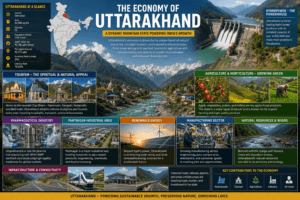
Uttarakhand has one of the fastest-growing economies among the Himalayan states of India. The state’s economy is primarily driven by tourism, hydropower, agriculture, horticulture, forestry, pharmaceuticals, manufacturing, education, and information technology. Its strategic location, abundant natural resources, and well-developed industrial areas have contributed significantly to its economic growth.
Tourism is the backbone of Uttarakhand’s economy. Millions of pilgrims visit the Char Dham (Kedarnath, Badrinath, Gangotri, and Yamunotri) every year. Popular destinations such as Rishikesh, Haridwar, Mussoorie, Nainital, Auli, Valley of Flowers, and Jim Corbett National Park also attract domestic and international tourists, generating substantial employment and revenue.
Uttarakhand is one of India’s leading producers of hydroelectric power. Major hydroelectric projects on the Bhagirathi, Alaknanda, and other Himalayan rivers supply electricity to Uttarakhand and neighbouring states. Hydropower plays a vital role in the state’s economy.
Agriculture remains an important livelihood for rural communities. Major crops include rice, wheat, maize, millets, sugarcane, pulses, and oilseeds. The state is also well known for horticulture, producing apples, pears, peaches, plums, apricots, litchis, and citrus fruits. Organic farming and medicinal plant cultivation are expanding rapidly.
The industrial sector is concentrated mainly in Haridwar, Dehradun, Rudrapur, Kashipur, and Pantnagar. Uttarakhand is a major hub for pharmaceuticals, automobiles, food processing, electrical equipment, FMCG products, and textiles. Government-supported industrial estates have attracted investments from several leading companies.
The service sector, including education, healthcare, banking, hospitality, transport, IT services, and wellness tourism, contributes the largest share to the state’s Gross State Domestic Product (GSDP). Institutions such as the Indian Military Academy (IMA), Forest Research Institute (FRI), and Indian Institute of Technology (IIT Roorkee) also strengthen the state’s educational economy.
With its growing tourism industry, renewable energy potential, industrial development, and sustainable natural resources, Uttarakhand continues to emerge as one of northern India’s most dynamic and environmentally conscious economies.
Economy at a Glance
| Sector | Major Contribution |
|---|---|
| Tourism | Char Dham, Hill Stations & Adventure Tourism |
| Hydropower | Major source of renewable energy |
| Agriculture | Rice, Wheat, Maize & Sugarcane |
| Horticulture | Apples, Litchi, Pears & Plums |
| Industries | Pharmaceuticals, Automobiles & FMCG |
| Major Industrial Cities | Haridwar, Rudrapur, Pantnagar & Dehradun |
| Service Sector | Education, Healthcare, IT & Hospitality |
| Key Economic Strength | Tourism, Hydropower & Manufacturing |
Agriculture of Uttarakhand
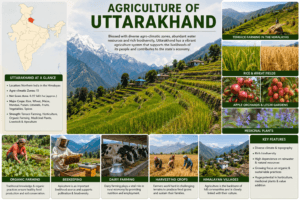
Agriculture is one of the primary occupations in Uttarakhand, providing livelihoods to a large section of the rural population. Due to its diverse topography, the state practices both terrace farming in the hilly regions and modern agriculture in the fertile plains of the Terai and Bhabar regions. The fertile valleys, adequate rainfall, and numerous rivers support the cultivation of a wide variety of crops.
The major food crops of Uttarakhand include rice, wheat, maize, finger millet (Mandua), barnyard millet (Jhangora), barley, pulses, and oilseeds. Traditional millets are widely grown in the hill districts because they are nutritious and well suited to the mountainous terrain.
Uttarakhand is also a leading centre for horticulture. The state produces high-quality apples, pears, peaches, plums, apricots, kiwis, walnuts, litchis, mangoes, oranges, and lemons. Districts such as Nainital, Almora, Pithoragarh, Chamoli, Uttarkashi, and Tehri Garhwal are well known for fruit cultivation.
The state is famous for cultivating medicinal and aromatic plants, including herbs used in Ayurveda, pharmaceuticals, and cosmetics. Crops such as lemongrass, mint, rosemary, tulsi, and lavender are increasingly cultivated due to growing market demand.
Organic farming is rapidly expanding across Uttarakhand. Farmers are adopting sustainable agricultural practices, vermicomposting, and natural farming methods to improve soil fertility and produce chemical-free food. The state government actively promotes organic farming, beekeeping, mushroom cultivation, floriculture, and protected farming through various schemes.
Animal husbandry also contributes significantly to the rural economy. Dairy farming, poultry, sheep and goat rearing, and fisheries provide additional income to farming families.
With its favourable climate, fertile valleys, rich biodiversity, and increasing emphasis on organic agriculture, Uttarakhand has emerged as one of India’s leading Himalayan states for sustainable farming and horticultural development.
Agriculture at a Glance
| Category | Details |
|---|---|
| Main Occupation | Agriculture & Horticulture |
| Major Food Crops | Rice, Wheat, Maize, Mandua & Jhangora |
| Cash Crops | Sugarcane, Oilseeds & Pulses |
| Major Fruits | Apple, Litchi, Pear, Peach & Plum |
| Medicinal Plants | Tulsi, Lemongrass, Mint & Lavender |
| Farming Method | Terrace Farming & Organic Farming |
| Allied Activities | Dairy, Poultry, Beekeeping & Fisheries |
| Famous Region | Terai & Bhabar Plains |
Rivers of Uttarakhand
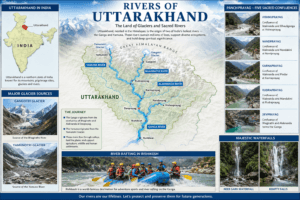
Uttarakhand is often called the “Land of Rivers” because many of northern India’s most important rivers originate from its Himalayan glaciers. These rivers are not only sacred in Hinduism but also play a vital role in drinking water supply, irrigation, hydropower generation, agriculture, biodiversity, and tourism.
The Ganga, India’s holiest river, begins as the Bhagirathi River from the Gangotri Glacier in Uttarkashi district. At Devprayag, the Bhagirathi merges with the Alaknanda River, and from this confluence the river is officially known as the Ganga.
The Yamuna River, the largest tributary of the Ganga, originates from the Yamunotri Glacier in Uttarkashi district. The Yamunotri Temple, one of the Char Dham pilgrimage sites, is dedicated to Goddess Yamuna.
The Alaknanda River rises near the Satopanth and Bhagirath Kharak Glaciers in Chamoli district. It passes through the sacred town of Badrinath and meets several tributaries, including the Mandakini, Pindar, Nandakini, and Dhauliganga, before joining the Bhagirathi at Devprayag.
Other important rivers include the Ramganga, Kosi, Saryu, Kali (Sharda), Tons, Goriganga, and Gaula. These rivers support agriculture, forests, wildlife, and local communities across the state.
Uttarakhand is also famous for the Panch Prayag, the five sacred confluences of the Alaknanda River:
- Vishnuprayag – Alaknanda + Dhauliganga
- Nandaprayag – Alaknanda + Nandakini
- Karnaprayag – Alaknanda + Pindar
- Rudraprayag – Alaknanda + Mandakini
- Devprayag – Alaknanda + Bhagirathi (formation of the Ganga)
These rivers make Uttarakhand one of India’s most important states for hydropower, pilgrimage, river rafting, freshwater resources, and ecological conservation.
Major Rivers at a Glance
| River | Origin | Importance |
|---|---|---|
| Ganga | Devprayag (Bhagirathi + Alaknanda) | India’s holiest river |
| Bhagirathi | Gangotri Glacier | Main source stream of the Ganga |
| Alaknanda | Satopanth Glacier | Major tributary of the Ganga |
| Yamuna | Yamunotri Glacier | Major river of northern India |
| Mandakini | Chorabari Glacier | Flows through Kedarnath |
| Ramganga | Dudhatoli Hills | Irrigation & wildlife |
| Kali (Sharda) | Kalapani | Forms the India–Nepal border |
| Kosi | Kumaon Himalayas | Agriculture & drinking water |
Wildlife & National Parks of Uttarakhand
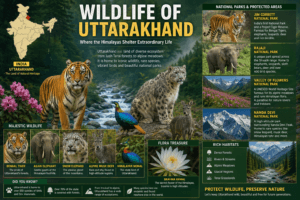
Uttarakhand is one of India’s richest states in terms of biodiversity, wildlife conservation, and forest cover. Nearly 45% of the state’s geographical area is covered by forests, providing habitat for a wide variety of mammals, birds, reptiles, amphibians, and medicinal plants. The state is home to several national parks, wildlife sanctuaries, conservation reserves, and UNESCO World Heritage Sites, making it a paradise for wildlife enthusiasts and nature lovers.
The most famous protected area is Jim Corbett National Park, established in 1936 as Hailey National Park, making it India’s oldest national park. Located in Nainital and Pauri Garhwal districts, it is renowned for its healthy population of Bengal tigers, Asian elephants, leopards, sloth bears, gharials, and over 600 species of birds. It was also the first national park to become part of Project Tiger in 1973.
Another major protected area is the Rajaji National Park, spread across Dehradun, Haridwar, and Pauri Garhwal districts. It is famous for Asian elephants, Bengal tigers, leopards, deer, Himalayan black bears, and rich birdlife. In 2015, Rajaji National Park and Corbett National Park were linked through the Rajaji-Corbett Elephant Corridor, strengthening wildlife conservation.
The Valley of Flowers National Park, a UNESCO World Heritage Site, is internationally famous for its spectacular alpine meadows, rare Himalayan flowers, orchids, medicinal plants, and butterflies. It is home to rare species such as the snow leopard, musk deer, Himalayan monal, and blue sheep (bharal).
The Nanda Devi National Park, another UNESCO World Heritage Site, surrounds Nanda Devi Peak, India’s highest mountain located entirely within the country. The park protects fragile Himalayan ecosystems and endangered species including the snow leopard, Himalayan tahr, serow, and Himalayan musk deer.
Other important wildlife areas include Govind National Park, Gangotri National Park, Askot Wildlife Sanctuary, Binsar Wildlife Sanctuary, Kedarnath Wildlife Sanctuary, and Sonanadi Wildlife Sanctuary.
Uttarakhand’s official state animal is the Alpine Musk Deer, the state bird is the Himalayan Monal, the state tree is Burans (Rhododendron arboreum), and the state flower is the Brahma Kamal, a rare Himalayan flower.
With its pristine forests, snow-covered mountains, rare wildlife, and successful conservation programmes, Uttarakhand remains one of India’s leading eco-tourism and wildlife destinations.
Wildlife at a Glance
| Category | Details |
|---|---|
| Oldest National Park | Jim Corbett National Park |
| UNESCO National Parks | Valley of Flowers & Nanda Devi |
| Famous Tiger Reserve | Corbett Tiger Reserve |
| Largest National Park | Gangotri National Park |
| State Animal | Alpine Musk Deer |
| State Bird | Himalayan Monal |
| State Tree | Burans (Rhododendron arboreum) |
| State Flower | Brahma Kamal |
| Famous Animals | Bengal Tiger, Asian Elephant, Snow Leopard & Himalayan Black Bear |
| Major Sanctuaries | Rajaji, Kedarnath, Binsar & Askot |
Top Tourist Places in Uttarakhand
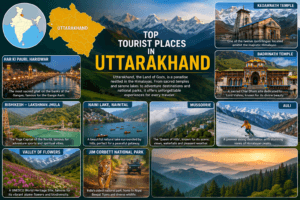
Uttarakhand is one of India’s most popular tourist destinations, renowned for its Himalayan peaks, sacred temples, hill stations, national parks, glaciers, lakes, and adventure sports. Known as “Devbhoomi” (Land of Gods), the state attracts millions of pilgrims, nature lovers, wildlife enthusiasts, and adventure seekers every year.
Kedarnath Temple, one of the twelve Jyotirlingas of Lord Shiva, is among India’s holiest pilgrimage sites and forms part of the Char Dham Yatra. Badrinath Temple, dedicated to Lord Vishnu, is another sacred destination visited by millions of devotees annually.
Haridwar is famous for the Ganga Aarti at Har Ki Pauri, while Rishikesh, known as the “Yoga Capital of the World,” attracts visitors for yoga, meditation, river rafting, bungee jumping, and the iconic Lakshman Jhula and Ram Jhula.
Among the hill stations, Mussoorie, popularly called the “Queen of the Hills,” offers panoramic Himalayan views, waterfalls, and colonial charm. Nainital, famous for its beautiful lake and surrounding mountains, is one of India’s most visited hill stations. Auli is a premier skiing destination, while Chopta is known as the “Mini Switzerland of India.”
Nature lovers can explore the Valley of Flowers National Park, a UNESCO World Heritage Site celebrated for its colourful alpine flowers and rare Himalayan biodiversity. Jim Corbett National Park, India’s oldest national park, is world-famous for Bengal tiger safaris and rich wildlife.
Other major attractions include Gangotri, Yamunotri, Hemkund Sahib, Ranikhet, Almora, Bhimtal, Tehri Lake, Pithoragarh, and the scenic Pindari Glacier Trek.
With its perfect blend of spirituality, adventure, wildlife, and breathtaking natural beauty, Uttarakhand offers unforgettable experiences for every traveller.
Top Tourist Places at a Glance
| Tourist Place | Famous For |
|---|---|
| Kedarnath | Jyotirlinga & Char Dham |
| Badrinath | Vishnu Temple & Char Dham |
| Haridwar | Ganga Aarti & Har Ki Pauri |
| Rishikesh | Yoga, River Rafting & Adventure |
| Mussoorie | Queen of the Hills |
| Nainital | Naini Lake & Hill Station |
| Auli | Skiing & Snow Sports |
| Valley of Flowers | UNESCO World Heritage Site |
| Jim Corbett National Park | Tiger Safaris & Wildlife |
| Hemkund Sahib | Sikh Pilgrimage Site |
Famous Food of Uttarakhand
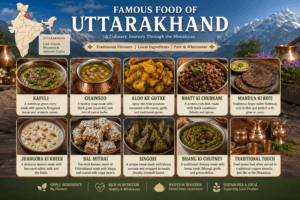
Uttarakhand’s cuisine is simple, nutritious, and deeply rooted in the traditions of the Garhwal and Kumaon regions. The food reflects the state’s Himalayan climate and agricultural practices, with an emphasis on millets, pulses, locally grown vegetables, dairy products, and aromatic spices. Many traditional dishes are prepared using organic ingredients and are known for their high nutritional value.
One of the most famous dishes is Kafuli, a healthy curry made from spinach and fenugreek leaves, considered the state dish of Uttarakhand. Another popular delicacy is Chainsoo, a protein-rich dish prepared from roasted black gram (urad dal).
Aloo Ke Gutke, a spicy potato preparation, is a favourite snack often served with Puri during festivals and family gatherings. Phaanu, made from mixed lentils, and Dubuk, a traditional Kumaoni lentil curry, are popular comfort foods.
Among rice-based dishes, Jhangora Ki Kheer is a famous dessert made from barnyard millet, milk, and dry fruits. Mandua Ki Roti, prepared from finger millet flour, is widely consumed in the hill districts due to its nutritional benefits.
Other well-known dishes include Bhatt Ki Churkani, Gahat (Kulath) Dal, Kandalee Ka Saag (made from stinging nettle leaves), Bhang Ki Chutney, Arsa, Singori, Bal Mithai, and Lesu.
The state is also known for its fresh fruits such as apples, pears, peaches, plums, apricots, litchis, and malta oranges, which are widely grown in the Himalayan orchards.
Uttarakhand’s traditional cuisine perfectly combines health, taste, and simplicity, making it one of India’s most unique regional food cultures.
Famous Foods at a Glance
| Dish | Famous For |
|---|---|
| Kafuli | State dish made from spinach & fenugreek |
| Chainsoo | Roasted black gram curry |
| Aloo Ke Gutke | Spicy potato dish |
| Phaanu | Mixed lentil curry |
| Dubuk | Traditional Kumaoni lentil dish |
| Bhatt Ki Churkani | Black soybean curry |
| Mandua Ki Roti | Finger millet bread |
| Jhangora Ki Kheer | Barnyard millet dessert |
| Bal Mithai | Famous Kumaoni sweet |
| Singori | Traditional sweet wrapped in Malu leaves |
Festivals of Uttarakhand
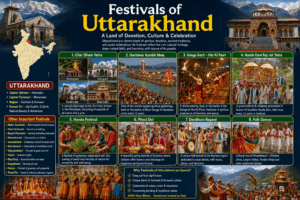
Uttarakhand is widely known as the “Land of Gods (Devbhoomi)”, where festivals are celebrated with great devotion, cultural enthusiasm, and traditional folk customs. The state’s festivals reflect its religious heritage, Himalayan traditions, agriculture, and local culture. Throughout the year, devotees and tourists gather to participate in colourful fairs, temple festivals, and cultural celebrations.
One of the most significant religious events is the Char Dham Yatra, during which millions of pilgrims visit the sacred shrines of Kedarnath, Badrinath, Gangotri, and Yamunotri. The annual opening and closing ceremonies of these temples are celebrated with great devotion.
The Kumbh Mela and Ardh Kumbh Mela, held in Haridwar, are among the world’s largest religious gatherings, attracting millions of pilgrims who take a holy dip in the River Ganga at Har Ki Pauri.
Nanda Devi Raj Jat Yatra, organised once every 12 years, is one of the longest and most sacred Himalayan pilgrimages. Often called the “Himalayan Kumbh,” it is dedicated to Goddess Nanda Devi and covers hundreds of kilometres through the Garhwal Himalayas.
Other important festivals include Harela, celebrated to welcome the monsoon and promote environmental conservation, Phool Dei, a traditional spring festival celebrated mainly by children, and Ghughutiya (Makar Sankranti), which marks the harvest season.
Popular fairs such as the Uttarayani Fair (Bageshwar), Purnagiri Mela, Magh Mela, and Devidhura Bagwal Festival, where participants traditionally throw stones in a symbolic ritual, attract thousands of visitors every year.
National festivals such as Diwali, Holi, Navratri, Dussehra, Janmashtami, Mahashivratri, Buddha Purnima, Eid, and Christmas are also celebrated with harmony across the state.
These vibrant festivals preserve Uttarakhand’s rich cultural heritage while strengthening community bonds and promoting tourism.
Major Festivals at a Glance
| Festival | Famous For |
|---|---|
| Char Dham Yatra | Kedarnath, Badrinath, Gangotri & Yamunotri pilgrimage |
| Kumbh Mela | Holy bathing festival at Haridwar |
| Ardh Kumbh Mela | Religious gathering every 6 years |
| Nanda Devi Raj Jat Yatra | Sacred Himalayan pilgrimage |
| Harela | Nature & harvest festival |
| Phool Dei | Spring festival |
| Uttarayani Fair | Traditional fair in Bageshwar |
| Devidhura Bagwal | Traditional stone-throwing festival |
| Ghughutiya | Makar Sankranti harvest festival |
| Diwali & Holi | Major Hindu festivals |
Culture of Uttarakhand
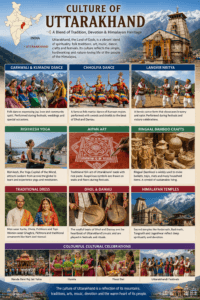
Uttarakhand’s culture is a beautiful blend of Himalayan traditions, spirituality, folk heritage, and tribal customs. Popularly known as “Devbhoomi” (Land of Gods), the state has preserved its unique identity through its festivals, folk music, dances, temples, traditional attire, handicrafts, cuisine, and ancient rituals. The two major cultural regions of Uttarakhand are Garhwal and Kumaon, each with its own customs and traditions.
The people of Uttarakhand are known for their warm hospitality, simple lifestyle, deep religious faith, and close relationship with nature. Hinduism is the predominant religion, while Sikhism, Islam, Buddhism, Christianity, and other faiths are also practised peacefully across the state.
Traditional folk dances such as Langvir Nritya, Barada Nati, Pandav Nritya, Chholiya Dance, Jhoda, Chanchari, and Jhora Dance are performed during festivals, weddings, fairs, and religious ceremonies. These dances showcase the rich cultural heritage of the Garhwal and Kumaon regions.
Uttarakhand is equally famous for its folk music, featuring traditional instruments such as the Dhol, Damau, Hudka, Ransingha, Bhankora, Turri, and Murli. Folk songs celebrate devotion, love, nature, agriculture, and the heroic history of the Himalayan region.
The traditional attire of Uttarakhand reflects the state’s mountain lifestyle. Women commonly wear Ghagra, Pichora, Saree, Angadi, and beautiful traditional jewellery such as the Nath (nose ring) and Hansuli. Men traditionally wear Kurta-Pyjama, Dhoti, Woollen Caps, and Chola.
Handicrafts are an important part of Uttarakhand’s culture. The state is well known for Aipan art, Ringaal bamboo crafts, wood carving, woollen shawls, carpets, copperware, handwoven textiles, and traditional handmade products.
Yoga and spirituality are deeply rooted in Uttarakhand’s identity. Rishikesh, known as the “Yoga Capital of the World,” attracts millions of visitors for yoga, meditation, Ayurveda, and spiritual retreats every year.
With its ancient traditions, colourful folk arts, sacred temples, and harmonious way of life, Uttarakhand proudly preserves one of India’s richest cultural heritages.
Culture at a Glance
| Category | Details |
|---|---|
| Cultural Regions | Garhwal & Kumaon |
| Nickname | Devbhoomi (Land of Gods) |
| Famous Dance | Chholiya, Langvir, Jhoda & Pandav Nritya |
| Folk Music | Garhwali & Kumaoni Folk Songs |
| Musical Instruments | Dhol, Damau, Hudka & Ransingha |
| Traditional Dress | Ghagra, Pichora, Kurta-Pyjama & Woollen Caps |
| Famous Art | Aipan Art & Ringaal Bamboo Craft |
| Spiritual Centre | Rishikesh – Yoga Capital of the World |
| Traditional Jewellery | Nath & Hansuli |
| Famous Handicrafts | Woollen Shawls, Carpets & Wood Carving |
Transport of Uttarakhand
Uttarakhand has a well-developed transportation network that connects its major cities, hill stations, pilgrimage centres, and remote Himalayan regions through roads, railways, and airways. The state’s transport infrastructure plays a crucial role in supporting tourism, pilgrimage, trade, and economic development.
Road transport is the backbone of connectivity in Uttarakhand. The state has an extensive network of National Highways, State Highways, and mountain roads connecting destinations such as Dehradun, Haridwar, Rishikesh, Nainital, Mussoorie, Kedarnath, Badrinath, Gangotri, and Yamunotri. The Uttarakhand Transport Corporation (UTC) operates regular bus services, while private buses, taxis, and shared jeeps provide transport to remote villages and tourist destinations.
Rail transport mainly serves the plains and foothill regions. Major railway stations include Dehradun, Haridwar Junction, Rishikesh, Kathgodam, Haldwani, Rudrapur City, Roorkee, and Kotdwar. Kathgodam Railway Station is the primary rail gateway to the Kumaon region, including Nainital and nearby hill stations.
Air connectivity is provided by Jolly Grant Airport (Dehradun), the state’s primary airport, offering regular flights to Delhi, Mumbai, Bengaluru, Hyderabad, Lucknow, Jaipur, and other major Indian cities. Other important airports include Pantnagar Airport and Naini Saini Airport (Pithoragarh), while helicopter services connect pilgrims to Kedarnath during the Char Dham season.
The Char Dham All Weather Road Project has significantly improved road access to the sacred pilgrimage sites, while the Rishikesh–Karnaprayag Railway Project is one of India’s most important ongoing railway infrastructure projects in the Himalayan region.
Adventure transport options such as the Auli Ropeway, one of Asia’s longest cable cars, and river rafting facilities in Rishikesh further enhance the state’s tourism appeal.
With continuous investment in roads, railways, airports, and ropeways, Uttarakhand is steadily improving connectivity while promoting sustainable tourism and regional development.
Transport at a Glance
| Mode | Major Facilities |
|---|---|
| Roads | National Highways, State Highways & Char Dham Roads |
| State Bus Service | Uttarakhand Transport Corporation (UTC) |
| Major Railway Stations | Dehradun, Haridwar, Kathgodam, Rishikesh & Roorkee |
| Main Airport | Jolly Grant Airport (Dehradun) |
| Other Airports | Pantnagar & Naini Saini (Pithoragarh) |
| Helicopter Services | Kedarnath & Char Dham Yatra |
| Famous Ropeway | Auli Ropeway |
| Major Infrastructure Project | Rishikesh–Karnaprayag Railway |

Sports of Uttarakhand
Uttarakhand has emerged as an important destination for adventure sports, mountaineering, winter sports, athletics, and traditional games. Its majestic Himalayan landscape, snow-covered mountains, rivers, forests, and valleys provide ideal conditions for outdoor sports and adventure tourism.
Adventure sports are among the biggest attractions in Uttarakhand. Rishikesh is internationally famous for white-water river rafting, bungee jumping, kayaking, rock climbing, and camping. Every year, thousands of adventure enthusiasts from India and abroad visit Rishikesh for these thrilling activities.
Auli, one of India’s premier skiing destinations, hosts national and international skiing and snowboarding competitions during winter. Its well-maintained ski slopes, cable car, and breathtaking Himalayan views make it a favourite destination for winter sports.
The state is also renowned for trekking and mountaineering. Popular trekking routes include the Valley of Flowers Trek, Roopkund Trek, Har Ki Dun Trek, Kedarkantha Trek, Pindari Glacier Trek, Nag Tibba Trek, and Kuari Pass Trek. The Nehru Institute of Mountaineering (NIM) in Uttarkashi is one of India’s leading mountaineering training institutes.
Traditional sports such as Kabaddi, Wrestling (Kushti), Kho Kho, and Archery continue to be popular in rural areas and are often organised during village fairs and festivals.
Cricket, football, badminton, volleyball, athletics, and hockey are widely played across the state. Modern stadiums and sports facilities in Dehradun, Haridwar, Haldwani, and Rudrapur encourage young athletes to participate in national competitions.
The Rajiv Gandhi International Cricket Stadium in Dehradun has hosted international cricket matches, while Uttarakhand’s athletes have represented India in mountaineering, athletics, shooting, and winter sports.
With growing investments in sports infrastructure and adventure tourism, Uttarakhand is becoming one of India’s leading destinations for both recreational and competitive sports.
Sports at a Glance
| Category | Details |
|---|---|
| Famous Adventure Sport | River Rafting |
| Winter Sports Destination | Auli |
| Major Training Institute | Nehru Institute of Mountaineering (Uttarkashi) |
| Famous Trek | Valley of Flowers Trek |
| Popular Sports | Cricket, Football, Badminton & Athletics |
| Traditional Sports | Kabaddi, Wrestling, Kho Kho & Archery |
| International Cricket Venue | Rajiv Gandhi International Cricket Stadium, Dehradun |
| Adventure Activities | Skiing, Trekking, Bungee Jumping & Camping |
Famous Personalities of Uttarakhand
Uttarakhand has produced many distinguished personalities who have made remarkable contributions in the fields of politics, literature, military service, sports, science, spirituality, music, and social service. The state’s rich cultural heritage, educational institutions, and disciplined lifestyle have helped nurture several nationally and internationally recognised figures.
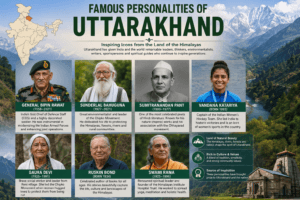
One of Uttarakhand’s most respected personalities is General Bipin Rawat, India’s first Chief of Defence Staff (CDS), who hailed from Pauri Garhwal. His outstanding military leadership and service to the nation earned him immense respect.
The state is also associated with renowned environmental activist Sunderlal Bahuguna, leader of the Chipko Movement, whose efforts played a crucial role in protecting the Himalayan forests and promoting environmental conservation.
In literature, Sumitranandan Pant, one of the greatest Hindi poets and a recipient of the Jnanpith Award, was born in Kausani. His poetry beautifully portrays nature and the Himalayan landscape.
Former Chief Minister and senior politician Narayan Dutt Tiwari made significant contributions to the development of Uttarakhand and Uttar Pradesh.
In sports, Vandana Katariya, India’s international hockey player from Haridwar, became the first Indian woman to score a hat-trick at the Olympic Games, inspiring young athletes across the country.
The state is also known for famous spiritual leaders such as Swami Rama, who established the Himalayan Institute, and numerous yoga masters who have contributed to making Rishikesh the Yoga Capital of the World.
Other notable personalities include Gaura Devi, a prominent leader of the Chipko Movement, Ruskin Bond, the celebrated author based in Mussoorie, and Anil Baluni, a prominent political leader and Member of Parliament.
These eminent personalities have played a vital role in shaping Uttarakhand’s identity and have brought pride to the state through their achievements and dedicated service.
Famous Personalities at a Glance
| Personality | Famous For |
|---|---|
| General Bipin Rawat | India’s First Chief of Defence Staff (CDS) |
| Sunderlal Bahuguna | Environmentalist & Chipko Movement Leader |
| Sumitranandan Pant | Jnanpith Award-winning Hindi Poet |
| Narayan Dutt Tiwari | Former Chief Minister |
| Vandana Katariya | Indian Hockey Player |
| Gaura Devi | Chipko Movement Activist |
| Ruskin Bond | Celebrated Author |
| Swami Rama | Spiritual Leader & Founder of Himalayan Institute |
Shopping in Uttarakhand
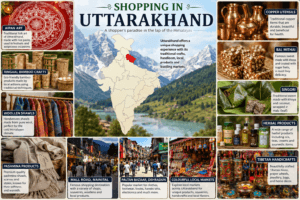
Shopping in Uttarakhand is a delightful experience, offering a wide range of traditional handicrafts, handwoven woollen products, organic food items, wooden artefacts, copperware, local spices, and handmade souvenirs. The state’s markets reflect the rich cultural heritage of the Garhwal and Kumaon regions, making them popular among tourists and collectors.
One of Uttarakhand’s most famous handicrafts is Aipan Art, a traditional folk art of the Kumaon region created using red ochre and white rice paste. Beautiful Ringaal bamboo products, including baskets, trays, mats, and decorative items, are also widely available.
The state is well known for its woollen shawls, pashmina products, handwoven blankets, tweed jackets, woollen caps, mufflers, and carpets, especially from hill towns such as Almora, Munsiyari, and Pithoragarh.
Visitors can also purchase wood carvings, copper utensils, brass idols, handmade candles, natural honey, herbal tea, organic spices, medicinal herbs, essential oils, and Ayurvedic products. These products represent Uttarakhand’s eco-friendly lifestyle and Himalayan traditions.
Food lovers often buy famous local delicacies such as Bal Mithai, Singori, Burans (Rhododendron) squash, apple jam, fruit preserves, herbal products, and organic millet flour as souvenirs.
Popular shopping destinations include Paltan Bazaar (Dehradun), Tibetan Market (Dehradun), Mall Road (Nainital), Moti Bazaar (Haridwar), Rishikesh Market, Almora Bazaar, and local handicraft emporiums operated by the state government.
Shopping in Uttarakhand offers visitors an opportunity to take home authentic Himalayan craftsmanship, traditional textiles, organic products, and unique cultural souvenirs.
Shopping at a Glance
| Shopping Item | Famous Place |
|---|---|
| Aipan Art | Almora & Kumaon |
| Ringaal Bamboo Crafts | Garhwal & Kumaon |
| Woollen Shawls & Blankets | Munsiyari & Almora |
| Copperware | Almora & Pithoragarh |
| Bal Mithai & Singori | Almora |
| Organic Honey & Herbal Tea | Across Uttarakhand |
| Wooden Handicrafts | Ranikhet & Dehradun |
| Tibetan Handicrafts | Dehradun & Nainital |
| Ayurvedic & Herbal Products | Rishikesh & Haridwar |
| Souvenir Shopping | Mall Road (Nainital), Paltan Bazaar & Moti Bazaar |
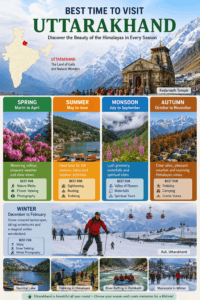
Best Time to Visit Uttarakhand
Uttarakhand is a year-round travel destination, with each season offering a unique experience. Whether you are looking for pilgrimage, adventure sports, wildlife safaris, trekking, snowfall, or peaceful hill stations, the state has something to offer throughout the year.
Summer (March – June)
Summer is considered the best time to visit Uttarakhand. The weather remains pleasant, with temperatures ranging between 15°C and 30°C, making it ideal for sightseeing, trekking, camping, river rafting, wildlife safaris, and visiting popular hill stations such as Mussoorie, Nainital, Auli, Ranikhet, and Almora. The Char Dham Yatra also begins during this season.
Monsoon (July – September)
The monsoon season brings lush greenery, waterfalls, and scenic landscapes across the state. It is the perfect time to visit the Valley of Flowers National Park, which blooms with thousands of colourful alpine flowers. However, travellers should be cautious, as heavy rainfall may cause landslides and road closures in some hilly areas.
Winter (October – February)
Winter transforms Uttarakhand into a snowy paradise. Temperatures can fall below 0°C in higher altitudes, making destinations like Auli, Munsiyari, Chopta, and Dhanaulti popular for snowfall, skiing, and winter photography. The cool weather also makes it a great time to explore Rishikesh, Haridwar, Dehradun, and Jim Corbett National Park.
Adventure lovers can enjoy skiing, snowboarding, trekking, mountain biking, camping, paragliding, river rafting, wildlife safaris, and yoga retreats throughout different seasons.
Overall, the best time to visit Uttarakhand is from March to June and October to November, when the weather is pleasant and most tourist attractions are easily accessible.
Best Time at a Glance
| Season | Months | Best For |
|---|---|---|
| Summer | March – June | Hill Stations, Char Dham, Trekking & Rafting |
| Monsoon | July – September | Valley of Flowers, Waterfalls & Green Landscapes |
| Autumn | October – November | Sightseeing, Photography & Pilgrimage |
| Winter | December – February | Snowfall, Skiing, Auli & Winter Tourism |
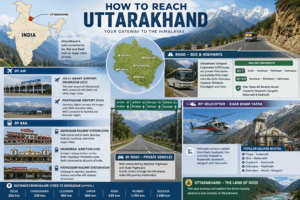
How to Reach Uttarakhand
Uttarakhand is well connected to the rest of India through airways, railways, and an extensive road network. Whether you are travelling for the Char Dham Yatra, hill stations, wildlife tourism, or adventure activities, reaching Uttarakhand is convenient from major Indian cities.
By Air
The primary airport serving Uttarakhand is Jolly Grant Airport in Dehradun, located about 25 km from Dehradun city and around 35 km from Rishikesh. It offers regular flights to major cities such as Delhi, Mumbai, Bengaluru, Hyderabad, Lucknow, Jaipur, and Ahmedabad.
Other airports include:
- Pantnagar Airport – Gateway to Nainital, Kumaon, and Jim Corbett National Park.
- Naini Saini Airport (Pithoragarh) – Serves the eastern Himalayan region.
During the Char Dham pilgrimage season, helicopter services operate to Kedarnath and other important pilgrimage destinations.
By Train
Uttarakhand has a well-connected railway network, especially in the foothill regions.
Major railway stations include:
- Dehradun Railway Station
- Haridwar Junction
- Kathgodam Railway Station (Gateway to Nainital and Kumaon)
- Rishikesh Railway Station
- Roorkee Railway Station
- Kotdwar Railway Station
- Rudrapur City Railway Station
Direct trains connect Uttarakhand with Delhi, Mumbai, Kolkata, Chennai, Lucknow, Varanasi, Ahmedabad, Jaipur, and other major cities.
By Road
Uttarakhand has an excellent road network maintained by the National Highways Authority of India (NHAI) and the Public Works Department (PWD).
Regular buses are operated by the Uttarakhand Transport Corporation (UTC) and various private operators from Delhi, Chandigarh, Jaipur, Lucknow, Dehradun, Haridwar, and neighbouring states.
Important highways include:
- NH 7 – Connects Haridwar, Rishikesh, Srinagar, Rudraprayag, Joshimath, and Badrinath.
- NH 109 – Connects Rudrapur, Haldwani, Nainital, Almora, and Pithoragarh.
- Delhi–Dehradun Expressway (under development) – Will significantly reduce travel time.
Private taxis, rental cars, and shared jeeps are widely available for travelling to remote hill stations and pilgrimage sites.
Helicopter Services
Helicopter services are especially popular during the Char Dham Yatra and operate from Dehradun, Guptkashi, Phata, Sersi, and other helipads to destinations such as Kedarnath.
Transport Connectivity at a Glance
| Mode | Major Connectivity |
|---|---|
| Airport | Jolly Grant Airport (Dehradun) |
| Other Airports | Pantnagar & Naini Saini (Pithoragarh) |
| Major Railway Stations | Dehradun, Haridwar, Kathgodam, Rishikesh & Roorkee |
| Bus Service | Uttarakhand Transport Corporation (UTC) |
| Major Highways | NH 7 & NH 109 |
| Helicopter Services | Kedarnath & Char Dham Yatra |
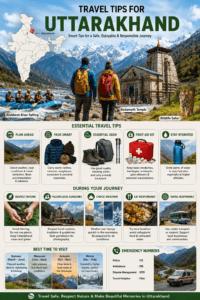
Travel Tips for Uttarakhand
Uttarakhand is one of India’s most beautiful Himalayan destinations, offering pilgrimage, adventure, wildlife, and nature tourism. Proper planning can help travellers enjoy a safe, comfortable, and memorable journey. Due to the state’s mountainous terrain and changing weather conditions, visitors should prepare according to the season and destination.
If you are planning the Char Dham Yatra, complete the required online registration, check weather updates, and carry valid identity proof. Since many pilgrimage sites are located at high altitudes, travellers should allow time for acclimatisation and avoid overexertion.
The best time to visit is from March to June and October to November, when the weather is pleasant and roads are generally accessible. During the monsoon season (July–September), travellers should stay updated on weather forecasts as heavy rainfall may cause landslides and road closures in hilly areas.
Carry warm clothing even during summer if you plan to visit high-altitude destinations such as Kedarnath, Badrinath, Auli, Chopta, or Valley of Flowers, where temperatures can drop suddenly. Comfortable trekking shoes, rainwear, sunscreen, sunglasses, and a basic first-aid kit are also recommended.
Adventure enthusiasts participating in trekking, river rafting, skiing, or camping should always choose authorised operators and follow all safety guidelines. Wildlife visitors should respect park rules, avoid feeding animals, and help preserve the natural environment.
Uttarakhand is a sacred region with numerous temples, monasteries, and pilgrimage sites. Visitors should wear modest clothing, respect local customs, avoid littering, and support eco-friendly tourism by reducing plastic use.
Booking hotels, transport, helicopter services, and safari permits in advance is highly recommended, especially during the peak pilgrimage and holiday seasons.
With proper planning and responsible travel, visitors can enjoy Uttarakhand’s spectacular mountains, spiritual heritage, adventure activities, wildlife, and warm hospitality.
Essential Travel Tips
| Travel Tip | Recommendation |
|---|---|
| Best Time | March–June & October–November |
| Char Dham | Complete online registration before travel |
| Clothing | Carry warm clothes for high-altitude areas |
| Monsoon Travel | Check weather and landslide updates |
| Adventure Sports | Choose authorised operators |
| Wildlife Safari | Follow park rules |
| Temple Visits | Dress modestly and respect traditions |
| Environment | Avoid plastic and keep nature clean |
| Health | Carry medicines and a first-aid kit |
| Advance Booking | Book hotels, safaris, and helicopter services early |
Interesting Facts About Uttarakhand
Uttarakhand, popularly known as the “Land of Gods (Devbhoomi)”, is one of India’s most fascinating states due to its unique blend of spirituality, Himalayan landscapes, biodiversity, adventure tourism, and cultural heritage. From sacred temples to snow-covered peaks, the state offers countless natural and historical wonders.
The state is home to the Char Dham pilgrimage circuit—Kedarnath, Badrinath, Gangotri, and Yamunotri—which attracts millions of devotees every year. Rishikesh, located on the banks of the River Ganga, is internationally recognised as the “Yoga Capital of the World” and hosts the renowned International Yoga Festival.
Uttarakhand is home to Nanda Devi (7,816 metres), India’s highest mountain located entirely within the country. The state also contains two UNESCO World Heritage Sites—Nanda Devi National Park and Valley of Flowers National Park, famous for their rare Himalayan biodiversity.
Jim Corbett National Park, established in 1936, is India’s oldest national park and the first to become part of Project Tiger. Uttarakhand is also the birthplace of the sacred Ganga and Yamuna rivers, which originate from the Gangotri and Yamunotri glaciers.
Nearly 45% of Uttarakhand is covered by forests, making it one of India’s most environmentally rich states. The state is famous for adventure activities such as river rafting, trekking, skiing, camping, mountaineering, and wildlife safaris.
The Valley of Flowers blooms with hundreds of alpine flower species every monsoon, while Auli is one of India’s premier skiing destinations. Uttarakhand is also famous for traditional Aipan Art, Ringaal bamboo crafts, and the delicious sweets Bal Mithai and Singori.
Interesting Facts at a Glance
| Fact | Details |
|---|---|
| Nickname | Devbhoomi (Land of Gods) |
| Formation | 9 November 2000 |
| Highest Peak | Nanda Devi (7,816 m) |
| UNESCO Sites | Nanda Devi National Park & Valley of Flowers |
| Oldest National Park | Jim Corbett National Park |
| Yoga Capital | Rishikesh |
| Sacred Rivers | Ganga & Yamuna originate here |
| Famous Pilgrimage | Char Dham Yatra |
| Forest Cover | Around 45% |
| Adventure Sports | River Rafting, Skiing & Trekking |
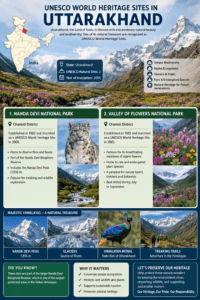
UNESCO World Heritage Sites in Uttarakhand
Uttarakhand is home to two UNESCO World Heritage Sites, both internationally recognised for their exceptional natural beauty, biodiversity, and ecological importance. Located in the heart of the Himalayas, these protected areas attract scientists, trekkers, photographers, and nature lovers from around the world.
Valley of Flowers National Park
The Valley of Flowers National Park was inscribed as a UNESCO World Heritage Site in 2005 as part of the Nanda Devi and Valley of Flowers National Parks World Heritage property. Situated in Chamoli district, the park is famous for its spectacular alpine meadows that bloom with more than 600 species of wildflowers during the monsoon season.
The valley is home to several rare and endangered species, including the snow leopard, Himalayan musk deer, blue sheep (bharal), and the Himalayan monal. It is one of India’s most beautiful trekking destinations and is open to visitors mainly between June and October.
Nanda Devi National Park
Nanda Devi National Park, also located in Chamoli district, became a UNESCO World Heritage Site in 1988 and was later extended to include the Valley of Flowers.
The park surrounds Nanda Devi (7,816 metres), the highest mountain located entirely within India. It protects one of the most pristine Himalayan ecosystems, featuring glaciers, alpine meadows, deep valleys, and rare wildlife such as the snow leopard, Himalayan tahr, serow, Himalayan black bear, and musk deer.
These UNESCO sites play a vital role in conserving the fragile Himalayan ecosystem and promoting sustainable eco-tourism in Uttarakhand.
UNESCO World Heritage Sites at a Glance
| UNESCO Site | Year | Category | Famous For |
|---|---|---|---|
| Nanda Devi National Park | 1988 | Natural | Nanda Devi Peak, glaciers & Himalayan wildlife |
| Valley of Flowers National Park | 2005* | Natural | Alpine flowers, biodiversity & trekking |
*Inscribed in 2005 as part of the Nanda Devi and Valley of Flowers National Parks World Heritage property.
Frequently Asked Questions (FAQs) About Uttarakhand
1. Why is Uttarakhand called the “Land of Gods”?
Uttarakhand is known as “Devbhoomi” (Land of Gods) because it is home to numerous ancient Hindu temples and sacred pilgrimage sites, including Kedarnath, Badrinath, Gangotri, and Yamunotri, which together form the famous Char Dham Yatra.
2. What is the capital of Uttarakhand?
Dehradun is the winter capital, while Bhararisain (Gairsain) serves as the summer capital of Uttarakhand.
3. Which is the best time to visit Uttarakhand?
The best time to visit Uttarakhand is March to June for pleasant weather and October to November for sightseeing and pilgrimage. December to February is ideal for snowfall and skiing.
4. What are the top tourist attractions in Uttarakhand?
Some of the most popular attractions include Kedarnath, Badrinath, Rishikesh, Haridwar, Nainital, Mussoorie, Auli, Valley of Flowers National Park, Jim Corbett National Park, and Hemkund Sahib.
5. How many districts are there in Uttarakhand?
Uttarakhand has 13 districts, divided into the Garhwal and Kumaon regions.
6. Which is the highest peak in Uttarakhand?
Nanda Devi (7,816 metres) is the highest mountain located entirely within India and the highest peak in Uttarakhand.
7. Which rivers originate in Uttarakhand?
The sacred Ganga and Yamuna rivers originate in Uttarakhand. Other important rivers include the Alaknanda, Bhagirathi, Mandakini, Ramganga, Kali (Sharda), and Kosi.
8. How many UNESCO World Heritage Sites are there in Uttarakhand?
Uttarakhand has two UNESCO World Heritage Sites:
- Nanda Devi National Park
- Valley of Flowers National Park
9. What is Uttarakhand famous for?
Uttarakhand is famous for its Char Dham pilgrimage, Himalayan mountains, yoga, adventure tourism, wildlife, national parks, glaciers, hill stations, rivers, and spiritual heritage.
10. What are the famous foods of Uttarakhand?
Popular dishes include Kafuli, Chainsoo, Aloo Ke Gutke, Bhatt Ki Churkani, Mandua Ki Roti, Jhangora Ki Kheer, Bal Mithai, Singori, and Bhang Ki Chutney.
Conclusion
Uttarakhand, popularly known as the “Land of Gods (Devbhoomi),” is one of India’s most extraordinary travel destinations, where spirituality, Himalayan landscapes, adventure, wildlife, and rich cultural heritage come together to create an unforgettable experience. From the sacred Char Dham pilgrimage and the peaceful banks of the Ganga in Haridwar and Rishikesh to the snow-covered peaks of Nanda Devi, Uttarakhand offers something special for every traveller.
The state is internationally recognised for its UNESCO World Heritage Sites, including Nanda Devi National Park and the Valley of Flowers National Park, along with famous destinations such as Kedarnath, Badrinath, Mussoorie, Nainital, Auli, and Jim Corbett National Park. Whether you seek pilgrimage, trekking, skiing, river rafting, wildlife safaris, yoga retreats, or nature photography, Uttarakhand provides unforgettable experiences throughout the year.
Uttarakhand is also known for its rich Garhwali and Kumaoni culture, traditional festivals, nutritious Himalayan cuisine, colourful handicrafts, and warm hospitality. The state’s commitment to environmental conservation and sustainable tourism has made it one of India’s leading eco-tourism destinations.
Whether you are a spiritual seeker, adventure enthusiast, wildlife lover, or family traveller, Uttarakhand promises breathtaking landscapes, peaceful surroundings, and lifelong memories.
Plan your journey to Uttarakhand and discover a land where sacred rivers begin, majestic mountains touch the sky, ancient temples inspire devotion, and every destination showcases the timeless beauty of the Himalayas.
Thank you for reading the complete Uttarakhand Travel Guide on DealKart Market. Explore our other Indian State Travel Guides, local business listings, and destination articles to discover the incredible diversity of India.
Internal Links
Connect your Uttarakhand article with other state pages to improve SEO, user engagement, and page views.
- Telangana Travel Guide – https://dealkartmarket.in/telangana/
- Andhra Pradesh Travel Guide – https://dealkartmarket.in/andhra-pradesh/
- Karnataka Travel Guide – https://dealkartmarket.in/karnataka/
- Tamil Nadu Travel Guide – https://dealkartmarket.in/tamil-nadu/
- Kerala Travel Guide – https://dealkartmarket.in/kerala/
- Maharashtra Travel Guide – https://dealkartmarket.in/maharashtra/
- Goa Travel Guide – https://dealkartmarket.in/goa/
- Gujarat Travel Guide – https://dealkartmarket.in/gujarat/
- Madhya Pradesh Travel Guide – https://dealkartmarket.in/madhya-pradesh/
- Himachal Pradesh Travel Guide – https://dealkartmarket.in/himachal-pradesh/
- Punjab Travel Guide – https://dealkartmarket.in/punjab/
- Haryana Travel Guide – https://dealkartmarket.in/haryana/
References
- https://uttarakhandtourism.gov.in/
- https://uttarakhand.gov.in/
- https://whc.unesco.org/
- https://indianculture.gov.in/
- https://knowindia.india.gov.in/