
Introduction
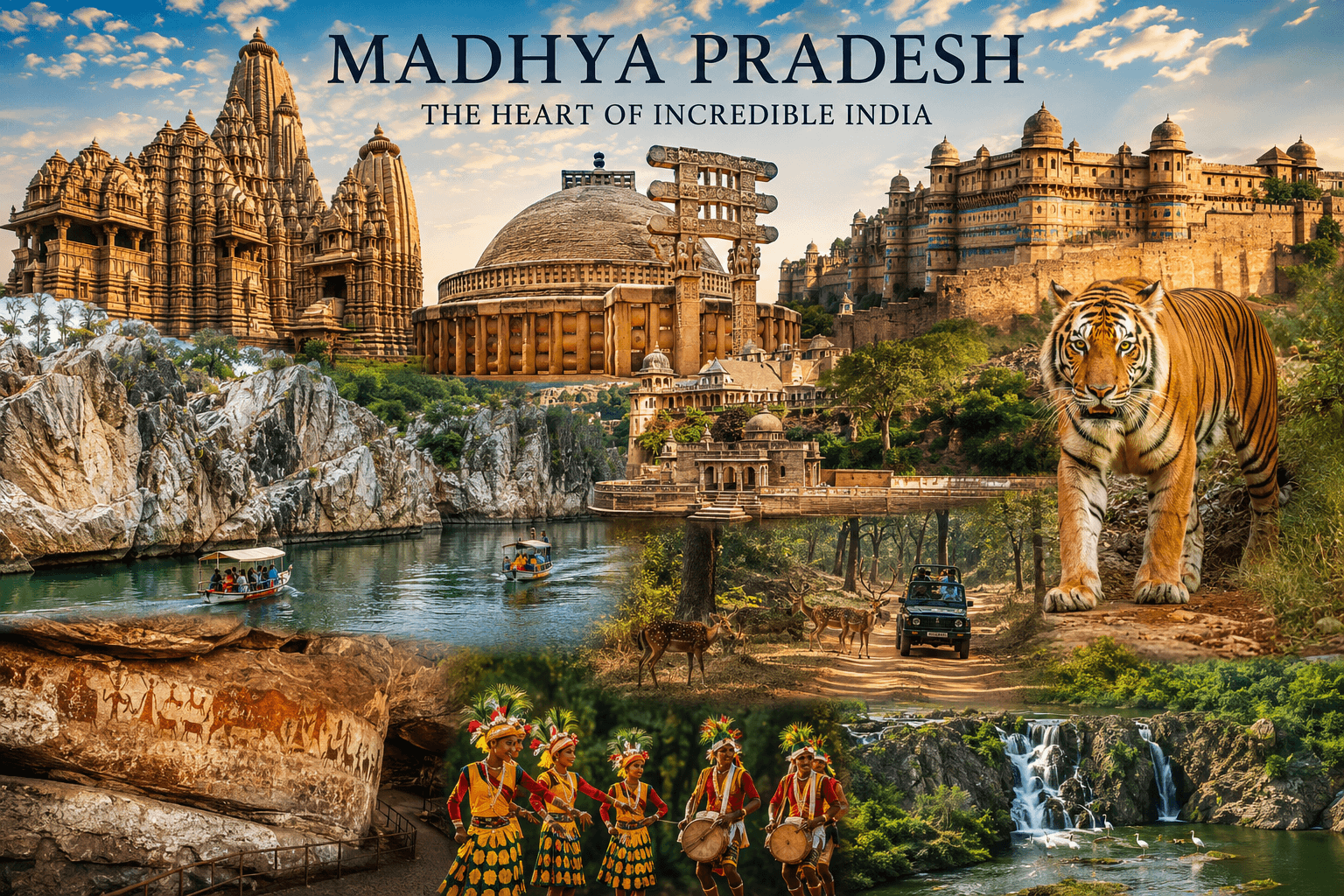
Madhya Pradesh, popularly known as the “Heart of India”, is the second-largest state in India by area and is located in the central part of the country. The state is renowned for its rich history, magnificent temples, UNESCO World Heritage Sites, dense forests, diverse wildlife, ancient caves, majestic forts, and vibrant tribal culture. Its strategic location and rich heritage make it one of India’s most fascinating travel destinations.
The capital city of Madhya Pradesh is Bhopal, also known as the City of Lakes, while Indore is the state’s largest city and commercial hub. Madhya Pradesh is bordered by Uttar Pradesh, Chhattisgarh, Maharashtra, Gujarat, and Rajasthan.
The state is home to three UNESCO World Heritage Sites—Khajuraho Group of Monuments, Sanchi Stupa, and Bhimbetka Rock Shelters. It is also famous for Bandhavgarh National Park, Kanha National Park, Pench National Park, Satpura National Park, and the stunning Marble Rocks of Bhedaghat.
Madhya Pradesh has a rich cultural legacy shaped by ancient kingdoms such as the Mauryas, Guptas, Paramaras, Chandelas, and Marathas. The state is equally known for its tribal traditions, handicrafts, classical architecture, and religious landmarks.
With breathtaking landscapes, historical monuments, wildlife sanctuaries, and spiritual destinations, Madhya Pradesh truly represents the heart of India’s cultural and natural heritage.
Madhya Pradesh on India Map
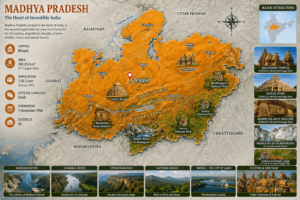
Madhya Pradesh, popularly known as the “Heart of India,” is located in the central part of the country and is the second-largest state in India by area. Its strategic location connects northern, southern, eastern, and western India, making it an important geographical and cultural centre.
The state shares its borders with Uttar Pradesh to the north, Chhattisgarh to the east, Maharashtra to the south, and Gujarat and Rajasthan to the west. The capital city, Bhopal, is centrally located and is famous for its beautiful lakes, while Indore is the largest city and commercial hub.
Madhya Pradesh is blessed with diverse landscapes, including the Vindhya and Satpura mountain ranges, dense forests, fertile river valleys, and rich wildlife habitats. Major rivers flowing through the state include the Narmada, Tapti (Tapi), Chambal, Betwa, Son, and Ken rivers.
The state is home to world-famous heritage and tourism destinations such as Khajuraho, Sanchi, Bhimbetka, Bandhavgarh National Park, Kanha National Park, Pench National Park, and the spectacular Marble Rocks of Bhedaghat, making it one of India’s most attractive travel destinations.
History of Madhya Pradesh
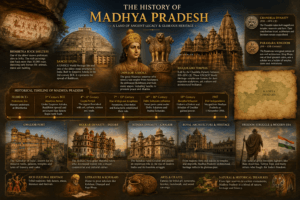
Madhya Pradesh has one of the richest historical legacies in India, with evidence of human civilization dating back more than 30,000 years. The Bhimbetka Rock Shelters, a UNESCO World Heritage Site, contain prehistoric cave paintings that provide valuable insights into the lives of early humans during the Stone Age.
During ancient times, the region formed part of several powerful kingdoms, including the Maurya Empire, Shunga Dynasty, Satavahana Dynasty, Gupta Empire, and the Paramara Dynasty. One of the most significant historical landmarks is the Sanchi Stupa, commissioned by Emperor Ashoka in the 3rd century BCE. Today, it is one of the world’s oldest and best-preserved Buddhist monuments and a UNESCO World Heritage Site.
Between the 10th and 12th centuries, the Chandela Dynasty built the magnificent Khajuraho Temples, renowned for their exceptional Nagara-style architecture and intricate stone carvings. These temples are recognized globally as a UNESCO World Heritage Site and are among India’s greatest architectural masterpieces.
The medieval period witnessed the rise of the Tomar, Bundela, and Gond kingdoms. The majestic Gwalior Fort became an important centre of military and political power, while the Gond rulers strengthened regions such as Garha-Katanga and Mandla.
During the 18th century, the Marathas, especially the Holkar and Scindia dynasties, established their rule over large parts of Madhya Pradesh. Cities like Indore and Gwalior flourished as centres of administration, trade, and culture.
After India’s independence in 1947, several princely states and provinces were reorganized to form the modern state of Madhya Pradesh on 1 November 1956 under the States Reorganisation Act. On 1 November 2000, the southeastern districts were separated to create the new state of Chhattisgarh.
Today, Madhya Pradesh proudly preserves its ancient monuments, forts, temples, caves, and archaeological treasures, making it one of India’s most historically significant states.
History at a Glance
| Period | Historical Significance |
|---|---|
| Prehistoric Era | Bhimbetka Rock Shelters |
| Maurya Empire | Sanchi Stupa built by Emperor Ashoka |
| Gupta Period | Golden Age of Art & Culture |
| Chandela Dynasty | Construction of Khajuraho Temples |
| Paramara Dynasty | Rule from Dhar |
| Gond Kingdom | Garha-Katanga & Tribal Heritage |
| Maratha Rule | Holkar & Scindia Dynasties |
| British Period | Central Provinces & Berar |
| State Formation | 1 November 1956 |
| Chhattisgarh Formation | 1 November 2000 |
Geography & Climate of Madhya Pradesh
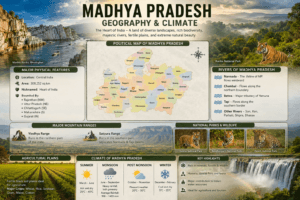
Madhya Pradesh, known as the “Heart of India,” is the second-largest state in India by area, covering approximately 308,252 square kilometres. Located in central India, the state is blessed with diverse landscapes, including mountain ranges, plateaus, dense forests, fertile river valleys, waterfalls, and rich wildlife habitats.
The state is bordered by Uttar Pradesh to the north, Chhattisgarh to the east, Maharashtra to the south, and Gujarat and Rajasthan to the west. Its central location has made Madhya Pradesh an important geographical, cultural, and economic hub for centuries.
The geography of Madhya Pradesh is dominated by the Vindhya Range in the north and the Satpura Range in the south. Between these mountain ranges flows the sacred Narmada River, one of India’s most important west-flowing rivers. Other major rivers include the Tapti (Tapi), Chambal, Betwa, Ken, Son, Shipra, and Tawa rivers, which support agriculture, drinking water supply, and hydroelectric power generation.
Nearly one-fourth of Madhya Pradesh’s land area is covered by forests, making it one of India’s greenest states. These forests are home to rich biodiversity, including Bandhavgarh National Park, Kanha National Park, Pench National Park, and Satpura National Park, which are famous for Bengal tigers and other wildlife.
Madhya Pradesh experiences a tropical monsoon climate with three main seasons. Summer (March–June) is generally hot, with temperatures reaching 45°C in some regions. Monsoon (June–September) brings moderate to heavy rainfall, especially in the eastern and southern districts. Winter (November–February) is cool and pleasant, with temperatures ranging between 8°C and 25°C, making it the best season for tourism.
The state’s fertile plains, abundant forests, river systems, and favourable climate make Madhya Pradesh one of India’s leading agricultural and eco-tourism destinations.
Geography & Climate at a Glance
| Feature | Details |
|---|---|
| Total Area | 308,252 sq km |
| Location | Central India |
| Major Mountain Ranges | Vindhya & Satpura |
| Major Rivers | Narmada, Chambal, Betwa, Ken, Son & Tapti |
| Forest Cover | About 25% of the State |
| Highest Peak | Dhupgarh (Satpura Range) |
| Climate Type | Tropical Monsoon |
| Summer Temperature | Up to 45°C |
| Winter Temperature | 8°C – 25°C |
| Best Time to Visit | October to March |
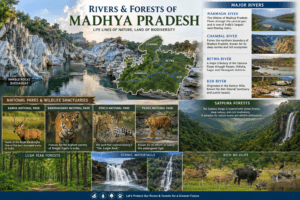
Rivers & Forests of Madhya Pradesh
Madhya Pradesh is one of India’s most ecologically diverse states, blessed with an extensive network of rivers, dense forests, mountain ranges, waterfalls, and wildlife habitats. Often referred to as the “Tiger State of India,” the state has one of the largest forest areas in the country and is home to rich biodiversity.
The Narmada River is the lifeline of Madhya Pradesh and one of India’s most sacred rivers. Originating from Amarkantak, it flows westward through the state before emptying into the Arabian Sea. The river is famous for the spectacular Marble Rocks of Bhedaghat, where the Narmada cuts through towering white marble cliffs, creating one of India’s most scenic landscapes.
Other major rivers include the Chambal, Betwa, Ken, Son, Tapti (Tapi), Shipra, Tawa, and Wainganga rivers. These rivers support irrigation, hydroelectric power generation, drinking water supply, agriculture, fisheries, and tourism.
Nearly 25% of Madhya Pradesh’s geographical area is covered by forests, making it one of India’s greenest states. The forests mainly consist of teak, sal, bamboo, tendu, mahua, and mixed deciduous vegetation, providing habitat for numerous wildlife species.
Madhya Pradesh is internationally famous for its protected areas, including Kanha National Park, Bandhavgarh National Park, Pench National Park, Satpura National Park, Panna National Park, Sanjay-Dubri National Park, Madhav National Park, and Van Vihar National Park. These parks are home to Bengal tigers, leopards, Indian bison (gaur), sloth bears, wild dogs, barasingha (swamp deer), chital, sambar, and hundreds of bird species.
The state’s forests also support many tribal communities and contribute significantly to the economy through timber, bamboo, medicinal plants, tendu leaves, honey, and eco-tourism.
With its majestic rivers, lush forests, abundant wildlife, and breathtaking natural landscapes, Madhya Pradesh stands as one of India’s premier destinations for nature lovers and wildlife enthusiasts.
Rivers & Forests at a Glance
| Category | Details |
|---|---|
| Longest River | Narmada River |
| Other Major Rivers | Chambal, Betwa, Ken, Son, Tapti, Shipra & Tawa |
| Forest Cover | About 25% of the State |
| Major Forest Types | Teak, Sal, Bamboo & Deciduous Forests |
| Famous National Park | Kanha National Park |
| Tiger Reserve | Bandhavgarh Tiger Reserve |
| UNESCO Natural Attraction | Marble Rocks of Bhedaghat |
| State Animal | Barasingha (Swamp Deer) |
| State Tree | Banyan |
| Eco-tourism Highlights | Kanha, Bandhavgarh, Pench, Panna & Satpura |
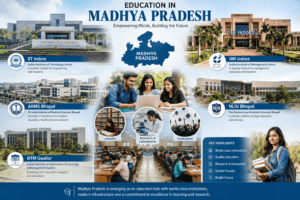
Education in Madhya Pradesh
Madhya Pradesh has a well-developed education system with numerous universities, engineering colleges, medical institutions, research centres, and schools. Major universities include Devi Ahilya Vishwavidyalaya (Indore), Barkatullah University (Bhopal), Rani Durgavati University (Jabalpur), Jiwaji University (Gwalior), Vikram University (Ujjain), and Dr. Harisingh Gour University (Sagar).
Prestigious institutions such as IIT Indore, IIM Indore, AIIMS Bhopal, IIITM Gwalior, and NLIU Bhopal make the state an important higher education destination.
Education in madhya pradesh
| Category | Details |
|---|---|
| IIT | IIT Indore |
| IIM | IIM Indore |
| AIIMS | AIIMS Bhopal |
| IIIT | IIITM Gwalior |
| Law University | NLIU Bhopal |
| Major Universities | DAVV, Barkatullah, Vikram & Jiwaji |
| Literacy Rate | 69.3% |
| Education Hubs | Indore & Bhopal |
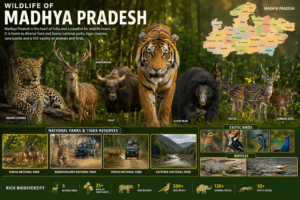
Wildlife of Madhya Pradesh
Madhya Pradesh is widely known as the “Tiger State of India” because it is home to one of the largest populations of Bengal tigers in the country. The state’s vast forests, river valleys, and protected reserves provide ideal habitats for diverse wildlife.
The state has several renowned national parks and tiger reserves, including Kanha National Park, Bandhavgarh National Park, Pench National Park, Satpura National Park, Panna National Park, Madhav National Park, Sanjay-Dubri National Park, and Van Vihar National Park.
Apart from tigers, these forests are home to leopards, Indian gaur (bison), sloth bears, barasingha (swamp deer), sambar deer, chital, nilgai, wild dogs, crocodiles, and more than 500 species of birds.
Wildlife tourism is one of the major attractions of Madhya Pradesh, drawing nature lovers, photographers, and safari enthusiasts from around the world.
Wildlife of Madhya Pradesh
| Category | Details |
|---|---|
| Nickname | Tiger State of India |
| Major National Parks | Kanha, Bandhavgarh, Pench, Satpura & Panna |
| Tiger Reserves | 7+ |
| State Animal | Barasingha (Swamp Deer) |
| Famous Wildlife | Tiger, Leopard, Gaur, Sloth Bear, Chital & Sambar |
| Bird Species | 500+ |
| Best Safari Season | October – June |
| Wildlife Tourism | Safari & Bird Watching |
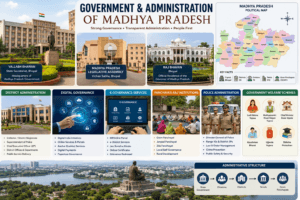
Government & Administration of Madhya Pradesh
Madhya Pradesh follows a parliamentary system of government, similar to other Indian states, operating under the Constitution of India. The Governor is the constitutional head of the state, while the Chief Minister serves as the executive head and leads the Council of Ministers responsible for the administration of the state.
The capital city of Madhya Pradesh is Bhopal, where the Madhya Pradesh Legislative Assembly (Vidhan Sabha), the State Secretariat (Vallabh Bhawan), and the Raj Bhavan are located. The state has a unicameral legislature, consisting of the Madhya Pradesh Legislative Assembly.
For administrative convenience, Madhya Pradesh is divided into 10 administrative divisions and 55 districts. Each district is headed by a District Collector (Deputy Commissioner), who oversees revenue administration, law and order, disaster management, and the implementation of government welfare schemes. Police administration in each district is headed by the Superintendent of Police (SP).
The state government delivers public services through departments responsible for education, healthcare, agriculture, rural development, transport, industries, tourism, tribal welfare, women and child development, environment, and digital governance.
Madhya Pradesh has made significant progress in e-governance through online citizen services, digital land records, public grievance redressal systems, and transparent administration. Various welfare schemes focus on farmers, women, children, tribal communities, senior citizens, students, and economically weaker sections.
The state also has a well-developed Panchayati Raj system, empowering Gram Panchayats, Janpad Panchayats, and Zila Panchayats to promote local self-governance and rural development.
With efficient administration, expanding digital governance, and citizen-centric welfare programmes, Madhya Pradesh continues to strengthen public service delivery and sustainable development.
Government at a Glance
| Category | Details |
|---|---|
| Capital | Bhopal |
| State Legislature | Unicameral Legislative Assembly |
| Administrative Divisions | 10 |
| Total Districts | 55 |
| Constitutional Head | Governor |
| Executive Head | Chief Minister |
| State Secretariat | Vallabh Bhawan, Bhopal |
| Local Governance | Gram Panchayat, Janpad Panchayat & Zila Panchayat |
| Major Governance Focus | Digital Governance & Public Welfare |
| Administrative Strength | Efficient District Administration & Citizen Services |
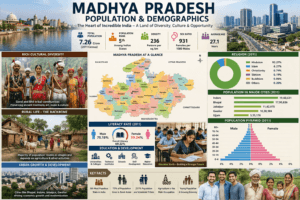
Population & Demographics of Madhya Pradesh
Madhya Pradesh is the fifth-most populous state in India, with a population of over 72 million according to the 2011 Census of India. The state is known for its cultural diversity, tribal heritage, and multilingual society. It is home to numerous indigenous tribal communities, making it one of India’s leading tribal-populated states.
The capital city, Bhopal, and the commercial hub, Indore, are the state’s largest urban centres. Other major cities include Jabalpur, Gwalior, Ujjain, Sagar, Rewa, Satna, Dewas, and Ratlam.
Hindi is the official language of Madhya Pradesh and is widely spoken across the state. Regional dialects such as Malvi, Bundeli, Bagheli, Nimadi, Gondi, Bhili, and Korku are also commonly spoken in different regions.
Madhya Pradesh has one of the largest tribal populations in India. Major tribal communities include the Gond, Bhil, Baiga, Korku, Kol, Sahariya, and Bharia tribes. These communities have preserved their unique traditions, folk music, dance, handicrafts, and cultural heritage for centuries.
According to the 2011 Census, the literacy rate of Madhya Pradesh is approximately 69.3%, with continuous improvements through educational initiatives and government welfare programmes. The state has witnessed rapid urbanisation, infrastructure development, and improvements in healthcare, education, and employment opportunities over the past decade.
Madhya Pradesh’s diverse population, rich tribal traditions, and cultural harmony contribute significantly to the state’s identity and social development.
Population at a Glance
| Category | Details |
|---|---|
| Population (2011 Census) | 72.6 Million |
| Population Rank in India | 5th |
| Capital | Bhopal |
| Largest City | Indore |
| Official Language | Hindi |
| Major Regional Languages | Malvi, Bundeli, Bagheli, Nimadi, Gondi, Bhili & Korku |
| Literacy Rate | 69.3% |
| Major Tribes | Gond, Bhil, Baiga, Korku, Kol & Sahariya |
| Urban Centres | Indore, Bhopal, Jabalpur, Gwalior & Ujjain |
| Cultural Identity | Tribal Heritage & Cultural Diversity |
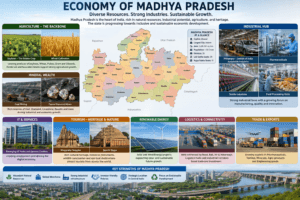
Economy of Madhya Pradesh
Madhya Pradesh has one of the fastest-growing economies in central India, supported by agriculture, manufacturing, mining, forestry, tourism, and service industries. Due to its central location and abundant natural resources, the state plays a significant role in India’s economic development.
Agriculture is the backbone of the state’s economy, employing a large portion of the population. Madhya Pradesh is India’s largest producer of soybeans and among the leading producers of wheat, pulses, gram (chickpea), garlic, onions, oilseeds, maize, and mustard. The fertile plains of the Malwa, Nimar, Bundelkhand, and Chambal regions contribute significantly to agricultural production.
The state is also rich in minerals such as coal, limestone, manganese, copper, dolomite, bauxite, and diamond. The famous Panna Diamond Mines are India’s only active diamond-producing mines, making Madhya Pradesh an important contributor to the country’s mining industry.
Industrial development is concentrated in cities such as Indore, Bhopal, Pithampur, Jabalpur, Dewas, Gwalior, and Mandideep. Key industries include automobiles, pharmaceuticals, engineering, textiles, food processing, cement, chemicals, and information technology (IT). Pithampur, often called the “Detroit of India,” is one of the country’s largest automobile manufacturing hubs.
Tourism is another major contributor to the state’s economy. World-famous destinations such as Khajuraho, Sanchi, Bhimbetka, Bandhavgarh National Park, Kanha National Park, Ujjain, Omkareshwar, and Bhedaghat attract millions of domestic and international tourists every year.
The Government of Madhya Pradesh actively promotes industrial investment, digital infrastructure, renewable energy, logistics, MSMEs, and skill development, making the state an attractive destination for businesses and investors.
With strong agricultural production, abundant mineral resources, expanding industries, and a growing tourism sector, Madhya Pradesh continues to strengthen its position as one of India’s emerging economic powerhouses.
Economy at a Glance
| Category | Details |
|---|---|
| Economic Base | Agriculture, Industry & Services |
| Largest Crop | Soybean |
| Other Major Crops | Wheat, Gram, Pulses, Mustard, Maize & Garlic |
| Famous Mineral | Diamond (Panna), Coal & Limestone |
| Major Industrial Hub | Pithampur |
| Leading Industries | Automobile, Pharmaceuticals, Textiles, Cement & Food Processing |
| Major Tourism Economy | Khajuraho, Sanchi, Kanha & Bandhavgarh |
| Major Commercial City | Indore |
| Key Investment Sectors | Manufacturing, Logistics, Renewable Energy & IT |
| Economic Strength | Agriculture, Mining, Manufacturing & Tourism |
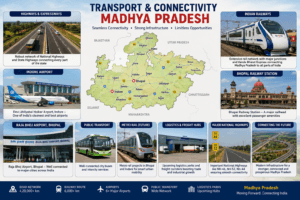
Transport & Connectivity
Madhya Pradesh enjoys excellent connectivity through road, rail, and air networks. Major airports include Devi Ahilyabai Holkar Airport (Indore), Raja Bhoj Airport (Bhopal), Gwalior Airport, and Jabalpur Airport.
The state has an extensive railway network connecting major cities such as Indore, Bhopal, Jabalpur, Gwalior, Ujjain, Satna, and Katni. National Highways including NH-44, NH-46, NH-47, NH-52, and NH-30 pass through the state, providing seamless connectivity across India.
Transport and connectivity in madhya pradesh
| Category | Details |
|---|---|
| Major Airports | Indore, Bhopal, Jabalpur & Gwalior |
| Largest Airport | Devi Ahilyabai Holkar Airport |
| Railway Network | Extensive |
| Major Stations | Bhopal, Indore, Gwalior & Jabalpur |
| National Highways | NH-44, NH-46, NH-47, NH-52 & NH-30 |
| Local Transport | Bus, Taxi & Auto |
| Connectivity | Excellent Across India |
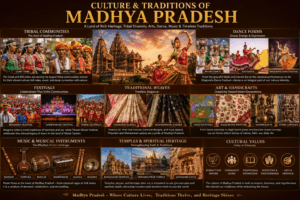
Culture & Traditions of Madhya Pradesh
Madhya Pradesh is one of India’s most culturally diverse states, where ancient traditions, tribal heritage, classical architecture, folk arts, music, dance, and vibrant festivals come together to create a unique cultural identity. Often called the “Cultural Heart of India,” the state preserves centuries-old customs while embracing modern development.
The state is home to several indigenous tribal communities, including the Gond, Bhil, Baiga, Korku, Kol, Sahariya, and Bharia tribes. These communities are known for their colourful attire, traditional jewellery, folk songs, dances, paintings, and handicrafts, which reflect their deep connection with nature and local traditions.
Madhya Pradesh is famous for its traditional folk dances such as Matki Dance, Rai Dance, Karma Dance, Ahirai Dance, Saila Dance, and Bhagoria Dance. These performances are accompanied by traditional musical instruments like the Dhol, Mandar, Nagada, Flute, and Shehnai, adding energy and colour to festivals and celebrations.
The state is also renowned for its traditional handicrafts. Chanderi and Maheshwari handloom sarees are admired across India for their elegant weaving and intricate designs. Other famous handicrafts include Gond paintings, Bagh block printing, bell metal crafts, bamboo products, terracotta art, stone carving, wood carving, and tribal jewellery.
Major festivals celebrated with great enthusiasm include Diwali, Holi, Dussehra, Navratri, Makar Sankranti, Mahashivratri, Eid, Christmas, and regional festivals such as Bhagoria Festival, Khajuraho Dance Festival, Tansen Music Festival, Lokrang Festival, and Ujjain Kumbh Mela (Simhastha).
Madhya Pradesh’s culture is also reflected in its magnificent temples, forts, palaces, caves, and UNESCO World Heritage Sites, making it one of India’s richest cultural destinations.
Culture at a Glance
| Category | Details |
|---|---|
| Major Tribes | Gond, Bhil, Baiga, Korku, Kol & Sahariya |
| Famous Folk Dances | Matki, Rai, Karma, Saila & Bhagoria |
| Traditional Music | Dhol, Mandar, Nagada, Flute & Shehnai |
| Famous Handlooms | Chanderi & Maheshwari Sarees |
| Traditional Art | Gond Painting & Bagh Block Printing |
| Popular Festivals | Bhagoria, Khajuraho Dance Festival, Tansen Music Festival |
| Traditional Crafts | Bamboo, Bell Metal, Terracotta & Stone Carving |
| Religious Diversity | Hinduism, Islam, Jainism, Buddhism & Christianity |
| Cultural Identity | Tribal Heritage & Classical Traditions |
| Tourism Highlight | UNESCO Heritage, Folk Arts & Festivals |
Shopping & Handicrafts
Madhya Pradesh is famous for its traditional handicrafts and handloom products. Popular shopping items include Chanderi Sarees, Maheshwari Sarees, Gond Paintings, Bagh Block Prints, Bamboo Crafts, Bell Metal Crafts, Stone Carvings, Leather Products, Tribal Jewellery, and Terracotta Art.
Popular shopping destinations include Bhopal, Indore, Gwalior, Jabalpur, Ujjain, Chanderi, Maheshwar, and Khajuraho.
| Category | Details |
|---|---|
| Famous Sarees | Chanderi & Maheshwari Sarees |
| Traditional Art | Gond Paintings |
| Famous Craft | Bagh Block Printing |
| Bamboo Crafts | Popular |
| Bell Metal Crafts | Traditional Handicrafts |
| Tribal Jewellery | Widely Available |
| Best Shopping Cities | Bhopal, Indore, Gwalior, Chanderi & Maheshwar |
Best Time to Visit
The best time to visit Madhya Pradesh is from October to March, when the weather is pleasant for sightseeing, wildlife safaris, pilgrimages, and outdoor activities. Wildlife enthusiasts often visit Bandhavgarh, Kanha, and Pench between November and April for the best safari experience.
| Season | Experience |
|---|---|
| October – March | Best Time for Sightseeing & Tourism |
| November – April | Best Season for Wildlife Safari |
| June – September | Monsoon Green Landscapes |
| March – June | Hot Summer Season |
How to Reach Madhya Pradesh
By Air: Airports at Indore, Bhopal, Jabalpur & Gwalior.
By Train: Excellent railway connectivity from Delhi, Mumbai, Chennai, Hyderabad, Kolkata & Bengaluru.
By Road: National Highways connect all major cities and tourist destinations.
| Mode of Transport | Details |
|---|---|
| By Air | Indore, Bhopal, Jabalpur & Gwalior Airports |
| By Train | Excellent Railway Connectivity Across India |
| By Road | NH-44, NH-46, NH-47, NH-52 & NH-30 |
| Local Transport | Taxi, Bus, Auto & Cab Services |
- Visit between October and March.
- Book tiger safaris in advance.
- Wear comfortable clothing and walking shoes.
- Respect heritage monuments and wildlife rules.
- Carry water and sunscreen during summer.
- Try local cuisine like Poha-Jalebi and Dal Bafla.
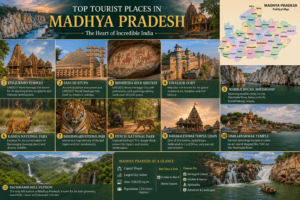
Top Tourist Places in Madhya Pradesh
Madhya Pradesh is one of India’s most popular tourist destinations, offering a perfect blend of history, spirituality, wildlife, architecture, and natural beauty. Known as the “Heart of Incredible India,” the state is home to UNESCO World Heritage Sites, magnificent forts, sacred temples, scenic rivers, waterfalls, and famous tiger reserves that attract millions of visitors every year.
One of the state’s most iconic attractions is the Khajuraho Group of Monuments, a UNESCO World Heritage Site renowned for its exquisite Nagara-style temple architecture and intricate stone carvings. Another UNESCO site, the Sanchi Stupa, is one of the oldest Buddhist monuments in the world and was commissioned by Emperor Ashoka.
Nature lovers can explore Kanha National Park, Bandhavgarh National Park, Pench National Park, Panna National Park, and Satpura National Park, all of which are famous for Bengal tigers, leopards, barasingha, and rich biodiversity.
The spectacular Marble Rocks of Bhedaghat near Jabalpur, carved by the sacred Narmada River, offer breathtaking scenery and popular boat rides. Bhimbetka Rock Shelters, another UNESCO World Heritage Site, showcase prehistoric cave paintings dating back thousands of years.
Spiritual destinations such as Ujjain, home to the Mahakaleshwar Jyotirlinga, and Omkareshwar, another sacred Jyotirlinga temple on the Narmada River, attract millions of pilgrims every year.
Historic landmarks including Gwalior Fort, Orchha, Mandu, Pachmarhi, and Amarkantak further enrich the tourism experience, making Madhya Pradesh one of India’s most diverse travel destinations.
Top Tourist Places at a Glance
| Tourist Place | Famous For |
|---|---|
| Khajuraho | UNESCO World Heritage Temples |
| Sanchi | Ancient Buddhist Stupa |
| Bhimbetka | Prehistoric Rock Shelters |
| Gwalior Fort | Historic Hill Fort |
| Bhedaghat | Marble Rocks & Narmada River |
| Kanha National Park | Bengal Tigers & Barasingha |
| Bandhavgarh National Park | Tiger Safari |
| Pench National Park | Wildlife & Jungle Safari |
| Ujjain | Mahakaleshwar Jyotirlinga |
| Omkareshwar | Jyotirlinga Temple on Narmada River |
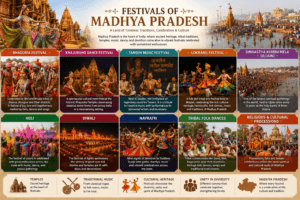
Festivals of Madhya Pradesh
Madhya Pradesh is a land of vibrant festivals that reflect its tribal heritage, religious diversity, and rich cultural traditions. Throughout the year, the state celebrates numerous religious, cultural, and folk festivals with great enthusiasm. These celebrations feature colourful processions, traditional music, folk dances, handicrafts, fairs, and delicious local cuisine.
One of the most famous festivals is the Bhagoria Festival, celebrated by the Bhil and Bhilala tribal communities in western Madhya Pradesh. This colourful tribal festival is known for traditional dances, music, local markets, and cultural performances.
The Khajuraho Dance Festival is an internationally renowned cultural event held against the backdrop of the magnificent Khajuraho Temples. It showcases India’s classical dance forms such as Bharatanatyam, Kathak, Odissi, Kuchipudi, Manipuri, Mohiniyattam, and Kathakali.
Another major event is the Tansen Music Festival, held annually in Gwalior to honour the legendary musician Miyan Tansen, one of Emperor Akbar’s Navaratnas. The festival attracts renowned classical musicians from across India.
The Lokrang Festival, organised in Bhopal, celebrates the folk arts, handicrafts, music, dance, and cultural traditions of Madhya Pradesh and other Indian states.
Religious festivals such as Diwali, Holi, Dussehra, Navratri, Makar Sankranti, Mahashivratri, Janmashtami, Eid, Christmas, and the grand Simhastha Kumbh Mela in Ujjain are celebrated with immense devotion. The Simhastha Kumbh Mela, held every 12 years, is one of the largest religious gatherings in the world, attracting millions of pilgrims.
These colourful festivals reflect the unity, traditions, spirituality, and cultural richness that make Madhya Pradesh one of India’s most fascinating states.
Major Festivals of Madhya Pradesh
| Festival | Famous For |
|---|---|
| Bhagoria Festival | Tribal Fair & Folk Celebrations |
| Khajuraho Dance Festival | Classical Dance Performances |
| Tansen Music Festival | Indian Classical Music |
| Lokrang Festival | Folk Arts & Cultural Heritage |
| Simhastha Kumbh Mela | Grand Hindu Pilgrimage at Ujjain |
| Diwali | Festival of Lights |
| Holi | Festival of Colours |
| Navratri | Worship of Goddess Durga |
| Dussehra | Victory of Good over Evil |
| Makar Sankranti | Harvest Festival |
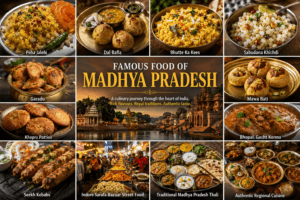
Famous Food of Madhya Pradesh
Madhya Pradesh offers a rich and diverse culinary tradition that reflects the state’s royal heritage, tribal culture, and regional flavours. The cuisine varies across the Malwa, Bundelkhand, Baghelkhand, Mahakoshal, Nimar, and Chambal regions, with each area offering its own unique specialties.
One of the state’s most famous dishes is Poha-Jalebi, especially popular in Indore, where it is enjoyed as a traditional breakfast. The combination of soft, lightly spiced poha with crispy, sweet jalebi has become an iconic food of Madhya Pradesh.
Another famous delicacy is Dal Bafla, often considered the state’s signature dish. Similar to Rajasthan’s Dal Baati, Dal Bafla consists of wheat dumplings cooked in ghee and served with spicy lentils, chutney, and traditional accompaniments.
Madhya Pradesh is also known for delicious snacks such as Bhutte Ka Kees, made from grated corn cooked with milk and spices, Sabudana Khichdi, Garadu, Khopra Patties, and Mawa Bati. Street food lovers especially enjoy Indore’s vibrant food culture, which includes famous treats from Sarafa Bazaar and Chappan Dukan.
Traditional sweets such as Mawa Bati, Malpua, Jalebi, Rabri, Khoya Jalebi, and Gajak are widely enjoyed during festivals and celebrations.
The state’s cuisine also includes wholesome dishes like Bhopali Gosht Korma, Seekh Kebabs, Biryani, Chakki Ki Shaak, and various tribal recipes prepared using locally available grains, vegetables, forest produce, and spices.
From bustling street food markets to traditional village kitchens, Madhya Pradesh offers a memorable culinary experience that perfectly reflects its history, diversity, and hospitality
Famous Foods of Madhya Pradesh
| Dish | Famous For |
|---|---|
| Poha Jalebi | Iconic Breakfast of Indore |
| Dal Bafla | Signature Traditional Dish |
| Bhutte Ka Kees | Spiced Grated Corn Recipe |
| Sabudana Khichdi | Popular Fasting & Breakfast Dish |
| Garadu | Famous Indore Street Food |
| Khopra Patties | Coconut-Stuffed Snack |
| Mawa Bati | Traditional Sweet |
| Bhopali Gosht Korma | Rich Mughlai Meat Curry |
| Seekh Kebabs | Popular Non-Vegetarian Delicacy |
| Gajak | Traditional Winter Sweet |
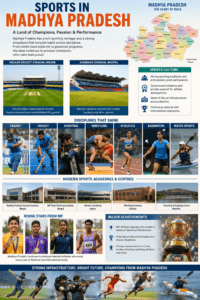
Sports in Madhya Pradesh
Madhya Pradesh has steadily emerged as a prominent sporting state in India by investing in modern sports infrastructure, athlete development, coaching academies, and grassroots programmes. While cricket is the most popular sport, the state also excels in hockey, shooting, athletics, wrestling, badminton, football, kabaddi, archery, and water sports.
The Holkar Cricket Stadium in Indore is one of India’s finest international cricket venues. It regularly hosts international matches, Indian Premier League (IPL) games, and domestic tournaments. The stadium is well known for its excellent pitch and world-class facilities.
Another important sporting venue is the Aishbagh Stadium in Bhopal, which has hosted several national and international hockey tournaments. Madhya Pradesh has also produced outstanding athletes in shooting, athletics, wrestling, and badminton, who have represented India at international competitions.
The state government actively promotes sports through the Madhya Pradesh State Sports Academy, one of India’s leading sports training institutions. Academies in Bhopal, Indore, Gwalior, Jabalpur, and Ujjain provide professional coaching in disciplines such as hockey, shooting, athletics, canoeing, kayaking, water sports, martial arts, gymnastics, and fencing.
Madhya Pradesh has developed excellent sports infrastructure, including international cricket stadiums, synthetic hockey turfs, athletics tracks, indoor stadiums, swimming pools, shooting ranges, and multipurpose sports complexes. These facilities encourage young athletes to participate in national and international competitions.
With continued investment in sports infrastructure, coaching, and youth development, Madhya Pradesh is strengthening its position as one of India’s emerging sporting destinations.
Sports at a Glance
| Category | Details |
|---|---|
| Most Popular Sport | Cricket |
| Major Cricket Stadium | Holkar Cricket Stadium, Indore |
| Major Hockey Venue | Aishbagh Stadium, Bhopal |
| Popular Sports | Cricket, Hockey, Shooting, Athletics, Wrestling & Badminton |
| Sports Academy | Madhya Pradesh State Sports Academy |
| Major Sports Cities | Bhopal, Indore, Gwalior, Jabalpur & Ujjain |
| Water Sports | Canoeing & Kayaking |
| Infrastructure | Stadiums, Indoor Arenas & Sports Academies |
| Youth Development | Professional Coaching Programmes |
| Sports Strength | Cricket, Hockey & Shooting |
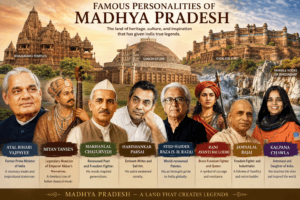
Famous Personalities of Madhya Pradesh
Madhya Pradesh has produced many distinguished personalities who have made remarkable contributions to politics, literature, music, sports, science, social reform, and public service. Their achievements have earned national and international recognition while enriching India’s cultural and intellectual heritage.
One of the state’s most respected leaders was Atal Bihari Vajpayee, former Prime Minister of India, who was born in Gwalior. He is remembered for his visionary leadership, powerful oratory, and contributions to India’s development and foreign policy.
The legendary classical musician Miyan Tansen, one of the Navaratnas in Emperor Akbar’s court, is closely associated with Gwalior. His immense contribution to Hindustani classical music is celebrated every year through the famous Tansen Music Festival.
In literature, Makhanlal Chaturvedi was one of India’s greatest poets, writers, and freedom fighters. His patriotic writings inspired generations during India’s independence movement. Another celebrated literary figure, Harishankar Parsai, is widely regarded as one of the finest Hindi satirists.
Madhya Pradesh has also produced internationally acclaimed artists such as Syed Haider Raza (S. H. Raza), one of India’s most renowned modern painters. His artworks are admired across the world for their distinctive style and deep philosophical themes.
The state is also associated with renowned industrialist Jamnalal Bajaj, freedom fighter Rani Avanti Bai Lodhi, and several accomplished sportspersons, scientists, administrators, and social reformers who have contributed significantly to India’s progress.
These remarkable personalities continue to inspire future generations through their achievements, dedication, and service to society.
Famous Personalities of Madhya Pradesh
| Personality | Known For |
|---|---|
| Atal Bihari Vajpayee | Former Prime Minister of India |
| Miyan Tansen | Legendary Hindustani Classical Musician |
| Makhanlal Chaturvedi | Poet, Writer & Freedom Fighter |
| Harishankar Parsai | Eminent Hindi Satirist |
| S. H. Raza | Internationally Acclaimed Painter |
| Rani Avanti Bai Lodhi | Freedom Fighter |
| Jamnalal Bajaj | Industrialist & Freedom Fighter |
| Kishore Kumar | Legendary Playback Singer & Actor |
| Lata Mangeshkar | Legendary Playback Singer (Born in Indore) |
| Kailash Satyarthi | Nobel Peace Prize Laureate |
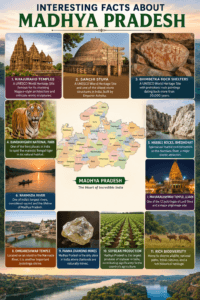
Interesting Facts About Madhya Pradesh
Madhya Pradesh is one of India’s most fascinating states, known for its rich history, UNESCO World Heritage Sites, dense forests, wildlife, spiritual destinations, and ancient architecture. Popularly called the “Heart of India,” the state lies at the geographical centre of the country and offers an extraordinary blend of culture, nature, and heritage.
Madhya Pradesh is home to three UNESCO World Heritage Sites—the Khajuraho Group of Monuments, Sanchi Stupa, and Bhimbetka Rock Shelters. These sites attract millions of tourists and history enthusiasts from around the world.
The state is also known as the “Tiger State of India” because it has one of the largest populations of Bengal tigers in the country. National parks such as Bandhavgarh, Kanha, Pench, Satpura, and Panna are among India’s finest wildlife destinations.
The sacred Narmada River, one of India’s holiest rivers, originates near Amarkantak and flows westward across the state. The breathtaking Marble Rocks of Bhedaghat, carved by the Narmada River, are among Madhya Pradesh’s most iconic natural attractions.
Madhya Pradesh is also famous for the Mahakaleshwar Jyotirlinga at Ujjain and the Omkareshwar Jyotirlinga, making it one of India’s most important spiritual destinations.
The state is India’s largest producer of soybeans and is the only state with active diamond mines at Panna. Its rich forests, tribal culture, magnificent forts, ancient temples, and diverse wildlife make Madhya Pradesh one of India’s most unique travel destinations.
Interesting Facts at a Glance
| Fact | Details |
|---|---|
| Nickname | Heart of India |
| Area Rank | Second Largest State in India |
| UNESCO World Heritage Sites | Khajuraho, Sanchi & Bhimbetka |
| Tiger Identity | Tiger State of India |
| Sacred River | Narmada River |
| Famous Natural Attraction | Marble Rocks of Bhedaghat |
| Active Diamond Mines | Panna Diamond Mines |
| Largest Soybean Producer | Yes |
| Famous Jyotirlingas | Mahakaleshwar & Omkareshwar |
| Tourism Identity | Heritage, Wildlife & Spiritual Tourism |
Top 10 FAQs About Madhya Pradesh
1. Why is Madhya Pradesh called the Heart of India?
Madhya Pradesh is called the Heart of India because it is located in the geographical centre of the country.
2. What is the capital of Madhya Pradesh?
Bhopal is the capital city of Madhya Pradesh.
3. Which is the largest city in Madhya Pradesh?
Indore is the largest city and commercial hub of Madhya Pradesh.
4. What are the UNESCO World Heritage Sites in Madhya Pradesh?
Khajuraho Temples, Sanchi Stupa, and Bhimbetka Rock Shelters.
5. Why is Madhya Pradesh famous?
It is famous for tiger reserves, UNESCO sites, temples, forts, wildlife, and tribal culture.
6. Which is the best time to visit Madhya Pradesh?
October to March is the best time to visit.
7. Which is the famous food of Madhya Pradesh?
Poha-Jalebi, Dal Bafla, Bhutte Ka Kees, Garadu, and Mawa Bati.
8. Which is the famous national park in Madhya Pradesh?
Kanha National Park and Bandhavgarh National Park.
9. Which river is known as the lifeline of Madhya Pradesh?
The Narmada River.
10. What is the state animal of Madhya Pradesh?
Barasingha (Swamp Deer).
Conclusion
Madhya Pradesh, known as the Heart of India, is one of the country’s most diverse travel destinations. From the magnificent Khajuraho Temples and Sanchi Stupa to the breathtaking Marble Rocks of Bhedaghat and world-famous Bandhavgarh and Kanha National Parks, the state offers unforgettable experiences for every traveller.
Its rich history, vibrant tribal culture, UNESCO World Heritage Sites, delicious cuisine, colourful festivals, dense forests, sacred temples, and thriving wildlife make Madhya Pradesh a perfect destination for history lovers, nature enthusiasts, pilgrims, and adventure seekers alike.
Whether you are planning a wildlife safari, spiritual pilgrimage, heritage tour, or family vacation, Madhya Pradesh promises an unforgettable journey through the heart of India.
Internal Links
https://dealkartmarket.in/rajasthan/
https://dealkartmarket.in/gujarat/
https://dealkartmarket.in/telangana-complete-guide/
https://dealkartmarket.in/andhra-pradesh/
https://dealkartmarket.in/karnataka/
https://dealkartmarket.in/tamil-nadu/
https://dealkartmarket.in/kerala/
https://dealkartmarket.in/maharashtra/
External Links
https://www.incredibleindia.gov.in/
References
Madhya Pradesh Tourism
Government of Madhya Pradesh
UNESCO World Heritage Centre
Incredible India
Census of India
Ministry of Tourism, Government of India
National Tiger Conservation Authority