
Introduction
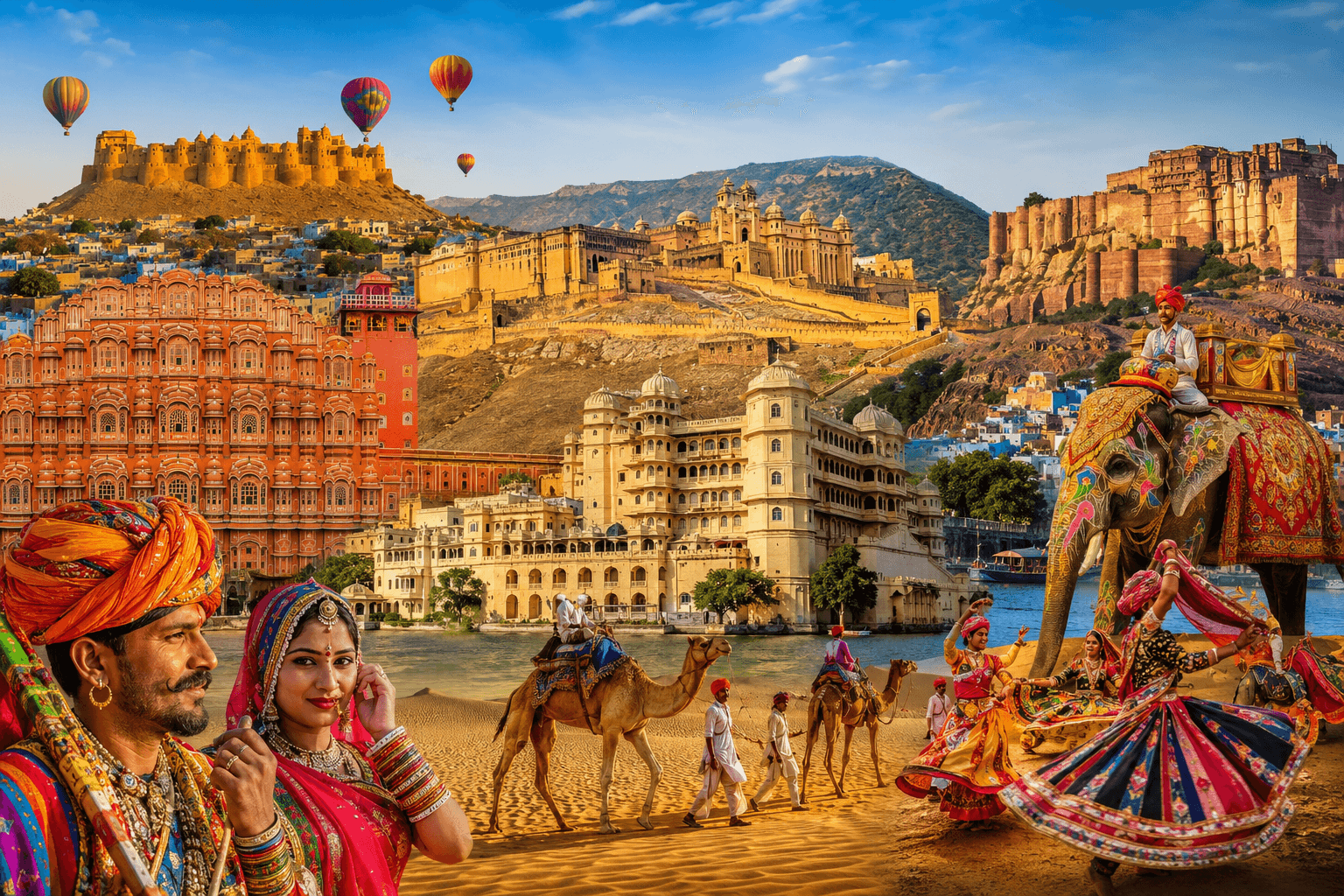
Rajasthan is India’s largest state by area and is popularly known as the “Land of Kings.” Located in northwestern India, Rajasthan is renowned for its majestic forts, royal palaces, colorful festivals, vast Thar Desert, rich history, and vibrant culture. The state attracts millions of tourists every year with world-famous destinations like Jaipur, Udaipur, Jodhpur, Jaisalmer, Mount Abu, and Ranthambore National Park.
Formed on 30 March 1949, the state has a glorious legacy of Rajput rulers who built magnificent forts, temples, and architectural wonders. The Aravalli Range, Thar Desert, wildlife sanctuaries, traditional handicrafts, folk music, and delicious Rajasthani cuisine make the state one of India’s most unique travel destinations.
Whether you are planning a trip, preparing for competitive exams, or simply exploring India’s diverse heritage, this Rajasthan Complete Guide covers everything you need to know about the state’s history, geography, economy, tourism, culture, education, transport, wildlife, famous foods, and interesting facts.
Rajasthan on India Map
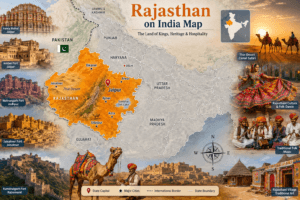
The state is located in the northwestern region of India and is the largest state by area, covering approximately 342,239 square kilometres. It shares international borders with Pakistan to the west and state borders with Punjab, Haryana, Uttar Pradesh, Madhya Pradesh, and Gujarat. The Tropic of Cancer does not pass through the state, but the state occupies a strategically important position connecting northern and western India.
The capital city, Jaipur, is centrally located and serves as the administrative, cultural, and economic hub of the state. Other major cities include Jodhpur, Udaipur, Jaisalmer, Ajmer, Bikaner, Kota, Bharatpur, and Alwar.
The state is geographically diverse, featuring the Thar Desert in the west, the ancient Aravalli Range running from southwest to northeast, fertile plains in the east, and numerous lakes around Udaipur. Its location has made Rajasthan an important centre of trade, tourism, culture, and history for centuries.
The state’s strategic location, rich heritage, magnificent forts, wildlife sanctuaries, and vibrant traditions make Rajasthan one of India’s most visited tourist destinations.
History of Rajasthan
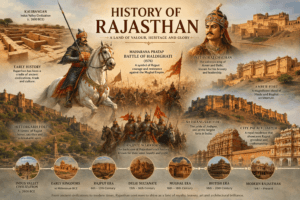
The state has one of the richest and most glorious histories in India, earning the title “Land of Kings.” The state’s history spans thousands of years, from the ancient Indus Valley Civilization to the powerful Rajput kingdoms, the Mughal era, British rule, and finally its integration into independent India.
Archaeological sites such as Kalibangan in Hanumangarh district reveal that Rajasthan was part of the Indus Valley Civilization, dating back over 4,500 years. Excavations have uncovered well-planned cities, pottery, and evidence of advanced agriculture, making Rajasthan one of India’s oldest inhabited regions.
During the medieval period, the state became the homeland of the Rajputs, who established powerful kingdoms such as Mewar, Marwar, Amber (Jaipur), Bikaner, Jaisalmer, Bundi, and Kota. Rajput rulers became renowned for their bravery, loyalty, and determination to protect their kingdoms from foreign invasions.
Among Rajasthan’s greatest heroes was Maharana Pratap, the legendary ruler of Mewar, who courageously resisted the Mughal Empire under Emperor Akbar. His bravery during the Battle of Haldighati (1576) remains one of the most celebrated chapters in Indian history. Another notable ruler, Prithviraj Chauhan, is remembered for his courage and military leadership against foreign invaders.
The Mughal period witnessed both conflicts and alliances between Rajput rulers and the Mughal emperors. Many magnificent forts, palaces, temples, stepwells, and lakes were constructed during this era, many of which are now UNESCO World Heritage Sites and major tourist attractions.
Following India’s independence in 1947, the princely states of Rajasthan were gradually merged into the Indian Union. The modern state of Rajasthan was officially formed on 30 March 1949, a day celebrated every year as Rajasthan Day.
Today, the state proudly preserves its royal heritage through its majestic forts, grand palaces, colourful traditions, museums, and historic cities, making it one of India’s most culturally significant states.
History at a Glance
| Event | Details |
|---|---|
| Ancient Civilization | Indus Valley Civilization (Kalibangan) |
| Famous Rajput Kingdoms | Mewar, Marwar, Amber, Bikaner & Jaisalmer |
| Legendary King | Maharana Pratap |
| Famous Battle | Battle of Haldighati (1576) |
| Renowned Ruler | Prithviraj Chauhan |
| Mughal Period | Rajput–Mughal Alliances & Conflicts |
| Integration into India | 1948–1949 |
| Rajasthan Formation Day | 30 March 1949 |
| Historic Identity | Land of Kings |
| Heritage | Forts, Palaces & UNESCO World Heritage Sites |
Geography & Climate of Rajasthan
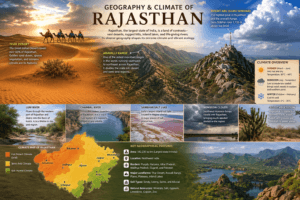
The state is the largest state in India by area, covering approximately 342,239 square kilometres in the northwestern part of the country. It shares borders with Punjab, Haryana, Uttar Pradesh, Madhya Pradesh, Gujarat, and the neighboring country of Pakistan. The state is geographically diverse, featuring vast deserts, ancient mountain ranges, fertile plains, rivers, forests, and wetlands.
The most prominent geographical feature of Rajasthan is the Thar Desert, also known as the Great Indian Desert, which covers nearly 60% of the state’s total area. Located mainly in western Rajasthan, the desert is famous for its golden sand dunes, camel safaris, unique wildlife, and colourful desert festivals. Cities such as Jaisalmer, Barmer, Bikaner, and Jodhpur lie within or near the Thar Desert region.
The Aravalli Range, one of the oldest mountain ranges in the world, stretches diagonally across Rajasthan from the southwest to the northeast. It divides the state into two distinct regions—the arid desert in the west and the more fertile plains in the east. Guru Shikhar (1,722 metres), located near Mount Abu, is the highest peak in Rajasthan.
The eastern and southeastern parts of Rajasthan are more fertile and receive higher rainfall than the desert region. Rivers such as the Chambal, Banas, Mahi, Luni, Sabarmati, and Banganga support agriculture and provide water for irrigation. The famous Sambhar Lake, India’s largest inland salt lake, is also located in Rajasthan.
The state experiences a hot desert climate with three major seasons: summer (March–June), monsoon (July–September), and winter (October–February). Summers are extremely hot, with temperatures often exceeding 45°C, especially in western districts. Winters are cool and pleasant, making it the best season for tourism. Rainfall varies significantly across the state, with the western desert receiving less than 200 mm annually, while southeastern districts receive much higher rainfall.
This remarkable geographical diversity makes Rajasthan one of India’s most unique states, offering breathtaking landscapes, wildlife habitats, mountain retreats, lakes, and vast desert ecosystems.
Geography & Climate at a Glance
| Feature | Details |
|---|---|
| Total Area | 342,239 km² |
| Largest Geographical Feature | Thar Desert |
| Major Mountain Range | Aravalli Range |
| Highest Peak | Guru Shikhar (1,722 m) |
| Largest Salt Lake | Sambhar Lake |
| Major Rivers | Chambal, Banas, Luni, Mahi & Sabarmati |
| Climate Type | Hot Desert & Semi-Arid |
| Summer Temperature | Up to 45–50°C |
| Best Time to Visit | October to March |
| Geographical Identity | Desert, Hills, Lakes & Plains |
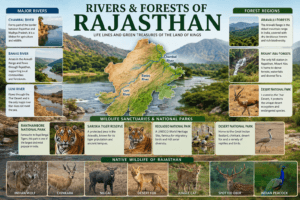
Rivers & Forests of Rajasthan
Despite being India’s largest state and home to the vast Thar Desert, the state has several important rivers, forests, and protected ecosystems that support agriculture, wildlife, and biodiversity. The state’s river systems, mountain forests, wetlands, and desert vegetation play a vital role in maintaining ecological balance and sustaining millions of people.
The Chambal River is the longest and most important perennial river in Rajasthan. Flowing through the southeastern part of the state, it supports irrigation, hydroelectric power generation, and drinking water supply. The river is also home to the National Chambal Sanctuary, which protects endangered species such as the gharial, Gangetic dolphin, mugger crocodile, and numerous migratory birds.
Other major rivers include the Banas, Luni, Mahi, Sabarmati, Banganga, and Jawai rivers. The Luni River is the largest river flowing through the Thar Desert and eventually disappears into the marshy lands of the Rann of Kutch. Rivers like the Banas and Chambal are essential for agriculture and water conservation across eastern Rajasthan.
Although much of the state is arid, the state possesses valuable forest resources. Forests are mainly concentrated in the Aravalli Hills, Mount Abu, and the southeastern districts. Rajasthan’s forests consist of tropical dry deciduous forests, thorn forests, and dry scrub vegetation, supporting a rich variety of wildlife.
The Sariska Tiger Reserve, Ranthambore National Park, Mount Abu Wildlife Sanctuary, Kumbhalgarh Wildlife Sanctuary, Desert National Park, and Keoladeo National Park are among the state’s most famous protected areas. These forests provide habitat for Bengal tigers, leopards, sloth bears, wolves, hyenas, chinkaras, blackbucks, nilgai, desert foxes, and hundreds of bird species.
The state is also home to the Keoladeo National Park (Bharatpur), a UNESCO World Heritage Site and one of the world’s most important bird sanctuaries, attracting thousands of migratory birds every winter.
Through afforestation programmes, water conservation projects, wildlife protection, and sustainable forest management, Rajasthan continues to preserve its unique desert ecosystems and rich biodiversity.
Rivers & Forests at a Glance
| Category | Details |
|---|---|
| Longest Perennial River | Chambal River |
| Largest Desert River | Luni River |
| Major Rivers | Chambal, Banas, Luni, Mahi, Sabarmati & Banganga |
| Major Mountain Range | Aravalli Hills |
| Forest Type | Tropical Dry Deciduous & Thorn Forests |
| Famous Tiger Reserve | Ranthambore Tiger Reserve |
| Another Tiger Reserve | Sariska Tiger Reserve |
| UNESCO Natural Site | Keoladeo National Park |
| Famous Desert Ecosystem | Desert National Park |
| Major Wildlife | Bengal Tiger, Leopard, Gharial, Chinkara & Great Indian Bustard |
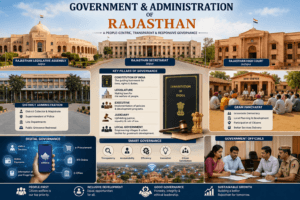
Government & Administration of Rajasthan
The state follows a parliamentary system of government, similar to other Indian states, functioning under the Constitution of India. The Governor serves as the constitutional head of the state, while the Chief Minister is the executive head responsible for administering the government and implementing policies. The Council of Ministers, headed by the Chief Minister, assists in governance and decision-making.
The capital city, Jaipur, serves as the administrative headquarters of Rajasthan and houses the Rajasthan Legislative Assembly (Vidhan Sabha), the Secretariat, and other important government offices. The Rajasthan High Court is located in Jodhpur, with a permanent bench in Jaipur.
The state currently has 50 districts, which are further divided into divisions, subdivisions, tehsils, panchayat samitis, gram panchayats, and municipalities for efficient administration and delivery of public services. The state government focuses on infrastructure development, digital governance, education, healthcare, agriculture, tourism, water conservation, and industrial growth.
The state Legislative Assembly consists of 200 elected Members of the Legislative Assembly (MLAs). Rajasthan elects 25 Members of Parliament (Lok Sabha) and 10 Members of Parliament (Rajya Sabha) to represent the state in the Parliament of India.
The state has adopted several e-Governance initiatives, enabling citizens to access government services online through digital portals. Programmes related to public welfare, rural development, women’s empowerment, renewable energy, tourism promotion, and water resource management continue to contribute to Rajasthan’s socio-economic progress.
With a well-structured administrative system and decentralized local governance, Rajasthan ensures effective implementation of development programmes while preserving its rich cultural and historical heritage.
Government at a Glance
| Category | Details |
|---|---|
| Capital | Jaipur |
| Governor | Constitutional Head of the State |
| Chief Minister | Executive Head of the Government |
| Legislature | Unicameral (Legislative Assembly) |
| Assembly Seats | 200 |
| Lok Sabha Seats | 25 |
| Rajya Sabha Seats | 10 |
| High Court | Rajasthan High Court, Jodhpur |
| Administrative Districts | 50 |
| Governance Focus | Digital Governance, Infrastructure, Tourism & Rural Development |
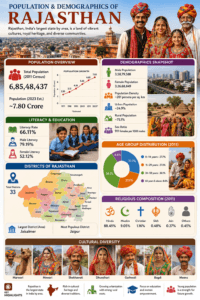
Population & Demographics of Rajasthan
The state is the largest state in India by area and one of the country’s most culturally diverse states. According to the 2011 Census of India, Rajasthan has a population of approximately 68.55 million (6.85 crore), making it the seventh most populous state in India. Over the years, rapid urbanization, economic development, tourism, and industrial growth have contributed to a steady increase in population.
The population density of Rajasthan is around 200 people per square kilometre, which is relatively low compared to many other Indian states due to its vast desert landscape. The sex ratio stands at 928 females per 1,000 males, while the literacy rate is approximately 66.11%, with continuous improvements through government education initiatives.
Jaipur is the largest and most populous city in Rajasthan, followed by Jodhpur, Kota, Bikaner, Ajmer, Udaipur, Alwar, Bharatpur, Sikar, and Bhilwara. These cities serve as major centres for education, tourism, commerce, healthcare, and industry.
Hindi is the official language of Rajasthan, while Rajasthani dialects such as Marwari, Mewari, Shekhawati, Dhundhari, Harauti, Mewati, and Bagri are widely spoken across different regions. English is commonly used in education, tourism, business, and administration.
The state is home to various communities, including Rajputs, Jats, Meenas, Bhils, Gurjars, Brahmins, and several tribal groups, each contributing to the state’s rich cultural diversity. Traditional customs, colourful attire, folk music, and festivals reflect the unique heritage of these communities.
With a young and growing population, expanding cities, and improving social infrastructure, Rajasthan continues to strengthen its position as one of India’s most important cultural, economic, and tourism destinations.
Population at a Glance
| Category | Details |
|---|---|
| Population (2011 Census) | 68.55 Million |
| Population Rank in India | 7th |
| Population Density | 200 people/km² |
| Literacy Rate | 66.11% |
| Sex Ratio | 928 females per 1,000 males |
| Largest City | Jaipur |
| Official Language | Hindi |
| Major Regional Languages | Marwari, Mewari, Shekhawati, Dhundhari, Harauti |
| Urban Population | About 24.9% |
| Cultural Identity | Rajput, Tribal & Rajasthani Heritage |
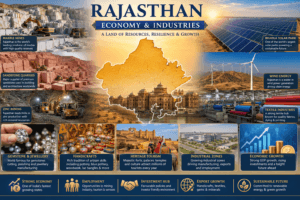
Economy & Industries of Rajasthan
The state has one of the fastest-growing economies in India, driven by mining, tourism, agriculture, manufacturing, renewable energy, handicrafts, textiles, cement production, and infrastructure development. As India’s largest state by area, Rajasthan has abundant natural resources, strategic connectivity, and a rapidly expanding industrial base that significantly contributes to the country’s economy.
The state is widely known as the “Mineral Museum of India” because it is one of the country’s largest producers of marble, sandstone, limestone, zinc, lead, copper, gypsum, granite, rock phosphate, and lignite. Rajasthan is India’s largest producer of marble and sandstone, supplying high-quality building materials to domestic and international markets.
Tourism is another major pillar of Rajasthan’s economy. Millions of visitors travel every year to iconic destinations such as Jaipur, Udaipur, Jodhpur, Jaisalmer, Mount Abu, Pushkar, Ranthambore National Park, and Chittorgarh Fort. Heritage hotels, royal palaces, desert safaris, cultural festivals, and wildlife tourism generate substantial employment and revenue.
The manufacturing sector is also expanding rapidly. Major industries include textiles, handicrafts, gemstones and jewellery, cement, engineering products, ceramics, chemicals, fertilizers, and food processing. Cities such as Jaipur, Kota, Bhilwara, Udaipur, Jodhpur, Alwar, Neemrana, and Bhiwadi have emerged as important industrial centres.
The state has become a national leader in renewable energy, particularly solar and wind power. With vast desert land and abundant sunshine, the state hosts some of India’s largest solar parks, including the Bhadla Solar Park, one of the largest solar power parks in the world.
The Government of Rajasthan promotes industrial growth through industrial corridors, Special Economic Zones (SEZs), startup initiatives, digital governance, and investment promotion programmes. These efforts continue to attract domestic and international investors.
With strong growth in mining, tourism, renewable energy, manufacturing, and infrastructure, Rajasthan continues to strengthen its position as one of India’s most dynamic and economically significant states.
Economy at a Glance
| Sector | Major Activities |
|---|---|
| Mining | Marble, Sandstone, Zinc, Copper & Limestone |
| Tourism | Heritage Tourism, Forts, Palaces & Desert Safaris |
| Renewable Energy | Solar & Wind Power |
| Textile Industry | Cotton, Wool & Fabric Manufacturing |
| Gemstones & Jewellery | Cutting, Polishing & Exports |
| Cement Industry | Large-scale Cement Manufacturing |
| Handicrafts | Blue Pottery, Carpets, Leather & Handloom |
| Agriculture | Wheat, Bajra, Mustard, Pulses & Cotton |
| Major Industrial Cities | Jaipur, Kota, Alwar, Bhiwadi, Bhilwara & Udaipur |
| Economic Strength | Mining, Tourism, Renewable Energy & Manufacturing |
Agriculture of Rajasthan
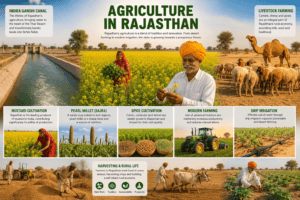
Agriculture is the backbone of Rajasthan’s rural economy and provides livelihoods to a large section of the state’s population. Despite its arid climate and the vast Thar Desert, Rajasthan has made remarkable progress in agriculture through irrigation projects, water conservation, modern farming techniques, and drought-resistant crop cultivation. The state contributes significantly to India’s production of food grains, oilseeds, spices, and horticultural crops.
The Indira Gandhi Canal Project, one of India’s largest irrigation projects, has transformed the agricultural landscape of northwestern Rajasthan by bringing water from the Sutlej and Beas rivers to the desert districts of Jaisalmer, Bikaner, Jodhpur, Sri Ganganagar, Hanumangarh, and Barmer. The project has converted vast stretches of barren land into fertile agricultural fields.
The state is India’s largest producer of pearl millet (bajra) and is also a leading producer of mustard, cumin, coriander, fenugreek, guar (cluster bean), moth bean, gram, and isabgol. Other important crops include wheat, barley, maize, pulses, cotton, sugarcane, and vegetables.
The state is famous for its spice cultivation, particularly coriander, cumin, fenugreek, and fennel, which are exported to many countries. Horticulture is also growing rapidly with the cultivation of oranges, pomegranates, kinnow, dates, guava, ber (Indian jujube), and aonla (Indian gooseberry).
Animal husbandry plays an equally important role in Rajasthan’s economy. The state has one of India’s largest populations of camels, sheep, goats, and cattle. Rajasthan is renowned for producing high-quality wool, making it a leading centre for the wool and textile industries.
The Government of the state promotes drip irrigation, sprinkler irrigation, organic farming, crop diversification, soil health management, and agricultural mechanization to improve productivity while conserving water resources.
With its innovative irrigation systems, resilient farming practices, rich livestock resources, and expanding horticulture sector, Rajasthan has become one of India’s leading agricultural states despite its challenging climatic conditions.
Agriculture at a Glance
| Category | Major Products |
|---|---|
| Food Crops | Wheat, Bajra, Barley, Maize & Pulses |
| Cash Crops | Mustard, Cotton, Guar & Sugarcane |
| Major Spices | Cumin, Coriander, Fenugreek & Fennel |
| Fruits | Orange, Kinnow, Pomegranate, Ber & Guava |
| Irrigation Project | Indira Gandhi Canal Project |
| Livestock | Camel, Sheep, Goat & Cattle |
| Major Animal Product | Wool |
| Farming Methods | Drip & Sprinkler Irrigation |
| Agricultural Strength | Spices, Oilseeds & Livestock |
| Major Export Products | Spices, Guar Gum & Wool |
Education in Rajasthan
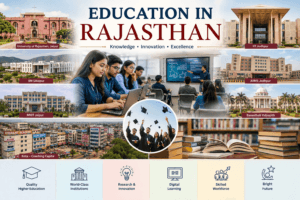
Education plays a vital role in the social and economic development of Rajasthan. Over the years, the state has made significant progress in expanding access to school education, higher education, technical institutions, skill development, and digital learning. Through various government initiatives and educational reforms, Rajasthan continues to improve literacy, enrolment, and educational infrastructure across urban and rural areas.
The state is home to several prestigious universities and institutions that attract students from across India. Prominent universities include the University of Rajasthan (Jaipur), Malaviya National Institute of Technology (MNIT Jaipur), Indian Institute of Technology (IIT Jodhpur), Indian Institute of Management (IIM Udaipur), All India Institute of Medical Sciences (AIIMS Jodhpur), Banasthali Vidyapith, Mohanlal Sukhadia University, and Jai Narain Vyas University.
The state has a vast network of government schools, private schools, colleges, engineering institutions, medical colleges, law universities, polytechnic colleges, and vocational training centres. The state government implements schemes to promote girls’ education, scholarships for economically weaker students, digital classrooms, teacher training, and skill-based education.
Higher education in Rajasthan is rapidly expanding, particularly in the fields of engineering, medicine, management, law, agriculture, tourism, information technology, and research. Cities such as Jaipur, Jodhpur, Udaipur, Kota, Ajmer, and Bikaner have become major educational hubs.
Kota is internationally famous as India’s largest coaching hub, preparing thousands of students every year for competitive examinations such as JEE Main, JEE Advanced, NEET, Olympiads, and other national-level entrance exams. Students from every corner of India travel to Kota for quality coaching and academic guidance.
With continuous investment in educational infrastructure, digital learning, research, and skill development, Rajasthan is steadily emerging as one of India’s leading centres for quality education and higher learning.
Education at a Glance
| Category | Details |
|---|---|
| Literacy Rate | 66.11% |
| Leading University | University of Rajasthan |
| IIT | IIT Jodhpur |
| IIM | IIM Udaipur |
| AIIMS | AIIMS Jodhpur |
| NIT | MNIT Jaipur |
| Famous Women’s University | Banasthali Vidyapith |
| Education Hub | Kota |
| Major Courses | Engineering, Medicine, Management, Law & Agriculture |
| Education Strength | Higher Education, Research & Competitive Exam Coaching |
Healthcare in Rajasthan
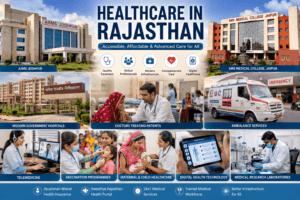
Healthcare is a key priority for the Government of Rajasthan, with continuous investments in medical infrastructure, public health programmes, digital healthcare, maternal and child welfare, and emergency medical services. Over the years, the state has expanded access to quality healthcare through government hospitals, community health centres, primary health centres, medical colleges, and super-speciality institutions across both urban and rural areas.
The state has a vast healthcare network comprising district hospitals, sub-divisional hospitals, community health centres (CHCs), primary health centres (PHCs), urban health centres, and thousands of health sub-centres. These facilities provide essential medical services, immunization, maternal healthcare, child nutrition, disease prevention, and emergency treatment.
The state is home to several renowned medical institutions, including AIIMS Jodhpur, SMS Medical College Jaipur, Dr. Sampurnanand Medical College Jodhpur, RNT Medical College Udaipur, JLN Medical College Ajmer, SP Medical College Bikaner, and numerous government and private medical colleges that produce skilled healthcare professionals.
The Government of Rajasthan implements various healthcare initiatives such as the Mukhyamantri Chiranjeevi Health Insurance Scheme, Ayushman Bharat – Pradhan Mantri Jan Arogya Yojana (PM-JAY), free medicine distribution, free diagnostic services, telemedicine, ambulance services, and maternal and child healthcare programmes. These schemes aim to provide affordable and accessible healthcare to all citizens.
Preventive healthcare is promoted through vaccination drives, nutrition programmes, sanitation campaigns, tuberculosis control, vector-borne disease prevention, and digital health services. Special attention is given to improving healthcare access in remote desert and tribal regions through mobile medical units and outreach programmes.
With modern hospitals, expanding medical education, health insurance coverage, and continuous public health reforms, Rajasthan is steadily strengthening its healthcare system and improving the quality of life for its people.
Healthcare at a Glance
| Category | Details |
|---|---|
| Premier Medical Institute | AIIMS Jodhpur |
| Leading Government Medical College | SMS Medical College, Jaipur |
| Health Insurance Scheme | Mukhyamantri Chiranjeevi Health Insurance Scheme |
| National Health Scheme | Ayushman Bharat (PM-JAY) |
| Healthcare Facilities | District Hospitals, CHCs & PHCs |
| Emergency Services | 108 Ambulance Service |
| Key Focus Areas | Maternal & Child Health, Immunization & Telemedicine |
| Medical Education | Government & Private Medical Colleges |
| Public Health Programmes | Free Medicines & Free Diagnostic Services |
| Healthcare Goal | Accessible, Affordable & Quality Healthcare |
Transport in Rajasthan
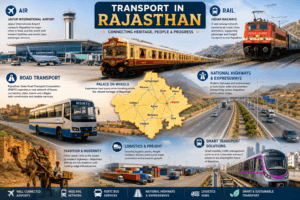
The state has one of the largest and most well-developed transportation networks in India, connecting its major cities, tourist destinations, industrial centres, and rural areas through an extensive system of roads, railways, airports, and public transport. The state’s strategic location in northwestern India makes it an important gateway for trade, tourism, and commerce.
The road network forms the backbone of Rajasthan’s transportation system. The state is connected by several major National Highways, including NH 48, NH 27, NH 52, NH 62, and NH 11, which link Rajasthan with Delhi, Gujarat, Haryana, Punjab, Madhya Pradesh, and Uttar Pradesh. The Rajasthan State Road Transport Corporation (RSRTC) operates an extensive fleet of buses that provides affordable and reliable transportation to cities, towns, and villages across the state.
The railway network is operated by Indian Railways and plays a vital role in passenger and freight transportation. Major railway junctions include Jaipur, Jodhpur, Ajmer, Kota, Bikaner, Udaipur, Alwar, and Bharatpur. Rajasthan is also famous for luxury tourist trains such as the Palace on Wheels, which offers visitors a royal travel experience through the state’s historic cities and heritage sites.
Air connectivity has improved significantly in recent years. Jaipur International Airport is the state’s busiest airport and offers domestic and international flights. Other important airports include Jodhpur, Udaipur (Maharana Pratap Airport), Jaisalmer, Bikaner, Kishangarh (Ajmer), and Kota (limited services). These airports enhance tourism, business, and regional connectivity.
The state is also investing in expressways, smart roads, logistics parks, electric mobility, and digital transport services to strengthen infrastructure and improve travel efficiency. Ongoing highway expansion and railway modernization projects continue to boost economic growth and tourism.
With modern highways, an extensive railway network, growing air connectivity, and efficient public transport services, Rajasthan offers excellent transportation facilities for residents, businesses, and millions of tourists every year.
Transport at a Glance
| Category | Details |
|---|---|
| Major Airport | Jaipur International Airport |
| Other Airports | Jodhpur, Udaipur, Jaisalmer, Bikaner & Kishangarh |
| Railway Zones | North Western Railway & West Central Railway |
| Major Railway Junctions | Jaipur, Jodhpur, Ajmer, Kota, Bikaner & Udaipur |
| Luxury Train | Palace on Wheels |
| State Bus Service | Rajasthan State Road Transport Corporation (RSRTC) |
| Major Highways | NH 48, NH 27, NH 52, NH 62 & NH 11 |
| Public Transport | Buses, Taxis, Auto-rickshaws & App-based Cabs |
| Infrastructure Focus | Expressways, Smart Roads & Logistics Parks |
| Transport Strength | Tourism, Trade & Industrial Connectivity |
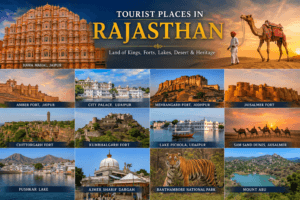
Tourist Places in Rajasthan
The state is one of India’s most popular tourist destinations, attracting millions of domestic and international visitors every year. Known as the “Land of Kings,” the state is famous for its magnificent forts, royal palaces, ancient temples, wildlife sanctuaries, colourful festivals, lakes, and the golden sand dunes of the Thar Desert. Rajasthan offers a perfect blend of history, architecture, adventure, spirituality, and culture.
The capital city, Jaipur, popularly known as the Pink City, is home to iconic attractions such as the Hawa Mahal, Amber Fort, City Palace, Jantar Mantar (UNESCO World Heritage Site), Nahargarh Fort, and Jaigarh Fort. Jaipur forms part of India’s famous Golden Triangle tourist circuit.
Udaipur, often called the “City of Lakes,” is renowned for its beautiful lakes, royal palaces, luxury heritage hotels, and romantic atmosphere. Major attractions include the City Palace, Lake Pichola, Jag Mandir, Fateh Sagar Lake, and Sajjangarh (Monsoon Palace).
Jaisalmer, known as the “Golden City,” is famous for the magnificent Jaisalmer Fort (UNESCO World Heritage Site), desert safaris, camel rides, Sam Sand Dunes, and traditional Rajasthani cultural performances in the Thar Desert.
Jodhpur, popularly called the “Blue City,” is home to the majestic Mehrangarh Fort, Umaid Bhawan Palace, Jaswant Thada, and the vibrant old city with its blue-painted houses.
Other major tourist destinations include Chittorgarh Fort, Kumbhalgarh Fort, Mount Abu, Pushkar, Ajmer Sharif Dargah, Ranthambore National Park, Keoladeo National Park, Bikaner, Bundi, Ranakpur Jain Temple, and Dilwara Temples.
From UNESCO World Heritage Sites and wildlife sanctuaries to royal palaces and desert adventures, Rajasthan offers unforgettable experiences for history lovers, nature enthusiasts, photographers, pilgrims, and adventure seekers.
Top Tourist Places in Rajasthan
| Tourist Place | Famous For |
|---|---|
| Jaipur | Hawa Mahal, Amber Fort & City Palace |
| Udaipur | City of Lakes & Lake Pichola |
| Jodhpur | Mehrangarh Fort & Blue City |
| Jaisalmer | Golden Fort & Desert Safari |
| Chittorgarh | Chittorgarh Fort |
| Kumbhalgarh | UNESCO Fort & Great Wall of India |
| Mount Abu | Rajasthan’s Only Hill Station |
| Pushkar | Brahma Temple & Pushkar Lake |
| Ajmer | Ajmer Sharif Dargah |
| Ranthambore National Park | Bengal Tigers & Wildlife |
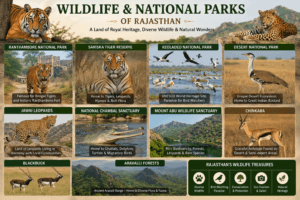
Wildlife & National Parks of Rajasthan
The state is one of India’s most biodiverse states, offering a remarkable variety of wildlife sanctuaries, tiger reserves, bird sanctuaries, desert ecosystems, wetlands, and protected forests. Although much of the state is covered by the Thar Desert, Rajasthan supports a rich diversity of flora and fauna through its national parks, wildlife sanctuaries, and conservation reserves.
The most famous protected area is Ranthambore National Park, located in Sawai Madhopur district. It is one of India’s premier tiger reserves and is globally renowned for its healthy population of Bengal Tigers. Visitors also spot leopards, sloth bears, striped hyenas, jackals, sambar deer, chital, nilgai, marsh crocodiles, and more than 300 bird species.
Another important tiger reserve is the Sariska Tiger Reserve in Alwar district. Nestled within the Aravalli Hills, the reserve is home to Bengal tigers, leopards, jungle cats, hyenas, wild boars, sambar deer, and langurs, making it one of Rajasthan’s leading wildlife destinations.
The Keoladeo National Park in Bharatpur is a UNESCO World Heritage Site and one of the world’s most famous bird sanctuaries. Every winter, thousands of migratory birds from Europe, Central Asia, and Siberia visit the park. It is a paradise for birdwatchers and photographers, with over 370 species of birds recorded.
The Desert National Park, located near Jaisalmer and Barmer, protects the unique ecosystem of the Thar Desert. It is one of the last remaining habitats of the Great Indian Bustard, one of the world’s most endangered birds. Other wildlife found here includes chinkara, desert fox, desert cat, monitor lizard, and numerous reptiles.
Other notable protected areas include Mount Abu Wildlife Sanctuary, Kumbhalgarh Wildlife Sanctuary, Tal Chhapar Blackbuck Sanctuary, National Chambal Sanctuary, Jawai Leopard Conservation Area, and Ramgarh Vishdhari Tiger Reserve.
Through dedicated conservation efforts, eco-tourism initiatives, and habitat protection, Rajasthan continues to preserve its extraordinary wildlife heritage while promoting sustainable tourism and biodiversity conservation.
Wildlife at a Glance
| Protected Area | Famous For |
|---|---|
| Ranthambore National Park | Bengal Tigers |
| Sariska Tiger Reserve | Tigers & Leopards |
| Keoladeo National Park | Migratory Birds (UNESCO Site) |
| Desert National Park | Great Indian Bustard |
| Mount Abu Wildlife Sanctuary | Aravalli Wildlife |
| Kumbhalgarh Wildlife Sanctuary | Wolves & Leopards |
| Tal Chhapar Sanctuary | Blackbucks |
| National Chambal Sanctuary | Gharial & Gangetic Dolphin |
| Jawai Leopard Conservation Area | Wild Leopards |
| State Bird | Great Indian Bustard |
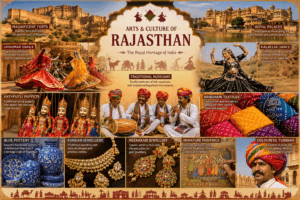
Arts & Culture of Rajasthan
The state is one of India’s most culturally vibrant states, renowned for its royal heritage, colourful traditions, folk music, dance, handicrafts, festivals, and magnificent architecture. Popularly known as the “Land of Kings,” Rajasthan has preserved its rich cultural legacy through centuries of Rajput history, making it one of the country’s most celebrated cultural destinations.
The state is famous for its traditional folk dances, including Ghoomar, Kalbelia, Bhavai, Chari, Kathputli (Puppet Dance), Terah Taali, and Kachhi Ghodi. These performances are an integral part of festivals, weddings, and cultural events, showcasing Rajasthan’s artistic excellence.
Rajasthani folk music is equally captivating, featuring traditional instruments such as the Ravanhatta, Sarangi, Algoza, Morchang, Khartal, and Dholak. Folk songs celebrating bravery, romance, devotion, and desert life have been passed down through generations.
The state’s handicrafts are internationally acclaimed. Rajasthan is famous for blue pottery, block printing, Bandhani (tie-dye textiles), Leheriya fabrics, Meenakari jewellery, Kundan jewellery, lac bangles, marble carving, wood carving, leather crafts, miniature paintings, and handwoven carpets. Cities such as Jaipur, Jodhpur, Udaipur, Bikaner, Barmer, and Jaisalmer are major handicraft centres.
Rajasthan’s magnificent architecture is reflected in its forts, palaces, havelis, temples, stepwells, and cenotaphs. UNESCO World Heritage Sites such as Amber Fort, Chittorgarh Fort, Kumbhalgarh Fort, Jaisalmer Fort, Ranthambore Fort, and Gagron Fort highlight the state’s glorious architectural heritage.
Traditional attire adds to Rajasthan’s cultural identity. Men wear colourful safas (turbans), angrakhas, and dhotis, while women wear beautifully embroidered ghagras, cholis, and odhnis adorned with traditional jewellery.
From royal traditions and vibrant festivals to exquisite handicrafts and timeless architecture, Rajasthan’s arts and culture continue to attract millions of visitors from around the world while preserving one of India’s richest cultural heritages.
Arts & Culture at a Glance
| Category | Famous For |
|---|---|
| Folk Dance | Ghoomar, Kalbelia, Bhavai & Chari |
| Folk Music | Sarangi, Ravanhatta, Algoza & Morchang |
| Traditional Art | Miniature Paintings |
| Textile Crafts | Bandhani & Leheriya |
| Pottery | Jaipur Blue Pottery |
| Jewellery | Kundan & Meenakari |
| Puppet Art | Kathputli |
| Traditional Dress | Ghagra-Choli, Safa & Angrakha |
| Architecture | Forts, Palaces & Havelis |
| Cultural Identity | Rajput Heritage & Desert Traditions |
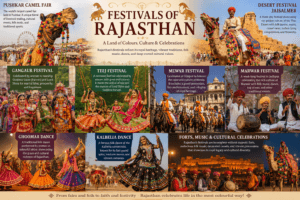
Festivals of Rajasthan
The state is renowned for its colourful festivals, which reflect the state’s royal heritage, vibrant traditions, religious diversity, and rich folk culture. Throughout the year, people celebrate festivals with folk dances, music, camel fairs, traditional costumes, handicrafts, and grand processions, attracting millions of tourists from India and around the world.
One of the most famous celebrations is the Pushkar Camel Fair, held annually in the holy town of Pushkar. It is one of the largest camel and livestock fairs in the world, where thousands of camels, horses, and cattle are traded. The fair also features folk music, Ghoomar and Kalbelia dance performances, cultural competitions, hot air balloons, handicraft exhibitions, and religious ceremonies at Pushkar Lake.
The Desert Festival, celebrated in Jaisalmer, showcases Rajasthan’s unique desert culture through camel races, turban-tying competitions, moustache contests, folk dances, puppet shows, and traditional music against the backdrop of the golden sand dunes of the Thar Desert.
The Gangaur Festival is one of Rajasthan’s most important festivals and is dedicated to Goddess Gauri, symbolizing marital happiness and prosperity. Women dress in colourful traditional attire, carry beautifully decorated idols, and participate in grand processions across cities like Jaipur, Udaipur, and Jodhpur.
Another significant celebration is Teej, celebrated mainly by women during the monsoon season. The festival includes colourful processions, swings, traditional songs, dances, and prayers for family well-being.
Other major festivals celebrated across Rajasthan include Mewar Festival, Marwar Festival, Kite Festival (Makar Sankranti), Diwali, Holi, Navratri, Dussehra, and the famous Nagaur Cattle Fair.
These vibrant festivals preserve Rajasthan’s centuries-old traditions while promoting tourism, handicrafts, folk arts, and cultural exchange. Every celebration offers visitors an unforgettable experience of the state’s royal lifestyle and colourful heritage.
Major Festivals of Rajasthan
| Festival | Famous For |
|---|---|
| Pushkar Camel Fair | World’s Largest Camel Fair |
| Desert Festival | Camel Safari & Desert Culture |
| Gangaur Festival | Worship of Goddess Gauri |
| Teej Festival | Women’s Festival & Monsoon Celebration |
| Mewar Festival | Udaipur Cultural Celebrations |
| Marwar Festival | Rajput Folk Heritage |
| Nagaur Cattle Fair | Livestock Trading Fair |
| Makar Sankranti | International Kite Flying |
| Diwali | Festival of Lights |
| Holi | Festival of Colours |
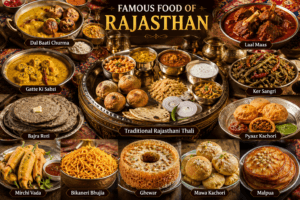
Famous Food of Rajasthan
Rajasthani cuisine is one of the richest and most distinctive culinary traditions in India, known for its bold flavours, traditional cooking methods, and unique recipes developed to suit the state’s arid climate. Since water was historically scarce in many parts of Rajasthan, local cuisine evolved to include dishes with a long shelf life, generous use of spices, clarified butter (ghee), gram flour, pulses, and dried ingredients.
The most iconic dish of Rajasthan is Dal Baati Churma, considered the state’s signature meal. It consists of baked wheat dumplings (Baati) served with spicy lentil curry (Dal) and sweet crushed wheat (Churma). This wholesome dish is enjoyed across the state and is a must-try for visitors.
Another famous delicacy is Laal Maas, a traditional Rajput mutton curry prepared with red chillies, aromatic spices, and rich gravy. Safed Maas, made with milk, cream, yogurt, and mild spices, is another popular royal dish.
Rajasthan is also famous for delicious vegetarian dishes such as Gatte Ki Sabzi, Ker Sangri, Panchmel Dal, Papad Ki Sabzi, Bajra Roti, Missi Roti, and Methi Bajra Poori. These dishes are nutritious, flavourful, and perfectly suited to the state’s desert climate.
The state is equally renowned for its traditional snacks. Pyaaz Kachori, Mirchi Vada, Kachori, and Bikaneri Bhujia are among the most popular street foods enjoyed by locals and tourists alike.
Rajasthan’s sweets are equally famous throughout India. Traditional desserts such as Ghewar, Mawa Kachori, Malpua, Mohanthal, Rabri, and Besan Chakki are widely prepared during festivals, weddings, and special occasions.
From royal palace kitchens to bustling street food markets, Rajasthan offers a memorable culinary experience that beautifully reflects its royal heritage, desert lifestyle, and centuries-old traditions.
Famous Foods of Rajasthan
| Dish | Famous For |
|---|---|
| Dal Baati Churma | Signature Rajasthani Dish |
| Laal Maas | Traditional Spicy Mutton Curry |
| Gatte Ki Sabzi | Gram Flour Dumplings in Curry |
| Ker Sangri | Traditional Desert Vegetable Dish |
| Bajra Roti | Nutritious Millet Flatbread |
| Pyaaz Kachori | Popular Street Food |
| Mirchi Vada | Spicy Snack |
| Bikaneri Bhujia | Famous Crispy Snack |
| Ghewar | Traditional Festival Sweet |
| Mawa Kachori | Rich Dessert Filled with Mawa |

Sports in Rajasthan
The state has made remarkable progress in sports development, with modern stadiums, sports academies, training centres, and government initiatives encouraging young athletes to participate in national and international competitions. While cricket remains the most popular sport, Rajasthan also excels in kabaddi, hockey, athletics, wrestling, shooting, football, tennis, volleyball, badminton, and traditional rural sports.
Cricket enjoys immense popularity across the state. The Sawai Mansingh Stadium in Jaipur is Rajasthan’s premier cricket venue and has hosted numerous international matches, Indian Premier League (IPL) games, and domestic tournaments. The Rajasthan Royals franchise, winners of the inaugural IPL 2008 season, represents the state in the Indian Premier League and has played a significant role in promoting cricket across Rajasthan.
Apart from cricket, shooting has emerged as one of Rajasthan’s strongest sporting disciplines. The state has produced internationally recognised athletes such as Rajyavardhan Singh Rathore, India’s Olympic silver medallist in shooting. Wrestling, boxing, athletics, kabaddi, and hockey are also widely played at school, college, and state levels.
The Government of the state actively promotes sports through initiatives such as the Rajasthan State Sports Council, youth development programmes, school sports competitions, and modern sports infrastructure. Sports academies and coaching centres in Jaipur, Jodhpur, Udaipur, Kota, Ajmer, and Bikaner help nurture talented athletes.
The state has invested in indoor stadiums, athletics tracks, swimming pools, synthetic hockey turfs, football grounds, and multi-purpose sports complexes. These facilities support training, competitions, and grassroots sports development.
With improving infrastructure, dedicated coaching programmes, and increasing participation in national and international events, Rajasthan continues to strengthen its reputation as an emerging sporting destination in India.
Sports at a Glance
| Category | Details |
|---|---|
| Most Popular Sport | Cricket |
| Major Cricket Stadium | Sawai Mansingh Stadium, Jaipur |
| IPL Team | Rajasthan Royals |
| Popular Sports | Cricket, Shooting, Wrestling, Kabaddi, Hockey & Athletics |
| Olympic Sport | Shooting |
| Famous Olympian | Rajyavardhan Singh Rathore |
| Sports Authority | Rajasthan State Sports Council |
| Major Sports Cities | Jaipur, Jodhpur, Udaipur, Kota & Ajmer |
| Infrastructure | Stadiums, Indoor Arenas & Sports Academies |
| Sports Strength | Cricket, Shooting & Grassroots Talent Development |
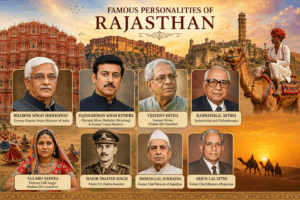
Famous Personalities of Rajasthan
The state has produced many distinguished personalities who have made remarkable contributions to politics, literature, sports, military service, social reform, education, and public administration. Their achievements have brought pride to the state and inspired generations across India.
One of Rajasthan’s most respected leaders was Bhairon Singh Shekhawat, the former Vice President of India and a three-time Chief Minister of Rajasthan. He was widely admired for his leadership, administrative reforms, and dedication to public service.
Rajyavardhan Singh Rathore, an Olympic silver medallist in shooting, is among Rajasthan’s most celebrated sportspersons. He became the first Indian shooter to win an individual Olympic silver medal, inspiring thousands of young athletes.
In literature, Vijaydan Detha earned national recognition for preserving and promoting Rajasthani folklore through his stories and literary works. Kanhaiyalal Sethia, a renowned poet and writer, made significant contributions to Rajasthani and Hindi literature.
Rajasthan has also produced internationally acclaimed artists such as Gulabo Sapera, the legendary Kalbelia dancer who helped popularise Rajasthan’s folk culture across the world. Her performances have received numerous national and international honours.
Among the state’s brave military heroes, Major Shaitan Singh, recipient of the Param Vir Chakra, is remembered for his extraordinary courage during the 1962 Indo-China War. His sacrifice remains a symbol of patriotism and bravery.
The state has also produced successful entrepreneurs, educationists, scientists, civil servants, musicians, and social reformers who continue to contribute to India’s development while preserving Rajasthan’s rich cultural heritage.
Famous Personalities of Rajasthan
| Personality | Known For |
|---|---|
| Bhairon Singh Shekhawat | Former Vice President of India |
| Rajyavardhan Singh Rathore | Olympic Silver Medalist (Shooting) |
| Vijaydan Detha | Renowned Writer & Folklorist |
| Kanhaiyalal Sethia | Poet & Literary Icon |
| Gulabo Sapera | Famous Kalbelia Folk Dancer |
| Major Shaitan Singh | Param Vir Chakra Awardee |
| Mohan Lal Sukhadia | Former Chief Minister & Education Reformer |
| Arjun Lal Sethi | Freedom Fighter & Social Reformer |
| Jamnalal Bajaj | Industrialist & Freedom Fighter |
| Lakshmi Kumari Chundawat | Author & Historian |
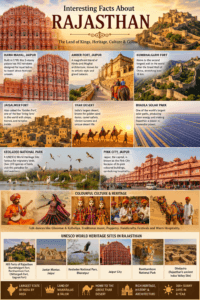
Interesting Facts About Rajasthan
Rajasthan is one of India’s most fascinating states, known for its royal heritage, magnificent forts, colourful culture, vast deserts, and rich history. As the largest state in India by area, Rajasthan offers a unique blend of ancient traditions, architectural marvels, wildlife, and natural beauty that attracts millions of visitors every year.
One of Rajasthan’s most remarkable features is the Thar Desert, also known as the Great Indian Desert, which covers nearly 60% of the state’s geographical area. The desert is famous for its golden sand dunes, camel safaris, desert festivals, and breathtaking sunsets.
Rajasthan is home to several UNESCO World Heritage Sites, including the Hill Forts of Rajasthan—Amber Fort, Chittorgarh Fort, Kumbhalgarh Fort, Jaisalmer Fort, Ranthambore Fort, and Gagron Fort. These forts showcase the architectural brilliance and military strength of the Rajput kingdoms.
The state also boasts the Kumbhalgarh Fort, which has the second-longest continuous wall in the world after the Great Wall of China, stretching over 36 kilometres.
Rajasthan’s capital, Jaipur, is popularly known as the Pink City because many of its historic buildings are painted in a distinctive pink colour. Jaipur is also India’s first planned city and forms part of the famous Golden Triangle tourist circuit.
The Keoladeo National Park in Bharatpur, a UNESCO World Heritage Site, is one of the world’s most important bird sanctuaries, welcoming thousands of migratory birds every winter.
Rajasthan is India’s leading producer of marble, sandstone, zinc, lead, gypsum, and wool. The state is also a national leader in solar energy, hosting the Bhadla Solar Park, one of the largest solar power parks in the world.
From royal palaces and desert adventures to colourful festivals, wildlife sanctuaries, and timeless traditions, Rajasthan remains one of India’s most iconic and unforgettable destinations.
Interesting Facts at a Glance
| Fact | Details |
|---|---|
| Largest State in India | By Area |
| Famous Desert | Thar Desert |
| Pink City | Jaipur |
| UNESCO Heritage | Hill Forts of Rajasthan & Keoladeo National Park |
| Famous Fort Wall | Kumbhalgarh Fort (36 km wall) |
| Largest Solar Park | Bhadla Solar Park |
| Largest Salt Lake | Sambhar Salt Lake |
| State Bird | Great Indian Bustard |
| Famous Animal | Camel & Chinkara |
| Tourism Identity | Land of Kings |
Frequently Asked Questions (FAQs) About Rajasthan
1. Why is Rajasthan called the “Land of Kings”?
Rajasthan is called the “Land of Kings” because it was historically ruled by powerful Rajput kingdoms. The state is famous for its royal heritage, magnificent forts, grand palaces, and brave warrior traditions.
2. What is the capital of Rajasthan?
Jaipur is the capital and largest city of Rajasthan. Popularly known as the Pink City, it is famous for attractions such as Hawa Mahal, Amber Fort, City Palace, and Jantar Mantar.
3. Which is the largest district in Rajasthan?
Jaisalmer is the largest district in Rajasthan by area. It is famous for the Thar Desert, Jaisalmer Fort, Sam Sand Dunes, and desert tourism.
4. What is Rajasthan famous for?
Rajasthan is famous for its royal forts, palaces, Thar Desert, camel safaris, colourful festivals, traditional handicrafts, folk dances, wildlife, delicious cuisine, and rich cultural heritage.
5. Which is the highest peak in Rajasthan?
Guru Shikhar, located near Mount Abu in the Aravalli Range, is the highest peak in Rajasthan with an elevation of approximately 1,722 metres (5,650 feet).
6. Which is the most famous national park in Rajasthan?
Ranthambore National Park is Rajasthan’s most famous national park and one of India’s best places to see Bengal Tigers in the wild.
7. What is the famous food of Rajasthan?
The most famous dish of Rajasthan is Dal Baati Churma. Other popular foods include Laal Maas, Gatte Ki Sabzi, Ker Sangri, Pyaaz Kachori, Mirchi Vada, Bikaneri Bhujia, and Ghewar.
8. Which is the best time to visit Rajasthan?
The best time to visit Rajasthan is October to March, when the weather is pleasant and ideal for sightseeing, desert safaris, wildlife tours, and cultural festivals.
9. Which languages are spoken in Rajasthan?
Hindi is the official language of Rajasthan. Regional languages and dialects such as Marwari, Mewari, Dhundhari, Shekhawati, Harauti, and Mewati are also widely spoken.
10. Why is Rajasthan one of India’s top tourist destinations?
Rajasthan attracts millions of visitors because of its UNESCO World Heritage Sites, royal palaces, historic forts, colourful culture, wildlife sanctuaries, desert landscapes, festivals, lakes, and warm hospitality.
FAQ Schema
Why is Rajasthan called the Land of Kings?
Rajasthan is known as the Land of Kings because it was ruled by powerful Rajput kingdoms and is famous for its royal heritage, forts, and palaces.
What is the capital of Rajasthan?
Jaipur is the capital and largest city of Rajasthan.
Which is the largest district in Rajasthan?
Jaisalmer is the largest district in Rajasthan by area.
Conclusion
Rajasthan is truly one of India’s most extraordinary states, offering a perfect blend of royal heritage, magnificent forts, vibrant culture, colourful festivals, diverse wildlife, delicious cuisine, and breathtaking landscapes. From the golden sand dunes of the Thar Desert to the majestic palaces of Jaipur, Udaipur, Jodhpur, and Jaisalmer, every corner of Rajasthan tells a story of courage, tradition, and architectural brilliance.
Whether you are a traveller planning your next adventure, a student preparing for competitive exams, or someone interested in Indian history and culture, Rajasthan has something unique to offer. Its rich traditions, warm hospitality, UNESCO World Heritage Sites, and natural beauty make it one of the most visited destinations in India.
We hope this Complete Rajasthan Guide has helped you understand the state’s history, geography, economy, tourism, culture, wildlife, famous food, festivals, and many other important aspects. Keep exploring the incredible diversity of India through our detailed state guides.
Explore More Indian State Guides
Continue exploring India with our complete state guides:
- Telangana Complete Guide
- Andhra Pradesh Complete Guide
- Karnataka Complete Guide
- Tamil Nadu Complete Guide
- Kerala Complete Guide
- Maharashtra Complete Guide
- Goa Complete Guide
- Gujarat Complete Guide
More Indian state guides are coming soon
Explore More Indian State Guides
Continue exploring India with our detailed state guides:
Telangana Complete Guide – History, Tourism, Culture & Interesting Facts
Andhra Pradesh Complete Guide – History, Geography & Tourist Places
Karnataka Complete Guide – Travel, Heritage & Famous Attractions
Tamil Nadu Complete Guide – Temples, Culture & Tourism
Kerala Complete Guide – God’s Own Country Travel Guide
Maharashtra Complete Guide – History, Economy & Tourist Places
Goa Complete Guide – Beaches, Culture & Travel Guide
Gujarat Complete Guide – History, Wildlife & Tourism
Refference
Rajasthan Government
https://rajasthan.gov.in
Rajasthan Tourism
https://www.tourism.rajasthan.gov.in
Incredible India – Rajasthan
https://www.incredibleindia.gov.in
Census of India
https://censusindia.gov.in
UNESCO World Heritage Centre
https://whc.unesco.org
India Meteorological Department (IMD)
https://mausam.imd.gov.in
Ministry of Environment, Forest and Climate Change
https://moef.gov.in
National Tiger Conservation Authority
https://ntca.gov.in
Geological Survey of India
https://www.gsi.gov.in
India.gov.in (National Portal of India)
https://www.india.gov.in