
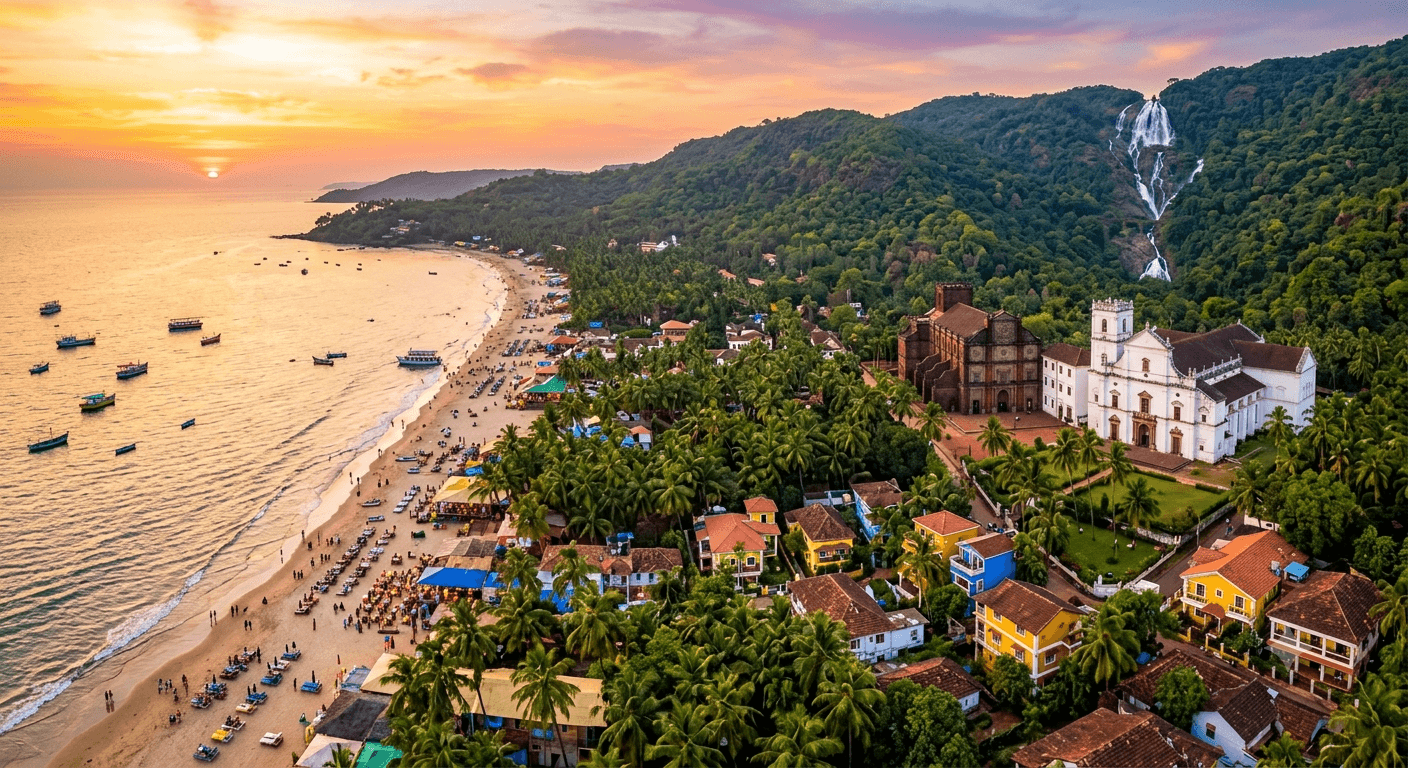
Goa is India’s smallest state by area and one of the country’s most popular tourist destinations. Located on the western coast of India along the Arabian Sea, Goa is famous for its golden beaches, Portuguese heritage, vibrant nightlife, historic churches, ancient temples, lush forests, waterfalls, and delicious seafood. The state offers a unique blend of Indian and Portuguese cultures, making it one of the most distinctive regions in the country.
Goa was a Portuguese colony for over 450 years before becoming part of India in 1961 through Operation Vijay. It became the 25th state of India on 30 May 1987. Today, Goa is known for its high quality of life, thriving tourism industry, literacy, biodiversity, and multicultural society.
The capital of Goa is Panaji (Panjim), while Vasco da Gama is its largest city. The official language is Konkani, although Marathi, Hindi, and English are also widely spoken. Goa’s economy is driven by tourism, mining, fisheries, agriculture, and hospitality, attracting millions of domestic and international visitors every year.
From the UNESCO World Heritage churches of Old Goa and the lively beaches of Calangute, Baga, and Palolem to the scenic Western Ghats, wildlife sanctuaries, spice plantations, and colourful festivals, Goa offers unforgettable experiences for travellers, nature lovers, history enthusiasts, and adventure seekers.
Whether you are looking for relaxing beach holidays, thrilling water sports, spiritual landmarks, delicious cuisine, or cultural festivals, Goa has something for everyone. Its unique charm, warm hospitality, and natural beauty continue to make it one of India’s top travel destinations.
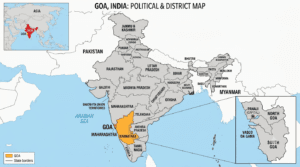
Goa on India Map
Goa is located on the southwestern coast of India, along the Arabian Sea. It is India’s smallest state by area and shares its northern border with Maharashtra and its eastern and southern borders with Karnataka. The western side of the state is bordered by the Arabian Sea, giving Goa a coastline of approximately 101 km.
Situated between the Western Ghats and the Arabian Sea, Goa enjoys a strategic geographical location with beautiful beaches, lush forests, rivers, waterfalls, and rich biodiversity. The state’s location has historically made it an important centre for maritime trade, tourism, and cultural exchange.
Goa is divided into two districts:
- North Goa
- South Goa
The capital city is Panaji (Panjim), while Vasco da Gama is the state’s largest city and an important port. Goa is well connected to the rest of India through roadways, railways, airways, and seaports, making it one of the country’s most accessible tourist destinations.
Its tropical climate, scenic coastline, and proximity to the Western Ghats make Goa one of India’s most beautiful and ecologically diverse states.
Goa at a Glance
| Category | Details |
|---|---|
| Region | Western India |
| Coast | Arabian Sea |
| Capital | Panaji (Panjim) |
| Largest City | Vasco da Gama |
| Area | 3,702 sq km |
| Districts | 2 (North Goa & South Goa) |
| Neighbouring States | Maharashtra & Karnataka |
| Coastline | Approximately 101 km |
| Latitude | 14°53′N – 15°48′N |
| Longitude | 73°40′E – 74°20′E |
History of Goa
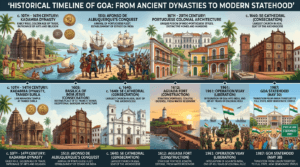
Goa has a rich and fascinating history that spans more than 2,000 years, making it one of India’s most culturally diverse states. Over the centuries, Goa was ruled by several powerful dynasties, including the Mauryas, Satavahanas, Chalukyas, Rashtrakutas, Kadambas, Vijayanagara Empire, Bahmani Sultanate, and the Adil Shah dynasty of Bijapur. Each of these rulers contributed to the state’s culture, architecture, trade, and administration.
The Kadamba Dynasty (10th–14th century CE) is considered one of Goa’s golden periods. During their rule, Goa flourished as an important centre for trade, education, art, and Hindu culture. Many ancient temples and inscriptions from this era still reflect the state’s rich heritage.
A major turning point came in 1510, when the Portuguese commander Afonso de Albuquerque captured Goa from the Bijapur Sultanate. Goa remained under Portuguese rule for more than 450 years, making it one of the longest-held European colonies in Asia. During this period, magnificent churches, cathedrals, forts, convents, and Portuguese-style houses were built, many of which still stand today. The Basilica of Bom Jesus and Se Cathedral are among the most famous monuments from this era and are now recognised as UNESCO World Heritage Sites.
Following India’s independence in 1947, Goa continued under Portuguese administration. After diplomatic efforts failed, the Government of India launched Operation Vijay in December 1961, leading to the liberation of Goa, along with Daman and Diu. On 19 December 1961, Goa officially became part of India.
Initially administered as a Union Territory, Goa was granted full statehood on 30 May 1987, becoming the 25th state of India. Since then, the state has developed into one of India’s leading tourist destinations while successfully preserving its unique blend of Indian and Portuguese heritage.
Today, Goa’s historical monuments, colonial architecture, ancient temples, churches, museums, and forts continue to attract millions of visitors from around the world, reflecting the state’s remarkable journey through history.
Historical Timeline of Goa
| Period | Historical Event |
|---|---|
| Ancient Period | Ruled by the Mauryas and Satavahanas |
| 10th–14th Century | Kadamba Dynasty ruled Goa |
| 14th–15th Century | Vijayanagara Empire and Bahmani Sultanate |
| Early 16th Century | Adil Shah dynasty of Bijapur |
| 1510 | Portuguese captured Goa under Afonso de Albuquerque |
| 1510–1961 | Portuguese colonial rule for over 450 years |
| 19 December 1961 | Goa liberated through Operation Vijay |
| 1961 | Became part of the Indian Union |
| 30 May 1987 | Goa became the 25th state of India |
| Present | Leading tourism, culture, and heritage destination |
Geography & Climate of Goa
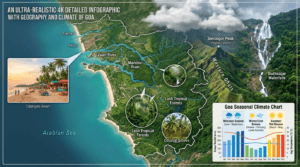
Goa is India’s smallest state by area, covering approximately 3,702 square kilometres on the southwestern coast of India. Despite its small size, Goa is blessed with diverse landscapes that include golden beaches, lush forests, rivers, estuaries, hills, waterfalls, fertile plains, and the Western Ghats, making it one of the country’s most scenic states.
The Arabian Sea forms Goa’s western boundary, giving the state a coastline of approximately 101 km. Famous beaches such as Calangute, Baga, Anjuna, Candolim, Colva, Palolem, and Morjim attract millions of tourists every year.
The eastern part of Goa is dominated by the Western Ghats (Sahyadri Hills), a UNESCO World Heritage Site known for its rich biodiversity, evergreen forests, wildlife sanctuaries, and picturesque waterfalls. The state’s highest point is Sonsogor Peak, which rises to about 1,026 metres above sea level.
Goa experiences a tropical monsoon climate, characterized by three distinct seasons:
Summer (March to May): Warm and humid, with temperatures ranging from 25°C to 35°C.
Monsoon (June to September): Heavy rainfall brought by the southwest monsoon transforms the state into a lush green paradise.
Winter (October to February): Pleasant weather with temperatures between 20°C and 30°C, making it the best season for tourism.
Goa receives an average annual rainfall of around 3,000 mm, especially in the Western Ghats. This abundant rainfall supports dense forests, rivers, agriculture, and rich biodiversity.
The state’s fertile soil, tropical climate, and scenic landscapes make Goa ideal for agriculture, spice plantations, coconut cultivation, and eco-tourism. Its unique combination of beaches, forests, hills, and rivers gives Goa a natural beauty unmatched by many other Indian states.
Geography & Climate at a Glance
| Category | Details |
|---|---|
| Total Area | 3,702 sq km |
| Region | Western India |
| Coastline | Approximately 101 km |
| Coast | Arabian Sea |
| Highest Peak | Sonsogor Peak (1,026 m) |
| Mountain Range | Western Ghats (Sahyadri Hills) |
| Climate Type | Tropical Monsoon Climate |
| Summer Temperature | 25°C – 35°C |
| Winter Temperature | 20°C – 30°C |
| Average Annual Rainfall | Around 3,000 mm |
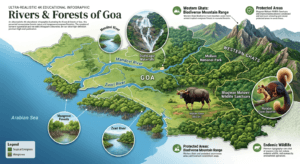
Rivers & Forests of Goa
Although Goa is India’s smallest state, it is blessed with a rich network of rivers, estuaries, mangrove forests, evergreen forests, and wildlife habitats. These natural resources support agriculture, fisheries, tourism, biodiversity, and the state’s ecological balance.
Goa has several important rivers that originate in the Western Ghats and flow westward into the Arabian Sea. The Mandovi River is the state’s largest and most significant river, flowing through Panaji and serving as an important waterway for transportation, tourism, and inland navigation. The Zuari River is another major river, forming Goa’s largest estuary and supporting fishing, shipping, and port activities.
Other important rivers include the Terekhol, Chapora, Baga, Sal, Talpona, and Galgibaga rivers. These rivers create beautiful backwaters, islands, mangrove ecosystems, and fertile plains that contribute to Goa’s natural beauty.
Nearly one-third of Goa’s geographical area is covered by forests, most of which lie in the Western Ghats, a globally recognized biodiversity hotspot and a UNESCO World Heritage Site. These forests consist mainly of tropical evergreen, semi-evergreen, moist deciduous, and mangrove forests, providing habitat for hundreds of plant and animal species.
Goa is home to several protected areas, including the Bhagwan Mahavir Wildlife Sanctuary, Mollem National Park, Bondla Wildlife Sanctuary, Cotigao Wildlife Sanctuary, Mhadei Wildlife Sanctuary, and Netravali Wildlife Sanctuary. These reserves protect iconic wildlife such as the Indian Gaur, Leopard, Sloth Bear, Sambar Deer, Malabar Giant Squirrel, King Cobra, and numerous bird species.
The state’s rivers, forests, waterfalls, and wildlife sanctuaries make Goa one of India’s leading destinations for eco-tourism, birdwatching, trekking, river cruises, and nature photography.
Rivers & Forests at a Glance
| Category | Details |
|---|---|
| Largest River | Mandovi River |
| Major Rivers | Mandovi, Zuari, Terekhol, Chapora, Sal, Baga, Talpona, Galgibaga |
| Largest Estuary | Zuari Estuary |
| Forest Cover | Around 33% of the state’s geographical area |
| Forest Type | Tropical Evergreen, Semi-evergreen, Moist Deciduous & Mangrove Forests |
| Biodiversity Hotspot | Western Ghats |
| National Park | Mollem National Park |
| Major Wildlife Sanctuaries | Bhagwan Mahavir, Bondla, Cotigao, Mhadei, Netravali |
| State Animal | Indian Gaur |
| Eco-tourism Attractions | River Cruises, Birdwatching, Trekking & Waterfalls |
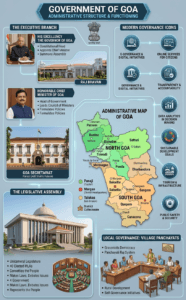
Government of Goa
Goa follows a parliamentary system of government, similar to other Indian states. The Governor serves as the constitutional head of the state and is appointed by the President of India, while the Chief Minister is the executive head who leads the Council of Ministers and oversees the administration.
Unlike some larger states, Goa has a unicameral legislature, consisting of the Goa Legislative Assembly (Vidhan Sabha) with 40 elected members. Members of the Legislative Assembly (MLAs) are elected by the people to represent different constituencies across the state. The Assembly plays a vital role in making laws, approving budgets, and overseeing the functioning of the state government.
The capital city, Panaji (Panjim), is the administrative and political centre of Goa. It houses the Goa Secretariat, the Goa Legislative Assembly, and other major government departments responsible for governance, finance, education, tourism, healthcare, and public administration.
For administrative purposes, Goa is divided into two districts:
- North Goa
- South Goa
These districts are further divided into talukas, villages, and urban local bodies. Local governance is carried out through Village Panchayats, Municipal Councils, and the City Corporation of Panaji, ensuring effective administration and development at the grassroots level.
The Government of Goa focuses on tourism, education, healthcare, digital governance, environmental conservation, infrastructure development, fisheries, agriculture, and sustainable economic growth. Special emphasis is placed on protecting Goa’s beaches, forests, rivers, cultural heritage, and biodiversity while promoting responsible tourism.
With transparent governance, a high literacy rate, modern infrastructure, and efficient public services, Goa continues to be one of India’s most progressive and well-governed states.
Government at a Glance
| Category | Details |
|---|---|
| Capital | Panaji (Panjim) |
| State Formation | 30 May 1987 |
| Governor | Constitutional Head |
| Chief Minister | Head of Government |
| Legislature | Unicameral |
| Legislative Assembly | 40 Members |
| High Court | Bombay High Court at Goa |
| Administrative Districts | 2 |
| Talukas | 12 |
| Official Language | Konkani |
| State Animal | Indian Gaur |
| State Bird | Flame-throated Bulbul |
| State Tree | Matti (Terminalia crenulata) |
| State Flower | Red Jasmine |
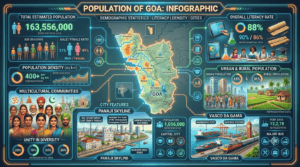
Population of Goa
Goa is the fourth least populous state in India but ranks among the country’s most developed states in terms of literacy, healthcare, quality of life, and per capita income. According to the 2011 Census, Goa had a population of 14.59 lakh (1.46 million). Recent estimates indicate that the population has grown to around 16 lakh (1.6 million) due to natural growth and migration.
Despite its small population, Goa has a highly urbanized and multicultural society. People from different parts of India and the world have settled in the state, creating a unique blend of cultures, traditions, and lifestyles. Tourism, hospitality, education, and employment opportunities continue to attract migrants to Goa.
The state has a population density of approximately 394 persons per square kilometre, with most residents living in coastal towns and urban centres such as Panaji, Margao, Vasco da Gama, Mapusa, and Ponda.
Konkani is the official language of Goa and is widely spoken across the state. Other commonly spoken languages include Marathi, Hindi, English, Kannada, and Portuguese influences in local culture and heritage.
Goa is one of India’s most literate states, with a literacy rate of approximately 88.7% according to the 2011 Census. The state has made remarkable progress in education, healthcare, digital governance, and social development, resulting in one of the highest standards of living in the country.
Goa’s diverse population, peaceful lifestyle, clean environment, and strong social infrastructure make it one of India’s most attractive places to live, work, and visit.
Population at a Glance
| Category | Details |
|---|---|
| Population (2011 Census) | 14,58,545 (14.59 Lakh) |
| Estimated Population (2025) | Around 16 Lakh |
| Population Rank | 28th in India |
| Population Density | 394 persons/sq km |
| Literacy Rate | 88.7% |
| Sex Ratio | 973 females per 1,000 males |
| Urban Population | Around 62% |
| Rural Population | Around 38% |
| Official Language | Konkani |
| Largest City | Vasco da Gama |
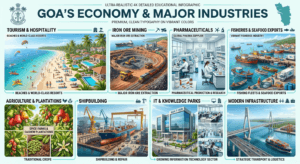
Economy & Industries of Goa
Goa has one of the strongest and most diversified economies among India’s smaller states. Despite its small geographical area, the state enjoys one of the highest per capita incomes in India, supported by tourism, mining, fisheries, manufacturing, agriculture, pharmaceuticals, shipbuilding, and information technology.
Tourism is the backbone of Goa’s economy. Every year, millions of domestic and international tourists visit the state to enjoy its beautiful beaches, UNESCO World Heritage Sites, churches, temples, waterfalls, wildlife sanctuaries, casinos, cruises, and vibrant nightlife. The tourism and hospitality sector provides employment to a large section of the population through hotels, resorts, restaurants, transport services, travel agencies, and water sports.
Goa is also known for its mining industry, particularly the extraction of iron ore, manganese ore, and bauxite. Although mining activities have faced environmental regulations in recent years, they continue to contribute to the state’s economy.
The manufacturing sector has grown steadily with industries such as pharmaceuticals, chemicals, fertilizers, food processing, beverages, electronics, shipbuilding, engineering products, and packaging. Industrial estates developed by the Goa Industrial Development Corporation (Goa-IDC) have attracted several national and international companies.
Agriculture remains important, especially in rural areas. Major crops include rice, coconut, cashew, arecanut, sugarcane, banana, pineapple, spices, and mangoes. Goa is internationally famous for cashew nuts and cashew-based Feni, a traditional alcoholic beverage with a Geographical Indication (GI) tag.
The state also has a thriving fisheries sector, with marine fishing, aquaculture, and seafood exports contributing significantly to employment and export earnings. Goa’s long Arabian Sea coastline supports one of India’s important fishing industries.
With modern infrastructure, a skilled workforce, strong tourism, expanding industries, and sustainable development initiatives, Goa continues to be one of India’s most prosperous and investment-friendly states.
Economy at a Glance
| Sector | Major Activities |
|---|---|
| Tourism | Beaches, Resorts, Cruises, Casinos & Heritage Tourism |
| Mining | Iron Ore, Manganese & Bauxite |
| Manufacturing | Pharmaceuticals, Chemicals, Food Processing & Engineering |
| Agriculture | Rice, Coconut, Cashew, Spices & Mango |
| Fisheries | Marine Fishing, Aquaculture & Seafood Exports |
| Beverage Industry | Cashew Feni & Food Processing |
| Ports | Mormugao Port |
| Industrial Areas | Verna, Ponda, Kundaim & Tuem Industrial Estates |
| Major Economic Strength | Tourism & Services |
| Per Capita Income | Among the Highest in India |
Agriculture of Goa
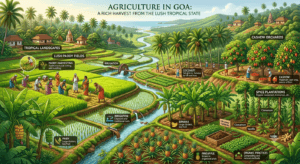
Although Goa is internationally known for its tourism industry, agriculture remains an important part of the state’s economy and rural livelihood. The fertile river valleys, abundant monsoon rainfall, and tropical climate create favourable conditions for cultivating a variety of food crops, fruits, spices, and plantation crops.
Rice is the principal food crop and is cultivated extensively in the low-lying coastal plains and river basins. It is the staple food of the people of Goa and occupies the largest share of the state’s cultivated land.
Among plantation crops, coconut is the most widely grown and plays a vital role in Goa’s agriculture and food industry. Coconut is used for cooking, oil production, beverages, handicrafts, and traditional cuisine. Cashew is another major commercial crop, and Goa is internationally famous for its high-quality cashew nuts and the traditional Goan Feni, a GI-tagged beverage made from cashew apples.
Other important crops include arecanut, sugarcane, banana, mango, pineapple, jackfruit, vegetables, pulses, and spices such as black pepper and turmeric. Goa is also home to numerous spice plantations, which have become popular tourist attractions offering guided tours and organic farming experiences.
The state government actively promotes organic farming, sustainable agriculture, drip irrigation, soil conservation, horticulture development, and farmer welfare schemes. Modern agricultural practices and scientific farming techniques are helping improve productivity while protecting Goa’s fragile ecosystem.
With its fertile soil, tropical climate, plantation crops, and eco-friendly farming practices, agriculture continues to play a significant role in preserving Goa’s rural economy, food security, and cultural traditions.
Major Agricultural Products of Goa
| Category | Major Products |
|---|---|
| Food Crops | Rice, Pulses |
| Plantation Crops | Coconut, Cashew, Arecanut |
| Fruits | Mango, Banana, Pineapple, Jackfruit |
| Spices | Black Pepper, Turmeric, Nutmeg |
| Vegetables | Brinjal, Okra, Tomato, Chilli |
| Commercial Crop | Sugarcane |
| Beverage Crop | Cashew (Feni Production) |
| Farming Type | Organic & Sustainable Farming |
| Irrigation Sources | Rivers, Wells & Rainwater |
| Major Strength | Plantation Agriculture & Horticulture |

Education in Goa
Goa has one of the best education systems in India, reflected in its high literacy rate, quality schools, renowned colleges, and modern universities. The state has consistently invested in education, making it one of the country’s leading states in human development and academic excellence.
The literacy rate of Goa is 88.7% (2011 Census), one of the highest in India. The Government of Goa has introduced several initiatives to improve access to quality education, including free education, scholarships, digital classrooms, mid-day meal programmes, skill development, and vocational training.
Goa offers education through government schools, aided institutions, private schools, international schools, colleges, technical institutes, and universities. Both English and Konkani are widely used as mediums of instruction, while Marathi is also taught in many institutions.
The state is home to Goa University, one of India’s leading public universities, offering undergraduate, postgraduate, doctoral, and research programmes in science, commerce, humanities, engineering, management, law, and marine sciences. Goa also has prestigious institutions such as the National Institute of Technology (NIT Goa), Goa Engineering College, Goa Medical College, BITS Pilani – K K Birla Goa Campus, and the Indian Institute of Technology (IIT Goa).
Technical education, hospitality management, tourism studies, information technology, pharmacy, architecture, and maritime education are growing rapidly in Goa, supporting the state’s economy and employment opportunities.
With modern infrastructure, highly qualified faculty, digital learning initiatives, and strong government support, Goa continues to produce skilled professionals who contribute to India’s growth in education, science, healthcare, tourism, engineering, and technology.
Education at a Glance
| Category | Details |
|---|---|
| Literacy Rate | 88.7% |
| State University | Goa University |
| IIT | IIT Goa |
| NIT | NIT Goa |
| Premier Private University | BITS Pilani – K K Birla Goa Campus |
| Oldest Medical College | Goa Medical College |
| Engineering College | Goa Engineering College |
| Medium of Instruction | English, Konkani & Marathi |
| Major Courses | Engineering, Medicine, Tourism, IT, Pharmacy, Management |
| Education Strength | High Literacy & Quality Higher Education |

Healthcare in Goa
Goa has one of the best healthcare systems in India, supported by a strong network of government hospitals, primary health centres (PHCs), community health centres (CHCs), private hospitals, specialty clinics, and medical colleges. The state’s high literacy rate, quality healthcare services, and effective public health programmes contribute to one of the highest standards of living in the country.
The Directorate of Health Services (DHS), Goa, oversees the state’s public healthcare system and implements various national and state health programmes. Every district has well-equipped government hospitals, while PHCs and CHCs ensure that healthcare services reach rural and remote communities.
The state’s premier healthcare institution is Goa Medical College and Hospital (GMC), Bambolim, established in 1842, making it one of Asia’s oldest medical colleges. GMC provides advanced medical treatment, medical education, research facilities, and super-speciality healthcare services.
Apart from government institutions, Goa has several reputed private hospitals, including Manipal Hospitals Goa, Healthway Hospitals, and other multi-speciality healthcare centres that offer modern diagnostic and treatment facilities.
Goa has achieved impressive progress in maternal and child healthcare, immunization, disease prevention, digital health services, emergency medical care, and public health awareness. The state also promotes telemedicine, preventive healthcare, mental health programmes, and health insurance schemes to improve access to quality healthcare.
Medical tourism is another growing sector in Goa. Many domestic and international visitors choose Goa for wellness treatments, Ayurveda, yoga retreats, rehabilitation centres, and affordable healthcare services while enjoying the state’s peaceful environment.
With experienced healthcare professionals, modern hospitals, advanced medical technology, and comprehensive public health programmes, Goa continues to rank among India’s leading states in healthcare and medical services.
Healthcare at a Glance
| Category | Details |
|---|---|
| Healthcare Authority | Directorate of Health Services (DHS), Goa |
| Premier Medical College | Goa Medical College and Hospital (GMC) |
| Established | 1842 |
| Government Hospitals | District & Sub-District Hospitals |
| Primary Healthcare | PHCs & CHCs Across the State |
| Major Private Hospitals | Manipal Hospitals Goa, Healthway Hospitals |
| Medical Tourism | Wellness, Ayurveda & Rehabilitation |
| Health Programmes | Immunization, Maternal & Child Healthcare |
| Emergency Services | 108 Ambulance Service |
| Healthcare Strength | High-quality Public & Private Healthcare |
Transport in Goa
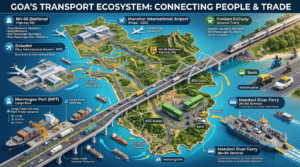
Despite being India’s smallest state, Goa has a well-developed transport network that efficiently connects its cities, towns, villages, beaches, tourist destinations, and neighbouring states. The state’s transportation system includes national highways, railways, airports, seaports, inland waterways, buses, taxis, ferries, and app-based transport services, making travel convenient for both residents and millions of tourists.
Road transport is the primary mode of travel in Goa. The Goa State Road Transport Corporation (Kadamba Transport Corporation – KTC) operates bus services connecting major cities such as Panaji, Margao, Vasco da Gama, Mapusa, Ponda, and Canacona. Private buses, taxis, motorcycle taxis (Pilots), rental scooters, and self-drive cars are also popular modes of transportation.
Goa is well connected to the rest of India through National Highway 66 (NH-66), which runs along the western coast, and National Highway 748 (NH-748), connecting Goa with Karnataka. These highways provide smooth access to Mumbai, Mangaluru, Bengaluru, and other major cities.
Rail connectivity is provided by the Konkan Railway, one of India’s most scenic railway routes. Major railway stations include Madgaon (Margao Junction), Thivim, Karmali, Vasco da Gama, and Canacona, offering direct train services to Mumbai, Delhi, Bengaluru, Chennai, Hyderabad, Kochi, and several other cities.
Goa is served by two airports. The Goa International Airport (Dabolim Airport) handles domestic and international flights, while the Manohar International Airport (Mopa Airport), inaugurated in 2022, has significantly improved the state’s air connectivity and tourism infrastructure.
The Mormugao Port is one of India’s major natural ports, handling cargo, iron ore exports, cruise ships, and maritime trade. Goa is also famous for its ferry services, which connect river islands and coastal villages across the Mandovi and Zuari rivers, providing an affordable and scenic mode of transport.
With modern highways, efficient railways, international airports, seaports, and integrated public transport, Goa offers one of the most convenient travel experiences in India.
Transport at a Glance
| Category | Details |
|---|---|
| Major Highways | NH-66, NH-748 |
| State Transport | Kadamba Transport Corporation (KTC) |
| Major Railway | Konkan Railway |
| Main Railway Stations | Madgaon, Thivim, Karmali, Vasco da Gama, Canacona |
| International Airports | Dabolim Airport & Manohar International Airport (Mopa) |
| Major Seaport | Mormugao Port |
| Ferry Services | Mandovi & Zuari River Ferries |
| Public Transport | Buses, Taxis, Motorcycle Taxis & Rental Vehicles |
| Air Connectivity | Domestic & International Flights |
| Transport Strength | Excellent Connectivity for Tourism & Trade |
Tourist Places in Goa
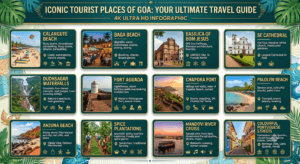
Goa is one of India’s most visited tourist destinations, attracting millions of domestic and international visitors every year. Known for its golden beaches, Portuguese architecture, historic churches, ancient temples, waterfalls, wildlife sanctuaries, forts, nightlife, casinos, and adventure sports, Goa offers unforgettable experiences for every traveller.
The state’s coastline is home to world-famous beaches such as Calangute, Baga, Candolim, Anjuna, Vagator, Colva, Palolem, Morjim, and Arambol. These beaches are popular for swimming, parasailing, jet skiing, scuba diving, dolphin watching, beach parties, and spectacular sunsets.
Goa’s rich Portuguese heritage is reflected in the historic monuments of Old Goa, a UNESCO World Heritage Site. The Basilica of Bom Jesus, housing the mortal remains of St. Francis Xavier, and the magnificent Se Cathedral are among the state’s most iconic landmarks.
Nature lovers can explore the breathtaking Dudhsagar Waterfalls, one of India’s tallest waterfalls, nestled within the lush forests of the Western Ghats. Wildlife enthusiasts can visit Mollem National Park, Bhagwan Mahavir Wildlife Sanctuary, Bondla Wildlife Sanctuary, and Cotigao Wildlife Sanctuary, which are home to diverse flora and fauna.
History enthusiasts can visit Fort Aguada, Chapora Fort, Reis Magos Fort, Cabo de Rama Fort, and Terekhol Fort, offering panoramic views of the Arabian Sea and a glimpse into Goa’s colonial past.
Goa is equally famous for its vibrant nightlife, luxury cruises, river casinos, spice plantations, flea markets, yoga retreats, wellness resorts, and authentic Goan cuisine. Whether you are seeking relaxation, adventure, spirituality, or cultural exploration, Goa offers something for every traveller throughout the year.
Top Tourist Attractions in Goa
| Tourist Place | Famous For |
|---|---|
| Calangute Beach | Largest & Most Popular Beach |
| Baga Beach | Nightlife & Water Sports |
| Palolem Beach | Scenic Beauty & Relaxation |
| Basilica of Bom Jesus | UNESCO World Heritage Site |
| Se Cathedral | Historic Portuguese Church |
| Dudhsagar Waterfalls | One of India’s Tallest Waterfalls |
| Fort Aguada | Historic Portuguese Fort |
| Chapora Fort | Arabian Sea Views & Sunset |
| Anjuna Beach | Flea Market & Beach Parties |
| Mollem National Park | Wildlife & Nature Tourism |
Wildlife & National Parks of Goa
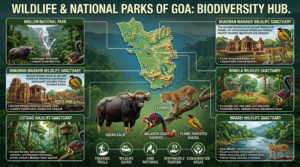
Goa is not only famous for its beaches but also for its rich biodiversity, dense forests, wildlife sanctuaries, and protected national parks. Nearly one-third of the state’s geographical area is covered by forests, most of which lie in the Western Ghats, a UNESCO World Heritage Site and one of the world’s eight “hottest” biodiversity hotspots.
The state’s only national park, Mollem National Park, is located within the Bhagwan Mahavir Wildlife Sanctuary in South Goa. Covering a vast area of evergreen forests, rivers, waterfalls, and hills, the park is home to diverse wildlife, including the Indian Gaur (State Animal), Leopard, Sloth Bear, Sambar Deer, Barking Deer, Malabar Giant Squirrel, Indian Pangolin, King Cobra, and numerous reptiles, butterflies, and bird species.
One of Goa’s most famous natural attractions, Dudhsagar Waterfalls, is located inside Bhagwan Mahavir Wildlife Sanctuary. Surrounded by lush forests and the scenic Western Ghats, it attracts thousands of nature lovers and trekkers every year.
Other important protected areas include Bondla Wildlife Sanctuary, Goa’s smallest but most popular wildlife sanctuary, known for its mini zoo, botanical garden, deer park, and educational nature trails. Cotigao Wildlife Sanctuary is famous for its towering trees, watchtowers, and peaceful trekking routes, while Mhadei Wildlife Sanctuary protects the headwaters of the Mhadei River and supports rich biodiversity. Netravali Wildlife Sanctuary is known for its evergreen forests, waterfalls, rare wildlife, and the famous Bubble Lake (Budbudyanchi Tali).
Goa is also a paradise for birdwatchers, with more than 450 species of birds recorded across its forests, wetlands, estuaries, and mangroves. Popular bird species include the Flame-throated Bulbul (State Bird), Malabar Grey Hornbill, Kingfishers, Eagles, and Paradise Flycatchers.
With its protected forests, scenic waterfalls, wildlife reserves, and eco-tourism opportunities, Goa offers one of India’s finest destinations for nature lovers, wildlife photographers, trekkers, and birdwatchers.
Wildlife at a Glance
| Category | Details |
|---|---|
| National Park | Mollem National Park |
| Largest Wildlife Sanctuary | Bhagwan Mahavir Wildlife Sanctuary |
| Other Wildlife Sanctuaries | Bondla, Cotigao, Mhadei & Netravali |
| UNESCO Region | Western Ghats |
| State Animal | Indian Gaur |
| State Bird | Flame-throated Bulbul |
| Famous Waterfall | Dudhsagar Waterfalls |
| Major Wildlife | Leopard, Sloth Bear, Sambar Deer, Malabar Giant Squirrel |
| Bird Species | More than 450 species |
| Eco-tourism Activities | Wildlife Safari, Trekking, Birdwatching & Nature Trails |
Beaches of Goa
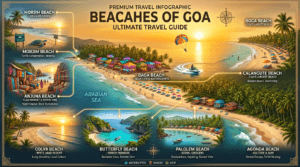
Goa is famously known as the “Beach Capital of India”, offering more than 50 stunning beaches along its 101-kilometre Arabian Sea coastline. These beaches attract millions of tourists every year with their golden sands, crystal-clear waters, swaying coconut palms, colourful beach shacks, water sports, vibrant nightlife, and breathtaking sunsets.
The beaches of Goa are broadly divided into North Goa and South Goa. North Goa is famous for its lively atmosphere, beach parties, flea markets, nightlife, water sports, and entertainment, while South Goa is known for its peaceful beaches, luxury resorts, scenic beauty, and relaxing environment.
Among the most popular beaches, Calangute Beach is often called the “Queen of Beaches” because of its long shoreline and vibrant tourist activities. Baga Beach is famous for its nightlife, beach clubs, Tito’s Lane, and thrilling water sports such as parasailing, jet skiing, and banana boat rides. Anjuna Beach attracts backpackers and international tourists with its weekly flea market, trance music culture, and rocky coastline.
For travellers seeking peace and natural beauty, Palolem Beach, Colva Beach, Agonda Beach, and Butterfly Beach offer serene surroundings, dolphin-spotting tours, kayaking, and spectacular sunsets. Morjim Beach and Galgibaga Beach are important nesting sites for the endangered Olive Ridley Sea Turtle, making them popular among nature lovers.
Adventure enthusiasts can enjoy scuba diving, snorkeling, parasailing, windsurfing, kayaking, speed boating, paddleboarding, and deep-sea fishing across many beaches. Luxury cruises, sunset cruises, dolphin cruises, beach festivals, seafood restaurants, and wellness retreats further enhance Goa’s appeal as one of India’s top coastal destinations.
With its unmatched combination of natural beauty, adventure, entertainment, and hospitality, Goa’s beaches remain among the most iconic tourist attractions in Asia.
Famous Beaches of Goa
| Beach | Famous For |
|---|---|
| Calangute Beach | Queen of Beaches, Water Sports |
| Baga Beach | Nightlife, Tito’s Lane & Parasailing |
| Anjuna Beach | Flea Market & Beach Parties |
| Vagator Beach | Scenic Cliffs & Sunset Views |
| Candolim Beach | Luxury Resorts & Relaxation |
| Colva Beach | White Sand & Family Tourism |
| Palolem Beach | Peaceful Atmosphere & Dolphin Tours |
| Agonda Beach | Tranquility & Turtle Nesting |
| Morjim Beach | Olive Ridley Turtle Habitat |
| Butterfly Beach | Hidden Cove & Scenic Beauty |
Arts & Culture of Goa
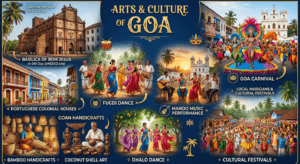
Goa is renowned for its rich cultural heritage, which reflects a unique blend of Indian and Portuguese traditions developed over centuries. The state’s art, music, dance, architecture, handicrafts, literature, and festivals create a vibrant cultural identity that attracts visitors from around the world.
Goa’s cultural diversity is visible in its Portuguese-style churches, colourful colonial houses, Hindu temples, traditional villages, and lively local markets. The influence of Portuguese rule can still be seen in the state’s architecture, cuisine, language, music, and celebrations, while traditional Konkani customs continue to preserve Goa’s Indian roots.
Music plays a central role in Goan culture. Traditional musical forms such as Mando, Dulpod, and Fugdi songs are performed during festivals, weddings, and community celebrations. Goa has also earned an international reputation for jazz, electronic dance music (EDM), and beach music festivals, making it one of India’s leading entertainment destinations.
Traditional dance forms include Fugdi, Dhalo, Dekhni, Corridinho, Kunbi Dance, and Goff Dance. These dances are performed during religious festivals, harvest celebrations, weddings, and cultural events, showcasing the state’s colourful traditions and community spirit.
Goa is equally famous for its handicrafts and folk arts. Skilled artisans produce bamboo crafts, coconut shell products, brassware, pottery, crochet work, shell crafts, wooden carvings, and traditional jewellery, which are popular among tourists and collectors.
The state also has a rich literary tradition, with Konkani literature playing an important role in preserving local history, folklore, and culture. Numerous museums, art galleries, theatres, and cultural centres continue to promote Goa’s artistic heritage.
With its unique fusion of Indian traditions and Portuguese influence, vibrant music, colourful dance forms, traditional handicrafts, and welcoming lifestyle, Goa remains one of India’s most culturally fascinating states.
Arts & Culture at a Glance
| Category | Details |
|---|---|
| Cultural Heritage | Indian & Portuguese Blend |
| Traditional Dances | Fugdi, Dhalo, Dekhni, Corridinho, Kunbi |
| Traditional Music | Mando, Dulpod, Folk Music |
| Architecture | Portuguese Colonial Style |
| Famous Handicrafts | Bamboo, Coconut Shell, Brassware, Shell Crafts |
| Traditional Dress | Kunbi Saree & Portuguese-inspired Attire |
| Folk Art | Pottery, Wood Carving & Crochet |
| Language | Konkani |
| Cultural Attractions | Museums, Churches & Heritage Villages |
| Cultural Identity | Music, Dance, Festivals & Coastal Heritage |
Festivals of Goa
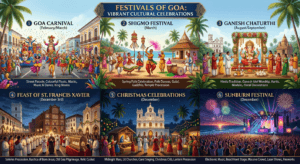
Goa is famous for its vibrant festivals, which beautifully reflect the state’s unique blend of Indian traditions and Portuguese heritage. Throughout the year, Goa celebrates a variety of religious, cultural, music, and food festivals that attract thousands of visitors from India and around the world.
One of the most iconic celebrations is the Goa Carnival, held every year before Lent. Introduced during Portuguese rule, the carnival features colourful parades, elaborate floats, music, dance performances, costumes, street entertainment, and cultural events across cities such as Panaji, Margao, Vasco da Gama, and Mapusa.
The Feast of St. Francis Xavier, celebrated every December at the Basilica of Bom Jesus in Old Goa, is one of the state’s largest Christian festivals. Thousands of pilgrims and tourists visit the basilica to pay homage to St. Francis Xavier, one of Goa’s most revered saints.
Hindu festivals are also celebrated with great devotion across the state. Shigmo is Goa’s traditional spring festival, featuring colourful processions, folk dances, traditional music, and cultural performances. Ganesh Chaturthi (Chavath) is one of the most important family festivals in Goa, marked by prayers, beautifully decorated idols, and community celebrations.
Other major festivals include Diwali, Christmas, Easter, Navratri, Janmashtami, Holi, and New Year celebrations, which transform Goa into one of India’s most festive destinations.
Goa also hosts internationally recognised cultural events such as the International Film Festival of India (IFFI), Sunburn Festival, Goa Food & Cultural Festival, Grape Escapade, and various music, seafood, and art festivals that showcase the state’s global appeal.
With its colourful traditions, religious harmony, lively music, dance, and cultural celebrations, Goa offers visitors a festive atmosphere throughout the year.
Major Festivals of Goa
| Festival | Celebrated For |
|---|---|
| Goa Carnival | Colourful Parades & Cultural Celebrations |
| Shigmo | Spring Festival & Folk Dances |
| Feast of St. Francis Xavier | Christian Pilgrimage & Religious Celebration |
| Ganesh Chaturthi (Chavath) | Major Hindu Festival |
| Christmas | Birth of Jesus Christ |
| Easter | Christian Religious Festival |
| Diwali | Festival of Lights |
| Holi | Festival of Colours |
| International Film Festival of India (IFFI) | International Cinema Festival |
| Sunburn Festival | International Electronic Dance Music Festival |
Famous Food of Goa
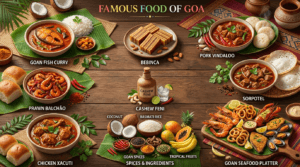
Goa is famous for its rich and flavorful cuisine, which reflects a unique blend of Konkani traditions and Portuguese culinary influences. Fresh seafood, coconut, rice, spices, kokum, vinegar, and tropical fruits are the key ingredients that make Goan food one of the most distinctive cuisines in India.
One of the state’s most iconic dishes is Goan Fish Curry, prepared with fresh fish, coconut milk, kokum, tamarind, and aromatic spices. It is traditionally served with steamed rice and is considered the staple meal of many Goan households.
Another world-famous delicacy is Prawn Balchão, a spicy and tangy prawn pickle-like curry influenced by Portuguese cooking techniques. Chicken Xacuti, made with roasted coconut, poppy seeds, and a blend of fragrant spices, is another popular traditional dish enjoyed throughout the state.
Goa is also known for Pork Vindaloo, a spicy curry introduced during Portuguese rule and now recognized as one of India’s most famous dishes. Sorpotel and Feijoada are traditional Goan-Portuguese recipes often prepared during festivals and family celebrations.
Vegetarian visitors can enjoy authentic dishes such as Khatkhate, Alsande Tonak, Mushroom Xacuti, and Tendli Bhaji, showcasing the diversity of Goan cuisine.
For desserts, Bebinca, a traditional layered Goan sweet, is the state’s signature dessert. Other popular sweets include Dodol, Serradura, Doce, and Cocada.
Goa is equally famous for its beverages. The traditional Cashew Feni and Coconut Feni, both carrying Geographical Indication (GI) status, are among the state’s most celebrated drinks. Fresh coconut water, kokum juice, and tropical fruit juices are also widely enjoyed by locals and tourists.
Whether you’re exploring beach shacks, luxury restaurants, local markets, or village homes, Goa offers a memorable culinary experience that perfectly combines tradition, flavour, and coastal freshness.
Famous Foods of Goa
| Dish | Famous For |
|---|---|
| Goan Fish Curry | Traditional State Dish |
| Prawn Balchão | Spicy Seafood Delicacy |
| Chicken Xacuti | Rich Coconut & Spice Curry |
| Pork Vindaloo | Portuguese-inspired Curry |
| Sorpotel | Traditional Festive Pork Dish |
| Bebinca | Famous Layered Goan Dessert |
| Dodol | Coconut & Jaggery Sweet |
| Khatkhate | Traditional Mixed Vegetable Curry |
| Cashew Feni | GI-tagged Traditional Beverage |
| Seafood Platter | Fresh Coastal Seafood |
Sports in Goa
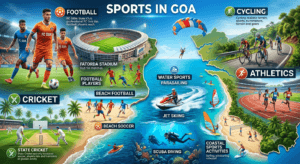
Despite being India’s smallest state, Goa has a vibrant sporting culture and has produced several outstanding athletes who have represented India at national and international levels. The state’s passion for sports is reflected in its strong participation in football, cricket, athletics, swimming, hockey, tennis, cycling, and water sports.
Football is the most popular sport in Goa and is deeply rooted in the state’s culture. Many legendary Indian footballers have emerged from Goa, and the state has contributed significantly to the growth of Indian football. Clubs such as FC Goa, Dempo SC, Churchill Brothers FC, Salgaocar FC, and Sporting Clube de Goa have achieved success in national competitions. Fatorda Stadium (Pandit Jawaharlal Nehru Stadium) in Margao is one of India’s premier football venues and regularly hosts Indian Super League (ISL) and international football matches.
Although football dominates, cricket has also gained immense popularity. The Goa Cricket Association promotes the sport across the state, while the Dr. Shyama Prasad Mukherjee Indoor Stadium and the Goa Cricket Association Academy Ground provide modern training facilities for aspiring players.
Goa’s long coastline makes it an ideal destination for water sports, including parasailing, jet skiing, kayaking, scuba diving, snorkeling, windsurfing, paddleboarding, and sailing. Adventure sports play a major role in boosting tourism and attracting sports enthusiasts from around the world.
The state has also hosted prestigious sporting events such as the National Games, international football tournaments, beach sports championships, marathons, cycling events, and triathlons. The Government of Goa actively supports sports development through modern stadiums, training centres, grassroots programmes, and youth development initiatives.
With its excellent sports infrastructure, strong football legacy, growing cricket culture, and world-class water sports facilities, Goa continues to be one of India’s leading sporting destinations.
Sports at a Glance
| Sport | Highlights |
|---|---|
| Football | Most Popular Sport in Goa |
| Major Football Club | FC Goa |
| Famous Stadium | Pandit Jawaharlal Nehru Stadium (Fatorda Stadium) |
| Cricket | Rapidly Growing Sport |
| Water Sports | Parasailing, Scuba Diving, Jet Skiing, Kayaking |
| Adventure Sports | Surfing, Windsurfing, Paddleboarding |
| Major Events | National Games, ISL Matches, Beach Sports |
| Sports Authority | Goa Football Association & Goa Cricket Association |
| Popular Outdoor Activities | Cycling, Marathon, Trekking |
| Sports Strength | Football Excellence & Coastal Adventure Sports |
Famous Personalities of Goa
Goa has produced several distinguished leaders, freedom fighters, musicians, artists, sportspersons, scientists, and writers who have made significant contributions to India and the world. Their achievements reflect Goa’s rich cultural heritage, intellectual excellence, and sporting tradition.
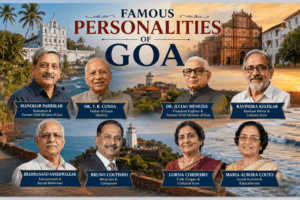
One of Goa’s most respected freedom fighters was Dr. Juliao Menezes, who played an important role in Goa’s liberation movement and inspired the struggle against Portuguese colonial rule. Another prominent leader, Dr. T. B. Cunha, is widely known as the “Father of Goan Nationalism” for his efforts in awakening political consciousness among Goans.
Goa has also made remarkable contributions to Indian politics through leaders such as Manohar Parrikar, the former Chief Minister of Goa and former Defence Minister of India. His leadership, administrative reforms, and contributions to national defence earned him widespread respect across the country.
In the field of sports, Brahmanand Sankhwalkar, one of India’s greatest football goalkeepers, and Bruno Coutinho, a former captain of the Indian football team, have brought pride to Goa through their outstanding performances. Football remains deeply rooted in Goan culture, producing many talented players for the national team.
Goa has also contributed significantly to literature, music, and the arts. Renowned Konkani writer Ravindra Kelekar received the Jnanpith Award, India’s highest literary honour, for his outstanding contribution to Konkani literature. Internationally acclaimed singer Lorna Cordeiro, often called the “Nightingale of Goa,” has played a major role in promoting Goan music.
These remarkable personalities have enriched Goa’s identity through their achievements in politics, literature, sports, social reform, music, and public service, inspiring future generations.
Famous Personalities of Goa
| Personality | Field | Contribution |
|---|---|---|
| Manohar Parrikar | Politics | Former Defence Minister of India & Chief Minister of Goa |
| Dr. T. B. Cunha | Freedom Movement | Father of Goan Nationalism |
| Dr. Juliao Menezes | Freedom Fighter | Leader of Goa Liberation Movement |
| Ravindra Kelekar | Literature | Jnanpith Award-winning Konkani Writer |
| Brahmanand Sankhwalkar | Football | Legendary Indian Goalkeeper |
| Bruno Coutinho | Football | Former Captain of the Indian Football Team |
| Lorna Cordeiro | Music | Nightingale of Goa |
| Maria Aurora Couto | Literature | Renowned Goan Writer & Scholar |
| Remo Fernandes | Music | Popular Indian Singer & Composer |
| Leander Paes* | Sports | International Tennis Legend with Goan roots |
Interesting Facts About Goa
Goa is one of India’s most unique and fascinating states, known for its golden beaches, Portuguese heritage, rich biodiversity, vibrant festivals, and relaxed coastal lifestyle. Although it is India’s smallest state by area, Goa attracts millions of tourists every year and contributes significantly to the country’s tourism industry.
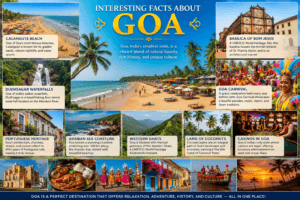
Goa was under Portuguese rule for more than 450 years, making it one of the longest-held European colonies in Asia. This unique history has left a lasting influence on the state’s architecture, cuisine, language, music, and culture. The historic churches and convents of Old Goa are recognized as a UNESCO World Heritage Site.
The state has more than 50 beautiful beaches spread across a coastline of approximately 101 kilometres. Popular beaches such as Calangute, Baga, Palolem, and Anjuna are famous for water sports, nightlife, and scenic beauty.
Goa is home to Dudhsagar Waterfalls, one of the tallest waterfalls in India, with a height of about 310 metres. The state is also part of the Western Ghats, one of the world’s richest biodiversity hotspots and a UNESCO World Heritage Site.
Goa has one of the highest literacy rates and per capita incomes in India, reflecting its strong education system, healthcare, and economic development. It is also famous for Goa Carnival, International Film Festival of India (IFFI), Sunburn Festival, and its world-renowned seafood cuisine.
From pristine beaches and wildlife sanctuaries to colonial architecture and colourful festivals, Goa offers a perfect blend of history, nature, adventure, and modern tourism, making it one of India’s most loved travel destinations.
Quick Facts About Goa
| Fact | Details |
|---|---|
| State Formation | 30 May 1987 |
| Liberation Day | 19 December 1961 |
| Capital | Panaji (Panjim) |
| Largest City | Vasco da Gama |
| Smallest State by Area | 3,702 sq km |
| Coastline | Approximately 101 km |
| UNESCO World Heritage Site | Churches and Convents of Old Goa |
| Official Language | Konkani |
| State Animal | Indian Gaur |
| State Bird | Flame-throated Bulbul |
| Famous For | Beaches, Carnival, Portuguese Heritage & Seafood |
Frequently Asked Questions (FAQs) About Goa
1. Where is Goa located?
Goa is located on the southwestern coast of India along the Arabian Sea. It shares borders with Maharashtra to the north and Karnataka to the east and south.
2. What is the capital of Goa?
Panaji (Panjim) is the capital of Goa, while Vasco da Gama is the state’s largest city.
3. When did Goa become a state?
Goa became the 25th state of India on 30 May 1987 after being a Union Territory since its liberation in 1961.
4. Which is the official language of Goa?
The official language of Goa is Konkani. Marathi, Hindi, and English are also widely spoken.
5. What is Goa famous for?
Goa is famous for its beautiful beaches, Portuguese heritage, churches, nightlife, water sports, seafood, Carnival, and tourism.
6. Which are the major rivers in Goa?
The major rivers of Goa include the Mandovi, Zuari, Terekhol, Chapora, Sal, Baga, Talpona, and Galgibaga rivers.
7. Which are the top tourist places in Goa?
Some of the most popular tourist attractions are Calangute Beach, Baga Beach, Palolem Beach, Basilica of Bom Jesus, Se Cathedral, Dudhsagar Waterfalls, Fort Aguada, Chapora Fort, and Old Goa.
8. Which are the famous churches in Goa?
The most famous churches include the Basilica of Bom Jesus, Se Cathedral, Church of Our Lady of the Immaculate Conception, Church of St. Cajetan, and Church of St. Francis of Assisi.
9. What are the major industries in Goa?
Goa’s major industries include tourism, hospitality, mining, pharmaceuticals, fisheries, agriculture, food processing, shipbuilding, manufacturing, and information technology.
10. Which crops are mainly grown in Goa?
Major crops include rice, coconut, cashew, arecanut, sugarcane, banana, mango, pineapple, vegetables, and spices.
11. What is the literacy rate of Goa?
According to the 2011 Census, Goa has a literacy rate of approximately 88.7%, making it one of India’s most literate states.
12. What is the best time to visit Goa?
The best time to visit Goa is from November to February, when the weather is pleasant and ideal for beaches, sightseeing, festivals, and water sports.
13. Which UNESCO World Heritage Site is located in Goa?
The Churches and Convents of Old Goa, including the Basilica of Bom Jesus and Se Cathedral, are recognized as a UNESCO World Heritage Site.
14. What adventure activities can you enjoy in Goa?
Visitors can enjoy parasailing, scuba diving, snorkeling, jet skiing, kayaking, banana boat rides, dolphin watching, trekking, river cruises, and camping.
15. Why should you visit Goa?
Goa offers a perfect combination of golden beaches, Portuguese heritage, wildlife, waterfalls, delicious cuisine, colourful festivals, adventure sports, and vibrant nightlife, making it one of India’s top travel destinations for families, couples, solo travellers, and adventure enthusiasts.
Conclusion
Goa is one of India’s most captivating states, offering a perfect blend of natural beauty, rich history, vibrant culture, and modern tourism. From its golden beaches and breathtaking waterfalls to its Portuguese-era churches and colourful festivals, Goa provides unforgettable experiences for visitors of all ages.
The state is home to world-famous attractions such as Calangute Beach, Baga Beach, Palolem Beach, Dudhsagar Waterfalls, Basilica of Bom Jesus, Se Cathedral, and Fort Aguada. Along with its scenic coastline, lush forests, wildlife sanctuaries, and the biodiversity-rich Western Ghats, Goa is also known for its excellent quality of life, high literacy rate, and strong tourism-driven economy.
Goa’s unique fusion of Indian traditions and Portuguese heritage is reflected in its architecture, cuisine, music, dance, festivals, and warm hospitality. Whether you are seeking adventure through water sports, relaxation on pristine beaches, spiritual experiences, wildlife exploration, or delicious seafood, Goa offers something special for everyone.
With its thriving tourism industry, rich cultural heritage, excellent infrastructure, and peaceful coastal lifestyle, Goa continues to be one of India’s most popular travel destinations and a favourite choice for domestic as well as international visitors.
Whether you are planning your next vacation, preparing for competitive exams, or exploring India’s incredible diversity, Goa truly deserves a place on your must-visit list. Its timeless charm, welcoming atmosphere, and unforgettable experiences make it one of the jewels of the Indian coastline.
Explore More State Guides on DealKart Market
Continue exploring India’s diverse states with our detailed guides covering history, geography, culture, tourism, economy, education, healthcare, agriculture, famous places, wildlife, and much more.
Indian State Guides
- Telangana Complete Guide
- https://dealkartmarket.in/telangana-complete-guide/
- Andhra Pradesh Complete Guide
- https://dealkartmarket.in/andhra-pradesh/
- Kerala Complete Guide
- https://dealkartmarket.in/kerala/
- Maharashtra Complete Guide
- https://dealkartmarket.in/maharashtra/
- Goa Complete Guide
- https://dealkartmarket.in/goa/
- Karnataka Complete Guide (Coming Soon)
- https://dealkartmarket.in/karnataka/
- Tamil Nadu Complete Guide (Coming Soon)
- https://dealkartmarket.in/tamil-nadu/
- Dr. A. P. J. Abdul Kalam Biography
- https://dealkartmarket.in/dr-apj-abdul-kalam-biography/Ratan Tata Biography
- https://dealkartmarket.in/ratan-tata-biography/
- Visit DealKart Market
- Website: https://dealkartmarket.in/
- Explore India. Learn Better. Travel Smarter. Only on DealKart Market.
References
Use these trusted and authoritative sources at the end of your Goa Complete Guide article:
Government of Goa – Official Portal
Goa Tourism – Official Website
https://www.goatourism.gov.in/
Census of India – Population & Demographic Data
Ministry of Statistics and Programme Implementation (MoSPI)
India Brand Equity Foundation (IBEF) – Goa State Profile
Ministry of Tourism, Government of India
India Meteorological Department (IMD)
National Portal of India
Forest Survey of India (FSI)
Archaeological Survey of India (ASI)
UNESCO World Heritage Centre – Churches and Convents of Goa
Reserve Bank of India (RBI) – Handbook of Statistics on Indian States