
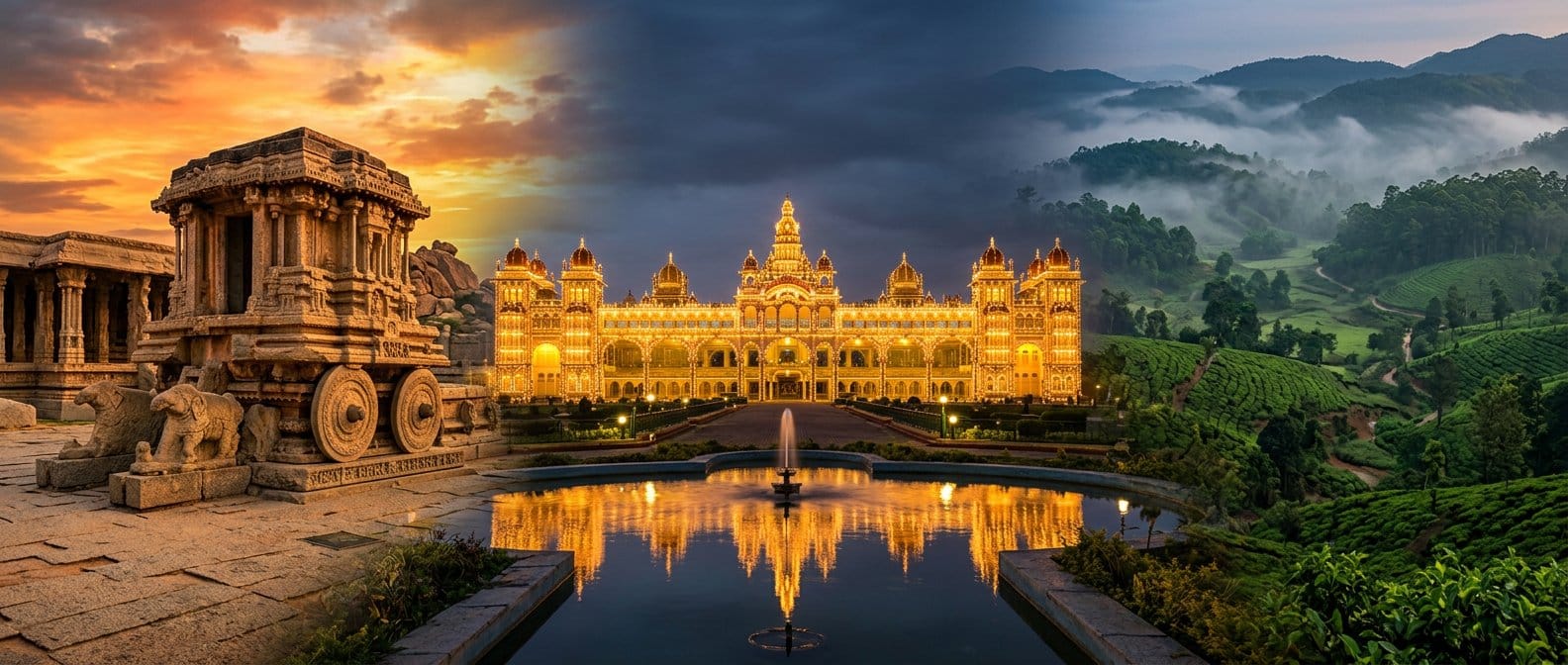
Almost 70% of India’s coffee comes from just one southern state. If you drank a cup of aromatic filter coffee this morning, chances are the beans were harvested in the misty hills of Kodagu or Chikkamagaluru.
This region manages to balance high-tech corporate parks with ancient stone temples that have stood for a thousand years.Step into Bengaluru on any weekday, and you’ll find a city buzzing with energy.
Young programmers rush to offices in Electronic City while older residents quietly enjoy their morning walks in Cubbon Park. It’s a fascinating contrast, a place where futuristic startups thrive right next to historic royal palaces.Formed on November 1, 1956, as Mysore State, the region adopted its current name in 1973.
It stretches from the pristine beaches of the Arabian Sea to the rugged peaks of the Western Ghats. Today, it stands as an economic powerhouse, contributing heavily to India’s GDP, space research, and agricultural wealth.
1. Karnataka at a Glance
| Fact | Details |
|---|---|
| State Name | Karnataka |
| Capital City | Bengaluru |
| Official Language | Kannada |
| Date of Formation | November 1, 1956 (as Mysore State) |
| Renamed as Karnataka | November 1, 1973 |
| Total Area | 191,791 sq km (6th largest in India) |
| Estimated Population | Over 70 Million |
| Literacy Rate | 75.36% (2011 Census) |
| Number of Districts | 31 |
| State Animal | Indian Elephant |
| State Bird | Indian Roller (Blue Jay) |
| State Tree | Sandalwood |
| State Flower | Lotus |
| Highest Point | Mullayanagiri (1,930 m) |
| Major Coastline | About 320 km along the Arabian Sea |
2. Mapping the State: Location & Borders
Where exactly does this southwestern giant sit on the Indian map?
- To the north, Maharashtra guards the state line, while tiny Goa hugs the coast on the northwest. If you travel east, you’ll cross into Telangana and Andhra Pradesh. Head south, and you find yourself entering Tamil Nadu and Kerala.
Finally, the entire western edge is kissed by the warm waters of the Arabian Sea. This location gives the state a massive 320-kilometer coastline, perfect for trade and sandy getaways.
3. The Administrative Network: 31 Districts
Managing a population of over 70 million requires a smart, organized setup.
To keep things running smoothly, the state is divided into 31 distinct districts. These are grouped into four administrative divisions—Bengaluru, Belagavi, Kalaburagi, and Mysuru. Each district has its own local headquarters that handle everything from law enforcement to local development.
While Bengaluru Urban represents the high-tech heart, areas like Kodagu offer quiet coffee-scented retreats. On the other hand, coastal spots like Udupi and Mangaluru keep the economy moving with busy ports and fishing industries.
4. A Journey Through Time: Key Historical Eras
Long before the software engineers arrived, ancient dynasties ruled these lands.
The earliest records point to the Kadamba dynasty of Banavasi and the Western Gangas. Soon after, the Badami Chalukyas came to power, carving spectacular temples directly out of solid rock. Later, the Rashtrakutas built an empire that became a dominant force across the Indian subcontinent.
During the medieval period, the Hoysala dynasty left behind jaw-dropping temple architecture in places like Belur and Halebidu. Then came the Vijayanagara Empire, ruling from its magnificent capital at Hampi. It grew into one of the wealthiest kingdoms of its time before eventually falling to Deccan sultanates.
In more recent centuries, the Kingdom of Mysore grabbed the spotlight under Hyder Ali and Tipu Sultan. They fought fierce battles against British colonial forces, leaving behind a legacy of resistance. Eventually, the princely state of Mysore merged with neighboring Kannada-speaking areas in 1956 to form the state we know today.
Historical Timeline of Major Milestones
| Period / Year | Major Event or Ruler | Historical Significance |
|---|---|---|
| 345 AD | Mayurasharma founds the Kadamba Dynasty | Established the first major kingdom native to the region. |
| 6th to 8th Century | Badami Chalukya rule | Carved iconic cave temples and promoted regional art. |
| 11th to 14th Century | Hoysala Dynasty | Built intricately decorated temples in Belur and Halebidu. |
| 1336 – 1646 | Rise and Fall of Vijayanagara Empire | Transformed Hampi into a global hub of wealth and culture. |
| 1761 – 1799 | Reign of Hyder Ali and Tipu Sultan | Modernized military forces and fought British colonial expansion. |
| 1956 | Reorganisation of Indian States | United major Kannada-speaking areas under Mysore State. |
| 1973 | Official renaming to Karnataka | Adopted the historic cultural identity of the Kannada people. |
5. Geography, Climate, & Rivers
The physical features of the state change dramatically as you travel from west to east.
First, you have the warm coastal plains, locally known as Karavali. Step inland and the terrain rises sharply into the Western Ghats—a mountain chain packed with thick forests and rare wildlife. Beyond these hills lie the dry, sunny plains of the Deccan Plateau, which cover the largest portion of the state.
Three main seasons dominate the local weather patterns. Summers are hot and dry, lasting from March to May. Monsoons arrive in June, dumping heavy rain on the coastal belt and the hills until September. Winters, from October to February, are pleasantly cool and dry, especially in the hill stations.
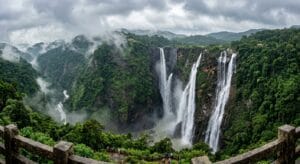
A network of rivers keeps the dry plains fertile and green. The mighty Krishna flows northward, while the Kaveri winds its way through the southern plains. Dams like the Krishna Raja Sagara (KRS) and Almatti trap these waters, providing drinking water and electricity to millions.
6. Silicon Valley & Beyond: The Economy
How did a quiet pensioners’ paradise become a global tech engine?
It started back in the 1980s when the first tech companies set up shop in Bengaluru. Today, the city is home to massive Indian IT firms like Infosys and Wipro, alongside global giants like Google and Amazon. This tech boom attracted thousands of ambitious graduates, turning the capital into a bustling startup capital.
But there is more to the economy than just writing lines of code. Industrial zones in Belagavi and Hubballi-Dharwad manufacture heavy machinery, auto parts, and aerospace components. Meanwhile, Mysore and Mangaluru contribute through traditional silk weaving, sandalwood products, and banking.
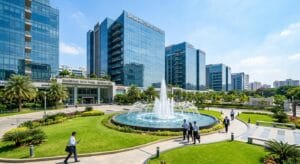
Renewable energy has also taken off in a big way. Massive solar parks dot the dry northern plains, making the state a leader in green power.
7. Agriculture & Transport
Despite the rapid urban growth, farming remains the backbone of daily life for millions of families.
Fields of ragi, paddy, and sugarcane fill the southern districts, while northern farmers grow jowar and maize. Up in the cool, moist hills of Chikkamagaluru, coffee plantation owners harvest some of the finest Arabica and Robusta beans in Asia. You’ll also find endless groves of arecanut, coconut, and cardamom scattered across the hillside farms.
Getting around the state is relatively easy thanks to a massive network of roads and rail lines. The South Western Railway operates major junctions in Hubballi and Bengaluru, connecting remote towns to big cities. For daily city commuters, Bengaluru’s Namma Metro has become a favorite way to beat the legendary traffic.
Two international airports, located in Bengaluru and Mangaluru, handle global flights. If you’re looking at heavy cargo, the New Mangalore Port handles bulk shipping, exporting coffee, iron ore, and spices to ports worldwide.
8. Education & Healthcare
The state has a long-standing reputation for producing top-tier brains and medical professionals.
Students from all over India compete to get into the Indian Institute of Science (IISc) or the Indian Institute of Management (IIM) in Bengaluru. The Visvesvaraya Technological University (VTU) in Belagavi oversees hundreds of engineering colleges, supplying skilled talent to the tech sector.
When it comes to staying healthy, residents rely on a mix of public and private medical facilities. Bengaluru has earned a name for advanced treatments, housing legendary institutes like NIMHANS for brain health. Excellent medical colleges in Manipal and Mangaluru also train thousands of doctors every year, keeping the healthcare system running.
9. Wandering Through Karnataka: Best Time to Visit & Top Hubs
If you are planning a trip, timing is everything.
The absolute best window to explore is between October and March when the weather is cool and dry. Summers can get uncomfortably hot, while monsoons might wash out your travel plans, especially near the hills.
Here are the top hubs you shouldn’t miss:
- Bengaluru: Great for dining, shopping, and green parks.
- Mysuru: Home to the spectacular Mysore Palace and rich royal traditions.
- Hampi: A massive open-air museum of stone ruins from the Vijayanagara era.
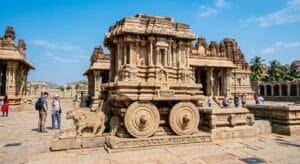
- Coorg: Perfect for relaxing in cozy cottages surrounded by misty coffee plantations.
- Gokarna: Offers quiet, laid-back beaches that feel a world away from crowded tourist spots.
11. Local Kannada Phrases for Travelers
Getting around is much easier when you know a few local words. Locals always appreciate when you try to speak their tongue, even if you make a mistake.
| Kannada Phrase | Pronunciation | English Meaning |
|---|---|---|
| ನಮಸ್ಕಾರ (Namaskara) | Na-mas-kar-a | Hello / Greetings |
| ಎಷ್ಟು? (Eshtu?) | Esh-too? | How much? |
| ಕನ್ನಡ ಗೊತ್ತಿಲ್ಲ (Kannada gothilla) | Kan-na-da go-thil-la | I don’t know Kannada |
| ಊಟ ಆಯ್ತಾ? (Oota aaytha?) | Oo-ta ay-tha? | Did you have your food? |
| ಧನ್ಯವಾದ (Dhanyavada) | Dhan-ya-va-da | Thank you |
| ಹೋಗి బర్తీನಿ (Hogi bartheeni) | Ho-gee bar-thee-nee | Goodbye (literally: I will go and return) |
12. The Shopping Checklist: What to Bring Home
Don’t leave the state empty-handed. Here is a quick guide on what to buy and where to find the authentic versions:
- Mysore Silk Sarees: Head to the government-owned KSIC showrooms in Mysuru or Bengaluru to buy genuine silk woven with pure gold zari.
- Channapatna Wooden Toys: These bright, non-toxic wooden toys are colored using natural vegetable dyes, made by local artisans in Channapatna town.
- Coorg Coffee Powder: Pick up freshly ground, aromatic dark roast coffee beans directly from local estate shops in Madikeri.
- Bidriware: Beautiful black metal handicraft inlaid with pure silver, handcrafted in Bidar district.
13. Travel Budgets: Backpacker vs. Luxury
How much does it cost to travel here? Here is a realistic daily estimate for two different travel styles.
| Budget Item | Backpacker Style (Per Day) | Luxury Style (Per Day) |
|---|---|---|
| Stay | ₹800 – ₹1,500 (Hostels or local homestays) | ₹8,000 – ₹20,000+ (Heritage palaces & luxury resorts) |
| Food | ₹300 – ₹600 (Udupi cafes & local street food) | ₹2,500 – ₹5,000 (Fine dining & estate cafes) |
| Transport | ₹200 – ₹400 (KSRTC buses & Namma Metro) | ₹2,500 – ₹5,000 (Private AC cabs) |
| Sightseeing | ₹100 – ₹300 (Public parks & temple entry) | ₹1,500 – ₹3,000 (Guided palace & wildlife tours) |
14. Culture, Food, & Festivals
The local culture is a colorful tapestry woven over centuries.
Kannada is the official tongue, but you’ll hear Urdu, Telugu, Tamil, Tulu, and Konkani as you travel across borders. If you get a chance, watch a performance of Yakshagana—a traditional folk theater combining loud music, heavy makeup, and dramatic storytelling.
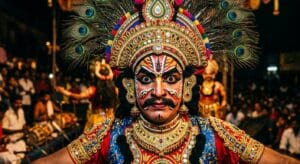
Food is another highlight, changing from region to region. In Udupi, you’ll feast on crispy masala dosas and fluffy idlis served with spicy sambar. Head to the coast for hot fish curry, or try ragi mudde (millet balls) in the southern farmlands. Don’t forget to end your meal with a piece of Mysore Pak, a rich, melt-in-your-mouth sweet made from ghee and gram flour.
When it comes to celebrations, nothing matches the grandeur of Mysuru Dasara in October. The entire city lights up, and a grand procession of decorated elephants marches through the streets to mark the victory of good over evil.
15. 10 Unknown Facts About Karnataka
- The Only National Flag Unit: The Karnataka Khadi Gramodyoga Samyukta Sangha in Hubballi is the only unit in India authorized to manufacture the official Indian national flag.
- Oldest Kannada Inscription: The Halmidi inscription, dating back to 450 AD, is the earliest written record of the Kannada language.
- World’s Longest Railway Platform: Hubballi railway station features a platform measuring a massive 1,507 meters, holding a world record.
- First Private Sector Bank: Karnataka Bank, established in Mangaluru in 1924, was one of India’s early private banking institutions.
- The Gommateshwara Statue: The 57-foot monolith of Bahubali at Shravanabelagola is one of the tallest free-standing monolithic statues in the world.
- Sanskrit-Speaking Village: Mattur, a small village near Shivamogga, is one of the very few places in India where residents still speak Sanskrit in their daily lives.
- Sandalwood Soap Soap Roots: The government soap factory in Bengaluru, established in 1916, was the first to extract and sell pure sandalwood oil commercially.
- Origin of Ragi Mudde: This healthy dish was originally the staple food of rural farmers in the southern dry plains, giving them strength to work long hours in the fields.
- The Sounding Stones of Hampi: Some pillars in the Vittala Temple at Hampi produce musical notes when tapped gently.
- The Rainiest Place: Agumbe, a small village in Shimoga, is often called the “Cherrapunji of the South” due to its intense monsoon downpours.
16. Did You Know?
Did you know that the state was almost named something else? When borders were redrawn in 1956, the new territory was simply called Mysore State. It took nearly 17 years of political debates and public demands before the name was officially changed to Karnataka on November 1, 1973, uniting all Kannada-speaking regions under one proud identity.
17. Frequently Asked Questions (FAQs)
Q: What is the official language of Karnataka?
A: Kannada is the official language and is spoken by the vast majority of the population.
Q: Why is Bengaluru famous around the world?
A: It is known as the Silicon Valley of India because it serves as the country’s main technology, startup, and software services hub.
Q: Which is the highest peak in the state?
A: Mullayanagiri, standing at 1,930 meters in the Chikkamagaluru district, is the highest point.
Q: How many UNESCO World Heritage Sites are located here?
A: The state is home to two major UNESCO sites—Hampi and Pattadakal.
Q: What is the best month to visit Coorg?
A: The winter months from October to March offer pleasant weather, ideal for exploring the coffee plantations.
18. Balanced Closing Opinion
Karnataka manages to pull off a difficult trick. It embraces the future with open arms through tech parks and modern startups, yet it holds tight to its ancient roots, local art, and quiet village life. This constant balance between tomorrow’s innovation and yesterday’s heritage makes it a truly fascinating corner of India to explore, live, and work in.
Verified References & Resources
All statistical, geographical, and historical data in this guide has been verified using official Indian government portals and trusted national databases:
- Official Portal of Government of Karnataka
- Karnataka Tourism Official Website
- Karnataka State Tourism Development Corporation (KSTDC)
- Census of India (Demographics Database)
- Ministry of Statistics and Programme Implementation (MoSPI)
- India Brand Equity Foundation (IBEF) – Karnataka State Report
- Incredible India Official Tourism Portal
- India Meteorological Department (IMD) Climate Data
- Forest Survey of India (FSI) Reports
- Reserve Bank of India (RBI) Handbook of Statistics
- Wikipedia – Karnataka State Historical Records