
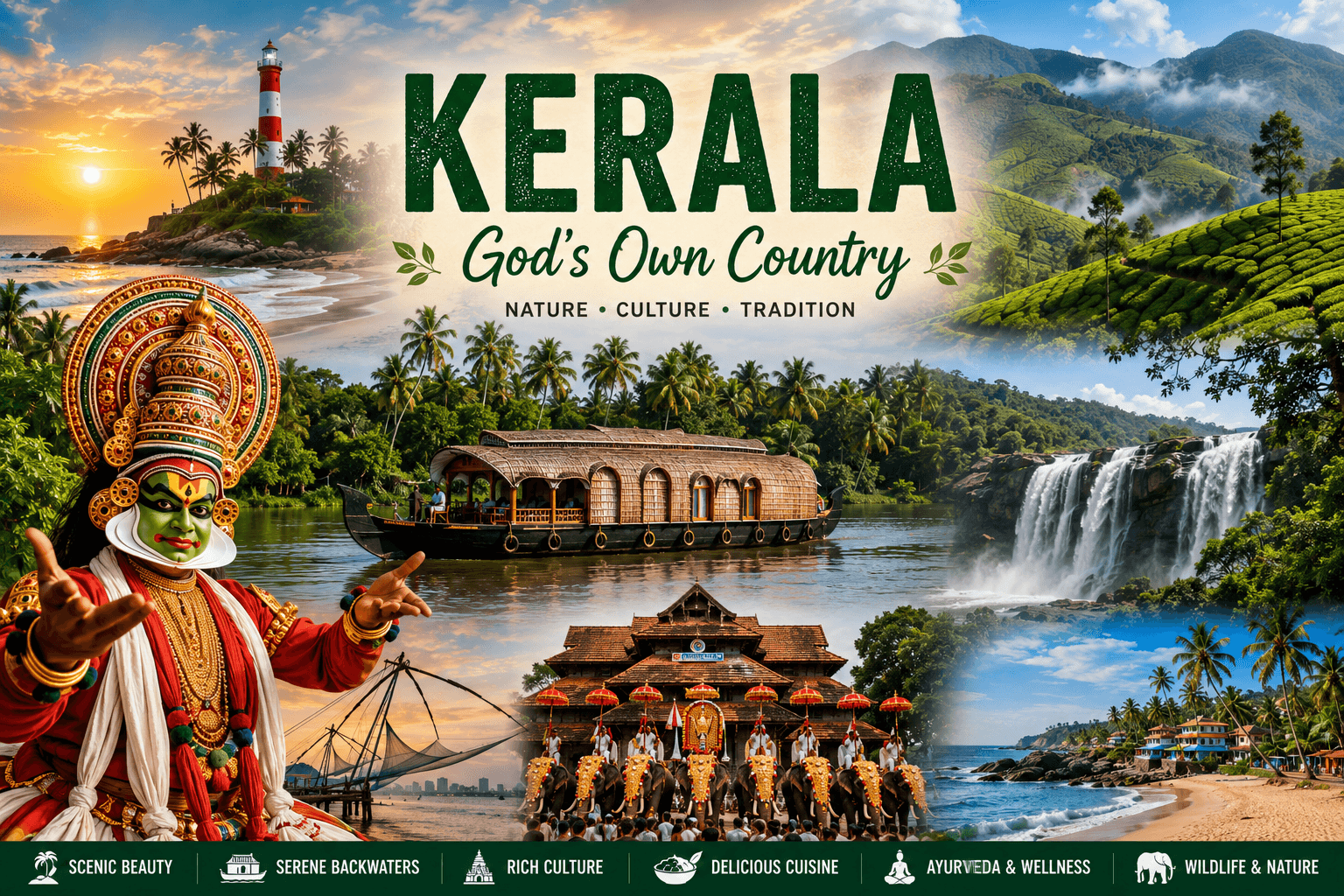
Imagine a strip of land so narrow that you can drive from the Arabian Sea to the Western Ghats in under two hours — yet that tiny stretch holds more biodiversity than most European countries combined. That’s Kerala for you.
Kerala at a Glance
| Category | Details |
|---|---|
| Official Name | Kerala |
| Nickname | God’s Own Country |
| Capital | Thiruvananthapuram (Trivandrum) |
| Largest Urban Area | Kochi (Cochin) |
| Formation Day | 1 November 1956 |
| Area | 38,863 sq km (21st largest in India) |
| Population (2011 Census) | 3.34 crore (33.4 million) |
| Estimated Population (2026) | ~3.6 crore |
| Official Language | Malayalam |
| Literacy Rate | 93.91% — highest among Indian states (2011 Census) |
| Sex Ratio | 1,084 females per 1,000 males |
| HDI | 0.758 — among the highest in India |
| Number of Districts | 14 |
| Coastline | ~580 km |
| Highest Peak | Anamudi — 2,695 m |
| State Animal | Indian Elephant |
| State Bird | Great Indian Hornbill |
| State Flower | Golden Shower (Kanikonna) |
| State Tree | Coconut Palm |
| State Sport | Kalaripayattu |
| Chief Minister (2026) | V.D. Satheesan (since May 2026) |
| Governor (2026) | Rajendra Arlekar (since January 2025) |
| High Court | Kerala High Court, Ernakulam |
Where Is Kerala?
Tucked along India’s southwestern edge, Kerala sits between the Lakshadweep Sea and the Western Ghats. Karnataka borders it to the north, Tamil Nadu wraps around the east and south, and the Arabian Sea stretches out to the west.
The state runs roughly between 8°18′N and 12°48′N latitude — putting it squarely in the tropics. That single geographic fact explains a lot: the humidity, the coconut palms everywhere, the two-monsoon pattern, and why it never really gets cold.
Here’s what makes Kerala’s location special. The Western Ghats — a UNESCO World Heritage Site older than the Himalayas — form a natural wall along the eastern border. These mountains trap monsoon winds, which is why Kerala gets drenched while the Tamil Nadu side stays relatively dry.
The coast, meanwhile, has shaped Kerala’s identity for millennia. Spices, traders, colonizers, religions — everything arrived by sea.
History of Kerala
The Ancient Spice Routes
Long before Europeans drew maps, Kerala was already a trading hub. Sumerian records from around 3000 BCE mention a land called “Meluhha” that exported pepper. Roman writers like Pliny the Elder complained about how much gold Rome was spending on Malabar pepper — he reportedly called it “black gold.”
The Chera Dynasty ruled most of Kerala during the Sangam period (roughly 300 BCE to 300 CE). Their port at Muziris — near modern-day Kodungallur — was one of the busiest in the ancient world. Ships from Rome, Arabia, Greece, and China all docked there, picking up pepper, cardamom, cinnamon, ivory, and teak.
You can still see remnants of this era. The Pattanam archaeological site, excavated since 2007, turned up Roman amphorae, Chinese pottery, and semi-precious stones — proof that Muziris wasn’t a myth.
Arrival of Foreign Powers
Three major religions arrived in Kerala through trade routes — and all three found welcoming shores:
- Christianity: St. Thomas the Apostle is believed to have landed at Muziris in 52 CE. Whether you accept that tradition or not, Kerala’s Syrian Christian community is undeniably one of the oldest Christian communities in the world.
- Islam: Arab traders brought Islam to Kerala’s coast around the 7th century CE. The Cheraman Juma Mosque in Kodungallur claims to be India’s oldest mosque, with origins traced to 629 CE.
- Judaism: A Jewish community existed in Kochi for nearly two thousand years. The Paradesi Synagogue (built 1568) in Mattancherry still stands, though most of the community emigrated to Israel after 1948.
That’s three world religions, coexisting for centuries in a single state — something worth pausing to think about.
The Colonial Period
Vasco da Gama landed at Kappad Beach near Kozhikode on May 20, 1498. That single event reshaped Kerala’s destiny for the next four and a half centuries.
The Portuguese came first, then the Dutch pushed them out in the 1600s, and finally the British took control through a mix of treaties and wars. Meanwhile, the kingdom of Travancore in southern Kerala managed to stay largely independent — and under rulers like Marthanda Varma, it even defeated the Dutch at the Battle of Colachel in 1741. (That’s one of the rare instances of an Asian army defeating a European colonial power in open battle.)
Modern Kerala — Formation in 1956
After independence — read about India’s First Independence Day here — the region was split between the princely states of Travancore and Cochin and the British-administered Malabar district. On November 1, 1956, the States Reorganisation Act merged all Malayalam-speaking areas into a single state — Kerala.
The first elected government, led by E.M.S. Namboodiripad in 1957, made history as one of the world’s first democratically elected communist governments. That political streak — progressive, reformist, sometimes chaotic — still defines Kerala today.
Kerala History Timeline
| Period | Event |
|---|---|
| ~3000 BCE | Spice trade with Mesopotamia |
| 300 BCE – 300 CE | Chera Dynasty, Sangam Age |
| 52 CE | St. Thomas arrives at Muziris (traditional date) |
| 7th Century CE | Islam arrives via Arab traders |
| 1498 | Vasco da Gama lands at Kappad |
| 1510–1663 | Portuguese dominance on the coast |
| 1663–1795 | Dutch control of key ports |
| 1741 | Battle of Colachel — Travancore defeats the Dutch |
| 1795–1947 | British influence and indirect rule |
| 15 August 1947 | Indian Independence |
| 1 November 1956 | Kerala state formed |
| 1957 | First elected communist government (EMS Namboodiripad) |
| 1991 | Kerala declared fully literate — first state in India (April 18, 1991) |
Geography & Climate
Kerala’s terrain splits neatly into three zones:
The Highlands — The eastern belt where the Western Ghats rise sharply. Tea and coffee plantations cover the slopes. Munnar, Wayanad, and Thekkady sit here. Anamudi, at 2,695 metres, is the highest point in South India.
The Midlands — Rolling hills and valleys. This is where most of Kerala’s population lives, where paddy fields stretch between clusters of coconut palms, and where rubber, banana, and tapioca plantations thrive.
The Coastal Lowlands — A narrow strip along the Arabian Sea. Fishing villages, backwater networks, and famous beaches line this zone. The backwaters — especially around Alappuzha, Kumarakom, and Kollam — are interconnected lagoons, lakes, and canals that stretch for hundreds of kilometres.
Rivers
Kerala has 44 rivers, most of them short and monsoon-fed. The longest is the Periyar (244 km), followed by the Bharathapuzha (209 km) and the Pamba (176 km). None are navigable for large distances, but they’re lifelines for irrigation, drinking water, and hydroelectric power.
Climate
Kerala has a tropical climate with three distinct seasons:
| Season | Months | Temperature | Notes |
|---|---|---|---|
| Summer | March – May | 28°C – 36°C | Hot and humid |
| SW Monsoon (Edavappathy) | June – September | 24°C – 30°C | Heavy rainfall — ~60% of annual rain |
| NE Monsoon (Thulavarsham) | October – November | 24°C – 30°C | Secondary rainfall |
| Winter | December – February | 20°C – 28°C | Pleasant, dry — peak tourist season |
Annual rainfall averages around 3,000 mm, though some parts of Idukki and Wayanad receive over 5,000 mm. The village of Lakkidi in Wayanad is one of India’s wettest places.
14 Districts of Kerala
Kerala’s 14 districts each have their own character. Here’s a quick breakdown:
| District | Headquarters | Known For |
|---|---|---|
| Thiruvananthapuram | Thiruvananthapuram | Capital city, Padmanabhaswamy Temple, Kovalam Beach, IT hub (Technopark) |
| Kollam | Kollam | Cashew capital, Ashtamudi Lake, Munroe Island |
| Pathanamthitta | Pathanamthitta | Sabarimala Temple, Aranmula Kannadi (metal mirrors) |
| Alappuzha | Alappuzha | Backwaters, houseboats, Nehru Trophy Boat Race |
| Kottayam | Kottayam | First town in India to achieve 100% literacy, Kumarakom |
| Idukki | Painavu | Munnar tea gardens, Anamudi, Idukki Dam, wildlife |
| Ernakulam | Kochi | Commercial capital, Fort Kochi, Marine Drive, IT corridor |
| Thrissur | Thrissur | Thrissur Pooram festival, cultural capital of Kerala |
| Palakkad | Palakkad | Palakkad Gap, paddy fields, Nelliyampathy hills |
| Malappuram | Malappuram | Teak Museum, Kottakkal Arya Vaidya Sala |
| Kozhikode | Kozhikode | Historical spice trade port, Kappad Beach, biryani |
| Wayanad | Kalpetta | Edakkal Caves, wildlife sanctuary, coffee plantations |
| Kannur | Kannur | Theyyam performances, handloom, Muzhappilangad Drive-in Beach |
| Kasaragod | Kasaragod | Bekal Fort, northernmost district, Malik Dinar Mosque |
Government & Administration
Kerala operates as a parliamentary democracy with a unicameral legislature — the Kerala Legislative Assembly (Niyamasabha) in Thiruvananthapuram. The state sends 20 members to the Lok Sabha and 9 to the Rajya Sabha.
The political scene is dominated by two coalitions:
- UDF (United Democratic Front) — Led by the Indian National Congress, currently in power since May 2026 after winning 102 of 140 assembly seats
- LDF (Left Democratic Front) — Led by CPI(M), governed the state for a decade from 2016 to 2026
Kerala’s voters have a long-standing tradition of alternating between the two fronts every election cycle — a pattern so consistent that political analysts call it “Kerala’s pendulum.” The 2026 election broke that streak slightly: the UDF’s landslide under V.D. Satheesan ended ten years of LDF rule.
The state’s 14 districts are further divided into 78 taluks and 1,200+ local self-governing bodies, including panchayats, municipalities, and corporations.
Population & Demographics
Kerala’s demographics are unusual — not just for India, but globally.
The 2011 Census recorded a population of 3.34 crore. By 2026, estimates put it around 3.6 crore. But the raw numbers aren’t the story. The story is in the indicators:
| Indicator | Kerala | India Average |
|---|---|---|
| Literacy Rate | 93.91% (2011 Census) | 74.04% |
| Sex Ratio | 1,084 : 1,000 | 943 : 1,000 |
| Life Expectancy | ~76 years | ~70 years |
| Infant Mortality Rate | 5 per 1,000 (SRS 2024) | ~25 per 1,000 |
| Fertility Rate | ~1.2 (SRS 2024) | ~1.9 |
| Urbanisation | 47.7% | 34.2% |
The sex ratio is particularly striking. Kerala is the only Indian state where women outnumber men — a result of better healthcare, higher female literacy, and historically matrilineal traditions among communities like the Nairs and Mappilas.
Language
Malayalam is the official and most-spoken language. It’s a Dravidian language closely related to Tamil, with its own script and a literary tradition going back to the 12th century. English is used extensively in education, business, and government. Tamil, Hindi, Konkani, and Tulu are also spoken in specific communities.
Religion (2011 Census)
| Religion | Percentage |
|---|---|
| Hinduism | 54.73% |
| Islam | 26.56% |
| Christianity | 18.38% |
| Others | 0.33% |
Economy & Industries
Kerala’s economy is a paradox. On paper, its GDP isn’t the highest — it ranks around 11th among Indian states. But per capita income tells a different story: at approximately ₹1,90,149 (2024-25, at constant prices), Kerala consistently sits in the top tier.
Where the Money Comes From
Remittances — This is Kerala’s economic backbone. An estimated 2.5 million Keralites work abroad, mostly in the Gulf countries (UAE, Saudi Arabia, Qatar, Kuwait, Oman), with growing numbers in the US, UK, Canada, and Australia. Their remittances crossed ₹2 lakh crore in 2024-25 (approximately $24 billion), accounting for nearly a third of the state’s GDP. Kerala receives about 19.7% of all foreign remittances to India — the largest share among states. That’s a staggering dependency, and also a significant economic engine.
Tourism — Over 20 million domestic and international tourists visit Kerala each year. Houseboat stays in Alappuzha, Ayurvedic retreats in Kottayam, wildlife safaris in Thekkady, and beach holidays in Kovalam and Varkala drive a massive hospitality industry.
IT & Knowledge Economy — Kochi’s Infopark and Thiruvananthapuram’s Technopark together host over 500 companies and employ more than 70,000 professionals. The Kerala Startup Mission has nurtured over 5,000 registered startups since its inception.
Manufacturing — Cochin Shipyard, one of India’s largest shipbuilding facilities, operates in Kochi. FACT (Fertilizers and Chemicals Travancore) and KELTRON (Kerala State Electronics Development Corporation) are other major industrial players.
Spice Trade — Kerala still produces a significant share of India’s black pepper, cardamom, and cinnamon. The India Pepper & Spice Trade Association is headquartered in Kochi.
Kerala’s GDP Breakdown (Approximate)
| Sector | Share |
|---|---|
| Services | ~63% |
| Industry | ~20% |
| Agriculture | ~17% |
Agriculture & Plantations
Despite agriculture’s shrinking share of GDP, it remains central to Kerala’s identity.
Key crops:
- Coconut — Kerala literally means “Land of Coconuts” (Kera = coconut, Alam = land). The state produces around 5.5 billion coconuts annually.
- Rubber — Kerala accounts for over 75% of India’s natural rubber production. Kottayam and Pathanamthitta are the main growing areas.
- Tea — Munnar in Idukki district has some of the world’s highest tea estates, sitting at 1,500–2,000 metres above sea level.
- Coffee — Wayanad and the eastern hills of Idukki grow both Arabica and Robusta.
- Spices — Black pepper, cardamom, cinnamon, cloves, nutmeg, and ginger. The Cardamom Hills in Idukki are among the world’s premier cardamom-growing regions.
- Rice (Paddy) — Palakkad, known as Kerala’s “rice bowl,” has vast paddy fields — though urbanization has reduced acreage significantly.
- Tapioca — A staple food in many Keralite households, especially with fish curry.
The Decline of Agriculture
Here’s a worrying trend: Kerala’s cultivated area under paddy has dropped from over 8 lakh hectares in the 1970s to less than 2 lakh hectares today. Labour costs are high (Kerala has India’s highest daily agricultural wages), and many farmers have switched to rubber, coconut, or simply sold land for real estate.
Education & Healthcare
Education
Kerala declared total literacy in 1991 — the first state in India to do so. The literacy movement, led by the Kerala Sastra Sahitya Parishad (KSSP) and the state government, involved hundreds of thousands of volunteers who went door-to-door teaching adults to read and write. Today, estimates put Kerala’s literacy rate at around 96%, though the last official Census (2011) recorded 93.91%.
Today, the state has:
- Over 12,000 schools (government, aided, and private)
- 14 universities, including the University of Kerala, Mahatma Gandhi University, Calicut University, and Kannur University
- Cochin University of Science and Technology (CUSAT) — a top-ranked institution for engineering and applied sciences
- IISER Thiruvananthapuram — one of India’s premier science research institutes
- NIT Calicut — a nationally ranked engineering institute
- IIM Kozhikode — consistently ranked among India’s top 5 business schools
Healthcare
Kerala’s health indicators rival those of developed nations. The state has a dense network of government hospitals, primary health centres, and private super-specialty hospitals.
- Life expectancy: ~76 years (vs. India’s average of ~70)
- Institutional delivery rate: over 99% — almost every birth happens in a hospital
- Kerala was the first Indian state to achieve the UN’s Millennium Development Goals on maternal and child health
Ayurveda — the ancient Indian system of medicine — thrives here. The Arya Vaidya Sala in Kottakkal (founded 1902 by Vaidyaratnam P.S. Varier) is one of the world’s most respected Ayurvedic institutions. Tourists from Europe, the Middle East, and Southeast Asia come specifically for Ayurvedic treatments and wellness retreats.
Transport & Connectivity
Airports
Kerala has four international airports — more than any other Indian state:
| Airport | IATA Code | Location |
|---|---|---|
| Cochin International Airport | COK | Nedumbassery, Ernakulam |
| Trivandrum International Airport | TRV | Thiruvananthapuram |
| Calicut International Airport | CCJ | Karipur, Malappuram |
| Kannur International Airport | CNN | Mattannur, Kannur |
Cochin International Airport deserves a special mention: it became the world’s first fully solar-powered airport in 2015. Over 46,000 solar panels generate more electricity than the airport consumes, and the surplus goes into the state grid.
Railways
Kerala’s rail network falls under the Southern Railway zone. The state has about 1,050 km of rail track, with major stations at Thiruvananthapuram Central, Ernakulam Junction, Kozhikode, and Thrissur. The Konkan Railway connects northern Kerala (Kasaragod, Kannur) to Mumbai via the scenic western coast.
Roads
Kerala has one of India’s highest road densities — roughly 540 km of road per 100 sq km of area. National Highway 66 (formerly NH-17) runs along the entire coast from Kasaragod to Thiruvananthapuram and beyond to Tamil Nadu. The state transport corporation (KSRTC) and private operators run extensive bus services.
Waterways
The Kerala State Water Transport Department operates ferry services across the backwaters — a cheap, scenic, and practical way to travel between villages. The National Waterway 3 (Kollam-Kottapuram stretch, 205 km) is used for both cargo and tourism.
Tourism in Kerala
Kerala’s tourism brand — “God’s Own Country” — was launched in the 1990s and became one of India’s most successful marketing campaigns. The state consistently appears on global lists: National Geographic Traveller called it one of “50 destinations of a lifetime,” and Time magazine featured it among Asia’s best.
Major Tourism Circuits
Backwaters — Alappuzha (Alleppey) is the houseboat capital. Traditional kettuvallams — rice barges converted into floating cottages — cruise through interconnected lagoons, lakes, and canals. Kumarakom, on the banks of Vembanad Lake, offers luxury resorts and bird-watching.
Hill Stations — Munnar’s tea plantations are the most famous, but Wayanad offers denser forests, caves, and tribal heritage. Ponmudi near Thiruvananthapuram is a quieter, less commercialised option.
Beaches — Kovalam (near the capital) is the most developed. Varkala has dramatic red cliffs dropping into the sea. Bekal in Kasaragod has an enormous 17th-century fort overlooking the shore. Marari Beach near Alappuzha is quieter and less touristy.
Wildlife — Periyar Tiger Reserve in Thekkady is the flagship. Eravikulam National Park near Munnar protects the endangered Nilgiri Tahr. Wayanad Wildlife Sanctuary is part of the Nilgiri Biosphere Reserve.
Ayurvedic Wellness — Kottakkal, Kalady, and dozens of resorts across the state offer traditional Ayurvedic treatments ranging from a few days to multi-week Panchakarma programmes.
Tourism Numbers
| Year | Domestic Tourists | Foreign Tourists | Total |
|---|---|---|---|
| 2019 | 1.84 crore | 11.9 lakh | 1.96 crore |
| 2022 | 1.89 crore | 3.46 lakh | 1.92 crore |
| 2023 | 2.19 crore | 6.49 lakh | 2.25 crore |
| 2024 | 2.22 crore | 7.38 lakh | 2.30 crore |
Tourism revenue in 2023-24 crossed ₹40,000 crore, making it one of the state’s largest single-sector contributors.
Best Time to Visit
Here’s my honest recommendation based on the season:
| Season | Months | Best For | Verdict |
|---|---|---|---|
| Winter | October – February | Sightseeing, backwaters, beaches, houseboats, wildlife | ⭐ Best time overall |
| Summer | March – May | Hill stations (Munnar, Wayanad, Ponmudi) | Good for escaping the heat |
| Monsoon | June – September | Ayurvedic treatments, lush greenery, fewer crowds | Magical if you don’t mind rain |
Month-by-Month Quick Guide
- October–November: Post-monsoon greenery, pleasant weather, Onam aftermath celebrations
- December–January: Peak tourist season, coolest temperatures, Cochin Carnival in Fort Kochi
- February: Thrissur Pooram preparations begin, still comfortable
- March–April: Hot and humid on the coast — head to the hills
- May: Hottest month; school holidays mean domestic tourist rush at hill stations
- June–August: Monsoon magic. Lower hotel rates, dramatic waterfalls, lush Western Ghats
- September: Rain eases, Onam festival falls around August/September, greenery at its peak
Culture, Arts & Festivals
Classical & Folk Arts
Kathakali — A 500-year-old classical dance-drama where performers wear elaborate costumes and painted faces. A single performance can last all night, telling stories from the Mahabharata or Ramayana through precise hand gestures (mudras) and facial expressions.
Mohiniyattam — A graceful, solo classical dance performed by women. The name means “Dance of the Enchantress.” It was revived in the early 20th century after nearly dying out.
Theyyam — A ritualistic folk art from northern Kerala (Kannur, Kasaragod). Performers — always from specific communities — transform into deities through elaborate costumes, face painting, and trance-like dancing. Villagers believe the Theyyam is the god, not just a representation. Some performances run from sunset to sunrise. I’ve watched one, and it genuinely changes how you think about performance and spirituality.
Kalaripayattu — Often called the “mother of all martial arts.” Originating in Kerala over 3,000 years ago, it involves strikes, kicks, grappling, weaponry, and knowledge of vital body points (marmam). Some historians believe it influenced martial arts traditions across Southeast Asia.
Koodiyattam — A Sanskrit theatre tradition, possibly over 2,000 years old, proclaimed by UNESCO as a Masterpiece of the Oral and Intangible Heritage of Humanity in 2001.
Major Festivals
| Festival | When | What |
|---|---|---|
| Onam | August/September | Harvest festival — 10 days of flower arrangements, boat races, feasts (sadya) |
| Thrissur Pooram | April/May | “Festival of festivals” — elephant procession, percussion, fireworks |
| Vishu | April 14/15 | Malayalam New Year — Vishukkani (auspicious arrangement) |
| Christmas | December 25 | Celebrated across the state, especially in central Kerala |
| Ramadan & Eid | Lunar calendar | Major celebrations in Malabar region |
| Navaratri/Dussehra | September/October | Saraswati Puja, Vidhyarambham |
| Cochin Carnival | Last week of December | Parades, music, New Year’s Eve “Pappanji” burning in Fort Kochi |
Onam 2026 — Complete Guide
Onam is Kerala’s biggest festival, and in 2026, Thiruvonam — the most important day — falls on August 26.
The Story Behind Onam
Onam celebrates the mythical King Mahabali, a just and beloved ruler who was pushed to the underworld by Vamana (an avatar of Lord Vishnu). Legend says Mahabali is allowed to visit his people once a year during Onam — and Keralites go all out to welcome him.
Onam 2026 — Key Dates
| Day | Date (2026) | Name |
|---|---|---|
| Day 1 | August 16 | Atham |
| Day 2 | August 17 | Chithira |
| Day 3 | August 18 | Chodhi |
| Day 4 | August 19 | Vishakam |
| Day 5 | August 20 | Anizham |
| Day 6 | August 21 | Thriketa |
| Day 7 | August 22 | Moolam |
| Day 8 | August 23 | Pooradam |
| Day 9 | August 25 | Uthradom |
| Day 10 | August 26 | Thiruvonam |
Note: Dates may vary slightly depending on regional panchangam (almanac) calculations.
How Keralites Celebrate
- Pookalam — Intricate flower arrangements on the floor, growing larger each day from Atham to Thiruvonam
- Onasadya — A grand vegetarian feast served on a banana leaf, with 26+ dishes including sambar, avial, olan, payasam, and banana chips
- Vallamkali (Snake Boat Race) — The Nehru Trophy Boat Race on Punnamada Lake in Alappuzha is the most famous, held on August 22, 2026
- Onakkodi — New clothes gifted to family members
- Pulikali — Tiger dance in Thrissur — performers paint themselves as tigers and dance through the streets
- Thiruvathira — A traditional dance performed by women around a lit lamp
Onam 2026 Travel Tips
If you’re planning to visit Kerala during Onam:
- Book accommodation early — Hotels in Alappuzha, Kochi, and Thrissur fill up weeks in advance
- The Nehru Trophy Boat Race is on August 22, 2026 (Saturday) at Punnamada Lake, Alappuzha — the 72nd edition of this iconic race
- Onasadya experience — Many restaurants across Kerala serve traditional Onam sadya during the festival week
- Government holidays — State offices and many businesses close for several days around Thiruvonam
- Aranmula Boat Race follows on August 30, 2026 — another major Vallamkali event
Kerala Cuisine
Kerala’s food is a story of its geography — coconut grows everywhere, so it goes into almost everything. The long coastline means fish is a daily staple. The spice hills mean freshly ground pepper, cardamom, and cinnamon aren’t luxuries — they’re everyday ingredients.
Must-Try Dishes
| Dish | What It Is |
|---|---|
| Appam with Stew | Lacy, fermented rice pancakes with a coconut-milk-based vegetable or chicken stew |
| Puttu and Kadala Curry | Steamed rice cylinders with spiced black chickpea curry — a classic breakfast |
| Karimeen Pollichathu | Pearl spot fish marinated in spices, wrapped in a banana leaf, and slow-grilled |
| Malabar Biryani | Fragrant rice layered with meat, fried onions, and spices — Kozhikode and Thalassery versions are legendary |
| Kerala Prawn Curry | Prawns in a tangy coconut and kudampuli (Malabar tamarind) gravy |
| Avial | Mixed vegetables in a coconut-yogurt sauce — an Onasadya essential |
| Banana Chips (Nendran Chips) | Thinly sliced raw banana, deep-fried in coconut oil — addictive |
| Payasam | Sweet dessert made with vermicelli, rice, or lentils, cooked in milk/jaggery |
| Beef Fry (Erachi Olathiyathu) | Slow-fried beef with spices, curry leaves, and coconut slivers — a Malabar speciality |
| Parotta with Beef Curry | Layered flatbread with spicy beef curry — Kerala’s unofficial street food combo |
A word about toddy (kallu) — freshly tapped palm wine, served at toddy shops across the state, usually paired with spicy fish curry and tapioca. It’s an acquired taste, but a genuinely local experience.
Temples, Churches & Mosques
Kerala’s religious architecture reflects its plural history.
Major Temples
- Padmanabhaswamy Temple, Thiruvananthapuram — One of the world’s wealthiest temples. In 2011, vaults were opened revealing gold, diamonds, and jewels estimated to be worth over ₹1 lakh crore. The temple is dedicated to Lord Vishnu in a reclining posture on the serpent Ananta.
- Sabarimala Temple, Pathanamthitta — One of the world’s largest pilgrimage sites, receiving an estimated 40–50 million devotees annually during the Mandala-Makaravilakku season (November–January). Dedicated to Lord Ayyappa.
- Guruvayur Temple, Thrissur — Dedicated to Lord Krishna (Guruvayurappan), one of the most important Vaishnava temples in South India.
- Vadakunnathan Temple, Thrissur — An ancient Shiva temple and the venue of the famous Thrissur Pooram festival. It received the UNESCO Asia-Pacific Award for Cultural Heritage Conservation for its restoration work.
Historic Churches
- Basilica of Our Lady of Dolours, Thrissur — The tallest church in India, with its Bible Tower (bell tower) reaching 260 feet (79 metres) — one of the tallest church towers in Asia
- St. Francis Church, Fort Kochi — One of the oldest European churches in India (built 1503). Vasco da Gama was originally buried here.
- Santa Cruz Cathedral Basilica, Fort Kochi — Built by the Portuguese in 1505, rebuilt and consecrated in 1905 — one of India’s 39 minor basilicas
Notable Mosques
- Cheraman Juma Mosque, Kodungallur — Believed to be India’s oldest mosque (629 CE)
- Malik Dinar Mosque, Kasaragod — Built by the Arab missionary Malik Dinar
- Mishkal Mosque, Kozhikode — A 14th-century wooden mosque without a dome or minaret
Famous Personalities from Kerala
| Name | Field | Notable Achievement |
|---|---|---|
| Raja Ravi Varma | Art | Father of modern Indian painting |
| M.T. Vasudevan Nair | Literature/Film | Jnanpith Award winner, legendary screenwriter |
| Adoor Gopalakrishnan | Cinema | Dadasaheb Phalke Award winner |
| K.J. Yesudas | Music | “Gana Gandharvan” — sang over 50,000 songs |
| P.T. Usha | Athletics | “Payyoli Express” — India’s greatest female track athlete, IOA President |
| Sanju Samson | Cricket | Indian wicketkeeper-batsman, Rajasthan Royals |
| Dr. Verghese Kurien | Dairy | “Father of the White Revolution” — created Amul, born in Kozhikode |
| E.M.S. Namboodiripad | Politics | First democratically elected communist CM in the world |
| Arundhati Roy | Literature | Booker Prize winner for The God of Small Things |
| Shashi Tharoor | Politics/Literature | Author, MP, former UN Under-Secretary-General |
| Mohanlal | Cinema | “Complete Actor” — 5 National Film Awards, Padma Bhushan, Dadasaheb Phalke Award |
| Mammootty | Cinema | 4 National Film Awards, Padma Bhushan (2026) |
| Dr. A.P.J. Abdul Kalam | Science/Politics | Though from Tamil Nadu, deeply connected to Kerala through his career at TERLS and ISRO in Thiruvananthapuram |
10 Unknown Facts About Kerala
- Kerala has India’s lowest population growth rate — Its fertility rate of ~1.2 (SRS 2024) is well below the replacement level of 2.1, meaning the population is stabilising faster than any other Indian state.
- The world’s first fully solar-powered airport — Cochin International Airport (CIAL) went fully solar in 2015 with a 12 MWp plant. The UN recognised it with the Champions of the Earth award in 2018.
- Kerala has more newspapers per capita than any other Indian state — Malayalam has over 200 registered dailies, including Malayala Manorama (founded 1888, one of India’s largest-circulated newspapers) and Mathrubhumi.
- The Jatayu Earth’s Centre in Kollam houses the world’s largest bird sculpture — a 200-foot-long (61 metre) concrete sculpture of the mythical bird Jatayu from the Ramayana, perched on a hilltop at Chadayamangalam.
- Kerala’s backwaters stretch over 900 km — The interconnected network of lagoons, lakes, and canals is one of the largest freshwater systems in India.
- The 2026 elections broke a 45-year political pattern — Since 1980, power had swung between LDF and UDF in near-perfect alternation. The UDF’s 102-seat win in 2026 under V.D. Satheesan ended a decade of LDF rule.
- Kerala has the highest density of hospitals in India — Over 5,000 government and private hospitals serve a population of 3.6 crore.
- The village of Kumbalanghi near Kochi is India’s first model tourism village — a community-driven initiative where tourists stay with local families and experience fishing, coir-making, and village life.
- Kerala was the first Indian state to provide free internet as a basic right — The Kerala Fibre Optic Network (KFON) project aims to connect all households with free/subsidised internet.
- The Padmanabhaswamy Temple’s Vault B has never been opened — Despite court orders, the temple’s most mysterious vault remains sealed. Devotees believe opening it would bring misfortune. The other vaults revealed treasures estimated at over ₹1 lakh crore.
Did You Know?
- Kerala’s name most likely comes from “Kera” (coconut) + “Alam” (land) — though some scholars trace it to the ancient Chera kingdom (“Cheralam” → “Keralam”).
- The state has over 600 species of birds, including the Great Indian Hornbill (the state bird), Malabar Pied Hornbill, and the endemic Nilgiri Laughing Thrush.
- Kalaripayattu predates both karate and kung fu. Some scholars have suggested that Bodhidharma — the monk who brought martial arts traditions to China and Japan — may have origins connected to South India, though this remains debated among historians.
- Kerala consumes more alcohol per capita than any other Indian state, yet also has India’s highest literacy and health indicators.
- The state accounts for nearly 100% of India’s natural rubber production and about 90% of its cashew kernel exports.
- The annual Nehru Trophy Boat Race features snake boats (chundan vallams) that are over 30 metres long and carry 100+ rowers.
- Kerala’s NRI deposits in banks crossed ₹3 lakh crore in 2025 — a testament to the Gulf diaspora’s economic influence.
FAQ — Kerala
What is the best time to visit Kerala?
October through February is the ideal window — cool, dry, and perfect for backwaters, beaches, and sightseeing. Monsoon season (June–September) is excellent for Ayurvedic treatments and budget travel.
How many days do I need for Kerala?
A comfortable itinerary covers the highlights in 7–10 days: Kochi (1–2 days), Munnar (2 days), Thekkady/Periyar (1 day), Alappuzha backwaters (1–2 days), and Kovalam/Varkala (2 days).
Is Kerala safe for solo travellers?
Yes — Kerala is considered one of India’s safest states for solo travellers, including women. The state has high literacy, strong law enforcement, and a well-developed tourism infrastructure.
What language do people speak in Kerala?
Malayalam is the primary language. English is understood in tourist areas, hotels, and restaurants. Hindi is spoken in many urban areas.
How do I reach Kerala?
By air: Four international airports (Kochi, Trivandrum, Calicut, Kannur). By train: Connected to all major Indian cities. By road: NH-66 runs along the entire western coast.
What should I eat in Kerala?
Don’t leave without trying appam with stew, Malabar biryani, karimeen pollichathu, puttu with kadala curry, and a proper Onam sadya if you’re visiting during the festival.
Is Kerala expensive to visit?
It depends. Budget travellers can manage on ₹2,000–3,000/day (guesthouses, local food, buses). Mid-range stays with houseboats and guided tours run ₹5,000–10,000/day. Luxury resorts can go much higher.
What is Onam and when is it celebrated in 2026?
Onam is Kerala’s biggest festival — a 10-day harvest celebration welcoming the mythical King Mahabali. In 2026, Thiruvonam (the main day) falls on August 26.
Are there any dress codes at temples in Kerala?
Yes. Most temples require men to wear a dhoti/mundu (no shirt), and women to wear sarees or long skirts. Some temples like Guruvayur and Padmanabhaswamy strictly enforce this.
What are the best hill stations in Kerala?
Munnar (most popular, tea plantations), Wayanad (forests, caves, tribal culture), Ponmudi (quiet, near Trivandrum), Vagamon (offbeat, meadows), and Peerumedu (less commercialised).
Closing Thoughts
Kerala isn’t trying to be anything it’s not. It doesn’t have the scale of Maharashtra, the tech swagger of Karnataka, or the political theatre of Uttar Pradesh. What it has is consistency — in education, in healthcare, in social indicators that most Indian states are still chasing.
Of course, it’s not perfect. Unemployment among the educated remains stubbornly high. The economy leans too heavily on Gulf remittances. Environmental pressures from tourism and construction are real. The fertility rate has crashed to 1.19 — well below replacement level — which means an ageing population and shrinking workforce lie ahead. And the political pendulum, while stable, sometimes feels like it discourages fresh thinking.
But when you stand on a houseboat drifting through Alappuzha’s backwaters at sunset, or sit in a Thrissur temple courtyard listening to a Panchavadyam performance build to a crescendo, or eat a simple fish curry and rice meal at a roadside thattu kada — you understand why people keep coming back. Kerala works because it knows what matters and doesn’t pretend to be something else.
If you’re planning a visit, don’t try to see everything. Pick two or three regions, slow down, and let the state reveal itself at its own pace. That’s the Kerala way.
Last updated: August 2026. Facts and figures sourced from Census of India 2011, SRS Statistical Report 2024, Kerala State Planning Board Economic Review 2025, Kerala Tourism official data, and government publications. Tourism estimates for 2024-26 are based on available reports and may be subject to revision.
Sources & References
- Census of India 2011 — Kerala Demographics: https://censusindia.gov.in/
- Kerala State Planning Board — Economic Review 2025: https://spb.kerala.gov.in/economic-review/ER2025/
- Invest Kerala 2025 — Quality of Life & HDI: https://investkerala2025.kerala.gov.in/quality-of-life/
- SRS Statistical Report 2024 — Fertility Rate & IMR: DownToEarth Report
- Kerala IMR drops to 5 (Deccan Herald, Sep 2025): Deccan Herald
- Kerala Tourism Statistics 2024 (New Indian Express): New Indian Express
- Kerala NRI Remittances Cross ₹2 Lakh Crore (OnManorama, May 2025): OnManorama
- V.D. Satheesan sworn in as CM (Manorama Yearbook): Manorama Yearbook
- Rajendra Arlekar as Kerala Governor (Wikipedia): Wikipedia
- Onam 2026 Dates (CNBC TV18): CNBC TV18
- Nehru Trophy Boat Race 2026 — August 22: Backwater Holidays
- Cochin International Airport — World’s First Solar Airport: Wikipedia
- UN Champions of the Earth Award (World Economic Forum): WEF
- Kerala Life Expectancy Data (India Data Map): India Data Map
- Dr. Verghese Kurien — Born in Kozhikode (Vajiram & Ravi): Vajiram & Ravi
- Kerala Rivers — Bharatpedia: Bharatpedia
- Britannica — Kerala: Britannica
- Kerala Fertility Rate Drop (New Indian Express, Jul 2026): New Indian Express
- Koodiyattam — UNESCO Heritage: UNESCO
- Jatayu Earth’s Centre: ImVoyager