
Introduction
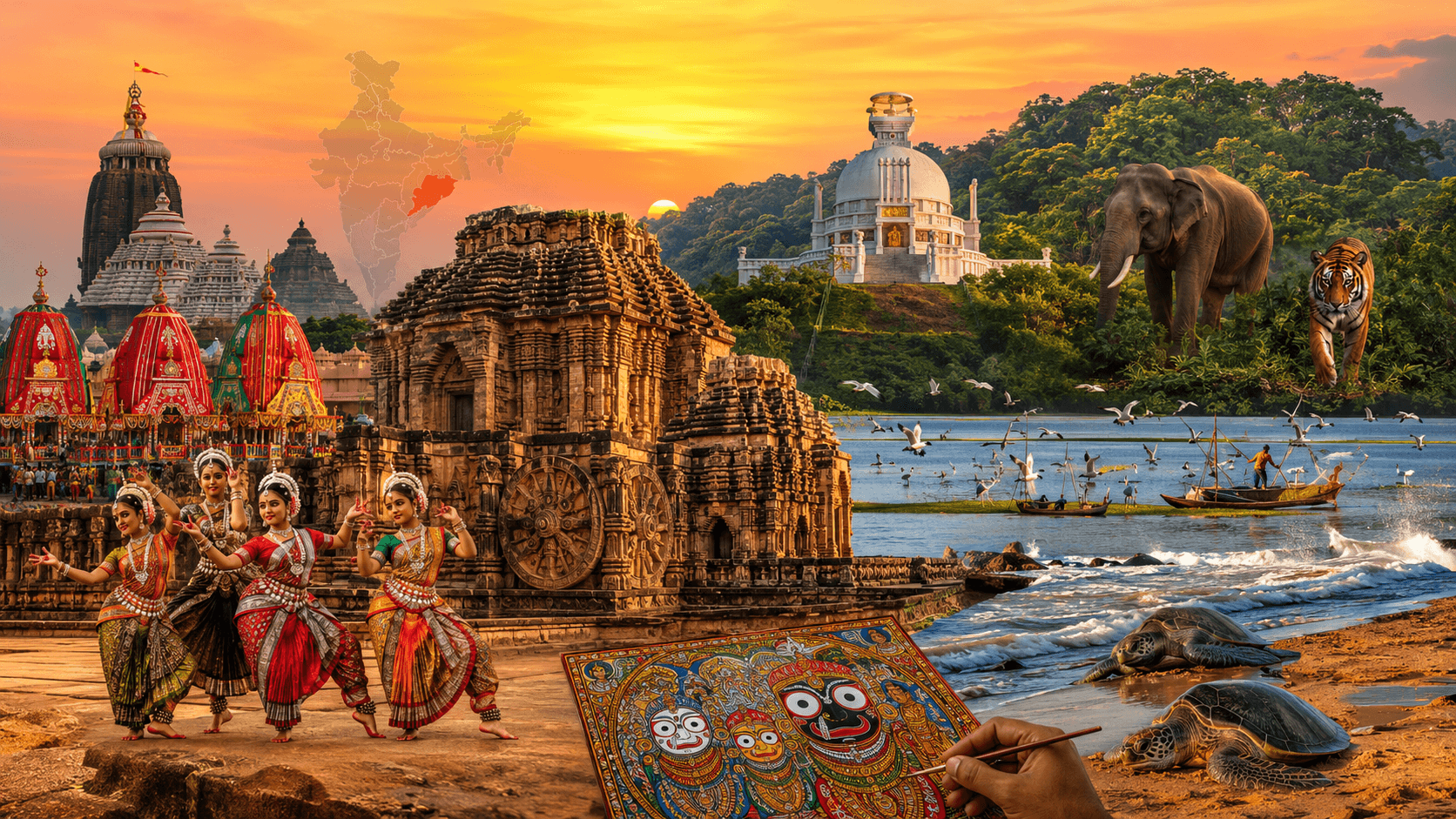
Odisha, formerly known as Orissa, is one of India’s most historically significant and culturally vibrant states, located on the eastern coast of India along the Bay of Bengal. Renowned for its ancient temples, classical dance, rich tribal heritage, pristine beaches, wildlife sanctuaries, and magnificent monuments, Odisha is often referred to as the “Soul of Incredible India.”
The state was officially renamed from Orissa to Odisha on 4 November 2011, while its official language became Odia. The capital city, Bhubaneswar, popularly known as the Temple City of India, is famous for its hundreds of ancient temples, modern infrastructure, educational institutions, and thriving IT sector.
Odisha is bordered by West Bengal to the northeast, Jharkhand to the north, Chhattisgarh to the west, Andhra Pradesh to the south, and the Bay of Bengal to the east. Covering an area of approximately 155,707 square kilometres, it is the 8th largest state in India by area.
The state is globally famous for the Konark Sun Temple, a UNESCO World Heritage Site, the sacred Jagannath Temple in Puri, the spectacular Rath Yatra, Chilika Lake—Asia’s largest brackish water lagoon—and the biodiversity-rich Similipal National Park. Odisha is also known for its traditional arts such as Pattachitra paintings, Appliqué work of Pipili, Silver Filigree (Tarakasi), and the graceful Odissi classical dance.
Historically, Odisha was known as Kalinga, the land where the famous Kalinga War took place in 261 BCE. The war profoundly transformed Emperor Ashoka, leading him to embrace Buddhism and spread its teachings across Asia. Since then, Odisha has remained an important centre of Buddhist, Jain, and Hindu heritage.
The state’s economy is supported by agriculture, mining, steel, aluminium, power generation, tourism, fisheries, handicrafts, and information technology. Rich deposits of minerals such as iron ore, coal, bauxite, chromite, and manganese have made Odisha one of India’s leading industrial and mining states.
Today, Odisha is admired for its harmonious blend of ancient heritage, spiritual significance, natural beauty, modern development, and warm hospitality, making it one of the most fascinating destinations in India.
Odisha on the India Map
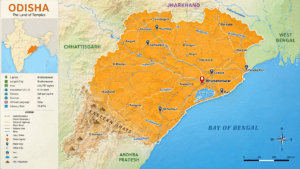
The state is located on the eastern coast of India, along the Bay of Bengal, and is one of the country’s most strategically important states. It lies between 17°49′ N and 22°34′ N latitude and 81°27′ E and 87°29′ E longitude. Its geographical location has made Odisha a major centre for maritime trade, culture, tourism, and economic development for centuries.
The state covers an area of approximately 155,707 square kilometres, making it the 8th largest state in India by area. Odisha shares interstate borders with West Bengal to the northeast, Jharkhand to the north, Chhattisgarh to the west, and Andhra Pradesh to the south. To the east, it has a coastline of about 485 kilometres along the Bay of Bengal, one of the longest coastlines among Indian states.
The capital city, Bhubaneswar, is centrally located and serves as the administrative, educational, technological, and cultural hub of the state. Other major cities include Cuttack, Puri, Rourkela, Sambalpur, Berhampur, and Balasore.
Odisha’s location provides diverse geographical features, including the Eastern Ghats, fertile river valleys, coastal plains, dense forests, waterfalls, mineral-rich plateaus, and the famous Chilika Lake, Asia’s largest brackish water lagoon. This geographical diversity supports rich biodiversity, agriculture, fisheries, tourism, and industrial growth.
Due to its long coastline and major ports such as Paradip Port, Dhamra Port, and Gopalpur Port, Odisha plays a crucial role in India’s maritime trade and economic development. The state’s strategic location also makes it an important gateway to eastern and central India.
Key Geographical Facts
| Feature | Details |
|---|---|
| Region | Eastern India |
| Area | 155,707 sq km |
| Capital | Bhubaneswar |
| Coastline | Approximately 485 km |
| Neighboring States | West Bengal, Jharkhand, Chhattisgarh, Andhra Pradesh |
| Eastern Boundary | Bay of Bengal |
| Largest Coastal Lake | Chilika Lake |
| Major Port | Paradip Port |
Districts of Odisha
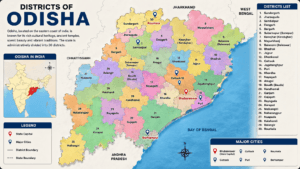
The state is administratively divided into 30 districts, which are grouped under 3 Revenue Divisions—Central, Northern, and Southern. These districts play a vital role in the state’s governance, economic development, agriculture, industry, tourism, education, and public administration. Each district is headed by a District Collector & Magistrate, who oversees law and order, revenue administration, and developmental activities.
The districts of Odisha exhibit remarkable geographical and cultural diversity. The coastal districts, including Puri, Khordha, Cuttack, Jagatsinghpur, Kendrapara, and Balasore, are known for fertile agricultural lands, temples, beaches, ports, and fisheries. The western districts, such as Sambalpur, Jharsuguda, Sundargarh, and Bargarh, are rich in minerals, industries, forests, and hydroelectric projects. The southern districts, including Koraput, Malkangiri, Nabarangpur, Rayagada, and Kandhamal, are famous for their tribal culture, waterfalls, coffee plantations, and scenic landscapes.
Khordha district, where the capital Bhubaneswar is located, serves as the administrative, educational, and IT hub of Odisha. Cuttack, the former capital, remains an important commercial and judicial centre. Puri is internationally renowned for the Jagannath Temple and the annual Rath Yatra, while Mayurbhanj is home to the famous Similipal National Park and Tiger Reserve.
Together, these 30 districts contribute significantly to Odisha’s economy through agriculture, mining, tourism, handicrafts, manufacturing, ports, and information technology.
List of Districts of Odisha
- Angul
- Balangir
- Balasore
- Bargarh
- Bhadrak
- Boudh
- Cuttack
- Deogarh
- Dhenkanal
- Gajapati
- Ganjam
- Jagatsinghpur
- Jajpur
- Jharsuguda
- Kalahandi
- Kandhamal
- Kendrapara
- Kendujhar (Keonjhar)
- Khordha
- Koraput
- Malkangiri
- Mayurbhanj
- Nabarangpur
- Nayagarh
- Nuapada
- Puri
- Rayagada
- Sambalpur
- Subarnapur (Sonepur)
- Sundargarh
| District | Headquarters |
|---|---|
| Angul | Angul |
| Balangir | Balangir |
| Balasore | Balasore |
| Bargarh | Bargarh |
| Bhadrak | Bhadrak |
| Boudh | Boudh |
| Cuttack | Cuttack |
| Deogarh | Deogarh |
| Dhenkanal | Dhenkanal |
| Gajapati | Paralakhemundi |
| Ganjam | Chhatrapur |
| Jagatsinghpur | Jagatsinghpur |
| Jajpur | Jajpur |
| Jharsuguda | Jharsuguda |
| Kalahandi | Bhawanipatna |
| Kandhamal | Phulbani |
| Kendrapara | Kendrapara |
| Kendujhar | Kendujhar |
| Khordha | Bhubaneswar |
| Koraput | Koraput |
| Malkangiri | Malkangiri |
| Mayurbhanj | Baripada |
| Nabarangpur | Nabarangpur |
| Nayagarh | Nayagarh |
| Nuapada | Nuapada |
| Puri | Puri |
| Rayagada | Rayagada |
| Sambalpur | Sambalpur |
| Subarnapur | Sonepur |
| Sundargarh | Sundargarh |
History of Odisha
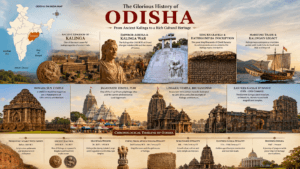
Odisha, historically known as Kalinga, possesses one of the oldest and most glorious civilizations in India. The state’s recorded history dates back more than 2,500 years, with evidence of advanced urban settlements, maritime trade, art, religion, and culture. Ancient Odisha was renowned for its powerful kingdoms, prosperous ports, skilled artisans, and fearless warriors, making it one of the most influential regions of eastern India.
One of the most significant events in Indian history was the Kalinga War, fought in 261 BCE between Emperor Ashoka of the Maurya Empire and the kingdom of Kalinga. Although Ashoka emerged victorious, the immense loss of life deeply affected him. The war transformed Ashoka’s life, leading him to embrace Buddhism, adopt the principles of peace and non-violence, and spread Buddhist teachings across Asia. The Dhauli Shanti Stupa near Bhubaneswar commemorates this historic event.
After the decline of the Mauryan Empire, Odisha came under the rule of several powerful dynasties, including the Mahameghavahana Dynasty under King Kharavela, who promoted Jainism, trade, art, and public welfare. His achievements are recorded in the famous Hathigumpha Inscription at Udayagiri Hills, one of India’s most important historical inscriptions.
Between the 8th and 15th centuries, Odisha flourished under the Somavamshi and Eastern Ganga dynasties. During this golden period, magnificent temples such as the Lingaraj Temple, Jagannath Temple, and the world-famous Konark Sun Temple were constructed, showcasing the excellence of Kalinga architecture.
The region later came under the rule of the Gajapati Dynasty, followed by the Afghans, Mughals, Marathas, and eventually the British East India Company in 1803. During British rule, Odisha became part of the Bengal Presidency and later the Bihar and Orissa Province.
A major milestone was achieved on 1 April 1936, when Odisha became the first Indian province formed on a linguistic basis, recognizing the identity of the Odia-speaking people. After India’s independence in 1947, Odisha became a constituent state of the Republic of India on 26 January 1950.
Today, Odisha is celebrated for its ancient heritage, temple architecture, maritime history, tribal culture, Buddhist legacy, and contributions to India’s cultural and historical development.
Timeline of Odisha History
| Period | Major Event |
|---|---|
| Ancient Period | Rise of the Kingdom of Kalinga |
| 261 BCE | Kalinga War between Ashoka and Kalinga |
| 1st Century BCE | Rule of King Kharavela and Hathigumpha Inscription |
| 8th–11th Century CE | Somavamshi Dynasty |
| 11th–15th Century CE | Eastern Ganga Dynasty and major temple construction |
| 15th–16th Century CE | Gajapati Dynasty |
| 1576 | Mughal Rule Begins |
| 1751 | Maratha Rule |
| 1803 | British East India Company conquered Odisha |
| 1 April 1936 | Odisha became the first linguistic province |
| 15 August 1947 | India gained Independence |
| 26 January 1950 | Odisha became a state of the Republic of India |
Geography of Odisha
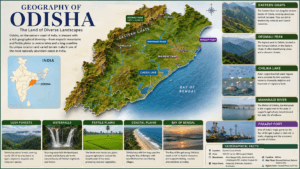
The state is located on the eastern coast of India, occupying a strategically important position along the Bay of Bengal. Covering an area of approximately 155,707 square kilometres, it is the 8th largest state in India by area. The state stretches from the forested hills of the Eastern Ghats in the west to the fertile coastal plains and sandy beaches of the Bay of Bengal in the east.
The state shares its borders with West Bengal to the northeast, Jharkhand to the north, Chhattisgarh to the west, Andhra Pradesh to the south, and the Bay of Bengal to the east. The state has a coastline of about 485 kilometres, making it one of India’s major maritime states with important ports such as Paradip, Dhamra, and Gopalpur.
The geography of Odisha can be broadly divided into four major physiographic regions:
Northern Plateau – Rich in minerals such as iron ore, manganese, chromite, and coal, covering districts like Keonjhar, Sundargarh, and Mayurbhanj.
Eastern Ghats – A range of hills and mountains extending through southern and western Odisha, known for dense forests, waterfalls, wildlife, and tribal communities.
Central River Basin – Fertile plains formed by major rivers, making this region the agricultural heartland of Odisha.
Coastal Plains – Stretching along the Bay of Bengal, these plains are known for fertile farmland, famous beaches, Chilika Lake, ports, and major cities such as Bhubaneswar, Cuttack, and Puri.
Odisha is blessed with numerous rivers, including the Mahanadi, Brahmani, Baitarani, Subarnarekha, Rushikulya, Budhabalanga, and Nagavali. These rivers support agriculture, drinking water supply, hydroelectric power generation, fisheries, and inland ecosystems.
The state is also home to Chilika Lake, Asia’s largest brackish water lagoon, which is internationally recognized as a Ramsar Wetland and supports thousands of migratory birds, Irrawaddy dolphins, and rich aquatic biodiversity.
With its diverse landscapes of mountains, forests, rivers, wetlands, plateaus, waterfalls, beaches, and coastal ecosystems, Odisha possesses one of India’s richest natural environments and plays a significant role in biodiversity conservation, agriculture, tourism, and mineral-based industries.
Key Geographical Facts
| Feature | Details |
|---|---|
| Area | 155,707 sq km |
| Region | Eastern India |
| Coastline | Approximately 485 km |
| Highest Peak | Deomali (1,672 m) |
| Major Mountain Range | Eastern Ghats |
| Largest Lake | Chilika Lake |
| Longest River | Mahanadi |
| Physiographic Regions | Northern Plateau, Eastern Ghats, Central River Basin, Coastal Plains |
Climate of Odisha
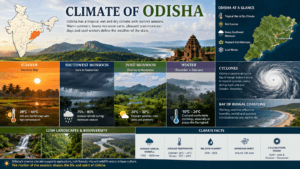
Odisha experiences a tropical monsoon climate, characterized by hot summers, a humid monsoon season, a pleasant post-monsoon period, and mild winters. Due to its long coastline along the Bay of Bengal, the state’s climate is greatly influenced by the sea. While the coastal districts experience warm and humid weather throughout the year, the hilly regions of the Eastern Ghats enjoy comparatively cooler temperatures.
The summer season extends from March to June, with temperatures generally ranging between 30°C and 45°C. Interior districts such as Angul, Balangir, Sambalpur, Jharsuguda, and Titilagarh often record some of the highest temperatures in India during peak summer. In contrast, coastal cities like Puri, Bhubaneswar, and Cuttack experience relatively moderate temperatures due to the influence of sea breezes.
The southwest monsoon arrives in June and continues until September, bringing nearly 75–80% of the state’s annual rainfall. The districts of Koraput, Kandhamal, Gajapati, Mayurbhanj, and Keonjhar receive the highest rainfall. The monsoon is essential for agriculture, groundwater recharge, forests, and reservoirs.
The post-monsoon season (October–November) is one of the most pleasant periods in Odisha. The weather becomes cooler and less humid, making it the ideal season for tourism, wildlife safaris, and festivals such as the famous Puri Rath Yatra (held during June–July according to the Hindu calendar) and Durga Puja celebrations in many parts of the state.
The winter season lasts from December to February, with temperatures generally ranging between 12°C and 28°C. Hill stations such as Daringbadi, often called the “Kashmir of Odisha,” experience much cooler temperatures and occasionally witness frost during cold waves. Winter is considered the best time to visit Odisha because of its comfortable climate and clear skies.
Due to its coastal location, Odisha is occasionally affected by tropical cyclones originating in the Bay of Bengal. Over the years, the state has developed one of India’s most effective cyclone forecasting, evacuation, and disaster management systems, significantly reducing the impact of severe storms.
Climate of Odisha
| Season | Months | Average Temperature |
|---|---|---|
| Summer | March – June | 30°C – 45°C |
| Monsoon | June – September | 25°C – 35°C |
| Post-Monsoon | October – November | 22°C – 32°C |
| Winter | December – February | 12°C – 28°C |
Major Rivers of Odisha
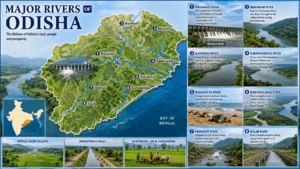
Odisha is blessed with a vast network of rivers that play a crucial role in the state’s agriculture, irrigation, drinking water supply, hydroelectric power generation, fisheries, biodiversity, and economic development. Most of these rivers originate in the Eastern Ghats, Chota Nagpur Plateau, or neighbouring states before flowing eastward into the Bay of Bengal.
The Mahanadi is the longest and most important river in Odisha. Originating in Chhattisgarh, it enters Odisha near Sambalpur, where the famous Hirakud Dam, one of the world’s longest earthen dams, has been built. The river flows through Cuttack before forming a vast delta and emptying into the Bay of Bengal. It is the lifeline of Odisha’s agriculture, irrigation, flood control, and hydroelectric power.
The Brahmani River, formed by the confluence of the South Koel and Sankh Rivers, is another major river supporting industries, irrigation projects, and agriculture in northern Odisha. The Baitarani River is considered one of Odisha’s sacred rivers and is vital for farming and drinking water supply.
The Subarnarekha River flows through Jharkhand, West Bengal, and Odisha, while the Rushikulya River is famous for the annual mass nesting of Olive Ridley Sea Turtles near its river mouth. Other important rivers include the Budhabalanga, Nagavali, Indravati, Kolab, and Vansadhara, each contributing significantly to irrigation, fisheries, biodiversity, and regional development.
Odisha’s river systems create fertile plains, support numerous wetlands, sustain wildlife habitats, and contribute to the state’s rich agricultural economy. They also provide immense potential for tourism, inland fisheries, and renewable energy generation.
Major Rivers of Odisha
| River | Origin | Importance |
|---|---|---|
| Mahanadi | Chhattisgarh | Hirakud Dam, Irrigation, Hydropower |
| Brahmani | South Koel & Sankh Rivers | Agriculture & Industries |
| Baitarani | Gonasika Hills | Irrigation & Drinking Water |
| Subarnarekha | Chota Nagpur Plateau | Agriculture & Fisheries |
| Rushikulya | Eastern Ghats | Olive Ridley Turtle Nesting |
| Budhabalanga | Similipal Hills | Irrigation & Agriculture |
| Nagavali | Eastern Ghats | Agriculture & Water Supply |
| Indravati | Eastern Ghats | Hydropower & Irrigation |
| Kolab | Eastern Ghats | Hydroelectric Project |
| Vansadhara | Eastern Ghats | Agriculture & Irrigation |
Agriculture of Odisha
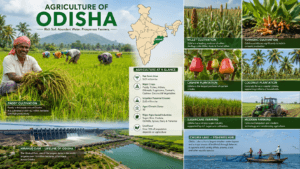
Agriculture is the backbone of Odisha’s economy, providing livelihood to nearly half of the state’s population. The state’s fertile river valleys, extensive irrigation network, favourable tropical climate, and abundant monsoon rainfall make it one of eastern India’s leading agricultural regions. Agriculture contributes significantly to food security, employment, rural development, and agro-based industries.
Rice is the principal crop and staple food of Odisha. The state is one of India’s leading producers of paddy, with cultivation spread across almost all districts. The fertile delta regions of the Mahanadi, Brahmani, and Baitarani rivers are especially suitable for rice cultivation.
Besides rice, Odisha produces a variety of crops including pulses, maize, millets, oilseeds, sugarcane, groundnut, cotton, turmeric, ginger, and vegetables. The state is also known for horticultural crops such as mango, banana, coconut, cashew, pineapple, guava, and jackfruit.
Odisha is one of India’s leading producers of cashew nuts, turmeric, and millets. Tribal regions in southern and western Odisha traditionally cultivate finger millet (Ragi), which is gaining popularity due to its high nutritional value. The state government actively promotes millet cultivation under various sustainable agriculture initiatives.
Horticulture, floriculture, dairy farming, poultry, inland fisheries, and aquaculture also play an important role in Odisha’s rural economy. The long coastline and numerous rivers, reservoirs, and Chilika Lake make Odisha one of India’s major fish-producing states.
To improve agricultural productivity, the Government of Odisha promotes modern irrigation systems, mechanization, organic farming, high-yield seed varieties, watershed development, climate-resilient agriculture, and digital farming technologies. Major irrigation projects such as the Hirakud Dam, Rengali Dam, and Indravati Project support year-round farming across the state.
Major Crops of Odisha
| Crop | Major Producing Districts |
|---|---|
| Rice | Cuttack, Puri, Kendrapara, Jajpur, Balasore |
| Pulses | Kalahandi, Balangir, Nuapada |
| Maize | Koraput, Nabarangpur, Malkangiri |
| Millets (Ragi) | Koraput, Rayagada, Kandhamal |
| Sugarcane | Cuttack, Nayagarh, Bargarh |
| Groundnut | Ganjam, Balasore, Bhadrak |
| Cotton | Kalahandi, Rayagada, Nabarangpur |
| Turmeric | Kandhamal, Koraput |
| Cashew | Ganjam, Puri, Koraput |
| Coconut | Puri, Jagatsinghpur, Kendrapara |
Flora & Fauna of Odisha
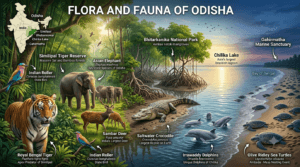
The state is one of India’s richest biodiversity states, blessed with dense forests, mangrove ecosystems, grasslands, wetlands, rivers, and coastal habitats. Nearly one-third of the state’s geographical area is under forest cover, making Odisha an important centre for wildlife conservation and ecological diversity. The state’s varied landscapes, ranging from the Eastern Ghats to the Bay of Bengal, support thousands of species of plants, mammals, birds, reptiles, amphibians, and aquatic animals.
The forests of Odisha are primarily classified into Tropical Moist Deciduous, Tropical Dry Deciduous, Semi-Evergreen, and Mangrove Forests. Dominant tree species include Sal, Teak, Bamboo, Mahua, Piasal, Asan, Kusum, Arjun, and Mango. The famous Bhitarkanika Mangrove Forest contains one of India’s largest mangrove ecosystems and acts as a natural barrier against cyclones and coastal erosion.
OD is home to several iconic wildlife species, including the Royal Bengal Tiger, Asian Elephant, Leopard, Gaur (Indian Bison), Sambar Deer, Spotted Deer, Wild Boar, Sloth Bear, Indian Pangolin, and Mouse Deer. The state also has one of India’s largest populations of Asian Elephants, mainly found in Similipal, Satkosia, and Debrigarh landscapes.
The state’s coastline is globally famous for the annual mass nesting of Olive Ridley Sea Turtles at Gahirmatha Marine Sanctuary and Rushikulya Beach, one of the world’s largest nesting sites for this endangered species.
OD is also a paradise for birdwatchers. Chilika Lake, Asia’s largest brackish water lagoon and a Ramsar Wetland, attracts over one million migratory birds every winter from Siberia, Central Asia, Europe, and the Himalayas. Common bird species include the Indian Roller (State Bird), Greater Flamingo, Openbill Stork, Painted Stork, Grey Heron, Brahminy Kite, Kingfisher, and Spot-billed Pelican.
The state government has established several National Parks, Wildlife Sanctuaries, Tiger Reserves, Elephant Reserves, Marine Protected Areas, and Biosphere Reserves to conserve Odisha’s exceptional biodiversity and natural heritage.
Flora & Fauna of Odisha
| Category | Major Species |
|---|---|
| Major Forest Types | Tropical Moist Deciduous, Tropical Dry Deciduous, Semi-Evergreen, Mangrove |
| Dominant Trees | Sal, Teak, Bamboo, Mahua, Piasal, Arjun |
| State Animal | Sambar Deer |
| State Bird | Indian Roller |
| State Tree | Ashoka |
| State Flower | Ashoka Flower |
| Famous Mammals | Royal Bengal Tiger, Asian Elephant, Leopard, Gaur, Sloth Bear |
| Famous Birds | Indian Roller, Greater Flamingo, Painted Stork, Brahminy Kite |
| Marine Wildlife | Olive Ridley Sea Turtle, Irrawaddy Dolphin, Saltwater Crocodile |
National Parks & Wildlife Sanctuaries of Odisha
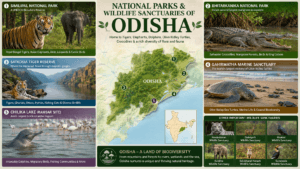
OD is one of India’s richest biodiversity states, with an extensive network of National Parks, Wildlife Sanctuaries, Tiger Reserves, Elephant Reserves, Marine Protected Areas, and Biosphere Reserves. Nearly 33% of the state’s geographical area is covered by forests, providing habitat for numerous endangered species, including the Royal Bengal Tiger, Asian Elephant, Leopard, Saltwater Crocodile, Olive Ridley Sea Turtle, and Irrawaddy Dolphin.
The Similipal National Park, located in Mayurbhanj district, is Odisha’s largest national park and forms the core of the Similipal Tiger Reserve. Recognized as a UNESCO Biosphere Reserve, Similipal is famous for its dense sal forests, spectacular waterfalls such as Barehipani and Joranda, rich biodiversity, and populations of tigers, elephants, gaurs, and leopards.
The Bhitarkanika National Park, situated in Kendrapara district, is India’s second-largest mangrove ecosystem after the Sundarbans. It is internationally known for its Saltwater Crocodiles, King Cobras, Olive Ridley Sea Turtles, and hundreds of resident and migratory bird species. The park is also recognized as a Ramsar Wetland.
The Satkosia Tiger Reserve, spread across the Mahanadi River gorge, is renowned for its scenic beauty, tiger conservation, gharial reintroduction programme, elephants, leopards, and rich birdlife. It is one of Odisha’s most important wildlife conservation landscapes.
OD also has several important wildlife sanctuaries, including Debrigarh, Kuldiha, Hadgarh, Baisipalli, Karlapat, Ushakothi, Kotagarh, Balukhand-Konark, and Chandaka-Dampara, each protecting unique ecosystems and wildlife.
The state’s coastline is globally famous for the annual mass nesting of Olive Ridley Sea Turtles at Gahirmatha Marine Sanctuary and Rushikulya Beach, one of the largest nesting events of its kind in the world.
Through scientific conservation programmes, eco-tourism initiatives, anti-poaching measures, and community participation, Odisha continues to play a leading role in wildlife conservation and biodiversity protection in India.
Major National Parks & Wildlife Sanctuaries of Odisha
| Protected Area | Type | Famous For |
|---|---|---|
| Similipal National Park | National Park & Tiger Reserve | Tigers, Elephants, Waterfalls |
| Bhitarkanika National Park | National Park | Saltwater Crocodiles & Mangroves |
| Satkosia Tiger Reserve | Tiger Reserve | Mahanadi Gorge, Tigers & Gharials |
| Debrigarh Wildlife Sanctuary | Wildlife Sanctuary | Wildlife & Hirakud Reservoir |
| Kuldiha Wildlife Sanctuary | Wildlife Sanctuary | Elephants & Dense Forests |
| Chandaka-Dampara Wildlife Sanctuary | Wildlife Sanctuary | Asian Elephants |
| Balukhand-Konark Wildlife Sanctuary | Wildlife Sanctuary | Blackbuck & Coastal Forest |
| Karlapat Wildlife Sanctuary | Wildlife Sanctuary | Waterfalls & Leopard Habitat |
| Hadgarh Wildlife Sanctuary | Wildlife Sanctuary | Forests & Hadgarh Dam |
| Gahirmatha Marine Sanctuary | Marine Sanctuary | Olive Ridley Sea Turtle Nesting |
Culture & Traditions of Odisha
OD is one of India’s most culturally rich states, renowned for its ancient traditions, temple heritage, classical dance, tribal customs, handicrafts, music, and festivals. The cultural identity of Odisha has evolved over thousands of years through the influence of Hinduism, Buddhism, Jainism, and numerous indigenous tribal communities, creating a unique blend of spirituality, art, and tradition.
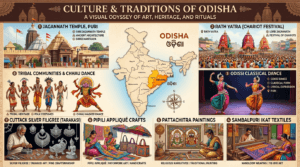
The state is internationally famous for Odissi, one of the eight classical dance forms of India. Originating from the temples of Odisha, Odissi is known for its graceful movements, expressive storytelling, intricate footwork, and devotional themes dedicated to Lord Jagannath, Lord Krishna, and other Hindu deities.
Odisha is home to 62 officially recognized tribal communities, each preserving its own language, customs, festivals, music, dance, attire, and lifestyle. Tribes such as the Dongria Kondh, Bonda, Saora, Juang, Gadaba, and Santal contribute significantly to the state’s cultural diversity and traditional knowledge.
Traditional handicrafts form an important part of Odisha’s cultural heritage. The state is globally recognized for Pattachitra paintings, Pipili Appliqué work, Cuttack Silver Filigree (Tarakasi), Stone Carving, Palm Leaf Engraving (Tala Pattachitra), Dhokra metal craft, Sambalpuri Handloom, and Ikat weaving. Many of these crafts have received Geographical Indication (GI) Tags for their uniqueness.
Religion plays a central role in the daily lives of the people. The Jagannath Temple at Puri is one of the holiest pilgrimage sites in India and is famous for the annual Rath Yatra, attracting millions of devotees from across the world. Other important temples, including the Lingaraj Temple, Mukteswara Temple, and Konark Sun Temple, reflect Odisha’s remarkable architectural and spiritual heritage.
Music and folk traditions are equally vibrant. Popular folk dance forms include Sambalpuri Dance, Chhau Dance (Mayurbhanj Style), Dalkhai, Ghumura, Ranapa, and Gotipua, while traditional musical instruments such as the Mardala, Dhol, Mahuri, and Flute accompany cultural performances.
The people of Odisha are known for their hospitality, devotion, artistic excellence, and deep respect for tradition. Despite rapid modernization, the state has successfully preserved its rich cultural heritage, making it one of India’s most fascinating cultural destinations.
Major Cultural Highlights of Odisha
| Cultural Element | Significance |
|---|---|
| Classical Dance | Odissi |
| Famous Folk Dances | Chhau (Mayurbhanj), Sambalpuri, Dalkhai, Ghumura, Gotipua |
| Traditional Paintings | Pattachitra |
| Handicrafts | Pipili Appliqué, Silver Filigree (Tarakasi), Dhokra Art |
| Traditional Weaving | Sambalpuri Ikat |
| Major Tribal Communities | Dongria Kondh, Bonda, Saora, Gadaba, Juang |
| Famous Temple Tradition | Jagannath Culture |
| Traditional Musical Instrument | Mardala |
Festivals of Odisha
OD is renowned for its vibrant festivals, which reflect the state’s deep spiritual traditions, cultural heritage, tribal customs, and religious harmony. Throughout the year, people celebrate numerous festivals with great devotion, colourful processions, traditional music, dance, and community participation. Most festivals are closely associated with the worship of Lord Jagannath, Lord Shiva, Goddess Durga, and various local deities.
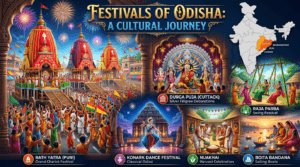
The Rath Yatra of Puri is the most famous festival of Odisha and one of the largest religious festivals in the world. Celebrated annually during the Hindu month of Ashadha (June–July), the festival marks the grand procession of Lord Jagannath, Lord Balabhadra, and Goddess Subhadra on magnificent wooden chariots from the Jagannath Temple to the Gundicha Temple. Millions of devotees from India and abroad gather in Puri to witness this spectacular event.
Durga Puja is another major festival celebrated with great enthusiasm, especially in Cuttack, which is famous for its magnificent silver filigree (Tarakasi) decorations. Beautifully decorated pandals, cultural programmes, and religious rituals attract thousands of visitors every year.
The Konark Dance Festival, held against the backdrop of the UNESCO-listed Konark Sun Temple, showcases India’s classical dance forms, including Odissi, Bharatanatyam, Kathak, Kuchipudi, and Manipuri. The festival attracts artists and tourists from around the world.
Other important festivals include Raja Parba, celebrating womanhood and the arrival of the monsoon; Nuakhai, a harvest festival celebrated mainly in western Odisha; Kumar Purnima, dedicated to Lord Kartikeya; Makar Sankranti; Boita Bandana, commemorating Odisha’s ancient maritime trade; Pana Sankranti (Odia New Year); and Chandan Yatra, associated with Lord Jagannath.
Odisha’s tribal communities also celebrate unique festivals such as Chaita Parab, Bali Yatra, and regional harvest festivals, preserving centuries-old customs, folk dances, music, and rituals. Together, these festivals make Odisha one of India’s most culturally vibrant and spiritually significant states.
Major Festivals of Odisha
| Festival | Significance | Time of Celebration |
|---|---|---|
| Rath Yatra | Grand chariot festival of Lord Jagannath | June–July |
| Durga Puja | Worship of Goddess Durga | September–October |
| Raja Parba | Celebration of womanhood and monsoon | June |
| Konark Dance Festival | Classical dance festival | December |
| Nuakhai | Harvest festival | August–September |
| Kumar Purnima | Worship of Lord Kartikeya | October |
| Boita Bandana | Ancient maritime tradition | October–November |
| Bali Yatra | Historic trade fair | November |
| Pana Sankranti | Odia New Year | April |
| Chandan Yatra | Festival of Lord Jagannath | April–May |
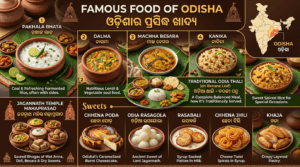
Famous Food of Odisha
Odisha is renowned for its simple, nutritious, and flavorful cuisine, which reflects the state’s rich agricultural heritage, coastal lifestyle, and deep spiritual traditions. The cuisine is primarily based on rice, lentils, vegetables, seafood, milk, and traditional spices, with many recipes passed down through generations. Temple cuisine, especially the sacred Mahaprasad of the Jagannath Temple in Puri, holds a unique place in Odisha’s culinary culture.
The most famous dish of Odisha is Pakhala Bhata, a traditional fermented rice dish served with curd, fried vegetables, fish, or roasted potatoes. It is especially popular during the hot summer months because of its cooling properties. Every year, 20 March is celebrated as Pakhala Dibasa (Pakhala Day) by Odias around the world.
Another iconic delicacy is Dalma, a wholesome preparation made from lentils and vegetables, seasoned with mild spices. It is considered one of the healthiest traditional dishes and is commonly prepared during festivals and family gatherings.
Odisha is also famous for its delicious sweets. Rasgola (Odia Rasagola), Chhena Poda, Chhena Jhili, Rasabali, Khira Gaja, and Khaja are among the state’s most loved desserts. Odia Rasagola has received a Geographical Indication (GI) Tag, recognizing its unique origin and traditional preparation.
Being a coastal state, Odisha offers a wide variety of seafood dishes, including fish curry, prawn curry, crab curry, and dried fish preparations. Coconut, mustard, curry leaves, and fresh spices are commonly used to enhance the flavour of these dishes.
Traditional festive meals are incomplete without Mahaprasad, prepared in the kitchens of the Jagannath Temple using centuries-old methods. It consists of rice, dal, vegetables, curries, sweets, and desserts, and is regarded as sacred food by millions of devotees.
Odisha’s cuisine perfectly balances nutrition, simplicity, and taste, making it one of the most distinctive regional cuisines in India.
Famous Dishes of Odisha
| Dish | Specialty |
|---|---|
| Pakhala Bhata | Fermented rice dish |
| Dalma | Lentils cooked with vegetables |
| Mahaprasad | Sacred temple meal |
| Chhena Poda | Baked cottage cheese dessert |
| Odia Rasagola | GI-tagged traditional sweet |
| Chhena Jhili | Fried cottage cheese sweet |
| Rasabali | Milk-based dessert |
| Khaja | Crispy temple sweet |
| Machha Besara | Fish in mustard gravy |
| Kanika | Sweet aromatic rice |
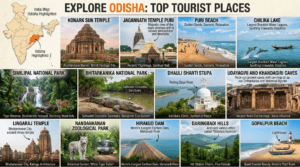
Top Tourist Places in Odisha
Odisha is one of India’s most captivating travel destinations, offering a perfect blend of ancient temples, pristine beaches, wildlife sanctuaries, waterfalls, lakes, Buddhist heritage sites, and tribal culture. From the magnificent Konark Sun Temple to the serene waters of Chilika Lake, the state attracts millions of domestic and international tourists every year.
The Jagannath Temple in Puri is one of the Char Dham pilgrimage sites and is world-famous for the annual Rath Yatra. Nearby, Puri Beach offers beautiful sunrise views, golden sands, and vibrant local markets.
The Konark Sun Temple, a UNESCO World Heritage Site, is one of India’s finest architectural masterpieces. Built in the 13th century by King Narasimhadeva I, the temple is designed in the shape of a colossal stone chariot dedicated to the Sun God.
Nature lovers can explore Chilika Lake, Asia’s largest brackish water lagoon, famous for Irrawaddy Dolphins, migratory birds, and picturesque islands such as Nalabana Bird Sanctuary and Kalijai Island.
Wildlife enthusiasts can visit Similipal National Park, Bhitarkanika National Park, and Satkosia Tiger Reserve, where they can spot Royal Bengal Tigers, Asian Elephants, Saltwater Crocodiles, and numerous bird species.
History lovers should visit the Dhauli Shanti Stupa, where Emperor Ashoka embraced Buddhism after the Kalinga War, and the Udayagiri and Khandagiri Caves, known for their ancient Jain rock-cut architecture.
Other popular destinations include Lingaraj Temple, Nandankanan Zoological Park, Hirakud Dam, Daringbadi, Gopalpur Beach, Debrigarh Wildlife Sanctuary, and the scenic Koraput region.
With its unique combination of spirituality, heritage, adventure, beaches, forests, and wildlife, Odisha offers unforgettable experiences for every traveller.
Top Tourist Places in Odisha
| Tourist Place | Famous For |
|---|---|
| Jagannath Temple, Puri | Char Dham Pilgrimage & Rath Yatra |
| Konark Sun Temple | UNESCO World Heritage Site |
| Chilika Lake | Irrawaddy Dolphins & Migratory Birds |
| Puri Beach | Golden Beach & Sunrise Views |
| Similipal National Park | Tigers, Elephants & Waterfalls |
| Bhitarkanika National Park | Saltwater Crocodiles & Mangroves |
| Satkosia Tiger Reserve | Wildlife & Mahanadi Gorge |
| Lingaraj Temple | Ancient Kalinga Architecture |
| Dhauli Shanti Stupa | Kalinga War & Buddhist Heritage |
| Udayagiri & Khandagiri Caves | Ancient Jain Rock-cut Caves |
| Nandankanan Zoological Park | White Tigers & Safari |
| Hirakud Dam | World’s Longest Earthen Dam |
| Daringbadi | Hill Station |
| Gopalpur Beach | Beach Tourism |
| Koraput | Tribal Culture & Scenic Beauty |
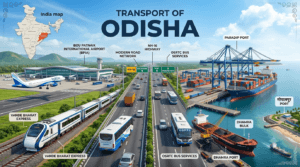
Transport in Odisha
Odisha has a well-developed transportation network comprising roadways, railways, airways, and seaports, ensuring seamless connectivity within the state and with the rest of India. Its strategic location on the eastern coast and extensive infrastructure have made Odisha a major hub for trade, tourism, industry, and logistics.
Road Transport
Odisha has an extensive road network maintained by the National Highways Authority of India (NHAI), the Odisha Works Department, and the Rural Development Department. The state is connected by several major National Highways, including NH-16, NH-53, NH-26, NH-49, and NH-55, linking important cities such as Bhubaneswar, Cuttack, Puri, Sambalpur, Rourkela, Balasore, Berhampur, and Koraput.
The Odisha State Road Transport Corporation (OSRTC) and private operators provide regular bus services connecting cities, towns, pilgrimage centres, and tourist destinations.
Railway Transport
Odisha has a strong railway network managed primarily by the East Coast Railway (ECoR), headquartered in Bhubaneswar. Major railway junctions include Bhubaneswar, Cuttack, Puri, Khurda Road, Balasore, Sambalpur, Rourkela, Berhampur, and Jajpur Keonjhar Road.
Premium trains such as Vande Bharat Express, Rajdhani Express, Duronto Express, Shatabdi Express, and Superfast Express trains connect Odisha with major Indian cities including Delhi, Kolkata, Mumbai, Chennai, Bengaluru, Hyderabad, and Visakhapatnam.
Air Transport
The Biju Patnaik International Airport (Bhubaneswar) is Odisha’s primary international airport, offering domestic and international connectivity. It operates regular flights to Delhi, Mumbai, Bengaluru, Chennai, Hyderabad, Kolkata, Pune, Ahmedabad, Dubai, Singapore (seasonal/subject to airline operations), and other destinations.
Other operational airports include Jharsuguda (Veer Surendra Sai Airport), Jeypore Airport, and Rourkela Airport, improving regional connectivity.
Sea Transport
With a coastline of nearly 485 km, Odisha is home to some of India’s most important ports. Paradip Port is one of the country’s largest major ports, handling coal, iron ore, crude oil, fertilizers, and containers. Dhamra Port and Gopalpur Port are major commercial ports that significantly contribute to Odisha’s maritime trade and industrial growth.
Continuous investment in highways, railways, airports, and ports has strengthened Odisha’s position as a major transportation and logistics hub in eastern India.
Transport Infrastructure of Odisha
| Mode of Transport | Major Facilities |
|---|---|
| Roadways | NH-16, NH-53, NH-26, NH-49, NH-55, OSRTC |
| Railways | Bhubaneswar, Cuttack, Puri, Khurda Road, Rourkela, Sambalpur |
| International Airport | Biju Patnaik International Airport, Bhubaneswar |
| Domestic Airports | Jharsuguda, Jeypore, Rourkela |
| Major Ports | Paradip Port, Dhamra Port, Gopalpur Port |
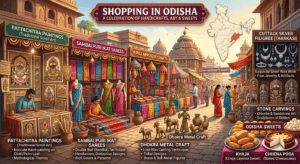
Shopping in Odisha
Shopping in Odisha is a delightful experience for visitors looking to explore the state’s rich handicrafts, handloom textiles, traditional art forms, jewellery, and local products. Odisha is internationally renowned for its centuries-old craftsmanship, with many traditional products receiving Geographical Indication (GI) Tags for their uniqueness and authenticity.
One of the state’s most famous handicrafts is Pattachitra, a traditional scroll painting originating from Raghurajpur Heritage Village near Puri. These intricate paintings depict stories from the Ramayana, Mahabharata, and the life of Lord Jagannath, making them popular souvenirs.
Odisha is also famous for Sambalpuri Ikat handloom sarees and fabrics, known for their distinctive tie-and-dye weaving technique and vibrant geometric patterns. These textiles are widely produced in Sambalpur, Bargarh, and Sonepur and are highly valued across India and abroad.
Another iconic craft is Pipili Appliqué Work, featuring colourful embroidered fabric used to create umbrellas, wall hangings, lampshades, handbags, and decorative items. Cuttack Silver Filigree (Tarakasi) is equally admired for its delicate silver jewellery and decorative artefacts crafted using fine silver wires.
Other popular shopping items include Dhokra metal crafts, Stone Carvings, Palm Leaf Engravings (Tala Pattachitra), Brass and Bell Metal Crafts, Horn Craft, Wood Carvings, and Tribal Jewellery.
Food lovers can purchase authentic Odia delicacies such as Khaja, Chhena Poda, Odia Rasagola, dry seafood, spices, and locally processed cashew nuts.
Popular shopping destinations include Ekamra Haat (Bhubaneswar), Utkalika – The Odisha State Handicrafts Emporium, Pipili, Raghurajpur, Cuttack, Sambalpur, Puri Beach Market, and local handicraft fairs held throughout the year.
Shopping in Odisha offers visitors an opportunity to take home a piece of the state’s rich artistic, cultural, and culinary heritage.
Famous Shopping Items in Odisha
| Product | Famous Place |
|---|---|
| Pattachitra Paintings | Raghurajpur, Puri |
| Sambalpuri Ikat Sarees | Sambalpur, Bargarh, Sonepur |
| Pipili Appliqué Work | Pipili |
| Silver Filigree (Tarakasi) | Cuttack |
| Dhokra Metal Craft | Dhenkanal, Mayurbhanj |
| Palm Leaf Engravings | Puri, Raghurajpur |
| Stone Carvings | Bhubaneswar, Konark |
| Brass & Bell Metal Crafts | Kantilo, Balakati |
| Horn Craft | Cuttack |
| Khaja & Chhena Poda | Puri, Nayagarh |
Best Time to Visit Odisha
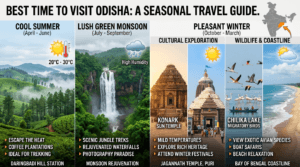
Odisha is a year-round destination, but the best time to visit is from October to March, when the weather is pleasant, cool, and ideal for sightseeing, wildlife safaris, beach holidays, and pilgrimage tours. During these months, temperatures remain comfortable, making it the perfect season to explore Odisha’s temples, lakes, forests, waterfalls, hill stations, and coastal attractions.
The winter season (December to February) is considered the peak tourist season. Temperatures generally range between 12°C and 28°C, providing ideal conditions for visiting destinations such as Konark Sun Temple, Jagannath Temple (Puri), Chilika Lake, Similipal National Park, Bhitarkanika National Park, Daringbadi, and Hirakud Dam. It is also the best time for birdwatching, as thousands of migratory birds arrive at Chilika Lake and Bhitarkanika.
The post-monsoon season (October to November) offers lush green landscapes, clear skies, and pleasant temperatures. This is also the season of major cultural events such as the Konark Dance Festival, Durga Puja, Kumar Purnima, Boita Bandana, and Bali Yatra, attracting tourists from across the world.
The summer season (March to June) is generally hot and humid, with temperatures reaching 45°C in some interior districts. However, hill stations like Daringbadi remain relatively cooler and are popular summer retreats.
The monsoon season (June to September) transforms Odisha into a lush green paradise. Rivers, waterfalls, forests, and lakes become more scenic, making it an excellent time for nature lovers and photographers. However, heavy rainfall and occasional cyclones along the Bay of Bengal may affect travel plans in some coastal areas.
Whether you are interested in heritage tourism, wildlife, beaches, adventure, festivals, or spiritual journeys, Odisha offers memorable experiences throughout the year, with October to March being the most recommended period for travel.
Best Time to Visit Odisha
| Season | Months | Best For |
|---|---|---|
| Winter | December – February | Sightseeing, Wildlife, Birdwatching, Beaches |
| Post-Monsoon | October – November | Festivals, Photography, Heritage Tourism |
| Summer | March – June | Hill Stations, Daringbadi |
| Monsoon | June – September | Waterfalls, Green Landscapes, Nature Photography |
How to Reach Odisha
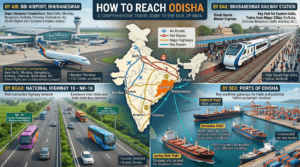
Odisha is well connected to the rest of India through an extensive network of airways, railways, roadways, and seaports. The state’s modern transportation infrastructure makes travelling to major destinations such as Bhubaneswar, Puri, Cuttack, Konark, Rourkela, Sambalpur, Chilika Lake, and Gopalpur convenient for domestic and international visitors.
By Air
The Biju Patnaik International Airport in Bhubaneswar is the primary gateway to Odisha. It offers regular domestic flights connecting the state with major cities such as Delhi, Mumbai, Bengaluru, Chennai, Hyderabad, Kolkata, Pune, Ahmedabad, Lucknow, and Visakhapatnam. The airport also operates international flights to select destinations, making Odisha easily accessible for overseas travellers.
Other operational airports include Veer Surendra Sai Airport (Jharsuguda), Rourkela Airport, and Jeypore Airport, which improve regional connectivity within the state.
By Train
Odisha has an excellent railway network managed mainly by the East Coast Railway (ECoR). Major railway stations include Bhubaneswar, Cuttack, Puri, Khurda Road Junction, Rourkela, Sambalpur, Balasore, Berhampur, and Jajpur Keonjhar Road.
Several premium trains, including Vande Bharat Express, Rajdhani Express, Duronto Express, Shatabdi Express, and Superfast Express services, connect Odisha with major Indian cities such as New Delhi, Kolkata, Mumbai, Chennai, Bengaluru, Hyderabad, and Ahmedabad.
By Road
Odisha has a well-maintained network of National Highways and State Highways, providing excellent road connectivity. The state is connected through important highways such as NH-16, NH-53, NH-26, NH-49, and NH-55.
The Odisha State Road Transport Corporation (OSRTC) and private bus operators run regular services connecting Bhubaneswar, Puri, Cuttack, Rourkela, Sambalpur, Berhampur, Balasore, and neighbouring states including West Bengal, Jharkhand, Chhattisgarh, Andhra Pradesh, and Telangana.
By Sea
Odisha’s 485-kilometre coastline is home to major ports including Paradip Port, Dhamra Port, and Gopalpur Port. These ports primarily handle commercial cargo and industrial trade, while also contributing significantly to the state’s maritime economy.
Thanks to its integrated transport system, Odisha is one of the most accessible states in eastern India for tourism, pilgrimage, business, and trade.
How to Reach Odisha
| Mode | Major Facilities |
|---|---|
| By Air | Biju Patnaik International Airport, Jharsuguda Airport, Rourkela Airport, Jeypore Airport |
| By Train | Bhubaneswar, Cuttack, Puri, Khurda Road, Rourkela, Sambalpur |
| By Road | NH-16, NH-53, NH-26, NH-49, NH-55, OSRTC Bus Services |
| By Sea | Paradip Port, Dhamra Port, Gopalpur Port |
Travel Tips for Visiting Odisha
Odisha is a welcoming destination that offers a perfect blend of spiritual heritage, cultural experiences, wildlife adventures, scenic beaches, and natural beauty. Proper planning can make your journey more comfortable, safe, and memorable. Whether you are visiting ancient temples, exploring national parks, relaxing on beaches, or experiencing local festivals, following a few practical travel tips will help you make the most of your trip.
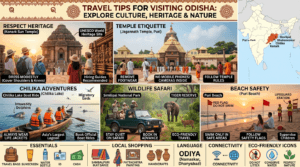
The best time to visit Odisha is between October and March, when the weather is pleasant for sightseeing and outdoor activities. If you plan to visit during the Rath Yatra in Puri, book your accommodation and transportation several months in advance, as hotels and trains fill up quickly due to the large number of pilgrims.
When visiting religious sites such as the Jagannath Temple, Lingaraj Temple, and other sacred places, wear modest clothing and respect local customs. Photography may be restricted inside certain temples, so always follow the guidelines issued by temple authorities.
Wildlife enthusiasts planning to visit Similipal National Park, Bhitarkanika National Park, or Satkosia Tiger Reserve should check the opening season before travelling, as some parks remain closed during the monsoon months. Hiring authorized local guides can enhance your wildlife experience while ensuring safety.
Carry light cotton clothing during summer and the monsoon, while a light jacket is useful during winter, especially when visiting Daringbadi or other hilly regions. Comfortable walking shoes, sunscreen, sunglasses, insect repellent, reusable water bottles, and basic medicines are recommended for long sightseeing trips.
Food lovers should try authentic Odia dishes such as Pakhala Bhata, Dalma, Chhena Poda, Mahaprasad, and fresh seafood from reputed restaurants. Shopping enthusiasts should purchase handicrafts like Pattachitra paintings, Sambalpuri Ikat, Pipili Appliqué, and Silver Filigree (Tarakasi) from government emporiums or certified artisans to ensure authenticity.
Finally, respect Odisha’s rich cultural traditions, avoid littering in heritage sites and natural areas, support eco-friendly tourism, and follow local regulations while visiting protected forests, beaches, and wildlife sanctuaries.
Essential Travel Tips for Odisha
| Tip | Recommendation |
|---|---|
| Best Season | October to March |
| Clothing | Light cotton in summer, light woollens in winter |
| Temple Visits | Dress modestly and follow temple rules |
| Wildlife Safari | Visit during the open season and hire authorized guides |
| Beach Safety | Follow lifeguard instructions and avoid rough seas |
| Shopping | Buy authentic handicrafts from certified stores |
| Food | Try Pakhala Bhata, Dalma, Mahaprasad, Chhena Poda |
| Eco Tourism | Avoid plastic and keep tourist places clean |
Interesting Facts About Odisha
Odisha is one of India’s oldest civilizations and is widely celebrated for its ancient heritage, magnificent temples, classical arts, diverse wildlife, mineral wealth, and vibrant cultural traditions. From the historic Kingdom of Kalinga to becoming one of India’s fastest-growing industrial states, Odisha offers countless fascinating facts that make it unique.
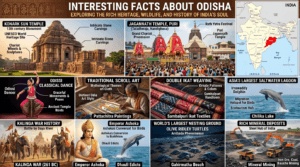
One of the most significant events in Indian history, the Kalinga War (261 BCE), took place in present-day Odisha. The immense destruction caused by this war led Emperor Ashoka to embrace Buddhism and dedicate his life to peace and non-violence, influencing the course of Asian history.
Odisha is home to the Konark Sun Temple, a UNESCO World Heritage Site and one of the finest examples of Kalinga architecture. Designed as a colossal stone chariot with intricately carved wheels and horses, it is regarded as one of the greatest architectural achievements of medieval India.
The Jagannath Temple in Puri is one of the Char Dham pilgrimage sites of Hinduism and hosts the world-famous Rath Yatra, where millions of devotees gather annually to witness the grand procession of Lord Jagannath, Lord Balabhadra, and Goddess Subhadra.
Odisha is home to Chilika Lake, Asia’s largest brackish water lagoon, which attracts over one million migratory birds every winter. It is also one of the few places in India where visitors can see the Irrawaddy Dolphin in its natural habitat.
The state is globally recognized for the mass nesting of Olive Ridley Sea Turtles at Gahirmatha Marine Sanctuary and Rushikulya Beach, one of the largest such nesting events in the world.
Odisha is rich in natural resources and is one of India’s leading producers of iron ore, bauxite, chromite, coal, and manganese, making it a major hub for steel, aluminium, and mining industries.
The state is also famous for Odissi, one of the eight classical dance forms of India, and for traditional handicrafts such as Pattachitra paintings, Sambalpuri Ikat, Pipili Appliqué, and Cuttack Silver Filigree (Tarakasi), many of which have received GI Tags.
Interesting Facts About Odisha
| Fact | Details |
|---|---|
| Ancient Name | Kalinga |
| Famous Historic Event | Kalinga War (261 BCE) |
| UNESCO World Heritage Site | Konark Sun Temple |
| Largest Brackish Water Lagoon in Asia | Chilika Lake |
| Famous Festival | Rath Yatra |
| Classical Dance | Odissi |
| Largest Marine Turtle Nesting | Gahirmatha & Rushikulya |
| Major Minerals | Iron Ore, Bauxite, Chromite, Coal |
| Famous Handicrafts | Pattachitra, Sambalpuri Ikat, Pipili Appliqué |
| Nickname | Soul of Incredible India |
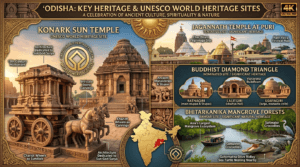
UNESCO World Heritage Sites of Odisha
Odisha is home to one of India’s most celebrated UNESCO World Heritage Sites—the magnificent Konark Sun Temple. In addition, the state has several historically and culturally significant monuments that are included in UNESCO’s Tentative List, reflecting Odisha’s rich architectural, religious, and historical legacy.
The Konark Sun Temple, located about 35 km from Puri, was built in the 13th century CE by King Narasimhadeva I of the Eastern Ganga Dynasty. Dedicated to Surya (the Sun God), the temple is designed in the form of a gigantic stone chariot with 24 intricately carved wheels pulled by seven majestic horses. It represents one of the finest examples of Kalinga architecture and was inscribed as a UNESCO World Heritage Site in 1984.
The temple is admired for its remarkable stone sculptures, astronomical symbolism, engineering excellence, and artistic brilliance. Every year, thousands of tourists, historians, architects, and devotees from around the world visit Konark to witness its timeless beauty.
Apart from Konark, Odisha also has several heritage sites of global importance. The Jagannath Temple in Puri, Buddhist monuments at Lalitgiri, Ratnagiri, and Udayagiri (Diamond Triangle), and the Bhitarkanika Mangrove Ecosystem are internationally recognized for their historical, religious, ecological, and archaeological significance. Many of these sites continue to receive conservation support and are considered important candidates for future UNESCO recognition.
The Konark Dance Festival, organized annually near the Sun Temple, celebrates India’s classical dance traditions and further enhances the global cultural significance of the monument.
Odisha’s heritage reflects over two millennia of architectural excellence, religious harmony, maritime history, and artistic achievement, making it one of India’s most culturally significant states.
UNESCO Heritage & Tentative Heritage Sites of Odisha
| Site | Status | Significance |
|---|---|---|
| Konark Sun Temple | UNESCO World Heritage Site | 13th-century Sun Temple & Kalinga Architecture |
| Jagannath Temple, Puri | UNESCO Tentative Significance | Major Hindu Pilgrimage Centre |
| Lalitgiri-Ratnagiri-Udayagiri (Diamond Triangle) | UNESCO Tentative Significance | Ancient Buddhist Monastic Complexes |
| Bhitarkanika Mangroves | International Ecological Importance | Mangrove Ecosystem & Biodiversity |
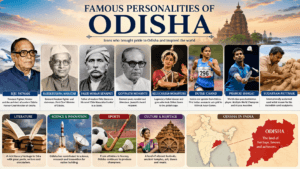
Famous Personalities of Odisha
Odisha has produced numerous visionary leaders, freedom fighters, scientists, literary icons, artists, industrialists, sportspersons, and social reformers who have made remarkable contributions at both the national and international levels. Their achievements have enriched India’s cultural, political, scientific, and sporting heritage.
One of the most respected leaders from Odisha is Biju Patnaik, a legendary freedom fighter, aviator, industrialist, and former Chief Minister of Odisha. He played a significant role in India’s freedom movement and was internationally recognized for assisting Indonesia during its struggle for independence. Odisha’s capital airport, Biju Patnaik International Airport, is named in his honour.
Harekrushna Mahatab, another distinguished freedom fighter and former Chief Minister, played a vital role in the formation and development of modern Odisha. He was also an accomplished writer and journalist.
In the field of science, Dr. Pramod Kale, a renowned space scientist from Odisha, made valuable contributions to India’s satellite and space programmes through ISRO.
Odisha has made remarkable contributions to Indian literature through personalities like Fakir Mohan Senapati, widely regarded as the Father of Modern Odia Literature, and Gopinath Mohanty, a celebrated Jnanpith Award-winning novelist whose works beautifully portray Odisha’s tribal life and culture.
The state has also produced internationally acclaimed artists such as Kelucharan Mohapatra, one of the greatest exponents of Odissi dance, who played a pivotal role in popularizing the classical dance form across the world.
In sports, Odisha has earned global recognition through athletes like Dutee Chand, an international sprinter and Olympian, and Pramod Bhagat, a Paralympic gold medal-winning badminton player. The state is also recognized as India’s “Sports Capital” for successfully hosting multiple international hockey tournaments, including the FIH Men’s Hockey World Cup.
These distinguished personalities continue to inspire generations through their contributions to public service, literature, science, sports, arts, and nation-building.
Famous Personalities of Odisha
| Personality | Field | Contribution |
|---|---|---|
| Biju Patnaik | Politics & Freedom Movement | Former Chief Minister, Freedom Fighter, Aviator |
| Harekrushna Mahatab | Politics & Literature | Freedom Fighter and Former Chief Minister |
| Fakir Mohan Senapati | Literature | Father of Modern Odia Literature |
| Gopinath Mohanty | Literature | Jnanpith Award-winning Novelist |
| Kelucharan Mohapatra | Classical Dance | Legendary Odissi Guru |
| Dutee Chand | Athletics | International Sprinter & Olympian |
| Pramod Bhagat | Para Badminton | Paralympic Gold Medalist |
| Nandini Satpathy | Politics | Former Chief Minister of Odisha |
| Sudarsan Pattnaik | Sand Art | International Sand Artist |
| Dr. Pramod Kale | Science | Space Scientist |
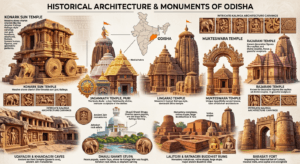
Architecture & Historical Monuments of Odisha
Odisha is renowned for its magnificent Kalinga-style architecture, which represents one of the finest traditions of Indian temple construction. The state’s architectural heritage spans over two thousand years and reflects the influence of Hinduism, Buddhism, and Jainism. From grand stone temples and rock-cut caves to ancient stupas and forts, Odisha preserves an extraordinary collection of historical monuments that attract historians, architects, archaeologists, and tourists from around the world.
The Konark Sun Temple, a UNESCO World Heritage Site, is Odisha’s most iconic monument. Built in the 13th century CE by King Narasimhadeva I of the Eastern Ganga Dynasty, the temple is designed as a colossal stone chariot dedicated to Surya (the Sun God). Its 24 intricately carved wheels, seven stone horses, and exquisite sculptures make it one of the greatest masterpieces of medieval Indian architecture.
The Jagannath Temple at Puri, built during the 12th century by King Anantavarman Chodaganga Deva, is one of the holiest Hindu pilgrimage sites and one of the Char Dham shrines. The temple is world-famous for the annual Rath Yatra, during which millions of devotees gather to witness the grand chariot procession.
Located in Bhubaneswar, the Lingaraj Temple is considered the finest example of mature Kalinga architecture. Dedicated to Lord Shiva, this 11th-century temple is admired for its towering 180-foot (55 m) shikhara, detailed stone carvings, and spiritual significance. Other notable temples include the Mukteswara Temple, often called the “Gem of Odisha Architecture,” and the Rajarani Temple, celebrated for its elegant sculptures and unique red-and-yellow sandstone construction.
The state also preserves remarkable Buddhist and Jain heritage. The Udayagiri and Khandagiri Caves, dating back to the 1st century BCE, contain beautifully carved rock-cut shelters and inscriptions associated with King Kharavela. The Diamond Triangle—comprising Lalitgiri, Ratnagiri, and Udayagiri—is one of India’s most important Buddhist archaeological complexes, featuring monasteries, stupas, sculptures, and relics.
Other historically significant monuments include the Dhauli Shanti Stupa, Barabati Fort, Sisupalgarh Fort, Chausathi Yogini Temple, and Hirapur Temple, each reflecting Odisha’s rich architectural, religious, and cultural legacy.
Today, these monuments stand as enduring symbols of Odisha’s artistic excellence, engineering brilliance, and historical importance, making the state one of India’s premier heritage destinations.
Major Historical Monuments of Odisha
| Monument | Location | Significance |
|---|---|---|
| Konark Sun Temple | Konark | UNESCO World Heritage Site |
| Jagannath Temple | Puri | Char Dham Pilgrimage |
| Lingaraj Temple | Bhubaneswar | Finest Kalinga Architecture |
| Mukteswara Temple | Bhubaneswar | Gem of Odisha Architecture |
| Rajarani Temple | Bhubaneswar | Sandstone Temple & Sculptures |
| Udayagiri & Khandagiri Caves | Bhubaneswar | Ancient Jain Rock-cut Caves |
| Dhauli Shanti Stupa | Dhauli | Kalinga War & Buddhist Peace Monument |
| Lalitgiri | Jajpur | Ancient Buddhist Monastery |
| Ratnagiri | Jajpur | Buddhist University & Stupas |
| Barabati Fort | Cuttack | Medieval Fort of Odisha |
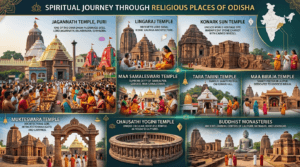
Religious Places of Odisha
The state is one of India’s most sacred states, renowned for its ancient temples, pilgrimage centres, Buddhist monasteries, Jain caves, and spiritual heritage. Often referred to as the “Land of Temples,” Odisha attracts millions of pilgrims and tourists every year. The state’s religious traditions have flourished for over two thousand years, with influences from Hinduism, Buddhism, Jainism, and tribal faiths.
The Jagannath Temple in Puri is the most famous religious site in Odisha and one of the Char Dham pilgrimage destinations of Hinduism. Built during the 12th century by King Anantavarman Chodaganga Deva, the temple is dedicated to Lord Jagannath, along with Lord Balabhadra and Goddess Subhadra. The annual Rath Yatra is one of the world’s largest religious festivals, attracting millions of devotees from across the globe.
The Lingaraj Temple in Bhubaneswar is one of India’s finest examples of Kalinga architecture and is dedicated to Lord Shiva. Standing over 180 feet (55 metres) tall, it is regarded as the spiritual centre of the Temple City of Bhubaneswar.
Another architectural masterpiece is the Konark Sun Temple, dedicated to Surya (the Sun God). Although it is no longer an active temple, it remains one of India’s most important religious and cultural monuments and is recognized as a UNESCO World Heritage Site.
The Maa Samaleswari Temple in Sambalpur is one of western Odisha’s most revered shrines, while the Tara Tarini Temple in Ganjam district is one of India’s ancient Shakti Peethas. Other important temples include the Maa Biraja Temple (Jajpur), Maa Mangala Temple (Kakatpur), Mukteswara Temple, Rajarani Temple, and the Chausathi Yogini Temple at Hirapur.
The state also preserves an extraordinary Buddhist heritage through the Diamond Triangle—Lalitgiri, Ratnagiri, and Udayagiri—which contains ancient monasteries, stupas, sculptures, and relics dating back to the early centuries of Buddhism in India.
These sacred places reflect Odisha’s deep spiritual traditions, religious harmony, remarkable temple architecture, and enduring cultural heritage.
Major Religious Places in Odisha
| Religious Place | Location | Dedicated To / Significance |
|---|---|---|
| Jagannath Temple | Puri | Lord Jagannath, Char Dham |
| Lingaraj Temple | Bhubaneswar | Lord Shiva |
| Konark Sun Temple | Konark | Surya (Sun God), UNESCO Site |
| Maa Samaleswari Temple | Sambalpur | Goddess Samaleswari |
| Tara Tarini Temple | Ganjam | Shakti Peetha |
| Maa Biraja Temple | Jajpur | Goddess Biraja |
| Maa Mangala Temple | Kakatpur | Goddess Mangala |
| Mukteswara Temple | Bhubaneswar | Lord Shiva |
| Chausathi Yogini Temple | Hirapur | 64 Yoginis |
| Lalitgiri-Ratnagiri-Udayagiri | Jajpur | Ancient Buddhist Heritage |
GI Tagged Products of Odisha
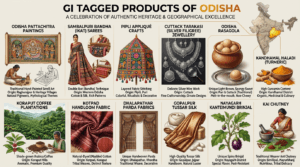
Odisha is renowned for its rich artistic traditions, handloom textiles, handicrafts, agricultural products, and traditional foods, many of which have received Geographical Indication (GI) Tags. A GI Tag is an intellectual property right that recognizes products originating from a specific geographical region and possessing unique qualities, reputation, or characteristics linked to that location.
One of Odisha’s most celebrated GI products is Odisha Pattachitra, a traditional scroll painting originating from Raghurajpur and surrounding regions of Puri. Created using natural colours on cloth, these paintings depict stories from the Ramayana, Mahabharata, and the life of Lord Jagannath.
The state is equally famous for Sambalpuri Bandha (Ikat) handloom textiles, produced mainly in Sambalpur, Bargarh, Sonepur, and Boudh districts. These intricately woven sarees and fabrics are admired for their unique tie-and-dye technique and vibrant geometric patterns.
Another internationally recognized craft is Pipili Appliqué Work, known for colourful embroidered fabric used to make umbrellas, wall hangings, lampshades, bags, and decorative items. Cuttack Tarakasi (Silver Filigree) is another iconic GI product, featuring delicate silver jewellery and decorative artefacts crafted using fine silver wires.
Odisha has also earned GI recognition for Odisha Rasagola, Koraput Coffee, Nayagarh Kanteimundi Brinjal, Kandhamal Haladi (Turmeric), Kai Chutney, Kotpad Handloom Fabric, Dhalapathar Parda & Fabrics, and Gopalpur Tussar Fabrics, among several others.
These GI-tagged products not only preserve Odisha’s cultural heritage and traditional knowledge but also provide livelihoods to thousands of artisans, farmers, weavers, and craftsmen while promoting the state’s identity in national and international markets.
Major GI Tagged Products of Odisha
| GI Product | Category | Famous Region |
|---|---|---|
| Odisha Pattachitra | Traditional Painting | Puri (Raghurajpur) |
| Sambalpuri Bandha (Ikat) | Handloom Textile | Sambalpur, Bargarh |
| Pipili Appliqué Work | Handicraft | Pipili |
| Cuttack Tarakasi | Jewellery & Handicraft | Cuttack |
| Odisha Rasagola | Sweet | Odisha |
| Kandhamal Haladi | Agricultural Product | Kandhamal |
| Koraput Coffee | Coffee | Koraput |
| Kotpad Handloom Fabric | Textile | Koraput |
| Dhalapathar Parda & Fabrics | Handloom | Khordha |
| Gopalpur Tussar Fabrics | Silk Textile | Ganjam |
| Nayagarh Kanteimundi Brinjal | Vegetable | Nayagarh |
| Kai Chutney | Traditional Food | Mayurbhanj |
Education & Universities of Odisha
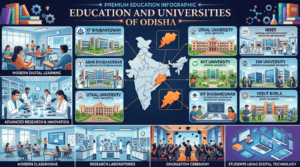
Odisha has emerged as one of India’s leading educational destinations, offering quality education through its universities, engineering colleges, medical institutions, research centres, management schools, and skill development institutes. The state has made significant progress in higher education, technical education, vocational training, and research, attracting students from across India and abroad.
The capital city Bhubaneswar, often called the “Education Hub of Eastern India,” is home to several prestigious institutions, including the Indian Institute of Technology (IIT Bhubaneswar), All India Institute of Medical Sciences (AIIMS Bhubaneswar), National Institute of Science Education and Research (NISER), Xavier Institute of Management, Bhubaneswar (XIM University), and KIIT University.
Utkal University, established in 1943, is the oldest university in Odisha and one of the oldest universities in eastern India. It offers undergraduate, postgraduate, doctoral, and research programmes across various disciplines including science, arts, commerce, law, and management.
Odisha is also known for its excellent engineering and technical education. Institutions such as Veer Surendra Sai University of Technology (VSSUT), Odisha University of Technology and Research (OUTR), and IIIT Bhubaneswar produce highly skilled engineers and technology professionals.
Medical education has also witnessed rapid growth with institutions such as SCB Medical College and Hospital (Cuttack), MKCG Medical College (Berhampur), VIMSAR (Burla), and AIIMS Bhubaneswar, which provide quality healthcare education and advanced medical research.
The state government actively promotes digital education, research, innovation, vocational training, startup incubation, skill development, and industry-academia collaboration. Odisha is steadily strengthening its position as an important centre for higher education, scientific research, and technological innovation in India.
Major Universities & Educational Institutions of Odisha
| Institution | Location | Specialization |
|---|---|---|
| Utkal University | Bhubaneswar | General Higher Education |
| IIT Bhubaneswar | Bhubaneswar | Engineering & Technology |
| AIIMS Bhubaneswar | Bhubaneswar | Medical Education |
| NISER | Bhubaneswar | Science & Research |
| KIIT University | Bhubaneswar | Multidisciplinary Education |
| XIM University | Bhubaneswar | Management Studies |
| IIIT Bhubaneswar | Bhubaneswar | Information Technology |
| VSSUT | Burla | Engineering |
| OUTR | Bhubaneswar | Engineering & Research |
| SCB Medical College | Cuttack | Medical Sciences |
Major Industries & Economy of Odisha
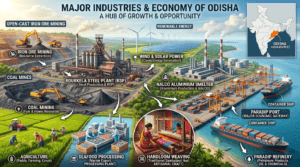
Odisha has one of the fastest-growing economies in eastern India and is widely recognized for its mineral wealth, heavy industries, manufacturing sector, agriculture, fisheries, ports, tourism, and information technology. The state possesses abundant natural resources and has emerged as a major hub for steel, aluminium, mining, power generation, petrochemicals, and metal industries.
Odisha is one of India’s leading producers of iron ore, bauxite, chromite, manganese, coal, limestone, and nickel. These rich mineral reserves have attracted significant investments from both public and private sector industries. The state contributes substantially to India’s production of steel and aluminium, making it one of the country’s most industrialized mineral-rich states.
The steel industry plays a crucial role in Odisha’s economy. Major integrated steel plants operated by SAIL (Rourkela Steel Plant), Tata Steel, JSW Steel, Jindal Steel & Power (JSPL), and AM/NS India have strengthened Odisha’s position as India’s steel manufacturing powerhouse.
The aluminium sector is led by companies such as NALCO, Vedanta Aluminium, and Hindalco Industries, utilizing Odisha’s vast bauxite reserves. The state is also an important centre for power generation, with numerous thermal, hydroelectric, and renewable energy projects supporting industrial growth.
Odisha’s Paradip Port, Dhamra Port, and Gopalpur Port serve as major gateways for exports and imports, facilitating international trade in minerals, petroleum products, fertilizers, and industrial goods. The Paradip Petroleum, Chemicals and Petrochemicals Investment Region (PCPIR) further strengthens the state’s industrial ecosystem.
Besides heavy industries, agriculture, fisheries, forestry, tourism, handloom, handicrafts, food processing, and MSMEs (Micro, Small and Medium Enterprises) contribute significantly to employment and rural development. The state government actively promotes industrial investment, startup ecosystems, skill development, ease of doing business, and sustainable economic growth.
With its strategic location, abundant resources, world-class ports, and expanding infrastructure, Odisha continues to emerge as one of India’s most important industrial and economic growth centres.
Major Industries of Odisha
| Industry | Major Products / Companies |
|---|---|
| Steel | Rourkela Steel Plant (SAIL), Tata Steel, JSW Steel, JSPL |
| Aluminium | NALCO, Vedanta Aluminium, Hindalco |
| Mining | Iron Ore, Bauxite, Chromite, Coal, Manganese |
| Power | Thermal, Hydroelectric & Renewable Energy |
| Petrochemicals | Paradip Refinery & PCPIR |
| Fertilizers | Paradip Fertilizers |
| Handloom & Handicrafts | Sambalpuri Ikat, Pattachitra, Pipili Appliqué |
| Food Processing | Rice, Seafood, Cashew, Spices |
| Fisheries | Marine & Inland Fisheries |
| Tourism | Heritage, Wildlife, Beaches & Pilgrimage |

Sports & Stadiums of Odisha
Odisha has emerged as one of India’s leading sporting states, earning the reputation of being the “Sports Capital of India.” The state has made remarkable investments in sports infrastructure, athlete development, coaching facilities, and international sporting events. Through progressive sports policies and world-class stadiums, Odisha has become a major destination for national and international competitions.
The Kalinga Stadium in Bhubaneswar is the state’s premier sports complex and one of India’s finest multi-sport venues. Equipped with modern facilities for hockey, athletics, football, swimming, tennis, and indoor sports, it has hosted numerous prestigious events, including the FIH Men’s Hockey World Cup in 2018 and 2023, the FIH Hockey Pro League, and several national championships.
Odisha has played a pioneering role in promoting hockey, India’s national sport. The Government of Odisha became the official sponsor of the Indian Men’s and Women’s National Hockey Teams, making the state internationally recognized for its commitment to sports development.
Apart from hockey, Odisha has produced talented athletes in athletics, badminton, weightlifting, cricket, football, boxing, and para sports. International athletes such as Dutee Chand, one of India’s fastest sprinters, and Pramod Bhagat, a Paralympic gold medal-winning badminton player, have brought global recognition to the state.
Other important sports venues include the Barabati Stadium in Cuttack, famous for hosting international cricket matches; Birsa Munda Hockey Stadium in Rourkela, one of the world’s largest hockey stadiums by seating capacity; and the Jawaharlal Nehru Indoor Stadium in Cuttack, which hosts badminton, basketball, volleyball, and indoor sporting events.
The state government continues to promote grassroots sports through sports hostels, high-performance centres, talent identification programmes, and rural sports initiatives, encouraging young athletes to compete at national and international levels.
With world-class infrastructure and consistent support for athletes, Odisha has become a model state for sports development in India.
| Stadium / Sports Centre | Location | Famous For |
|---|---|---|
| Kalinga Stadium | Bhubaneswar | Hockey, Athletics & International Events |
| Birsa Munda Hockey Stadium | Rourkela | One of the World’s Largest Hockey Stadiums |
| Barabati Stadium | Cuttack | International Cricket Matches |
| Jawaharlal Nehru Indoor Stadium | Cuttack | Indoor Sports |
| KIIT International Cricket Stadium | Bhubaneswar | Cricket |
| Odisha Naval Tata Hockey High Performance Centre | Bhubaneswar | Hockey Training |
| Dhyan Chand Hockey Training Centre | Sundargarh | Grassroots Hockey Development |
Why Odisha is Famous
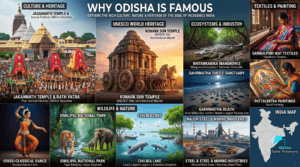
Odisha is one of India’s most culturally rich and historically significant states, renowned for its ancient temples, classical dance, pristine beaches, wildlife sanctuaries, rich mineral resources, vibrant festivals, traditional handicrafts, and spiritual heritage. Located on the eastern coast of India along the Bay of Bengal, Odisha attracts millions of pilgrims, tourists, researchers, wildlife enthusiasts, and nature lovers every year.
The state is internationally famous for the Jagannath Temple in Puri, one of the Char Dham pilgrimage sites of Hinduism. Every year, the world-famous Rath Yatra attracts millions of devotees who gather to witness the magnificent chariot procession of Lord Jagannath, Lord Balabhadra, and Goddess Subhadra.
Odisha is also home to the Konark Sun Temple, a UNESCO World Heritage Site and one of the greatest masterpieces of Kalinga architecture. Designed as a gigantic stone chariot dedicated to the Sun God, the temple symbolizes India’s architectural brilliance and artistic excellence.
Nature lovers admire Odisha for Chilika Lake, Asia’s largest brackish water lagoon, famous for Irrawaddy Dolphins, migratory birds, and scenic islands. The state is equally renowned for Bhitarkanika National Park, Similipal National Park, and the annual mass nesting of Olive Ridley Sea Turtles at Gahirmatha and Rushikulya, one of the largest such events in the world.
Odisha is the birthplace of Odissi, one of the eight classical dance forms of India, and is celebrated for its exquisite handicrafts including Pattachitra paintings, Sambalpuri Ikat, Pipili Appliqué, Cuttack Silver Filigree (Tarakasi), and numerous GI-tagged products.
The state is also one of India’s leading producers of iron ore, bauxite, chromite, coal, and aluminium, making it an important industrial and mining hub. At the same time, agriculture, fisheries, tourism, and handloom industries contribute significantly to its economy.
Often called the “Soul of Incredible India,” Odisha offers a unique combination of spirituality, history, culture, biodiversity, adventure, and modern development. Its timeless heritage, warm hospitality, and diverse attractions make it one of India’s most fascinating destinations.
Why Odisha is Famous
| Attraction | Why It Is Famous |
|---|---|
| Jagannath Temple | Char Dham Pilgrimage & Rath Yatra |
| Konark Sun Temple | UNESCO World Heritage Site |
| Chilika Lake | Asia’s Largest Brackish Water Lagoon |
| Similipal National Park | Tigers, Elephants & UNESCO Biosphere Reserve |
| Bhitarkanika National Park | Saltwater Crocodiles & Mangroves |
| Odissi Dance | Classical Dance of India |
| Pattachitra | Traditional Scroll Painting |
| Sambalpuri Ikat | World-famous Handloom |
| Olive Ridley Turtles | Mass Nesting at Gahirmatha |
| Mineral Resources | Steel, Aluminium & Mining Hub |
Frequently Asked Questions (FAQs) About Odisha
1. What is Odisha famous for?
Odisha is famous for the Jagannath Temple, Konark Sun Temple, Chilika Lake, Rath Yatra, Odissi dance, Pattachitra paintings, Sambalpuri Ikat, and its rich cultural and spiritual heritage.
2. What is the capital of Odisha?
The capital city of Odisha is Bhubaneswar, also known as the Temple City of India.
3. Which is the largest city in Odisha?
Bhubaneswar is the largest city and the administrative capital of Odisha.
4. Which language is spoken in Odisha?
Odia is the official language of Odisha. Hindi and English are also widely understood.
5. Which is the famous temple in Odisha?
The Jagannath Temple in Puri is the most famous temple and one of the Char Dham pilgrimage sites of Hinduism.
6. Which UNESCO World Heritage Site is located in Odisha?
The Konark Sun Temple is Odisha’s UNESCO World Heritage Site.
7. What is the best time to visit Odisha?
The best time to visit Odisha is from October to March, when the weather is pleasant for sightseeing and festivals.
8. What is Chilika Lake famous for?
Chilika Lake is Asia’s largest brackish water lagoon, famous for Irrawaddy Dolphins, migratory birds, and boating.
9. Which national parks are located in Odisha?
Major national parks include Similipal National Park and Bhitarkanika National Park.
10. What are the famous foods of Odisha?
Popular Odia dishes include Pakhala Bhata, Dalma, Chhena Poda, Mahaprasad, Rasagola, Khaja, and seafood.
11. What are the major festivals of Odisha?
Major festivals include Rath Yatra, Durga Puja, Raja Parba, Nuakhai, Boita Bandana, and Konark Dance Festival.
12. What are the famous handicrafts of Odisha?
Odisha is known for Pattachitra paintings, Sambalpuri Ikat, Pipili Appliqué, Cuttack Silver Filigree (Tarakasi), and Dhokra metal crafts.
13. What are the major rivers of Odisha?
Major rivers include the Mahanadi, Brahmani, Baitarani, Subarnarekha, Rushikulya, Indravati, and Kolab.
14. Which airport serves Odisha?
Biju Patnaik International Airport in Bhubaneswar is the state’s primary international airport.
15. Why is Odisha called the Soul of Incredible India?
Odisha is called the “Soul of Incredible India” because of its unique blend of ancient temples, spiritual traditions, classical arts, wildlife, beaches, and vibrant cultural heritage.
Conclusion
Odisha is a land where history, spirituality, culture, nature, and modern development come together to create an unforgettable experience. From the sacred Jagannath Temple and the magnificent Konark Sun Temple to the tranquil waters of Chilika Lake and the lush forests of Similipal National Park, the state offers something for every traveler.
Rich in ancient heritage, vibrant festivals, classical Odissi dance, colourful handicrafts, delicious cuisine, and breathtaking landscapes, Odisha showcases the true essence of India’s cultural diversity. The state is also a leader in mining, steel, aluminium, sports, tourism, and education, making it one of the fastest-growing regions in the country.
Whether you are a pilgrim, history enthusiast, wildlife lover, adventure seeker, student, or cultural explorer, Odisha promises a unique and memorable journey. Its warm hospitality, timeless traditions, and remarkable attractions continue to inspire visitors from across India and around the world.
Plan your visit to Odisha and discover why it is proudly known as the “Soul of Incredible India.”
Internal links
Andhra Pradesh
https://dealkartmarket.in/andhra-pradesh/
Telangana
https://dealkartmarket.in/telangana/
Karnataka
https://dealkartmarket.in/karnataka/
Tamil Nadu
https://dealkartmarket.in/tamil-nadu/
Kerala
https://dealkartmarket.in/kerala/
Maharashtra
https://dealkartmarket.in/maharashtra/
Goa
https://dealkartmarket.in/goa/
Gujarat
https://dealkartmarket.in/gujarat/
Rajasthan
https://dealkartmarket.in/rajasthan/
Madhya Pradesh
https://dealkartmarket.in/madhya-pradesh/
Himachal Pradesh
https://dealkartmarket.in/himachal-pradesh/
Haryana
https://dealkartmarket.in/haryana/
Punjab
https://dealkartmarket.in/punjab/
Uttarakhand
https://dealkartmarket.in/uttarakhand/
Uttar Pradesh
https://dealkartmarket.in/uttar-pradesh/
References
Government of Odisha – https://odisha.gov.in/
Odisha Tourism – https://odishatourism.gov.in/
Incredible India – https://www.incredibleindia.gov.in/
Ministry of Tourism, Government of India – https://tourism.gov.in/
India Brand Equity Foundation (IBEF) – https://www.ibef.org/
Census of India – https://censusindia.gov.in/
Geological Survey of India – https://www.gsi.gov.in/
India Meteorological Department (IMD) – https://mausam.imd.gov.in/
Ministry of Environment, Forest and Climate Change – https://moef.gov.in/
UNESCO World Heritage Centre – https://whc.unesco.org/
Archaeological Survey of India (ASI) – https://asi.nic.in/
National Informatics Centre (NIC) – https://www.nic.in/