
Introduction
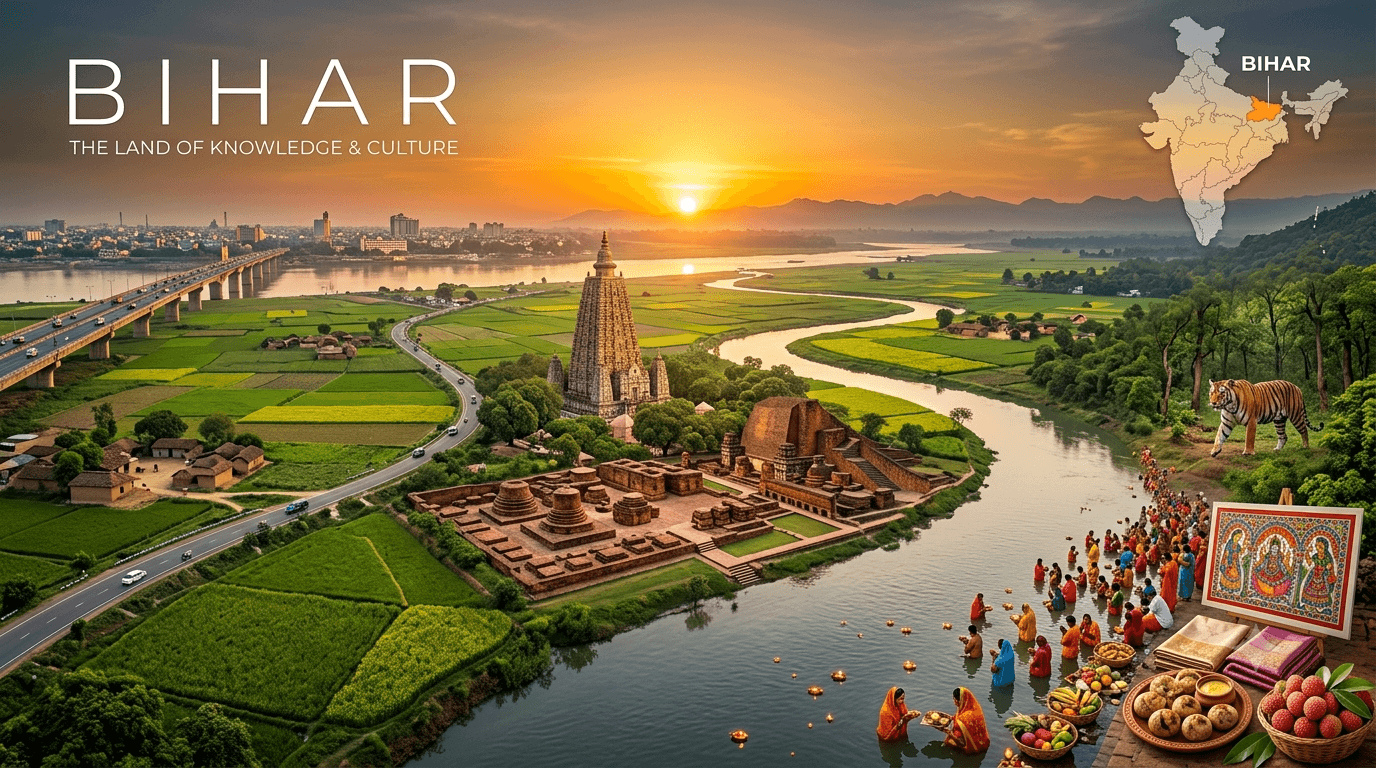
Bihar is one of India’s oldest and most historically significant states, located in the eastern part of the country. Known as the cradle of ancient Indian civilization, Bihar has played a vital role in shaping India’s history, culture, education, religion, and politics. It was the heart of the Magadha Empire, home to the world’s oldest universities, and the birthplace of many great rulers, scholars, saints, and freedom fighters.
The state is globally renowned as the land where Lord Buddha attained enlightenment at Bodh Gaya and where Lord Mahavira, the 24th Tirthankara of Jainism, was born. Bihar is also home to Nalanda University, one of the world’s oldest residential universities, which attracted scholars from across Asia.
The fertile plains of the Ganga River make BR one of India’s leading agricultural states, producing crops such as rice, wheat, maize, sugarcane, fruits, vegetables, and makhana (fox nuts). In addition to agriculture, Bihar is known for its rich traditions, Madhubani (Mithila) Paintings, Bhagalpuri Silk, Chhath Puja, and delicious cuisine like Litti Chokha.
Today, BR is rapidly developing through investments in infrastructure, education, tourism, industry, and digital services. With its UNESCO World Heritage Sites, vibrant festivals, diverse wildlife, religious landmarks, and growing economy, BR offers a unique blend of ancient heritage and modern progress.
Whether you are a history enthusiast, pilgrim, student, traveller, or investor, Bihar provides an unforgettable experience through its timeless legacy and dynamic future.
Introduction Highlights
| Feature | Details |
|---|---|
| Location | Eastern India |
| Capital | Patna |
| Known As | Land of Buddha & Ancient Magadha |
| UNESCO World Heritage Sites | Mahabodhi Temple & Nalanda Mahavihara |
| Famous Festival | Chhath Puja |
| Famous Food | Litti Chokha |
| Famous Art | Madhubani (Mithila) Painting |
| Major River | Ganga River |
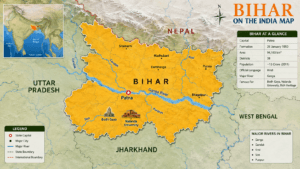
Bihar is located in eastern India and shares borders with Nepal, Uttar Pradesh, Jharkhand, and West Bengal.
Bihar on the India Map
The state is located in eastern India and occupies a strategic position in the fertile Indo-Gangetic Plain. The state shares an international border with Nepal to the north and is surrounded by Uttar Pradesh to the west, Jharkhand to the south, and West Bengal to the east. This geographical location has made the state an important centre for trade, agriculture, culture, and education for thousands of years.
The mighty Ganga River flows from west to east across BR, dividing the state into North The state and South Bihar. Several major Himalayan rivers, including the Kosi, Gandak, Bagmati, Kamla Balan, and Mahananda, flow through the state before joining the Ganga, creating one of India’s most fertile agricultural regions.
Patna, the capital city, is situated on the southern bank of the Ganga River and serves as Bihar’s administrative, economic, educational, and cultural hub. The state’s strategic location provides excellent connectivity to northern and eastern India through road, rail, air, and inland waterways.
Because of its location, BR became the heart of the ancient Magadha Empire and later emerged as a global centre for Buddhism, Jainism, and higher education, with world-famous institutions such as Nalanda University.
Districts of Bihar
BR is administratively divided into 38 districts, which are grouped under 9 administrative divisions. Each district is headed by a District Magistrate (DM), who is responsible for administration, law and order, revenue management, disaster response, and implementation of government welfare schemes.
Patna, the capital district, is Bihar’s largest urban and administrative centre. Other important districts include Gaya, known for the Mahabodhi Temple and Vishnupad Temple; Nalanda, famous for the ancient Nalanda University; Muzaffarpur, renowned for its GI-tagged Shahi Litchi; Bhagalpur, known as the Silk City of India; and Darbhanga, the cultural heart of the Mithila region.
The state is divided into the following 9 administrative divisions:
- Patna Division
- Tirhut Division
- Saran Division
- Darbhanga Division
- Kosi Division
- Purnia Division
- Bhagalpur Division
- Munger Division
- Magadh Division
These districts contribute significantly to Bihar’s agriculture, education, tourism, industries, trade, and cultural heritage. Efficient district administration helps deliver public services and supports the state’s overall development.
Administrative Divisions of Bihar
| Division | Number of Districts |
|---|---|
| Patna | 6 |
| Tirhut | 6 |
| Saran | 3 |
| Darbhanga | 3 |
| Kosi | 3 |
| Purnia | 4 |
| Bhagalpur | 2 |
| Munger | 6 |
| Magadh | 5 |
List of 38 Districts of Bihar
Araria, Arwal, Aurangabad, Banka, Begusarai, Bhagalpur, Bhojpur, Buxar, Darbhanga, East Champaran, Gaya, Gopalganj, Jamui, Jehanabad, Kaimur, Katihar, Khagaria, Kishanganj, Lakhisarai, Madhepura, Madhubani, Munger, Muzaffarpur, Nalanda, Nawada, Patna, Purnia, Rohtas, Saharsa, Samastipur, Saran, Sheikhpura, Sheohar, Sitamarhi, Siwan, Supaul, Vaishali, and West Champaran.
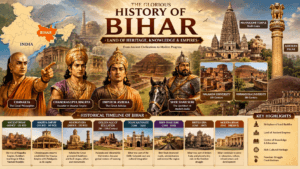
Explore the rich history of Bihar, from the ancient Magadha Kingdom and Maurya Empire to modern Bihar.
History of Bihar
BR has one of the oldest and richest histories in the world, with a legacy spanning more than 3,000 years. The region was the heart of several powerful kingdoms and empires that shaped the political, cultural, educational, and religious history of India. Ancient Bihar was known as Magadha, one of the sixteen Mahajanapadas (great kingdoms) of ancient India.
During the 6th century BCE, Magadha emerged as a dominant power under rulers such as Bimbisara and Ajatashatru. Later, the Nanda Dynasty expanded the kingdom before it was succeeded by the Maurya Empire, founded by Chandragupta Maurya with the guidance of the renowned scholar Chanakya (Kautilya).
The Mauryan ruler Emperor Ashoka transformed Bihar into the centre of Buddhism after embracing the religion following the Kalinga War. He built numerous stupas, pillars, monasteries, and roads, helping spread Buddhism across Asia.
Between the 4th and 6th centuries CE, the Gupta Empire, often called the Golden Age of India, flourished in Bihar. This period witnessed remarkable achievements in science, mathematics, astronomy, literature, art, and architecture. The great mathematician Aryabhata is closely associated with this era.
The state also became a global centre of education through Nalanda University and Vikramshila University, attracting scholars from China, Korea, Tibet, Sri Lanka, and Southeast Asia. These universities were among the world’s earliest residential institutions of higher learning.
During the medieval period, Bihar came under the rule of the Delhi Sultanate, followed by the Mughal Empire. In the 16th century, Sher Shah Suri, born in Sasaram, introduced major administrative reforms, improved the Grand Trunk Road, and established an efficient currency and postal system.
Under British rule, BR was part of the Bengal Presidency until it became a separate province on 22 March 1912. After India’s independence in 1947, Bihar became a full-fledged state of the Republic of India. On 15 November 2000, the southern districts of Bihar were separated to form the new state of Jharkhand.
Today, The state is recognised worldwide for its ancient civilisation, spiritual heritage, educational legacy, and rapidly developing economy.
History of Bihar Timeline
| Period | Major Event |
|---|---|
| Ancient Period | Magadha Kingdom Established |
| 6th Century BCE | Rule of Bimbisara & Ajatashatru |
| 4th Century BCE | Maurya Empire Founded |
| 3rd Century BCE | Emperor Ashoka Spread Buddhism |
| 4th–6th Century CE | Gupta Empire (Golden Age of India) |
| 5th Century CE | Nalanda University Flourished |
| 8th Century CE | Vikramshila University Established |
| 16th Century | Sher Shah Suri’s Administration |
| 22 March 1912 | Bihar Became a Separate Province |
| 15 November 2000 | Formation of Jharkhand |
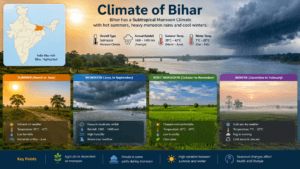
Explore Bihar’s subtropical climate, including summer, monsoon, and winter seasons with average temperatures and rainfall.
Climate of Bihar
The state experiences a subtropical climate with three main seasons: summer, monsoon, and winter. The state’s climate is greatly influenced by the Himalayas to the north and the Ganga River, which flows across the central part of the state. Due to its fertile alluvial plains and abundant river systems, BR supports extensive agriculture throughout the year.
The summer season lasts from March to June, with temperatures ranging from 30°C to 45°C. May is usually the hottest month, and hot, dry winds known as Loo are common in many parts of the state.
The southwest monsoon arrives in June and continues until September, bringing nearly 1,000–1,700 mm of annual rainfall. Northern districts generally receive more rainfall than southern districts due to their proximity to the Himalayan foothills. Rivers such as the Kosi, Gandak, and Bagmati may overflow during this season, causing floods in some areas.
The winter season, from November to February, is cool and pleasant, with temperatures ranging between 5°C and 25°C. Dense fog is common during December and January, especially in northern BR. Winter is considered the best season for tourism, wildlife safaris, pilgrimage, and sightseeing.
Overall, Bihar’s climate supports rich biodiversity, high agricultural productivity, and a variety of seasonal crops, making it one of India’s important farming regions.
Climate of Bihar at a Glance
| Season | Months | Temperature | Characteristics |
|---|---|---|---|
| Summer | March – June | 30°C – 45°C | Hot and Dry |
| Monsoon | June – September | 25°C – 35°C | Heavy Rainfall & Floods |
| Winter | November – February | 5°C – 25°C | Cool, Pleasant & Foggy |
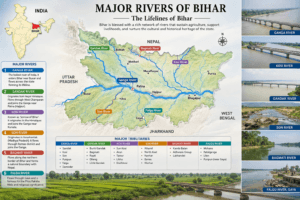
Explore the major rivers of Bihar that support agriculture, irrigation, biodiversity, and cultural heritage.
Major Rivers of Bihar
BR is blessed with an extensive network of rivers that play a vital role in the state’s agriculture, irrigation, drinking water supply, fisheries, transportation, and biodiversity. Most of these rivers originate in the Himalayas or the Chotanagpur Plateau and eventually join the Ganga River, which is the lifeline of Bihar.
The Ganga River is the longest and most important river in Bihar. Flowing from west to east across the state, it divides Bihar into North Bihar and South Bihar while supporting millions of people through agriculture, trade, and religious activities.
The Kosi River, often called the “Sorrow of Bihar,” originates in Nepal and is known for frequent flooding due to its shifting course. The Gandak River, another major Himalayan river, provides irrigation and fertile alluvial soil to northern Bihar.
The Son River, originating in the Amarkantak Hills, joins the Ganga near Patna and is an important source of irrigation and hydroelectric potential. The Bagmati River, Kamla Balan River, and Mahananda River also originate in Nepal and contribute significantly to agriculture in northern Bihar.
Other important rivers include the Falgu River at Gaya, which holds immense religious significance for Hindu pilgrims performing Pind Daan rituals, and the Punpun River, which flows through central Bihar before joining the Ganga.
The fertile floodplains created by these rivers make Bihar one of India’s leading agricultural states. However, seasonal flooding, especially in northern Bihar, remains a major challenge, leading to government initiatives for flood control, embankment construction, and river management.
The rivers of BR are not only essential for the economy but also hold great cultural, historical, and religious importance.
Major Rivers of Bihar at a Glance
| River | Origin | Importance |
|---|---|---|
| Ganga | Gangotri Glacier | Lifeline of Bihar |
| Kosi | Himalayas (Nepal) | Known as the “Sorrow of Bihar” |
| Gandak | Nepal Himalayas | Irrigation & Agriculture |
| Son | Amarkantak Hills | Irrigation & Hydropower |
| Bagmati | Nepal | Agriculture & Floodplains |
| Kamla Balan | Nepal | Irrigation |
| Mahananda | Darjeeling Hills | Eastern Bihar Agriculture |
| Falgu | Jharkhand Hills | Religious Significance (Gaya) |
| Punpun | Jharkhand | Tributary of the Ganga |
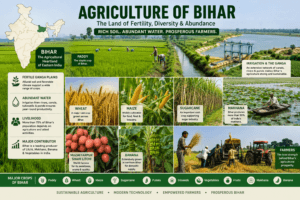
Explore Bihar’s agriculture, famous crops, horticulture, irrigation systems, and farming practices.
Agriculture of Bihar
Agriculture is the backbone of Bihar’s economy, employing more than 70% of the state’s population either directly or indirectly. The fertile Indo-Gangetic Plains, abundant river systems, favourable climate, and rich alluvial soil make Bihar one of India’s leading agricultural states.
The state is a major producer of rice, wheat, maize, pulses, sugarcane, oilseeds, potatoes, onions, and vegetables. Bihar is also famous for its horticultural produce, including Shahi Litchi of Muzaffarpur, Katarni Rice, Makhana (Fox Nuts), Bananas, Mangoes, and Honey. These products are exported to various parts of India and abroad.
Agriculture in Bihar follows three major cropping seasons:
- Kharif (June–October): Rice, maize, and pulses
- Rabi (November–April): Wheat, mustard, gram, and lentils
- Zaid (March–June): Vegetables, watermelon, muskmelon, and fodder crops
Irrigation is supported by the Ganga, Kosi, Gandak, Son, and Bagmati rivers, along with canals, tube wells, and groundwater resources. Despite this, floods in northern BR and occasional droughts in some southern districts remain significant challenges.
The Government of Bihar promotes organic farming, crop diversification, modern irrigation, mechanisation, seed improvement, and farmer welfare schemes to increase productivity and improve farmers’ incomes.
With its fertile land, abundant water resources, and diverse crop production, Bihar continues to play a crucial role in ensuring India’s food security and agricultural development.
Major Crops of Bihar
| Crop | Major Producing Regions |
|---|---|
| Rice | Patna, Purnia, Darbhanga & Bhagalpur |
| Wheat | Bhojpur, Buxar, Rohtas & Patna |
| Maize | Purnia, Katihar, Araria & Kishanganj |
| Sugarcane | West Champaran, Gopalganj & East Champaran |
| Pulses | Gaya, Nalanda & Aurangabad |
| Makhana | Madhubani, Darbhanga & Supaul |
| Shahi Litchi | Muzaffarpur |
| Banana | Vaishali, Katihar & Bhagalpur |
| Mango | Bhagalpur, Patna & Muzaffarpur |
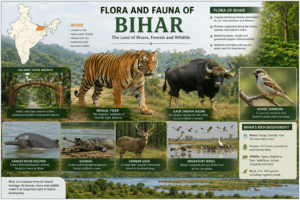
Explore the rich flora and fauna of Bihar, including forests, wildlife, wetlands, and endangered species.
Flora & Fauna of Bihar
BR is home to a diverse range of flora and fauna, supported by its fertile plains, forests, wetlands, rivers, and protected wildlife areas. Although forests cover a relatively small portion of the state’s geographical area, Bihar possesses rich biodiversity, especially in the Valmiki Tiger Reserve, river ecosystems, and wetland habitats.
The forests of Bihar mainly consist of Tropical Moist Deciduous Forests, Dry Deciduous Forests, and Riverine Forests. Common tree species include Sal, Teak, Shisham, Bamboo, Neem, Mahua, Peepal, Banyan, Arjun, and Khair. These forests play a crucial role in maintaining ecological balance and supporting wildlife.
The Valmiki Tiger Reserve, located in West Champaran along the Indo-Nepal border, is Bihar’s only tiger reserve and the state’s largest protected forest. It provides habitat for Bengal Tigers, Leopards, Sloth Bears, Indian Bison (Gaur), Spotted Deer, Sambar Deer, Wild Boars, Barking Deer, and Indian Wolves.
BR is also famous for its rich birdlife. Wetlands and bird sanctuaries attract thousands of migratory birds every winter. Species commonly found include the House Sparrow (State Bird), Sarus Crane, Indian Peafowl, Painted Stork, Black-necked Stork, Asian Openbill, Kingfishers, and several species of ducks and geese.
The rivers of Bihar support important aquatic species such as the Gangetic River Dolphin (India’s National Aquatic Animal), Gharial, freshwater turtles, and numerous fish species. Conservation programmes focus on protecting endangered wildlife, restoring wetlands, and increasing forest cover.
The Government of Bihar actively promotes afforestation, wildlife conservation, wetland restoration, and eco-tourism through various environmental initiatives. These efforts help preserve the state’s biodiversity while supporting sustainable development.
Flora & Fauna at a Glance
| Category | Details |
|---|---|
| Major Forest Types | Tropical Moist Deciduous, Dry Deciduous & Riverine Forests |
| Largest Protected Area | Valmiki Tiger Reserve |
| State Animal | Gaur (Indian Bison) |
| State Bird | House Sparrow |
| National Aquatic Animal | Gangetic River Dolphin |
| Common Mammals | Bengal Tiger, Leopard, Sloth Bear & Sambar Deer |
| Common Trees | Sal, Teak, Shisham, Bamboo, Neem & Mahua |
| Major Bird Species | Sarus Crane, Painted Stork, Indian Peafowl & Kingfisher |
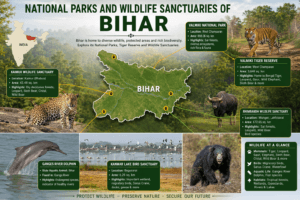
Explore Bihar’s national park, tiger reserve, wildlife sanctuaries, and bird sanctuaries rich in biodiversity.
National Parks & Wildlife Sanctuaries of Bihar
BR is home to several national parks, tiger reserves, wildlife sanctuaries, bird sanctuaries, and protected forests that conserve the state’s rich biodiversity. These protected areas provide safe habitats for endangered wildlife, migratory birds, reptiles, and diverse plant species while promoting eco-tourism and environmental conservation.
The most important protected area is the Valmiki Tiger Reserve, located in West Champaran district along the Indo-Nepal border. It is the only tiger reserve in Bihar and includes the Valmiki National Park and Valmiki Wildlife Sanctuary. The reserve is famous for Bengal Tigers, Leopards, Indian Bison (Gaur), Sloth Bears, Wild Dogs, Sambar Deer, Spotted Deer, Barking Deer, and over 300 species of birds.
Valmiki National Park, established in 1989, is Bihar’s only national park. It forms part of the Terai Arc Landscape, an internationally important conservation region shared by India and Nepal.
BR also has several important wildlife sanctuaries, including Bhimbandh Wildlife Sanctuary, Kaimur Wildlife Sanctuary, Gautam Buddha Wildlife Sanctuary, Pant Wildlife Sanctuary, Rajgir Wildlife Sanctuary, and Udaypur Wildlife Sanctuary. These forests support leopards, hyenas, wolves, jackals, monkeys, reptiles, and numerous bird species.
The state is also known for its bird sanctuaries, such as Kanwar Lake Bird Sanctuary (Kabartal), Asia’s largest freshwater oxbow lake and a Ramsar Wetland, along with Nagi-Nakti Bird Sanctuary, which attracts thousands of migratory birds during winter.
Through wildlife conservation programmes, afforestation, anti-poaching initiatives, and eco-tourism development, Bihar continues to protect its natural heritage while encouraging sustainable tourism.
National Parks & Wildlife Sanctuaries at a Glance
| Protected Area | Type | Famous For |
|---|---|---|
| Valmiki National Park | National Park | Bengal Tigers & Terai Forests |
| Valmiki Tiger Reserve | Tiger Reserve | Bihar’s Only Tiger Reserve |
| Bhimbandh Wildlife Sanctuary | Wildlife Sanctuary | Forests & Hot Springs |
| Kaimur Wildlife Sanctuary | Wildlife Sanctuary | Waterfalls & Wildlife |
| Gautam Buddha Wildlife Sanctuary | Wildlife Sanctuary | Leopards & Dry Forests |
| Rajgir Wildlife Sanctuary | Wildlife Sanctuary | Hills & Biodiversity |
| Kanwar Lake Bird Sanctuary | Bird Sanctuary | Migratory Birds & Ramsar Site |
| Nagi-Nakti Bird Sanctuary | Bird Sanctuary | Waterfowl & Migratory Birds |
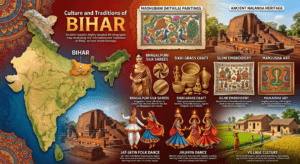
- Explore the rich culture and traditions
- of
- Bihar through its folk art, music, d
- ance, handicrafts, and heritage.
Culture & Traditions of Bihar
BR is one of India’s oldest cultural regions, renowned for its ancient traditions, literature, art, music, dance, festivals, and spiritual heritage. The state’s rich cultural identity has evolved over thousands of years under the influence of the Magadha, Maurya, and Gupta empires, as well as Buddhism, Jainism, and Hinduism.
The people of Bihar are known for their warm hospitality and deep respect for family values and traditions. The state’s cultural diversity is reflected in its regional communities, including Maithili, Bhojpuri, Magahi, Angika, and Bajjika, each with its own language, customs, folk songs, and traditional attire.
One of Bihar’s greatest cultural treasures is Madhubani (Mithila) Painting, a world-famous folk art known for its intricate patterns, vibrant natural colours, and depictions of mythology, nature, and daily life. Other traditional crafts include Sikki Grass Craft, Sujni Embroidery, Manjusha Art, Stone Carving, and Lac Bangles.
Traditional music and dance are an integral part of Bihar’s culture. Popular folk dances include Jat-Jatin, Jhijhiya, Bidesia, Domkach, and Paika Dance. Folk music such as Sohar, Kajari, Chaita, Birha, and Vidyapati Geet is performed during festivals, weddings, and community celebrations.
Traditional clothing varies across regions. Men commonly wear Dhoti-Kurta or Kurta-Pyjama, while women wear Sarees, especially Tussar Silk and Bhagalpuri Silk Sarees. Traditional jewellery and handcrafted accessories add to the state’s cultural richness.
Bihar’s cultural heritage is also closely connected with its famous festivals, delicious cuisine, religious pilgrimages, and ancient educational centres such as Nalanda University and Vikramshila University.
Today, BR proudly preserves its centuries-old traditions while embracing modern development, making it one of India’s most culturally vibrant states.
Culture of Bihar at a Glance
| Category | Highlights |
|---|---|
| Major Cultures | Maithili, Bhojpuri, Magahi, Angika & Bajjika |
| Famous Folk Art | Madhubani (Mithila) Painting |
| Traditional Crafts | Sikki Grass Craft, Sujni Embroidery & Manjusha Art |
| Popular Folk Dances | Jat-Jatin, Jhijhiya, Bidesia, Domkach & Paika |
| Traditional Music | Sohar, Kajari, Chaita, Birha & Vidyapati Geet |
| Traditional Dress | Dhoti-Kurta, Saree & Bhagalpuri Silk |
| Famous Silk | Bhagalpuri Silk |
| Cultural Heritage | Buddhism, Jainism & Ancient Magadha Civilization |
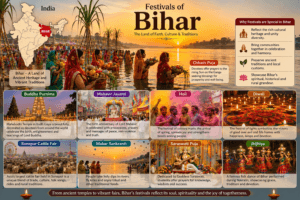
- Discover the vibrant festivals of Bihar, celebrating spirituality, culture, and centuries-old traditions.
Festivals of Bihar
BR is a land of vibrant traditions and colourful celebrations, where festivals reflect the state’s religious harmony, cultural diversity, and ancient heritage. Throughout the year, people celebrate Hindu, Buddhist, Jain, Sikh, and Muslim festivals with great enthusiasm, attracting pilgrims and tourists from across India and the world.
The most important and iconic festival of Bihar is Chhath Puja, dedicated to Surya (the Sun God) and Chhathi Maiya. Celebrated six days after Diwali, devotees observe a rigorous four-day fast and offer prayers to the setting and rising sun on riverbanks and ponds. Chhath Puja is regarded as one of India’s most sacred and environmentally friendly festivals.
Buddha Purnima is another major festival celebrated at Bodh Gaya, where Lord Buddha attained enlightenment. Thousands of Buddhist pilgrims from countries such as Sri Lanka, Thailand, Japan, Myanmar, Bhutan, and Nepal visit the Mahabodhi Temple during this occasion.
Mahavir Jayanti, marking the birth of Lord Mahavira, is celebrated with great devotion across Bihar, especially in Vaishali, his birthplace. Other important Hindu festivals include Diwali, Holi, Durga Puja, Makar Sankranti, Ram Navami, Saraswati Puja, Raksha Bandhan, and Janmashtami.
Muslim communities celebrate Eid-ul-Fitr, Eid-ul-Adha, and Muharram, while Sikh devotees observe Guru Nanak Jayanti with religious processions and prayers.
Several regional fairs are also famous in Bihar, including the Sonepur Cattle Fair, one of Asia’s largest traditional livestock fairs, and the Pitrapaksha Mela at Gaya, where devotees perform Pind Daan rituals for their ancestors.
These festivals strengthen social harmony, preserve Bihar’s rich traditions, and showcase its unique cultural identity to the world.
Major Festivals of Bihar
| Festival | Celebrated For |
|---|---|
| Chhath Puja | Worship of the Sun God |
| Buddha Purnima | Birth, Enlightenment & Nirvana of Lord Buddha |
| Mahavir Jayanti | Birth of Lord Mahavira |
| Diwali | Festival of Lights |
| Holi | Festival of Colours |
| Durga Puja | Worship of Goddess Durga |
| Makar Sankranti | Harvest Festival |
| Sonepur Cattle Fair | Asia’s Largest Traditional Cattle Fair |
| Pitrapaksha Mela | Ancestor Rituals at Gaya |
| Eid-ul-Fitr | Islamic Festival |
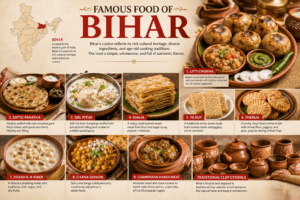
- Discover Bihar’s tradition
- al cuisine, including Litti Chokha, Khaja, Tilkut, Sattu Paratha, and other regional delicacies.
Famous Food of Bihar
BR is renowned for its simple, nutritious, and flavourful cuisine, deeply rooted in the state’s agricultural traditions and cultural heritage. The food of Bihar is prepared using fresh seasonal ingredients, locally grown grains, pulses, vegetables, and aromatic spices. Many traditional dishes have been passed down through generations and continue to be an essential part of festivals and everyday life.
The most iconic dish of BR is Litti Chokha, considered the state’s signature food. Litti is made from whole wheat flour stuffed with roasted gram flour (Sattu) and served with Chokha, a smoky mash of roasted brinjal, tomatoes, potatoes, and mustard oil. It is enjoyed across the state and is one of Bihar’s most popular culinary attractions.
Another famous delicacy is Sattu Paratha, a nutritious flatbread stuffed with roasted gram flour, herbs, and spices. Dal Pitha, a steamed rice flour dumpling filled with spiced lentils, is a traditional dish often compared to momos or modaks.
Bihar is also famous for its sweets. Khaja from Silao (Nalanda) is a crispy layered sweet and holds a Geographical Indication (GI) tag. Other popular sweets include Thekua, Tilkut from Gaya, Anarsa, Malpua, Balushahi, and Pedakiya.
Popular snacks include Chana Ghugni, Kadhi Bari, Dal Puri, Makhana Kheer, Mutton Curry, and Champaran Handi Meat, a slow-cooked meat dish prepared in sealed earthen pots using traditional spices.
The cuisine of BR reflects the state’s rich history, agricultural abundance, and vibrant traditions, offering visitors an authentic taste of eastern India.
Famous Foods of Bihar
| Dish | Famous For |
|---|---|
| Litti Chokha | Signature Dish of Bihar |
| Sattu Paratha | Traditional Breakfast |
| Dal Pitha | Rice Flour Dumplings |
| Khaja (Silao) | GI-Tagged Sweet |
| Tilkut (Gaya) | Traditional Winter Sweet |
| Thekua | Chhath Puja Special |
| Makhana Kheer | Fox Nut Dessert |
| Chana Ghugni | Popular Snack |
| Champaran Handi Meat | Traditional Slow-Cooked Curry |
| Kadhi Bari | Traditional Curry |
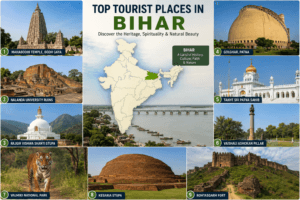
- Discover the top tourist attractions in Bihar, from UNESCO World Heritage Sites and ancient universities to wildlife and pilgrimage destinations.
Top Tourist Places in Bihar
BR is one of India’s most historically and spiritually significant states, attracting millions of visitors every year. The state is renowned for its Buddhist pilgrimage sites, ancient universities, Hindu temples, Jain heritage, wildlife sanctuaries, historical monuments, and cultural landmarks. From the sacred Mahabodhi Temple in Bodh Gaya to the ruins of Nalanda University, Bihar offers a unique blend of history, spirituality, architecture, and natural beauty.
Bodh Gaya, a UNESCO World Heritage Site, is Bihar’s most famous tourist destination. It is here that Lord Buddha attained enlightenment under the sacred Bodhi Tree, making it one of the holiest Buddhist pilgrimage sites in the world.
The ancient Nalanda University, another UNESCO World Heritage Site, was one of the world’s oldest residential universities and attracted scholars from across Asia. Nearby, Rajgir is famous for the Vishwa Shanti Stupa, Griddhakuta Hill (Vulture Peak), hot springs, and the Rajgir Ropeway.
Patna, the state capital, offers attractions such as Golghar, Bihar Museum, Patna Museum, Takht Sri Patna Sahib, and the Mahatma Gandhi Setu. Vaishali, the birthplace of Lord Mahavira, is an important pilgrimage destination for both Jains and Buddhists.
Nature lovers can visit Valmiki National Park, Bihar’s only national park, which is home to Bengal tigers, leopards, elephants, and diverse birdlife. Other major attractions include Vikramshila University Ruins, Kesaria Stupa, Barabar Caves, Rohtasgarh Fort, Sasaram Tomb of Sher Shah Suri, and Kanwar Lake Bird Sanctuary, a Ramsar Wetland.
With its rich heritage, sacred pilgrimage sites, wildlife, and archaeological treasures, Bihar offers unforgettable experiences for history enthusiasts, spiritual seekers, and nature lovers alike.
Top Tourist Places in Bihar
| Tourist Place | Famous For |
|---|---|
| Bodh Gaya | Mahabodhi Temple (UNESCO) |
| Nalanda | Ancient Nalanda University (UNESCO) |
| Rajgir | Vishwa Shanti Stupa & Ropeway |
| Patna | Golghar, Bihar Museum & Patna Sahib |
| Vaishali | Birthplace of Lord Mahavira |
| Gaya | Vishnupad Temple & Pind Daan |
| Valmiki National Park | Wildlife & Tiger Reserve |
| Vikramshila | Ancient Buddhist University |
| Kesaria Stupa | One of the World’s Tallest Buddhist Stupas |
| Rohtasgarh Fort | Historic Hill Fort |

- Explore Bihar’s transport network, including highways, railways, airports, bridges, and inland waterways.
Transport in Bihar
BR has a well-developed road, rail, air, and inland water transport network, connecting the state with major cities across India. Its strategic location in eastern India and extensive transportation infrastructure play a crucial role in trade, tourism, agriculture, and economic development.
The state has an extensive road network consisting of National Highways (NHs), State Highways (SHs), and rural roads. Major highways such as NH-27, NH-19, NH-31, NH-22, and NH-33 connect important cities including Patna, Gaya, Muzaffarpur, Bhagalpur, Darbhanga, Purnia, and Bihar Sharif. The Mahatma Gandhi Setu and the Kacchi Dargah–Bidupur Bridge (under development) are among the state’s most significant road infrastructure projects across the Ganga River.
BR is one of India’s busiest railway regions. The East Central Railway (ECR), headquartered in Hajipur, manages a large part of the state’s rail network. Major railway stations include Patna Junction, Gaya Junction, Muzaffarpur Junction, Danapur, Bhagalpur, Darbhanga, and Barauni Junction. Premium trains such as Vande Bharat Express, Rajdhani Express, Duronto Express, and Humsafar Express provide excellent connectivity to major Indian cities.
Air travel is served by Jay Prakash Narayan International Airport (Patna), the state’s busiest airport. Other important airports include Gaya International Airport, which serves international Buddhist pilgrims, and the domestic airports at Darbhanga and Purnia (under development and expansion).
BR also benefits from the National Waterway-1 (NW-1) on the Ganga River, supporting inland cargo transport and improving trade logistics between northern and eastern India.
Continuous investments in highways, bridges, railway modernization, airport expansion, and inland waterways are strengthening Bihar’s transportation network and boosting tourism, commerce, and regional connectivity.
Transport at a Glance
| Mode | Major Facilities |
|---|---|
| Road | NH-27, NH-19, NH-31, NH-22 & NH-33 |
| Railway Zone | East Central Railway (Hajipur) |
| Major Railway Stations | Patna, Gaya, Muzaffarpur, Darbhanga, Bhagalpur & Barauni |
| International Airports | Patna & Gaya |
| Domestic Airport | Darbhanga |
| Inland Waterway | National Waterway-1 (Ganga River) |
| Major Bridge | Mahatma Gandhi Setu |
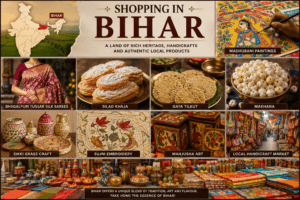
- Discover the best shopping items in Bihar, including Madhubani paintings, Bhagalpuri Silk, GI-tagged sweets, and traditional handicrafts.
Shopping in Bihar
BR is a wonderful destination for shoppers looking to buy traditional handicrafts, handloom products, silk textiles, folk paintings, locally made sweets, and unique GI-tagged products. The state’s rich cultural heritage is reflected in its artisan communities, whose skills have been passed down through generations.
One of Bihar’s most famous shopping attractions is Madhubani (Mithila) Paintings, internationally recognised for their intricate designs, natural colours, and depictions of mythology and nature. These paintings are among the most sought-after souvenirs from Bihar.
Bhagalpuri Silk, also known as Tussar Silk, is another iconic product of the state. The city of Bhagalpur is often called the Silk City of India, producing premium-quality silk sarees, stoles, scarves, and fabrics that are exported worldwide.
Visitors can also purchase Sikki Grass Craft, Sujni Embroidery, Manjusha Art, Lac Bangles, Stone Carvings, Terracotta Crafts, and handcrafted bamboo products made by local artisans.
Food lovers should not miss Bihar’s famous delicacies, including Silao Khaja (GI-tagged), Gaya Tilkut, Thekua, Makhana (Fox Nuts), Shahi Litchi, local pickles, spices, and traditional sweets.
Popular shopping destinations include Patna Market, Hathwa Market, Maurya Lok Complex, Bhagalpur Silk Market, Madhubani Craft Centres, Bodh Gaya Local Markets, and Muzaffarpur Markets, where visitors can buy authentic handicrafts and local specialties.
Shopping in Bihar not only offers memorable souvenirs but also supports local artisans and preserves the state’s centuries-old artistic traditions.
Best Shopping Items in Bihar
| Product | Famous Place |
|---|---|
| Madhubani (Mithila) Paintings | Madhubani |
| Bhagalpuri (Tussar) Silk | Bhagalpur |
| Silao Khaja (GI) | Nalanda |
| Gaya Tilkut | Gaya |
| Makhana (Fox Nuts) | Mithila Region |
| Shahi Litchi | Muzaffarpur |
| Sikki Grass Craft | Madhubani & Darbhanga |
| Sujni Embroidery | Muzaffarpur |
| Manjusha Art | Bhagalpur |
| Lac Bangles | Patna & Rural Bihar |

- Plan your Bihar trip during the best season to enjoy pleasant weather, festivals, wildlife, and historic attractions.
Best Time to Visit Bihar
BR can be visited throughout the year, but the best time to visit is from October to March, when the weather is cool and pleasant. During these months, tourists can comfortably explore the state’s historical monuments, UNESCO World Heritage Sites, wildlife reserves, and religious destinations.
The winter season (November to February) is considered the ideal time for sightseeing. Temperatures range between 8°C and 25°C, making it perfect for visiting Bodh Gaya, Nalanda, Rajgir, Patna, Vaishali, Gaya, and Valmiki National Park. Major festivals such as Chhath Puja, Makar Sankranti, and the Rajgir Mahotsav also take place during this period, offering visitors a chance to experience Bihar’s vibrant culture.
The summer season (March to June) is generally hot, with temperatures often reaching 45°C. While sightseeing during the day can be challenging, early mornings and evenings remain suitable for visiting religious places and museums.
The monsoon season (June to September) transforms Bihar into a lush green landscape. Rivers, forests, and agricultural fields become scenic, but heavy rainfall and occasional flooding in northern districts may affect travel plans. Nature enthusiasts, however, can enjoy the state’s greenery and wetlands during this season.
For pilgrims, Bodh Gaya is especially popular during Buddha Purnima, while Gaya attracts thousands of devotees during the Pitrapaksha Mela. Wildlife enthusiasts should plan their visit to Valmiki National Park between November and April, when animal sightings are more frequent.
Overall, October to March offers the most comfortable weather and the best opportunities to experience Bihar’s history, spirituality, culture, festivals, and natural beauty.
Best Time to Visit Bihar at a Glance
| Season | Months | Ideal For |
|---|---|---|
| Winter | November – February | Sightseeing, Pilgrimage & Wildlife |
| Spring | October & March | Heritage Tours & Cultural Festivals |
| Summer | March – June | Early Morning Temple Visits & Museums |
| Monsoon | June – September | Nature, Green Landscapes & Photography |

- Bihar is easily accessible by air, rail, road, and inland waterways from major cities across India.
How to Reach Bihar
BR is well connected to all parts of India through an extensive network of airways, railways, roadways, and inland waterways. The state has modern transportation infrastructure that makes travel convenient for tourists, pilgrims, business travellers, and students.
By Air
The state has two major airports serving domestic and international passengers. Jay Prakash Narayan International Airport in Patna is the state’s busiest airport, offering regular flights to major cities such as Delhi, Mumbai, Bengaluru, Kolkata, Chennai, Hyderabad, and Pune.
Gaya International Airport serves both domestic and international flights and is one of India’s most important gateways for Buddhist pilgrims visiting Bodh Gaya. Darbhanga Airport has also become a major domestic airport with direct flights to several Indian cities.
By Train
The state has one of the largest railway networks in India and is primarily served by the East Central Railway (ECR). Major railway stations include Patna Junction, Gaya Junction, Muzaffarpur Junction, Danapur, Barauni Junction, Bhagalpur, Darbhanga, and Rajendra Nagar Terminal.
Premium trains such as Vande Bharat Express, Rajdhani Express, Duronto Express, Humsafar Express, and numerous superfast trains connect Bihar with almost every major city in India.
By Road
A well-developed network of National Highways, State Highways, and express roads connects Bihar with neighbouring states and the rest of the country. Major highways include NH-19, NH-27, NH-31, NH-22, and NH-33.
Regular government and private buses operate between Bihar and cities such as Delhi, Kolkata, Ranchi, Varanasi, Lucknow, Gorakhpur, and Siliguri.
By Waterways
The National Waterway-1 (NW-1) along the Ganga River provides inland water transport for cargo and is gradually improving passenger connectivity and tourism in Bihar.
With excellent connectivity by air, rail, road, and waterways, travelling to Bihar is convenient from anywhere in India.
How to Reach Bihar at a Glance
| Mode | Major Connectivity |
|---|---|
| Air | Patna, Gaya & Darbhanga Airports |
| Rail | Patna, Gaya, Muzaffarpur, Barauni & Bhagalpur |
| Road | NH-19, NH-27, NH-31, NH-22 & NH-33 |
| Waterway | National Waterway-1 (Ganga River) |

- Plan a comfortable and memorable trip to Bihar with these essential travel tips.
Travel Tips for Visiting Bihar
The state is a fascinating destination known for its ancient history, Buddhist heritage, Hindu pilgrimage sites, wildlife, and vibrant culture. Planning your trip well will help you enjoy a comfortable and memorable experience.
The best time to visit the state is from October to March, when the weather is pleasant for sightseeing, wildlife safaris, and religious tours. Summers can be very hot, while the monsoon season may bring heavy rainfall and occasional flooding in some northern districts.
If you plan to visit popular destinations such as Bodh Gaya, Nalanda, Rajgir, Patna, or Vaishali, it is advisable to book hotels and transportation in advance, especially during Buddha Purnima, Chhath Puja, Pitrapaksha Mela, and other major festivals.
While visiting temples, monasteries, and religious sites, wear modest clothing, remove your footwear where required, and respect local customs and traditions. Photography may be restricted inside certain religious monuments, so always check local guidelines before taking pictures.
Carry light cotton clothes during summer and warm clothing during winter, particularly if you are travelling in December or January. Comfortable walking shoes, sunscreen, sunglasses, a reusable water bottle, and basic medicines are useful for sightseeing.
Use registered taxis, app-based cabs, or authorised transport services for convenient and safe travel. Keep your valuables secure in crowded markets, railway stations, and festival gatherings.
Don’t miss Bihar’s famous local cuisine such as Litti Chokha, Sattu Paratha, Khaja, Tilkut, and Makhana Kheer, and shop for authentic Madhubani Paintings, Bhagalpuri Silk, and Sikki Grass Crafts from trusted local stores.
By respecting local traditions, planning your itinerary in advance, and travelling responsibly, you can fully experience the rich heritage and hospitality of Bihar.
Essential Travel Tips
| Tip | Recommendation |
|---|---|
| Best Season | October – March |
| Clothing | Cotton in Summer, Woollens in Winter |
| Transport | Use Registered Taxis & Public Transport |
| Temple Visits | Dress Modestly & Remove Footwear |
| Safety | Keep Valuables Secure |
| Food | Try Authentic Local Cuisine |
| Shopping | Buy from Trusted Local Shops |
| Wildlife Visits | Follow Park Rules & Avoid Littering |
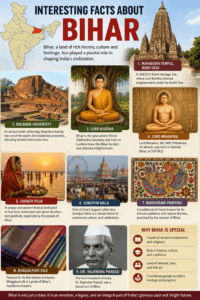
- Discover fascinating facts about Bihar, from ancient universities and UNESCO sites to festivals and cultural heritage.
Interesting Facts About Bihar
The state is one of India’s most historically significant states and has made remarkable contributions to civilization, education, religion, politics, and culture. It is regarded as the birthplace of powerful empires, ancient universities, and major world religions, making it one of the most fascinating destinations in India.
The state was the centre of the Magadha Kingdom, from which the Maurya and Gupta Empires emerged. Bihar is also home to Bodh Gaya, where Lord Buddha attained enlightenment beneath the sacred Bodhi Tree. This holy site is now a UNESCO World Heritage Site and attracts millions of Buddhist pilgrims every year.
BR is famous for Nalanda University, one of the world’s oldest residential universities, established in the 5th century CE. Scholars from countries such as China, Korea, Tibet, and Sri Lanka travelled to Nalanda to study philosophy, medicine, astronomy, mathematics, and literature.
The state is also the birthplace of Lord Mahavira, the 24th Tirthankara of Jainism, and Dr. Rajendra Prasad, the first President of independent India. Bihar hosts the world-famous Chhath Puja, one of India’s oldest and most environmentally friendly festivals dedicated to the Sun God.
The Sonepur Mela, held in BR, is one of Asia’s largest traditional livestock fairs, attracting thousands of visitors every year. The state is also renowned for Madhubani Paintings, Bhagalpuri Silk, Silao Khaja, and Shahi Litchi, which have earned national and international recognition.
With its unparalleled historical legacy, spiritual importance, cultural richness, and educational heritage, Bihar continues to be one of India’s most unique and inspiring states.
Interesting Facts at a Glance
| Fact | Details |
|---|---|
| Ancient Kingdom | Magadha |
| UNESCO World Heritage Sites | Mahabodhi Temple & Nalanda Mahavihara |
| World’s Ancient University | Nalanda University |
| Birthplace of Lord Mahavira | Vaishali |
| Enlightenment of Lord Buddha | Bodh Gaya |
| First President of India | Dr. Rajendra Prasad |
| Famous Festival | Chhath Puja |
| Famous Fair | Sonepur Mela |
| Famous Art | Madhubani (Mithila) Painting |
| Famous Silk | Bhagalpuri (Tussar) Silk |
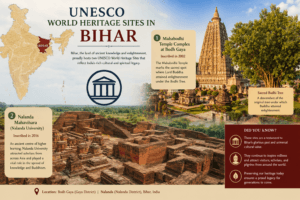
- Explore Bihar’s UNESCO World Heritage Sites, including the Mahabodhi Temple Complex and Nalanda Mahavihara.
UNESCO World Heritage Sites in Bihar
BR is home to two UNESCO World Heritage Sites, both recognised for their outstanding historical, cultural, and religious significance. These sites attract millions of pilgrims, historians, researchers, and tourists from around the world every year.
The Mahabodhi Temple Complex at Bodh Gaya is Bihar’s most famous UNESCO World Heritage Site. It is the sacred place where Lord Buddha attained enlightenment under the Bodhi Tree around the 6th century BCE. The present temple, standing about 55 metres tall, is one of the finest examples of ancient Indian brick architecture. Pilgrims from countries such as Thailand, Sri Lanka, Japan, Myanmar, Bhutan, and Tibet visit the temple throughout the year.
The second UNESCO World Heritage Site is Nalanda Mahavihara (Nalanda University), one of the world’s oldest residential universities. Established in the 5th century CE, Nalanda became an internationally renowned centre of education where scholars studied Buddhism, philosophy, astronomy, mathematics, medicine, literature, and logic. Students from China, Korea, Tibet, Sri Lanka, and Southeast Asia travelled to Nalanda to pursue higher learning.
Both UNESCO sites reflect Bihar’s immense contribution to world education, Buddhism, history, architecture, and cultural heritage. They continue to be among India’s most visited historical and spiritual destinations.
UNESCO World Heritage Sites at a Glance
| UNESCO Site | Location | Year Inscribed | Famous For |
|---|---|---|---|
| Mahabodhi Temple Complex | Bodh Gaya | 2002 | Enlightenment of Lord Buddha |
| Nalanda Mahavihara (Nalanda University) | Nalanda | 2016 | Ancient Residential University |
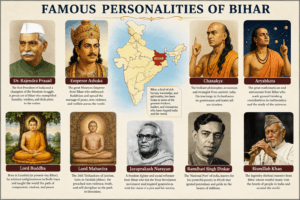
- Discover the famous personalities of Bihar who made remarkable contributions to history, politics, science, literature, music, and spirituality.
Famous Personalities of Bihar
BR has produced many great leaders, scholars, spiritual teachers, freedom fighters, social reformers, writers, scientists, and artists who have made significant contributions to India and the world. From ancient philosophers to modern statesmen, the state has played a remarkable role in shaping Indian history, politics, literature, education, and culture.
Dr. Rajendra Prasad, born in Siwan district, was the first President of independent India and one of the country’s most respected freedom fighters. He played a key role in India’s independence movement and served as President from 1950 to 1962.
Emperor Ashoka, one of India’s greatest rulers, governed the Maurya Empire from Pataliputra (present-day Patna). After the Kalinga War, he embraced Buddhism and spread its teachings across Asia through pillars, stupas, and inscriptions.
Chanakya (Kautilya), the legendary economist, philosopher, and author of the Arthashastra, was closely associated with ancient Pataliputra and played a crucial role in establishing the Maurya Empire under Chandragupta Maurya.
Bihar is also associated with Aryabhata, one of the world’s greatest mathematicians and astronomers, who made groundbreaking contributions to mathematics and astronomy while studying and working in ancient Bihar.
The state is the birthplace of Lord Mahavira, the 24th Tirthankara of Jainism, and the place where Lord Buddha attained enlightenment at Bodh Gaya, making Bihar one of the world’s most important spiritual centres.
Other notable personalities include Jayaprakash Narayan, a renowned freedom fighter and social reformer; Ramdhari Singh Dinkar, one of India’s greatest Hindi poets; Bismillah Khan, the legendary shehnai maestro associated with Bihar through his birthplace; and Phanishwar Nath Renu, a celebrated Hindi novelist.
These personalities have left a lasting legacy in politics, philosophy, literature, science, music, and spirituality, bringing global recognition to Bihar.
Famous Personalities of Bihar
| Personality | Known For |
|---|---|
| Dr. Rajendra Prasad | First President of India |
| Emperor Ashoka | Maurya Emperor & Spread of Buddhism |
| Chanakya (Kautilya) | Economist & Author of Arthashastra |
| Aryabhata | Mathematician & Astronomer |
| Lord Buddha | Attained Enlightenment at Bodh Gaya |
| Lord Mahavira | 24th Tirthankara of Jainism |
| Jayaprakash Narayan | Freedom Fighter & Social Reformer |
| Ramdhari Singh Dinkar | National Poet |
| Bismillah Khan | Legendary Shehnai Maestro |
| Phanishwar Nath Renu | Famous Hindi Novelist |
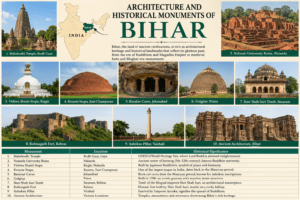
- Explore Bihar’s architectural wonders, ancient monuments, UNESCO World Heritage Sites, and historical landmarks
Architecture & Historical Monuments of Bihar
BR is one of India’s richest states in terms of architecture, archaeology, and historical monuments. The state preserves magnificent Buddhist monasteries, Hindu temples, Jain pilgrimage sites, ancient universities, forts, caves, stupas, and Mughal-era structures that reflect over 2,500 years of history.
The Mahabodhi Temple Complex at Bodh Gaya, a UNESCO World Heritage Site, is Bihar’s most iconic monument. Built in the 5th–6th century CE, the temple is one of the finest surviving examples of ancient Indian brick architecture and marks the place where Lord Buddha attained enlightenment.
Another UNESCO site, Nalanda Mahavihara (Nalanda University), showcases the remains of one of the world’s oldest residential universities. Its monasteries, temples, lecture halls, and libraries demonstrate the architectural brilliance of ancient India.
Rajgir is home to the Vishwa Shanti Stupa, Cyclopean Wall, Griddhakuta Hill (Vulture Peak), and ancient Buddhist monasteries. Kesaria Stupa, located in East Champaran, is one of the tallest Buddhist stupas in the world and is believed to have been built by Emperor Ashoka.
Among Bihar’s rock-cut monuments, the Barabar Caves are the oldest surviving rock-cut caves in India, dating back to the 3rd century BCE during the Mauryan period. These caves are renowned for their polished granite interiors and historical significance.
Other notable monuments include Golghar in Patna, the Sher Shah Suri Tomb in Sasaram, Rohtasgarh Fort, Ashokan Pillars at Vaishali and Lauriya Nandangarh, Vikramshila University Ruins, and Takht Sri Patna Sahib, one of Sikhism’s holiest shrines.
Together, these architectural masterpieces highlight Bihar’s extraordinary contribution to education, religion, engineering, and cultural heritage, making the state a treasure trove for history enthusiasts and travellers.
Famous Monuments of Bihar
| Monument | Location | Famous For |
|---|---|---|
| Mahabodhi Temple | Bodh Gaya | UNESCO World Heritage Site |
| Nalanda Mahavihara | Nalanda | Ancient University (UNESCO) |
| Vishwa Shanti Stupa | Rajgir | Buddhist Peace Pagoda |
| Kesaria Stupa | East Champaran | One of the World’s Tallest Buddhist Stupas |
| Barabar Caves | Jehanabad | India’s Oldest Rock-Cut Caves |
| Golghar | Patna | Historic Granary |
| Sher Shah Suri Tomb | Sasaram | Indo-Islamic Architecture |
| Rohtasgarh Fort | Rohtas | Historic Hill Fort |
| Ashokan Pillar | Vaishali | Mauryan Monument |
| Vikramshila University Ruins | Bhagalpur | Ancient Buddhist University |
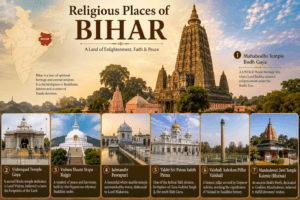
- Explore Bihar’s most sacred religious places, including Buddhist, Hindu, Jain, and Sikh pilgrimage sites
Religious Places in Bihar
BR is one of the world’s most important spiritual and religious destinations, holding immense significance for Buddhism, Hinduism, Jainism, Sikhism, and Islam. The state attracts millions of pilgrims and tourists every year who come to experience its sacred temples, monasteries, mosques, gurudwaras, and ancient pilgrimage sites.
The most famous religious destination is Bodh Gaya, where Lord Buddha attained enlightenment beneath the sacred Bodhi Tree. The Mahabodhi Temple Complex, a UNESCO World Heritage Site, is one of the holiest places for Buddhists worldwide and attracts pilgrims from countries such as Thailand, Sri Lanka, Japan, Myanmar, Bhutan, and Tibet.
Gaya is one of Hinduism’s most sacred pilgrimage centres. The Vishnupad Temple, dedicated to Lord Vishnu, is believed to contain the divine footprint of the deity. Every year, thousands of devotees visit Gaya during the Pitrapaksha Mela to perform Pind Daan rituals for their ancestors.
Rajgir is another important spiritual destination associated with both Buddhism and Jainism. It is home to the Vishwa Shanti Stupa, Griddhakuta (Vulture Peak) where Lord Buddha delivered many sermons, and several ancient Jain temples.
Vaishali, the birthplace of Lord Mahavira, is one of Jainism’s holiest pilgrimage sites. It is also closely associated with Lord Buddha, who delivered his last sermon here before attaining Mahaparinirvana.
BR is also home to Takht Sri Patna Sahib, one of the five Takhts of Sikhism and the birthplace of Guru Gobind Singh Ji, the tenth Sikh Guru. The gurudwara attracts thousands of Sikh pilgrims throughout the year.
Other important religious sites include the Mundeshwari Devi Temple, considered one of India’s oldest functional Hindu temples, Jalmandir Pawapuri, where Lord Mahavira attained Nirvana, Pretshila Hill, Mangla Gauri Temple, and numerous ancient monasteries and shrines.
With its extraordinary spiritual heritage and sacred landmarks, Bihar remains one of India’s most revered pilgrimage destinations.
Major Religious Places in Bihar
| Religious Place | Religion | Famous For |
|---|---|---|
| Mahabodhi Temple, Bodh Gaya | Buddhism | Enlightenment of Lord Buddha |
| Vishnupad Temple, Gaya | Hinduism | Sacred Footprint of Lord Vishnu |
| Vishwa Shanti Stupa, Rajgir | Buddhism | Peace Pagoda |
| Jalmandir, Pawapuri | Jainism | Nirvana of Lord Mahavira |
| Vaishali | Jainism & Buddhism | Birthplace of Lord Mahavira |
| Takht Sri Patna Sahib | Sikhism | Birthplace of Guru Gobind Singh Ji |
| Mundeshwari Devi Temple | Hinduism | One of India’s Oldest Functional Temples |
| Mangla Gauri Temple | Hinduism | Shakti Peetha |
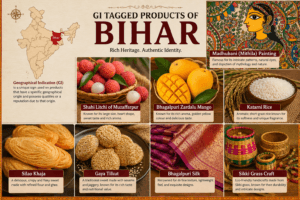
- Explore Bihar’s famous GI-tagged products, showcasing the state’s rich artistic, agricultural, and culinary heritage.
GI Tagged Products of Bihar
BR is home to several Geographical Indication (GI)-tagged products, recognised for their unique quality, traditional craftsmanship, and regional identity. These products represent the state’s rich cultural heritage, agricultural excellence, and centuries-old artisan traditions. GI tags help protect authentic products, promote local industries, and increase export opportunities.
One of Bihar’s most famous GI products is Madhubani (Mithila) Painting, a globally renowned folk art known for its intricate designs, natural colours, and depictions of mythology, rituals, and nature. This traditional art form has been practiced for generations in the Mithila region.
Bhagalpuri Zardalu Mango, grown mainly in Bhagalpur district, is prized for its sweet taste, rich aroma, and premium quality. Another famous GI product is Shahi Litchi of Muzaffarpur, recognised internationally for its exceptional sweetness, juicy pulp, and unique flavour.
Among traditional foods, Silao Khaja from Nalanda district is a popular layered sweet with a crisp texture, while Gaya Tilkut is a famous winter delicacy made from sesame seeds and jaggery or sugar.
BR is also known for Katarni Rice from Bhagalpur and Banka districts, valued for its distinctive aroma and taste. The state further preserves traditional crafts such as Sikki Grass Products, Bhagalpuri Silk, and Stone Craft of Gaya, which showcase the exceptional skills of local artisans.
These GI-tagged products not only preserve Bihar’s heritage but also support rural livelihoods, promote tourism, and strengthen the state’s identity in national and international markets.
GI Tagged Products of Bihar
| GI Product | Category | Famous Region |
|---|---|---|
| Madhubani (Mithila) Painting | Folk Art | Madhubani |
| Shahi Litchi | Fruit | Muzaffarpur |
| Bhagalpuri Zardalu Mango | Fruit | Bhagalpur |
| Katarni Rice | Agricultural Product | Bhagalpur & Banka |
| Silao Khaja | Sweet | Nalanda |
| Gaya Tilkut | Sweet | Gaya |
| Bhagalpuri Silk | Textile | Bhagalpur |
| Sikki Grass Craft | Handicraft | Mithila Region |

- Explore Bihar’s rich educational heritage, from ancient Nalanda University to modern institutions like IIT Patna and AIIMS Patna.
Education & Universities in Bihar
BR has been a global centre of education for over 1,500 years and is home to some of the world’s oldest universities. The state gained international recognition through Nalanda University and Vikramshila University, which attracted scholars from across Asia and played a significant role in the development of philosophy, medicine, astronomy, mathematics, and Buddhist studies.
Today, BR continues this legacy with several prestigious universities, engineering institutes, medical colleges, management institutes, and research centres. The state is home to IIT Patna, NIT Patna, AIIMS Patna, Patna University, Nalanda University (modern campus), Central University of South Bihar, and Chanakya National Law University, attracting students from across India.
Patna University, established in 1917, is one of the oldest universities in India. IIT Patna is recognised for excellence in engineering, technology, and innovation, while AIIMS Patna is among the country’s leading medical institutions.
The BR Government is investing in higher education, digital learning, research infrastructure, and skill development to improve educational opportunities across the state.
With its remarkable educational heritage and growing academic institutions, Bihar remains one of India’s most important centres of learning.
Major Educational Institutions in Bihar
| Institution | Location | Famous For |
|---|---|---|
| Nalanda University | Rajgir | Ancient & Modern International University |
| Patna University | Patna | One of India’s Oldest Universities |
| IIT Patna | Bihta (Patna) | Engineering & Technology |
| NIT Patna | Patna | Engineering Education |
| AIIMS Patna | Patna | Medical Education & Healthcare |
| Central University of South Bihar | Gaya | Higher Education |
| Chanakya National Law University | Patna | Law Education |
| Vikramshila University Ruins | Bhagalpur | Ancient Buddhist University |

- Explore Bihar’s major industries, including food processing, silk, sugar, dairy, ethanol, handicrafts, and manufacturing.
Major Industries of Bihar
Bihar’s economy has traditionally been driven by agriculture, but in recent years the state has witnessed steady growth in food processing, dairy, textiles, leather, sugar, ethanol, cement, tourism, and small-scale industries. The abundance of agricultural resources, skilled workforce, and improving infrastructure has encouraged industrial development across the state.
The food processing industry is one of Bihar’s largest sectors. The state is a major producer of rice, maize, wheat, fruits, vegetables, makhana (fox nuts), and litchi, leading to the establishment of rice mills, maize processing units, fruit processing plants, and cold storage facilities.
The sugar industry has historically played a significant role in Bihar’s economy. Districts such as West Champaran, East Champaran, Gopalganj, Sitamarhi, and Samastipur are known for sugarcane cultivation and sugar mills. With the increasing focus on renewable energy, several sugar mills have also expanded into ethanol production.
Bhagalpur is famous for its silk industry, particularly Bhagalpuri (Tussar) Silk, which is exported to domestic and international markets. Traditional industries such as Madhubani Painting, Sikki Grass Craft, Stone Carving, Handloom Weaving, and Leather Goods continue to provide employment to thousands of artisans.
The BR Industrial Area Development Authority (BIADA) has established industrial areas across the state to attract investments in manufacturing, logistics, pharmaceuticals, textiles, and engineering. The government also promotes startups, MSMEs, IT parks, food parks, and industrial corridors to accelerate economic growth.
With its growing industrial base, improving infrastructure, and investment-friendly policies, Bihar is steadily emerging as an important destination for manufacturing and agro-based industries in eastern India.
Major Industries of Bihar
| Industry | Major Locations |
|---|---|
| Food Processing | Muzaffarpur, Patna & Bhagalpur |
| Sugar Industry | West Champaran, East Champaran & Gopalganj |
| Ethanol Production | Sugar Mill Regions |
| Silk Industry | Bhagalpur |
| Dairy Industry | Patna, Barauni & Muzaffarpur |
| Handloom & Handicrafts | Madhubani, Darbhanga & Bhagalpur |
| Leather Industry | Patna & Bihar Sharif |
| Cement Industry | Rohtas & Kaimur |
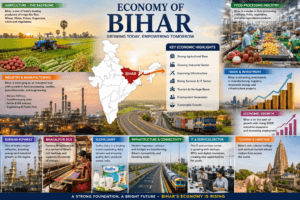
- Discover the key sectors driving Bihar’s economy, including agriculture, services, manufacturing, tourism, and industry.
Economy of Bihar
BR has one of the fastest-growing economies in eastern India, with agriculture, services, manufacturing, trade, and small-scale industries forming the backbone of its economic development. The state has been focusing on infrastructure, industrial investment, skill development, digital services, and rural development to accelerate economic growth.
Agriculture remains the largest contributor to Bihar’s economy, employing a significant portion of the population. The state is a leading producer of rice, wheat, maize, pulses, sugarcane, makhana (fox nuts), vegetables, bananas, mangoes, and Shahi Litchi. Food processing industries have expanded rapidly due to the abundance of agricultural produce.
The service sector is the largest contributor to Bihar’s Gross State Domestic Product (GSDP). It includes banking, education, healthcare, tourism, transportation, retail, telecommunications, and information technology. Tourism, particularly Buddhist, Hindu, Jain, and Sikh pilgrimage tourism, contributes significantly to the state’s economy.
The industrial sector is steadily expanding with investments in food processing, textiles, sugar, ethanol production, dairy, oil refining, fertilizers, cement, renewable energy, and logistics. Industrial hubs such as Barauni, Patna, Muzaffarpur, Bhagalpur, and Gaya continue to attract new investments.
The BR Government has introduced initiatives such as the Bihar Industrial Investment Promotion Policy (BIIPP), startup support programmes, MSME development, industrial parks, and infrastructure projects to encourage domestic and foreign investment. Improvements in highways, railways, airports, inland waterways, and digital connectivity have further strengthened the state’s economic potential.
With its young workforce, fertile agricultural land, improving infrastructure, and strategic location in eastern India, Bihar is emerging as an important destination for business, trade, tourism, and industrial development.
Economy of Bihar at a Glance
| Sector | Major Contribution |
|---|---|
| Agriculture | Rice, Wheat, Maize, Sugarcane, Makhana & Litchi |
| Services | Banking, Education, Healthcare & Tourism |
| Manufacturing | Food Processing, Sugar, Textiles & Cement |
| Dairy | Milk & Dairy Products |
| Energy | Oil Refining, Thermal Power & Renewable Energy |
| Tourism | Buddhist, Hindu, Jain & Sikh Pilgrimage |
| Major Industrial Hubs | Patna, Barauni, Muzaffarpur, Gaya & Bhagalpur |
| Growth Drivers | Infrastructure, MSMEs, Startups & Industrial Policies |
Bihar at a Glance (Quick Facts)
Bihar is one of India’s oldest and most historically significant states, located in eastern India. It is widely known as the birthplace of Buddhism and Jainism, the centre of the ancient Magadha Empire, and the home of the world-famous Nalanda University. With fertile plains formed by the Ganga River and its tributaries, Bihar is one of India’s leading agricultural states.
The state covers an area of 94,163 sq km and has a population of over 104 million (2011 Census), making it the third most populous state in India. Patna serves as the capital and largest city, while Hindi and Urdu are the official languages. Major regional languages include Maithili, Bhojpuri, Magahi, Angika, and Bajjika.
Bihar is internationally recognised for the Mahabodhi Temple, Nalanda Mahavihara, Chhath Puja, Madhubani Painting, Bhagalpuri Silk, Shahi Litchi, and Litti Chokha. The state’s economy is driven by agriculture, services, food processing, textiles, tourism, and manufacturing.
Bihar at a Glance
| Category | Details |
|---|---|
| Capital | Patna |
| Area | 94,163 sq km |
| Population | 104.1 Million (2011 Census) |
| Districts | 38 |
| Official Languages | Hindi & Urdu |
| State Animal | Gaur (Indian Bison) |
| State Bird | House Sparrow |
| Longest River | Ganga |
| UNESCO Sites | 2 |
| National Park | Valmiki National Park |
| Major Industries | Food Processing, Sugar, Silk & Dairy |
| Famous Festival | Chhath Puja |
| Famous Food | Litti Chokha |
Top 20 FAQs About Bihar
1. What is Bihar famous for?
Bihar is famous for Bodh Gaya, Nalanda University, Chhath Puja, Madhubani Painting, Bhagalpuri Silk, Litti Chokha, Shahi Litchi, and its rich Buddhist and Jain heritage.
2. What is the capital of Bihar?
Patna is the capital and largest city of Bihar.
3. Where is Bihar located?
Bihar is located in eastern India and shares borders with Nepal, Uttar Pradesh, Jharkhand, and West Bengal.
4. Which is the largest city in Bihar?
Patna is the largest city and the political, educational, and commercial centre of Bihar.
5. How many districts are there in Bihar?
Bihar has 38 districts divided into 9 administrative divisions.
6. Which are the UNESCO World Heritage Sites in Bihar?
The two UNESCO World Heritage Sites are:
- Mahabodhi Temple Complex, Bodh Gaya
- Nalanda Mahavihara (Nalanda University)
7. Which is the famous festival of Bihar?
Chhath Puja is the most famous and widely celebrated festival in Bihar.
8. What is the famous food of Bihar?
Litti Chokha is the signature dish of Bihar. Other popular foods include Sattu Paratha, Dal Pitha, Khaja, Tilkut, and Makhana Kheer.
9. Which river is the lifeline of Bihar?
The Ganga River is the lifeline of Bihar and flows across the state from west to east.
10. What are the major languages spoken in Bihar?
The official languages are Hindi and Urdu, while Maithili, Bhojpuri, Magahi, Angika, and Bajjika are widely spoken.
11. Which is the only national park in Bihar?
Valmiki National Park in West Champaran is Bihar’s only national park.
12. What are the major industries in Bihar?
Major industries include food processing, sugar, dairy, textiles, Bhagalpuri Silk, ethanol production, oil refining, cement, and handicrafts.
13. Which is the best time to visit Bihar?
The best time to visit Bihar is October to March, when the weather is cool and pleasant.
14. What are the famous tourist places in Bihar?
Popular tourist destinations include Bodh Gaya, Nalanda, Rajgir, Patna, Vaishali, Gaya, Valmiki National Park, Kesaria Stupa, and Vikramshila.
15. Which airport is the busiest in Bihar?
Jay Prakash Narayan International Airport, Patna is the busiest airport in Bihar.
16. Which GI-tagged products are famous in Bihar?
Famous GI products include Madhubani Painting, Shahi Litchi, Bhagalpuri Zardalu Mango, Katarni Rice, Silao Khaja, Gaya Tilkut, and Bhagalpuri Silk.
17. Which is the oldest university in Bihar?
Nalanda University was one of the world’s oldest residential universities, established in the 5th century CE.
18. What is the economy of Bihar based on?
Bihar’s economy is mainly based on agriculture, services, manufacturing, food processing, tourism, and small-scale industries.
19. Which is the state animal of Bihar?
The Gaur (Indian Bison) is the state animal of Bihar.
20. Why is Bihar historically important?
Bihar was the centre of the Magadha Empire, the birthplace of Buddhism and Jainism, home to Nalanda University, and the land of great personalities such as Emperor Ashoka, Chanakya, Aryabhata, Lord Buddha, Lord Mahavira, and Dr. Rajendra Prasad.
Conclusion
Bihar is one of India’s most remarkable states, celebrated for its ancient civilization, rich cultural heritage, spiritual significance, educational legacy, and growing economy. From the sacred Mahabodhi Temple and the historic Nalanda University to the vibrant celebrations of Chhath Puja and the world-famous Madhubani Paintings, Bihar offers a unique blend of history, tradition, and modern development.
The state’s fertile plains, diverse wildlife, UNESCO World Heritage Sites, religious landmarks, delicious cuisine, GI-tagged products, and improving infrastructure make it an attractive destination for tourists, students, researchers, pilgrims, and investors alike. With continuous progress in education, agriculture, industry, tourism, and connectivity, Bihar is steadily emerging as one of eastern India’s fastest-developing states while preserving its centuries-old heritage.
Whether you are planning to explore its historical monuments, experience its spiritual atmosphere, discover its rich traditions, or learn about its economic growth, Bihar promises an unforgettable journey. Its timeless legacy and bright future make it a truly unique destination in India.
We hope this complete guide to Bihar has helped you understand the state’s geography, history, culture, economy, tourism, and heritage. Keep exploring our website for more detailed guides on every Indian state, major cities, historical places, and travel destinations.
Internal links
- Andhra Pradesh
https://dealkartmarket.in/andhra-pradesh/
- Telangana
https://dealkartmarket.in/telangana/
- Karnataka
https://dealkartmarket.in/karnataka/
- Tamil Nadu
https://dealkartmarket.in/tamil-nadu/
- Kerala
https://dealkartmarket.in/kerala/
- Maharashtra
https://dealkartmarket.in/maharashtra/
- Goa
https://dealkartmarket.in/goa/
- Madhya Pradesh
https://dealkartmarket.in/madhya-pradesh/
- Rajasthan
- Himachal Pradesh
https://dealkartmarket.in/himachal-pradesh/
- Haryana
https://dealkartmarket.in/haryana/
- Punjab
- Uttar Pradesh
https://dealkartmarket.in/uttar-pradesh/
- Bihar
https://dealkartmarket.in/bihar/
Suggested “Related Articles” section for the Bihar post
- Andhra Pradesh Travel Guide
- Telangana Travel Guide
- Karnataka Travel Guide
- Tamil Nadu Travel Guide
- Kerala Travel Guide
- Maharashtra Travel Guide
- Goa Travel Guide
- Madhya Pradesh Travel Guide
- Rajasthan Travel Guide
- Himachal Pradesh Travel Guide
- Haryana travel guide
- Punjab Travel Guide
- Uttar Pradesh Travel Guide
References
- Government of Bihar – https://state.bihar.gov.in/
- Bihar Tourism – https://tourism.bihar.gov.in/
- Incredible India – Bihar – https://www.incredibleindia.gov.in/
- Census of India – https://censusindia.gov.in/
- Ministry of Statistics and Programme Implementation (MOSPI) – https://mospi.gov.in/
- India State of Forest Report (FSI) – https://fsi.nic.in/
- UNESCO World Heritage Centre – Mahabodhi Temple – https://whc.unesco.org/
- UNESCO World Heritage Centre – Nalanda Mahavihara – https://whc.unesco.org/
- Geological Survey of India (GSI) – https://www.gsi.gov.in/
- India Water Resources Information System – https://indiawris.gov.in/
- National Highways Authority of India (NHAI) – https://nhai.gov.in/
- East Central Railway – https://ecr.indianrailways.gov.in/
- Airports Authority of India (AAI) – https://www.aai.aero/
- Ministry of Agriculture & Farmers Welfare – https://agriwelfare.gov.in/
- Bihar Industrial Area Development Authority (BIADA) – https://www.biada.bihar.gov.in/
- Geographical Indications Registry of India – https://ipindia.gov.in/gi.htm
- National Portal of India – https://www.india.gov.in/
- Reserve Bank of India – Handbook of Statistics – https://www.rbi.org.in/
- Ministry of Tourism, Government of India – https://tourism.gov.in/
- Press Information Bureau (PIB) – https://pib.gov.in/