
Overview of Haryana
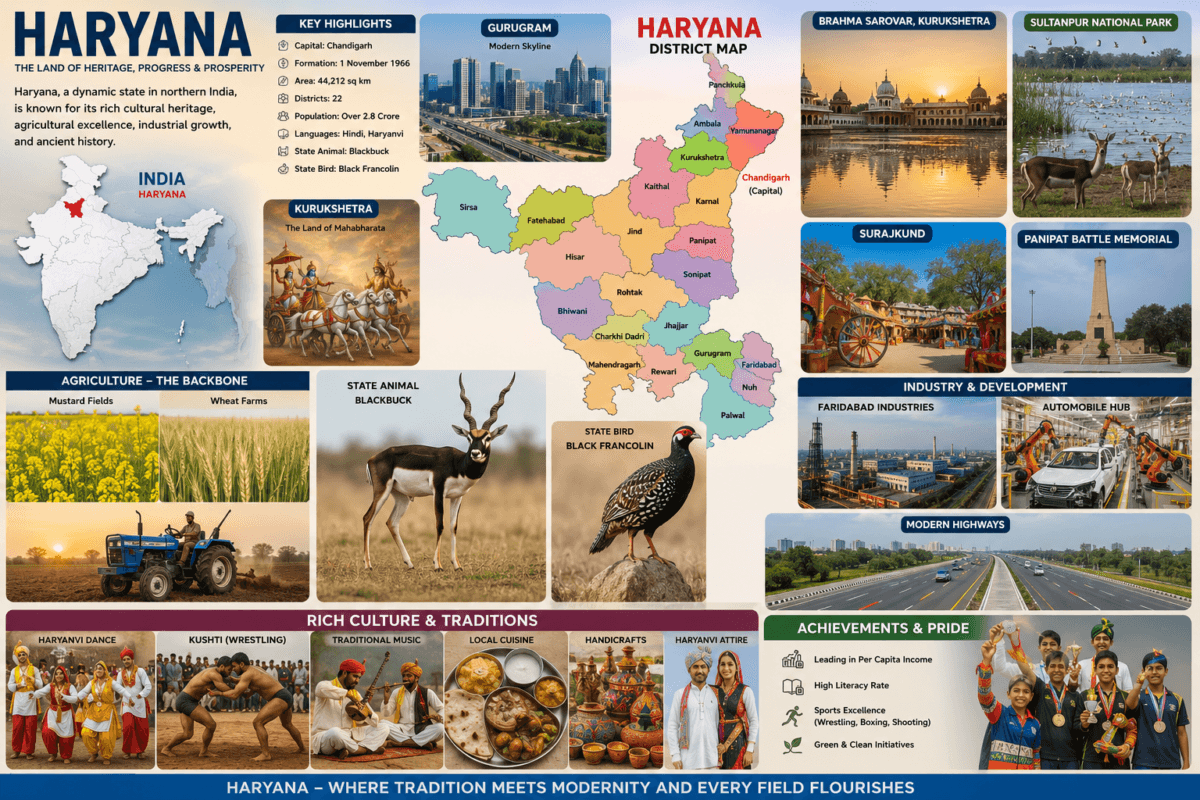
Haryana is one of India’s most prosperous states, renowned for its rich history, agricultural excellence, rapid industrial development, and vibrant cultural heritage.
Located in Northern India, Haryana surrounds the National Capital Territory of Delhi on three sides and shares its borders with Punjab, Himachal Pradesh, Rajasthan, Uttar Pradesh, and Uttarakhand.
The state’s strategic location has made it one of India’s leading centres for manufacturing, commerce, agriculture, education, and sports.
The name “Haryana” is believed to mean “The Abode of God” or “Land of Hari (Lord Vishnu)”, reflecting its ancient religious significance.
The region has been inhabited since the time of the Indus Valley Civilization and is closely associated with the epic Mahabharata.
The historic city of Kurukshetra is believed to be the battlefield where Lord Krishna delivered the sacred Bhagavad Gita to Arjuna.
The state was officially formed as India’s 17th state on 1 November 1966, after being separated from the former state of Punjab on a linguistic basis.
Chandigarh serves as the shared capital of both Haryana and Punjab.
The state covers an area of approximately 44,212 square kilometres and has a population of over 25 million (2011 Census).
Faridabad is the largest city, while Gurugram (Gurgaon) has emerged as one of India’s leading financial, IT, and corporate hubs.
Haryana is also famous for modern planned cities such as Panchkula, Karnal, Panipat, Hisar, Rohtak, and Ambala.
Agriculture is the backbone of Haryana’s economy, earning it the title of one of India’s “Food Bowls.” The state is among the country’s largest producers of wheat, rice, mustard, cotton, sugarcane, and dairy products.
Haryana also played a vital role in India’s Green Revolution, significantly boosting agricultural productivity.
Apart from agriculture, the state is a major industrial powerhouse.
Gurugram, Faridabad, Manesar, and Panipat are globally recognised for industries such as automobiles, IT services, textiles, petrochemicals, manufacturing, engineering, and startups.
Haryana is home to one of India’s largest automobile manufacturing clusters and contributes significantly to the national economy.
The state is equally famous for its folk dances, Haryanvi music, wrestling traditions, rich cuisine, colourful festivals, and sporting excellence. Haryana has produced numerous Olympic medalists, world champions, and renowned athletes in wrestling, boxing, shooting, athletics, and hockey.
Visitors to the state can explore spiritual destinations like Kurukshetra, historical monuments such as the Panipat battlefields, wildlife sanctuaries, beautiful lakes, adventure parks, and modern urban attractions in Gurugram.
With its unique blend of ancient heritage, modern infrastructure, agricultural prosperity, and economic growth, Haryana offers something for every traveller and continues to play a vital role in India’s development.
Haryana at a Glance
| Category | Details |
|---|---|
| Formation | 1 November 1966 |
| Capital | Chandigarh (Shared with Punjab) |
| Largest City | Faridabad |
| Major Financial Hub | Gurugram |
| Total Area | 44,212 sq km |
| Population (2011) | 2.53 Crore (25.35 Million) |
| Official Language | Hindi |
| State Animal | Blackbuck |
| State Bird | Black Francolin |
| Famous For | Agriculture, IT, Automobiles, Wrestling & Kurukshetra |
Haryana Location in India
Haryana is located in Northern India and is one of the country’s most strategically important states. It surrounds the National Capital Territory (NCT) of Delhi on three sides and shares borders with Punjab to the northwest, Himachal Pradesh to the north, Uttarakhand and Uttar Pradesh to the east, and Rajasthan to the south and southwest. Due to its central location in North India, Haryana serves as a major transportation, industrial, and commercial hub.
On the India map, Haryana occupies an area of approximately 44,212 square kilometres and lies between 27°39′N and 30°55′N latitude and 74°28′E and 77°36′E longitude. The state consists mainly of fertile plains, making it one of India’s leading agricultural regions. Its proximity to New Delhi has also contributed to the rapid growth of cities such as Gurugram, Faridabad, Panipat, Hisar, and Karnal, transforming Haryana into a major centre for business, manufacturing, and information technology.
Haryana’s strategic location, excellent road and rail connectivity, and close association with the National Capital Region (NCR) make it one of India’s fastest-growing and most economically significant states.
History of Haryana
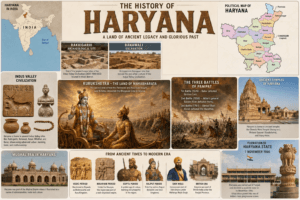
Haryana has a rich and glorious history that dates back to the Indus Valley Civilization, making it one of the oldest inhabited regions in India. Archaeological excavations at sites such as Rakhigarhi (Hisar district), Banawali (Fatehabad district), and Bhirrana have revealed evidence of one of the world’s earliest urban civilizations, dating back more than 5,000 years. Rakhigarhi is considered the largest Harappan (Indus Valley Civilization) site in India.
Haryana holds immense religious and historical significance because it is closely associated with the Mahabharata. The ancient city of Kurukshetra is believed to be the sacred battlefield where the epic Battle of Mahabharata was fought between the Pandavas and Kauravas. It was here that Lord Krishna delivered the sacred Bhagavad Gita to Arjuna, making Kurukshetra one of Hinduism’s holiest pilgrimage destinations.
During the Vedic period, Haryana became an important centre of learning, culture, and spiritual development. The region was ruled by several powerful dynasties, including the Mauryas, Kushans, Guptas, Pushyabhutis, Tomaras, and Chauhans, all of whom contributed to its cultural and architectural heritage.
Haryana also played a decisive role in Indian history through the Three Battles of Panipat (1526, 1556, and 1761), fought near the city of Panipat. These historic battles significantly influenced the political future of the Indian subcontinent by shaping the rise and fall of major empires, including the Mughal Empire and the Maratha Empire.
During British rule, Haryana formed part of the Punjab Province. Following India’s independence in 1947, the region remained within the state of Punjab. On 1 November 1966, Haryana was officially carved out as a separate state on the basis of language, with Hindi becoming the official language. Chandigarh was designated as the shared capital of both Haryana and Punjab.
Since its formation, Haryana has transformed into one of India’s fastest-growing states. It became a major contributor to the Green Revolution, significantly increasing agricultural production. Today, Haryana is recognised for its excellence in agriculture, automobile manufacturing, information technology, sports, education, and industrial development, making it one of India’s most prosperous states.
History at a Glance
| Category | Details |
|---|---|
| Ancient Civilization | Indus Valley Civilization |
| Largest Harappan Site | Rakhigarhi |
| Famous Epic | Mahabharata |
| Sacred Place | Kurukshetra |
| Historic Battles | Three Battles of Panipat |
| Major Dynasties | Mauryas, Guptas, Tomaras & Chauhans |
| British Era | Part of Punjab Province |
| State Formation | 1 November 1966 |
| Shared Capital | Chandigarh |
| Historical Identity | Cradle of Indian Civilization & Bhagavad Gita |
Geography & Climate of Haryana
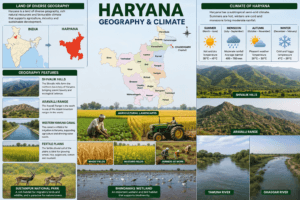
Haryana is located in Northern India and is primarily characterised by its fertile alluvial plains, seasonal rivers, low hills, and semi-arid landscapes. Covering an area of approximately 44,212 square kilometres, the state is bordered by Punjab and Himachal Pradesh to the north, Rajasthan to the west and south, Uttar Pradesh and Uttarakhand to the east, while surrounding the National Capital Territory (NCT) of Delhi on three sides.
Most of Haryana lies in the Indo-Gangetic Plain, making it one of India’s most productive agricultural regions. The fertile soil, supported by extensive irrigation systems and favourable climatic conditions, enables large-scale cultivation of wheat, rice, mustard, cotton, sugarcane, pearl millet (bajra), and vegetables. The northeastern part of the state is covered by the Shivalik Hills, while the southern districts include parts of the Aravalli Range, one of the world’s oldest mountain systems.
Haryana is drained by several important rivers, including the Yamuna, Ghaggar, Markanda, Tangri, and Sahibi rivers. The Western Yamuna Canal and Bhakra Canal System play a vital role in irrigation, supporting agriculture across the state.
The climate of Haryana is subtropical continental, with distinct summer, monsoon, autumn, and winter seasons. Summers (April to June) are extremely hot, with temperatures often reaching 45°C to 48°C. The monsoon season (July to September) brings moderate rainfall, averaging 300–700 mm annually, with higher rainfall in the Shivalik region. Winter (December to February) is cool and pleasant, with temperatures occasionally dropping below 5°C, especially in northern districts.
The state experiences diverse landscapes ranging from fertile plains and river valleys to rocky hills and forested areas. Important wetlands such as Sultanpur National Park and Bhindawas Wildlife Sanctuary provide habitats for migratory birds and contribute to Haryana’s ecological diversity.
With its strategic location, fertile land, varied landscapes, and favourable climate, Haryana continues to be one of India’s leading agricultural and industrial states.
Geography & Climate at a Glance
| Category | Details |
|---|---|
| Total Area | 44,212 sq km |
| Terrain | Fertile Indo-Gangetic Plains |
| Major Hills | Shivalik Hills & Aravalli Range |
| Major Rivers | Yamuna, Ghaggar, Markanda & Tangri |
| Major Canals | Western Yamuna Canal & Bhakra Canal |
| Climate Type | Subtropical Continental |
| Summer Temperature | Up to 48°C |
| Average Rainfall | 300–700 mm |
| Winter Temperature | 5°C–20°C |
| Agricultural Identity | Wheat, Rice & Mustard Producing State |
Rivers & Forests of Haryana
Haryana is blessed with an extensive network of rivers, canals, forests, wetlands, and protected wildlife habitats that support agriculture, biodiversity, and ecological balance. Although the state has relatively low forest cover compared to many Himalayan states, its rivers, wetlands, and forest areas play a vital role in sustaining wildlife and providing water for farming.
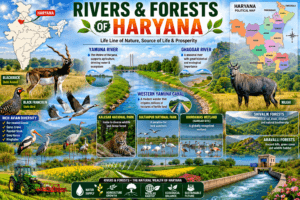
The Yamuna River is the most important river of Haryana and forms the state’s eastern boundary with Uttar Pradesh. It is the primary source of irrigation and drinking water for many districts. Other important rivers include the Ghaggar, Markanda, Tangri, Sahibi, Chautang, and Krishnavati rivers. Most of these are seasonal rivers that flow mainly during the monsoon season.
Haryana has one of India’s most efficient irrigation systems. Major canals such as the Western Yamuna Canal, Bhakra Canal, Jawahar Lal Nehru Canal, and Sirsa Branch Canal distribute water across the state’s fertile agricultural lands, making Haryana one of India’s leading producers of wheat, rice, and mustard.
Although forests cover only a small percentage of the state’s geographical area, Haryana has several important forest regions, particularly in the Shivalik Hills and the Aravalli Range. Common forest types include Tropical Dry Deciduous Forests, Tropical Thorn Forests, and Riverine Forests. These forests help conserve soil, recharge groundwater, and protect wildlife habitats.
Haryana is home to several protected areas, including Sultanpur National Park, Kalesar National Park, Bhindawas Wildlife Sanctuary, Kalesar Wildlife Sanctuary, Nahar Wildlife Sanctuary, Bir Shikargah Wildlife Sanctuary, and Chhilchhila Wildlife Sanctuary.
The Blackbuck is the State Animal of Haryana, while the Black Francolin is the State Bird. Other wildlife species found in the state include Nilgai (Blue Bull), Leopard, Sambar Deer, Chital (Spotted Deer), Wild Boar, Golden Jackal, Indian Hare, and numerous reptiles.
Wetlands such as Sultanpur National Park and Bhindawas Wetland (Ramsar Site) attract thousands of migratory birds every winter, including Bar-headed Geese, Painted Storks, Sarus Cranes, Black-necked Storks, Eurasian Spoonbills, Northern Pintails, Common Teals, and Flamingos.
Haryana continues to promote afforestation, wetland conservation, and wildlife protection through sustainable environmental initiatives, making its rivers, forests, and protected areas valuable natural assets.
Rivers & Forests at a Glance
| Category | Details |
|---|---|
| Major Rivers | Yamuna, Ghaggar, Markanda, Tangri & Sahibi |
| Major Canals | Western Yamuna Canal, Bhakra Canal & JLN Canal |
| Largest National Park | Kalesar National Park |
| Famous Bird Sanctuary | Sultanpur National Park |
| Ramsar Site | Bhindawas Wetland |
| State Animal | Blackbuck |
| State Bird | Black Francolin |
| Major Forest Types | Tropical Dry Deciduous, Thorn & Riverine Forests |
| Famous Wildlife | Leopard, Nilgai, Sambar, Chital & Wild Boar |
| Ecological Identity | Wetlands, Forests & Rich Birdlife |
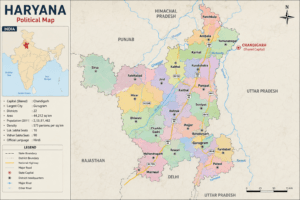
Political Map of Haryana
The political map of Haryana displays the state’s 22 districts, district headquarters, capital, major cities, national highways, rivers, and neighbouring states. Chandigarh serves as the shared capital of Haryana and Punjab.
Haryana is administratively divided into 22 districts, each governed by a Deputy Commissioner (DC). These districts are further divided into sub-divisions, tehsils, blocks, and villages for efficient governance and public administration.
The state is bordered by Punjab, Himachal Pradesh, Uttarakhand, Uttar Pradesh, Rajasthan, and surrounds the National Capital Territory (NCT) of Delhi on three sides. Important cities shown on the political map include Gurugram, Faridabad, Panipat, Karnal, Hisar, Ambala, Rohtak, Sonipat, Kurukshetra, Panchkula, Yamunanagar, Rewari, Sirsa, Fatehabad, Kaithal, Jind, Bhiwani, Charkhi Dadri, Mahendragarh, Nuh, Jhajjar, and Palwal.
The political map is an essential reference for understanding Haryana’s administrative boundaries, district locations, transportation network, and geographical position within India.
Haryana Political Map at a Glance
| Category | Details |
|---|---|
| State | Haryana |
| Capital | Chandigarh (Shared with Punjab) |
| Total Districts | 22 |
| Largest City | Faridabad |
| Major NCR City | Gurugram |
| Administrative Divisions | Districts, Tehsils & Blocks |
| Major Rivers | Yamuna & Ghaggar |
| Neighbouring States | Punjab, Himachal Pradesh, Uttarakhand, Uttar Pradesh & Rajasthan |
| National Capital Region | Delhi surrounded on three sides |
| Map Highlights | District Boundaries, Cities & Highways |
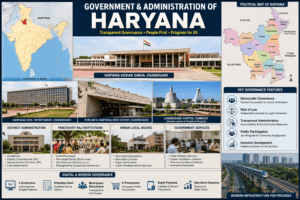
Government & Administration of Haryana
Haryana follows a parliamentary system of government as provided by the Constitution of India. The Governor is the constitutional head of the state, while the Chief Minister serves as the executive head, leading the Council of Ministers and overseeing the administration of Haryana. The state government is responsible for implementing laws, maintaining public welfare, promoting economic development, and delivering essential public services.
The Haryana Legislative Assembly (Vidhan Sabha) is a unicameral legislature consisting of 90 elected Members of the Legislative Assembly (MLAs). The Assembly meets in Chandigarh, which serves as the shared capital of both Haryana and Punjab.
Administratively, Haryana is divided into 22 districts, each headed by a Deputy Commissioner (DC). These districts are further subdivided into sub-divisions, tehsils, sub-tehsils, development blocks, municipalities, and villages, ensuring efficient governance and local administration across the state.
Rural governance is managed through the Panchayati Raj System, which includes Gram Panchayats, Panchayat Samitis, and Zila Parishads. Urban areas are administered by Municipal Corporations, Municipal Councils, and Municipal Committees, which oversee civic services, urban planning, sanitation, and infrastructure development.
The Punjab and Haryana High Court, located in Chandigarh, serves as the highest judicial authority for both Haryana and Punjab. The judiciary ensures justice, protects constitutional rights, and upholds the rule of law.
Haryana has been a pioneer in e-Governance and digital public services. Citizens can access numerous government services online, including land records, certificates, licenses, utility payments, and welfare schemes through digital portals. The state also focuses on agriculture, education, healthcare, infrastructure, industrial development, women’s empowerment, skill development, and social welfare through various government initiatives.
With transparent administration, strong local governance, and modern digital infrastructure, Haryana continues to be one of India’s most efficiently governed and rapidly developing states.
Government & Administration at a Glance
| Category | Details |
|---|---|
| Capital | Chandigarh (Shared with Punjab) |
| Government Type | Parliamentary System |
| Legislature | Unicameral |
| Legislative Assembly Seats | 90 |
| High Court | Punjab and Haryana High Court |
| Total Districts | 22 |
| Administrative Units | Districts, Tehsils, Blocks & Villages |
| Rural Governance | Panchayati Raj System |
| Urban Governance | Municipal Corporations, Municipal Councils & Municipal Committees |
| Official Language | Hindi |
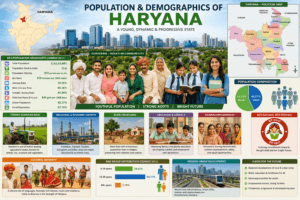
Population & Demographics of Haryana
Haryana is one of India’s fastest-growing and economically developed states, known for its young population, rapid urbanisation, high agricultural productivity, and expanding industrial sector. According to the 2011 Census of India, Haryana has a population of approximately 25.35 million (2.53 crore). Due to rapid economic growth, urban expansion, and migration to cities such as Gurugram and Faridabad, the state’s population has continued to increase.
The population density of Haryana is approximately 573 persons per square kilometre. The state has made significant progress in education, healthcare, and women’s welfare over the years. The literacy rate stands at 75.55%, while continuous government initiatives are helping improve educational opportunities and digital literacy across both urban and rural areas.
The sex ratio of Haryana is 879 females per 1,000 males (Census 2011). Various government programmes such as Beti Bachao, Beti Padhao, which was launched from Panipat, have contributed towards improving gender awareness and promoting the welfare of girl children.
Hindi is the official language of Haryana and is widely spoken across the state. Haryanvi, a popular dialect of Hindi, is commonly spoken in rural and urban areas. Punjabi, English, and Urdu are also spoken by sections of the population.
The majority of Haryana’s population follows Hinduism, while Sikhism, Islam, Jainism, Christianity, and Buddhism are also practised throughout the state, reflecting its cultural diversity and social harmony.
Major urban centres include Faridabad, Gurugram, Panipat, Hisar, Karnal, Ambala, Rohtak, Yamunanagar, Sonipat, and Panchkula. These cities are important hubs for education, healthcare, manufacturing, IT services, trade, and administration.
Haryana has a youthful workforce and one of India’s highest per capita income levels. The state’s rapidly growing urban population, combined with strong industrial and agricultural sectors, continues to drive economic development and improve the quality of life.
Population & Demographics at a Glance
| Category | Details |
|---|---|
| Population (2011 Census) | 2.53 Crore (25.35 Million) |
| Population Density | 573 persons/sq km |
| Literacy Rate | 75.55% |
| Sex Ratio | 879 females per 1,000 males |
| Official Language | Hindi |
| Popular Dialect | Haryanvi |
| Other Languages | Punjabi, English & Urdu |
| Major Religions | Hinduism, Sikhism, Islam, Jainism, Christianity & Buddhism |
| Largest City | Faridabad |
| Economic Identity | Young Workforce & Rapid Urbanisation |
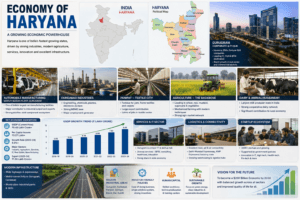
Economy of Haryana
Haryana has one of the strongest and fastest-growing economies in India, driven by agriculture, manufacturing, automobiles, information technology (IT), real estate, textiles, dairy farming, and services. Due to its strategic location in the National Capital Region (NCR), excellent infrastructure, and business-friendly policies, Haryana has become a major economic powerhouse and consistently ranks among the states with the highest per capita income in India.
Agriculture remains the backbone of Haryana’s economy. The fertile Indo-Gangetic Plains, supported by the Western Yamuna Canal, Bhakra Canal System, and advanced irrigation facilities, make the state one of India’s largest producers of wheat, rice, mustard, cotton, sugarcane, pearl millet (bajra), and vegetables. Haryana played a vital role in the Green Revolution, significantly increasing food grain production and strengthening India’s food security. The state is also a leading producer of milk, buffaloes, and dairy products, making livestock an important part of the rural economy.
The industrial sector contributes significantly to Haryana’s economic growth. Gurugram (Gurgaon) has developed into one of India’s leading IT, financial, startup, and corporate hubs, housing the offices of numerous multinational companies. Manesar and Faridabad are internationally recognised for automobile manufacturing, engineering, electronics, heavy machinery, and industrial production. Haryana is home to Maruti Suzuki India’s largest automobile manufacturing facilities, making it one of the country’s most important automotive centres.
Other major industrial cities include Panipat, famous for textiles, handlooms, carpets, and petrochemical industries; Yamunanagar, known for plywood, paper, and timber industries; Hisar, recognised for steel production and agro-industries; and Ambala, which is famous for scientific instruments, textile products, and defence-related manufacturing.
The services sector has expanded rapidly in recent years. Banking, finance, education, healthcare, tourism, logistics, retail, e-commerce, and information technology contribute significantly to the state’s Gross State Domestic Product (GSDP). Haryana also attracts substantial domestic and foreign investments due to its excellent road connectivity, industrial corridors, and modern infrastructure.
Government initiatives such as Digital Haryana, Startup Haryana, Ease of Doing Business reforms, industrial parks, special economic zones (SEZs), and skill development programmes continue to strengthen the state’s economy and generate employment opportunities.
With its strong agricultural base, world-class industrial infrastructure, booming corporate sector, and rapidly growing service industry, Haryana remains one of India’s most prosperous and economically dynamic states.
Economy at a Glance
| Category | Details |
|---|---|
| Economic Strength | Agriculture, Industry & Services |
| Major Crops | Wheat, Rice, Mustard, Cotton & Sugarcane |
| IT & Corporate Hub | Gurugram |
| Automobile Hub | Gurugram, Manesar & Faridabad |
| Textile Hub | Panipat |
| Dairy Industry | Milk & Buffalo Production |
| Major Industries | Automobiles, Textiles, Petrochemicals, Engineering & IT |
| Leading Company | Maruti Suzuki India |
| Per Capita Income | Among the Highest in India |
| Economic Identity | Industrial & Agricultural Powerhouse |
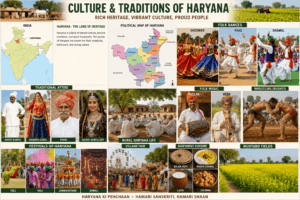
Culture & Traditions of Haryana
Haryana is renowned for its rich cultural heritage, vibrant folk traditions, rural lifestyle, traditional attire, music, dance, festivals, and warm hospitality. The state’s culture reflects simplicity, bravery, agricultural prosperity, and strong family values that have been preserved for centuries. Most traditions are deeply connected with farming, seasonal celebrations, and community life.
The people of Haryana primarily speak Hindi, while Haryanvi, a popular dialect of Hindi, is widely spoken throughout the state. The traditional greeting “Ram Ram” is commonly used across villages and towns, reflecting the state’s deep-rooted cultural values.
Haryana is famous for its energetic folk dances, especially Ghoomar, Phag Dance, Dhamal, Loor, Khoria, and Raas Leela. These dances are performed during festivals, weddings, harvest celebrations, and other cultural events. Traditional folk music, accompanied by instruments such as the Dholak, Nagara, Been, Harmonium, Chimta, and Sarangi, plays an important role in preserving Haryanvi heritage.
Traditional attire in Haryana includes Dhoti-Kurta, Pagri (Turban), and Mojari for men, while women traditionally wear Ghagra-Choli, Salwar-Kameez, Odhni (Dupatta), and beautiful silver jewellery. Colourful embroidered garments and handcrafted ornaments are an integral part of the state’s cultural identity.
Agriculture is at the heart of Haryana’s traditions. Harvest festivals, cattle fairs, wrestling competitions (Kushti), rural sports, and village fairs are celebrated with great enthusiasm. Haryana has produced many internationally recognised wrestlers, boxers, and athletes, making sports an important part of its cultural fabric.
The state celebrates festivals such as Baisakhi, Holi, Diwali, Teej, Janmashtami, Makar Sankranti, Gugga Naumi, and Basant Panchami with great enthusiasm. Religious harmony and community participation are central to these celebrations.
Haryana is also known for its rich culinary traditions, including Bajra Khichdi, Kadhi Pakora, Hara Dhania Cholia, Bathua Raita, Mixed Dal, Kachri Ki Sabzi, Churma, Rabri, Lassi, and Ghee-based dishes, which reflect the state’s agricultural abundance.
With its colourful traditions, folk arts, rural heritage, and strong cultural values, Haryana continues to preserve its unique identity while embracing modern development.
Culture & Traditions at a Glance
| Category | Details |
|---|---|
| Official Language | Hindi |
| Popular Dialect | Haryanvi |
| Famous Folk Dances | Ghoomar, Phag, Dhamal, Loor & Khoria |
| Traditional Dress | Dhoti-Kurta, Pagri, Ghagra-Choli & Odhni |
| Traditional Music | Dholak, Been, Nagara, Sarangi & Harmonium |
| Popular Sport | Kushti (Wrestling) |
| Major Festivals | Baisakhi, Teej, Holi, Diwali & Janmashtami |
| Traditional Food | Bajra Khichdi, Kadhi, Churma & Lassi |
| Cultural Identity | Agriculture & Rural Heritage |
| Famous Greeting | Ram Ram |
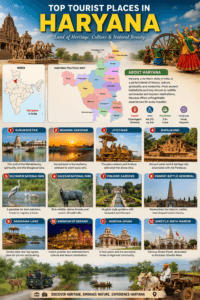
Top Tourist Places in Haryana
Haryana is home to a diverse range of religious sites, historical monuments, wildlife sanctuaries, lakes, museums, and modern attractions. From the sacred land of Kurukshetra to the bustling corporate city of Gurugram, the state offers memorable experiences for pilgrims, history enthusiasts, nature lovers, and families.
One of the most famous destinations is Kurukshetra, believed to be the battlefield of the Mahabharata where Lord Krishna delivered the Bhagavad Gita to Arjuna. Attractions such as Brahma Sarovar, Jyotisar, and Sannihit Sarovar attract millions of pilgrims every year.
The Surajkund near Faridabad is internationally famous for hosting the annual Surajkund International Crafts Mela, one of the world’s largest handicrafts fairs showcasing art, culture, cuisine, and traditions from India and abroad.
Nature lovers can visit Sultanpur National Park near Gurugram, a paradise for birdwatchers with hundreds of resident and migratory bird species. Another important wildlife destination is Kalesar National Park in Yamunanagar, known for its forests, leopards, elephants, and rich biodiversity.
History enthusiasts should explore the Panipat Battlefields, where the historic Three Battles of Panipat shaped the course of Indian history. Nearby attractions include the Panipat Museum and Kabuli Bagh Mosque, which preserve the region’s historical legacy.
Other popular tourist attractions include Pinjore Gardens (Yadavindra Gardens), a beautiful Mughal-style garden in Panchkula; Morna Hills; Damdama Lake, a popular destination for boating and adventure sports; Badkhal Lake; Kingdom of Dreams in Gurugram; Sheetla Mata Mandir; Agroha Dham; and the Baba Mast Nath Math in Rohtak.
Whether you are interested in spirituality, history, wildlife, culture, or recreation, Haryana offers a perfect blend of ancient heritage and modern attractions for every traveller.
Top Tourist Places at a Glance
| Tourist Place | Famous For |
|---|---|
| Kurukshetra | Mahabharata & Bhagavad Gita |
| Brahma Sarovar | Sacred Pilgrimage Site |
| Jyotisar | Birthplace of the Bhagavad Gita |
| Surajkund | International Crafts Mela |
| Sultanpur National Park | Bird Watching |
| Kalesar National Park | Wildlife & Forests |
| Pinjore Gardens | Mughal-style Gardens |
| Panipat | Historic Battlefields |
| Damdama Lake | Boating & Adventure Activities |
| Kingdom of Dreams | Entertainment & Cultural Shows |
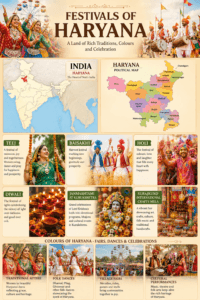
Festivals of Haryana
Haryana celebrates a wide variety of religious, cultural, harvest, and traditional festivals that reflect its rich heritage, agricultural lifestyle, and vibrant community spirit. Most festivals are associated with farming seasons, mythology, and local customs, bringing together people from different communities in colourful celebrations filled with music, dance, fairs, and traditional cuisine.
One of the most important festivals in Haryana is Teej, celebrated primarily by women during the monsoon season. Women wear colourful traditional attire, apply mehndi (henna), sing folk songs, perform Ghoomar and Phag dances, and participate in community gatherings. Swings decorated with flowers are a major attraction during the festival.
Baisakhi is another significant festival marking the harvest season. Farmers celebrate a successful crop with prayers, folk music, wrestling competitions, fairs, and traditional dances. It also holds great religious significance for the Sikh community.
Holi, the festival of colours, is celebrated with great enthusiasm across Haryana. People enjoy traditional sweets, cultural performances, folk songs, and community feasts. Rural villages organise wrestling matches, cultural programmes, and festive gatherings.
Diwali, the festival of lights, is celebrated by decorating homes with lamps, rangoli, and colourful lights. Families perform Lakshmi Puja, exchange sweets and gifts, and participate in community celebrations.
Janmashtami, commemorating the birth of Lord Krishna, is especially important because Kurukshetra is closely associated with the Mahabharata and the Bhagavad Gita. Thousands of devotees visit temples and participate in religious events.
Other major festivals include Makar Sankranti, Basant Panchami, Gugga Naumi, Maha Shivaratri, Navratri, Dussehra, Karva Chauth, and Guru Nanak Jayanti. Haryana is also internationally recognised for the Surajkund International Crafts Mela, held annually in Faridabad, where artisans from India and around the world showcase handicrafts, cultural performances, traditional cuisines, and folk arts.
These festivals showcase Haryana’s traditions of unity, hospitality, agriculture, spirituality, and cultural diversity, making the state an exciting destination throughout the year.
Festivals at a Glance
| Festival | Famous For |
|---|---|
| Teej | Women’s Festival & Monsoon Celebrations |
| Baisakhi | Harvest Festival |
| Holi | Festival of Colours |
| Diwali | Festival of Lights |
| Janmashtami | Birth of Lord Krishna |
| Surajkund International Crafts Mela | International Handicrafts & Cultural Fair |
| Makar Sankranti | Harvest & Kite Flying |
| Basant Panchami | Spring Festival |
| Gugga Naumi | Folk & Religious Festival |
| Dussehra | Victory of Good over Evil |
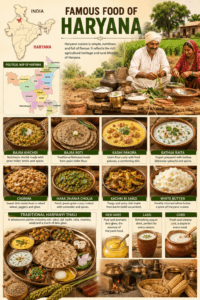
Famous Food of Haryana
Haryana is famous for its simple, nutritious, and wholesome cuisine, which reflects the state’s rich agricultural heritage and rural lifestyle. Traditional Haryanvi food is prepared using fresh dairy products, wheat, millet (bajra), seasonal vegetables, homemade butter, curd, and pure desi ghee. Most dishes are healthy, flavourful, and prepared with locally grown ingredients.
One of the signature dishes of Haryana is Bajra Khichdi, made with pearl millet and served with desi ghee, curd, or buttermilk. It is especially popular during the winter season because of its nutritional value and warming properties.
Another favourite is Kadhi Pakora, a delicious curry made from gram flour and yoghurt, served with steamed rice or chapatis. Hara Dhania Cholia, prepared from fresh green chickpeas, and Kachri Ki Sabzi are also widely enjoyed in rural households.
Mixed Dal, Bathua Raita, Besan Masala Roti, Singri Ki Sabzi, Aloo Roti, and Bajra Roti are common everyday dishes that showcase Haryana’s traditional cooking style. Homemade white butter (Makhan), fresh curd, and lassi are served with most meals.
Haryana is also well known for its delicious desserts. Popular sweets include Churma, Meethe Chawal, Kheer, Rabri, Malpua, Gajar Ka Halwa, and Pinni, which are prepared during festivals and special occasions.
The state’s dairy products are among the finest in India. Fresh milk, curd, paneer, buttermilk, and desi ghee are produced in abundance and form an essential part of the Haryanvi diet.
Whether enjoyed in a traditional village home or a local dhaba, Haryanvi cuisine offers a perfect combination of nutrition, simplicity, and authentic flavours that represent the state’s agricultural traditions and warm hospitality.
Famous Food at a Glance
| Food Item | Famous For |
|---|---|
| Bajra Khichdi | Traditional Winter Dish |
| Bajra Roti | Millet Flatbread |
| Kadhi Pakora | Gram Flour & Yogurt Curry |
| Bathua Raita | Seasonal Yogurt Dish |
| Hara Dhania Cholia | Fresh Green Chickpeas |
| Churma | Traditional Sweet |
| Lassi | Refreshing Yogurt Drink |
| White Butter (Makhan) | Homemade Dairy Product |
| Desi Ghee | Traditional Cooking Ingredient |
| Haryanvi Thali | Authentic Regional Cuisine |
Wildlife of Haryana
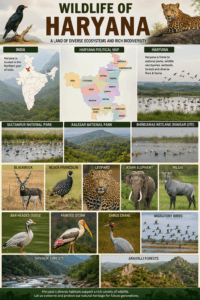
Haryana is home to a diverse range of wildlife, forests, wetlands, and protected areas that support numerous mammals, birds, reptiles, and aquatic species. Although the state has relatively low forest cover compared to many other Indian states, its Shivalik Hills, Aravalli Range, wetlands, grasslands, and river ecosystems provide important habitats for rich biodiversity.
The Blackbuck is the State Animal of Haryana and is one of India’s most graceful antelopes. Once widespread across the plains, Blackbucks are now protected in several wildlife sanctuaries and conservation areas within the state.
The Black Francolin is the State Bird of Haryana. The state is also famous for its rich birdlife, especially in its wetlands and bird sanctuaries. Thousands of migratory birds arrive every winter from Central Asia, Siberia, and Europe, making Haryana a popular destination for birdwatchers and wildlife photographers.
The Kalesar National Park, located in Yamunanagar district, is Haryana’s largest national park. Spread across the foothills of the Shivalik Range, it is known for its dense forests and wildlife, including Leopards, Asian Elephants, Sambar Deer, Chital (Spotted Deer), Barking Deer, Nilgai (Blue Bull), Wild Boar, Indian Porcupine, Langurs, and Golden Jackals.
Another major wildlife destination is Sultanpur National Park in Gurugram district, one of India’s most famous bird sanctuaries. It attracts more than 250 species of resident and migratory birds, including Bar-headed Geese, Painted Storks, Black-necked Storks, Sarus Cranes, Eurasian Spoonbills, Flamingos, Northern Pintails, and Common Teals.
The Bhindawas Wildlife Sanctuary, which includes the Bhindawas Wetland (Ramsar Site), is the largest wetland in Haryana and an important habitat for migratory waterbirds. Other protected areas include Kalesar Wildlife Sanctuary, Nahar Wildlife Sanctuary, Bir Shikargah Wildlife Sanctuary, and Chhilchhila Wildlife Sanctuary.
Haryana continues to strengthen wildlife conservation through afforestation programmes, wetland restoration, biodiversity protection, and eco-tourism initiatives. These efforts help preserve the state’s natural heritage while promoting sustainable environmental management.
Wildlife at a Glance
| Category | Details |
|---|---|
| State Animal | Blackbuck |
| State Bird | Black Francolin |
| Largest National Park | Kalesar National Park |
| Famous Bird Sanctuary | Sultanpur National Park |
| Largest Wetland | Bhindawas Wetland (Ramsar Site) |
| Major Wildlife | Leopard, Asian Elephant, Nilgai, Sambar & Wild Boar |
| Famous Birds | Sarus Crane, Painted Stork, Flamingo & Bar-headed Goose |
| Migratory Birds | More than 250 Species |
| Major Habitat | Shivalik Forests, Wetlands & Grasslands |
| Wildlife Identity | Bird Conservation & Wetland Ecosystem |
Education in Haryana
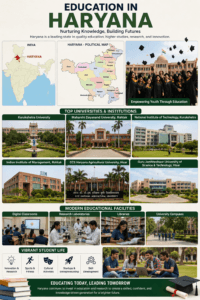
Haryana has emerged as one of India’s leading states in education, higher learning, research, technical education, agriculture, and medical sciences. The state has invested significantly in improving educational infrastructure through government schools, private institutions, universities, engineering colleges, medical colleges, and skill development centres. Today, Haryana is recognised for its growing literacy, quality education, and world-class research institutions.
According to the 2011 Census, Haryana has a literacy rate of 75.55%, with continuous improvement through digital education, smart classrooms, scholarship programmes, girls’ education initiatives, and vocational training. Government schemes such as Beti Bachao, Beti Padhao, launched from Panipat, have played a significant role in promoting female education and reducing gender disparities.
Haryana is home to several prestigious universities. Kurukshetra University, established in 1956, is one of the state’s oldest and most respected institutions. Maharshi Dayanand University (MDU), Rohtak, is another leading university known for higher education, research, and professional courses.
The state also hosts premier institutions such as the National Institute of Technology (NIT), Kurukshetra, one of India’s top engineering institutes, and the Indian Institute of Management (IIM), Rohtak, which is among the country’s leading management schools.
Other important universities include Chaudhary Charan Singh Haryana Agricultural University (Hisar), India’s leading agricultural research institution; Guru Jambheshwar University of Science and Technology (Hisar); Deenbandhu Chhotu Ram University of Science and Technology (Murthal); and O.P. Jindal Global University (Sonipat), which has earned international recognition for legal education and multidisciplinary research.
Haryana also has numerous engineering, medical, law, pharmacy, nursing, management, teacher-training, and technical colleges that attract students from across India. The government continues to strengthen digital learning, innovation, research, entrepreneurship, and skill development to prepare students for future careers.
With its modern educational institutions, research excellence, and focus on innovation, Haryana continues to be one of India’s fastest-growing centres for higher education and professional learning.
Education at a Glance
| Category | Details |
|---|---|
| Literacy Rate | 75.55% |
| Oldest Major University | Kurukshetra University |
| Leading State University | Maharshi Dayanand University (MDU), Rohtak |
| Premier Engineering Institute | NIT Kurukshetra |
| Premier Management Institute | IIM Rohtak |
| Agricultural University | CCS Haryana Agricultural University, Hisar |
| Science & Technology University | Guru Jambheshwar University, Hisar |
| Private University | O.P. Jindal Global University, Sonipat |
| Focus Areas | Higher Education, Research & Skill Development |
| Education Strength | Technical, Agricultural & Professional Education |
Transport & Connectivity of Haryana
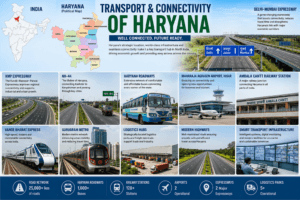
Haryana has one of the most advanced transport networks in India, supported by an extensive system of national highways, expressways, railways, airports, and public transportation. Due to its strategic location surrounding the National Capital Territory (NCT) of Delhi, Haryana serves as a major transportation, logistics, and industrial hub connecting northern India with the rest of the country.
The state has an excellent road network maintained by the National Highways Authority of India (NHAI), the Haryana Public Works Department (PWD), and the Haryana State Roads & Bridges Development Corporation. Major highways such as NH-44, NH-48, NH-9, NH-52, and NH-152D connect important cities including Gurugram, Faridabad, Panipat, Karnal, Ambala, Hisar, Rohtak, Sonipat, and Kurukshetra with Delhi, Punjab, Rajasthan, Uttar Pradesh, Himachal Pradesh, and Uttarakhand.
Haryana is also home to several modern expressways, including the Delhi–Mumbai Expressway, Kundli–Manesar–Palwal (KMP) Expressway, Dwarka Expressway, and the Delhi–Amritsar–Katra Expressway, significantly improving connectivity and reducing travel time.
The railway network is operated primarily by the Northern Railway and North Western Railway zones. Major railway stations include Ambala Cantt Junction, Panipat Junction, Kurukshetra Junction, Rohtak Junction, Hisar Junction, Sonipat Junction, Rewari Junction, Gurugram Railway Station, Karnal Railway Station, and Faridabad Railway Station. Haryana is also served by Vande Bharat Express, Shatabdi Express, Rajdhani Express, and numerous superfast trains connecting the state to major Indian cities.
Air connectivity is provided mainly through the Maharaja Agrasen Airport (Hisar), which is being developed as a major aviation hub. Residents also benefit from the nearby Indira Gandhi International Airport (New Delhi), one of India’s busiest international airports. Domestic air services are also expanding from Hisar.
Public transportation is efficiently managed by Haryana Roadways, which operates one of India’s largest state-run bus fleets. Volvo buses, AC buses, electric buses, taxis, app-based cab services, auto-rickshaws, and metro connectivity in Gurugram and Faridabad further enhance mobility.
With its world-class highways, expanding expressways, strong railway network, airports, and efficient public transport, Haryana provides seamless connectivity for tourism, trade, business, and daily commuting.
Transport & Connectivity at a Glance
| Category | Details |
|---|---|
| Major Airport | Maharaja Agrasen Airport, Hisar |
| Nearest International Airport | Indira Gandhi International Airport, New Delhi |
| Major Railway Stations | Ambala Cantt, Panipat, Kurukshetra, Rohtak, Hisar & Rewari |
| Railway Zones | Northern Railway & North Western Railway |
| Major Highways | NH-44, NH-48, NH-9, NH-52 & NH-152D |
| Major Expressways | Delhi–Mumbai, KMP, Dwarka & Delhi–Amritsar–Katra |
| State Bus Service | Haryana Roadways |
| Urban Transport | Gurugram Metro, Buses, Taxis & Auto-rickshaws |
| Connectivity | Excellent Road, Rail & Air Network |
| Transport Strength | Logistics, Industry & NCR Connectivity |

Sports of Haryana
Haryana is widely recognised as the “Sports Powerhouse of India” because of its exceptional contribution to national and international sports. Despite having a relatively small population, the state has produced a remarkable number of Olympic medalists, world champions, Commonwealth Games medalists, Asian Games winners, and national champions. Haryana’s strong sporting culture, modern training facilities, and government support have made it one of India’s leading sporting states.
Wrestling (Kushti) is the most popular sport in Haryana and is deeply rooted in the state’s culture. Traditional Akharas (wrestling arenas) continue to train young athletes alongside modern sports academies. Haryana has produced legendary wrestlers such as Sushil Kumar, Yogeshwar Dutt, Bajrang Punia, Vinesh Phogat, Geeta Phogat, Babita Phogat, Ravi Kumar Dahiya, and Sakshi Malik, who have brought international recognition to India.
The state also excels in boxing, athletics, shooting, kabaddi, hockey, cricket, badminton, and weightlifting. Haryana’s athletes have won numerous medals at the Olympic Games, Asian Games, Commonwealth Games, and World Championships, making the state one of India’s highest contributors to international sporting success.
Haryana has developed excellent sports infrastructure through facilities such as the Tau Devi Lal Stadium (Panchkula), Nahar Singh Stadium (Faridabad), Chaudhary Bansi Lal Cricket Stadium (Lahli, Rohtak), and several district-level sports complexes, academies, and training centres. The state government actively supports athletes through scholarships, cash rewards, sports quotas, coaching programmes, and high-performance training initiatives.
Traditional rural sports such as Kabaddi, Kho Kho, Bullock Cart Races, and Wrestling Competitions remain popular during village fairs and festivals, reflecting Haryana’s rich sporting heritage.
With a strong sports culture, world-class athletes, modern infrastructure, and continued investment in talent development, Haryana continues to inspire future generations and remains one of India’s leading contributors to global sporting excellence.
Sports at a Glance
| Category | Details |
|---|---|
| Sports Identity | Sports Powerhouse of India |
| Most Popular Sport | Wrestling (Kushti) |
| Other Major Sports | Boxing, Hockey, Athletics, Shooting & Kabaddi |
| Olympic Medalists | Sushil Kumar, Yogeshwar Dutt, Sakshi Malik, Bajrang Punia & Ravi Kumar Dahiya |
| Famous Women Athletes | Vinesh Phogat, Geeta Phogat & Babita Phogat |
| Major Stadium | Tau Devi Lal Stadium, Panchkula |
| Cricket Stadium | Chaudhary Bansi Lal Cricket Stadium, Lahli |
| Government Support | Scholarships, Cash Awards & Sports Quota |
| Traditional Sports | Wrestling, Kabaddi & Kho Kho |
| Sporting Strength | Olympic & International Success |
Famous Personalities of Haryana
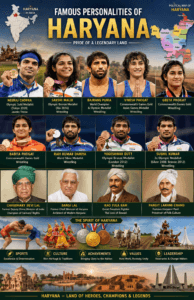
Haryana has produced numerous national heroes, freedom fighters, sportspersons, political leaders, scientists, artists, military officers, and entrepreneurs who have made significant contributions to India and the world. The state’s culture of discipline, hard work, and determination has helped shape many internationally recognised personalities.
In sports, Haryana has earned the title of India’s Sports Powerhouse by producing several Olympic and World Championship medalists. Famous wrestlers such as Sushil Kumar, Yogeshwar Dutt, Bajrang Punia, Ravi Kumar Dahiya, Vinesh Phogat, Geeta Phogat, Babita Phogat, and Sakshi Malik have brought glory to India through their outstanding achievements in international competitions.
Haryana has also produced legendary athletes like Neeraj Chopra, India’s first Olympic gold medalist in athletics (javelin throw), whose historic victory inspired millions across the country.
The state has contributed many prominent political leaders, including Chaudhary Devi Lal, former Deputy Prime Minister of India and former Chief Minister of Haryana, Bansi Lal, known as the architect of modern Haryana, and Bhajan Lal, who played an important role in the state’s political development.
Among freedom fighters, Rao Tula Ram is remembered for his courageous role in the Indian Rebellion of 1857 against British rule. Haryana has also produced brave military personnel who have served the nation with distinction.
In literature and culture, Pandit Lakhmi Chand, popularly known as the “Shakespeare of Haryana,” made remarkable contributions to Haryanvi folk theatre and literature through his famous Saang performances and folk songs.
The state is also home to renowned industrialists, educators, scientists, artists, and business leaders who continue to contribute to India’s economic growth and social development. Their achievements reflect Haryana’s spirit of excellence, leadership, and national pride.
Famous Personalities at a Glance
| Personality | Known For |
|---|---|
| Neeraj Chopra | Olympic Gold Medalist (Javelin) |
| Sakshi Malik | Olympic Medalist (Wrestling) |
| Bajrang Punia | World Champion Wrestler |
| Vinesh Phogat | International Wrestler |
| Ravi Kumar Dahiya | Olympic Medalist (Wrestling) |
| Yogeshwar Dutt | Olympic Medalist (Wrestling) |
| Chaudhary Devi Lal | Former Deputy Prime Minister of India |
| Bansi Lal | Former Chief Minister of Haryana |
| Rao Tula Ram | Freedom Fighter (1857 Revolt) |
| Pandit Lakhmi Chand | Shakespeare of Haryana |
Shopping & Handicrafts of Haryana
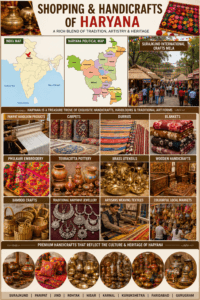
Haryana is famous for its traditional handicrafts, handloom products, textiles, pottery, woodcraft, metalwork, carpets, and vibrant local markets. The state’s rich cultural heritage is reflected in its skilled artisans, who continue to preserve centuries-old craftsmanship while blending it with modern designs. Visitors can shop for authentic Haryanvi products ranging from handmade textiles to decorative home décor and traditional jewellery.
One of the most popular shopping destinations in Haryana is the Surajkund International Crafts Mela held annually in Faridabad. It is one of the world’s largest handicrafts fairs, where artisans from across India and many other countries showcase handmade products, traditional textiles, paintings, pottery, jewellery, wooden crafts, bamboo products, and regional cuisines.
Panipat, often called the “City of Weavers,” is internationally renowned for its handloom products, carpets, rugs, blankets, durries, curtains, towels, and home furnishings. The city’s textile industry exports premium-quality products to countries around the world.
Traditional Haryanvi handicrafts include Phulkari embroidery, handwoven cotton and woollen textiles, terracotta pottery, wooden handicrafts, brass and copper utensils, bamboo crafts, leather footwear (Mojari), and traditional jewellery. Rural artisans continue to produce these handmade items using traditional techniques passed down through generations.
Major shopping destinations include Sector 14 Market (Gurugram), MGF Metropolitan Mall, Ambience Mall (Gurugram), Elante Mall (near Chandigarh), Crown Interiorz Mall (Faridabad), Panipat Handloom Market, Hisar Market, Ambala Cloth Market, and numerous local bazaars where visitors can buy authentic regional products.
Popular items to purchase from Haryana include handloom carpets, Panipat blankets, cotton textiles, durries, handmade pottery, brassware, Phulkari embroidery, traditional Haryanvi jewellery, wooden decorative items, and local handicrafts.
Shopping in Haryana offers visitors an opportunity to experience the state’s artistic traditions while supporting local artisans and small businesses.
Shopping & Handicrafts at a Glance
| Category | Details |
|---|---|
| Famous Fair | Surajkund International Crafts Mela |
| Textile Hub | Panipat |
| Famous Products | Carpets, Durries & Blankets |
| Traditional Embroidery | Phulkari |
| Pottery | Terracotta Crafts |
| Metal Crafts | Brass & Copper Utensils |
| Wooden Crafts | Decorative Furniture & Handicrafts |
| Popular Markets | Panipat, Gurugram, Faridabad & Ambala |
| Traditional Footwear | Mojari |
| Shopping Identity | Handlooms, Handicrafts & Home Furnishings |
Best Time to Visit Haryana
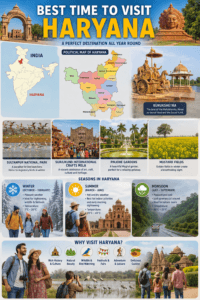
Haryana can be visited throughout the year, but the best time to visit is from October to March, when the weather is cool and pleasant. During these months, temperatures generally range between 10°C and 25°C, making it ideal for sightseeing, wildlife tourism, cultural festivals, and outdoor activities.
Winter (October to March) is the most popular tourist season. Visitors can comfortably explore famous attractions such as Kurukshetra, Sultanpur National Park, Kalesar National Park, Pinjore Gardens, Surajkund, Panipat, and Damdama Lake. It is also the best season for birdwatching, as thousands of migratory birds arrive at Sultanpur National Park and Bhindawas Wetland.
The Surajkund International Crafts Mela, held every year in February, is one of Haryana’s biggest attractions. It brings together artisans, performers, and visitors from across India and around the world, making winter the ideal time to experience the state’s rich culture.
Summer (April to June) is generally hot and dry, with temperatures often reaching 45°C to 48°C. Although sightseeing during the day can be challenging, early mornings and evenings are suitable for short visits and business travel.
The Monsoon season (July to September) brings moderate rainfall, refreshing the countryside and enhancing the beauty of lakes, forests, and agricultural fields. Nature lovers can enjoy lush green landscapes, although occasional heavy showers may affect travel plans.
Whether you are planning a pilgrimage to Kurukshetra, exploring historical sites, enjoying wildlife tourism, attending cultural festivals, or travelling for business, Haryana offers memorable experiences throughout the year. However, October to March remains the most comfortable and recommended period for visitors.
Best Time to Visit at a Glance
| Season | Months | Highlights |
|---|---|---|
| Winter | October – March | Best for sightseeing, festivals & wildlife |
| Summer | April – June | Hot weather, suitable for business travel |
| Monsoon | July – September | Green landscapes & scenic beauty |
| Best Tourist Season | October – March | Pleasant climate & outdoor activities |
| Major Event | February | Surajkund International Crafts Mela |
How to Reach Haryana
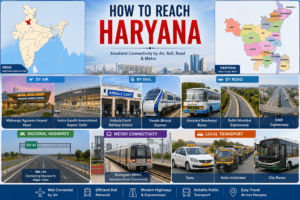
Haryana is one of the best-connected states in India, with excellent road, rail, and air connectivity. Its strategic location around the National Capital Territory (NCT) of Delhi and extensive transport infrastructure make it easily accessible from all parts of the country.
By Air
Haryana is served by the Maharaja Agrasen Airport in Hisar, which is being developed as an important regional aviation hub. For international and extensive domestic connectivity, travellers primarily use the Indira Gandhi International Airport (IGI Airport) in New Delhi, located close to major Haryana cities such as Gurugram, Faridabad, Sonipat, and Panipat.
By Train
Haryana has a well-developed railway network operated mainly by the Northern Railway and North Western Railway. Major railway stations include Ambala Cantt Junction, Panipat Junction, Kurukshetra Junction, Rohtak Junction, Hisar Junction, Rewari Junction, Gurugram Railway Station, Karnal Railway Station, Sonipat Railway Station, and Faridabad Railway Station. Premium trains such as Vande Bharat Express, Shatabdi Express, Rajdhani Express, and Duronto Express provide fast connectivity to major Indian cities.
By Road
Haryana has one of India’s finest road networks. Major National Highways (NH-44, NH-48, NH-9, NH-52, and NH-152D) and modern expressways such as the Delhi–Mumbai Expressway, Kundli–Manesar–Palwal (KMP) Expressway, Dwarka Expressway, and Delhi–Amritsar–Katra Expressway ensure smooth travel across the state.
The state-run Haryana Roadways operates an extensive fleet of ordinary, AC, Volvo, and electric buses connecting all districts with Delhi and neighbouring states. Private buses, taxis, app-based cab services, and auto-rickshaws are also widely available.
Local Transportation
Within Haryana, travellers can use Gurugram Metro, city buses, taxis, auto-rickshaws, and app-based ride services. Well-maintained roads and modern transport infrastructure make travelling within the state convenient and comfortable.
With its world-class highways, railway network, expanding airport facilities, and efficient public transportation, Haryana is one of the easiest states in India to reach.
How to Reach at a Glance
| Mode of Transport | Major Connectivity |
|---|---|
| Air | Maharaja Agrasen Airport (Hisar), IGI Airport (New Delhi) |
| Rail | Ambala Cantt, Panipat, Kurukshetra, Rohtak, Hisar & Rewari |
| Road | NH-44, NH-48, NH-9, NH-52 & NH-152D |
| Expressways | Delhi–Mumbai, KMP, Dwarka & Delhi–Amritsar–Katra |
| Bus Services | Haryana Roadways & Private Operators |
| Local Transport | Gurugram Metro, City Buses, Taxis & Auto-rickshaws |
| Best Connectivity | Road, Rail & Air |
Travel Tips for Visiting Haryana
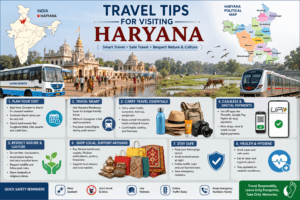
Haryana is a safe, culturally rich, and well-connected destination that offers a mix of religious sites, historical landmarks, wildlife sanctuaries, modern cities, and rural experiences. Whether you are visiting for pilgrimage, business, sightseeing, or family vacations, following a few travel tips will help make your journey comfortable and memorable.
The best time to visit Haryana is from October to March, when the weather is pleasant for sightseeing and outdoor activities. If travelling during summer (April–June), carry light cotton clothing, sunscreen, sunglasses, and stay hydrated, as temperatures can exceed 45°C.
When visiting religious places such as Kurukshetra, Jyotisar, Agroha Dham, or Sheetla Mata Mandir, dress modestly, remove footwear where required, and respect local customs and traditions.
Nature enthusiasts visiting Sultanpur National Park, Kalesar National Park, or Bhindawas Wetland should carry binoculars, cameras, comfortable walking shoes, hats, and reusable water bottles. Avoid disturbing wildlife or littering inside protected areas.
Use Haryana Roadways buses, taxis, metro services in Gurugram, or app-based cab services for convenient local transportation. The state has excellent highways, making self-drive road trips a popular option.
Carry digital payment options such as UPI, debit/credit cards, or some cash for shopping in local markets and village fairs. While major cities accept digital payments widely, cash may be useful in smaller towns and rural areas.
Shop for authentic local products such as Panipat handloom items, carpets, durries, Phulkari embroidery, terracotta pottery, brassware, and traditional Haryanvi handicrafts from authorised stores and government handicraft emporiums.
Help preserve Haryana’s heritage by keeping tourist places clean, avoiding single-use plastics, respecting wildlife, and supporting local artisans and businesses.
With proper planning and responsible travel, you can enjoy Haryana’s spiritual heritage, historical monuments, colourful culture, wildlife, and modern attractions while creating unforgettable memories.
Travel Tips at a Glance
| Tip | Recommendation |
|---|---|
| Best Season | October–March |
| Clothing | Light cotton in summer, warm clothes in winter |
| Transport | Haryana Roadways, Metro, Taxi & Private Car |
| Payments | UPI, Cards & Cash |
| Wildlife Visits | Carry binoculars, camera & water |
| Religious Places | Dress modestly & respect local customs |
| Shopping | Buy authentic Panipat handlooms & handicrafts |
| Responsible Tourism | Keep tourist places clean & avoid plastic |
| Stay Hydrated | Especially during summer |
| Emergency | Keep important contacts & ID proof |
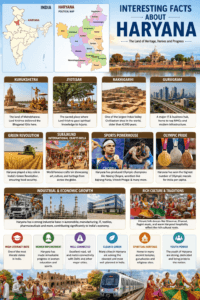
Interesting Facts About Haryana
Haryana is one of India’s most remarkable states, known for its ancient history, spiritual significance, agricultural excellence, industrial growth, and sporting achievements. The state is often called the “Sports Powerhouse of India” because it has produced a large number of Olympic medalists and world champions despite its relatively small population.
Haryana is home to Kurukshetra, the sacred land where the Mahabharata War is believed to have taken place. According to Hindu tradition, Lord Krishna delivered the Bhagavad Gita to Arjuna at Jyotisar, making it one of the holiest pilgrimage sites in India.
The state also has a rich archaeological heritage. Rakhigarhi, located in Hisar district, is the largest Harappan (Indus Valley Civilization) site in India and one of the largest in South Asia, providing valuable insights into one of the world’s oldest urban civilizations.
Haryana played a major role in India’s Green Revolution, helping transform the country into a food-surplus nation. Today, it is one of the leading producers of wheat, rice, mustard, milk, and dairy products, earning recognition as one of India’s agricultural powerhouses.
Gurugram (Gurgaon) has evolved into one of India’s leading IT, corporate, financial, and startup hubs, hosting the offices of numerous multinational companies and Fortune 500 firms. The state is also home to one of India’s largest automobile manufacturing clusters.
Haryana has made history in sports by producing internationally renowned athletes such as Neeraj Chopra, Sakshi Malik, Bajrang Punia, Vinesh Phogat, Ravi Kumar Dahiya, Yogeshwar Dutt, Geeta Phogat, and Babita Phogat, who have won Olympic and World Championship medals.
The annual Surajkund International Crafts Mela in Faridabad is one of the world’s largest handicrafts fairs, attracting artisans and visitors from across India and many other countries.
With its blend of ancient heritage, modern industries, sporting excellence, and vibrant culture, Haryana continues to be one of India’s most dynamic and influential states.
| Fact | Details |
|---|---|
| Historic Landmark | Kurukshetra – Land of the Mahabharata |
| Largest Harappan Site | Rakhigarhi |
| Spiritual Importance | Bhagavad Gita delivered at Jyotisar |
| Agricultural Identity | Major contributor to the Green Revolution |
| Corporate Hub | Gurugram |
| Sports Identity | Sports Powerhouse of India |
| Famous Fair | Surajkund International Crafts Mela |
| State Animal | Blackbuck |
| State Bird | Black Francolin |
| Economic Strength | Agriculture, Automobiles & IT |
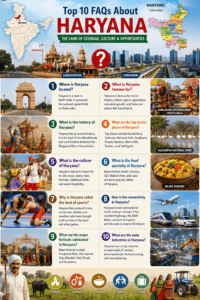
Frequently Asked Questions
1. Why is Haryana famous?
Haryana is famous for Kurukshetra, the Bhagavad Gita, the Green Revolution, Gurugram’s corporate hub, wrestling champions, agriculture, and the Surajkund International Crafts Mela.
2. What is the best time to visit Haryana?
The best time to visit Haryana is October to March, when the weather is pleasant for sightseeing, wildlife tourism, and festivals.
3. What is the capital of Haryana?
Chandigarh is the capital of Haryana and also serves as the shared capital of Punjab.
4. Which is the most famous tourist place in Haryana?
Kurukshetra is the most famous tourist destination, followed by Surajkund, Sultanpur National Park, Pinjore Gardens, Kalesar National Park, and Panipat.
5. Which is the largest city in Haryana?
Faridabad is the largest city by population, while Gurugram is the state’s leading financial, IT, and corporate hub.
6. What are the famous foods of Haryana?
Popular dishes include Bajra Khichdi, Bajra Roti, Kadhi Pakora, Bathua Raita, Churma, Lassi, White Butter (Makhan), and Desi Ghee-based foods.
7. How can I reach Haryana?
Haryana is well connected by air, rail, and road through Maharaja Agrasen Airport (Hisar), Indira Gandhi International Airport (New Delhi), major railway stations, national highways, expressways, and Haryana Roadways bus services.
8. What should tourists buy from Haryana?
Visitors can shop for Panipat handloom products, carpets, durries, blankets, Phulkari embroidery, terracotta pottery, brassware, wooden handicrafts, and traditional Mojari footwear.
9. Which wildlife sanctuary is famous in Haryana?
Sultanpur National Park, Kalesar National Park, and Bhindawas Wetland (Ramsar Site) are among the state’s most popular wildlife destinations.
10. Why is Haryana called the Sports Powerhouse of India?
Haryana has produced numerous Olympic medalists, world champions, and international athletes, including Neeraj Chopra, Sakshi Malik, Bajrang Punia, Vinesh Phogat, Ravi Kumar Dahiya, and Yogeshwar Dutt, making it one of India’s most successful sporting states.
FAQs at a Glance
| Question | Short Answer |
|---|---|
| Why is Haryana famous? | Kurukshetra, Sports, Agriculture & Gurugram |
| Best time to visit? | October–March |
| Capital of Haryana? | Chandigarh |
| Largest city? | Faridabad |
| Famous tourist place? | Kurukshetra |
| Famous food? | Bajra Khichdi, Kadhi & Lassi |
| How to reach? | Air, Rail & Road |
| What to buy? | Panipat Handlooms & Handicrafts |
| Famous wildlife destination? | Sultanpur & Kalesar National Parks |
| Why Sports Powerhouse? | Olympic champions & world-class athletes |
Conclusion
Haryana is a unique state where ancient history, spiritual heritage, agricultural prosperity, industrial development, and sporting excellence come together to create one of India’s most dynamic destinations. From the sacred land of Kurukshetra, where the Bhagavad Gita was delivered, to the modern skyscrapers of Gurugram, Haryana beautifully blends tradition with progress.
Known for its significant contribution to the Green Revolution, world-class automobile industry, thriving corporate sector, rich cultural traditions, and outstanding Olympic champions, Haryana continues to play a vital role in India’s economic and social development. Visitors can explore historic battlefields, magnificent gardens, wildlife sanctuaries, colourful fairs, traditional villages, and vibrant urban centres, all within a well-connected and welcoming state.
Whether you are seeking spiritual experiences, historical landmarks, wildlife adventures, cultural festivals, delicious Haryanvi cuisine, shopping, or business opportunities, Haryana offers unforgettable experiences for every traveller. Its warm hospitality, modern infrastructure, and rich heritage make it one of the most rewarding destinations in North India.
Plan your journey to Haryana and discover a state where history inspires, culture thrives, nature flourishes, and innovation drives the future. Haryana truly represents the spirit of strength, tradition, progress, and pride.
Thank you for reading our complete Haryana Travel Guide on DealKart Market. Explore more Indian state travel guides, local business listings, and destination articles to plan your next unforgettable journey across India!
About DealKart Market
DealKart Market is India’s trusted online platform for discovering travel destinations, local businesses, shopping, services, classified ads, and authentic regional information. Our mission is to help people explore India with reliable, well-researched, and easy-to-understand content while connecting them with trusted local businesses and service providers.
Our platform features comprehensive travel guides covering Indian states, tourist attractions, history, culture, festivals, cuisine, wildlife, transportation, shopping, and travel tips. We also provide local business listings, classified advertisements, and useful information to help users make informed decisions.
DealKart Market is committed to promoting India’s rich heritage, tourism, entrepreneurship, and local businesses through high-quality content, accurate information, and modern digital solutions. Whether you’re planning a holiday, searching for nearby services, exploring famous destinations, or discovering local opportunities, DealKart Market is your one-stop destination.
We continuously update our platform with the latest travel guides, business directories, local services, shopping information, and educational content to deliver the best experience for travellers, customers, and businesses across India.
Thank you for choosing DealKart Market—your trusted destination for exploring India, discovering local businesses, and connecting with communities nationwide.
Internal Links
Explore more Indian state travel guides on DealKart Market:
Telangana Travel Guide –
https://dealkartmarket.in/telangana/
Andhra Pradesh Travel Guide – https://dealkartmarket.in/andhra-pradesh/
Karnataka Travel Guide –
https://dealkartmarket.in/karnataka/
Tamil Nadu Travel Guide –
https://dealkartmarket.in/tamil-nadu/
Kerala Travel Guide –
https://dealkartmarket.in/kerala/
Maharashtra Travel Guide – https://dealkartmarket.in/maharashtra/
Goa Travel Guide –
https://dealkartmarket.in/goa/
Gujarat Travel Guide –
https://dealkartmarket.in/gujarat/
Madhya Pradesh Travel Guide – https://dealkartmarket.in/madhya-pradesh/
Himachal Pradesh Travel Guide – https://dealkartmarket.in/himachal-pradesh/
Punjab Travel Guide –
Reference
- India Portal –
https://www.india.gov.in/
- Haryana Government – https://haryana.gov.in/
- Haryana Tourism – https://haryanatourism.gov.in/
- Incredible India – https://www.incredibleindia.gov.in/
- Ministry of Tourism, Government of India – https://tourism.gov.in/
- Census of India – https://censusindia.gov.in/
- Ministry of Statistics and Programme Implementation (MOSPI) – https://mospi.gov.in/
- Archaeological Survey of India (ASI) – https://asi.nic.in/
- UNESCO World Heritage Centre – https://whc.unesco.org/
- National Tiger Conservation Authority / Protected Areas Information – https://ntca.gov.in/
- India Wildlife Portal – https://indiawilds.com/
- Survey of India – https://www.surveyofindia.gov.in/
- Election Commission of India – https://eci.gov.in/
- Haryana Forest Department – https://forestsharyana.gov.in/
- Haryana Roadways – https://hartrans.gov.in/