
Introduction
Manipur, popularly known as the “Jewel of India,” is a beautiful state in Northeast India renowned for its breathtaking landscapes, vibrant culture, rich history, and exceptional biodiversity. Surrounded by scenic hills and a fertile central valley, the state shares international borders with Myanmar and domestic borders with Nagaland, Assam, and Mizoram.
The capital city, Imphal, serves as the state’s political, cultural, and economic centre. Manipur is globally recognised for Loktak Lake, Keibul Lamjao National Park, the endangered Sangai Deer, Manipuri Classical Dance, and Ima Keithel, one of the world’s largest women-run markets.
The state is home to diverse tribal communities, colourful festivals, traditional handicrafts, and world-renowned sportspersons such as Mary Kom and Mirabai Chanu. With its unique blend of natural beauty, cultural heritage, wildlife, and adventure tourism, Manipur has become one of India’s most fascinating travel destinations.
This comprehensive guide explores Manipur’s history, geography, culture, tourist attractions, economy, wildlife, transport, education, sports, famous personalities, travel tips, and much more.
Quick facts
Manipur is one of the eight states of Northeast India and is renowned for its breathtaking landscapes, rich cultural heritage, diverse tribal communities, and strategic location along the India–Myanmar border. Popularly known as the “Jewel of Northeast India,” the state is famous for its floating national park, classical dance, traditional polo, handloom products, biodiversity, and historical significance. Although relatively small in geographical area, Manipur possesses immense ecological, cultural, and economic importance.
The capital city, Imphal, serves as the administrative, political, commercial, educational, and cultural centre of the state. Manipur covers an area of 22,327 square kilometres and is divided into 16 administrative districts. The state shares borders with Nagaland, Assam, Mizoram, and Myanmar, making it one of India’s most strategically important northeastern states.
The official language is Manipuri (Meiteilon), which is recognised under the Eighth Schedule of the Constitution of India. English is widely used for official communication, administration, and higher education. Besides these, numerous tribal languages belonging to the Tibeto-Burman language family are spoken throughout the hill districts.
Manipur is internationally recognised as the birthplace of Sagol Kangjei, the traditional sport that later evolved into modern polo. The state is also famous for Manipuri Ras Lila, one of India’s eight classical dance forms. Its unique ecosystem includes Loktak Lake, the largest freshwater lake in Northeast India, and Keibul Lamjao National Park, the world’s only floating national park and the natural habitat of the endangered Sangai (Brow-antlered Deer).
Agriculture forms the backbone of the state’s economy, while handloom weaving, handicrafts, horticulture, bamboo products, fisheries, tourism, sports, and border trade contribute significantly to its economic growth. Rich biodiversity, pleasant climate, colourful festivals, delicious cuisine, and warm hospitality continue to make Manipur one of India’s most attractive destinations for tourism and cultural exploration.
Quick Facts Table
| Category | Particular | Details |
|---|---|---|
| General | State Name | Manipur |
| General | Capital | Imphal |
| General | Formation Day | 21 January 1972 |
| General | Statehood | 21st State of India |
| General | Region | Northeast India |
| Geography | Total Area | 22,327 sq km |
| Geography | Highest Peak | Mount Iso |
| Geography | Largest Lake | Loktak Lake |
| Administration | Districts | 16 |
| Administration | High Court | High Court of Manipur, Imphal |
| Population | Population | Over 3 Million (Latest Official Estimate) |
| Language | Official Language | Manipuri (Meiteilon) and English |
| Wildlife | State Animal | Sangai (Brow-antlered Deer) |
| Wildlife | State Bird | Mrs. Hume’s Pheasant (Nongin) |
| Wildlife | State Flower | Shirui Lily |
| Wildlife | State Tree | Uningthou (Phoebe hainesiana) |
| Culture | Classical Dance | Manipuri Ras Lila |
| Sports | Traditional Sport | Sagol Kangjei (Origin of Modern Polo) |
| Economy | Main Crops | Rice, Maize, Pulses, Oilseeds |
| Economy | Major Industries | Handloom, Handicrafts, Bamboo, Tourism, Agriculture |
| Border | International Border | Myanmar (Approx. 398 km) |
| Time | Time Zone | Indian Standard Time (UTC +5:30) |
Manipur on India Map
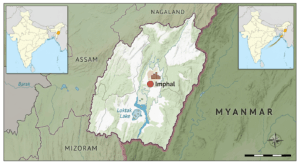
Manipur is strategically located in the northeastern region of India and forms an integral part of the country’s Northeast Region (NER). It is one of the eight Northeastern states and serves as an important geographical, cultural, and economic bridge between India and Southeast Asia. Due to its international boundary with Myanmar, Manipur has immense geopolitical, strategic, and commercial significance, making it one of India’s key frontier states.
The state lies approximately between 23°50′ North and 25°41′ North latitudes and 93°03′ East and 94°78′ East longitudes. It covers a total geographical area of 22,327 square kilometres, accounting for nearly 0.68% of India’s total land area. Although relatively small in size, Manipur possesses extraordinary geographical diversity, featuring fertile valleys, forest-covered hills, rivers, wetlands, lakes, caves, waterfalls, and mountain ranges.
Geographically, Manipur shares boundaries with Nagaland to the north, Assam to the west, Mizoram to the southwest, and Myanmar to the east and south. The state has an international border of approximately 398 kilometres with Myanmar, making it one of India’s longest land borders with a neighbouring Southeast Asian nation. This border plays an important role in trade, tourism, security, and diplomatic relations.
One of the most unique geographical features of Manipur is its distinctive landform. Nearly 90% of the state’s area is occupied by surrounding hills, while the remaining 10% consists of the fertile Imphal Valley situated at the centre. This valley supports the majority of the state’s population and serves as its political, administrative, commercial, agricultural, and cultural hub. In contrast, the surrounding hill districts are characterised by dense forests, tribal settlements, rich biodiversity, and mountainous terrain.
The capital city, Imphal, is centrally located within the valley and functions as the administrative headquarters of the state. It also serves as the principal centre for education, healthcare, commerce, transport, governance, tourism, and cultural activities. Most of the state’s major roads radiate from Imphal, connecting different districts as well as neighbouring states and the international border with Myanmar.
Manipur’s strategic location has become increasingly important under the Government of India’s Act East Policy, which aims to strengthen economic cooperation and connectivity with Southeast Asian countries. The Moreh Integrated Check Post (ICP), located in Tengnoupal district along the India–Myanmar border, is one of India’s most significant international land trade gateways. It connects India with Myanmar through the India–Myanmar–Thailand Trilateral Highway, creating new opportunities for international trade, tourism, logistics, and regional development.
Manipur’s location also makes it one of India’s most ecologically significant states. The surrounding mountain ranges support dense tropical, subtropical, and temperate forests that are home to thousands of species of plants and animals. Numerous rivers originate from these hills and flow towards the central valley, creating fertile agricultural lands, wetlands, and freshwater ecosystems. The most prominent among these is Loktak Lake, the largest freshwater lake in Northeast India, which serves as an important source of water, fisheries, agriculture, hydroelectric power, and tourism.
The state’s geographical position has greatly influenced its climate, biodiversity, agriculture, transportation, and settlement patterns. The central valley enjoys fertile alluvial soil suitable for paddy cultivation, while the hill regions support shifting cultivation, horticulture, bamboo forests, and rich wildlife habitats. This natural diversity has enabled Manipur to become one of India’s important biodiversity hotspots and an emerging destination for eco-tourism.
From a strategic perspective, Manipur is one of India’s most important border states. The presence of an international boundary with Myanmar has made it a key centre for defence, border management, international trade, and regional diplomacy. Several important security installations, border roads, customs facilities, and infrastructure projects have strengthened the state’s role in safeguarding India’s eastern frontier while simultaneously promoting legal trade and cultural exchange with neighbouring countries.
Transport connectivity has improved considerably in recent years through the development of national highways, upgraded border infrastructure, and improved air services. The ongoing expansion of highways linking Manipur with Assam, Nagaland, Mizoram, and Myanmar is expected to significantly boost tourism, commerce, logistics, and regional integration. These projects are expected to transform Manipur into one of the most important trade corridors connecting India with the Association of Southeast Asian Nations (ASEAN).
Manipur’s position on the map also reflects its remarkable cultural diversity. The fertile valley is predominantly inhabited by the Meitei community, while the surrounding hills are home to numerous indigenous tribal communities, each preserving its own traditions, languages, festivals, and cultural practices. This geographical distribution has shaped the state’s unique social and cultural landscape over many centuries.
Despite being one of India’s smaller states in terms of area, Manipur occupies a place of exceptional importance because of its natural beauty, strategic international location, ecological wealth, historical heritage, and cultural richness. Whether viewed from a geographical, political, environmental, economic, or tourism perspective, Manipur remains one of the most significant states in Northeast India.
The map of Manipur not only represents its physical boundaries but also highlights its role as a gateway connecting India with Southeast Asia. Its combination of fertile valleys, forested hills, international borders, vibrant cultural heritage, and growing economic potential continues to make Manipur one of India’s most valuable and strategically important states.
Manipur Location at a Glance
| Feature | Details |
|---|---|
| Region | Northeast India |
| Geographic Coordinates | 23°50′ N to 25°41′ N Latitude, 93°03′ E to 94°78′ E Longitude |
| Total Area | 22,327 sq km |
| Physiography | Central Valley surrounded by Hills |
| Capital City | Imphal |
| International Border | Myanmar (Approx. 398 km) |
| Neighbouring States | Nagaland, Assam, Mizoram |
| Major Border Town | Moreh |
| Largest Lake | Loktak Lake |
| Strategic Importance | Gateway to Southeast Asia under India’s Act East Policy |
Formation & State Profile
Manipur is one of India’s oldest historically documented regions and has a remarkable political journey that spans ancient kingdoms, colonial influence, constitutional transformation, and modern democratic governance. Today, it stands as one of the eight Northeastern states of India, known for its rich cultural heritage, strategic international location, vibrant traditions, and diverse indigenous communities. The state’s evolution from an independent kingdom to a full-fledged state of the Republic of India reflects centuries of historical continuity and political change.
The history of organised governance in Manipur dates back to the early centuries of the Common Era. According to the Cheitharol Kumbaba, the Royal Chronicle of Manipur, the kingdom was established in 33 CE under the rule of King Nongda Lairen Pakhangba, who is regarded as the first historically recorded ruler of Manipur. Over the following centuries, successive Meitei kings expanded the kingdom, strengthened administrative institutions, encouraged agriculture, promoted trade, and developed a distinctive cultural identity that continues to influence the state today.
Unlike many regions of the Indian subcontinent, Manipur maintained its independent political identity for a considerable period. The kingdom developed diplomatic, commercial, and cultural relations with neighbouring regions, including present-day Myanmar, Assam, Tripura, and other parts of Northeast India. Due to its strategic geographical location between South Asia and Southeast Asia, Manipur became an important centre for trade, cultural exchange, and regional diplomacy.
During the eighteenth century, the kingdom witnessed significant political and religious transformations. The adoption of Vaishnavism under King Pamheiba (Garib Niwaz) profoundly influenced Manipuri society, literature, architecture, dance, music, and religious practices. At the same time, indigenous traditions and beliefs continued to flourish alongside the newly adopted religious customs, resulting in the unique cultural identity that characterises Manipur today.
The nineteenth century was marked by major political developments, including internal conflicts and external invasions. One of the most significant events was the Anglo-Manipur War of 1891, which resulted in British victory and the establishment of British control over the kingdom. Although Manipur became a princely state under British paramountcy, it continued to retain its monarchy and certain internal administrative powers under British supervision. This period also witnessed administrative reforms, infrastructure development, and changes in governance that laid the foundation for the state’s modern administrative system.
Following India’s independence in 1947, Manipur briefly functioned under its own democratic government with an elected Legislative Assembly. This made Manipur one of the earliest regions in South Asia to experiment with democratic governance through an elected assembly based on adult franchise. However, subsequent political developments led to important constitutional changes that eventually integrated the state into the Republic of India.
On 21 September 1949, the Manipur Merger Agreement was signed in Shillong between the Maharaja of Manipur and the Government of India. The agreement came into effect on 15 October 1949, officially integrating Manipur into the Republic of India. After the merger, Manipur became a Part C State, administered by the Government of India through a Chief Commissioner. This marked the beginning of a new constitutional and administrative phase in the state’s history.
With the implementation of the States Reorganisation Act, 1956, Manipur was reclassified as a Union Territory on 1 November 1956. During this period, the Government of India introduced several administrative reforms, expanded public services, improved educational institutions, strengthened road connectivity, and initiated development programmes aimed at improving the socio-economic conditions of the region. Democratic institutions also gradually evolved, providing greater participation for the people in governance.
Recognising the aspirations of the people for greater political representation and self-governance, the Government of India enacted the North-Eastern Areas (Reorganisation) Act, 1971. Under this legislation, Manipur attained full statehood on 21 January 1972, becoming the 21st state of the Republic of India. This historic milestone established a full-fledged democratic government headed by a Governor, an elected Legislative Assembly, a Council of Ministers led by the Chief Minister, and representation in both Houses of the Parliament of India.
Today, Manipur is administratively divided into 16 districts, each headed by a Deputy Commissioner. The state follows a democratic parliamentary system based on the Constitution of India. The Legislative Assembly consists of elected representatives who frame laws and oversee governance. Administrative responsibilities are carried out through various state departments responsible for education, healthcare, agriculture, rural development, tourism, infrastructure, industries, forests, and public welfare.
The capital city, Imphal, serves as the administrative, political, cultural, educational, and commercial headquarters of the state. It houses the Raj Bhavan, the State Secretariat, the Legislative Assembly, the High Court of Manipur, major educational institutions, healthcare facilities, museums, markets, and important government offices. Imphal also functions as the primary transportation hub connecting the valley with the surrounding hill districts and neighbouring states.
Covering an area of 22,327 square kilometres, Manipur consists of a fertile central valley surrounded by forested hills. This distinctive geographical pattern has influenced settlement, agriculture, transportation, culture, and administration for centuries. The valley is predominantly inhabited by the Meitei community, while the surrounding hills are home to various Naga, Kuki-Zo, and other indigenous tribal communities. Together, these communities contribute to Manipur’s multicultural identity and vibrant social fabric.
Economically, Manipur continues to depend on agriculture, horticulture, fisheries, handloom weaving, handicrafts, bamboo-based industries, tourism, and border trade. Government initiatives focusing on digital infrastructure, entrepreneurship, skill development, eco-tourism, sports, healthcare, education, and connectivity are creating new opportunities for sustainable growth. Strategic infrastructure projects, including improved highways and international trade facilities at Moreh, are expected to strengthen Manipur’s position as India’s gateway to Southeast Asia.
Today, Manipur stands as a progressive state that successfully balances its ancient heritage with modern development. Its centuries-old monarchy, democratic institutions, cultural diversity, ecological richness, sporting excellence, and strategic importance continue to shape its identity. As one of India’s most historically significant and geographically unique states, Manipur remains a symbol of resilience, tradition, and progress in the northeastern region of the country.
Formation & State Profile at a Glance
| Particular | Details |
|---|---|
| State Name | Manipur |
| Former Status | Kingdom of Manipur |
| Founded (Traditional Chronology) | 33 CE (Reign of King Nongda Lairen Pakhangba) |
| Merger with India | 15 October 1949 |
| Union Territory Status | 1 November 1956 |
| Full Statehood | 21 January 1972 |
| Statehood Act | North-Eastern Areas (Reorganisation) Act, 1971 |
| Capital | Imphal |
| Total Area | 22,327 sq km |
| Administrative Districts | 16 |
| Legislature | Unicameral Legislative Assembly |
| High Court | High Court of Manipur, Imphal |
| International Border | Myanmar (Approx. 398 km) |
| Region | Northeast India |
History (Ancient)
The ancient history of Manipur is one of the richest and most fascinating among the states of Northeast India. Unlike many regions whose early history is known mainly through archaeological discoveries, Manipur possesses an unbroken historical tradition preserved in royal chronicles, oral traditions, myths, legends, religious literature, and archaeological evidence. These sources provide valuable insights into the political, social, cultural, and religious development of the region over nearly two thousand years.
The earliest recorded history of Manipur begins with the establishment of the Kingdom of Kangleipak, the ancient name of present-day Manipur. According to the Cheitharol Kumbaba (Royal Chronicle of Manipur), the kingdom was founded in 33 CE by King Nongda Lairen Pakhangba, who is regarded as the first historically documented ruler of Manipur. His accession to the throne marks the beginning of the recorded political history of the state and laid the foundation for one of the oldest continuously governed kingdoms in South Asia.
Long before the emergence of organised monarchy, archaeological evidence indicates that humans inhabited the region during prehistoric times. Excavations carried out in different parts of Manipur have revealed Neolithic stone tools, polished axes, pottery fragments, and ancient settlements, suggesting that early communities practised hunting, fishing, food gathering, and primitive agriculture. Over time, these communities gradually developed permanent settlements in the fertile valleys and surrounding hills, leading to the formation of organised societies.
The fertile Imphal Valley became the centre of early civilisation due to its favourable climate, abundant water resources, fertile soil, and strategic location. Several indigenous clans known as the Salais gradually settled in the valley. According to traditional accounts, seven major clans—Ningthouja, Angom, Khuman, Luwang, Moirang, Khaba-Nganba, and Sarang-Leishangthem—played a significant role in the early political and social organisation of the region. These clans established independent chiefdoms before eventually becoming united under a central monarchy.
The rise of the Ningthouja Dynasty marked a turning point in the ancient history of Manipur. King Nongda Lairen Pakhangba united several competing clans under a single political authority, creating a more organised kingdom with a structured administration. This political unification encouraged agricultural expansion, trade, irrigation, settlement growth, and the development of legal and administrative institutions. It also strengthened cultural unity among the diverse communities living in the valley.
Ancient Manipur maintained active interactions with neighbouring regions, including present-day Assam, Tripura, Myanmar, and parts of southern China. These contacts promoted trade, diplomacy, cultural exchange, and the movement of people. Merchants exchanged agricultural produce, forest products, salt, textiles, metals, horses, and handicrafts through traditional trade routes connecting the Brahmaputra Valley with Southeast Asia. These interactions significantly influenced the economic and cultural development of the kingdom.
Religion during the early period was centred around the indigenous Sanamahism, one of the oldest surviving traditional belief systems in Northeast India. The people worshipped natural forces, ancestral spirits, sacred forests, mountains, rivers, celestial bodies, and local deities. Religious ceremonies were closely linked with agriculture, seasonal changes, community welfare, and royal authority. These ancient beliefs continue to survive today alongside Hinduism, Christianity, and other religions, reflecting the remarkable continuity of Manipur’s indigenous spiritual heritage.
As the kingdom expanded, the rulers of Manipur gradually established a more organised administrative system. The king served as the supreme political, military, judicial, and religious authority, while village chiefs and local administrators assisted in maintaining law and order, collecting revenue, managing agricultural lands, and resolving local disputes. This administrative framework strengthened political stability and enabled the kingdom to prosper over several centuries.
Agriculture formed the foundation of the ancient economy. The fertile Imphal Valley supported the cultivation of rice, vegetables, fruits, and other food crops, while the surrounding hills provided forest products, medicinal plants, timber, bamboo, cane, and wildlife resources. Rivers, lakes, and wetlands supported fishing, irrigation, and transportation, making agriculture and natural resource management central to the livelihood of the people.
Ancient Manipuri society was highly organised and community-oriented. Families lived in close-knit settlements where cooperation, collective farming, traditional craftsmanship, and mutual support played an important role in daily life. Women actively participated in agriculture, weaving, trade, and household management. Their significant contribution to economic and social life laid the foundation for the strong position that women continue to hold in Manipuri society today.
The period also witnessed remarkable developments in art, architecture, literature, music, dance, and traditional sports. Indigenous forms of storytelling, oral literature, ritual performances, and folk dances evolved alongside religious ceremonies. Traditional martial practices gradually developed into Thang-Ta, one of India’s oldest martial arts, while Sagol Kangjei, the ancient horse-riding game played in Manipur, later became the inspiration for modern polo. These cultural traditions became symbols of Manipuri identity and have been preserved across generations.
Ancient Manipur also developed an indigenous writing system known as Meitei Mayek, one of the oldest scripts in Northeast India. Historical records, religious texts, royal decrees, and literary works were originally written using this script. Although the script experienced a period of decline after the introduction of the Bengali script during the eighteenth century, it has witnessed a remarkable revival in recent decades and is now taught in schools and promoted as an important part of Manipuri cultural heritage.
The kingdom successfully defended its independence for centuries despite facing occasional conflicts with neighbouring kingdoms and external invasions. Strong military organisation, strategic alliances, and the natural protection provided by the surrounding hills enabled Manipur to preserve its political autonomy for a long period. The courage and resilience displayed by the ancient rulers and their people became an enduring part of the state’s historical identity.
By the end of the ancient period, Manipur had emerged as a well-established kingdom with a stable monarchy, organised administration, flourishing agriculture, active trade networks, rich indigenous culture, and strong regional influence. The foundations laid during this era shaped the political institutions, social customs, religious traditions, and cultural practices that continued to evolve throughout the medieval and modern periods.
The ancient history of Manipur remains a source of pride for its people. Its royal chronicles, archaeological discoveries, indigenous traditions, ancient script, and enduring cultural heritage continue to provide valuable insights into one of India’s oldest continuously recorded civilizations. This remarkable legacy forms the cornerstone of Manipur’s identity and continues to inspire historical research, cultural preservation, and public awareness across the state.
Ancient History Timeline
| Period | Major Development |
|---|---|
| Prehistoric Period | Human settlements, Neolithic tools, early agriculture |
| Around 33 CE | Establishment of the Kingdom of Kangleipak under King Nongda Lairen Pakhangba |
| Early Historic Period | Unification of major Meitei clans |
| Ancient Era | Growth of agriculture, trade, administration, and indigenous religion |
| Ancient Era | Development of Meitei Mayek script |
| Ancient Era | Evolution of Thang-Ta martial art and Sagol Kangjei (traditional polo) |
| End of Ancient Period | Emergence of a stable and influential kingdom with organised governance |
Medieval History
The medieval period marked one of the most significant phases in the history of Manipur. During this era, the kingdom witnessed political consolidation, territorial expansion, administrative reforms, cultural transformation, and increasing interaction with neighbouring kingdoms. Between the 7th and 18th centuries CE, Manipur evolved into a powerful and organised kingdom that played an important role in the political landscape of Northeast India and parts of Southeast Asia.
The Ningthouja Dynasty, established during the ancient period, continued to strengthen its authority throughout the medieval era. Successive rulers expanded the kingdom by bringing neighbouring principalities and indigenous clans under a unified administration. This political integration enhanced internal stability, improved governance, encouraged agricultural expansion, and facilitated trade across the region. The kings established stronger administrative institutions while maintaining close relationships with local chiefs and village authorities.
One of the defining features of medieval Manipur was its strategic geographical position. Situated between the Brahmaputra Valley and the Burmese kingdoms, Manipur became an important centre for trade, diplomacy, and cultural exchange. Merchants travelled through the kingdom carrying textiles, horses, salt, forest products, metals, agricultural goods, and handicrafts. These commercial interactions not only strengthened the economy but also introduced new cultural influences that enriched Manipuri society.
Agriculture remained the backbone of the kingdom’s economy during this period. The fertile Imphal Valley produced abundant rice and other food crops, while the surrounding hill regions supplied timber, bamboo, medicinal plants, fruits, and forest products. Efficient irrigation systems, improved farming practices, and community-based agricultural management enabled the kingdom to support a growing population and maintain economic stability.
The medieval rulers also strengthened the kingdom’s military organisation. Frequent conflicts with neighbouring kingdoms and external invasions required a disciplined army capable of defending the kingdom’s territorial integrity. Horse-mounted cavalry, skilled archers, swordsmen, and traditional warriors formed the backbone of the Manipuri armed forces. Military training gradually evolved into highly organised indigenous martial traditions, including Thang-Ta, which remains an important part of Manipuri cultural heritage even today.
Religion and culture underwent significant changes during the medieval period. Indigenous Sanamahism continued to flourish as the principal faith of the people for many centuries. Worship of local deities, sacred forests, rivers, mountains, and ancestral spirits remained central to religious life. Numerous festivals, rituals, and traditional ceremonies strengthened social unity and reinforced the close relationship between religion, agriculture, and community life.
During the later medieval period, particularly from the 15th century onwards, Hindu influence gradually increased through diplomatic contacts and cultural exchanges with neighbouring regions. Vaishnavism slowly gained prominence among sections of the royal family and the elite, while indigenous beliefs continued to remain deeply rooted among the general population. This coexistence of traditional and emerging religious practices laid the foundation for the major cultural transformations that would occur during the eighteenth century.
The reign of King Khagemba (1597–1652 CE) is widely regarded as one of the golden periods in the medieval history of Manipur. King Khagemba successfully defended the kingdom against repeated invasions, expanded its territorial influence, strengthened diplomatic relations, and introduced important administrative reforms. His victory over invading forces from Burma earned him the title “Khagemba,” meaning “Conqueror of the Chinese” in traditional Manipuri history. Under his leadership, agriculture, trade, architecture, handicrafts, and urban development flourished, making Manipur one of the strongest kingdoms in the region.
Following Khagemba’s reign, several capable rulers continued to consolidate the kingdom. They improved administrative efficiency, promoted irrigation projects, strengthened taxation systems, and encouraged the development of traditional industries such as weaving, blacksmithing, pottery, bamboo crafts, and wood carving. Royal patronage also supported literature, music, dance, and religious ceremonies, enriching the cultural life of the kingdom.
The Meitei Mayek script remained an important medium for recording royal chronicles, religious texts, administrative records, and literary works throughout much of the medieval period. Scholars, priests, and royal scribes preserved valuable historical information that continues to serve as an important source for understanding the political and cultural evolution of Manipur. The famous Cheitharol Kumbaba continued to document important events, royal successions, military campaigns, diplomatic relations, and social developments.
Relations with neighbouring kingdoms frequently alternated between cooperation and conflict. Manipur maintained diplomatic and commercial contacts with Ahom Kingdom (Assam), Tripura, Cachar, and the Burmese kingdoms. Strategic marriages, military alliances, and trade agreements helped strengthen regional relationships, while occasional wars tested the kingdom’s military capabilities and political resilience.
During the late seventeenth and early eighteenth centuries, King Charairongba initiated closer cultural and religious interactions with the Indian mainland. His policies paved the way for the widespread acceptance of Vaishnavism under his successor King Pamheiba (Garib Niwaz). The adoption of Vaishnavism transformed many aspects of Manipuri society, including literature, architecture, classical dance, music, religious festivals, and temple construction. At the same time, many indigenous traditions continued to survive alongside the new religious practices, creating the distinctive cultural identity that characterises Manipur today.
The medieval period also witnessed the gradual emergence of Manipuri Ras Lila, devotional music, temple traditions, and various performing arts that later became internationally recognised symbols of the state’s cultural heritage. Indigenous martial traditions, equestrian skills, and the ancient game of Sagol Kangjei continued to flourish, eventually influencing the development of modern polo.
By the close of the medieval era, Manipur had emerged as a politically stable, economically prosperous, and culturally vibrant kingdom with well-developed administrative institutions, organised military forces, flourishing agriculture, active regional trade, and a rich artistic tradition. The foundations established during this period prepared the kingdom for the complex political challenges of the colonial era while preserving its unique cultural identity.
The medieval history of Manipur remains a remarkable chapter in India’s historical heritage. It reflects the resilience of its rulers, the unity of its people, the richness of its indigenous traditions, and the successful blending of local and external cultural influences. The achievements of this period continue to shape the state’s identity, heritage, and cultural pride even in modern times.
Medieval History Timeline
| Period | Major Development |
|---|---|
| 7th–15th Century | Consolidation of the Ningthouja Dynasty |
| Medieval Era | Expansion of agriculture, trade, and administration |
| 1597–1652 CE | Reign of King Khagemba and major administrative reforms |
| 16th–17th Century | Strengthening of diplomatic and commercial relations with neighbouring kingdoms |
| Late 17th Century | Increasing cultural and religious influence from mainland India |
| Early 18th Century | Rise of Vaishnavism under the royal family |
| End of Medieval Period | Emergence of a prosperous, politically stable, and culturally vibrant kingdom |
British Period
The British Period represents one of the most transformative and challenging chapters in the history of Manipur. During the nineteenth century, the kingdom experienced increasing political interaction with the British East India Company and later the British Crown. While Manipur retained its monarchy for much of this period, British influence gradually expanded through diplomacy, military intervention, and political agreements. These developments significantly affected the kingdom’s administration, economy, military, and foreign relations.
Before the arrival of British influence, Manipur functioned as an independent kingdom governed by the Meitei monarchy. Its strategic location between the Indian subcontinent and Burma (present-day Myanmar) made it an important buffer state. Both regional kingdoms and colonial powers recognised Manipur’s geographical importance because it controlled key routes connecting Northeast India with Southeast Asia.
British involvement in Manipur increased following the First Anglo-Burmese War (1824–1826). During this conflict, Burmese forces had occupied large parts of Manipur after a devastating period known in Manipuri history as the Seven Years Devastation (1819–1826). This invasion caused widespread destruction, displacement of people, decline in agriculture, and severe political instability throughout the kingdom.
The British supported Maharaja Gambhir Singh in driving out the Burmese forces from Manipur. With military assistance from the British East India Company, Gambhir Singh successfully restored the kingdom and re-established indigenous rule. His leadership played a crucial role in rebuilding administration, restoring agriculture, strengthening the armed forces, and resettling displaced populations. The restoration of the kingdom also strengthened political relations between Manipur and the British authorities.
The Treaty of Yandabo, signed in 1826, officially ended the First Anglo-Burmese War. Under the treaty, Burma recognised Manipur as an independent kingdom under the protection of the British. Although Manipur retained its internal autonomy and monarchy, British political influence in the kingdom increased considerably. British Political Agents were gradually appointed to supervise relations between the kingdom and the colonial administration.
Throughout the mid-nineteenth century, the rulers of Manipur continued to govern internal affairs while maintaining diplomatic relations with British India. During this period, improvements were made in road construction, communication, administrative organisation, and military preparedness. Trade between Manipur, Assam, Cachar, and Burma expanded, allowing agricultural products, forest resources, textiles, horses, and handicrafts to move across regional trade routes.
Despite generally cooperative relations, differences occasionally arose between the Manipuri monarchy and British officials regarding succession, administration, and political authority. These disagreements gradually increased during the latter half of the nineteenth century, creating tensions that eventually culminated in one of the most significant events in the state’s history—the Anglo-Manipur War of 1891.
The immediate cause of the Anglo-Manipur War of 1891 was a succession dispute within the royal family following the death of Maharaja Chandrakirti Singh. Political disagreements over the selection of the new ruler created instability within the kingdom. The British authorities attempted to influence the succession process, which was strongly opposed by many Manipuri leaders who considered it an interference in the kingdom’s internal affairs.
One of the central figures during this period was Yuvraj (Crown Prince) Tikendrajit Singh, an able military commander and influential leader who defended the sovereignty of Manipur. Tensions between the Manipuri leadership and the British administration escalated rapidly after the British attempted to arrest Tikendrajit. The confrontation eventually led to armed conflict in March 1891.
Although the Manipuri army displayed exceptional courage and determination, it faced a much larger and better-equipped British force. After several battles, British troops captured Imphal, bringing the conflict to an end. The defeat marked the end of Manipur’s complete political independence and significantly altered the kingdom’s constitutional position.
Following the war, several prominent Manipuri leaders were tried by the British authorities. Yuvraj Tikendrajit Singh and General Thangal were publicly executed on 13 August 1891 at Imphal for their role in resisting British rule. Their sacrifice is remembered with great respect throughout Manipur, and 13 August is observed every year as Patriots’ Day, honouring all those who laid down their lives in defence of the kingdom’s sovereignty.
Although British control was established after the war, Manipur was not directly annexed into British India. Instead, it continued as a princely state under British paramountcy. The monarchy was retained, and Maharaja Churachand Singh later ascended the throne under British supervision. While the Maharaja continued to administer many internal matters, important political decisions remained subject to British oversight through the office of the Political Agent.
During the early twentieth century, the British administration introduced several administrative reforms aimed at improving governance, revenue collection, education, public works, and communication. Roads connecting Manipur with Assam and neighbouring regions were improved, facilitating trade and administrative control. Modern educational institutions, healthcare facilities, postal services, and public infrastructure gradually expanded during this period.
The British era also witnessed the emergence of important social and political movements within Manipur. Among the most significant were the Nupi Lan (Women’s Wars) of 1904 and 1939, in which Manipuri women organised large-scale peaceful protests against unpopular colonial policies and economic exploitation. These movements became powerful symbols of women’s leadership, social justice, and resistance against colonial rule, earning a unique place in India’s freedom struggle.
The British Period left a lasting impact on Manipur’s political institutions, administrative structure, economy, education, and infrastructure. At the same time, it strengthened the spirit of nationalism and inspired future generations to protect their cultural identity and political rights. The courage shown during the Anglo-Manipur War and the sacrifices made by leaders such as Tikendrajit Singh, General Thangal, and countless others continue to occupy a place of honour in the collective memory of the people of Manipur.
British Period Timeline
| Year | Event |
|---|---|
| 1819–1826 | Seven Years Devastation under Burmese occupation |
| 1824–1826 | First Anglo-Burmese War |
| 1826 | Treaty of Yandabo signed |
| 1826 | Restoration of Maharaja Gambhir Singh |
| Mid-1800s | Appointment of British Political Agents |
| 1891 | Anglo-Manipur War |
| 13 August 1891 | Execution of Tikendrajit Singh and General Thangal |
| 1891 onwards | Manipur continued as a Princely State under British Paramountcy |
| 1904 | First Nupi Lan (Women’s War) |
| 1939 | Second Nupi Lan (Women’s War) |
Ningthouja (Meitei) Dynasty
The Ningthouja Dynasty, also known as the Meitei Dynasty, was the longest-ruling and most influential royal dynasty in the history of Manipur. For nearly two thousand years, this dynasty shaped the political, cultural, social, and religious identity of the kingdom. Under its rulers, Manipur evolved from a group of independent clans into a powerful and well-organised kingdom that became one of the most important states in Northeast India.
According to the Cheitharol Kumbaba (Royal Chronicle of Manipur), the dynasty was founded in 33 CE when King Nongda Lairen Pakhangba ascended the throne. He is regarded as the first historically recorded king of Manipur and the founder of the Ningthouja royal lineage. His reign marked the beginning of an organised monarchy that continued, with successive rulers, until the middle of the twentieth century.
During the early years of the dynasty, the rulers focused on consolidating power by bringing various indigenous clans under a unified administration. Major clans such as the Angom, Khuman, Luwang, Moirang, Khaba-Nganba, and Sarang-Leishangthem gradually became integrated into the expanding kingdom. This political unification strengthened internal stability, encouraged agricultural development, improved trade, and established a common administrative system across the valley.
The Ningthouja kings introduced an organised system of governance that included royal ministers, military commanders, village chiefs, and local administrators. The king served as the supreme authority responsible for governance, justice, defence, diplomacy, and religious affairs. Local institutions played an important role in maintaining law and order, collecting revenue, resolving disputes, and implementing royal policies throughout the kingdom.
Agriculture flourished under the dynasty. The fertile Imphal Valley became the centre of rice cultivation, while irrigation systems, water management, and land development projects improved agricultural productivity. Trade routes connecting Manipur with Assam, Tripura, Cachar, and Myanmar encouraged commercial activities involving textiles, horses, salt, forest products, bamboo, handicrafts, and agricultural goods. These developments contributed to the economic prosperity of the kingdom.
The dynasty also promoted remarkable achievements in culture and literature. The indigenous Meitei Mayek script was widely used for royal chronicles, administrative records, religious literature, and historical documents. Court scholars, priests, and historians carefully preserved the kingdom’s history through manuscripts such as the Cheitharol Kumbaba, which remains one of the oldest continuously maintained royal chronicles in South Asia.
Religion during the early centuries of the dynasty was primarily based on Sanamahism, the indigenous faith of the Meitei people. Worship of Sanamahi, Leimarel Sidabi, Pakhangba, and numerous local deities formed the foundation of religious life. Traditional rituals, sacred groves, festivals, and seasonal ceremonies strengthened social unity and reflected the close relationship between nature, spirituality, and governance.
During the medieval period, the Ningthouja rulers greatly expanded the kingdom’s political influence and territorial boundaries. Several capable kings strengthened the military, improved diplomatic relations, encouraged agriculture, and promoted trade with neighbouring kingdoms. Their leadership enabled Manipur to maintain its independence despite repeated invasions and political challenges from surrounding regions.
Among the most celebrated rulers of the dynasty was King Khagemba (1597–1652 CE). His reign is remembered as one of the golden periods in Manipuri history. King Khagemba successfully defeated invading forces, strengthened the kingdom’s administration, improved irrigation, encouraged handicrafts and commerce, and expanded diplomatic relations. His achievements contributed significantly to Manipur’s prosperity and political stability.
Another important ruler was King Charairongba (1697–1709 CE), who encouraged cultural exchange with the Indian mainland and initiated the gradual introduction of Vaishnavism into the kingdom. His successor, King Pamheiba (Garib Niwaz) (1709–1748 CE), officially adopted Vaishnavism as the state religion. This decision profoundly influenced Manipuri society, literature, architecture, music, dance, festivals, and temple traditions. Although Vaishnavism became widely accepted, many indigenous Sanamahi beliefs and customs continued to coexist, creating the unique religious harmony visible in Manipur today.
The Ningthouja Dynasty also played a vital role in the development of Manipuri Classical Dance (Ras Lila), devotional music, temple architecture, and various forms of performing arts. Royal patronage encouraged scholars, musicians, dancers, artisans, and craftsmen to preserve and enrich the state’s cultural heritage. Traditional sports such as Sagol Kangjei (the origin of modern polo) and the martial art Thang-Ta also flourished under the support of the royal court.
The dynasty faced several external challenges, including repeated Burmese invasions and later British intervention. The most devastating period was the Seven Years Devastation (1819–1826), when Burmese occupation caused widespread destruction across the kingdom. However, under the leadership of Maharaja Gambhir Singh, the kingdom was restored with British assistance, allowing the royal dynasty to continue its rule.
Following the Anglo-Manipur War of 1891, the monarchy continued under British paramountcy, although its political powers became more limited. Maharaja Churachand Singh and later rulers continued to administer many internal affairs while working under British supervision. Despite constitutional changes, the royal family remained an important symbol of Manipuri identity and cultural continuity.
The rule of the Ningthouja Dynasty effectively came to an end after the Merger of Manipur with the Republic of India in 1949. With the signing of the Manipur Merger Agreement, the kingdom became part of independent India, bringing nearly two thousand years of continuous royal rule to a close. Nevertheless, the legacy of the dynasty continues to shape the state’s history, traditions, literature, architecture, festivals, and cultural identity.
Today, the Ningthouja Dynasty is remembered as the foundation of Manipur’s civilisation. Its rulers established organised governance, promoted agriculture and trade, preserved indigenous traditions, encouraged cultural achievements, and defended the kingdom’s sovereignty for centuries. Their contributions remain deeply respected and continue to inspire historical research, cultural preservation, and public awareness throughout Manipur.
Major Rulers of the Ningthouja Dynasty
| Ruler | Period | Major Contribution |
|---|---|---|
| Nongda Lairen Pakhangba | From 33 CE | Founder of the Ningthouja Dynasty and the recorded Kingdom of Manipur |
| Khagemba | 1597–1652 CE | Strengthened administration, expanded trade, and successfully defended the kingdom |
| Charairongba | 1697–1709 CE | Encouraged cultural exchange and introduced early Vaishnavite influence |
| Pamheiba (Garib Niwaz) | 1709–1748 CE | Established Vaishnavism as the state religion and promoted major cultural reforms |
| Gambhir Singh | 1825–1834 CE | Restored Manipur after the Seven Years Devastation and Burmese occupation |
| Churachand Singh | 1891–1941 CE | Modernised administration and ruled during the British paramountcy period |
Merger with India (1949)
The merger of Manipur with the Republic of India is one of the most significant and widely discussed events in the state’s modern political history. It marked the transition of Manipur from an independent princely kingdom with a constitutional monarchy to an integral part of independent India. The developments between 1947 and 1949 brought fundamental changes to the state’s political structure, constitutional status, and administrative system, shaping the course of Manipur’s future.
When India gained independence from British rule on 15 August 1947, British paramountcy over princely states came to an end. Like many other princely states, Manipur regained its internal sovereignty. Maharaja Bodhchandra Singh, the last ruling monarch of Manipur, became the constitutional head of the kingdom and initiated steps to establish a modern democratic system of governance.
One of the most remarkable achievements during this period was the adoption of the Manipur State Constitution Act, 1947. This progressive constitution introduced constitutional monarchy and representative government in the kingdom. It provided for an elected Legislative Assembly and established democratic institutions based on adult franchise. Manipur thus became one of the earliest regions in South Asia to introduce an elected legislative system after the end of British rule.
The first elections to the Manipur State Assembly were held in 1948. Representatives from different parts of the state were elected to the Assembly, which began functioning as the legislative body responsible for lawmaking and governance. This democratic experiment reflected the aspirations of the people for representative government while preserving the constitutional role of the Maharaja.
During this period, the Government of India was engaged in integrating hundreds of princely states into the newly independent Union of India. Discussions were held with the rulers of various states regarding their future constitutional relationship with the Indian Union. Because of Manipur’s strategic location along the international border with Myanmar and its importance in Northeast India, the future political status of the kingdom received considerable attention from both the Government of India and the leadership of Manipur.
In September 1949, Maharaja Bodhchandra Singh travelled to Shillong, where discussions were held with representatives of the Government of India regarding the constitutional future of Manipur. These negotiations resulted in the signing of the Manipur Merger Agreement on 21 September 1949. The agreement provided for the integration of Manipur into the Republic of India and outlined the administrative arrangements that would follow the merger.
The Manipur Merger Agreement came into effect on 15 October 1949, officially integrating Manipur into the Republic of India. From that date, the kingdom ceased to exist as an independent constitutional monarchy, and its administration came under the authority of the Government of India. The merger marked the beginning of a new political era in the history of Manipur.
Following the integration, Manipur was designated as a Part C State under the Constitution of India. Instead of an elected state government, the administration was headed by a Chief Commissioner appointed by the Government of India. This change brought significant constitutional and administrative restructuring, replacing the earlier system established under the Manipur State Constitution Act of 1947.
The merger has remained an important subject of historical and academic discussion. While the Government of India considers the Merger Agreement a lawful step in the political integration of the country after Independence, some political organisations and scholars in Manipur have expressed different interpretations regarding the circumstances surrounding the agreement. These differing historical perspectives continue to be studied and discussed by historians, legal experts, and researchers. Understanding these viewpoints is important for a balanced appreciation of Manipur’s modern history.
In the years following the merger, the Government of India initiated several administrative and developmental measures. Educational institutions, healthcare facilities, road networks, public administration, communication systems, and economic programmes gradually expanded. These initiatives contributed to the state’s long-term social and economic development while strengthening its integration with the rest of the country.
A major constitutional milestone came with the North-Eastern Areas (Reorganisation) Act, 1971, under which Manipur attained full statehood on 21 January 1972. It became the 21st state of the Republic of India, with an elected Legislative Assembly, a Governor, a Council of Ministers headed by the Chief Minister, and representation in both Houses of Parliament. Statehood provided greater democratic participation and constitutional autonomy within the framework of the Indian Union.
Today, Manipur is an integral part of India and plays a vital role in the country’s northeastern region. Its strategic location along the India–Myanmar border makes it important for national security, regional connectivity, international trade, and India’s Act East Policy. Infrastructure projects, border trade initiatives, tourism development, education, sports, and economic reforms continue to strengthen the state’s role in national development.
The merger with India represents a turning point that reshaped Manipur’s constitutional and political identity. While the event remains an important subject of historical study and public discussion, it also laid the foundation for the state’s democratic institutions, modern administration, and participation in the constitutional framework of the Republic of India. Today, Manipur continues to preserve its unique cultural heritage while contributing significantly to India’s diversity, unity, and progress.
Merger with India Timeline
| Date / Year | Event |
|---|---|
| 15 August 1947 | British paramountcy ended; Manipur regained internal sovereignty |
| 1947 | Manipur State Constitution Act adopted |
| 1948 | First election to the Manipur State Assembly |
| 21 September 1949 | Manipur Merger Agreement signed at Shillong |
| 15 October 1949 | Manipur officially merged with the Republic of India |
| 26 January 1950 | Became a Part C State under the Constitution of India |
| 1 November 1956 | Reclassified as a Union Territory |
| 21 January 1972 | Attained full statehood as the 21st State of India |
Geography
Manipur is one of the most geographically diverse and ecologically rich states in Northeast India. The state is characterised by a unique combination of fertile valleys, forest-covered hills, rivers, lakes, wetlands, caves, waterfalls, and mountain ranges. Its remarkable landscape supports rich biodiversity, traditional agriculture, and diverse tribal cultures while making Manipur one of India’s most beautiful natural regions.
Covering an area of 22,327 square kilometres, Manipur accounts for approximately 0.68% of India’s total geographical area. The state lies between 23°50′ N to 25°41′ N latitude and 93°03′ E to 94°78′ E longitude. It shares boundaries with Nagaland in the north, Assam in the west, Mizoram in the southwest, and Myanmar in the east and south.
Physical Divisions
Geographically, Manipur is divided into two major natural regions:
- Central Imphal Valley – A fertile alluvial plain covering nearly 10% of the state’s total area.
- Surrounding Hill Region – Covers about 90% of the state’s land area with dense forests, mountains, valleys, rivers, and tribal settlements.
The Imphal Valley lies at an average elevation of about 790 metres above sea level and serves as the state’s:
- Political capital
- Administrative headquarters
- Agricultural centre
- Commercial hub
- Educational centre
- Cultural heart of Manipur
The surrounding hills rise to elevations exceeding 2,500 metres, creating spectacular landscapes with thick forests, grasslands, mountain streams, and diverse wildlife habitats.
Major Geographical Features
Manipur’s physical geography includes numerous natural attractions and ecosystems.
Important geographical features include:
- Fertile Imphal Valley
- Loktak Lake (Largest freshwater lake in Northeast India)
- Keibul Lamjao National Park (World’s only floating national park)
- Barak River Basin
- Manipur River Basin
- Dzukou Valley
- Shirui Hills
- Mount Iso (Highest Peak)
- Extensive bamboo forests
- Evergreen and semi-evergreen forests
- Wetlands and floating islands (Phumdis)
Major Bordering States & Country
- North – Nagaland
- West – Assam
- South-West – Mizoram
- East & South – Myanmar
The international boundary with Myanmar extends for approximately 398 kilometres, making Manipur one of India’s most strategically important border states for trade, security, tourism, and regional connectivity.
Topography
The topography of Manipur is highly varied, consisting of low-lying fertile plains, rolling hills, rugged mountain ranges, deep valleys, river basins, and extensive forests. The state’s landscape has evolved over millions of years through tectonic movements, erosion, and river action, resulting in one of the most diverse physical environments in Northeast India.
The Imphal Valley
The Imphal Valley forms the geographical and economic heart of Manipur.
Key characteristics include:
- Covers approximately 2,000 square kilometres.
- Located at an average elevation of 790 metres above sea level.
- Surrounded by hills on all sides.
- Contains highly fertile alluvial soil.
- Supports the majority of the state’s population.
- Acts as the centre of agriculture, commerce, education, governance, healthcare, and transportation.
- Home to the capital city, Imphal.
The valley is drained by several rivers that eventually feed Loktak Lake and the Manipur River system, ensuring a reliable water supply for agriculture and fisheries.
Hill Regions
The surrounding hill districts occupy the majority of the state’s land area and are inhabited by numerous indigenous tribal communities.
Characteristics of the hill regions:
- Dense evergreen and subtropical forests.
- Mountain ridges ranging between 900 and 2,500 metres.
- Deep river valleys and narrow gorges.
- Rich biodiversity with rare wildlife.
- Bamboo forests and medicinal plants.
- Scenic trekking routes.
- Traditional tribal villages.
- Extensive shifting cultivation (Jhum cultivation) in certain areas.
These hills serve as important watersheds that feed rivers flowing into the central valley.
Major Mountain Peaks
| Peak | Height | District |
|---|---|---|
| Mount Iso | Approx. 2,994 m | Senapati |
| Mount Tempu | Approx. 2,994 m | Senapati Region |
| Shirui Peak | Approx. 2,835 m | Ukhrul |
River Basins
The state’s drainage system is divided into two major river basins.
Manipur River Basin
- Drains the central valley.
- Supports agriculture and fisheries.
- Connected with Loktak Lake.
Barak River Basin
- Originates in the hill regions.
- Flows westward into Assam.
- Provides irrigation and drinking water.
- Supports forest ecosystems and biodiversity.
Natural Resources
Major natural resources include:
- Forests
- Bamboo
- Cane
- Limestone
- Medicinal plants
- Freshwater fisheries
- Fertile agricultural land
- Hydroelectric potential
- Orchids and ornamental plants
Geographical Importance
Its geographical importance includes:
- Gateway connecting India with Southeast Asia.
- Strategic international border with Myanmar.
- Rich biodiversity hotspot.
- Important watershed for Northeast India.
- Major eco-tourism destination.
- Suitable climate for horticulture and floriculture.
- Excellent potential for adventure tourism.
- Significant role in India’s Act East Policy.
Geological Features
Manipur possesses one of the most fascinating geological landscapes in Northeast India. The state’s present-day landforms are the result of millions of years of tectonic activity, mountain-building processes, erosion, river deposition, and climatic changes. Located within the Indo-Myanmar Mountain System, Manipur lies in a geologically active zone where the Indian Plate continues to interact with the Burma (Myanmar) Plate, creating a landscape of rugged hills, fertile valleys, rivers, and sedimentary basins.
The geological history of Manipur dates back to the Mesozoic and Cenozoic Eras, when the region was covered by shallow seas. Over millions of years, the collision of tectonic plates uplifted these marine sediments, gradually forming the mountain ranges and valleys seen today. As a result, the state contains a variety of sedimentary rock formations, folded mountain systems, river terraces, and alluvial plains.
Geological Location
Manipur is situated within the Indo-Burma Range, one of the youngest fold mountain systems in Asia.
Its geological position is characterised by:
- Location within the Indo-Myanmar Fold Belt.
- Active tectonic zone.
- Young fold mountains.
- High seismic activity.
- Deep river valleys.
- Rich sedimentary rock formations.
- Extensive weathering and erosion processes.
Because of its location in this tectonically active region, Manipur experiences occasional earthquakes and continuous geological changes.
Major Rock Types
The geology of Manipur is dominated by sedimentary rocks, with smaller occurrences of metamorphic and igneous formations in certain areas.
The major rock types found in Manipur include:
- Sandstone
- Shale
- Siltstone
- Limestone
- Mudstone
- Conglomerates
- Quartzite (limited areas)
- Metamorphic rocks in isolated hill regions
These rocks were deposited over millions of years in ancient marine environments before being uplifted through tectonic activity.
Mountain Formation
The mountain ranges surrounding the Imphal Valley were formed by intense folding and faulting caused by the collision of tectonic plates.
Important geological processes include:
- Plate collision.
- Folding.
- Faulting.
- Uplift.
- Weathering.
- River erosion.
- Sediment deposition.
These processes continue even today, making the landscape dynamic and geologically young compared to many other parts of India.
Imphal Valley Formation
One of the most remarkable geological features of Manipur is the Imphal Valley.
Scientists believe that the valley was once occupied by a large ancient lake. Over thousands of years:
- Rivers deposited fertile alluvial sediments.
- Water gradually drained through river systems.
- Thick layers of fertile soil accumulated.
- The present-day agricultural plains were formed.
Today, the valley supports the majority of the state’s agriculture, settlements, industries, and transportation network.
Seismic Activity
Manipur lies in Seismic Zone V, the highest earthquake-risk zone in India as classified by the Bureau of Indian Standards. The state’s location along the active boundary between the Indian Plate and the Burma (Myanmar) Plate makes it vulnerable to earthquakes of varying magnitudes.
Key characteristics of the seismic zone include:
- Falls under Seismic Zone V (Very High Risk).
- Frequent low- to moderate-intensity earthquakes.
- Occasional strong earthquakes.
- Active tectonic faults beneath the Indo-Myanmar ranges.
- Continuous crustal movement.
- Ongoing landscape evolution.
Although earthquakes are a natural part of the region’s geological evolution, modern engineering standards and disaster preparedness programmes help minimise risks.
Mineral Resources
Compared with many other Indian states, Manipur has relatively limited large-scale mineral deposits. However, several economically important minerals occur in different districts.
Major mineral resources include:
- Limestone
- Chromite
- Nickel
- Copper (minor occurrences)
- Clay
- Building stone
- Sand and gravel
- Dimension stone
Most of these resources are used for construction, cement production, and local industrial activities.
Soil Types
The geological formations of Manipur have produced different soil types suitable for agriculture, horticulture, and forestry.
Major soil types include:
- Alluvial soil (Imphal Valley)
- Red loamy soil
- Forest soil
- Mountain soil
- Lateritic patches
- Riverine deposits
These soils support rice cultivation, fruits, vegetables, spices, bamboo, medicinal plants, floriculture, and diverse forest ecosystems.
Geological Importance
The geology of Manipur has a direct influence on the state’s environment, economy, and biodiversity.
Its geological significance includes:
- Formation of fertile agricultural valleys.
- Development of mountain ecosystems.
- Creation of rich forest habitats.
- Formation of rivers and wetlands.
- Support for biodiversity hotspots.
- Availability of mineral resources.
- Potential for hydroelectric development.
- Scientific importance for tectonic and earthquake studies.
Environmental Significance
The geological structure of Manipur plays an important role in maintaining ecological balance.
It supports:
- Dense evergreen forests.
- Unique wetlands such as Loktak Lake.
- Floating islands (phumdis).
- Rare orchids.
- Endemic wildlife.
- Watersheds feeding major rivers.
- Rich groundwater recharge.
- Climate regulation.
Geological Features at a Glance
| Feature | Details |
|---|---|
| Geological Region | Indo-Myanmar Fold Belt |
| Mountain Type | Young Fold Mountains |
| Seismic Zone | Zone V (Very High Risk) |
| Dominant Rocks | Sandstone, Shale, Limestone, Siltstone |
| Valley Type | Alluvial Basin |
| Highest Geological Process | Plate Collision and Mountain Building |
| Major Soil | Alluvial, Red Loamy, Forest Soil |
| Important Mineral | Limestone |
| Major Geological Hazard | Earthquakes |
| Geological Significance | Young mountains, fertile valleys, rich biodiversity |
Climate
Manipur experiences a moderate subtropical highland climate, influenced by its altitude, surrounding mountain ranges, dense forests, and the Southwest Monsoon. Unlike many parts of India that experience extreme temperatures, Manipur generally enjoys pleasant weather throughout the year, making it one of the most comfortable destinations in Northeast India. The state’s varied topography creates noticeable climatic differences between the central valley and the surrounding hill districts.
The Imphal Valley, situated at an average elevation of around 790 metres above sea level, experiences moderate temperatures throughout the year. In contrast, the higher hill regions remain significantly cooler due to their greater altitude, with some areas experiencing near-freezing temperatures during winter.
Climatic Characteristics
The climate of Manipur is shaped by several natural factors.
Major climatic features include:
- Moderate subtropical highland climate.
- Pleasant weather for most of the year.
- Heavy monsoon rainfall.
- Cool winters.
- Mild summers.
- High humidity during the rainy season.
- Significant variation between valley and hill climates.
- Rich forest cover that moderates temperatures.
These climatic conditions support rich biodiversity, fertile agricultural land, and abundant water resources.
Factors Influencing Climate
Several geographical features influence Manipur’s climate.
The major influencing factors are:
- Altitude of the Imphal Valley.
- Elevation of surrounding mountain ranges.
- Southwest Monsoon winds.
- Dense forest cover.
- Rivers, wetlands, and Loktak Lake.
- Indo-Myanmar mountain system.
- Local wind circulation.
- Seasonal cloud formation.
The interaction of these factors creates a comfortable climate that is favourable for agriculture, horticulture, floriculture, tourism, and wildlife.
Average Temperature
Temperatures vary according to season and altitude.
| Season | Valley Temperature | Hill Temperature |
|---|---|---|
| Summer | 22°C – 32°C | 16°C – 25°C |
| Monsoon | 20°C – 28°C | 15°C – 23°C |
| Winter | 4°C – 24°C | 0°C – 15°C |
Higher hill stations such as Ukhrul, Dzükou Valley, Mao, and parts of Senapati may occasionally experience temperatures close to or below freezing during particularly cold winter nights.
Rainfall
Manipur receives abundant rainfall due to the Southwest Monsoon.
Rainfall characteristics include:
- Average annual rainfall of 1,200–2,500 mm.
- Most rainfall occurs between May and October.
- July and August are generally the wettest months.
- Hill districts usually receive higher rainfall than the central valley.
- Rainfall supports forests, rivers, lakes, agriculture, and hydroelectric resources.
Humidity
Humidity levels in Manipur vary considerably throughout the year and are strongly influenced by the monsoon season.
Humidity characteristics include:
- High humidity during the monsoon season.
- Moderate humidity during summer.
- Lower humidity in winter.
- Dense morning mist in valleys during winter.
- Frequent cloud cover during the rainy season.
The combination of humidity and moderate temperatures creates favourable conditions for forests, wetlands, agriculture, and horticulture.
Climatic Zones
Because of variations in altitude, Manipur can be divided into different climatic zones.
Major climatic zones include:
- Valley Climate – Warm summers, mild winters, and moderate rainfall.
- Lower Hill Climate – Cooler than the valley with heavier rainfall.
- High Hill Climate – Cool summers, cold winters, and occasional frost.
Climate and Agriculture
The favourable climate plays a crucial role in supporting agriculture and rural livelihoods.
Major agricultural benefits include:
- Rice cultivation in the Imphal Valley.
- Fruit orchards in hill districts.
- Vegetable cultivation throughout the year.
- Bamboo and forest-based resources.
- Floriculture and ornamental plants.
- Medicinal plant cultivation.
- Organic farming opportunities.
- Fisheries supported by rivers and lakes.
Climate and Tourism
Pleasant weather makes Manipur an attractive tourist destination in every season.
Tourism advantages include:
- Comfortable sightseeing conditions.
- Ideal weather for trekking.
- Excellent birdwatching opportunities.
- Scenic landscapes during the monsoon.
- Colourful flowers during spring.
- Pleasant winters for cultural tourism.
- Adventure tourism in hill regions.
- Eco-tourism around forests and Loktak Lake.
Climate Challenges
Although the climate is generally favourable, Manipur also faces several environmental challenges.
Major climate-related issues include:
- Landslides during heavy monsoon rains.
- Localised flooding in low-lying areas.
- Soil erosion in hill regions.
- Occasional drought-like conditions in some seasons.
- Increasing effects of climate change.
- Forest degradation in vulnerable areas.
Government agencies and local communities are implementing afforestation, watershed management, sustainable agriculture, and disaster preparedness programmes to minimise these impacts.
Climate at a Glance
| Climate Feature | Details |
|---|---|
| Climate Type | Moderate Subtropical Highland Climate |
| Average Summer Temperature | 22°C–32°C (Valley) |
| Average Winter Temperature | 4°C–24°C (Valley) |
| Hill Winter Temperature | Around 0°C or below in higher elevations |
| Annual Rainfall | Approximately 1,200–2,500 mm |
| Rainy Season | May–October |
| Wettest Months | July–August |
| Main Rain Source | Southwest Monsoon |
| Humidity | Moderate to High |
| Best Weather | October–April |
Seasons
Manipur experiences four distinct seasons throughout the year, each bringing unique weather conditions, natural beauty, agricultural activities, and cultural celebrations. Owing to its moderate subtropical highland climate and varied topography, the state enjoys comparatively pleasant weather in all seasons. The changing seasons influence agriculture, tourism, biodiversity, festivals, and the daily lives of the people.
Unlike many regions of India that experience extreme heat or severe cold, Manipur maintains a relatively balanced climate. The fertile Imphal Valley experiences moderate temperatures, while the surrounding hill districts remain cooler because of their higher elevations. This seasonal diversity enhances the state’s scenic beauty and makes it an attractive destination throughout the year.
Spring Season (March – April)
Spring is one of the most beautiful seasons in Manipur. As winter comes to an end, temperatures begin to rise gradually, flowers bloom across the hills and valleys, and forests become lush green.
Highlights of Spring:
- Pleasant daytime temperatures ranging from 18°C to 28°C.
- Colourful blooming flowers and orchids.
- Fresh greenery across forests and hills.
- Excellent season for sightseeing.
- Ideal weather for trekking and nature walks.
- Beginning of agricultural preparations.
- Popular time for photography and eco-tourism.
The famous Shirui Lily begins attracting nature enthusiasts during this period in the higher hills of Ukhrul.
Summer Season (May – June)
Summer in Manipur is generally mild compared to most parts of India. The surrounding mountains and forest cover help maintain comfortable temperatures.
Characteristics of Summer:
- Average temperatures between 22°C and 32°C.
- Warm but rarely extremely hot.
- Increasing humidity before the monsoon.
- Occasional pre-monsoon showers.
- Ideal for visiting hill stations.
- Active agricultural activities.
- Pleasant evenings and cool nights in hill regions.
The higher altitude areas such as Ukhrul, Senapati, Tamenglong, and Chandel remain cooler than the central valley throughout the season.
Monsoon Season (May/June – October)
The monsoon is the wettest season in Manipur. Moisture-laden winds from the Bay of Bengal bring abundant rainfall that replenishes rivers, lakes, forests, and agricultural lands.
Major features of the Monsoon:
- Heavy rainfall across the state.
- Average annual rainfall of 1,200–2,500 mm.
- Rivers and waterfalls flow at full capacity.
- Forests become lush green.
- Excellent season for nature lovers.
- Rice cultivation reaches its peak.
- Rich biodiversity becomes more visible.
Although the rains transform the landscape into a spectacular green paradise, occasional landslides and temporary road disruptions may occur in some hill districts.
Autumn Season (October – November)
Autumn marks the transition from the rainy season to cooler weather. The skies become clear, humidity decreases, and the landscapes remain lush after the monsoon, making it one of the best times to visit Manipur.
Highlights of Autumn:
- Pleasant temperatures ranging from 15°C to 27°C.
- Clear blue skies and excellent visibility.
- Fresh green landscapes after the monsoon.
- Ideal weather for sightseeing and photography.
- Popular season for cultural festivals.
- Comfortable conditions for trekking and camping.
- Excellent time to visit Loktak Lake and hill stations.
Winter Season (December – February)
Winter in Manipur is cool and pleasant, especially in the central valley, while the higher hill districts experience much colder conditions. In some high-altitude areas, temperatures may approach or occasionally fall below 0°C during the coldest nights.
Characteristics of Winter:
- Valley temperatures generally range from 4°C to 24°C.
- Hill temperatures range between 0°C and 15°C.
- Cold mornings and evenings.
- Misty mornings in the Imphal Valley.
- Pleasant sunny afternoons.
- Ideal weather for tourism.
- Peak season for adventure activities.
- Best time for wildlife observation.
Seasonal Importance
The changing seasons play a vital role in the state’s economy, environment, and culture.
Importance of seasonal changes:
- Support rice cultivation and horticulture.
- Maintain rich forest ecosystems.
- Recharge rivers, lakes, and groundwater.
- Promote biodiversity and wildlife habitats.
- Encourage eco-tourism and adventure tourism.
- Influence traditional festivals and cultural events.
- Support floriculture and orchid cultivation.
- Improve agricultural productivity.
Best Season to Visit
Although Manipur can be visited throughout the year, some seasons are particularly favourable for tourism.
Recommended travel seasons:
- October to April – Best overall weather.
- March to April – Best for flowers, orchids, and pleasant temperatures.
- October to November – Ideal for clear skies and post-monsoon landscapes.
- December to February – Perfect for sightseeing, festivals, and trekking.
Seasonal Challenges
Each season also presents certain environmental challenges.
Common seasonal challenges include:
- Landslides during heavy monsoon rainfall.
- Flooding in some low-lying valley areas.
- Dense fog during winter mornings.
- Soil erosion in hill regions.
- Occasional water scarcity in isolated hill villages during the dry season.
Government agencies and local communities continue implementing watershed management, afforestation, disaster preparedness, and sustainable farming practices to minimise seasonal impacts.
Seasons at a Glance
| Season | Months | Average Temperature | Major Features |
|---|---|---|---|
| Spring | March–April | 18°C–28°C | Flowers, orchids, pleasant weather |
| Summer | May–June | 22°C–32°C | Mild temperatures, pre-monsoon showers |
| Monsoon | May/June–October | 20°C–28°C | Heavy rainfall, lush greenery, rice cultivation |
| Autumn | October–November | 15°C–27°C | Clear skies, post-monsoon beauty, ideal for tourism |
| Winter | December–February | 4°C–24°C (Valley) 0°C–15°C (Hills) | Cool weather, trekking, sightseeing, wildlife observation |
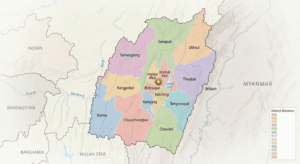
Districts
Manipur is administratively divided into 16 districts, each with its own unique geographical features, cultural traditions, tribal communities, historical importance, and economic activities. These districts are spread across the fertile Imphal Valley and the surrounding hill regions, creating remarkable diversity in landscape, biodiversity, language, and lifestyle.
The districts are administered by Deputy Commissioners (DCs) appointed by the Government of Manipur. Each district is further divided into subdivisions, blocks, municipalities, town committees, gram panchayats (where applicable), and villages to ensure efficient governance and delivery of public services.
Evolution of Districts
The administrative structure of Manipur has evolved over time to improve governance and bring public services closer to the people.
Major milestones include:
- Initially, Manipur had fewer administrative districts.
- Population growth and administrative needs led to district reorganisation.
- In 2016, the Government of Manipur created seven new districts, increasing the total number from 9 to 16.
- The reorganisation aimed to improve administration, law and order, infrastructure development, healthcare, education, and rural development.
List of Districts
The 16 districts of Manipur are:
| S.No. | District | Headquarters | Region |
|---|---|---|---|
| 1 | Bishnupur | Bishnupur | Valley |
| 2 | Chandel | Chandel | Hill |
| 3 | Churachandpur | Churachandpur | Hill |
| 4 | Imphal East | Porompat | Valley |
| 5 | Imphal West | Lamphelpat | Valley |
| 6 | Jiribam | Jiribam | Valley |
| 7 | Kakching | Kakching | Valley |
| 8 | Kamjong | Kamjong | Hill |
| 9 | Kangpokpi | Kangpokpi | Hill |
| 10 | Noney | Noney | Hill |
| 11 | Pherzawl | Pherzawl | Hill |
| 12 | Senapati | Senapati | Hill |
| 13 | Tamenglong | Tamenglong | Hill |
| 14 | Tengnoupal | Tengnoupal | Hill |
| 15 | Thoubal | Thoubal | Valley |
| 16 | Ukhrul | Ukhrul | Hill |
Valley Districts
The valley districts are densely populated and serve as the state’s economic, political, and administrative centres.
Major valley districts include:
- Imphal East
- Imphal West
- Thoubal
- Bishnupur
- Kakching
- Jiribam
Key characteristics:
- Fertile agricultural land.
- Rice cultivation.
- Major educational institutions.
- Government offices.
- Commercial centres.
- Better road connectivity.
- Higher population density.
Hill Districts
The hill districts cover nearly 90% of Manipur’s geographical area and are known for forests, mountains, tribal cultures, and biodiversity.
Hill districts include:
- Senapati
- Ukhrul
- Tamenglong
- Chandel
- Churachandpur
- Kangpokpi
- Kamjong
- Tengnoupal
- Noney
- Pherzawl
These districts are home to numerous indigenous tribal communities and contain many of the state’s forests, wildlife habitats, waterfalls, caves, and trekking destinations.
Administrative Importance
Each district plays an important role in ensuring effective governance and public service delivery across the state.
Major administrative functions include:
- Implementation of government welfare schemes.
- Maintenance of law and order.
- Revenue administration.
- Land records management.
- Disaster management.
- Rural and urban development.
- Healthcare and education administration.
- Agricultural extension services.
The Deputy Commissioner (DC) is the chief administrative officer of each district and is supported by officials from various government departments.
Economic Significance of the Districts
Each district contributes to Manipur’s economy through agriculture, forestry, tourism, handicrafts, trade, and small-scale industries.
Major economic activities include:
- Rice cultivation in valley districts.
- Horticulture in hill districts.
- Bamboo and cane industries.
- Handloom and handicrafts.
- Fisheries around Loktak Lake.
- Eco-tourism and adventure tourism.
- Border trade through Moreh (Tengnoupal District).
- Small and medium-scale enterprises.
Cultural Diversity
The districts of Manipur represent remarkable cultural diversity.
Different districts are home to:
- Meitei community.
- Naga tribes.
- Kuki-Zo communities.
- Hmar community.
- Paite community.
- Zeliangrong community.
- Anal, Aimol, Kom, Chothe, Monsang, Maring, Moyon, and several other indigenous tribes.
Each community preserves its own:
- Language.
- Traditional dress.
- Festivals.
- Dance forms.
- Music.
- Cuisine.
- Handicrafts.
- Indigenous customs.
Tourism by District
Every district offers unique attractions for visitors.
Popular tourism destinations include:
- Imphal West – Kangla Fort and Ima Keithel.
- Bishnupur – Loktak Lake and Keibul Lamjao National Park.
- Ukhrul – Shirui Hills and the famous Shirui Lily.
- Tamenglong – Barak Waterfalls and orange orchards.
- Senapati – Dzükou Valley (shared region) and scenic mountain landscapes.
- Churachandpur – Beautiful hills, waterfalls, and rich tribal heritage.
- Tengnoupal – Moreh International Border and Indo–Myanmar trade route.
Districts at a Glance
| Category | Details |
|---|---|
| Total Districts | 16 |
| Valley Districts | 6 |
| Hill Districts | 10 |
| Capital District | Imphal West (Administrative Capital Region) |
| Largest District (Area) | Churachandpur |
| International Border District | Tengnoupal |
| Famous Lake District | Bishnupur |
| Famous Hill District | Ukhrul |
| Border Trade Town | Moreh |
| Administrative Head | Deputy Commissioner (DC) |
Subdivisions & Administrative Structure
The administrative structure of Manipur has been designed to ensure efficient governance, balanced regional development, effective implementation of government schemes, and easy delivery of public services. The state follows the administrative framework prescribed under the Constitution of India, with governance carried out through state departments, district administrations, local bodies, municipalities, autonomous institutions, and village-level organisations.
Manipur is headed by the Governor, who serves as the constitutional head of the state. The executive powers are exercised by the Chief Minister and the Council of Ministers, who are collectively responsible to the Manipur Legislative Assembly. The administration functions through various departments responsible for education, healthcare, agriculture, finance, rural development, tourism, industries, forests, tribal affairs, and infrastructure.
Administrative Hierarchy
The state administration is organised into multiple levels to ensure smooth governance.
Administrative structure of Manipur:
- Governor (Constitutional Head)
- Chief Minister (Executive Head)
- Council of Ministers
- State Secretariat
- Government Departments
- District Administration
- Subdivisions
- Development Blocks
- Municipal Councils
- Town Committees
- Gram Panchayats (where applicable)
- Village Authorities and Village Councils
This decentralised system helps bring governance closer to the people.
State Government
The Government of Manipur functions through several administrative departments.
Major government departments include:
- Home Department
- Finance Department
- Education Department
- Health & Family Welfare Department
- Agriculture Department
- Horticulture & Soil Conservation Department
- Forest & Environment Department
- Rural Development & Panchayati Raj Department
- Public Works Department (PWD)
- Tourism Department
- Industries & Commerce Department
- Tribal Affairs & Hills Department
These departments formulate policies and implement welfare programmes across the state.
District Administration
The district administration forms the backbone of governance at the local level.
Each district is headed by a Deputy Commissioner (DC) who performs multiple responsibilities.
Major responsibilities of the Deputy Commissioner include:
- Revenue administration.
- Land records management.
- Maintenance of law and order.
- Disaster management.
- Election management.
- Implementation of development programmes.
- Public grievance redressal.
- Coordination among government departments.
The Deputy Commissioner works closely with the Superintendent of Police (SP), district-level officers, engineers, health officials, education officers, and local development agencies to ensure efficient governance.
Subdivisions
Each district is further divided into subdivisions to improve administrative efficiency and bring governance closer to local communities.
Subdivisions are generally headed by:
- Sub-Divisional Magistrates (SDMs).
- Sub-Divisional Officers (SDOs).
Their key responsibilities include:
- Local administration.
- Revenue collection.
- Land administration.
- Maintenance of law and order.
- Rural development.
- Coordination with village authorities.
The subdivision system helps ensure that government services reach even remote hill villages and rural communities.
Development Blocks
For rural administration and implementation of development programmes, Manipur is divided into Community Development Blocks (CD Blocks).
Major functions of Development Blocks include:
- Implementation of rural development schemes.
- Agricultural extension services.
- Watershed development.
- Rural housing programmes.
- Drinking water projects.
- Road connectivity.
- Women’s empowerment programmes.
- Skill development initiatives.
Block Development Officers (BDOs) supervise these activities and coordinate with village-level institutions.
Urban Local Bodies
Urban areas in Manipur are administered through various local bodies responsible for civic services and urban development.
Major urban local institutions include:
- Municipal Councils.
- Town Committees.
- Nagar Panchayats (where applicable).
These institutions are responsible for:
- Urban planning.
- Water supply.
- Sanitation.
- Solid waste management.
- Street lighting.
- Public health.
- Parks and recreational facilities.
- Local infrastructure development.
Village Administration
Village administration differs between the valley and hill regions because of historical, cultural, and legal traditions.
Valley Areas
- Gram Panchayats.0
- Gram Sabhas.
- Local elected representatives.
Hill Areas
- Village Authorities.
- Village Chiefs (in traditional chiefship areas).
- Village Councils.
These institutions play an important role in:
- Local governance.
- Traditional dispute resolution.
- Community development.
- Forest resource management.
- Social welfare.
- Cultural preservation.
Autonomous Administration
Certain tribal areas benefit from special constitutional and administrative arrangements.
Important institutions include:
- Autonomous District Councils (ADCs).
- Hill Areas Committee (HAC) of the Manipur Legislative Assembly.
- Tribal Affairs & Hills Department.
These bodies help protect:
- Tribal rights.
- Traditional customs.
- Community land ownership.
- Indigenous governance systems.
- Cultural heritage.
Judiciary and Law Enforcement
The state maintains an independent judicial and law enforcement system.
Major institutions include:
- High Court of Manipur (Imphal).
- District and Sessions Courts.
- Magistrate Courts.
- Family Courts.
- Manipur Police.
- Special Investigation Units.
- Disaster Response Forces.
Administrative Structure at a Glance
| Administrative Level | Head / Authority |
|---|---|
| State | Governor |
| Executive Government | Chief Minister |
| Legislature | Manipur Legislative Assembly |
| District | Deputy Commissioner (DC) |
| Law & Order | Superintendent of Police (SP) |
| Subdivision | Sub-Divisional Magistrate (SDM) / Sub-Divisional Officer (SDO) |
| Development Block | Block Development Officer (BDO) |
| Urban Local Body | Municipal Council / Town Committee |
| Village (Valley) | Gram Panchayat |
| Village (Hill Areas) | Village Authority / Village Council |
Languages
Manipur is one of India’s most linguistically diverse states, where numerous indigenous languages and dialects are spoken by different ethnic communities. The state’s rich linguistic heritage reflects its multicultural society and centuries-old traditions. Languages in Manipur belong mainly to the Tibeto-Burman language family, while some communities also use Indo-Aryan languages for communication and education.
The official language of Manipur is Meitei (Manipuri), which serves as the primary language of administration, education, literature, media, and everyday communication across the state. Meitei is also recognised in the Eighth Schedule of the Constitution of India, highlighting its national importance. Besides Meitei, several tribal languages continue to flourish in the hill districts, preserving the unique identities of indigenous communities.
Official Language
Meitei (Manipuri) is the most widely spoken language in Manipur and acts as a common link among different communities.
Key features of Meitei include:
- Official language of Manipur.
- Included in the Eighth Schedule of the Constitution of India.
- Written primarily in the Meitei Mayek script.
- Also written in the Bengali script for many years before the revival of Meitei Mayek.
- Used in government offices and administration.
- Medium of instruction in many schools.
- Rich literary and historical tradition.
- Widely used in newspapers, television, radio, and digital media.
The revival of the Meitei Mayek script has become an important movement for preserving the linguistic and cultural heritage of Manipur.
Major Languages Spoken
Apart from Meitei, many indigenous languages are spoken by various tribal communities across the state.
Major languages include:
- Meitei (Manipuri).
- Tangkhul.
- Thadou.
- Paite.
- Hmar.
- Rongmei.
- Mao.
- Maram.
- Anal.
- Aimol.
- Kom.
- Monsang.
- Chothe.
- Maring.
- Moyon.
- Liangmai.
- Zeme.
- Poumai.
- Lamkang.
- Various Kuki dialects.
Each language reflects the history, folklore, traditions, and cultural identity of its respective community.
Language Families
Most languages spoken in Manipur belong to the Sino-Tibetan (Tibeto-Burman) language family.
Major language families represented are:
- Tibeto-Burman (majority of indigenous languages).
- Indo-Aryan (Hindi, Bengali, Nepali, and others).
- English (official and educational use).
This linguistic diversity makes Manipur one of the richest language regions in India.
Role of English and Hindi
English and Hindi are also widely understood and used for different purposes.
English is mainly used in:
- Higher education.
- Government administration.
- Judiciary.
- Business communication.
- Official documents.
Hindi is commonly used in:
- Trade and commerce.
- Communication with visitors.
- Central government offices.
- Tourism.
- Security forces.
Meitei Mayek Script
The Meitei Mayek script is the traditional writing system of the Meitei language and is one of the oldest indigenous scripts in Northeast India. Historical records show that it was widely used for writing royal chronicles, religious texts, literature, and administrative documents before the Bengali script became prevalent during the eighteenth century.
In recent decades, significant efforts have been made to revive and promote Meitei Mayek. Today, it is taught in schools, used in books and newspapers, displayed on public signboards, and promoted through digital platforms. The revival of the script has become an important symbol of Manipuri cultural identity and heritage.
Key features of Meitei Mayek:
- Traditional script of the Meitei language.
- One of the oldest indigenous scripts in Northeast India.
- Used in ancient manuscripts and royal records.
- Revived through educational and cultural initiatives.
- Taught in schools across Manipur.
- Increasingly used in publications, media, and digital communication.
Language and Culture
Language plays a central role in preserving Manipur’s rich cultural heritage. Every community uses its mother tongue to pass on traditional knowledge, folklore, music, oral history, customs, and religious practices from one generation to the next.
Languages help preserve:
- Folk songs and traditional music.
- Oral history and legends.
- Indigenous literature.
- Traditional dances and theatre.
- Festivals and rituals.
- Community identity.
- Cultural values.
- Historical knowledge.
Language Preservation
The Government of Manipur, educational institutions, and cultural organisations actively work to preserve and promote the state’s linguistic diversity.
Major preservation initiatives include:
- Teaching indigenous languages in schools.
- Promotion of Meitei Mayek.
- Publication of books and dictionaries.
- Cultural festivals and literary events.
- Digital documentation of endangered languages.
- Research on tribal languages and dialects.
- Community-based language preservation programmes.
Importance of Linguistic Diversity
The multilingual nature of Manipur strengthens social harmony and cultural exchange among different communities.
Benefits of linguistic diversity include:
- Preservation of indigenous knowledge.
- Promotion of cultural identity.
- Rich literary traditions.
- Better understanding among communities.
- Development of multilingual education.
- Growth of tourism and cultural studies.
- Protection of intangible cultural heritage.
Languages at a Glance
| Category | Details |
|---|---|
| Official Language | Meitei (Manipuri) |
| Official Script | Meitei Mayek |
| Constitutional Status | Included in the Eighth Schedule (1992) |
| Major Language Family | Tibeto-Burman |
| Other Widely Spoken Languages | Tangkhul, Thadou, Paite, Hmar, Rongmei, Mao, Maram and other indigenous languages |
| Official Administrative Language | English |
| Common Link Language | Meitei (Manipuri) |
| Traditional Script | Meitei Mayek |
| Language Preservation | Schools, literature, cultural organisations, and digital initiatives |
| Linguistic Diversity | Dozens of indigenous languages and dialects |
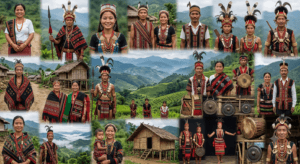
Tribes & Communities
Manipur is one of India’s most ethnically diverse states, home to numerous indigenous tribes and communities that have lived in the region for centuries. These communities have developed distinct languages, customs, traditions, festivals, attire, music, dance, food, and social institutions, making Manipur a vibrant mosaic of cultures.
The population is broadly divided into three major social groups: the Meitei community, the Naga tribes, and the Kuki-Zo communities. In addition, several smaller indigenous communities such as the Meitei Pangal (Manipuri Muslims), Hmar, Paite, Aimol, Anal, Kom, Chothe, Maring, Moyon, and Monsang contribute to the state’s rich cultural diversity.
Meitei Community
The Meitei are the largest community in Manipur and primarily inhabit the Imphal Valley. They have played a central role in the state’s history, administration, literature, arts, sports, and cultural development.
Key characteristics of the Meitei community:
- Largest ethnic community in Manipur.
- Mainly reside in the Imphal Valley.
- Speak Meitei (Manipuri).
- Use the Meitei Mayek script.
- Rich tradition of classical dance and music.
- Famous for handloom weaving and handicrafts.
- Celebrate festivals such as Yaoshang and Lai Haraoba.
- Follow Hinduism, Sanamahism, or both.
The Meitei community has made significant contributions to Manipuri literature, theatre, martial arts, and sports.
Naga Tribes
The Naga tribes mainly inhabit the northern and eastern hill districts of Manipur. They are known for their colourful festivals, traditional village institutions, craftsmanship, and rich oral traditions.
Major Naga tribes include:
- Tangkhul.
- Mao.
- Maram.
- Poumai.
- Rongmei.
- Liangmai.
- Zeme.
- Anal (in some classifications).
Key features:
- Mostly live in hill districts.
- Rich tribal customs and traditions.
- Distinct languages and dialects.
- Traditional shawls and handicrafts.
- Community-based village governance.
- Celebrations of harvest festivals.
Kuki-Zo Communities
The Kuki-Zo communities are mainly concentrated in the southern and western hill districts of Manipur. They comprise several related tribes with shared cultural traditions while maintaining distinct identities.
Major Kuki-Zo communities include:
- Thadou.
- Paite.
- Hmar.
- Vaiphei.
- Gangte.
- Simte.
- Zou.
- Aimol.
- Kom.
- Chothe.
These communities are known for:
- Rich folk traditions.
- Colourful festivals.
- Traditional dances.
- Bamboo and cane handicrafts.
- Community cooperation.
- Agricultural practices.
Meitei Pangal Community
The Meitei Pangal are the Manipuri Muslim community who have lived in Manipur for several centuries.
Important characteristics include:
- Practise Islam.
- Speak Meitei (Manipuri).
- Preserve unique cultural traditions.
- Active in trade and commerce.
- Contribute to agriculture and handicrafts.
- Participate actively in the state’s social and cultural life.
The Meitei Pangal community represents a unique blend of Islamic faith and Manipuri cultural heritage.
Traditional Lifestyle
The indigenous communities of Manipur have preserved many traditional customs that continue to shape their daily lives and cultural identity.
Common traditional practices include:
- Community-based village life.
- Traditional wooden and bamboo houses.
- Handwoven traditional clothing.
- Folk music and dances.
- Indigenous agricultural methods.
- Community festivals.
- Traditional food prepared from local ingredients.
- Respect for nature and ancestral customs.
Although modern lifestyles have influenced many aspects of society, these traditions remain an important part of community life.
Traditional Occupations
Different communities have traditionally depended on a variety of occupations based on local geography and natural resources.
Major traditional occupations include:
- Agriculture.
- Terrace farming.
- Horticulture.
- Handloom weaving.
- Handicrafts.
- Bamboo and cane work.
- Fishing.
- Animal husbandry.
- Pottery.
- Blacksmithing.
Today, many people are also employed in education, government services, business, healthcare, sports, and tourism.
Cultural Contributions
The various tribes and communities have made significant contributions to Manipur’s cultural heritage.
Major cultural contributions include:
- Manipuri classical dance.
- Folk dances and music.
- Traditional martial arts.
- Handloom and textile weaving.
- Bamboo and cane handicrafts.
- Indigenous festivals.
- Oral literature and folklore.
- Traditional cuisine.
Community Harmony
Despite their linguistic, cultural, and religious diversity, the people of Manipur have a long history of community cooperation and cultural exchange.
Community values include:
- Mutual respect.
- Community participation.
- Preservation of traditional customs.
- Support during festivals and social events.
- Respect for elders.
- Collective responsibility.
Tribes & Communities at a Glance
| Category | Details |
|---|---|
| Largest Community | Meitei |
| Major Tribal Groups | Naga and Kuki-Zo |
| Indigenous Religion | Sanamahism |
| Official Language | Meitei (Manipuri) |
| Traditional Script | Meitei Mayek |
| Major Livelihood | Agriculture, Handloom, Handicrafts |
| Traditional Housing | Bamboo and wooden houses |
| Famous Cultural Heritage | Manipuri Dance, Folk Music, Handloom Weaving |
| Traditional Crafts | Bamboo, Cane, Pottery, Weaving |
| Cultural Diversity | More than 30 recognised tribes and communities |
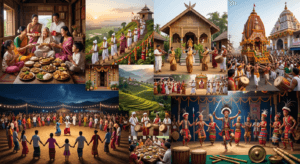
Festivals
Manipur is renowned for its colourful and vibrant festivals that reflect the state’s rich cultural heritage, religious diversity, and deep-rooted traditions. Throughout the year, different communities celebrate festivals with great enthusiasm through music, dance, rituals, sports, feasting, and community gatherings. These celebrations strengthen social harmony while preserving centuries-old customs and cultural values.
The festivals of Manipur are influenced by Sanamahism, Hinduism, Christianity, Islam, and various indigenous tribal traditions. From the lively Yaoshang festival to the sacred Lai Haraoba, from the internationally famous Sangai Festival to tribal harvest celebrations, each festival showcases a unique aspect of Manipuri life.
Yaoshang
Yaoshang is the most popular festival in Manipur and is often compared to the festival of Holi celebrated in other parts of India. It marks the arrival of spring and is celebrated for five days with religious rituals, sports, cultural performances, music, and dance.
Highlights of Yaoshang:
- Celebrated during the full moon of the month of Lamta (February–March).
- Marks the beginning of spring.
- Similar to Holi but with unique Manipuri traditions.
- Community sports competitions.
- Traditional folk dances.
- Cultural programmes.
- Singing and music.
- Participation by people of all age groups.
Yaoshang is also famous for promoting sports activities, making it one of the most distinctive festivals in Northeast India.
Lai Haraoba
Lai Haraoba, meaning “Merry Making of the Gods,” is one of the oldest and most sacred festivals of the Meitei people. It celebrates the traditional Sanamahism faith and honours local deities known as Umang Lai.
Major features include:
- Ancient religious festival.
- Traditional rituals.
- Sacred dances performed by Maibis (priestesses).
- Folk music and storytelling.
- Re-enactment of creation myths.
- Community worship.
- Preservation of indigenous culture.
Lai Haraoba provides valuable insight into the ancient history, beliefs, and customs of the Meitei people.
Sangai Festival
Sangai Festival is Manipur’s biggest tourism festival, organised annually by the Government of Manipur to promote tourism, culture, handicrafts, cuisine, sports, and adventure activities.
Festival highlights:
- Showcases Manipuri culture.
- Traditional dance and music performances.
- Indigenous sports.
- Handloom and handicraft exhibitions.
- Local cuisine.
- Adventure tourism.
- Cultural exchange programmes.
- Participation by domestic and international tourists.
The festival is named after the Sangai, the endangered brow-antlered deer that is the State Animal of Manipur.
Christmas
Christmas is widely celebrated by the Christian communities living in the hill districts.
Celebration highlights:
- Church services.
- Christmas carols.
- Community feasts.
- Cultural programmes.
- Family gatherings.
- Charity activities.
The festival promotes peace, unity, and goodwill among all communities.
Cheiraoba
Cheiraoba is the traditional Manipuri New Year festival, celebrated mainly by the Meitei community. It marks the beginning of a new year according to the traditional Manipuri calendar and is observed with prayers, family gatherings, and special meals.
Highlights of Cheiraoba:
- Traditional Manipuri New Year.
- Cleaning and decorating homes.
- Offering prayers to household deities.
- Preparation of festive meals.
- Family reunions.
- Visiting temples and sacred places.
- Hill climbing, symbolising progress and prosperity.
Ningol Chakouba
Ningol Chakouba is one of the most cherished social festivals in Manipur. On this occasion, married daughters are invited to their parental homes and welcomed with love, gifts, and a grand feast.
Key features include:
- Celebration of family bonds.
- Traditional family feast.
- Exchange of gifts.
- Strengthening relationships.
- Cultural performances.
- Traditional attire.
Kut Festival
Kut Festival is the major harvest festival celebrated by the Kuki-Zo communities after the harvest season.
Festival highlights:
- Thanksgiving for a successful harvest.
- Folk dances and songs.
- Traditional sports.
- Community feasts.
- Colourful cultural performances.
- Traditional costumes.
Kut is one of the largest tribal festivals in Manipur and attracts visitors from across the region.
Religious Festivals
People belonging to different religions celebrate their festivals with great devotion and mutual respect.
Major religious festivals include:
- Janmashtami.
- Rath Yatra.
- Diwali.
- Eid-ul-Fitr.
- Eid-ul-Adha.
- Easter.
- Good Friday.
- Ram Navami.
Importance of Festivals
Festivals play a vital role in preserving Manipur’s traditions and strengthening community relationships.
They help in:
- Preserving cultural heritage.
- Promoting tourism.
- Encouraging traditional arts.
- Strengthening family and community bonds.
- Supporting local artisans.
- Showcasing indigenous cuisine.
- Promoting inter-community harmony.
Major Festivals at a Glance
| Festival | Community | Significance |
|---|---|---|
| Yaoshang | Meitei | Spring festival and sports celebrations |
| Lai Haraoba | Meitei / Sanamahism | Worship of traditional deities |
| Sangai Festival | State Festival | Tourism and cultural showcase |
| Cheiraoba | Meitei | Traditional Manipuri New Year |
| Ningol Chakouba | Meitei | Family reunion festival |
| Kut Festival | Kuki-Zo | Harvest festival |
| Christmas | Christian | Birth of Jesus Christ |
| Eid-ul-Fitr | Muslim | End of Ramadan |
| Janmashtami | Hindu | Birth of Lord Krishna |
| Rath Yatra | Hindu | Chariot festival of Lord Jagannath |
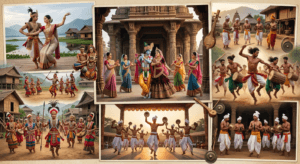
Dance, Music & Culture
Manipur is internationally renowned for its rich cultural heritage, graceful classical dance, vibrant folk traditions, soulful music, colourful festivals, and centuries-old performing arts. The state’s cultural identity has been shaped by the traditions of the Meitei, Naga, Kuki-Zo, and numerous other indigenous communities. Every dance, musical performance, costume, and ritual reflects the deep spiritual beliefs and artistic excellence of the people.
Among all its cultural treasures, Manipuri Dance is one of India’s eight recognised classical dance forms. Famous for its graceful movements, devotional themes, elegant costumes, and expressive storytelling, it has earned worldwide recognition. Alongside classical dance, the state also preserves a rich tradition of folk dances, martial arts, indigenous music, and community festivals.
Manipuri Classical Dance
Manipuri Dance is one of the oldest and most refined classical dance traditions in India. It developed under the influence of Vaishnavism while also preserving elements of the ancient Sanamahi culture.
Major characteristics include:
- One of India’s eight classical dance forms.
- Soft, graceful, and flowing movements.
- Devotional themes based on Lord Krishna and Radha.
- Elegant costumes and jewellery.
- Expressive storytelling.
- Classical music accompaniment.
- Spiritual and religious significance.
- International recognition.
Manipuri Dance is performed during festivals, religious ceremonies, cultural programmes, and international cultural events.
Ras Lila
Ras Lila is the most famous form of Manipuri classical dance and depicts the divine love of Lord Krishna and Radha.
Key features include:
- Vaishnavite devotional dance.
- Graceful circular movements.
- Traditional musical instruments.
- Beautiful costumes.
- Spiritual themes.
- Performed during Janmashtami and other festivals.
- Globally recognised as part of India’s classical dance heritage.
Ras Lila remains one of the finest expressions of devotion and artistic excellence in Indian classical dance.
Folk Dances
In addition to classical dance, Manipur has a wide variety of folk dances performed by different communities.
Popular folk dances include:
- Thabal Chongba.
- Lai Haraoba dances.
- Kabui dance.
- Tangkhul dance.
- Kuki bamboo dance.
- Paite folk dance.
- Hmar traditional dance.
- Harvest dances.
These dances are performed during festivals, weddings, harvest celebrations, and community gatherings.
Traditional Music
Music forms an integral part of Manipuri culture and accompanies almost every religious ceremony and social celebration.
Major musical traditions include:
- Devotional songs.
- Folk songs.
- Tribal music.
- Classical music.
- Ritual music.
- Festival music.
- Martial music.
Traditional music reflects themes of nature, devotion, heroism, agriculture, and community life.
Traditional Musical Instruments
Manipur has a rich tradition of indigenous musical instruments that accompany classical dances, folk performances, religious ceremonies, and festivals.
Major traditional instruments include:
- Pung (traditional Manipuri drum).
- Pena (ancient bowed string instrument).
- Kartal (hand cymbals).
- Flute.
- Conch shell.
- Bamboo percussion instruments.
- Tribal drums.
- Traditional gongs.
The Pena is regarded as one of the oldest surviving folk musical instruments in Manipur and holds great cultural significance.
Martial Arts
The state is also famous for its ancient martial traditions.
Major traditional martial arts include:
- Thang-Ta (sword and spear martial art).
- Sarit-Sarak (unarmed combat).
- Traditional archery.
- Indigenous wrestling.
Thang-Ta combines physical skill, discipline, spirituality, and self-defence, making it one of India’s oldest martial art traditions.
Traditional Attire
The colourful traditional attire of Manipur reflects the identity of its diverse communities.
Famous traditional costumes include:
- Potloi (bridal and dance costume).
- Phanek.
- Innaphi.
- Traditional tribal shawls.
- Bamboo ornaments.
- Handwoven textiles.
- Traditional jewellery.
Most garments are woven using traditional handloom techniques that have been passed down through generations.
Cultural Institutions
Several institutions actively preserve and promote Manipuri art and culture.
Major institutions include:
- Jawaharlal Nehru Manipur Dance Academy.
- Manipur State Kala Akademi.
- Manipur State Museum.
- Cultural research centres.
- Tribal cultural organisations.
- Community cultural associations.
These institutions organise performances, workshops, festivals, and research programmes to preserve the state’s cultural heritage.
Importance of Culture
The cultural traditions of Manipur continue to influence every aspect of daily life.
They contribute to:
- Preservation of heritage.
- Promotion of tourism.
- Employment through handloom and handicrafts.
- Cultural education.
- National and international recognition.
- Community harmony.
- Artistic excellence.
Dance, Music & Culture at a Glance
| Category | Highlights |
|---|---|
| Classical Dance | Manipuri Dance |
| Famous Dance Form | Ras Lila |
| Traditional Martial Art | Thang-Ta |
| Ancient Musical Instrument | Pena |
| Famous Drum | Pung |
| Traditional Women’s Dress | Phanek, Innaphi |
| Famous Dance Costume | Potloi |
| Major Folk Dance | Thabal Chongba |
| Cultural Institutions | Jawaharlal Nehru Manipur Dance Academy, Manipur State Kala Akademi |
| Cultural Identity | Dance, Music, Martial Arts, Handloom, Festivals |
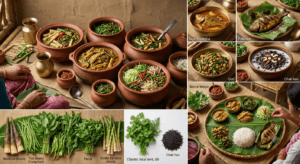
Cuisine & Traditional Food
Manipur is famous for its unique and healthy cuisine, which reflects the state’s rich natural resources, agricultural traditions, and cultural diversity. Traditional Manipuri food is known for its fresh ingredients, aromatic herbs, seasonal vegetables, fermented products, freshwater fish, bamboo shoots, and mild use of oil. Most dishes are nutritious and prepared using locally grown ingredients, making Manipuri cuisine one of the healthiest food traditions in India.
Rice is the staple food of Manipur and is served with a variety of vegetable dishes, fish preparations, leafy greens, pulses, and traditional condiments. Different communities have their own distinctive cooking styles, but all emphasise freshness, natural flavours, and balanced nutrition.
Staple Food
Rice forms the foundation of daily meals across the state.
Common foods eaten with rice include:
- Fresh vegetables.
- Fish curry.
- Seasonal leafy greens.
- Bamboo shoots.
- Fermented soybean.
- Fresh herbs.
- Pulses.
- Chutneys.
Most households also prepare seasonal vegetables collected from forests, wetlands, and home gardens.
Famous Traditional Dishes
Manipur offers a wide variety of traditional dishes that are unique to the region.
Popular dishes include:
- Eromba – Mashed vegetables mixed with fermented fish and chillies.
- Chamthong (Kangshoi) – A healthy vegetable stew prepared with seasonal vegetables.
- Singju – A spicy traditional salad made from vegetables and herbs.
- Nga Thongba – Traditional fish curry.
- Paknam – Steamed savoury cake made with gram flour, herbs, and fish or vegetables.
- Ooti – A mild curry prepared using peas and baking soda.
- Chak-Hao Kheer – Sweet pudding prepared using the famous black rice.
These dishes are widely enjoyed during festivals, family gatherings, and everyday meals.
Chak-Hao – Black Rice
Chak-Hao, the famous black aromatic rice of Manipur, is one of the state’s most celebrated traditional foods.
Special features include:
- Naturally black in colour.
- Rich in antioxidants.
- Pleasant aroma.
- High nutritional value.
- Used in desserts.
- Popular souvenir for tourists.
- Exported to various parts of India.
Chak-Hao has gained international recognition because of its nutritional benefits and unique flavour.
Traditional Ingredients
Manipuri cuisine uses a wide range of fresh local ingredients.
Common ingredients include:
- Bamboo shoots.
- Freshwater fish.
- Ngari (fermented fish).
- Hawaijar (fermented soybean).
- Local herbs.
- Ginger.
- Chillies.
- Seasonal vegetables.
Traditional Cooking Methods
The people of Manipur follow simple cooking techniques that help preserve the natural flavour and nutritional value of food.
Common cooking methods include:
- Boiling.
- Steaming.
- Light roasting.
- Slow cooking.
- Fermentation.
- Smoking (for selected foods).
- Minimal use of oil.
Fresh herbs and seasonal vegetables are commonly added at the end of cooking to retain their aroma and nutrients.
Traditional Beverages
Several traditional drinks are prepared using local ingredients and are served during festivals, family gatherings, and community celebrations.
Popular traditional beverages include:
- Black tea.
- Herbal tea.
- Traditional rice-based beverages (prepared by some communities).
- Fresh fruit juices.
- Seasonal herbal drinks.
Many beverages are prepared using indigenous herbs known for their refreshing and medicinal properties.
Festival Foods
Special dishes are prepared during religious and cultural festivals.
Popular festival foods include:
- Chak-Hao Kheer.
- Eromba.
- Paknam.
- Nga Thongba.
- Singju.
- Traditional sweets.
- Fresh fruits.
- Community feast preparations.
Festival meals are often shared with family members, relatives, and neighbours, reflecting the spirit of unity and hospitality.
Health Benefits
Traditional Manipuri cuisine is widely appreciated for its nutritional value.
Health benefits include:
- Rich in vegetables.
- High dietary fibre.
- Good source of protein.
- Low oil content.
- Rich in vitamins and minerals.
- Natural fermented foods that support digestion.
- Balanced and nutritious meals.
These healthy food habits contribute to a balanced lifestyle and overall well-being.
Culinary Heritage
The cuisine of Manipur is an important part of the state’s cultural identity and tourism.
It promotes:
- Preservation of traditional recipes.
- Sustainable farming.
- Local agriculture.
- Food tourism.
- Cultural exchange.
- Indigenous knowledge.
- Healthy eating habits.
Cuisine & Traditional Food at a Glance
| Category | Highlights |
|---|---|
| Staple Food | Rice |
| Famous Rice Variety | Chak-Hao (Black Rice) |
| Popular Dish | Eromba |
| Traditional Salad | Singju |
| Famous Fish Curry | Nga Thongba |
| Healthy Vegetable Dish | Chamthong (Kangshoi) |
| Traditional Ingredient | Ngari (Fermented Fish) |
| Traditional Cooking Style | Boiling, Steaming, Fermentation |
| Famous Dessert | Chak-Hao Kheer |
| Food Identity | Fresh, Healthy, Nutritious Cuisine |
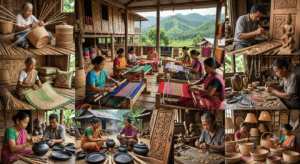
Handloom & Handicrafts
Manipur is one of India’s leading centres of handloom weaving and traditional handicrafts. These age-old crafts represent the creativity, artistic excellence, and cultural identity of the state’s indigenous communities. Handloom weaving has been practised for centuries, especially by women, and continues to provide employment to thousands of families while preserving traditional knowledge and craftsmanship.
The state’s handwoven textiles, bamboo products, cane crafts, pottery, wood carvings, jewellery, and decorative items are highly valued across India and internationally for their quality, intricate designs, and eco-friendly production methods.
Handloom Industry
The handloom sector is one of the largest cottage industries in Manipur and plays a significant role in the state’s economy.
Major features of the handloom industry include:
- One of the oldest traditional industries in Manipur.
- Large participation of women weavers.
- Production of cotton and silk fabrics.
- Traditional weaving techniques.
- Colourful indigenous designs.
- Eco-friendly production.
- Generation of rural employment.
- Promotion of women’s economic empowerment.
Most households in rural Manipur possess traditional handlooms that are used for weaving garments and household textiles.
Famous Handwoven Textiles
Manipuri textiles are known for their elegance, durability, and artistic beauty.
Popular handloom products include:
- Phanek.
- Innaphi.
- Potloi.
- Tribal shawls.
- Cotton fabrics.
- Silk fabrics.
- Decorative scarves.
- Handwoven stoles.
Each community has its own distinctive weaving patterns, colours, and motifs that reflect its cultural identity.
Bamboo and Cane Crafts
Bamboo and cane are widely available in Manipur and are used to produce a variety of useful and decorative items.
Popular bamboo and cane products include:
- Baskets.
- Mats.
- Furniture.
- Decorative items.
- Storage containers.
- Household utensils.
- Fishing equipment.
- Traditional musical instruments.
These eco-friendly products are widely used in daily life and are also popular among tourists.
Pottery and Wood Crafts
Traditional pottery and wood carving continue to be practised in several parts of the state.
Important products include:
- Earthen pots.
- Clay utensils.
- Decorative pottery.
- Wooden sculptures.
- Religious idols.
- Household furniture.
- Traditional masks.
These crafts preserve ancient artistic traditions while supporting rural livelihoods.
Traditional Jewellery and Decorative Crafts
In addition to textiles, the artisans of Manipur produce beautiful traditional jewellery and decorative handicrafts using locally available materials.
Popular handcrafted products include:
- Beaded necklaces.
- Bamboo jewellery.
- Silver ornaments.
- Brass decorative items.
- Cane accessories.
- Handcrafted home décor.
- Traditional ceremonial items.
These products reflect the artistic skills of local craftsmen and are widely appreciated for their unique designs.
Economic Importance
The handloom and handicraft sector is one of the major sources of employment and income in Manipur.
Its contribution includes:
- Employment generation.
- Women’s empowerment.
- Rural livelihood support.
- Promotion of small-scale industries.
- Export of handmade products.
- Preservation of indigenous skills.
- Growth of cultural tourism.
The sector also plays an important role in strengthening the state’s rural economy.
Government Support
The Government of Manipur and various organisations actively promote the development of handloom and handicrafts.
Major initiatives include:
- Skill development programmes.
- Handloom cooperatives.
- Artisan training.
- Financial assistance.
- National and international exhibitions.
- Marketing support.
- E-commerce promotion.
These initiatives help artisans improve product quality, expand market access, and increase income.
Tourism and Handicrafts
Traditional crafts have become an important attraction for visitors to Manipur.
Tourists commonly purchase:
- Handwoven shawls.
- Phanek.
- Innaphi.
- Bamboo handicrafts.
- Decorative items.
- Traditional jewellery.
- Handmade textiles.
These authentic products serve as popular souvenirs and help promote Manipuri culture around the world.
Handloom & Handicrafts at a Glance
| Category | Highlights |
|---|---|
| Major Industry | Handloom Weaving |
| Main Producers | Women Weavers |
| Famous Products | Phanek, Innaphi, Potloi |
| Natural Materials | Bamboo, Cane, Cotton, Silk |
| Traditional Crafts | Pottery, Wood Carving, Jewellery |
| Major Cottage Industry | Handloom |
| Economic Importance | Employment and Rural Livelihood |
| Government Support | Training, Cooperatives, Marketing |
| Popular Souvenirs | Shawls, Bamboo Crafts, Handwoven Textiles |
| Cultural Identity | Indigenous Craftsmanship and Heritage |
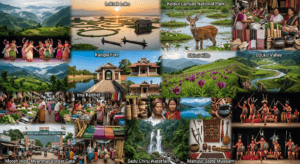
Tourism
Manipur is one of the most beautiful tourist destinations in Northeast India, offering a unique blend of breathtaking landscapes, rich cultural heritage, historical monuments, wildlife, adventure activities, and vibrant festivals. Surrounded by scenic hills and blessed with lush valleys, pristine lakes, waterfalls, caves, and forests, the state attracts nature lovers, history enthusiasts, adventure seekers, photographers, and cultural travellers from across India and around the world.
The state is widely known as the “Jewel of India” because of its natural beauty and cultural richness. Tourists can explore iconic attractions such as Loktak Lake, Keibul Lamjao National Park, Kangla Fort, Ima Keithel (Mother’s Market), Shri Govindajee Temple, Shirui Hills, Sadu Chiru Waterfall, and the bustling Mother’s Market while also experiencing the warmth and hospitality of the local communities.
Major Tourist Attractions
Manipur is home to numerous natural, historical, religious, and cultural attractions.
Top tourist destinations include:
- Loktak Lake.
- Keibul Lamjao National Park.
- Kangla Fort.
- Ima Keithel (Mother’s Market).
- Shri Govindajee Temple.
- Shirui Hills.
- Sadu Chiru Waterfall.
- Dzükou Valley (shared with Nagaland).
- Manipur State Museum.
- War Cemeteries.
Each destination offers visitors a unique glimpse into the state’s history, biodiversity, and traditions.
Loktak Lake
Loktak Lake is the largest freshwater lake in Northeast India and is the most famous tourist attraction in Manipur.
Major highlights include:
- Largest freshwater lake in Northeast India.
- Floating islands known as Phumdis.
- Boating and photography.
- Rich biodiversity.
- Scenic sunrise and sunset views.
- Traditional fishing communities.
- Home to Keibul Lamjao National Park.
Loktak Lake is recognised for its ecological importance and breathtaking natural beauty.
Keibul Lamjao National Park
Located on the floating Phumdis of Loktak Lake, Keibul Lamjao National Park is the world’s only floating national park.
Major attractions include:
- Habitat of the endangered Sangai deer.
- Floating marshland ecosystem.
- Birdwatching.
- Nature photography.
- Eco-tourism.
- Wildlife conservation.
The park is one of India’s most unique protected areas and an important symbol of Manipur’s natural heritage.
Kangla Fort
Kangla Fort, situated in Imphal, served as the ancient seat of the Meitei kings for centuries and remains one of the state’s most significant historical landmarks.
Highlights include:
- Ancient royal palace complex.
- Historical temples.
- Museums.
- Archaeological remains.
- Sacred sites.
- Beautiful gardens.
The fort offers valuable insights into the history and culture of the erstwhile Kingdom of Manipur.
Adventure Tourism
Manipur offers excellent opportunities for adventure enthusiasts because of its mountains, valleys, forests, rivers, and caves.
Popular adventure activities include:
- Trekking.
- Hiking.
- Camping.
- Boating.
- Birdwatching.
- Mountain biking.
- Rock climbing.
- Nature photography.
Popular adventure destinations include Shirui Hills, Dzükou Valley, Sadu Chiru Waterfall, and the forests of Tamenglong.
Cultural Tourism
Visitors can experience Manipur’s rich cultural traditions through its festivals, dance, music, handicrafts, and cuisine.
Major cultural attractions include:
- Sangai Festival.
- Manipuri Classical Dance performances.
- Ima Keithel (Mother’s Market).
- Traditional handloom centres.
- Tribal villages.
- Local food festivals.
These experiences provide tourists with an opportunity to understand the traditions and lifestyles of the state’s diverse communities.
Religious Tourism
Manipur is home to many important temples, churches, mosques, and sacred indigenous sites.
Major religious attractions include:
- Shri Govindajee Temple.
- Sanamahi Temple.
- Mahabali Temple.
- Historic churches in the hill districts.
- Sacred groves.
These sites attract devotees as well as visitors interested in history and architecture.
Best Time to Visit
The climate of Manipur remains pleasant for most of the year.
Best months to visit:
- October to March – Ideal for sightseeing and festivals.
- April to June – Pleasant weather for nature tourism.
- July to September – Lush greenery, though heavy rainfall may affect travel.
Winter is generally considered the best season for tourism because of its comfortable weather and numerous cultural events.
Tourism Importance
Tourism plays a vital role in the state’s economy.
Benefits include:
- Employment generation.
- Promotion of local handicrafts.
- Development of infrastructure.
- Conservation of natural heritage.
- Preservation of cultural traditions.
- Growth of eco-tourism.
- Support for local communities.
Tourism at a Glance
| Category | Highlights |
|---|---|
| Most Famous Attraction | Loktak Lake |
| Famous National Park | Keibul Lamjao National Park |
| Historical Monument | Kangla Fort |
| Famous Market | Ima Keithel (Mother’s Market) |
| Adventure Destination | Shirui Hills |
| Major Tourism Festival | Sangai Festival |
| Best Season | October to March |
| Eco-tourism | Loktak Lake, Tamenglong, Dzükou Valley |
| Cultural Attraction | Manipuri Dance, Handloom, Festivals |
| State Tourism Identity | Nature, Culture, Heritage, Adventure |
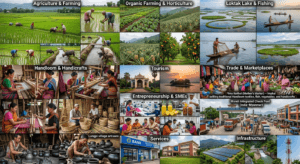
Economy
The economy of Manipur is primarily based on agriculture, horticulture, handloom weaving, handicrafts, fisheries, forestry, tourism, and small-scale industries. The state has a predominantly rural economy, with a large section of the population depending on farming and allied activities for their livelihood. In recent years, sectors such as tourism, information technology, trade, education, healthcare, and border commerce have also contributed to economic growth.
Manipur’s strategic location on the India–Myanmar border provides significant opportunities for international trade under India’s Act East Policy. The state’s abundant natural resources, skilled artisans, and rich cultural heritage continue to support sustainable economic development.
Major Economic Sectors
The economy is supported by a diverse range of primary, secondary, and service-sector activities.
Major sectors include:
- Agriculture.
- Horticulture.
- Handloom and handicrafts.
- Fisheries.
- Animal husbandry.
- Forestry.
- Tourism.
- Small-scale industries.
- Trade and commerce.
- Government services.
These sectors provide employment to a large proportion of the state’s population.
Agriculture
Agriculture is the backbone of Manipur’s economy and remains the primary occupation of the rural population.
Major agricultural crops include:
- Rice.
- Maize.
- Wheat.
- Pulses.
- Oilseeds.
- Sugarcane.
- Potato.
- Seasonal vegetables.
Rice is the principal crop and staple food of the state.
Horticulture
The favourable climate of Manipur supports the cultivation of a wide variety of fruits, vegetables, spices, and flowers.
Major horticultural products include:
- Pineapple.
- Orange.
- Lemon.
- Banana.
- Passion fruit.
- Ginger.
- Turmeric.
- King chilli.
Horticulture has emerged as an important source of income for farmers due to increasing market demand.
Handloom and Handicrafts
Manipur is nationally recognised for its traditional handloom and handicraft industries.
Major products include:
- Phanek.
- Innaphi.
- Potloi.
- Tribal shawls.
- Bamboo products.
- Cane crafts.
- Pottery.
- Wooden handicrafts.
The sector provides employment to thousands of artisans, particularly women.
Fisheries and Animal Husbandry
Fisheries and animal husbandry play an important role in supporting rural livelihoods and improving food security in Manipur.
Major activities include:
- Freshwater fish farming.
- Fish production in ponds and lakes.
- Poultry farming.
- Pig farming.
- Dairy farming.
- Goat rearing.
- Duck farming.
Loktak Lake and other inland water bodies provide excellent opportunities for fisheries development.
Tourism Industry
Tourism has become one of the fastest-growing sectors of the state’s economy.
Major tourism segments include:
- Eco-tourism.
- Cultural tourism.
- Adventure tourism.
- Wildlife tourism.
- Religious tourism.
- Heritage tourism.
The tourism sector generates employment in hotels, transport, handicrafts, restaurants, tour operations, and local businesses.
Border Trade
Manipur plays a key role in India’s trade with Southeast Asia through the border town of Moreh.
Major advantages include:
- India–Myanmar border trade.
- International trade opportunities.
- Integrated Check Post (ICP).
- Act East Policy.
- Logistics and transport services.
- Cross-border commerce.
The expansion of border trade is expected to boost economic growth and regional connectivity.
Small-Scale Industries
The state has several small and cottage industries based on local resources.
Major industries include:
- Food processing.
- Handloom.
- Handicrafts.
- Bamboo processing.
- Cane products.
- Wood-based industries.
- Cottage industries.
These industries create employment opportunities and encourage entrepreneurship.
Economic Development
The Government of Manipur is promoting sustainable development through infrastructure projects, industrial growth, digital connectivity, skill development, and tourism promotion.
Development priorities include:
- Rural development.
- Road and transport infrastructure.
- Agricultural modernisation.
- Entrepreneurship.
- Women’s empowerment.
- Digital economy.
- Investment promotion.
Economy at a Glance
| Category | Highlights |
|---|---|
| Main Economic Sector | Agriculture |
| Major Crop | Rice |
| Important Horticultural Products | Pineapple, Orange, Ginger, Turmeric |
| Largest Cottage Industry | Handloom |
| Important Trade Centre | Moreh |
| Growing Sector | Tourism |
| Fisheries Resource | Loktak Lake |
| Major Small Industries | Bamboo, Cane, Food Processing |
| Key Government Focus | Infrastructure, Skill Development and Investment |
| Economic Strength | Agriculture, Handloom, Tourism and Border Trade |
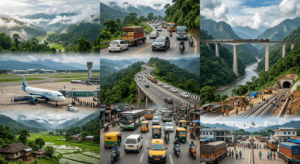
Transport
Transport plays a vital role in the economic development, tourism, trade, and connectivity of Manipur. Surrounded by hills and sharing an international border with Myanmar, the state has steadily improved its transport infrastructure through investments in roads, railways, air connectivity, and border trade facilities. These developments have strengthened links between Manipur and the rest of India while also enhancing its strategic importance under India’s Act East Policy.
Although much of Manipur’s terrain is mountainous, modern highways, bridges, airports, and railway projects have significantly improved accessibility. Road transport remains the primary mode of travel within the state, while rail and air services continue to expand.
Road Transport
Roadways form the backbone of Manipur’s transport network.
Major features include:
- Extensive network of national and state highways.
- Road connectivity between all district headquarters.
- Bus services connecting towns and villages.
- Private taxis and shared cabs.
- Interstate bus services.
- Tourist transport facilities.
- Ongoing highway improvement projects.
Road transport is the most widely used means of passenger and freight movement across the state.
National Highways
Several national highways connect Manipur with neighbouring states and Myanmar.
Important highways include:
- National Highway 2 (NH-2) – Connects Manipur with Nagaland and Assam.
- National Highway 37 (NH-37) – Connects Imphal with Jiribam and further to Assam.
- National Highway 102 (NH-102) – Connects Imphal with Moreh on the India–Myanmar border.
These highways are essential for trade, tourism, defence logistics, and regional connectivity.
Railway Transport
Rail connectivity in Manipur has improved significantly in recent years.
Key railway features include:
- Jiribam Railway Station serves as the state’s rail gateway.
- Expansion of the Jiribam–Imphal Railway Project.
- Improved passenger and freight connectivity.
- Support for tourism and trade.
- Engineering marvels including long tunnels and high railway bridges.
The completion of the railway project will greatly enhance connectivity between Manipur and the rest of India.
Air Transport
Air travel provides the fastest connection between Manipur and major Indian cities.
Imphal International Airport is the state’s principal airport.
Major services include:
- Domestic flights to Delhi, Kolkata, Guwahati, and other cities.
- International status with potential for future international operations.
- Passenger and cargo services.
- Modern terminal facilities.
The airport plays a crucial role in tourism, business, healthcare, and emergency services.
Border Connectivity
Manipur shares an international border with Myanmar, making it an important gateway for trade and regional cooperation.
Major border transport features include:
- Moreh Border Town.
- Integrated Check Post (ICP) at Moreh.
- India–Myanmar–Thailand Trilateral Highway.
- Cross-border trade facilities.
- Customs and immigration services.
- International cargo movement.
The development of border infrastructure is expected to strengthen trade with Southeast Asian countries.
Public Transport
Public transport services are available across most parts of the state and connect urban as well as rural areas.
Common modes of public transport include:
- State transport buses.
- Private buses.
- Mini buses.
- Shared taxis.
- Auto-rickshaws.
- Rental cars.
These services provide affordable and convenient travel for residents and visitors.
Future Transport Projects
Several infrastructure projects are being implemented to improve transport and connectivity in Manipur.
Major projects include:
- Completion of the Jiribam–Imphal Railway Line.
- Highway widening and modernisation.
- Bridge construction.
- Smart transport systems.
- Logistics parks.
- Border infrastructure development.
These projects aim to boost economic growth, tourism, and regional connectivity.
Importance of Transport
A strong transport network supports the overall development of the state.
Key benefits include:
- Faster movement of goods and people.
- Promotion of tourism.
- Growth in trade and commerce.
- Better access to education and healthcare.
- Employment generation.
- Strengthening border trade.
- Regional integration under the Act East Policy.
Important Note
Transport infrastructure is transforming Manipur into an important gateway between India and Southeast Asia. With improved roads, expanding railway connectivity, modern airport facilities, and growing international trade links, the state is strengthening its position as a key centre for commerce, tourism, and regional development.
Transport at a Glance
| Category | Highlights |
|---|---|
| Main Mode of Transport | Roadways |
| Principal Airport | Imphal International Airport |
| Railway Gateway | Jiribam Railway Station |
| Major Border Trade Centre | Moreh |
| Important National Highways | NH-2, NH-37, NH-102 |
| International Connectivity | India–Myanmar Border |
| Major Railway Project | Jiribam–Imphal Railway Line |
| Public Transport | Buses, Shared Taxis, Auto-rickshaws |
| Strategic Initiative | Act East Policy |
| Transport Importance | Trade, Tourism, Regional Connectivity |
Education & Healthcare
Education and healthcare are two of the most important pillars of Manipur’s development. Over the years, the state has made steady progress in improving literacy, expanding educational institutions, strengthening healthcare infrastructure, and promoting public welfare. Manipur is recognised for its emphasis on education, with a high literacy rate compared to many Indian states, while continuous investments in hospitals, medical education, and public health programmes have improved access to healthcare services.
The Government of Manipur, along with private institutions and non-governmental organisations, works to provide quality education and affordable healthcare to both urban and rural populations.
Education in Manipur
Education has played a major role in the social and economic development of the state.
Key features of the education sector include:
- High literacy rate.
- Well-developed school education system.
- Government and private educational institutions.
- Universities and colleges.
- Technical and professional education.
- Skill development programmes.
- Digital learning initiatives.
Education has helped improve employment opportunities and overall quality of life across the state.
Major Universities
Manipur is home to several renowned universities offering higher education in various disciplines.
Major universities include:
- Manipur University, Canchipur.
- Central Agricultural University, Imphal.
- National Sports University, Imphal.
- Dhanamanjuri University, Imphal.
These institutions offer undergraduate, postgraduate, doctoral, and professional courses in science, arts, commerce, agriculture, sports, engineering, and other fields.
Medical Education
The state has several institutions that provide quality medical education and healthcare training.
Major medical institutions include:
- Regional Institute of Medical Sciences (RIMS).
- Jawaharlal Nehru Institute of Medical Sciences (JNIMS).
- Government nursing colleges.
- Paramedical training institutes.
These institutions produce skilled doctors, nurses, and healthcare professionals who serve both Manipur and other parts of India.
Healthcare System
The healthcare network of Manipur includes government hospitals, community health centres, primary health centres, district hospitals, and private healthcare facilities.
Major healthcare services include:
- Primary healthcare.
- Maternal and child healthcare.
- Emergency medical services.
- Immunisation programmes.
- Disease prevention and control.
- Telemedicine services.
- Public health awareness programmes.
Healthcare services continue to expand through government initiatives aimed at improving accessibility and quality.
Literacy
Manipur has consistently maintained a literacy rate that is higher than the national average, reflecting the importance given to education by its people.
Factors contributing to literacy include:
- Strong emphasis on school education.
- Wide network of government and private schools.
- Adult literacy programmes.
- Girls’ education initiatives.
- Scholarships for students.
- Digital education programmes.
The increasing literacy rate has supported social progress and economic development across the state.
Public Health Programmes
The Government of Manipur implements various health programmes to improve the well-being of its citizens.
Major public health initiatives include:
- Universal immunisation.
- Maternal healthcare.
- Child nutrition programmes.
- Tuberculosis control.
- Malaria prevention.
- HIV/AIDS awareness.
- Health insurance schemes.
These programmes focus on preventive healthcare as well as improving access to medical treatment.
Sports Education
Manipur is widely recognised as the Sports Powerhouse of India, and sports education plays an important role in the state’s development.
Major sports education facilities include:
- National Sports University.
- Sports Authority of India training centres.
- Coaching academies.
- Sports hostels.
- High-performance training facilities.
These institutions have produced numerous international athletes and Olympians.
Challenges and Development
Despite significant progress, the education and healthcare sectors continue to face certain challenges.
Key focus areas include:
- Improving rural healthcare access.
- Upgrading school infrastructure.
- Expanding digital education.
- Increasing specialist medical services.
- Strengthening research institutions.
- Enhancing skill development programmes.
The government continues to invest in these areas to improve human development across the state.
Education & Healthcare at a Glance
| Category | Highlights |
|---|---|
| Literacy | Higher than the national average |
| Central University | Manipur University |
| Agricultural University | Central Agricultural University |
| Sports University | National Sports University |
| Major Medical Institute | Regional Institute of Medical Sciences (RIMS) |
| Government Medical College | Jawaharlal Nehru Institute of Medical Sciences (JNIMS) |
| Healthcare Focus | Primary Healthcare and Public Health |
| Major Programmes | Immunisation, Maternal Care, Disease Control |
| Strength | Sports Education |
| Development Goal | Quality Education and Better Healthcare |
Sports & Famous Personalities
Manipur is widely known as the “Sports Powerhouse of India” because of its outstanding contribution to Indian sports. Despite its relatively small population, the state has produced numerous Olympians, world champions, Commonwealth Games medalists, Asian Games medalists, and Arjuna Award winners. Boxing, weightlifting, football, hockey, archery, athletics, and martial arts are among the most popular sports in the state.
Apart from sports, Manipur has also produced distinguished personalities in literature, arts, music, politics, social service, and public administration. Their achievements have brought national and international recognition to the state.
Sports Culture
Sports are an integral part of everyday life in Manipur. Many children begin training at a young age, supported by schools, sports academies, coaches, and local communities.
Key features of sports culture include:
- Strong sporting tradition.
- Community support for athletes.
- Modern sports training centres.
- National Sports University.
- Sports Authority of India (SAI) centres.
- Traditional indigenous games.
- High participation of women in sports.
The state’s dedication to sports has made it one of India’s leading producers of international athletes.
Major Sports
A wide variety of sports are played and promoted across Manipur.
Popular sports include:
- Boxing.
- Weightlifting.
- Football.
- Hockey.
- Archery.
- Athletics.
- Taekwondo.
- Martial arts (Thang-Ta).
- Cycling.
- Wrestling.
These sports have helped Manipur win numerous medals at national and international competitions.
Famous Sportspersons
Manipur has produced many internationally acclaimed athletes.
Renowned sportspersons include:
- Mary Kom – Six-time World Boxing Champion and Olympic medalist.
- Mirabai Chanu – Olympic silver medalist in weightlifting.
- Dingko Singh – Asian Games gold medal-winning boxer.
- Kunjarani Devi – International weightlifter.
- Ngangom Bala Devi – International footballer.
- Bombayla Devi Laishram – Olympic archer.
- L. Sarita Devi – International boxer.
These athletes have inspired millions of young sportspersons across India.
National Sports University
The National Sports University, located in Imphal, is India’s first central university dedicated exclusively to sports education, sports science, coaching, and sports management.
Its major objectives include:
- Sports education.
- Scientific athlete training.
- Sports medicine.
- Coaching programmes.
- Research in sports science.
- Development of future champions.
The university plays an important role in strengthening India’s sports ecosystem.
Famous Personalities
Apart from sports, Manipur has produced several distinguished personalities in literature, arts, politics, education, and social service.
Notable personalities include:
- Ratan Thiyam – Internationally acclaimed theatre director and playwright.
- Arambam Dorendrajit Singh – Historian and writer.
- Guru Bipin Singh – Renowned exponent of Manipuri classical dance.
- R. K. Dorendra Singh – Former Chief Minister of Manipur.
- Hijam Irabot Singh – Freedom fighter, social reformer, and political leader.
These personalities have made lasting contributions to the cultural, intellectual, and political development of the state.
Traditional Sports
Manipur also has a rich heritage of indigenous sports that have been practised for centuries.
Traditional sports include:
- Thang-Ta (martial art).
- Mukna (traditional wrestling).
- Sagol Kangjei (traditional polo).
- Yubi Lakpi (traditional rugby-like game).
- Indigenous archery.
Many of these traditional games continue to be promoted through cultural festivals and sporting events.
Awards and Achievements
Athletes from Manipur have earned numerous prestigious national and international honours.
Major recognitions include:
- Olympic medals.
- World Championship titles.
- Asian Games medals.
- Commonwealth Games medals.
- Arjuna Awards.
- Padma Awards.
- Major Dhyan Chand Khel Ratna Award.
These achievements have established Manipur as one of India’s leading sporting states.
Importance of Sports
Sports contribute significantly to the state’s development and youth empowerment.
Key benefits include:
- Promotion of health and fitness.
- Employment opportunities.
- National and international recognition.
- Youth development.
- Women’s empowerment.
- Tourism through sporting events.
- Community unity.
Sports & Famous Personalities at a Glance
| Category | Highlights |
|---|---|
| Sports Identity | Sports Powerhouse of India |
| Olympic Champions | Mary Kom, Mirabai Chanu |
| Traditional Game | Sagol Kangjei (Polo) |
| Famous Martial Art | Thang-Ta |
| Sports University | National Sports University |
| Popular Sports | Boxing, Football, Weightlifting, Hockey |
| Traditional Wrestling | Mukna |
| Famous Theatre Personality | Ratan Thiyam |
| Freedom Fighter | Hijam Irabot Singh |
| Global Recognition | Olympic, World & Commonwealth Medals |
Hydroelectric Projects
Manipur has significant hydroelectric power potential because of its numerous rivers, hilly terrain, and abundant rainfall. The state is working to harness its water resources to generate clean and renewable electricity while reducing dependence on conventional energy sources. Hydroelectric projects play an important role in improving power supply, supporting industrial development, and promoting sustainable economic growth.
The Government of Manipur, in collaboration with central agencies, has undertaken several hydroelectric and multipurpose power projects to meet the growing energy demand of the state. These projects also contribute to irrigation, flood management, employment generation, and regional development.
Importance of Hydroelectric Power
Major benefits include:
- Renewable source of energy.
- Environment-friendly electricity generation.
- Reduced dependence on fossil fuels.
- Improved energy security.
- Support for industrial growth.
- Rural electrification.
- Employment generation.
- Sustainable development.
Hydroelectric power is considered one of the cleanest and most reliable sources of renewable energy.
Major Hydroelectric Projects
Manipur has several important hydroelectric projects in different stages of development.
Major projects include:
- Loktak Hydroelectric Project.
- Khoupum Hydroelectric Project.
- Leimatak Hydroelectric Station.
- Iril River hydro projects.
- Thoubal River hydro projects.
- Micro and mini hydropower projects.
The Loktak Hydroelectric Project is the largest and most significant hydroelectric project in the state.
Loktak Hydroelectric Project
The Loktak Hydroelectric Project is one of the most important infrastructure projects in Manipur.
Key features include:
- Located near Loktak Lake.
- Operated by the National Hydroelectric Power Corporation (NHPC).
- Utilises water from Loktak Lake.
- Supplies electricity to Manipur and neighbouring states.
- Supports regional power stability.
- Promotes clean energy generation.
The project has played a major role in strengthening electricity generation in Northeast India.
Small Hydropower Projects
The state also encourages the development of small and mini hydropower projects in remote and hilly regions.
Advantages include:
- Electricity for remote villages.
- Low environmental impact.
- Local employment.
- Sustainable energy production.
- Rural development.
These projects help improve the quality of life in areas where grid connectivity is limited.
Economic Importance
Hydroelectric projects contribute significantly to the economic development of Manipur.
Major contributions include:
- Reliable electricity supply.
- Industrial development.
- Promotion of investment.
- Employment generation.
- Rural electrification.
- Infrastructure development.
- Improved quality of life.
A stable power supply supports agriculture, education, healthcare, tourism, and small industries across the state.
Environmental Considerations
Hydropower is a clean source of renewable energy, but projects are planned with environmental protection measures.
Key environmental measures include:
- Environmental impact assessments.
- Watershed management.
- Forest conservation.
- Wildlife protection.
- Sustainable water management.
- Community participation.
These measures aim to balance development with environmental conservation.
Future Potential
Manipur has considerable untapped hydropower potential because of its rivers and mountainous terrain.
Future opportunities include:
- Development of additional hydropower stations.
- Expansion of renewable energy.
- Modernisation of existing facilities.
- Integration with regional power grids.
- Promotion of green energy.
- Improved energy security.
The state is expected to play a larger role in renewable energy generation in Northeast India.
Hydroelectric Projects at a Glance
| Category | Highlights |
|---|---|
| Largest Project | Loktak Hydroelectric Project |
| Main Energy Source | Hydropower |
| Operating Agency | National Hydroelectric Power Corporation (NHPC) |
| Primary Water Source | Loktak Lake and State Rivers |
| Major Benefits | Clean Energy, Rural Electrification, Industrial Growth |
| Small Projects | Mini and Micro Hydropower Projects |
| Environmental Focus | Sustainable Water Management and Forest Conservation |
| Economic Contribution | Power Supply, Employment and Infrastructure Development |
| Renewable Energy | Hydroelectric Power |
| Future Scope | Expansion of Green Energy and Hydropower Capacity |
Industries
The industrial sector of Manipur is primarily based on small-scale industries, handloom, handicrafts, food processing, bamboo and cane products, agro-based industries, and cottage enterprises. Although the state has limited heavy industries due to its mountainous terrain and ecological sensitivity, industrial development has steadily grown with government support, entrepreneurship, and infrastructure improvements.
Manipur’s rich natural resources, skilled artisans, agricultural produce, and strategic location near the India–Myanmar border provide excellent opportunities for industrial expansion. The Government is promoting industrialisation through industrial estates, skill development programmes, investment incentives, and the development of border trade infrastructure.
Importance of Industries
Major benefits include:
- Employment generation.
- Economic diversification.
- Value addition to agricultural products.
- Rural industrial development.
- Promotion of entrepreneurship.
- Export opportunities.
- Growth of small businesses.
- Improvement in household incomes.
Industries play a significant role in reducing unemployment and strengthening the state’s economy.
Major Industries
Manipur has a variety of traditional and modern industries.
Major industries include:
- Handloom industry.
- Handicraft industry.
- Food processing.
- Bamboo and cane processing.
- Agro-based industries.
- Sericulture.
- Wood-based industries.
- Cottage industries.
- Small manufacturing units.
Most industries are concentrated around Imphal and nearby industrial estates.
Handloom Industry
Handloom is the largest traditional industry in Manipur and is one of the state’s biggest employment-generating sectors.
Major products include:
- Phanek.
- Innaphi.
- Potloi.
- Tribal shawls.
- Cotton fabrics.
- Silk fabrics.
- Decorative textiles.
Women form the backbone of the handloom industry and contribute significantly to textile production.
Food Processing Industry
Food processing is a rapidly growing industry due to the state’s rich agricultural and horticultural resources.
Major processed products include:
- Pineapple products.
- Ginger products.
- Turmeric products.
- Black Rice (Chak-Hao).
- Fruit juices.
- Pickles.
- Bamboo shoot products.
- Spice products.
Value-added food products create additional income for farmers and entrepreneurs.
Bamboo and Cane Industry
Manipur has abundant bamboo and cane resources, making this one of the state’s important traditional industries.
Major products include:
- Furniture.
- Baskets.
- Decorative handicrafts.
- Household utensils.
- Storage containers.
- Mats.
- Cane furniture.
- Eco-friendly utility products.
These products are widely used within the state and are also sold in markets across India.
Sericulture
Sericulture is an important agro-based industry that supports rural livelihoods.
Major activities include:
- Mulberry cultivation.
- Silkworm rearing.
- Silk production.
- Weaving of silk fabrics.
- Skill development for rural families.
The silk industry contributes to employment generation and supports the handloom sector.
Industrial Development
The Government of Manipur is promoting industrial growth through infrastructure and investment initiatives.
Major initiatives include:
- Industrial estates.
- Skill development programmes.
- Financial assistance for entrepreneurs.
- MSME promotion.
- Start-up support.
- Border trade infrastructure.
- Ease of doing business reforms.
These initiatives encourage investment and create new employment opportunities.
Future Potential
Manipur has strong potential for sustainable industrial development.
Future opportunities include:
- Agro-processing industries.
- Organic food processing.
- Bamboo-based industries.
- Textile manufacturing.
- Renewable energy industries.
- Tourism-related enterprises.
- Cross-border trade and logistics.
The state’s strategic location under the Act East Policy provides significant opportunities for industrial expansion.
Industries at a Glance
| Category | Highlights |
|---|---|
| Largest Industry | Handloom |
| Major Agro-based Industry | Food Processing |
| Traditional Industry | Bamboo & Cane |
| Important Cottage Industry | Handicrafts |
| Agro Industry | Sericulture |
| Government Focus | MSME Development & Industrial Estates |
| Key Resources | Bamboo, Cane & Agricultural Produce |
| Future Growth Areas | Organic Processing, Textiles & Tourism |
| Trade Advantage | India–Myanmar Border |
| Industrial Strength | Small-scale & Cottage Industries |
Loktak Lake
Loktak Lake is the largest freshwater lake in Northeast India and the most famous tourist attraction in Manipur. Located about 48 km south of Imphal in Bishnupur district, the lake covers an area that varies seasonally and is renowned for its breathtaking scenery, rich biodiversity, and unique floating islands known as Phumdis. Because of its ecological importance and natural beauty, Loktak Lake is often referred to as the “Lifeline of Manipur.”
The lake supports thousands of local families through fishing, agriculture, tourism, and traditional livelihoods. It is also home to the world-famous Keibul Lamjao National Park, the only floating national park on Earth and the natural habitat of the endangered Sangai Deer.
Why Loktak Lake is Famous
Major highlights include:
- Largest freshwater lake in Northeast India.
- Unique floating islands called Phumdis.
- Home to Keibul Lamjao National Park.
- Habitat of the endangered Sangai Deer.
- Beautiful sunrise and sunset views.
- Traditional fishing villages.
- Excellent destination for boating and photography.
- Rich biodiversity.
The lake attracts thousands of domestic and international tourists every year.
Phumdis – Floating Islands
One of the most unique features of Loktak Lake is its floating islands, locally known as Phumdis.
Characteristics of Phumdis:
- Floating masses of vegetation, soil, and organic matter.
- Naturally formed over many years.
- Move slowly with water currents.
- Support plant and animal life.
- Used by local communities for fishing.
- Form the base of Keibul Lamjao National Park.
These floating islands make Loktak Lake one of the most unique freshwater ecosystems in the world.
Tourist Activities
Visitors can enjoy a variety of experiences at Loktak Lake.
Popular activities include:
- Boating.
- Nature photography.
- Birdwatching.
- Fishing village tours.
- Sunrise and sunset viewing.
- Eco-tourism.
- Wildlife observation.
The calm waters and scenic surroundings make the lake an ideal destination for relaxation and nature lovers.
Best Time to Visit
The best time to visit Loktak Lake is from October to March, when the weather is cool and pleasant, making sightseeing, boating, and wildlife viewing more enjoyable.
Loktak Lake at a Glance
| Category | Details |
|---|---|
| Location | Bishnupur District, Manipur |
| Distance from Imphal | About 48 km |
| Famous For | Phumdis (Floating Islands) |
| Special Feature | Largest Freshwater Lake in Northeast India |
| Nearby Attraction | Keibul Lamjao National Park |
| Major Activities | Boating, Photography, Birdwatching |
| Best Time to Visit | October to March |
| Tourism Type | Nature, Eco & Wildlife Tourism |
| State Importance | Lifeline of Manipur |
| Unique Identity | Floating Lake Ecosystem |
Keibul Lamjao National Park
Keibul Lamjao National Park is one of the most extraordinary wildlife destinations in the world and the pride of Manipur. Situated on the southern part of Loktak Lake in Bishnupur district, it is globally famous as the world’s only floating national park. The park covers approximately 40 square kilometres and is formed by floating masses of vegetation known as Phumdis, creating a unique floating ecosystem unlike any other protected area on Earth.
The national park is the last natural habitat of the endangered Sangai Deer (Rucervus eldii eldii), also known as the Brow-antlered Deer or the Dancing Deer of Manipur. Because of its exceptional ecological importance, rich biodiversity, and rare wildlife, Keibul Lamjao National Park is one of the state’s most visited eco-tourism destinations.
Why Keibul Lamjao National Park is Famous
Major highlights include:
- World’s only floating national park.
- Natural habitat of the endangered Sangai Deer.
- Floating Phumdi ecosystem.
- Rich biodiversity.
- Excellent birdwatching destination.
- Eco-tourism hotspot.
- Nature photography.
- Wildlife conservation centre.
The park is recognised internationally for its unique wetland ecosystem and conservation efforts.
Flora and Fauna
The park supports a rich variety of plant and animal life.
Major wildlife includes:
- Sangai Deer.
- Hog Deer.
- Wild Boar.
- Otters.
- Fishing Cats.
- Jungle Cats.
- Python.
- Numerous migratory birds.
Major plant species include:
- Aquatic grasses.
- Reeds.
- Wetland vegetation.
- Floating aquatic plants.
The diverse ecosystem provides ideal habitats for many rare and endangered species.
Tourist Activities
Visitors can enjoy several nature-based activities inside and around the park.
Popular activities include:
- Wildlife observation.
- Birdwatching.
- Nature photography.
- Eco-tourism.
- Boating near Loktak Lake.
- Educational tours.
Observation towers provide visitors with excellent opportunities to view the Sangai Deer in its natural habitat.
Best Time to Visit
The ideal time to visit Keibul Lamjao National Park is from October to March, when the weather is pleasant and wildlife sightings are more frequent.
Conservation Importance
The park plays a vital role in protecting Manipur’s ecological heritage.
Major conservation objectives include:
- Protection of the Sangai Deer.
- Conservation of floating wetlands.
- Biodiversity preservation.
- Wetland ecosystem management.
- Environmental education.
- Promotion of sustainable eco-tourism.
Keibul Lamjao National Park at a Glance
| Category | Details |
|---|---|
| Location | Bishnupur District, Manipur |
| Famous For | World’s Only Floating National Park |
| Area | About 40 sq km |
| Main Attraction | Sangai Deer |
| Ecosystem | Floating Phumdis |
| Major Activities | Wildlife Viewing, Birdwatching, Photography |
| Best Time to Visit | October to March |
| Tourism Type | Eco & Wildlife Tourism |
| Nearby Attraction | Loktak Lake |
| Global Importance | Unique Floating Wetland Ecosystem |
Kangla Fort
Kangla Fort is one of the most important historical and cultural landmarks of Manipur. Located in the heart of Imphal, on the banks of the Imphal River, it served as the ancient capital and royal seat of the Meitei Kingdom for several centuries. The name “Kangla” means “dry land” in the Meitei language and is deeply connected with the history, mythology, and identity of the people of Manipur.
For centuries, Kangla Fort was the political, administrative, military, and religious centre of the Meitei rulers. Today, it is one of the most visited tourist attractions in the state, attracting history enthusiasts, pilgrims, photographers, and travellers from across India and abroad.
Historical Importance
Kangla Fort played a central role in the history of Manipur.
Major historical highlights include:
- Ancient capital of the Meitei Kingdom.
- Residence of the Meitei kings.
- Centre of administration and governance.
- Religious and cultural significance.
- Witness to the Anglo-Manipur War of 1891.
- Occupied by British forces after the war.
- Restored as a heritage and tourism site.
The fort remains a powerful symbol of Manipur’s rich historical legacy.
Major Attractions
The fort complex contains several historical monuments and sacred sites.
Important attractions include:
- Kangla Sha (mythical dragon-lion statues).
- Kangla Museum.
- Ancient temples.
- Royal palace ruins.
- Historic gates.
- Sacred ponds.
- Archaeological remains.
- Landscaped gardens.
These attractions offer visitors a fascinating glimpse into the state’s royal heritage.
Cultural Significance
Kangla Fort holds immense spiritual and cultural importance for the people of Manipur.
Its significance includes:
- Venue for cultural events.
- Traditional ceremonies.
- Religious rituals.
- Historical exhibitions.
- Heritage conservation.
- Educational tours.
The fort continues to preserve and celebrate the traditions of the Meitei civilisation.
Tourist Activities
Visitors can enjoy a variety of experiences within the fort complex.
Popular activities include:
- Heritage walks.
- Museum visits.
- Photography.
- Cultural exploration.
- Historical sightseeing.
- Guided tours.
The peaceful surroundings and historical architecture make Kangla Fort one of the most rewarding places to visit in Manipur.
Best Time to Visit
The ideal time to visit Kangla Fort is between October and March, when the weather is pleasant for sightseeing and outdoor exploration.
Kangla Fort at a Glance
| Category | Details |
|---|---|
| Location | Imphal, Manipur |
| Famous For | Ancient Royal Fort of the Meitei Kingdom |
| Historical Importance | Former Royal Capital |
| Main Attractions | Kangla Sha, Museum, Palace Ruins |
| River | Imphal River |
| Tourism Type | Heritage & Cultural Tourism |
| Best Time to Visit | October to March |
| Major Activities | Sightseeing, Photography, Museum Visits |
| Cultural Significance | Symbol of Meitei Heritage |
| Heritage Value | One of Manipur’s Most Important Historical Sites |
Ima Keithel (Mother’s Market)
Ima Keithel, also known as the Mother’s Market, is one of the most iconic landmarks of Manipur and a symbol of women’s empowerment. Located in the heart of Imphal, this historic market is internationally famous as the world’s largest market managed and operated entirely by women. The name “Ima Keithel” means “Mother’s Market” in the Meitei language, reflecting the important role women have played in the state’s economy and society for centuries.
With a history spanning several hundred years, the market is not only a centre of trade but also a cultural and social institution. Thousands of women vendors sell a wide range of traditional products, making Ima Keithel one of the most unique marketplaces in the world.
Why Ima Keithel is Famous
Major highlights include:
- World’s largest women-run market.
- Managed exclusively by women vendors.
- Historic marketplace with centuries of tradition.
- Major shopping destination in Manipur.
- Rich cultural heritage.
- Traditional handicrafts and handloom products.
- Popular tourist attraction.
- Symbol of women’s economic empowerment.
The market attracts visitors from across India and around the world.
Products Available
Ima Keithel offers an impressive variety of local and traditional products.
Popular items include:
- Handloom textiles.
- Phanek and Innaphi.
- Bamboo and cane products.
- Handicrafts.
- Black Rice (Chak-Hao).
- Organic vegetables.
- Fresh fruits.
- Traditional spices.
- Fish and local food products.
- Jewellery and decorative items.
Shopping at Ima Keithel provides visitors with an authentic experience of Manipuri culture.
Cultural Importance
The market has played an important role in Manipur’s social and economic life for generations.
Its significance includes:
- Women’s financial independence.
- Preservation of traditional trade.
- Promotion of local artisans.
- Cultural exchange.
- Support for rural producers.
- Preservation of traditional crafts.
It remains one of the strongest examples of women’s entrepreneurship in Asia.
Tourist Activities
Visitors can enjoy a variety of experiences at Ima Keithel.
Popular activities include:
- Shopping for local handicrafts.
- Buying traditional textiles.
- Tasting local food.
- Cultural photography.
- Meeting local women entrepreneurs.
- Exploring traditional markets.
The vibrant atmosphere makes the market one of the most memorable attractions in Manipur.
Best Time to Visit
The best time to visit Ima Keithel is between October and March, when the weather is pleasant and ideal for sightseeing and shopping..
Ima Keithel at a Glance
| Category | Details |
|---|---|
| Location | Imphal, Manipur |
| Famous For | World’s Largest Women-run Market |
| Meaning | Mother’s Market |
| Main Products | Handloom, Handicrafts, Organic Produce |
| Managed By | Women Vendors |
| Tourism Type | Cultural & Shopping Tourism |
| Best Time to Visit | October to March |
| Major Activities | Shopping, Photography, Cultural Experience |
| Historical Importance | Centuries-old Traditional Market |
| Unique Identity | Symbol of Women’s Empowerment |
Shirui Hills
Shirui Hills, also known as Shirui Kashong Peak, is one of the most beautiful mountain destinations in Manipur. Located near Ukhrul town in Ukhrul district at an altitude of approximately 2,835 metres (9,301 feet) above sea level, the hills are internationally famous as the only natural habitat of the rare Shirui Lily (Lilium mackliniae), the state flower of Manipur.
Surrounded by rolling green meadows, mist-covered mountains, dense forests, and breathtaking landscapes, Shirui Hills is a paradise for nature lovers, trekkers, photographers, and birdwatchers. The hills are also home to a rich variety of flora and fauna and attract thousands of visitors every year, especially during the annual Shirui Lily Festival.
Why Shirui Hills is Famous
Major highlights include:
- Home of the rare Shirui Lily.
- State flower of Manipur.
- Scenic mountain landscapes.
- Popular trekking destination.
- Rich biodiversity.
- Beautiful sunrise and sunset views.
- Annual Shirui Lily Festival.
- Excellent destination for photography.
The unique natural beauty of Shirui Hills makes it one of the top tourist attractions in Manipur.
Shirui Lily
The Shirui Lily (Lilium mackliniae) is one of the rarest flowers in the world.
Key features include:
- Blooms naturally only in Shirui Hills.
- State flower of Manipur.
- Delicate pale pink petals.
- Flowers during May and June.
- Protected under conservation programmes.
- Internationally recognised botanical species.
The flower attracts botanists and nature enthusiasts from around the world.
Trekking and Adventure
Shirui Hills offers one of the best trekking experiences in Northeast India.
Popular activities include:
- Mountain trekking.
- Nature walks.
- Birdwatching.
- Camping.
- Photography.
- Sunrise viewing.
- Landscape exploration.
The trek provides spectacular panoramic views of the surrounding hills and valleys.
Biodiversity
The hills support a rich ecosystem with numerous plant and animal species.
Major biodiversity includes:
- Rare orchids.
- Rhododendrons.
- Medicinal plants.
- Native grasses.
- Colourful butterflies.
- Himalayan birds.
- Small mammals.
The region is an important centre for biodiversity conservation in Northeast India.
Best Time to Visit
The best time to visit Shirui Hills is from May to June to witness the blooming of the Shirui Lily. For trekking and sightseeing, October to April also offers pleasant weather and clear mountain views.
Shirui Hills at a Glance
| Category | Details |
|---|---|
| Location | Ukhrul District, Manipur |
| Altitude | About 2,835 metres (9,301 ft) |
| Famous For | Shirui Lily |
| State Flower | Shirui Lily (Lilium mackliniae) |
| Major Activities | Trekking, Photography, Birdwatching |
| Best Time for Lily Bloom | May to June |
| Other Best Visiting Season | October to April |
| Tourism Type | Nature & Adventure Tourism |
| Annual Event | Shirui Lily Festival |
| Unique Identity | Only Natural Habitat of Shirui Lily |
Moreh Border Town
Moreh is an important border town located in Tengnoupal district of Manipur on the India–Myanmar international border. Situated about 110 km southeast of Imphal, Moreh serves as India’s principal land gateway to Myanmar and Southeast Asia. The town has immense strategic, commercial, and tourism importance due to its location on the India–Myanmar–Thailand Trilateral Highway and its role in India’s Act East Policy.
Moreh is known for its vibrant cross-border trade, multicultural atmosphere, shopping opportunities, and international connectivity. Across the border lies the town of Tamu in Myanmar, connected to Moreh by the historic Indo–Myanmar Friendship Gate.
Why Moreh is Famous
Major highlights include:
- India–Myanmar international border town.
- Gateway to Southeast Asia.
- Indo–Myanmar Friendship Gate.
- Cross-border trade.
- International shopping.
- Cultural diversity.
- Strategic location.
- Part of the India–Myanmar–Thailand Trilateral Highway.
Moreh plays a vital role in strengthening trade, tourism, and regional cooperation.
Major Attractions
Visitors can explore several unique attractions in and around Moreh.
Popular attractions include:
- Indo–Myanmar Friendship Gate.
- Border market.
- Integrated Check Post (ICP).
- Namphalong Market (Myanmar).
- Border viewpoints.
- Local cultural experiences.
- Scenic hill landscapes.
These attractions make Moreh one of the most distinctive destinations in Northeast India.
Shopping Experience
Moreh is well known for its bustling markets and imported goods.
Popular shopping items include:
- Electronics.
- Clothing.
- Handicrafts.
- Decorative items.
- Household products.
- Imported food items.
- Traditional Myanmar products.
Shopping in Moreh offers a unique international border market experience.
Strategic Importance
Moreh holds immense strategic and economic importance for India.
Its significance includes:
- International trade.
- Border security.
- Regional connectivity.
- Economic development.
- Cultural exchange.
- Gateway under the Act East Policy.
The town is expected to play a major role in future trade with Southeast Asian nations.
Best Time to Visit
The best time to visit Moreh is from October to March, when the weather is cool and comfortable for sightseeing and shopping.
Moreh at a Glance
| Category | Details |
|---|---|
| Location | Tengnoupal District, Manipur |
| Distance from Imphal | About 110 km |
| Famous For | India–Myanmar Border Trade |
| Border Country | Myanmar |
| Nearby Myanmar Town | Tamu |
| Main Attractions | Friendship Gate, Border Market, Integrated Check Post (ICP) |
| Tourism Type | Border, Cultural & Shopping Tourism |
| Best Time to Visit | October to March |
| Strategic Importance | Gateway to Southeast Asia |
| International Project | India–Myanmar–Thailand Trilateral Highway |
Andro Heritage Village
Andro Heritage Village is a traditional cultural village located about 25 km east of Imphal in Imphal East district, Manipur. The village is famous for preserving the ancient traditions, customs, architecture, pottery, and lifestyle of the Meitei community. It is one of the best places to experience the authentic cultural heritage of Manipur and is a popular destination for tourists, researchers, students, and history enthusiasts.
Andro is particularly renowned for its traditional pottery, which is made without using a potter’s wheel. The village is also home to the Santhei Natural Park, the Doll House Museum, and several sacred sites that reflect the rich cultural legacy of the region.
Why Andro Heritage Village is Famous
Major highlights include:
- Traditional Meitei cultural village.
- Famous for handmade pottery.
- Ancient indigenous lifestyle.
- Traditional mud houses.
- Cultural museum.
- Sacred temples and shrines.
- Folk traditions.
- Heritage tourism.
The village offers visitors a unique opportunity to experience the living traditions of Manipur.
Major Attractions
Several attractions showcase the cultural richness of Andro.
Popular attractions include:
- Andro Pottery Centre.
- Doll House Museum.
- Santhei Natural Park.
- Traditional Meitei houses.
- Sacred water ponds.
- Local temples.
- Heritage museum.
These attractions provide valuable insights into the traditional lifestyle of the local community.
Traditional Pottery
Andro is internationally recognised for its unique pottery-making tradition.
Key features include:
- Handmade pottery without a wheel.
- Traditional clay utensils.
- Decorative items.
- Earthen cooking pots.
- Indigenous techniques passed through generations.
- Eco-friendly craftsmanship.
The pottery tradition is an important source of livelihood for many local families.
Cultural Experience
Visitors can actively participate in the local culture.
Popular experiences include:
- Watching pottery demonstrations.
- Exploring traditional homes.
- Learning local customs.
- Tasting traditional cuisine.
- Purchasing handmade crafts.
- Photography.
These activities make Andro one of the most authentic cultural tourism destinations in Manipur.
Best Time to Visit
The ideal time to visit Andro Heritage Village is from October to March, when the weather is cool and comfortable for sightseeing.
Andro Heritage Village at a Glance
| Category | Details |
|---|---|
| Location | Imphal East District, Manipur |
| Distance from Imphal | About 25 km |
| Famous For | Traditional Pottery & Meitei Culture |
| Main Attractions | Pottery Centre, Doll House Museum, Santhei Natural Park |
| Cultural Importance | Living Heritage Village |
| Major Activities | Pottery Demonstrations, Cultural Tours, Photography |
| Best Time to Visit | October to March |
| Tourism Type | Heritage & Cultural Tourism |
| Traditional Craft | Handmade Pottery |
| Unique Identity | Pottery Made Without a Potter’s Wheel |
Sadu Chiru Waterfall
Sadu Chiru Waterfall, also known as Leimaram Waterfall, is one of the most scenic waterfalls in Manipur. Located near Sadu Chiru Village in Bishnupur district, approximately 27 km from Imphal, the waterfall is surrounded by lush green forests, rolling hills, and rich biodiversity. Its serene atmosphere and picturesque beauty make it a popular destination for nature lovers, photographers, trekkers, and families seeking a peaceful getaway.
The waterfall cascades down rocky cliffs into a clear natural pool, creating a refreshing environment. During the monsoon season, the waterfall becomes even more spectacular as the increased water flow enhances its beauty.
Why Sadu Chiru Waterfall is Famous
Major highlights include:
- Beautiful multi-tiered waterfall.
- Surrounded by dense forests.
- Scenic trekking route.
- Ideal picnic destination.
- Nature photography.
- Peaceful natural environment.
- Rich biodiversity.
- Eco-tourism attraction.
The combination of natural beauty and easy accessibility makes it one of the most visited waterfalls in Manipur.
Tourist Activities
Visitors can enjoy a variety of outdoor activities.
Popular activities include:
- Nature walks.
- Trekking.
- Photography.
- Picnics.
- Birdwatching.
- Landscape exploration.
- Relaxation in natural surroundings.
The peaceful atmosphere provides an ideal escape from the busy city life of Imphal.
Flora and Fauna
The surrounding forest is rich in biodiversity.
Major flora includes:
- Bamboo.
- Tropical trees.
- Ferns.
- Wildflowers.
- Medicinal plants.
Major fauna includes:
- Colourful birds.
- Butterflies.
- Small mammals.
- Reptiles.
The forest ecosystem supports a variety of native plant and animal species.
Best Time to Visit
The ideal time to visit Sadu Chiru Waterfall is from October to March, when the weather is pleasant and trekking conditions are favourable. During the monsoon season (June to September), the waterfall carries more water and appears especially spectacular, though visitors should exercise caution on slippery trails.
Conservation Importance
The waterfall and its surrounding forests contribute to environmental conservation.
Major conservation benefits include:
- Protection of forest ecosystems.
- Conservation of native wildlife.
- Promotion of eco-tourism.
- Environmental awareness.
- Sustainable tourism practices.
Sadu Chiru Waterfall at a Glance
| Category | Details |
|---|---|
| Location | Bishnupur District, Manipur |
| Distance from Imphal | About 27 km |
| Also Known As | Leimaram Waterfall |
| Famous For | Scenic Waterfall & Eco-tourism |
| Major Activities | Trekking, Photography, Picnics |
| Best Time to Visit | October to March |
| Monsoon Season | June to September |
| Tourism Type | Nature & Adventure Tourism |
| Nearby Attraction | Loktak Lake |
| Unique Identity | One of Manipur’s Most Beautiful Waterfalls |
Manipur State Museum
Manipur State Museum is one of the most important cultural and historical museums in Northeast India. Located in Imphal, near the historic Polo Ground, the museum preserves and showcases the rich heritage, history, art, archaeology, and traditions of Manipur. Established in 1969, it serves as a valuable centre for education, research, and tourism.
The museum houses an extensive collection of ancient manuscripts, traditional costumes, tribal artefacts, weapons, sculptures, coins, pottery, musical instruments, paintings, and royal relics. It provides visitors with a comprehensive understanding of the state’s diverse communities, cultural evolution, and historical legacy.
Why Manipur State Museum is Famous
Major highlights include:
- Rich collection of historical artefacts.
- Traditional tribal exhibits.
- Ancient manuscripts and royal relics.
- Archaeological collections.
- Traditional costumes and jewellery.
- Historic weapons and armour.
- Cultural preservation.
- Educational and research centre.
The museum is an excellent destination for anyone interested in learning about the history and culture of Manipur.
Major Galleries
The museum contains several specialised galleries.
Important galleries include:
- Archaeology Gallery.
- Ethnography Gallery.
- Tribal Culture Gallery.
- Natural History Gallery.
- Art Gallery.
- Manuscript Collection.
- Arms and Weapons Gallery.
- Traditional Costume Gallery.
Each gallery highlights a different aspect of Manipur’s cultural and historical heritage.
Important Exhibits
Visitors can explore numerous rare and valuable collections.
Popular exhibits include:
- Ancient royal artefacts.
- Meitei traditional costumes.
- Tribal ornaments.
- Bronze and stone sculptures.
- Traditional musical instruments.
- Ancient coins.
- Pottery.
- Historical photographs.
- Manipuri Polo artefacts.
These exhibits preserve the unique identity and traditions of the state.
Educational Importance
The museum plays a significant role in education and research.
Its contributions include:
- Historical research.
- Cultural awareness.
- Student educational tours.
- Heritage conservation.
- Academic studies.
- Public exhibitions.
The museum serves as an important learning resource for students, researchers, and visitors.
Best Time to Visit
The museum can be visited throughout the year. However, the period from October to March is considered the best time, as the pleasant weather makes it convenient to explore other nearby attractions in Imphal as well.
Manipur State Museum at a Glance
| Category | Details |
|---|---|
| Location | Imphal, Manipur |
| Established | 1969 |
| Famous For | History, Culture & Heritage |
| Major Collections | Artefacts, Manuscripts, Costumes, Weapons |
| Main Galleries | Archaeology, Ethnography, Tribal Culture, Natural History |
| Tourism Type | Heritage & Educational Tourism |
| Best Time to Visit | October to March |
| Educational Importance | Research & Cultural Preservation |
| Nearby Attractions | Kangla Fort and Polo Ground |
| Unique Identity | One of the Most Important Museums in Manipur |
Temples
Manipur is home to many ancient and sacred temples that reflect the state’s rich religious and cultural heritage. Hinduism, particularly Vaishnavism, has had a profound influence on Manipur since the 18th century, and many temples are dedicated to Lord Krishna, Radha, Lord Vishnu, and other Hindu deities. Alongside Hindu temples, the state also preserves several ancient sacred sites associated with indigenous Meitei traditions.
These temples are not only important places of worship but also centres of art, music, dance, festivals, and cultural activities. Every year, thousands of devotees and tourists visit these religious sites to seek blessings and experience the spiritual atmosphere.
Importance of Temples
Major roles include:
- Centres of religious worship.
- Preservation of Vaishnavite traditions.
- Cultural and spiritual heritage.
- Celebration of traditional festivals.
- Pilgrimage destinations.
- Promotion of classical music and dance.
- Community gatherings.
- Religious tourism.
The temples of Manipur continue to play a vital role in preserving the state’s religious identity.
Major Temples
Manipur has several famous temples that attract devotees throughout the year.
Important temples include:
- Shree Govindajee Temple, Imphal.
- Mahabali Hanuman Temple.
- ISKCON Temple, Imphal.
- Vishnu Temple.
- Sanamahi Temple.
- Hiyangthang Lairembi Temple.
These temples represent both Hindu and indigenous Meitei religious traditions.
Shree Govindajee Temple
The Shree Govindajee Temple is the most famous Hindu temple in Manipur.
Key features include:
- Located in Imphal.
- Dedicated to Lord Krishna and Radha.
- Beautiful twin golden domes.
- Important centre of Vaishnavism.
- Venue for major religious festivals.
- Historic royal temple.
The temple is one of the most visited pilgrimage sites in the state.
Major Festivals Celebrated
The temples host many important religious festivals.
Popular festivals include:
- Janmashtami.
- Rath Yatra.
- Holi (Yaoshang).
- Diwali.
- Durga Puja.
- Cheiraoba (Manipuri New Year).
These festivals attract large numbers of devotees and tourists.
Best Time to Visit
The best time to visit the temples is from October to March, when the weather is pleasant and many important religious festivals are celebrated.
Temples at a Glance
| Category | Details |
|---|---|
| Main Religion | Hinduism & Indigenous Meitei Faith |
| Most Famous Temple | Shree Govindajee Temple |
| Location | Imphal |
| Main Deity | Lord Krishna & Radha |
| Other Important Temples | Mahabali Hanuman Temple, Sanamahi Temple, Hiyangthang Lairembi Temple, ISKCON Temple |
| Major Festivals | Janmashtami, Yaoshang, Rath Yatra, Cheiraoba |
| Tourism Type | Religious & Cultural Tourism |
| Best Time to Visit | October to March |
| Cultural Importance | Centre of Vaishnavite Tradition |
| Unique Identity | Blend of Hindu and Indigenous Meitei Religious Heritage |
Lakes
Manipur is blessed with numerous natural lakes that enhance the state’s scenic beauty, biodiversity, and ecological importance. These lakes play a vital role in supporting agriculture, fisheries, tourism, wildlife conservation, and the livelihoods of local communities. Surrounded by green hills and forests, the lakes of Manipur attract nature lovers, birdwatchers, photographers, and eco-tourists from across the country.
The most famous among them is Loktak Lake, the largest freshwater lake in Northeast India, which is internationally recognised for its unique floating islands known as Phumdis and for hosting the world’s only floating national park.
Importance of Lakes
Major benefits include:
- Freshwater resources.
- Fisheries and aquaculture.
- Irrigation.
- Drinking water supply.
- Eco-tourism.
- Wildlife habitat.
- Flood regulation.
- Biodiversity conservation.
These lakes are essential for maintaining the ecological balance of the state.
Major Lakes
Manipur has several beautiful natural lakes.
Important lakes include:
- Loktak Lake.
- Ikop Lake.
- Waithou Lake.
- Pumlen Lake.
- Lousi Lake.
- Khoidumpat Wetland.
Each lake has its own ecological and tourism significance.
Loktak Lake
Loktak Lake is the most important lake in Manipur.
Key features include:
- Largest freshwater lake in Northeast India.
- Famous for floating Phumdis.
- Home to Keibul Lamjao National Park.
- Habitat of the endangered Sangai Deer.
- Popular boating destination.
- Centre for fisheries and tourism.
Loktak Lake is often called the “Lifeline of Manipur.”
Birdwatching and Biodiversity
Many lakes in Manipur support rich biodiversity.
Major wildlife includes:
- Migratory birds.
- Resident water birds.
- Freshwater fish.
- Aquatic plants.
- Wetland mammals.
- Amphibians.
These wetlands are important habitats for numerous native and migratory species.
Best Time to Visit
The best time to visit the lakes of Manipur is from October to March, when the weather is pleasant and migratory birds can also be seen in many wetland areas.
Lakes at a Glance
| Category | Details |
|---|---|
| Largest Lake | Loktak Lake |
| Famous Feature | Floating Phumdis |
| Major Lakes | Loktak, Ikop, Waithou, Pumlen, Lousi |
| Main Activities | Boating, Fishing, Birdwatching |
| Tourism Type | Nature & Eco-tourism |
| Best Time to Visit | October to March |
| Ecological Importance | Wetland Biodiversity & Conservation |
| Main Wildlife | Birds, Fish & Aquatic Species |
| Nearby Attraction | Keibul Lamjao National Park |
| Unique Identity | Largest Freshwater Wetland of Northeast India |
Rivers
Manipur is blessed with a rich network of rivers that originate from the surrounding hills and flow through the fertile Imphal Valley before draining into neighbouring states and Myanmar. These rivers are the lifeline of the state’s agriculture, fisheries, drinking water supply, hydropower generation, and biodiversity. They also play an important role in maintaining wetlands such as Loktak Lake, one of the most significant freshwater ecosystems in Northeast India.
The rivers of Manipur support irrigation, transportation in certain areas, tourism, and the livelihoods of thousands of farming and fishing communities.
Importance of Rivers
Major benefits include:
- Irrigation for agriculture.
- Drinking water supply.
- Fisheries and aquaculture.
- Hydroelectric power generation.
- Wetland conservation.
- Floodwater drainage.
- Biodiversity support.
- Eco-tourism.
These rivers are essential for the sustainable development of the state.
Major Rivers
Manipur has several important rivers flowing through its hills and valleys.
Major rivers include:
- Imphal River.
- Iril River.
- Thoubal River.
- Nambul River.
- Barak River.
- Manipur River.
- Khuga River.
- Chakpi River.
Each river contributes significantly to the state’s ecology and economy.
Barak River
The Barak River is one of the most important rivers of Manipur.
Key features include:
- Originates in the hills of Manipur.
- One of Northeast India’s major river systems.
- Flows into Assam and Bangladesh.
- Supports agriculture and biodiversity.
- Important source of freshwater.
The Barak River plays a major role in the hydrology of Northeast India.
Imphal River
The Imphal River flows through the capital city, Imphal, and is one of the state’s principal rivers.
Its importance includes:
- Supports irrigation.
- Provides water for local communities.
- Enhances the landscape of Imphal.
- Contributes to wetland ecosystems.
- Supports fisheries.
The river has significant historical and geographical importance.
Best Time to Visit
The rivers can be visited throughout the year. However, October to March offers pleasant weather for sightseeing, photography, and nature tourism.
Rivers at a Glance
| Category | Details |
|---|---|
| Largest River System | Barak River |
| Major Valley River | Imphal River |
| Other Important Rivers | Iril, Thoubal, Nambul, Manipur, Khuga and Chakpi Rivers |
| Main Uses | Irrigation, Fisheries and Hydroelectric Power |
| Tourism Type | Nature & Eco-tourism |
| Best Time to Visit | October to March |
| Ecological Importance | Wetlands & Biodiversity Conservation |
| Supports | Agriculture, Drinking Water and Fisheries |
| Connected Ecosystem | Loktak Lake |
| Unique Identity | Lifeline of Manipur’s Agriculture and Wetland Ecosystems |
Waterfalls
Manipur is home to several beautiful waterfalls nestled among lush green hills, dense forests, and picturesque valleys. These waterfalls enhance the state’s natural beauty and are popular destinations for nature lovers, trekkers, photographers, and eco-tourists. Many waterfalls are located near protected forests and wildlife habitats, making them ideal places to experience the peaceful environment of Northeast India.
Most waterfalls become especially spectacular during and immediately after the monsoon season, when the increased water flow creates breathtaking cascades surrounded by vibrant greenery.
Importance of Waterfalls
Major benefits include:
- Eco-tourism development.
- Nature conservation.
- Water resource protection.
- Biodiversity support.
- Recreation and relaxation.
- Adventure tourism.
- Environmental awareness.
- Local employment opportunities.
These waterfalls contribute to sustainable tourism while promoting environmental conservation.
Major Waterfalls
Manipur has several scenic waterfalls spread across different districts.
Important waterfalls include:
- Sadu Chiru Waterfall (Leimaram Waterfall).
- Khayang Waterfall.
- Barak Waterfall.
- Langol Waterfall.
- Phaibung Waterfall.
These waterfalls attract visitors throughout the year.
Sadu Chiru Waterfall
Sadu Chiru Waterfall is one of the most famous waterfalls in Manipur.
Key highlights include:
- Located near Imphal.
- Surrounded by forests and hills.
- Popular picnic destination.
- Scenic trekking route.
- Ideal for photography.
- Rich biodiversity.
Its natural beauty makes it one of the state’s top eco-tourism destinations.
Tourist Activities
Visitors can enjoy a variety of outdoor experiences.
Popular activities include:
- Trekking.
- Nature walks.
- Photography.
- Birdwatching.
- Picnics.
- Landscape exploration.
- Relaxation in peaceful surroundings.
These activities make the waterfalls attractive destinations for families and adventure enthusiasts alike.
Best Time to Visit
The best time to visit the waterfalls is from October to March, when the weather is pleasant and the surrounding landscape remains lush and green. During the monsoon season (June to September), the waterfalls are at their fullest, though visitors should be cautious because of slippery trails.
Waterfalls at a Glance
| Category | Details |
|---|---|
| Most Famous Waterfall | Sadu Chiru Waterfall (Leimaram Waterfall) |
| Other Waterfalls | Khayang, Barak, Langol and Phaibung Waterfalls |
| Main Activities | Trekking, Photography and Picnics |
| Tourism Type | Nature & Adventure Tourism |
| Best Time to Visit | October to March |
| Monsoon Season | June to September |
| Ecological Importance | Forest & Biodiversity Conservation |
| Nearby Attractions | Hills, Forests and Nature Trails |
| Popular Visitors | Nature Lovers, Trekkers and Photographers |
| Unique Identity | Scenic Waterfalls of Northeast India |
Mountains & Peaks
Manipur is a predominantly mountainous state, with nearly 90% of its geographical area covered by hills and mountain ranges. These mountains form part of the Patkai Range and the eastern Himalayan hill system, surrounding the fertile Imphal Valley. The state’s peaks are known for their breathtaking landscapes, dense forests, rich biodiversity, rare flowers, and trekking opportunities.
The mountains of Manipur are home to several tribal communities and serve as important centres of eco-tourism, wildlife conservation, and adventure tourism. Visitors are attracted by panoramic viewpoints, scenic trekking trails, colourful wildflowers, and pleasant weather throughout much of the year.
Importance of Mountains
Major benefits include:
- Rich biodiversity.
- Forest conservation.
- Source of rivers and streams.
- Eco-tourism development.
- Adventure tourism.
- Climate regulation.
- Habitat for wildlife.
- Cultural significance for tribal communities.
These mountain ranges are essential for maintaining the ecological balance of Manipur.
Major Mountains & Peaks
Manipur has several well-known hills and mountain peaks.
Important mountains and peaks include:
- Shirui Kashong Peak.
- Dzükou Hills.
- Koubru Peak.
- Thangjing Hill.
- Kounu Hills.
- Siroi Range.
These mountains are famous for their natural beauty and ecological importance.
Shirui Kashong Peak
Shirui Kashong Peak is one of the most famous peaks in Manipur.
Key highlights include:
- Located in Ukhrul district.
- Height of about 2,835 metres (9,301 feet).
- Home of the rare Shirui Lily.
- Popular trekking destination.
- Panoramic mountain views.
- Rich biodiversity.
The peak attracts trekkers, botanists, photographers, and nature lovers from across the world.
Adventure Activities
The mountains provide excellent opportunities for outdoor recreation.
Popular activities include:
- Trekking.
- Hiking.
- Camping.
- Birdwatching.
- Nature photography.
- Wildlife observation.
- Sunrise and sunset viewing.
These activities make Manipur one of the emerging adventure tourism destinations in Northeast India.
Best Time to Visit
The best time to explore the mountains and peaks is from October to April, when the weather is cool, dry, and ideal for trekking and sightseeing. May to June is especially popular for visiting Shirui Hills during the blooming season of the Shirui Lily.
Mountains & Peaks at a Glance
| Category | Details |
|---|---|
| Major Mountain System | Patkai Hills |
| Highest Famous Peak | Shirui Kashong Peak |
| Height | About 2,835 metres (9,301 ft) |
| Famous Flower | Shirui Lily |
| Major Activities | Trekking, Camping and Photography |
| Tourism Type | Nature & Adventure Tourism |
| Best Time to Visit | October to April |
| Special Season | May–June (Shirui Lily Bloom) |
| Ecological Importance | Forests, Rivers and Biodiversity |
| Unique Identity | Mountain Landscape Surrounding the Imphal Valley |
Valleys
Manipur is renowned for its picturesque valleys surrounded by majestic hills and mountains. The fertile valleys support agriculture, settlements, transportation, and economic activities, while also providing breathtaking landscapes that attract tourists throughout the year. The most prominent is the Imphal Valley, which forms the geographical, cultural, and economic heart of the state.
These valleys are enriched by rivers, wetlands, forests, and agricultural fields, making them ideal habitats for diverse plant and animal species. They also serve as centres of traditional Manipuri culture and history.
Importance of Valleys
Major benefits include:
- Fertile agricultural land.
- Human settlements.
- Transportation network.
- Rich biodiversity.
- Tourism development.
- Water resources.
- Economic activities.
- Cultural heritage.
The valleys are essential for the state’s agriculture and overall development.
Major Valleys
Manipur has several beautiful valleys.
Important valleys include:
- Imphal Valley.
- Dzükou Valley.
- Khoupum Valley.
- Barak Valley (western region).
- Yangoupokpi Valley.
Each valley has its own geographical and ecological significance.
Imphal Valley
The Imphal Valley is the largest and most important valley in Manipur.
Key features include:
- Located in central Manipur.
- Surrounded by hills on all sides.
- Home to Imphal, the state capital.
- Fertile agricultural plains.
- Rich cultural heritage.
- Major transportation hub.
The valley serves as the political, economic, and cultural centre of the state.
Tourism and Adventure
The valleys offer excellent opportunities for sightseeing and outdoor activities.
Popular activities include:
- Nature photography.
- Trekking.
- Birdwatching.
- Cultural tourism.
- Village tours.
- Cycling.
- Landscape exploration.
The scenic beauty of the valleys attracts visitors from across India and abroad.
Best Time to Visit
The best time to visit the valleys of Manipur is from October to April, when the weather is pleasant, skies are clear, and the surrounding landscapes are lush and beautiful.
Valleys at a Glance
| Category | Details |
|---|---|
| Largest Valley | Imphal Valley |
| Famous Valley | Dzükou Valley |
| Main Features | Fertile Plains & Scenic Landscapes |
| Major Activities | Photography, Trekking, Cultural Tourism |
| Tourism Type | Nature & Eco-tourism |
| Best Time to Visit | October to April |
| Agricultural Importance | Rice Cultivation & Horticulture |
| Ecological Importance | Rivers, Wetlands & Biodiversity |
| State Importance | Cultural, Economic & Administrative Centre |
| Unique Identity | Beautiful Valleys Surrounded by Hills |
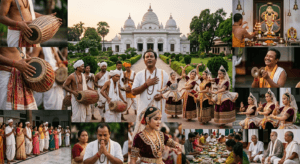
UNESCO World Heritage Site
Manipur currently has no UNESCO World Heritage Site. However, the state has received global recognition through its rich cultural traditions. In 2013, Manipuri Sankirtana: Ritual Singing, Drumming and Dancing was inscribed on UNESCO’s Representative List of the Intangible Cultural Heritage of Humanity. This recognition honours Manipur’s living cultural heritage rather than a physical monument.
UNESCO Intangible Cultural Heritage
Manipuri Sankirtana is a traditional devotional performance that combines music, dance and rhythmic drumming.
Its major features include:
- Devotional singing dedicated to Lord Krishna.
- Traditional Pung (Manipuri drum) performances.
- Graceful classical dance movements.
- Vaishnavite religious traditions.
- Performed during festivals and ceremonies.
- Preserved through generations by trained artists.
It is regarded as one of the finest classical performing traditions of Northeast India.
Why UNESCO Recognised Manipuri Sankirtana
The tradition was recognised because it:
- Preserves centuries-old cultural practices.
- Strengthens community identity.
- Combines music, dance and spirituality.
- Is passed from one generation to another.
- Promotes cultural diversity.
- Represents the living heritage of Manipur.
Cultural Importance
Manipuri Sankirtana continues to influence many aspects of the state’s cultural life.
- Preserves classical performing arts.
- Promotes Manipuri identity.
- Supports traditional musicians and dancers.
- Encourages cultural tourism.
- Receives international recognition.
- Strengthens community traditions.
Future Heritage Potential
Although Manipur does not currently have a UNESCO World Heritage Site, several places possess outstanding heritage value.
Important heritage sites include:
- Kangla Fort.
- Loktak Lake.
- Keibul Lamjao National Park.
- Shirui Hills.
- Ima Keithel (Mother’s Market).
These sites continue to attract historians, researchers and tourists because of their historical, ecological and cultural importance.
UNESCO Heritage at a Glance
| Category | Details |
|---|---|
| UNESCO World Heritage Site | None (Presently) |
| UNESCO Intangible Heritage | Manipuri Sankirtana |
| Recognition Year | 2013 |
| Heritage Type | Intangible Cultural Heritage |
| Recognised For | Ritual Singing, Drumming and Dancing |
| Cultural Tradition | Vaishnavite Devotional Performance |
| International Recognition | UNESCO Representative List |
| Main Occasions | Festivals, Religious Ceremonies and Weddings |
| Tourism Importance | Cultural & Heritage Tourism |
| Unique Identity | Globally Recognised Manipuri Performing Tradition |
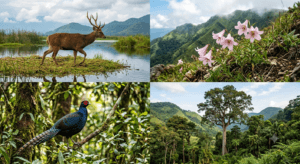
State Symbols
The official state symbols of Manipur represent its unique natural heritage, cultural identity, and ecological wealth. These symbols have been officially adopted to highlight the state’s rich biodiversity and traditions. They play an important role in environmental awareness, wildlife conservation, education, and state pride.
Each official symbol reflects a distinctive aspect of Manipur’s flora, fauna, forests, and cultural legacy.
Official State Symbols
| Symbol | Official State Symbol |
|---|---|
| State Animal | Sangai (Brow-antlered Deer) (Rucervus eldii eldii) |
| State Bird | Mrs. Hume’s Pheasant (Syrmaticus humiae) |
| State Tree | Uningthou (Phoebe hainesiana) |
| State Flower | Shirui Lily (Lilium mackliniae) |
These symbols are protected through conservation programmes and public awareness initiatives.
State Animal – Sangai
The Sangai is the official state animal of Manipur and one of India’s rarest deer species.
- Found naturally only in Keibul Lamjao National Park.
- Popularly known as the Dancing Deer.
- Walks gracefully on floating Phumdis.
- Listed as an endangered species.
- Represents Manipur’s wetland ecosystem.
State Bird – Mrs. Hume’s Pheasant
The Mrs. Hume’s Pheasant is a colourful pheasant native to the forests of Northeast India.
- Found in subtropical forests.
- Known for its striking plumage.
- Protected under wildlife conservation laws.
- Represents the state’s avian diversity.
State Tree – Uningthou
Uningthou (Phoebe hainesiana) is the official state tree of Manipur.
- Evergreen native tree.
- Produces high-quality timber.
- Supports forest ecosystems.
- Helps prevent soil erosion.
- Has ecological and economic importance.
State Flower – Shirui Lily
The Shirui Lily is one of the world’s rarest flowering plants.
- Found only on Shirui Kashong Peak.
- Blooms during May and June.
- Has delicate pale pink petals.
- Endemic to Manipur.
- Protected through conservation programmes.
Importance of State Symbols
The official state symbols strengthen Manipur’s identity while promoting conservation.
- Encourage wildlife conservation.
- Promote environmental awareness.
- Preserve natural heritage.
- Support tourism promotion.
- Strengthen state identity.
- Inspire biodiversity conservation.
State Symbols at a Glance
| Category | Official Symbol |
|---|---|
| State Animal | Sangai (Rucervus eldii eldii) |
| State Bird | Mrs. Hume’s Pheasant (Syrmaticus humiae) |
| State Tree | Uningthou (Phoebe hainesiana) |
| State Flower | Shirui Lily (Lilium mackliniae) |
| Wildlife Importance | Protection of Endemic Species |
| Botanical Importance | Rare Endemic Flower |
| Ecological Importance | Forest & Wetland Conservation |
| Tourism Significance | Nature & Wildlife Heritage |
| Cultural Value | Official Identity of Manipur |
| Unique Identity |
Frequently Asked Questions (FAQs)
1. Where is Manipur located?
Manipur is a northeastern state of India. It shares its borders with Nagaland to the north, Assam to the west, Mizoram to the southwest, and Myanmar to the east and south.
2. What is the capital of Manipur?
Imphal is the capital and largest city of Manipur. It serves as the administrative, cultural, educational, and commercial centre of the state.
3. Why is Manipur famous?
Manipur is famous for Loktak Lake, Keibul Lamjao National Park, the endangered Sangai Deer, Manipuri Classical Dance, Ima Keithel (Women’s Market), the rare Shirui Lily, rich tribal culture, and world-class sportspersons.
4. Which is the largest lake in Manipur?
Loktak Lake is the largest freshwater lake in Northeast India and is famous for its floating Phumdis and Keibul Lamjao National Park.
5. What is the state animal of Manipur?
The Sangai (Brow-antlered Deer) is the official state animal of Manipur and is found naturally only in Keibul Lamjao National Park.
6. What is the state flower of Manipur?
The Shirui Lily (Lilium mackliniae) is the official state flower of Manipur. It blooms naturally only on Shirui Kashong Peak in Ukhrul district.
7. Which languages are spoken in Manipur?
Manipuri (Meitei) is the official language. English is widely used for administration and education, while several tribal languages are also spoken throughout the state.
8. What is the best time to visit Manipur?
The best time to visit Manipur is from October to April, when the weather is pleasant and ideal for sightseeing, trekking, and outdoor activities.
9. Which is the nearest airport to Manipur?
Imphal International Airport (IMF) is the main airport serving Manipur and offers regular flights to major Indian cities.
10. Does Manipur have a UNESCO World Heritage Site?
No. Manipur currently has no UNESCO World Heritage Site. However, Manipuri Sankirtana was inscribed on UNESCO’s Representative List of the Intangible Cultural Heritage of Humanity in 2013.
11. Which are the major tourist attractions in Manipur?
Popular tourist attractions include Loktak Lake, Keibul Lamjao National Park, Kangla Fort, Ima Keithel, Shirui Hills, Dzüko Valley, Andro Heritage Village, and Moreh.
12. Why is Manipur called the “Jewel of India”?
Manipur is popularly known as the “Jewel of India” because of its breathtaking landscapes, rich biodiversity, vibrant cultural traditions, scenic valleys, and unique natural heritage.
Conclusion
Manipur is a land where nature, culture, history, and tradition come together in perfect harmony. From the breathtaking beauty of Loktak Lake and the world’s only floating national park to the graceful elegance of Manipuri Classical Dance, the state offers an extraordinary blend of natural wonders and cultural richness.
Known as the “Jewel of India”, Manipur has made remarkable contributions to Indian sports, art, literature, handloom weaving, handicrafts, and tourism. Its vibrant festivals, diverse tribal communities, unique cuisine, traditional martial arts, and centuries-old customs make it one of the most fascinating states in the country.
The state’s strategic location on the India–Myanmar border further enhances its importance as a gateway to Southeast Asia under India’s Act East Policy. With continued progress in education, healthcare, infrastructure, tourism, and sustainable development, Manipur is steadily moving toward a brighter future while preserving its priceless cultural and ecological heritage.
Whether you are a traveller, student, researcher, or culture enthusiast, Manipur offers unforgettable experiences through its scenic landscapes, warm hospitality, rich traditions, and inspiring stories. Preserving this unique heritage will ensure that future generations continue to appreciate the beauty and significance of this remarkable northeastern state.
Key Takeaways
- Popularly known as the “Jewel of India.”
- Home to the world’s only floating national park.
- Famous for Loktak Lake and the Sangai Deer.
- Birthplace of Sagol Kangjei, the traditional game that inspired modern polo.
- Internationally recognised for Manipuri Classical Dance.
- Known as the Sports Powerhouse of India.
- Rich in biodiversity, culture, festivals, and indigenous traditions.
- A major gateway connecting India with Southeast Asia.
Related Articles
References
- Government of Manipur – https://manipur.gov.in/
- Manipur Tourism – https://manipurtourism.gov.in/
- Ministry of Tourism, Government of India – https://tourism.gov.in/
- Census of India – https://censusindia.gov.in/
- Forest Survey of India (FSI) – https://fsi.nic.in/
- India Meteorological Department (IMD) – https://mausam.imd.gov.in/
- National Informatics Centre (NIC) – https://www.nic.in/
- UNESCO – https://www.unesco.org/
- Archaeological Survey of India (ASI) – https://asi.nic.in/
- National Sports University – https://www.nsu.ac.in/
- Manipur University – https://www.manipuruniv.ac.in/
- Central Agricultural University – https://www.cau.ac.in/
- Regional Institute of Medical Sciences (RIMS) – https://www.rims.edu.in/
- Jawaharlal Nehru Institute of Medical Sciences (JNIMS) – https://jnims.nic.in/
- Ministry of Road Transport and Highways (MoRTH) – https://morth.nic.in/
- Indian Railways – https://indianrailways.gov.in/
- Airports Authority of India (AAI) – https://www.aai.aero/
- National Highways Authority of India (NHAI) – https://nhai.gov.in/