
Introduction
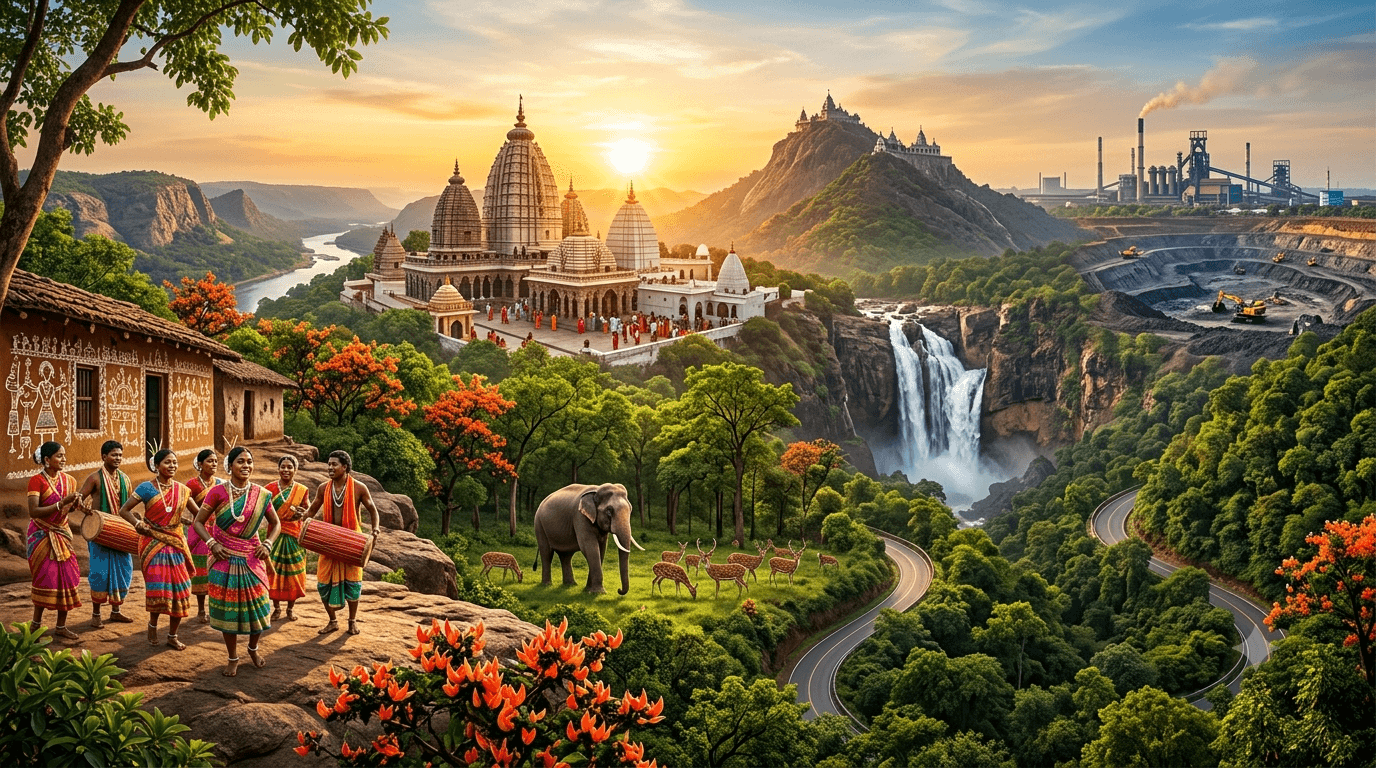
Jharkhand is a beautiful state located in the eastern part of India. It is popularly known as the “Land of Forests” because nearly one-third of its geographical area is covered with dense forests. The state is blessed with abundant natural resources, including coal, iron ore, copper, bauxite, mica, uranium, and limestone, making it one of India’s most mineral-rich states. Jharkhand also has a rich tribal heritage, vibrant culture, magnificent waterfalls, wildlife reserves, and important pilgrimage sites.
Jharkhand was carved out of Bihar on 15 November 2000 to provide a separate identity to the tribal communities and ensure balanced regional development. The date also marks the birth anniversary of the great tribal freedom fighter Birsa Munda, who played a significant role in India’s freedom movement and tribal rights.
The capital city, Ranchi, is famous for its pleasant climate, waterfalls, educational institutions, and administrative importance. Jamshedpur, established by Tata Steel, is India’s first planned industrial city and one of the country’s leading steel manufacturing centers. Other important cities include Dhanbad, Bokaro, Deoghar, Hazaribagh, and Dumka.
Jharkhand is home to numerous indigenous tribes such as the Santhal, Munda, Oraon, Ho, Kharia, and Birhor. These communities preserve unique traditions, languages, music, dance forms, handicrafts, and festivals that contribute to the state’s rich cultural diversity.
The state is famous for spectacular waterfalls like Hundru Falls, Dassam Falls, Jonha Falls, Hirni Falls, and Panchghagh Falls. Wildlife lovers can explore Betla National Park and Palamau Tiger Reserve, while pilgrims visit Baidyanath Jyotirlinga Temple in Deoghar and Parasnath Hills, one of the holiest Jain pilgrimage sites.
Jharkhand’s economy is driven by mining, steel production, power generation, agriculture, forestry, and tourism. Major crops include rice, maize, pulses, oilseeds, and vegetables. The state also produces lac, silk, bamboo products, and forest-based goods.
Today, Jharkhand is emerging as an important destination for eco-tourism, adventure tourism, religious tourism, and industrial investment. Its combination of natural beauty, mineral wealth, tribal traditions, historical significance, and modern infrastructure makes it one of India’s most unique and fascinating states.
| Particular | Details |
|---|---|
| State Name | Jharkhand |
| Capital | Ranchi |
| Largest City | Jamshedpur |
| Formation Date | 15 November 2000 |
| Parent State | Bihar |
| Nickname | Land of Forests |
| Region | Eastern India |
| Official Language | Hindi |
| Additional Official Language | Urdu |
| Major Tribal Languages | Santhali, Mundari, Ho, Kurukh, Kharia, Nagpuri |
| Total Area | 79,716 sq km |
| Population | Around 3.3 Crore (2011 Census) |
| Number of Districts | 24 |
| State Animal | Asian Elephant |
| State Bird | Asian Koel |
| State Tree | Sal Tree |
| State Flower | Palash |
| Highest Peak | Parasnath Hill |
| Major Rivers | Damodar, Subarnarekha, Koel, Barakar, Ajay |
| Famous Waterfalls | Hundru, Dassam, Jonha, Hirni, Panchghagh |
| Major Industries | Mining, Steel, Power, Heavy Engineering |
| Famous Pilgrimage | Baidyanath Temple, Parasnath Hill |
| Famous National Park | Betla National Park |
Jharkhand on India Map
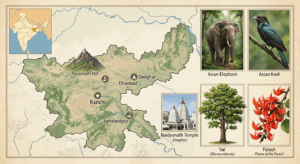
Jharkhand is located in the eastern part of India and occupies a strategically important position between northern and southern India. The state lies on the Chota Nagpur Plateau, a region famous for its rich mineral deposits, dense forests, waterfalls, and rugged hills. Due to its central location in eastern India, Jharkhand serves as an important link for trade, transportation, mining, and industrial development.
The geographical coordinates of Jharkhand are approximately 21°58′ N to 25°18′ N latitude and 83°22′ E to 87°57′ E longitude. The state covers an area of 79,716 square kilometres, making it the 15th largest state in India by area.
Jharkhand shares its borders with five Indian states:
- Bihar to the north
- West Bengal to the east
- Odisha to the south
- Chhattisgarh to the west
- Uttar Pradesh to the north-west
The Tropic of Cancer passes through the northern part of the state, influencing its climate and seasonal weather patterns.
The capital city, Ranchi, is located almost in the central part of Jharkhand and serves as the state’s administrative, educational, and political hub. Other important cities such as Jamshedpur, Dhanbad, Bokaro, Deoghar, Hazaribagh, and Dumka are spread across different regions of the state.
Jharkhand’s location on the mineral-rich Chota Nagpur Plateau has made it one of India’s leading producers of coal, iron ore, copper, uranium, mica, and bauxite. The plateau’s elevation, forests, rivers, and waterfalls also contribute significantly to the state’s biodiversity and tourism potential.
Several major rivers, including the Damodar, Subarnarekha, North Koel, South Koel, Barakar, and Ajay, flow through the state, supporting agriculture, industries, hydroelectric projects, and drinking water supplies.
The state’s excellent connectivity through national highways, railways, and airports enables easy access from major Indian cities such as Delhi, Kolkata, Patna, Bhubaneswar, Hyderabad, and Mumbai.
Jharkhand Location & Boundaries
| Particular | Details |
|---|---|
| Region | Eastern India |
| Latitude | 21°58′ N – 25°18′ N |
| Longitude | 83°22′ E – 87°57′ E |
| Total Area | 79,716 sq km |
| Area Rank in India | 15th |
| Physiographic Region | Chota Nagpur Plateau |
| Northern Border | Bihar |
| Eastern Border | West Bengal |
| Southern Border | Odisha |
| Western Border | Chhattisgarh |
| North-West Border | Uttar Pradesh |
| Capital | Ranchi |
| Largest City | Jamshedpur |
| Tropic of Cancer | Passes through northern Jharkhand |
History of Jharkhand
The history of Jharkhand is one of the oldest and most fascinating in India. The region has been inhabited since prehistoric times and is known for its rich tribal heritage, ancient civilizations, powerful kingdoms, resistance against foreign rulers, and its struggle for a separate state. Over thousands of years, Jharkhand has evolved from a forest-covered tribal region into one of India’s most important industrial and mineral-rich states while preserving its unique cultural identity.
Prehistoric Period
Archaeological discoveries indicate that human settlements existed in the Jharkhand region during the Stone Age. Stone tools, rock paintings, and prehistoric artifacts found in districts such as Hazaribagh, Ranchi, Gumla, and Palamu provide evidence of early human civilization. The dense forests, rivers, and fertile valleys supported the livelihood of early hunter-gatherer communities.
The Chota Nagpur Plateau, where most of Jharkhand is located, became one of the earliest inhabited plateau regions in eastern India. Ancient cave paintings and megalithic structures discovered across the state continue to provide valuable information about prehistoric life.
Ancient Period
During ancient times, Jharkhand was widely known as Jharkhand, Kokrah, Kark Khand, and Atavi, meaning a forest region. Ancient Sanskrit texts, Buddhist literature, and Jain scriptures describe this area as a land of forests inhabited by tribal communities.
Although many parts of the region remained under the control of local tribal chiefs, several powerful dynasties influenced the area from time to time, including:
- Maurya Empire
- Gupta Empire
- Pala Dynasty
- Nagvanshi Dynasty
- Chero Kingdom
Among these, the Nagvanshi rulers governed large parts of present-day Jharkhand for several centuries and made Navratangarh one of their important capitals.
Jharkhand also became an important religious center. Parasnath Hill, the state’s highest peak, is regarded as one of the holiest pilgrimage sites in Jainism because twenty of the twenty-four Jain Tirthankaras are believed to have attained salvation there.
Medieval Period
During the medieval period, most tribal kingdoms remained largely independent because the region’s dense forests and rugged hills made it difficult for outside rulers to establish permanent control.
The Delhi Sultanate and later the Mughal Empire attempted to extend their influence over the area. However, tribal rulers and local chiefs frequently resisted their authority. The Mughals mainly collected tribute while allowing many tribal leaders to retain local administration.
Trade routes connecting eastern and central India gradually developed during this period, contributing to regional economic growth.
British Rule
The British East India Company gained control over the region after acquiring Bengal, Bihar, and Odisha in 1765. The discovery of valuable minerals and forests made Jharkhand economically important to the British administration.
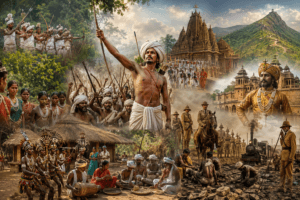
British land revenue policies, exploitation of forests, forced labour, and interference in traditional tribal governance caused widespread dissatisfaction among tribal communities. As a result, Jharkhand witnessed several major tribal uprisings that became important chapters in India’s freedom struggle.
Some of the most significant tribal revolts include:
- Chuar Rebellion
- Kol Rebellion (1831–32)
- Santhal Hul (1855–56)
- Birsa Munda’s Ulgulan (1899–1900)
- Tana Bhagat Movement
Among these, Birsa Munda’s Ulgulan became one of the most influential tribal movements in Indian history. Birsa Munda inspired tribal communities to resist British rule, protect their land rights, and preserve their cultural identity.
Freedom Movement
The people of Jharkhand actively participated in India’s freedom movement. Tribal leaders, social reformers, students, and ordinary citizens joined various national movements led by Mahatma Gandhi and other freedom fighters.
The region also witnessed movements demanding protection of tribal land, forest rights, and social justice. These movements later inspired the demand for a separate Jharkhand state.
Movement for Separate Jharkhand State
The demand for a separate Jharkhand began during the early twentieth century. Tribal organizations argued that the region possessed a distinct language, culture, history, and economic identity different from Bihar.
Important milestones include:
- Formation of the Adivasi Mahasabha in 1938 under Jaipal Singh Munda.
- Formation of the Jharkhand Party in 1949.
- Continued political movements throughout the 1960s, 1970s, 1980s, and 1990s.
- Support from various political parties and tribal organizations for statehood.
After decades of peaceful democratic struggle, the Parliament of India passed the Bihar Reorganisation Act, 2000.
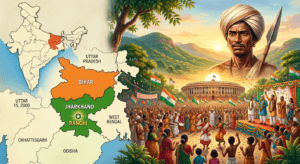
On 15 November 2000, Jharkhand officially became the 28th state of India, with Ranchi as its capital. The date was chosen to honour the birth anniversary of Birsa Munda.
Modern Jharkhand
Since its formation, Jharkhand has made significant progress in infrastructure, mining, steel production, education, healthcare, tourism, and industrial development.
Today the state is:
- India’s leading coal-producing state.
- One of the largest producers of iron ore, uranium, mica, and copper.
- Home to major industries such as Tata Steel, Bokaro Steel Plant, and Heavy Engineering Corporation.
- An important destination for eco-tourism, wildlife tourism, and religious tourism.
Despite rapid industrialization, Jharkhand continues to preserve its rich tribal traditions, forests, languages, festivals, and cultural heritage.
Timeline of Jharkhand History
| Period | Major Events |
|---|---|
| Prehistoric Period | Early human settlements, Stone Age tools, rock art |
| Ancient Period | Maurya, Gupta, Pala, Nagvanshi and Chero influence |
| Medieval Period | Tribal kingdoms, Delhi Sultanate and Mughal influence |
| 1765 | British East India Company gained control |
| 1831–32 | Kol Rebellion |
| 1855–56 | Santhal Hul |
| 1899–1900 | Birsa Munda’s Ulgulan |
| 1938 | Adivasi Mahasabha formed |
| 1949 | Jharkhand Party established |
| 2000 | Jharkhand became the 28th state of India |
Geography of Jharkhand
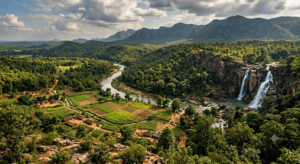
Jharkhand is located in the eastern part of India and is one of the country’s most geographically diverse states. It is characterized by plateaus, hills, valleys, forests, rivers, waterfalls, and mineral-rich landscapes. Most of the state lies on the Chota Nagpur Plateau, one of India’s oldest geological formations. This plateau is famous for its abundant mineral resources, unique landforms, and scenic beauty.
The state covers an area of 79,716 square kilometres, making it the 15th largest state in India by area. Nearly 29–30% of the state’s geographical area is covered by forests, which play an important role in maintaining biodiversity and supporting tribal communities.
Jharkhand shares its boundaries with five Indian states. Bihar lies to the north, West Bengal to the east, Odisha to the south, and Chhattisgarh and Uttar Pradesh to the west. Its central location in eastern India has contributed significantly to trade, mining, transportation, and industrial development.
The average elevation of the state ranges from 300 to 900 metres above sea level, while Parasnath Hill (1,365 metres) in Giridih district is the highest peak. The plateau landscape is intersected by numerous rivers and streams that create spectacular waterfalls such as Hundru Falls, Dassam Falls, Jonha Falls, Hirni Falls, and Panchghagh Falls.
Jharkhand has a variety of soil types that support agriculture as well as forests. The major soils include:
- Red Soil
- Laterite Soil
- Sandy Soil
- Alluvial Soil (in river valleys)
- Black Soil (in limited areas)
These soils are suitable for cultivating rice, maize, pulses, oilseeds, vegetables, fruits, and horticultural crops.
The state is extremely rich in natural resources. It possesses some of India’s largest reserves of coal, iron ore, copper, uranium, bauxite, mica, limestone, graphite, and dolomite. These mineral deposits have made Jharkhand one of India’s leading mining and industrial states.
The Damodar Valley is one of the most important geographical regions in the state. Besides supporting industries and thermal power generation, it also plays a crucial role in irrigation and water supply.
Jharkhand’s forests are dominated by Sal (Shorea robusta) trees along with teak, bamboo, mahua, kendu, palash, neem, and various medicinal plants. These forests support elephants, leopards, sloth bears, deer, wolves, wild boars, and hundreds of bird species.
The combination of forests, hills, rivers, fertile valleys, waterfalls, and mineral-rich plateaus gives Jharkhand a unique geographical identity among Indian states.
Physiographic Divisions of Jharkhand
Jharkhand can broadly be divided into the following physiographic regions:
- Chota Nagpur Plateau
- Ranchi Plateau
- Hazaribagh Plateau
- Palamu Plateau
- Rajmahal Hills
- Singhbhum Plateau
- Damodar Valle
- Santhal Pargana Region
Each of these regions has distinct geological, climatic, and ecological characteristics.
Major Natural Resources
Jharkhand is one of India’s richest states in terms of mineral wealth.
Major natural resources include:
- Coal
- Iron Ore
- Copper
- Uranium
- Bauxite
- Limestone
- Mica
- Graphite
- Dolomite
- China Clay
These resources contribute significantly to India’s mining, steel, power, and manufacturing industries.
Important Geographical Features
Some of the state’s major geographical landmarks include:
- Parasnath Hill
Climate of Jharkhand
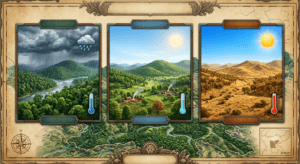
Jharkhand experiences a tropical monsoon climate, characterized by three distinct seasons: summer, monsoon, and winter. Due to its location on the Chota Nagpur Plateau, the state generally enjoys a more moderate climate than many other regions of eastern India. The plateau’s elevation, extensive forest cover, rivers, and hills help keep temperatures relatively pleasant, especially in Ranchi and surrounding areas.
The climate plays a crucial role in agriculture, forestry, biodiversity, tourism, and the daily lives of the people. Most of the annual rainfall is received from the Southwest Monsoon, which is essential for rice cultivation and replenishing rivers, reservoirs, and groundwater.
Summer Season (March to June)
Summer begins in March and continues until June. During this period, temperatures gradually rise, particularly in the western and northern districts. Daytime temperatures generally range between 30°C and 40°C, although some areas may experience temperatures above 42°C during severe heatwaves.
Despite the summer heat, plateau cities like Ranchi usually remain cooler than the surrounding plains because of their higher elevation. People often visit waterfalls and hill stations during this season to escape the heat.
Summer Highlights
- Season: March–June
- Average Temperature: 30°C–40°C
- Maximum Temperature: Around 42°C
- Weather: Hot and dry
- Best Activities: Waterfall sightseeing, hill excursions, nature photography
Monsoon Season (June to September)
The Southwest Monsoon reaches Jharkhand in June and remains active until September. The state receives around 1,000–1,400 mm of annual rainfall, though rainfall varies from district to district.
Monsoon transforms Jharkhand into a lush green landscape. Rivers flow at full capacity, waterfalls become spectacular, and forests flourish with fresh vegetation. This season is particularly important for agriculture, as farmers cultivate paddy and other crops using monsoon rainfall.
However, heavy rainfall may occasionally cause waterlogging and temporary transportation disruptions in low-lying areas.
Monsoon Highlights
- Season: June–September
- Average Rainfall: 1,000–1,400 mm annually
- Weather: Humid with moderate to heavy rainfall
- Importance: Agriculture, forests, rivers, reservoirs, and waterfalls
Winter Season (October to February)
Winter is the most pleasant season in Jharkhand. Temperatures usually range between 5°C and 25°C, with higher-altitude areas occasionally recording temperatures close to 0°C.
The weather remains cool, dry, and comfortable, making it the ideal time for tourism. Visitors explore national parks, waterfalls, temples, wildlife sanctuaries, and trekking destinations during these months.
Morning fog is common in many districts, especially during December and January.
Winter Highlights
- Season: October–February
- Average Temperature: 5°C–25°C
- Weather: Cool and pleasant
- Best Activities: Wildlife tourism, sightseeing, trekking, pilgrimage, photography
Best Time to Visit Jharkhand
The best time to visit Jharkhand is October to March, when the weather is cool and comfortable. Most tourist attractions remain easily accessible, and outdoor activities can be enjoyed without the discomfort of extreme heat or heavy rainfall.
Visitors interested in seeing waterfalls at their fullest may choose to travel shortly after the monsoon season, especially during September and October.
Climate’s Impact on Economy
Jharkhand’s climate directly supports several sectors:
- Agriculture depends heavily on monsoon rainfall.
- Forests thrive because of seasonal rainfall.
- Rivers and reservoirs receive adequate water supply.
- Eco-tourism and wildlife tourism flourish during winter.
- Mining and industrial activities continue throughout the year with seasonal adjustments.
Climate of Jharkhand
| Season | Months | Temperature | Characteristics |
|---|---|---|---|
| Summer | March–June | 30°C–40°C | Hot and dry |
| Monsoon | June–September | Moderate | Heavy rainfall and greenery |
| Winter | October–February | 5°C–25°C | Cool and pleasant |
| Annual Rainfall | — | 1,000–1,400 mm | Mainly from Southwest Monsoon |
| Best Time to Visit | October–March | Pleasant | Ideal for tourism |
Administrative Divisions and Districts of Jharkhand
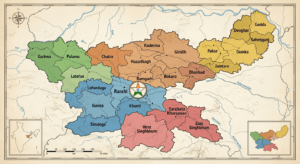
Jharkhand is administratively divided into 5 divisions and 24 districts. Each district is headed by a Deputy Commissioner (DC) or District Magistrate (DM), who is responsible for maintaining law and order, implementing government schemes, revenue administration, and overall district development.
For better governance and efficient administration, the districts are grouped into five administrative divisions: North Chotanagpur, South Chotanagpur, Kolhan, Palamu, and Santhal Pargana.
The administrative system of Jharkhand includes divisions, districts, subdivisions, community development blocks, municipalities, municipal corporations, nagar panchayats, gram panchayats, and villages. This decentralized structure helps the government deliver public services effectively across urban and rural areas.
The state capital, Ranchi, serves as the administrative headquarters of Jharkhand and houses the Governor’s residence, the Jharkhand Legislative Assembly, the High Court, and major government departments.
Administrative Divisions of Jharkhand
Jharkhand has the following five administrative divisions:
- North Chotanagpur Division
- South Chotanagpur Division
- Kolhan Division
- Palamu Division
- Santhal Pargana Division
Each division consists of multiple districts that share geographical, cultural, and administrative characteristics.
List of Districts of Jharkhand
| Particular | Details |
|---|---|
| State Capital | Ranchi |
| Administrative Divisions | 5 |
| Total Districts | 24 |
| Municipal Corporations | 7 |
| Community Development Blocks | 260+ |
| Gram Panchayats | 4,400+ |
| Villages | 32,000+ |
| Largest District | West Singhbhum |
| Smallest District | Ramgarh |
| Most Populous District | Ranchi |
Major Cities of Jharkhand
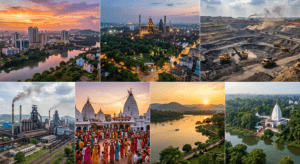
Jharkhand is home to several important cities that contribute significantly to the state’s administration, economy, education, industry, tourism, healthcare, and culture. While Ranchi serves as the capital and administrative center, cities like Jamshedpur, Dhanbad, and Bokaro Steel City are recognized nationally for their industrial development. Other cities such as Deoghar, Hazaribagh, Dumka, Chaibasa, and Medininagar play important roles in religion, education, tourism, and regional administration.
Each city has developed its own unique identity while contributing to Jharkhand’s overall growth.
Ranchi
Ranchi is the capital and administrative headquarters of Jharkhand. Situated on the Chota Nagpur Plateau at an elevation of around 650 metres above sea level, it enjoys a pleasant climate throughout most of the year. Ranchi is known as the “City of Waterfalls” due to the presence of famous waterfalls such as Hundru Falls, Dassam Falls, Jonha Falls, and Sita Falls nearby.
The city houses the Jharkhand Legislative Assembly, Raj Bhavan, Jharkhand High Court, and major government departments. It is also an important educational and healthcare hub with institutions such as IIM Ranchi, BIT Mesra, RIMS, and Central University of Jharkhand.
Jamshedpur
Jamshedpur, located in East Singhbhum district, is India’s first planned industrial city. Founded by Jamsetji Nusserwanji Tata, it is home to Tata Steel, one of the largest steel manufacturers in the world.
The city is known for its excellent urban planning, wide roads, parks, industries, and quality of life. Popular attractions include Jubilee Park, Dimna Lake, Dalma Wildlife Sanctuary, and the Tata Steel Zoological Park.
Jamshedpur is widely regarded as the industrial backbone of Jharkhand.
Dhanbad
Dhanbad is popularly known as the “Coal Capital of India.” It is one of the country’s largest coal-producing regions and plays a vital role in India’s energy sector.
The city is home to Indian Institute of Technology (IIT) (ISM) Dhanbad, one of India’s premier institutions for mining, engineering, and earth sciences. Mining, thermal power generation, and coal transportation form the backbone of Dhanbad’s economy.
Bokaro Steel City
Bokaro Steel City is one of India’s leading steel-producing cities and is home to the famous Bokaro Steel Plant, operated by the Steel Authority of India Limited (SAIL).
The city has modern infrastructure, planned residential sectors, educational institutions, hospitals, parks, and industrial establishments. It is considered one of the cleanest industrial cities in eastern India.
Deoghar
Deoghar is one of India’s most important Hindu pilgrimage destinations. It is famous for the Baidyanath Jyotirlinga Temple, one of the twelve sacred Jyotirlingas dedicated to Lord Shiva.
Every year, millions of devotees participate in the Shravani Mela, making it one of the largest religious gatherings in eastern India.
The city has also emerged as an educational and healthcare center in recent years.
Hazaribagh
Hazaribagh is known for its scenic hills, forests, pleasant weather, wildlife, and educational institutions. The city serves as an important administrative and commercial center in northern Jharkhand.
Nearby attractions include Hazaribagh Wildlife Sanctuary, Canary Hill, and several lakes and parks.
Dumka
Dumka serves as the sub-capital of Jharkhand and is the administrative headquarters of the Santhal Pargana Division.
The city has significant cultural importance because it is closely associated with the Santhal tribal community. Dumka is also known for its temples, educational institutions, and peaceful surroundings.
Other Important Cities
Several other cities also contribute to Jharkhand’s development:
- Chaibasa – Administrative headquarters of West Singhbhum district.
- Medininagar (Daltonganj) – Headquarters of Palamu district and gateway to Betla National Park.
- Giridih – Famous for Parasnath Hill and mica mining.
- Ramgarh – Important military and industrial town.
- Khunti – Birthplace of tribal leader Birsa Munda.
- Sahibganj – Major river port on the Ganga.
Major Cities of Jharkhand
| City | District | Importance |
|---|---|---|
| Ranchi | Ranchi | Capital city, administration, education, healthcare |
| Jamshedpur | East Singhbhum | India’s first planned industrial city, Tata Steel |
| Dhanbad | Dhanbad | Coal Capital of India, IIT (ISM) |
| Bokaro Steel City | Bokaro | Bokaro Steel Plant, industrial hub |
| Deoghar | Deoghar | Baidyanath Jyotirlinga, pilgrimage city |
| Hazaribagh | Hazaribagh | Tourism, education, wildlife |
| Dumka | Dumka | Sub-capital, Santhal Pargana headquarters |
| Chaibasa | West Singhbhum | Administrative center |
| Medininagar | Palamu | Gateway to Betla National Park |
| Giridih | Giridih | Parasnath Hill, mica mining |
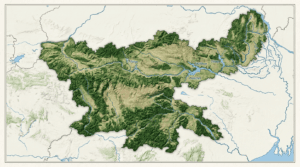
Rivers of Jharkhand
Rivers are an integral part of Jharkhand’s geography, ecology, agriculture, and economy. Originating mainly from the Chota Nagpur Plateau, these rivers flow through forests, valleys, and plains before joining larger river systems in eastern India. They provide water for irrigation, drinking, hydroelectric power generation, industries, and wildlife habitats.
Many of Jharkhand’s famous waterfalls, including Hundru Falls, Dassam Falls, Jonha Falls, and Hirni Falls, are formed by these rivers as they descend from the plateau. The rivers also support mining operations, industrial development, fisheries, and tourism.
Although most rivers in the state are rain-fed, they receive substantial water during the southwest monsoon and play a crucial role in maintaining the ecological balance of the region.
Damodar River
The Damodar River is one of the most important rivers in Jharkhand and is often called the “Lifeline of Industrial Jharkhand.” It originates from the Khamarpat Hill near Chandwa in Latehar district and flows through major industrial regions before entering West Bengal.
The river supports coal mining, thermal power generation, steel industries, irrigation, and drinking water supply. Several dams under the Damodar Valley Corporation (DVC) have been constructed to control floods, generate hydroelectric power, and provide irrigation.
Subarnarekha River
The Subarnarekha River originates near Ranchi and flows through Jharkhand, West Bengal, and Odisha before emptying into the Bay of Bengal.
The name Subarnarekha means “Streak of Gold,” as traces of gold were historically found in its sands. The river is an important source of water for agriculture, industries, and urban areas, especially around Ranchi and Jamshedpur.
Hundru Falls, one of Jharkhand’s most famous waterfalls, is formed by the Subarnarekha River.
North Koel River
The North Koel River originates on the Chota Nagpur Plateau and flows through Jharkhand before joining the Son River in Bihar.
It is an important river for irrigation and agriculture in the Palamu region. The river also supports wildlife habitats around Betla National Park and the Palamau Tiger Reserve.
South Koel River
The South Koel River rises near Ranchi and flows through southern Jharkhand before entering Odisha, where it eventually joins the Brahmani River system.
The river is important for agriculture, local water supply, and maintaining forest ecosystems.
Barakar River
The Barakar River is the largest tributary of the Damodar River. It originates in Hazaribagh district and flows through Jharkhand and West Bengal.
Major dams such as Maithon Dam and Tilaiya Dam have been built on the Barakar River for hydroelectric power generation, irrigation, and flood control.
Ajay River
The Ajay River originates from the hills of Jharkhand and flows eastward into West Bengal before joining the Bhagirathi River.
It supports agriculture in eastern Jharkhand and contributes to the fertile plains of West Bengal.
Other Important Rivers
Several other rivers are also important for the state’s ecology and economy:
- Kharkai River
- Sankh River
- Karo River
- Mayurakshi River
- Brahmani River (tributaries)
- Auranga River
- Amanat River
These rivers support irrigation, fisheries, biodiversity, and rural livelihoods.
Major Dams and Reservoirs
Jharkhand has several dams that provide irrigation, electricity, and drinking water.
Some important dams include:
- Maithon Dam
- Panchet Dam
- Tilaiya Dam
- Tenughat Dam
- Konar Dam
- Chandil Dam
- Getalsud Dam
These projects are essential for water conservation, flood management, industrial development, and hydroelectric power generation.
Major Rivers of Jharkhand
| River | Origin | Flows Through | Importance |
|---|---|---|---|
| Damodar | Khamarpat Hill, Latehar | Jharkhand, West Bengal | Industry, irrigation, DVC projects |
| Subarnarekha | Near Ranchi | Jharkhand, West Bengal, Odisha | Agriculture, tourism, Hundru Falls |
| North Koel | Chota Nagpur Plateau | Jharkhand, Bihar | Irrigation, wildlife |
| South Koel | Near Ranchi | Jharkhand, Odisha | Agriculture, forests |
| Barakar | Hazaribagh | Jharkhand, West Bengal | Hydroelectric projects, irrigation |
| Ajay | Jharkhand Hills | Jharkhand, West Bengal | Agriculture |
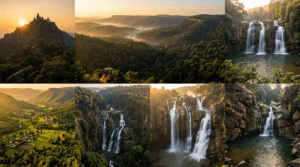
Mountains, Plateaus and Waterfalls of Jharkhand
Jharkhand is one of India’s most scenic states, blessed with majestic hills, vast plateaus, deep valleys, dense forests, and spectacular waterfalls. The state’s landscape is dominated by the Chota Nagpur Plateau, one of the oldest geological formations in the Indian subcontinent. Its elevated terrain, rocky cliffs, and numerous rivers create hundreds of picturesque waterfalls, making Jharkhand a paradise for nature lovers, trekkers, photographers, and eco-tourists.
The mountains and plateaus not only enhance the natural beauty of the state but also contain rich deposits of coal, iron ore, copper, bauxite, uranium, and other valuable minerals. These geographical features have played an important role in shaping Jharkhand’s economy, biodiversity, climate, and tribal culture.
Chota Nagpur Plateau
The Chota Nagpur Plateau covers most of Jharkhand and extends into neighbouring states. It is among India’s oldest rock formations and is internationally known for its immense mineral wealth.
The plateau has an average elevation of 300–900 metres above sea level and consists of rolling hills, valleys, forests, rivers, and rocky landscapes. It is considered the backbone of Jharkhand’s geography and economy.
Importance of the Chota Nagpur Plateau
- Rich deposits of coal, iron ore, copper, uranium, and bauxite
- Source of many major rivers
- Supports dense forests and wildlife
- Home to numerous tribal communities
- Major centre for mining and industries
Parasnath Hill
Parasnath Hill, located in Giridih district, is the highest peak in Jharkhand, standing at approximately 1,365 metres (4,478 feet) above sea level.
The hill is one of the most sacred pilgrimage sites for followers of Jainism, as twenty of the twenty-four Jain Tirthankaras are believed to have attained moksha (liberation) here. Every year, thousands of pilgrims and trekkers visit Parasnath Hill.
The hill is also covered with forests rich in biodiversity and offers panoramic views of the surrounding landscape.
Rajmahal Hills
The Rajmahal Hills, situated mainly in Sahibganj district, form an important mountain range in northeastern Jharkhand.
These hills are famous for:
- Volcanic rock formations
- Fossil discoveries
- Rich biodiversity
- Geological significance
- Scenic landscapes
The Rajmahal Hills attract geologists, researchers, and eco-tourists from across the country.
Ranchi Plateau
The Ranchi Plateau is one of the most important plateau regions of Jharkhand. Situated at an elevation of around 600–700 metres, it enjoys a pleasant climate throughout the year.
Most of Jharkhand’s famous waterfalls originate from rivers flowing across this plateau due to the sudden drop in elevation.
The Ranchi Plateau also serves as an important centre for education, administration, tourism, and agriculture.
Hundru Falls
Hundru Falls is the highest and one of the most famous waterfalls in Jharkhand. Formed by the Subarnarekha River, the waterfall plunges from a height of approximately 98 metres (322 feet).
Located about 45 kilometres from Ranchi, Hundru Falls attracts thousands of tourists every year, especially during the monsoon and post-monsoon seasons.
Dassam Falls
Dassam Falls is formed by the Kanchi River, a tributary of the Subarnarekha River.
The waterfall drops from a height of nearly 44 metres (144 feet) and is surrounded by forests and rocky cliffs, making it one of Jharkhand’s most popular picnic destinations.
Jonha Falls
Also known as Gautamdhara Falls, Jonha Falls is formed by the Raru River.
The waterfall is famous for its scenic beauty, peaceful surroundings, and the nearby Buddhist temple dedicated to Lord Buddha.
Visitors descend hundreds of steps to reach the base of the waterfall.
Hirni Falls
Located in West Singhbhum district, Hirni Falls is one of Jharkhand’s most picturesque waterfalls.
Surrounded by dense forests and hills, it is an excellent destination for nature lovers, birdwatchers, and photographers.
Panchghagh Falls
Panchghagh Falls is situated near Khunti district and is formed by the Banai River.
Unlike most waterfalls, Panchghagh consists of five separate streams flowing side by side over rocky terrain, creating a unique natural spectacle.
Other Famous Waterfalls
Jharkhand is home to several other beautiful waterfalls, including:
- Sita Falls
- Lodh Falls (Burha River)
- Sadni Falls
- Perwaghagh Falls
- Motijharna Falls
- Usri Falls
- Rajrappa Falls
These waterfalls are popular tourist attractions and contribute significantly to eco-tourism in the state.
Major Mountains, Plateaus and Waterfalls of Jharkhand
| Name | Type | Location | Importance |
|---|---|---|---|
| Parasnath Hill | Mountain | Giridih | Highest peak, Jain pilgrimage |
| Chota Nagpur Plateau | Plateau | Most of Jharkhand | Mineral wealth, forests |
| Ranchi Plateau | Plateau | Ranchi Region | Pleasant climate, waterfalls |
| Rajmahal Hills | Hills | Sahibganj | Geological importance |
| Hundru Falls | Waterfall | Ranchi | Highest waterfall in Jharkhand |
| Dassam Falls | Waterfall | Near Ranchi | Tourist attraction |
| Jonha Falls | Waterfall | Ranchi | Scenic beauty |
| Hirni Falls | Waterfall | West Singhbhum | Eco-tourism |
| Panchghagh Falls | Waterfall | Khunti | Five-stream waterfall |
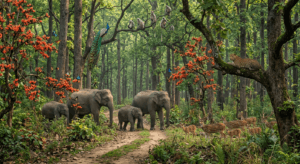
Forests, Flora and Fauna of Jharkhand
Jharkhand is one of India’s most forest-rich states, with approximately 29–30% of its geographical area under forest cover. The state’s dense forests are spread across districts such as West Singhbhum, Gumla, Simdega, Latehar, Palamu, Khunti, Ranchi, Lohardaga, and Hazaribagh. These forests are an important part of the Chota Nagpur Plateau ecosystem and support rich biodiversity, tribal livelihoods, and environmental sustainability.
Forests play a vital role in regulating the climate, conserving soil and water, supporting wildlife, and providing livelihood opportunities to millions of people. Many tribal communities depend on forest resources for food, fuel, medicine, handicrafts, and income through minor forest produce.
Jharkhand’s forests mainly consist of Tropical Dry Deciduous and Tropical Moist Deciduous vegetation. The Sal (Shorea robusta) tree dominates the landscape and is considered one of the state’s most valuable forest species.
Types of Forests
Jharkhand has different types of forests depending on rainfall, altitude, and soil conditions.
Tropical Moist Deciduous Forests
These forests are found in areas receiving higher rainfall and are characterized by dense vegetation and rich biodiversity.
Major tree species include:
- Sal
- Teak
- Mahua
- Arjun
- Kusum
- Bamboo
- Jamun
- Neem
Tropical Dry Deciduous Forests
These forests occur in comparatively drier regions of the state.
Common tree species include:
- Sal
- Palash
- Acacia
- Kendu
- Ber
- Bamboo
- Babul
Flora of Jharkhand
Jharkhand possesses a rich variety of plant species that contribute to ecological balance and the rural economy.
Major Trees
- Sal
- Teak
- Bamboo
- Mahua
- Palash
- Arjun
- Neem
- Kusum
- Kendu
- Tamarind
Medicinal Plants
The forests contain several medicinal plants traditionally used in Ayurvedic and tribal medicine, including:
- Ashwagandha
- Giloy
- Tulsi
- Haritaki
- Bahera
- Amla
- Satavar
Forest Produce
Important forest products include:
- Lac
- Tendu (Kendu) leaves
- Bamboo
- Honey
- Tamarind
- Mahua flowers
- Medicinal herbs
- Resin
These products provide significant income to tribal families and forest-dependent communities.
Fauna of Jharkhand
Jharkhand’s forests support a wide variety of wild animals, birds, reptiles, and insects.
- Mammals
- Asian Elephant
- Bengal Tiger
- Leopard
- Sloth Bear
- Indian Wolf
- Jackal
- Hyena
- Wild Boar
- Barking Deer
- Sambar Deer
- Chital (Spotted Deer)
- Indian Gaur
- Langur
- Rhesus Macaque
Birds
More than 300 species of birds are found across the state.
Common birds include:
- Asian Koel (State Bird)
- Indian Peafowl
- Indian Roller
- Grey Hornbill
- Parakeets
- Kingfishers
- Egrets
- Herons
- Eagles
- Owls
Reptiles
Jharkhand is home to several reptile species, including:
- Indian Cobra
- King Cobra
- Python
- Monitor Lizard
- Rat Snake
- Common Krait
- Crocodile (in selected river systems)
State Symbols of Jharkhand
Symbol Name
State Animal. Asian Elephant
State Bird. Asian Koel
State Tree. Sal (Shorea robusta)
State Flower. Palash
Importance of Forests
The forests of Jharkhand are important because they:
- Protect biodiversity.
- Prevent soil erosion.
- Recharge groundwater.
- Regulate climate.
- Support wildlife habitats.
- Provide livelihood to tribal communities.
- Supply medicinal plants and forest produce.
- Promote eco-tourism and nature conservation.
Conservation Efforts
The Government of Jharkhand has implemented various measures to conserve forests and wildlife.
Major initiatives include:
- Afforestation programmes
- Joint Forest Management (JFM)
- Wildlife conservation projects
- Anti-poaching operations
- Eco-development committees
- Community participation in forest protection
- Sustainable forest management
- Awareness campaigns on biodiversity conservation
Forests, Flora and Fauna of Jharkhand
| Particular | Details |
|---|---|
| Forest Cover | Approximately 29–30% |
| Major Forest Type | Tropical Dry & Moist Deciduous |
| Dominant Tree | Sal |
| State Tree | Sal (Shorea robusta) |
| State Flower | Palash |
| State Animal | Asian Elephant |
| State Bird | Asian Koel |
| Major Forest Produce | Lac, Bamboo, Honey, Mahua, Kendu Leaves |
| Major Wildlife | Elephant, Tiger, Leopard, Sloth Bear, Deer |
| Bird Diversity | 300+ Species |
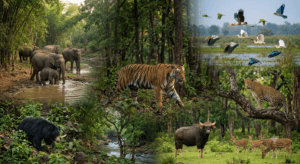
National Parks and Wildlife Sanctuaries of Jharkhand
Jharkhand is home to a rich variety of wildlife and natural habitats, making it one of the most ecologically significant states in eastern India. Dense forests, rolling hills, rivers, grasslands, and plateaus provide suitable habitats for numerous species of mammals, birds, reptiles, and plants. The state has established national parks, tiger reserves, wildlife sanctuaries, and bird sanctuaries to conserve its biodiversity and protect endangered species.
These protected areas not only help preserve wildlife but also promote eco-tourism, environmental education, scientific research, and sustainable development. Thousands of tourists, wildlife photographers, birdwatchers, and researchers visit these destinations every year.
Betla National Park
Betla National Park is the only national park in Jharkhand and one of the oldest national parks in India. Located in Latehar district, it forms an important part of the Palamau Tiger Reserve.
Established in 1986, the park covers a diverse landscape of forests, grasslands, hills, rivers, and waterfalls. It is famous for its elephant population, deer, leopards, sloth bears, langurs, wild boars, and rich birdlife.
Popular attractions inside the park include ancient forts, watchtowers, elephant safaris, jeep safaris, and nature trails.
Major Attractions
- Elephant Safari
- Jeep Safari
- Palamau Fort
- Forest Watch Towers
- Nature Trails
- Bird Watching
Palamau Tiger Reserve
The Palamau Tiger Reserve, established in 1974 under Project Tiger, is one of India’s earliest tiger reserves.
Located mainly in Latehar and Palamu districts, the reserve consists of tropical deciduous forests, bamboo groves, rivers, and grasslands.
Wild animals found here include:
- Bengal Tiger
- Asian Elephant
- Leopard
- Sloth Bear
- Gaur
- Sambar Deer
- Chital
- Wild Boar
- Jackal
The reserve is also home to hundreds of bird species and numerous reptiles.
Dalma Wildlife Sanctuary
Located near Jamshedpur in East Singhbhum district, Dalma Wildlife Sanctuary covers the Dalma Hills.
The sanctuary is particularly famous for its migratory elephants that move seasonally between Jharkhand and neighbouring states.
Other wildlife includes:
- Leopard
- Barking Deer
- Wild Boar
- Porcupine
- Giant Squirrel
- Langur
- Various reptiles
Dalma Hills also offer excellent trekking opportunities and panoramic views.
Hazaribagh Wildlife Sanctuary
The Hazaribagh Wildlife Sanctuary is located near Hazaribagh town and consists of forests, hills, and lakes.
Although wildlife populations have declined over the years, visitors can still observe:
- Deer
- Nilgai
- Wild Boar
- Jackal
- Fox
- Various birds
The sanctuary remains an important destination for nature lovers and photographers.
Udhwa Bird Sanctuary
The Udhwa Bird Sanctuary in Sahibganj district is the only notified bird sanctuary in Jharkhand.
It is famous for its wetlands, migratory birds, and freshwater lakes.
During winter, thousands of migratory birds arrive from Central Asia and other regions.
Common bird species include:
- Storks
- Egrets
- Herons
- Ducks
- Cormorants
- Kingfishers
- Openbill Storks
Lawalong Wildlife Sanctuary
Located in Chatra district, Lawalong Wildlife Sanctuary is known for its dense forests and diverse wildlife.
Animals commonly found include:
- Leopard
- Sloth Bear
- Deer
- Wild Boar
- Jackal
- Fox
- Numerous bird species
Palkot Wildlife Sanctuary
Situated in Gumla district, Palkot Wildlife Sanctuary protects tropical forests and wildlife native to the Chota Nagpur Plateau.
Important wildlife includes:
- Leopard
- Elephant
- Barking Deer
- Sambar
- Wild Boar
- Langur
The sanctuary also preserves valuable medicinal plants and tribal forest ecosystems.
Biodiversity of Jharkhand
Jharkhand’s protected areas support an impressive variety of wildlife.
Mammals
- Bengal Tiger
- Asian Elephant
- Leopard
- Sloth Bear
- Gaur
- Sambar Deer
- Chital
- Barking Deer
- Wild Boar
- Indian Wolf
Birds
- Asian Koel
- Indian Peafowl
- Hornbill
- Kingfisher
- Eagle
- Owl
- Parakeet
- Heron
- Egret
Reptiles
- Indian Cobra
- Python
- Monitor Lizard
- Rat Snake
- Crocodile (limited habitats)
Importance of Protected Areas
Jharkhand’s national parks and wildlife sanctuaries help:
- Conserve endangered species.
- Protect forests and watersheds.
- Promote eco-tourism.
- Support biodiversity research.
- Generate local employment.
- Protect tribal forest ecosystems.
- Maintain ecological balance.
National Parks and Wildlife Sanctuaries of Jharkhand
| Protected Area | Type | District | Famous For |
|---|---|---|---|
| Betla National Park | National Park | Latehar | Elephant safari, wildlife |
| Palamau Tiger Reserve | Tiger Reserve | Latehar & Palamu | Bengal Tiger, forests |
| Dalma Wildlife Sanctuary | Wildlife Sanctuary | East Singhbhum | Migratory elephants |
| Hazaribagh Wildlife Sanctuary | Wildlife Sanctuary | Hazaribagh | Forests and wildlife |
| Udhwa Bird Sanctuary | Bird Sanctuary | Sahibganj | Migratory birds |
| Lawalong Wildlife Sanctuary | Wildlife Sanctuary | Chatra | Dense forests |
| Palkot Wildlife Sanctuary | Wildlife Sanctuary | Gumla | Biodiversity |
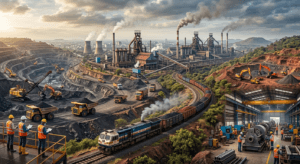
Economy and Mineral Resources of Jharkhand
Jharkhand has one of the strongest resource-based economies in India. The state is widely known as the “Mineral Capital of India” because of its abundant reserves of coal, iron ore, copper, uranium, bauxite, mica, limestone, and other valuable minerals. These natural resources have made Jharkhand a major centre for mining, steel production, heavy engineering, thermal power generation, and manufacturing industries.
The economy of Jharkhand is primarily driven by mining, industries, agriculture, forestry, power generation, and the service sector. Since the formation of the state in 2000, the government has invested significantly in infrastructure, industrial development, education, healthcare, and tourism to promote balanced economic growth.
Today, Jharkhand contributes substantially to India’s mineral production and plays a crucial role in supplying raw materials to industries across the country.
Mineral Resources
Jharkhand possesses some of the richest mineral deposits in India. Mining is one of the largest contributors to the state’s economy and provides employment to thousands of people.
The state is a leading producer of:
- Coal
- Iron Ore
- Copper Ore
- Uranium
- Bauxite
- Mica
- Limestone
- Dolomite
- Graphite
- China Clay
- Quartz
- Fire Clay
Coalfields such as Jharia, Bokaro, North Karanpura, South Karanpura, and Rajmahal are among the most productive mining regions in the country.
Mining Industry
Mining is the backbone of Jharkhand’s economy.
Major public and private sector companies operating in the state include:
- Coal India Limited (CCL & BCCL)
- Steel Authority of India Limited (SAIL)
- Tata Steel
- Uranium Corporation of India Limited (UCIL)
- Hindustan Copper Limited (HCL)
- National Mineral Development Corporation (NMDC)
- MECON Limited
The mining sector supports thousands of direct and indirect jobs and supplies raw materials to steel plants, thermal power stations, cement factories, and manufacturing industries.
Steel and Manufacturing Industries
Jharkhand is one of India’s leading steel-producing states.
Major steel industries include:
- Tata Steel, Jamshedpur
- Bokaro Steel Plant (SAIL)
- Usha Martin
- Electrosteel Castings
The state also has industries related to:
- Heavy engineering
- Automobile components
- Machinery manufacturing
- Cement
- Chemicals
- Fertilizers
- Aluminium processing
The Heavy Engineering Corporation (HEC) at Ranchi manufactures equipment for mining, steel, defence, and power industries.
Agriculture
Although Jharkhand is an industrial state, agriculture remains the primary occupation for a large section of the rural population.
Major crops include:
- Rice
- Maize
- Wheat
- Pulses
- Oilseeds
- Millets
- Vegetables
- Fruits
Farmers also cultivate horticultural crops such as mango, litchi, jackfruit, guava, banana, papaya, and spices.
The government promotes irrigation projects, organic farming, watershed management, and modern agricultural practices to improve productivity.
Forest-Based Economy
Forests contribute significantly to rural livelihoods.
Major forest products include:
- Lac
- Bamboo
- Kendu Leaves
- Mahua Flowers
- Tamarind
- Honey
- Medicinal Plants
Jharkhand is one of India’s leading producers of lac, which is widely used in handicrafts, paints, varnishes, and the pharmaceutical industry.
Power Generation
Jharkhand is a major power-producing state because of its abundant coal reserves.
Important thermal power stations include:
- Patratu Thermal Power Station
- Tenughat Thermal Power Station
- Chandrapura Thermal Power Station
- Koderma Thermal Power Station
Hydroelectric and renewable energy projects are also being developed to meet future energy demands.
Service Sector
The service sector has expanded rapidly over the past two decades.
Major contributors include:
- Banking
- Education
- Healthcare
- Tourism
- Information Technology
- Retail Trade
- Hospitality
- Transport and Logistics
Cities such as Ranchi, Jamshedpur, Dhanbad, and Deoghar are emerging as important service centres.
Industrial Corridors and Infrastructure
The state government has established industrial parks, logistics hubs, and infrastructure projects to attract domestic and foreign investment.
Major industrial regions include:
- Jamshedpur
- Bokaro
- Dhanbad
- Ranchi
- Adityapur Industrial Area
- Ramgarh
Modern highways, railway connectivity, airports, and digital infrastructure continue to strengthen Jharkhand’s industrial growth.
Future Economic Potential
Jharkhand has enormous potential for sustainable economic development due to:
- Rich mineral reserves
- Large industrial base
- Skilled workforce
- Expanding infrastructure
- Eco-tourism opportunities
- Renewable energy projects
- Manufacturing investments
- Digital economy
With balanced development and environmental conservation, the state is expected to remain one of India’s key economic growth centres.
Economy and Mineral Resources of Jharkhand
| Sector | Major Highlights |
|---|---|
| Mining | Coal, Iron Ore, Copper, Uranium, Bauxite |
| Steel Industry | Tata Steel, Bokaro Steel Plant |
| Major Crops | Rice, Maize, Wheat, Pulses |
| Forest Produce | Lac, Bamboo, Mahua, Kendu Leaves |
| Power Generation | Thermal & Hydroelectric Projects |
| Major Industrial Cities | Jamshedpur, Bokaro, Ranchi, Dhanbad |
| Important Companies | Tata Steel, SAIL, CCL, BCCL, UCIL, HEC |
| Key Economic Sectors | Mining, Manufacturing, Agriculture, Services |
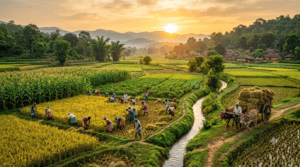
Agriculture and Crops of Jharkhand
Agriculture is one of the most important sectors of Jharkhand’s economy and serves as the primary source of livelihood for a large portion of the state’s rural population. Although Jharkhand is widely recognized for its rich mineral resources and industrial development, agriculture continues to play a crucial role in ensuring food security, employment, and rural development.
Nearly 60–70% of the population is directly or indirectly dependent on agriculture and allied activities. Most farming in the state is rain-fed, making the southwest monsoon extremely important for crop production. The government has been promoting irrigation projects, modern farming techniques, organic cultivation, horticulture, and crop diversification to improve agricultural productivity and farmers’ income.
The fertile valleys, plateau lands, river basins, and forest regions of Jharkhand support the cultivation of cereals, pulses, oilseeds, vegetables, fruits, and cash crops.
Agricultural Seasons
Jharkhand follows three major agricultural seasons.
Kharif Season
The Kharif season begins with the arrival of the southwest monsoon in June and continues until October.
Major Kharif crops include:
- Rice
- Maize
- Finger Millet (Ragi)
- Sorghum
- Arhar (Pigeon Pea)
- Groundnut
- Soybean
Rice is the most widely cultivated crop and serves as the staple food of the state.
Rabi Season
The Rabi season begins after the monsoon and extends from October to March.
Major Rabi crops include:
- Wheat
- Gram
- Lentil
- Mustard
- Linseed
- Peas
- Barley
Irrigation facilities are especially important during this season.
Zaid Season
The Zaid season is a short agricultural period between March and June.
Farmers cultivate:
- Watermelon
- Muskmelon
- Cucumber
- Vegetables
- Fodder Crops
Major Food Crops
The principal food crops grown in Jharkhand are:
- Rice
- Wheat
- Maize
- Finger Millet
- Sorghum
- Pulses
- Barley
Rice occupies the largest share of cultivated land and is grown across almost all districts.
Cash Crops
Important cash crops include:
- Groundnut
- Mustard
- Sesame
- Sunflower
- Sugarcane
- Cotton (limited areas)
These crops provide additional income to farmers and support agro-based industries.
Horticulture
Jharkhand has favourable climatic conditions for horticulture.
Major fruits include:
- Mango
- Litchi
- Guava
- Papaya
- Banana
- Jackfruit
- Pineapple
Major vegetables include:
- Tomato
- Potato
- Brinjal
- Cauliflower
- Cabbage
- Okra
- Onion
- Chilli
The state is also promoting floriculture and medicinal plant cultivation.
Irrigation
Agriculture in Jharkhand depends mainly on monsoon rainfall, but irrigation is gradually expanding.
Major sources of irrigation include:
- Canals
- Reservoirs
- Dams
- Tube Wells
- Open Wells
- Lift Irrigation
- Check Dams
- Farm Ponds
The government encourages micro-irrigation techniques such as drip and sprinkler irrigation to improve water-use efficiency.
Livestock and Allied Activities
Livestock contributes significantly to rural livelihoods.
Major activities include:
- Dairy Farming
- Poultry Farming
- Goat Rearing
- Sheep Rearing
- Pig Farming
- Fisheries
- Beekeeping
These activities provide supplementary income to farming households.
Organic Farming
Jharkhand has considerable potential for organic agriculture due to relatively low chemical fertilizer usage in many areas.
Organic cultivation is increasing for:
- Vegetables
- Fruits
- Pulses
- Spices
- Medicinal Plants
Government agencies provide training, certification, and financial support for organic farming initiatives.
Challenges in Agriculture
Despite significant potential, the agricultural sector faces several challenges:
- Dependence on monsoon rainfall
- Small and fragmented landholdings
- Limited irrigation facilities
- Soil erosion
- Low mechanization
- Climate change
- Market access issues
- Storage and transportation constraints
Government programmes aim to address these challenges through improved infrastructure, irrigation, technology, and farmer support.
Agriculture of Jharkhand
| Particular | Details |
|---|---|
| Main Occupation | Agriculture |
| Major Season | Kharif |
| Principal Crop | Rice |
| Major Rabi Crops | Wheat, Gram, Mustard |
| Major Cash Crops | Groundnut, Sesame, Sugarcane |
| Major Fruits | Mango, Litchi, Banana, Guava |
| Major Vegetables | Potato, Tomato, Onion, Cabbage |
| Irrigation Sources | Canals, Dams, Tube Wells, Wells |
| Allied Activities | Dairy, Poultry, Fisheries, Goat Rearing |
| Organic Farming | Rapidly Expanding |
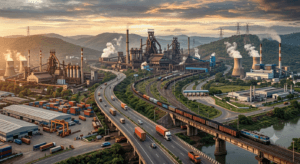
Industries and Infrastructure of Jharkhand
Jharkhand is one of India’s leading industrial states due to its abundant mineral resources, strategic location, skilled workforce, and well-established manufacturing sector. The state has developed into a major hub for steel production, mining, heavy engineering, power generation, cement manufacturing, automobile components, and metal processing.
The presence of large deposits of coal, iron ore, copper, uranium, bauxite, limestone, and mica has encouraged the establishment of numerous public and private industries. Cities such as Jamshedpur, Bokaro, Ranchi, Dhanbad, Ramgarh, Adityapur, and Chaibasa serve as the state’s major industrial centres.
Along with industrial growth, Jharkhand has significantly improved its transport network, electricity generation, digital infrastructure, logistics facilities, and industrial parks to attract domestic and international investment.
Major Industries of Jharkhand
Jharkhand has a diversified industrial base that contributes significantly to India’s economy.
The major industries include:
- Iron and Steel Industry
- Coal Mining
- Copper Mining
- Uranium Mining
- Heavy Engineering
- Cement Manufacturing
- Thermal Power Generation
- Aluminium Processing
- Automobile Components
- Fertilizer Industry
- Chemicals
- Engineering Equipment
- Refractory Industry
- Food Processing
The mining and steel sectors continue to be the backbone of the state’s industrial economy.
Steel Industry
Jharkhand is one of India’s largest steel-producing states.
Major steel plants include:
- Tata Steel, Jamshedpur
- Bokaro Steel Plant (SAIL)
- Usha Martin
- Electrosteel Castings
- Tata Tinplate
The steel industry supports automobile manufacturing, railways, construction, defence, engineering, and exports.
Mining Industry
Mining remains the largest industrial sector in Jharkhand.
Major minerals extracted include:
- Coal
- Iron Ore
- Copper
- Uranium
- Bauxite
- Limestone
- Mica
- Dolomite
- Graphite
The major coalfields include:
- Jharia Coalfield
- Bokaro Coalfield
- North Karanpura Coalfield
- South Karanpura Coalfield
- Rajmahal Coalfield
These mines supply raw materials to industries throughout India.
Industrial Areas
The major industrial regions of Jharkhand are:
- Jamshedpur
- Bokaro Steel City
- Ranchi
- Dhanbad
- Adityapur Industrial Area
- Ramgarh
- Chaibasa
- Hazaribagh
- Patratu
The Adityapur Industrial Area is one of eastern India’s largest industrial estates and houses hundreds of manufacturing units.
Power Infrastructure
Jharkhand is an important producer of electricity because of its rich coal reserves.
Major power stations include:
- Patratu Thermal Power Station
- Tenughat Thermal Power Station
- Chandrapura Thermal Power Station
- Koderma Thermal Power Station
The state is also investing in:
- Solar Energy
- Hydroelectric Projects
- Renewable Energy
- Smart Power Distribution
Transport Infrastructure
Jharkhand has a well-developed transport network.
Road Network
The state is connected through:
- National Highways
- State Highways
- District Roads
- Rural Roads
Important highways connect Ranchi with Kolkata, Patna, Bhubaneswar, Delhi, and Raipur.
Railway Network
Jharkhand has one of India’s busiest railway networks due to mineral transportation.
Major railway junctions include:
- Ranchi
- Jamshedpur (Tatanagar)
- Dhanbad
- Bokaro Steel City
- Gomoh
- Koderma
- Deoghar
Air Connectivity
Major airports include:
- Birsa Munda Airport (Ranchi)
- Deoghar Airport
- Sonari Airport (Jamshedpur)
These airports improve tourism, business, and cargo transportation.
Digital Infrastructure
Jharkhand is rapidly expanding its digital connectivity through:
- BharatNet Programme
- Optical Fibre Networks
- Digital Governance
- Online Public Services
- Smart City Projects
- E-Governance Platforms
Cities like Ranchi and Jamshedpur are witnessing significant digital transformation.
Industrial Investment
The Government of Jharkhand has introduced several policies to encourage investment.
Priority sectors include:
- Mining
- Steel
- Manufacturing
- Electronics
- Food Processing
- Renewable Energy
- Tourism
- Information Technology
- Logistics
Special industrial parks and investment zones are being developed to generate employment and promote economic growth.
Future Prospects
Jharkhand has immense potential for future industrial growth due to:
- Large mineral reserves
- Strong industrial base
- Strategic location
- Growing infrastructure
- Skilled workforce
- Expanding logistics network
- Renewable energy opportunities
- Government investment policies
With continued infrastructure development and sustainable resource management, Jharkhand is expected to strengthen its position as one of India’s leading industrial states.
Industries and Infrastructure of Jharkhand
| Sector | Major Highlights |
|---|---|
| Major Industries | Steel, Mining, Cement, Heavy Engineering |
| Major Steel Plants | Tata Steel, Bokaro Steel Plant |
| Major Coalfields | Jharia, Bokaro, North & South Karanpura, Rajmahal |
| Industrial Cities | Jamshedpur, Bokaro, Ranchi, Dhanbad |
| Major Airports | Ranchi, Deoghar, Sonari |
| Major Railway Hubs | Ranchi, Dhanbad, Tatanagar, Bokaro |
| Energy Sources | Thermal, Solar, Hydroelectric |
| Investment Sectors | Manufacturing, Mining, IT, Tourism |
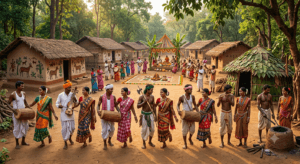
Tribal Communities, Culture and Traditions of Jharkhand
Jharkhand is one of India’s most culturally diverse states and is widely recognized for its rich tribal heritage. The state is home to 32 Scheduled Tribes, many of whom have lived in the forests and plateaus of the Chota Nagpur region for centuries. These communities have preserved their unique languages, customs, festivals, traditional governance systems, folk dances, music, handicrafts, and deep respect for nature.
Tribal culture forms the foundation of Jharkhand’s identity. Forests, rivers, mountains, and agriculture are closely connected with the daily lives and religious beliefs of tribal communities. Most festivals celebrate nature, harvests, forests, ancestors, and local deities, reflecting a harmonious relationship between humans and the environment.
Traditional tribal villages are known for their simplicity, community cooperation, mud houses decorated with natural colours, and rich oral traditions passed down through generations.
Major Tribal Communities
Jharkhand has one of the largest tribal populations in India.
Some of the major tribal communities include:
- Santhal
- Munda
- Oraon (Kurukh)
- Ho
- Kharia
- Birhor
- Asur
- Bhumij
- Paharia
- Lohra
- Mahli
- Kharwar
- Gond
- Korwa
- Sauria Paharia
Among these, the Santhal, Munda, Oraon, and Ho tribes constitute the largest tribal populations in the state.
Traditional Lifestyle
Most tribal communities traditionally depend on:
- Agriculture
- Forestry
- Animal Husbandry
- Hunting (historically)
- Fishing
- Collection of Forest Produce
- Handicrafts
- Bamboo Craft
- Lac Cultivation
Village life revolves around agriculture, forests, and community participation. Traditional village councils continue to play an important role in resolving local issues and preserving customs.
Traditional Dress
Traditional attire varies among different tribes but generally includes colourful handwoven garments and ornaments.
Men
- Dhoti
- Gamcha
- Turban (during festivals)
- Traditional jewellery
Women
- Saree with tribal draping style
- Colourful beads
- Silver ornaments
- Bangles
- Necklaces
- Anklets
- Earrings
Bright colours and handmade jewellery are commonly worn during festivals and community celebrations.
Tribal Houses
Traditional tribal houses are usually built using locally available materials such as:
- Mud
- Bamboo
- Wood
- Stone
- Thatch
- Clay Tiles
The walls are often decorated with colourful paintings, floral motifs, and geometric designs, reflecting the artistic traditions of the community.
Languages Spoken by Tribal Communities
Several tribal languages are spoken across Jharkhand.
Major tribal languages include:
- Santhali
- Mundari
- Ho
- Kurukh
- Kharia
- Nagpuri
- Khortha
- Panchpargania
Hindi serves as the primary official language, while many communities continue to preserve their native languages.
Traditional Occupations
Besides agriculture, tribal communities engage in:
- Lac Cultivation
- Sericulture
- Bamboo Craft
- Pottery
- Blacksmithing
- Wood Carving
- Basket Making
- Leaf Plate Making
- Honey Collection
- Herbal Medicine
These occupations contribute significantly to rural livelihoods.
Tribal Art and Handicrafts
Jharkhand’s tribal communities are known for their artistic skills.
Popular handicrafts include:
- Bamboo Products
- Cane Furniture
- Stone Carving
- Wood Carving
- Dokra Metal Craft
- Terracotta
- Tribal Paintings
- Leaf Crafts
- Handwoven Textiles
These handicrafts are widely appreciated across India and are an important source of income for artisans.
Traditional Beliefs
Many tribal communities worship nature and ancestral spirits.
Sacred elements include:
- Forests
- Hills
- Rivers
- Sacred Groves (Sarna)
- Sun
- Moon
- Village Deities
- Ancestors
Over time, many communities have also embraced Hinduism, Christianity, and other religions while preserving their traditional customs.
Social Structure
Tribal society is generally community-oriented and emphasizes:
- Mutual cooperation
- Collective decision-making
- Respect for elders
- Community festivals
- Sustainable use of natural resources
- Traditional self-governance
Village councils continue to play an important role in maintaining social harmony.
Cultural Importance
The tribal heritage of Jharkhand contributes significantly to:
- Cultural diversity
- Eco-friendly lifestyles
- Traditional ecological knowledge
- Folk literature
- Music and dance
- Handicraft traditions
- Sustainable forest management
- Tourism
The Government of Jharkhand actively promotes tribal welfare through education, healthcare, skill development, cultural preservation, and livelihood programmes.
Major Tribal Communities of Jharkhand
| Tribe | Main Region | Traditional Occupation |
|---|---|---|
| Santhal | Santhal Pargana | Agriculture, Handicrafts |
| Munda | Ranchi, Khunti | Agriculture, Forestry |
| Oraon (Kurukh) | Ranchi, Gumla | Farming, Animal Husbandry |
| Ho | West Singhbhum | Agriculture, Forest Produce |
| Kharia | Simdega, Gumla | Forestry, Agriculture |
| Birhor | Hazaribagh, Latehar | Forest Produce, Rope Making |
| Asur | Gumla, Latehar | Traditional Iron Smelting (Historically) |
| Bhumij | East & West Singhbhum | Agriculture |
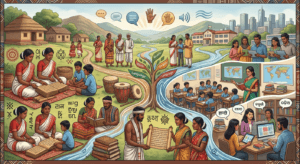
Languages of Jharkhand
Jharkhand is one of the most linguistically diverse states in India. Due to its rich tribal heritage and multicultural society, numerous languages are spoken across the state. Along with Hindi, several regional and tribal languages are widely used in daily communication, education, literature, media, and cultural activities.
The linguistic diversity of Jharkhand reflects the coexistence of tribal communities, local ethnic groups, and people who migrated from different parts of India for employment in mining, industries, and trade. Many languages belong to the Indo-Aryan, Austroasiatic, and Dravidian language families.
The Government of Jharkhand recognizes multiple regional languages to preserve the state’s cultural heritage and promote inclusive development.
Official Languages
Hindi is the official language of Jharkhand and is used for administration, legislation, education, judiciary, and government communication.
Urdu has been recognized as an additional official language and is widely spoken in several districts.
Government offices, educational institutions, newspapers, and television channels primarily use Hindi, while English is commonly used in higher education, technical education, business, and official correspondence.
Major Regional Languages
Several regional languages are spoken by different communities across the state.
Major regional languages include:
- Nagpuri
- Khortha
- Kurmali
- Panchpargania
These languages are widely used in folk songs, literature, theatre, local media, and cultural events.
Tribal Languages
Jharkhand has a rich tradition of tribal languages that have been preserved for centuries.
Major tribal languages include:
- Santhali
- Mundari
- Ho
- Kurukh (Oraon)
- Kharia
- Bhumij
- Birhor
- Malto
- Asuri
Many tribal languages continue to be taught through cultural organizations, educational initiatives, and literary programmes.
Language Families
The languages spoken in Jharkhand belong to three major language families:
Indo-Aryan Languages
- Hindi
- Urdu
- Nagpuri
- Khortha
- Kurmali
- Panchpargania
Austroasiatic Languages
- Santhali
- Mundari
- Ho
- Bhumij
- Kharia
Dravidian Languages
- Kurukh (Oraon)
- Malto
This linguistic diversity makes Jharkhand one of India’s most culturally vibrant states.
Scripts Used
Different languages in Jharkhand use different writing systems.
Common scripts include:
- Devanagari
- Ol Chiki (for Santhali)
- Latin Script (limited use)
- Perso-Arabic Script (Urdu)
The Ol Chiki script, developed by Pandit Raghunath Murmu, has played a vital role in preserving and promoting the Santhali language.
Language in Education
Hindi is the primary medium of instruction in most government schools.
However, education is also available in:
- English
- Urdu
- Santhali
- Regional languages (in selected schools)
The government has introduced multilingual education programmes to improve learning outcomes among tribal children.
Literature and Media
Jharkhand has a rich literary tradition in Hindi, Urdu, Santhali, Nagpuri, and other regional languages.
Popular forms include:
- Folk Songs
- Tribal Literature
- Poetry
- Novels
- Drama
- Newspapers
- Magazines
- Community Radio
- Television Programmes
Many writers and cultural organizations actively work to preserve indigenous languages through publications and digital media.
Importance of Linguistic Diversity
The linguistic diversity of Jharkhand contributes to:
- Cultural preservation
- Tribal identity
- Traditional knowledge
- Folk literature
- Music and theatre
- Social harmony
- Educational inclusion
- Tourism and cultural exchange
Government initiatives continue to promote regional and tribal languages through education, cultural festivals, and literary academies.
Major Languages of Jharkhand
| Language | Language Family | Script | Status |
|---|---|---|---|
| Hindi | Indo-Aryan | Devanagari | Official Language |
| Urdu | Indo-Aryan | Perso-Arabic | Additional Official Language |
| Santhali | Austroasiatic | Ol Chiki | Major Tribal Language |
| Mundari | Austroasiatic | Devanagari/Latin | Tribal Language |
| Ho | Austroasiatic | Warang Citi/Devanagari | Tribal Language |
| Kurukh | Dravidian | Devanagari | Tribal Language |
| Nagpuri | Indo-Aryan | Devanagari | Regional Language |
| Khortha | Indo-Aryan | Devanagari | Regional Language |
| Kurmali | Indo-Aryan | Devanagari | Regional Language |
| Panchpargania | Indo-Aryan | Devanagari | Regional Language |
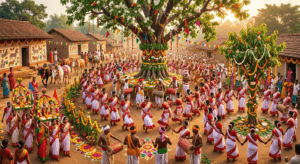
Festivals of Jharkhand
Jharkhand is a land of vibrant festivals that reflect its rich tribal heritage, agricultural traditions, and cultural diversity. Festivals in the state are closely connected with nature, forests, harvest seasons, livestock, and community life. Along with traditional tribal festivals, people also celebrate major Hindu, Muslim, Christian, Jain, Sikh, and Buddhist festivals with great enthusiasm.
The colourful celebrations include traditional dances, folk music, rituals, fairs, community feasts, and cultural performances. These festivals strengthen social harmony and preserve the customs and traditions that have been passed down through generations.
Sarhul Festival
Sarhul is one of the most important tribal festivals of Jharkhand and is celebrated mainly by the Munda, Oraon, and Ho communities. It marks the arrival of spring and the beginning of a new agricultural season.
The festival is dedicated to Sarna, the sacred grove, where people worship nature and village deities. The Sal tree plays a significant role in Sarhul, and its flowers are offered during religious ceremonies.
Highlights
- Celebration of spring
- Worship of nature
- Sal flower rituals
- Traditional dances and songs
- Community feasts
Karma Festival
Karma (Karam) is another major tribal festival celebrated across Jharkhand, especially by the Oraon, Munda, Ho, and Santhal communities.
The festival honours the Karam tree, which symbolizes prosperity, fertility, and good fortune. Men and women perform the famous Karma Dance throughout the night while singing traditional folk songs.
Highlights
- Worship of the Karam tree
- Folk dances
- Traditional music
- Community celebrations
- Agricultural significance
Sohrai Festival
Sohrai is a harvest festival celebrated after the rice harvest. It is also associated with the worship of cattle, which are considered essential for agriculture.
Homes are decorated with beautiful Sohrai paintings, made using natural colours and traditional tribal art techniques.
Highlights
- Harvest celebration
- Cattle worship
- Traditional wall paintings
- Folk music
- Community feasts
Tusu Parab
Tusu Parab is celebrated during Makar Sankranti after the winter harvest.
Young girls prepare colourful idols of Goddess Tusu, sing folk songs, and participate in cultural processions. The festival is especially popular in eastern Jharkhand.
Mage Parab
Mage Parab is one of the biggest festivals of the Ho tribe.
It marks the beginning of the new year according to the traditional tribal calendar.
The celebrations include:
- Community worship
- Traditional dances
- Music
- Feasting
- Cultural gatherings
Jani Shikar
Jani Shikar is a unique traditional festival celebrated by certain tribal communities.
Historically, women symbolically participated in hunting activities to commemorate acts of bravery and community unity.
Today, the festival is celebrated as a cultural tradition rather than an actual hunting event.
Chhath Puja
Chhath Puja is one of the most important Hindu festivals celebrated across Jharkhand.
Devotees worship the Sun God (Surya) and Chhathi Maiya by offering prayers at rivers, lakes, and ponds during sunrise and sunset.
The festival is especially popular in Ranchi, Dhanbad, Bokaro, and other urban centres.
Other Major Festivals
People across Jharkhand also celebrate:
- Diwali
- Holi
- Durga Puja
- Ram Navami
- Maha Shivaratri
- Eid-ul-Fitr
- Eid-ul-Adha
- Christmas
- Buddha Purnima
- Mahavir Jayanti
- Guru Nanak Jayanti
These festivals reflect the state’s religious harmony and multicultural society.
Tribal Fairs and Cultural Events
Jharkhand hosts numerous fairs and cultural festivals throughout the year.
Some famous fairs include:
- Shravani Mela (Deoghar)
- Baishakhi Mela
- Tusu Mela
- Sarhul Processions
- Tribal Cultural Festivals
- Handicraft Exhibitions
These events promote tourism, local handicrafts, folk music, and traditional cuisine.
Importance of Festivals
Festivals in Jharkhand play a vital role in:
- Preserving tribal traditions
- Promoting social harmony
- Encouraging cultural tourism
- Strengthening community relationships
- Celebrating agriculture and nature
- Preserving folk music and dance
- Supporting local artisans and handicrafts
Major Festivals of Jharkhand
| Festival | Community | Time of Celebration | Significance |
|---|---|---|---|
| Sarhul | Munda, Oraon, Ho | March–April | Spring and nature worship |
| Karma | Tribal Communities | August–September | Prosperity and fertility |
| Sohrai | Tribal Communities | October–November | Harvest and cattle worship |
| Tusu Parab | Rural Communities | January | Harvest festival |
| Mage Parab | Ho Tribe | January–February | Tribal New Year |
| Chhath Puja | Hindu | October–November | Sun worship |
| Holi | All Communities | March | Festival of colours |
| Diwali | All Communities | October–November | Festival of lights |
| Christmas | Christian | December | Birth of Jesus Christ |
| Eid | Muslim | Islamic Calendar | Religious celebration |
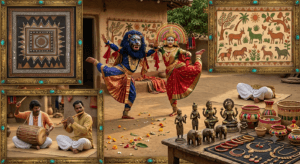
Traditional Dance, Music and Handicrafts of Jharkhand
Jharkhand is renowned for its vibrant tribal art, traditional dances, folk music, and exquisite handicrafts. The cultural identity of the state is deeply rooted in the customs of its tribal communities, who have preserved these artistic traditions for centuries. Dance and music are inseparable parts of festivals, weddings, harvest celebrations, religious ceremonies, and community gatherings.
Traditional musical instruments, colourful costumes, masks, paintings, bamboo crafts, wood carvings, and metal artworks showcase the creativity and craftsmanship of the people of Jharkhand. Today, these cultural traditions also contribute to tourism and provide livelihoods to thousands of artisans.
Chhau Dance
Chhau Dance is one of the most famous classical folk dances associated with Jharkhand, especially the Seraikela Chhau style, which originated in Seraikela-Kharsawan district.
The dance is famous for its graceful movements, martial arts techniques, elaborate masks, and dramatic storytelling based on themes from the Ramayana, Mahabharata, Puranas, and folklore.
In 2010, Chhau Dance was inscribed on UNESCO’s Representative List of the Intangible Cultural Heritage of Humanity.
Highlights
- Masked dance drama
- Martial art movements
- Mythological themes
- Colourful costumes
- Traditional music
Karma Dance
Karma Dance is performed during the Karma Festival, one of the most important tribal festivals in Jharkhand.
Men and women dance together around the sacred Karam tree while singing traditional folk songs accompanied by drums and flutes.
The dance symbolizes prosperity, fertility, unity, and harmony with nature.
Paika Dance
Paika Dance is a traditional martial dance performed by tribal communities.
The dance demonstrates ancient battlefield techniques using swords and shields and reflects the courage, discipline, and warrior traditions of the region.
Jhumair Dance
Jhumair is a popular folk dance performed during harvest festivals, weddings, and social gatherings.
Both men and women participate in rhythmic group performances accompanied by folk songs and traditional musical instruments.
Other Traditional Dances
Several other tribal dances are performed across Jharkhand, including:
- Domkach
- Santhali Dance
- Mardani Dance
- Natua Dance
- Fagua Dance
- Jadur Dance
Each dance represents the traditions and cultural identity of different tribal communities.
Folk Music
Folk music is an integral part of Jharkhand’s cultural heritage.
Traditional songs celebrate:
- Nature
- Agriculture
- Love
- Heroism
- Festivals
- Marriage
- Spirituality
Popular musical instruments include:
- Mandar
- Nagara
- Dhol
- Dhak
- Flute
- Shehnai
- Kartal
- Bansi
These instruments create energetic rhythms during festivals and celebrations.
Sohrai and Khovar Paintings
Jharkhand is internationally recognized for its unique tribal paintings.
Sohrai Painting
Sohrai paintings are created during the harvest festival using natural colours made from clay, charcoal, and plant extracts.
Common themes include:
- Animals
- Birds
- Flowers
- Trees
- Farming
- Nature
- Khovar Painting
Khovar paintings are traditionally created on the walls of homes during weddings.
These artworks feature intricate geometric patterns, floral designs, and symbolic motifs representing prosperity and marital happiness.
Handicrafts of Jharkhand
Jharkhand’s artisans produce a wide variety of traditional handicrafts.
Popular handicrafts include:
- Dokra Metal Craft
- Bamboo Craft
- Cane Furniture
- Wood Carving
- Stone Carving
- Terracotta
- Lac Bangles
- Tribal Jewellery
- Leaf Plates
- Handwoven Textiles
Many of these products are exported to different parts of India and abroad.
Cultural Importance
Traditional arts contribute significantly to:
- Preservation of tribal identity
- Promotion of tourism
- Employment generation
- Cultural education
- Heritage conservation
- Women’s self-help groups
- Rural economy
The Government of Jharkhand actively supports artisans through training programmes, handicraft fairs, exhibitions, and financial assistance.
Traditional Arts of Jharkhand
| Art Form | Category | Famous For |
|---|---|---|
| Seraikela Chhau | Dance | Masked dance, martial arts |
| Karma Dance | Folk Dance | Karma Festival |
| Paika Dance | Martial Dance | Sword and shield performance |
| Jhumair | Folk Dance | Harvest celebrations |
| Sohrai Painting | Tribal Art | Nature-inspired wall paintings |
| Khovar Painting | Tribal Art | Wedding wall art |
| Dokra Craft | Metal Craft | Lost-wax metal casting |
| Bamboo Craft | Handicraft | Baskets and decorative items |
| Stone Carving | Handicraft | Sculptures and decorative art |
| Lac Bangles | Handicraft | Traditional jewellery |

Famous Food of Jharkhand
Jharkhand is known for its simple, nutritious, and flavourful cuisine, which reflects the lifestyle of its tribal communities and agricultural traditions. Most traditional dishes are prepared using locally grown rice, millets, pulses, vegetables, forest produce, and natural herbs. Seasonal ingredients play an important role in everyday cooking, while festivals and special occasions feature unique sweets and delicacies.
The cuisine of Jharkhand is influenced by neighbouring states such as Bihar, West Bengal, Odisha, and Chhattisgarh, yet it has maintained its own distinct identity through indigenous recipes and tribal cooking methods.
Dhuska
Dhuska is one of the most popular traditional dishes of Jharkhand.
It is prepared by grinding rice and lentils into a batter, which is then deep-fried until golden brown. Dhuska is usually served with:
- Potato Curry
- Gram Curry
- Chutney
- Pickle
It is commonly eaten as a breakfast or evening snack.
Rugra
Rugra is a rare edible mushroom found in the forests of Jharkhand during the monsoon season.
It is considered a delicacy and is cooked with spices, onions, garlic, and mustard oil. Rugra is highly valued for its rich taste and nutritional benefits.
Chilka Roti
Chilka Roti is a traditional rice-based flatbread made using rice flour and lentils.
It is generally served with:
- Green Chutney
- Vegetable Curry
- Meat Curry
This wholesome dish is popular in rural households.
Pittha
Pittha is a steamed or fried rice flour dumpling filled with ingredients such as:
- Jaggery
- Coconut
- Sesame Seeds
- Lentils
Pittha is especially prepared during festivals and family celebrations.
Litti Chokha
Although closely associated with Bihar, Litti Chokha is also widely enjoyed across Jharkhand.
The dish consists of:
- Wheat flour balls stuffed with roasted gram flour (Sattu)
- Roasted brinjal mash
- Boiled potato mash
- Tomato chutney
It is considered a complete and nutritious traditional meal.
Handia
Handia is a traditional fermented rice beverage prepared by several tribal communities.
It is made using rice and natural herbal fermentation starters. Handia is traditionally consumed during festivals, weddings, and community gatherings.
Thekua
Thekua is one of the most popular traditional sweets prepared during Chhath Puja.
It is made from:
- Wheat Flour
- Jaggery
- Ghee
- Cardamom
The sweet is known for its crisp texture and long shelf life.
Malpua
Malpua is a traditional sweet pancake made with flour, milk, sugar, and cardamom.
It is served during festivals such as Holi, Diwali, and weddings.
Bamboo Shoot Dishes
Tender bamboo shoots collected from forests are used to prepare delicious curries and pickles.
These dishes are especially popular among tribal communities and are valued for their distinctive flavour and nutritional value.
Arsa Roti
Arsa Roti is a traditional sweet made from rice flour and jaggery.
It is commonly prepared during festivals and family functions.
Traditional Tribal Cuisine
Many tribal dishes are prepared using locally available ingredients such as:
- Forest Mushrooms
- Bamboo Shoots
- Wild Leafy Vegetables
- Millets
- Rice
- Pulses
- Mahua Flowers
- Tamarind
- Fresh Fish
- Country Chicken
Traditional cooking methods include slow cooking over wood-fired stoves, which enhances the natural flavour of the food.
Popular Beverages
Traditional beverages enjoyed in Jharkhand include:
- Handia
- Mahua Drink
- Rice Gruel
- Herbal Drinks
- Fresh Sugarcane Juice
- Lassi
These beverages are commonly consumed during festivals and summer months.
Importance of Jharkhand Cuisine
The cuisine of Jharkhand reflects:
- Tribal heritage
- Sustainable food practices
- Seasonal agriculture
- Nutritional diversity
- Forest-based livelihoods
- Traditional cooking methods
- Community celebrations
Today, many traditional dishes are being promoted through food festivals, tourism, and cultural events.
Famous Foods of Jharkhand
| Dish | Category | Main Ingredients |
|---|---|---|
| Dhuska | Snack | Rice, Lentils |
| Rugra | Forest Delicacy | Wild Mushroom |
| Chilka Roti | Bread | Rice Flour, Lentils |
| Pittha | Sweet/Dumpling | Rice Flour, Jaggery |
| Litti Chokha | Main Course | Wheat Flour, Sattu |
| Handia | Traditional Beverage | Fermented Rice |
| Thekua | Sweet | Wheat Flour, Jaggery |
| Malpua | Sweet | Flour, Milk, Sugar |
| Bamboo Shoot Curry | Curry | Bamboo Shoots |
| Arsa Roti | Sweet | Rice Flour, Jaggery |
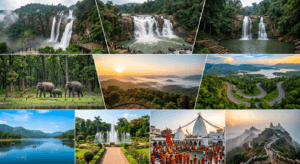
Top Tourist Places in Jharkhand
Jharkhand is one of India’s most beautiful travel destinations, offering a perfect combination of nature, spirituality, wildlife, adventure, and cultural heritage. From majestic waterfalls and dense forests to sacred temples and wildlife sanctuaries, the state has something to offer every traveller.
Tourism in Jharkhand is growing rapidly due to its scenic landscapes, pleasant climate, rich tribal culture, and improved transportation infrastructure. Nature lovers, pilgrims, wildlife enthusiasts, photographers, historians, and adventure seekers visit the state throughout the year.
The best time to explore most tourist attractions is October to March, when the weather remains cool and pleasant.
Baidyanath Temple, Deoghar
The Baidyanath Temple, also known as Baba Baidyanath Dham, is one of the twelve sacred Jyotirlingas of Lord Shiva. Located in Deoghar, it is among the most important pilgrimage destinations in India.
Every year, millions of devotees participate in the Shravani Mela, carrying holy water from Sultanganj to offer prayers at the temple.
Highlights
- One of the 12 Jyotirlingas
- Major Hindu pilgrimage centre
- Shravani Mela
- Ancient temple architecture
Betla National Park
Located in Latehar district, Betla National Park is famous for its rich biodiversity, jeep safaris, elephant safaris, and ancient Palamau Fort.
Visitors can spot elephants, deer, leopards, sloth bears, langurs, and numerous bird species.
Parasnath Hill
Parasnath Hill is the highest mountain in Jharkhand and one of the holiest Jain pilgrimage sites in the world.
Thousands of pilgrims undertake the trek every year to visit the sacred temples located on the hill.
Hundru Falls
Hundru Falls, formed by the Subarnarekha River, is one of the highest waterfalls in Jharkhand.
The waterfall is especially spectacular during the monsoon and post-monsoon seasons.
Dassam Falls
Dassam Falls is a picturesque waterfall surrounded by forests and rocky cliffs.
It is a popular destination for picnics, photography, and sightseeing.
Jonha Falls
Also known as Gautamdhara Falls, Jonha Falls is famous for its scenic beauty and nearby Buddhist temple.
Visitors descend several hundred steps to reach the base of the waterfall.
Netarhat
Popularly called the “Queen of Chota Nagpur,” Netarhat is Jharkhand’s most famous hill station.
It is known for:
- Sunrise and sunset viewpoints
- Pine forests
- Pleasant climate
- Trekking
- Nature photography
Patratu Valley
Patratu Valley is one of the most scenic destinations in Jharkhand.
Its winding roads, green hills, and Patratu Dam attract tourists, bikers, and photographers throughout the year.
Jubilee Park
Located in Jamshedpur, Jubilee Park was developed by Tata Steel.
The park features:
- Musical fountains
- Rose gardens
- Walking paths
- Children’s attractions
- Illuminated fountains
Dalma Wildlife Sanctuary
Dalma Wildlife Sanctuary is famous for elephant migration, trekking, wildlife photography, and panoramic hill views.
It is located near Jamshedpur and is one of the state’s major eco-tourism destinations.
Rajrappa Temple
Rajrappa Temple, dedicated to Goddess Chhinnamasta, is one of the most important Shakti temples in eastern India.
The temple is situated at the confluence of the Damodar and Bhairavi rivers.
Deori Temple
Deori Temple, near Ranchi, is dedicated to Goddess Durga and is one of the oldest temples in Jharkhand.
It is visited by devotees throughout the year.
Jagannath Temple, Ranchi
Built in the 17th century, the Jagannath Temple in Ranchi resembles the famous Jagannath Temple of Puri.
The annual Rath Yatra attracts thousands of devotees.
Tagore Hill
Tagore Hill in Ranchi is associated with the Tagore family and offers panoramic views of the city.
It is a popular destination for trekking, meditation, and photography.
Other Popular Tourist Attractions
Jharkhand also offers many other beautiful destinations:
- Hirni Falls
- Panchghagh Falls
- Sita Falls
- Lodh Falls
- Usri Falls
- Palamau Fort
- Hazaribagh National Park Area
- Chandil Dam
- Dimna Lake
- Hudco Lake
- Rock Garden, Ranchi
- Nakshatra Van
- Kanke Dam
- McCluskieganj
- Udhwa Bird Sanctuary
- Pahari Mandir
- Sun Temple, Ranchi
- Birsa Zoological Park
- Shikharji Jain Temples
Adventure Tourism
Adventure enthusiasts can enjoy:
- Trekking
- Rock Climbing
- Camping
- Wildlife Safari
- Bird Watching
- Nature Trails
- Photography
- Boating
- Cycling
These activities are especially popular in Netarhat, Dalma Hills, Betla National Park, and Patratu Valley.
Top Tourist Places in Jharkhand
| Tourist Place | District | Famous For |
|---|---|---|
| Baidyanath Temple | Deoghar | Jyotirlinga |
| Betla National Park | Latehar | Wildlife Safari |
| Parasnath Hill | Giridih | Jain Pilgrimage |
| Hundru Falls | Ranchi | Waterfall |
| Dassam Falls | Ranchi | Scenic Beauty |
| Jonha Falls | Ranchi | Waterfall |
| Netarhat | Latehar | Hill Station |
| Patratu Valley | Ramgarh | Valley & Dam |
| Jubilee Park | East Singhbhum | Urban Park |
| Dalma Wildlife Sanctuary | East Singhbhum | Wildlife |
| Rajrappa Temple | Ramgarh | Shakti Peeth |
| Tagore Hill | Ranchi | Viewpoint |
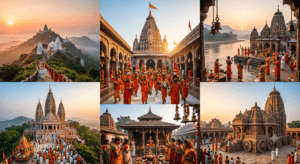
Religious Places of Jharkhand
Jharkhand is an important spiritual destination in eastern India and is home to several ancient temples, Jain pilgrimage sites, churches, mosques, and sacred tribal worship places. The state’s religious heritage reflects centuries of faith, cultural diversity, and peaceful coexistence among different communities.
From the world-famous Baidyanath Jyotirlinga in Deoghar to the sacred Parasnath Hill (Shikharji) of Jainism, Jharkhand attracts millions of pilgrims every year. The state is also known for its historic Shakti temples, ancient Hindu shrines, churches built during the colonial period, and sacred Sarna groves worshipped by tribal communities.
Baidyanath Dham (Baba Baidyanath Temple)
Located in Deoghar district, Baidyanath Dham is one of the twelve Jyotirlingas of Lord Shiva and one of the most sacred pilgrimage sites in Hinduism.
The temple complex consists of the main Shiva temple along with several smaller shrines dedicated to various Hindu deities.
During the annual Shravani Mela, millions of devotees carry holy water from Sultanganj (Bihar) and walk nearly 105 kilometres to offer it to Lord Shiva.
Highlights
- One of the 12 Jyotirlingas
- Major pilgrimage destination
- Shravani Mela
- Ancient temple architecture
Parasnath Hill (Shikharji)
Parasnath Hill, also known as Shikharji, is the holiest pilgrimage site in Jainism.
Located in Giridih district, the hill rises to 1,365 metres, making it the highest peak in Jharkhand.
According to Jain tradition, 20 of the 24 Tirthankaras attained moksha (liberation) here. Thousands of Jain pilgrims undertake the challenging trek to the summit every year.
Rajrappa Temple
The Rajrappa Temple, dedicated to Goddess Chhinnamasta, is one of the most important Shakti Peeths in eastern India.
Situated at the confluence of the Damodar and Bhairavi (Bhairavi/Bhera) rivers in Ramgarh district, the temple attracts devotees throughout the year, especially during Navratri.
Jagannath Temple, Ranchi
Built in 1691, the Jagannath Temple in Ranchi is inspired by the famous Jagannath Temple in Puri, Odisha.
The temple is situated on a hilltop and offers panoramic views of the surrounding area. The annual Rath Yatra festival attracts thousands of devotees.
Deori Temple
Located near Ranchi, Deori Temple is dedicated to Goddess Durga (Solahbhuji Devi).
The temple is believed to be over 700 years old and is visited by devotees seeking blessings for prosperity and success.
H3: Sun Temple, Ranchi
The Sun Temple is one of Jharkhand’s most iconic modern temples.
Constructed in the shape of a giant chariot with 18 beautifully carved wheels and seven horses, the temple is dedicated to Lord Surya (Sun God).
It is a popular destination for both pilgrims and tourists.
Pahari Mandir
Pahari Mandir, located on a hill in Ranchi, is dedicated to Lord Shiva.
Visitors climb several hundred steps to reach the temple and enjoy breathtaking views of Ranchi city.
The temple is especially crowded during Mahashivaratri and Independence Day, when the national flag is ceremonially hoisted.
Angrabadi Temple (Amreshwar Dham)
Situated in Khunti district, Angrabadi Temple is a famous Hindu pilgrimage centre.
The temple complex includes shrines dedicated to:
- Lord Shiva
- Goddess Parvati
- Lord Hanuman
- Lord Ganesha
- Lord Rama
Maluti Temples
The historic Maluti Temple Complex in Dumka district consists of over 70 ancient terracotta temples built between the 17th and 19th centuries.
These temples are renowned for their intricate terracotta artwork depicting scenes from Hindu mythology.
Sarna Sacred Groves
For many tribal communities, Sarna (sacred groves) are among the most important places of worship.
People worship:
- Nature
- Sal Trees
- Village Deities
- Ancestors
- Earth Goddess
Festivals such as Sarhul are celebrated in these sacred groves.
Churches and Mosques
Jharkhand also has several important churches and mosques that reflect the state’s religious diversity.
Prominent churches include:
- G.E.L. Church, Ranchi
- St. Mary’s Cathedral
- St. Xavier’s Church
Major mosques are located in Ranchi, Jamshedpur, Dhanbad, Deoghar, and other cities.
Religious Tourism
Religious tourism contributes significantly to Jharkhand’s economy.
Major pilgrimage circuits include:
- Baidyanath Dham
- Parasnath (Shikharji)
- Rajrappa Temple
- Jagannath Temple
- Deori Temple
- Sun Temple
- Pahari Mandir
- Angrabadi Temple
- Maluti Temple Complex
These destinations attract millions of visitors every year and support local businesses, hotels, transport services, and handicraft markets.
Major Religious Places of Jharkhand
| Religious Place | District | Religion | Famous For |
|---|---|---|---|
| Baidyanath Dham | Deoghar | Hindu | Jyotirlinga |
| Parasnath (Shikharji) | Giridih | Jain | Pilgrimage Hill |
| Rajrappa Temple | Ramgarh | Hindu | Chhinnamasta Temple |
| Jagannath Temple | Ranchi | Hindu | Rath Yatra |
| Deori Temple | Ranchi | Hindu | Durga Temple |
| Sun Temple | Ranchi | Hindu | Chariot Architecture |
| Pahari Mandir | Ranchi | Hindu | Hilltop Shiva Temple |
| Angrabadi Temple | Khunti | Hindu | Amreshwar Dham |
| Maluti Temples | Dumka | Hindu | Terracotta Temples |
| Sarna Sacred Groves | Various Districts | Tribal Faith | Nature Worship |
Education and Universities of Jharkhand
Education has become one of the key pillars of Jharkhand’s development since the formation of the state in 2000. The government has expanded access to schools, colleges, technical institutions, universities, and professional education across both urban and rural areas. Today, Jharkhand is home to several nationally reputed institutions that attract students from across India.
The state offers education in fields such as engineering, medicine, management, law, agriculture, mining, forestry, science, arts, commerce, and vocational training. Special emphasis is also being placed on improving literacy, girls’ education, digital learning, tribal education, and skill development.
Education System in Jharkhand
The education system follows the 10+2+3 pattern.
The major stages include:
- Pre-Primary Education
- Primary Education
- Upper Primary Education
- Secondary Education
- Higher Secondary Education
- Undergraduate Courses
- Postgraduate Courses
- Doctoral and Research Programmes
Schools in the state are affiliated with:
- Jharkhand Academic Council (JAC)
- CBSE
- CISCE
- State Board
- Kendriya Vidyalaya Sangathan
- Navodaya Vidyalaya Samiti
The medium of instruction varies across schools and includes Hindi, English, Urdu, and selected regional and tribal languages.
Literacy Rate
According to the 2011 Census, Jharkhand has an overall literacy rate of approximately 66.41%.
- Male Literacy: about 76.84%
- Female Literacy: about 55.42%
The state government has introduced several literacy and school enrollment programmes to improve educational outcomes, particularly among girls and tribal communities.
Major Universities
Jharkhand has several public and private universities offering higher education.
Major universities include:
- Ranchi University
- Vinoba Bhave University
- Sidho Kanho Murmu University
- Kolhan University
- Nilamber-Pitamber University
- Binod Bihari Mahto Koyalanchal University
- Dr. Shyama Prasad Mukherjee University
- Central University of Jharkhand
- Birsa Agricultural University
These universities provide undergraduate, postgraduate, doctoral, and research programmes in multiple disciplines.
Premier Educational Institutions
Jharkhand is home to several prestigious institutions of national importance.
Indian Institute of Technology (ISM), Dhanbad
One of India’s oldest and most prestigious engineering institutions, IIT (ISM) Dhanbad is internationally known for excellence in:
- Mining Engineering
- Petroleum Engineering
- Earth Sciences
- Computer Science
- Mechanical Engineering
- Research
Indian Institute of Management (IIM), Ranchi
Established in 2010, IIM Ranchi is among India’s leading management institutes.
It offers programmes in:
- MBA
- Human Resource Management
- Business Analytics
- Executive Education
- Doctoral Research
Birla Institute of Technology (BIT), Mesra
Located near Ranchi, BIT Mesra is one of India’s premier engineering and technological institutions.
It offers courses in:
- Engineering
- Architecture
- Pharmacy
- Management
- Sciences
- Artificial Intelligence
- Data Science
National University of Study and Research in Law (NUSRL), Ranchi
NUSRL is one of India’s leading National Law Universities.
It provides:
- Integrated Law Programmes
- Postgraduate Law Courses
- Doctoral Research
- Legal Studies
AIIMS Deoghar
The All India Institute of Medical Sciences (AIIMS), Deoghar, is one of the newest AIIMS institutions established to improve medical education and healthcare services in eastern India.
Medical and Technical Education
Major medical institutions include:
- AIIMS Deoghar
- Rajendra Institute of Medical Sciences (RIMS), Ranchi
- MGM Medical College, Jamshedpur
- Patliputra Medical College, Dhanbad
Major engineering colleges include:
- BIT Mesra
- IIT (ISM) Dhanbad
- Government Engineering Colleges
- Private Engineering Institutions
Skill Development
The Government of Jharkhand promotes skill development through:
- Industrial Training Institutes (ITIs)
- Polytechnic Colleges
- Skill Development Centres
- Digital Learning Initiatives
- Entrepreneurship Programmes
- Vocational Education
These programmes aim to improve employability among youth.
Government Initiatives
Major educational initiatives include:
- Mid-Day Meal Scheme
- Free Textbooks
- Scholarships for SC/ST/OBC Students
- E-Learning Platforms
- Smart Classrooms
- Digital Education
- Girls’ Education Programmes
- Tribal Education Projects
These initiatives have significantly improved access to quality education.
Major Educational Institutions of Jharkhand
| Institution | Location | Specialization |
|---|---|---|
| IIT (ISM) Dhanbad | Dhanbad | Engineering & Mining |
| IIM Ranchi | Ranchi | Management |
| BIT Mesra | Ranchi | Engineering & Technology |
| AIIMS Deoghar | Deoghar | Medical Education |
| RIMS | Ranchi | Medical Sciences |
| Ranchi University | Ranchi | Higher Education |
| Central University of Jharkhand | Ranchi | Multi-disciplinary Studies |
| Birsa Agricultural University | Ranchi | Agriculture & Veterinary Sciences |
| NUSRL | Ranchi | Law |
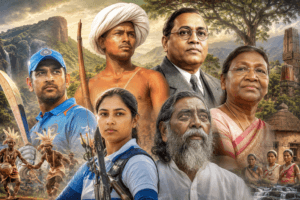
Famous Personalities of Jharkhand
Jharkhand has produced many outstanding personalities who have made remarkable contributions to India’s freedom struggle, tribal rights, politics, sports, literature, education, social reform, arts, and public service. These individuals have brought national and international recognition to the state through their achievements and continue to inspire future generations.
From legendary tribal freedom fighters like Birsa Munda to world-renowned cricketer Mahendra Singh Dhoni, Jharkhand has played a significant role in shaping India’s social, cultural, and political landscape.
Birsa Munda (1875–1900)
Birsa Munda is the greatest tribal freedom fighter in the history of Jharkhand and one of India’s most respected tribal leaders.
He led the famous Ulgulan (Great Rebellion) against British rule during 1899–1900 to protect the land, forests, and rights of tribal communities.
Birsa Munda inspired thousands of tribal people to fight against exploitation and injustice. His birth anniversary, 15 November, is celebrated as Jharkhand Foundation Day.
Major Contributions
- Led the Ulgulan Movement
- Protected tribal rights
- Opposed British rule
- Inspired social and religious reforms
Jaipal Singh Munda (1903–1970)
Jaipal Singh Munda was an eminent tribal leader, educationist, politician, and sportsperson.
He captained the Indian Hockey Team, which won the gold medal at the 1928 Amsterdam Olympics.
He also played a crucial role in demanding a separate Jharkhand state and founded the Jharkhand Party.
Major Contributions
- Olympic Gold Medal-winning Hockey Captain
- Founder of Jharkhand Party
- Tribal rights advocate
- Member of the Constituent Assembly of India
Mahendra Singh Dhoni
Mahendra Singh Dhoni (MS Dhoni), born in Ranchi, is one of the greatest cricketers in the history of world cricket.
Under his captaincy, India won:
- ICC T20 World Cup (2007)
- ICC Cricket World Cup (2011)
- ICC Champions Trophy (2013)
He is regarded as one of the finest wicketkeeper-batsmen and captains in cricket history.
Shibu Soren
Shibu Soren is a senior tribal leader and founder of the Jharkhand Mukti Morcha (JMM).
He played a significant role in the movement for the creation of the state of Jharkhand and has served multiple terms as the Chief Minister of Jharkhand.
Arjun Munda
Arjun Munda is a prominent political leader from Jharkhand who has served several terms as the Chief Minister of Jharkhand.
He has also served as a Union Cabinet Minister in the Government of India and has contributed to tribal welfare and rural development.
Babulal Marandi
Babulal Marandi became the first Chief Minister of Jharkhand after the state was formed on 15 November 2000.
He played an important role in laying the administrative foundation of the newly created state.
Kariya Munda
Kariya Munda is a respected tribal leader and senior parliamentarian.
He served as the Deputy Speaker of the Lok Sabha and has worked extensively for tribal development, education, and rural welfare.
Droupadi Murmu
Droupadi Murmu, who hails from the Santhal tribal community, served as the Governor of Jharkhand (2015–2021) before becoming the 15th President of India in 2022.
She is the first tribal woman to become the President of India and is widely admired for her dedication to public service, education, and tribal welfare.
Ram Dayal Munda
Ram Dayal Munda was a distinguished scholar, linguist, musician, tribal activist, and former Vice-Chancellor of Ranchi University.
He made significant contributions to the preservation of tribal languages, music, literature, and culture.
He was honoured with the Padma Shri for his contributions.
Other Notable Personalities
Jharkhand has also produced many distinguished personalities in different fields:
- Deepika Kumari – International Archer
- Salima Tete – Indian Hockey Player
- Nikki Pradhan – International Hockey Player
- Mukund Nayak – Folk Singer
- Simon Oraon – Environmental Conservationist
- B.P. Keshri – Historian and Writer
These personalities have brought pride to Jharkhand through their achievements at national and international levels.
Famous Personalities of Jharkhand
| Personality | Field | Major Contribution |
|---|---|---|
| Birsa Munda | Freedom Fighter | Ulgulan Movement |
| Jaipal Singh Munda | Politics & Sports | Olympic Hockey Captain, Jharkhand Movement |
| Mahendra Singh Dhoni | Cricket | World Cup-winning Captain |
| Shibu Soren | Politics | Founder of JMM |
| Arjun Munda | Politics | Former Chief Minister |
| Babulal Marandi | Politics | First Chief Minister of Jharkhand |
| Kariya Munda | Politics | Former Deputy Speaker, Lok Sabha |
| Droupadi Murmu | Public Service | President of India, Former Governor of Jharkhand |
| Ram Dayal Munda | Education & Culture | Tribal Scholar and Musician |
| Deepika Kumari | Sports | International Archer |
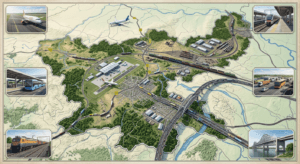
Transport and Connectivity of Jharkhand
Jharkhand has developed a strong transportation network that connects its major cities, industrial centres, tourist destinations, and rural areas. The state’s strategic location in eastern India makes it an important transportation hub for the movement of minerals, industrial goods, agricultural products, and passengers.
Roads, railways, and air transport play a significant role in supporting Jharkhand’s economy. The extensive railway network is especially important for transporting coal, iron ore, steel, and other minerals to different parts of the country. Continuous investment in highways, airports, bridges, and logistics infrastructure has further strengthened connectivity within the state.
Road Transport
Road transport is the most widely used mode of transportation in Jharkhand. The state has a well-connected network of National Highways (NHs), State Highways (SHs), district roads, and rural roads.
Major highways connect Ranchi, Jamshedpur, Dhanbad, Bokaro, Deoghar, Hazaribagh, Dumka, and other important cities with neighbouring states.
Major National Highways
- NH 18
NH 19
- NH 20
- NH 22
- NH 33
- NH 39
- NH 43
- NH 75
- NH 114A
- NH 133
The Jharkhand government continues to upgrade roads through four-lane highways, bypasses, flyovers, and expressway projects.
Railway Transport
Jharkhand has one of the busiest railway networks in India due to its importance in mineral transportation.
The state is served by the East Central Railway (ECR) and the South Eastern Railway (SER) zones of Indian Railways.
Major Railway Stations
- Ranchi Junction
- Tatanagar Junction (Jamshedpur)
- Dhanbad Junction
- Bokaro Steel City
- Deoghar Junction
- Koderma Junction
- Gomoh Junction (Netaji Subhas Chandra Bose Gomoh)
- Hazaribagh Town
- Jasidih Junction
- Hatia Junction
These stations connect Jharkhand with Delhi, Mumbai, Kolkata, Chennai, Hyderabad, Bengaluru, Patna, Bhubaneswar, and many other cities.
Air Transport
Air connectivity in Jharkhand has improved considerably in recent years.
Major Airports
Birsa Munda Airport (Ranchi)
- Largest airport in Jharkhand
- Domestic flights to major Indian cities
- Primary aviation hub of the state
Deoghar Airport
- Modern domestic airport
- Improves connectivity for pilgrims and tourists visiting Baidyanath Dham
Sonari Airport (Jamshedpur)
- Primarily used for regional and charter flight operations
- Supports business and industrial travel
The government is also exploring the development and expansion of additional regional airports.
Public Transport
Public transportation is available throughout the state.
Major modes include:
- State-run Buses
- Private Buses
- Mini Buses
- Auto Rickshaws
- Taxis
- App-based Cab Services
- Shared Vehicles
City bus services operate in Ranchi, Jamshedpur, Dhanbad, and several other urban centres.
Industrial Logistics
Jharkhand’s transport network plays a vital role in industrial logistics.
Major commodities transported include:
- Coal
- Iron Ore
- Steel
- Cement
- Copper
- Fertilizers
- Agricultural Produce
- Forest Products
Dedicated railway freight corridors and highway networks help industries transport goods efficiently across India.
Connectivity to Tourist Destinations
Most major tourist attractions are easily accessible by road.
Popular destinations connected through good road networks include:
- Baidyanath Dham
- Betla National Park
- Netarhat
- Parasnath Hill
- Hundru Falls
- Dassam Falls
- Patratu Valley
- Dalma Wildlife Sanctuary
- Rajrappa Temple
Taxi services, buses, and private vehicles are commonly used by tourists.
Future Infrastructure Projects
The Government of Jharkhand is implementing several infrastructure development projects, including:
- National Highway Expansion
- New Railway Lines
- Railway Station Modernization
- Airport Expansion
- Smart City Projects
- Industrial Corridors
- Logistics Parks
- Urban Transport Improvements
These projects are expected to improve connectivity, promote tourism, and support industrial growth.
Transport and Connectivity of Jharkhand
| Mode | Major Facilities |
|---|---|
| Road | National Highways, State Highways, Rural Roads |
| Railway | Ranchi, Dhanbad, Tatanagar, Bokaro, Jasidih |
| Airport | Birsa Munda Airport, Deoghar Airport, Sonari Airport |
| Public Transport | Buses, Auto Rickshaws, Taxis, Cab Services |
| Industrial Transport | Coal, Steel, Iron Ore Logistics |
| Tourism Connectivity | Well-connected road network to major attractions |

Interesting Facts About Jharkhand
Jharkhand is one of India’s most unique states, known for its ancient tribal heritage, vast mineral wealth, dense forests, spectacular waterfalls, and rapidly developing industries. Although it is one of India’s younger states, its history dates back thousands of years. From being home to legendary tribal freedom fighters to producing world-class athletes and industrial achievements, Jharkhand has many fascinating facts that make it a remarkable destination.
Below are some of the most interesting facts about Jharkhand.
30 Interesting Facts About Jharkhand
- Jharkhand became the 28th state of India on 15 November 2000.
- The state’s name means “Land of Forests,” derived from the Sanskrit words Jhar (forest) and Khand (land).
- Ranchi is the capital city of Jharkhand.
- Jamshedpur is India’s first planned industrial city.
- Jharkhand is one of India’s richest mineral-producing states.
- The state is one of the country’s leading producers of coal and iron ore.
- Parasnath Hill is the highest peak in Jharkhand.
- Parasnath is one of the holiest pilgrimage sites in Jainism.
- Baidyanath Dham in Deoghar is one of the 12 Jyotirlingas of Lord Shiva.
- Betla National Park is the only national park in Jharkhand.
- Palamau Tiger Reserve was among the first tiger reserves established under Project Tiger.
- Jharkhand has 24 districts and 5 administrative divisions.
- Nearly one-third of the state’s geographical area is covered by forests.
- The Sal Tree is the state tree of Jharkhand.
- The Asian Elephant is the state animal.
- The Asian Koel is the state bird.
- The Palash is the state flower.
- Hundru Falls is one of the highest waterfalls in the state.
- Netarhat is popularly known as the “Queen of Chota Nagpur.”
- MS Dhoni, one of India’s greatest cricketers, was born and brought up in Ranchi.
- Birsa Munda is regarded as the greatest tribal freedom fighter of Jharkhand.
- The famous Seraikela Chhau Dance is recognized by UNESCO as an Intangible Cultural Heritage.
- Sohrai and Khovar paintings are internationally admired tribal art forms.
- Dhanbad is known as the “Coal Capital of India.”
- IIT (ISM) Dhanbad is one of India’s oldest and most prestigious engineering institutions.
- Tata Steel, founded in Jamshedpur, is one of India’s largest steel producers.
- Patratu Valley is one of the most scenic road destinations in eastern India.
- Jharkhand has more than 30 Scheduled Tribes, making it one of India’s most culturally diverse states.
- The state is famous for lac production, bamboo crafts, and Dokra metal art.
- Jharkhand offers an excellent combination of nature, wildlife, adventure, spirituality, and industrial heritage, making it a unique tourism destination.
Why is Jharkhand Famous?
Jharkhand is famous for:
- Rich mineral resources
- Dense forests
- Tribal heritage
- Baidyanath Jyotirlinga
- Parasnath Hill
- Waterfalls
- Steel industries
- Coal mines
- Wildlife sanctuaries
- Chhau Dance
- Sohrai Paintings
- MS Dhoni
- Birsa Munda
- Eco-tourism
- Adventure tourism
Quick Facts About Jharkhand
| Particular | Fact |
|---|---|
| State Formation | 15 November 2000 |
| Capital | Ranchi |
| Largest City | Jamshedpur |
| Highest Peak | Parasnath Hill |
| National Park | Betla National Park |
| State Animal | Asian Elephant |
| State Bird | Asian Koel |
| State Tree | Sal |
| State Flower | Palash |
| Famous Personality | Birsa Munda |
| Famous Cricketer | MS Dhoni |
| Famous Industry | Steel & Mining |
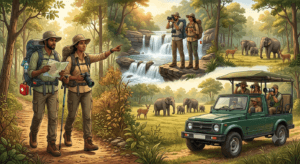
Best Time to Visit Jharkhand & Travel Tips
Jharkhand is a year-round destination, but the experience varies depending on the season and the type of attractions you wish to explore. The state offers lush forests, majestic waterfalls, wildlife sanctuaries, religious shrines, hill stations, and industrial heritage sites. Choosing the right season can make your journey more enjoyable and comfortable.
In general, October to March is considered the best time to visit Jharkhand because of its cool weather, pleasant climate, and ideal conditions for sightseeing, trekking, wildlife safaris, and pilgrimage.
Winter Season (October to February)
Winter is the most popular tourist season in Jharkhand.
The weather remains pleasant, with temperatures ranging from 5°C to 25°C, making it comfortable for outdoor activities.
This is the best season to visit:
- Betla National Park
- Netarhat
- Patratu Valley
- Parasnath Hill
- Baidyanath Dham
- Ranchi Waterfalls
- Dalma Wildlife Sanctuary
- Rajrappa Temple
Advantages
- Pleasant weather
- Excellent visibility
- Ideal for trekking
- Comfortable wildlife safaris
- Perfect for photography
Summer Season (March to June)
Summer temperatures generally range between 30°C and 40°C.
Although afternoons can be hot, higher-altitude areas such as Ranchi and Netarhat remain comparatively cooler.
Waterfalls and hill stations continue to attract tourists during this season.
Suitable Activities
- Early morning sightseeing
- Hill station visits
- Waterfall excursions
- Nature photography
Monsoon Season (June to September)
During the monsoon, Jharkhand receives abundant rainfall that transforms forests and waterfalls into breathtaking landscapes.
The waterfalls flow at their fullest, making this season ideal for nature lovers and photographers.
However, heavy rainfall may occasionally affect road conditions and trekking routes.
Suitable Activities
- Waterfall photography
- Nature tourism
- Eco-tourism
- Scenic drives
Ideal Duration for a Trip
Depending on your interests, you can plan:
- 2–3 Days – Ranchi and nearby attractions
- 4–5 Days – Ranchi, Netarhat, Betla National Park
- 6–7 Days – Comprehensive tour covering Ranchi, Deoghar, Jamshedpur, Parasnath Hill, and major waterfalls
- 8–10 Days – Complete Jharkhand exploration including wildlife, pilgrimage, tribal culture, and industrial cities
Travel Tips
To ensure a safe and enjoyable trip, keep the following suggestions in mind:
- Carry valid identity proof.
- Wear comfortable walking shoes.
- Pack light woollen clothes during winter.
- Carry rain protection during the monsoon.
- Stay hydrated during summer.
- Follow safety instructions at waterfalls.
- Avoid entering restricted forest areas without permission.
- Respect local customs and tribal traditions.
- Do not litter in forests or tourist destinations.
- Book hotels in advance during major festivals and pilgrimage seasons.
- Keep sufficient cash while travelling to remote villages, although digital payments are increasingly available.
Local Transportation
Visitors can travel within Jharkhand using:
- State Transport Buses
- Private Buses
- Taxis
- Auto Rickshaws
- App-based Cab Services
- Rental Cars
Private vehicles are often the most convenient option for exploring waterfalls, wildlife sanctuaries, and remote tourist destinations.
Safety Tips
Jharkhand is generally safe for tourists, but basic precautions should always be followed.
- Avoid travelling alone late at night in remote forest areas.
- Follow forest department guidelines during wildlife safaris.
- Stay behind safety barriers near waterfalls.
- Keep emergency contact numbers handy.
- Follow weather advisories during the monsoon.
Responsible Tourism
Visitors are encouraged to practice responsible tourism by:
- Protecting forests and wildlife.
- Avoiding plastic waste.
- Supporting local artisans and handicrafts.
- Respecting tribal culture and religious traditions.
- Conserving water and natural resources.
Responsible tourism helps preserve Jharkhand’s rich natural and cultural heritage for future generations.
Best Time to Visit Jharkhand
| Season | Months | Weather | Recommended Activities |
|---|---|---|---|
| Winter | October–February | Cool & Pleasant | Sightseeing, Wildlife, Trekking, Pilgrimage |
| Summer | March–June | Warm | Waterfalls, Hill Stations |
| Monsoon | June–September | Rainy & Green | Nature Tourism, Photography |
State Symbols of Jharkhand
State symbols represent the unique identity, cultural heritage, biodiversity, and natural wealth of a state. Jharkhand’s official state symbols reflect its rich forests, tribal traditions, wildlife, and ecological diversity. These symbols are recognized by the Government of Jharkhand and are widely used in educational materials, government publications, tourism campaigns, and competitive examinations.
The Asian Elephant, Asian Koel, Sal Tree, and Palash Flower are among the most recognizable symbols of the state. They highlight Jharkhand’s close connection with forests and nature.
State Animal – Asian Elephant
The Asian Elephant (Elephas maximus) is the official state animal of Jharkhand.
Large elephant populations inhabit the forests of Dalma Wildlife Sanctuary, Betla National Park, Palamau Tiger Reserve, and other forest regions. Elephants play a vital role in maintaining forest ecosystems by dispersing seeds and creating natural pathways through dense forests.
Key Facts
- Scientific Name: Elephas maximus
- Conservation Status: Endangered
- Habitat: Tropical forests
- Found In: Dalma, Palamau, Saranda and surrounding forests
State Bird – Asian Koel
The Asian Koel (Eudynamys scolopaceus) is the official state bird of Jharkhand.
It is famous for its melodious call, especially during spring and early summer. The bird is commonly seen in forests, gardens, orchards, and rural areas across the state.
Key Facts
- Scientific Name: Eudynamys scolopaceus
- Habitat: Forests, gardens and agricultural lands
- Diet: Fruits, berries and insects
State Tree – Sal
The Sal Tree (Shorea robusta) is the official state tree of Jharkhand.
Sal forests cover a significant portion of the state and are central to the livelihoods of tribal communities. The timber is highly durable, while the leaves, seeds, and resin have economic and medicinal importance.
Importance
- Dominant tree species in Jharkhand
- Valuable timber
- Supports biodiversity
- Sacred in tribal traditions
State Flower – Palash
The Palash (Butea monosperma), also known as the “Flame of the Forest,” is the official state flower.
Its bright orange-red flowers bloom during spring and symbolize beauty, prosperity, and the arrival of the harvest season. Palash flowers are traditionally used to prepare natural colours for festivals.
Key Facts
- Scientific Name: Butea monosperma
- Blooming Season: February–April
- Colour: Bright orange-red
- Cultural Importance: Tribal festivals and traditional medicine
State Emblem
The State Emblem of Jharkhand represents the state’s governance, heritage, and identity. It incorporates elements that reflect the state’s tribal culture, natural resources, and commitment to development.
It is officially used by:
- Government of Jharkhand
- State departments
- Official documents
- Government publications
Importance of State Symbols
The official symbols of Jharkhand:
- Represent the state’s natural heritage.
- Promote biodiversity conservation.
- Preserve tribal traditions.
- Encourage environmental awareness.
- Strengthen cultural identity.
- Support educational and tourism initiatives.
State Symbols of Jharkhand
| Symbol | Official Symbol |
|---|---|
| State Animal | Asian Elephant |
| State Bird | Asian Koel |
| State Tree | Sal (Shorea robusta) |
| State Flower | Palash (Butea monosperma) |
| State Formation Day | 15 November |
| Capital | Ranchi |
Administrative Divisions and Districts of Jharkhand
Jharkhand is administratively divided into 5 divisions and 24 districts to ensure efficient governance, development, law enforcement, and public service delivery. Each district is headed by a Deputy Commissioner (DC), while each division is supervised by a Divisional Commissioner.
The districts are further divided into sub-divisions, blocks (Community Development Blocks), municipalities, nagar panchayats, and gram panchayats. This decentralized administrative system helps the government effectively implement development schemes, improve infrastructure, provide healthcare and education, and strengthen local governance.
The five administrative divisions cover different geographical and cultural regions of the state, each having its own historical, economic, and social significance.
Administrative Divisions of Jharkhand
Jharkhand has the following 5 administrative divisions:
1. North Chotanagpur Division
Headquarters: Hazaribagh
Districts:
- Bokaro
- Chatra
- Dhanbad
- Giridih
- Hazaribagh
- Koderma
- Ramgarh
2. South Chotanagpur Division
Headquarters: Ranchi
Districts:
- Gumla
- Khunti
- Lohardaga
- Ranchi
- Simdega
3. Kolhan Division
Headquarters: Chaibasa
Districts:
- East Singhbhum
- Seraikela-Kharsawan
- West Singhbhum
4. Palamu Division
Headquarters: Medininagar (Daltonganj)
Districts:
- Garhwa
- Latehar
- Palamu
5. Santhal Pargana Division
Headquarters: Dumka
Districts:
- Deoghar
- Dumka
- Godda
- Jamtara
- Pakur
- Sahibganj
Complete List of Districts
Jharkhand has 24 districts, each known for its unique geographical, cultural, historical, or industrial importance.
- Bokaro
- Chatra
- Deoghar
- Dhanbad
- Dumka
- East Singhbhum
- Garhwa
- Giridih
- Godda
- Gumla
- Hazaribagh
- Jamtara
- Khunti
- Koderma
- Latehar
- Lohardaga
- Pakur
- Palamu
- Ramgarh
- Ranchi
- Sahibganj
- Seraikela-Kharsawan
- Simdega
- West Singhbhum
Administrative Structure
The administrative hierarchy of Jharkhand is organized as follows:
- State Government
- Administrative Divisions
- Districts
- Sub-Divisions
- Community Development Blocks
- Municipal Corporations
- Municipal Councils
- Nagar Panchayats
- Gram Panchayats
- Villages
This structure ensures efficient governance and better implementation of welfare schemes.
Role of District Administration
The district administration is responsible for:
- Law and Order
- Revenue Administration
- Disaster Management
- Land Records
- Elections
- Public Welfare Schemes
- Health Services
- Education
- Rural Development
- Infrastructure Projects
Deputy Commissioners coordinate with various government departments to ensure smooth administration.
Administrative Divisions of Jharkhand
| Division | Headquarters | Number of Districts |
|---|---|---|
| North Chotanagpur | Hazaribagh | 7 |
| South Chotanagpur | Ranchi | 5 |
| Kolhan | Chaibasa | 3 |
| Palamu | Medininagar (Daltonganj) | 3 |
| Santhal Pargana | Dumka | 6 |
Complete List of Districts
| S.No | District | Division |
|---|---|---|
| 1 | Bokaro | North Chotanagpur |
| 2 | Chatra | North Chotanagpur |
| 3 | Deoghar | Santhal Pargana |
| 4 | Dhanbad | North Chotanagpur |
| 5 | Dumka | Santhal Pargana |
| 6 | East Singhbhum | Kolhan |
| 7 | Garhwa | Palamu |
| 8 | Giridih | North Chotanagpur |
| 9 | Godda | Santhal Pargana |
| 10 | Gumla | South Chotanagpur |
| 11 | Hazaribagh | North Chotanagpur |
| 12 | Jamtara | Santhal Pargana |
| 13 | Khunti | South Chotanagpur |
| 14 | Koderma | North Chotanagpur |
| 15 | Latehar | Palamu |
| 16 | Lohardaga | South Chotanagpur |
| 17 | Pakur | Santhal Pargana |
| 18 | Palamu | Palamu |
| 19 | Ramgarh | North Chotanagpur |
| 20 | Ranchi | South Chotanagpur |
| 21 | Sahibganj | Santhal Pargana |
| 22 | Seraikela-Kharsawan | Kolhan |
| 23 | Simdega | South Chotanagpur |
| 24 | West Singhbhum | Kolhan |
Demographics of Jharkhand
Jharkhand is one of India’s most culturally and ethnically diverse states. The population consists of tribal communities, rural agricultural families, industrial workers, and urban residents. The state is known for its significant Scheduled Tribe (ST) population, rich linguistic diversity, and multicultural society.
According to the 2011 Census of India, Jharkhand had a population of 32,988,134, making it one of the most populous states in eastern India. The state has experienced steady population growth since its formation in 2000 due to improvements in healthcare, education, and infrastructure.
The demographic profile reflects a balanced mix of rural and urban populations, with tribal communities playing a central role in the state’s social, cultural, and economic life.
Population
Jharkhand has a population of nearly 33 million people.
Population Highlights
- Total Population: 32,988,134
- Male Population: 16,930,315
- Female Population: 16,057,819
- Population Rank in India: 14th
- Population Density: 414 persons per sq km
The majority of the population resides in rural areas, while cities such as Ranchi, Jamshedpur, Dhanbad, Bokaro, and Deoghar have witnessed rapid urbanization.
Literacy Rate
Education has improved considerably over the past two decades.
Literacy Statistics
- Overall Literacy Rate: 66.41%
- Male Literacy: 76.84%
- Female Literacy: 55.42%
Government initiatives focusing on girls’ education, tribal education, scholarships, and digital learning continue to improve literacy levels.
Sex Ratio
The sex ratio of Jharkhand is approximately:
- 948 females per 1,000 males
The state government has implemented several programmes to improve women’s health, education, nutrition, and social welfare.
Urban and Rural Population
Jharkhand remains predominantly rural.
Rural Population
Approximately 75.95%
Urban Population
Approximately 24.05%
Major urban centres include:
- Ranchi
- Jamshedpur
- Dhanbad
- Bokaro Steel City
- Deoghar
- Hazaribagh
Scheduled Tribes (ST) Population
Jharkhand has one of the largest tribal populations in India.
Major Tribal Communities
- Santhal
- Munda
- Oraon
- Ho
- Kharia
- Bhumij
- Birhor
- Asur
- Paharia
- Gond
The Scheduled Tribe (ST) population constitutes approximately 26.2% of the state’s total population.
Scheduled Castes (SC) Population
The Scheduled Caste (SC) population accounts for approximately 12.1% of Jharkhand’s total population.
Government welfare programmes support education, employment, housing, and social development for SC communities.
Religious Composition
Jharkhand is home to followers of several religions.
Major religions include:
- Hinduism
- Islam
- Christianity
- Sarna (Tribal Indigenous Faith)
- Jainism
- Sikhism
- Buddhism
The state is known for peaceful coexistence and religious harmony.
Languages Spoken
The linguistic diversity of Jharkhand reflects its multicultural society.
Major languages include:
- Hindi
- Urdu
- Santhali
- Mundari
- Ho
- Kurukh
- Nagpuri
- Khortha
- Kurmali
- Panchpargania
Human Development
Over the years, Jharkhand has made significant progress in:
- School enrollment
- Healthcare services
- Road connectivity
- Drinking water supply
- Digital governance
- Women’s empowerment
- Tribal welfare
- Skill development
Continuous investment in education, infrastructure, and healthcare is expected to further improve the state’s human development indicators.
Demographic Profile of Jharkhand
| Particular | Details |
|---|---|
| Total Population | 32,988,134 |
| Population Rank | 14th in India |
| Population Density | 414 persons/sq km |
| Literacy Rate | 66.41% |
| Male Literacy | 76.84% |
| Female Literacy | 55.42% |
| Sex Ratio | 948 females per 1,000 males |
| Rural Population | 75.95% |
| Urban Population | 24.05% |
| Scheduled Tribe Population | 26.2% |
| Scheduled Caste Population | 12.1% |
Major Demographic Indicators
| Indicator | Value |
|---|---|
| Total Population | 32,988,134 |
| Male Population | 16,930,315 |
| Female Population | 16,057,819 |
| Literacy Rate | 66.41% |
| Population Density | 414 persons/sq km |
| Sex Ratio | 948 |
| ST Population | 26.2% |
| SC Population | 12.1% |
Major Cities of Jharkhand
Jharkhand is home to several rapidly developing cities that serve as important centres of administration, industry, education, commerce, healthcare, tourism, and culture. While Ranchi is the state capital and administrative hub, Jamshedpur, Dhanbad, and Bokaro Steel City are among India’s leading industrial cities.
Each city has its own unique identity—whether it is steel production, coal mining, pilgrimage tourism, education, or tribal heritage. Together, these urban centres play a crucial role in the economic and social development of Jharkhand.
Ranchi
Ranchi, the capital of Jharkhand, is known as the “City of Waterfalls.” Situated on the Chota Nagpur Plateau at an elevation of about 651 metres, it enjoys a pleasant climate throughout the year.
Ranchi is the state’s administrative, educational, healthcare, and commercial centre.
Major Attractions
- Hundru Falls
- Dassam Falls
- Jonha Falls
- Pahari Mandir
- Jagannath Temple
- Rock Garden
- Tagore Hill
- Birsa Zoological Park
Major Institutions
- Ranchi University
- BIT Mesra
- IIM Ranchi
- Central University of Jharkhand
- RIMS
Jamshedpur
Jamshedpur is the largest city in Jharkhand and is popularly known as the “Steel City of India.” Founded by Jamsetji Tata, it is India’s first planned industrial city.
The city is home to Tata Steel, one of the country’s largest steel manufacturers.
Major Attractions
- Jubilee Park
- Dimna Lake
- Dalma Wildlife Sanctuary
- Tata Steel Zoological Park
- Hudco Lake
Dhanbad
Dhanbad is widely known as the “Coal Capital of India.”
The city is one of the country’s largest coal mining centres and plays a vital role in India’s energy sector. It is also home to the prestigious IIT (ISM) Dhanbad.
Major Attractions
- Maithon Dam
- Panchet Dam
- Topchanchi Lake
- Bhatinda Falls
Bokaro Steel City
Bokaro Steel City is one of India’s leading planned industrial cities.
It is famous for the Bokaro Steel Plant, operated by the Steel Authority of India Limited (SAIL).
Major Attractions
- City Park
- Jawaharlal Nehru Biological Park
- Garga Dam
- Parasnath Hills (nearby)
Deoghar
Deoghar is one of the holiest cities in eastern India.
It is famous for the Baba Baidyanath Dham, one of the 12 Jyotirlingas of Lord Shiva.
Millions of pilgrims visit Deoghar during the annual Shravani Mela.
Major Attractions
- Baidyanath Temple
- Naulakha Temple
- Tapovan Caves
- Trikut Hills
Hazaribagh
Hazaribagh is known for its pleasant climate, forests, lakes, and educational institutions.
It serves as an important educational and administrative centre in northern Jharkhand.
Major Attractions
- Canary Hill
- Hazaribagh Lake
- Hazaribagh Wildlife Sanctuary
- Konar Dam
Dumka
Dumka is the headquarters of the Santhal Pargana Division and is considered the cultural heartland of the Santhal tribal community.
The city is known for its temples, tribal heritage, and scenic landscapes.
Major Attractions
- Maluti Temples
- Massanjore Dam
- Basukinath Temple
Chaibasa
Chaibasa, located in West Singhbhum district, is an important mining, forest, and tribal cultural centre.
The city is surrounded by rich forests and is close to the famous Saranda Forest, one of Asia’s largest Sal forests.
Major Attractions
- Saranda Forest
- Lupungutu Waterfall
- Tribal Cultural Centres
Other Important Cities
Other developing urban centres include:
- Ramgarh
- Giridih
- Sahibganj
- Pakur
- Godda
- Gumla
- Khunti
- Simdega
- Latehar
- Lohardaga
- Koderma
- Jamtara
These cities contribute significantly to agriculture, mining, tourism, education, and local commerce.
Major Cities of Jharkhand
| City | District | Famous For |
|---|---|---|
| Ranchi | Ranchi | State Capital, Waterfalls |
| Jamshedpur | East Singhbhum | Steel Industry |
| Dhanbad | Dhanbad | Coal Mining, IIT (ISM) |
| Bokaro Steel City | Bokaro | Bokaro Steel Plant |
| Deoghar | Deoghar | Baidyanath Jyotirlinga |
| Hazaribagh | Hazaribagh | Hills, Lakes, Education |
| Dumka | Dumka | Tribal Heritage |
| Chaibasa | West Singhbhum | Forests, Mining |
| Ramgarh | Ramgarh | Coal & Rajrappa Temple |
| Giridih | Giridih | Parasnath Hill |
Major Dams and Reservoirs of Jharkhand
Jharkhand has several important dams and reservoirs that play a crucial role in irrigation, hydroelectric power generation, flood control, drinking water supply, fisheries, tourism, and industrial development. Most of these projects have been constructed on major rivers such as the Damodar, Barakar, Subarnarekha, Konar, and Mayurakshi.
Many dams are managed by the Damodar Valley Corporation (DVC), one of India’s earliest multipurpose river valley projects. Besides supporting agriculture and industries, these reservoirs have become popular tourist destinations because of their scenic surroundings and recreational activities.
Maithon Dam
Maithon Dam is one of the most important dams in Jharkhand. Built across the Barakar River, it is jointly managed by the Damodar Valley Corporation (DVC).
Completed in 1957, the dam is used for:
- Flood Control
- Hydroelectric Power Generation
- Irrigation
- Drinking Water Supply
- Tourism
The underground hydroelectric power station at Maithon is one of the first of its kind in India.
Panchet Dam
Panchet Dam is another major DVC project built across the Damodar River near the Jharkhand–West Bengal border.
Its major purposes include:
- Flood Control
- Irrigation
- Hydroelectric Power
- Water Storage
The reservoir is also a popular destination for boating and photography.
Tenughat Dam
Constructed across the Damodar River in Bokaro district, Tenughat Dam is one of the largest earthen dams in India.
It provides:
- Drinking Water
- Industrial Water Supply
- Irrigation
- Flood Management
The reservoir also supports fisheries and tourism.
Chandil Dam
Chandil Dam, built on the Subarnarekha River, is located in Seraikela-Kharsawan district.
The dam forms part of the Subarnarekha Multipurpose Project.
Major benefits include:
- Irrigation
- Water Supply
- Flood Control
- Tourism
The scenic reservoir attracts visitors throughout the year.
Konar Dam
Konar Dam is built across the Konar River, a tributary of the Damodar River.
It is one of the four major dams constructed under the Damodar Valley Project.
The dam supports:
- Irrigation
- Flood Control
- Water Conservation
Tilaiya Dam
Tilaiya Dam is the first dam constructed by the Damodar Valley Corporation.
Built across the Barakar River in Koderma district, it became operational in 1953.
Its objectives include:
- Hydroelectric Power
- Irrigation
- Flood Control
- Water Storage
Getalsud Dam
Getalsud Dam, also known as Rukka Dam, is located near Ranchi on the Subarnarekha River.
It is the primary source of drinking water for Ranchi city.
The reservoir is also popular for:
- Boating
- Bird Watching
- Photography
- Picnics
Massanjore Dam
Massanjore Dam, built across the Mayurakshi River in Dumka district, is popularly known as the “Canada Dam”, as it received financial assistance from the Government of Canada.
The dam supports:
- Irrigation
- Flood Control
- Tourism
- Fisheries
Importance of Dams
The dams of Jharkhand contribute significantly to:
- Agricultural Irrigation
- Drinking Water Supply
- Industrial Development
- Hydroelectric Power Generation
- Flood Control
- Fisheries
- Tourism
- Environmental Conservation
They play a vital role in supporting the state’s economic growth and sustainable water resource management.
Major Dams of Jharkhand
| Dam | River | District | Major Purpose |
|---|---|---|---|
| Maithon Dam | Barakar | Dhanbad | Power, Irrigation, Flood Control |
| Panchet Dam | Damodar | Dhanbad | Power, Irrigation |
| Tenughat Dam | Damodar | Bokaro | Water Supply, Irrigation |
| Chandil Dam | Subarnarekha | Seraikela-Kharsawan | Irrigation, Tourism |
| Konar Dam | Konar | Hazaribagh | Flood Control |
| Tilaiya Dam | Barakar | Koderma | Power Generation |
| Getalsud Dam | Subarnarekha | Ranchi | Drinking Water |
| Massanjore Dam | Mayurakshi | Dumka | Irrigation, Tourism |
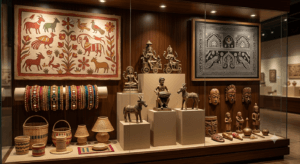
UNESCO Heritage and GI Tagged Products of Jharkhand
Jharkhand is renowned for its rich tribal heritage, traditional art forms, and vibrant cultural diversity. Although the state currently does not have a UNESCO World Heritage Site, it has earned international recognition through its unique cultural traditions. The Seraikela Chhau Dance has been inscribed on UNESCO’s Representative List of the Intangible Cultural Heritage of Humanity, highlighting the global significance of Jharkhand’s performing arts.
The state is also known for its traditional handicrafts and indigenous art forms. Some of these have received Geographical Indication (GI) status, while others are recognized as unique cultural products closely associated with Jharkhand’s tribal communities.
UNESCO Intangible Cultural Heritage
Seraikela Chhau Dance
Seraikela Chhau is one of the three major styles of Chhau dance in India and originated in Seraikela-Kharsawan district of Jharkhand.
This classical folk dance combines:
- Martial arts
- Folk traditions
- Classical dance movements
- Storytelling
- Colourful masks
- Traditional music
The performances are based on themes from:
- Ramayana
- Mahabharata
- Puranas
- Nature
- Tribal folklore
In 2010, Chhau Dance (including the Seraikela style) was inscribed on the UNESCO Representative List of the Intangible Cultural Heritage of Humanity.
Importance
- Preserves tribal traditions
- Promotes cultural tourism
- Provides livelihood to artists
- Represents Jharkhand internationally
GI Tagged Products of Jharkhand
Geographical Indication (GI) tags protect products that possess unique qualities linked to a specific geographical region.
Jharkhand is gradually gaining recognition for its traditional tribal arts and handicrafts.
Sohrai Painting (GI Tagged)
Sohrai Painting is one of Jharkhand’s most famous tribal art forms.
Created mainly by women, these paintings decorate the walls of houses during the Sohrai Festival, celebrating the harvest season.
Common themes include:
- Cattle
- Birds
- Forest animals
- Trees
- Flowers
- Farming
- Tribal life
Natural colours prepared from clay, charcoal, and plant materials are traditionally used.
Khovar Painting (GI Tagged)
Khovar Painting is another celebrated tribal painting tradition of Jharkhand.
Traditionally created during weddings, these artworks feature:
- Floral designs
- Geometric patterns
- Peacocks
- Vines
- Sacred symbols
The paintings symbolize prosperity, fertility, and marital happiness.
Other Famous Traditional Products
Jharkhand is also known for several unique traditional products.
Dokra Metal Craft
Ancient lost-wax brass casting practiced by tribal artisans.
Lac Bangles
Beautiful handmade bangles produced using natural lac.
Bamboo and Cane Crafts
Eco-friendly household and decorative products made by tribal communities.
Stone Carving
Traditional stone sculptures and decorative handicrafts.
Wooden Handicrafts
Furniture, toys, masks, and decorative articles made from locally available wood.
Tribal Jewellery
Handmade ornaments crafted from brass, silver, beads, seeds, and natural materials.
Importance of GI Products
GI-tagged and traditional products help:
- Protect indigenous knowledge
- Promote rural employment
- Preserve tribal culture
- Increase exports
- Encourage tourism
- Support women artisans
- Strengthen local economies
The Government of Jharkhand actively promotes these products through exhibitions, handicraft fairs, and e-commerce platforms.
UNESCO Heritage and GI Products of Jharkhand
| Heritage / Product | Category | Famous For |
|---|---|---|
| Seraikela Chhau Dance | UNESCO Intangible Heritage | Masked Dance Tradition |
| Sohrai Painting | GI Tagged Tribal Art | Wall Paintings |
| Khovar Painting | GI Tagged Tribal Art | Wedding Art |
| Dokra Craft | Metal Craft | Lost-Wax Casting |
| Lac Bangles | Handicraft | Traditional Jewellery |
| Bamboo Craft | Handicraft | Eco-friendly Products |
| Stone Carving | Handicraft | Sculptures |
| Tribal Jewellery | Traditional Craft | Handmade Ornaments |
Shopping in Jharkhand
Shopping in Jharkhand offers visitors a wonderful opportunity to experience the state’s rich tribal heritage, traditional craftsmanship, and local culture. The markets are filled with handcrafted products made by skilled tribal artisans using natural materials such as bamboo, wood, lac, clay, brass, and stone. These products are not only beautiful souvenirs but also represent centuries-old traditions passed down through generations.
Apart from handicrafts, Jharkhand is also known for handloom textiles, tribal jewellery, organic forest products, and locally produced food items. Government emporiums, handicraft exhibitions, and weekly tribal markets provide authentic products at reasonable prices.
HWhat to Buy in Jharkhand
Visitors should consider purchasing the following traditional products:
- Sohrai Paintings
- Khovar Paintings
- Dokra Metal Craft
- Lac Bangles
- Bamboo Handicrafts
- Cane Furniture
- Tribal Jewellery
- Wooden Handicrafts
- Stone Carvings
- Handwoven Textiles
- Terracotta Items
- Leaf Craft Products
- Organic Honey
- Tamarind Products
- Mahua-based Products (where legally available)
- Herbal and Ayurvedic Products
These items reflect the artistic excellence of Jharkhand’s tribal communities and make excellent souvenirs and gifts.
Ranchi Markets
Being the capital city, Ranchi offers numerous shopping destinations.
Firayalal Chowk Market
One of the busiest commercial areas in Ranchi, known for:
- Clothing
- Footwear
- Electronics
- Handicrafts
- Traditional items
Upper Bazar
A popular wholesale and retail market famous for:
- Textiles
- Household goods
- Tribal products
- Local spices
Government Handicraft Emporiums
These stores sell authentic tribal handicrafts produced by government-recognized artisan groups.
Jamshedpur Markets
Jamshedpur is one of the state’s best shopping destinations.
Popular markets include:
- Bistupur Market
- Sakchi Market
- Kadma Market
Visitors can purchase:
- Fashion products
- Jewellery
- Handicrafts
- Gift items
- Local food products
Deoghar Markets
Pilgrims visiting Baidyanath Dham often shop for:
- Religious souvenirs
- Rudraksha beads
- Brass idols
- Incense sticks
- Prayer materials
- Local sweets
Tribal Handicraft Markets
Weekly village markets (Haats) across Jharkhand offer authentic handmade products directly from tribal artisans.
Popular products include:
- Bamboo baskets
- Wooden toys
- Dokra sculptures
- Tribal ornaments
- Clay pots
- Lac jewellery
Shopping from these markets supports rural artisans and promotes sustainable livelihoods.
Government Emporiums
The Government of Jharkhand promotes tribal handicrafts through state-run emporiums and exhibitions.
These outlets ensure:
- Authentic products
- Fair prices
- Quality assurance
- Support for artisan communities
They are ideal places to purchase genuine handicrafts.
Food Products to Buy
Some locally produced food items include:
- Organic Honey
- Tamarind
- Pickles
- Traditional Snacks
- Herbal Tea
- Millets
- Spices
- Forest Produce
These products are popular among tourists seeking authentic local flavours.
Shopping Tips
While shopping in Jharkhand, visitors should:
- Purchase from authorized stores.
- Support local tribal artisans.
- Compare prices before buying.
- Carry reusable shopping bags.
- Check the quality of handicrafts.
- Ask about the origin of handmade products.
- Prefer government-certified handicraft outlets for authentic items.
Importance of Tribal Handicrafts
Shopping for traditional handicrafts helps:
- Preserve tribal culture.
- Generate rural employment.
- Promote women artisans.
- Encourage sustainable tourism.
- Protect traditional craftsmanship.
- Strengthen local economies.
By purchasing local products, visitors directly contribute to the livelihoods of artisan families.
Popular Shopping Items in Jharkhand
| Product | Category | Famous Place |
|---|---|---|
| Sohrai Painting | Tribal Art | Hazaribagh |
| Khovar Painting | Tribal Art | Hazaribagh |
| Dokra Metal Craft | Metal Handicraft | Saraikela & Kharsawan |
| Lac Bangles | Jewellery | Ranchi |
| Bamboo Crafts | Handicraft | Khunti, Gumla |
| Tribal Jewellery | Handicraft | Ranchi |
| Wooden Handicrafts | Wood Craft | West Singhbhum |
| Stone Carvings | Stone Art | Ranchi |
| Organic Honey | Forest Product | Various Districts |
| Tamarind Products | Food Product | Tribal Areas |
Sports in Jharkhand
Sports play an important role in the social and cultural life of Jharkhand. The state has produced several internationally acclaimed athletes in cricket, hockey, archery, athletics, and football. With a strong tribal sporting tradition, abundant natural talent, and improved sports infrastructure, Jharkhand has emerged as one of India’s leading states in sports development.
The Government of Jharkhand actively promotes sports through academies, training centres, scholarships, and modern stadiums. Tribal communities have traditionally excelled in archery, hockey, and athletics, while cricket has gained immense popularity due to the success of Mahendra Singh Dhoni (MS Dhoni).
Cricket
Cricket is the most popular sport in Jharkhand.
The state gained worldwide recognition after MS Dhoni led the Indian cricket team to victory in the:
- ICC T20 World Cup (2007)
- ICC Cricket World Cup (2011)
- ICC Champions Trophy (2013)
Jharkhand has consistently produced talented cricketers who represent domestic teams and the Indian national team.
Major Cricket Stadiums
- JSCA International Stadium Complex, Ranchi
- Keenan Stadium, Jamshedpur
The JSCA International Stadium regularly hosts international matches, IPL games, and domestic tournaments.
Hockey
Hockey is one of the oldest and most successful sports in Jharkhand.
Many tribal players have represented India at international competitions.
Notable hockey players include:
- Nikki Pradhan
- Salima Tete
- Savita Punia (represented clubs in Jharkhand competitions)
- Several national-level tribal athletes
The state government continues to establish hockey training centres and AstroTurf grounds.
Archery
Jharkhand is widely regarded as one of India’s strongest centres for archery.
The tribal communities have practiced traditional archery for centuries, which has helped produce world-class athletes.
Famous Archer
Deepika Kumari
Achievements:
- Multiple World Cup medals
- Commonwealth Games Gold Medalist
- Olympian
- Former World No. 1 Archer
Archery academies in Ranchi continue to train young athletes.
Football
Football enjoys significant popularity, particularly in rural and tribal areas.
School tournaments, district leagues, and state championships encourage young players to participate in competitive football.
Several football academies operate across the state to nurture emerging talent.
Athletics
Jharkhand has produced talented athletes in:
- Sprinting
- Long-distance running
- High Jump
- Javelin Throw
- Tribal traditional sports
Government-supported training programmes continue to improve athletic performance.
Traditional Tribal Sports
Many indigenous sports remain popular in tribal communities.
Traditional activities include:
- Traditional Archery
- Wrestling
- Kabaddi
- Running Competitions
- Indigenous Games during Festivals
These sports are an integral part of tribal festivals and community celebrations.
Sports Infrastructure
Jharkhand has significantly improved its sports infrastructure.
Major facilities include:
- JSCA International Stadium
- Mega Sports Complex, Ranchi
- AstroTurf Hockey Grounds
- Indoor Stadiums
- District Sports Complexes
- Archery Training Centres
- Athletic Tracks
These facilities host state, national, and international sporting events.
Government Initiatives
The Government of Jharkhand promotes sports through:
- Sports Scholarships
- Talent Identification Programmes
- Rural Sports Development
- Tribal Sports Promotion
- Sports Academies
- Coaching Camps
- Women’s Sports Development
- Infrastructure Development
These initiatives encourage youth participation and improve competitive performance.
Contribution of Sports
Sports contribute to:
- Youth Development
- Employment Opportunities
- Tourism
- National Recognition
- Women’s Empowerment
- Tribal Talent Development
- Physical Fitness
- International Success
Jharkhand continues to strengthen its reputation as one of India’s emerging sporting states.
Major Sports of Jharkhand
| Sport | Famous Personality / Venue | Speciality |
|---|---|---|
| Cricket | MS Dhoni, JSCA Stadium | International Cricket |
| Hockey | Salima Tete, Nikki Pradhan | International Hockey |
| Archery | Deepika Kumari | World-class Archery |
| Football | State Football Leagues | Grassroots Development |
| Athletics | State Athletes | Track & Field |
| Traditional Archery | Tribal Communities | Indigenous Sport |
| Kabaddi | Rural Competitions | Traditional Sport |
Government and Political Structure of Jharkhand
Jharkhand follows a parliamentary system of government based on the Constitution of India. The state has three independent branches of governance—the Executive, Legislature, and Judiciary—which work together to ensure democratic administration, law enforcement, and public welfare.
Since its formation on 15 November 2000, Jharkhand has witnessed continuous political and administrative development. The state government is responsible for sectors such as education, healthcare, agriculture, rural development, industries, tribal welfare, tourism, transport, and law and order.
Executive
The Executive is responsible for implementing government policies and administering the state.
Its key constitutional offices include:
- Governor
- Chief Minister
- Council of Ministers
- Chief Secretary
- State Government Departments
Governor
The Governor is the constitutional head of Jharkhand and is appointed by the President of India.
Major responsibilities include:
- Appointing the Chief Minister
- Summoning and proroguing the Legislative Assembly
- Giving assent to Bills
- Safeguarding constitutional governance
- Acting on the advice of the Council of Ministers
Chief Minister
The Chief Minister is the head of the elected government and exercises executive authority.
Major responsibilities include:
- Leading the Council of Ministers
- Formulating government policies
- Implementing development programmes
- Managing state administration
- Representing Jharkhand at the national level
Legislative Assembly
Jharkhand has a unicameral legislature known as the Jharkhand Legislative Assembly (Vidhan Sabha).
Key Facts
- Legislature Type: Unicameral
- Total Assembly Constituencies: 81
- Elected Members: 81
- Term: 5 Years (unless dissolved earlier)
The Assembly passes state laws, approves the state budget, and discusses matters relating to governance and development.
Parliamentary Representation
Jharkhand is represented in the Parliament of India through members elected to both the Lok Sabha and the Rajya Sabha.
Lok Sabha
- Total Seats: 14
Rajya Sabha
- Total Seats: 6
Members represent the interests of Jharkhand at the national level.
Judiciary
The judiciary ensures justice and protects constitutional rights.
High Court
The High Court of Jharkhand is located in Ranchi.
It has jurisdiction over the entire state and hears:
- Civil Cases
- Criminal Cases
- Constitutional Matters
- Public Interest Litigations
- Appeals from Lower Courts
District and Sessions Courts function under the supervision of the High Court.
Local Self-Government
Local governance in Jharkhand operates through both rural and urban bodies.
Rural Local Bodies
- Zila Parishad
- Panchayat Samiti
- Gram Panchayat
Urban Local Bodies
- Municipal Corporations
- Municipal Councils
- Nagar Panchayats
These institutions play a vital role in local administration, sanitation, drinking water supply, roads, and community development.
Major Government Departments
The Government of Jharkhand functions through several departments, including:
- Home Department
- Finance Department
- Education Department
- Health Department
- Agriculture Department
- Forest, Environment & Climate Change Department
- Rural Development Department
- Industries Department
- Tribal Welfare Department
- Tourism Department
- Transport Department
Each department is responsible for implementing welfare schemes and development projects.
Governance Initiatives
The Government of Jharkhand has launched several initiatives to improve governance, including:
- Digital Governance
- Online Citizen Services
- Land Record Digitization
- E-District Services
- Rural Infrastructure Development
- Tribal Welfare Programmes
- Skill Development Missions
- Women’s Empowerment Schemes
- Healthcare Expansion
- Smart City Projects
These initiatives aim to provide transparent, efficient, and citizen-friendly governance.
Importance of the Political System
Jharkhand’s political and administrative framework supports:
- Democratic Governance
- Rule of Law
- Social Justice
- Tribal Development
- Economic Growth
- Infrastructure Development
- Public Welfare
- Sustainable Development
The state’s governance system plays a crucial role in balancing industrial growth with environmental conservation and tribal rights.
Government and Political Structure of Jharkhand
| Particular | Details |
|---|---|
| State Formation | 15 November 2000 |
| Capital | Ranchi |
| Legislature | Unicameral |
| Legislative Assembly Seats | 81 |
| Lok Sabha Seats | 14 |
| Rajya Sabha Seats | 6 |
| High Court | High Court of Jharkhand, Ranchi |
| Head of State | Governor |
| Head of Government | Chief Minister |
| Local Governance | Panchayati Raj & Urban Local Bodies |
Timeline of Jharkhand History
Jharkhand has a rich and fascinating history that spans thousands of years. The region has been inhabited since prehistoric times and has witnessed the rise of ancient kingdoms, tribal civilizations, medieval dynasties, the Mughal period, British colonial rule, tribal uprisings, the Indian freedom movement, and finally the creation of Jharkhand as a separate state in 2000.
The history of Jharkhand is closely associated with its indigenous tribal communities, mineral wealth, dense forests, and continuous struggle to protect land, forests, and cultural identity. The timeline below highlights some of the most significant events that shaped the state’s historical journey.
Prehistoric Period
Archaeological discoveries indicate that humans lived in the Jharkhand region during prehistoric times.
Stone tools, rock paintings, and ancient settlements found in various districts suggest that early human communities depended on hunting, gathering, and primitive agriculture.
Ancient Period
During ancient times, the region formed part of several kingdoms and tribal chiefdoms.
Important features of this period include:
- Growth of tribal societies
- Development of agriculture
- Trade routes connecting eastern and central India
- Spread of Hinduism, Buddhism, and Jainism
- Emergence of Parasnath as an important Jain pilgrimage centre
Medieval Period
Between the 8th and 16th centuries, Jharkhand came under the influence of various regional dynasties.
Major developments included:
- Rule of the Nagvanshi Kings
- Construction of temples and forts
- Expansion of agriculture
- Growth of local trade
- Preservation of tribal self-governance
Many tribal communities continued to enjoy considerable autonomy in forest regions.
Mughal Period
During the Mughal era, parts of present-day Jharkhand came under Mughal influence.
However, dense forests and difficult terrain limited direct administrative control, allowing many tribal kingdoms to retain their traditional systems of governance.
British Colonial Period
The British East India Company gradually established control over the region during the 18th and 19th centuries.
Large-scale mining, railway construction, and forest exploitation began during this period.
British policies led to widespread dissatisfaction among tribal communities because of:
- Land alienation
- Heavy taxation
- Forest restrictions
- Exploitation by landlords and moneylenders
Major Tribal Revolts
Jharkhand became the centre of several important tribal resistance movements.
Chuar Rebellion
One of the earliest tribal uprisings against British authority.
Kol Rebellion (1831–32)
Led mainly by the Ho, Munda, and Oraon communities against exploitation and British administration.
Santhal Hul (1855–56)
Led by Sidhu Murmu and Kanhu Murmu, this was one of the largest tribal revolts in Indian history.
Birsa Munda’s Ulgulan (1899–1900)
Led by Birsa Munda, the Ulgulan (Great Tumult) aimed to restore tribal land rights and resist British rule.
This movement remains one of the most significant chapters in Jharkhand’s history.
Indian Freedom Movement
People from Jharkhand actively participated in India’s struggle for independence.
Many tribal leaders, social reformers, and freedom fighters contributed to movements against British colonial rule.
H3: Demand for a Separate State
After Independence, demands for a separate Jharkhand state gained momentum.
Key developments included:
- Formation of the Jharkhand Party
- Leadership of Jaipal Singh Munda
- Tribal rights movements
- Public campaigns
- Parliamentary discussions
- The movement continued for several decades.
Formation of Jharkhand
After years of public demand, the Jharkhand Reorganisation Act, 2000 was passed by the Parliament of India.
On 15 November 2000, Jharkhand officially became the 28th state of India, with Ranchi as its capital.
The date was chosen to commemorate the birth anniversary of Birsa Munda.
Modern Jharkhand
Since its formation, Jharkhand has made significant progress in:
- Mining
- Steel Industry
- Infrastructure
- Education
- Healthcare
- Tourism
- Tribal Welfare
- Digital Governance
Today, Jharkhand is one of India’s leading mineral-producing states and continues to balance industrial growth with environmental conservation and tribal development.
Historical Timeline of Jharkhand
| Year / Period | Major Event |
|---|---|
| Prehistoric Period | Early Human Settlements |
| Ancient Period | Tribal Kingdoms and Early Civilizations |
| Medieval Period | Rule of Nagvanshi Kings |
| Mughal Era | Partial Mughal Influence |
| 1765 onwards | British Expansion in the Region |
| 1831–32 | Kol Rebellion |
| 1855–56 | Santhal Hul |
| 1899–1900 | Birsa Munda’s Ulgulan |
| 1947 | India Became Independent |
| 15 November 2000 | Formation of Jharkhand State |
Competitive Exam Notes (UPSC, SSC, PSC & State Exams)
Jharkhand is an important topic in competitive examinations such as UPSC, SSC, State PSCs, Railways, Banking, CDS, CAPF, NDA, Police Recruitment, APPSC, TSPSC, BPSC, and JPSC. Questions related to the state’s geography, history, economy, tribal communities, national parks, rivers, industries, and important personalities are frequently asked.
The following revision notes provide quick facts and one-liners that are useful for last-minute preparation.
Quick Revision Notes
Basic Facts
- State Name: Jharkhand
- Formation Date: 15 November 2000
- Statehood: 28th State of India
- Capital: Ranchi
- Largest City: Jamshedpur
- Official Language: Hindi
- Additional Official Language: Urdu
- High Court: High Court of Jharkhand, Ranchi
- Legislative Assembly Seats: 81
- Lok Sabha Seats: 14
- Rajya Sabha Seats: 6
Geography One-Liners
- Highest Peak: Parasnath Hill
- Largest River System: Damodar River
- Famous Plateau: Chota Nagpur Plateau
- Largest Forest Region: Saranda Forest
- Major Waterfall: Hundru Falls
- Largest Industrial City: Jamshedpur
- Coal Capital: Dhanbad
State Symbols
- State Animal: Asian Elephant
- State Bird: Asian Koel
- State Tree: Sal
- State Flower: Palash
National Parks & Wildlife
- National Park: Betla National Park
- Tiger Reserve: Palamau Tiger Reserve
- Famous Wildlife Sanctuary: Dalma Wildlife Sanctuary
- Elephant Reserve: Singhbhum Elephant Reserve
Major Rivers
- Damodar
- Subarnarekha
- Barakar
- Koel
- Sankh
- Ajay
- Mayurakshi
Major Industries
- Steel Industry
- Coal Mining
- Iron Ore Mining
- Copper Mining
- Power Generation
- Heavy Engineering
- Cement Industry
Famous Personalities
- Birsa Munda – Tribal Freedom Fighter
- Jaipal Singh Munda – Hockey Captain & Constituent Assembly Member
- MS Dhoni – Cricketer
- Deepika Kumari – Archer
- Droupadi Murmu – Former Governor of Jharkhand & President of India
- Shibu Soren – Tribal Leader
- Arjun Munda – Former Chief Minister
Important Religious Places
- Baidyanath Dham
- Parasnath Hill
- Rajrappa Temple
- Jagannath Temple
- Deori Temple
- Sun Temple
- Pahari Mandir
Important Tourist Places
- Netarhat
- Patratu Valley
- Betla National Park
- Hundru Falls
- Dassam Falls
- Jonha Falls
- Jubilee Park
- Dalma Wildlife Sanctuary
Important Tribal Communities
- Santhal
- Munda
- Oraon
- Ho
- Kharia
- Asur
- Birhor
- Bhumij
- Paharia
Frequently Asked Exam Questions
Q1. When was Jharkhand formed?
Answer: 15 November 2000
Q2. Which is the capital of Jharkhand?
Answer: Ranchi
Q3. Which is the largest city?
Answer: Jamshedpur
Q4. Which is the highest peak?
Answer: Parasnath Hill
Q5. Which is the only national park?
Answer: Betla National Park
Q6. Which river is known as the lifeline of industrial Jharkhand?
Answer: Damodar River
Q7. Which freedom fighter led the Ulgulan Movement?
Answer: Birsa Munda
Q8. Which cricketer belongs to Jharkhand?
Answer: Mahendra Singh Dhoni
Q9. Which district is known as the Coal Capital of India?
Answer: Dhanbad
Q10. Which UNESCO-recognized cultural tradition is associated with Jharkhand?
Answer: Seraikela Chhau Dance (part of the UNESCO-listed Chhau dance tradition)
Competitive Exam Quick Facts
| Topic | Answer |
|---|---|
| Formation Date | 15 November 2000 |
| Capital | Ranchi |
| Largest City | Jamshedpur |
| Highest Peak | Parasnath Hill |
| State Animal | Asian Elephant |
| State Bird | Asian Koel |
| National Park | Betla National Park |
| Tiger Reserve | Palamau Tiger Reserve |
| Largest Industrial City | Jamshedpur |
| Coal Capital | Dhanbad |
| Major River | Damodar |
| Famous Freedom Fighter | Birsa Munda |
| Famous Cricketer | MS Dhoni |
| UNESCO Heritage | Seraikela Chhau Dance (Intangible Heritage) |
Jharkhand Travel Itinerary (1-Day, 3-Day & 5-Day Travel Plan)
Jharkhand offers an ideal mix of spirituality, waterfalls, wildlife, forests, hill stations, tribal culture, and industrial heritage. Whether you have one day or a full week, you can explore some of the state’s most iconic attractions. The following itineraries are designed to help tourists make the best use of their time while experiencing Jharkhand’s diverse landscapes and cultural heritage.
1-Day Jharkhand Itinerary (Ranchi City Tour)
If you have only one day, Ranchi is the best place to explore because many attractions are located within a short distance.
Morning
- Tagore Hill
- Pahari Mandir
- Rock Garden
Afternoon
- Kanke Dam
- Birsa Zoological Park
- Ranchi Lake
Evening
- Jagannath Temple
- Local Shopping
- Traditional Jharkhand Dinner
Best For
- Families
- Weekend Travelers
- Business Visitors
3-Day Jharkhand Itinerary
A three-day trip allows visitors to explore waterfalls, temples, wildlife, and scenic valleys.
Day 1 – Ranchi
- Tagore Hill
- Pahari Mandir
- Rock Garden
- Ranchi Lake
- Local Markets
Day 2 – Waterfalls
- Hundru Falls
- Dassam Falls
- Jonha Falls
- Sita Falls
Day 3 – Patratu Valley
- Patratu Valley
- Patratu Dam
- Scenic Drive
- Local Tribal Cuisine
- Return to Ranchi
Ideal For
- Nature Lovers
- Photographers
- Adventure Travelers
5-Day Jharkhand Itinerary
Five days provide enough time to experience Jharkhand’s major attractions.
Day 1
- Explore Ranchi
- Tagore Hill
- Jagannath Temple
- Rock Garden
- Local Markets
Day 2
- Waterfalls Circuit
- Hundru Falls
- Dassam Falls
- Jonha Falls
Day 3
- Betla National Park
Activities:
- Jeep Safari
- Wildlife Photography
- Palamau Fort
- Nature Walk
Day 4
- Netarhat
- Sunrise Point
- Sunset Point
- Magnolia Point
- Pine Forests
Day 5
- Deoghar
- Baba Baidyanath Dham
- Naulakha Temple
- Trikut Hills
- Local Shopping
Pilgrimage Tour
For devotees, the following spiritual circuit is recommended:
- Baidyanath Dham
- Rajrappa Temple
- Jagannath Temple
- Deori Temple
- Sun Temple
- Pahari Mandir
- Parasnath Hill
Duration:
3–5 Days
Wildlife Tour
Recommended destinations:
- Betla National Park
- Palamau Tiger Reserve
- Dalma Wildlife Sanctuary
- Udhwa Bird Sanctuary
Duration:
2–4 Days
Adventure Tour
Adventure enthusiasts can enjoy:
- Trekking at Parasnath Hill
- Trekking in Netarhat
- Wildlife Safari
- Camping
- Boating
- Photography
- Nature Trails
Family Tour
Recommended attractions:
- Ranchi
- Patratu Valley
- Jubilee Park
- Dimna Lake
- Deoghar
- Netarhat
These destinations are suitable for visitors of all age groups.
Estimated Travel Budget
Budget Trip
- ₹1,500–₹2,500 per day
- Mid-Range Trip
- ₹3,000–₹6,000 per day
Luxury Trip
- ₹7,000–₹15,000+ per day
The cost depends on accommodation, transportation, dining, and sightseeing preferences.
Travel Tips
- Visit between October and March for the best weather.
- Book hotels in advance during Shravani Mela and major festivals.
- Wear comfortable trekking shoes.
- Carry light woollen clothing in winter.
- Follow safety instructions near waterfalls.
- Respect tribal customs and local traditions.
- Avoid littering in forests and tourist destinations.
- Carry cash when travelling to remote villages, although digital payments are widely accepted in cities.
Frequently Asked Questions (FAQs) About Jharkhand
Below are some of the most commonly asked questions about Jharkhand. These FAQs are useful for students, competitive exam aspirants, tourists, researchers, and general readers. They also help improve SEO by covering common search queries related to the state.
H3: 1. Where is Jharkhand located?
Jharkhand is located in eastern India. It shares its borders with Bihar, West Bengal, Odisha, Chhattisgarh, and Uttar Pradesh.
H3: 2. When was Jharkhand formed?
Jharkhand was formed on 15 November 2000 after being separated from Bihar. The date also marks the birth anniversary of Birsa Munda.
H3: 3. What is the capital of Jharkhand?
Ranchi is the capital city of Jharkhand and serves as its administrative, political, and educational centre.
H3: 4. Which is the largest city in Jharkhand?
Jamshedpur is the largest city in Jharkhand and is famous as India’s first planned industrial city.
H3: 5. How many districts are there in Jharkhand?
Jharkhand has 24 districts, grouped into 5 administrative divisions.
H3: 6. Why is Jharkhand famous?
Jharkhand is famous for:
- Mineral resources
- Coal mines
- Steel industries
- Dense forests
- Waterfalls
- Tribal culture
- Baidyanath Jyotirlinga
- Parasnath Hill
- Wildlife sanctuaries
H3: 7. What is the meaning of the name Jharkhand?
The word Jharkhand means “Land of Forests.” It is derived from the Sanskrit words Jhar (forest) and Khand (land).
H3: 8. Which is the highest peak in Jharkhand?
Parasnath Hill in Giridih district is the highest peak in Jharkhand, with an elevation of approximately 1,365 metres.
H3: 9. Which is the only national park in Jharkhand?
Betla National Park is the only national park in Jharkhand.
H3: 10. Which river is the most important in Jharkhand?
The Damodar River is considered one of the most important rivers because of its role in industry, irrigation, and power generation.
H3: 11. Which is the most famous temple in Jharkhand?
Baidyanath Dham (Baba Baidyanath Temple) in Deoghar is the most famous temple in the state and one of the 12 Jyotirlingas of Lord Shiva.
H3: 12. Which languages are spoken in Jharkhand?
Major languages include:
- Hindi
- Urdu
- Santhali
- Mundari
- Ho
- Kurukh
- Nagpuri
- Khortha
- Kurmali
H3: 13. Who is the most famous freedom fighter from Jharkhand?
Birsa Munda is the most celebrated tribal freedom fighter from Jharkhand.
H3: 14. Which famous cricketer belongs to Jharkhand?
Mahendra Singh Dhoni (MS Dhoni) belongs to Ranchi, Jharkhand.
H3: 15. Which is the best time to visit Jharkhand?
The best time to visit Jharkhand is October to March, when the weather is pleasant and ideal for sightseeing.
H3: 16. What are the major industries of Jharkhand?
Major industries include:
- Steel
- Mining
- Coal
- Heavy Engineering
- Power Generation
- Cement
- Manufacturing
H3: 17. What is the state animal of Jharkhand?
The Asian Elephant is the state animal of Jharkhand.
H3: 18. What is the state bird of Jharkhand?
The Asian Koel is the state bird of Jharkhand.
H3: 19. What are the famous tourist places in Jharkhand?
Some famous tourist attractions include:
- Baidyanath Dham
- Betla National Park
- Parasnath Hill
- Netarhat
- Hundru Falls
- Patratu Valley
- Dassam Falls
- Dalma Wildlife Sanctuary
20. Why should tourists visit Jharkhand?
Tourists should visit Jharkhand because it offers:
- Beautiful waterfalls
- Dense forests
- Wildlife
- Tribal culture
- Religious sites
- Hill stations
- Adventure tourism
- Industrial heritage
Quick FAQ Summary
| Question | Short Answer |
|---|---|
| Capital | Ranchi |
| Largest City | Jamshedpur |
| Formation Date | 15 November 2000 |
| Number of Districts | 24 |
| Highest Peak | Parasnath Hill |
| National Park | Betla National Park |
| State Animal | Asian Elephant |
| State Bird | Asian Koel |
| Best Time to Visit | October–March |
| Famous Personality | Birsa Munda |
Conclusion
Jharkhand, popularly known as the “Land of Forests,” is one of India’s most fascinating states, where rich tribal heritage, breathtaking natural beauty, spiritual significance, and industrial progress come together. Since its formation on 15 November 2000, the state has emerged as a major centre for mining, steel production, education, eco-tourism, and cultural preservation while maintaining its unique identity and traditions.
From the sacred Baidyanath Dham Jyotirlinga and the holy Parasnath Hill to the scenic Hundru Falls, Patratu Valley, Betla National Park, and the industrial cities of Jamshedpur, Bokaro, and Dhanbad, Jharkhand offers unforgettable experiences for every type of traveller. Nature lovers can explore dense Sal forests and wildlife sanctuaries, adventure enthusiasts can enjoy trekking and waterfalls, pilgrims can visit revered temples and Jain pilgrimage sites, while history lovers can discover the inspiring legacy of Birsa Munda, the Santhal Hul, and the state’s tribal freedom movements.
Jharkhand is also a land of remarkable achievements. Its rich mineral resources have played a vital role in India’s industrial development, while internationally acclaimed personalities such as Birsa Munda, Jaipal Singh Munda, Mahendra Singh Dhoni, and Deepika Kumari have brought immense pride to the state through their contributions to history, sports, and public life.
The state’s colourful festivals, traditional dances, indigenous art forms such as Sohrai and Khovar, vibrant handicrafts, delicious cuisine, and warm hospitality make it one of the most culturally diverse destinations in India. Whether you are planning a family vacation, wildlife safari, pilgrimage, educational tour, photography expedition, or preparing for competitive examinations, Jharkhand has something unique to offer.
As tourism, infrastructure, education, and sustainable development continue to grow, Jharkhand is steadily strengthening its position as one of India’s most promising states while preserving its forests, biodiversity, tribal traditions, and cultural heritage for future generations.
We hope this comprehensive guide has helped you understand every important aspect of Jharkhand, including its history, geography, culture, economy, wildlife, tourism, administration, education, and people. If you are planning to visit Jharkhand, take time to explore its hidden gems, support local artisans, respect tribal customs, and experience the unmatched beauty of this incredible Land of Forests.
Jharkhand is not just a destination—it is an unforgettable journey through India’s forests, heritage, spirituality, adventure, and vibrant tribal culture.
Internal links
Andhra Pradesh – https://dealkartmarket.in/andhra-pradesh/
Arunachal Pradesh – https://dealkartmarket.in/arunachal-pradesh/
Assam – https://dealkartmarket.in/assam/
Bihar – https://dealkartmarket.in/bihar/
Chhattisgarh – https://dealkartmarket.in/chhattisgarh/
Goa – https://dealkartmarket.in/goa/
Gujarat – https://dealkartmarket.in/gujarat/
Haryana – https://dealkartmarket.in/haryana/
Himachal Pradesh – https://dealkartmarket.in/himachal-pradesh/
Jharkhand – https://dealkartmarket.in/jharkhand/
Karnataka – https://dealkartmarket.in/karnataka/
Kerala – https://dealkartmarket.in/kerala/
Madhya Pradesh – https://dealkartmarket.in/madhya-pradesh/
Maharashtra – https://dealkartmarket.in/maharashtra/
Odisha – https://dealkartmarket.in/odisha/
Punjab – https://dealkartmarket.in/punjab/
Rajasthan – https://dealkartmarket.in/rajasthan/
Tamil Nadu – https://dealkartmarket.in/tamil-nadu/
Telangana – https://dealkartmarket.in/telangana/
Uttar Pradesh – https://dealkartmarket.in/uttar-pradesh/
Uttarakhand – https://dealkartmarket.in/uttarakhand/
Reference Links
https://tourism.jharkhand.gov.in/
https://tourism.jharkhand.gov.in/historic-jharkhand
https://tourism.jharkhand.gov.in/eServices