
Introduction:
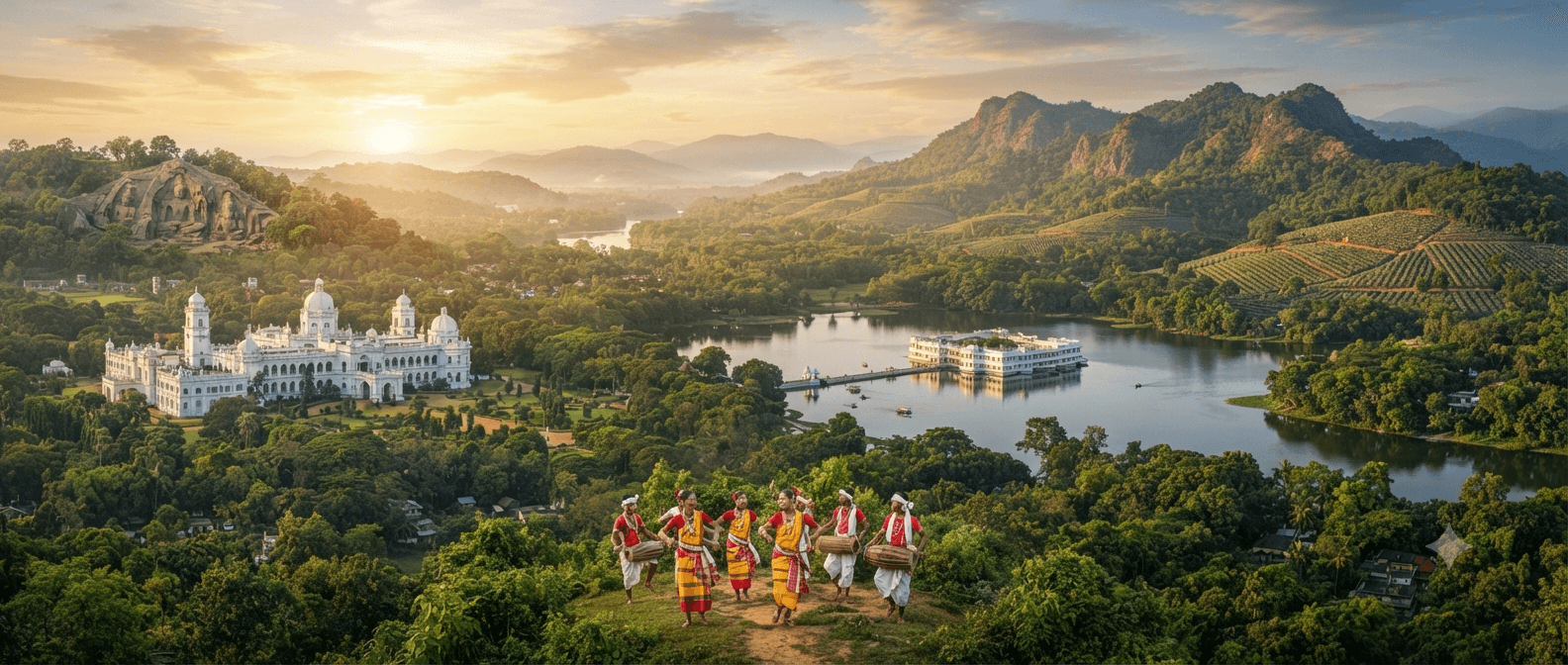
Tripura is one of India’s most fascinating northeastern states, known for its rich cultural heritage, ancient royal history, lush green landscapes, vibrant tribal traditions, and remarkable biodiversity. Surrounded by Bangladesh on three sides and sharing its eastern boundary with Assam and Mizoram, Tripura occupies a strategic position in Northeast India. Despite being one of the smallest states in the country by area, Tripura offers an impressive blend of history, nature, spirituality, and modern development.
The state’s capital, Agartala, serves as the political, cultural, and economic center of Tripura. It is home to magnificent palaces, centuries-old temples, museums, educational institutions, and bustling markets that reflect both traditional and contemporary lifestyles. Over the years, Agartala has emerged as one of the fastest-growing cities in Northeast India while preserving the legacy of the former Manikya dynasty.
Tripura has a history stretching back thousands of years. The region finds mention in ancient Indian literature, including the Mahabharata and several Puranas. For centuries, it was ruled by the Manikya kings, whose contributions shaped the state’s architecture, administration, culture, and religious traditions. The magnificent Ujjayanta Palace and Neermahal Palace continue to stand as symbols of Tripura’s glorious royal past.
Nature is one of Tripura’s greatest treasures. Rolling hills, dense forests, bamboo groves, sparkling rivers, scenic lakes, waterfalls, and wildlife sanctuaries create breathtaking landscapes throughout the state. More than half of Tripura’s geographical area is covered by forests, making it one of India’s environmentally significant states. The state’s rich biodiversity supports numerous species of mammals, birds, reptiles, and medicinal plants.
Tripura is equally celebrated for its cultural diversity. Several indigenous tribal communities, including the Tripuri, Reang (Bru), Jamatia, Chakma, Halam, Mog, Noatia, and Uchoi, have preserved their unique customs, languages, festivals, music, dance forms, and handicrafts for generations. Their colorful traditions coexist harmoniously with Bengali culture, creating a vibrant multicultural society.
Agriculture continues to play an important role in Tripura’s economy. Rice is the primary food crop, while rubber cultivation has transformed the state’s agricultural landscape in recent decades. Pineapple, jackfruit, bamboo, tea, spices, oranges, and various horticultural products also contribute significantly to the state’s economy. Today, Tripura is recognized as one of India’s leading natural rubber-producing states.
Tourism has become another important pillar of Tripura’s development. Visitors are attracted by royal palaces, archaeological sites, ancient rock carvings, Hindu and Buddhist pilgrimage centers, wildlife sanctuaries, eco-tourism destinations, lakes, waterfalls, and cultural festivals. Popular attractions such as Ujjayanta Palace, Neermahal, Unakoti, Sepahijala Wildlife Sanctuary, Jampui Hills, and Dumboor Lake showcase the state’s diverse tourism potential.
Tripura has also made remarkable progress in education, healthcare, infrastructure, digital governance, renewable energy, and connectivity. Improved highways, railway expansion, internet connectivity, and border trade have strengthened the state’s integration with the rest of India while creating new economic opportunities for its people.
Whether someone is interested in history, nature, wildlife, architecture, culture, spirituality, adventure, or authentic northeastern cuisine, Tripura offers unforgettable experiences. Its peaceful environment, welcoming people, and rich heritage make it one of India’s most rewarding yet lesser-explored travel destinations.
The following guide explores every major aspect of Tripura, including its history, geography, districts, climate, culture, festivals, famous tourist attractions, wildlife, cuisine, transportation, education, economy, architecture, UNESCO heritage significance, travel tips, and many fascinating facts that make this beautiful northeastern state truly unique.
Tripura on India Map
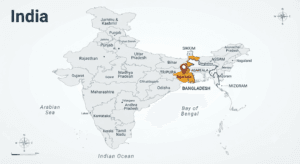
Tripura is strategically located in the northeastern part of India and forms an integral part of the country’s culturally rich and ecologically diverse Northeast Region. Although it is one of India’s smallest states by geographical area, Tripura holds immense strategic importance due to its unique location. The state is almost surrounded by Bangladesh on three sides, while its eastern boundary connects with the Indian states of Assam and Mizoram. This geographical setting has significantly influenced Tripura’s history, trade, transportation, cultural exchanges, and economic development over the centuries.
Covering an area of approximately 10,491 square kilometres, Tripura ranks as the third-smallest state in India. Despite its modest size, the state boasts remarkable geographical diversity, featuring rolling hills, fertile valleys, dense forests, winding rivers, scenic lakes, and productive agricultural lands. These natural features make Tripura one of the greenest and most environmentally significant states in the country.
The capital city, Agartala, is situated in the western part of the state near the India–Bangladesh border. Its strategic location has made it an important administrative, commercial, educational, and transportation hub. Agartala is well connected with the rest of India through roadways, railways, and air transport, while also serving as a key gateway for cross-border trade with Bangladesh.
Tripura lies between 22°56′ North and 24°32′ North latitude and 91°09′ East and 92°20′ East longitude. The state experiences a tropical monsoon climate, with abundant rainfall supporting its rich forests, diverse wildlife, and thriving agriculture. Numerous rivers originate from the surrounding hill ranges and flow westward into Bangladesh, providing valuable water resources for irrigation and local communities.
The state’s geographical position has also strengthened India’s Act East Policy, as Tripura serves as an important link between mainland India and neighbouring Bangladesh. Improved border infrastructure, integrated check posts, railway connectivity, and national highways have enhanced trade opportunities and regional cooperation, contributing to the state’s economic growth.
Key Geographical Highlights
- Region: Northeast India
- Capital City: Agartala
- Total Area: Approximately 10,491 sq km
- International Border: Bangladesh (West, South and North)
- Neighbouring Indian States: Assam and Mizoram
- Latitude: 22°56′ N to 24°32′ N
- Longitude: 91°09′ E to 92°20′ E
- Major Landforms: Hills, valleys, forests, rivers, lakes and plains
- Climate: Tropical monsoon
- Strategic Importance: Important gateway connecting Northeast India with Bangladesh and Southeast Asian trade corridors
Tripura’s location has helped shape its unique identity by blending natural beauty, historical significance, cultural diversity, and economic potential. Today, the state continues to play a vital role in regional connectivity, tourism, border trade, environmental conservation, and sustainable development, making it one of the most strategically significant states in Northeast India.
Quick Facts About Tripura
Tripura is a land of royal heritage, breathtaking natural beauty, rich tribal traditions, and remarkable cultural diversity. Although it is one of the smallest states in India by area, Tripura has played an important role in the historical, cultural, and economic development of Northeast India. The state is known for its centuries-old Manikya dynasty, magnificent palaces, ancient temples, lush forests, wildlife sanctuaries, bamboo handicrafts, rubber plantations, and warm hospitality.
Before exploring Tripura’s history, geography, culture, and tourist attractions in detail, understanding some essential facts about the state provides a strong foundation. These quick facts offer a concise overview of Tripura’s administrative, geographical, demographic, cultural, and economic significance.
Quick Facts at a Glance
| Particular | Details |
|---|---|
| State Name | Tripura |
| Capital | Agartala |
| Formation as a Full-Fledged State | 21 January 1972 |
| Earlier Status | Union Territory (1 November 1956 – 20 January 1972) |
| Largest City | Agartala |
| Total Area | 10,491 sq km |
| Area Rank in India | 3rd Smallest State |
| Population (2011 Census) | Approximately 36.7 lakh |
| Official Languages | Bengali, Kokborok and English |
| Major Tribal Communities | Tripuri, Reang (Bru), Jamatia, Chakma, Halam, Mog, Noatia and Uchoi |
| State Animal | Phayre’s Langur |
| State Bird | Green Imperial Pigeon |
| State Tree | Agar Tree |
| State Flower | Indian Rose Chestnut (Nagakesar) |
| High Court | High Court of Tripura (Agartala) |
| Legislative Assembly Seats | 60 |
| Lok Sabha Seats | 2 |
| Rajya Sabha Seats | 1 |
| Major Rivers | Gomati, Manu, Khowai, Dhalai, Feni, Juri and Haora |
| Highest Peak | Betlingchhip (Betling Sib) |
| Major Crops | Rice, Rubber, Pineapple, Tea, Bamboo, Jackfruit and Spices |
| Famous Tourist Attractions | Ujjayanta Palace, Neermahal, Unakoti, Sepahijala Wildlife Sanctuary, Jampui Hills and Dumboor Lake |
| Primary Economy | Agriculture, Rubber Production, Horticulture, Bamboo, Tourism and Handicrafts |
| Time Zone | Indian Standard Time (IST) |
Tripura is often referred to as one of the hidden gems of Northeast India because it combines royal history, archaeological wonders, rich biodiversity, colourful festivals, tribal heritage, and peaceful landscapes within a relatively small geographical area. The state’s continuous progress in infrastructure, education, healthcare, tourism, and border trade has further strengthened its importance in India’s northeastern region.
Its harmonious blend of traditional values and modern development makes Tripura an attractive destination for travellers, researchers, students, and nature enthusiasts seeking an authentic experience of Northeast India.
Districts of Tripura
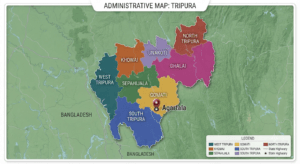
Tripura is administratively divided into 8 districts, each playing a significant role in the state’s governance, economy, culture, and regional development. These districts were reorganized in January 2012 to improve administrative efficiency, strengthen local governance, and ensure better delivery of public services. Every district has its own administrative headquarters, unique geographical features, cultural traditions, and economic activities.
From the bustling urban landscape of West Tripura to the scenic hills of North Tripura, the lush forests of Dhalai, the fertile agricultural lands of Sepahijala, and the picturesque surroundings of various hill regions, every district contributes to Tripura’s diverse identity. The districts are connected through an expanding network of highways, railways, and rural roads, promoting trade, tourism, education, and economic growth across the state.
Agriculture remains the backbone of most districts, while rubber cultivation, bamboo products, tea plantations, horticulture, fisheries, handicrafts, and tourism provide additional employment opportunities. Several districts are also home to important archaeological sites, royal monuments, wildlife sanctuaries, religious destinations, and tribal cultural centres, attracting visitors from across India and abroad.
The table below provides an overview of all the districts of Tripura along with their administrative headquarters.
Districts of Tripura
| District | Headquarters |
|---|---|
| Dhalai | Ambassa |
| Gomati | Udaipur |
| Khowai | Khowai |
| North Tripura | Dharmanagar |
| Sepahijala | Bishramganj |
| South Tripura | Belonia |
| Unakoti | Kailashahar |
| West Tripura | Agartala |
Each district reflects a distinct blend of history, natural beauty, tribal heritage, and economic importance. Together, these eight districts form the administrative framework of Tripura and contribute significantly to the state’s balanced development, cultural preservation, environmental conservation, and tourism growth. Their diversity makes Tripura one of the most fascinating and culturally vibrant states in Northeast India.
History of Tripura
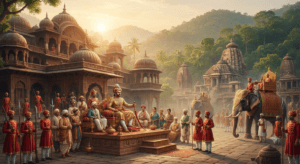
Tripura possesses one of the oldest and most fascinating historical legacies in Northeast India. Its history spans thousands of years and reflects a remarkable blend of mythology, ancient kingdoms, royal dynasties, cultural evolution, colonial interactions, and modern political transformation. From legendary references in ancient Hindu scriptures to the rule of the powerful Manikya dynasty and its eventual integration into the Indian Union, Tripura has played a unique role in shaping the history of the northeastern region.
The origins of Tripura are deeply rooted in mythology. According to local traditions and ancient texts, the state’s name is believed to have originated from King Tripur, a legendary ruler mentioned in the royal chronicle Rajmala. Another popular belief associates the name with Goddess Tripura Sundari, one of the 51 revered Shakti Peethas in Hinduism. The famous Tripura Sundari Temple at Udaipur remains one of the most important pilgrimage centres in India and continues to attract thousands of devotees every year.
Ancient Indian literature also contains references to Tripura. The Mahabharata, several Puranas, and various regional legends mention the region, indicating that it had established cultural and political significance long before the medieval period. Archaeological discoveries, including ancient sculptures, inscriptions, coins, and rock carvings, further suggest that human settlements flourished here for many centuries.
The earliest inhabitants of Tripura were indigenous tribal communities who developed distinct languages, customs, social systems, and cultural traditions. Over time, various tribal groups established organized settlements throughout the hills and valleys. Agriculture, hunting, fishing, bamboo craftsmanship, and forest-based livelihoods formed the backbone of their economy. Even today, these communities continue to preserve many of their traditional practices, contributing significantly to Tripura’s rich cultural identity.
One of the most significant chapters in Tripura’s history began with the rise of the Manikya dynasty, which ruled the kingdom for several centuries. The Manikya rulers transformed Tripura into a powerful and well-organized kingdom that maintained political influence across large parts of present-day Northeast India and neighbouring Bangladesh. Under their leadership, magnificent palaces, temples, forts, reservoirs, and administrative institutions were established, many of which remain important historical landmarks today.
The royal chronicle Rajmala, written in Bengali verse over several centuries, serves as one of the most valuable historical sources for understanding Tripura’s monarchy. It records the genealogy of the Manikya kings, important political events, military campaigns, religious developments, and administrative reforms. Although parts of the chronicle combine mythology with historical narratives, it remains an indispensable source for studying Tripura’s royal heritage.
During the medieval period, Tripura maintained diplomatic and military relations with neighbouring kingdoms, including the Bengal Sultanate and later the Mughal Empire. While conflicts occasionally occurred, the Manikya rulers successfully preserved the kingdom’s autonomy for long periods through strategic alliances, military strength, and effective governance.
The influence of the Mughal Empire gradually expanded into parts of the plains surrounding Tripura during the seventeenth century. Although the Manikya rulers lost control over some lowland territories, they continued to govern the hilly regions independently. The kingdom adapted to changing political conditions by strengthening its administration, improving diplomatic relations, and preserving its cultural identity despite external pressures.
The eighteenth and nineteenth centuries witnessed significant political changes. As the influence of the Mughal Empire declined, the British East India Company emerged as the dominant power in the Indian subcontinent. Tripura entered into treaty relationships with the British while continuing to function as a princely state under the rule of the Manikya dynasty. Unlike many directly administered British provinces, Tripura retained internal autonomy, allowing its rulers to manage local administration, judicial affairs, and cultural institutions.
Several Manikya kings initiated important administrative and developmental reforms during the colonial period. Among the most notable rulers was Maharaja Bir Bikram Kishore Manikya Bahadur Debbarman, often regarded as the architect of modern Tripura. His visionary leadership brought major improvements in education, urban planning, public administration, healthcare, infrastructure, and land management. He also laid the foundation for planned development in Agartala and donated land for establishing educational institutions that continue to serve the state today.
Tripura’s royal family also encouraged literature, music, fine arts, architecture, and religious harmony. Magnificent structures such as Ujjayanta Palace, Neermahal, temples, lakes, and public buildings stand as enduring reminders of the kingdom’s architectural excellence and cultural prosperity. These monuments remain among Tripura’s most celebrated heritage attractions.
A turning point in Tripura’s history came after India’s independence in 1947. Following the death of Maharaja Bir Bikram Kishore Manikya, the administration of the kingdom was managed by Maharani Kanchan Prava Devi as Regent. After careful negotiations, the Instrument of Accession was signed, and Tripura officially merged with the Indian Union on 15 October 1949, becoming a Part C State of India.
On 1 November 1956, Tripura became a Union Territory under the States Reorganisation framework. Continued administrative growth, democratic development, and increasing political representation eventually led to full statehood. On 21 January 1972, Tripura officially became the 21st state of the Republic of India, marking a historic milestone in its political evolution.
Today, Tripura stands as a vibrant democratic state that successfully preserves its royal legacy, tribal traditions, archaeological heritage, and cultural diversity while embracing modernization, economic development, education, tourism, digital governance, and sustainable growth. Its remarkable historical journey—from an ancient tribal kingdom and powerful monarchy to a modern Indian state—makes Tripura one of the most historically significant regions of Northeast India.
Geography of Tripura
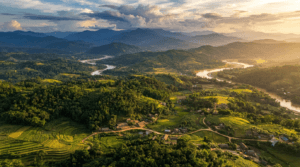
Tripura is one of the most geographically diverse states in Northeast India, despite its relatively small size. Spread over an area of approximately 10,491 square kilometres, the state is characterized by undulating hills, fertile valleys, dense forests, rivers, lakes, wetlands, and rich biodiversity. Its varied landscape supports agriculture, wildlife, forestry, and eco-tourism, making geography one of the defining features of the state.
Situated in the southwestern part of Northeast India, Tripura shares an international border of nearly 856 kilometres with Bangladesh, accounting for most of its boundary. The remaining eastern border is shared with the Indian states of Assam and Mizoram. This strategic geographical position has significantly influenced the state’s trade, transportation, cultural exchanges, and economic development over the centuries.
The terrain of Tripura is dominated by a series of north-south hill ranges separated by fertile valleys. Unlike the snow-covered Himalayan ranges, these hills are comparatively low in elevation and are covered with thick tropical forests. The valleys between the hill ranges contain highly fertile alluvial soil, making them ideal for agriculture and human settlements.
The major hill ranges of Tripura include:
- Jampui Hills – Famous for orange orchards, panoramic viewpoints, and pleasant climate.
- Sakhan Hills – Covered with dense forests and rich biodiversity.
- Longtharai Hills – One of the state’s important hill systems supporting wildlife and tribal settlements.
- Atharamura Hills – Known for rugged landscapes and forest resources.
- Baramura Hills – Rich in bamboo, timber, and diverse flora and fauna.
The highest point in Tripura is Betlingchhip (also known as Betling Sib), located in the Jampui Hill range at an elevation of approximately 939 metres (3,081 feet) above sea level. It is the state’s highest peak and offers spectacular views of the surrounding hills, forests, and neighbouring Bangladesh on clear days.
Tripura is blessed with numerous rivers that originate from its hill ranges and flow westward into Bangladesh. These rivers are essential for irrigation, agriculture, fisheries, drinking water, and local transportation. Some of the state’s major rivers include:
- Gomati
- Manu
- Khowai
- Dhalai
- Feni
- Haora
- Juri
Apart from rivers, Tripura is home to several beautiful lakes and wetlands. Dumboor Lake, formed by the confluence of the Raima and Sarma rivers, is one of the largest freshwater lakes in Northeast India. It supports rich aquatic biodiversity, migratory birds, fishing communities, and eco-tourism activities.
Forests cover more than half of Tripura’s total geographical area, making it one of India’s greenest states. These forests consist mainly of tropical evergreen, semi-evergreen, moist deciduous, and bamboo forests. They provide habitat for elephants, clouded leopards, Phayre’s langurs, bison, deer, hornbills, and numerous other wildlife species. Forest resources also support the livelihoods of many tribal communities through bamboo, medicinal plants, honey, and other non-timber forest products.
Tripura’s fertile valleys, abundant rainfall, extensive forests, rolling hills, and rich natural resources have shaped its economy, culture, biodiversity, and settlement patterns. The state’s unique geography continues to play a vital role in agriculture, environmental conservation, renewable resource management, and sustainable tourism, making Tripura one of the most ecologically significant states in Northeast India.
Climate of Tripura
Tripura experiences a tropical monsoon climate, characterized by warm summers, a humid rainy season, and mild winters. The state’s climate is greatly influenced by the Southwest Monsoon, its extensive forest cover, rolling hills, and proximity to Bangladesh. These geographical features contribute to abundant rainfall, lush vegetation, and favorable conditions for agriculture and biodiversity throughout the year.
The weather in Tripura generally remains pleasant compared to many other parts of India, especially during the winter months. Seasonal variations support the cultivation of rice, rubber, tea, bamboo, pineapples, spices, and a wide variety of horticultural crops. The climate also sustains rich wildlife habitats and dense tropical forests that are home to numerous plant and animal species.
Summer Season (March to May)
Summer in Tripura begins in March and continues until May. During this period, temperatures usually range between 24°C and 35°C, although some areas may occasionally record slightly higher temperatures. The weather remains warm and humid due to high moisture levels in the atmosphere.
Despite the heat, the state’s hills, forests, and river valleys help moderate extreme temperatures. Afternoon thunderstorms, locally associated with pre-monsoon weather patterns, occasionally provide temporary relief from the heat.
Monsoon Season (June to September)
The southwest monsoon arrives in Tripura during June and continues until September. This is the wettest season of the year, with the state receiving an average annual rainfall of approximately 2,000 to 2,500 millimetres, though rainfall varies across different regions.
Heavy rainfall replenishes rivers, lakes, reservoirs, and groundwater resources while supporting agriculture and maintaining the state’s lush forests. However, prolonged rainfall may also lead to localized flooding, waterlogging, and landslides in some hilly areas.
Post-Monsoon Season (October to November)
After the withdrawal of the southwest monsoon, Tripura experiences a pleasant post-monsoon season. The weather becomes cooler, humidity gradually decreases, and the landscape remains fresh and green following the rains.
This period is ideal for sightseeing, cultural festivals, wildlife exploration, and outdoor activities. Clear skies and comfortable temperatures make it one of the most enjoyable times to travel across the state.
Winter Season (December to February)
Winter is the most comfortable season in Tripura. Temperatures generally range between 10°C and 25°C, creating ideal conditions for tourism and outdoor recreation. The weather remains cool, dry, and pleasant, with occasional morning mist in valleys and low-lying areas.
Most major festivals, tourism events, trekking activities, wildlife safaris, and cultural celebrations take place during the winter months. Popular destinations such as Ujjayanta Palace, Neermahal, Unakoti, Jampui Hills, and Sepahijala Wildlife Sanctuary attract a large number of visitors during this season.
Climate Highlights
| Climate Feature | Details |
|---|---|
| Climate Type | Tropical Monsoon |
| Summer Temperature | 24°C to 35°C |
| Winter Temperature | 10°C to 25°C |
| Average Annual Rainfall | 2,000–2,500 mm |
| Wettest Months | June to September |
| Best Time to Visit | October to March |
Tripura’s balanced climate, abundant rainfall, fertile soil, and extensive forest cover create ideal conditions for agriculture, biodiversity, eco-tourism, and sustainable development. The state’s pleasant winter season and scenic post-monsoon landscapes make it one of the most attractive travel destinations in Northeast India throughout much of the year.
Major Rivers of Tripura
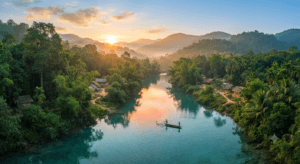
Tripura is blessed with a network of rivers that play a crucial role in the state’s geography, agriculture, economy, biodiversity, and daily life. Most of these rivers originate in the hill ranges of the state and flow westward or southward into neighbouring Bangladesh. They provide water for irrigation, drinking, fisheries, hydroelectric projects, and domestic use while also supporting fertile agricultural lands and rich ecosystems.
The rivers of Tripura have shaped human settlements for centuries. Many towns and villages have developed along riverbanks due to the availability of water and fertile alluvial soil. These rivers also hold religious, cultural, and historical significance, with several temples, festivals, and traditional ceremonies associated with them.
Among all the rivers, the Gomati River is considered the lifeline of Tripura. Originating from the Dumboor Lake region in the Gomati district, it flows westward before entering Bangladesh. The river is of immense importance for irrigation, fisheries, drinking water supply, and hydroelectric power generation. The Gumti Hydroelectric Project constructed on this river contributes significantly to the state’s electricity production.
Another major river is the Manu River, which flows through the districts of Dhalai and Unakoti before entering Bangladesh. It supports agriculture, fishing activities, and rural livelihoods. Similarly, the Khowai River originates in the Atharamura Hills and flows through Khowai district into Bangladesh, serving as an important source of water for nearby settlements.
The Dhalai River is another significant river that flows through the eastern parts of Tripura. It nourishes forests, agricultural lands, and tribal villages while supporting the region’s ecological balance. The Feni River, which forms part of the international boundary between India and Bangladesh, is strategically important for irrigation, water resource management, and cross-border cooperation.
Other notable rivers such as the Haora River and Juri River also contribute significantly to the state’s water resources. The Haora River flows through Agartala, providing water for urban areas, while the Juri River supports agriculture and biodiversity in northern Tripura.
Major Rivers of Tripura
| River | Origin | Importance |
|---|---|---|
| Gomati | Dumboor Lake Region | Irrigation, Hydroelectric Power, Fisheries, Drinking Water |
| Manu | Longtharai Hills | Agriculture, Fishing, Rural Water Supply |
| Khowai | Atharamura Hills | Irrigation and Local Water Supply |
| Dhalai | Eastern Hill Ranges | Agriculture, Forest Ecosystem, Tribal Settlements |
| Feni | South Tripura Hills | International Border River and Irrigation |
| Haora | Baramura Hills | Urban Water Supply and Agriculture |
| Juri | North Tripura Hills | Agriculture and Biodiversity |
These rivers not only sustain agriculture and human settlements but also enrich Tripura’s natural beauty by forming scenic valleys, wetlands, and freshwater ecosystems. Their importance extends beyond water resources, as they support wildlife habitats, eco-tourism, fisheries, and sustainable development. Protecting these rivers through effective conservation and water management remains essential for Tripura’s environmental and economic future.
Agriculture of Tripura
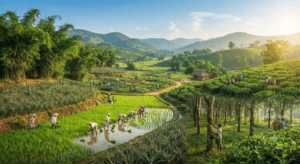
Agriculture is the backbone of Tripura’s economy and remains the primary source of livelihood for a large section of the state’s population. Blessed with fertile alluvial valleys, abundant rainfall, favourable climatic conditions, and rich natural resources, Tripura offers an ideal environment for cultivating a wide variety of food crops, plantation crops, fruits, vegetables, spices, and medicinal plants. Although the state has witnessed rapid growth in industry and the service sector, agriculture continues to play a vital role in ensuring food security, employment, and rural development.
Rice is the principal food crop of Tripura and occupies the largest share of cultivated land. It is grown across almost all districts during different agricultural seasons, with the fertile plains and river valleys producing high-quality paddy. Modern irrigation methods, improved seed varieties, and scientific farming techniques have significantly enhanced rice production in recent years.
Tripura has earned national recognition as one of India’s leading natural rubber-producing states. Rubber cultivation has transformed the rural economy by providing sustainable income to thousands of farming families. Large rubber plantations are spread across districts such as Gomati, Sepahijala, Dhalai, Khowai, and West Tripura. Today, the state ranks among the country’s top producers of natural rubber, making it an important contributor to India’s rubber industry.
Horticulture has also emerged as a major strength of Tripura’s agricultural sector. The state’s fertile soil and humid climate support the cultivation of numerous fruits and vegetables throughout the year. Queen Pineapple, known for its exceptional sweetness, aroma, and low fibre content, is one of Tripura’s most famous agricultural products and enjoys demand in both domestic and international markets. Other important fruits include jackfruit, oranges, bananas, mangoes, litchis, lemons, papayas, guavas, and coconuts.
Apart from fruits, farmers cultivate a variety of vegetables such as tomatoes, brinjals, cucumbers, pumpkins, gourds, beans, okra, cabbage, cauliflower, potatoes, and leafy greens. These crops contribute to food security while supplying local markets and neighbouring states.
Tea cultivation is another significant agricultural activity in Tripura. The state has numerous tea gardens that produce high-quality tea known for its distinctive flavour and aroma. Tripura tea is increasingly gaining recognition in national and international markets, supporting employment and export opportunities.
Spice cultivation has expanded considerably in recent years. Farmers grow black pepper, ginger, turmeric, chilli, bay leaves, cinnamon, and other spices that thrive under the state’s tropical climatic conditions. Bamboo and cane, though technically forest resources, also contribute significantly to rural livelihoods by supporting handicrafts, furniture making, construction, and cottage industries.
Major Agricultural Crops of Tripura
| Category | Major Crops |
|---|---|
| Food Crops | Rice, Maize, Pulses |
| Cash Crops | Natural Rubber, Tea |
| Fruits | Queen Pineapple, Jackfruit, Orange, Banana, Mango, Litchi, Papaya |
| Vegetables | Tomato, Brinjal, Cabbage, Cauliflower, Pumpkin, Okra, Beans |
| Spices | Ginger, Turmeric, Black Pepper, Chilli, Bay Leaf |
| Plantation & Forest Produce | Bamboo, Cane, Coconut, Arecanut |
The Government of Tripura actively promotes sustainable agriculture through irrigation projects, organic farming initiatives, improved seed distribution, farmer training programmes, mechanisation, horticulture missions, and modern agricultural technologies. These initiatives aim to increase farmers’ incomes while ensuring environmental sustainability and efficient use of natural resources.
With its fertile land, favourable climate, diversified cropping pattern, expanding rubber plantations, and growing horticultural sector, Tripura continues to strengthen its position as one of the most agriculturally productive states in Northeast India. Agriculture remains the foundation of the state’s economy and plays a crucial role in its long-term sustainable development.
Flora and Fauna of Tripura
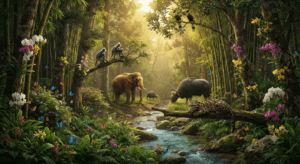
Tripura is one of the most biodiverse states in Northeast India, blessed with vast stretches of tropical forests, rolling hills, wetlands, rivers, and rich wildlife habitats. Forests cover more than 60% of the state’s geographical area, making Tripura an important ecological hotspot. These forests not only support an extraordinary variety of plant and animal species but also play a crucial role in maintaining environmental balance, conserving water resources, preventing soil erosion, and supporting the livelihoods of indigenous tribal communities.
The state’s vegetation mainly consists of tropical evergreen, semi-evergreen, moist deciduous, and bamboo forests. The warm and humid climate, combined with abundant monsoon rainfall, creates ideal conditions for the growth of dense forests and a wide variety of flowering plants, medicinal herbs, orchids, climbers, shrubs, and grasses.
Bamboo and cane are among Tripura’s most valuable forest resources. More than twenty species of bamboo are found across the state, providing raw materials for handicrafts, furniture, construction, paper production, and traditional household items. Bamboo also plays an important role in the cultural and economic life of Tripura’s tribal communities.
The forests of Tripura are home to numerous valuable tree species, including teak, sal, agar, gamhar, champak, rubber, eucalyptus, and various fruit-bearing trees. Medicinal plants and aromatic herbs are also widely distributed throughout the state’s forests, contributing to traditional healthcare practices and biodiversity conservation.
Tripura supports an impressive diversity of wildlife. The state is home to mammals such as the Asian Elephant, Clouded Leopard, Leopard Cat, Barking Deer, Sambar Deer, Wild Boar, Indian Gaur (Bison), Capped Langur, Slow Loris, Hoolock Gibbon, and several species of civets and mongooses.
The Phayre’s Langur, also known as Phayre’s Leaf Monkey, is the State Animal of Tripura. Recognized by its distinctive grey coat and white eye-rings, this endangered primate inhabits the state’s evergreen and semi-evergreen forests and is considered one of Northeast India’s most significant wildlife species.
Tripura is equally rich in birdlife, with more than 300 recorded bird species. Forests, wetlands, and river ecosystems provide habitats for hornbills, kingfishers, woodpeckers, barbets, drongos, eagles, owls, herons, egrets, migratory ducks, and numerous other resident and migratory birds. The Green Imperial Pigeon, the State Bird of Tripura, is commonly found in the state’s forested regions.
Reptiles and amphibians also contribute significantly to the state’s biodiversity. Various species of turtles, tortoises, snakes, lizards, frogs, and freshwater fish inhabit Tripura’s rivers, lakes, wetlands, and forest ecosystems. Many butterfly and insect species further enrich the state’s ecological diversity.
Major Flora and Fauna of Tripura
| Category | Notable Species |
|---|---|
| Major Forest Types | Tropical Evergreen, Semi-Evergreen, Moist Deciduous, Bamboo Forests |
| Important Trees | Agar, Sal, Teak, Gamhar, Champak, Rubber |
| Major Forest Resources | Bamboo, Cane, Medicinal Plants, Aromatic Herbs |
| State Animal | Phayre’s Langur |
| State Bird | Green Imperial Pigeon |
| Mammals | Asian Elephant, Clouded Leopard, Indian Gaur, Sambar Deer, Hoolock Gibbon, Slow Loris |
| Birds | Hornbills, Kingfishers, Woodpeckers, Eagles, Herons, Owls |
| Reptiles | Turtles, Snakes, Lizards |
| Aquatic Life | Freshwater Fish, Amphibians |
The Government of Tripura actively promotes biodiversity conservation through protected areas, wildlife sanctuaries, afforestation programmes, community forest management, and eco-tourism initiatives. These efforts help safeguard the state’s rich natural heritage while encouraging sustainable development.
With its dense forests, remarkable wildlife, valuable forest resources, and exceptional biodiversity, Tripura stands as one of India’s most ecologically significant states. Its flora and fauna continue to play a vital role in environmental conservation, scientific research, tourism, and the traditional lifestyles of its indigenous communities.
National Parks and Wildlife Sanctuaries of Tripura
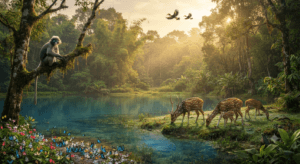
Tripura is one of the richest biodiversity regions in Northeast India, with extensive forest cover, rolling hills, wetlands, rivers, and diverse ecosystems that support a remarkable variety of wildlife. Although the state does not have a national park, it is home to several well-managed wildlife sanctuaries that play a crucial role in conserving endangered species, protecting natural habitats, and promoting eco-tourism. These protected areas preserve Tripura’s unique flora and fauna while providing opportunities for wildlife research, environmental education, and sustainable tourism.
The wildlife sanctuaries of Tripura are spread across different districts and consist of tropical evergreen forests, semi-evergreen forests, bamboo groves, grasslands, marshes, and freshwater lakes. Together, they provide suitable habitats for elephants, clouded leopards, Phayre’s langurs, hoolock gibbons, deer, wild boars, hornbills, migratory birds, reptiles, butterflies, and numerous other species.
Among these protected areas, Sepahijala Wildlife Sanctuary is the most famous. Located about 25 kilometres from Agartala, it covers approximately 18.5 square kilometres and is renowned for its rich biodiversity, botanical garden, zoo, boating facilities, and environmental education centre. The sanctuary is especially known for conserving the endangered Phayre’s Langur, the state animal of Tripura. Visitors can also observe spectacled monkeys, clouded leopards, deer, crocodiles, and hundreds of bird species.
Another important protected area is the Trishna Wildlife Sanctuary, situated in South Tripura district. Covering nearly 195 square kilometres, it is best known for its population of the Indian Gaur (Bison), the largest wild bovine species in India. The sanctuary also supports elephants, barking deer, hoolock gibbons, wild boars, primates, reptiles, and diverse birdlife. Dense forests, grasslands, and water bodies make it one of the state’s premier wildlife destinations.
The Gumti Wildlife Sanctuary, located around the scenic Dumboor Lake, is another major conservation area in Tripura. Spread over approximately 390 square kilometres, it protects tropical forests, wetlands, and important wildlife habitats. The sanctuary is home to elephants, leopards, sambar deer, wild boars, langurs, numerous reptiles, and migratory birds. Dumboor Lake within the sanctuary also supports rich aquatic biodiversity and attracts birdwatchers during winter.
The Rowa Wildlife Sanctuary, located in North Tripura district, is one of the smallest wildlife sanctuaries in the state but remains ecologically significant. Despite its relatively small size, it supports rich tropical vegetation and provides habitat for monkeys, civets, reptiles, butterflies, and several resident bird species. The sanctuary is particularly valuable for conserving local biodiversity and maintaining ecological balance.
Apart from wildlife conservation, these sanctuaries also contribute significantly to eco-tourism, scientific research, environmental awareness, and community participation. Nature trails, birdwatching opportunities, boating, photography, and educational programmes attract tourists, students, researchers, and wildlife enthusiasts throughout the year.
Protected Areas of Tripura
| Protected Area | Type | District | Major Attractions |
|---|---|---|---|
| Sepahijala Wildlife Sanctuary | Wildlife Sanctuary | Sepahijala | Phayre’s Langur, Clouded Leopard, Birds, Botanical Garden |
| Trishna Wildlife Sanctuary | Wildlife Sanctuary | South Tripura | Indian Gaur, Elephants, Hoolock Gibbon |
| Gumti Wildlife Sanctuary | Wildlife Sanctuary | Gomati | Dumboor Lake, Elephants, Deer, Migratory Birds |
| Rowa Wildlife Sanctuary | Wildlife Sanctuary | North Tripura | Tropical Forest, Birds, Primates, Butterflies |
Tripura’s protected areas represent the state’s strong commitment to wildlife conservation and sustainable environmental management. Through habitat protection, afforestation programmes, eco-tourism initiatives, and community-based conservation efforts, these wildlife sanctuaries continue to safeguard the state’s extraordinary biodiversity for future generations while strengthening Tripura’s reputation as one of Northeast India’s premier eco-tourism destinations.
Culture and Traditions of Tripura
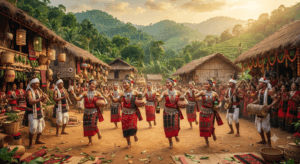
Tripura is a vibrant cultural mosaic where ancient tribal traditions blend harmoniously with Bengali heritage, creating one of the most diverse and fascinating cultural landscapes in Northeast India. The state’s rich cultural identity has evolved over centuries through the coexistence of various indigenous communities, royal influences, religious traditions, and regional customs. Today, Tripura is home to numerous ethnic groups, each preserving its own language, attire, music, dance, festivals, handicrafts, and social practices while contributing to the state’s shared cultural heritage.
The cultural foundation of Tripura is deeply rooted in its indigenous tribal communities. The Tripuri, Reang (Bru), Jamatia, Chakma, Halam, Mog, Noatia, Uchoi, and several other tribes have maintained their distinct customs and traditions for generations. These communities celebrate life through colourful festivals, traditional dances, folk songs, community gatherings, and rituals that strengthen social unity and preserve their ancestral heritage.
Bengali culture also has a significant influence on Tripura’s social and cultural life. Bengali literature, music, theatre, cuisine, festivals, and art have flourished alongside tribal traditions, resulting in a unique multicultural society where different communities coexist peacefully with mutual respect and harmony.
Traditional attire reflects the state’s cultural diversity. Tribal women commonly wear the Rignai, a beautifully woven handloom wrap-around skirt, paired with the Risa, an ornamental upper garment. Men traditionally wear colourful handwoven cloths during festivals and ceremonies. Bengali communities generally wear sarees, dhotis, and kurtas during religious and cultural occasions. The intricate weaving patterns and vibrant colours of Tripura’s traditional textiles showcase the exceptional craftsmanship of local artisans.
Music and dance occupy a central place in the cultural life of Tripura. Folk dances such as Hojagiri, performed by the Reang community, are internationally recognized for their graceful balancing movements and rhythmic performances. Other popular dance forms include Garia Dance, Lebang Boomani Dance, Mamita Dance, Hai-Hak Dance, Bizhu Dance, and Sangrai Dance, each reflecting the customs, agricultural practices, and spiritual beliefs of different communities.
Handloom weaving and handicrafts are among Tripura’s most celebrated cultural traditions. Skilled artisans produce exquisite bamboo and cane furniture, baskets, decorative items, handwoven textiles, mats, wall hangings, and household products. Bamboo craftsmanship has become one of the state’s most important cottage industries, providing employment while preserving traditional artistic skills.
Religion also plays a vital role in shaping Tripura’s cultural identity. Hinduism is the predominant religion, while Buddhism, Christianity, Islam, and indigenous faiths are also practiced across the state. Ancient temples, Buddhist monasteries, mosques, churches, and sacred tribal sites reflect Tripura’s spirit of religious harmony and cultural coexistence.
Traditional cuisine forms another important aspect of the state’s heritage. Local dishes are prepared using rice, fish, bamboo shoots, fermented ingredients, fresh vegetables, herbs, and aromatic spices. Signature tribal delicacies such as Mui Borok, along with Bengali sweets and seafood preparations, represent the diverse culinary traditions of Tripura.
Highlights of Tripura’s Culture
| Cultural Aspect | Highlights |
|---|---|
| Major Communities | Tripuri, Reang (Bru), Jamatia, Chakma, Halam, Mog, Noatia, Uchoi, Bengali |
| Traditional Dress | Rignai, Risa, Saree, Dhoti, Kurta |
| Famous Folk Dances | Hojagiri, Garia, Lebang Boomani, Mamita, Hai-Hak, Bizhu, Sangrai |
| Traditional Crafts | Bamboo Craft, Cane Products, Handloom Weaving, Wood Carving |
| Major Religions | Hinduism, Buddhism, Christianity, Islam, Indigenous Faiths |
| Traditional Cuisine | Mui Borok, Fish Dishes, Bamboo Shoot Preparations, Rice-Based Foods |
Tripura’s culture represents a remarkable blend of ancient traditions and modern influences. The state’s commitment to preserving its tribal heritage, promoting traditional arts, encouraging handloom and handicrafts, and celebrating cultural diversity continues to strengthen its identity as one of India’s most culturally rich and harmonious states.
Festivals of Tripura
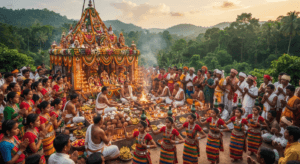
Festivals in Tripura reflect the state’s rich cultural diversity, tribal heritage, religious harmony, and agricultural traditions. Throughout the year, people from different communities celebrate numerous festivals with great enthusiasm, showcasing colourful rituals, traditional dances, folk music, delicious cuisine, and community gatherings. These celebrations not only strengthen social bonds but also preserve the unique customs and cultural identity of Tripura’s indigenous tribes and Bengali communities.
Many festivals are closely associated with agriculture and the changing seasons, expressing gratitude to nature for a bountiful harvest. Others commemorate religious beliefs, historical traditions, or important cultural events. The vibrant celebrations attract tourists from across India and abroad, offering a unique opportunity to experience Tripura’s multicultural lifestyle.
One of the most significant tribal festivals is Garia Puja, celebrated mainly by the Tripuri community during April after the sowing season. The festival is dedicated to Lord Garia, the deity believed to bless people with prosperity, good harvests, livestock, happiness, and overall well-being. Traditional songs, energetic Garia dances, bamboo musical instruments, and community feasts form the highlights of this colourful celebration.
Another important festival is Kharchi Puja, one of the oldest and most famous religious festivals in Tripura. Celebrated near Agartala, the festival is dedicated to the Fourteen Deities (Chaturdasha Devata) worshipped by the former royal family of Tripura. Thousands of devotees visit the Chaturdasha Devata Temple to participate in rituals, processions, cultural programmes, fairs, and traditional performances.
Ker Puja is a unique traditional festival observed shortly after Kharchi Puja. It is performed to seek protection from natural calamities, diseases, and evil influences while praying for peace and prosperity. During the rituals, a sacred area is marked, and special customs are strictly followed until the ceremony concludes.
The Durga Puja celebration in Tripura is among the grandest festivals observed by the Bengali community. Beautifully decorated pandals, artistic idols, devotional music, cultural programmes, and community feasts transform cities like Agartala into vibrant centres of celebration. Lakhs of devotees participate in the festivities every year.
The Diwali Festival is celebrated with equal enthusiasm, especially at the famous Tripura Sundari Temple in Udaipur. Thousands of oil lamps illuminate the temple complex, creating a spectacular spiritual atmosphere. Devotees from different parts of India visit the temple during this auspicious occasion.
Other important tribal festivals include Mamita, celebrated after the harvest season; Hojagiri Festival, showcasing the traditional balancing dance of the Reang community; Bizhu, celebrated by the Chakma community; and Sangrai, observed by the Mog community to mark the traditional New Year. These festivals feature colourful costumes, folk dances, music, rituals, and traditional cuisine.
In addition to tribal festivals, major national celebrations such as Holi, Janmashtami, Eid-ul-Fitr, Christmas, Buddha Purnima, and Independence Day are observed with harmony and mutual respect, reflecting Tripura’s multicultural society.
Major Festivals of Tripura
| Festival | Celebrated By | Significance |
|---|---|---|
| Garia Puja | Tripuri Community | Prosperity, Good Harvest and Well-being |
| Kharchi Puja | Entire State | Worship of Fourteen Deities |
| Ker Puja | Indigenous Communities | Protection, Peace and Prosperity |
| Durga Puja | Bengali Community | Worship of Goddess Durga |
| Diwali | Hindus | Festival of Lights and Tripura Sundari Temple Celebrations |
| Mamita | Tribal Communities | Harvest Festival |
| Hojagiri Festival | Reang (Bru) Community | Traditional Dance and Cultural Heritage |
| Bizhu | Chakma Community | New Year and Harvest Celebration |
| Sangrai | Mog Community | Traditional New Year Festival |
The festivals of Tripura beautifully showcase the state’s unity in diversity. They preserve centuries-old customs, promote traditional arts, strengthen community relationships, and contribute significantly to cultural tourism. Through these vibrant celebrations, Tripura continues to uphold its rich heritage while welcoming visitors to experience the warmth, hospitality, and colourful traditions of Northeast India.
Famous Food of Tripura
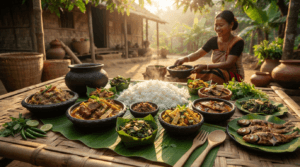
Tripura offers a distinctive culinary tradition that reflects the lifestyles, agricultural practices, and cultural diversity of its indigenous tribes and Bengali communities. The cuisine is simple, nutritious, and flavourful, relying heavily on locally available ingredients such as rice, freshwater fish, bamboo shoots, seasonal vegetables, leafy greens, herbs, and aromatic spices. Unlike many other Indian cuisines, traditional Tripuri food uses comparatively less oil and emphasizes natural flavours, making it both wholesome and healthy.
The staple food of Tripura is rice, which is consumed daily and served with a variety of vegetable dishes, fish curries, meat preparations, and chutneys. Freshwater fish from the state’s rivers and lakes are an essential part of the local diet. Fish is commonly prepared with mustard, herbs, and indigenous spices, reflecting both tribal and Bengali culinary traditions.
The signature dish of Tripura is Mui Borok, which literally means “the food of the people.” It is not a single dish but a traditional style of cooking followed by the indigenous Tripuri communities. Mui Borok includes a variety of preparations made using vegetables, fish, meat, bamboo shoots, and a traditional fermented fish ingredient known as Berma. Berma adds a distinctive aroma and flavour to many tribal dishes and is considered the backbone of authentic Tripuri cuisine.
One of the most popular dishes is Chakhwi, a nutritious preparation made with bamboo shoots, green papaya, seasonal vegetables, beans, and Berma. It is widely enjoyed in tribal households and is known for its rich earthy flavour and nutritional value.
Another favourite is Mosdeng Serma, a spicy chutney prepared using roasted tomatoes, green chillies, onions, and Berma. It is often served alongside rice and meat dishes, adding a bold and smoky flavour to traditional meals.
Gudok is another authentic Tripuri delicacy made by slowly cooking vegetables with fermented fish, herbs, and local spices. It is appreciated for its unique taste and represents the traditional cooking methods passed down through generations.
Meat dishes prepared with chicken, pork, duck, and mutton are especially popular during festivals and family celebrations. These are often cooked with bamboo shoots, indigenous herbs, and minimal spices to retain their natural flavours. Pork dishes hold particular importance in many tribal communities.
Bengali cuisine also has a strong presence in Tripura. Popular dishes include Machher Jhol (Fish Curry), Shorshe Ilish, Chingri Malai Curry, and various rice-based meals. Traditional Bengali sweets such as Rasgulla, Sandesh, Mishti Doi, and Cham Cham are widely available, particularly in Agartala and other urban centres.
Street food has also become an integral part of Tripura’s food culture. Visitors can enjoy snacks such as Momos, Chow Mein, Singara (Samosa), Pakoras, and a variety of local tea and snacks sold in markets and roadside eateries.
Popular Dishes of Tripura
| Dish | Description |
|---|---|
| Mui Borok | Traditional Tripuri cuisine prepared using vegetables, fish, meat and Berma |
| Chakhwi | Bamboo shoot and vegetable curry with Berma |
| Mosdeng Serma | Spicy tomato and fermented fish chutney |
| Gudok | Vegetable stew prepared with fermented fish and herbs |
| Fish Curry | Freshwater fish cooked with traditional spices |
| Pork with Bamboo Shoots | Popular tribal meat delicacy |
| Shorshe Ilish | Bengali hilsa fish cooked in mustard gravy |
| Rasgulla & Sandesh | Popular Bengali sweets served across Tripura |
Tripura’s cuisine is a delightful blend of tribal authenticity and Bengali culinary excellence. From traditional bamboo shoot preparations and fermented fish delicacies to flavourful seafood and delicious sweets, the state’s food reflects its rich cultural heritage, sustainable lifestyle, and deep connection with nature. Exploring Tripura’s cuisine offers visitors an unforgettable gastronomic experience that perfectly complements the state’s vibrant traditions and warm hospitality.
Top Tourist Places in Tripura
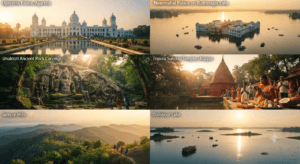
Tripura is a hidden gem in Northeast India, offering a captivating blend of historical monuments, royal palaces, ancient temples, serene lakes, wildlife sanctuaries, waterfalls, and lush green landscapes. The state’s tourism is enriched by its royal heritage, tribal culture, religious significance, and abundant natural beauty. Whether visitors seek spiritual experiences, historical exploration, adventure, or eco-tourism, Tripura offers a wide variety of attractions that appeal to every traveller.
The capital city, Agartala, serves as the gateway to most tourist destinations. The city is known for its magnificent palaces, museums, temples, bustling markets, and beautiful gardens. The state’s well-connected road network makes it convenient for tourists to explore both famous attractions and lesser-known destinations.
One of the most iconic landmarks is the Ujjayanta Palace, located in Agartala. Built by Maharaja Radha Kishore Manikya in the early 20th century, this magnificent white palace now houses the Tripura State Museum. Its grand architecture, royal galleries, landscaped gardens, and historical exhibits make it one of the most visited attractions in the state.
Another world-famous destination is Neermahal, India’s largest water palace. Situated in the middle of Rudrasagar Lake, this architectural masterpiece beautifully combines Hindu and Mughal styles. Visitors can enjoy boat rides across the lake while admiring the palace’s stunning reflection on the water, especially during sunrise and sunset.
The sacred Tripura Sundari Temple, located in Udaipur, is one of the 51 Shakti Peethas in Hinduism. Dedicated to Goddess Tripura Sundari, it attracts thousands of pilgrims throughout the year, particularly during Diwali when the temple is illuminated with thousands of lamps.
Nature lovers should not miss Dumboor Lake, a picturesque freshwater lake formed by the confluence of several rivers. Surrounded by green hills and dotted with numerous small islands, the lake is famous for boating, birdwatching, fishing, and scenic beauty.
The Unakoti Rock Carvings represent one of the most extraordinary archaeological sites in Northeast India. Massive rock-cut sculptures of Lord Shiva and other Hindu deities, believed to date back several centuries, make Unakoti a remarkable destination for history enthusiasts, pilgrims, and photographers.
Wildlife enthusiasts can explore Sepahijala Wildlife Sanctuary, Trishna Wildlife Sanctuary, Gumti Wildlife Sanctuary, and Rowa Wildlife Sanctuary, where visitors can observe rare wildlife species, migratory birds, butterflies, and dense tropical forests while enjoying eco-tourism activities.
Adventure seekers can visit Jampui Hills, the highest hill range in Tripura. Famous for its pleasant climate, orange orchards, panoramic viewpoints, trekking trails, and spectacular sunrise and sunset views, Jampui Hills is one of the state’s most popular hill stations.
Other notable attractions include Heritage Park, Jagannath Temple, Chabimura Rock Carvings, Pilak Archaeological Site, Kamalasagar Kali Temple, and Melasaghar, each offering unique historical, religious, or cultural experiences.
Major Tourist Attractions in Tripura
| Tourist Place | Location | Famous For |
|---|---|---|
| Ujjayanta Palace | Agartala | Royal Palace and State Museum |
| Neermahal | Rudrasagar Lake | India’s Largest Water Palace |
| Tripura Sundari Temple | Udaipur | Shakti Peetha Pilgrimage |
| Unakoti | Unakoti District | Ancient Rock Carvings |
| Dumboor Lake | Gomati District | Boating, Islands and Birdwatching |
| Jampui Hills | North Tripura | Hill Station and Orange Orchards |
| Sepahijala Wildlife Sanctuary | Sepahijala District | Wildlife and Botanical Garden |
| Trishna Wildlife Sanctuary | South Tripura | Indian Gaur and Eco-tourism |
| Pilak Archaeological Site | South Tripura | Buddhist and Hindu Sculptures |
| Chabimura | Gomati District | Rock Carvings Along Gomati River |
Tripura’s tourist destinations showcase the state’s perfect blend of history, spirituality, architecture, wildlife, and natural beauty. From majestic palaces and sacred temples to scenic lakes and lush hill stations, every destination offers a memorable experience. With improving tourism infrastructure and excellent hospitality, Tripura is steadily emerging as one of Northeast India’s most rewarding travel destinations.
Transport in Tripura
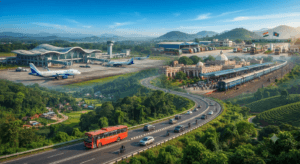
Transport plays a vital role in the economic development and tourism growth of Tripura. Despite its hilly terrain and location in the northeastern region of India, the state has witnessed remarkable improvements in road, rail, air, and border transport infrastructure over the past two decades. Better connectivity has strengthened trade, tourism, education, healthcare, and access to remote tribal areas, making Tripura one of the best-connected states in Northeast India.
Roadways form the backbone of Tripura’s transport network. The state has an extensive network of National Highways, State Highways, district roads, and rural roads that connect major cities, towns, villages, and neighbouring states. The National Highway 8 (NH-8) is the lifeline of Tripura, connecting Agartala with Assam through Meghalaya and linking the state to the rest of India. The highway has significantly improved passenger travel, freight movement, and tourism.
The Tripura Road Transport Corporation (TRTC) operates regular bus services across the state and provides connectivity to neighbouring states such as Assam, Mizoram, and Meghalaya. In addition to government buses, numerous private buses, taxis, auto-rickshaws, and app-based cab services are available in urban centres, ensuring convenient local transportation.
Rail connectivity has improved significantly with the expansion of the Northeast Frontier Railway network. Agartala Railway Station serves as the state’s primary railway hub, connecting Tripura with major Indian cities including Kolkata, Guwahati, Delhi, Bengaluru, and Silchar. Railway extensions to Sabroom, located near the India-Bangladesh border, have further enhanced trade and passenger connectivity while supporting regional economic development.
Air transport is centred around Maharaja Bir Bikram Airport (MBB Airport) in Agartala, one of the busiest airports in Northeast India. The modern integrated terminal handles domestic flights connecting Tripura with cities such as Kolkata, Delhi, Guwahati, Bengaluru, Chennai, and other major destinations. The airport plays a crucial role in promoting tourism, business, and government administration.
Tripura also benefits from its strategic international border with Bangladesh. The Akhaura Integrated Check Post (ICP) near Agartala facilitates cross-border trade and passenger movement between India and Bangladesh. This important gateway supports regional commerce under India’s Act East Policy and strengthens cultural and economic ties between the two neighbouring countries.
Water transport has limited importance due to the state’s geographical features. However, lakes such as Dumboor Lake support boating and local tourism activities. Inland waterways are primarily used for recreation rather than commercial transportation.
The state government continues to invest in modern highways, railway expansion, airport development, smart transport systems, and rural connectivity projects. These initiatives are improving accessibility, reducing travel time, and creating new opportunities for economic growth and tourism.
Transport Network of Tripura
| Mode of Transport | Major Facilities | Importance |
|---|---|---|
| Road Transport | NH-8, State Highways, TRTC Buses | Primary mode of passenger and freight transport |
| Rail Transport | Agartala, Dharmanagar, Kumarghat, Sabroom Railway Stations | Connects Tripura with major Indian cities |
| Air Transport | Maharaja Bir Bikram Airport, Agartala | Fastest mode of travel and tourism gateway |
| Border Connectivity | Akhaura Integrated Check Post | International trade with Bangladesh |
| Water Transport | Dumboor Lake | Tourism and recreational boating |
Tripura’s transport infrastructure has transformed the state’s connectivity and economic prospects. Efficient roads, expanding railway lines, a modern airport, and growing international trade links have made the state more accessible than ever before. Continued investment in transport development is expected to further strengthen Tripura’s position as an important gateway to Northeast India and neighbouring Bangladesh.
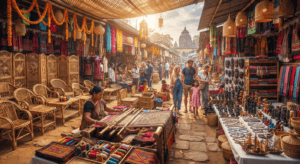
Shopping in Tripura
Shopping in Tripura is a delightful experience that reflects the state’s rich tribal heritage, exceptional craftsmanship, and vibrant local culture. From beautifully handwoven textiles and bamboo handicrafts to traditional jewellery, organic products, and local spices, Tripura offers visitors an opportunity to take home authentic souvenirs that represent the state’s artistic traditions. Most handcrafted products are made by skilled tribal artisans using eco-friendly materials and techniques passed down through generations.
One of the most famous shopping attractions in Tripura is its handloom industry. The state is renowned for producing colourful handwoven fabrics, especially the traditional Rignai, Risa, and Rikutu Gamcha, which are worn by the indigenous Tripuri communities. These textiles feature intricate geometric patterns, vibrant colours, and unique tribal motifs that reflect the cultural identity of the state. Handloom products are highly valued for their quality, durability, and craftsmanship.
Tripura is equally famous for its bamboo and cane handicrafts. Local artisans transform bamboo and cane into elegant furniture, baskets, lampshades, trays, wall décor, flower vases, storage boxes, mats, decorative items, and household accessories. These eco-friendly products are popular among both domestic and international tourists because of their attractive designs and sustainable production methods.
Another unique shopping item is tribal jewellery, crafted using beads, silver, brass, shells, and natural materials. Necklaces, earrings, bangles, bracelets, and traditional ornaments showcase the artistic heritage of Tripura’s tribal communities and make excellent souvenirs.
Tripura is also known for its organic agricultural products. Visitors can purchase locally grown tea, spices, honey, bamboo shoot pickles, pineapple products, jackfruit products, and seasonal fruits. The state’s famous Queen Pineapple, recognised with a Geographical Indication (GI) tag, is especially popular for its exceptional sweetness and aroma.
For those interested in local art, handmade decorative items, wood carvings, paintings, traditional musical instruments, and handcrafted souvenirs are available in government emporiums and artisan markets across the state.
The capital city Agartala offers the best shopping experience in Tripura. Markets such as Purbasha Emporium, Gol Bazaar, Maharaj Ganj Bazaar, and various local handicraft centres provide a wide selection of authentic products at reasonable prices. Government-run emporiums ensure genuine quality while supporting local artisans and self-help groups.
Shopping during local festivals and handicraft exhibitions allows visitors to experience live demonstrations by artisans and purchase exclusive handmade products directly from the creators. These events also promote Tripura’s traditional crafts on national and international platforms.
Popular Shopping Items in Tripura
| Shopping Item | Famous For |
|---|---|
| Rignai & Risa | Traditional Handwoven Tribal Clothing |
| Bamboo Handicrafts | Eco-friendly Furniture and Decorative Items |
| Cane Products | Baskets, Mats, Household Accessories |
| Tribal Jewellery | Handmade Bead, Silver and Brass Ornaments |
| Queen Pineapple | GI-Tagged Fruit with Exceptional Sweetness |
| Organic Tea | Premium Locally Produced Tea |
| Bamboo Shoot Pickles | Traditional Tribal Delicacy |
| Wooden Handicrafts | Decorative and Utility Products |
Tripura’s shopping experience beautifully combines tradition, sustainability, and craftsmanship. Whether purchasing handwoven textiles, bamboo handicrafts, tribal jewellery, or organic local products, visitors not only acquire memorable souvenirs but also contribute to preserving the state’s rich cultural heritage and supporting the livelihoods of local artisans.
Best Time to Visit Tripura
Tripura is a year-round travel destination, but the ideal time to visit depends on the weather, sightseeing preferences, and the type of experience visitors seek. The state experiences a tropical monsoon climate with three major seasons—winter, summer, and monsoon. Among these, the winter season is considered the most pleasant and is widely regarded as the best time to explore Tripura’s historical monuments, wildlife sanctuaries, lakes, temples, and hill stations.
The winter season, from October to March, offers cool and comfortable weather with temperatures generally ranging between 10°C and 25°C. The skies remain clear, humidity is low, and the pleasant climate makes it ideal for outdoor activities such as sightseeing, trekking, boating, birdwatching, photography, and wildlife exploration. Major tourist attractions including Ujjayanta Palace, Neermahal, Tripura Sundari Temple, Unakoti, Dumboor Lake, and Jampui Hills are best visited during this period.
Winter is also the season of vibrant cultural celebrations. Festivals such as Diwali, Kharchi Puja (depending on the calendar), local tribal fairs, handicraft exhibitions, and tourism festivals provide visitors with an opportunity to experience Tripura’s rich traditions, colourful performances, and authentic cuisine. Nature enthusiasts can enjoy migratory birdwatching around lakes and wetlands during these months.
The summer season, from April to June, is moderately warm, with temperatures ranging between 24°C and 35°C. While afternoons can be hot and humid, mornings and evenings remain relatively comfortable. Visitors planning to explore hill destinations like Jampui Hills or indoor attractions such as museums and palaces can still enjoy a pleasant trip during summer.
The monsoon season, extending from June to September, brings heavy rainfall due to the southwest monsoon. The forests, hills, rivers, and waterfalls become lush green and exceptionally beautiful, making it an attractive season for nature lovers and photographers. However, continuous rainfall may occasionally affect road travel, trekking, and outdoor sightseeing. Travellers visiting during this period should monitor weather conditions and carry appropriate rain gear.
Wildlife enthusiasts often prefer the months from November to February, when pleasant weather increases the chances of spotting animals and migratory birds in Sepahijala, Trishna, and Gumti Wildlife Sanctuaries. Adventure travellers also find this period ideal for trekking, camping, and exploring the scenic landscapes of Northeast India.
Best Time to Visit Tripura by Season
| Season | Months | Temperature | Travel Experience |
|---|---|---|---|
| Winter | October – March | 10°C – 25°C | Best for sightseeing, wildlife, festivals, and outdoor activities |
| Summer | April – June | 24°C – 35°C | Good for hill stations, museums, and cultural attractions |
| Monsoon | June – September | 22°C – 30°C | Ideal for lush landscapes, waterfalls, and nature photography |
Overall, October to March is considered the best time to visit Tripura due to its pleasant climate, vibrant festivals, and favourable conditions for tourism. Whether exploring royal palaces, ancient temples, wildlife sanctuaries, picturesque lakes, or tribal villages, visitors can enjoy a memorable travel experience during this season while witnessing the natural beauty and cultural richness that make Tripura one of Northeast India’s most fascinating destinations.
How to Reach Tripura
Tripura is well connected to the rest of India through airways, railways, and roadways, making travel to the state convenient for tourists, business travellers, pilgrims, and students. Over the past decade, major infrastructure developments have significantly improved accessibility, enabling visitors to reach Tripura comfortably from different parts of the country. The capital city, Agartala, serves as the primary transportation hub and acts as the gateway to the state’s major tourist destinations.
By Air
Air travel is the fastest and most convenient way to reach Tripura. The Maharaja Bir Bikram Airport (MBB Airport) in Agartala is the state’s only international-standard airport and one of the busiest airports in Northeast India. It offers regular domestic flights to major Indian cities, including Delhi, Kolkata, Guwahati, Bengaluru, Chennai, Hyderabad, and Mumbai. The modern integrated terminal provides excellent passenger facilities, making air travel comfortable throughout the year.
By Train
Tripura has become well connected through the Northeast Frontier Railway network. Agartala Railway Station is the state’s principal railway station and provides direct train services to important cities such as Kolkata, Delhi, Guwahati, Silchar, and Bengaluru. Other important railway stations include Dharmanagar, Kumarghat, Ambassa, Udaipur Tripura, and Sabroom, improving connectivity within the state and supporting tourism and trade.
By Road
Tripura has an extensive road network connecting it with neighbouring states. National Highway 8 (NH-8) is the state’s lifeline, linking Agartala with Assam through Meghalaya and providing road access to the rest of India. The highway supports regular movement of passenger buses, tourist coaches, private vehicles, taxis, and commercial transport.
The Tripura Road Transport Corporation (TRTC) operates reliable bus services connecting Agartala with major towns within the state as well as neighbouring states like Assam, Mizoram, and Meghalaya. Private buses, shared taxis, auto-rickshaws, and rental vehicles are also widely available.
Via Bangladesh
Tripura shares an 856-kilometre international border with Bangladesh, offering an additional gateway for cross-border travel and trade. The Akhaura Integrated Check Post (ICP) near Agartala facilitates passenger movement and commercial activities between India and Bangladesh. Subject to visa and immigration regulations, international travellers can use this route for convenient access to Tripura.
Local Transportation
Within Tripura, tourists can travel using government buses, private buses, taxis, auto-rickshaws, rental cars, and two-wheelers. Agartala has good local transport services, while taxis and shared vehicles provide easy access to popular attractions such as Ujjayanta Palace, Neermahal, Tripura Sundari Temple, Unakoti, Jampui Hills, and Dumboor Lake.
Connectivity at a Glance
| Mode | Major Entry Point | Connectivity |
|---|---|---|
| Air | Maharaja Bir Bikram Airport, Agartala | Delhi, Kolkata, Guwahati, Bengaluru, Chennai, Hyderabad, Mumbai |
| Rail | Agartala Railway Station | Delhi, Kolkata, Guwahati, Silchar, Bengaluru |
| Road | National Highway 8 (NH-8) | Connected via Assam and Meghalaya |
| International | Akhaura Integrated Check Post | Cross-border access to Bangladesh |
With its expanding transport infrastructure, excellent road network, modern airport, growing railway connectivity, and international border facilities, Tripura has become one of the most accessible states in Northeast India. Visitors can easily reach the state using multiple modes of transport and enjoy a smooth journey while exploring its historical landmarks, scenic landscapes, vibrant culture, and rich biodiversity.
Travel Tips for Visiting Tripura
Tripura is one of Northeast India’s safest and most welcoming travel destinations, offering visitors a unique combination of royal heritage, ancient temples, tribal culture, wildlife sanctuaries, scenic hills, and serene lakes. Proper planning and awareness of local customs can help travellers enjoy a comfortable, memorable, and hassle-free journey. Whether you are travelling for sightseeing, pilgrimage, adventure, photography, or cultural exploration, following a few practical travel tips will enhance your overall experience.
The ideal time to visit Tripura is between October and March, when the weather remains cool and pleasant. During this season, tourists can comfortably explore outdoor attractions such as Ujjayanta Palace, Neermahal, Unakoti, Tripura Sundari Temple, Jampui Hills, and the state’s wildlife sanctuaries. If travelling during the monsoon season, always check weather forecasts in advance, as heavy rainfall may occasionally affect road travel.
While exploring tribal villages and religious sites, visitors should respect local customs, traditions, and cultural practices. Wearing modest clothing at temples and seeking permission before photographing local people or cultural ceremonies is considered courteous and helps preserve the state’s rich cultural heritage.
Tripura’s cuisine offers many unique tribal delicacies, including dishes prepared with bamboo shoots and fermented fish. Visitors who are unfamiliar with these flavours may prefer to try them gradually while also enjoying popular Bengali cuisine, fresh seafood, and locally grown fruits such as the famous Queen Pineapple.
Comfortable clothing and walking shoes are recommended, especially for sightseeing, trekking, wildlife safaris, and exploring archaeological sites like Unakoti and Pilak. Travellers visiting during winter should carry light woollen clothing, while those travelling during the monsoon should pack umbrellas, waterproof footwear, and raincoats.
Although Agartala and other major towns provide good banking facilities, ATMs, and digital payment options, travellers visiting remote villages or hill regions should carry sufficient cash, as digital payment facilities may not always be available in rural areas.
Wildlife enthusiasts should maintain a safe distance from animals and follow all instructions provided by forest authorities while visiting Sepahijala, Trishna, Gumti, and Rowa Wildlife Sanctuaries. Littering, feeding animals, or disturbing natural habitats should be strictly avoided to support conservation efforts.
Visitors should also carry essential medicines, identity documents, mobile chargers, reusable water bottles, sunscreen, insect repellent, and basic first-aid supplies. Staying hydrated and following local travel advisories will ensure a comfortable journey.
Essential Travel Tips for Tripura
| Travel Tip | Recommendation |
|---|---|
| Best Season | October to March |
| Clothing | Comfortable cotton clothes, light woollens in winter |
| Footwear | Walking shoes or trekking shoes |
| Cash | Carry some cash for remote areas |
| Local Customs | Respect tribal traditions and religious practices |
| Wildlife Visits | Follow forest department guidelines |
| Photography | Seek permission before photographing local people |
| Health Essentials | Carry medicines, sunscreen, insect repellent, and drinking water |
Tripura offers a peaceful, culturally rich, and rewarding travel experience for visitors of all ages. By respecting local traditions, planning according to the season, and following responsible tourism practices, travellers can fully enjoy the state’s magnificent palaces, sacred temples, lush forests, vibrant festivals, and warm hospitality while creating unforgettable memories in one of Northeast India’s most beautiful destinations.
Interesting Facts About Tripura
Tripura is one of India’s most fascinating states, known for its ancient royal heritage, unique tribal culture, architectural marvels, and rich biodiversity. Despite being the third-smallest state in India by area, Tripura possesses a remarkable history that spans centuries. From magnificent palaces and ancient rock carvings to vibrant festivals and lush forests, the state offers numerous fascinating facts that make it truly unique among the northeastern states.
One of the most remarkable facts about Tripura is that it was once an independent princely state ruled by the Manikya dynasty, one of the longest-ruling royal dynasties in South Asia. The dynasty governed the region for several centuries before Tripura officially merged with the Indian Union on 15 October 1949.
Tripura is home to Neermahal, the largest water palace in India. Built in the middle of Rudrasagar Lake by Maharaja Bir Bikram Kishore Manikya Bahadur Debbarman, this magnificent palace is a rare blend of Hindu and Mughal architectural styles. It remains one of the state’s most iconic tourist attractions.
Another extraordinary attraction is Unakoti, an ancient archaeological site famous for its gigantic rock-cut sculptures and carvings of Hindu deities. According to local legend, the site contains one less than one crore (ten million) sculptures, giving rise to the name “Unakoti,” which literally means “one less than a crore.”
Tripura is also renowned for Tripura Sundari Temple, one of the 51 Shakti Peethas in Hinduism. The temple is among the most important pilgrimage destinations in eastern India and attracts thousands of devotees throughout the year.
The state has one of the highest forest cover percentages in India, with forests covering nearly 60% of its geographical area. These forests support diverse wildlife, including elephants, clouded leopards, hoolock gibbons, Phayre’s langurs, hornbills, and numerous rare bird species.
Agriculture remains an important part of Tripura’s economy, and the state is India’s second-largest producer of natural rubber after Kerala. In addition, the famous Queen Pineapple of Tripura has received a Geographical Indication (GI) tag for its exceptional sweetness, aroma, and quality.
Tripura is home to 19 recognized indigenous tribal communities, each preserving its own language, customs, traditional attire, folk dances, music, and festivals. This cultural diversity makes the state one of the richest centres of tribal heritage in India.
The capital city, Agartala, is located only a few kilometres from the international border with Bangladesh, making it one of the closest Indian state capitals to a neighbouring country. This strategic location has strengthened trade, tourism, and cultural exchanges between the two nations.
Fascinating Facts About Tripura
| Fact | Details |
|---|---|
| State Formation | Became a state on 21 January 1972 |
| Merger with India | 15 October 1949 |
| Largest Water Palace | Neermahal |
| Famous Archaeological Site | Unakoti Rock Carvings |
| Major Pilgrimage Site | Tripura Sundari Temple (Shakti Peetha) |
| Forest Cover | Nearly 60% of the state’s geographical area |
| Natural Rubber Production | Second-largest producer in India |
| GI Product | Queen Pineapple |
| Tribal Communities | 19 Recognized Indigenous Tribes |
Tripura is a land where history, nature, spirituality, and culture come together in perfect harmony. Its unique royal legacy, architectural treasures, tribal diversity, ecological richness, and agricultural achievements make it one of the most distinctive and rewarding destinations in Northeast India.
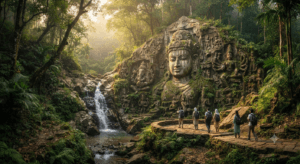
UNESCO World Heritage Sites Related to Tripur
Tripura does not currently have any site inscribed on the UNESCO World Heritage List. However, the state possesses several historically, culturally, and archaeologically significant monuments that have the potential to receive national and international recognition in the future. Its ancient temples, rock carvings, royal palaces, archaeological sites, and unique cultural traditions reflect a rich heritage that spans more than a thousand years.
Among Tripura’s heritage attractions, Unakoti is considered the strongest candidate for future UNESCO recognition. Located in the Unakoti district, this remarkable archaeological site is famous for its gigantic rock-cut sculptures and stone carvings of Hindu deities, especially the colossal image of Lord Shiva known as Unakotiswara Kal Bhairava. Believed to date between the 7th and 9th centuries CE, the site is one of the largest rock-cut sculptural complexes in Northeast India and attracts historians, archaeologists, pilgrims, and tourists from across the country.
Another important heritage monument is Neermahal, the magnificent water palace situated in the middle of Rudrasagar Lake. Built in 1930 by Maharaja Bir Bikram Kishore Manikya Bahadur Debbarman, the palace is celebrated for its harmonious blend of Hindu and Mughal architectural styles. Its unique location and elegant design make it one of India’s most distinctive royal residences.
The Tripura Sundari Temple at Udaipur is one of the 51 Shakti Peethas in Hinduism and holds immense religious importance. Every year, thousands of devotees visit the temple, especially during Diwali, making it one of the most significant pilgrimage centres in eastern India.
The Pilak Archaeological Site is another valuable heritage destination in Tripura. Dating from approximately the 8th to 12th centuries CE, Pilak contains numerous Hindu and Buddhist sculptures, stone carvings, terracotta plaques, and temple remains. The site demonstrates the harmonious coexistence of different religious traditions and highlights Tripura’s role as an important cultural crossroads in ancient India.
The Ujjayanta Palace in Agartala represents the royal legacy of the Manikya dynasty. Today it houses the Tripura State Museum, preserving priceless collections related to the state’s tribal communities, royal history, archaeology, traditional arts, and cultural heritage.
Beyond monuments, Tripura’s tribal traditions, handloom weaving, bamboo craftsmanship, folk dances, music, and festivals form an important part of India’s intangible cultural heritage. These living traditions continue to preserve centuries-old knowledge and artistic skills that are passed from one generation to the next.
Major Heritage Attractions of Tripura
| Heritage Site | Significance | UNESCO Status |
|---|---|---|
| Unakoti | Ancient Rock-Cut Sculptures of Hindu Deities | Potential Future Candidate |
| Neermahal | Largest Water Palace in India | National Heritage Monument |
| Tripura Sundari Temple | One of the 51 Shakti Peethas | Religious Heritage Site |
| Pilak Archaeological Site | Hindu and Buddhist Sculptures | Protected Archaeological Site |
| Ujjayanta Palace | Royal Palace and State Museum | Heritage Monument |
Although Tripura does not yet have an officially recognised UNESCO World Heritage Site, its remarkable archaeological treasures, royal architecture, sacred temples, and vibrant cultural traditions make it one of India’s most heritage-rich states. Continued conservation, archaeological research, and sustainable tourism initiatives may help these priceless landmarks gain international recognition in the years ahead.
Famous Personalities of Tripura
Tripura has produced many distinguished personalities who have made remarkable contributions to politics, literature, music, sports, education, science, social service, and public administration. From visionary kings who shaped the state’s history to modern leaders, artists, and athletes who have earned national and international recognition, these individuals have played a significant role in enhancing Tripura’s cultural and historical identity.
One of the most respected figures in Tripura’s history is Maharaja Bir Bikram Kishore Manikya Bahadur Debbarman, often regarded as the Architect of Modern Tripura. During his reign (1923–1947), he introduced progressive reforms in education, urban planning, infrastructure, and administration. He established educational institutions, promoted modern governance, planned the city of Agartala, and donated land for what later became Maharaja Bir Bikram Airport, one of Northeast India’s most important airports.
Another prominent royal personality is Maharaja Radha Kishore Manikya Bahadur Debbarman, who commissioned the construction of the magnificent Ujjayanta Palace in Agartala. His reign witnessed significant developments in architecture, governance, and cultural preservation.
In Indian politics, Biplab Kumar Deb, the former Chief Minister of Tripura, played an important role in promoting infrastructure development, digital governance, tourism, education, and investment in the state. His administration focused on improving connectivity and economic growth.
The current generation of political leadership has continued efforts toward economic development, industrial investment, and welfare programmes, contributing to Tripura’s ongoing progress.
Tripura has also produced internationally acclaimed sports personalities. Dipa Karmakar, India’s pioneering artistic gymnast, became the first Indian female gymnast to qualify for the Olympic Games. Her outstanding performance at the 2016 Rio Olympics brought global recognition to Tripura and inspired thousands of young athletes across India. She has received prestigious honours including the Padma Shri and the Major Dhyan Chand Khel Ratna Award.
The literary and cultural heritage of Tripura has been enriched by numerous writers, poets, historians, musicians, and folk artists who have preserved the traditions of both tribal and Bengali communities. Their contributions have strengthened the state’s multilingual and multicultural identity.
Tripura is also known for its skilled handloom weavers, bamboo artisans, traditional musicians, and folk dancers whose artistic excellence continues to receive appreciation at national and international exhibitions, cultural festivals, and craft fairs.
Prominent Personalities of Tripura
| Personality | Field | Major Contribution |
|---|---|---|
| Maharaja Bir Bikram Kishore Manikya Bahadur Debbarman | Royal Administration | Modernisation of Tripura, Education and Urban Planning |
| Maharaja Radha Kishore Manikya Bahadur Debbarman | Royal Administration | Construction of Ujjayanta Palace |
| Dipa Karmakar | Sports | First Indian Female Gymnast to Qualify for the Olympics |
| Biplab Kumar Deb | Politics | Former Chief Minister and Infrastructure Development |
| Traditional Tribal Artisans | Arts & Culture | Handloom, Bamboo Crafts and Folk Traditions |
The personalities of Tripura have significantly contributed to the state’s progress in governance, culture, sports, education, and social development. Their achievements continue to inspire future generations while strengthening Tripura’s reputation as a land of rich heritage, remarkable talent, and enduring cultural excellence.
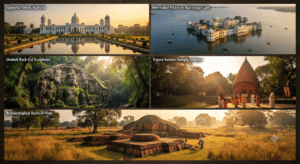
Architecture and Historical Monuments of Tripura
Tripura is home to an extraordinary collection of palaces, temples, rock-cut sculptures, archaeological sites, and royal buildings that reflect its glorious past and rich cultural heritage. Influenced by the Manikya dynasty, indigenous traditions, and architectural styles from Bengal and Mughal India, the state’s monuments showcase a remarkable blend of elegance, spirituality, and artistic excellence. These historical landmarks not only attract tourists but also preserve the legacy of Tripura’s royal rulers, religious traditions, and ancient civilizations.
The most iconic architectural landmark of Tripura is the Ujjayanta Palace, located in the heart of Agartala. Constructed in 1901 by Maharaja Radha Kishore Manikya Bahadur Debbarman, the palace is an excellent example of Indo-Saracenic architecture with influences from Mughal and European styles. Its magnificent white domes, grand halls, ornamental staircases, beautiful gardens, and artificial lakes make it one of the finest royal palaces in Northeast India. Today, the palace houses the Tripura State Museum, displaying valuable collections related to tribal culture, archaeology, history, and royal heritage.
Another architectural masterpiece is Neermahal, India’s largest water palace, situated in the middle of Rudrasagar Lake. Built in 1930 by Maharaja Bir Bikram Kishore Manikya Bahadur Debbarman, the palace combines Hindu and Mughal architectural elements. Its elegant balconies, royal chambers, open courtyards, and picturesque lakeside setting create one of the most beautiful palace complexes in India.
Among the state’s most significant archaeological monuments is Unakoti, famous for its gigantic rock-cut sculptures carved directly into the hillsides. The colossal image of Unakotiswara Kal Bhairava and numerous sculptures of Hindu deities represent one of the largest rock-carving sites in India. Historians believe these masterpieces date back to the 7th–9th centuries CE, making Unakoti one of Tripura’s most valuable archaeological treasures.
The Pilak Archaeological Site is another important historical destination. Dating from the 8th to 12th centuries CE, Pilak contains Hindu and Buddhist sculptures, terracotta plaques, temple remains, and stone carvings that illustrate the religious harmony and artistic achievements of ancient Tripura.
Religious architecture also forms an important part of the state’s heritage. The Tripura Sundari Temple, one of the 51 Shakti Peethas, features traditional Hindu temple architecture and continues to attract thousands of pilgrims every year. Other notable temples include the Jagannath Temple, Chaturdasha Devata Temple, and Kamalasagar Kali Temple, each showcasing distinctive architectural styles and historical significance.
Several royal buildings, museums, gateways, and heritage structures across Agartala further highlight the architectural achievements of the Manikya rulers. These monuments preserve valuable records of Tripura’s political, cultural, and artistic evolution.
Major Historical Monuments of Tripura
| Monument | Location | Historical Importance |
|---|---|---|
| Ujjayanta Palace | Agartala | Royal Palace and State Museum |
| Neermahal | Rudrasagar Lake | India’s Largest Water Palace |
| Unakoti | Unakoti District | Ancient Rock-Cut Sculptures |
| Pilak Archaeological Site | South Tripura | Hindu and Buddhist Heritage |
| Tripura Sundari Temple | Udaipur | One of the 51 Shakti Peethas |
| Jagannath Temple | Agartala | Traditional Hindu Temple |
| Chaturdasha Devata Temple | Old Agartala | Temple of the Fourteen Deities |
| Kamalasagar Kali Temple | Sepahijala District | Historic Temple Near Bangladesh Border |
Tripura’s architecture and historical monuments stand as enduring symbols of its royal legacy, religious diversity, and artistic brilliance. From magnificent palaces and sacred temples to ancient archaeological sites and monumental rock carvings, these heritage landmarks offer visitors a fascinating journey through the state’s glorious past while preserving its unique cultural identity for future generations.
Religious Places in Tripura
Tripura is a land of deep spiritual significance, where ancient temples, Buddhist monasteries, mosques, churches, and sacred tribal worship sites coexist in harmony. The state’s religious heritage reflects centuries of cultural exchange and peaceful coexistence among Hindu, Buddhist, Muslim, Christian, and indigenous tribal communities. Pilgrims and tourists visit Tripura throughout the year to experience its sacred atmosphere, architectural beauty, and vibrant religious festivals.
The most revered pilgrimage destination in the state is the Tripura Sundari Temple, located in Udaipur, Gomati district. Dedicated to Goddess Tripura Sundari (Maa Tripureswari), the temple is one of the 51 Shakti Peethas in Hinduism and is considered among the holiest shrines in India. Built by Maharaja Dhanya Manikya in 1501 CE, the temple attracts lakhs of devotees annually, especially during Diwali, when a grand fair and religious celebrations are held.
Another important religious site is the Chaturdasha Devata Temple in Old Agartala, dedicated to the Fourteen Guardian Deities of the Manikya kingdom. The temple is famous for the annual Kharchi Puja, one of Tripura’s largest religious festivals, celebrated with traditional rituals, processions, and cultural programmes.
The Jagannath Temple in Agartala is a magnificent Vaishnavite temple known for its distinctive architecture, colourful domes, and peaceful surroundings. Inspired by the famous Jagannath Temple of Puri, it attracts devotees throughout the year and becomes the centre of celebrations during the annual Rath Yatra festival.
Located near the India–Bangladesh border, the Kamalasagar Kali Temple is another prominent pilgrimage centre dedicated to Goddess Kali. Built by Maharaja Dhanya Manikya, the temple offers a serene spiritual environment along with panoramic views of the surrounding countryside.
Tripura is also home to several Buddhist monasteries that serve the state’s Buddhist tribal communities, particularly among the Chakma people. These monasteries preserve Buddhist teachings, traditional rituals, and cultural practices that have been followed for centuries.
Mosques and churches across Agartala and other towns reflect the religious diversity of the state. They serve as important centres of worship for the Muslim and Christian communities while contributing to Tripura’s harmonious multicultural society.
In addition to organised religions, many indigenous tribal communities continue to worship nature, ancestral spirits, and local deities through traditional sacred groves, village shrines, and seasonal festivals, preserving ancient spiritual customs that remain an integral part of Tripura’s cultural identity.
Major Religious Places in Tripura
| Religious Place | Location | Religious Significance |
|---|---|---|
| Tripura Sundari Temple | Udaipur | One of the 51 Shakti Peethas |
| Chaturdasha Devata Temple | Old Agartala | Temple of the Fourteen Deities |
| Jagannath Temple | Agartala | Important Vaishnavite Temple |
| Kamalasagar Kali Temple | Sepahijala District | Historic Kali Temple |
| Buddhist Monasteries | Various Districts | Centres of Buddhist Worship |
| Mosques | Agartala & Other Towns | Islamic Religious Centres |
| Churches | Across Tripura | Christian Places of Worship |
The religious places of Tripura beautifully represent the state’s spiritual richness, cultural harmony, and historical heritage. Whether visiting ancient temples, peaceful monasteries, historic mosques, or traditional tribal sacred sites, travellers experience the deep faith and diverse religious traditions that have shaped Tripura’s identity for centuries.
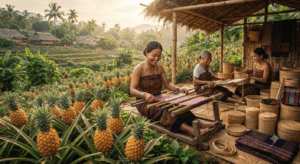
GI Tagged Products of Tripura
Tripura is renowned for its rich tradition of handloom weaving, bamboo craftsmanship, horticultural products, and tribal artistry. Several products from the state have received the prestigious Geographical Indication (GI) Tag, which recognizes their unique origin, traditional production methods, and cultural significance. These GI-tagged products not only preserve Tripura’s indigenous heritage but also provide livelihood opportunities to thousands of artisans, farmers, and weavers.
The most famous GI-tagged product of Tripura is the Queen Pineapple, celebrated for its exceptional sweetness, pleasant aroma, juicy texture, and low fibre content. Cultivated mainly in the districts of Sepahijala, Gomati, Dhalai, Khowai, and West Tripura, the Queen Pineapple is grown without the excessive use of chemical fertilizers, making it a premium-quality fruit. The GI tag has enhanced its market value and boosted exports to various parts of India and abroad.
Another iconic GI product is the Rignai, the traditional handwoven lower garment worn by Tripuri women. Woven using age-old techniques on indigenous looms, each Rignai features vibrant colours, intricate geometric patterns, and unique tribal motifs that represent the identity of different indigenous communities. It is not only an essential part of traditional attire but also a symbol of Tripura’s rich textile heritage.
The Risa, a beautifully woven upper garment or scarf, also holds great cultural significance among the tribal communities of Tripura. Often worn during festivals, weddings, and religious ceremonies, the Risa showcases exceptional craftsmanship and artistic excellence. Together, the Rignai and Risa reflect centuries of weaving traditions passed down through generations.
Tripura is equally famous for its bamboo and cane handicrafts, which include baskets, furniture, decorative items, lampshades, mats, home décor products, and utility articles. Skilled tribal artisans transform locally available bamboo and cane into eco-friendly products that are appreciated in national and international markets for their durability and craftsmanship.
The state’s handloom sector also produces high-quality cotton and silk fabrics featuring traditional tribal designs. These textiles have gained popularity for their vibrant colours, natural dyes, and intricate weaving patterns.
The promotion of GI-tagged products has strengthened rural livelihoods, encouraged traditional craftsmanship, supported women’s self-help groups, and contributed significantly to Tripura’s economy by creating new opportunities in domestic and international markets.
GI Tagged Products of Tripura
| GI Tagged Product | Category | Special Features |
|---|---|---|
| Queen Pineapple | Horticultural Product | Sweet, Juicy, Aromatic and Low Fibre |
| Rignai | Traditional Handloom | Tribal Women’s Traditional Dress |
| Risa | Traditional Handloom | Ceremonial Tribal Scarf |
| Bamboo Handicrafts | Traditional Craft | Eco-friendly Handmade Products |
| Cane Handicrafts | Traditional Craft | Durable Decorative and Utility Items |
Tripura’s GI-tagged products beautifully represent the state’s cultural identity, artistic excellence, and agricultural richness. From the world-famous Queen Pineapple to the elegant Rignai and Risa textiles and eco-friendly bamboo crafts, these unique products preserve centuries-old traditions while promoting sustainable development and empowering local communities.
Education and Universities in Tripura
Education has played a vital role in Tripura’s social and economic development. Over the years, the state has made significant progress in improving literacy, expanding educational infrastructure, and increasing access to quality education in both urban and rural areas. Today, Tripura boasts one of the highest literacy rates in Northeast India, supported by a strong network of government and private schools, colleges, universities, technical institutions, and vocational training centres.
The Department of Education, Government of Tripura oversees the state’s education system and implements various programmes to improve enrolment, digital learning, teacher training, and educational quality. Primary and secondary education is available through government schools, private institutions, Kendriya Vidyalayas, Jawahar Navodaya Vidyalayas, and missionary schools spread across the state.
The premier institution of higher education is Tripura University, located in Suryamaninagar, near Agartala. Established as a Central University in 2007, it offers undergraduate, postgraduate, doctoral, and research programmes in arts, science, commerce, humanities, social sciences, engineering, and management. The university serves students from Tripura as well as neighbouring states.
Another leading institution is the National Institute of Technology (NIT) Agartala, one of India’s prestigious engineering institutes. It offers undergraduate, postgraduate, and doctoral programmes in engineering, technology, architecture, science, and management, attracting students from across the country.
Medical education in the state is provided by institutions such as Agartala Government Medical College, which offers MBBS and postgraduate medical programmes while serving as a major healthcare centre for the region.
Tripura also has several teacher education colleges, polytechnic institutes, industrial training institutes (ITIs), nursing colleges, agricultural colleges, and law colleges that contribute to developing a skilled workforce. Various government scholarship schemes and skill development programmes encourage students from tribal and economically weaker communities to pursue higher education.
Digital classrooms, smart schools, e-learning initiatives, and vocational training programmes are being promoted to enhance educational opportunities and prepare students for modern careers. The state government continues to focus on improving educational infrastructure, research facilities, and employment-oriented education.
Major Educational Institutions in Tripura
| Institution | Location | Specialization |
|---|---|---|
| Tripura University | Suryamaninagar | Central University |
| National Institute of Technology (NIT) Agartala | Agartala | Engineering and Technology |
| Agartala Government Medical College | Agartala | Medical Education |
| ICFAI University Tripura | Agartala | Higher Education and Management |
| Tripura Institute of Technology | Narsingarh | Engineering Diploma Courses |
| Government Degree Colleges | Various Districts | Undergraduate Education |
With its growing network of educational institutions, increasing literacy rate, and emphasis on skill development and higher education, Tripura is steadily emerging as an important educational hub in Northeast India. Continued investment in education is helping the state build a knowledgeable, skilled, and innovative workforce for the future.
Economy and Industries of Tripura
Tripura has a rapidly developing economy based on agriculture, horticulture, forestry, bamboo resources, handloom and handicrafts, natural gas, tourism, and small-scale industries. Over the past few decades, the state has witnessed steady economic growth through improved infrastructure, better connectivity, industrial development, and government initiatives aimed at boosting investment and employment. Its strategic location, sharing an international border with Bangladesh, also offers significant opportunities for trade and commerce.
Agriculture remains the backbone of Tripura’s economy, providing livelihood to a large proportion of the population. The major crops include rice, pineapple, rubber, tea, banana, jackfruit, orange, coconut, arecanut, and various vegetables. The state’s fertile soil and favourable climate support year-round agricultural production. Tripura is one of India’s leading producers of natural rubber, with thousands of hectares under rubber plantations.
Horticulture has emerged as a major contributor to the state’s economy. The world-famous Queen Pineapple, a GI-tagged product, is known for its sweetness and superior quality. Fruits such as litchi, mango, lemon, papaya, and guava are also cultivated extensively, supporting food processing industries and exports.
Tripura possesses significant reserves of natural gas, making the energy sector an important part of the state’s industrial development. Natural gas is used for electricity generation, fertilizer production, and industrial activities. The availability of clean energy has encouraged the establishment of gas-based industries in the state.
The handloom and handicraft sector is another major source of employment. Traditional products such as Rignai, Risa, bamboo furniture, cane handicrafts, decorative items, baskets, and woven textiles are highly valued across India. Thousands of artisans, especially women, depend on these industries for their livelihood.
Tourism has become an increasingly important economic sector. Attractions such as Ujjayanta Palace, Neermahal, Unakoti, Tripura Sundari Temple, Jampui Hills, and various wildlife sanctuaries attract visitors from India and abroad, creating employment in hospitality, transport, handicrafts, and local businesses.
The Government of Tripura has established industrial estates, food parks, bamboo parks, and skill development programmes to encourage entrepreneurship and attract investment. Improved road, rail, and international connectivity through Bangladesh has further strengthened the state’s economic potential.
Major Economic Sectors of Tripura
| Sector | Major Products / Activities | Economic Importance |
|---|---|---|
| Agriculture | Rice, Rubber, Tea, Vegetables | Primary Source of Employment |
| Horticulture | Queen Pineapple, Banana, Orange | Fruit Production and Exports |
| Natural Gas | Energy and Power Generation | Industrial Development |
| Handloom & Handicrafts | Rignai, Risa, Bamboo Crafts | Rural Employment and Exports |
| Tourism | Heritage, Wildlife, Pilgrimage | Growing Service Sector |
| Small-Scale Industries | Food Processing, Bamboo Products | Entrepreneurship and Manufacturing |
With its abundant natural resources, skilled artisans, expanding infrastructure, and strategic location in Northeast India, Tripura is steadily transforming into a dynamic economy. Continued investment in agriculture, industries, tourism, renewable energy, and cross-border trade is expected to further strengthen the state’s economic growth and improve the quality of life for its people.
Government and Administrative Structure of Tripura
Tripura follows a parliamentary system of government based on the Constitution of India. As one of the 28 states of India, it has an elected legislative assembly, an executive headed by the Chief Minister, and an independent judiciary. The administrative framework ensures effective governance, implementation of development programmes, law and order, and the delivery of public services across the state.
The Governor is the constitutional head of the state and is appointed by the President of India. The Governor performs ceremonial duties while acting on the advice of the Council of Ministers. The Chief Minister is the head of the elected government and leads the Council of Ministers, which is responsible for policy-making, administration, and the overall development of Tripura.
The Tripura Legislative Assembly (Vidhan Sabha) is a unicameral legislature consisting of 60 elected Members of the Legislative Assembly (MLAs). The Assembly is responsible for enacting state laws, approving the state budget, debating public issues, and ensuring accountability of the government.
Tripura is represented in the Parliament of India by 2 Members of Parliament (MPs) in the Lok Sabha and 1 Member of Parliament in the Rajya Sabha, ensuring the state’s participation in national governance.
Administratively, Tripura is divided into 8 districts, which are further subdivided into subdivisions, blocks, tehsils, gram panchayats, and urban local bodies. District Collectors (District Magistrates) oversee district administration, while local governance is carried out through Panchayati Raj Institutions in rural areas and Municipal Corporations, Municipal Councils, and Nagar Panchayats in urban regions.
The Tripura Tribal Areas Autonomous District Council (TTAADC) plays a crucial role in administering the tribal-majority areas of the state. Established under the Sixth Schedule of the Constitution of India, the Council has legislative and administrative powers over subjects such as education, agriculture, forest management, tribal customs, village administration, and local development.
The Tripura High Court, located in Agartala, is the highest judicial authority in the state. It ensures the protection of constitutional rights, interprets laws, and supervises the functioning of subordinate courts.
The Government of Tripura continues to strengthen governance through e-governance initiatives, digital public services, transparent administration, infrastructure development, and citizen welfare programmes aimed at improving the quality of life across the state.
Administrative Profile of Tripura
| Administrative Feature | Details |
|---|---|
| Capital | Agartala |
| Governor | Constitutional Head of the State |
| Chief Minister | Head of the State Government |
| Legislature | Unicameral (60-member Legislative Assembly) |
| Lok Sabha Seats | 2 |
| Rajya Sabha Seats | 1 |
| Districts | 8 |
| High Court | Tripura High Court, Agartala |
| Tribal Autonomous Council | Tripura Tribal Areas Autonomous District Council (TTAADC) |
Tripura’s well-structured administrative system combines constitutional governance with local self-government, ensuring balanced development, efficient public administration, and inclusive growth. Through democratic institutions and effective governance, the state continues to promote social welfare, economic progress, and sustainable development for all its citizens.
Conclusion
Tripura is one of India’s most captivating northeastern states, where ancient history, royal heritage, vibrant tribal traditions, breathtaking landscapes, and rapid modern development come together in perfect harmony. Despite being one of the country’s smallest states by area, Tripura offers an extraordinary diversity of experiences—from majestic palaces and sacred temples to lush forests, serene lakes, archaeological wonders, and colourful cultural festivals.
The state’s historical legacy is reflected in remarkable landmarks such as Ujjayanta Palace, Neermahal, Unakoti, Pilak Archaeological Site, and the revered Tripura Sundari Temple. These monuments showcase the artistic brilliance and architectural excellence of the Manikya dynasty while preserving centuries of religious and cultural heritage.
Nature lovers are drawn to Tripura’s rolling hills, evergreen forests, wildlife sanctuaries, rivers, waterfalls, and picturesque destinations like Jampui Hills and Dumboor Lake. The state’s rich biodiversity, pleasant climate, and ecological wealth make it an attractive destination for eco-tourism and nature-based travel.
Tripura’s cultural identity is equally impressive. The harmonious coexistence of tribal and Bengali communities has created a vibrant cultural landscape filled with traditional dances, folk music, handloom weaving, bamboo craftsmanship, colourful festivals, and delicious local cuisine. Products such as the GI-tagged Queen Pineapple, Rignai, and Risa beautifully represent the state’s unique traditions and skilled craftsmanship.
The state’s economy continues to grow through agriculture, natural rubber cultivation, horticulture, bamboo-based industries, natural gas, tourism, handloom, handicrafts, and cross-border trade. Investments in education, infrastructure, digital governance, healthcare, and industrial development are creating new opportunities for sustainable growth and improving the quality of life for its people.
With a high literacy rate, improving connectivity through roads, railways, air transport, and international trade routes, Tripura is steadily emerging as an important gateway to Northeast India. Government initiatives focused on sustainable development, environmental conservation, entrepreneurship, and tribal welfare continue to strengthen the state’s future prospects.
Whether you are a history enthusiast, spiritual traveller, wildlife lover, adventure seeker, photographer, researcher, or cultural explorer, Tripura offers unforgettable experiences at every step. Its warm hospitality, peaceful atmosphere, rich heritage, and stunning natural beauty make it one of India’s most rewarding travel destinations.
As Tripura continues to preserve its glorious past while embracing modern development, it stands as a shining example of how tradition and progress can coexist. Exploring this remarkable state is not merely a journey through beautiful landscapes—it is an opportunity to experience the timeless spirit, cultural richness, and enduring legacy of one of India’s most fascinating destinations.
Related Articles
- Sonam Wangchuk
- West Bengal
- Nagaland
- Mizoram
- Subhas Chandra Bose
- Meghalaya
- Manipur
- Sikkim
- Jharkhand
- Assam
- Arunachal Pradesh
- Mahatma Gandhi
- Chhattisgarh
- Odisha
- Bihar
- Uttar Pradesh
- Uttarakhand
- Haryana
- Punjab
- Himachal Pradesh
- Madhya Pradesh
- Rajasthan
- Gujarat
- Goa
- Maharashtra
- Kerala
- Tamil Nadu
- Karnataka
- Andhra Pradesh
- Telangana
- Dr. APJ Abdul Kalam
- Ratan Tata
References
- Tripura Tourism Department (Official)
- Tripura Tourism – History & Origin
- Tripura Tourism – Cultural Heritage
- Government of Tripura (Official Portal)
- Know India – National Portal of India: Tripura
- Indira Gandhi National Centre for the Arts (IGNCA) – Introduction to Tripura
- Office of the Registrar General & Census Commissioner, India
- Incredible India – Ministry of Tourism, Government of India
- UNESCO World Heritage Centre
- IndiaStat – Statistical Information on Indian States