
Major Dhyan Chand Biography 2026: The Hockey Wizard Who Refused Hitler
Somewhere in Europe, in the late 1920s, hockey officials took a stick and cracked it open. They were hunting for a magnet. The stick belonged to a 22-year-old Indian soldier, and the men examining it simply couldn’t accept that a human being could keep a ball tied to wood for seventy minutes without help.
They found nothing. Just grain and tape.
That soldier went on to win three Olympic gold medals, score over a thousand goals, and turn down an offer from Adolf Hitler himself. And yet — here’s the part that stings — he died a forgotten man in Delhi, and India still hasn’t given him its highest civilian honour.
I first heard the magnet story in school and assumed it was made up. It isn’t. Well, mostly isn’t. And that’s exactly why Dhyan Chand’s story deserves a fresh telling in 2026.
Quick Info: Dhyan Chand at a Glance
| Real name | Dhyan Singh |
| Born | 29 August 1905, Allahabad (now Prayagraj) |
| Died | 3 December 1979, AIIMS New Delhi (aged 74) |
| Nicknames | The Wizard, Hockey ka Jaadugar |
| Position | Centre-forward |
| Olympic medals | 3 gold — 1928, 1932, 1936 |
| International record | 570 goals in 185 matches (1926–1948) |
| Career goals | 1,000+ (army, domestic and international) |
| Army service | Joined 1922, retired 1956 as Major |
| Civilian honour | Padma Bhushan (1956) |
| Autobiography | Goal! (1952) |
| Remembered on | National Sports Day, 29 August (since 2012) |
The Boy Who Wanted to Wrestle
Here’s a twist most fans miss. Hockey wasn’t his first love — wrestling was.
Dhyan Singh was born on 29 August 1905 in Allahabad, into a Rajput family where the father, Sameshwar Dutt Singh, played hockey for his army regiment. With the father getting transferred constantly, the household kept packing up and moving. The boy’s formal schooling ended after roughly six years.
At sixteen, in 1922, he enlisted in the British Indian Army — the 1st Brahmans, later part of the Punjab Regiment. A subedar-major named Bale Tiwari spotted the raw talent and made him stay back after practice, day after day, long after everyone else had hit the showers. The army has kept producing Indian sporting champions ever since — Gulveer Singh’s distance-running rise is simply the newest chapter.
A Name Made by Moonlight
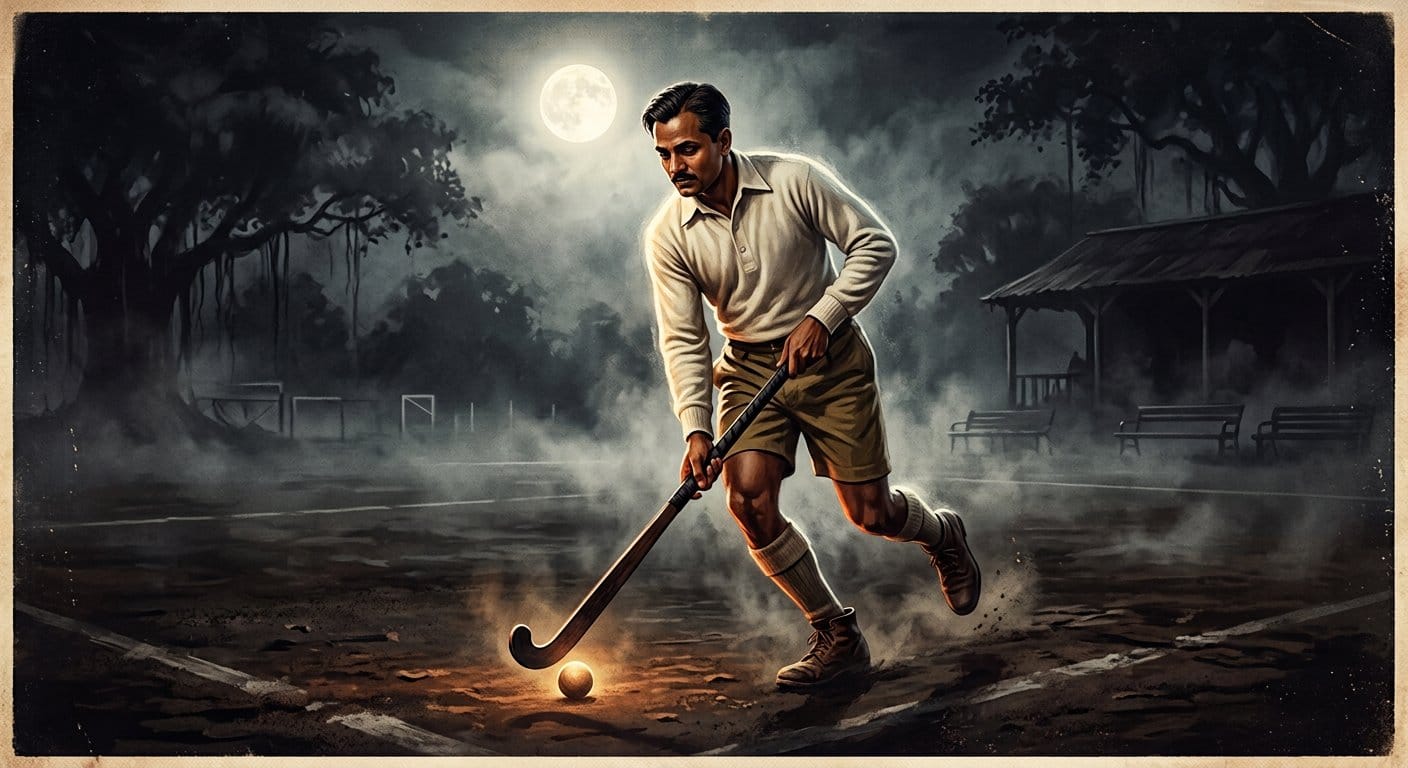
Army pitches in the 1920s had no floodlights. So when Dhyan finished his drills at dusk, he kept playing in the dark, the ball rolling through moonlight.
His fellow soldiers found the image so striking that they renamed him after it. Chand — the moon. Dhyan Singh became Dhyan Chand, and the nickname outlived empires.
In 1926, the army team toured New Zealand, and the young soldier came home a minor celebrity. The team won 18 of their 21 matches, and his stick work drew newspaper coverage for the first time. The army promoted him to lance naik almost immediately after landing back.
1928, Amsterdam: The Tournament Where India Conceded Nothing
India’s first Olympic hockey campaign wasn’t a contest so much as an announcement. The results still look like a typing error:
- Austria 6–0. Belgium 9–0. Denmark 5–0. Switzerland 6–0.
- The final against the Netherlands: 3–0, with two goals from Dhyan Chand.
- Across the whole tournament, India scored 29 and conceded zero.
Fourteen of those 29 goals came off his stick. A Dutch reporter, reaching for the right words, wrote that the ball appeared to be tied to his stick with a thread. (That’s the polite version of the magnet theory — the impolite version ended with his stick getting sawn open.)
It was, for a colonised country, something bigger than sport. A team of Indians had just told the world it was the best at something, and nobody could argue.
1932, Los Angeles: That 24–1 Afternoon
Four years later, the mythology got louder.
India beat Japan 11–1. Then came the match against the United States — a 24–1 rout that stood as the world record for an international hockey match until 2003. Dhyan Chand scored eight. His younger brother Roop Singh, also in the team, scored ten.
Between them, the brothers from one family had delivered 18 goals in a single Olympic match. The press started calling them the “hockey twins”, and India collected its second straight gold with 35 goals across two games.
Three Olympics, One Man: The Comparison
| Year | Venue | Key Result | Dhyan Chand’s Goals | The Detail People Forget |
|---|---|---|---|---|
| 1928 | Amsterdam | Final: India 3–0 Netherlands | 14 in 5 matches | India conceded zero goals all tournament |
| 1932 | Los Angeles | India 24–1 USA; 11–1 Japan | 12 in 2 matches | Brother Roop scored 10 in the same 24–1 game |
| 1936 | Berlin | Final: India 8–1 Germany | 11 in 4 matches | The final fell on 15 August — 1936 |
1936, Berlin: The Final Played on 15 August
Mark this date, because it’s almost too neat to be true: the Olympic final in Berlin was played on 15 August 1936. Eleven years later, to the very day, India would wake up free.
The backdrop was pure theatre. Hitler in the stands, by most accounts. A German team that had beaten India 4–1 in a practice match weeks earlier. And an Indian captain under instructions from his management: win, or the hockey world changes hands — the sort of occasion MS Dhoni would understand seven decades later.
India led 1–0 at half-time and Germany was still breathing. What happened next has been told a hundred ways, but the spine of it holds — Dhyan Chand, struggling with his studs on the rain-affected turf, is said to have pulled off his boots and played part of the second half barefoot.
The scoreboard stopped caring after that. Germany 1, India 8.
In his autobiography, he credits himself with three goals in the final. Newspapers of the day gave him four. Legends insist on six. He never settled the argument — which tells you something about how little the number mattered to him.
The Offer He Turned Down
The most repeated story from Berlin needs careful handling. As the account goes, Hitler was so struck by the centre-forward who dismantled his team that he offered Dhyan Chand German citizenship and the rank of colonel in the German army.
The exact words have been polished by nine decades of retelling, and historians still argue over the fine print. The refusal, though, has never been seriously disputed. An Indian soldier said no to the most powerful man in Europe, and went home to Jhansi.
One quote from that era survives with solid attribution. Sir Don Bradman watched Dhyan Chand play in Adelaide during the 1935 tour of Australia and came out with the finest compliment Indian sport has ever received: “He scores goals like runs in cricket.” Cricket fans can picture the scale — it’s the hockey equivalent of what Sachin Tendulkar did to bowling attacks for two decades.
The Numbers — Told Honestly
Let’s do what lazy articles don’t, and separate fact from folklore.
By his own account in Goal! (1952), he scored 570 goals in 185 international matches between 1926 and 1948, and more than 1,000 across his entire playing career. Modern statisticians sometimes trim the international figure toward 400-odd, because record-keeping in the 1930s was, charitably, a mess.
His Olympic tally has the same problem. Wikipedia puts the figure at 37 goals; The Indian Express counted 33. Pick either number — nobody who watched him play ever disputed the outcome.
Then there’s the tour that sounds fabricated. Captaining India in New Zealand and Australia in 1934–35, he led the team through 48 matches — winning all 48 — with 584 goals scored. He personally hit 201 in his 23 games on that tour. Read that again — close to nine goals a match, in India’s colours.
Life After the Final Whistle
His last international match came in 1948. He retired from the army in 1956 with the rank of Major; that same year came the Padma Bhushan — rare recognition for a sportsperson in that era.
What followed was quiet, and quietly unfair. He coached a little, served briefly at the National Institute of Sports, and never got an official role that matched what he’d built. Zafar Iqbal, the former India captain who lived in the same Delhi colony in the 1970s, remembered him as “the simplest man in sporting history” — a Padma Bhushan winner who never asked anyone for money and never mentioned his own medals.
Cancer found him in his final years. On 3 December 1979, the greatest hockey player who ever lived died at AIIMS New Delhi, aged 74, largely out of the public eye. His son, Ashok Dhyan Chand, wore India’s colours after him — proof that some of the magic ran in the family.
The Honours That Arrived Late
The country caught up with its wizard slowly. Painfully slowly.
A commemorative postage stamp after his death. Delhi’s National Stadium renamed after him in 2002. A lifetime-achievement award — the Dhyan Chand Award — instituted the same year. London’s Indian Gymkhana Club named an Astroturf pitch after him, and Vienna put up a statue of four hands gripping a hockey stick, an artist’s attempt to explain his control to people who never saw it.
Two dates matter more than the rest:
- 2012 — India began celebrating his birthday, 29 August, as National Sports Day.
- 6 August 2021 — Prime Minister Narendra Modi announced that the Khel Ratna, the country’s highest sporting honour, would be renamed the Major Dhyan Chand Khel Ratna.
So every time a Neeraj Chopra or a Rohit Sharma lifts that award, the ceremony begins with a soldier’s name. The BBC once called him hockey’s equivalent of Muhammad Ali. Still no Bharat Ratna, though — and we’ll come to that.
Why 2026 Keeps His Name Alive
This year has already given his legacy fresh plotlines.
National Sports Day 2026 falls on Saturday, 29 August. And in a decision announced on 18 August, the Sports Ministry named no Khel Ratna winner for 2025 — the first blank year since 2014 — while clearing 17 Arjuna awards, including two hockey players, Rajkumar Pal and Lalremsiami. A year where India’s highest sports award carries Dhyan Chand’s name, but crowns nobody.
The next stage belongs to his sport’s future. Both Indian hockey teams fly to the Asian Games in Aichi-Nagoya, Japan (19 September – 4 October 2026), with the men drawn alongside South Korea, Japan, Indonesia, Sri Lanka and Bangladesh. A century after a soldier first wore India’s colours in New Zealand, the team he turned into a superpower is still measured against the standard he set.
10 Unknown Facts About Dhyan Chand
- His real name was Dhyan Singh — “Chand” was a nickname earned by practising under the moon.
- Wrestling, not hockey, was the sport he loved as a boy.
- His schooling ended after about six years because of his father’s army transfers.
- He joined the army at 16, and got his first promotion — to lance naik — straight after the 1926 New Zealand tour.
- In the famous 24–1 win over the USA, he and his brother Roop scored 18 of the 24 goals.
- On the 1934–35 tour, he captained India to 48 wins in 48 matches.
- Vienna honoured him with a statue of four hands holding a hockey stick.
- An Astroturf pitch in London — at the Indian Gymkhana Club — carries his name.
- His son Ashok Dhyan Chand played hockey for India too.
- He wrote his autobiography, Goal!, way back in 1952 — among the first sports autobiographies by an Indian athlete.
Did You Know?
- The Berlin Olympic final was played on 15 August 1936 — eleven years, to the exact date, before Indian Independence.
- India’s hockey team won 7 of 8 Olympic golds between 1928 and 1964 — a run that began with Dhyan Chand’s generation.
- A Dutch journalist wrote that the ball looked tied to his stick with a thread — the origin of a legend that ended with officials breaking his stick to search for a magnet.
What We Can Learn From His Life
Repetition beats resources. No academies, no sports science, no floodlights — just moonlight and a ball, every single night. The modern athlete with every facility still can’t buy that kind of practice.
Skill is the loudest argument. In an era when an Indian couldn’t demand respect on the world stage, a centre-forward from Allahabad earned it in Amsterdam, Los Angeles and Berlin — without saying a word.
Saying no defines you. A colonel’s post and a foreign citizenship, offered by the most feared man in Europe, couldn’t move a soldier from Jhansi. Character, it turns out, is what survives the news cycle.
Institutions forget; numbers don’t. He died half-forgotten while stadiums filled for other games. Today his name opens every Khel Ratna ceremony in the country. The scoreboard always settles the argument — it just takes time.
FAQ
When is National Sports Day 2026?
Saturday, 29 August 2026 — the birth anniversary of Major Dhyan Chand, observed since 2012.
Why is Dhyan Chand called the Wizard of Hockey?
Because of ball control so extreme that opponents genuinely suspected trickery — officials reportedly broke his stick open looking for a magnet.
How many goals did he actually score?
His autobiography claims 570 goals in 185 internationals, and 1,000+ across his whole career. Some modern counts are lower. Even the smallest verified number makes him hockey’s most prolific scorer.
Did Hitler really offer him citizenship?
That’s the documented account from the 1936 Berlin Olympics — citizenship and a colonel’s commission in the German army. Dhyan Chand refused.
Which award is named after him?
The Major Dhyan Chand Khel Ratna (renamed from Rajiv Gandhi Khel Ratna on 6 August 2021) and the Dhyan Chand Award for lifetime achievement.
Has Dhyan Chand received the Bharat Ratna?
No. The demand has been raised for years by athletes, historians and fans, and it remained pending as of 2026.
The Honest Verdict
Should Dhyan Chand have the Bharat Ratna by now? Honestly, yes — three Olympic golds under a colonial flag, a refusal that would’ve tested any man’s loyalty, and a name the country itself stamps on its highest sports award. If the honour exists for anything, it exists for this.
But there’s a fair counterpoint, and it deserves saying. Awards are political animals, handed out on political clocks. Pinning his legacy to one more medal might actually undersell him. The man practised in moonlight because there was nothing else to practise under — and a hundred years later, an entire nation’s sporting calendar is fixed to his birthday.
That’s a bigger prize than any ribbon. Watch one old clip of him dribbling sometime. You’ll understand why they broke his stick looking for a magnet — and why they never found one.
Read next: more sports biographies on DealKart Market.
Related Articles You’ll Love
More legendary Indian sports stories from DealKart Market
Olympics
Neeraj Chopra: The Boy Who Taught a Nation to Dream in Metres
Army Athlete
Gulveer Singh Biography 2026: India’s New Distance-Running Star
Cricket
Sachin Tendulkar Biography 2026: Career, Records and Legacy
Cricket
Captain Cool’s Untold Story: MS Dhoni Biography 2026
Cricket
Smriti Mandhana Biography 2026: 17 Record-Breaking Centuries
Cricket
Rohit Sharma Biography 2026: Career, Family, Records & Net Worth
Sources & References
Facts in this article were verified against these sources
- Wikipedia — Dhyan Chand — career records, Olympic matches, autobiography Goal! details
- Olympics.com — Zafar Iqbal on Dhyan Chand’s humility — Don Bradman quote, army joining, Lance Naik promotion
- The Indian Express — Why Dhyan Chand matters — Olympic goal tally (33 vs 37 discrepancy)
- News18 — 2025 National Sports Awards announcement — no Khel Ratna for 2025, 17 Arjuna winners (18 Aug 2026)
- PIB (Govt. of India) — Khel Ratna renamed — official announcement, 6 August 2021
- Sportstar — Asian Games 2026 schedule — dates (19 Sept – 4 Oct 2026), Aichi-Nagoya
- Wikipedia — India at the 2026 Asian Games — hockey group-stage opponents
- Awareness Days — National Sports Day 2026 — 29 August date, observed since 2012
- Moneycontrol — Remembering the Hockey Wizard — 1st Brahmans Regiment (1922), Padma Bhushan (1956)
- Britannica — Dhyan Chand — 1905–1979 overview, final international match 1948, Major rank
Note: …we have presented them with careful caveats. Dhyan Chand goal tallies vary across sources (37 vs 33 Olympic; 570 vs 400+ international) — a limitation of 1930s record-keeping.