
Introduction
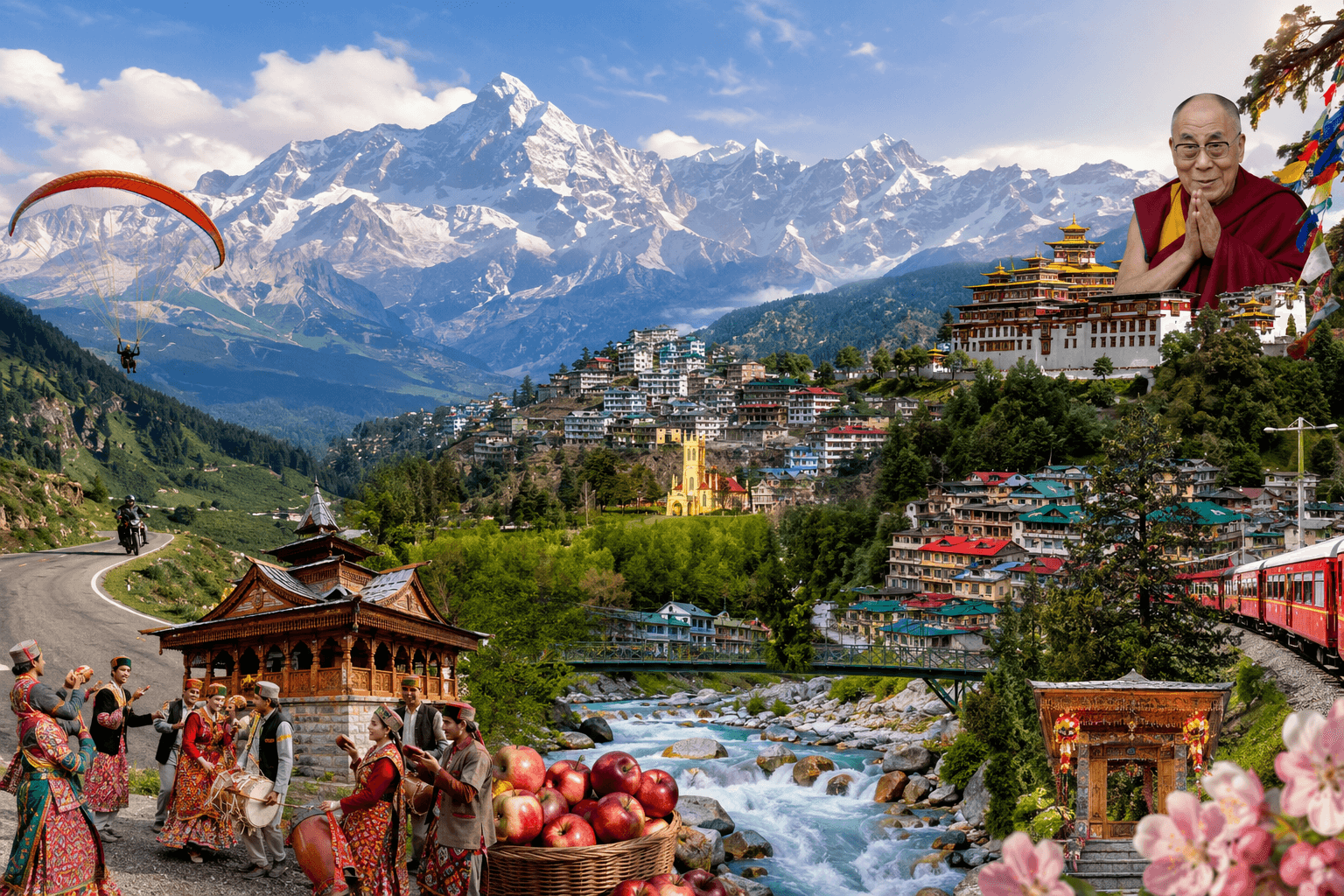
Himachal Pradesh, often called the “Land of the Himalayas” and the “Dev Bhoomi (Land of Gods)”, is one of India’s most beautiful mountain states. Located in the western Himalayas, it is renowned for its snow-capped peaks, lush valleys, ancient temples, adventure tourism, and picturesque hill stations.
The capital city is Shimla, while Dharamshala serves as the winter capital. The state shares its borders with Jammu & Kashmir, Ladakh, Punjab, Haryana, Uttarakhand, and Tibet (China).
Himachal Pradesh is home to world-famous destinations such as Shimla, Manali, Dharamshala, Dalhousie, Spiti Valley, Kullu, Kasol, Chamba, and Kinnaur. Visitors enjoy trekking, skiing, river rafting, paragliding, camping, and mountain expeditions throughout the year.
The state is also known for its rich cultural heritage, colourful festivals, traditional Himachali handicrafts, apple orchards, Buddhist monasteries, Hindu temples, and diverse wildlife.
With breathtaking Himalayan landscapes, peaceful hill towns, adventure activities, and spiritual destinations, Himachal Pradesh is one of India’s most popular tourist destinations and an ideal getaway for nature lovers.
Himachal Pradesh on India Map
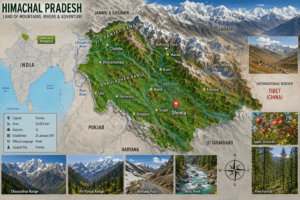
Himachal Pradesh is a beautiful Himalayan state located in northern India, renowned for its snow-capped mountains, lush valleys, rivers, forests, and hill stations. Covering an area of approximately 55,673 square kilometres, it is one of India’s most popular mountain destinations.
The state shares its borders with Jammu & Kashmir and Ladakh to the north, Punjab to the west, Haryana to the southwest, Uttarakhand to the southeast, and Tibet (China) to the east. Its strategic Himalayan location makes Himachal Pradesh an important gateway for mountain tourism, adventure sports, and cultural heritage.
Shimla, the capital city, is famous for its colonial architecture and scenic beauty, while Dharamshala serves as the winter capital and is known worldwide as the residence of His Holiness the 14th Dalai Lama. Other major cities include Manali, Solan, Mandi, Kullu, Chamba, Hamirpur, Bilaspur, Una, and Kinnaur.
The state is blessed with major rivers such as the Beas, Sutlej, Ravi, Chenab, and Yamuna, along with spectacular mountain ranges including the Greater Himalayas, Dhauladhar Range, Pir Panjal Range, and Zanskar Range.
Himachal Pradesh is famous for iconic destinations including Shimla, Manali, Rohtang Pass, Spiti Valley, Kullu Valley, Dharamshala, Dalhousie, Khajjiar, Kasol, Kinnaur, and Chail, making it one of India’s top travel destinations.
| Feature | Details |
|---|---|
| Location | Northern India |
| Area | 55,673 sq km |
| Capital | Shimla |
| Winter Capital | Dharamshala |
| Major Rivers | Beas, Sutlej, Ravi, Chenab & Yamuna |
| Major Mountain Ranges | Greater Himalayas, Dhauladhar & Pir Panjal |
| Neighbouring States | Punjab, Haryana, Uttarakhand, Jammu & Kashmir & Ladakh |
| International Border | Tibet (China) |
| Highest Peak | Reo Purgyil (6,816 m) |
| Famous Destinations | Shimla, Manali, Spiti Valley, Dharamshala & Dalhousie |
History of Himachal Pradesh
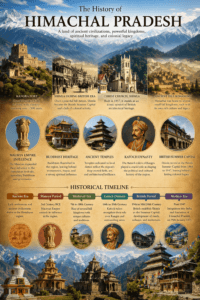
Himachal Pradesh has a rich history that dates back to prehistoric times, with archaeological evidence indicating human settlements in the Himalayan region thousands of years ago. Ancient texts such as the Rig Veda, Mahabharata, and Ramayana mention several regions that now form part of modern Himachal Pradesh.
During ancient times, the region was inhabited by tribes such as the Kols, Kiratas, Nagas, Khasas, and Gujjars. It later came under the influence of powerful empires including the Maurya Empire, Gupta Empire, and the Kushan Empire. Emperor Ashoka is believed to have spread Buddhism across parts of the Himalayan region, leaving behind inscriptions and Buddhist influences.
During the medieval period, Himachal Pradesh consisted of numerous independent hill kingdoms, including Chamba, Kangra, Kullu, Mandi, Bushahr, Sirmaur, Bilaspur, and Suket. These kingdoms built magnificent forts, palaces, temples, monasteries, and unique Himalayan architecture that still attract visitors today.
One of the most significant historical landmarks is the Kangra Fort, one of the oldest and largest forts in India, with a history spanning more than 3,500 years. The fort witnessed the rule of the Katoch dynasty, Mughal emperors, Sikh rulers, and later the British.
Following the Anglo-Gorkha War (1814–1816), the British East India Company gained control over large parts of the region. During British rule, Shimla became the Summer Capital of British India in 1864, transforming into an important administrative and cultural centre with impressive colonial architecture.
After India’s independence in 1947, several princely hill states were integrated to form the Chief Commissioner’s Province of Himachal Pradesh on 15 April 1948. On 25 January 1971, Himachal Pradesh officially became the 18th state of India, marking a major milestone in its political history.
Today, Himachal Pradesh proudly preserves its ancient temples, forts, monasteries, colonial heritage, and traditional Himalayan culture, making it one of India’s most historically significant mountain states.
| Period | Historical Significance |
|---|---|
| Prehistoric Era | Early Human Settlements |
| Ancient Period | Maurya, Gupta & Kushan Influence |
| Medieval Period | Independent Hill Kingdoms |
| Famous Dynasty | Katoch Dynasty |
| Historic Landmark | Kangra Fort |
| British Rule | Shimla became Summer Capital (1864) |
| Independence | Hill States Integrated (1948) |
| Statehood | 25 January 1971 |
| Cultural Heritage | Temples, Forts & Monasteries |
| Historical Identity | Dev Bhoomi & Himalayan Kingdoms |
Geography & Climate of Himachal Pradesh
Himachal Pradesh is one of India’s most picturesque mountain states, located in the western Himalayas. Covering an area of 55,673 square kilometres, the state is characterised by towering snow-capped peaks, deep valleys, glaciers, rivers, alpine meadows, dense forests, and fertile apple-growing regions.
The state’s landscape ranges from 350 metres above sea level in the southern foothills to over 6,800 metres in the Greater Himalayas. Reo Purgyil (6,816 m) in the Kinnaur district is the highest peak in Himachal Pradesh.
Several major Himalayan mountain ranges pass through the state, including the Greater Himalayas (Himadri), Pir Panjal Range, Dhauladhar Range, and Zanskar Range. These mountains support glaciers, rivers, forests, and some of India’s most popular trekking and skiing destinations.
Himachal Pradesh is blessed with numerous rivers, including the Beas, Sutlej, Ravi, Chenab, and Yamuna, which originate from the Himalayas and provide water for agriculture, hydroelectric power generation, and drinking purposes. The state is also known for beautiful valleys such as Kullu Valley, Spiti Valley, Parvati Valley, Kangra Valley, Chamba Valley, and Kinnaur Valley.
The climate varies significantly with altitude. The lower hills experience a subtropical climate, while the middle regions enjoy a temperate climate. Higher elevations have an alpine climate, with heavy snowfall during winter. Summers are generally pleasant, making Himachal Pradesh a popular destination for escaping the heat, while winters attract visitors for skiing and snow tourism.
The state receives rainfall mainly during the southwest monsoon season (July to September), while higher Himalayan regions experience significant snowfall between December and February.
With its breathtaking mountain scenery, pleasant climate, rivers, valleys, forests, and rich biodiversity, Himachal Pradesh is one of India’s premier destinations for nature lovers and adventure enthusiasts.
| Category | Details |
|---|---|
| Total Area | 55,673 sq km |
| Highest Peak | Reo Purgyil (6,816 m) |
| Major Mountain Ranges | Greater Himalayas, Pir Panjal, Dhauladhar & Zanskar |
| Major Rivers | Beas, Sutlej, Ravi, Chenab & Yamuna |
| Famous Valleys | Kullu, Spiti, Parvati, Kangra, Chamba & Kinnaur |
| Climate Types | Subtropical, Temperate & Alpine |
| Summer Season | March – June |
| Monsoon Season | July – September |
| Winter Season | December – February |
| Natural Features | Glaciers, Waterfalls, Pine Forests & Apple Orchards |
Rivers & Forests of Himachal Pradesh
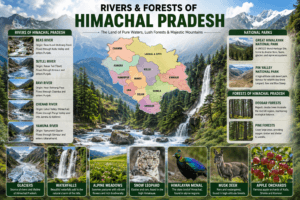
Himachal Pradesh is blessed with an extensive network of snow-fed rivers, dense forests, glaciers, alpine meadows, and Himalayan valleys, making it one of India’s richest states in terms of natural resources and biodiversity. Nearly two-thirds of the state’s geographical area is under forest cover, providing habitat for diverse wildlife and supporting the ecological balance of the western Himalayas.
The state is traversed by five major Himalayan rivers—Beas, Sutlej, Ravi, Chenab, and Yamuna. These rivers originate from glaciers and high-altitude regions of the Himalayas, supplying water for agriculture, drinking, hydroelectric power generation, and tourism. The Beas River is one of the most important rivers, flowing through Kullu Valley and Manali, while the Sutlej River enters India from Tibet and powers several hydroelectric projects.
Himachal Pradesh’s forests mainly consist of deodar cedar, pine, oak, fir, spruce, rhododendron, and Himalayan birch. These forests are not only ecologically important but also support local livelihoods through medicinal plants, forest produce, eco-tourism, and horticulture.
The state is home to several protected areas, including Great Himalayan National Park (UNESCO World Heritage Site), Pin Valley National Park, Khirganga National Park, Simbalbara National Park, and Inderkilla National Park. Numerous wildlife sanctuaries such as Kalatop-Khajjiar Wildlife Sanctuary, Chail Wildlife Sanctuary, and Kibber Wildlife Sanctuary further protect the region’s rich biodiversity.
Wildlife found in Himachal Pradesh includes the Snow Leopard, Himalayan Black Bear, Musk Deer, Himalayan Tahr, Blue Sheep (Bharal), Western Tragopan, Monal, and many other rare Himalayan species.
The state’s rivers and forests also make Himachal Pradesh a leading destination for river rafting, trekking, camping, angling, birdwatching, wildlife photography, and eco-tourism, attracting visitors from across the world.
| Category | Details |
|---|---|
| Major Rivers | Beas, Sutlej, Ravi, Chenab & Yamuna |
| Forest Cover | Around 66% of the State |
| Major Forest Types | Deodar, Pine, Oak, Fir, Spruce & Rhododendron |
| UNESCO Natural Site | Great Himalayan National Park |
| Other National Parks | Pin Valley, Khirganga, Simbalbara & Inderkilla |
| Famous Wildlife | Snow Leopard, Himalayan Black Bear & Musk Deer |
| State Bird | Western Tragopan |
| State Animal | Snow Leopard |
| Eco-tourism Activities | Trekking, River Rafting, Camping & Birdwatching |
| Natural Identity | Himalayan Rivers, Glaciers & Dense Forests |
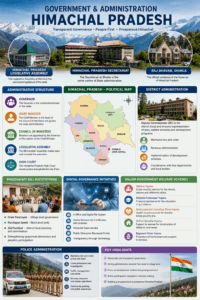
Government & Administration of Himachal Pradesh
Himachal Pradesh follows a parliamentary system of government under the Constitution of India. The Governor serves as the constitutional head of the state, while the Chief Minister is the executive head, leading the Council of Ministers responsible for governance and administration.
The capital of Himachal Pradesh is Shimla, while Dharamshala serves as the winter capital. The state has a unicameral legislature, known as the Himachal Pradesh Legislative Assembly (Vidhan Sabha), which is responsible for making laws and overseeing state administration.
For administrative efficiency, Himachal Pradesh is divided into 3 administrative divisions and 12 districts: Bilaspur, Chamba, Hamirpur, Kangra, Kinnaur, Kullu, Lahaul & Spiti, Mandi, Shimla, Sirmaur, Solan, and Una. Each district is administered by a Deputy Commissioner (District Magistrate), while law enforcement is managed by the Superintendent of Police (SP).
The state government operates through departments such as education, healthcare, tourism, horticulture, agriculture, rural development, public works, forests, transport, industries, power, and digital governance. Himachal Pradesh is particularly recognised for its efficient implementation of e-governance, citizen-centric services, and sustainable mountain development.
The Panchayati Raj system plays a vital role in rural administration through Gram Panchayats, Panchayat Samitis, and Zila Parishads, promoting local self-governance and community participation.
Known for its transparent governance, environmental conservation, and focus on rural development, Himachal Pradesh consistently ranks among India’s better-performing states in human development and public service delivery.
Government at a Glance
| Category | Details |
|---|---|
| Capital | Shimla |
| Winter Capital | Dharamshala |
| State Legislature | Unicameral Legislative Assembly |
| Administrative Divisions | 3 |
| Total Districts | 12 |
| Constitutional Head | Governor |
| Executive Head | Chief Minister |
| State Secretariat | Shimla |
| Local Governance | Gram Panchayat, Panchayat Samiti & Zila Parishad |
| Governance Focus | Digital Governance, Tourism, Rural Development & Environment |
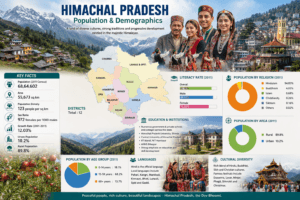
Population & Demographics of Himachal Pradesh
Himachal Pradesh is one of India’s least populous yet most literate states, known for its high quality of life, balanced rural development, rich cultural diversity, and peaceful mountain communities. According to the 2011 Census of India, the state has a population of approximately 6.86 million (68.6 lakh).
The capital city Shimla is the administrative centre, while Dharamshala serves as the winter capital. Other major urban centres include Solan, Mandi, Kullu, Hamirpur, Una, Bilaspur, Chamba, Kangra, and Kinnaur.
Hindi is the official language of Himachal Pradesh. Regional languages and dialects such as Pahari, Kangri, Mandeali, Kinnauri, Chambeali, Kulvi, Sirmauri, Bhoti, and Punjabi are widely spoken across different regions of the state, reflecting its rich cultural heritage.
Himachal Pradesh has one of the highest literacy rates in India, at approximately 82.8%, thanks to its strong education system and widespread access to schools and higher education institutions. The state also enjoys a high Human Development Index (HDI) and consistently performs well in healthcare, education, and social development.
Most of the population lives in rural and hilly areas, with agriculture, horticulture, tourism, government services, and small-scale industries providing employment. Apple cultivation has significantly improved the economic conditions of many rural communities.
The people of Himachal Pradesh are known for their warm hospitality, colourful traditions, and harmonious lifestyle. The state’s diverse communities celebrate numerous religious and cultural festivals while preserving their traditional customs, music, dance, and handicrafts.
Population at a Glance
| Category | Details |
|---|---|
| Population (2011 Census) | 6.86 Million (68.6 Lakh) |
| Population Rank in India | 21st |
| Capital | Shimla |
| Winter Capital | Dharamshala |
| Largest City | Shimla |
| Official Language | Hindi |
| Major Regional Languages | Pahari, Kangri, Kinnauri, Mandeali, Kulvi & Chambeali |
| Literacy Rate | 82.8% |
| Rural Population | Around 90% |
| Cultural Identity | Pahari Heritage & Himalayan Traditions |
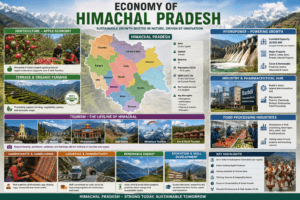
Economy of Himachal Pradesh
Himachal Pradesh has a diverse and steadily growing economy, driven by horticulture, agriculture, tourism, hydropower, manufacturing, handicrafts, and the service sector. The state’s mountainous terrain, abundant water resources, and pleasant climate have helped it develop a sustainable economy with a strong focus on environmental conservation.
Horticulture is the backbone of Himachal Pradesh’s economy. The state is popularly known as the “Apple Bowl of India”, producing some of the country’s finest apples. Besides apples, farmers cultivate pears, peaches, plums, apricots, cherries, kiwi, and off-season vegetables, which are exported across India.
Agriculture remains an important source of livelihood, with major crops including maize, wheat, rice, barley, ginger, potato, tomato, peas, and pulses. Terrace farming is widely practised in the hilly regions due to the mountainous landscape.
Himachal Pradesh is also one of India’s leading producers of hydroelectric power. Rivers such as the Sutlej, Beas, Ravi, and Chenab support numerous hydroelectric projects, making the state an important contributor to the nation’s renewable energy sector.
Tourism is another major pillar of the economy. Popular destinations including Shimla, Manali, Dharamshala, Dalhousie, Spiti Valley, Kullu, Kasol, Chail, and Khajjiar attract millions of domestic and international tourists every year. Adventure tourism, eco-tourism, religious tourism, and winter sports contribute significantly to employment and income.
Industrial development is concentrated in Baddi, Solan, Nalagarh, Parwanoo, Kala Amb, and Paonta Sahib, where industries such as pharmaceuticals, food processing, textiles, electronics, cement, packaging, and consumer goods have flourished. Baddi is one of Asia’s largest pharmaceutical manufacturing hubs.
The government continues to promote renewable energy, sustainable tourism, organic farming, digital infrastructure, MSMEs, and startup initiatives, ensuring balanced economic growth while protecting the fragile Himalayan ecosystem.
Economy at a Glance
| Category | Details |
|---|---|
| Economic Base | Horticulture, Tourism, Hydropower & Agriculture |
| Famous Produce | Apples |
| Other Major Crops | Wheat, Maize, Rice, Barley, Ginger & Potatoes |
| Major Industry Hub | Baddi |
| Leading Industries | Pharmaceuticals, Food Processing, Textiles & Electronics |
| Major Tourism Centres | Shimla, Manali, Dharamshala, Dalhousie & Spiti Valley |
| Renewable Energy | Hydroelectric Power |
| Famous Economic Identity | Apple Bowl of India |
| Key Investment Sectors | Tourism, Hydropower, Pharmaceuticals & Organic Farming |
| Economic Strength | Horticulture, Tourism & Clean Energy |
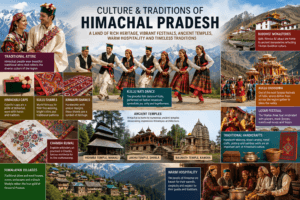
Culture & Traditions of Himachal Pradesh
Himachal Pradesh is renowned for its rich cultural heritage, ancient traditions, colourful festivals, folk music, traditional dances, handicrafts, and spiritual significance. Popularly known as “Dev Bhoomi” (Land of Gods), the state is home to thousands of temples, monasteries, and sacred pilgrimage sites that reflect its deep religious and cultural roots.
The culture of Himachal Pradesh has been shaped by its Himalayan geography, ancient hill kingdoms, Hindu and Buddhist traditions, and diverse tribal communities. Each region—including Kullu, Kangra, Chamba, Kinnaur, Lahaul-Spiti, Mandi, and Sirmaur—has its own unique customs, attire, dialects, festivals, and architectural styles.
Traditional attire forms an important part of Himachali identity. Men wear the famous Himachali cap (Pahari topi) with woollen garments, while women wear colourful shawls, woollen dresses, silver jewellery, and beautifully embroidered caps. The state is internationally known for its Kullu shawls, Kinnauri shawls, Chamba rumals, and fine woollen handicrafts.
Himachal Pradesh is famous for vibrant folk dances such as Nati, Kullu Nati, Chham Dance, Kayang, Shand, and Losar Dance. Nati is one of the most popular folk dances in the state and has earned recognition for featuring one of the world’s largest folk dance performances.
Major festivals celebrated include Kullu Dussehra, Losar Festival, Mandi Shivratri Fair, Minjar Fair, Halda Festival, Phulaich Festival, Lavi Fair, Diwali, Holi, and Navratri. These festivals feature traditional music, dance, colourful processions, handicrafts, and local cuisine.
The state’s handicrafts include wood carving, metal crafts, Chamba Rumal embroidery, Kullu and Kinnauri shawls, carpets, pottery, and traditional jewellery, reflecting the artistic skills passed down through generations.
With its vibrant traditions, Himalayan hospitality, religious harmony, and artistic heritage, Himachal Pradesh preserves one of India’s richest mountain cultures.
Culture at a Glance
| Category | Details |
|---|---|
| Cultural Identity | Dev Bhoomi (Land of Gods) |
| Famous Folk Dance | Nati & Kullu Nati |
| Traditional Dress | Himachali Cap, Woollen Attire & Silver Jewellery |
| Famous Handicrafts | Kullu Shawls, Kinnauri Shawls & Chamba Rumal |
| Traditional Arts | Wood Carving, Metal Crafts & Embroidery |
| Major Festivals | Kullu Dussehra, Losar, Minjar & Mandi Shivratri |
| Major Communities | Pahari, Kinnauri, Gaddi, Gujjar & Lahauli |
| Religious Heritage | Hindu Temples & Buddhist Monasteries |
| Traditional Music | Dhol, Karnal, Narsingha & Shehnai |
| Cultural Strength | Himalayan Heritage & Folk Traditions |
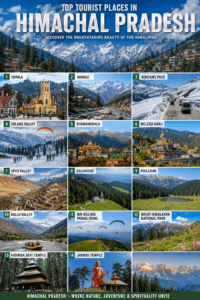
Top Tourist Places in Himachal Pradesh
Himachal Pradesh is one of India’s most spectacular tourist destinations, attracting millions of visitors every year with its snow-covered mountains, scenic valleys, ancient temples, Buddhist monasteries, adventure sports, and charming hill stations. Popularly known as the “Land of the Himalayas”, the state offers unforgettable experiences for nature lovers, pilgrims, honeymooners, and adventure enthusiasts.
The capital city Shimla, once the Summer Capital of British India, is famous for The Ridge, Mall Road, Christ Church, Jakhoo Temple, Kufri, and colonial architecture. Manali is another world-famous hill station known for Solang Valley, Rohtang Pass, Hidimba Devi Temple, adventure sports, and breathtaking Himalayan landscapes.
Dharamshala and McLeod Ganj are globally recognised as the residence of His Holiness the 14th Dalai Lama and are renowned for Tibetan culture, monasteries, and peaceful mountain surroundings. Spiti Valley, often called the “Middle Land”, offers dramatic landscapes, ancient monasteries, high-altitude villages, and one of India’s most scenic road trips.
Other popular destinations include Dalhousie, Khajjiar (Mini Switzerland of India), Kullu Valley, Kasol, Chail, Kinnaur, Chamba, Palampur, and Bir Billing, which is internationally famous for paragliding.
Nature lovers can explore the Great Himalayan National Park, a UNESCO World Heritage Site, while pilgrims visit sacred shrines such as Jwala Devi Temple, Naina Devi Temple, Chintpurni Temple, Baijnath Temple, and Manikaran Sahib.
With its breathtaking scenery, adventure activities, spiritual destinations, and rich cultural heritage, Himachal Pradesh remains one of India’s most loved travel destinations throughout the year.
Top Tourist Places at a Glance
| Tourist Place | Famous For |
|---|---|
| Shimla | Colonial Heritage & Mall Road |
| Manali | Adventure Sports & Snow Mountains |
| Dharamshala | Dalai Lama Monastery & Tibetan Culture |
| Spiti Valley | High-Altitude Desert & Monasteries |
| Dalhousie | Scenic Hill Station |
| Khajjiar | Mini Switzerland of India |
| Rohtang Pass | Snow Activities & Mountain Views |
| Solang Valley | Skiing, Paragliding & Adventure Sports |
| Bir Billing | World’s Top Paragliding Destination |
| Great Himalayan National Park | UNESCO World Heritage Site |
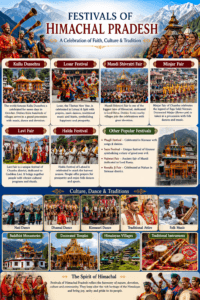
Festivals of Himachal Pradesh
Himachal Pradesh is famous for its vibrant festivals, ancient traditions, colourful fairs, folk dances, and deep spiritual heritage. Popularly known as “Dev Bhoomi” (Land of Gods), the state celebrates numerous Hindu, Buddhist, tribal, and local festivals throughout the year. These festivals reflect the rich cultural diversity, religious harmony, and centuries-old customs of the Himalayan region.
One of the most celebrated festivals is Kullu Dussehra, recognised internationally for its grand processions, traditional music, folk dances, and participation of hundreds of local deities. Unlike the rest of India, Kullu Dussehra begins when Dussehra celebrations end elsewhere, attracting thousands of visitors from around the world.
The Losar Festival, celebrated mainly in Lahaul-Spiti, Kinnaur, and Tibetan Buddhist communities, marks the Tibetan New Year with colourful prayers, monastery rituals, masked dances, and cultural performances.
Another major event is the Mandi Shivratri Fair, where hundreds of local deities gather in the historic town of Mandi for religious ceremonies, folk performances, and traditional processions.
The Minjar Fair in Chamba celebrates the harvest season and is famous for cultural programmes, handicrafts, local cuisine, and processions along the Ravi River. Other important festivals include the Lavi Fair in Rampur, Halda Festival in Lahaul, Phulaich Festival in Kinnaur, and Sazo Festival, each reflecting the unique traditions of different Himalayan communities.
Religious festivals such as Diwali, Holi, Navratri, Janmashtami, Mahashivratri, Eid, Christmas, and Baisakhi are also celebrated with great enthusiasm across the state.
These colourful festivals showcase Himachal Pradesh’s rich cultural heritage, warm hospitality, folk traditions, and spiritual significance, making the state one of India’s most fascinating cultural destinations.
Festivals at a Glance
| Festival | Famous For |
|---|---|
| Kullu Dussehra | International Dussehra Celebration |
| Losar Festival | Tibetan New Year |
| Mandi Shivratri Fair | Gathering of Local Deities |
| Minjar Fair | Harvest Festival in Chamba |
| Lavi Fair | Traditional Trade Fair |
| Halda Festival | New Year Celebration in Lahaul |
| Phulaich Festival | Flower Festival of Kinnaur |
| Sazo Festival | Traditional Kinnauri Festival |
| Diwali | Festival of Lights |
| Holi | Festival of Colours |
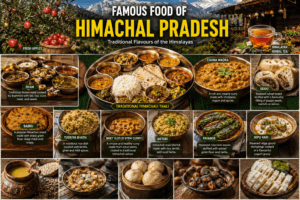
Famous Food of Himachal Pradesh
Himachal Pradesh is renowned for its traditional Himalayan cuisine, which reflects the state’s rich cultural heritage, mountain lifestyle, and locally sourced ingredients. The cuisine varies across regions such as Kangra, Kullu, Chamba, Kinnaur, Lahaul-Spiti, and Mandi, offering a delightful blend of flavours, spices, and centuries-old cooking traditions.
One of the most famous dishes is Dham, the traditional festive meal of Himachal Pradesh. Prepared during weddings, festivals, and religious ceremonies, Dham is served on leaf plates and includes rice, rajma, madra, dal, boor ki kadi, and sweet dishes, all cooked by traditional Boti chefs.
Another iconic dish is Chana Madra, a creamy yogurt-based curry made with chickpeas and aromatic spices. It is one of the signature dishes of Himachali cuisine and is widely enjoyed across the state.
Other popular dishes include Siddu, a steamed wheat bread stuffed with poppy seeds or walnuts; Babru, a Himachali-style stuffed bread; Tudkiya Bhath, a flavourful rice preparation; Aktori, Patande, Bhey (Lotus Stem Curry), and Sepu Vadi.
The state is also famous for fresh fruits such as apples, pears, plums, peaches, cherries, apricots, and kiwis, which are grown in its fertile orchards. Locally produced apple juice, apple cider, fruit jams, pickles, and herbal teas are popular among visitors.
Traditional sweets include Mittha, Meetha Bhaat, Malpua, and locally prepared desserts served during festivals and celebrations.
From festive feasts to mountain delicacies, Himachal Pradesh offers a unique culinary experience that perfectly reflects its Himalayan culture, hospitality, and natural abundance.
Famous Food at a Glance
| Dish | Famous For |
|---|---|
| Dham | Traditional Festive Feast |
| Chana Madra | Yogurt-Based Chickpea Curry |
| Siddu | Steamed Wheat Bread |
| Babru | Stuffed Himachali Bread |
| Tudkiya Bhath | Spiced Rice Dish |
| Bhey | Lotus Stem Curry |
| Sepu Vadi | Lentil Dumplings in Gravy |
| Aktori | Traditional Buckwheat Pancake |
| Patande | Himachali Pancakes |
| Apples | Famous Fruit of Himachal Pradesh |
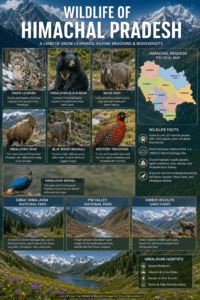
Wildlife of Himachal Pradesh
Himachal Pradesh is one of India’s richest biodiversity hotspots, offering a unique combination of snow-covered mountains, alpine meadows, dense forests, glaciers, and protected wildlife habitats. The state’s varied altitude and climatic conditions support a remarkable diversity of flora and fauna, making it a paradise for wildlife enthusiasts, trekkers, photographers, and nature lovers.
The state is home to 5 National Parks, including the Great Himalayan National Park, a UNESCO World Heritage Site, renowned for its exceptional biodiversity and pristine Himalayan ecosystems. Other important national parks include Pin Valley National Park, Khirganga National Park, Inderkilla National Park, and Simbalbara National Park.
Himachal Pradesh also has numerous wildlife sanctuaries, such as Kalatop-Khajjiar Wildlife Sanctuary, Chail Wildlife Sanctuary, Kibber Wildlife Sanctuary, Renuka Wildlife Sanctuary, and Nargu Wildlife Sanctuary, which protect many endangered Himalayan species.
The Snow Leopard, the State Animal of Himachal Pradesh, is one of the world’s rarest big cats and is found in the high-altitude regions of Spiti Valley and Lahaul. Other important wildlife includes the Himalayan Black Bear, Musk Deer, Himalayan Tahr, Blue Sheep (Bharal), Red Fox, Ibex, Goral, and Serow.
Birdlife is equally impressive, with more than 500 species of birds recorded in the state. The Western Tragopan, the State Bird, along with the Himalayan Monal, Cheer Pheasant, Snow Partridge, and Golden Eagle, attracts birdwatchers from across the globe.
Wildlife tourism plays an important role in the state’s economy. Activities such as jungle safaris, trekking, birdwatching, camping, wildlife photography, and eco-tourism provide unforgettable experiences while promoting conservation of the fragile Himalayan ecosystem.
Wildlife at a Glance
| Category | Details |
|---|---|
| State Animal | Snow Leopard |
| State Bird | Western Tragopan |
| UNESCO Site | Great Himalayan National Park |
| Total National Parks | 5 |
| Famous Wildlife | Snow Leopard, Himalayan Black Bear, Musk Deer, Bharal & Himalayan Tahr |
| Famous Bird Species | Western Tragopan, Himalayan Monal & Cheer Pheasant |
| Major Wildlife Sanctuaries | Kibber, Kalatop-Khajjiar, Chail, Renuka & Nargu |
| Bird Species | 500+ |
| Popular Activities | Trekking, Birdwatching, Wildlife Photography & Eco-tourism |
| Wildlife Identity | Himalayan Biodiversity Hotspot |
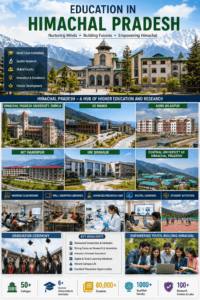
Education in Himachal Pradesh
Himachal Pradesh has one of the highest literacy rates in India and is widely recognised for its strong education system, quality public schools, and higher education institutions. The state government has consistently invested in education, resulting in excellent school enrolment, high literacy, and improved educational infrastructure across both urban and rural areas.
The state is home to several prestigious universities and institutions, including Himachal Pradesh University (Shimla), Central University of Himachal Pradesh (Dharamshala), Dr. Yashwant Singh Parmar University of Horticulture and Forestry (Nauni, Solan), CSK Himachal Pradesh Krishi Vishvavidyalaya (Palampur), and National Institute of Technology (NIT) Hamirpur.
Himachal Pradesh also hosts reputed institutions such as Indian Institute of Technology (IIT) Mandi, Indian Institute of Management (IIM) Sirmaur, All India Institute of Medical Sciences (AIIMS) Bilaspur, and several engineering, medical, law, pharmacy, nursing, and teacher-training colleges.
The state government has introduced various initiatives to improve digital learning, skill development, vocational training, and higher education opportunities. Special emphasis is placed on education in remote Himalayan regions through modern schools, residential institutions, and online learning facilities.
With its high literacy rate, quality institutions, and student-friendly educational environment, Himachal Pradesh continues to be one of India’s leading states in education and human development.
Education at a Glance
| Category | Details |
|---|---|
| Literacy Rate | 82.8% |
| State University | Himachal Pradesh University, Shimla |
| IIT | IIT Mandi |
| IIM | IIM Sirmaur |
| AIIMS | AIIMS Bilaspur |
| NIT | NIT Hamirpur |
| Agriculture University | CSK HP Krishi Vishvavidyalaya, Palampur |
| Horticulture University | Dr. Y.S. Parmar University, Nauni |
| Central University | Central University of Himachal Pradesh |
| Education Strength | High Literacy & Quality Higher Education |
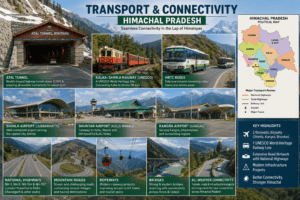
Transport & Connectivity of Himachal Pradesh
Himachal Pradesh has a well-developed transport network connecting its hill towns, tourist destinations, and remote mountain regions through roads, railways, and air transport. Although the state’s rugged Himalayan terrain limits large-scale rail infrastructure, an extensive road network ensures smooth connectivity across the state.
Road transport is the backbone of Himachal Pradesh’s transportation system. The state is connected by major National Highways, including NH-3, NH-5, NH-205, NH-503, NH-154, and NH-707, linking important destinations such as Shimla, Manali, Dharamshala, Solan, Kullu, Mandi, Chamba, Bilaspur, and Kinnaur. The Himachal Road Transport Corporation (HRTC) operates one of India’s largest hill transport networks, providing reliable bus services across the state and to neighbouring states.
Rail connectivity is available through three famous narrow-gauge mountain railways—the Kalka–Shimla Railway (a UNESCO World Heritage Site), the Pathankot–Jogindernagar Railway, and the Nangal Dam–Una Railway. The Kalka–Shimla Railway is internationally renowned for its scenic journey through tunnels, bridges, and Himalayan landscapes.
Air connectivity is provided by Shimla Airport (Jubbarhatti), Kullu–Manali Airport (Bhuntar), Kangra Airport (Gaggal, Dharamshala), and Shimla’s nearby Chandigarh Airport, offering regular flights to major Indian cities.
The government continues to improve connectivity through all-weather roads, tunnels, ropeways, highways, and digital infrastructure. Projects such as the Atal Tunnel have significantly enhanced year-round access to Lahaul Valley and nearby Himalayan regions.
With efficient road transport, scenic mountain railways, regional airports, and ongoing infrastructure development, Himachal Pradesh offers excellent connectivity for residents and tourists alike.
| Category | Details |
|---|---|
| Major Airports | Shimla, Bhuntar (Kullu-Manali) & Kangra (Gaggal) |
| Famous Railway | Kalka–Shimla Railway (UNESCO World Heritage Site) |
| Other Rail Routes | Pathankot–Jogindernagar & Nangal Dam–Una |
| Major Road Transport | Himachal Road Transport Corporation (HRTC) |
| Key National Highways | NH-3, NH-5, NH-205, NH-503, NH-154 & NH-707 |
| Iconic Infrastructure | Atal Tunnel |
| Local Transport | Buses, Taxis & Ropeways |
| Connectivity | Excellent Road Network Across the State |
| Tourism Transport | HRTC, Private Buses, Taxis & Rental Vehicles |
| Infrastructure Focus | Highways, Tunnels & Sustainable Mountain Connectivity |
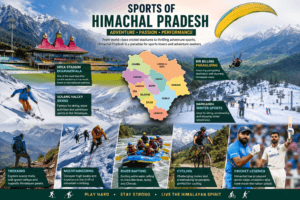
Sports of Himachal Pradesh
Himachal Pradesh has a vibrant sporting culture, supported by its mountainous terrain, adventure tourism, and growing sports infrastructure. The state is internationally recognised for winter sports, mountaineering, paragliding, trekking, skiing, and river rafting, making it one of India’s leading destinations for adventure sports.
Cricket is the most popular sport in Himachal Pradesh. The Himachal Pradesh Cricket Association (HPCA) Stadium in Dharamshala is one of the world’s highest and most picturesque international cricket stadiums, hosting domestic and international matches.
The state is also famous for paragliding, with Bir Billing regarded as one of the world’s best paragliding destinations. It regularly hosts international paragliding competitions and attracts adventure enthusiasts from around the globe.
Winter sports are another major attraction. Narkanda, Solang Valley, and nearby Himalayan regions are popular for skiing, snowboarding, ice skating, and snow trekking during the winter season. The state also promotes mountaineering, rock climbing, camping, cycling, and hiking through various adventure tourism initiatives.
Himachal Pradesh has produced several accomplished sportspersons, including Ajay Jadeja (who represented Himachal in domestic cricket), Rishi Dhawan, Pankaj Jaswal, Prashant Chopra, and Ekta Bisht, who have contributed significantly to Indian cricket.
The state government actively promotes sports through stadiums, training centres, youth development programmes, and adventure sports infrastructure, encouraging participation at the national and international levels.
Sports at a Glance
| Category | Details |
|---|---|
| Most Popular Sport | Cricket |
| Famous Stadium | HPCA Stadium, Dharamshala |
| Adventure Sports | Paragliding, Skiing, Trekking & Mountaineering |
| World-Famous Destination | Bir Billing (Paragliding) |
| Winter Sports Hub | Solang Valley & Narkanda |
| Water Adventure | River Rafting in Beas River |
| Major Outdoor Activities | Camping, Hiking, Rock Climbing & Cycling |
| Sports Authority | Himachal Pradesh Cricket Association (HPCA) |
| Famous Sportspersons | Rishi Dhawan, Pankaj Jaswal, Prashant Chopra & Ekta Bisht |
| Sports Identity | Adventure Sports Capital of India |
Famous Personalities of Himachal Pradesh
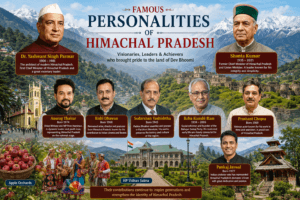
Himachal Pradesh has produced many distinguished personalities who have made remarkable contributions to politics, literature, science, sports, the armed forces, social service, and environmental conservation. Their achievements have brought national and international recognition to the state while inspiring future generations.
One of the most respected leaders from Himachal Pradesh is Yashwant Singh Parmar, popularly known as the “Architect of Modern Himachal Pradesh.” He played a pivotal role in the formation of the state and served as its first Chief Minister, laying the foundation for its modern development.
Another prominent political leader is Shanta Kumar, a former Chief Minister of Himachal Pradesh and former Union Minister, recognised for his contributions to rural development, governance, and public welfare.
The state is also home to renowned writer Sudarshan Vashishtha, whose works beautifully portray Himachal Pradesh’s culture, folklore, and Himalayan traditions.
In sports, Anurag Thakur, former President of the Board of Control for Cricket in India (BCCI) and former Union Minister, has made significant contributions to Indian cricket administration. Cricketers such as Rishi Dhawan, Pankaj Jaswal, and Prashant Chopra have represented Himachal Pradesh at the national level.
The state has also produced notable personalities in public service, education, mountaineering, environmental conservation, and the armed forces, reflecting the spirit of resilience and dedication associated with the Himalayan region.
These remarkable personalities continue to inspire the people of Himachal Pradesh through their leadership, achievements, and service to the nation.
Famous Personalities at a Glance
| Personality | Known For |
|---|---|
| Dr. Yashwant Singh Parmar | First Chief Minister & Architect of Modern Himachal Pradesh |
| Shanta Kumar | Former Chief Minister & Union Minister |
| Anurag Thakur | Former BCCI President & Former Union Minister |
| Baba Kanshi Ram | Poet & Freedom Fighter |
| Sudarshan Vashishtha | Renowned Author & Folklorist |
| Rishi Dhawan | Indian Cricketer |
| Pankaj Jaswal | Indian Cricketer |
| Prashant Chopra | Indian Cricketer |
| Prem Kumar Dhumal | Former Chief Minister |
| Vikram Seth | Acclaimed Author (Associated with Himachal Pradesh) |
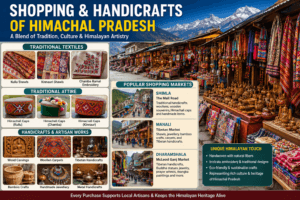
Shopping & Handicrafts of Himachal Pradesh
Himachal Pradesh is renowned for its traditional handicrafts, handloom products, wood carvings, woollen textiles, and exquisite artisan work, reflecting the rich cultural heritage of the Himalayan region. Each district has its own distinctive craft traditions that have been preserved for generations.
The state is internationally famous for its Kullu Shawls and Kinnauri Shawls, admired for their intricate patterns, vibrant colours, and exceptional craftsmanship. These handwoven woollen shawls are among the most sought-after handicraft products in India.
Another iconic craft is the Chamba Rumal, a traditional embroidered textile known for its double-sided embroidery and artistic designs. It has received the Geographical Indication (GI) Tag for its cultural and historical significance.
Himachal Pradesh is also known for wood carving, metal crafts, woollen carpets, handmade caps, bamboo crafts, pottery, traditional jewellery, handwoven blankets, and decorative household items. Local artisans continue to preserve these centuries-old traditions using sustainable and indigenous techniques.
Popular shopping destinations include Shimla, Manali, Dharamshala, Kullu, Kinnaur, Chamba, Mandi, and McLeod Ganj, where visitors can purchase authentic Himachali handicrafts, woollen garments, dry fruits, herbal products, local honey, handmade souvenirs, and Tibetan handicrafts.
Shopping in Himachal Pradesh offers visitors a perfect opportunity to experience the state’s artistic heritage while supporting local artisans and traditional Himalayan craftsmanship.
Shopping & Handicrafts at a Glance
| Category | Details |
|---|---|
| Famous Shawls | Kullu Shawls & Kinnauri Shawls |
| Famous Embroidery | Chamba Rumal (GI Tagged) |
| Traditional Craft | Wood Carving |
| Woollen Products | Carpets, Blankets & Mufflers |
| Traditional Wear | Himachali Caps |
| Popular Crafts | Bamboo Crafts, Pottery & Metal Crafts |
| Tibetan Products | Prayer Wheels, Carpets & Handicrafts |
| Famous Shopping Cities | Shimla, Manali, Dharamshala, Kullu & Chamba |
| Local Products | Honey, Dry Fruits, Herbal Products & Souvenirs |
| Shopping Identity | Himalayan Handloom & Traditional Handicrafts |
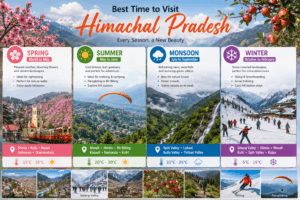
Best Time to Visit Himachal Pradesh
Himachal Pradesh is a year-round destination, with each season offering a unique travel experience. The best time to visit depends on the type of holiday you are planning, whether it’s sightseeing, adventure sports, trekking, wildlife exploration, or enjoying snowfall.
The summer season (March to June) is considered the most popular time to visit. During these months, the weather remains pleasant with temperatures ranging between 15°C and 30°C, making it ideal for sightseeing, trekking, camping, paragliding, river rafting, and exploring famous destinations such as Shimla, Manali, Dharamshala, Dalhousie, Khajjiar, and Kullu.
The monsoon season (July to September) transforms the state into a lush green paradise with beautiful waterfalls and mist-covered mountains. However, travellers should be cautious of occasional landslides in some hilly areas.
The winter season (October to February) is perfect for those who wish to experience snowfall and winter sports. Popular destinations such as Manali, Solang Valley, Kufri, Narkanda, and Rohtang Pass (subject to seasonal access) become favourite spots for skiing, snowboarding, snow trekking, and winter photography.
Adventure enthusiasts can visit Bir Billing for paragliding, Spiti Valley for high-altitude road trips, and Great Himalayan National Park for trekking and wildlife exploration during suitable seasons.
Overall, October to June is widely regarded as the ideal period to explore Himachal Pradesh’s natural beauty, cultural heritage, and adventure destinations.
Best Time to Visit at a Glance
| Season | Months | Best For |
|---|---|---|
| Spring | March – April | Flowers, Sightseeing & Trekking |
| Summer | May – June | Hill Stations & Adventure Activities |
| Monsoon | July – September | Green Landscapes & Photography |
| Autumn | October – November | Pleasant Weather & Road Trips |
| Winter | December – February | Snowfall, Skiing & Winter Sports |
| Best Overall Time | October – June | Tourism, Adventure & Pilgrimage |
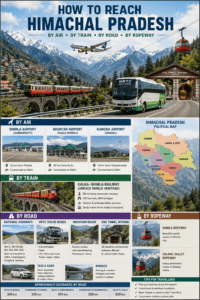
How to Reach Himachal Pradesh
Himachal Pradesh is well connected to the rest of India through air, rail, and road networks, making travel convenient for tourists and pilgrims. Although the state’s mountainous terrain limits extensive railway connectivity, an efficient road network and regional airports ensure easy access to major destinations.
By Air
Himachal Pradesh has three domestic airports:
Shimla Airport (Jubbarhatti) – Serves Shimla and nearby regions.
Kullu–Manali Airport (Bhuntar) – Gateway to Kullu Valley and Manali.
Kangra Airport (Gaggal) – Serves Dharamshala, McLeod Ganj, and Kangra Valley.
For international travellers, Chandigarh International Airport is the nearest major airport and is well connected by road to Himachal Pradesh.
By Train
The state is connected through the famous Kalka–Shimla Railway, a UNESCO World Heritage Site, offering one of the most scenic train journeys in India. Other important rail routes include the Pathankot–Jogindernagar Railway and the Nangal Dam–Una Railway.
By Road
Himachal Pradesh has an excellent road network maintained by the Himachal Road Transport Corporation (HRTC) and the National Highways Authority of India. National Highways connect major destinations such as Shimla, Manali, Dharamshala, Kullu, Solan, Chamba, Dalhousie, and Kinnaur with Delhi, Chandigarh, Punjab, Haryana, Uttarakhand, and Jammu & Kashmir.
Luxury buses, Volvo coaches, taxis, rental cars, and self-drive vehicles are widely available, making road travel the most preferred way to explore the state’s scenic hill stations and valleys.
How to Reach at a Glance
| Mode of Transport | Details |
|---|---|
| By Air | Shimla, Bhuntar (Kullu-Manali) & Kangra (Gaggal) Airports |
| Nearest International Airport | Chandigarh International Airport |
| By Train | Kalka–Shimla Railway, Pathankot–Jogindernagar & Nangal Dam–Una Railway |
| By Road | Well Connected by National Highways |
| Major Bus Operator | Himachal Road Transport Corporation (HRTC) |
| Popular Road Routes | Delhi–Shimla, Chandigarh–Manali, Pathankot–Dharamshala |
| Best Travel Option | Road Travel for Scenic Himalayan Views |
| Connectivity | Excellent from Major North Indian Cities |
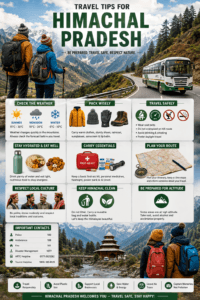
Travel Tips for Himachal Pradesh
A trip to Himachal Pradesh can be an unforgettable experience with proper planning. The state’s mountainous terrain, changing weather, and high-altitude destinations require travellers to prepare accordingly. Whether you’re visiting for sightseeing, trekking, adventure sports, or spiritual tourism, following a few essential travel tips will help ensure a safe and enjoyable journey.
The best time to visit most destinations is between March and June and October to February, depending on whether you prefer pleasant weather or snowfall. If you’re planning to visit Spiti Valley, Rohtang Pass, or other high-altitude regions, always check weather and road conditions before travelling.
Carry warm clothing even during summer, as temperatures can drop significantly in the evenings and at higher altitudes. During winter, pack heavy woollen clothes, gloves, thermal wear, waterproof jackets, and snow boots.
Book hotels, Volvo buses, train tickets, and adventure activities in advance during peak tourist seasons to avoid last-minute inconvenience. If travelling to remote areas, keep sufficient cash, as digital payment facilities may not be available everywhere.
Drive carefully on mountain roads, follow traffic rules, avoid travelling during heavy rainfall or snowfall, and stay updated with local weather advisories. Respect local customs, avoid littering, and help preserve the fragile Himalayan environment by practising responsible tourism.
Travel Tips at a Glance
| Travel Tip | Recommendation |
|---|---|
| Best Time to Visit | March–June & October–February |
| Clothing | Carry Warm Clothes in All Seasons |
| Trekking Essentials | Good Shoes, First-Aid Kit & Water Bottle |
| Hotel Booking | Book in Advance During Peak Season |
| Road Safety | Drive Carefully on Mountain Roads |
| Weather Check | Monitor Road & Weather Updates |
| Eco-Tourism | Avoid Plastic & Keep Nature Clean |
| Local Transport | HRTC Buses, Taxis & Rental Cars |
| Emergency Items | Power Bank, Torch & Medicines |
| Must-Try Experience | Trekking, Paragliding, Skiing & Local Cuisine |
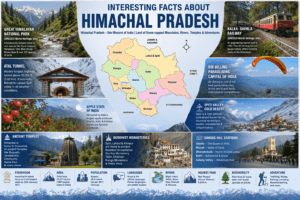
Interesting Facts About Himachal Pradesh
Himachal Pradesh is one of India’s most fascinating Himalayan states, known for its snow-capped mountains, ancient temples, adventure tourism, rich biodiversity, and picturesque hill stations. Popularly called “Dev Bhoomi” (Land of Gods), the state is home to thousands of temples and sacred pilgrimage sites spread across its valleys and mountains.
One of the state’s greatest treasures is the Great Himalayan National Park, a UNESCO World Heritage Site, famous for its pristine Himalayan ecosystem and rare wildlife. The Kalka–Shimla Railway, another UNESCO World Heritage Site, is one of the world’s most scenic mountain railways, featuring over 100 tunnels and 800+ bridges.
Himachal Pradesh is often referred to as the “Apple State of India” because it is one of the country’s leading producers of apples. The state’s apple orchards, especially in Shimla, Kinnaur, Kullu, and Kotgarh, have transformed the rural economy and made Himachali apples famous across India.
The state is also home to Bir Billing, regarded as one of the world’s best paragliding destinations, attracting adventure enthusiasts from across the globe. The Atal Tunnel, built beneath the Rohtang Pass, is one of the world’s longest highway tunnels above 10,000 feet, providing year-round connectivity to Lahaul Valley.
Himachal Pradesh has one of the highest literacy rates in India and is widely recognised for its environmental conservation, clean mountain towns, sustainable tourism, and high quality of life.
With its breathtaking Himalayan landscapes, UNESCO heritage sites, colourful traditions, winter sports, and spiritual destinations, Himachal Pradesh remains one of India’s most unique and beautiful states.
Interesting Facts at a Glance
| Fact | Details |
|---|---|
| Nickname | Dev Bhoomi (Land of Gods) |
| Apple Identity | Apple State of India |
| UNESCO World Heritage Sites | Great Himalayan National Park & Kalka-Shimla Railway |
| Famous Adventure Destination | Bir Billing |
| Iconic Infrastructure | Atal Tunnel |
| Highest Peak | Reo Purgyil (6,816 m) |
| Famous Hill Stations | Shimla, Manali & Dalhousie |
| State Animal | Snow Leopard |
| State Bird | Western Tragopan |
| Tourism Identity | Himalayas, Adventure & Spiritual Tourism |
Top 10 FAQs About Himachal Pradesh
Frequently Asked Questions
1. Why is Himachal Pradesh called “Dev Bhoomi”?
Himachal Pradesh is known as “Dev Bhoomi” (Land of Gods) because it is home to thousands of ancient Hindu temples, Buddhist monasteries, sacred pilgrimage sites, and centuries-old spiritual traditions.
2. What is the best time to visit Himachal Pradesh?
The best time to visit is March to June for pleasant weather and sightseeing, and December to February for snowfall, skiing, and winter sports.
3. What is Himachal Pradesh famous for?
Himachal Pradesh is famous for Shimla, Manali, Dharamshala, Spiti Valley, apple orchards, the Great Himalayan National Park, adventure sports, temples, monasteries, and snow-covered Himalayan mountains.
4. Which is the capital of Himachal Pradesh?
Shimla is the capital of Himachal Pradesh, while Dharamshala serves as the winter capital.
5. Which is the highest peak in Himachal Pradesh?
Reo Purgyil (6,816 metres) in Kinnaur district is the highest mountain peak in Himachal Pradesh.
6. What are the major adventure activities in Himachal Pradesh?
Popular adventure activities include paragliding at Bir Billing, skiing in Solang Valley and Narkanda, trekking, river rafting, camping, mountaineering, mountain biking, and rock climbing.
7. How can I reach Himachal Pradesh?
You can reach Himachal Pradesh by air (Shimla, Bhuntar, and Kangra airports), rail (Kalka–Shimla Railway), or road through National Highways and HRTC bus services.
8. Which are the UNESCO World Heritage Sites in Himachal Pradesh?
The two UNESCO World Heritage Sites are:
Great Himalayan National Park
Kalka–Shimla Railway
9. What is the famous food of Himachal Pradesh?
Popular dishes include Dham, Chana Madra, Siddu, Babru, Tudkiya Bhath, Bhey, Sepu Vadi, Aktori, and Patande.
10. What should tourists buy from Himachal Pradesh?
Visitors should buy Kullu Shawls, Kinnauri Shawls, Chamba Rumal, Himachali caps, woollen carpets, wooden handicrafts, Tibetan handicrafts, local honey, herbal products, dry fruits, and handmade souvenirs.
FAQs at a Glance
| Question | Short Answer |
|---|---|
| Why is Himachal Pradesh called Dev Bhoomi? | Land of Gods with thousands of temples |
| Best time to visit? | March–June & December–February |
| What is Himachal Pradesh famous for? | Hill stations, adventure, temples & apple orchards |
| Capital of Himachal Pradesh? | Shimla |
| Highest peak? | Reo Purgyil (6,816 m) |
| Famous adventure sport? | Paragliding at Bir Billing |
| UNESCO Sites? | Great Himalayan National Park & Kalka–Shimla Railway |
| Famous food? | Dham & Chana Madra |
| Famous shopping items? | Kullu Shawls & Chamba Rumal |
| Best way to reach? | Air, Rail & Road |
About DealKart Market
DealKart Market is a modern Indian online marketplace designed to connect buyers, sellers, service providers, employers, and local businesses on a single platform. It allows users to buy, sell, rent, and promote products and services while also offering job listings, business directory listings, and local service discovery.
Our mission is to make local commerce simple, affordable, and accessible for everyone across India. Whether you’re looking to sell a used mobile phone, rent a house, find a job, promote your business, or hire a trusted local service provider, DealKart Market brings everything together in one easy-to-use platform.
What We Offer
- Buy & Sell New and Used Products
- Property Listings (Rent, Sale & Commercial Cars, Bikes & Commercial Vehicles
- Jobs & Career Opportunities
- Local Services (Electrician, Plumber, AC Repair, Home Cleaning, Beauty & Salon, Mobile Repair and more)
- Business Directory for Local Businesses
- Informative Blogs & State Guides
Easy Ad Posting for Individuals & Businesses
DealKart Market is committed to providing a secure, user-friendly, and reliable marketplace where people can connect locally and grow their businesses. We continuously improve our platform by adding new categories, enhancing search features, and expanding our services to every state and city across India.
Why Choose DealKart Market?
- Free & Easy Ad Posting
- India-Wide Marketplace
- Local Business Promotion
- Trusted Service Listings
- User-Friendly Interface
- Fast Search & Category Navigation
- Regularly Updated Listings
- Mobile-Friendly Platform
At DealKart Market, our vision is to become one of India’s most trusted online classified marketplaces, empowering individuals and businesses with a smarter way to buy, sell, and grow in the digital world.
- Andhra Pradesh – https://dealkartmarket.in/andhra-pradesh/
- Telangana Complete Guide – https://dealkartmarket.in/telangana-complete-guide/
- Gujarat – https://dealkartmarket.in/gujarat/
- Madhya Pradesh – https://dealkartmarket.in/madhya-pradesh/
- Rajasthan – https://dealkartmarket.in/rajasthan/
- Himachal Pradesh – https://dealkartmarket.in/himachal-pradesh/
Reference
- Punjab Government Official Website
- Punjab Tourism Official Website
https://punjabtourism.punjab.gov.in/
- Census of India
- India State of Forest Report (FSI)
- UNESCO World Heritage Centre
- Ministry of Tourism, Government of India
- National Portal of India
- Incredible India
https://www.incredibleindia.gov.in/
- India Meteorological Department (IMD)
- Punjab State Council for Science & Technology