
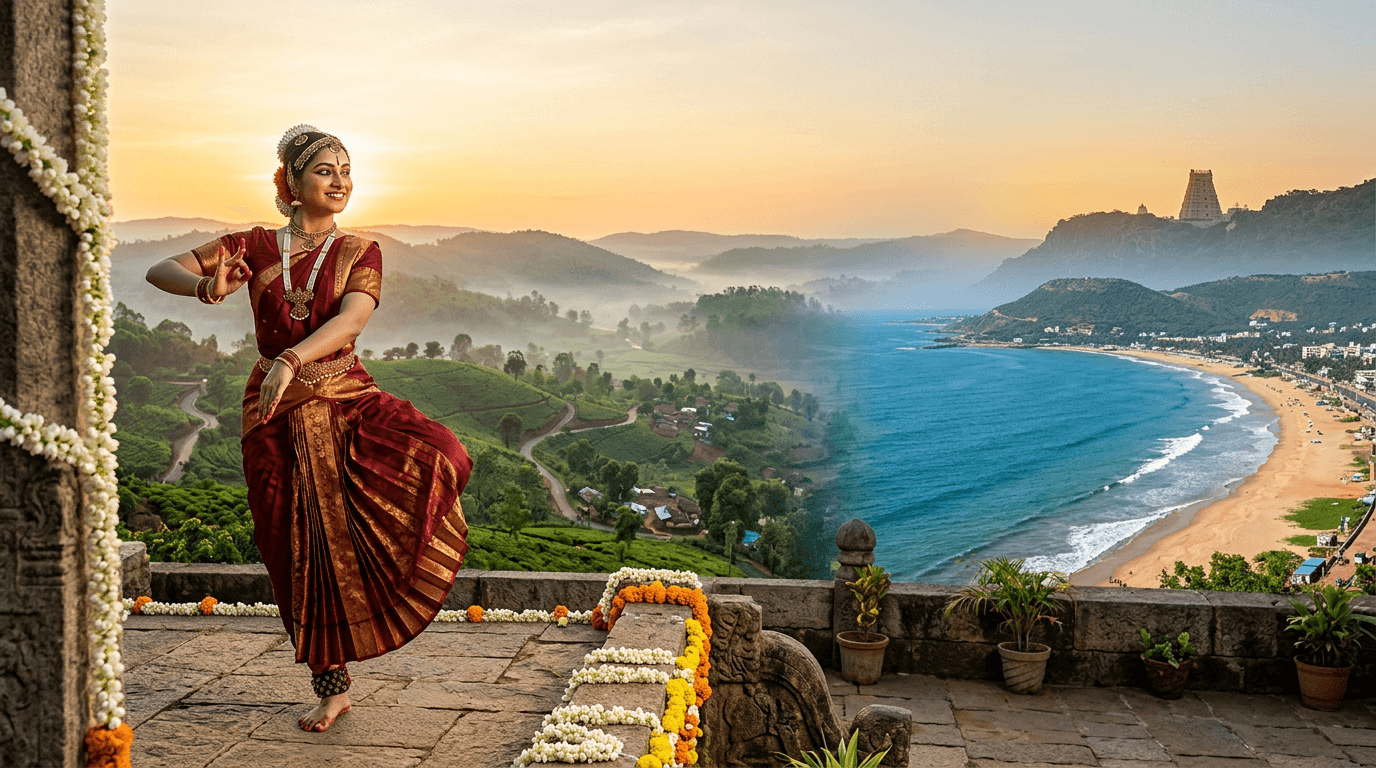
Walk into any Telugu household on Bhogi, the first morning of Sankranti, and you’ll find three generations huddled around a bonfire in the driveway, throwing old brooms and faded clothes into the flames while the air smells like cow dung smoke and jaggery pongal bubbling on the stove. Kids fly kites from the terrace, their kites shaped like M.S. Dhoni or Allu Arjun or whatever god was trending that year. Grandmothers grind gongura pachadi on stone rollers, ignoring the mixie sitting right there on the counter.
The Basics, Served Up Like a Quick Tea-Stall Breakdown
Before we get ahead of ourselves, here’s the Cliff Notes version:
| Feature | Details |
|---|---|
| Capital | Amaravati (long story — see the politics section) |
| Biggest City | Visakhapatnam (everyone just calls it Vizag) |
| Formed (linguistic state) | 1 October 1953 |
| Unified with Telangana | 1 November 1956 |
| Split from Telangana | 2 June 2014 |
| Districts | 28 (as of 1 January 2026) |
| Area | 162,975 km² — roughly the size of Tunisia |
| Population | About 5.3 crore (recent official estimates; census figures are older) |
| Language | Telugu (Urdu in some pockets) |
| State Animal | Blackbuck (Krishna Jinka) |
| State Bird | Rose-ringed Parakeet — you’ll see them everywhere in Vijayawada |
| State Flower | Jasmine (malle puvvu) |
| State Fruit | Banganapalle mango |
| Coastline | About 974 km — India’s second-longest state coastline after Gujarat. |
| Highest Point | Arma Konda, 1,680 m — in the Eastern Ghats, most Andhraites haven’t heard of it |
| Big Rivers | Godavari (the real Dakshin Ganga), Krishna, Penna, Tungabhadra, Vamsadhara |
| Vehicle Code | AP |
Capital note: Amaravati is Andhra Pradesh’s capital. After bifurcation, the state selected the Amaravati area between Vijayawada and Guntur for a greenfield capital. The 2019 proposal for three capitals triggered a prolonged political and legal dispute; after the change of government in 2024, Amaravati again became the administration’s stated sole-capital plan. Development is continuing, and readers should check official notices for the latest office locations and project timelines.
Where Exactly We’re Talking About
AP sits on India’s southeast coast, stretched out along the Bay of Bengal like a long green comma. If you drive NH-16 from the Odisha border down to Tamil Nadu, you’ll spend almost ten hours just crossing Andhra Pradesh. Even on a four-lane highway at 100 km/h. It’s that long.
We share borders with five states: Telangana (north/northwest), Chhattisgarh (a small stretch in the northeast), Odisha (northeast), Karnataka (west), and Tamil Nadu (south). The ocean is our entire eastern edge, which is why fishing villages show up on the horizon every ten minutes along the coast.
Geographically, we’re in a sweet spot. The Eastern Ghats run parallel to the coast the entire length of the state, which means you can go from a beach to a 1,000-metre hill station in under two hours (if you survive the ghat roads). The mountains also trap the monsoon, creating wet, forested eastern slopes and a drier plateau on the Rayalaseema side.
Two Thousand Years Before 1953: History That Isn’t Just Dates
I won’t give you the dynastic laundry list every travel site forces you to scroll through. But a few things you need to understand to get this state:
People have lived here since the Stone Age. The caves in Kurnool district have tools dating back 30,000 years. But the first big kingdom that matters is the Satavahana Empire, kicking off around the second century BCE. They ran things for 500 years, controlled most of the Deccan, turned Amaravati into a Buddhist centre so famous monks walked there from China, and traded with Rome through the port at Machilipatnam. Roman coins have been found in excavations all over coastal AP.
Then came the Eastern Chalukyas (Vengi), who spent 500 years promoting Telugu literature and building temples along the coast. The Kakatiyas built Warangal (that’s Telangana now, but their cultural influence runs deep into Rayalaseema). The Vijayanagara Empire left us the Lepakshi Temple with its famous hanging pillar — go see it; there’s a pillar in that complex that doesn’t touch the ground. The British called it “a curiosity of architecture.” Locals have been passing cloth under it for 400 years to prove it.
The thing that surprises most people: AP’s coastline was one of the first parts of India that Europeans showed up to. The Portuguese, Dutch, French, and British all had settlements at Machilipatnam or nearby within a 50-year window starting in the early 1600s. The Kohinoor diamond is believed to have been shipped out from Machilipatnam port when it was part of the Golconda kingdom. Let that sink in — the diamond on the British Crown? It left India from a fishing town in Krishna district.
How a Hunger Strike Redrew India’s Map
You can’t understand modern AP without this story.
After independence in 1947, India’s states were drawn around British administrative boundaries, not languages. Telugu speakers were split between the Madras Presidency (coastal AP and Rayalaseema) and the Nizam’s Hyderabad State (Telangana). For decades, activists said this was unworkable.
In 1952, a quiet, frail freedom fighter named Potti Sriramulu decided to go on a hunger strike. He’d been fasting on and off for years for various causes, but this time he was serious: no separate Andhra state, no food. The Madras government thought he was bluffing. Nehru didn’t give it much attention.
Fifty-eight days in, on 15 December 1952, Sriramulu died.
All hell broke loose. Crowds poured into the streets. Trains were blocked. Police stations were set on fire. The town of Vijayawada shut down completely. The government panicked — Nehru announced the creation of a separate Andhra State on 19 December.
Andhra State — with Kurnool as capital, because they couldn’t agree on anything else — came into existence on 1 October 1953. It was the first Indian state formed on linguistic lines. After that, the dam burst. Every linguistic group in India wanted their own state. The States Reorganisation Commission was set up, and within three years, India’s state map had been completely redrawn.
In 1956, the Telugu-speaking parts of Hyderabad State merged with Andhra State to form unified Andhra Pradesh. Hyderabad became the capital. That arrangement lasted 58 years.
Telangana split off on 2 June 2014, after decades of protest over perceived neglect by coastal-Andhra-dominated governments. Suddenly, AP found itself with no capital (Hyderabad was in Telangana now), no major IT sector (also in Hyderabad), no institutions (AIIMS, IIT, Central University — all in Hyderabad), and a budget hole big enough to drive a lorry through.
The rebuilding is still going on.
The Land: Three Faces of AP
Drive from Srikakulam to Anantapuramu, and you’ll cross three completely different worlds. AP isn’t one place — it’s three regions shoved together by history, and each has its own dialect, food, politics, and problems.
Coastal Andhra (Kosta): The delta districts between Vizag and Nellore. This is where the Godavari and Krishna split into a hundred canals before emptying into the sea, turning the land into the kind of rice bowl that makes Punjab jealous. Green fields, coconut groves, fishing boats, port cities, spicy seafood. This is the prosperous AP — or at least, the prosperous-looking AP. The coast got most of the British investment, most of the irrigation water, and a lot of the political power post-independence.
Rayalaseema: The southern and western interior — Kurnool, Nandyal, Anantapuramu, Kadapa, Tirupati, Chittoor. This is dry, red-soil country. Rainfall in Anantapuramu averages 550 mm a year (that’s less than half of what Kerala gets). Borewells can run a thousand feet deep before hitting water, and when the bore runs dry, a farmer’s life savings go down with it. Rayalaseema is famous for temple towns (Tirupati, Srisailam, Puttaparthi, Lepakshi), faction politics (yes, it’s real, and yes, it’s less cinematic and more tragic than the movies make it look), and food that will genuinely make you sweat.
Uttarandhra (North Andhra): The three northeast districts — Srikakulam, Vizianagaram, and Visakhapatnam, plus the tribal agency areas. This region borders Odisha, has a different Telugu dialect (people in Vizag make fun of the Srikakulam accent, and vice versa), heavy Adivasi population in the hills, and historically, much lower development than the Godavari-Krishna delta. The Alluri Sitharama Raju district (named for the freedom fighter) is carved from this area, covering the tribal highlands.
The Rivers
If AP had a spine, it would be the Godavari. At over 1,465 km, it’s India’s second-longest river (after the Ganga), and it enters AP at Telangana’s border before splitting into two branches and forming a 170-km-wide delta so fertile they call it Konaseema, the Kerala of Andhra. The Krishna comes second, forming its own delta around Vijayawada-Guntur-Machilipatnam.
The Polavaram Project — a massive dam under construction on the Godavari near the Telangana-Chhattisgarh border — is supposed to be AP’s answer to irrigation problems. It’ll irrigate 7 lakh acres, supply drinking water to Vizag, and generate 960 MW of power. It’s been under construction for decades, stalled by inter-state disputes (Odisha and Chhattisgarh will see submergence), environment protests (thousands of tribals will be displaced), and funding issues. Every politician promises to finish it. None have.
Weather
Let me save you the official description: it gets hot. Really hot. Summer (March to June) is a trial by fire — Rentachintala in Guntur regularly hits 45°C, and Vizag’s famous “sea breeze” is a lie locals tell tourists until June. The southwest monsoon hits Rayalaseema and the interior June-September. The northeast monsoon (October-December) soaks the coast, especially Nellore and Chittoor.
Araku and Lambasingi are the exceptions. Perched at 1,000 metres in the Eastern Ghats, Lambasingi sometimes drops below zero on December-January nights. It’s the only place in AP where you’ll see frost on the grass. They call it the “Kashmir of Andhra,” which is an exaggeration, but if you drive up at 6 a.m. and find the whole valley covered in mist, you’ll understand why.
Districts: Why 13 Became 28 (and What That Means)
Andhra Pradesh had 13 districts after bifurcation. In 2022, the state reorganised them into 26 districts. Polavaram and Markapuram districts came into force on 1 January 2026, taking the total to 28.
For visitors, the districts most often used as travel bases include Visakhapatnam (Vizag), Tirupati, East Godavari, West Godavari, Guntur, NTR (Vijayawada), Kurnool, YSR Kadapa, Sri Sathya Sai, Dr. B.R. Ambedkar Konaseema, and Alluri Sitharama Raju. Before travel, confirm district boundaries and office locations through the Andhra Pradesh government’s revenue portal, as administrative arrangements can change.
Cities You’ll Actually Want to Stop In
Let’s be honest — lists of cities are boring. Here’s what you actually need to know about the ones worth your time:
Vizag (Visakhapatnam)
If Amaravati is the capital on paper, Vizag is the capital in every way that matters. It’s the biggest city, the biggest port, the industrial heart, the navy headquarters (Eastern Naval Command is here), and the only AP city that feels like a proper metro.
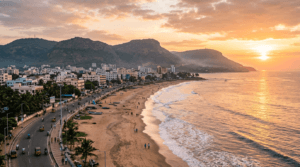
Here’s what Vizag has that no other AP city does: actual nightlife (for very conservative South Indian values of “nightlife”), clean beaches (Rushikonda is Blue Flag certified, Yarada is the secret one locals don’t want tourists to find), a working IT sector, a steel plant that produces 7 million tonnes a year, a shipyard building warships, two refineries, and an IIM. Also, the best Bengali food in South India (there’s a historic Bengali settlement going back to the British railway days).
For local seafood and Andhra-style meals, choose a well-reviewed restaurant near Diamond Park or the beach road and ask about the day’s fresh catch.
Vijayawada
Vijayawada is the commercial capital, the railway junction where every train stops, and the city where Kanaka Durga sits on a hill watching over 17 lakh people. Prakasam Barrage across the Krishna is iconic — walk it at sunset and watch the light turn gold over the river.
Also: Vijayawada biryani is its own category. It’s not Hyderabadi (less saffron, more fire). It’s not Lucknowi (no subtlety here). It’s just spicy, flavourful, and served with mirchi ka salan that will make you drink three glasses of buttermilk. Babai Hotel near the railway station is a century-old institution. Go early, get a pesarattu with upma, and you’ll understand what breakfast is supposed to taste like.
Tirupati
Tirumala is among India’s busiest pilgrimage centres. Daily footfall varies sharply with the season, ticket availability, and festivals; in 2024, reported annual footfall was about 2.55 crore devotees. Check TTD’s official updates before planning a visit, especially during Brahmotsavam and holiday periods.
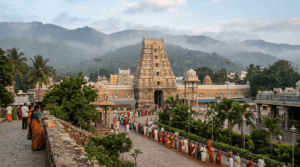
The Tirupati laddu prasadam has a geographical-indication tag and is made in very large quantities each day. Its modern preparation uses ingredients such as Bengal gram flour, ghee, sugar, cashews, raisins and cardamom. TTD’s production and distribution figures vary by season, so avoid treating a daily number as fixed.
Tirupati is also building an IT park near the airport, and Sri City — the giant industrial park on the Tamil Nadu border, where Isuzu assembles SUVs and Mondelez makes Cadbury chocolate — is technically in Tirupati district.
Amaravati
Amaravati is a capital in progress. It was supposed to be a world-class greenfield city designed by Singapore consultants, bigger than Paris, with a riverfront that would put Ahmedabad to shame. Construction started in 2016, stopped in 2019, started again in 2025. As of 2026, the Assembly and High Court are there, a few government buildings are up, and farmers who gave their land in 2015 are still waiting for the plots they were promised.
That said, the ancient village of Amaravati (Dharanikota, 35 km away) is worth the trip for the Buddhist stupa ruins and museum alone. Pieces of this stupa are in the British Museum. Let that one sit with you.
Rajamahendravaram (Rajahmundry)
Rajahmundry is where Telugu literature grew up. It sits on the Godavari’s east bank, and it’s the city where Kandukuri Veeresalingam — the man who fought child marriage and started widow remarriage campaigns in AP — launched the Telugu renaissance. It’s also where the Godavari Pushkaralu happens every 12 years, when crores of pilgrims come for a holy dip.
The Sir Arthur Cotton Barrage at Dowleswaram, built in the 1850s by a British engineer, tamed the Godavari floods and turned the delta into the rice bowl it is today. Farmers in these parts still name their children after him. Cross the Godavari Bridge (that’s the rail-cum-road bridge) at sunset and you’ll understand why Telugu cinema has shot 500+ scenes there.
Kakinada
Kakinada is the port city most people outside AP haven’t heard of. It’s where the Krishna-Godavari basin’s natural gas comes ashore. It’s one of the cleanest cities in the state. And it’s where Kakinada Kaja comes from — a layered, ghee-drenched, syrup-soaked sweet that’s been made here for 130 years, with a GI tag. Eat one fresh from Subbayya Gari Hotel. Then eat another. Don’t look at the calorie count.
Guntur
Guntur grows the chillies that power half of India’s curries. The Guntur Mirchi Yard is Asia’s largest chilli market, trading over 10 lakh tonnes a year. Guntur Sannam chillies are GI-tagged, deep red, fiery, and show up in everything from Andhra avakaya pickle to Thai curry pastes (they’re exported all over Southeast Asia).
Nellore
Nellore is where most of India’s farmed shrimp comes from (over 40% of India’s shrimp exports come from AP, and Nellore is the biggest producer). It’s also home to Sriharikota, the rocket launch site where Chandrayaan-3 took off in 2023. The city has its own biryani style (milder, saffron-heavy, nothing like Vijayawada’s fire) and a dargah where Hindus and Muslims exchange rotis during Rottela Panduga — a festival I’ll talk more about later.
Anantapuramu
Anantapuramu is South India’s driest district. It gets barely 550 mm of rain a year. Farmers here mostly grow groundnuts; the district is India’s largest groundnut producer. It’s also where Dharmavaram silk sarees come from, and where hundreds of wind turbines and solar panels dot the plateau — Rayalaseema’s wind and sun are finally being turned into electricity rather than just drought.
What Keeps the Lights On: The Economy
For 2025–26, Andhra Pradesh’s Planning Department estimated GSDP at about ₹17.62 lakh crore and per-capita income at roughly ₹2.94 lakh. State comparisons should be made carefully because estimates, base years and current-price versus constant-price measures can differ.
What does AP actually sell to the world?
- Shrimp and seafood — We are India’s #1 shrimp exporter. About 40% of the shrimp Americans eat at Red Lobster might very well come from a pond in Nellore or Bapatla.
- Pharmaceuticals — The Jawaharlal Nehru Pharma City near Vizag makes generic drugs for Dr. Reddy’s, Aurobindo, Hetero, and dozens of other companies.
- Steel — Vizag Steel (RINL) makes 7 million tonnes a year, although the privatization debate has hung over it for years.
- Chillies, rice, mangoes, tobacco, cotton — Agriculture still employs over 60% of the population.
- Barytes — Kadapa district’s Mangampet mine produces 97% of India’s barytes (the heavy mineral used in oil drilling).
- IT and services — Vizag is growing fast (Fintech Valley, Millennium Tower, 35,000+ IT jobs), but it’s still tiny compared to Hyderabad, Bengaluru, or Pune.
- Ports and logistics — Vizag, Gangavaram, Krishnapatnam, Kakinada, and the upcoming ports at Machilipatnam and Ramayapatnam handle a massive share of India’s east-coast cargo.
- Renewables — Kurnool’s 1,000 MW solar park was Asia’s largest when it opened in 2019. Wind farms stretch across Anantapuramu and Nandyal.
Why Your Plate Probably Has Something Grown in AP
Walk into any grocery store in North India, pick up a bag of rice, a packet of chilli powder, a mango, a bag of shrimp, or a jar of pickles, and there’s a very good chance it came from AP.
We’re the largest fruit producer in India (18 million tonnes a year — mostly mangoes, bananas, papaya). We’re top-three in rice. Guntur Sannam chillies are in kitchens all over India and Southeast Asia. Banganapalle mangoes (the yellow ones that look like they were designed in a cartoon) are considered by many Telugu people to be the best mango cultivar on the planet. Don’t argue with them on this.
Aquaculture is the quiet revolution. In the last 20 years, farmers across Nellore, Prakasam, Krishna, and West Godavari converted thousands of acres of salt-affected paddy fields into shrimp ponds. The Pacific whiteleg shrimp (L. vannamei) changed lives here — exports boomed from almost nothing in the early 2000s to ₹30,000 crore a year today. It hasn’t been all good — salinization of groundwater, disease outbreaks, and land-price inflation followed — but there’s no denying it transformed the coastal economy.
Araku coffee deserves a special mention. Grown by Adivasi farmers in the Eastern Ghats at 1,000 metres elevation, Araku Arabica won a Gold Award for Best Coffee at the Prix Epicures in Paris in 2018, beating Colombian and Ethiopian entries. You can now buy Araku coffee in Parisian cafes. That’s pretty wild for a tribal valley most Indians haven’t visited.
The Industries That Snuck Up On Everyone
The old stereotype of AP as a purely agricultural state died years ago.
Pharma is massive in Vizag. A lot of people don’t realize how much of India’s generic drug manufacturing happens in and around Visakhapatnam. The Pharma City at Parawada is one of India’s biggest pharma clusters.
IT is coming back slowly. The 2014 bifurcation was a nuclear bomb for AP’s IT industry — practically every major tech company was in Hyderabad, which went to Telangana. Rebuilding in Vizag has been slower than politicians promised, but Millennium Tower at Rushikonda now hosts Tech Mahindra, Infosys, Wipro, Conduent, IBM, Patra Corp, and others. Fintech Valley Vizag, launched in 2016, positioned the city for payment tech and digital banking. It’s no Bengaluru, but it’s real, and it’s growing.
Sri City, the industrial park straddling the AP-Tamil Nadu border at Tada, makes everything from Cadbury chocolate to Isuzu SUVs to PepsiCo drinks to smartphones. It’s basically a 7,500-acre private city an hour north of Chennai, and it’s been quietly pulling in investment for a decade.
Renewable energy is Rayalaseema’s surprise growth story. Anantapuramu and Kurnool districts, which get barely two feet of rain a year and have almost no industrial base, have among India’s highest solar irradiance and wind speeds. The Kurnool Ultra Mega Solar Park was, for a moment, the largest solar farm in Asia. Adani, Greenko, Renew Power, and others have poured in thousands of crores.
Colleges, Schools, and the English-Medium War
Bifurcation left AP with almost no central institutions — IIT, IIM, NIT, AIIMS, IISER, Central University, NID — everything was in Hyderabad. The central government responded fast, sanctioning a cluster of new institutions:
- IIT Tirupati (2015)
- IIM Visakhapatnam (2015)
- NIT Tadepalligudem (2015)
- IISER Tirupati (2015)
- AIIMS Mangalagiri (2018, still building the full campus)
- Central University, Anantapuramu (2018)
- IIPE (Petroleum and Energy), Vizag
- NID Amaravati
Andhra University in Visakhapatnam, founded in 1926, remains one of the state’s best-known public universities. Nobel laureate C.V. Raman conducted work associated with its science college, but it is safer not to describe him as regular early faculty without a university archival citation.
But where AP still struggles is schools. Government schools here have historically had poor learning outcomes, and the state government’s 2020 decision to convert all government schools to English-medium instruction was controversial in the way only a language question can be. Parents largely welcomed it — they want their kids to get jobs that require English. Telugu language activists hated it — they see it as a slow erasure of the mother tongue.
The Nadu-Nedu programme (school infrastructure revamp) and Ammavodi (cash transfers to mothers for school expenses) are trying to fix the basics, but progress is uneven.
The 108 Ambulance, Aarogyasri, and Everything In Between
The 108 emergency ambulance service began in Andhra Pradesh in 2005 through a public-private initiative and later became a model adopted in other parts of India. The service remains a major part of the state’s emergency-response network. Fleet size and call volumes change, so use current Health Department or service-provider figures rather than a fixed number.
Aarogyasri, the health insurance scheme started by Y.S. Rajasekhara Reddy in 2007, provides cashless coverage up to ₹25 lakh per family per year for 1.4 crore BPL families. It’s been renamed, relaunched, and copied by half a dozen other states.
The reality, though, is that healthcare is still a two-tier system in AP. Vizag, Vijayawada, Guntur, and Tirupati have excellent private hospitals (Apollo, Care, KIMS) offering world-class cardiac care and transplants. Government medical colleges produce thousands of doctors every year. But rural areas — especially Rayalaseema’s drought villages and the tribal agency areas — still face doctor shortages, empty primary health centres, and distances that make emergency care a 2-hour drive away.
Tourist Spots That Aren’t Just Tirupati (But Include It)
Let me save you from the same list every site gives you. Here’s what’s actually worth the trip:
Pilgrimage
Tirumala obviously. But go on a weekday. The weekend crowds are something else. Also, walk the footpath from Alipiri if you’re fit — 3,550 steps up the hill, forests on both sides, old pilgrims singing bhajans, and free food and water every few hundred metres.
Srisailam is different. It sits deep in the Nallamala forests, a Shiva Jyotirlinga temple on the banks of the Krishna (backed up by the Srisailam Dam). The drive from Kurnool through the tiger reserve is half the reason to go — you might spot spotted deer, peacocks, and if you’re extraordinarily lucky, a leopard or tiger.
Srikalahasti is 35 km from Tirupati. It’s called the Kailash of the South, famous for the Rahu-Ketu pooja that people fly in from across India to perform.
Lepakshi has a 16th-century Veerabhadra Temple with the famous hanging pillar. The British tried to dislodge it to figure out how it worked during the Raj and broke part of it; they never got it to move.
Puttaparthi — Sathya Sai Baba’s ashram, Prasanthi Nilayam. Draws devotees from over 100 countries. The hospital and university there run entirely on donations.
Nature
Araku Valley gets overhyped by locals and underrated by tourists. The ghat road up from Vizag is 85 km of hairpin bends, waterfalls, coffee plantations, and viewpoints looking out over the Bay of Bengal on clear days. Go before sunrise. Stop at the viewpoints on the way up before the tourist buses arrive.
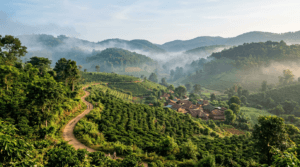
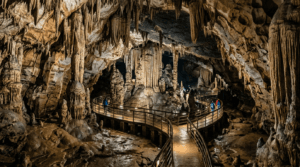
Borra Caves, 17 km before Araku, are 150-million-year-old limestone caves discovered accidentally by a British geologist in 1807. Walk through the lit-up chambers and you’ll see formations that look like a Shiva Lingam, a cow’s udder, a human brain — whatever your imagination projects, basically.
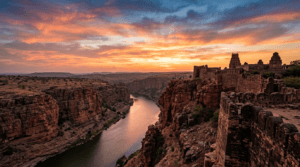
Gandikota is the one I tell every traveller not to miss. The Pennar River carved a 300-foot red sandstone gorge that looks like a miniature Grand Canyon. The fort at the edge, built in the 13th century, has a Ranganayaka temple, a Jama Masjid, granaries, and a viewpoint where you can watch the sun paint the gorge pink and orange at sunset. There are tent stays right at the fort edge now. Wake up for sunrise over the canyon.
Konaseema is AP’s answer to Kerala backwaters. Coconut groves, canals, houseboats, slow-moving villages where boats are the main form of transport. Dindi has nice resorts on the canals. Antardwederi (where the Godavari meets the sea) is worth a sunset trip.
Belum Caves, near Kurnool, are the second-longest natural caves in India open to the public (3.2 km of passages). They were used by Buddhist and Jain monks 2,000 years ago and have natural ventilation systems that have kept the air flowing for millennia.
Lambasingi is the tiny hill station where frost forms in December. Go for sunrise, carry a jacket, and don’t expect much in the way of tourist infrastructure. That’s the charm.
Beaches
Skip the overcrowded R.K. Beach on weekends. Go to Rushikonda for watersports (it’s Blue Flag certified), Yarada for quiet cove vibes (15 km south of Vizag, surrounded by hills), Bheemunipatnam (Bheemili) for old Dutch cemetery ruins and quieter sands, Mypadu near Nellore for the long empty stretch, and Suryalanka near Bapatla for a weekend trip from Guntur/Vijayawada.
Buddhist Heritage
AP is one of the oldest Buddhist regions in India, and almost no one knows this. Thotlakonda and Bavikonda are 2,000-year-old monastic complexes on hills overlooking the sea just 15 km from Vizag. You can walk among the stupas, meditation halls, and refectories where monks lived and studied. The views of the Bay from Thotlakonda at sunset are incredible. Amaravati Stupa and Nagarjunakonda (partially submerged by the Nagarjuna Sagar dam) were major Mahayana Buddhist centres 2,000 years ago.
When to Actually Visit
Don’t come in April, May, or early June. I’m saying this as someone who’s spent those months here. It’s 42-43 degrees, the air feels like someone is holding a hair dryer to your face, and you won’t enjoy a single thing.
October to March is ideal. The monsoon finishes by late October, everything is green, temperatures are 20-32 degrees (perfect for sightseeing), and skies are clear.
July to September works if you want Araku and the waterfalls at peak flow. The rains turn the Eastern Ghats electric green, hotel prices are cheap, and you won’t fight crowds. Pack a raincoat.
December-January is Vizag and Araku peak season. Nights on the hills get down to 10-12 degrees, so carry a sweater. Lambasingi sometimes sees temperatures flirting with zero late December and early January.
Arts, Festivals, and the Movies That Run the State
You cannot separate Andhra culture from Telugu cinema. It’s not an industry here — it’s a religion. On release day, fans pour milk on cutouts of their favourite stars, set off firecrackers at 5 a.m. outside theatres, and fight with rival fan groups online for months before a movie comes out.
Chiranjeevi, NTR, Pawan Kalyan, Mahesh Babu, Ram Charan, Prabhas, Allu Arjun — these aren’t just actors. They’re cultural forces whose political endorsements swing elections. Pawan Kalyan has his own political party. NTR founded one. Chiranjeevi founded one (then merged it into Congress). Allu Arjun’s Pushpa made Telugu cinema a pan-India phenomenon, grossing over ₹1,200 crore worldwide and making “Thaggedhe le” a national catchphrase.
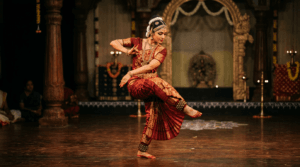
Kuchipudi
Kuchipudi is a village in Krishna district that gave its name to India’s eighth major classical dance form. The dance started as an all-male Brahmin dance-drama tradition in the 17th century — men played all the female roles — but it was Vempati Chinna Satyam who moved to Madras in the 1950s, codified the form, and made it the classical dance the world knows today.
Handicrafts You’ll Actually Want to Take Home
- Kondapalli Toys — Lightweight wooden toys (deities, village scenes, animals) painted by hand. Made in Kondapalli village near Vijayawada. GI-tagged.
- Kalamkari — Hand-painted cotton hangings from Srikalahasti (pen kalamkari, temple narratives) and block-printed textiles from Pedana/Machilipatnam. GI-tagged.
- Etikoppaka Toys — Lacquered wood toys from Etikoppaka village (Anakapalli), made with soft wood and natural vegetable dyes.
- Mangalagiri sarees — Distinctive cotton sarees with a small woven Nizam border. Worn in Telangana and AP for decades.
- Dharmavaram silks — Heavy zari-work silk sarees from Anantapuramu, popular for weddings.
- Uppada Jamdani — Ultra-fine handwoven cotton-silk sarees from Uppada, East Godavari. Translucent, airy, expensive, beautiful.
Festivals
Sankranti is the biggest Telugu festival — three days of kites, bonfires, pongal, new clothes, cattle worship, and visits to every relative in a 20-km radius. Every terrace in the state has a kite. The sky over Hyderabad and Vijayawada turns into a tangle of manjha thread.
Ugadi (Telugu New Year, March/April) is quieter but more traditional. You eat ugadi pachadi — a paste made from neem (bitterness), jaggery (sweetness), raw mango (sour), tamarind (tang), and salt — a reminder that the new year will bring all flavours of experience.
Dasara in Vijayawada is a spectacle. Lakhs of people climb Indrakeeladri to see Kanaka Durga decorated in a different alankaram each day. The temple trust runs special buses; the city lights up like a wedding hall.
Rottela Panduga in Nellore deserves a special mention. It’s a three-day festival at the Bara Shaheed Dargah where Hindu and Muslim devotees exchange rotis across a barrier as a wish-fulfillment ritual. Hindus bring rotis for the pirs, Muslims bring rotis for the saints, and everyone eats together. It’s the kind of syncretic tradition that makes you feel better about India, even in polarizing times.
The Food Will Make You Cry (And You’ll Thank It)
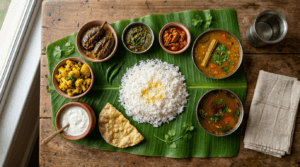
Andhra food has a reputation for being impossibly spicy. It is. But reducing it to “spicy” misses the point. There’s depth here — the sour of tamarind, the fire of Guntur chillies, the earthiness of gongura, the sweetness of coconut, the tang of curd, all balanced in a way that takes your breath away but has you reaching for more.
A few things to seek out:
Gongura Pachadi — The iconic Andhra chutney. Gongura (sorrel leaves) ground with red chillies, garlic, and tempering. It’s sour, spicy, and strangely addictive. Telugu grandmothers will tell you it’s good for digestion. It’s really just good.
Pesarattu — A dosa made from whole green gram (moong dal), not the usual rice-urad dal batter. Served with ginger chutney. The MLA pesarattu (stuffed with upma) is a Vijayawada speciality.
Avakaya — The raw mango pickle made every summer in almost every Telugu household. Raw mango chunks, mustard powder, red chilli powder, sesame oil, left to mature in ceramic jars for weeks. A single avakaya mango piece with rice and ghee is a meal in itself.
Royyala Iguru — Prawns slow-cooked in a thick onion-masala paste. Coastal Andhra at its best.
Chepala Pulusu — Fish (usually murrel) in a tangy tamarind gravy. A meal in itself with hot rice.
Gutti Vankaya Kura — Baby brinjals stuffed with peanut-sesame masala and cooked in a spicy gravy. Rayalaseema speciality.
Pootharekulu — Paper-thin rice-starch wrappers layered with ghee, powdered sugar, and dry fruits. From Atreyapuram village in East Godavari.
Kakinada Kaja — The layered, syrup-soaked sweet from Kakinada. Eat it fresh.
Bobbatlu (Bakshalu) — Sweet stuffed flatbreads (chana dal and jaggery filling). Made for every festival.
Andhra biryani — If you’ve only had Hyderabadi biryani, Andhra biryani is a shock. It’s spicier, uses less saffron, leans into green chillies and mint, and has a different masala profile. Vijayawada does it one way, Nellore does it another (milder, saffron-forward). They’re both great.
Avakai, Gongura, and Guntur Kodi Kura — The holy trinity of Andhra non-veg/veg pickle-curry combinations. If an Andhra person offers you a home-cooked meal with these three, cancel whatever else you had planned and go.
Andhra meals are traditionally served on a vistharaku (banana leaf). The order matters — salt first, then pickle, pachadi, curries, rice, sambar, rasam, perugu (curd), sweet. Don’t skip the perugu at the end — your stomach will thank you after all the chillies.
Tigers, Flamingos, and the Fish That Climbs Trees
Wait, the climbing fish part is real — the anabas testudineus (climbing perch) lives in the Godavari-Krishna mangroves and can actually walk across land using its gill plates and fins.
AP has around 19-20% forest cover, which is below the national average, but the forests we have are spectacularly diverse:
Sri Venkateswara National Park, near Tirupati, covers about 354 sq km in the Seshachalam hills. The wider Sri Venkateswara Wildlife Sanctuary is larger, which is the likely source of the often-quoted 525 sq km figure. Wildlife records include leopards, sloth bears, deer and the golden gecko.
Papikonda National Park protects a large stretch of Eastern Ghats forest around the Godavari gorge. It should not be described as part of the Nagarjunasagar-Srisailam Tiger Reserve; they are separate protected landscapes. Boat operations and access rules can change with water levels and forest permissions.
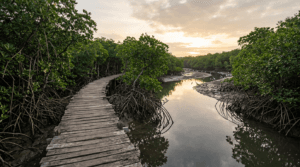
Coringa Wildlife Sanctuary near Kakinada is the second-largest mangrove forest in India after the Sunderbans. It has fishing cats (they swim and hunt in the mangroves at night), smooth-coated otters, saltwater crocodiles, and over 120 bird species.
Rollapadu near Nandyal is one of the last refuges of the Great Indian Bustard — a massive, ground-dwelling bird that’s critically endangered (fewer than 150 left in all of India). You’ll also spot blackbuck here.
Pulicat Lake (shared with Tamil Nadu) is India’s second-largest brackish lagoon. Every winter, 50,000+ greater flamingos arrive, along with pelicans, painted storks, and dozens of migratory duck species. Sriharikota island, where ISRO launches rockets, sits in the southern part of the lagoon.
Getting From Here to There
Roads: NH-16 runs the length of the coast from Kolkata to Chennai. Most major stretches are 4/6 lane now. APSRTC runs 12,000 buses connecting every village. Private sleeper buses (Kaali, Diwakar, Morning Star) run overnight between Vizag-Hyderabad, Vizag-Chennai, Vijayawada-Bengaluru.
Trains: Vijayawada is South India’s busiest junction outside Chennai Central. You can catch a train to practically anywhere in India from there. Vizag, Guntur, Rajahmundry, and Tirupati are other major junctions. The South Coast Railway (SCoR), headquartered at Vizag, was carved out as India’s 18th railway zone in 2019.
Airports: Vizag (VTZ) is the busiest, with flights to Hyderabad, Bengaluru, Mumbai, Delhi, Chennai, Kolkata, plus limited international (Dubai, Singapore). Vijayawada (VGA), Tirupati (TIR), Rajahmundry (RJA), Kadapa, and Kurnool have domestic flights. Bhogapuram, the new international airport 45 km from Vizag, is supposed to open around 2027-28 and will become AP’s largest airport. Nellore (Dagadarthi) also has a greenfield airport in the works.
Ports: Vizag Port is the big one (established 1933, central government, busiest east-coast port after Paradip and Chennai). Gangavaram (private, Adani) and Krishnapatnam (private, Adani) are deep-water ports that handle massive coal, iron ore, and container traffic. Kakinada handles natural gas. Machilipatnam is being redeveloped.
Politics: It’s Complicated
Let me save you from a civics lesson. AP has 175 MLAs (down from 294 in the united state), 25 Lok Sabha seats, and an extremely high-stakes political culture.
Three parties dominate:
- TDP (Telugu Desam Party), founded by NTR in 1982, currently led by N. Chandrababu Naidu (CM as of 2024). Draws strength from urban centres, the Kamma community, and coastal Andhra. Naidu is the man who built Cyberabad in the 1990s and turned Hyderabad into an IT hub.
- YSRCP, founded by Y.S. Jagan Mohan Reddy after his father’s death. Held power 2019-2024. Strong base in Rayalaseema and among SC/ST/BC/Muslim voters.
- Janasena, Pawan Kalyan’s party. Contested 2024 in alliance with TDP and BJP, draws youth and Kapu voters.
Elections here are notoriously expensive and personal. Candidates routinely spend crores far beyond EC limits, political families have rivalries that run 30 years deep, and the media wars between pro-TDP and pro-YSRCP channels can make American cable news look tame.
The capital issue we discussed earlier? It’s been the defining political fault line since 2014, and it’ll probably take another decade to settle.
People Who Put AP on the Map
AP doesn’t get enough credit for the number of people who shaped modern India coming out of a state with 4% of the country’s population. A few names to know:
Sarvepalli Radhakrishnan — India’s second President (and first Vice President), philosopher extraordinaire, Bharat Ratna. His birthday, 5 September, is Teachers’ Day. Raised and educated in the AP/TS region.
Pingali Venkayya — The man who designed the Indian national flag. Born in Bhatlapenumarru (Krishna district). The original flag he presented at the 1921 Congress session in Vijayawada had the charkha; the Ashoka Chakra was added in 1947.
Potti Sriramulu — His fast-unto-death created Andhra State and triggered the linguistic reorganization of all of India.
Alluri Sitarama Raju — The “Hero of the Jungles” who led the Rampa Rebellion (1922-24) against British forest laws that were destroying Adivasi livelihoods. The British hunted him for two years and killed him in the forests at age 26.
N.T. Rama Rao (NTR) — Telugu cinema’s biggest icon who walked into politics and won the 1983 election within 9 months of launching his party, becoming CM. He changed AP politics forever.
Tanguturi Prakasam Pantulu — “Andhra Kesari” (Lion of Andhra). The first CM of Andhra State. When British soldiers threatened to shoot protesters during the independence movement, he bared his chest and said “shoot me if you have the guts.” The soldiers backed down.
P.V. Narasimha Rao — Born in Telangana (then part of AP), represented AP in the Lok Sabha, and became India’s PM in 1991. The man who liberalized India’s economy.
Y.S. Rajasekhara Reddy (YSR) — Two-term CM who launched Aarogyasri and Jala Yagnam (irrigation expansion). Died in a helicopter crash in the Nallamala forests in 2009; his death reshaped AP politics forever.
S.P. Balasubrahmanyam — The legendary playback singer who recorded over 40,000 songs in 16 languages. Six National Awards. Died of COVID in 2020; Tamil Nadu and AP shut down for his funeral.
M. Balamuralikrishna — Carnatic music legend. Started performing at age 8. Created new ragas. Padma Vibhushan.
Pullela Gopichand — His 2001 All England victory placed him among India’s leading badminton players of that period. After retiring from international competition, he built a high-performance coaching programme in Hyderabad and helped guide athletes including P.V. Sindhu, Saina Nehwal and Kidambi Srikanth.
P.V. Sindhu — First Indian woman to win an Olympic silver (Rio 2016). World Championship gold (2019). Olympic bronze (Tokyo 2020). She trained at Gopichand’s academy and is the pride of Telugu sports.
Kandukuri Veeresalingam — 19th-century social reformer who fought child marriage, started widow remarriage, and campaigned for women’s education. Considered the father of the Telugu renaissance.
Yelavarthy Nayudamma — Internationally renowned leather chemist, CSIR Director General. Died in the 1985 Air India Kanishka bombing.
10 Things Even Locals Don’t Know
- Pingali Venkayya designed the Indian flag at the 1921 Congress session in Vijayawada. He was also a geologist, agricultural researcher, and polyglot who spoke Japanese. There’s a statue of him on Beach Road in Vizag.
- Araku coffee beat Colombian and Ethiopian coffees to win the Prix Epicures Gold in Paris in 2018. It’s grown entirely by Adivasi farmers using traditional organic methods.
- The TTD kitchen makes 3 lakh laddus every day during peak season — using 5 tonnes of gram flour, 3 tonnes of sugar, a tonne of cashews, 700 kg of ghee, and 150 kg of cardamom. Over 600 cooks work in shifts 24 hours a day.
- Mangampet mine in Kadapa produces 97% of India’s barytes — the heavy mineral that keeps oil wells from blowing out. Without it, the global oil industry runs into trouble.
- Arma Konda is the highest peak in the entire Eastern Ghats north of the Nilgiris — 1,680 metres. You’ve probably never heard of it. Most Andhraites haven’t either.
- Machilipatnam port was where the Kohinoor diamond is believed to have been shipped from India. The Dutch had their first Indian trading post there in 1605; the British followed in 1611. It was the Golconda kingdom’s main port for diamond and textile trade.
- The Kakinada submarine canyon plunges 3,000 metres deep just off the coast — one of the deepest canyons in the Bay of Bengal. Whale strandings sometimes happen on nearby beaches because of the deep water coming close to shore.
- Kuchipudi nearly went extinct in the 1950s. Only a handful of families in Kuchipudi village were still practicing. Vempati Chinna Satyam almost single-handedly revived the form by moving to Madras, setting up a dance academy, and training hundreds of students.
- Bhavani Island on the Krishna River in Vijayawada is one of the largest river islands in India — 133 acres, right upstream of Prakasam Barrage. It has resorts, water sports, and coracle rides.
- Visakhapatnam was bombed by Japanese aircraft in April 1942. The wartime raid targeted the harbour area and remains an important part of the city’s Second World War history. Do not attribute a First World War attack on Vizag to SMS Emden: the ship is known for its 1914 bombardment of Madras, now Chennai.
Did You Know?
- The Sriharikota Range (Satish Dhawan Space Centre) has launched over 100 missions, including Chandrayaan-3 in July 2023, which made India the first country to soft-land a spacecraft near the Moon’s south pole.
- The Lepakshi Temple has a giant Nandi statue carved from a single granite boulder — it’s 8 metres long and 3 metres high, and it sits facing the Shiva linga several hundred metres away.
- The Guntur Mirchi Yard (Asia’s largest chilli market) trades Guntur Sannam chillies that are exported to the USA, Japan, Sri Lanka, the EU, and Thailand. Your green curry in Bangkok might have Andhra chilli in it.
- Andhra Bank (now merged into Union Bank of India) was founded in Machilipatnam in 1923 by freedom fighter Bhogaraju Pattabhi Sitaramayya — one of the few Indian-owned banks during British rule.
- Pothuluri Veerabrahmam, a 17th-century saint from Kadapa, wrote the Kalagnanam — a book of prophecies (similar in style to Nostradamus) that some Telugu households still read today. He predicted, among other things, the end of caste-based occupations and British rule centuries before they happened.
- The Eastern Ghats in AP have flowering Strobilanthes bushes (neelakurinji) that bloom once every 12 years. The last major bloom was 2018 in the Tirumala hills, which painted whole hillsides blue-purple.
- The INS Visakhapatnam — the Indian Navy’s most advanced guided-missile destroyer — is named after the city.
Questions People Actually Ask
Is Amaravati really the capital, or is Vizag?
Amaravati is Andhra Pradesh’s capital under the present government’s policy. As development and government-office arrangements can change, check the Andhra Pradesh government’s latest notifications before relying on a particular office location.
How many districts does AP have?
28 as of 2026, after adding Markapuram and Polavaram in 2024.
Is Telugu hard to learn?
It’s a Dravidian language, completely different from Hindi/English. But the script is phonetic and consistent — what you see is what you say. Most people in cities speak Hindi and English, so you can get by fine.
Is Andhra food really that spicy?
Yes. It is. If you can’t handle heat, ask for “less chilli” — they might laugh, but they’ll do it. And always have curd (perugu) with your meal.
Is Vizag worth visiting for a beach holiday?
Absolutely. It’s cleaner, cheaper, and less crowded than Goa. Less party scene, but better food and friendlier locals. Go between October and February.
Is Tirupati accessible for non-Hindus?
TTD has a declaration process for non-Hindu visitors seeking darshan, requiring an affirmation of faith and respect for Lord Venkateswara and the temple’s customs. Rules, dress requirements, ticket quotas and fees can change, so verify them on the official TTD website before travelling.
How many days do I need to see AP properly?
At least 10 days if you want to cover Vizag, Araku, Borra, Amaravati, Vijayawada, Guntur, Gandikota, Srisailam, and Tirupati. Otherwise, pick a region: Vizag-Araku (3-4 days), Amaravati-Vijayawada-Guntur (2 days), Kadapa-Gandikota (1-2 days), Tirupati-Lepakshi (2 days).
Is it safe for solo women travellers?
Cities like Vizag, Vijayawada, and Tirupati are as safe as any other Indian city, with normal precautions. Avoid isolated rural areas after dark, use registered cabs or app-based services (Ola/Uber work in Vizag/Vijayawada/Tirupati), and trust your instincts. APSRTC buses are generally safe for women.
What should I bring home from AP as a souvenir?
Kalamkari hangings from Srikalahasti, Kondapalli toys, Etikoppaka toys, Uppada sarees, Dharmavaram silks, Mangalagiri cotton, Guntur chilli powder, a pack of Kakinada kaja (eat within 2-3 days), Araku coffee beans (get them at the Araku plantations for the freshest stuff), and a jar of avakaya pickle if you’re taking it to a cold country (oil-based pickles keep for months).
Do people speak Hindi?
In the big cities, yes, especially in shops, hotels, and auto rickshaws. In villages, less so, but people are usually friendly and will try to help even without a common language. Learn a couple of basic Telugu words — dhanyavaadalu (thank you), ekkada (where), bagaunnara (how are you) — and locals will love you.
Will I have trouble finding vegetarian food?
Andhra cuisine has a huge vegetarian repertoire. Meals at most local restaurants will have veg options. Temples (Tirupati, Srisailam, Annavaram) serve free vegetarian meals (annadanam) to thousands every day.
What’s the one thing I absolutely must not miss?
Gandikota at sunrise. No contest.
Final Thought
If there’s one thing I want you to take away from this, it’s that Andhra Pradesh doesn’t fit a single stereotype.
We’re a state where a woman selling mangoes on a highway in Krishna district has a son working at SpaceX. Where a Kuchipudi dancer in a remote village has a TikTok following of 20 lakh. Where shrimp farmers in Nellore export to the US and do Bhairavi puja at the local temple on Fridays. Where ISRO scientists watch launches from the same beach that fishermen use to launch boats every morning. Where Vizag steel plant workers live down the road from IT engineers who work from co-working spaces overlooking Rushikonda.
The last decade was rough. Bifurcation gutted our capital city, took our institutions, and left us rebuilding from scratch. Political drama over Amaravati made investors nervous. Cyclones like Hudhud (2014) wrecked Vizag. COVID shut down aquaculture exports. Rayalaseema farmers still commit suicide in drought years.
But there’s something stubborn about this place and its people. Telugu people don’t wait for governments to build things for them — they build them themselves. The IT industry in Vizag came back because entrepreneurs and engineers moved there, not just because the government built a park. Shrimp exports grew because farmers took risks and learned the technology. Araku coffee won awards because Adivasi farmers refused to be pushed off their land.
A longer stay beyond a quick Tirupati darshan or a short Vizag visit offers a fuller view of the state. Take the ghat road to Araku. Eat a gongura meal at a roadside dhaba in Guntur — not a restaurant, a dhaba. Watch a Kuchipudi performance in the village it was born in. Stand at Gandikota as the sun goes down over the gorge. Walk the Tirumala footpath at 4 a.m. with pilgrims singing bhajans. Eat a warm laddu at Tirupati. Talk to a shrimp farmer in Nellore. Have coffee with an Adivasi family in Araku. Watch a rocket launch from Satish Dhawan Space Centre (check ISRO’s schedule — they have open viewing).
AP isn’t Rajasthan or Kerala or Goa, where every corner is photogenic and Instagram-ready. It’s messier, louder, spicier, and slightly chaotic. The roads might be under construction, the auto drivers might overcharge you, and the summer heat will test your patience. But there’s a warmth here — in the food, in the people, in the way a grandmother will feed you an extra laddu even if you say you’re full, in the way auto drivers will invite you for chai at a roadside stall during a rainstorm.
Come see it. Just don’t come in May.
References
- Government of Andhra Pradesh
- Andhra Pradesh Tourism Authority
- Tirumala Tirupati Devasthanams
- ISRO — Satish Dhawan Space Centre, Sriharikota
- MPEDA — Marine Products Export Statistics
- Andhra Pradesh Capital Region Development Authority
- Andhra Pradesh District Reorganisation Update
- Andhra Pradesh GSDP and Per-Capita Income Update