
Introduction
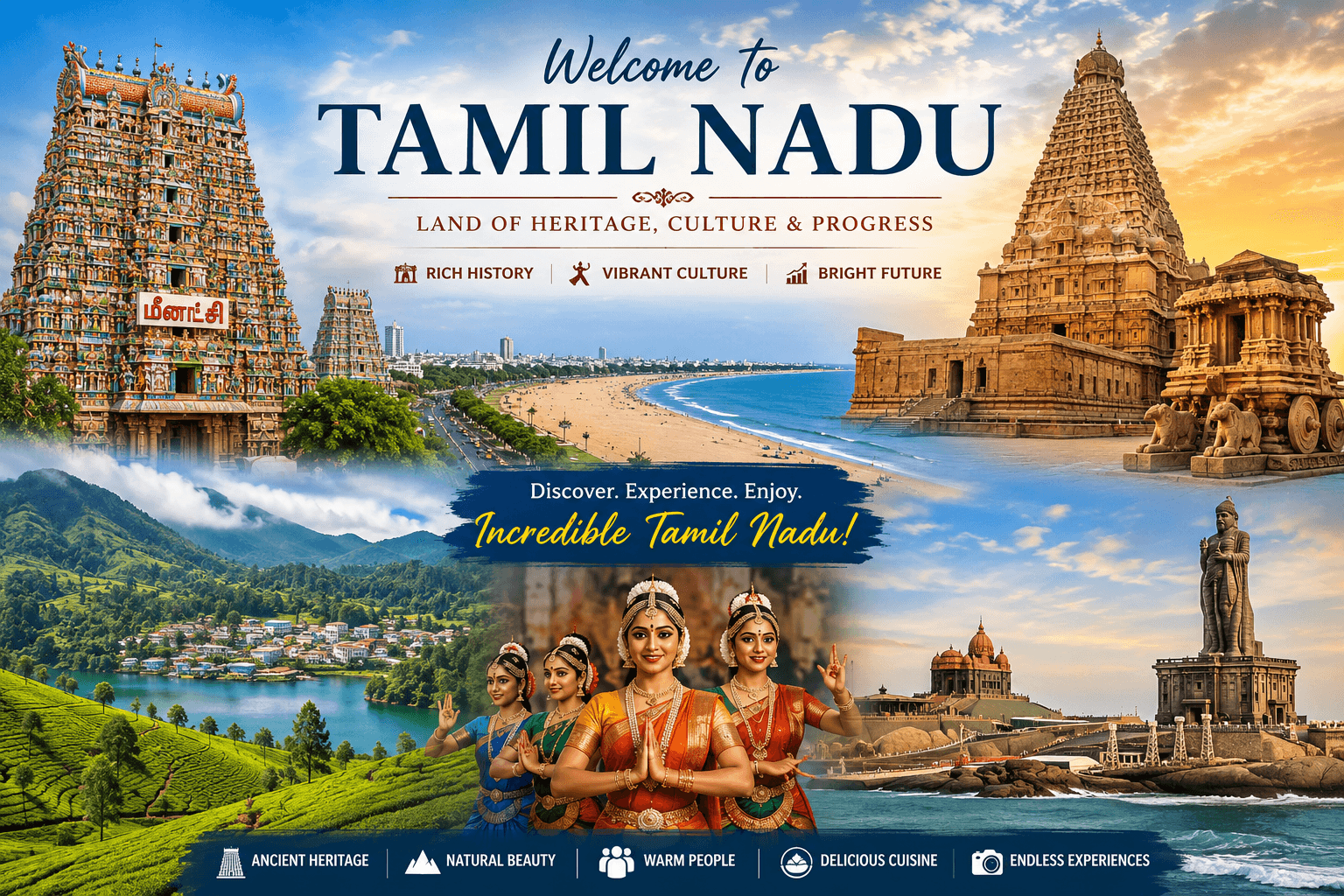
Tamil Nadu is one of India’s most historically significant, culturally vibrant, and economically advanced states. Located in the southernmost part of the country, Tamil Nadu is renowned for its magnificent temples, ancient civilizations, classical Tamil language, rich cultural heritage, scenic hill stations, beautiful beaches, thriving industries, and world-famous cuisine. The state serves as a perfect blend of tradition and modern development, attracting millions of tourists, pilgrims, students, and business investors every year.
The capital city, Chennai, is a major metropolitan city and one of India’s leading centres for information technology, automobile manufacturing, healthcare, education, and trade. Often referred to as the “Detroit of India,” Chennai is home to numerous automobile industries, multinational companies, research institutions, and prestigious universities.
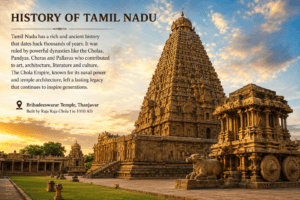
Tamil Nadu has a glorious history that dates back over 2,000 years. Powerful dynasties such as the Cholas, Cheras, Pandyas, and Pallavas ruled the region and left behind remarkable architectural masterpieces, including the Brihadeeswarar Temple in Thanjavur and the Shore Temple in Mahabalipuram. These monuments continue to showcase the state’s artistic brilliance and engineering excellence.
The state is blessed with diverse geographical features, including the Western Ghats, Eastern Ghats, fertile river plains, dense forests, long coastlines, waterfalls, and wildlife sanctuaries. Tamil Nadu is also home to famous tourist destinations such as Ooty, Kodaikanal, Rameswaram, Kanyakumari, Madurai, and Mahabalipuram, making it one of India’s top travel destinations.
Apart from tourism, Tamil Nadu is one of India’s strongest economic powerhouses, leading in automobile manufacturing, textiles, electronics, renewable energy, information technology, healthcare, and agriculture. The state is also famous for its traditional arts, Bharatanatyam classical dance, Carnatic music, silk sarees, and delicious South Indian cuisine.
This comprehensive guide explores everything about Tamil Nadu, including its history, geography, districts, economy, agriculture, education, transport, healthcare, tourism, culture, festivals, food, sports, famous personalities, and interesting facts, making it a complete resource for students, travelers, competitive exam aspirants, and anyone interested in learning about this remarkable South Indian state.
Tamil Nadu Location in India
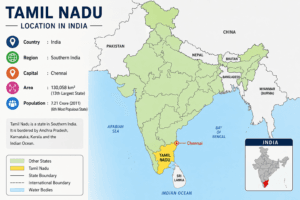
Tamil Nadu is located in the southernmost part of India and is one of the country’s most important cultural, historical, and economic states. It shares its borders with Andhra Pradesh to the north, Karnataka to the northwest, and Kerala to the west. The Bay of Bengal lies to the east, while the Indian Ocean surrounds its southern coastline. Across the Palk Strait and the Gulf of Mannar, Tamil Nadu is separated from Sri Lanka.
With a coastline of about 1,076 km, Tamil Nadu has the second-longest coastline in India, making it a major hub for maritime trade, fisheries, and tourism. Its strategic location has played a vital role in trade, culture, and international relations for centuries.
The state’s geographical position offers a unique blend of mountains, plains, forests, rivers, beaches, and fertile agricultural land. Tamil Nadu is also home to famous hill stations such as Ooty and Kodaikanal, along with iconic coastal destinations like Chennai, Rameswaram, and Kanyakumari.
Tamil Nadu at a Glance
| Feature | Details |
|---|---|
| Capital | Chennai |
| Largest City | Chennai |
| Formation Day | 1 November 1956 |
| Statehood Name | Madras State (Renamed as Tamil Nadu on 14 January 1969) |
| Total Area | 130,058 sq km |
| Area Rank | 10th Largest State in India |
| Population (2011 Census) | 72.15 Million |
| Estimated Population (2025) | Over 80 Million |
| Official Language | Tamil |
| Literacy Rate | 80.09% |
| Number of Districts | 38 |
| Coastline | About 1,076 km (Second Longest in India) |
| Highest Peak | Doddabetta (2,637 m) |
| Major Rivers | Kaveri, Vaigai, Palar, Bhavani & Tamirabarani |
| State Animal | Nilgiri Tahr |
| State Bird | Emerald Dove |
| State Flower | Glory Lily |
| State Tree | Palmyra Palm |
| Famous Dance | Bharatanatyam |
| Major Industries | Automobiles, IT, Textiles, Electronics & Manufacturing |
| Famous Tourist Places | Chennai, Ooty, Kodaikanal, Madurai, Rameswaram, Kanyakumari & Mahabalipuram |
History of Tamil Nadu
Tamil Nadu has one of the oldest and most glorious histories in India, with a civilization that dates back over 2,000 years. The region has been a centre of Tamil language, literature, trade, art, architecture, and culture since ancient times. Tamil Nadu’s history is closely associated with the powerful Chera, Chola, Pandya, and Pallava dynasties, whose contributions shaped South India’s political, cultural, and economic landscape.
During the Sangam Age (300 BCE–300 CE), Tamil Nadu flourished as a hub of literature, maritime trade, and urban civilization. Tamil poets composed the famous Sangam literature, one of the world’s oldest literary traditions. The ports of Kaveripoompattinam (Poompuhar) and Muziris played an important role in trade with the Roman Empire, Southeast Asia, and other regions.
The Pallava Dynasty (4th–9th century CE) made remarkable contributions to architecture by constructing magnificent monuments such as the Shore Temple and the Group of Monuments at Mahabalipuram, now recognized as a UNESCO World Heritage Site.
The Chola Empire (9th–13th century CE) marked the golden age of Tamil Nadu. Under rulers such as Rajaraja Chola I and Rajendra Chola I, the empire expanded across South India and Southeast Asia. During this period, the magnificent Brihadeeswarar Temple at Thanjavur was built, showcasing extraordinary achievements in engineering and temple architecture.
Later, the Pandya Dynasty, Vijayanagara Empire, and Nayak rulers governed different parts of Tamil Nadu before the region came under British rule as the Madras Presidency. After India’s independence in 1947, Madras State became one of the states of the Indian Union. On 14 January 1969, it was officially renamed Tamil Nadu, meaning “Land of the Tamils.”
Timeline of Tamil Nadu History
| Period | Major Event |
|---|---|
| 300 BCE – 300 CE | Sangam Age and flourishing Tamil literature |
| 4th – 9th Century | Pallava Dynasty and Mahabalipuram monuments |
| 9th – 13th Century | Chola Empire and Brihadeeswarar Temple |
| 13th – 16th Century | Pandya Dynasty |
| 16th – 18th Century | Vijayanagara & Nayak Rule |
| 1801 – 1947 | British Madras Presidency |
| 1956 | Formation of Madras State |
| 14 January 1969 | Renamed as Tamil Nadu |
Geography & Climate of Tamil Nadu
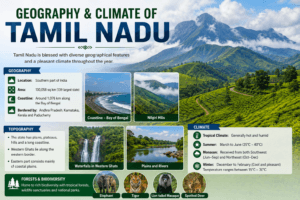
Tamil Nadu is located in the southernmost part of the Indian Peninsula and covers an area of approximately 130,058 square kilometres, making it the 10th largest state in India. The state is bordered by Andhra Pradesh to the north, Karnataka to the northwest, Kerala to the west, and the Bay of Bengal to the east. The Indian Ocean lies to its south, while the Palk Strait and Gulf of Mannar separate it from Sri Lanka.
Tamil Nadu has diverse geographical features that include the Western Ghats, Eastern Ghats, fertile river plains, coastal regions, forests, waterfalls, and hill stations. The Nilgiri Hills, Anamalai Hills, and Palani Hills are among the state’s most important mountain ranges. Doddabetta Peak (2,637 metres), located in the Nilgiris, is the highest point in Tamil Nadu.
The state experiences a tropical climate with hot summers, moderate winters, and seasonal rainfall. Unlike many Indian states, Tamil Nadu receives a significant portion of its rainfall from the Northeast Monsoon (October–December), while the Southwest Monsoon (June–September) contributes rainfall mainly to the western districts. This unique climatic pattern supports agriculture, water resources, and biodiversity across the state.
Tamil Nadu is also blessed with a 1,076-kilometre-long coastline, the second longest in India, which supports major ports, fisheries, tourism, and maritime trade. The state’s varied landscape and favorable climate make it one of India’s most geographically diverse regions.
Geography & Climate at a Glance
| Category | Details |
|---|---|
| Total Area | 130,058 sq km |
| Area Rank | 10th Largest State in India |
| Highest Peak | Doddabetta (2,637 m) |
| Major Mountain Ranges | Western Ghats, Eastern Ghats, Nilgiri Hills, Anamalai Hills & Palani Hills |
| Coastline | About 1,076 km (Second Longest in India) |
| Climate | Tropical |
| Summer Season | March – June |
| Southwest Monsoon | June – September |
| Northeast Monsoon | October – December |
| Winter Season | December – February |
Rivers, Dams & Forests of Tamil Nadu
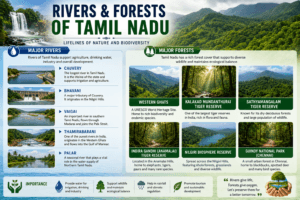
Tamil Nadu is blessed with a rich network of rivers, reservoirs, dams, forests, and wildlife-rich landscapes that play a crucial role in the state’s agriculture, drinking water supply, hydroelectric power generation, biodiversity, and ecological balance. Although many rivers are seasonal, they are supported by numerous dams and irrigation projects that help sustain farming throughout the year.
The Kaveri (Cauvery) is the longest and most important river in Tamil Nadu, often referred to as the “Lifeline of Tamil Nadu.” Other major rivers include the Vaigai, Bhavani, Palar, Tamirabarani, Amaravathi, Noyyal, and Thenpennai (South Pennar).
Tamil Nadu is home to several major dams such as the Mettur Dam, one of India’s largest masonry dams, along with Bhavanisagar Dam, Vaigai Dam, Amaravathi Dam, Sathanur Dam, and Papanasam Dam. These reservoirs support irrigation, hydroelectric power, and drinking water needs.
Approximately 20% of Tamil Nadu’s geographical area is covered by forests. The state’s forests are concentrated in the Western Ghats, a UNESCO World Heritage region known for its exceptional biodiversity. Important protected areas include Mudumalai Tiger Reserve, Anamalai Tiger Reserve, Sathyamangalam Tiger Reserve, Kalakkad Mundanthurai Tiger Reserve, Gulf of Mannar Marine National Park, and Guindy National Park. These forests are home to elephants, Bengal tigers, leopards, gaur, Nilgiri tahr, lion-tailed macaques, and hundreds of bird species.
Rivers, Dams & Forests at a Glance
| Category | Details |
|---|---|
| Longest River | Kaveri (Cauvery) |
| Other Major Rivers | Vaigai, Bhavani, Palar, Tamirabarani, Amaravathi & Noyyal |
| Largest Dam | Mettur Dam |
| Other Major Dams | Bhavanisagar, Vaigai, Amaravathi, Sathanur & Papanasam |
| Forest Cover | Around 20% of the State |
| Major Forest Region | Western Ghats |
| Tiger Reserves | Mudumalai, Anamalai, Sathyamangalam & Kalakkad Mundanthurai |
| Marine National Park | Gulf of Mannar Marine National Park |
| State Animal | Nilgiri Tahr |
| Famous Wildlife | Bengal Tiger, Asian Elephant, Leopard, Gaur & Lion-tailed Macaque |
Government & Administration of Tamil Nadu
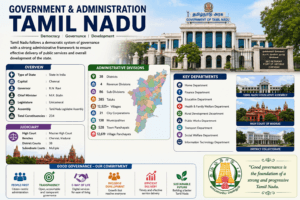
Tamil Nadu has a well-structured democratic system of government that functions under the Constitution of India. The state follows a parliamentary form of government, where the Governor serves as the constitutional head, while the Chief Minister is the executive head responsible for administering the state.
The capital city, Chennai, houses the Tamil Nadu Legislative Assembly, the Secretariat, and the Madras High Court, one of the oldest High Courts in India. The Legislative Assembly consists of 234 elected members, representing constituencies across the state.
For efficient governance and public administration, Tamil Nadu is divided into 38 districts, each headed by a District Collector. These districts are further divided into revenue divisions, taluks, blocks, municipalities, corporations, and village panchayats, ensuring effective delivery of government services at the grassroots level.
Tamil Nadu is recognized as one of India’s leading states in e-governance, digital public services, healthcare, education, infrastructure, industrial development, and social welfare programmes. The government actively implements initiatives for economic growth, rural development, women’s empowerment, public welfare, and environmental conservation.
Government at a Glance
| Category | Details |
|---|---|
| Capital | Chennai |
| Government Type | Parliamentary Democratic System |
| Constitutional Head | Governor |
| Executive Head | Chief Minister |
| Legislature | Unicameral |
| Legislative Assembly Seats | 234 |
| High Court | Madras High Court |
| Districts | 38 |
| Administrative Headquarters | Fort St. George, Chennai |
| Local Governance | Municipal Corporations, Municipalities, Town Panchayats & Village Panchayats |
Population & Demographics of Tamil Nadu
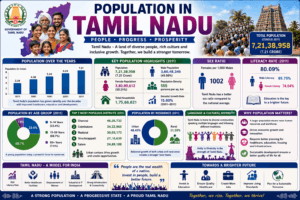
Tamil Nadu is one of India’s most populous and urbanized states, known for its rich cultural diversity, high literacy rate, and strong human development indicators. According to the 2011 Census, the state had a population of approximately 72.15 million, making it one of the most populated states in the country. Current estimates place the population at over 80 million.
The official language of Tamil Nadu is Tamil, one of the world’s oldest living classical languages with a literary history spanning more than two thousand years. English is also widely used in education, business, government administration, and information technology.
Tamil Nadu has one of India’s highest urbanization rates, with major metropolitan cities such as Chennai, Coimbatore, Madurai, Tiruchirappalli, Salem, Tiruppur, Tirunelveli, and Erode serving as important centres of industry, education, healthcare, and commerce.
The state has achieved remarkable progress in education, healthcare, gender development, and public welfare, resulting in a high literacy rate and improved quality of life. Tamil Nadu is also recognized for its cultural harmony, religious diversity, and inclusive social development, making it one of India’s leading states in human development.
Tamil Nadu Population at a Glance
| Category | Details |
|---|---|
| Population (2011 Census) | 72.15 Million |
| Estimated Population (2025) | Over 80 Million |
| Population Rank | 6th in India |
| Literacy Rate | 80.09% |
| Official Language | Tamil |
| Other Languages | English, Telugu, Kannada, Malayalam & Urdu |
| Number of Districts | 38 |
| Largest City | Chennai |
| Major Cities | Chennai, Coimbatore, Madurai, Tiruchirappalli, Salem & Tiruppur |
| Urban Population | Around 48% |
Economy & Industries of Tamil Nadu
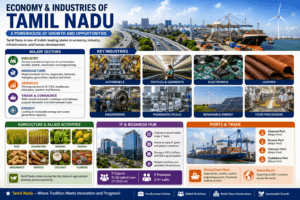
Tamil Nadu is one of India’s largest and most diversified economies, contributing significantly to the country’s industrial production, exports, manufacturing, services, and information technology sectors. The state is widely recognized as the Automobile Capital of India due to the presence of numerous global automobile manufacturers and component industries. With a strong industrial base, skilled workforce, world-class infrastructure, and investor-friendly policies, Tamil Nadu has emerged as a major economic powerhouse in South Asia.
The capital city, Chennai, is a leading hub for automobiles, information technology (IT), electronics, healthcare, financial services, and port-based industries. Major global companies in the automobile, electronics, and software sectors have established manufacturing plants and research centres across the state.
Tamil Nadu is also a national leader in textiles, leather products, renewable energy, engineering goods, cement, chemicals, pharmaceuticals, and food processing. Cities such as Coimbatore, Tiruppur, Hosur, Salem, Erode, Sivakasi, and Thoothukudi play vital roles in the state’s industrial growth. Tiruppur is internationally known as India’s leading knitwear export hub, while Sivakasi is famous for fireworks, printing, and match industries.
The state has developed a strong ecosystem of Special Economic Zones (SEZs), industrial parks, IT parks, and export-oriented manufacturing clusters, attracting domestic and foreign investment. Tamil Nadu also leads India in wind energy generation and continues to expand its renewable energy capacity through solar and green energy projects.
With its robust industrial infrastructure, excellent connectivity, skilled manpower, and diversified economy, Tamil Nadu remains one of the most attractive investment destinations in India.
Economy & Industries at a Glance
| Category | Details |
|---|---|
| Economic Status | One of India’s Largest State Economies |
| Major Economic Hub | Chennai |
| Nickname | Automobile Capital of India |
| Leading Industries | Automobiles, IT, Textiles, Electronics, Leather & Engineering |
| Textile Hub | Tiruppur |
| Engineering Hub | Coimbatore |
| Fireworks Industry | Sivakasi |
| Major Ports | Chennai Port, VOC Port (Thoothukudi) & Kamarajar Port |
| Renewable Energy | Wind & Solar Power |
| Major Exports | Garments, Automobiles, Leather, Engineering Goods & Electronics |
Agriculture of Tamil Nadu
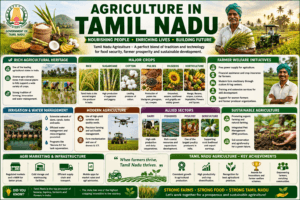
Agriculture is one of the most important sectors of Tamil Nadu’s economy, providing livelihoods to millions of farmers and contributing significantly to the state’s food security and rural development. Despite rapid industrialization, Tamil Nadu continues to maintain a strong agricultural base through modern farming techniques, irrigation projects, and diversified crop cultivation.
The state benefits from fertile river basins, especially the Cauvery Delta, often referred to as the “Rice Bowl of Tamil Nadu.” Major food crops include rice, maize, millets, pulses, and sugarcane, while important cash crops include cotton, groundnut, coconut, tea, coffee, rubber, banana, and spices.
Tamil Nadu is one of India’s leading producers of bananas, coconuts, flowers, turmeric, jasmine, mangoes, and horticultural crops. The Nilgiri and Kodaikanal hills are well known for tea plantations, while coffee is cultivated in parts of the Western Ghats.
To improve agricultural productivity, the state government promotes micro-irrigation, drip irrigation, organic farming, precision farming, mechanization, and sustainable agriculture. Major irrigation projects supported by reservoirs and dams such as Mettur Dam, Bhavanisagar Dam, and Vaigai Dam help ensure year-round farming in many districts.
Agriculture, horticulture, dairy farming, poultry, inland fisheries, and aquaculture together play a vital role in strengthening Tamil Nadu’s rural economy and food production.
Agriculture at a Glance
| Category | Major Products |
|---|---|
| Food Crops | Rice, Maize, Millets & Pulses |
| Cash Crops | Sugarcane, Cotton & Groundnut |
| Plantation Crops | Tea, Coffee & Rubber |
| Horticulture | Banana, Mango, Coconut & Flowers |
| Spices | Turmeric, Pepper & Cardamom |
| Major Irrigation Source | Cauvery River & Mettur Dam |
| Rice Bowl | Cauvery Delta Region |
| Dairy & Livestock | Milk, Poultry & Animal Husbandry |
| Fisheries | Marine Fisheries & Aquaculture |
| Modern Farming | Drip Irrigation, Organic & Precision Farming |
Transport in Tamil Nadu
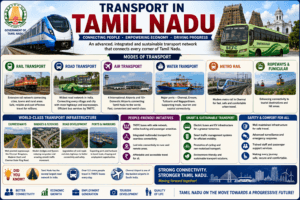
Tamil Nadu has one of the most advanced transportation networks in India, connecting its major cities, industrial hubs, ports, tourist destinations, and rural areas through an extensive system of roads, railways, airports, seaports, and metro services. The state’s well-developed infrastructure plays a vital role in supporting economic growth, tourism, trade, and logistics.
The road network is maintained by the National Highways Authority of India (NHAI) and the Tamil Nadu Highways Department, with several national highways connecting Chennai to Bengaluru, Madurai, Coimbatore, Tiruchirappalli, and other important cities. The Tamil Nadu State Transport Corporation (TNSTC) operates one of India’s largest public bus networks, providing reliable transport across the state.
Tamil Nadu has an extensive railway network managed by the Southern Railway Zone, headquartered in Chennai. Major railway junctions include Chennai Central, Chennai Egmore, Coimbatore Junction, Madurai Junction, Tiruchirappalli Junction, and Salem Junction. These stations connect Tamil Nadu with all major regions of India.
The state has four international airports at Chennai, Coimbatore, Madurai, and Tiruchirappalli, along with domestic airports such as Tuticorin (Thoothukudi) and Salem. Chennai International Airport is one of India’s busiest airports, handling millions of domestic and international passengers every year.
Tamil Nadu also has a strong maritime network with major ports including Chennai Port, V.O. Chidambaranar Port (Thoothukudi), Kamarajar Port (Ennore), and Cuddalore Port. These ports support international trade, exports, imports, and industrial development.
The Chennai Metro Rail has transformed urban transportation in the capital city by providing a fast, modern, and environmentally friendly public transit system.
Transport at a Glance
| Category | Details |
|---|---|
| Road Transport | National Highways & State Highways |
| State Bus Service | Tamil Nadu State Transport Corporation (TNSTC) |
| Railway Zone | Southern Railway |
| Major Railway Stations | Chennai Central, Chennai Egmore, Coimbatore, Madurai, Tiruchirappalli & Salem |
| International Airports | Chennai, Coimbatore, Madurai & Tiruchirappalli |
| Domestic Airports | Thoothukudi & Salem |
| Metro Rail | Chennai Metro |
| Major Ports | Chennai Port, V.O. Chidambaranar Port & Kamarajar Port |
| Longest National Highway | NH 44 |
| Transport Strength | Excellent Road, Rail, Air & Sea Connectivity |
Education in Tamil Nadu
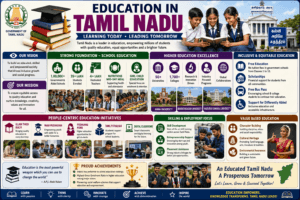
Tamil Nadu is one of India’s leading educational hubs, renowned for its high literacy rate, quality schools, prestigious universities, engineering colleges, medical institutions, and research centres. The state has consistently invested in education, making it a preferred destination for students from across India and abroad.
The capital city, Chennai, is home to some of India’s most respected institutions, including the Indian Institute of Technology Madras (IIT Madras), Anna University, University of Madras, and the National Institute of Technology Tiruchirappalli (NIT Trichy). These institutions are internationally recognized for excellence in engineering, technology, research, science, management, and higher education.
Tamil Nadu has one of the highest numbers of engineering colleges, medical colleges, polytechnic institutions, and arts & science colleges in India. The state is also known for its strong school education system, technical education, vocational training, digital learning initiatives, and skill development programmes.
The government actively supports education through scholarships, free textbooks, school meals, digital classrooms, higher education schemes, and initiatives to improve access to quality education in both urban and rural areas. As a result, Tamil Nadu continues to produce highly skilled professionals who contribute significantly to India’s economy and global workforce.
Education at a Glance
| Category | Details |
|---|---|
| Literacy Rate | 80.09% |
| Education Hub | Chennai |
| Premier Engineering Institute | IIT Madras |
| Leading State University | Anna University |
| Oldest University | University of Madras |
| Premier NIT | NIT Tiruchirappalli (NIT Trichy) |
| Major Courses | Engineering, Medicine, Science, Arts, Commerce & Management |
| School Education | Government & Private Schools |
| Higher Education | Universities, Engineering, Medical & Arts Colleges |
| Education Strength | Quality Higher Education & Research |
Healthcare in Tamil Nadu
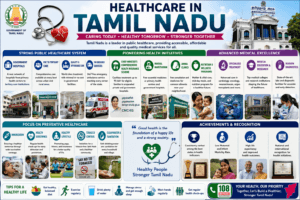
Tamil Nadu has one of the best healthcare systems in India, recognized for its advanced medical infrastructure, quality public healthcare services, renowned hospitals, medical colleges, and efficient disease prevention programmes. The state consistently ranks among India’s top performers in healthcare indicators, including maternal healthcare, child healthcare, immunization, and life expectancy.
The capital city, Chennai, is widely known as the “Health Capital of India” because of its world-class hospitals, multispecialty medical centres, and medical tourism industry. Every year, thousands of patients from across India and abroad visit Chennai for advanced treatments in cardiology, oncology, neurology, orthopaedics, organ transplantation, fertility care, and robotic surgery.
Tamil Nadu is home to prestigious institutions such as Madras Medical College, Christian Medical College (CMC), Vellore, Sri Ramachandra Medical Centre, Stanley Medical College, and Government Rajaji Hospital, Madurai. These institutions are recognized for excellence in medical education, research, and patient care.
The state government has established a strong healthcare network comprising Primary Health Centres (PHCs), Community Health Centres (CHCs), District Hospitals, Government Medical Colleges, and Super Specialty Hospitals. Public health initiatives, digital healthcare services, ambulance networks, vaccination programmes, and health insurance schemes have significantly improved healthcare accessibility across urban and rural areas.
With modern medical facilities, highly qualified healthcare professionals, and a strong focus on preventive healthcare, Tamil Nadu continues to be one of India’s leading healthcare destinations.
Healthcare at a Glance
| Category | Details |
|---|---|
| Healthcare Hub | Chennai |
| Nickname | Health Capital of India |
| Premier Medical College | Madras Medical College |
| Leading Medical Institution | Christian Medical College (CMC), Vellore |
| Major Healthcare Services | Cardiology, Oncology, Neurology & Organ Transplantation |
| Government Healthcare Network | PHCs, CHCs, District Hospitals & Medical Colleges |
| Medical Tourism | One of India’s Top Destinations |
| Emergency Services | 108 Ambulance Service |
| Public Health Focus | Vaccination, Maternal & Child Healthcare & Digital Health |
| Healthcare Strength | Advanced Medical Infrastructure & Medical Research |
Tourism in Tamil Nadu
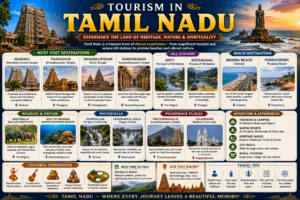
Tamil Nadu is one of India’s most visited tourist destinations, attracting millions of domestic and international visitors every year. The state is famous for its ancient temples, UNESCO World Heritage Sites, scenic hill stations, pristine beaches, waterfalls, wildlife sanctuaries, spiritual destinations, and vibrant cultural festivals. From the bustling city of Chennai to the tranquil hills of Ooty and Kodaikanal, Tamil Nadu offers unforgettable experiences for every traveler.
The state is home to world-famous heritage monuments such as the Brihadeeswarar Temple (Thanjavur), Shore Temple (Mahabalipuram), and the Great Living Chola Temples, all recognized as UNESCO World Heritage Sites. These architectural masterpieces reflect the rich history and artistic excellence of ancient Tamil kingdoms.
Tamil Nadu’s hill stations, including Ooty, Kodaikanal, Yercaud, and Yelagiri, are popular for their pleasant climate, tea plantations, lakes, waterfalls, and breathtaking mountain scenery. Nature lovers can also explore Mudumalai Tiger Reserve, Anamalai Tiger Reserve, Gulf of Mannar Marine National Park, and several wildlife sanctuaries.
The state’s coastline features famous destinations such as Marina Beach, Rameswaram, Kanyakumari, Mahabalipuram, and Nagapattinam, offering beautiful beaches, historic temples, and spectacular sunrise and sunset views. Tamil Nadu is also a major spiritual tourism destination with renowned temples including Meenakshi Amman Temple, Ramanathaswamy Temple, Kapaleeshwarar Temple, and Arunachaleswarar Temple.
With its unique blend of history, spirituality, natural beauty, adventure, and culture, Tamil Nadu continues to be one of India’s top tourism destinations.
Top Tourist Places in Tamil Nadu
| Category | Famous Places |
|---|---|
| Heritage Sites | Brihadeeswarar Temple, Mahabalipuram & Great Living Chola Temples |
| Hill Stations | Ooty, Kodaikanal, Yercaud & Yelagiri |
| Beaches | Marina Beach, Elliot’s Beach & Covelong Beach |
| Spiritual Destinations | Madurai, Rameswaram, Chidambaram & Tiruvannamalai |
| Wildlife | Mudumalai Tiger Reserve, Anamalai Tiger Reserve & Gulf of Mannar Marine National Park |
| Waterfalls | Hogenakkal Falls, Courtallam Falls & Catherine Falls |
| Famous Cities | Chennai, Madurai, Coimbatore & Thanjavur |
| UNESCO Sites | Great Living Chola Temples, Mahabalipuram Monuments & Nilgiri Mountain Railway |
Famous Temples of Tamil Nadu
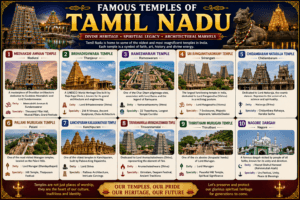
Tamil Nadu is widely known as the “Land of Temples” because it is home to thousands of ancient temples that reflect the state’s rich spiritual, cultural, and architectural heritage. Many of these temples were built by the Chola, Pallava, Pandya, and Nayak dynasties, showcasing remarkable Dravidian architecture with towering gopurams, intricate stone carvings, majestic halls, and beautifully sculpted pillars.
Among the most famous temples is the Meenakshi Amman Temple in Madurai, one of India’s most visited pilgrimage sites, renowned for its colorful towers and magnificent architecture. The Brihadeeswarar Temple in Thanjavur, a UNESCO World Heritage Site, stands as one of the finest examples of Chola architecture.
The sacred island town of Rameswaram is home to the Ramanathaswamy Temple, one of the twelve Jyotirlingas dedicated to Lord Shiva and an important destination in the Char Dham pilgrimage. Other prominent temples include the Kapaleeshwarar Temple in Chennai, Arunachaleswarar Temple in Tiruvannamalai, Nataraja Temple in Chidambaram, and Srivilliputhur Andal Temple.
Every year, millions of devotees and tourists visit these temples to experience Tamil Nadu’s spiritual traditions, festivals, and architectural grandeur. These sacred sites continue to preserve centuries of history, faith, art, and cultural heritage.
Major Temples of Tamil Nadu
| Temple | Location | Famous For |
|---|---|---|
| Meenakshi Amman Temple | Madurai | Dravidian Architecture |
| Brihadeeswarar Temple | Thanjavur | UNESCO World Heritage Site |
| Ramanathaswamy Temple | Rameswaram | Jyotirlinga & Char Dham |
| Kapaleeshwarar Temple | Chennai | Ancient Shiva Temple |
| Arunachaleswarar Temple | Tiruvannamalai | Karthigai Deepam Festival |
| Nataraja Temple | Chidambaram | Cosmic Dance of Lord Shiva |
| Srivilliputhur Andal Temple | Virudhunagar | Andal & Vaishnavite Heritage |
| Rockfort Temple | Tiruchirappalli | Hilltop Temple & City Landmark |
Arts of Tamil Nadu
Tamil Nadu is one of India’s most important centres for classical arts, traditional crafts, music, dance, sculpture, painting, and temple architecture. The state’s artistic heritage has flourished for over two thousand years, influenced by the Chola, Pallava, Pandya, and Nayak dynasties. Tamil Nadu’s arts continue to preserve its rich cultural identity while attracting art lovers and tourists from around the world.
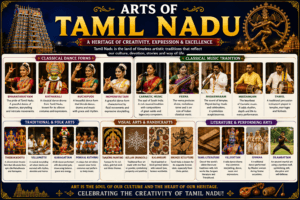
Bharatanatyam, one of India’s oldest classical dance forms, originated in Tamil Nadu and is celebrated globally for its graceful movements and expressive storytelling. Carnatic music, another classical art form deeply rooted in the state, is performed during the famous Margazhi Music Festival in Chennai.
Tamil Nadu is also renowned for its Thanjavur (Tanjore) paintings, bronze sculptures, stone carvings, Kanchipuram silk weaving, Kolam art, wood carvings, and temple architecture. These traditional art forms reflect the creativity, craftsmanship, and spiritual traditions of Tamil society.
The state’s artisans continue to preserve these centuries-old traditions through workshops, exhibitions, cultural festivals, and government-supported handicraft initiatives, making Tamil Nadu one of India’s richest artistic destinations.
Arts of Tamil Nadu at a Glance
| Art Form | Famous For |
|---|---|
| Bharatanatyam | Classical Dance |
| Carnatic Music | Classical Music Tradition |
| Thanjavur Paintings | Gold Foil Religious Paintings |
| Bronze Sculptures | Chola Bronze Art |
| Kanchipuram Silk | Handwoven Silk Sarees |
| Kolam | Traditional Floor Art |
| Stone Carving | Temple Sculptures |
| Wood Carving | Traditional Wooden Crafts |
| Temple Architecture | Dravidian Style |
| Handicrafts | Palm Leaf Crafts & Pottery |
Culture & Traditions of Tamil Nadu
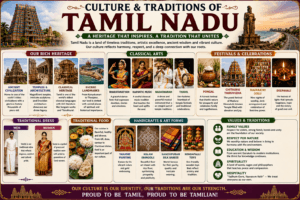
Tamil Nadu is one of India’s oldest cultural centres, preserving a heritage that spans over 2,000 years. The state is globally recognized for its classical Tamil language, Bharatanatyam dance, Carnatic music, magnificent temple architecture, traditional festivals, handicrafts, literature, and spiritual traditions. The culture of Tamil Nadu reflects a unique blend of ancient customs and modern lifestyles.
The Tamil language, one of the world’s oldest living classical languages, is the heart of the state’s identity. Tamil literature, especially the Sangam literature, is celebrated for its historical and literary significance.
Bharatanatyam, one of India’s oldest classical dance forms, originated in Tamil Nadu and is admired worldwide for its graceful movements, expressive storytelling, and devotional themes. Similarly, Carnatic music has deep roots in the state, with Chennai hosting the world-famous Margazhi Music Festival every year.
Tamil Nadu is also known for its exquisite handicrafts, including Kanchipuram silk sarees, Thanjavur paintings, bronze sculptures, stone carvings, palm-leaf crafts, and traditional temple architecture. These art forms showcase the exceptional craftsmanship of Tamil artisans.
Traditional attire includes the Veshti for men and the Kanchipuram Silk Saree for women, especially during festivals, weddings, and religious ceremonies. Hospitality, respect for traditions, and strong family values remain an integral part of Tamil culture.
The state’s vibrant festivals, ancient temples, music, dance, literature, and cuisine make Tamil Nadu one of the richest cultural destinations in India.
Culture at a Glance
| Category | Famous For |
|---|---|
| Classical Language | Tamil |
| Classical Dance | Bharatanatyam |
| Classical Music | Carnatic Music |
| Traditional Dress | Veshti & Kanchipuram Silk Saree |
| Famous Handicrafts | Thanjavur Paintings, Bronze Sculptures & Stone Carvings |
| Traditional Art | Kolam |
| Famous Silk | Kanchipuram Silk |
| Heritage | Dravidian Temple Architecture |
| Literature | Sangam Literature |
| Cultural Identity | Temples, Festivals, Arts & Hospitality |
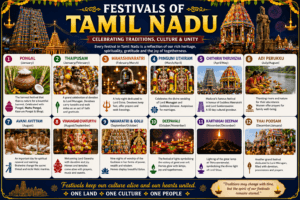
Festivals of Tamil Nadu
Tamil Nadu celebrates a wide variety of religious, cultural, harvest, and traditional festivals throughout the year. These festivals reflect the state’s rich heritage, spiritual values, agricultural traditions, and vibrant community life. The celebrations are marked by colorful decorations, traditional music, dance, temple processions, delicious food, and cultural performances.
The most important festival of Tamil Nadu is Pongal, the state’s famous harvest festival celebrated over four days in January. It honors the Sun God and expresses gratitude to farmers, cattle, and nature for a successful harvest. Families prepare Sweet Pongal, decorate their homes with Kolam, and participate in traditional celebrations.
Other major festivals include Tamil New Year (Puthandu), Thaipusam, Karthigai Deepam, Navaratri, Deepavali, Vinayaka Chaturthi, Chithirai Festival in Madurai, and Mahamaham Festival in Kumbakonam. Each festival showcases Tamil Nadu’s unique customs, devotion, and cultural identity.
The world-famous Karthigai Deepam Festival at Arunachaleswarar Temple in Tiruvannamalai attracts millions of devotees every year. Likewise, the Chithirai Festival in Madurai celebrates the divine wedding of Goddess Meenakshi and Lord Sundareswarar, making it one of South India’s grandest religious festivals.
These festivals preserve Tamil Nadu’s centuries-old traditions while promoting unity, spirituality, tourism, and cultural heritage.
Major Festivals of Tamil Nadu
| Festival | Celebrated For | Time |
|---|---|---|
| Pongal | Harvest Festival | January |
| Tamil New Year (Puthandu) | Tamil New Year | April |
| Thaipusam | Lord Murugan Festival | January / February |
| Chithirai Festival | Meenakshi–Sundareswarar Festival | April / May |
| Karthigai Deepam | Festival of Lights | November / December |
| Navaratri | Worship of Goddess Durga | September / October |
| Vinayaka Chaturthi | Lord Ganesha Festival | August / September |
| Deepavali | Festival of Lights | October / November |
| Mahamaham | Sacred Temple Festival | Every 12 Years |
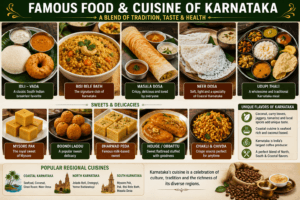
Famous Food & Cuisine of Tamil Nadu
Tamil Nadu is renowned for its rich culinary heritage, offering a wide variety of traditional vegetarian and non-vegetarian dishes. The cuisine is known for its balanced use of rice, lentils, coconut, spices, curry leaves, tamarind, and aromatic herbs. Every region of the state has its own unique flavors and specialties, making Tamil Nadu one of India’s top culinary destinations.
Rice is the staple food of Tamil Nadu and forms the base of many traditional meals. Popular breakfast dishes include Idli, Dosa, Pongal, Uttapam, Appam, and Paniyaram, often served with sambar and a variety of chutneys.
Tamil Nadu is also famous for Chettinad cuisine, one of India’s most flavorful cooking styles, known for its rich spices and aromatic meat dishes. Other popular dishes include Sambar Rice, Lemon Rice, Tamarind Rice (Puliyodarai), Curd Rice, Rasam, Parotta, Kothu Parotta, Kari Dosa, and Fish Curry.
The state is equally famous for its traditional sweets such as Mysore Pak, Adhirasam, Kozhukattai, Payasam, Jangiri, and Tirunelveli Halwa. Filter Coffee, prepared using freshly roasted coffee beans, is an integral part of Tamil Nadu’s food culture and is enjoyed across the state.
Tamil Nadu’s cuisine reflects its agricultural abundance, cultural diversity, and centuries-old culinary traditions, making it a favorite among food lovers from around the world.
Famous Foods of Tamil Nadu
| Category | Famous Dishes |
|---|---|
| Breakfast | Idli, Dosa, Pongal, Uttapam & Appam |
| Main Course | Sambar Rice, Lemon Rice, Puliyodarai, Curd Rice & Rasam |
| Non-Vegetarian | Chettinad Chicken, Mutton Curry, Fish Curry & Kari Dosa |
| Street Food | Kothu Parotta, Sundal & Bajji |
| Traditional Sweets | Mysore Pak, Adhirasam, Kozhukattai, Jangiri & Tirunelveli Halwa |
| Beverage | South Indian Filter Coffee |
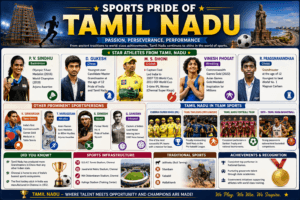
Sports in Tamil Nadu
Tamil Nadu has a rich sporting tradition and has produced numerous internationally acclaimed athletes across cricket, chess, tennis, athletics, squash, badminton, hockey, football, and motorsports. The state has world-class sports infrastructure, international stadiums, training academies, and sports development programmes that nurture talented athletes from a young age.
Cricket is the most popular sport in Tamil Nadu. The iconic M. A. Chidambaram Stadium (Chepauk Stadium) in Chennai is one of India’s oldest and most prestigious cricket venues. The state is proudly represented by the Chennai Super Kings (CSK) franchise in the Indian Premier League (IPL), one of the most successful teams in the tournament’s history.
Tamil Nadu is also globally recognized as the birthplace of Viswanathan Anand, India’s first Chess Grandmaster and multiple-time World Chess Champion. The state has earned the nickname “Chess Capital of India” due to its remarkable contribution to the sport.
Other popular sports include football, hockey, volleyball, kabaddi, tennis, athletics, squash, and motorsports. Chennai has hosted several international sporting events, including ATP tennis tournaments, international cricket matches, and the Chess Olympiad. The state government actively promotes sports through academies, scholarships, modern stadiums, and grassroots development programmes.
Sports at a Glance
| Category | Details |
|---|---|
| Most Popular Sport | Cricket |
| Famous IPL Team | Chennai Super Kings (CSK) |
| Major Cricket Stadium | M. A. Chidambaram Stadium (Chepauk) |
| Chess Icon | Viswanathan Anand |
| Nickname | Chess Capital of India |
| Popular Sports | Cricket, Chess, Football, Hockey, Tennis, Athletics & Kabaddi |
| International Events | Cricket World Cup, Chess Olympiad & ATP Tennis |
| Sports Infrastructure | International Stadiums & Sports Academies |
| Government Support | Sports Scholarships & Talent Development |
| Sporting Strength | Cricket, Chess & International Competitions |
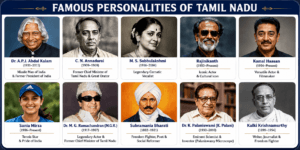
Famous Personalities of Tamil Nadu
Tamil Nadu has produced some of India’s greatest leaders, scientists, artists, writers, industrialists, sportspersons, musicians, actors, and social reformers. These personalities have made remarkable contributions to the fields of science, politics, literature, cinema, sports, business, education, and social development, earning national and international recognition.
One of the most respected personalities from Tamil Nadu is Dr. A. P. J. Abdul Kalam, popularly known as the “Missile Man of India” and the 11th President of India. His contributions to India’s space and defence programmes continue to inspire millions.
The state is also the birthplace of C. V. Raman, Nobel Prize-winning physicist, and Subrahmanyan Chandrasekhar, Nobel Prize-winning astrophysicist. Tamil Nadu has also produced legendary chess champion Viswanathan Anand, one of the greatest players in chess history.
In literature and culture, renowned poet Subramania Bharati played a vital role in India’s freedom movement through his patriotic writings. The state has also given India iconic film personalities such as M. G. Ramachandran (MGR), Sivaji Ganesan, Kamal Haasan, and Rajinikanth, who have significantly influenced Indian cinema.
Tamil Nadu’s contributions to science, education, arts, sports, and public service continue to shape India’s progress and global reputation.
Famous Personalities at a Glance
| Personality | Field | Famous For |
|---|---|---|
| Dr. A. P. J. Abdul Kalam | Science & Politics | Missile Man of India, Former President |
| C. V. Raman | Physics | Nobel Prize in Physics |
| Subrahmanyan Chandrasekhar | Astrophysics | Nobel Prize Winner |
| Viswanathan Anand | Chess | World Chess Champion |
| Subramania Bharati | Literature | Freedom Fighter & Poet |
| M. G. Ramachandran (MGR) | Politics & Cinema | Former Chief Minister & Actor |
| Sivaji Ganesan | Cinema | Legendary Actor |
| Rajinikanth | Cinema | Superstar |
| Kamal Haasan | Cinema | Actor, Director & Producer |
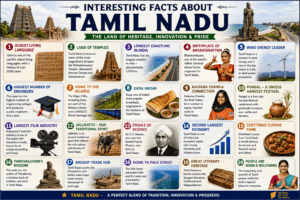
Interesting Facts About Tamil Nadu
Tamil Nadu is a state where ancient heritage meets modern development. It is famous for its classical Tamil language, magnificent temples, world-class educational institutions, thriving industries, beautiful hill stations, long coastline, and vibrant cultural traditions. From the UNESCO-listed Great Living Chola Temples to Chennai’s booming IT sector, Tamil Nadu has made remarkable contributions to India’s history, economy, science, arts, and tourism.
The state is home to India’s second-longest coastline, one of the world’s oldest living classical languages, and several internationally recognized cultural and architectural landmarks. It is also a leader in automobile manufacturing, renewable energy, healthcare, and higher education, making it one of India’s most progressive states.
Interesting Facts at a Glance
| Fact | Details |
|---|---|
| Capital City | Chennai |
| Nickname | Land of Temples |
| Official Language | Tamil (Classical Language) |
| Coastline | About 1,076 km (Second Longest in India) |
| Highest Peak | Doddabetta (2,637 m) |
| Largest Beach | Marina Beach |
| Famous Dance | Bharatanatyam |
| UNESCO World Heritage Sites | Great Living Chola Temples, Mahabalipuram Monuments & Nilgiri Mountain Railway |
| Automobile Hub | Chennai – Automobile Capital of India |
| Chess Capital | Chennai is known as the Chess Capital of India |
Frequently Asked Questions (FAQs)
1. What is the capital of Tamil Nadu?
Chennai is the capital and largest city of Tamil Nadu. It is one of India’s leading metropolitan cities and serves as a major hub for IT, automobiles, healthcare, education, and trade.
2. Why is Tamil Nadu famous?
Tamil Nadu is famous for its ancient temples, Bharatanatyam dance, Carnatic music, classical Tamil language, UNESCO World Heritage Sites, beautiful hill stations, beaches, rich culture, and automobile industry.
3. Which is the largest city in Tamil Nadu?
Chennai is the largest city in Tamil Nadu by population and is also the state’s economic, educational, and cultural centre.
4. What is the official language of Tamil Nadu?
The official language of Tamil Nadu is Tamil, one of the world’s oldest living classical languages.
5. Which is the highest peak in Tamil Nadu?
Doddabetta Peak (2,637 metres) in the Nilgiri Hills is the highest peak in Tamil Nadu.
6. Which are the famous tourist places in Tamil Nadu?
Some of the most popular tourist destinations include:
- Chennai
- Ooty
- Kodaikanal
- Madurai
- Rameswaram
- Kanyakumari
- Mahabalipuram
- Thanjavur
7. What are the major rivers of Tamil Nadu?
The major rivers are:
- Kaveri (Cauvery)
- Vaigai
- Bhavani
- Palar
- Tamirabarani
- Amaravathi
- Noyyal
8. What is the most famous festival of Tamil Nadu?
Pongal is the most important and widely celebrated harvest festival in Tamil Nadu.
9. Why is Chennai called the Automobile Capital of India?
Chennai is called the Automobile Capital of India because it is home to numerous automobile manufacturers, auto-component industries, and global automotive companies.
10. Why should you visit Tamil Nadu?
Tamil Nadu offers a perfect combination of heritage, spirituality, beaches, hill stations, wildlife, cuisine, culture, and modern cities, making it one of India’s top travel destinations.
Conclusion
Tamil Nadu is one of India’s most historically significant, culturally rich, and economically advanced states. From the magnificent Meenakshi Amman Temple and Brihadeeswarar Temple to the scenic beauty of Ooty, Kodaikanal, and Kanyakumari, the state offers a unique blend of ancient heritage and modern development.
With its thriving industries, world-class educational institutions, advanced healthcare system, vibrant festivals, delicious cuisine, classical arts, and remarkable tourism destinations, Tamil Nadu continues to play a vital role in India’s progress. Whether you are a traveler, student, competitive exam aspirant, or someone interested in Indian culture and history, Tamil Nadu has something valuable to offer.
We hope this comprehensive guide has helped you understand Tamil Nadu’s geography, history, economy, culture, education, tourism, agriculture, sports, famous personalities, and interesting facts. Continue exploring India’s incredible diversity through our detailed state guides on DealKart Market.
Related Articles (Internal Links)
Telangana – Complete Guide
https://dealkartmarket.in/telangana-complete-guide/
Andhra Pradesh – Complete Guide
https://dealkartmarket.in/andhra-pradesh/
Karnataka – Complete Guide
https://dealkartmarket.in/karnataka/
Education in Telangana
https://dealkartmarket.in/education-in-telangana/
Ratan Tata Biography
https://dealkartmarket.in/ratan-tata-biography/
References
Government of Tamil Nadu – https://www.tn.gov.in/
Tamil Nadu Tourism – https://www.tamilnadutourism.tn.gov.in/
Census of India – https://censusindia.gov.in/
Ministry of Statistics and Programme Implementation (MoSPI) – https://mospi.gov.in/
India Brand Equity Foundation (IBEF) – Tamil Nadu – https://www.ibef.org/states/tamil-nadu
Incredible India – Tamil Nadu – https://www.incredibleindia.gov.in/
Forest Survey of India – https://fsi.nic.in/
India Meteorological Department – https://mausam.imd.gov.in/
Reserve Bank of India – https://www.rbi.org.in/
Government of India – https://www.india.gov.in/
About DealKart Market
DealKart Market is your trusted destination for informative blogs, state guides, travel destinations, education, technology, business, local services, jobs, and buying & selling opportunities across India. Our mission is to provide accurate, well-researched, and easy-to-understand content that helps readers explore India in one place. Visit regularly for new guides, useful resources, and the latest updates.