
Introduction
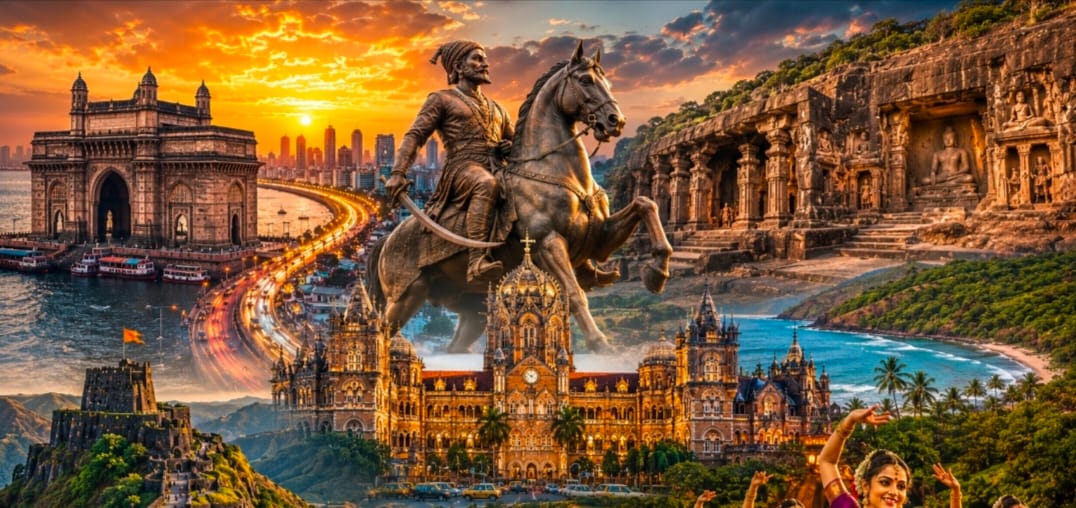
Maharashtra is one of India’s most influential and economically advanced states, located in the western part of the country along the Arabian Sea. Formed on 1 May 1960, the state is the second-most populous in India and the third-largest by area. Its capital, Mumbai, is known as the Financial Capital of India and is home to the Reserve Bank of India, Bombay Stock Exchange (BSE), National Stock Exchange (NSE), and the Bollywood film industry.
The state has a remarkable blend of history, culture, natural beauty, and modern development. Maharashtra is the land of the great Maratha Empire, founded by Chhatrapati Shivaji Maharaj, whose legacy continues to inspire millions. The state is also famous for its magnificent forts, ancient rock-cut caves, hill stations, beaches, wildlife sanctuaries, and UNESCO World Heritage Sites such as Ajanta Caves, Ellora Caves, and the Chhatrapati Shivaji Maharaj Terminus.
Geographically, Maharashtra is blessed with the Sahyadri (Western Ghats), fertile plains, forests, rivers, and a coastline stretching over 720 kilometres. The state’s economy is driven by finance, information technology, manufacturing, automobile industries, agriculture, tourism, entertainment, and exports, making it one of India’s largest contributors to the national GDP.
Rich traditions, colourful festivals, diverse cuisine, classical arts, and historical monuments make Maharashtra a fascinating destination for travellers, students, researchers, and competitive exam aspirants alike. This complete guide explores the state’s history, geography, government, economy, tourism, culture, education, healthcare, famous personalities, and many other important aspects in a simple and comprehensive manner.
Maharashtra on India Map
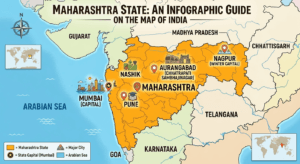
Maharashtra is located in the western region of India and is one of the country’s largest and most important states. It shares its borders with Gujarat to the northwest, Madhya Pradesh to the north, Chhattisgarh to the east, Telangana to the southeast, Karnataka to the south, and Goa to the southwest. The Arabian Sea forms its western coastline, stretching for approximately 720 kilometres.
Strategically positioned between northern and southern India, Maharashtra serves as a major hub for trade, transportation, finance, manufacturing, and tourism. Its capital, Mumbai, is India’s financial capital and one of the world’s leading commercial cities. The state’s central location and well-developed road, rail, air, and sea connectivity make it a vital gateway for domestic and international commerce.
Maharashtra covers an area of approximately 307,713 square kilometres, making it the third-largest state in India by area. The state consists of 36 districts, divided into 6 administrative divisions. Its diverse landscape includes the Sahyadri (Western Ghats), the Deccan Plateau, fertile river valleys, forests, and a long coastline along the Arabian Sea.
The state’s location has played a significant role in shaping its history, economy, biodiversity, and cultural diversity, making it one of India’s most dynamic and influential states.
Maharashtra at a Glance
| Category | Details |
|---|---|
| Region | Western India |
| Capital | Mumbai |
| Area | 307,713 sq km |
| Area Rank | 3rd Largest State in India |
| Districts | 36 |
| Administrative Divisions | 6 |
| Coastline | Approx. 720 km |
| Coast | Arabian Sea |
| Neighbouring States | Gujarat, Madhya Pradesh, Chhattisgarh, Telangana, Karnataka & Goa |
| Major Cities | Mumbai, Pune, Nagpur, Nashik, Chhatrapati Sambhajinagar |
History of Maharashtra
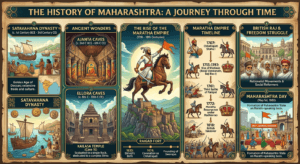
Maharashtra has one of the richest and most influential histories in India, with a legacy that spans over two thousand years. The region was ruled by several powerful dynasties, contributed significantly to Indian culture and trade, and became the birthplace of the Maratha Empire, founded by Chhatrapati Shivaji Maharaj.
The earliest known rulers were the Satavahanas (2nd century BCE – 3rd century CE), who established one of the first great kingdoms in the Deccan. They promoted trade with the Roman Empire and supported Buddhism, resulting in the creation of magnificent cave complexes such as Ajanta and Ellora.
After the Satavahanas, Maharashtra came under the rule of the Vakatakas, Chalukyas, Rashtrakutas, and Yadavas of Devagiri. The Rashtrakutas built the world-famous Kailasa Temple at Ellora, one of the greatest examples of rock-cut architecture.
The 17th century marked a turning point with the rise of Chhatrapati Shivaji Maharaj, who founded the Maratha Empire in 1674. Through strategic military leadership, efficient administration, and a strong navy, he established an independent kingdom that challenged the Mughal Empire. His forts, including Raigad, Pratapgad, Sinhagad, and Sindhudurg, remain symbols of courage and visionary leadership.
Following Shivaji Maharaj, the Peshwas expanded Maratha influence across large parts of the Indian subcontinent. During the 19th century, the British gradually took control of the region, incorporating it into the Bombay Presidency.
After India’s independence in 1947, the bilingual Bombay State was formed. Following the Samyukta Maharashtra Movement, Maharashtra was officially created on 1 May 1960, with Mumbai as its capital. Today, Maharashtra Day is celebrated every year on 1 May to commemorate the formation of the state.
Today, Maharashtra stands as a symbol of bravery, cultural heritage, industrial development, and economic leadership while preserving the legacy of its great rulers and historical monuments.
Historical Timeline of Maharashtra
| Period | Major Event |
|---|---|
| 2nd Century BCE – 3rd Century CE | Satavahana Dynasty ruled the Deccan |
| 3rd–5th Century CE | Vakataka Dynasty |
| 6th–8th Century CE | Chalukya Rule |
| 8th–10th Century CE | Rashtrakuta Dynasty built Kailasa Temple |
| 12th–14th Century CE | Yadava Dynasty of Devagiri |
| 1674 | Chhatrapati Shivaji Maharaj founded the Maratha Empire |
| 18th Century | Expansion under the Peshwas |
| 1818 | British East India Company gained control |
| 1947 | India became independent |
| 1 May 1960 | Formation of Maharashtra State |
Geography & Climate of Maharashtra
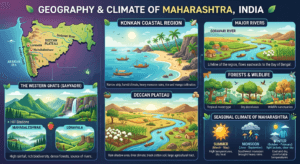
Maharashtra is the third-largest state in India by area, covering approximately 307,713 square kilometres. Located in western India, the state is known for its diverse landscapes, ranging from the Arabian Sea coastline and the Sahyadri (Western Ghats) to fertile river valleys, plateaus, forests, and rolling hills. This geographical diversity supports rich biodiversity, agriculture, tourism, and industrial development.
The Western Ghats, a UNESCO World Heritage region, run parallel to the state’s western coast and are home to dense forests, waterfalls, wildlife sanctuaries, and popular hill stations such as Mahabaleshwar, Lonavala, Matheran, and Panchgani. East of the Western Ghats lies the Deccan Plateau, which occupies a major portion of the state and is known for its black cotton soil, making it ideal for cultivating cotton, sugarcane, soybean, and pulses.
Several important rivers flow through the state, including the Godavari, Krishna, Bhima, Tapi (Tapti), Wardha, and Wainganga. These rivers play a vital role in irrigation, drinking water supply, hydroelectric power generation, and agriculture.
Maharashtra experiences a tropical monsoon climate with three main seasons: summer (March–May), monsoon (June–September), and winter (October–February). The Konkan Coast receives heavy rainfall due to the southwest monsoon, while the Vidarbha and Marathwada regions receive comparatively less rainfall and experience hotter summers.
The state’s varied geography, pleasant hill stations, scenic coastline, fertile plains, and protected forests make it one of India’s most geographically diverse and naturally beautiful states.
Geography & Climate at a Glance
| Category | Details |
|---|---|
| Total Area | 307,713 sq km |
| Area Rank | 3rd Largest State in India |
| Major Mountain Range | Sahyadri (Western Ghats) |
| Plateau | Deccan Plateau |
| Coastline | Approx. 720 km (Arabian Sea) |
| Major Rivers | Godavari, Krishna, Bhima, Tapi, Wardha, Wainganga |
| Climate Type | Tropical Monsoon |
| Seasons | Summer, Monsoon, Winter |
| Highest Peak | Kalsubai (1,646 m) |
| Famous Hill Stations | Mahabaleshwar, Lonavala, Matheran, Panchgani |
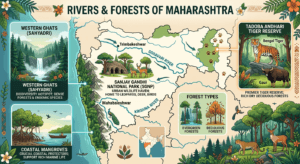
Rivers & Forests of Maharashtra
Maharashtra is blessed with a vast network of rivers, forests, wildlife sanctuaries, and national parks, making it one of India’s ecologically diverse states. The state has numerous perennial and seasonal rivers that support agriculture, drinking water supply, hydroelectric projects, industries, and wildlife habitats.
The Godavari River, often called the “Dakshin Ganga” (Ganges of the South), is the longest river in Maharashtra. It originates from Trimbakeshwar near Nashik and flows eastward across the state before entering Telangana. Other major rivers include the Krishna, Bhima, Tapi (Tapti), Wardha, Wainganga, Penganga, Koyna, and Purna. These rivers irrigate vast agricultural lands and support major dams and reservoirs.
Approximately 16–17% of Maharashtra’s geographical area is covered by forests. Most forested regions are located in Vidarbha, the Western Ghats, and parts of Marathwada. These forests consist of tropical deciduous, semi-evergreen, mangrove, and thorn forests, providing habitat for a wide variety of wildlife.
Maharashtra is home to several famous national parks and wildlife sanctuaries, including Tadoba-Andhari Tiger Reserve, Sanjay Gandhi National Park, Navegaon National Park, Gugamal National Park, Chandoli National Park, and Pench Tiger Reserve. These protected areas conserve endangered species such as the Bengal Tiger, Indian Leopard, Sloth Bear, Gaur, Wild Dog, and numerous bird species.
The Western Ghats and Konkan mangrove forests are biodiversity hotspots, supporting thousands of plant and animal species. Maharashtra’s rivers and forests play a crucial role in maintaining ecological balance, promoting eco-tourism, and sustaining rural livelihood
Rivers & Forests at a Glance
| Category | Details |
|---|---|
| Longest River | Godavari River |
| Other Major Rivers | Krishna, Bhima, Tapi, Wardha, Wainganga, Koyna, Penganga |
| Forest Cover | Around 16–17% of the state’s area |
| Forest Types | Tropical Deciduous, Semi-evergreen, Mangrove & Thorn Forests |
| Major National Parks | Sanjay Gandhi, Chandoli, Gugamal, Navegaon, Pench |
| Famous Tiger Reserve | Tadoba-Andhari Tiger Reserve |
| UNESCO Region | Western Ghats |
| Major Wildlife | Bengal Tiger, Leopard, Sloth Bear, Gaur, Wild Dog |
| Mangrove Region | Mumbai & Konkan Coast |
| Eco-tourism Attractions | Tadoba, Pench, Koyna Wildlife Sanctuary, Bhimashankar Wildlife Sanctuary |
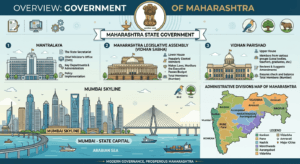
Government of Maharashtra
Maharashtra follows a parliamentary system of government, similar to other Indian states. The Governor serves as the constitutional head of the state and is appointed by the President of India, while the Chief Minister is the executive head who leads the Council of Ministers and oversees the administration.
The state has a bicameral legislature, making it one of the few Indian states with two legislative houses. These include the Maharashtra Legislative Assembly (Vidhan Sabha) and the Maharashtra Legislative Council (Vidhan Parishad). The Legislative Assembly has 288 elected members, while the Legislative Council consists of members elected and nominated through different constituencies and bodies.
Mumbai, the capital of Maharashtra, is the administrative, financial, and political centre of the state. It houses the Mantralaya (State Secretariat), the Maharashtra Legislative Assembly, and several important government offices. Mumbai is also India’s financial capital, hosting institutions such as the Reserve Bank of India (RBI), Bombay Stock Exchange (BSE), and National Stock Exchange (NSE).
For administrative convenience, Maharashtra is divided into 36 districts, which are grouped into 6 administrative divisions:
- Konkan
- Pune
- Nashik
- Chhatrapati Sambhajinagar
- Amravati
- Nagpur
Each district is administered by a District Collector, while rural development is managed through Zilla Parishads, Panchayat Samitis, and Gram Panchayats. Urban areas are governed by Municipal Corporations and Municipal Councils.
The Government of Maharashtra focuses on education, healthcare, agriculture, infrastructure, digital governance, industrial development, tourism, environmental conservation, and social welfare, making the state one of India’s most developed and economically significant regions.
Government at a Glance
| Category | Details |
|---|---|
| Capital | Mumbai |
| State Formation | 1 May 1960 |
| Governor | Constitutional Head |
| Chief Minister | Head of Government |
| Legislature | Bicameral |
| Legislative Assembly | 288 Members |
| Legislative Council | Vidhan Parishad |
| High Court | Bombay High Court |
| Administrative Divisions | 6 |
| Districts | 36 |
| Official Language | Marathi |
| State Animal | Indian Giant Squirrel (Shekru) |
| State Bird | Yellow-footed Green Pigeon (Hariyal) |
| State Tree | Mango Tree |
| State Flower | Jarul (Queen’s Crape Myrtle) |
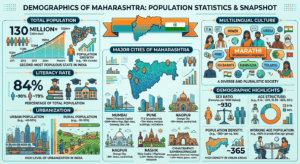
Population of Maharashtra
Maharashtra is the second-most populous state in India, with a population of 11.24 crore (112.4 million) according to the 2011 Census. Current estimates place the population at around 12.8–13 crore, reflecting the state’s rapid urbanization, industrial growth, and economic opportunities. People from across India migrate to Maharashtra for employment, education, business, and better living standards.
The state’s population density is approximately 365 persons per square kilometre, although it varies significantly across regions. Metropolitan cities such as Mumbai, Pune, Thane, and Nagpur are densely populated, while forested and hilly areas in Vidarbha and parts of the Western Ghats have comparatively lower population density.
Marathi is the official language and is spoken by the majority of the population. Other widely spoken languages include Hindi, English, Urdu, Gujarati, Kannada, Telugu, and Konkani, reflecting Maharashtra’s cultural diversity.
According to the 2011 Census, Maharashtra has a literacy rate of approximately 82.3%, one of the highest among India’s major states. The state has made significant progress in education, healthcare, women’s empowerment, and digital development, contributing to a high standard of living.
Mumbai, the state’s capital, is India’s largest metropolitan city and serves as the country’s financial, entertainment, and commercial hub. Other major urban centres include Pune, Nagpur, Nashik, Thane, Kolhapur, Solapur, and Chhatrapati Sambhajinagar, all of which contribute significantly to the state’s economy.
Maharashtra’s diverse population, skilled workforce, strong industrial base, and multicultural society make it one of India’s most dynamic and progressive states.
Population at a Glance
| Category | Details |
|---|---|
| Population (2011 Census) | 11,23,74,333 (11.24 Crore) |
| Estimated Population (2025) | Around 12.8–13 Crore |
| Population Rank | 2nd in India |
| Population Density | 365 persons/sq km |
| Literacy Rate | 82.3% |
| Sex Ratio | 929 females per 1,000 males |
| Urban Population | Around 45% |
| Rural Population | Around 55% |
| Official Language | Marathi |
| Largest City | Mumbai |
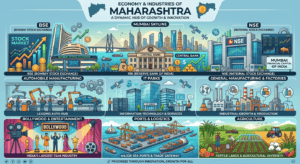
Economy & Industries of Maharashtra
Maharashtra has the largest economy among all Indian states and is widely regarded as the financial, commercial, and industrial powerhouse of India. The state’s strategic location, modern infrastructure, skilled workforce, and strong industrial base have made it one of the country’s biggest contributors to the national economy.
The capital city, Mumbai, is known as the Financial Capital of India. It is home to the Reserve Bank of India (RBI), Bombay Stock Exchange (BSE), National Stock Exchange (NSE), and the headquarters of many leading Indian and multinational companies. Mumbai is also the centre of Bollywood, India’s largest film industry, which contributes significantly to the entertainment sector.
Maharashtra has a diversified economy driven by finance, information technology (IT), automobile manufacturing, pharmaceuticals, engineering, textiles, petrochemicals, tourism, agriculture, and exports. Major industrial hubs such as Mumbai, Pune, Nashik, Nagpur, Aurangabad (Chhatrapati Sambhajinagar), and Kolhapur host thousands of manufacturing units and technology companies.
The state is India’s leading automobile manufacturing hub, with production facilities of companies such as Tata Motors, Mahindra & Mahindra, Bajaj Auto, Mercedes-Benz India, and Volkswagen India. Pune is often called the “Detroit of India” because of its strong automobile and engineering industries.
Information Technology has grown rapidly in cities like Pune, Mumbai, and Navi Mumbai, where numerous software companies, startups, and IT parks operate. Maharashtra is also a major producer of sugar, cotton, grapes, oranges, soybeans, and onions, making agriculture an important part of the economy.
Tourism, ports, logistics, banking, financial services, and exports further strengthen the state’s economy. With world-class infrastructure, major seaports, international airports, and industrial corridors, Maharashtra continues to be India’s leading economic engine.
Economy & Industries at a Glance
| Category | Details |
|---|---|
| Economic Rank | Largest State Economy in India |
| Financial Capital | Mumbai |
| Major Financial Institutions | RBI, BSE, NSE |
| Major Industries | Automobile, IT, Pharmaceuticals, Engineering, Textiles, Petrochemicals |
| IT Hubs | Mumbai, Pune, Navi Mumbai |
| Automobile Hub | Pune (Detroit of India) |
| Major Ports | Mumbai Port, Jawaharlal Nehru Port (JNPT) |
| Film Industry | Bollywood |
| Major Agricultural Products | Sugarcane, Cotton, Grapes, Oranges, Soybean, Onion |
| Economic Strength | Finance, Manufacturing, Services & Exports |
Agriculture of Maharashtra
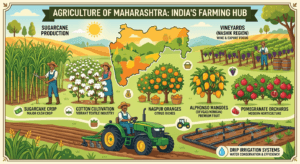
Agriculture is one of the most important sectors of Maharashtra’s economy, providing livelihoods to millions of farmers across the state. Thanks to its diverse climate, fertile soils, and extensive river systems, Maharashtra cultivates a wide variety of food grains, cash crops, fruits, vegetables, and spices. The state is one of India’s leading producers of sugarcane, cotton, soybean, grapes, oranges, onions, pomegranates, and bananas.
The black cotton soil (Regur soil) found across the Deccan Plateau is highly fertile and ideal for growing cotton, earning Maharashtra a prominent place in India’s textile industry. Major food crops include rice, wheat, jowar (sorghum), bajra (pearl millet), maize, and pulses, which are cultivated across different regions depending on rainfall and soil conditions.
Maharashtra is internationally recognized for its horticulture sector. The districts of Nashik are famous for grape cultivation and wine production, while Nagpur is known as the “Orange City of India” due to its high-quality oranges. The state is also a leading producer of mangoes (especially Alphonso), pomegranates, bananas, and onions, contributing significantly to agricultural exports.
Irrigation is supported by major projects and dams such as the Jayakwadi Dam, Koyna Dam, Ujjani Dam, and numerous canals and reservoirs. Government initiatives promote drip irrigation, organic farming, crop insurance, soil health management, and the use of modern agricultural technologies to improve productivity and sustainability.
With its strong agricultural base, thriving horticulture, and agro-processing industries, Maharashtra plays a vital role in ensuring India’s food security and agricultural exports.
Agriculture at a Glance
| Category | Major Products |
|---|---|
| Food Crops | Rice, Wheat, Jowar, Bajra, Maize, Pulses |
| Cash Crops | Sugarcane, Cotton, Soybean |
| Fruits | Grapes, Alphonso Mango, Orange, Banana, Pomegranate |
| Vegetables | Onion, Tomato, Brinjal, Chilli |
| Oilseeds | Groundnut, Sunflower, Soybean |
| Horticulture | Grapes, Mangoes, Oranges, Pomegranates |
| Famous Agricultural Region | Nashik (Grapes), Nagpur (Oranges), Konkan (Alphonso Mango) |
| Major Irrigation Projects | Jayakwadi, Koyna, Ujjani |
| Soil Type | Black Cotton Soil (Regur) |
| Agricultural Strength | Horticulture, Sugar Industry & Agricultural Exports |
Transport in Maharashtra
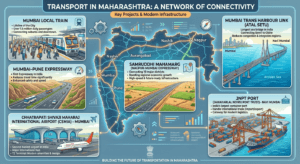
Maharashtra has one of the largest and most advanced transportation networks in India, connecting major cities, industrial hubs, ports, tourist destinations, and rural regions. The state’s well-developed infrastructure plays a crucial role in supporting trade, tourism, manufacturing, and economic growth.
The road network includes National Highways, State Highways, Expressways, and rural roads, making travel convenient across the state. The Mumbai–Pune Expressway, India’s first six-lane access-controlled expressway, significantly reduced travel time between Mumbai and Pune. Other important expressways include the Samruddhi Mahamarg (Hindu Hrudaysamrat Balasaheb Thackeray Maharashtra Samruddhi Mahamarg), Mumbai–Nagpur Expressway, Mumbai Trans Harbour Link (Atal Setu), and the Mumbai Coastal Road, which have further strengthened connectivity.
The railway network is one of the busiest in the country. Maharashtra is served by the Central Railway, Western Railway, South Central Railway, and South East Central Railway zones. The Mumbai Suburban Railway, often called the lifeline of Mumbai, carries millions of passengers every day. Major railway junctions include Mumbai, Pune, Nagpur, Nashik, Solapur, and Chhatrapati Sambhajinagar.
Air travel is supported by several airports, including Chhatrapati Shivaji Maharaj International Airport (Mumbai), Pune International Airport, Dr. Babasaheb Ambedkar International Airport (Nagpur), Nashik Airport, and Chhatrapati Sambhajinagar Airport. The upcoming Navi Mumbai International Airport is expected to further boost passenger and cargo capacity.
Maharashtra also has a strong maritime network. Jawaharlal Nehru Port (JNPT) in Navi Mumbai is India’s largest container port, while Mumbai Port remains one of the country’s oldest and busiest ports. These ports handle a significant share of India’s international trade.
The state’s integrated road, rail, air, and sea transport systems make Maharashtra one of India’s best-connected states and support its position as a leading economic and industrial hub.
Transport at a Glance
| Category | Details |
|---|---|
| Road Network | National Highways, State Highways & Expressways |
| Famous Expressways | Mumbai–Pune Expressway, Samruddhi Mahamarg |
| Longest Bridge | Mumbai Trans Harbour Link (Atal Setu) |
| Railway Zones | Central, Western, South Central & South East Central |
| Famous Rail Network | Mumbai Suburban Railway |
| Major Railway Stations | Mumbai, Pune, Nagpur, Nashik, Solapur, Chhatrapati Sambhajinagar |
| Major Airports | Mumbai, Pune, Nagpur, Nashik, Chhatrapati Sambhajinagar |
| Largest Container Port | Jawaharlal Nehru Port (JNPT) |
| Major Seaport | Mumbai Port |
| Transport Strength | Excellent Multi-modal Connectivity |
Education in Maharashtra
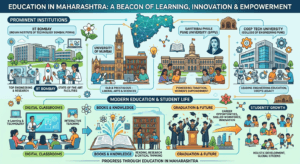
Maharashtra is one of India’s leading education hubs, known for its prestigious universities, renowned colleges, research institutions, and technical education centres. The state has played a significant role in shaping India’s higher education system and continues to attract students from across the country and abroad.
The Department of Higher and Technical Education, Government of Maharashtra, oversees higher education, while the School Education and Sports Department manages primary and secondary education. The state has thousands of government, aided, and private schools offering education in Marathi, English, Hindi, Urdu, and other regional languages.
Maharashtra is home to some of India’s oldest and most respected universities. The University of Mumbai, established in 1857, is one of the country’s oldest universities. Other prominent institutions include Savitribai Phule Pune University, Nagpur University, Shivaji University, Dr. Babasaheb Ambedkar Marathwada University, North Maharashtra University, and SNDT Women’s University, India’s first women’s university.
The state is also known for its world-class institutes such as the Indian Institute of Technology (IIT) Bombay, Institute of Chemical Technology (ICT Mumbai), College of Engineering Pune (COEP Tech University), Tata Institute of Social Sciences (TISS), and Symbiosis International (Deemed University). These institutions are recognized globally for excellence in engineering, management, science, medicine, law, and social sciences.
Maharashtra has a literacy rate of approximately 82.3%, with continuous improvements through digital learning initiatives, scholarship programmes, skill development missions, vocational education, and research funding. The state’s strong educational infrastructure contributes significantly to innovation, entrepreneurship, and economic growth.
With its excellent schools, universities, research centres, and professional institutions, Maharashtra continues to be one of India’s top destinations for quality education.
Education at a Glance
| Category | Details |
|---|---|
| Literacy Rate | 82.3% |
| Oldest University | University of Mumbai (1857) |
| Premier IIT | IIT Bombay |
| Women’s University | SNDT Women’s University |
| Major Universities | University of Mumbai, Savitribai Phule Pune University, Nagpur University, Shivaji University |
| Top Engineering Institute | COEP Tech University |
| Top Research Institute | Institute of Chemical Technology (ICT Mumbai) |
| Famous Social Science Institute | Tata Institute of Social Sciences (TISS) |
| Major Education Hub | Mumbai, Pune, Nagpur |
| Education Strength | Higher Education, Research & Technical Studies |
Healthcare in Maharashtra
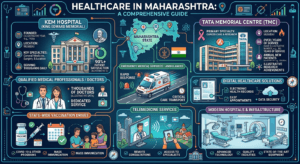
Maharashtra has one of the largest and most advanced healthcare systems in India, offering a comprehensive network of government hospitals, private medical institutions, primary health centres, community health centres, and specialized research hospitals. The state has made significant progress in improving public health, medical education, disease control, emergency care, and digital health services.
The Public Health Department, Government of Maharashtra, is responsible for providing affordable and accessible healthcare services across urban and rural areas. Thousands of Primary Health Centres (PHCs), Sub-Centres, Rural Hospitals, and District Hospitals ensure that essential healthcare services reach even remote villages.
Mumbai serves as the state’s medical hub and is home to several internationally recognized hospitals, including King Edward Memorial (KEM) Hospital, Sir J. J. Hospital, Tata Memorial Centre, Seth GS Medical College, and Lokmanya Tilak Municipal Medical College & Hospital. Other cities such as Pune, Nagpur, Nashik, and Chhatrapati Sambhajinagar also have well-equipped government and private hospitals.
Maharashtra is a leading centre for medical education, with numerous government and private medical colleges offering courses in medicine, dentistry, nursing, pharmacy, and allied health sciences. The state has also expanded telemedicine, e-health initiatives, and digital health records to improve healthcare accessibility and efficiency.
Government schemes such as the Mahatma Jyotirao Phule Jan Arogya Yojana (MJPJAY) and Ayushman Bharat – Pradhan Mantri Jan Arogya Yojana (PM-JAY) provide financial assistance for medical treatment to eligible families. Special programmes focus on maternal and child health, immunization, nutrition, communicable disease control, and non-communicable disease prevention.
With modern hospitals, skilled healthcare professionals, advanced medical research, and strong public health initiatives, Maharashtra continues to be one of India’s leading healthcare destinations.
Healthcare at a Glance
| Category | Details |
|---|---|
| Healthcare Department | Public Health Department, Government of Maharashtra |
| Major Medical Hub | Mumbai |
| Famous Government Hospitals | KEM Hospital, Sir J. J. Hospital, Tata Memorial Centre |
| Major Medical Cities | Mumbai, Pune, Nagpur, Nashik, Chhatrapati Sambhajinagar |
| Medical Education | Government & Private Medical Colleges |
| Health Insurance Schemes | MJPJAY, Ayushman Bharat (PM-JAY) |
| Primary Healthcare | PHCs, Community Health Centres & District Hospitals |
| Digital Healthcare | Telemedicine & e-Health Services |
| Focus Areas | Maternal Health, Child Care, Immunization & Disease Control |
| Healthcare Strength | Advanced Medical Infrastructure & Research |
Tourism in Maharashtra
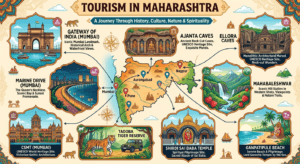
Maharashtra is one of India’s most popular tourist destinations, offering a perfect blend of history, spirituality, nature, wildlife, beaches, hill stations, and modern city attractions. From the bustling streets of Mumbai to the serene Western Ghats and the ancient rock-cut caves of Ajanta and Ellora, the state attracts millions of domestic and international visitors every year.
One of the state’s greatest attractions is the UNESCO World Heritage Sites of Ajanta Caves and Ellora Caves, renowned for their magnificent Buddhist, Hindu, and Jain rock-cut sculptures and architecture. Another UNESCO site, the Chhatrapati Shivaji Maharaj Terminus (CSMT) in Mumbai, is famous for its Victorian Gothic architecture.
Mumbai, the capital city, is home to iconic landmarks such as the Gateway of India, Marine Drive, Elephanta Caves, Juhu Beach, and the vibrant Bollywood film industry. Visitors can also explore museums, art galleries, shopping districts, and cultural festivals throughout the city.
Nature lovers can enjoy the scenic beauty of the Western Ghats, beautiful hill stations like Mahabaleshwar, Lonavala, Matheran, and Panchgani, as well as wildlife destinations including Tadoba-Andhari Tiger Reserve, Pench Tiger Reserve, and Sanjay Gandhi National Park.
Maharashtra is also a major pilgrimage destination. Famous religious sites include the Shirdi Sai Baba Temple, Trimbakeshwar Jyotirlinga, Bhimashankar Jyotirlinga, Siddhivinayak Temple, Mahalakshmi Temple (Kolhapur), Tulja Bhavani Temple, and Shani Shingnapur.
The state’s long Konkan coastline features beautiful beaches such as Ganpatipule, Tarkarli, Alibaug, and Harihareshwar, making Maharashtra an excellent destination for beach holidays and water sports.
With its rich cultural heritage, world-famous monuments, scenic landscapes, adventure activities, spiritual destinations, and modern attractions, Maharashtra offers unforgettable experiences for every traveller.
Top Tourist Attractions in Maharashtra
| Attraction | Famous For |
|---|---|
| Gateway of India | Iconic monument in Mumbai |
| Ajanta Caves | UNESCO World Heritage Buddhist caves |
| Ellora Caves | UNESCO World Heritage rock-cut temples |
| Chhatrapati Shivaji Maharaj Terminus (CSMT) | UNESCO World Heritage railway station |
| Mahabaleshwar | Popular hill station |
| Lonavala | Scenic hills & waterfalls |
| Shirdi Sai Baba Temple | Major pilgrimage centre |
| Tadoba-Andhari Tiger Reserve | Wildlife & Bengal Tigers |
| Ganpatipule Beach | Beautiful Konkan beach |
| Elephanta Caves | UNESCO-listed cave temples |
Famous Temples of Maharashtra
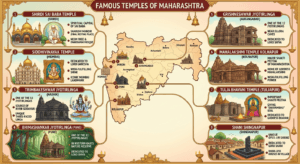
Maharashtra is one of India’s most sacred states, home to numerous ancient temples, Jyotirlingas, Shakti Peethas, and pilgrimage centres that attract millions of devotees every year. These temples are not only places of worship but also showcase the state’s rich history, architecture, and spiritual traditions.
One of the most visited temples is the Shirdi Sai Baba Temple, dedicated to Sai Baba of Shirdi. Devotees from across India and around the world visit Shirdi to seek blessings and experience its peaceful spiritual atmosphere.
Maharashtra is blessed with three of the twelve Jyotirlingas of Lord Shiva:
Trimbakeshwar Temple (Nashik)
Bhimashankar Temple (Pune district)
Grishneshwar Temple (near Ellora Caves)
These temples hold immense religious significance and are among the most important pilgrimage sites for Hindus.
The state is also home to the famous Siddhivinayak Temple in Mumbai, one of India’s most revered temples dedicated to Lord Ganesha. Thousands of devotees, including celebrities and public figures, visit the temple every day.
Other important temples include the Mahalakshmi Temple in Kolhapur, one of the Shakti Peethas, the Tulja Bhavani Temple in Dharashiv (Osmanabad), the Shani Shingnapur Temple, known for its unique traditions, and the Jejuri Khandoba Temple, an important centre of worship in western Maharashtra.
These temples reflect Maharashtra’s deep spiritual heritage and continue to preserve centuries-old traditions, festivals, rituals, and architectural excellence.
Famous Temples of Maharashtra
| Temple | Location | Famous For |
|---|---|---|
| Shirdi Sai Baba Temple | Shirdi | Shrine of Sai Baba |
| Siddhivinayak Temple | Mumbai | Famous Lord Ganesha Temple |
| Trimbakeshwar Temple | Nashik | One of the 12 Jyotirlingas |
| Bhimashankar Temple | Pune District | One of the 12 Jyotirlingas |
| Grishneshwar Temple | Chhatrapati Sambhajinagar | One of the 12 Jyotirlingas |
| Mahalakshmi Temple | Kolhapur | Shakti Peetha |
| Tulja Bhavani Temple | Dharashiv (Osmanabad) | Kuldevi of Chhatrapati Shivaji Maharaj |
| Shani Shingnapur Temple | Ahilyanagar | Temple dedicated to Lord Shani |
| Jejuri Khandoba Temple | Pune District | Temple of Lord Khandoba |
| Mumba Devi Temple | Mumbai | City’s presiding deity |
Arts of Maharashtra
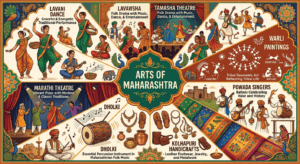
Maharashtra has a rich artistic and cultural heritage that reflects centuries of history, spirituality, and creativity. The state’s traditional performing arts, folk dances, music, theatre, painting, handicrafts, and martial traditions have been preserved for generations and continue to thrive through festivals, cultural events, and educational institutions.
One of Maharashtra’s most popular folk dance forms is Lavani, known for its energetic performances, rhythmic music, expressive storytelling, and colourful costumes. Traditionally performed to the beats of the Dholki, Lavani is an important part of Marathi folk culture and theatre.
Another famous performing art is Tamasha, a traditional Marathi folk theatre that combines music, dance, comedy, and dramatic storytelling. Tamasha has entertained audiences for centuries and remains one of the state’s most distinctive cultural traditions.
The state is also renowned for Powada, a powerful form of ballad singing that narrates the heroic stories of Chhatrapati Shivaji Maharaj and Maratha warriors. Kirtan and Bharud are devotional performance traditions that blend music, storytelling, and spiritual teachings.
Maharashtra’s visual arts include the internationally admired Warli Painting, a tribal art form created by the Warli community using simple geometric patterns to depict daily life, farming, festivals, and nature. The state is also famous for Kolhapuri handicrafts, Paithani silk sarees, Bidri work, Sawantwadi wooden toys, and traditional pottery.
The Marathi theatre industry is one of India’s oldest and most respected, producing legendary playwrights, actors, and musicians. Along with the globally recognized Bollywood film industry based in Mumbai, Maharashtra continues to play a leading role in India’s performing arts and entertainment sector.
Today, the state’s artistic traditions remain an integral part of its cultural identity, attracting artists, researchers, and visitors from around the world.
Famous Arts of Maharashtra
| Art Form | Type | Famous For |
|---|---|---|
| Lavani | Folk Dance | Energetic dance & music |
| Tamasha | Folk Theatre | Music, dance & storytelling |
| Warli Painting | Tribal Art | Traditional tribal painting style |
| Powada | Ballad Singing | Heroic tales of Maratha warriors |
| Kirtan | Devotional Performance | Spiritual storytelling |
| Bharud | Folk Performance | Social and devotional messages |
| Paithani Weaving | Textile Art | Luxurious silk sarees |
| Kolhapuri Handicrafts | Craft | Leather products & craftsmanship |
| Sawantwadi Wooden Toys | Folk Craft | Handcrafted wooden toys |
| Marathi Theatre | Performing Arts | Classical and modern stage performances |
Culture & Traditions of Maharashtra
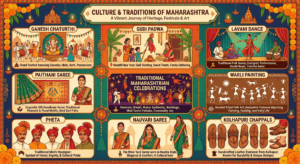
Maharashtra is known for its rich cultural heritage, shaped by centuries of history, the legacy of the Maratha Empire, diverse communities, and vibrant traditions. The state’s culture reflects a harmonious blend of ancient customs, spirituality, literature, music, dance, theatre, festivals, and modern urban influences.
The traditional attire of Maharashtra includes the Nauvari Saree for women and the Dhoti-Kurta with the iconic Pheta (turban) for men. These traditional outfits are commonly worn during festivals, weddings, religious ceremonies, and cultural celebrations.
Hospitality is an important part of Maharashtrian culture. Families warmly welcome guests and celebrate special occasions with traditional food, music, folk dances, and religious rituals. Respect for elders, community participation, and family values continue to play an important role in everyday life.
Maharashtra is famous for its colourful folk traditions, including Lavani, Tamasha, Powada, Kirtan, and Bharud, which preserve the state’s artistic and historical legacy. Tribal communities such as the Warli, Bhil, Gond, and Katkari have enriched the state’s culture through their unique customs, paintings, music, and festivals.
Traditional handicrafts such as Paithani silk sarees, Kolhapuri chappals, Warli paintings, Sawantwadi wooden toys, and Bidri metalwork are admired across India and internationally. The Marathi language, literature, theatre, and cinema continue to contribute significantly to India’s cultural landscape.
Major celebrations such as Ganesh Chaturthi, Gudi Padwa, Diwali, Navratri, and Makar Sankranti bring communities together and showcase Maharashtra’s vibrant traditions. These festivals feature devotional music, colourful processions, traditional attire, cultural performances, and delicious cuisine.
With its strong cultural identity, artistic excellence, and centuries-old traditions, Maharashtra remains one of India’s most culturally vibrant states.
Culture & Traditions at a Glance
| Category | Details |
|---|---|
| Traditional Dress | Nauvari Saree, Dhoti-Kurta & Pheta |
| Major Language | Marathi |
| Famous Folk Dance | Lavani |
| Folk Theatre | Tamasha |
| Tribal Art | Warli Painting |
| Traditional Footwear | Kolhapuri Chappals |
| Famous Handloom | Paithani Saree |
| Major Communities | Marathi, Warli, Bhil, Gond, Katkari |
| Major Celebrations | Ganesh Chaturthi, Gudi Padwa, Diwali |
| Cultural Identity | Maratha Heritage, Folk Arts & Hospitality |
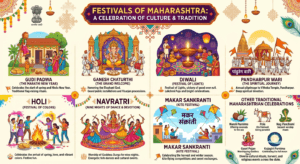
Festivals of Maharashtra
Maharashtra is renowned for its vibrant festivals, which reflect the state’s rich cultural heritage, religious diversity, and strong community spirit. Throughout the year, people celebrate traditional festivals with devotion, colourful processions, music, dance, delicious food, and cultural performances. These celebrations bring families and communities together while preserving centuries-old customs and traditions.
The most iconic festival of the state is Ganesh Chaturthi, introduced as a public celebration by Lokmanya Bal Gangadhar Tilak during India’s freedom movement. The festival is celebrated with beautifully decorated Ganesh idols, devotional songs, cultural programmes, and grand immersion processions. Cities like Mumbai, Pune, and Nagpur witness massive celebrations that attract visitors from across the world.
Another important festival is Gudi Padwa, the Marathi New Year, which marks the beginning of the traditional Hindu calendar. Families decorate their homes with colourful Gudis, prepare festive dishes, and perform special prayers for prosperity and happiness.
Other widely celebrated festivals include Diwali, the Festival of Lights; Makar Sankranti, known for kite flying and exchanging sweets; Navratri, celebrated with devotional music and traditional dances; Holi, the festival of colours; Dussehra (Vijayadashami); and Janmashtami, marking the birth of Lord Krishna.
Religious fairs and pilgrimages are also an integral part of Maharashtra’s cultural life. The Pandharpur Wari, one of India’s largest annual pilgrimages, sees thousands of devotees walking to the Vitthal-Rukmini Temple in Pandharpur. Similarly, celebrations at Shirdi, Trimbakeshwar, Jejuri, and Kolhapur attract millions of pilgrims every year.
These festivals showcase Maharashtra’s unity in diversity, strengthen social bonds, and preserve the state’s cultural and spiritual heritage for future generations.
Major Festivals of Maharashtra
| Festival | Celebrated For |
|---|---|
| Ganesh Chaturthi | Birth of Lord Ganesha |
| Gudi Padwa | Marathi New Year |
| Diwali | Festival of Lights |
| Makar Sankranti | Harvest Festival & Kite Flying |
| Holi | Festival of Colours |
| Navratri | Worship of Goddess Durga |
| Dussehra (Vijayadashami) | Victory of Good over Evil |
| Janmashtami | Birth of Lord Krishna |
| Pandharpur Wari | Pilgrimage to Lord Vitthal |
| Eid & Christmas | Celebrated by diverse communities |
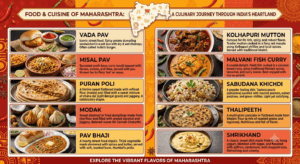
Food & Cuisine of Maharashtra
Maharashtra is famous for its diverse and flavorful cuisine, which reflects the traditions of different regions such as Konkan, Western Maharashtra, Vidarbha, Marathwada, and Khandesh. The state’s food culture ranges from simple home-style meals to spicy street food and festive delicacies, making it one of India’s most popular culinary destinations.
One of the most iconic dishes is Vada Pav, often called the “Indian Burger.” Originating in Mumbai, it consists of a spicy potato fritter served inside a bread bun with chutneys and fried green chillies. Another popular street food is Misal Pav, a spicy curry made with sprouted lentils, topped with farsan and served with bread.
Traditional Maharashtrian meals usually include Bhakri, Chapati, Rice, Dal, Amti, seasonal vegetables, pickles, and curd. Coastal regions are well known for fish curry, prawn dishes, crab curry, and Malvani cuisine, which is rich in coconut and aromatic spices.
Maharashtra is also famous for its festive sweets and snacks. Popular desserts include Puran Poli, Modak, Shrikhand, Basundi, Karanji, and Anarsa. During Ganesh Chaturthi, Ukadiche Modak, a steamed sweet dumpling filled with coconut and jaggery, is traditionally offered to Lord Ganesha.
Other popular dishes include Pithla Bhakri, Sabudana Khichdi, Poha, Thalipeeth, Pav Bhaji, Bombil Fry, and Kolhapuri Mutton, known for its rich and spicy flavour.
With its unique regional specialties, delicious street food, nutritious home-cooked meals, and festive delicacies, Maharashtra offers a memorable culinary experience for food lovers from around the world.
Famous Foods of Maharashtra
| Dish | Famous For |
|---|---|
| Vada Pav | Mumbai’s iconic street food |
| Misal Pav | Spicy Maharashtrian breakfast |
| Puran Poli | Traditional festive sweet |
| Ukadiche Modak | Ganesh Chaturthi delicacy |
| Pav Bhaji | Popular street food |
| Kolhapuri Mutton | Spicy meat curry |
| Malvani Fish Curry | Coastal seafood speciality |
| Sabudana Khichdi | Popular fasting dish |
| Thalipeeth | Multigrain flatbread |
| Shrikhand | Sweet yogurt dessert |
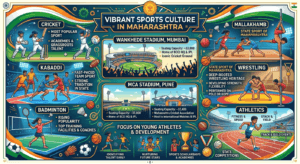
Sports in Maharashtra
Maharashtra has made significant contributions to Indian sports, producing world-class athletes, cricketers, chess players, badminton stars, and Olympians. The state’s excellent sports infrastructure, professional training academies, and national-level tournaments have helped nurture sporting talent across various disciplines.
Cricket is the most popular sport in Maharashtra. The state is home to the iconic Wankhede Stadium in Mumbai, one of India’s most famous cricket venues, and the Maharashtra Cricket Association (MCA) Stadium in Pune. Maharashtra has produced legendary cricketers including Sachin Tendulkar, Sunil Gavaskar, Rohit Sharma, and Ajinkya Rahane, who have represented India with distinction.
Traditional sports such as Kabaddi, Kho Kho, Mallakhamb, and Wrestling (Kushti) continue to enjoy immense popularity, especially in rural areas. Maharashtra has played an important role in preserving and promoting these indigenous sports through schools, colleges, and state-level competitions.
The state has also excelled in badminton, athletics, chess, shooting, football, hockey, and tennis. Several athletes from Maharashtra have represented India in international competitions, including the Olympic Games, Asian Games, and Commonwealth Games.
Modern sports infrastructure, including stadiums, sports complexes, academies, and training centres in Mumbai, Pune, Nagpur, and Nashik, supports the development of young athletes. Government initiatives and private academies continue to encourage participation in sports at grassroots and professional levels.
With its rich sporting culture, internationally recognized athletes, and world-class facilities, Maharashtra remains one of India’s leading sporting states.
Sports at a Glance
| Category | Details |
|---|---|
| Most Popular Sport | Cricket |
| Famous Stadium | Wankhede Stadium, Mumbai |
| International Stadium | MCA Stadium, Pune |
| Traditional Sports | Kabaddi, Kho Kho, Mallakhamb, Wrestling |
| Major Sports | Cricket, Football, Hockey, Badminton, Athletics, Chess |
| Famous Cricketers | Sachin Tendulkar, Sunil Gavaskar, Rohit Sharma, Ajinkya Rahane |
| Sports Infrastructure | Stadiums, Academies & Training Centres |
| Major Sports Cities | Mumbai, Pune, Nagpur, Nashik |
| International Participation | Olympics, Asian Games & Commonwealth Games |
| Sports Strength | Cricket, Traditional Sports & Athlete Development |
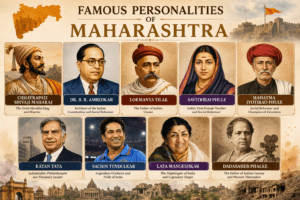
Famous Personalities of Maharashtra
Maharashtra has produced some of India’s most influential leaders, freedom fighters, social reformers, scientists, industrialists, artists, and sports personalities. Their remarkable contributions have shaped the nation’s history, education, economy, science, literature, and culture.
One of the greatest figures in Maharashtra’s history is Chhatrapati Shivaji Maharaj, the founder of the Maratha Empire. He is remembered for his visionary leadership, military strategy, progressive administration, and commitment to justice. His legacy continues to inspire millions across India.
Dr. Babasaheb Ambedkar, the principal architect of the Constitution of India, was born in present-day Madhya Pradesh but carried out much of his education, social reform, and public life in Maharashtra. His contributions to social justice, equality, and constitutional democracy remain invaluable.
The state is also the birthplace of Lokmanya Bal Gangadhar Tilak, a prominent freedom fighter and nationalist leader who played a vital role in India’s independence movement. Savitribai Phule and Mahatma Jyotirao Phule revolutionized education and social reform by promoting women’s education and fighting against caste discrimination.
In business and industry, Ratan Tata is one of India’s most respected industrialists and philanthropists. Under his leadership, the Tata Group expanded globally while maintaining a strong commitment to social responsibility.
Maharashtra has also produced world-renowned personalities in sports and entertainment. Cricket legend Sachin Tendulkar, often called the “God of Cricket,” is regarded as one of the greatest batsmen in history. The state has also nurtured icons such as Lata Mangeshkar, known as the “Nightingale of India,” and legendary filmmaker Dadasaheb Phalke, regarded as the Father of Indian Cinema.
The achievements of these personalities have brought pride to Maharashtra and continue to inspire future generations in India and around the world.
Famous Personalities of Maharashtra
| Personality | Field | Contribution |
|---|---|---|
| Chhatrapati Shivaji Maharaj | History | Founder of the Maratha Empire |
| Dr. B. R. Ambedkar | Law & Social Reform | Principal Architect of the Indian Constitution |
| Lokmanya Bal Gangadhar Tilak | Freedom Movement | Nationalist leader and freedom fighter |
| Savitribai Phule | Education | Pioneer of women’s education in India |
| Mahatma Jyotirao Phule | Social Reform | Worked for social equality and education |
| Ratan Tata | Business | Industrialist and philanthropist |
| Sachin Tendulkar | Sports | Legendary international cricketer |
| Lata Mangeshkar | Music | Legendary playback singer |
| Dadasaheb Phalke | Cinema | Father of Indian Cinema |
Interesting Facts About Maharashtra
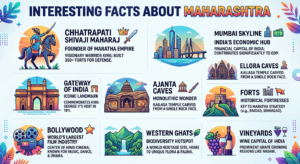
Maharashtra is one of India’s most influential and fascinating states, known for its remarkable history, economic strength, cultural diversity, and natural beauty. It is home to India’s financial capital, world-famous heritage monuments, thriving industries, and rich traditions. From the mighty forts of the Maratha Empire to modern skyscrapers in Mumbai, Maharashtra beautifully blends history with progress.
The state is home to Mumbai, India’s financial capital and the headquarters of the Reserve Bank of India (RBI), Bombay Stock Exchange (BSE), and National Stock Exchange (NSE). It also hosts Bollywood, the world’s largest Hindi film industry by film production.
Maharashtra has five UNESCO World Heritage Sites—Ajanta Caves, Ellora Caves, Chhatrapati Shivaji Maharaj Terminus (CSMT), the Victorian Gothic and Art Deco Ensembles of Mumbai, and the Western Ghats (shared across multiple states). These sites highlight the state’s outstanding historical, architectural, and natural significance.
The state is famous for its impressive forts, with more than 350 forts, including Raigad, Sinhagad, Pratapgad, and Sindhudurg, many of which are closely associated with Chhatrapati Shivaji Maharaj.
Maharashtra is also India’s leading producer of grapes, wine, oranges, pomegranates, and onions, while Nagpur is popularly known as the “Orange City of India.” The state continues to lead the country in finance, manufacturing, entertainment, and innovation.
With its unique blend of heritage, industry, tourism, education, and cultural richness, Maharashtra remains one of India’s most dynamic and globally recognized states.
Quick Facts About Maharashtra
| Fact | Details |
|---|---|
| State Formation Day | 1 May 1960 |
| Capital City | Mumbai |
| Largest Economy | Largest state economy in India |
| Financial Capital | Mumbai |
| UNESCO World Heritage Sites | 5 |
| Number of Districts | 36 |
| Longest Coastline | Approx. 720 km along the Arabian Sea |
| Famous For | Bollywood, Maratha Empire, Historic Forts |
| Largest Container Port | Jawaharlal Nehru Port (JNPT) |
| Popular Nickname | Gateway to Western India |
Frequently Asked Questions (FAQs) About Maharashtra
1. Where is Maharashtra located?
Maharashtra is located in western India. It shares borders with Gujarat, Madhya Pradesh, Chhattisgarh, Telangana, Karnataka, and Goa, and has a long coastline along the Arabian Sea.
2. What is the capital of Maharashtra?
Mumbai is the capital of Maharashtra and is also known as the Financial Capital of India.
3. When was Maharashtra formed?
Maharashtra was officially formed on 1 May 1960 after the division of the former Bombay State.
4. Which is the official language of Maharashtra?
The official language of Maharashtra is Marathi.
5. What is Maharashtra famous for?
Maharashtra is famous for Mumbai, Bollywood, the Maratha Empire, Chhatrapati Shivaji Maharaj, Ajanta & Ellora Caves, hill stations, beaches, forts, and its strong economy.
6. Which are the major rivers in Maharashtra?
The major rivers are Godavari, Krishna, Bhima, Tapi (Tapti), Wardha, Wainganga, and Koyna.
7. Which are the famous tourist places in Maharashtra?
Popular tourist destinations include Gateway of India, Ajanta Caves, Ellora Caves, Mahabaleshwar, Lonavala, Shirdi, Ganpatipule, Elephanta Caves, and Tadoba-Andhari Tiger Reserve.
8. Which are the famous temples in Maharashtra?
Major temples include Shirdi Sai Baba Temple, Siddhivinayak Temple, Trimbakeshwar Jyotirlinga, Bhimashankar Jyotirlinga, Grishneshwar Temple, Mahalakshmi Temple, and Tulja Bhavani Temple.
9. What are the major industries in Maharashtra?
Major industries include finance, banking, IT, automobile manufacturing, pharmaceuticals, textiles, engineering, entertainment (Bollywood), tourism, and agriculture.
10. Which crops are mainly grown in Maharashtra?
Major crops include sugarcane, cotton, soybean, rice, wheat, jowar, bajra, grapes, oranges, onions, pomegranates, and Alphonso mangoes.
11. What is the literacy rate of Maharashtra?
According to the 2011 Census, Maharashtra has a literacy rate of approximately 82.3%.
12. Why is Mumbai called the Financial Capital of India?
Mumbai is called the Financial Capital because it is home to the Reserve Bank of India (RBI), Bombay Stock Exchange (BSE), National Stock Exchange (NSE), major banks, financial institutions, and corporate headquarters.
13. Which UNESCO World Heritage Sites are located in Maharashtra?
- Major UNESCO World Heritage Sites include:
- Ajanta Caves
- Ellora Caves
- Chhatrapati Shivaji Maharaj Terminus (CSMT)
- Victorian Gothic and Art Deco Ensembles of Mumbai
- Western Ghats (shared with other states)
14. What is the best time to visit Maharashtra?
The best time to visit is October to February, when the weather is cool and pleasant for sightseeing, wildlife safaris, and hill station visits.
15. Why should you visit Maharashtra?
Maharashtra offers a unique combination of history, culture, spirituality, wildlife, beaches, hill stations, UNESCO World Heritage Sites, delicious cuisine, and modern cities, making it one of India’s top travel destinations.
Conclusion
Maharashtra is one of India’s most dynamic and influential states, known for its glorious history, strong economy, vibrant culture, and breathtaking natural beauty. From the majestic legacy of Chhatrapati Shivaji Maharaj and the historic forts of the Maratha Empire to the modern skyline of Mumbai, the state represents a perfect blend of tradition and progress.
Home to India’s financial capital, world-famous UNESCO World Heritage Sites, leading educational institutions, thriving industries, fertile agricultural regions, and diverse wildlife, Maharashtra continues to play a vital role in the nation’s development. Its colourful festivals, delicious cuisine, spiritual destinations, rich artistic heritage, and warm hospitality make it a favourite destination for travellers, students, entrepreneurs, and history enthusiasts.
Whether you are exploring the scenic Western Ghats, relaxing on the beautiful Konkan Coast, visiting ancient caves, experiencing the excitement of Bollywood, or learning about the state’s remarkable history and culture, Maharashtra offers unforgettable experiences for everyone.
With its unique combination of heritage, innovation, economic leadership, and cultural diversity, Maharashtra truly stands as one of India’s greatest states and continues to inspire people from around the world.
About DealKart Market
DealKart Market is your trusted destination for high-quality, well-researched, and easy-to-understand content about Indian states, history, geography, tourism, culture, education, economy, biographies, and travel. Our mission is to provide accurate, informative, and regularly updated articles that help students, competitive exam aspirants, travellers, researchers, and knowledge seekers.
Every article on DealKart Market is carefully prepared using reliable sources and presented in a reader-friendly format. From detailed state guides and famous personalities to travel destinations and educational resources, we aim to make learning simple, engaging, and accessible for everyone.
Whether you’re planning a trip, preparing for competitive exams, exploring India’s rich heritage, or expanding your general knowledge, DealKart Market is your one-stop destination for authentic and comprehensive information.
Visit Our Website
Why Choose DealKart Market?
- Comprehensive Indian State Guides
- Inspiring Biography Articles
- Travel & Tourism Information
- Education & General Knowledge Resources
- SEO-Friendly, Well-Researched Content
- Regularly Updated Information
- Easy-to-Read & User-Friendly Articles
Explore, Learn, and Discover India with DealKart Market!
Explore More State Guides on DealKart Market
Continue exploring India’s diverse states with our detailed guides covering history, geography, culture, tourism, economy, education, healthcare, agriculture, famous places, and much more.
Indian State Guides
📍 Telangana Complete Guide
https://dealkartmarket.in/telangana-complete-guide/
Andhra Pradesh Complete Guide
https://dealkartmarket.in/andhra-pradesh-complete-guide/
Kerala Complete Guide
https://dealkartmarket.in/kerala-complete-guide/
Maharashtra Complete Guide
https://dealkartmarket.in/maharashtra-complete-guide/
Karnataka Complete Guide (Coming Soon)
https://dealkartmarket.in/karnataka-complete-guide/
Tamil Nadu Complete Guide (Coming Soon)
https://dealkartmarket.in/tamil-nadu-complete-guide/
Explore Inspiring Biography Guides
Learn about the lives and achievements of India’s most inspiring personalities.
- Dr. A. P. J. Abdul Kalam Biography
https://dealkartmarket.in/dr-apj-abdul-kalam-biography/
- Ratan Tata Biography
https://dealkartmarket.in/ratan-tata-biography/
- Visit DealKart Market
Website: https://dealkartmarket.in/
Explore India. Learn More. Stay Informed with DealKart Market.
References
Use these trusted and authoritative sources at the end of your Maharashtra Complete Guide article:
- Government of Maharashtra – Official Portal
https://www.maharashtra.gov.in/
- Maharashtra Tourism – Official Website
https://maharashtratourism.gov.in/
- Department of Tourism Maharashtra
Census of India – Population & Demographic Data
- Ministry of Statistics and Programme Implementation (MoSPI)
- India Brand Equity Foundation (IBEF) – Maharashtra State Profile
- Ministry of Tourism, Government of India
- India Meteorological Department (IMD)
- National Portal of India
- Forest Survey of India (FSI)
- Reserve Bank of India (RBI) – Handbook of Statistics on Indian States
- Archaeological Survey of India (ASI)
- Maharashtra Tourism Development Corporation (MTDC)