
Introduction
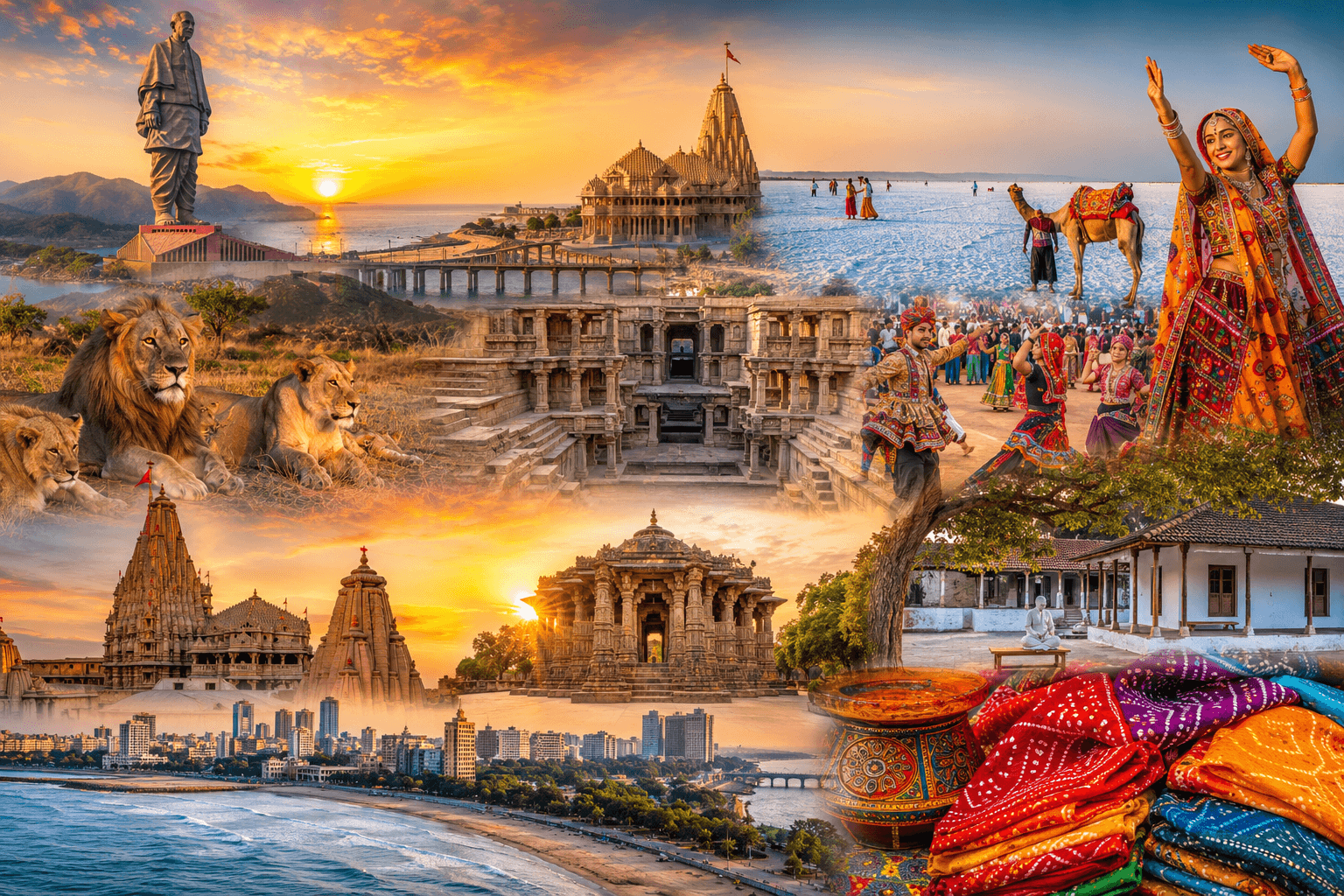
Gujarat is one of India’s most dynamic and prosperous states, renowned for its rich cultural heritage, remarkable history, thriving economy, diverse landscapes, and vibrant traditions. Located on the western coast of India, Gujarat shares its borders with Rajasthan to the north, Madhya Pradesh to the east, Maharashtra to the south, and Pakistan to the northwest. The state also has India’s longest coastline, stretching approximately 1,600 kilometres along the Arabian Sea, making it a major hub for trade, ports, and maritime activities.
The capital of Gujarat is Gandhinagar, while Ahmedabad, the state’s largest city, serves as its commercial, financial, educational, and cultural centre. Gujarat was officially formed on 1 May 1960 after the bilingual Bombay State was divided into Gujarat and Maharashtra based on linguistic lines. The state is home to over 70 million people and is widely recognized for its entrepreneurial spirit, industrial growth, and significant contribution to India’s economy.
The state is often referred to as the “Land of Legends” and the “Jewel of Western India” because of its historical significance and remarkable achievements. It is the birthplace of Mahatma Gandhi, the Father of the Nation, and Sardar Vallabhbhai Patel, India’s first Deputy Prime Minister and the Iron Man of India. Their contributions have made Gujarat an important destination in India’s freedom movement and political history.
The state is blessed with an extraordinary mix of natural and cultural attractions. From the spectacular Rann of Kutch, the world’s largest salt desert, to the Gir National Park, the only natural habitat of the Asiatic Lion, Gujarat offers unique experiences for nature lovers. The magnificent Statue of Unity, the world’s tallest statue, attracts millions of visitors every year. Pilgrimage destinations such as Somnath Temple, Dwarkadhish Temple, and Palitana Temples make Gujarat one of India’s most important spiritual destinations.
The state is also an economic powerhouse, leading the nation in industries such as petrochemicals, textiles, pharmaceuticals, diamonds, automobiles, engineering, renewable energy, and ports. Major ports like Mundra, Kandla (Deendayal Port), and Pipavav play a crucial role in India’s international trade. The state’s strong infrastructure, investor-friendly policies, and industrial development have made it one of India’s fastest-growing economies.
The cultural identity of Gujarat is equally remarkable. The colourful Navratri festival, energetic Garba and Dandiya Raas dances, exquisite Bandhani textiles, traditional handicrafts, and delicious Gujarati cuisine reflect the state’s vibrant heritage. Whether exploring ancient civilizations, wildlife sanctuaries, white deserts, coastal landscapes, religious sites, or modern cities, Gujarat offers a perfect blend of tradition, innovation, and natural beauty.
With its rich history, world-famous landmarks, thriving industries, diverse wildlife, and warm hospitality, Gujarat continues to be one of India’s most fascinating states for travellers, students, researchers, entrepreneurs, and competitive exam aspirants.
Gujarat on India Map
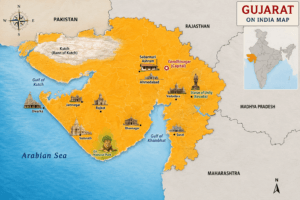
The state is located in the western part of India and is one of the country’s most economically developed and geographically diverse states. It shares borders with Rajasthan to the north, Madhya Pradesh to the east, Maharashtra to the south, and Pakistan to the northwest. The Arabian Sea lies to the west, giving Gujarat the longest coastline among all Indian states, measuring approximately 1,600 kilometres.
The state covers an area of about 196,024 square kilometres, making it the fifth-largest state in India by area. Its strategic location has made Gujarat an important centre for international trade, shipping, industry, and tourism for centuries.
Gandhinagar serves as the capital of the state, while Ahmedabad is the largest city and the state’s commercial, industrial, and cultural hub. Other major cities include Surat, Vadodara, Rajkot, Bhavnagar, Jamnagar, and Bhuj.
Thee state is home to several world-famous landmarks, including the Statue of Unity, the Rann of Kutch, Gir National Park, Somnath Temple, Dwarkadhish Temple, and Sabarmati Ashram. Its location on India’s western coast also supports major ports such as Mundra Port, Deendayal Port (Kandla), and Pipavav Port, making Gujarat a gateway for India’s international maritime trade.
The state’s diverse geography includes salt deserts, fertile plains, hills, forests, rivers, and an extensive coastline, making Gujarat one of the most unique states in India for tourism, biodiversity, and economic development.
History of Gujarat
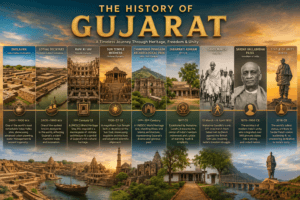
The state has one of the oldest and richest histories in India, with evidence of human civilization dating back more than 4,500 years. The state was home to several important settlements of the Indus Valley Civilization (Harappan Civilization), including Dholavira, Lothal, and Surkotada. These ancient cities were known for their advanced urban planning, drainage systems, dockyards, trade, and craftsmanship. The archaeological site of Dholavira was declared a UNESCO World Heritage Site in 2021, while Lothal is regarded as one of the world’s earliest known dockyard cities.
During the ancient period, Gujarat was ruled by powerful dynasties such as the Mauryas, Western Satraps, Guptas, Maitrakas, and Solankis (Chaulukyas). Under the Solanki rulers, Gujarat witnessed remarkable progress in architecture, literature, trade, and culture. Magnificent monuments such as the Sun Temple at Modhera, Rani ki Vav, and several temples and stepwells were built during this golden age.
From the 13th century onwards, Gujarat came under the Delhi Sultanate, followed by the independent Gujarat Sultanate, which transformed cities like Ahmedabad, Champaner, and Junagadh into important centres of trade, architecture, and culture. In the 16th century, the Mughal Empire annexed Gujarat, making it one of the wealthiest provinces due to its flourishing textile and maritime trade.
Later, parts of Gujarat came under the control of the Marathas, and eventually the British East India Company. During British rule, Gujarat played a crucial role in India’s freedom struggle. It is the birthplace of Mahatma Gandhi, who launched historic movements such as the Dandi Salt March (1930) from Sabarmati Ashram. The state is also the birthplace of Sardar Vallabhbhai Patel, who played a key role in unifying independent India.
After India gained independence in 1947, Gujarat became part of the bilingual Bombay State. Following the Mahagujarat Movement, the state of Gujarat was officially formed on 1 May 1960, when Bombay State was divided into Gujarat and Maharashtra based on linguistic identity.
Today, the state is recognized as one of India’s most progressive states, known for its industrial growth, cultural heritage, world-class infrastructure, and globally significant historical monuments. From the ancient Harappan civilization to modern economic leadership, Gujarat’s history reflects resilience, innovation, and enduring cultural richness.
Historical Timeline of Gujarat
| Period | Highlights |
|---|---|
| Indus Valley Civilization | Dholavira, Lothal & Surkotada |
| Mauryan Empire | Rule of Emperor Ashoka |
| Solanki Dynasty | Golden age of architecture & culture |
| Gujarat Sultanate | Growth of Ahmedabad & Islamic architecture |
| Mughal Period | Expansion of trade & administration |
| British Rule | Freedom movement & Dandi March |
| State Formation | 1 May 1960 |
| UNESCO Heritage Sites | Dholavira, Rani ki Vav & Champaner-Pavagadh |
Geography & Climate of Gujarat
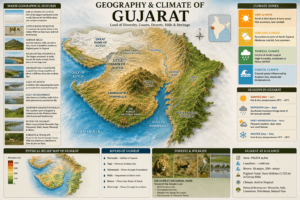
State is the fifth-largest state in India, covering an area of approximately 196,024 square kilometres. Located on the western coast of India, the state is known for its remarkable geographical diversity, ranging from vast white salt deserts and fertile plains to hills, forests, wetlands, and a long Arabian Sea coastline.
The state shares its borders with Rajasthan in the north, Madhya Pradesh in the east, Maharashtra in the south, and Pakistan to the northwest. Gujarat also has India’s longest coastline, stretching nearly 1,600 kilometres along the Arabian Sea, making it an important centre for ports, fisheries, maritime trade, and coastal tourism.
Gujarat’s landscape can be divided into several distinct geographical regions. The Great Rann of Kutch and Little Rann of Kutch are world-famous seasonal salt marshes that become spectacular white deserts during the dry season. The Saurashtra Peninsula is known for its rocky hills, coastal cliffs, and fertile agricultural lands, while the central plains support intensive farming and industrial development.
The eastern part of Gujarat is bordered by the Aravalli, Vindhya, Satpura, and Western Ghats hill ranges, which contain dense forests, wildlife sanctuaries, and tribal communities. The state’s highest peak is Girnar, located near Junagadh, rising to about 1,117 metres above sea level.
Gujarat experiences a tropical climate with three main seasons:
- Summer (March–June): Hot and dry, with temperatures often ranging between 35°C and 45°C.
- Monsoon (June–September): Moderate to heavy rainfall, especially in southern and eastern districts.
- Winter (November–February): Pleasant and cool, with temperatures ranging from 12°C to 30°C, making it the best season for tourism.
Rainfall varies significantly across the state. Southern Gujarat receives abundant rainfall due to the southwest monsoon, whereas the Kutch region remains comparatively dry and semi-arid. This climatic diversity supports a wide variety of ecosystems, agriculture, and wildlife.
From the white salt desert of Kutch to the lush forests of Gir and the scenic Arabian Sea coastline, Gujarat’s geography and climate make it one of India’s most diverse and naturally fascinating states.
Geography & Climate at a Glance
| Category | Details |
|---|---|
| Total Area | 196,024 sq km |
| Area Rank | 5th Largest State in India |
| Coastline | Approximately 1,600 km (Longest in India) |
| Highest Peak | Girnar (1,117 m) |
| Major Landforms | Great Rann of Kutch, Little Rann of Kutch, Saurashtra Peninsula |
| Major Water Bodies | Arabian Sea, Gulf of Kutch, Gulf of Khambhat |
| Climate Type | Tropical |
| Summer Temperature | 35°C–45°C |
| Winter Temperature | 12°C–30°C |
| Best Time to Visit | November to February |
Rivers & Forests of Gujarat
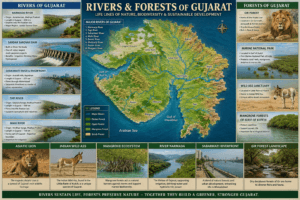
The state is blessed with a rich network of rivers, forests, wetlands, and coastal ecosystems, which support agriculture, wildlife, industries, and millions of people. Although parts of the state have an arid climate, its major rivers and protected forests play a crucial role in maintaining ecological balance and water resources.
The Narmada River is Gujarat’s longest and most important river. Flowing westward into the Arabian Sea, it is the lifeline of the state. The Sardar Sarovar Dam, one of India’s largest multipurpose river projects, is built on the Narmada and provides irrigation, drinking water, and hydroelectric power to millions of people.
Other major rivers include the Tapi (Tapti), Sabarmati, Mahi, Banas, Saraswati, Bhadar, Shetrunji, and Machhu rivers. These rivers support agriculture, industries, urban water supply, and numerous reservoirs across the state. The Sabarmati Riverfront in Ahmedabad has become one of Gujarat’s most iconic urban development projects.
Approximately 9–10% of Gujarat’s geographical area is covered by forests. Most forested regions are located in the eastern districts and the Gir Forest, which is world-famous as the only natural habitat of the Asiatic Lion. Gujarat also has diverse ecosystems including mangrove forests, dry deciduous forests, thorn forests, grasslands, and coastal wetlands.
The state is home to several important protected areas such as Gir National Park, Blackbuck National Park (Velavadar), Marine National Park (Gulf of Kutch), Wild Ass Sanctuary (Little Rann of Kutch), Vansda National Park, and Purna Wildlife Sanctuary. These forests protect rare wildlife including the Asiatic Lion, Indian Wild Ass, Blackbuck, Leopard, Striped Hyena, Sloth Bear, and hundreds of bird species.
The state also has one of India’s largest mangrove ecosystems, particularly around the Gulf of Kutch, which protects the coastline and supports marine biodiversity. Together, the state’s rivers, forests, wetlands, and wildlife reserves make Gujarat one of India’s most ecologically significant states.
Rivers & Forests at a Glance
| Category | Details |
|---|---|
| Longest River | Narmada |
| Other Major Rivers | Tapi, Sabarmati, Mahi, Banas, Saraswati, Bhadar |
| Largest Dam | Sardar Sarovar Dam |
| Forest Cover | Around 9–10% of the State’s Area |
| Famous Forest | Gir Forest |
| National Parks | Gir, Blackbuck (Velavadar), Marine, Vansda |
| Largest Sanctuary | Wild Ass Sanctuary (Little Rann of Kutch) |
| Mangrove Region | Gulf of Kutch |
| State Animal | Asiatic Lion |
| Major Importance | Irrigation, Drinking Water, Biodiversity & Wildlife Conservation |
Government of Gujarat
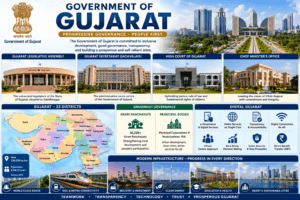
The state follows a parliamentary system of government, similar to other Indian states. The Governor is the constitutional head of the state and is appointed by the President of India, while the Chief Minister is the executive head who leads the Council of Ministers and oversees the day-to-day administration.
The state has a unicameral legislature, known as the Gujarat Legislative Assembly (Vidhan Sabha), which consists of 182 elected Members of the Legislative Assembly (MLAs). These representatives are elected by the people from different constituencies across the state. The Legislative Assembly is responsible for making state laws, approving the budget, and overseeing the functioning of the government.
Gandhinagar, the capital of Gujarat, serves as the state’s administrative and political centre. It houses the Gujarat Legislative Assembly, the Secretariat (Sachivalaya), the High Court of Gujarat, and various government departments responsible for public administration, finance, education, healthcare, agriculture, industries, and infrastructure development.
For administrative convenience, Gujarat is divided into 33 districts, which are further subdivided into talukas, municipalities, and village panchayats. Local governance is managed through Gram Panchayats, Municipal Councils, and Municipal Corporations, ensuring effective delivery of public services and grassroots development.
The Government of Gujarat places strong emphasis on industrial development, agriculture, digital governance, renewable energy, infrastructure, healthcare, education, tourism, water management, and environmental conservation. Flagship initiatives such as the Vibrant Gujarat Global Summit, Sujalam Sufalam Yojana, and the Statue of Unity development project have contributed significantly to the state’s economic growth and global recognition.
Known for efficient administration, investor-friendly policies, and rapid infrastructure development, Gujarat continues to play a leading role in India’s economic and social progress.
Government at a Glance
| Category | Details |
|---|---|
| Capital | Gandhinagar |
| State Formation | 1 May 1960 |
| Governor | Constitutional Head |
| Chief Minister | Head of Government |
| Legislature | Unicameral |
| Legislative Assembly | 182 Members |
| High Court | High Court of Gujarat (Ahmedabad) |
| Administrative Districts | 33 |
| Talukas | 250+ |
| Official Language | Gujarati |
| State Animal | Asiatic Lion |
| State Bird | Greater Flamingo |
| State Tree | Banyan |
| State Flower | Marigold |
Population of Gujarat
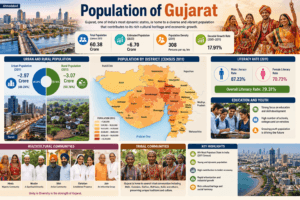
The state is one of India’s most populous and economically vibrant states, with a diverse population representing various communities, cultures, and traditions. According to the 2011 Census, Gujarat had a population of 6.04 crore (60.4 million). Recent estimates indicate that the state’s population has grown to around 7.3 crore (73 million), driven by natural growth, urbanization, and migration.
The state has a population density of approximately 308 persons per square kilometre, which is lower than the national average. Gujarat is highly urbanized, with major cities such as Ahmedabad, Surat, Vadodara, Rajkot, Gandhinagar, Bhavnagar, Jamnagar, and Bhuj serving as important centres of commerce, education, healthcare, and industry.
Gujarati is the official language and is spoken by the majority of the population. Other widely spoken languages include Hindi, English, Kutchi, Sindhi, Marathi, and Urdu, reflecting the state’s cultural diversity.
The state has made remarkable progress in education and human development, achieving a literacy rate of approximately 78% according to the 2011 Census. Continuous government initiatives in education, healthcare, sanitation, digital governance, and skill development have significantly improved the quality of life across the state.
The state is home to several tribal communities, particularly in the eastern districts, including the Bhil, Gamit, Dhodia, Chaudhari, and Rathwa tribes. Their rich traditions, art, handicrafts, and festivals contribute to Gujarat’s unique cultural heritage.
With its entrepreneurial spirit, multicultural society, growing urban centres, and strong economic opportunities, Gujarat continues to attract people from across India and remains one of the country’s fastest-growing states.
Population at a Glance
| Category | Details |
|---|---|
| Population (2011 Census) | 6,04,39,692 (6.04 Crore) |
| Estimated Population (2025) | Around 7.3 Crore |
| Population Rank | 9th in India |
| Population Density | 308 persons/sq km |
| Literacy Rate | 78.03% |
| Sex Ratio | 919 females per 1,000 males |
| Urban Population | Around 43% |
| Rural Population | Around 57% |
| Official Language | Gujarati |
| Largest City | Ahmedabad |
Economy & Industries of Gujarat
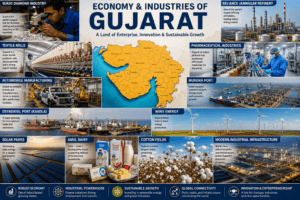
The state has one of the strongest and most diversified economies in India and is widely regarded as the country’s industrial powerhouse. With its business-friendly policies, modern infrastructure, excellent road and port connectivity, and entrepreneurial culture, the state contributes significantly to India’s manufacturing, exports, trade, and industrial production.
The state is a national leader in petrochemicals, oil and gas, textiles, pharmaceuticals, chemicals, engineering, automobiles, ceramics, renewable energy, and diamond processing. Gujarat accounts for a major share of India’s chemical production, pharmaceutical manufacturing, and textile exports, making it one of the country’s most important industrial hubs.
Ahmedabad, Surat, Vadodara, Rajkot, Jamnagar, Bhavnagar, and Gandhidham are among Gujarat’s leading industrial cities. Surat is internationally recognised as the Diamond City of India, where nearly 90% of the world’s diamonds are cut and polished. The city is also one of India’s largest textile manufacturing centres.
Jamnagar is home to the world’s largest oil refining complex, operated by Reliance Industries, while Vadodara has emerged as a major centre for petrochemicals, fertilizers, engineering, and power equipment manufacturing.
Gujarat’s extensive coastline has helped the state develop world-class ports. Mundra Port, Deendayal Port (Kandla), Pipavav Port, Dahej Port, and Hazira Port handle a significant portion of India’s maritime cargo and international trade.
Agriculture also plays an important role in the state’s economy. Gujarat is one of India’s leading producers of cotton, groundnut, cumin, castor, sesame, tobacco, milk, and spices. The state’s cooperative dairy movement, led by Amul, transformed India into the world’s largest milk producer through the White Revolution.
The Government of Gujarat actively promotes investment through initiatives such as the Vibrant Gujarat Global Summit, industrial corridors, Special Economic Zones (SEZs), and smart city projects. With rapid industrial growth, strong exports, modern infrastructure, and a thriving business environment, Gujarat continues to be one of India’s fastest-growing and most prosperous states.
Economy at a Glance
| Sector | Major Activities |
|---|---|
| Petrochemicals | Oil Refining, Chemicals & Fertilizers |
| Textile Industry | Cotton, Garments & Fabric Manufacturing |
| Diamond Industry | Diamond Cutting & Polishing (Surat) |
| Pharmaceuticals | Medicines & Healthcare Products |
| Automobile Industry | Vehicle & Engineering Manufacturing |
| Ports | Mundra, Deendayal (Kandla), Pipavav, Dahej & Hazira |
| Agriculture | Cotton, Groundnut, Cumin, Tobacco & Castor |
| Dairy Industry | Amul & White Revolution |
| Renewable Energy | Solar & Wind Power |
| Major Economic Strength | Manufacturing, Exports & International Trade |
Agriculture of Gujarat
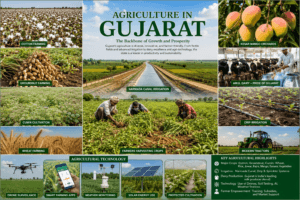
Agriculture is one of the most important sectors of Gujarat’s economy, providing employment and livelihoods to millions of people across the state. Although Gujarat is a leading industrial state, farming continues to play a vital role in supporting rural communities, food production, agro-based industries, and exports. The state’s diverse climate, fertile plains, irrigation projects, and modern farming techniques have helped increase agricultural productivity over the years.
The Narmada Canal Project, developed under the Sardar Sarovar Dam, has transformed agriculture by supplying irrigation water to drought-prone regions of Kutch, Saurashtra, and North Gujarat. Along with canal irrigation, farmers also depend on tube wells, reservoirs, rivers, and micro-irrigation systems such as drip and sprinkler irrigation.
Gujarat is India’s largest producer of cotton, making it the country’s leading textile raw material supplier. The state is also one of the top producers of groundnut, cumin, castor, sesame, fennel, isabgol, dates, and tobacco. Other important crops include wheat, bajra (pearl millet), rice, maize, sugarcane, pulses, and vegetables.
Horticulture has expanded rapidly in recent years. Gujarat is well known for producing Kesar mangoes from Gir, bananas, pomegranates, chikoo (sapota), guava, and papaya. The state also exports fruits, vegetables, spices, and processed agricultural products to many countries.
The dairy sector is another major strength of Gujarat’s rural economy. The state is the birthplace of Amul, the world’s largest dairy cooperative, which played a historic role in India’s White Revolution. Milk production continues to provide stable income to millions of farming families.
The Government of Gujarat promotes organic farming, precision agriculture, soil health management, crop diversification, mechanization, and digital farming technologies. These initiatives help farmers improve productivity while conserving natural resources and ensuring sustainable agricultural development.
With advanced irrigation, strong cooperative movements, high-value crops, and modern agricultural practices, Gujarat has become one of India’s leading agricultural and agro-industrial states.
Agriculture at a Glance
| Category | Major Products |
|---|---|
| Food Crops | Wheat, Rice, Bajra, Maize & Pulses |
| Cash Crops | Cotton, Groundnut, Tobacco & Sugarcane |
| Oilseeds | Groundnut, Castor, Sesame |
| Spices | Cumin, Fennel, Isabgol |
| Fruits | Kesar Mango, Banana, Pomegranate, Chikoo |
| Dairy | Amul & White Revolution |
| Major Irrigation Project | Sardar Sarovar (Narmada Canal) |
| Farming Methods | Drip Irrigation & Precision Farming |
| Agricultural Strength | Cotton, Dairy & Spice Production |
| Major Export Products | Cotton, Groundnut, Spices & Fresh Fruits |
Education in Gujarat
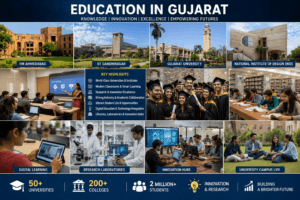
Education has played a vital role in Gujarat’s social and economic development. The state has built a strong educational ecosystem with thousands of schools, colleges, universities, research institutes, and skill development centres that provide quality education across urban and rural areas. Continuous government investment in education, digital learning, teacher training, and vocational programmes has significantly improved literacy and educational opportunities.
According to the 2011 Census, Gujarat has a literacy rate of 78.03%, with steady progress in school enrolment and higher education. The state government implements various initiatives to improve access to education, including scholarships, digital classrooms, girls’ education programmes, free textbooks, and skill development schemes.
The state is home to several prestigious universities and institutions. Indian Institute of Management Ahmedabad (IIM Ahmedabad) is one of the world’s leading business schools. Other renowned institutions include Indian Institute of Technology Gandhinagar (IIT Gandhinagar), Gujarat University, The Maharaja Sayajirao University of Baroda, Sardar Patel University, Pandit Deendayal Energy University, and National Institute of Design (NID Ahmedabad).
The state has also emerged as a centre for engineering, management, medicine, pharmacy, architecture, law, design, and agricultural education. Gujarat attracts students from across India and abroad because of its excellent academic infrastructure, research facilities, and industry-oriented education.
Technical and vocational education are promoted through Industrial Training Institutes (ITIs), polytechnic colleges, and skill development centres that prepare students for employment in manufacturing, information technology, renewable energy, healthcare, and other growing sectors.
With world-class educational institutions, modern learning facilities, strong industry partnerships, and a focus on innovation, Gujarat continues to strengthen its position as one of India’s leading destinations for higher education and research.
Education at a Glance
| Category | Details |
|---|---|
| Literacy Rate | 78.03% (2011 Census) |
| Official Language of Education | Gujarati, English & Hindi |
| Top Management Institute | IIM Ahmedabad |
| Premier Engineering Institute | IIT Gandhinagar |
| Famous Design Institute | National Institute of Design (NID) |
| Major Universities | Gujarat University, MS University of Baroda, Sardar Patel University |
| Technical Education | ITIs, Polytechnic Colleges & Engineering Institutes |
| Medical Education | Government & Private Medical Colleges |
| Skill Development | Vocational Training & Digital Learning |
| Education Strength | Higher Education, Research & Innovation |
Healthcare in Gujarat
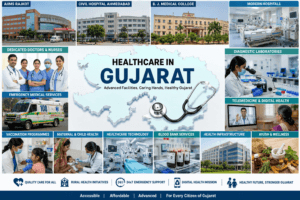
The state has one of India’s most advanced healthcare systems, supported by a strong network of government hospitals, private hospitals, medical colleges, research institutions, primary health centres (PHCs), and community health centres (CHCs). Over the years, the state has made significant investments in healthcare infrastructure, digital health services, maternal and child care, emergency response, and disease prevention.
The Health & Family Welfare Department, Government of Gujarat oversees the state’s healthcare system and implements various public health programmes aimed at improving the quality of medical services in both urban and rural areas. The state focuses on universal healthcare, vaccination, maternal health, nutrition, sanitation, and preventive medicine.
The state is home to several prestigious healthcare institutions, including All India Institute of Medical Sciences (AIIMS) Rajkot, B. J. Medical College, Civil Hospital Ahmedabad, U. N. Mehta Institute of Cardiology, Institute of Kidney Diseases and Research Centre (IKDRC), and Gujarat Cancer & Research Institute (GCRI). These institutions provide advanced treatment in cardiology, oncology, nephrology, trauma care, organ transplantation, and medical research.
The state has expanded access to healthcare through Ayushman Bharat – Pradhan Mantri Jan Arogya Yojana (PM-JAY) and the Mukhyamantri Amrutam (MA) Yojana, which offer financial assistance for medical treatment to eligible families. Emergency ambulance services, telemedicine, mobile health units, and digital health initiatives have further improved healthcare accessibility across Gujarat.
Special emphasis is placed on maternal and child healthcare, immunization, nutrition programmes, tuberculosis control, non-communicable disease management, and public health awareness campaigns. Regular vaccination drives and preventive healthcare programmes have contributed to improved health indicators throughout the state.
With modern hospitals, skilled medical professionals, expanding medical education, and continuous healthcare reforms, Gujarat continues to strengthen its position as one of India’s leading states in healthcare delivery and medical innovation.
Healthcare at a Glance
| Category | Details |
|---|---|
| Health Department | Health & Family Welfare Department, Gujarat |
| Premier Medical Institute | AIIMS Rajkot |
| Major Government Hospital | Civil Hospital Ahmedabad |
| Famous Medical College | B. J. Medical College |
| Super Speciality Care | Cardiology, Oncology, Nephrology & Trauma Care |
| Public Health Schemes | Ayushman Bharat (PM-JAY), Mukhyamantri Amrutam (MA) Yojana |
| Emergency Services | 108 Ambulance Service |
| Rural Healthcare | Primary Health Centres (PHCs) & Community Health Centres (CHCs) |
| Digital Healthcare | Telemedicine & e-Health Services |
| Healthcare Strength | Advanced Medical Infrastructure & Public Health Programmes |
Transport in Gujarat
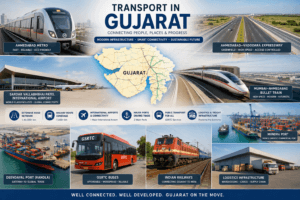
The state has one of the most advanced transportation networks in India, connecting its major cities, industrial hubs, ports, tourist destinations, and rural areas through an extensive system of roads, railways, airports, and seaports. The state’s strategic location on India’s western coast has made it a major gateway for domestic and international trade.
The road network in Gujarat is among the best in the country. The state has National Highways, State Highways, expressways, and rural roads that provide seamless connectivity. Important highways such as NH-48, NH-27, and NH-47 connect Gujarat with Maharashtra, Rajasthan, Madhya Pradesh, Delhi, and other parts of India. The Ahmedabad–Vadodara Expressway was India’s first expressway and remains one of the busiest road corridors in the country.
The railway network is operated by the Western Railway zone and connects all major cities, including Ahmedabad, Surat, Vadodara, Rajkot, Bhavnagar, Jamnagar, Gandhidham, Bhuj, and Gandhinagar. Ahmedabad serves as one of western India’s most important railway junctions, while Gujarat is also part of the Mumbai–Ahmedabad High-Speed Rail (Bullet Train) Project, India’s first high-speed rail corridor.
Air connectivity is provided through several domestic and international airports. Sardar Vallabhbhai Patel International Airport in Ahmedabad is the state’s busiest airport, offering flights to major cities in India and international destinations. Other important airports include Surat, Vadodara, Rajkot, Bhuj, Jamnagar, Kandla, Porbandar, Bhavnagar, and Keshod airports.
The state also has the largest port infrastructure in India, handling a significant share of the country’s maritime cargo. Major ports such as Mundra Port, Deendayal Port (Kandla), Pipavav Port, Dahej Port, and Hazira Port play a vital role in exports, imports, logistics, and industrial development.
Public transportation within cities is supported by Ahmedabad BRTS, Gujarat State Road Transport Corporation (GSRTC) buses, city buses, metro rail services in Ahmedabad, taxis, app-based cabs, and auto-rickshaws. With modern infrastructure and continuous investment in transport, Gujarat continues to strengthen its position as one of India’s best-connected states.
Transport at a Glance
| Category | Details |
|---|---|
| Major Road Network | National Highways, State Highways & Expressways |
| Famous Expressway | Ahmedabad–Vadodara Expressway |
| Railway Zone | Western Railway |
| Largest Railway Junction | Ahmedabad Junction |
| International Airport | Sardar Vallabhbhai Patel International Airport |
| Metro System | Ahmedabad Metro |
| Bullet Train Project | Mumbai–Ahmedabad High-Speed Rail |
| Major Ports | Mundra, Deendayal (Kandla), Pipavav, Dahej & Hazira |
| Public Transport | GSRTC Buses, BRTS, Metro, Taxis & Auto-rickshaws |
| Transport Strength | Roads, Railways, Ports & Logistics |
Top Tourist Places in Gujarat
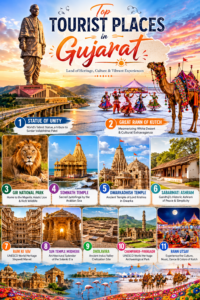
The state is one of India’s most fascinating travel destinations, offering a remarkable blend of history, spirituality, wildlife, architecture, natural beauty, and cultural heritage. From the world’s tallest statue and ancient temples to white salt deserts and UNESCO World Heritage Sites, the state attracts millions of domestic and international tourists every year.
The Statue of Unity, located at Kevadia on the banks of the Narmada River, is the world’s tallest statue, standing at 182 metres. Dedicated to Sardar Vallabhbhai Patel, it has become Gujarat’s most visited tourist attraction, featuring a viewing gallery, museum, Valley of Flowers, jungle safari, and riverfront experiences.
The spectacular Great Rann of Kutch is the world’s largest salt desert and is famous for its breathtaking white landscape. Every winter, the internationally renowned Rann Utsav showcases Gujarati folk music, Garba dance, handicrafts, camel safaris, desert camping, and local cuisine.
For wildlife enthusiasts, Gir National Park is the only natural habitat of the Asiatic Lion in the world. Other popular wildlife destinations include the Little Rann of Kutch Wild Ass Sanctuary, Blackbuck National Park (Velavadar), and Marine National Park in the Gulf of Kutch.
Gujarat is also a major pilgrimage destination. The Somnath Temple, one of the twelve Jyotirlingas of Lord Shiva, and the Dwarkadhish Temple in Dwarka, one of the Char Dham pilgrimage sites, attract millions of devotees annually. Other important spiritual destinations include the Palitana Jain Temples, Ambaji Temple, and Sun Temple at Modhera.
History lovers can explore UNESCO World Heritage Sites such as Rani ki Vav in Patan, the Historic City of Ahmedabad, Dholavira, and the Champaner-Pavagadh Archaeological Park. The Sabarmati Ashram, associated with Mahatma Gandhi, offers a glimpse into India’s freedom movement.
Whether you are interested in wildlife, spirituality, history, architecture, festivals, or scenic landscapes, Gujarat offers unforgettable experiences for every traveller.
Famous Tourist Places in Gujarat
| Tourist Place | Famous For |
|---|---|
| Statue of Unity | World’s Tallest Statue |
| Great Rann of Kutch | White Salt Desert & Rann Utsav |
| Gir National Park | Asiatic Lions |
| Somnath Temple | Jyotirlinga Shrine |
| Dwarkadhish Temple | Char Dham Pilgrimage |
| Sabarmati Ashram | Mahatma Gandhi’s Residence |
| Rani ki Vav | UNESCO World Heritage Stepwell |
| Sun Temple, Modhera | Ancient Solanki Architecture |
| Dholavira | Indus Valley Civilization Site |
| Champaner-Pavagadh | UNESCO World Heritage Archaeological Park |
Wildlife & National Parks of Gujarat
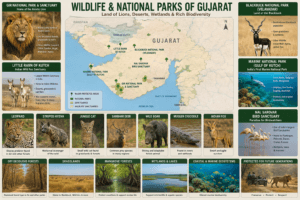
The state is one of India’s richest states in terms of wildlife, biodiversity, and protected ecosystems. Its diverse landscapes—including forests, grasslands, wetlands, mangroves, deserts, and coastal regions—support a remarkable variety of flora and fauna. The state is internationally recognised for conserving the Asiatic Lion, making it a premier destination for wildlife tourism and nature conservation.
The Gir National Park and Wildlife Sanctuary, located in the Junagadh, Gir Somnath, Amreli, and Bhavnagar districts, is the only natural habitat of the Asiatic Lion in the world. Spread over more than 1,400 square kilometres, Gir is home not only to lions but also to leopards, striped hyenas, jackals, sambar deer, nilgai, chital, marsh crocodiles, and over 300 species of birds.
Another unique protected area is the Indian Wild Ass Sanctuary in the Little Rann of Kutch, the world’s largest sanctuary for the endangered Indian Wild Ass (Khur). The sanctuary also supports desert foxes, wolves, flamingos, pelicans, cranes, and numerous migratory birds.
The Blackbuck National Park (Velavadar) is famous for its large population of Blackbucks, graceful antelopes known for their spiral horns. The park is also one of India’s best places to observe wolves, foxes, hyenas, and raptors in open grassland habitats.
The state is also home to India’s first Marine National Park, located in the Gulf of Kutch. This unique marine ecosystem protects coral reefs, mangrove forests, dolphins, sea turtles, octopuses, starfish, colourful reef fish, and other marine life, making it an important centre for marine biodiversity.
Other important protected areas include Vansda National Park, Purna Wildlife Sanctuary, Balaram Ambaji Wildlife Sanctuary, Jessore Sloth Bear Sanctuary, and Nal Sarovar Bird Sanctuary, which attract thousands of migratory birds during winter.
With its iconic Asiatic Lions, rare Indian Wild Ass, thriving marine ecosystems, wetlands, and bird sanctuaries, Gujarat remains one of India’s leading states for wildlife conservation, eco-tourism, and biodiversity research.
Wildlife at a Glance
| Protected Area | Famous For |
|---|---|
| Gir National Park | Asiatic Lions |
| Indian Wild Ass Sanctuary | Indian Wild Ass (Khur) |
| Blackbuck National Park (Velavadar) | Blackbucks & Grassland Wildlife |
| Marine National Park | Coral Reefs & Marine Biodiversity |
| Nal Sarovar Bird Sanctuary | Migratory Birds & Flamingos |
| Vansda National Park | Dense Forests & Leopards |
| Purna Wildlife Sanctuary | Western Ghats Biodiversity |
| Jessore Sloth Bear Sanctuary | Sloth Bears |
| State Animal | Asiatic Lion |
| State Bird | Greater Flamingo |
Arts & culture of Gujarat
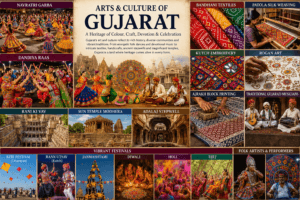
The state is renowned for its rich cultural heritage, vibrant traditions, colourful festivals, folk dances, handicrafts, and architectural marvels. The state’s culture reflects centuries of influence from ancient civilizations, Hindu, Jain, Islamic, and tribal traditions, creating a unique identity that continues to flourish in modern India.
One of Gujarat’s most celebrated cultural traditions is Garba and Dandiya Raas, which are performed during the Navratri Festival. These energetic folk dances attract millions of participants and visitors from across the world, making Gujarat’s Navratri celebration one of the largest cultural festivals globally.
The state is equally famous for its traditional handicrafts. Skilled artisans produce Bandhani (Bandhej) textiles, Patola silk sarees, Kutch embroidery, Ajrakh block printing, Rogan art, wood carving, terracotta pottery, lacquer work, and silver jewellery. These handicrafts are admired worldwide for their intricate craftsmanship and vibrant colours.
Gujarati architecture showcases a remarkable blend of history and artistry. Magnificent monuments such as Rani ki Vav, Sun Temple at Modhera, Adalaj Stepwell, Jama Masjid (Ahmedabad), and the historic city of Ahmedabad reflect the state’s rich architectural legacy. Several of these monuments have received UNESCO World Heritage recognition.
Music also forms an integral part of Gujarat’s cultural identity. Traditional folk music, devotional Bhajans, Dayro, Bhavai, and tribal performances are popular across the state. These art forms preserve Gujarat’s folklore, history, and spiritual traditions while entertaining audiences during festivals and community gatherings.
Gujarati cuisine is another important aspect of the state’s culture. Popular dishes such as Dhokla, Thepla, Khandvi, Undhiyu, Fafda-Jalebi, Handvo, and Khakhra are enjoyed throughout India and abroad. Hospitality, family values, entrepreneurship, and community celebrations further enrich the cultural life of Gujarat.
With its vibrant festivals, traditional dances, exquisite handicrafts, historic architecture, delicious cuisine, and warm hospitality, Gujarat stands as one of India’s most culturally diverse and colourful states.
Arts & Culture at a Glance
| Category | Details |
|---|---|
| Traditional Dances | Garba, Dandiya Raas, Bhavai |
| Folk Music | Dayro, Bhajans & Tribal Music |
| Famous Handicrafts | Bandhani, Patola, Kutch Embroidery, Rogan Art |
| Textile Arts | Ajrakh Printing & Handloom Weaving |
| Traditional Architecture | Rani ki Vav, Modhera Sun Temple, Adalaj Stepwell |
| Historic City | Ahmedabad (UNESCO World Heritage City) |
| Traditional Cuisine | Dhokla, Thepla, Khandvi, Undhiyu |
| Major Festival | Navratri |
| Cultural Identity | Heritage, Handicrafts & Folk Traditions |
| UNESCO Heritage | Historic City of Ahmedabad & Rani ki Vav |
Festivals of Gujarat
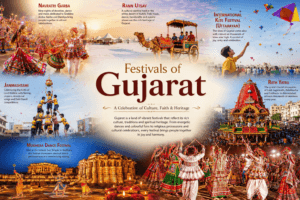
the state is famous for its vibrant festivals, which reflect the state’s rich cultural heritage, religious diversity, and strong community spirit. Throughout the year, people celebrate traditional Hindu, Jain, Muslim, and tribal festivals with great enthusiasm, colourful processions, folk music, dance, and cultural performances. These celebrations attract millions of visitors from India and around the world.
The most celebrated festival in Gujarat is Navratri, a nine-night cultural extravaganza dedicated to Goddess Durga. Gujarat hosts the world’s longest dance festival, where thousands of people perform Garba and Dandiya Raas in beautifully decorated venues across cities such as Ahmedabad, Vadodara, Rajkot, Surat, and Jamnagar. Navratri is one of the biggest cultural attractions in India and draws international tourists every year.
Another globally renowned celebration is the Rann Utsav, held in the spectacular Great Rann of Kutch during the winter season. Visitors enjoy the breathtaking white salt desert, luxury tent cities, camel safaris, hot-air balloon rides, folk music, traditional handicrafts, adventure activities, and authentic Gujarati cuisine.
The International Kite Festival (Uttarayan), celebrated on 14 January, is one of Gujarat’s most iconic events. The skies come alive with colourful kites from across the world, especially in Ahmedabad, where thousands of participants gather for international kite-flying competitions.
Other major festivals celebrated across the state include Janmashtami, Diwali, Holi, Mahashivratri, Ganesh Chaturthi, Rath Yatra, and Modhera Dance Festival. Religious fairs such as the Tarnetar Fair, Bhavnath Fair, and Shamlaji Fair showcase Gujarat’s tribal traditions, folk arts, handicrafts, music, and rural culture.
These colourful festivals preserve Gujarat’s centuries-old traditions while promoting tourism, local handicrafts, cultural exchange, and community harmony. Whether attending Navratri celebrations, flying kites during Uttarayan, or experiencing the magical Rann Utsav, visitors can witness the state’s vibrant cultural spirit throughout the year.
Major Festivals of Gujarat
| Festival | Famous For |
|---|---|
| Navratri | Garba & Dandiya Raas |
| Rann Utsav | White Desert Festival |
| International Kite Festival (Uttarayan) | Kite Flying Celebrations |
| Janmashtami | Birth of Lord Krishna |
| Rath Yatra | Jagannath Chariot Festival |
| Diwali | Festival of Lights |
| Holi | Festival of Colours |
| Mahashivratri | Worship of Lord Shiva |
| Tarnetar Fair | Tribal Culture & Folk Traditions |
| Modhera Dance Festival | Classical Dance & Heritage |
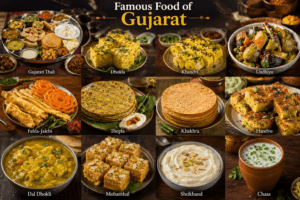
Famous Food of Gujarat
Gujarati cuisine is one of the most diverse, nutritious, and flavourful cuisines in India. It is known for its unique balance of sweet, spicy, salty, and tangy flavours, making every meal a delightful culinary experience. Prepared using fresh vegetables, pulses, cereals, spices, yogurt, and gram flour, Gujarati food is predominantly vegetarian and reflects the state’s rich cultural traditions and agricultural abundance.
One of the most famous dishes is the Gujarati Thali, a wholesome meal that includes roti, puri, dal, kadhi, rice, seasonal vegetables, farsan, pickles, chutneys, papad, and traditional sweets. The thali offers a perfect combination of nutrition and authentic regional flavours.
Among Gujarat’s most popular snacks, Dhokla is a soft and steamed savoury cake made from fermented gram flour or rice batter. Khandvi, prepared from gram flour and yogurt, is another favourite known for its delicate texture. Fafda served with Jalebi is a classic breakfast combination, especially popular during the Uttarayan (International Kite Festival).
Traditional dishes such as Undhiyu, a mixed vegetable delicacy cooked with seasonal vegetables and aromatic spices, are closely associated with winter festivals. Thepla, Handvo, Khakhra, Sev Tameta Nu Shaak, Dal Dhokli, and Muthiya are also enjoyed across the state and are popular among travellers because of their long shelf life and delicious taste.
Gujarat is equally famous for its sweets. Mohanthal, Basundi, Shrikhand, Sutarfeni, Ghari, and Magaj are widely prepared during festivals, weddings, and family celebrations.
The state’s rich dairy industry, led by Amul, has made milk products an essential part of Gujarati cuisine. Fresh buttermilk (Chaas), yogurt, butter, and ghee are commonly served with meals.
From traditional village kitchens to modern restaurants and street food markets, Gujarat offers a memorable culinary journey that reflects its hospitality, cultural heritage, and love for wholesome vegetarian food.
Famous Foods of Gujarat
| Dish | Famous For |
|---|---|
| Gujarati Thali | Traditional Complete Meal |
| Dhokla | Steamed Savoury Snack |
| Khandvi | Gram Flour Rolls |
| Undhiyu | Mixed Vegetable Delicacy |
| Fafda-Jalebi | Popular Festival Breakfast |
| Thepla | Spiced Flatbread |
| Khakhra | Crispy Roasted Snack |
| Handvo | Savoury Lentil Cake |
| Dal Dhokli | Traditional Comfort Food |
| Mohanthal | Classic Gujarati Sweet |
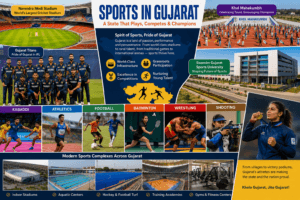
Sports in Gujarat
The state has emerged as one of India’s leading states in sports development, with world-class stadiums, modern training facilities, sports universities, and government initiatives promoting athletes across various disciplines. The state has made significant investments in sports infrastructure and regularly hosts national and international sporting events.
Cricket is the most popular sport in Gujarat. The state is home to the magnificent Narendra Modi Stadium in Ahmedabad, the largest cricket stadium in the world, with a seating capacity of over 132,000 spectators. The stadium has hosted international cricket matches, the ICC Cricket World Cup, the Indian Premier League (IPL), and several historic sporting events. Gujarat is represented in the IPL by the Gujarat Titans, who won the IPL championship in their debut season in 2022.
Apart from cricket, sports such as kabaddi, football, hockey, athletics, wrestling, badminton, chess, tennis, volleyball, and shooting are actively promoted across the state. Gujarat has produced several national and international athletes who have represented India with distinction.
The state government encourages sports participation through initiatives such as the Khel Mahakumbh, one of India’s largest grassroots sporting events. Every year, millions of participants from schools, colleges, villages, and urban areas compete in various sports, helping identify and nurture young talent.
Gujarat is also home to the Swarnim the state Sports University, India’s first dedicated sports university, established to promote sports education, research, coaching, sports science, and athlete development.
Modern sports complexes, indoor stadiums, swimming pools, athletics tracks, and training academies across Ahmedabad, Surat, Vadodara, Rajkot, and other cities continue to strengthen Gujarat’s sporting ecosystem. With world-class infrastructure and strong government support, Gujarat is rapidly becoming one of India’s premier sporting destinations.
Sports at a Glance
| Category | Details |
|---|---|
| Most Popular Sport | Cricket |
| Largest Stadium | Narendra Modi Stadium, Ahmedabad |
| IPL Team | Gujarat Titans |
| Major Sports Event | Khel Mahakumbh |
| Sports University | Swarnim Gujarat Sports University |
| Popular Sports | Cricket, Kabaddi, Football, Hockey, Athletics, Badminton |
| International Events | ICC Cricket World Cup, IPL & International Cricket |
| Major Sports Cities | Ahmedabad, Surat, Vadodara & Rajkot |
| Government Focus | Grassroots Sports Development |
| Sports Strength | World-Class Infrastructure & Talent Development |
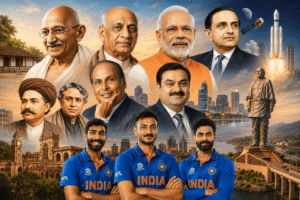
Famous Personalities of Gujarat
The state has given India many visionary leaders, freedom fighters, social reformers, industrialists, scientists, artists, and sportspersons whose contributions have shaped the nation’s history, economy, culture, and global reputation. Their achievements continue to inspire millions across India and the world.
Mahatma Gandhi, born in Porbandar, is the Father of the Nation and one of the greatest leaders of India’s freedom movement. His philosophy of truth (Satya) and non-violence (Ahimsa) inspired people across the globe and played a decisive role in India’s independence.
Another iconic personality is Sardar Vallabhbhai Patel, popularly known as the Iron Man of India. Born in Nadiad, he successfully integrated more than 560 princely states after independence, laying the foundation of a united India. The Statue of Unity, the world’s tallest statue, was built in his honour.
Narendra Modi, born in Vadnagar, served as the Chief Minister of Gujarat before becoming the Prime Minister of India. His leadership has brought Gujarat international recognition through industrial development and initiatives such as the Vibrant Gujarat Global Summit.
The state has also produced globally respected entrepreneurs. Dhirubhai Ambani, founder of Reliance Industries, transformed India’s corporate landscape through innovation and entrepreneurship. Gautam Adani, founder of the Adani Group, is another prominent business leader from the state whose enterprises span ports, logistics, energy, airports, and infrastructure.
The state has made remarkable contributions to science and technology through personalities such as Dr. Vikram Sarabhai, widely regarded as the Father of the Indian Space Programme. His pioneering vision led to the establishment of India’s space research institutions and laid the foundation for the country’s space achievements.
Gujarat’s literary and cultural heritage has been enriched by Narmad, Umashankar Joshi, Jhaverchand Meghani, and many other distinguished writers and poets who made significant contributions to Gujarati literature.
In sports, the state has produced internationally recognised athletes, including cricketers Jasprit Bumrah, Axar Patel, and Ravindra Jadeja, who have represented India with distinction across all formats of the game.
Through leadership, innovation, literature, science, business, and sports, these personalities have played an important role in shaping Gujarat’s identity and India’s progress.
Famous Personalities at a Glance
| Personality | Known For |
|---|---|
| Mahatma Gandhi | Father of the Nation |
| Sardar Vallabhbhai Patel | Iron Man of India |
| Narendra Modi | Prime Minister of India |
| Vikram Sarabhai | Father of the Indian Space Programme |
| Dhirubhai Ambani | Founder of Reliance Industries |
| Gautam Adani | Founder of Adani Group |
| Narmad | Gujarati Poet & Social Reformer |
| Jhaverchand Meghani | Poet & Author |
| Jasprit Bumrah | International Cricketer |
| Ravindra Jadeja | International Cricketer |
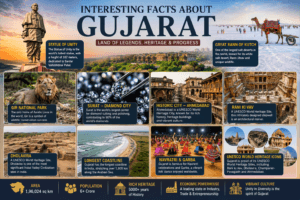
Interesting Facts About Gujarat
The state is one of India’s most remarkable states, known for its ancient civilization, rich cultural heritage, thriving industries, and extraordinary natural wonders. From the world’s tallest statue to the only home of the Asiatic Lion, Gujarat offers countless fascinating facts that make it unique.
One of Gujarat’s greatest achievements is the Statue of Unity, dedicated to Sardar Vallabhbhai Patel. Standing at 182 metres, it is the world’s tallest statue and attracts millions of visitors every year.
The state is also home to the Gir National Park, the only natural habitat of the Asiatic Lion anywhere in the world. Through successful conservation efforts, the lion population has grown steadily, making Gujarat a global wildlife conservation success story.
The spectacular Great Rann of Kutch is one of the largest salt deserts in the world. During winter, the white desert transforms into a breathtaking landscape and hosts the internationally famous Rann Utsav, celebrating Gujarat’s art, culture, music, and traditions.
The state has the longest coastline among all Indian states, stretching nearly 1,600 kilometres along the Arabian Sea. This coastline supports major ports, fisheries, tourism, and international trade.
The state is internationally recognised as the Diamond Processing Capital of the World. Around 90% of the world’s diamonds are cut and polished in Surat, making it one of the most important centres of the global diamond industry.
Gujarat is also the birthplace of two of India’s greatest leaders—Mahatma Gandhi, the Father of the Nation, and Sardar Vallabhbhai Patel, the Iron Man of India. Their contributions played a defining role in India’s independence and national integration.
The state is home to four UNESCO World Heritage Sites:
- Historic City of Ahmedabad
- Rani ki Vav
- Champaner–Pavagadh Archaeological Park
- Dholavira (Harappan City)
Known for entrepreneurship, innovation, and cultural diversity, Gujarat continues to be one of India’s fastest-growing states and a leading destination for tourism, business, education, and investment.
Interesting Facts at a Glance
| Fact | Details |
|---|---|
| World’s Tallest Statue | Statue of Unity (182 metres) |
| Only Wild Asiatic Lions | Gir National Park |
| Largest Salt Desert | Great Rann of Kutch |
| Longest Coastline in India | Approximately 1,600 km |
| Diamond Processing Hub | Surat processes about 90% of the world’s diamonds |
| Birthplace of Mahatma Gandhi | Porbandar |
| Birthplace of Sardar Vallabhbhai Patel | Nadiad |
| UNESCO World Heritage Sites | Ahmedabad, Rani ki Vav, Dholavira & Champaner-Pavagadh |
| India’s First Marine National Park | Gulf of Kutch |
| Famous Festival | Navratri & Rann Utsav |
Frequently Asked Questions (FAQs) About Gujarat
1. Where is Gujarat located?
The state is located in western India. It shares borders with Rajasthan, Madhya Pradesh, Maharashtra, and Pakistan, and has the longest coastline in India along the Arabian Sea.
2. What is the capital of Gujarat?
The capital of Gujarat is Gandhinagar, while Ahmedabad is the state’s largest city and major commercial hub.
3. Why is Gujarat famous?
Gujarat is famous for the Statue of Unity, Gir National Park, Great Rann of Kutch, Somnath Temple, Dwarkadhish Temple, Navratri celebrations, diamond industry, and its rich cultural heritage.
4. Which language is mainly spoken in Gujarat?
Gujarati is the official and most widely spoken language. Hindi and English are also commonly used.
5. Which is the largest city in Gujarat?
Ahmedabad is the largest city in Gujarat and serves as the state’s commercial, educational, and industrial centre.
6. Which is the most famous wildlife sanctuary in Gujarat?
Gir National Park is the most famous wildlife sanctuary and is the only natural habitat of the Asiatic Lion in the world.
7. What is the best time to visit Gujarat?
The best time to visit Gujarat is November to February, when the weather is pleasant and festivals like the Rann Utsav take place.
8. Which industries are important in Gujarat?
The state is a leader in petrochemicals, textiles, pharmaceuticals, diamond processing, ports, engineering, automobiles, dairy, and renewable energy.
9. Which are the UNESCO World Heritage Sites in Gujarat?
- The state has four UNESCO World Heritage Sites:
- Historic City of Ahmedabad
- Rani ki Vav
- Champaner–Pavagadh Archaeological Park
- Dholavira
10. What are the most popular tourist attractions in Gujarat?
Some of the top attractions include the Statue of Unity, Great Rann of Kutch, Gir National Park, Somnath Temple, Dwarkadhish Temple, Sabarmati Ashram, Rani ki Vav, and the Sun Temple at Modhera.
11. Which is the longest river in Gujarat?
The Narmada River is the longest and most important river in Gujarat. The Sardar Sarovar Dam is built on this river.
12. What is the famous food of Gujarat?
Popular Gujarati dishes include Gujarati Thali, Dhokla, Khandvi, Undhiyu, Thepla, Fafda-Jalebi, Khakhra, Handvo, Dal Dhokli, and Mohanthal.
13. Why is Surat famous?
Surat is known as the Diamond City of India because about 90% of the world’s diamonds are cut and polished there. It is also a major textile manufacturing centre.
14. Which festival is the biggest in Gujarat?
Navratri is the biggest and most celebrated festival in Gujarat, famous for Garba and Dandiya Raas. The Rann Utsav is another internationally popular festival.
15. Why should tourists visit Gujarat?
Tourists visit Gujarat for its historic monuments, temples, wildlife, white salt desert, beaches, UNESCO World Heritage Sites, colourful festivals, delicious cuisine, and vibrant culture.
Conclusion
Gujarat is one of India’s most vibrant and progressive states, where history, culture, spirituality, wildlife, industry, and innovation come together to create a truly unique destination. From the majestic Statue of Unity and the breathtaking Great Rann of Kutch to the Asiatic Lions of Gir National Park, Gujarat offers unforgettable experiences for travellers, students, researchers, and nature enthusiasts alike.
The state has played a significant role in shaping India’s history as the birthplace of Mahatma Gandhi and Sardar Vallabhbhai Patel. It is also a global leader in manufacturing, ports, textiles, pharmaceuticals, diamond processing, renewable energy, and entrepreneurship, making it one of India’s strongest economic engines.
Gujarat’s colourful festivals, traditional Garba dance, rich handicrafts, delicious cuisine, UNESCO World Heritage Sites, modern infrastructure, and warm hospitality make it one of the country’s most attractive travel destinations. Whether you wish to explore ancient civilizations, sacred temples, wildlife sanctuaries, white deserts, or bustling cities, Gujarat has something to offer every visitor.
As Gujarat continues to grow through sustainable development, technological innovation, and cultural preservation, it remains a shining example of progress while proudly preserving its rich heritage. A journey through Gujarat is not just a visit to a state—it’s an opportunity to experience the spirit, diversity, and timeless legacy of India.
About DealKart Market
DealKart Market is your trusted destination for reliable, well-researched, and easy-to-understand information about Indian states, history, geography, tourism, culture, education, economy, famous personalities, and travel. Our mission is to provide accurate, updated, and reader-friendly content that helps students, competitive exam aspirants, travellers, researchers, and knowledge seekers.
Every article published on DealKart Market is carefully researched using official government sources, trusted institutions, and authentic references. We present information in a simple and engaging format with detailed guides, informative tables, maps, premium images, and practical insights to make learning easy and enjoyable.
Whether you’re planning a trip, preparing for competitive exams, exploring India’s rich heritage, or learning about different states, DealKart Market is your one-stop destination for authentic and comprehensive information.
🌐 Visit DealKart Market
Website: https://dealkartmarket.in/
- Why Choose DealKart Market?
- Comprehensive Indian State Guides
- Trusted Biography Articles
- Travel & Tourism Information
- History, Geography & General Knowledge
- Education & Competitive Exam Resources
- SEO-Friendly & Human-Written Content
- Regularly Updated Information
- Mobile-Friendly Reading Experience
- Reliable Facts from Trusted Sources
Explore • Learn • Discover India with DealKart Market! 🇮🇳
Explore More State Guides on DealKart Market
Continue exploring India’s diverse states with our detailed guides covering history, geography, culture, tourism, economy, education, healthcare, transport, wildlife, festivals, food, famous personalities, and much more.
Explore Our State Guides
Telangana Guide
https://dealkartmarket.in/telangana-complete-guide/
Andhra Pradesh Guide
https://dealkartmarket.in/andhra-pradesh/
Kerala Guide
https://dealkartmarket.in/kerala/
Maharashtra Guide
https://dealkartmarket.in/maharashtra/
Goa Guide
https://dealkartmarket.in/goa/
Visit DealKart Market
Website: https://dealkartmarket.in/
Explore India • Learn Better • Travel Smarter • Only on DealKart Market
References
Use these trusted and authoritative sources at the end of your Gujarat Complete Guide article:
Government of Gujarat – Official Portal
Gujarat Tourism – Official Website
https://www.gujarattourism.com/
Census of India – Population & Demographic Data
Ministry of Statistics and Programme Implementation (MoSPI)
India Brand Equity Foundation (IBEF) – Gujarat State Profile
Ministry of Tourism, Government of India
India Meteorological Department (IMD)
National Portal of India
Forest Survey of India (FSI)
Archaeological Survey of India (ASI)
UNESCO World Heritage Centre
Reserve Bank of India (RBI) – Handbook of Statistics on Indian States
These references are reliable for Gujarat’s history, geography, tourism, economy, education, healthcare, transport, wildlife, culture, agriculture, festivals, and other factual information, making your article SEO-friendly, AdSense-friendly, and trustworthy.