
Introduction to Punjab
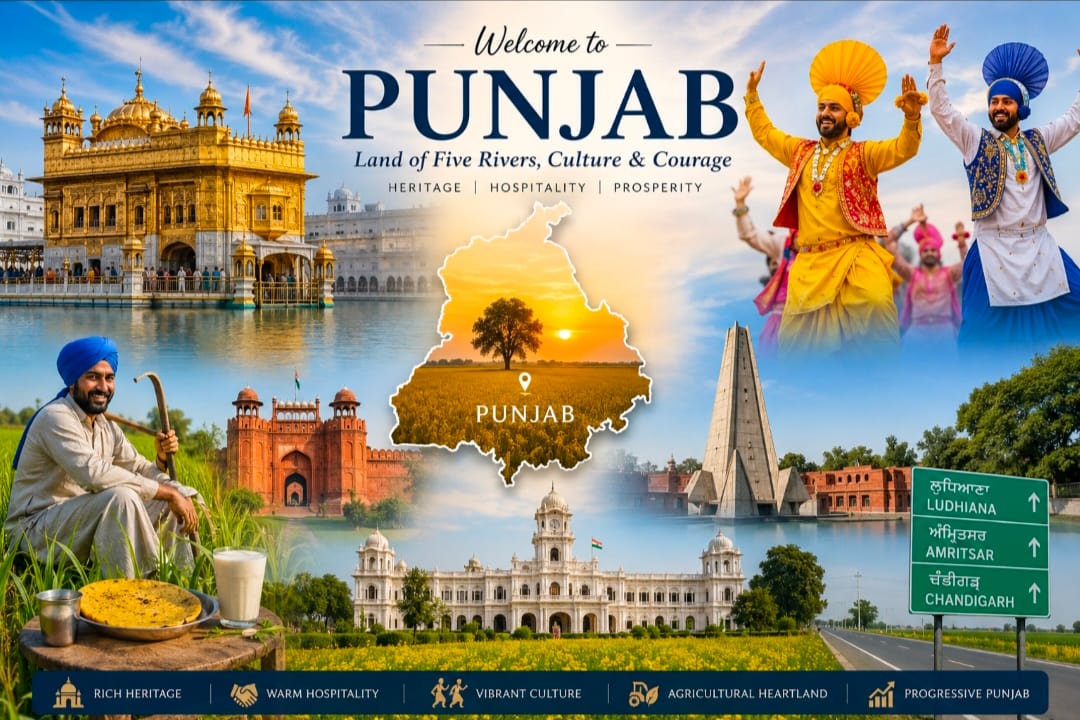
PB, known as the “Land of Five Rivers,” is one of India’s most prosperous and culturally vibrant states. Located in the northwestern part of the country, Punjab shares its borders with Jammu & Kashmir, Himachal Pradesh, Haryana, Rajasthan, and the international border with Pakistan. The state’s fertile plains, supported by the rivers Sutlej, Beas, Ravi, Chenab, and Jhelum, have made it one of India’s leading agricultural regions and earned it the title “Granary of India.”
The capital city, Chandigarh, is a Union Territory jointly serving as the capital of both Punjab and Haryana. Major cities such as Amritsar, Ludhiana, Jalandhar, Patiala, Bathinda, Mohali, Hoshiarpur, and Pathankot are known for their historical importance, industrial development, education, and cultural heritage.
PB is the birthplace of Sikhism, one of the world’s major religions. The state is home to the Golden Temple (Sri Harmandir Sahib) in Amritsar, the holiest shrine of Sikhism and one of India’s most visited religious landmarks. Punjab also has a rich legacy of bravery, patriotism, and freedom fighters, contributing significantly to India’s independence movement and national defence.
Agriculture forms the backbone of Punjab’s economy, with the state being one of the largest producers of wheat, rice, maize, cotton, and sugarcane. It is also a major centre for manufacturing, textiles, sports goods, bicycles, machine tools, and food processing industries.
Punjab’s vibrant traditions are reflected through Bhangra, Gidda, Punjabi folk music, colourful festivals, delicious cuisine, and warm hospitality. Festivals such as Baisakhi, Lohri, Gurpurab, and Hola Mohalla are celebrated with great enthusiasm, showcasing the state’s rich cultural heritage.
Today, PB stands as one of India’s leading states in agriculture, industry, education, sports, and cultural tourism, attracting millions of visitors every year.
Punjab at a Glance
| Category | Details |
|---|---|
| State Name | Punjab |
| Nickname | Land of Five Rivers |
| Capital | Chandigarh |
| Largest City | Ludhiana |
| Formation | 1 November 1966 |
| Official Language | Punjabi |
| State Animal | Blackbuck |
| State Bird | Northern Goshawk (Baaz) |
| State Tree | Shisham |
| State Flower | Gladiolus |
Punjab on India Map
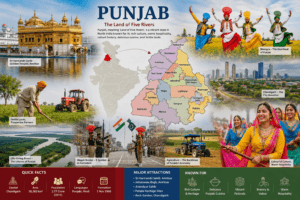
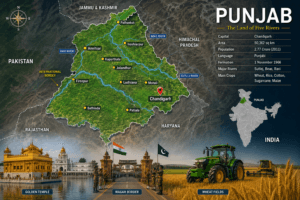
PB is located in the northwestern region of India and is one of the country’s most agriculturally prosperous states. Covering an area of approximately 50,362 square kilometres, Punjab is known for its fertile alluvial plains, extensive canal network, and rich agricultural heritage.
PB shares its borders with Jammu & Kashmir to the north, Himachal Pradesh to the northeast, Haryana to the south and southeast, Rajasthan to the southwest, and the Pakistan province of Punjab to the west. Its strategic location makes it an important gateway between India and Pakistan.
The state capital is Chandigarh, a Union Territory that also serves as the capital of neighbouring Haryana. Major cities include Amritsar, Ludhiana, Jalandhar, Patiala, Bathinda, Mohali (SAS Nagar), Pathankot, Hoshiarpur, Kapurthala, and Firozpur.
PB derives its name from the Persian words “Panj” (Five) and “Aab” (Waters), meaning “Land of Five Rivers.” Historically, these rivers are Sutlej, Beas, Ravi, Chenab, and Jhelum. Today, the Sutlej, Beas, and Ravi flow through Indian Punjab, while the Chenab and Jhelum flow mainly through Pakistan.
The state is famous for the Golden Temple (Sri Harmandir Sahib) in Amritsar, the Wagah Border, fertile farmlands, Sikh heritage, and vibrant Punjabi culture. Punjab’s flat terrain and extensive irrigation system have earned it the title “Granary of India.”
Its excellent road, rail, and air connectivity, along with its rich history and cultural landmarks, make Punjab one of India’s most significant states.
Punjab on India Map at a Glance
| Feature | Details |
|---|---|
| Location | Northwestern India |
| Area | 50,362 sq km |
| Capital | Chandigarh |
| Largest City | Ludhiana |
| Major Rivers | Sutlej, Beas & Ravi |
| Neighbouring States | Himachal Pradesh, Haryana, Rajasthan & Jammu & Kashmir |
| International Border | Pakistan |
| Famous Landmark | Golden Temple, Amritsar |
| Border Ceremony | Wagah Border |
| Nickname | Land of Five Rivers |
History of Punjab
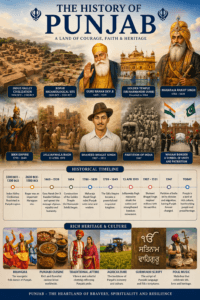
PB has one of the richest and oldest histories in the Indian subcontinent, dating back over 5,000 years. The region was home to the Indus Valley Civilization, one of the world’s earliest urban civilizations. Archaeological sites such as Ropar (Rupnagar) and nearby settlements reveal that Punjab was an important centre of trade, agriculture, and culture during ancient times.
The name PB is derived from the Persian words “Panj” (Five) and “Aab” (Water), meaning “Land of Five Rivers.” Historically, these rivers were the Jhelum, Chenab, Ravi, Beas, and Sutlej, which nurtured one of the most fertile regions in South Asia.
PB witnessed the arrival of many great empires, including the Maurya Empire, Indo-Greek Kingdom, Kushan Empire, Gupta Empire, and later the Delhi Sultanate and the Mughal Empire. Due to its strategic location, Punjab became a gateway for several foreign invasions into India.
The history of PB changed significantly in the 15th century with the birth of Guru Nanak Dev Ji (1469–1539), the founder of Sikhism. Over the following centuries, the ten Sikh Gurus shaped the religious, social, and cultural identity of Punjab. The Golden Temple (Sri Harmandir Sahib) in Amritsar, established by Guru Arjan Dev Ji, became the holiest shrine of Sikhism.
During the late 18th and early 19th centuries, Maharaja Ranjit Singh established the powerful Sikh Empire, with Lahore as its capital. His reign is remembered for political stability, religious harmony, military strength, and economic prosperity. The empire remained one of the strongest powers in the Indian subcontinent until the Anglo-Sikh Wars (1845–1849), after which PB came under British rule.
PB played a vital role in India’s freedom movement. Great revolutionaries such as Shaheed Bhagat Singh, Lala Lajpat Rai, Udham Singh, and Kartar Singh Sarabha made immense sacrifices for India’s independence.
Following the Partition of India in 1947, Punjab was divided between India and Pakistan, leading to one of the largest migrations in human history. Later, on 1 November 1966, the present-day state of PB was formed after the reorganisation of the former PB state, with the creation of Haryana and the transfer of some hilly regions to Himachal Pradesh.
Today, PB proudly preserves its rich heritage through its historical monuments, gurdwaras, forts, museums, and vibrant traditions, making it one of India’s most historically significant states.
History at a Glance
| Period | Historical Significance |
|---|---|
| Indus Valley Civilization | One of the World’s Oldest Civilizations |
| Ancient Empires | Maurya, Kushan, Gupta & Indo-Greek |
| Founder of Sikhism | Guru Nanak Dev Ji |
| Sikh Empire | Maharaja Ranjit Singh |
| British Rule | After Anglo-Sikh Wars (1849) |
| Freedom Movement | Bhagat Singh, Udham Singh & Lala Lajpat Rai |
| Partition | India-Pakistan Partition (1947) |
| State Reorganisation | Formation of Present Punjab (1966) |
| Famous Monument | Golden Temple |
| Historical Identity | Land of Five Rivers & Birthplace of Sikhism |
Geography & Climate of Punjab
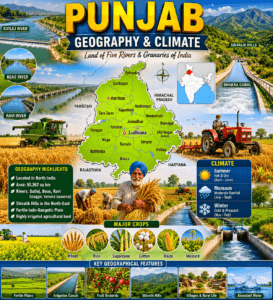
PB is located in the northwestern plains of India and is one of the country’s most fertile and agriculturally productive states. Covering an area of approximately 50,362 square kilometres, the state is characterised by vast alluvial plains, fertile agricultural land, rivers, canals, and a relatively flat landscape. Its rich soil and extensive irrigation system have earned Punjab the title of the “Granary of India.”
The state lies at an average elevation of 180 to 300 metres above sea level. Unlike the Himalayan states, PB has mostly flat terrain with gentle undulations. The Shivalik Hills form the northeastern boundary, while the rest of the state consists of fertile plains created by river deposits over thousands of years.
PB is nourished by three major rivers flowing through Indian territory—Sutlej, Beas, and Ravi. Historically, Punjab derived its name from the Five Rivers: Jhelum, Chenab, Ravi, Beas, and Sutlej. These rivers support agriculture, irrigation, hydroelectric projects, and drinking water supply across the state.
PB experiences a subtropical continental climate with four distinct seasons. Summer (April to June) is hot and dry, with temperatures often ranging from 35°C to 45°C. The monsoon season (July to September) brings moderate rainfall, which is vital for agriculture. Autumn (October to November) offers pleasant weather, while winter (December to February) is cool and foggy, with temperatures occasionally dropping below 5°C in some regions.
The state has an extensive canal irrigation system, including the Sirhind Canal, Bikaner Canal, and Bhakra Canal Network, which have played a crucial role in making Punjab one of India’s leading producers of wheat and rice.
Punjab’s fertile plains, favourable climate, and abundant water resources make it one of the most important agricultural regions in Asia and a key contributor to India’s food security.
Geography & Climate at a Glance
| Category | Details |
|---|---|
| Total Area | 50,362 sq km |
| Terrain | Fertile Alluvial Plains |
| Average Elevation | 180–300 metres |
| Major Rivers | Sutlej, Beas & Ravi |
| Historic Five Rivers | Sutlej, Beas, Ravi, Chenab & Jhelum |
| Major Landform | Shivalik Hills |
| Climate Type | Subtropical Continental |
| Summer Season | April – June |
| Monsoon Season | July – September |
| Winter Season | December – February |
Rivers & Forests of Punjab
PB is blessed with a network of rivers, canals, wetlands, and protected forests that play a vital role in the state’s agriculture, biodiversity, and ecological balance. Although Punjab is primarily known for its fertile plains and intensive farming, its rivers and forests are essential natural resources that support millions of people and diverse wildlife.
PB derives its name from the Persian words “Panj” (Five) and “Aab” (Water), meaning “Land of Five Rivers.” Historically, these five rivers are Jhelum, Chenab, Ravi, Beas, and Sutlej. Today, the Sutlej, Beas, and Ravi flow through Indian Punjab, while the Jhelum and Chenab are largely in Pakistan.
The Sutlej River is the longest river flowing through PB and is crucial for irrigation and hydroelectric power. The Beas River flows through northeastern PB before joining the Sutlej, while the Ravi River forms part of the international boundary before entering Pakistan. These rivers, along with an extensive canal system such as the Sirhind Canal, Bhakra Canal, and Bist Doab Canal, have transformed PB into one of India’s leading agricultural states.
Although PB has relatively low forest cover compared to many other Indian states, its forests include tropical dry deciduous forests, riverine forests, scrub forests, and Shivalik hill forests. Major protected areas include Harike Wetland, Abohar Wildlife Sanctuary, Bir Moti Bagh Wildlife Sanctuary, Jhajjar-Bachauli Wildlife Sanctuary, Nangal Wildlife Sanctuary, and Kathlour Wildlife Sanctuary.
The Harike Wetland, one of North India’s largest wetlands and a Ramsar Site, is a paradise for migratory birds. Punjab’s wildlife includes the Blackbuck (State Animal), Nilgai, Wild Boar, Indian Jackal, Hog Deer, and numerous reptile species. Birdlife is equally rich, featuring the Northern Goshawk (Baaz) (State Bird), Bar-headed Goose, Painted Stork, Sarus Crane, and hundreds of migratory birds during winter.
PB’s rivers, wetlands, forests, and wildlife sanctuaries contribute significantly to biodiversity conservation, eco-tourism, and environmental sustainability while supporting the state’s agricultural economy.
Rivers & Forests at a Glance
| Category | Details |
|---|---|
| Major Rivers | Sutlej, Beas & Ravi |
| Historic Five Rivers | Sutlej, Beas, Ravi, Chenab & Jhelum |
| Largest Wetland | Harike Wetland (Ramsar Site) |
| Major Canals | Sirhind Canal, Bhakra Canal & Bist Doab Canal |
| Forest Types | Tropical Dry Deciduous, Riverine & Shivalik Forests |
| State Animal | Blackbuck |
| State Bird | Northern Goshawk (Baaz) |
| Major Wildlife Sanctuaries | Harike, Abohar, Bir Moti Bagh, Jhajjar-Bachauli & Nangal |
| Famous Wildlife | Blackbuck, Nilgai, Hog Deer & Indian Jackal |
| Natural Identity | Rivers, Wetlands & Agricultural Plains |
Government & Administration of Punjab
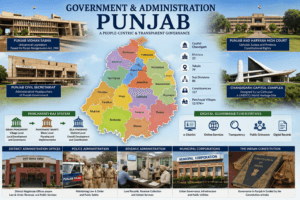
PB follows a parliamentary system of government as defined by the Constitution of India. The Governor serves as the constitutional head of the state, while the Chief Minister is the executive head responsible for the administration and governance of PB. The Council of Ministers assists the Chief Minister in implementing government policies, welfare programmes, and development initiatives.
The PB Legislative Assembly (Vidhan Sabha) is a unicameral legislature consisting of 117 elected Members of the Legislative Assembly (MLAs). The Assembly meets in Chandigarh, which serves as the capital of both Punjab and Haryana.
Administratively, PB is divided into 23 districts, each headed by a Deputy Commissioner (DC). The districts are further divided into tehsils, sub-divisions, blocks, and villages to ensure efficient governance and public service delivery. Urban areas are managed through Municipal Corporations, Municipal Councils, and Nagar Panchayats, while rural administration is handled by the Panchayati Raj System, comprising Gram Panchayats, Panchayat Samitis, and Zila Parishads.
The PB and Haryana High Court, located in Chandigarh, is the highest judicial authority for both Punjab and Haryana, ensuring justice and upholding the rule of law.
The Government of PB actively implements schemes in agriculture, education, healthcare, industry, digital governance, infrastructure, rural development, women and child welfare, employment, and social security. Various e-governance initiatives have also improved the delivery of public services through online portals.
With a strong administrative framework, transparent governance, and citizen-centric policies, PB continues to focus on sustainable development, economic growth, and improving the quality of life for its residents.
Government & Administration at a Glance
| Category | Details |
|---|---|
| Capital | Chandigarh |
| Government Type | Parliamentary System |
| Legislature | Unicameral |
| Legislative Assembly Seats | 117 |
| High Court | Punjab and Haryana High Court |
| Total Districts | 23 |
| Administrative Units | Districts, Tehsils, Blocks & Villages |
| Rural Governance | Panchayati Raj System |
| Urban Governance | Municipal Corporations, Municipal Councils & Nagar Panchayats |
| Official Language | Punjabi |
Population & Demographics of Punjab
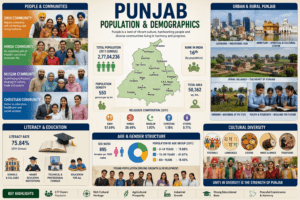
PB is one of India’s most prosperous and culturally vibrant states, with a diverse population known for its entrepreneurial spirit, agricultural expertise, and rich cultural heritage. According to the 2011 Census of India, Punjab has a population of approximately 27.74 million (2.77 crore) people. The state’s population has continued to grow due to urbanisation, industrial development, and economic opportunities.
The population density of PB is about 551 persons per square kilometre, making it one of the more densely populated states in northern India. The sex ratio stands at 895 females per 1,000 males, while the literacy rate is 75.84%, reflecting significant progress in education and human development.
Punjabi is the official language and is widely spoken throughout the state. Other commonly spoken languages include Hindi and English, especially in urban centres, educational institutions, and government offices.
PB is the birthplace of Sikhism, and Sikhism is the largest religion in the state, followed by Hinduism, with smaller communities of Islam, Christianity, Jainism, and Buddhism living in harmony. The state’s multicultural society is reflected in its festivals, traditions, cuisine, music, and architecture.
Major urban centres include Ludhiana, Amritsar, Jalandhar, Patiala, Bathinda, Mohali (SAS Nagar), Pathankot, Hoshiarpur, Moga, and Kapurthala. These cities are important hubs for education, healthcare, industry, trade, and tourism.
PB has a large Non-Resident Indian (NRI) community, with Punjabis living across countries such as Canada, the United Kingdom, the United States, Australia, Italy, and New Zealand. This global Punjabi diaspora contributes significantly to the state’s economy through investments, remittances, and cultural exchange.
With its youthful population, strong work ethic, cultural diversity, and global connections, Punjab continues to play an important role in India’s social and economic development.
Population & Demographics at a Glance
| Category | Details |
|---|---|
| Population (2011 Census) | 2.77 Crore (27.74 Million) |
| Population Density | 551 persons/sq km |
| Literacy Rate | 75.84% |
| Sex Ratio | 895 females per 1,000 males |
| Official Language | Punjabi |
| Other Languages | Hindi & English |
| Major Religions | Sikhism, Hinduism, Islam, Christianity, Jainism & Buddhism |
| Largest City | Ludhiana |
| Capital | Chandigarh |
| Global Identity | Strong NRI Punjabi Community |
Economy of Punjab
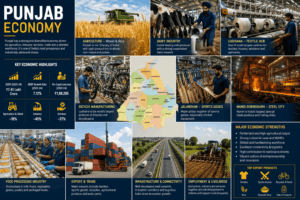
PB has one of the strongest and most diversified economies in northern India, driven by agriculture, manufacturing, food processing, dairy farming, textiles, trade, and services. Known as the “Granary of India,” Punjab plays a crucial role in ensuring the country’s food security by being one of the largest producers of wheat and rice.
Agriculture is the backbone of Punjab’s economy. The fertile alluvial plains, extensive irrigation network, and modern farming techniques have made the state a leader in the production of wheat, rice, maize, cotton, sugarcane, potatoes, and oilseeds. Punjab also has a well-developed dairy sector and is a major producer of milk, poultry, fruits, and vegetables.
The state is home to several major industries. Ludhiana is known as the industrial capital of Punjab, famous for manufacturing bicycles, hosiery, garments, machine tools, auto parts, and sports goods. Jalandhar is internationally recognised for its sports equipment industry, while Mandi Gobindgarh is known as the Steel City of Punjab due to its large steel manufacturing units. Batala is another important centre for agricultural machinery and engineering products.
PB has a rapidly growing food processing industry, producing packaged foods, dairy products, beverages, flour, rice, and processed agricultural goods for domestic and international markets. The state also exports basmati rice, textiles, bicycles, sports goods, leather products, engineering goods, and agricultural commodities to countries around the world.
The service sector, including banking, healthcare, education, tourism, retail, logistics, information technology, and hospitality, contributes significantly to the state’s economy. Religious tourism centred around the Golden Temple, Anandpur Sahib, and Wagah Border also generates substantial employment and revenue.
With strong agricultural productivity, industrial growth, skilled workforce, and expanding infrastructure, Punjab continues to be one of India’s leading contributors to agriculture, manufacturing, exports, and economic development.
Economy at a Glance
| Category | Details |
|---|---|
| Economic Identity | Granary of India |
| Major Crops | Wheat, Rice, Cotton, Sugarcane, Maize & Potatoes |
| Major Industries | Textiles, Bicycles, Sports Goods, Steel & Food Processing |
| Industrial Hub | Ludhiana |
| Steel Hub | Mandi Gobindgarh |
| Sports Goods Hub | Jalandhar |
| Dairy Sector | One of India’s Leading Milk Producers |
| Major Exports | Basmati Rice, Textiles, Sports Goods, Engineering Products & Bicycles |
| Key Economic Sectors | Agriculture, Manufacturing & Services |
| Economy Strength | Agriculture-Based with Strong Industrial Growth |
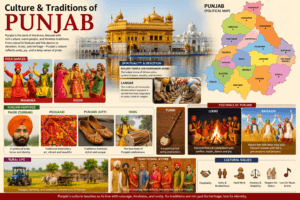
Culture & Traditions of Punjab
PB is renowned for its vibrant culture, rich traditions, colourful festivals, energetic folk dances, soulful music, and warm hospitality. The state’s cultural heritage has been shaped by centuries of history, agriculture, Sikhism, and the spirit of unity. Punjabis are known worldwide for their cheerful nature, hardworking attitude, and the famous tradition of “Mehmaan Nawazi” (hospitality).
The culture of PB is deeply influenced by Sikhism, although people from different religions live together in harmony. The Golden Temple (Sri Harmandir Sahib) in Amritsar stands as a symbol of peace, equality, and selfless service through the tradition of Langar, the world’s largest free community kitchen.
PB is famous for its energetic folk dances. Bhangra, traditionally performed by men during the harvest season, is recognised worldwide for its lively beats and energetic movements. Gidda, performed by women, showcases grace, colourful attire, and traditional folk songs known as Boliyan. Other traditional dance forms include Jhumar, Sammi, Luddi, Malwai Giddha, and Kikli.
Punjabi music has gained international popularity through folk songs, Sufi music, devotional hymns (Gurbani), and modern Punjabi pop music. Traditional musical instruments such as the Dhol, Tumbi, Algoza, Chimta, and Bugchu remain an integral part of Punjabi celebrations and festivals.
Traditional Punjabi attire includes the Salwar Kameez, Phulkari embroidery, Patiala Suit, Kurta-Pajama, and colourful Punjabi Turban (Pagri), symbolising pride and cultural identity. The famous Punjabi Jutti and handcrafted Phulkari shawls and dupattas are admired across India.
Major festivals such as Baisakhi, Lohri, Gurpurab, Hola Mohalla, Diwali, and Maghi are celebrated with immense enthusiasm. These occasions feature community gatherings, traditional food, music, dance, and religious ceremonies.
Punjab’s rich cultural heritage, traditional arts, music, dance, and festivals continue to inspire people around the world, making the state one of India’s most culturally vibrant regions.
Culture & Traditions at a Glance
| Category | Details |
|---|---|
| Major Religion | Sikhism |
| Famous Folk Dance | Bhangra & Gidda |
| Traditional Dress | Salwar Kameez, Patiala Suit & Kurta-Pajama |
| Famous Embroidery | Phulkari |
| Traditional Footwear | Punjabi Jutti |
| Traditional Instruments | Dhol, Tumbi, Algoza, Chimta & Bugchu |
| Community Tradition | Langar (Free Community Kitchen) |
| Major Festivals | Baisakhi, Lohri, Gurpurab, Hola Mohalla & Maghi |
| Cultural Symbol | Golden Temple |
| Cultural Identity | Hospitality, Music, Dance & Agriculture |
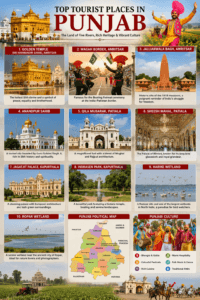
Top Tourist Places in Punjab
PB is one of India’s most culturally rich states, offering a perfect blend of religious heritage, historical monuments, vibrant cities, rural landscapes, museums, and patriotic landmarks. Millions of domestic and international visitors travel to Punjab every year to experience its spiritual atmosphere, colourful traditions, and warm hospitality.
The Golden Temple (Sri Harmandir Sahib) in Amritsar is the most iconic attraction in PB and the holiest shrine of Sikhism. Famous for its stunning golden architecture and the world’s largest free community kitchen (Langar), it welcomes millions of pilgrims annually.
Located near Amritsar, the Wagah Border is famous for the daily Beating Retreat Ceremony performed by the Border Security Force (BSF) of India and the Pakistan Rangers. This patriotic event attracts thousands of spectators every evening.
Another important historical site is Jallianwala Bagh, where a memorial commemorates the victims of the tragic 1919 massacre during British rule. It remains one of the most significant places in India’s freedom struggle.
Anandpur Sahib, one of Sikhism’s holiest cities, is renowned for Takht Sri Keshgarh Sahib, where Guru Gobind Singh Ji founded the Khalsa Panth in 1699. The city also hosts the famous Hola Mohalla festival.
Patiala is celebrated for its royal heritage, featuring attractions such as Qila Mubarak, Sheesh Mahal, and the Baradari Gardens. Kapurthala, often called the “Paris of Punjab,” is known for its Indo-French architecture and the magnificent Jagatjit Palace.
Nature lovers can explore Harike Wetland, a Ramsar Site famous for migratory birds and rich biodiversity, while Ropar Wetland and Kanjli Wetland are excellent destinations for birdwatching and eco-tourism.
Punjab’s unique combination of spirituality, history, patriotism, architecture, and cultural heritage makes it one of India’s most rewarding travel destinations.
Top Tourist Places at a Glance
| Tourist Place | Famous For |
|---|---|
| Golden Temple, Amritsar | Holiest Sikh Shrine |
| Wagah Border | Beating Retreat Ceremony |
| Jallianwala Bagh | Freedom Movement Memorial |
| Anandpur Sahib | Birthplace of the Khalsa |
| Qila Mubarak, Patiala | Historic Fort Complex |
| Sheesh Mahal, Patiala | Royal Palace & Museum |
| Jagatjit Palace, Kapurthala | Indo-French Architecture |
| Harike Wetland | Ramsar Site & Bird Sanctuary |
| Ropar Wetland | Bird Watching & Nature |
| Kanjli Wetland | Eco-tourism & Wetland Conservation |
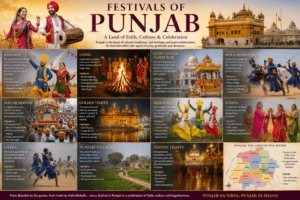
Festivals of Punjab
PB is famous for its vibrant festivals, rich traditions, religious harmony, and colourful cultural celebrations. The state’s festivals reflect its agricultural heritage, Sikh traditions, and joyful spirit. Throughout the year, people celebrate festivals with music, dance, traditional food, prayers, fairs, and community gatherings, making Punjab one of India’s most culturally lively states.
The most important festival is Baisakhi, celebrated every year on 13 or 14 April. It marks the harvest season and commemorates the formation of the Khalsa Panth by Guru Gobind Singh Ji in 1699 at Anandpur Sahib. The festival is celebrated with Nagar Kirtans, Bhangra, Gidda, fairs, and religious ceremonies.
Another major festival is Lohri, celebrated on the eve of Makar Sankranti in January. Families gather around bonfires, sing traditional songs, perform Bhangra and Gidda, and enjoy festive foods like rewri, gajak, peanuts, popcorn, and jaggery. Lohri is especially significant for newly married couples and newborn children.
Gurpurabs, which commemorate the birth and martyrdom anniversaries of the Sikh Gurus, are observed with great devotion across Punjab. The Guru Nanak Gurpurab is one of the most important Sikh festivals, featuring prayers, devotional singing (Kirtan), Nagar Kirtans, and community meals (Langar).
Hola Mohalla, celebrated at Anandpur Sahib, showcases Sikh martial arts (Gatka), horse riding, cultural performances, and religious gatherings. The festival highlights the courage, discipline, and warrior spirit of the Sikh community.
Other widely celebrated festivals include Diwali, Holi, Maghi, Teej, Basant Panchami, Dussehra, Eid, and Christmas, reflecting Punjab’s cultural diversity and communal harmony.
These festivals preserve PB’s traditions while promoting unity, faith, joy, and the state’s rich cultural heritage.
Festivals at a Glance
| Festival | Famous For |
|---|---|
| Baisakhi | Harvest Festival & Formation of Khalsa |
| Lohri | Bonfire Festival |
| Guru Nanak Gurpurab | Birth Anniversary of Guru Nanak Dev Ji |
| Hola Mohalla | Sikh Martial Arts & Cultural Festival |
| Maghi | Religious & Harvest Festival |
| Basant Panchami | Spring Festival |
| Diwali | Festival of Lights |
| Holi | Festival of Colours |
| Dussehra | Victory of Good over Evil |
| Teej | Traditional Women’s Festival |
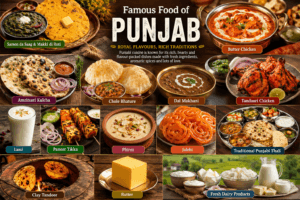
Famous Food of Punjab
PB is celebrated across the world for its rich, flavourful, and wholesome cuisine, which reflects the state’s agricultural abundance, vibrant culture, and warm hospitality. Punjabi food is prepared using fresh ingredients, aromatic spices, dairy products, and traditional cooking methods that have been passed down through generations.
One of the most iconic dishes of PB is Sarson da Saag & Makki di Roti, especially enjoyed during the winter season. Prepared using mustard leaves, butter, and maize flour bread, this traditional meal is considered the culinary identity of Punjab.
Another globally popular dish is Butter Chicken, which originated in Punjab and is loved for its creamy tomato-based gravy and tender roasted chicken. Tandoori Chicken, cooked in a traditional clay oven (tandoor), is another famous Punjabi delicacy that has gained worldwide recognition.
PB is also famous for Amritsari Kulcha, a stuffed flatbread served with spicy chickpea curry (Chole), and Chole Bhature, one of India’s most popular breakfast and street food dishes. Other traditional favourites include Dal Makhani, Rajma Chawal, Paneer Tikka, Shahi Paneer, Kadhi Pakora, and Lassi, a refreshing yogurt-based drink.
The state is equally renowned for its delicious desserts such as Phirni, Kheer, Jalebi, Pinni, Gajar ka Halwa, and Gulab Jamun, which are commonly prepared during festivals and celebrations.
Punjabi cuisine is known for its generous use of ghee, butter, fresh cream, paneer, wheat, pulses, and dairy products, making it one of the richest and most satisfying cuisines in India. Whether served in a village home, a roadside dhaba, or a fine-dining restaurant, Punjabi food represents the state’s spirit of generosity and celebration.
Famous Food at a Glance
| Dish | Famous For |
|---|---|
| Sarson da Saag & Makki di Roti | Traditional Winter Dish |
| Butter Chicken | World-Famous Punjabi Curry |
| Amritsari Kulcha | Stuffed Bread with Chole |
| Chole Bhature | Popular Breakfast & Street Food |
| Dal Makhani | Creamy Black Lentil Dish |
| Tandoori Chicken | Clay Oven Roasted Chicken |
| Lassi | Traditional Yogurt Drink |
| Paneer Tikka | Grilled Cottage Cheese |
| Phirni | Traditional Rice Dessert |
| Jalebi | Popular Sweet |
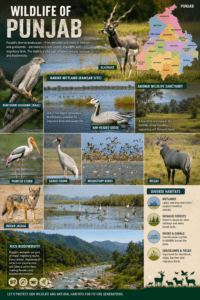
Wildlife of Punjab
Punjab is home to a diverse range of wildlife, wetlands, forests, and bird habitats, despite having relatively low forest cover compared to many other Indian states. The state’s rivers, wetlands, grasslands, and Shivalik foothills provide suitable habitats for numerous mammals, birds, reptiles, and aquatic species. Punjab has established several wildlife sanctuaries and protected areas to conserve its rich biodiversity and promote eco-tourism.
The Blackbuck is the State Animal of Punjab and is one of the fastest antelopes in the world. Large populations of Blackbucks are protected in the Abohar Wildlife Sanctuary, which is internationally recognised for community-based wildlife conservation.
The Northern Goshawk (Baaz) is the State Bird of Punjab. The state is also home to hundreds of resident and migratory bird species, including the Bar-headed Goose, Painted Stork, Sarus Crane, Black-necked Stork, Eurasian Spoonbill, Northern Pintail, Common Teal, and River Tern.
One of Punjab’s most important ecological treasures is the Harike Wetland, a Ramsar Site and the largest wetland in North India. Every winter, thousands of migratory birds arrive from Central Asia, Siberia, and Europe, making Harike a paradise for birdwatchers and wildlife photographers.
Other important protected areas include Abohar Wildlife Sanctuary, Bir Moti Bagh Wildlife Sanctuary, Jhajjar-Bachauli Wildlife Sanctuary, Kathlour Wildlife Sanctuary, Nangal Wildlife Sanctuary, and Kanjli Wetland. These protected areas conserve species such as Nilgai (Blue Bull), Hog Deer, Wild Boar, Indian Jackal, Jungle Cat, Smooth-coated Otter, Monitor Lizard, and numerous freshwater fish.
Punjab’s wetlands and wildlife sanctuaries play a vital role in maintaining ecological balance, protecting endangered species, and supporting sustainable eco-tourism. Conservation programmes, afforestation initiatives, and community participation continue to strengthen the state’s biodiversity conservation efforts.
Wildlife at a Glance
| Category | Details |
|---|---|
| State Animal | Blackbuck |
| State Bird | Northern Goshawk (Baaz) |
| Largest Wetland | Harike Wetland (Ramsar Site) |
| Famous Wildlife Sanctuary | Abohar Wildlife Sanctuary |
| Major Protected Areas | Harike, Kathlour, Nangal, Bir Moti Bagh & Jhajjar-Bachauli |
| Famous Mammals | Blackbuck, Nilgai, Hog Deer, Indian Jackal & Wild Boar |
| Famous Birds | Bar-headed Goose, Painted Stork, Sarus Crane & Northern Pintail |
| Migratory Birds | Thousands Visit During Winter |
| Major Habitat | Wetlands, Grasslands & Shivalik Foothills |
| Wildlife Identity | Wetland & Bird Conservation Hub |
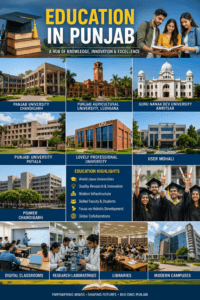
Education in Punjab
PB has a well-developed education system and is one of India’s leading states in school education, higher education, technical education, agricultural research, and medical sciences. The state has consistently invested in educational infrastructure, resulting in a strong network of government schools, private institutions, universities, and professional colleges.
The literacy rate of Punjab is 75.84% (Census 2011), with continuous improvements through government initiatives promoting universal education, digital classrooms, skill development, and vocational training. Punjabi is the primary medium of instruction in many schools, while English and Hindi are also widely used.
PB is home to several prestigious universities and higher education institutions. Panjab University, Chandigarh, established in 1882, is one of India’s oldest and most respected universities. Other leading institutions include Punjab Agricultural University (Ludhiana), which played a key role in India’s Green Revolution, Guru Nanak Dev University (Amritsar), Punjabi University (Patiala), Lovely Professional University (Phagwara), and Thapar Institute of Engineering and Technology (Patiala).
The state also hosts premier institutions such as the Indian Institute of Science Education and Research (IISER), Mohali, Postgraduate Institute of Medical Education and Research (PGIMER), Chandigarh, and the National Institute of Pharmaceutical Education and Research (NIPER), Mohali, which are recognised internationally for excellence in research, healthcare, and scientific innovation.
PB offers numerous engineering, medical, pharmacy, nursing, law, management, agriculture, and teacher-training colleges, attracting students from across India and abroad. Government programmes continue to strengthen digital learning, scholarship schemes, girls’ education, and employment-oriented skill development.
With its strong academic tradition, world-class universities, and emphasis on research and innovation, Punjab continues to be one of India’s leading educational destinations.
Education at a Glance
| Category | Details |
|---|---|
| Literacy Rate | 75.84% |
| Oldest University | Panjab University, Chandigarh |
| Agriculture University | Punjab Agricultural University, Ludhiana |
| Major University | Guru Nanak Dev University, Amritsar |
| State University | Punjabi University, Patiala |
| Private University | Lovely Professional University (LPU) |
| Research Institute | IISER Mohali |
| Medical Institute | PGIMER Chandigarh |
| Pharmacy Institute | NIPER Mohali |
| Education Strength | Higher Education, Research & Agricultural Innovation |
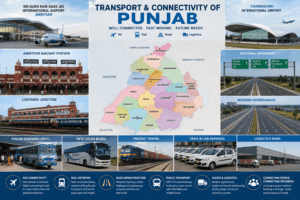
Transport & Connectivity of Punjab
PB has one of the best-developed transport networks in India, with excellent connectivity through roads, railways, airways, and public transport. Its strategic location in northwestern India makes it an important gateway for trade, tourism, and international connectivity with neighbouring states and Pakistan.
The state has an extensive road network maintained by the National Highways Authority of India (NHAI), the Punjab Public Works Department (PWD), and local authorities. Major National Highways connect important cities such as Amritsar, Ludhiana, Jalandhar, Patiala, Bathinda, Mohali, Pathankot, and Chandigarh with Delhi, Haryana, Himachal Pradesh, Jammu & Kashmir, Rajasthan, and other parts of India.
PB has a well-connected railway network operated by the Northern Railway and Firozpur Railway Division. Major railway stations include Amritsar Junction, Ludhiana Junction, Jalandhar City, Pathankot Junction, Patiala, Bathinda Junction, Firozpur Cantonment, and Chandigarh Railway Station. The rail network provides convenient connections to major Indian cities, including Delhi, Mumbai, Kolkata, Chennai, Jaipur, Ahmedabad, and Jammu.
The state is served by several airports. Sri Guru Ram Dass Jee International Airport (Amritsar) is Punjab’s largest international airport, offering domestic and international flights. Other important airports include Chandigarh International Airport, Ludhiana Airport, Bathinda Airport, Adampur Airport (Jalandhar), and Pathankot Airport.
Public transportation is efficiently managed by the Punjab Roadways and PEPSU Road Transport Corporation (PRTC), along with private bus operators. Luxury Volvo buses, taxis, app-based cab services, auto-rickshaws, and rental vehicles are widely available throughout the state.
With its modern highways, extensive railway network, international airport, and reliable public transport services, Punjab offers excellent connectivity for residents, tourists, businesses, and industries.
Transport & Connectivity at a Glance
| Category | Details |
|---|---|
| Largest International Airport | Sri Guru Ram Dass Jee International Airport, Amritsar |
| Other Airports | Chandigarh, Ludhiana, Bathinda, Adampur & Pathankot |
| Major Railway Stations | Amritsar, Ludhiana, Jalandhar, Bathinda & Pathankot |
| Railway Zone | Northern Railway |
| Major Highways | NH-3, NH-5, NH-7, NH-44 & NH-54 |
| State Bus Services | Punjab Roadways & PRTC |
| Public Transport | Buses, Taxis, Auto-rickshaws & Cabs |
| Major Logistics Hubs | Ludhiana, Amritsar & Jalandhar |
| Connectivity | Excellent Road, Rail & Air Network |
| Transport Strength | Trade, Tourism & Industrial Connectivity |

Sports of Punjab
PB has a glorious sporting tradition and has produced some of India’s finest athletes, Olympians, hockey legends, wrestlers, shooters, cricketers, and kabaddi players. The state’s sporting culture is deeply rooted in rural traditions, physical fitness, and community participation. Sports are actively promoted through educational institutions, sports academies, and government initiatives.
Field Hockey is the most celebrated sport in Punjab and holds a special place in the state’s history. Punjab has produced numerous Olympic gold medallists and legendary hockey players who have represented India at the highest level. The city of Jalandhar is internationally renowned for manufacturing high-quality hockey sticks, footballs, cricket equipment, and other sports goods exported worldwide.
Kabaddi is another immensely popular sport in Punjab. Traditional and professional Kabaddi tournaments attract large crowds, and Punjab has produced many national and international Kabaddi champions. Rural sporting festivals frequently feature Kabaddi as the main event.
Cricket has gained tremendous popularity across the state. The Punjab Kings franchise represents Punjab in the Indian Premier League (IPL), while the Punjab Cricket Association (PCA) manages cricket development. The Maharaja Yadavindra Singh International Cricket Stadium, Mullanpur, and the IS Bindra PCA Stadium, Mohali, are among India’s premier cricket venues, hosting international and domestic matches.
Punjab has also excelled in wrestling, athletics, boxing, weightlifting, shooting, football, and cycling. The state has produced internationally recognised athletes such as Milkha Singh, known as the “Flying Sikh,” and numerous Olympic medal winners and Commonwealth Games champions.
To encourage sports development, Punjab has established modern sports complexes, coaching centres, and training academies. Government programmes continue to identify young talent and provide world-class facilities for athletes.
With its strong sporting culture, world-class athletes, and internationally recognised sports infrastructure, Punjab continues to play a major role in India’s sporting achievements.
Sports at a Glance
| Category | Details |
|---|---|
| State’s Most Popular Sport | Field Hockey |
| Traditional Sport | Kabaddi |
| Major Cricket Team | Punjab Kings (IPL) |
| Major Cricket Stadiums | Maharaja Yadavindra Singh International Cricket Stadium & IS Bindra PCA Stadium |
| Famous Athlete | Milkha Singh (Flying Sikh) |
| Other Popular Sports | Wrestling, Athletics, Boxing, Shooting & Cycling |
| Sports Goods Hub | Jalandhar |
| Governing Body | Punjab Cricket Association (PCA) |
| International Recognition | Olympic & Commonwealth Medal Winners |
| Sports Identity | Hockey, Kabaddi & Sporting Excellence |
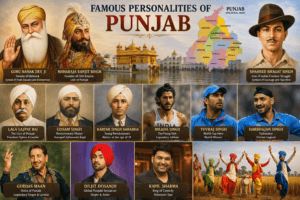
Famous Personalities of Punjab
PB has produced many visionary leaders, freedom fighters, saints, sportspersons, artists, writers, scientists, and entrepreneurs who have made remarkable contributions to India and the world. The state’s rich cultural heritage, spirit of courage, and dedication to excellence have shaped generations of inspiring personalities.
One of the most revered figures is Guru Nanak Dev Ji, the founder of Sikhism, whose teachings of equality, compassion, and humanity continue to inspire millions across the globe. The ten Sikh Gurus played a crucial role in shaping Punjab’s spiritual and cultural identity.
Maharaja Ranjit Singh, popularly known as the “Lion of Punjab,” established the powerful Sikh Empire in the early 19th century. His reign is remembered for religious harmony, administrative excellence, military strength, and economic prosperity.
PB played a significant role in India’s freedom struggle through legendary revolutionaries such as Shaheed Bhagat Singh, Lala Lajpat Rai, Udham Singh, and Kartar Singh Sarabha, whose sacrifices remain symbols of patriotism and courage.
The state has also produced internationally renowned athletes. Milkha Singh, famously known as the “Flying Sikh,” became one of India’s greatest track and field athletes. Other sporting icons include Harbhajan Singh, Yuvraj Singh, and several Olympic hockey legends from Punjab.
PB has made remarkable contributions to Indian entertainment and music through personalities such as Amrish Puri, Kapil Sharma, Gurdas Maan, Diljit Dosanjh, and Neeru Bajwa, who have gained international recognition.
These personalities continue to inspire future generations through their achievements in spirituality, leadership, patriotism, sports, literature, music, cinema, and public service.
Famous Personalities at a Glance
| Personality | Known For |
|---|---|
| Guru Nanak Dev Ji | Founder of Sikhism |
| Maharaja Ranjit Singh | Founder of the Sikh Empire |
| Shaheed Bhagat Singh | Freedom Fighter |
| Lala Lajpat Rai | Freedom Fighter & National Leader |
| Udham Singh | Revolutionary Freedom Fighter |
| Kartar Singh Sarabha | Revolutionary |
| Milkha Singh | Olympic Athlete (Flying Sikh) |
| Harbhajan Singh | International Cricketer |
| Yuvraj Singh | World Cup Winning Cricketer |
| Diljit Dosanjh | Singer, Actor & Global Punjabi Icon |
Shopping & Handicrafts of Punjab
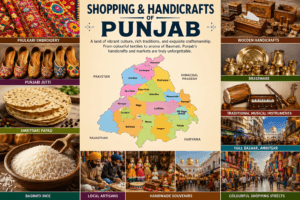
PB is renowned for its vibrant handicrafts, traditional textiles, colourful embroidery, leather footwear, wooden crafts, and delicious food products. The state’s rich artistic heritage reflects centuries of craftsmanship, cultural traditions, and agricultural prosperity. Visitors to Punjab often take home beautifully handcrafted souvenirs that represent the state’s unique identity.
One of Punjab’s most famous handicrafts is Phulkari embroidery, a traditional floral embroidery art known for its intricate patterns and vibrant colours. Handcrafted Phulkari dupattas, shawls, sarees, jackets, and home décor items are popular across India and abroad.
Another iconic product is the Punjabi Jutti, a handcrafted leather shoe decorated with colourful embroidery, beads, mirrors, and traditional designs. These comfortable and stylish footwear pieces are widely available in Patiala, Amritsar, Muktsar, and Jalandhar.
PB is also known for its wooden handicrafts, brassware, traditional musical instruments, handwoven durries, woollen shawls, and decorative items. Cities such as Amritsar, Patiala, Hoshiarpur, and Kapurthala are famous for producing high-quality wooden furniture, carved artifacts, and handcrafted gifts.
Food products are another major attraction for shoppers. Visitors often purchase Amritsari Papad, Wadiyan, Pickles, Basmati Rice, Organic Honey, Dry Fruits, Traditional Sweets, and Punjabi spices. Punjab’s dairy products, including desi ghee and traditional sweets, are also highly popular.
Major shopping destinations include Hall Bazaar (Amritsar), Katra Jaimal Singh Market, Patiala Market, Sector 17 Market (Chandigarh), Model Town Market (Jalandhar), and AC Market (Ludhiana). These markets offer everything from traditional clothing and handicrafts to modern fashion, electronics, and souvenirs.
Shopping in PB provides visitors with an opportunity to experience the state’s colourful traditions while supporting local artisans and small businesses.
Shopping & Handicrafts at a Glance
| Item | Famous For |
|---|---|
| Phulkari Embroidery | Traditional Floral Embroidery |
| Punjabi Jutti | Handmade Leather Footwear |
| Amritsari Papad | Traditional Snack |
| Basmati Rice | Premium Long-Grain Rice |
| Wooden Handicrafts | Furniture & Decorative Items |
| Brassware | Traditional Metal Crafts |
| Traditional Instruments | Dhol, Tumbi & Algoza |
| Hall Bazaar, Amritsar | Famous Shopping Market |
| Patiala Market | Traditional Clothing & Handicrafts |
| Popular Souvenirs | Phulkari, Jutti, Papad & Handmade Gifts |
Best Time to Visit Punjab
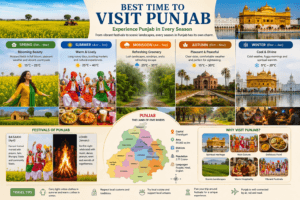
PB is a year-round destination, but the best time to visit depends on the type of experience you are looking for. The state experiences a subtropical climate with four distinct seasons—summer, monsoon, autumn, and winter. Each season offers unique attractions, festivals, and cultural experiences.
The most pleasant time to visit Punjab is from October to March, when the weather remains cool and comfortable. Daytime temperatures usually range between 10°C and 25°C, making it ideal for sightseeing, visiting religious places, exploring historical monuments, shopping, and enjoying outdoor activities.
Winter (December to February) is considered the peak tourist season. Cities such as Amritsar, Patiala, Chandigarh, Anandpur Sahib, and Ludhiana experience cool weather, while festivals like Lohri, Maghi, and Republic Day celebrations attract thousands of visitors. This is also the best season to enjoy authentic Punjabi cuisine, especially Sarson da Saag & Makki di Roti.
Spring (February to April) is another excellent season, with blooming mustard fields creating breathtaking landscapes across rural Punjab. During April, the grand festival of Baisakhi is celebrated with colourful processions, Bhangra and Gidda performances, fairs, and religious ceremonies, making it one of the best times to experience Punjabi culture.
The summer season (April to June) can be quite hot, with temperatures often exceeding 40°C. While sightseeing is possible during early mornings and evenings, travellers should stay hydrated and avoid outdoor activities during the afternoon.
The monsoon season (July to September) brings moderate rainfall, refreshing the countryside and enhancing the beauty of Punjab’s agricultural fields and wetlands. Although occasional waterlogging may occur in some areas, this season offers lush green landscapes and fewer tourist crowds.
Overall, October to March is widely regarded as the ideal period to visit Punjab for pleasant weather, festivals, sightseeing, photography, and cultural experiences.
Best Time to Visit at a Glance
| Season | Highlights |
|---|---|
| October – November | Pleasant Weather & Sightseeing |
| December – February | Winter Tourism, Lohri & Maghi |
| February – April | Mustard Fields & Baisakhi Festival |
| April – June | Hot Summer Season |
| July – September | Monsoon Greenery & Wetlands |
| Best Overall Time | October – March |
| Ideal For | Sightseeing, Festivals & Photography |
| Peak Tourist Season | December – February |
| Average Winter Temperature | 10°C–25°C |
| Recommended Season | Autumn, Winter & Spring |
How to Reach Punjab
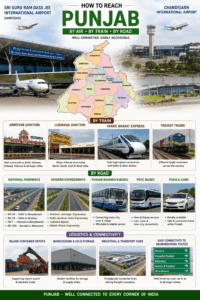
PB is one of the best-connected states in India, with an extensive network of airways, railways, and highways. Its strategic location in northwestern India makes it easily accessible from all major Indian cities as well as several international destinations. Whether travelling for tourism, business, education, or pilgrimage, visitors can conveniently reach Punjab by air, train, or road.
By Air
PB has several airports serving domestic and international passengers. The Sri Guru Ram Dass Jee International Airport (Amritsar) is the state’s largest international airport, offering direct flights to destinations in Europe, the Middle East, Southeast Asia, and major Indian cities.
Other important airports include:
- Chandigarh International Airport
- Adampur Airport (Jalandhar)
- Ludhiana Airport
- Bathinda Airport
- Pathankot Airport
These airports provide excellent connectivity for travellers across India.
By Train
Punjab has a well-developed railway network under the
Northern Railway Zone. Major railway stations include:
- Amritsar Junction
- Ludhiana Junction
- Jalandhar City Junction
- Bathinda Junction
- Pathankot Junction
- Chandigarh Railway Station
- Patiala Railway Station
Several premium trains, including Vande Bharat Express, Shatabdi Express, Rajdhani Express, and numerous superfast trains, connect Punjab with Delhi, Mumbai, Kolkata, Chennai, Jaipur, Ahmedabad, and Jammu.
By Road
PB has an excellent road network maintained by the National Highways Authority of India (NHAI) and the Punjab Public Works Department (PWD). Important National Highways such as NH-3, NH-5, NH-7, NH-44, and NH-54 connect the state with neighbouring regions.
Government-operated PB Roadways and PEPSU Road Transport Corporation (PRTC) buses, along with private Volvo coaches, taxis, app-based cab services, and self-drive vehicles, provide comfortable travel throughout the state.
With modern transport infrastructure, international air connectivity, an extensive railway network, and excellent highways, PB offers smooth and convenient access for travellers from across India and abroad.
How to Reach at a Glance
| Mode of Transport | Details |
|---|---|
| By Air | Amritsar, Chandigarh, Adampur, Ludhiana, Bathinda & Pathankot Airports |
| Largest International Airport | Sri Guru Ram Dass Jee International Airport, Amritsar |
| By Train | Amritsar, Ludhiana, Jalandhar, Bathinda, Patiala & Pathankot |
| Railway Zone | Northern Railway |
| By Road | National Highways & Expressways |
| Major Bus Operators | Punjab Roadways & PRTC |
| Public Transport | Volvo Buses, Taxis, Auto-rickshaws & App-based Cabs |
| Major Highways | NH-3, NH-5, NH-7, NH-44 & NH-54 |
| Best Connectivity | Air, Rail & Road |
| Connectivity Strength | Excellent Domestic & International Access |
Travel Tips for Punjab
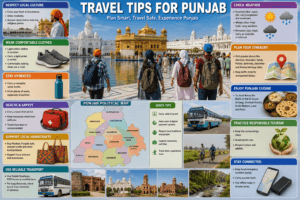
PB is a welcoming destination known for its rich culture, historic landmarks, delicious cuisine, and warm hospitality. Whether you’re visiting religious sites, historical monuments, rural villages, or vibrant cities, following a few practical travel tips will help you enjoy a safe and memorable trip.
The best time to visit Punjab is between October and March, when the weather is pleasant and ideal for sightseeing, shopping, and exploring cultural attractions. If you want to experience Punjab’s traditional celebrations, plan your visit during Baisakhi (April) or Lohri (January).
When visiting religious places such as the Golden Temple and other gurdwaras, dress modestly and cover your head with a scarf or handkerchief as a mark of respect. Shoes must be removed before entering the shrine, and visitors should maintain silence and follow the guidelines provided by the management.
PB offers excellent road connectivity, but it is advisable to book hotels, train tickets, flights, and Volvo buses in advance during festivals and peak tourist seasons. Carry valid identification documents, sufficient cash for rural areas, and use digital payment methods where available.
Don’t miss authentic Punjabi cuisine, including Sarson da Saag & Makki di Roti, Amritsari Kulcha, Butter Chicken, Chole Bhature, Lassi, and Phirni. Purchase authentic Phulkari embroidery, Punjabi Jutti, Amritsari Papad, and Basmati Rice from government emporiums or reputed local markets to ensure quality.
Respect local traditions, avoid littering, stay hydrated during summer, and follow traffic rules while travelling. Supporting local artisans and using eco-friendly practices helps preserve Punjab’s cultural and natural heritage.
With proper planning and responsible travel, visitors can experience the best of Punjab’s history, spirituality, food, festivals, and hospitality.
Travel Tips at a Glance
| Travel Tip | Recommendation |
|---|---|
| Best Time to Visit | October–March |
| Religious Etiquette | Cover Your Head & Remove Shoes in Gurdwaras |
| Clothing | Comfortable Clothes & Seasonal Wear |
| Advance Booking | Hotels, Flights & Trains During Peak Season |
| Food to Try | Sarson da Saag, Amritsari Kulcha & Lassi |
| Shopping | Buy Authentic Phulkari & Punjabi Jutti |
| Payments | Carry Cash & Use Digital Payments |
| Summer Advice | Stay Hydrated & Avoid Midday Heat |
| Eco-Friendly Travel | Avoid Plastic & Keep Places Clean |
| Must-Visit Experience | Golden Temple, Wagah Border & Baisakhi Festival |
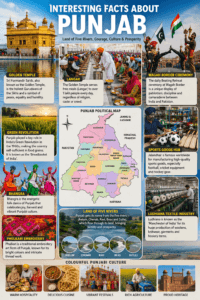
Interesting Facts About Punjab
PB is one of India’s most fascinating states, known for its rich history, Sikh heritage, fertile plains, vibrant culture, and remarkable contributions to agriculture. Popularly called the “Land of Five Rivers,” Punjab derives its name from the Persian words “Panj” (Five) and “Aab” (Water), referring to the five historic rivers—Sutlej, Beas, Ravi, Chenab, and Jhelum.
PB is the birthplace of Sikhism, one of the world’s major religions. The Golden Temple (Sri Harmandir Sahib) in Amritsar is the holiest shrine of Sikhism and welcomes millions of visitors every year, regardless of religion, caste, or nationality. It is also home to the world’s largest free community kitchen (Langar), serving over 100,000 meals daily, with significantly higher numbers during festivals and special occasions.
PBplayed a pivotal role in India’s Green Revolution during the 1960s, transforming the country from a food-deficient nation into one of the world’s largest food producers. Because of its exceptional agricultural productivity, Punjab is proudly known as the “Granary of India.”
The state is also internationally recognised for the Wagah Border Beating Retreat Ceremony, a unique daily military parade jointly conducted by the Border Security Force (BSF) of India and the Pakistan Rangers, attracting thousands of spectators.
PB is famous worldwide for Bhangra, Gidda, Punjabi music, Phulkari embroidery, Punjabi cuisine, and its strong sporting tradition. The city of Jalandhar is one of the world’s leading centres for the manufacture and export of sports goods, while Ludhiana is a major hub for textiles, bicycles, and hosiery industries.
With its rich cultural traditions, historical landmarks, agricultural excellence, religious significance, and global Punjabi diaspora, Punjab continues to be one of India’s most influential and dynamic states.
Interesting Facts at a Glance
| Fact | Details |
|---|---|
| Nickname | Land of Five Rivers |
| Birthplace of | Sikhism |
| Holiest Sikh Shrine | Golden Temple, Amritsar |
| Famous Community Service | World’s Largest Free Langar |
| Agricultural Identity | Granary of India |
| Historic Achievement | Green Revolution |
| Famous Border | Wagah Border |
| Sports Goods Hub | Jalandhar |
| Textile Hub | Ludhiana |
| Cultural Identity | Bhangra, Gidda & Phulkari |
Top 10 FAQs About Punjab
Frequently Asked Questions
1. Why is Punjab called the “Land of Five Rivers”?
Punjab gets its name from the Persian words “Panj” (Five) and “Aab” (Water), referring to the five historic rivers—Sutlej, Beas, Ravi, Chenab, and Jhelum.
2. What is the best time to visit Punjab?
The best time to visit Punjab is October to March, when the weather is pleasant and ideal for sightseeing, festivals, and outdoor activities.
3. What is Punjab famous for?
Punjab is famous for the Golden Temple, Sikh heritage, Bhangra, Gidda, Punjabi cuisine, agriculture, the Green Revolution, Wagah Border, and Phulkari embroidery.
4. Which is the capital of Punjab?
Chandigarh is the capital of Punjab. It also serves as the capital of the neighbouring state of Haryana.
5. Which is the holiest place in Punjab?
The Golden Temple (Sri Harmandir Sahib) in Amritsar is the holiest shrine of Sikhism and one of India’s most visited religious sites.
6. What are the major festivals celebrated in Punjab?
Major festivals include Baisakhi, Lohri, Guru Nanak Gurpurab, Hola Mohalla, Maghi, Diwali, Holi, and Basant Panchami.
7. How can I reach Punjab?
Punjab is well connected by air, rail, and road through Sri Guru Ram Dass Jee International Airport (Amritsar), major railway stations, National Highways, Punjab Roadways, and PRTC bus services.
8. What is the famous food of Punjab?
Popular Punjabi dishes include Sarson da Saag & Makki di Roti, Butter Chicken, Amritsari Kulcha, Chole Bhature, Dal Makhani, Lassi, and Phirni.
9. What should tourists buy from Punjab?
Visitors should buy Phulkari embroidery, Punjabi Jutti, Amritsari Papad, Basmati Rice, wooden handicrafts, brassware, traditional sweets, and handmade souvenirs.
10. Which are the most popular tourist places in Punjab?
The top tourist attractions include Golden Temple, Wagah Border, Jallianwala Bagh, Anandpur Sahib, Qila Mubarak, Sheesh Mahal, Harike Wetland, and Kapurthala.
FAQs at a Glance
| Question | Short Answer |
|---|---|
| Why is Punjab called the Land of Five Rivers? | Named after the five historic rivers. |
| Best time to visit? | October–March |
| What is Punjab famous for? | Golden Temple, Sikhism, Bhangra & Agriculture |
| Capital of Punjab? | Chandigarh |
| Holiest place? | Golden Temple, Amritsar |
| Major festivals? | Baisakhi, Lohri & Gurpurab |
| How to reach Punjab? | Air, Rail & Road |
| Famous food? | Sarson da Saag, Butter Chicken & Lassi |
| What to buy? | Phulkari, Punjabi Jutti & Amritsari Papad |
| Top tourist places? | Golden Temple, Wagah Border & Jallianwala Bagh |
Conclusion
PB is a land where history, spirituality, agriculture, culture, and modern development come together to create one of India’s most vibrant states. From the serene Golden Temple and the patriotic atmosphere of the Wagah Border to the colourful celebrations of Baisakhi and the energetic beats of Bhangra, Punjab offers unforgettable experiences for every visitor.
Known as the “Land of Five Rivers” and the “Granary of India,” PB has played a vital role in India’s agricultural success through the Green Revolution. Its fertile plains, rich heritage, delicious cuisine, thriving industries, renowned educational institutions, and warm hospitality make it an ideal destination for tourists, students, entrepreneurs, and pilgrims alike.
Whether you are exploring historic monuments, enjoying authentic Punjabi food, shopping for traditional Phulkari and Punjabi Jutti, witnessing the spectacular Wagah Border ceremony, or experiencing the peaceful atmosphere of the Golden Temple, PB promises memories that last a lifetime.
Plan your journey to PB and discover a state where tradition meets progress, faith meets hospitality, and every visitor is welcomed with open arms. Punjab truly reflects the spirit of unity, courage, prosperity, and celebration, making it one of India’s most remarkable destinations.
Thank you for reading our complete Punjab Travel Guide on DealKart Market. Explore more Indian states, travel destinations, and local guides to plan your next unforgettable journey!
About DealKart Market
DealKart Market is India’s trusted online platform for discovering travel guides, local businesses, services, shopping, classified ads, and valuable local information. Our mission is to connect people with authentic destinations, reliable services, and verified business listings across India through easy-to-understand, high-quality content.
Whether you’re planning your next trip, searching for nearby businesses, exploring Indian states, or looking for local services and deals, DealKart Market provides accurate, updated, and user-friendly information to help you make informed decisions.
Our platform features comprehensive guides on Indian states, tourist attractions, culture, festivals, cuisine, shopping destinations, transportation, and travel tips. We also support local businesses by offering directory listings, helping customers discover trusted service providers in their area.
At DealKart Market, we are committed to delivering reliable information, improving local business visibility, and promoting India’s rich heritage, tourism, and entrepreneurship through well-researched content and innovative digital solutions.
Thank you for choosing DealKart Market as your trusted destination for exploring India, discovering local opportunities, and connecting with businesses and communities nationwide.
State Article Link
- Andhra Pradesh
https://dealkartmarket.in/andhra-pradesh/
- Telangana
https://dealkartmarket.in/telangana/
- Karnataka
https://dealkartmarket.in/karnataka/
- Tamil Nadu
https://dealkartmarket.in/tamil-nadu/
- Kerala
https://dealkartmarket.in/kerala/
- Maharashtra
https://dealkartmarket.in/maharashtra/
- Goa
https://dealkartmarket.in/goa/
- Madhya Pradesh
https://dealkartmarket.in/madhya-pradesh/
- Himachal Pradesh
https://dealkartmarket.in/himachal-pradesh/
- Punjab
https://dealkartmarket.in/punjab/
References (Official Sources)
- https://punjabtourism.punjab.gov.in/
- punjabtourism.punjab.gov.in
- https://punjab.gov.in
- punjabtourism.punjab.gov.in
- https://eservices.punjab.gov.in
- https://www.incredibleindia.gov.in/en/punjab
- Incredible India
- https://tourism.gov.in
- https://censusindia.gov.in
- https://mausam.imd.gov.in
- https://asi.nic.in
- https://www.pau.edu
- https://punjabroadways.punjab.gov.in/en
- Wikipedia
- https://www.pepsuonline.com
- Wikipedia
- https://indianrailways.gov.in
- https://www.aai.aero
- https://forest.punjab.gov.in
These official sources are sufficient for the Punjab article and are suitable to include in your References section on DealKart Market.