The Revolt of 1857: The Night Meerut Refused to Stay Silent
Quick Info Table
| Detail | Information |
|---|---|
| Event | Revolt of 1857 (Sepoy Mutiny) |
| Start Date | May 10, 1857, Meerut |
| Governor-General | Lord Canning |
| Mughal Emperor at the time | Bahadur Shah Zafar II |
| Immediate Cause | Enfield rifle cartridge controversy |
| First Spark | Mangal Pandey’s revolt, Barrackpore, March 29, 1857 |
| Delhi fell to British | September 20, 1857 |
| Kanpur recaptured | December 6, 1857 |
| Jhansi fell | June 1858 |
| End of Company rule | November 1, 1858 (Queen’s Proclamation) |
| First Viceroy of India | Lord Canning |
| First Secretary of State for India | Lord Stanley |
What’s Inside This Article
- Why the sepoys revolted in the first place
- Mangal Pandey and the spark at Barrackpore
- How the revolt spread across North India
- The key centers, leaders, and British officers who crushed them
- Why the revolt failed
- What changed after 1858
- How historians remember it
- Ten facts most people don’t know
- FAQs
The Slow Build-Up: Why 1857 Didn’t Happen Overnight
People often think the revolt exploded out of nowhere. It didn’t. Discontent had been simmering since at least 1806, when sepoys in Vellore rebelled over a change in their uniform and headgear. There was another flare-up in 1824 involving the 34th Regiment at Barrackpore. Neither of those incidents caught on the way 1857 did, mainly because they stayed local and never found a bigger political cause to attach themselves to.
By the 1850s, four broad grievances had piled up, and they fed off each other.
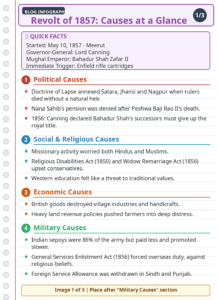
1. Political Causes
Lord Dalhousie’s Doctrine of Lapse annoyed Indian royal families more than almost anything else the British did. Under this policy, if a ruler died without a natural (biological) heir, the British simply annexed the kingdom — adopted sons didn’t count anymore. That’s how Satara, Jhansi, and Nagpur ended up under Company control.
Then there’s the case of Nana Sahib. He was the adopted son of the last Peshwa, Baji Rao II, and after his father’s death in 1851, the British refused to continue his pension or recognize his claims. That decision made an enemy out of a man who could have stayed neutral.
Even more damaging, in 1856 Lord Canning announced that after Bahadur Shah Zafar’s death, his successors would have to give up the royal title altogether and move out of the Red Fort. For a population that still viewed the Mughal emperor as a symbolic figurehead — even a powerless one — this felt like an open insult.
2. Social and Religious Causes
British missionaries were active across the country, and their conversion efforts made both Hindus and Muslims nervous. Add to that laws like the Religious Disabilities Act of 1850 (which protected the property rights of converts) and the Hindu Widows’ Remarriage Act of 1856, and a lot of conservative Indians started believing their traditions were under direct attack.
Western education didn’t help calm those fears either. Many saw it as a quiet tool to erode Indian values from within, one classroom at a time.
3. Economic Causes
This is the cause that gets skipped over in casual conversations but mattered enormously to ordinary people. British economic policy hit peasants, artisans, and weavers hard. Village industries and handicrafts collapsed under competition from British machine-made goods, throwing thousands out of work.
On top of that, land revenue policies squeezed farmers dry, leaving little room for savings or security. When your livelihood disappears and your land gets taxed beyond what you can afford, joining a rebellion doesn’t feel like such a big leap.
4. Military Causes
Indian soldiers made up close to 86% of the Company’s army — roughly 2,32,000 men, compared to just 43,000 British soldiers. Yet Indian sepoys were paid less, promoted slower, and treated with open disrespect by their British counterparts. A soldier doing the same job for less recognition tends to notice, and resentment builds.
Canning’s General Services Enlistment Act of 1856 made things worse. It required new recruits to serve overseas if ordered, something that clashed directly with religious beliefs among Hindu sepoys about crossing the sea (kala pani). Around the same time, the British also stopped paying the Foreign Service Allowance in regions like Sindh and Punjab, cutting into soldiers’ income even further.
The Spark: Mangal Pandey and the Enfield Rifle
The final trigger, though, was mechanical — a rifle. In 1856, the British introduced the new Enfield rifle, and its cartridges had to be bitten open before loading. Rumors spread that the cartridges were greased with cow and pig fat, an idea that horrified Hindu and Muslim soldiers alike, for different but equally serious religious reasons.
On March 29, 1857, at Barrackpore, a young sepoy named Mangal Pandey of the 34th Regiment refused to use the cartridges and attacked two British officers, Lieutenant Baugh and a Sergeant-Major, wounding them. He was tried and hanged on April 8, 1857. It’s worth remembering this was the spark, not the fire itself — the deeper causes had been building for decades.
The real turning point came on May 9, 1857, at Meerut. Eighty-five sepoys who refused to use the greased cartridges were court-martialed and sentenced to ten years of rigorous imprisonment. Their comrades weren’t willing to accept that quietly. The very next day, they broke open the jail, freed the prisoners, killed British officers, and marched to Delhi.
How the Revolt Spread: Centers, Leaders, and British Commanders
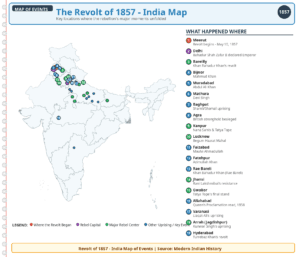
By May 12, 1857, sepoys reached Delhi and persuaded Bahadur Shah Zafar II — reluctant at first — to become the symbolic leader of the uprising. He was proclaimed “Shahenshah-e-Hindustan,” and the rebels raised the cry “Maaro Firangi Ko” (kill the foreigner) across the city. In the chaos, Simon Fraser, the British political agent in Delhi, was killed.
Here’s a breakdown of where the fighting happened and who led it on both sides:
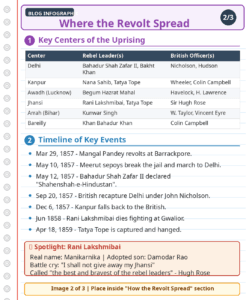
| Center | Rebel Leader(s) | British Officer(s) Who Suppressed It |
|---|---|---|
| Delhi | Bahadur Shah Zafar II, General Bakht Khan | Nicholson, Hudson, Wilson |
| Kanpur | Nana Sahib, Rao Sahib, Azimullah Khan | Sir Hugh Wheeler, Colin Campbell |
| Awadh (Lucknow) | Begum Hazrat Mahal | Havelock, Campbell, Henry Lawrence, Inglis |
| Gwalior | Tatya Tope | Hugh Rose |
| Jhansi | Rani Lakshmibai, Tatya Tope | Sir Hugh Rose |
| Rae Bareli | Khan Bahadur Khan | Campbell |
| Arrah (Bihar) | Kunwar Singh | William Taylor, Vincent Eyre |
Beyond these main centers, several regional leaders kept the flame going in their own territories — Kadam Singh in Meerut, Maulvi Ahmadullah in Faizabad, Azimullah Khan in Fatehpur, Devi Singh in Mathura, Mahmud Khan in Bijnor, Abdul Ali Khan in Muradabad, Liaqat Ali in Allahabad and Banaras, and Shamli in Baghpat.
What Happened in Delhi
The rebellion’s Delhi chapter is heartbreaking, honestly. Bakht Khan, a subedar in the British army, became Bahadur Shah’s military commander and led the resistance from the city. The British sent John Nicholson to retake it, and he succeeded on September 20, 1857 — but died from injuries just days later.
After Delhi fell, General Hudson captured the Mughal royal family and shot Bahadur Shah’s sons in cold blood, publicly, without trial. Bahadur Shah Zafar himself was exiled to Rangoon (present-day Yangon, Myanmar), where he died in captivity in November 1862. That exile marked the formal end of the Mughal dynasty — a line that had ruled parts of India for over 300 years.
Kanpur and Nana Sahib
Nana Sahib, born Govind Dhondu Pant, took charge of the revolt in Kanpur. He’d already written to the French emperor complaining about the “illegal laws” the British had imposed, and he declared himself Peshwa on his own authority. His forces, aided by Tatya Tope and Azimullah Khan, initially had the upper hand.
But Sir Hugh Wheeler and later Colin Campbell turned the tide against him. Nana Sahib eventually fled to Nepal, where he’s believed to have died, though his exact fate remains one of history’s unresolved mysteries.
Jhansi and Rani Lakshmibai
Rani Lakshmibai’s story is probably the most retold part of this whole chapter, and for good reason. Her real name was Manikarnika, and her adopted son was Damodar Rao. When the Doctrine of Lapse threatened to strip away her kingdom, she refused to hand it over without a fight.
Her famous battle cry, “Main Apni Jhansi Nahin Doongi” (I shall not give away my Jhansi), became a rallying line for resistance across the region. This clash is also remembered as the Jhansi massacre or the “Jhansi Bagh” episode. She joined forces with Tatya Tope, fought alongside him at Gwalior, and died in battle in June 1858. Sir Hugh Rose, the British general who eventually took Gwalior, called her “the best and bravest of the rebel leaders” — a rare compliment from an adversary. She’s still remembered today as “the Joan of Arc of India.”
Tatya Tope’s Guerrilla War
Tatya Tope, whose real name was Ramachandra Pandurang, was Nana Sahib’s most trusted lieutenant. After Kanpur fell, he shifted to Jhansi and Gwalior to support Rani Lakshmibai, and even after her death, he refused to give up. He kept up a guerrilla campaign for months, moving through central Indian forests and evading capture.
He was eventually betrayed by a local chief named Man Singh, captured by the British, and hanged on April 18, 1859. British historian Malleson called him one of the greatest guerrilla commanders of the revolt — high praise, considering how long he managed to stay one step ahead of an entire army hunting him.
Awadh and Begum Hazrat Mahal
When the British annexed Awadh under the Doctrine of Lapse, it hit the region hard — Awadh wasn’t some minor kingdom, it was one of the wealthiest and most culturally significant states in North India. Begum Hazrat Mahal, wife of the exiled Nawab Wajid Ali Shah, led the resistance and declared her young son Birjis Qadr as the new Nawab.
Officers like Henry Lawrence, Havelock, and Neill lost their lives during this campaign. Eventually, Colin Campbell’s forces, backed by the Gurkha Regiment, recaptured Lucknow, and Hazrat Mahal fled to Nepal by March 1858. A telegram sent by Lieutenant Colonel Tytler on August 6, 1857, gives a vivid, contemporary account of just how intense the fighting had become in this region.
Kunwar Singh and Bihar
Kunwar Singh, the zamindar of Jagdishpur, had a personal score to settle — the British had removed him from his position and seized his lands. He led the revolt in Bihar, recaptured Arrah from the British temporarily, and fought against officers William Taylor and Vincent Eyre. He died fighting the British, and today he’s remembered by titles like Bhishma Acharya, Bihar Kesari, and Bihar Simha (Lion of Bihar).
Bareilly, Hyderabad, and Other Pockets
In Bareilly, Khan Bahadur Khan from the Rohilla dynasty raised an army of 40,000 against the British, only to be captured and hanged by General Campbell’s forces. In Hyderabad, interestingly, it wasn’t the Nizam who rebelled — his own subjects, led by Turrebaz Khan and Maulana Allauddin, revolted against British-Nizam relations, though Salar Jung I, the Nizam’s prime minister, helped the British Resident escape and put the rebellion down.
Other regional flashpoints included Faizabad (Maulvi Ahmadullah), and Baghpat, where a man named Shamal organized 84 villages, destroyed British buildings and communication lines, and set up his own courthouse — nicknamed the “Hall of Justice” — before being defeated by an officer named Dunlop in July 1857.
Why the Revolt Failed
Given how widespread it was, you’d think 1857 had a real shot at succeeding. It didn’t, and the reasons are pretty instructive even today.
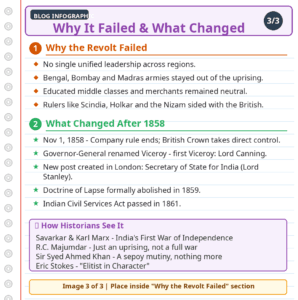
- There was no single unified leadership — every region fought its own battle, with its own goals, and little coordination between them.
- The rebels lacked money, weapons, and consistent military strategy compared to a well-organized British army.
- The Bengal, Bombay, and Madras armies didn’t join the uprising in any significant way.
- Educated middle classes and the merchant community largely stayed out of it, viewing the revolt with suspicion rather than sympathy.
- Several Indian rulers actively sided with the British — Scindia of Gwalior, Holkar of Indore, Gulab Singh of Kashmir, Jang Bahadur of Nepal, the Nizam of Hyderabad, the Begum of Bhopal, and interestingly, even Bahadur Shah Zafar’s own wife, Zeenat Mahal, cooperated with the British at certain points.
- Informers within Indian ranks passed on crucial information to British forces.
There’s a particularly telling comment from Lord Canning himself, who observed that some of these rulers acted like “breakwaters in a storm” — protecting British rule from being completely swept away.
What Changed After 1858
The revolt’s aftermath reshaped how Britain governed India, and honestly, the changes were significant enough to end an entire era.
On November 1, 1858, at Allahabad, the British formally read out Queen Victoria’s Proclamation, transferring control from the East India Company directly to the British Crown. This is when Company rule in India officially ended — a company that had governed parts of India for over a century was suddenly out of the picture.
Under the Government of India Act of 1858, the position of Governor-General was renamed Viceroy, and a brand-new post called the Secretary of State for India was created in London. Lord Canning, fittingly, became both the last Governor-General and the first Viceroy of India. Lord Stanley became the first Secretary of State.
Some other major shifts followed:
- The British ratio of European to Indian soldiers changed to about 1:2 in strategic areas, and Punjab and Bombay/Madras moved to a 1:3 ratio, all designed to prevent another uprising of this scale.
- Communities that had helped the British — Sikhs, Gurkhas, and Pathans — were recruited more heavily and labeled “martial races.”
- The Doctrine of Lapse was formally abandoned in 1859.
- The British promised, at least on paper, not to interfere in India’s religious and social customs.
- The Indian Civil Services Act of 1861 was passed, opening (in theory) civil service positions to Indians, though in practice access remained heavily restricted for decades.
How Historians Remember 1857
Few events in Indian history have triggered as much interpretive disagreement as this one. Here’s how different historians and thinkers have framed it over the years:
| Historian/Thinker | View |
|---|---|
| V.D. Savarkar & Karl Marx | India’s First War of Independence |
| R.C. Majumdar | The first uprising of 1857 (not a full-scale war) |
| Nehru & Benjamin Disraeli | A national rising |
| Jawaharlal Nehru (The Discovery of India, 1946) | A revolt largely of landowning classes |
| T.R. Holmes | A struggle between civilization and barbarism |
| Outram, Taylor & S.N. Sen | A Christian-versus-conservative religious clash |
| Sir Syed Ahmed Khan, Malleson & Majumdar | A sepoy mutiny, nothing more |
| S.B. Choudhury | A mix of military and civil uprisings |
| Eric Stokes | “Elitist in character” |
| Rees | A religiously-driven uprising |
| Meadows Taylor | A racial conflict between white and black |
| John Lawrence & Seeley | “Mere Sepoy Mutiny” |
| Ellenborough | A legitimate war |
| Fonblanque | An uprising of all classes |
| Canning | Rebellion by Brahmins under religious pretenses |
| Charles Ball | An uprising by everyone, across the board |
If you’re preparing for competitive exams, this table alone is worth memorizing — questions on “who called it what” show up frequently in TSPSC, APPSC, and UPSC prelims.
Ten Facts About 1857 Most People Miss
- The first sepoy uprising against the British actually happened way back in 1806 in Vellore, not 1857.
- Enfield rifles were originally manufactured in Enfield, England — the location that gave the rifle its name.
- Testing of the controversial cartridges reportedly took place at Dum Dum, Ambala, and Sialkot before the rebellion broke out.
- Bahadur Shah Zafar never actually wanted to lead the revolt — sepoys convinced (some say pressured) him into it.
- Zeenat Mahal, Bahadur Shah’s wife, is believed to have cooperated with the British at certain points to protect her son’s future.
- Rani Lakshmibai’s original name was Manikarnika — “Rani Lakshmibai” was the name she took after marriage.
- Nana Sahib’s real name was Govind Dhondu Pant, and he was the adopted son of Peshwa Baji Rao II.
- Tatya Tope was betrayed by an ally, not caught in open battle — a detail that still frustrates people who root for the underdog.
- The Indian soldier-to-British soldier ratio before the revolt was roughly 6:1, a massive imbalance the British moved quickly to correct afterward.
- The famous phrase “Bhishma Acharya” given to Kunwar Singh compares him to the Mahabharata warrior known for extraordinary loyalty and endurance in battle — a title that fit his fierce, almost stubborn resistance.
Did You Know?
Simon Fraser, the British political agent killed in Delhi during the early days of the revolt, was actually seen as a moderate figure who understood Indian customs better than most British officials of his time. His death, ironically, hardened British resolve rather than weakening it.
Also — and this surprises a lot of people — the phrase “First War of Independence” wasn’t commonly used until V.D. Savarkar wrote his book by that exact title in 1909, more than fifty years after the events themselves. Before that, British accounts almost universally referred to it as the “Sepoy Mutiny,” which is why the naming debate still matters when you’re reading older sources.
Books That Shaped How We Understand 1857
If you want to go deeper than any textbook chapter allows, these are the classic references historians keep coming back to:
| Book | Author |
|---|---|
| The Sepoy Revolt, Its Causes and Its Consequences | H. Mead |
| History of the Indian Mutiny | T.R. Holmes |
| The Indian War of Independence, 1857 | V.D. Savarkar |
| A History of the Sepoy War in India | Sir J.W. Kaye |
| Causes of the Indian Mutiny | Syed Ahmed Khan |
| The First Indian War of Independence: 1857-59 | Karl Marx |
| The Sepoy Mutiny and the Rebellion of 1857 | R.C. Majumdar |
| British Paramountancy and Indian Renaissance | R.C. Majumdar |
| Civil Rebellion in Indian Mutinies | S.B. Choudhury |
| Rebellion, 1857: A Symposium | P.C. Joshi |
| 1857 | S.N. Sen |
| Indian Mutiny of 1857 | G.B. Malleson |
| From Sepoy to Subedar | Sitaram Pandey (Awadhi, translated by Norgate) |
Frequently Asked Questions
Q1. When did the Revolt of 1857 start, and where?
It began on May 10, 1857, in Meerut, though Mangal Pandey’s individual act of defiance at Barrackpore on March 29, 1857, is usually treated as the first real spark.
Q2. Who was the Governor-General of India during the revolt?
Lord Canning held that position, and he later became the first Viceroy of India after the Government of India Act, 1858.
Q3. Why is it called both “Sepoy Mutiny” and “First War of Independence”?
British writers preferred “Sepoy Mutiny” since it downplayed the political scale of the uprising. Indian nationalist historians, especially Savarkar, argued it deserved to be called India’s First War of Independence because it wasn’t limited to soldiers — civilians, landlords, and rulers joined in too.
Q4. Who led the revolt in Jhansi?
Rani Lakshmibai led it, later joined by Tatya Tope, and their combined forces put up one of the fiercest resistances of the entire uprising.
Q5. What was the immediate cause of the revolt?
The Enfield rifle cartridges, rumored to be greased with cow and pig fat, offended both Hindu and Muslim sepoys and triggered the mutiny at Meerut.
Q6. What happened to Bahadur Shah Zafar after the revolt?
He was exiled to Rangoon by the British and died there in November 1862, marking the formal end of the Mughal dynasty.
Q7. What was the main outcome of the revolt?
The East India Company’s rule ended, and India came under direct British Crown control through the Government of India Act, 1858.
Closing Thoughts
Looking back at 1857, it’s hard not to feel a mix of admiration and frustration — admiration for people like Rani Lakshmibai and Kunwar Singh who fought knowing full well they were outgunned, and frustration at how disconnected the different rebel groups remained from one another. Maybe that’s the real lesson buried in this chapter of history: courage alone doesn’t win wars, coordination does.
Whatever label historians eventually settle on — mutiny, rebellion, or war of independence — one thing’s hard to dispute. The events of 1857 forced the British to rethink how they governed India, and in doing so, they planted an idea that would keep resurfacing for the next ninety years, until independence finally arrived in 1947.
Closing Thoughts
Looking back at 1857, it’s hard not to feel a mix of admiration and frustration — admiration for people like Rani Lakshmibai and Kunwar Singh who fought knowing full well they were outgunned, and frustration at how disconnected the different rebel groups remained from one another. Maybe that’s the real lesson buried in this chapter of history: courage alone doesn’t win wars, coordination does.
Whatever label historians eventually settle on — mutiny, rebellion, or war of independence — one thing’s hard to dispute. The events of 1857 forced the British to rethink how they governed India, and in doing so, they planted an idea that would keep resurfacing for the next ninety years, until independence finally arrived in 1947.
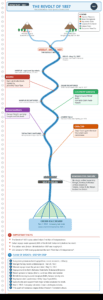
📌 Quick Recap: Mind Map