
Introduction
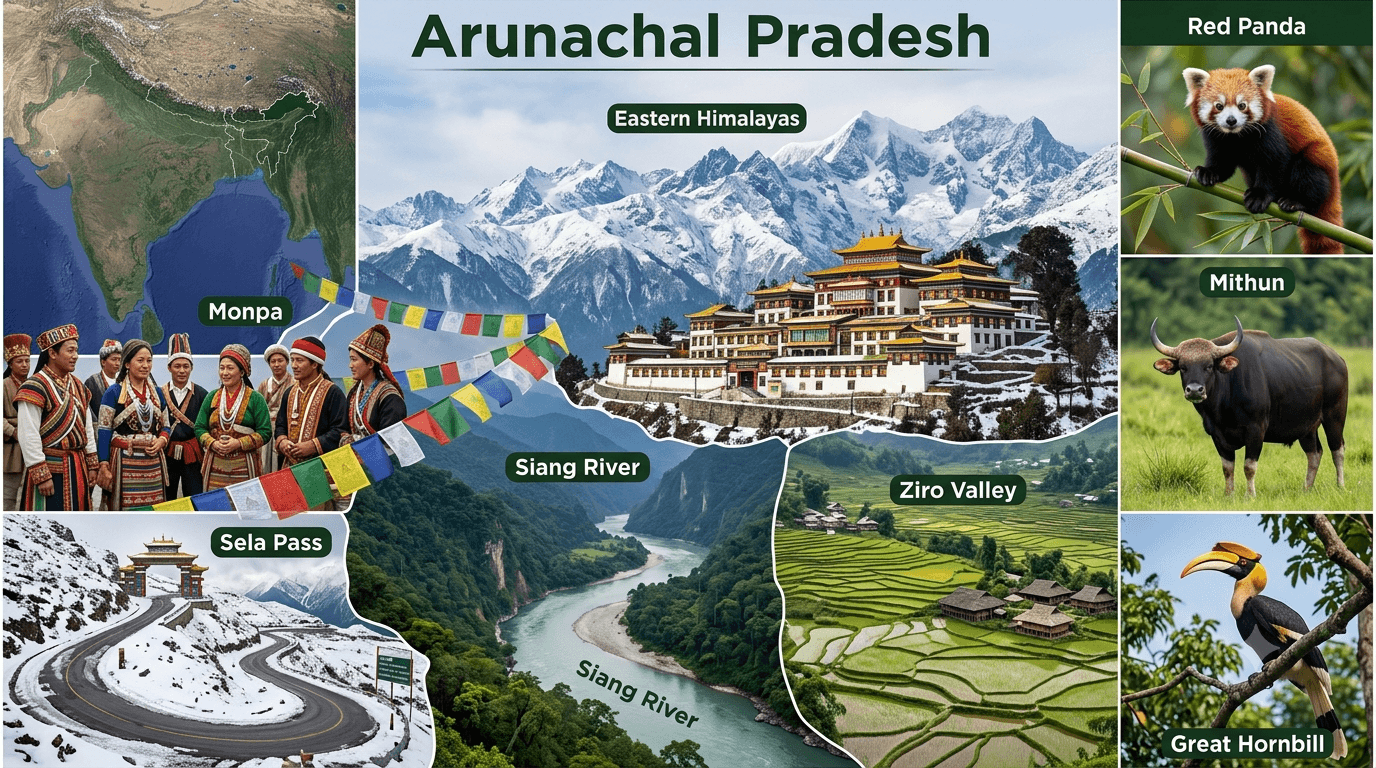
Arunachal Pradesh, often called the “Land of the Rising Sun,” is India’s easternmost state and one of the most picturesque destinations in the country. Located in the northeastern Himalayas, the state is renowned for its snow-capped mountains, dense forests, crystal-clear rivers, ancient Buddhist monasteries, and rich tribal heritage. The first rays of the sun in India are witnessed in Arunachal Pradesh, giving the state its popular nickname.
The state shares international borders with Bhutan to the west, China (Tibet Autonomous Region) to the north and northeast, and Myanmar to the east. Within India, it borders the states of Assam and Nagaland. Its strategic location makes Arunachal Pradesh one of the most important frontier states of India.
Itanagar, the capital of Arunachal Pradesh, serves as the state’s administrative and cultural center. With an area of approximately 83,743 square kilometres, Arunachal Pradesh is the largest state in Northeast India by area. More than 26 major tribes and over 100 sub-tribes live here, each preserving its unique language, customs, festivals, attire, and traditional lifestyle.
The state’s landscape ranges from towering Himalayan peaks and alpine meadows to evergreen forests and deep river valleys. Major rivers such as the Siang, Subansiri, Kameng, Lohit, Dibang, and Noa-Dihing originate in the Himalayas and flow through the state, supporting agriculture, biodiversity, and hydroelectric development.
Arunachal Pradesh is a paradise for nature lovers and adventure enthusiasts. Famous attractions include the magnificent Tawang Monastery, the breathtaking Sela Pass, Sela Lake, Namdapha National Park, Ziro Valley, Bomdila, and Mechuka Valley. The state is also home to rare wildlife, including the Red Panda, Snow Leopard, Clouded Leopard, Mithun, and Great Hornbill.
Tourism, agriculture, horticulture, handicrafts, bamboo products, hydropower, and eco-tourism play a vital role in the state’s economy. With its untouched natural beauty, vibrant tribal traditions, and spiritual significance, Arunachal Pradesh is considered one of India’s most fascinating travel destinations.
Arunachal Pradesh on the Map of India
Arunachal Pradesh is located in the extreme northeastern corner of India and is the country’s easternmost state. It is strategically important because it shares long international borders with China (Tibet Autonomous Region) to the north and northeast, Bhutan to the west, and Myanmar to the east. Within India, it is bordered by the states of Assam and Nagaland.
Covering an area of approximately 83,743 square kilometres, Arunachal Pradesh is the largest state in Northeast India by land area. The state’s diverse landscape extends from the snow-covered Eastern Himalayas in the north to lush forests and river valleys in the south.
The capital city, Itanagar, is located in the southwestern part of the state near the Assam border. Arunachal Pradesh is traversed by several major Himalayan rivers, including the Siang (Brahmaputra), Subansiri, Kameng, Lohit, and Dibang, which eventually merge with the Brahmaputra River in Assam.
Due to its mountainous terrain, rich biodiversity, and strategic international boundaries, Arunachal Pradesh plays a significant role in India’s ecology, national security, and cultural diversity. The state is connected to the rest of India through road, rail, and air links primarily via Assam.
Quick Facts
| Particular | Details |
|---|---|
| State | Arunachal Pradesh |
| Region | Northeast India |
| Capital | Itanagar |
| Area | 83,743 sq km |
| Largest City | Itanagar |
| Highest Peak | Kangto (7,060 m) |
| Major Rivers | Siang, Subansiri, Kameng, Lohit, Dibang |
| International Borders | China (Tibet Autonomous Region), Bhutan, Myanmar |
| Neighboring Indian States | Assam, Nagaland |
| Time Zone | Indian Standard Time (IST, UTC +5:30) |
Districts of Arunachal Pradesh
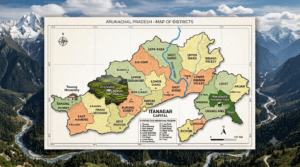
Arunachal Pradesh is administratively divided into 28 districts, making governance more efficient across its vast mountainous terrain and remote tribal regions. Each district is unique in terms of geography, culture, language, and traditions. The districts are inhabited by different indigenous tribes, each preserving its own customs, festivals, dialects, and traditional lifestyle.
The capital district, Papum Pare, is home to Itanagar, the state capital. Tawang is famous for its magnificent Buddhist monastery and breathtaking Himalayan landscapes, while Lower Subansiri is known for the picturesque Ziro Valley, a UNESCO World Heritage tentative site. Namdapha National Park in Changlang district is one of India’s richest biodiversity hotspots, and Anjaw is recognized as the easternmost district of India.
Several new districts have been created in recent years to improve administration and bring government services closer to remote communities. Despite the challenging Himalayan terrain, these districts play a vital role in preserving Arunachal Pradesh’s cultural heritage, biodiversity, and economic development.
List of Districts of Arunachal Pradesh
| S.No. | District | Headquarters |
|---|---|---|
| 1 | Anjaw | Hawai |
| 2 | Bichom | Napangphung |
| 3 | Changlang | Changlang |
| 4 | Dibang Valley | Anini |
| 5 | East Kameng | Seppa |
| 6 | East Siang | Pasighat |
| 7 | Kamle | Raga |
| 8 | Keyi Panyor | Yachuli |
| 9 | Kra Daadi | Palin |
| 10 | Kurung Kumey | Koloriang |
| 11 | Leparada | Basar |
| 12 | Lohit | Tezu |
| 13 | Longding | Longding |
| 14 | Lower Dibang Valley | Roing |
| 15 | Lower Siang | Likabali |
| 16 | Lower Subansiri | Ziro |
| 17 | Namsai | Namsai |
| 18 | Pakke-Kessang | Lemmi |
| 19 | Papum Pare | Yupia |
| 20 | Shi Yomi | Tato |
| 21 | Siang | Boleng |
| 22 | Tawang | Tawang |
| 23 | Tirap | Khonsa |
| 24 | Upper Siang | Yingkiong |
| 25 | Upper Subansiri | Daporijo |
| 26 | West Kameng | Bomdila |
| 27 | West Siang | Aalo |
| 28 | Lower Dihang | Silluk |
Note: Lower Dihang is a newly created district. Administrative details such as headquarters may be updated by the Government of Arunachal Pradesh over time.
History of Arunachal Pradesh
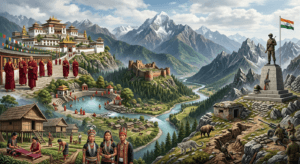
The history of Arunachal Pradesh is deeply rooted in ancient Indian traditions, indigenous tribal cultures, and Buddhist heritage. Archaeological discoveries, ancient scriptures, and local folklore suggest that the region has been inhabited for thousands of years by various indigenous communities, each preserving its own customs, languages, and traditions.
According to Hindu mythology, Arunachal Pradesh is associated with several episodes from the Ramayana and the Mahabharata. The sacred Parashuram Kund in Lohit district is believed to be the place where Sage Parashurama washed away his sins. Another important legend connects Bhismaknagar with King Bhismaka and his daughter Rukmini, who later married Lord Krishna.
Buddhism spread across the western Himalayan region of Arunachal Pradesh between the 7th and 17th centuries through Tibetan influence. The construction of the magnificent Tawang Monastery in the 17th century established the region as one of the most important centres of Mahayana Buddhism in India. The monastery continues to serve as a major spiritual and cultural landmark.
For centuries, the region remained under the control of independent tribal communities with limited influence from external kingdoms. During the British colonial period, the area became strategically important due to its proximity to Tibet and Burma (now Myanmar). The British administration gradually established control over parts of the region and introduced the Inner Line Regulation of 1873, which continues to regulate entry into certain protected areas.
After India’s independence in 1947, the region was administered as the North-East Frontier Agency (NEFA) under the Ministry of External Affairs and later the Ministry of Home Affairs. During the 1962 Sino-Indian War, Arunachal Pradesh became the main battleground between India and China. Although Chinese forces temporarily occupied parts of the region, they later withdrew, and India re-established full administrative control.
On 20 January 1972, NEFA was renamed the Union Territory of Arunachal Pradesh. Later, on 20 February 1987, Arunachal Pradesh officially became the 24th state of India, marking a significant milestone in its political and administrative history.
Today, Arunachal Pradesh is recognized for its strategic importance, rich tribal heritage, Buddhist monasteries, biodiversity, and vibrant cultural traditions. It continues to play a vital role in India’s national security, tourism, hydropower development, and environmental conservation.
Timeline of Arunachal Pradesh History
| Year / Period | Historical Event |
|---|---|
| Ancient Period | Indigenous tribes settled across the Eastern Himalayas. |
| Mythological Era | References in the Ramayana and Mahabharata; Parashuram Kund and Bhismaknagar traditions. |
| 7th–17th Century | Spread of Mahayana Buddhism in western Arunachal Pradesh. |
| 1680–1681 | Construction of Tawang Monastery. |
| 1873 | The British introduced the Inner Line Regulation. |
| 1947 | The region became part of independent India. |
| 1954 | North-East Frontier Agency (NEFA) was officially established. |
| 1962 | The Sino-Indian War was fought in Arunachal Pradesh. |
| 20 January 1972 | NEFA was renamed the Union Territory of Arunachal Pradesh. |
| 20 February 1987 | Arunachal Pradesh became the 24th State of India. |
Geography of Arunachal Pradesh
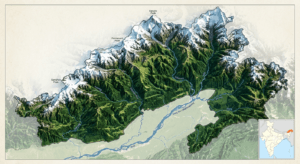
Arunachal Pradesh is the largest state in Northeast India, covering an area of 83,743 square kilometres. Nestled in the Eastern Himalayas, the state is renowned for its dramatic mountain ranges, deep valleys, dense forests, fast-flowing rivers, alpine meadows, and exceptional biodiversity. Its varied landscape makes it one of the most ecologically rich regions in India.
The state lies between 26°28′ N and 29°30′ N latitude and 91°30′ E and 97°30′ E longitude. Arunachal Pradesh shares international borders with China (Tibet Autonomous Region) to the north and northeast, Bhutan to the west, and Myanmar to the east. It is bordered by the Indian states of Assam and Nagaland in the south.
Altitude in Arunachal Pradesh ranges from less than 100 metres in the foothills to over 7,000 metres in the high Himalayan region. Kangto (7,060 m) is the state’s highest peak, while Gorichen Peak (6,488 m) is another prominent mountain attracting trekkers and mountaineers.
The state’s river system is dominated by the mighty Siang River, which enters India from Tibet before becoming the Brahmaputra River in Assam. Other important rivers include the Subansiri, Kameng, Lohit, Dibang, Noa-Dihing, Tirap, and Kamlang. These rivers provide water for agriculture, hydroelectric power generation, and sustain the state’s rich ecosystems.
Nearly 80% of Arunachal Pradesh is covered by forests, making it one of India’s greenest states. The vegetation varies from tropical evergreen forests in the foothills to temperate broadleaf forests, coniferous forests, bamboo groves, alpine meadows, and snow-covered mountain landscapes. This remarkable diversity supports thousands of plant species and a wide variety of wildlife.
The state is also prone to earthquakes, landslides, and heavy monsoon rainfall due to its location in the seismically active Himalayan belt. Despite these natural challenges, Arunachal Pradesh remains one of India’s most spectacular destinations for eco-tourism, trekking, mountaineering, river rafting, wildlife exploration, and nature photography.
Geographical Highlights
| Particular | Details |
|---|---|
| Total Area | 83,743 sq km |
| Region | Eastern Himalayas |
| Highest Peak | Kangto (7,060 m) |
| Major Mountain | Gorichen Peak (6,488 m) |
| Major Rivers | Siang, Subansiri, Kameng, Lohit, Dibang, Noa-Dihing |
| Forest Cover | Nearly 80% of the state’s geographical area |
| International Borders | China (Tibet Autonomous Region), Bhutan, Myanmar |
| Neighboring Indian States | Assam, Nagaland |
| Latitude | 26°28′ N – 29°30′ N |
| Longitude | 91°30′ E – 97°30′ E |
Climate of Arunachal Pradesh
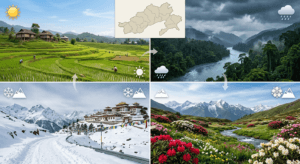
Arunachal Pradesh experiences a diverse climate due to its wide variation in altitude, ranging from tropical conditions in the foothills to alpine weather in the high Himalayas. The state’s climate is generally classified into tropical, subtropical, temperate, and alpine zones, making it one of India’s most climatically diverse regions.
The summer season (March to June) is pleasant in most parts of the state. Temperatures in the lower valleys range from 20°C to 35°C, while hill stations such as Tawang, Bomdila, and Ziro enjoy cooler weather with temperatures between 10°C and 25°C. This is an ideal time for sightseeing, trekking, and outdoor activities.
The monsoon season (June to September) brings heavy rainfall due to the southwest monsoon. Annual rainfall ranges between 2,000 mm and 5,000 mm, making Arunachal Pradesh one of the wettest states in India. The abundant rainfall supports lush forests, rivers, and agriculture but may also cause landslides and road disruptions in mountainous areas.
The winter season (October to February) is cold and dry. Temperatures in the higher Himalayan regions often fall below 0°C, with heavy snowfall in places like Tawang, Sela Pass, and Mechuka. Lower-altitude regions remain relatively mild, with temperatures generally ranging from 8°C to 20°C.
Because of its varied climate, Arunachal Pradesh supports an extraordinary range of ecosystems, from tropical rainforests to alpine meadows. The best time to visit the state is generally October to April, when the weather is pleasant and ideal for exploring its natural beauty, monasteries, valleys, and wildlife.
Seasonal Climate Overview
| Season | Months | Temperature | Weather |
|---|---|---|---|
| Summer | March – June | 20°C – 35°C (plains), 10°C – 25°C (hills) | Pleasant weather, ideal for sightseeing, trekking, and outdoor activities. |
| Monsoon | June – September | 18°C – 30°C | Heavy rainfall with lush greenery; occasional landslides in hilly regions. |
| Winter | October – February | Below 0°C to 20°C | Cold weather with snowfall in higher altitudes like Tawang and Sela Pass. |
Major Rivers of Arunachal Pradesh
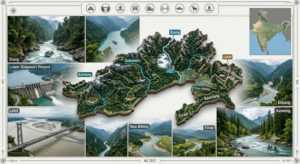
Arunachal Pradesh is blessed with an extensive network of Himalayan rivers that originate from glaciers and high-altitude regions in the Eastern Himalayas. These rivers are the lifeline of the state, supporting agriculture, drinking water supply, hydroelectric power generation, fisheries, biodiversity, and transportation in some remote areas. Most of these rivers eventually merge with the Brahmaputra River after flowing into Assam.
The Siang River, known as the Yarlung Tsangpo in Tibet, is the largest and most significant river in Arunachal Pradesh. After entering India near Gelling, it flows through deep gorges and scenic valleys before joining the Dibang and Lohit rivers in Assam to form the mighty Brahmaputra.
The Subansiri River is the largest tributary of the Brahmaputra and is famous for its fast-flowing waters and immense hydropower potential. Other important rivers such as the Kameng, Lohit, Dibang, Noa-Dihing, Kamlang, and Tirap flow through different parts of the state, nourishing forests, wildlife habitats, and agricultural lands.
These rivers also play a vital role in adventure tourism. Activities such as river rafting, angling, camping, and nature photography attract visitors from across India and abroad. The pristine river valleys of Arunachal Pradesh remain among the least disturbed natural landscapes in the country.
Major Rivers of Arunachal Pradesh
| River | Origin | Importance |
|---|---|---|
| Siang | Tibet (Yarlung Tsangpo) | Forms the Brahmaputra River, supports rafting, irrigation, fisheries, and hydroelectric projects. |
| Subansiri | Tibet | Largest tributary of the Brahmaputra; known for hydropower generation and irrigation. |
| Kameng | Eastern Himalayas | Supports agriculture, biodiversity, tourism, and river rafting. |
| Lohit | Eastern Tibet | Flows through Parashuram Kund before joining the Brahmaputra; important for pilgrimage and irrigation. |
| Dibang | Mishmi Hills | Known for hydropower potential, wildlife habitats, and scenic valleys. |
| Noa-Dihing | Patkai Hills | Flows through Namdapha National Park and supports rich biodiversity. |
| Kamlang | Eastern Himalayas | Provides water for agriculture and sustains forest ecosystems and wildlife. |
| Tirap | Patkai Hills | Supports agriculture, local livelihoods, and rural communities. |
Agriculture of Arunachal Pradesh
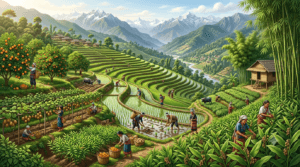
Agriculture is the backbone of Arunachal Pradesh’s economy, providing livelihood to a large portion of the population. Most farming is carried out by indigenous tribal communities, who combine traditional knowledge with modern agricultural practices. The state’s fertile valleys, abundant rainfall, numerous rivers, and favorable climate create ideal conditions for cultivating a wide variety of crops.
One of the traditional farming methods practiced in the state is Jhum (Shifting Cultivation), where land is cultivated for a few years before being left fallow to regenerate naturally. Although this method remains important in many tribal areas, the government is promoting sustainable farming practices, terrace cultivation, and horticulture to improve productivity while conserving the environment.
Rice is the principal food crop and is cultivated extensively across the river valleys and plains. Other important crops include maize, millets, wheat, barley, pulses, oilseeds, sugarcane, ginger, turmeric, and vegetables. The state is also emerging as a major producer of organic agricultural products due to limited use of chemical fertilizers and pesticides.
Horticulture plays a significant role in Arunachal Pradesh’s economy. The state is well known for producing oranges, kiwis, apples, pineapples, bananas, pears, plums, walnuts, and large cardamom. High-quality fruits grown in the cool Himalayan climate are increasingly finding markets across India.
Spices such as ginger, turmeric, large cardamom, and black pepper are cultivated in several districts. Bamboo and cane resources also contribute significantly to rural livelihoods by supporting traditional handicrafts and small-scale industries.
The government encourages farmers through irrigation projects, agricultural extension services, organic farming initiatives, horticulture missions, and improved market connectivity. These efforts are helping increase farmers’ incomes while promoting environmentally sustainable agriculture.
Major Crops of Arunachal Pradesh
| Crop Category | Major Crops |
|---|---|
| Food Crops | Rice, Maize, Wheat, Millets, Barley |
| Pulses | Lentils, Gram, Peas |
| Cash Crops | Ginger, Turmeric, Sugarcane |
| Fruits | Orange, Kiwi, Apple, Pineapple, Banana, Pear, Plum |
| Spices | Large Cardamom, Ginger, Turmeric, Black Pepper |
| Plantation & Others | Tea, Rubber, Bamboo, Cane |
Flora and Fauna of Arunachal Pradesh
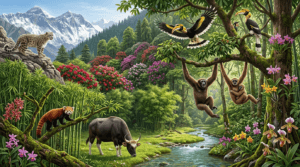
Arunachal Pradesh is one of India’s richest biodiversity hotspots and is recognized as part of the Eastern Himalaya Biodiversity Hotspot. Nearly 80% of the state’s geographical area is covered by forests, ranging from tropical evergreen forests in the foothills to temperate forests, coniferous forests, alpine meadows, and snow-covered mountain ecosystems. This remarkable diversity supports thousands of species of plants, birds, mammals, reptiles, amphibians, and insects.
The state is home to more than 5,000 species of flowering plants, including hundreds of varieties of orchids, rhododendrons, medicinal herbs, bamboo, cane, ferns, and rare alpine vegetation. Arunachal Pradesh is often called the “Orchid Paradise of India” because it has one of the highest concentrations of orchid species in the country. The Lady’s Slipper Orchid is the official state flower.
Arunachal Pradesh also shelters an extraordinary variety of wildlife. The Mithun (Gayal) is the state animal and plays an important role in the cultural and economic life of many tribal communities. The Great Hornbill, known for its impressive yellow casque and large wingspan, is the state bird and is commonly found in the state’s tropical forests.
Rare and endangered mammals such as the Red Panda, Snow Leopard, Clouded Leopard, Tiger, Asian Elephant, Hoolock Gibbon, Musk Deer, Takin, Gaur, and Himalayan Black Bear inhabit different parts of the state. Arunachal Pradesh is also a paradise for birdwatchers, with more than 700 recorded bird species, making it one of India’s premier birding destinations.
The state’s unique ecosystems are protected through national parks, wildlife sanctuaries, tiger reserves, community forests, and conservation programs. These efforts help preserve its exceptional biodiversity while promoting eco-tourism and sustainable environmental management.
State Symbols of Arunachal Pradesh
| Symbol | Name |
|---|---|
| State Animal | Mithun (Gayal) |
| State Bird | Great Hornbill |
| State Flower | Lady’s Slipper Orchid |
| State Tree | Hollong (Dipterocarpus macrocarpus) |
National Parks and Wildlife Sanctuaries of Arunachal Pradesh
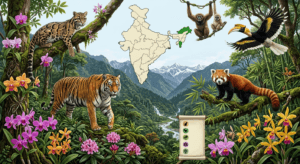
Arunachal Pradesh is one of India’s most important wildlife destinations, thanks to its vast forests, pristine river valleys, and diverse Himalayan ecosystems. The state is home to two national parks and thirteen wildlife sanctuaries, which protect a remarkable variety of flora and fauna. These protected areas range from tropical rainforests to alpine meadows, providing habitats for many endangered and endemic species.
The most famous protected area is Namdapha National Park, located in Changlang district. It is India’s third-largest national park and one of the country’s richest biodiversity hotspots. Namdapha is unique because it supports four species of big cats—Tiger, Leopard, Snow Leopard, and Clouded Leopard—along with Red Panda, Hoolock Gibbon, Asiatic Black Bear, and numerous rare birds.
Another major protected area is Mouling National Park, situated in the Upper Siang and Shi Yomi districts. The park is known for its dense forests, rugged mountains, and rich wildlife, including Red Panda, Himalayan Black Bear, Serow, and several species of pheasants and hornbills.
The state also has several important wildlife sanctuaries, including Pakke Tiger Reserve, Eaglenest Wildlife Sanctuary, Mehao Wildlife Sanctuary, Kamlang Wildlife Sanctuary, Sessa Orchid Sanctuary, Dibang Wildlife Sanctuary, Daying Ering Memorial Wildlife Sanctuary, and Talley Valley Wildlife Sanctuary. These areas are globally recognized for birdwatching, orchid diversity, trekking, and eco-tourism.
Together, these protected areas preserve Arunachal Pradesh’s exceptional biodiversity while promoting wildlife conservation, scientific research, sustainable tourism, and environmental education.
Major National Parks and Wildlife Sanctuaries
| Protected Area | Type | Famous For |
|---|---|---|
| Namdapha National Park | National Park | Tiger, Clouded Leopard, Snow Leopard, Red Panda, rich biodiversity |
| Mouling National Park | National Park | Himalayan forests, Red Panda, Himalayan Black Bear, rare wildlife |
| Pakke Tiger Reserve | Tiger Reserve | Bengal Tiger, Asian Elephant, Great Hornbill, birdwatching |
| Eaglenest Wildlife Sanctuary | Wildlife Sanctuary | Bugun Liocichla, rare Himalayan birds, biodiversity hotspot |
| Mehao Wildlife Sanctuary | Wildlife Sanctuary | Mehao Lake, Mishmi Takin, evergreen forests |
| Kamlang Wildlife Sanctuary | Wildlife Sanctuary | Dense forests, elephants, leopards, rich birdlife |
| Talley Valley Wildlife Sanctuary | Wildlife Sanctuary | Alpine forests, orchids, trekking, biodiversity |
| Sessa Orchid Sanctuary | Wildlife Sanctuary | More than 200 species of orchids and rich floral diversity |
| Dibang Wildlife Sanctuary | Wildlife Sanctuary | High-altitude Himalayan wildlife and pristine forests |
| Daying Ering Memorial Wildlife Sanctuary | Wildlife Sanctuary | Wetlands, migratory birds, riverine ecosystem |
Culture and Traditions of Arunachal Pradesh
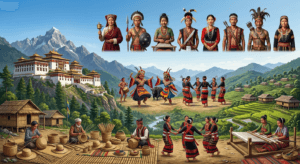
Arunachal Pradesh is one of India’s most culturally diverse states, with 26 major tribes and more than 100 sub-tribes, each preserving its unique language, customs, traditional attire, festivals, and way of life. The state’s rich cultural heritage reflects centuries of harmonious coexistence between people and nature, making it a fascinating destination for cultural tourism.
The major tribes include the Monpa, Adi, Nyishi, Apatani, Galo, Mishmi, Tagin, Nocte, Wancho, Tangsa, Sherdukpen, Aka (Hrusso), Memba, Khampti, and Singpho communities. Each tribe has its own dialect, folklore, rituals, dance forms, handicrafts, and architectural style.
Traditional attire varies among tribes and is beautifully woven using locally produced wool, cotton, and natural fibers. Colorful handwoven shawls, jackets, bamboo hats, bead necklaces, silver ornaments, and cane accessories are commonly worn during festivals and ceremonies.
Music and dance are integral parts of Arunachal Pradesh’s cultural identity. Folk dances such as Aji Lhamu, Ponung, Popir, Buiya, and Yak Dance are performed during festivals, harvest celebrations, weddings, and religious ceremonies. Traditional musical instruments include drums, gongs, bamboo flutes, trumpets, and cymbals.
The people of Arunachal Pradesh are renowned for their exceptional bamboo and cane craftsmanship. Skilled artisans create baskets, mats, furniture, masks, jewelry, weapons, and household items using locally available natural materials. Handloom weaving is another important traditional art practiced by tribal women across the state.
Buddhism is the predominant religion in western Arunachal Pradesh, particularly among the Monpa and Sherdukpen communities, while Donyi-Polo, an indigenous nature-based faith, is widely followed by tribes such as the Adi, Nyishi, Galo, and Tagin. Hinduism and Christianity are also practiced in different parts of the state, contributing to its rich religious diversity.
Despite modernization, the people of Arunachal Pradesh continue to preserve their traditional customs, community festivals, indigenous knowledge, and sustainable lifestyle, making the state one of India’s finest examples of living tribal heritage.
Major Tribes of Arunachal Pradesh
| Tribe | Primary Region | Known For |
|---|---|---|
| Monpa | Tawang, West Kameng | Tibetan Buddhism, Tawang Monastery, traditional wool weaving |
| Adi | East Siang, Upper Siang | Ponung Dance, Donyi-Polo faith, bamboo craftsmanship |
| Nyishi | Papum Pare, Kurung Kumey | Traditional bamboo hats, Nyokum Festival, rich tribal customs |
| Apatani | Ziro Valley (Lower Subansiri) | Sustainable wet rice cultivation, Apatani cultural heritage |
| Galo | West Siang, Leparada | Mopin Festival, handloom weaving, folk traditions |
| Mishmi | Dibang Valley, Lohit, Anjaw | Traditional medicine, colorful attire, handicrafts |
| Nocte | Tirap | Wood carving, folk dances, traditional festivals |
| Wancho | Longding | Bamboo crafts, bead ornaments, colorful tribal attire |
| Tangsa | Changlang | Traditional weaving, festivals, bamboo handicrafts |
| Sherdukpen | West Kameng | Buddhist culture, handloom weaving, traditional crafts |
Festivals of Arunachal Pradesh
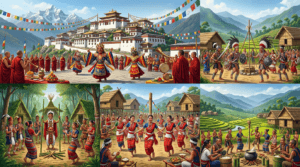
Festivals are an integral part of life in Arunachal Pradesh and reflect the state’s rich tribal heritage, agricultural traditions, and spiritual beliefs. With more than 26 major tribes and over 100 sub-tribes, each community celebrates its own unique festivals with traditional music, dance, rituals, colorful attire, and community feasts. These festivals strengthen social bonds, preserve ancient customs, and express gratitude to nature for prosperity and a good harvest.
One of the most famous festivals is the Losar Festival, celebrated by the Monpa community as the Tibetan New Year. The festival is marked by prayers at monasteries, masked dances, cultural performances, and festive gatherings.
The Nyokum Festival, celebrated by the Nyishi tribe, is dedicated to seeking peace, prosperity, and a good harvest. Traditional rituals, folk songs, dances, and community celebrations are central to the event.
The Mopin Festival is the most important festival of the Galo tribe. People wear traditional white attire, perform the famous Popir Dance, and pray for happiness, prosperity, and a successful agricultural season.
The Solung Festival, celebrated by the Adi tribe, is a major harvest festival that includes rituals, traditional dances, songs, and community feasts. It honors nature and seeks blessings for abundant crops and good health.
The Dree Festival is celebrated by the Apatani tribe in the picturesque Ziro Valley. It is one of the state’s largest agricultural festivals and is dedicated to ensuring a successful paddy harvest through traditional rituals, dances, and cultural programs.
Other important festivals include Si-Donyi (Tagin), Reh (Idu Mishmi), Boori Boot (Hill Miri/Nyishi), Sanken (Khampti), Tamladu (Mishmi), Chalo Loku (Nocte), and Oriah (Wancho). These celebrations showcase Arunachal Pradesh’s extraordinary cultural diversity and continue to attract visitors from across India and the world.
Major Festivals of Arunachal Pradesh
| Festival | Celebrated By | Significance |
|---|---|---|
| Losar | Monpa Tribe | Tibetan New Year celebrated with Buddhist prayers, masked dances, and cultural programs. |
| Nyokum | Nyishi Tribe | Prayers for peace, prosperity, good health, and a successful harvest. |
| Mopin | Galo Tribe | Agricultural festival celebrating prosperity, happiness, and abundant harvests. |
| Solung | Adi Tribe | Harvest festival featuring traditional rituals, folk dances, songs, and community feasts. |
| Dree | Apatani Tribe | Celebrated for successful paddy cultivation, agricultural prosperity, and community welfare. |
| Si-Donyi | Tagin Tribe | Nature worship festival dedicated to the Sun (Si) and Moon (Donyi). |
| Reh | Idu Mishmi Tribe | Festival seeking prosperity, good fortune, and community well-being. |
| Chalo Loku | Nocte Tribe | Post-harvest festival celebrating unity, gratitude, and cultural traditions. |
| Sanken | Khampti Tribe | Traditional Buddhist New Year celebrated with water rituals and prayers. |
| Oriah | Wancho Tribe | Harvest festival marked by folk dances, traditional music, and community celebrations. |
Famous Food of Arunachal Pradesh
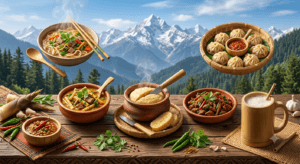
The cuisine of Arunachal Pradesh reflects the state’s rich tribal traditions, fresh natural ingredients, and Himalayan lifestyle. Unlike many other Indian states, the food here is generally mild in spices and emphasizes the natural flavors of locally grown vegetables, herbs, meat, bamboo shoots, and fermented ingredients. Rice is the staple food and is enjoyed with a variety of meat, fish, and vegetable dishes.
One of the most popular traditional dishes is Thukpa, a hearty noodle soup prepared with vegetables, chicken, or meat. Originally influenced by Tibetan cuisine, it is widely consumed, especially in the colder regions such as Tawang and West Kameng.
Another favorite is Momos, steamed dumplings filled with vegetables, chicken, pork, or yak meat. They are served with spicy chutney and are available in homes, local markets, and restaurants throughout the state.
Bamboo Shoot Curry is a signature delicacy prepared using fresh or fermented bamboo shoots cooked with pork, chicken, fish, or vegetables. Its unique flavor makes it one of Arunachal Pradesh’s most iconic dishes.
Zan is a traditional millet-based dish popular among the Monpa community. It is nutritious and usually served with vegetables, meat, or fermented cheese. Pika Pila, a spicy pickle made from bamboo shoots and king chilies, is another well-known tribal specialty.
Other popular foods include Lukter (dried meat with chili flakes), Pehak (fermented soybean chutney), Marua (finger millet preparation), Apong (traditional rice beverage), smoked meat, boiled leafy vegetables, and fresh river fish.
The cuisine of Arunachal Pradesh is deeply connected to nature and tribal culture, offering healthy, organic, and authentic Himalayan flavors that provide visitors with a unique culinary experience.
Popular Dishes of Arunachal Pradesh
| Dish | Main Ingredients | Specialty |
|---|---|---|
| Thukpa | Noodles, vegetables, chicken or meat | Traditional Himalayan noodle soup, popular in Tawang and other high-altitude regions. |
| Momos | Flour, vegetables, chicken, pork or yak meat | Steamed dumplings served with spicy chutney. |
| Bamboo Shoot Curry | Fresh or fermented bamboo shoots, meat or vegetables | One of Arunachal Pradesh’s signature tribal delicacies. |
| Zan | Millet flour | Traditional Monpa staple food served with vegetables or meat. |
| Pika Pila | Fermented bamboo shoots and king chili | Spicy tribal pickle with a distinctive flavor. |
| Lukter | Dried meat and chili flakes | Traditional smoked meat dish enjoyed by several tribal communities. |
| Pehak | Fermented soybean and chili | Popular tribal chutney served with rice and meat dishes. |
| Apong | Fermented rice | Traditional rice beverage prepared during festivals and celebrations. |
Tourist Places in Arunachal Pradesh
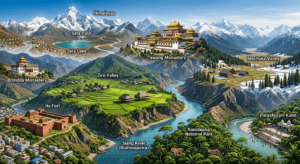
Arunachal Pradesh is one of India’s most spectacular travel destinations, offering breathtaking Himalayan landscapes, ancient Buddhist monasteries, pristine valleys, crystal-clear lakes, dense forests, and vibrant tribal culture. Often called the “Land of the Rising Sun,” the state attracts nature lovers, adventure seekers, wildlife enthusiasts, and spiritual travelers from around the world.
The most famous attraction is Tawang, home to the magnificent Tawang Monastery, the largest monastery in India and the second-largest in the world. Nearby attractions such as Sela Pass and Sela Lake offer mesmerizing views of snow-covered mountains throughout the year.
Ziro Valley, a UNESCO World Heritage Tentative Site, is renowned for its picturesque landscapes, Apatani tribal culture, and the internationally acclaimed Ziro Music Festival. The valley is surrounded by lush green paddy fields, pine forests, and charming villages.
Namdapha National Park is one of India’s richest biodiversity hotspots, featuring tropical rainforests, rare wildlife, and excellent trekking opportunities. Mechuka Valley, located near the Indo-China border, is famous for its untouched natural beauty, Buddhist monasteries, and adventure tourism.
Other must-visit destinations include Bomdila, known for its monasteries and panoramic Himalayan views; Itanagar, the state capital featuring the historic Ita Fort and Gompa; Parashuram Kund, a sacred Hindu pilgrimage site; Roing, famous for Mayudia Pass and Mehao Lake; and Pasighat, the oldest town in Arunachal Pradesh and a gateway to the Siang River.
Whether you are interested in trekking, river rafting, wildlife photography, spiritual tourism, or exploring indigenous cultures, Arunachal Pradesh offers unforgettable travel experiences in every season.
Top Tourist Attractions
| Tourist Place | District | Famous For |
|---|---|---|
| Tawang | Tawang | Tawang Monastery, snow-capped Himalayas, Buddhist culture |
| Sela Pass & Sela Lake | Tawang | High-altitude mountain pass, crystal-clear lake, breathtaking scenery |
| Ziro Valley | Lower Subansiri | Apatani tribal culture, paddy fields, Ziro Music Festival |
| Namdapha National Park | Changlang | Rich biodiversity, rare wildlife, trekking, rainforest ecosystem |
| Mechuka Valley | Shi Yomi | Pristine Himalayan landscapes, monasteries, adventure tourism |
| Bomdila | West Kameng | Buddhist monasteries, apple orchards, panoramic mountain views |
| Itanagar | Papum Pare | Ita Fort, Gompa, Jawaharlal Nehru State Museum |
| Parashuram Kund | Lohit | Sacred Hindu pilgrimage site and Makar Sankranti festival |
| Roing | Lower Dibang Valley | Mehao Lake, Mayudia Pass, trekking, scenic beauty |
| Pasighat | East Siang | Siang River, river rafting, adventure tourism |
Transport in Arunachal Pradesh
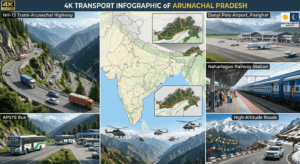
Despite its rugged Himalayan terrain, Arunachal Pradesh has witnessed significant improvements in transportation infrastructure over the past decade. The state is connected to the rest of India through an expanding network of national highways, railways, airports, and helicopter services, making travel more convenient for residents and tourists.
Road Transport
Roadways are the primary mode of transportation in Arunachal Pradesh. The state is connected to neighboring Assam and Nagaland through National Highway 13 (NH-13), also known as the Trans-Arunachal Highway, which is one of the state’s most important infrastructure projects. Other national and state highways connect major towns such as Itanagar, Tawang, Bomdila, Pasighat, Tezu, Ziro, Aalo, and Namsai.
The Arunachal Pradesh State Transport Services (APSTS) operates regular bus services connecting district headquarters and nearby states. Private taxis, shared cabs, and rental vehicles are also widely available.
Rail Transport
Rail connectivity in Arunachal Pradesh has improved significantly. Naharlagun Railway Station, located near Itanagar, is the state’s major railway station and is connected to cities such as New Delhi, Guwahati, and Naharlagun through direct and connecting train services.
Other nearby railway stations serving different parts of the state include Harmuti (Assam), Murkongselek (Assam), and Tinsukia (Assam).
Air Transport
The state’s first greenfield airport, Donyi Polo Airport (Itanagar), has greatly improved air connectivity. It offers regular flights to cities such as Delhi, Kolkata, Guwahati, and other regional destinations.
Other nearby airports include Tezu Airport, Pasighat Airport, and Lilabari Airport (Assam), providing additional access to different regions of the state.
Helicopter Services
Due to the mountainous terrain and remote locations, helicopter services operated under government-supported schemes connect remote districts such as Tawang, Mechuka, Tuting, Anini, and Vijaynagar, improving accessibility for residents and emergency services.
Inner Line Permit (ILP)
Indian citizens (except residents of Arunachal Pradesh) must obtain an Inner Line Permit (ILP) before entering the state. Foreign nationals require a Protected Area Permit (PAP) as per Government of India regulations.
Transport at a Glance
| Mode of Transport | Major Facilities |
|---|---|
| Road | NH-13 (Trans-Arunachal Highway), APSTS buses, taxis, shared cabs |
| Railway | Naharlagun Railway Station (nearest major railhead for Itanagar) |
| Airport | Donyi Polo Airport (Itanagar), Tezu Airport, Pasighat Airport |
| Nearby Airport | Lilabari Airport (North Lakhimpur, Assam) |
| Helicopter Services | Government-operated services to Tawang, Mechuka, Tuting, Anini, Vijaynagar, and other remote areas |
| Special Permit | Inner Line Permit (ILP) for Indian visitors; Protected Area Permit (PAP) for foreign nationals |
Shopping in Arunachal Pradesh
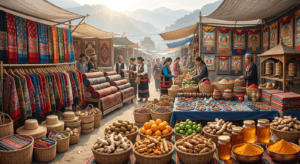
Shopping in Arunachal Pradesh offers visitors an opportunity to explore the state’s rich tribal heritage through authentic handicrafts, handloom products, bamboo and cane items, traditional jewelry, and locally produced organic goods. Most products are handmade by skilled artisans using techniques passed down through generations, making them unique souvenirs that reflect the state’s cultural identity.
One of the most popular purchases is handwoven shawls and traditional tribal textiles crafted by communities such as the Monpa, Apatani, Adi, Galo, and Nyishi. These colorful fabrics feature intricate geometric patterns and are woven using traditional looms.
The state is also famous for its bamboo and cane handicrafts, including baskets, hats, mats, furniture, trays, decorative items, and household products. These eco-friendly products are admired for their durability, craftsmanship, and sustainable use of natural resources.
Traditional ornaments such as bead necklaces, silver jewelry, wooden masks, tribal accessories, and ceremonial items are widely available in local markets. Visitors can also purchase handmade carpets, Buddhist prayer wheels, Thangka paintings, woolen garments, and monastery souvenirs, especially in Tawang and Bomdila.
Arunachal Pradesh is also known for its organic agricultural products, including kiwi, oranges, ginger, turmeric, large cardamom, honey, tea, bamboo shoot pickles, and herbal products. These locally produced items are popular among tourists looking for authentic Himalayan flavors.
Best Shopping Places
- Itanagar Market – Handicrafts, textiles, souvenirs, organic products.
- Tawang Market – Buddhist artifacts, woolen clothing, carpets, prayer flags, Thangka paintings.
- Bomdila Market – Monpa handicrafts, traditional garments, local crafts.
- Ziro Market – Apatani handloom products, bamboo crafts, tribal jewelry.
- Pasighat Market – Cane products, organic spices, local fruits, handmade souvenirs.
Popular Shopping Items
| Item | Specialty |
|---|---|
| Handwoven Shawls | Traditional tribal weaving with vibrant colors and intricate geometric patterns. |
| Bamboo & Cane Handicrafts | Eco-friendly baskets, mats, furniture, hats, trays, and decorative items. |
| Thangka Paintings | Traditional Tibetan Buddhist paintings depicting deities and spiritual themes. |
| Buddhist Prayer Wheels | Handcrafted religious souvenirs commonly available near monasteries. |
| Tribal Jewelry | Handmade bead necklaces, silver ornaments, bracelets, and traditional accessories. |
| Handmade Carpets | Beautiful woolen carpets woven by the Monpa community using traditional techniques. |
| Organic Spices | Fresh ginger, turmeric, large cardamom, and locally grown black pepper. |
| Organic Products | Kiwi, oranges, honey, tea, bamboo shoot pickles, and herbal products. |
Best Time to Visit Arunachal Pradesh
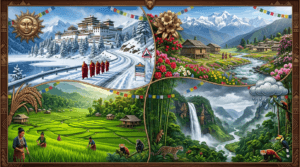
Arunachal Pradesh is a year-round destination, but the ideal time to visit depends on the type of experience you are looking for. Thanks to its diverse geography and altitude, the state offers pleasant weather, snow-covered mountains, colorful festivals, and lush green landscapes during different seasons.
The best time to visit Arunachal Pradesh is from October to April, when the weather is cool, dry, and ideal for sightseeing, trekking, wildlife exploration, and cultural tourism. During this period, visitors can comfortably explore famous destinations such as Tawang, Ziro Valley, Bomdila, Mechuka, Namdapha National Park, and Sela Pass.
Winter (October to February) is perfect for travelers who wish to experience snowfall in Tawang, Sela Pass, and other high-altitude regions. Temperatures often fall below freezing in the mountains, creating spectacular snow-covered landscapes.
Spring and Summer (March to June) offer pleasant weather with blooming flowers, clear skies, and comfortable temperatures. This season is ideal for trekking, photography, camping, birdwatching, and visiting national parks and wildlife sanctuaries.
The Monsoon season (June to September) transforms the state into a lush green paradise with abundant waterfalls and vibrant forests. However, heavy rainfall may trigger landslides and road closures in some mountainous areas, making travel more challenging.
Travelers planning a trip should also consider visiting during major tribal festivals such as Losar, Mopin, Dree, Solung, and Nyokum, which provide an excellent opportunity to experience Arunachal Pradesh’s rich cultural heritage.
Season-wise Travel Guide
| Season | Months | Best For |
|---|---|---|
| Winter | October – February | Snowfall in Tawang and Sela Pass, monasteries, sightseeing, photography, winter landscapes. |
| Spring | March – April | Blooming flowers, trekking, birdwatching, pleasant weather, nature photography. |
| Summer | May – June | Adventure activities, Ziro Valley, Mechuka, wildlife tourism, cultural festivals. |
| Monsoon | June – September | Lush greenery, waterfalls, scenic beauty (travel with caution due to heavy rainfall and landslides). |
How to Reach Arunachal Pradesh
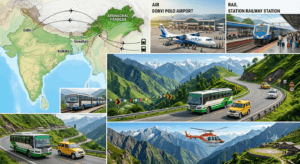
Arunachal Pradesh is well connected to the rest of India by air, rail, and road. Although the state’s mountainous terrain presents unique challenges, significant improvements in transport infrastructure have made traveling to this northeastern destination much easier. Visitors can reach the state through nearby airports, railway stations, and an expanding network of national highways.
By Air
The most convenient way to reach Arunachal Pradesh is by air. Donyi Polo Airport at Itanagar is the state’s primary airport and operates regular flights from major cities such as Delhi, Kolkata, and Guwahati. Other airports within the state include Tezu Airport and Pasighat Airport, while Lilabari Airport (Assam) and Dibrugarh Airport (Assam) also serve as important gateways.
By Train
Arunachal Pradesh has improved its railway connectivity with Naharlagun Railway Station, located near Itanagar. The station is connected to cities including New Delhi, Guwahati, and Naharlagun through direct and connecting trains. Travelers can also use nearby railway stations such as Harmuti, North Lakhimpur, Murkongselek, and Tinsukia in Assam before continuing by road.
By Road
The state is connected to neighboring Assam and Nagaland through National Highway 13 (Trans-Arunachal Highway) and several other national and state highways. Regular APSTS buses, private buses, taxis, and shared cabs operate between major towns such as Itanagar, Tawang, Bomdila, Ziro, Pasighat, Tezu, Aalo, and Namsai.
Road journeys offer spectacular views of the Eastern Himalayas, river valleys, forests, and traditional tribal villages, making them one of the most scenic travel experiences in Northeast India.
Travel Permit
Indian citizens (except residents of Arunachal Pradesh) must obtain an Inner Line Permit (ILP) before entering the state. Foreign nationals require a Protected Area Permit (PAP). These permits can be obtained online or from designated government offices before travel.
How to Reach at a Glance
| Mode | Major Entry Points |
|---|---|
| By Air | Donyi Polo Airport (Itanagar), Tezu Airport, Pasighat Airport |
| Nearby Airports | Lilabari Airport (North Lakhimpur, Assam), Dibrugarh Airport (Assam) |
| By Train | Naharlagun Railway Station |
| Nearby Railway Stations | Harmuti, North Lakhimpur, Murkongselek, Tinsukia (Assam) |
| By Road | NH-13 (Trans-Arunachal Highway), APSTS buses, private buses, taxis, shared cabs |
| Entry Requirement | Inner Line Permit (ILP) for Indian citizens (except Arunachal Pradesh residents); Protected Area Permit (PAP) for foreign nationals |
Travel Tips for Arunachal Pradesh
Arunachal Pradesh is one of India’s most beautiful and least-explored destinations. Its towering Himalayan mountains, remote valleys, rich tribal culture, and pristine forests offer unforgettable experiences. However, due to the state’s mountainous terrain, changing weather, and protected border areas, careful planning is essential for a safe and enjoyable trip.
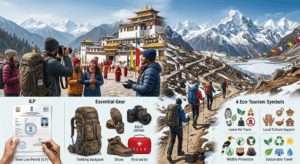
Before traveling, all Indian citizens (except residents of Arunachal Pradesh) must obtain an Inner Line Permit (ILP), while foreign nationals require a Protected Area Permit (PAP). Keeping printed or digital copies of your permit and identification documents is highly recommended.
The ideal time to visit is October to April, when the weather is pleasant and roads are generally in better condition. If traveling during the monsoon season (June to September), be prepared for heavy rainfall, occasional landslides, and road closures.
Carry warm clothing, especially when visiting high-altitude destinations such as Tawang, Sela Pass, Bomdila, and Mechuka, where temperatures can fall below freezing during winter. Layered clothing, waterproof jackets, gloves, comfortable trekking shoes, and rain gear are recommended.
Because many tourist destinations are located in remote areas, travelers should carry sufficient cash, essential medicines, power banks, drinking water, and basic first-aid supplies. Mobile network coverage may be limited in some mountain regions.
Respect the customs and traditions of local tribal communities. Seek permission before photographing people or entering religious sites, and avoid disturbing wildlife or damaging the natural environment. Responsible tourism helps preserve Arunachal Pradesh’s unique cultural and ecological heritage.
Essential Travel Tips
| Tip | Recommendation |
|---|---|
| Travel Permit | Obtain an Inner Line Permit (ILP) for Indian citizens or a Protected Area Permit (PAP) for foreign nationals before entering the state. |
| Best Season | Visit between October and April for pleasant weather and better road conditions. |
| Clothing | Carry warm clothes, a waterproof jacket, gloves, and comfortable trekking shoes, especially for high-altitude areas. |
| Health & Safety | Keep essential medicines, a first-aid kit, drinking water, and stay hydrated during your journey. |
| Cash | Carry sufficient cash, as ATM and digital payment facilities may be limited in remote areas. |
| Mobile Network | Expect limited mobile and internet connectivity in many mountainous and remote regions. |
| Eco-Tourism | Avoid littering, protect wildlife, and help preserve the natural environment. |
| Local Culture | Respect tribal customs and traditions, and seek permission before photographing local people or religious sites. |
Interesting Facts About Arunachal Pradesh
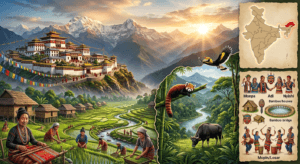
Arunachal Pradesh is one of India’s most fascinating states, known for its breathtaking Himalayan landscapes, remarkable biodiversity, vibrant tribal heritage, and strategic importance. From witnessing the first sunrise in India to housing the country’s largest monastery, the state offers numerous unique attractions and achievements.
The name “Arunachal Pradesh” means “Land of the Rising Sun,” as it is the easternmost state of India and receives the first rays of the sun every morning. This geographical distinction makes it a truly special destination.
The state is home to Tawang Monastery, the largest Buddhist monastery in India and the second-largest in the world, after the Potala Palace complex in Tibet. Built in the 17th century, it remains one of the most important centers of Mahayana Buddhism.
Arunachal Pradesh is part of the Eastern Himalaya Biodiversity Hotspot, one of the richest ecological regions in the world. Nearly 80% of the state’s geographical area is covered by forests, providing habitat for rare species such as the Red Panda, Clouded Leopard, Snow Leopard, and Great Hornbill.
The state has 26 major tribes and over 100 sub-tribes, each with its own language, customs, festivals, and traditional attire. This makes Arunachal Pradesh one of the most culturally diverse states in India.
Another remarkable feature is Ziro Valley, famous for the unique and sustainable wet rice cultivation practiced by the Apatani tribe. The valley is also internationally recognized for hosting the Ziro Music Festival, one of India’s leading outdoor music festivals.
Amazing Facts at a Glance
| Fact | Details |
|---|---|
| Nickname | Land of the Rising Sun |
| Easternmost State | Receives the first sunrise in India every day. |
| Largest Monastery | Tawang Monastery – the largest Buddhist monastery in India and the second-largest in the world. |
| Forest Cover | Nearly 80% of the state’s geographical area is covered by forests. |
| Major Tribes | Home to 26 major tribes and more than 100 sub-tribes. |
| Biodiversity | Part of the Eastern Himalaya Biodiversity Hotspot with exceptional flora and fauna. |
| Famous Valley | Ziro Valley, known for Apatani culture and the Ziro Music Festival. |
| Highest Peak | Kangto (7,060 m), the highest mountain in Arunachal Pradesh. |
| Largest National Park | Namdapha National Park, one of India’s richest biodiversity hotspots. |
| State Animal | Mithun (Gayal) |
UNESCO World Heritage Sites of Arunachal Pradesh
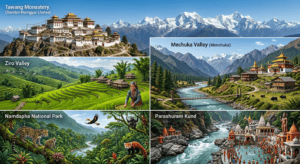
Arunachal Pradesh is renowned for its breathtaking Himalayan landscapes, vibrant tribal heritage, and exceptional biodiversity. Although the state does not currently have any UNESCO World Heritage Sites, it is home to several places of outstanding natural and cultural significance that have gained national and international recognition.
One of the most notable places is Ziro Valley, which has been included on UNESCO’s Tentative List for its unique cultural landscape. The valley is inhabited by the Apatani tribe, whose sustainable wet rice cultivation and traditional water management practices have attracted global attention. This harmonious relationship between people and nature makes Ziro Valley a strong candidate for future UNESCO World Heritage status.
Another globally significant destination is Namdapha National Park, one of India’s richest biodiversity hotspots. Although it is not a UNESCO World Heritage Site, the park is internationally recognized for its remarkable ecological diversity, ranging from tropical rainforests to alpine ecosystems. It is home to rare species such as the Red Panda, Clouded Leopard, Snow Leopard, and Hoolock Gibbon.
The state’s cultural heritage is further represented by Tawang Monastery, one of the most important Buddhist monasteries in Asia. While it is not a UNESCO World Heritage Site, it is considered one of India’s most valuable spiritual and historical landmarks.
With its unique combination of pristine landscapes, indigenous traditions, and ecological richness, Arunachal Pradesh has several sites that possess strong potential for future UNESCO recognition.
UNESCO-Related Heritage Sites
| Site | UNESCO Status | Significance |
|---|---|---|
| Ziro Valley | UNESCO Tentative List | Apatani cultural landscape, sustainable wet rice cultivation, and traditional water management system. |
| Namdapha National Park | Not Listed | One of India’s richest biodiversity hotspots with tropical rainforests and rare wildlife. |
| Tawang Monastery | Not Listed | Largest Buddhist monastery in India and an important center of Mahayana Buddhism. |
| Mechuka Valley | Not Listed | Scenic Himalayan valley known for its natural beauty, Buddhist heritage, and adventure tourism. |
| Parashuram Kund | Not Listed | Ancient Hindu pilgrimage site associated with Sage Parashurama and the Makar Sankranti festival. |

Famous Personalities of Arunachal Pradesh
Arunachal Pradesh has produced many distinguished personalities who have made remarkable contributions to politics, literature, public administration, social service, sports, and the preservation of tribal culture. Their achievements have brought recognition to the state at both the national and international levels.
Gegong Apang is one of the most prominent political leaders from Arunachal Pradesh. He served as the Chief Minister for over two decades, making him one of the longest-serving Chief Ministers in India’s history. His leadership played a significant role in the state’s infrastructure development and modernization.
Prem Khandu Thungan was the first Chief Minister of Arunachal Pradesh after it attained statehood in 1987. He played an important role in shaping the newly formed state’s administrative framework.
Pema Khandu, the current Chief Minister of Arunachal Pradesh, has focused on infrastructure, tourism, digital connectivity, education, and border area development. Under his leadership, several connectivity and development projects have been implemented across the state.
In the field of literature, Mamang Dai is an internationally acclaimed author, poet, and journalist. She received the Sahitya Akademi Award for her contribution to Indian English literature and is widely recognized for portraying the culture, traditions, and landscapes of Arunachal Pradesh through her writings.
Anshu Jamsenpa is one of India’s most celebrated mountaineers. She has successfully climbed Mount Everest multiple times, setting several national records and inspiring young adventurers across the country.
Other notable personalities include Nabam Tuki, former Chief Minister; Kiren Rijiju, senior Indian politician and Union Minister; Tapir Gao, Member of Parliament; Taba Tedir, educationist and politician; and several artists, athletes, and social workers who continue to contribute to the state’s development and cultural preservation.
Notable Personalities of Arunachal Pradesh
| Personality | Field | Contribution |
|---|---|---|
| Gegong Apang | Politics | One of India’s longest-serving Chief Ministers who played a key role in the development of Arunachal Pradesh. |
| Prem Khandu Thungan | Politics | First Chief Minister of Arunachal Pradesh after it became a state in 1987. |
| Pema Khandu | Politics | Current Chief Minister known for infrastructure, tourism, and border area development. |
| Mamang Dai | Literature | Sahitya Akademi Award-winning author, poet, and journalist renowned for her writings on Arunachal Pradesh. |
| Anshu Jamsenpa | Mountaineering | Record-breaking Indian mountaineer who has successfully climbed Mount Everest multiple times. |
| Kiren Rijiju | Politics | Senior Indian politician, Union Minister, and Member of Parliament from Arunachal Pradesh. |
| Nabam Tuki | Politics | Former Chief Minister who contributed to the state’s political and administrative development. |
| Tapir Gao | Politics | Member of Parliament actively representing Arunachal Pradesh in the Lok Sabha. |
| Taba Tedir | Education & Politics | Educationist and political leader contributing to educational reforms and public service. |
| Tage Rita Takhe | Social Service | Social worker known for promoting women’s empowerment and community development. |
Architecture and Historical Monuments of Arunachal Pradesh
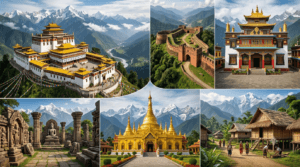
The architecture of Arunachal Pradesh is a remarkable blend of Buddhist monastic traditions, indigenous tribal craftsmanship, and ancient historical monuments. Due to the state’s mountainous terrain and rich cultural diversity, architectural styles vary significantly among different tribes and regions. Most traditional structures are built using locally available materials such as wood, bamboo, cane, and stone, reflecting a deep connection with nature.
The most iconic architectural landmark is the Tawang Monastery, located at an altitude of about 3,000 metres. Built in 1680–1681 by Merak Lama Lodre Gyatso, it is the largest Buddhist monastery in India and the second-largest in the world. The monastery features traditional Tibetan architecture, colorful murals, prayer halls, ancient scriptures, and a magnificent golden statue of Lord Buddha.
Another important historical monument is the Ita Fort in Itanagar. Constructed around the 14th–15th century, the fort is built primarily of stone and is one of the oldest surviving archaeological sites in the state. Its name, Ita, means “brick” in the Assamese language, referring to the bricks used in its construction.
Bhismaknagar Fort, located in the Lower Dibang Valley region, is one of the largest archaeological sites in Northeast India. According to local tradition, it is associated with King Bhismaka, the father of Rukmini, who later married Lord Krishna. Excavations have revealed fortifications, brick structures, and evidence of an advanced medieval settlement.
Traditional tribal architecture also forms an important part of the state’s heritage. Communities such as the Monpa, Apatani, Adi, Nyishi, Galo, and Wancho build elevated wooden and bamboo houses that are well adapted to the mountainous terrain and heavy rainfall. These eco-friendly homes showcase indigenous engineering techniques that have been preserved for generations.
Together, the monasteries, forts, temples, and traditional tribal settlements highlight Arunachal Pradesh’s unique architectural legacy, reflecting its history, spirituality, and cultural diversity.
Major Historical Monuments
| Monument | Location | Significance |
|---|---|---|
| Tawang Monastery | Tawang | Largest Buddhist monastery in India and the second-largest in the world. |
| Ita Fort | Itanagar | Historic 14th–15th century stone fort and one of Arunachal Pradesh’s oldest archaeological monuments. |
| Bhismaknagar Fort | Lower Dibang Valley | Ancient archaeological site associated with King Bhismaka and Princess Rukmini. |
| Bomdila Monastery | Bomdila, West Kameng | Prominent Tibetan Buddhist monastery offering spiritual and cultural significance. |
| Urgelling Monastery | Tawang | Birthplace of the 6th Dalai Lama and an important Buddhist pilgrimage site. |
| Malinithan Temple | Likabali, Lower Siang | Ancient Hindu temple ruins known for beautiful stone sculptures and mythology. |
| Golden Pagoda | Namsai | Magnificent modern Buddhist temple, also known as Kongmu Kham. |
| Gompa Buddhist Monastery | Itanagar | Important Buddhist monastery featuring Tibetan architecture and religious teachings. |
Religious Places in Arunachal Pradesh
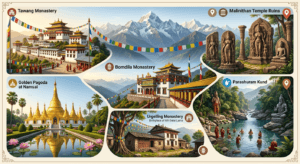
Arunachal Pradesh is a land of spiritual harmony where Buddhism, Hinduism, Christianity, and indigenous tribal faiths have coexisted peacefully for centuries. The state is home to magnificent Buddhist monasteries, ancient Hindu temples, sacred pilgrimage sites, and traditional places of worship that attract thousands of devotees and tourists every year.
The most famous religious destination is the Tawang Monastery, situated at an altitude of about 3,000 metres. Founded in 1680–1681, it is the largest Buddhist monastery in India and an important center of Mahayana Buddhism. The monastery houses ancient scriptures, colorful murals, prayer halls, and a majestic statue of Lord Buddha.
Another prominent Buddhist site is the Golden Pagoda (Kongmu Kham) in Namsai district. Built in traditional Thai architectural style, this magnificent temple has become one of the state’s most visited spiritual landmarks.
The sacred Parashuram Kund, located on the banks of the Lohit River, is one of the most important Hindu pilgrimage sites in Northeast India. According to Hindu mythology, Sage Parashurama purified himself here after seeking forgiveness for his sins. Every year during Makar Sankranti, thousands of pilgrims visit the holy site to take a ritual bath.
Malinithan Temple, near Likabali, is an ancient Hindu archaeological site dedicated to Goddess Malini, who is believed to be associated with Goddess Durga. The temple ruins contain beautifully carved stone sculptures and hold great historical and religious significance.
Other important religious sites include Bomdila Monastery, Urgelling Monastery, Gompa Buddhist Temple in Itanagar, and numerous tribal sacred groves and traditional worship sites that reflect the state’s rich spiritual heritage.
Major Religious Places
| Religious Place | Location | Religion |
|---|---|---|
| Tawang Monastery | Tawang | Buddhism |
| Golden Pagoda (Kongmu Kham) | Namsai | Buddhism |
| Bomdila Monastery | Bomdila, West Kameng | Buddhism |
| Urgelling Monastery | Tawang | Buddhism |
| Gompa Buddhist Temple | Itanagar | Buddhism |
| Parashuram Kund | Lohit | Hinduism |
| Malinithan Temple | Likabali, Lower Siang | Hinduism |
| Bhismaknagar | Lower Dibang Valley | Hindu Mythological Heritage |
GI Tagged Products of Arunachal Pradesh
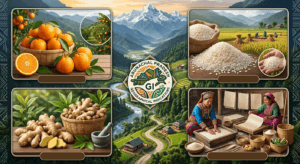
Arunachal Pradesh is known for its rich biodiversity, unique tribal traditions, and high-quality agricultural and handicraft products. Several products from the state have received the Geographical Indication (GI) Tag, which recognizes their unique origin, traditional production methods, and cultural significance. These products not only preserve the state’s heritage but also support the livelihoods of local farmers, artisans, and tribal communities.
One of the most famous GI-tagged products is Arunachal Orange, celebrated for its sweet taste, vibrant color, and excellent quality. Grown mainly in the hilly districts, these oranges are highly valued across India.
Another notable product is Khamti Rice, traditionally cultivated by the Tai Khamti community. This aromatic rice is known for its excellent texture and is an important part of the region’s cuisine and culture.
Adi Kekir Ginger, cultivated by the Adi tribe, is another GI-recognized product. It is valued for its strong aroma, medicinal properties, and superior quality.
Arunachal Pradesh is also known for its beautiful Monpa Handmade Paper, produced using the bark of the Daphne papyracea plant. This eco-friendly handmade paper has been manufactured for centuries and is used for religious manuscripts, paintings, and traditional artwork.
These GI-tagged products help promote Arunachal Pradesh’s identity in national and international markets while encouraging sustainable farming and traditional craftsmanship.
GI Tagged Products of Arunachal Pradesh
| GI Product | Category | Famous For |
|---|---|---|
| Arunachal Orange | Fruit | Sweet taste, rich aroma, vibrant colour, and premium quality citrus fruit grown in the Himalayan foothills. |
| Khamti Rice | Agricultural Product | Traditional aromatic rice cultivated by the Tai Khamti community, known for its fine texture and flavour. |
| Adi Kekir Ginger | Spice | High-quality ginger valued for its strong aroma, medicinal properties, and unique taste. |
| Monpa Handmade Paper | Handicraft | Eco-friendly handmade paper produced from the bark of the Daphne plant using traditional Monpa techniques. |

Education and Universities in Arunachal Pradesh
Education has witnessed remarkable growth in Arunachal Pradesh over the past few decades. The state government, along with the Government of India, has established universities, colleges, technical institutes, and research centers to improve access to quality education, especially in remote tribal areas. Today, Arunachal Pradesh offers educational opportunities in fields such as engineering, medicine, management, agriculture, forestry, law, teacher education, and the arts.
The state’s premier institution is Rajiv Gandhi University (RGU), located at Rono Hills, Doimukh. Established in 1984, it is the only Central University in Arunachal Pradesh and offers undergraduate, postgraduate, and doctoral programs in numerous disciplines.
Another important institution is North Eastern Regional Institute of Science and Technology (NERIST) at Nirjuli, a Deemed-to-be University renowned for engineering, technology, science, agriculture, and management education. It is one of the leading technical institutions in Northeast India.
Medical education in the state is provided by Tomo Riba Institute of Health & Medical Sciences (TRIHMS) in Naharlagun, which offers MBBS and postgraduate medical education while serving as a major healthcare institution.
The state also has Arunachal University of Studies, Himalayan University, Indira Gandhi Technological and Medical Sciences University, and several government degree colleges, teacher training institutes, polytechnics, and vocational education centers spread across different districts.
The National Education Policy (NEP 2020), digital learning initiatives, scholarships, skill development programs, and improved educational infrastructure are helping enhance literacy and higher education opportunities throughout Arunachal Pradesh.
Major Educational Institutions
| Institution | Location | Specialization |
|---|---|---|
| Rajiv Gandhi University (RGU) | Rono Hills, Doimukh | Central University offering Undergraduate, Postgraduate, and Doctoral programs in multiple disciplines. |
| North Eastern Regional Institute of Science and Technology (NERIST) | Nirjuli | Engineering, Technology, Science, Agriculture, and Management Education. |
| Tomo Riba Institute of Health & Medical Sciences (TRIHMS) | Naharlagun | Medical education (MBBS & PG), healthcare, and medical research. |
| Arunachal University of Studies (AUS) | Namsai | Multidisciplinary higher education, research, and professional courses. |
| Himalayan University | Itanagar | Higher education, research, management, commerce, arts, and science programs. |
| Indira Gandhi Technological and Medical Sciences University (IGTAMSU) | Ziro | Technical, medical, nursing, pharmacy, and allied health science education. |
Economy and Industries of Arunachal Pradesh
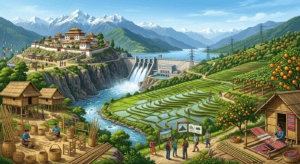
The economy of Arunachal Pradesh is primarily based on agriculture, horticulture, forestry, hydropower, tourism, handicrafts, and small-scale industries. Blessed with abundant natural resources, fertile valleys, dense forests, and fast-flowing Himalayan rivers, the state has significant potential for sustainable economic growth.
Agriculture remains the backbone of the state’s economy, employing a large proportion of the population. Rice is the principal crop, while maize, millets, pulses, ginger, turmeric, sugarcane, and vegetables are also widely cultivated. The state has gained recognition for organic farming due to the limited use of chemical fertilizers and pesticides.
Horticulture is another major contributor to the economy. Arunachal Pradesh produces high-quality oranges, kiwis, apples, pineapples, bananas, pears, walnuts, and large cardamom, which are marketed across India.
The state possesses enormous hydropower potential because of rivers such as the Siang, Subansiri, Lohit, Dibang, and Kameng. Several hydroelectric projects are being developed to generate clean energy and contribute to India’s power sector.
Tourism has emerged as one of the fastest-growing industries. Destinations such as Tawang, Ziro Valley, Mechuka, Namdapha National Park, Bomdila, and Sela Pass attract visitors interested in nature, adventure, wildlife, and tribal culture.
Traditional handloom and handicrafts also play a significant role in the rural economy. Tribal artisans produce bamboo and cane products, handwoven textiles, carpets, wood carvings, Thangka paintings, and traditional ornaments that are sold in local and national markets.
The government continues to promote entrepreneurship, infrastructure development, skill training, eco-tourism, food processing, and small industries to create employment opportunities and improve the state’s overall economic development.
Major Economic Sectors
| Sector | Major Activities |
|---|---|
| Agriculture | Rice, maize, millets, pulses, vegetables, organic farming |
| Horticulture | Orange, kiwi, apple, pineapple, banana, pear, large cardamom |
| Hydropower | Hydroelectric projects on the Siang, Subansiri, Dibang, Lohit, and Kameng rivers |
| Tourism | Eco-tourism, adventure tourism, monasteries, wildlife tourism, trekking, cultural tourism |
| Handloom & Handicrafts | Bamboo and cane crafts, handwoven textiles, carpets, Thangka paintings, wood carving |
| Forestry | Bamboo, cane, medicinal plants, timber resources, sustainable forest management |
Frequently Asked Questions (FAQs)
1. Where is Arunachal Pradesh located?
Arunachal Pradesh is located in Northeast India. It shares international borders with China (Tibet Autonomous Region), Bhutan, and Myanmar, while Assam and Nagaland are its neighboring Indian states.
2. What is the capital of Arunachal Pradesh?
Itanagar is the capital city of Arunachal Pradesh and serves as the state’s administrative, political, and cultural center.
3. Why is Arunachal Pradesh called the “Land of the Rising Sun”?
It is called the “Land of the Rising Sun” because it is India’s easternmost state and receives the first rays of the sun every morning.
4. What is the best time to visit Arunachal Pradesh?
The best time to visit is October to April, when the weather is pleasant and suitable for sightseeing, trekking, and exploring the Himalayan landscapes.
5. Is an Inner Line Permit (ILP) required to visit Arunachal Pradesh?
Yes. Indian citizens (except residents of Arunachal Pradesh) must obtain an Inner Line Permit (ILP) before entering the state. Foreign nationals require a Protected Area Permit (PAP).
6. Which is the most famous tourist attraction in Arunachal Pradesh?
Tawang Monastery is the state’s most famous tourist attraction. Other popular destinations include Ziro Valley, Sela Pass, Namdapha National Park, Mechuka Valley, and Bomdila.
7. What are the major rivers of Arunachal Pradesh?
The major rivers are Siang, Subansiri, Kameng, Lohit, Dibang, Noa-Dihing, Kamlang, and Tirap.
8. Which are the major tribes of Arunachal Pradesh?
Some of the major tribes are Monpa, Adi, Nyishi, Apatani, Galo, Mishmi, Tagin, Nocte, Wancho, Tangsa, Sherdukpen, and Khampti.
9. What is the state animal of Arunachal Pradesh?
The Mithun (Gayal) is the official state animal of Arunachal Pradesh.
10. What is Arunachal Pradesh famous for?
Arunachal Pradesh is famous for its Eastern Himalayan landscapes, Tawang Monastery, Ziro Valley, tribal culture, biodiversity, national parks, Buddhist heritage, adventure tourism, orchids, and rich wildlife.
Conclusion
Arunachal Pradesh, the “Land of the Rising Sun,” is one of India’s most captivating states, where majestic Himalayan mountains, ancient Buddhist monasteries, lush forests, crystal-clear rivers, and vibrant tribal traditions come together to create an unforgettable destination. From the spiritual serenity of Tawang Monastery and the breathtaking beauty of Sela Pass to the picturesque landscapes of Ziro Valley and the incredible biodiversity of Namdapha National Park, the state offers a unique blend of natural beauty, culture, and adventure.
Home to 26 major tribes and more than 100 sub-tribes, Arunachal Pradesh proudly preserves its rich cultural heritage through colorful festivals, traditional handloom weaving, bamboo handicrafts, indigenous customs, and centuries-old spiritual practices. At the same time, the state continues to progress through improvements in education, transportation, tourism, sustainable agriculture, hydropower development, and eco-friendly initiatives.
Whether you are a nature enthusiast, wildlife lover, adventure seeker, photographer, pilgrim, or cultural explorer, Arunachal Pradesh promises an experience unlike any other in India. Every valley, monastery, forest, and tribal village tells a story of harmony between people and nature.
With its untouched landscapes, warm hospitality, and timeless traditions, Arunachal Pradesh remains one of India’s most extraordinary destinations. A journey to this Himalayan state is not just a vacation—it’s an opportunity to discover the beauty, diversity, and cultural richness of Northeast India.
Internal links
1.Chhattisgarh
2.Odisha
3.Bihar
4.Uttar Pradesh
5.Uttarakhand
6
Haryana
7.Punjab
8.Himachal Pradesh
9.Madhya Pradesh
10.Rajasthan
11.Gujarat
12.Goa
13.Maharashtra
14.Kerala
15.Tamil Nadu
16.Karnataka
17.Andhra Pradesh
18.Telangana
- Mahatma Gandhi – https://dealkartmarket.in/mahatma-gandhi/
- A. P. J. Abdul Kalam – https://dealkartmarket.in/apj-abdul-kalam/
- RatanTata – https://dealkartmarket.in/ratan-tata-biography/
Reference
Government of Arunachal Pradesh
Incredible India
Arunachal Pradesh Tourism (Official)
Incredible India
Incredible India – Arunachal Pradesh
Incredible India +1
Ministry of Tourism, Government of India
Census of India
Forest Survey of India (FSI)
Ministry of Environment, Forest and Climate Change (MoEFCC)
UNESCO World Heritage Centre