
Introduction
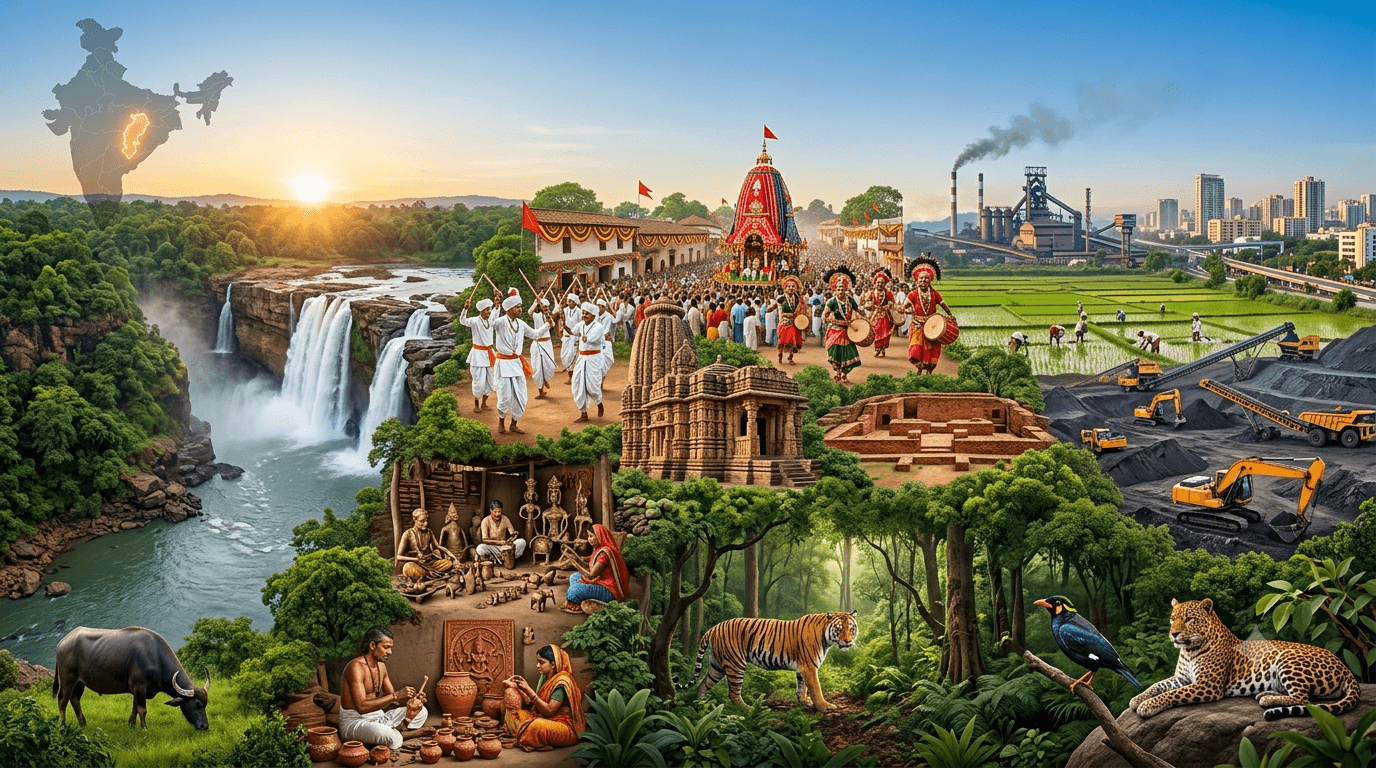
Chhattisgarh is one of India’s fastest-growing states, known for its rich tribal culture, dense forests, abundant mineral resources, magnificent waterfalls, ancient temples, wildlife sanctuaries, and vibrant traditions. Located in Central India, the state was carved out of Madhya Pradesh on 1 November 2000, becoming the 26th state of India. Its capital city is Raipur, while Bilaspur, Durg, Bhilai, Korba, and Jagdalpur are among its major cities.
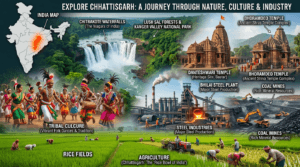
Covering an area of approximately 135,192 square kilometres, Chhattisgarh is India’s 10th largest state by area. It shares its borders with Madhya Pradesh, Maharashtra, Telangana, Odisha, Jharkhand, and Uttar Pradesh, making it an important geographical link between northern and southern India.
The state is blessed with vast natural resources and is often referred to as the “Rice Bowl of Central India” because of its extensive paddy cultivation. Chhattisgarh is also one of India’s leading producers of coal, iron ore, limestone, bauxite, dolomite, and tin ore, making it a major industrial and mining hub. Large steel plants, thermal power stations, aluminium industries, and cement factories significantly contribute to the state’s economy.
Nearly 44% of Chhattisgarh’s geographical area is covered by forests, making it one of India’s greenest states. These forests provide habitat for wildlife such as Royal Bengal Tigers, Leopards, Wild Buffaloes, Sloth Bears, Indian Bison (Gaur), and numerous bird species. The famous Kanger Valley National Park, Indravati National Park, and Achanakmar Tiger Reserve are among the state’s premier wildlife destinations.
Chhattisgarh is home to several indigenous tribal communities, including the Gond, Baiga, Maria, Muria, Halba, Oraon, and Bhatra tribes. Their colourful festivals, traditional dances, handicrafts, music, and customs form an integral part of the state’s rich cultural heritage.
The state also boasts remarkable natural attractions such as Chitrakote Waterfall (often called the “Niagara Falls of India”), Tirathgarh Waterfall, Kutumsar Cave, Barnawapara Wildlife Sanctuary, and the scenic Bastar region. Ancient temples like the Bhoramdeo Temple, Rajim Temple, and Danteshwari Temple further enhance Chhattisgarh’s historical and religious significance.
With its unique combination of natural beauty, cultural diversity, historical heritage, mineral wealth, and rapidly developing infrastructure, Chhattisgarh has emerged as one of India’s most promising tourism and investment destinations.
Quick Facts About Chhattisgarh
| Particular | Details |
|---|---|
| Capital | Raipur |
| Largest City | Raipur |
| Formation Day | 1 November 2000 |
| Area | 135,192 sq km |
| Population | Around 3 Crore (2025 estimate) |
| Official Language | Hindi |
| State Animal | Wild Water Buffalo |
| State Bird | Hill Myna |
| State Tree | Sal |
| State Flower | Rhynchostylis retusa (Foxtail Orchid) |
Chhattisgarh on the India Map
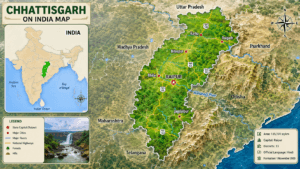
Chhattisgarh is a centrally located state in India, strategically positioned between northern and southern regions of the country. It was formed on 1 November 2000 after being separated from Madhya Pradesh. The state covers an area of approximately 135,192 square kilometres, making it the 10th largest state in India by area.
Chhattisgarh shares its borders with Madhya Pradesh to the northwest, Uttar Pradesh to the north, Jharkhand to the northeast, Odisha to the east, Telangana to the south, and Maharashtra to the southwest. This central location makes the state an important transportation and industrial corridor connecting different parts of India.
The state lies between 17°46′ N and 24°05′ N latitude and 80°15′ E and 84°24′ E longitude. Its geographical landscape consists of fertile plains, dense forests, hills, plateaus, rivers, and waterfalls. The Mahanadi River and its tributaries play a significant role in supporting agriculture and water resources across the state.
Raipur, the capital city, serves as the administrative, commercial, educational, and industrial centre of Chhattisgarh. Other major cities include Bhilai, Durg, Bilaspur, Korba, Raigarh, Jagdalpur, Ambikapur, and Rajnandgaon.
Due to its central location and abundant natural resources, Chhattisgarh has become one of India’s leading states in mining, steel production, power generation, and agriculture. Its excellent connectivity by road, rail, and air further strengthens its importance in the country’s economic development.
Chhattisgarh at a Glance
| Particular | Details |
|---|---|
| Region | Central India |
| Capital | Raipur |
| Largest City | Raipur |
| Area | 135,192 sq km |
| Latitude | 17°46′ N – 24°05′ N |
| Longitude | 80°15′ E – 84°24′ E |
| Neighboring States | Madhya Pradesh, Uttar Pradesh, Jharkhand, Odisha, Telangana, Maharashtra |
| Number of Districts | 33 |
| Time Zone | IST (UTC +5:30) |
History of Chhattisgarh
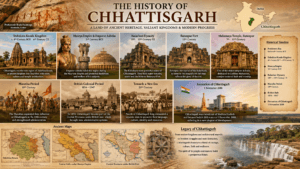
The history of Chhattisgarh dates back thousands of years and reflects a rich legacy of ancient civilizations, powerful kingdoms, tribal traditions, religious movements, and India’s freedom struggle. Archaeological discoveries indicate that the region has been inhabited since prehistoric times. Ancient caves, rock paintings, temples, inscriptions, and sculptures found across the state provide evidence of its glorious past.
In ancient India, much of present-day Chhattisgarh formed part of the historic region known as Dakshina Kosala (South Kosala). According to Hindu mythology, this region is closely associated with Lord Rama, who is believed to have spent a significant portion of his exile in the forests of present-day Chhattisgarh. Because of this, the state holds immense religious and cultural importance.
During the Maurya Empire (4th–2nd century BCE), the region came under the rule of Emperor Ashoka. Buddhism gradually spread across the area, leaving behind several archaeological sites and inscriptions. After the decline of the Mauryas, Chhattisgarh was ruled by the Satavahanas, Nalas, Sharabhpuriyas, Panduvamshis, and Kalachuris, each contributing to the development of art, architecture, literature, and administration.
The Kalachuri Dynasty, particularly between the 10th and 14th centuries CE, played a significant role in shaping the state’s cultural identity. They established their capital at Ratanpur and built numerous temples, forts, lakes, and public structures. The famous Mahamaya Temple, Ratanpur Fort, and several ancient Shiva temples belong to this period.
From the medieval period onwards, various regional rulers governed Chhattisgarh before it gradually came under Maratha rule during the 18th century. Later, after the Third Anglo-Maratha War (1817–1818), the British East India Company gained control over the region. During British rule, Chhattisgarh became part of the Central Provinces and Berar. The people actively participated in India’s freedom movement, with tribal communities and local leaders resisting colonial rule through various uprisings.
After India gained independence in 1947, Chhattisgarh became part of Madhya Pradesh following the States Reorganisation in 1956. Due to its distinct cultural identity, tribal population, natural resources, and developmental aspirations, there was a long-standing demand for separate statehood.
Finally, on 1 November 2000, Chhattisgarh was officially carved out of Madhya Pradesh and became the 26th state of India. Since its formation, the state has witnessed rapid growth in infrastructure, industry, education, healthcare, tourism, and agriculture while preserving its rich tribal traditions and cultural heritage.
Today, Chhattisgarh stands as one of India’s fastest-growing states, known for its abundant mineral resources, dense forests, ancient heritage, vibrant tribal culture, and significant contribution to the nation’s industrial development.
Timeline of Chhattisgarh History
| Period | Major Events |
|---|---|
| Prehistoric Period | Early human settlements and rock paintings |
| Ancient Period | Part of Dakshina Kosala |
| 4th–2nd Century BCE | Maurya Empire under Emperor Ashoka |
| 1st–8th Century CE | Satavahana, Nala, Sharabhpuriya and Panduvamshi rule |
| 10th–14th Century CE | Kalachuri Dynasty and Ratanpur Kingdom |
| 18th Century | Maratha Rule |
| 1818–1947 | British Rule (Central Provinces and Berar) |
| 1947 | Became part of Independent India |
| 1956 | Merged into Madhya Pradesh |
| 1 November 2000 | Formation of Chhattisgarh as the 26th State of India |
Geography of Chhattisgarh
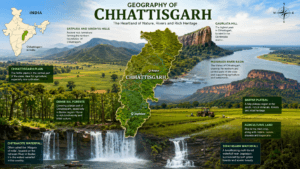
Chhattisgarh is located in the heart of India and is one of the country’s most geographically diverse states. Spread across an area of approximately 135,192 square kilometres, it is the 10th largest state in India. The state lies between 17°46′ N and 24°05′ N latitude and 80°15′ E and 84°24′ E longitude, forming an important part of the central Indian plateau.
The state shares its boundaries with Madhya Pradesh to the northwest, Uttar Pradesh to the north, Jharkhand to the northeast, Odisha to the east, Telangana to the south, and Maharashtra to the southwest. Its strategic location makes Chhattisgarh an important transportation and industrial hub connecting northern, eastern, and southern India.
The topography of Chhattisgarh is divided into three major physical regions: the Chhattisgarh Plain, the Northern Hills, and the Bastar Plateau. The fertile Chhattisgarh Plain, located in the central part of the state, is formed by the Mahanadi River and its tributaries. This plain is one of India’s most productive agricultural regions and is the reason why Chhattisgarh is known as the “Rice Bowl of Central India.”
The Northern Hills, which are part of the Satpura and Vindhya mountain systems, are covered with dense forests and rich mineral deposits. The Bastar Plateau in southern Chhattisgarh is famous for its rugged terrain, thick forests, tribal settlements, waterfalls, limestone caves, and rich biodiversity.
Nearly 44% of the state’s geographical area is covered by forests, making Chhattisgarh one of India’s greenest states. These forests are dominated by Sal, Teak, Bamboo, Mahua, Tendu, and Saja trees, supporting a rich variety of wildlife and tribal livelihoods.
The state’s highest peak is Gaurlata Hill, located in Balrampur district, with an elevation of approximately 1,225 metres (4,019 feet) above sea level. Chhattisgarh is also home to spectacular waterfalls such as Chitrakote Falls, Tirathgarh Falls, and Amrit Dhara Falls, which attract thousands of tourists every year.
The fertile plains, abundant rivers, dense forests, mineral-rich plateaus, and scenic landscapes make Chhattisgarh one of India’s most naturally endowed states.
Geography at a Glance
| Feature | Details |
|---|---|
| Total Area | 135,192 sq km |
| Largest Physiographic Region | Chhattisgarh Plain |
| Highest Peak | Gaurlata Hill (1,225 m) |
| Major Plateau | Bastar Plateau |
| Major Plain | Chhattisgarh Plain |
| Forest Cover | Around 44% |
| Major Mountain Ranges | Satpura & Vindhya Hills |
| Major Soil Types | Alluvial, Red & Yellow, Laterite, Black Soil |
| Major River Basin | Mahanadi Basin |
Climate of Chhattisgarh
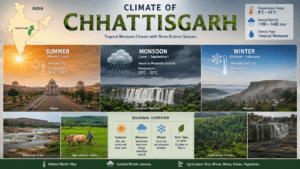
Chhattisgarh experiences a tropical wet and dry climate, characterized by three distinct seasons: summer, monsoon, and winter. Due to its central location in India, the state generally experiences hot summers, moderate to heavy rainfall during the southwest monsoon, and pleasant winters. The climate supports agriculture, forestry, and rich biodiversity throughout the state.
Summer (March to June)
Summer begins in March and continues until June. During this period, temperatures usually range from 30°C to 45°C, with some interior districts such as Raipur, Bilaspur, Durg, Rajnandgaon, Korba, and Janjgir-Champa recording temperatures above 46°C during severe heat waves. Despite the high temperatures, the forested regions of Bastar and Kanger Valley remain comparatively cooler.
Monsoon (June to September)
The southwest monsoon arrives in mid-June and continues until September. Chhattisgarh receives an average annual rainfall of approximately 1,200–1,500 mm, although rainfall varies across different regions. Districts in southern Chhattisgarh, particularly Bastar and Sukma, receive heavier rainfall than the northern plains. The monsoon transforms the state’s forests, rivers, waterfalls, and agricultural fields into lush green landscapes. Major waterfalls such as Chitrakote Falls and Tirathgarh Falls are at their most spectacular during this season.
Winter (October to February)
Winter begins in October and lasts until February. This is considered the best season to visit Chhattisgarh, as the weather remains cool and pleasant. Temperatures generally range between 10°C and 28°C, while hilly areas such as Mainpat and parts of northern Chhattisgarh may experience temperatures below 8°C on cold winter mornings. The season is ideal for wildlife safaris, sightseeing, trekking, and exploring waterfalls and tribal villages.
Climate and Agriculture
The combination of fertile plains, adequate monsoon rainfall, and warm temperatures makes Chhattisgarh one of India’s leading rice-producing states. Seasonal rainfall supports crops such as rice, maize, pulses, oilseeds, sugarcane, and horticultural produce. Dense forests also thrive under the state’s favorable climatic conditions, supporting diverse wildlife and tribal livelihoods.
Overall, Chhattisgarh’s climate plays a vital role in shaping its agriculture, biodiversity, tourism, and economy throughout the year.
Climate of Chhattisgarh
| Season | Months | Average Temperature |
|---|---|---|
| Summer | March – June | 30°C – 45°C |
| Monsoon | June – September | 24°C – 35°C |
| Winter | October – February | 10°C – 28°C |
| Average Annual Rainfall | — | 1,200–1,500 mm |
Major Rivers of Chhattisgarh
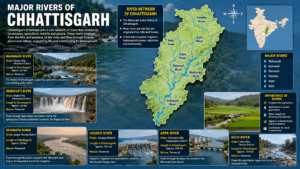
Chhattisgarh is blessed with an extensive network of rivers that support agriculture, drinking water supply, irrigation, hydroelectric power generation, fisheries, biodiversity, and tourism. The state’s rivers originate from the Maikal Hills, Satpura Range, Vindhya Hills, and the Bastar Plateau, flowing through fertile plains and dense forests before joining major river systems of central and eastern India.
The Mahanadi River is the longest and most important river of Chhattisgarh. It originates near Sihawa Hills in Dhamtari district and flows through Raipur, Dhamtari, Mahasamund, and other districts before entering Odisha and finally emptying into the Bay of Bengal. The Mahanadi basin is the lifeline of Chhattisgarh’s agriculture and irrigation system.
Another major river is the Indravati River, one of the principal tributaries of the Godavari River. Flowing through the Bastar region, it is famous for the spectacular Chitrakote Waterfall, popularly known as the “Niagara Falls of India.” The river also supports forests, wildlife, and tribal communities.
The Shivnath River is the largest tributary of the Mahanadi within Chhattisgarh. Originating in the Panabaras Hills, it flows through Rajnandgaon, Durg, Balod, Bemetara, and Janjgir-Champa before joining the Mahanadi. The river is vital for irrigation, agriculture, and industrial water supply.
Other important rivers include the Hasdeo, Arpa, Kelo, Mand, Pairi, Jonk, Sabari, Kanhar, and Rihand rivers. These rivers play a crucial role in supporting farming, fisheries, wildlife habitats, and hydroelectric projects across the state.
Several major dams and reservoirs have been constructed on these rivers, including the Gangrel Dam (Ravishankar Sagar) on the Mahanadi, Hasdeo Bango Dam on the Hasdeo River, and Minimata Bango Dam, which provide irrigation, drinking water, electricity generation, and flood control.
The rivers of Chhattisgarh not only contribute significantly to the state’s economy but also enhance its natural beauty through waterfalls, river valleys, forests, and scenic landscapes, making them popular destinations for eco-tourism and adventure activities.
Major Rivers of Chhattisgarh
| River | Origin | Importance |
|---|---|---|
| Mahanadi | Sihawa Hills | Longest river, irrigation & agriculture |
| Shivnath | Panabaras Hills | Largest tributary of Mahanadi |
| Indravati | Eastern Ghats | Chitrakote Waterfall, Godavari tributary |
| Hasdeo | Surguja Hills | Hasdeo Bango Dam, irrigation |
| Arpa | Pendra Hills | Flows through Bilaspur |
| Kelo | Raigarh Region | Irrigation & water supply |
| Mand | Surguja Plateau | Tributary of Mahanadi |
| Pairi | Gariaband Hills | Agriculture |
| Sabari | Eastern Ghats | Tributary of Godavari |
| Rihand | Surguja Region | Hydroelectric projects |
Agriculture of Chhattisgarh
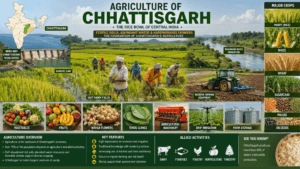
Agriculture is the backbone of Chhattisgarh’s economy, providing livelihood to nearly 70% of the state’s population. Blessed with fertile plains, abundant river systems, and a favorable tropical climate, Chhattisgarh is one of India’s leading agricultural states. The state is popularly known as the “Rice Bowl of Central India” because rice is the dominant crop cultivated across most districts.
The fertile Chhattisgarh Plain, nourished by the Mahanadi River and its tributaries, offers ideal conditions for paddy cultivation. Major rice-producing districts include Raipur, Dhamtari, Balod, Bemetara, Mahasamund, Janjgir-Champa, Kabirdham, and Baloda Bazar. Chhattisgarh produces a wide variety of aromatic and traditional rice varieties that are famous throughout India.
Apart from rice, farmers cultivate maize, wheat, pulses, oilseeds, millets, sugarcane, gram, soybean, groundnut, mustard, and vegetables. Horticulture is also expanding rapidly, with fruits such as mango, guava, papaya, banana, litchi, custard apple, and jackfruit being grown in different parts of the state.
Chhattisgarh is also known for the production of minor forest produce, including Tendu leaves, Mahua flowers, Tamarind, Sal seeds, Lac, Chironji, Honey, and Medicinal Plants, which play an important role in the livelihoods of tribal communities.
The state government has introduced several initiatives to improve agricultural productivity through modern irrigation systems, soil health management, mechanization, organic farming, crop insurance, seed distribution, and farmer welfare schemes. Major irrigation projects such as the Gangrel Dam, Hasdeo Bango Project, and Minimata Bango Dam support agriculture by providing water throughout the year.
Livestock farming, dairy, fisheries, and poultry are also important components of the rural economy. Chhattisgarh continues to strengthen its agricultural sector by promoting sustainable farming, value-added food processing, and climate-resilient agricultural practices.
With its fertile land, rich water resources, and dedicated farming community, Chhattisgarh remains one of India’s most important food-producing states.
Major Agricultural Crops of Chhattisgarh
| Crop | Major Producing Regions |
|---|---|
| Rice (Paddy) | Raipur, Dhamtari, Mahasamund, Balod |
| Wheat | Bilaspur, Kabirdham, Raigarh |
| Maize | Surguja, Jashpur, Korea |
| Pulses | Janjgir-Champa, Bemetara |
| Oilseeds | Raigarh, Korba, Baloda Bazar |
| Sugarcane | Kabirdham, Durg |
| Vegetables | Raipur, Bilaspur, Durg |
| Fruits | Bastar, Jashpur, Surguja |
| Minor Forest Produce | Bastar, Kanker, Dantewada |
Flora & Fauna of Chhattisgarh
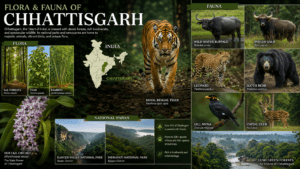
Chhattisgarh is one of India’s richest states in terms of forest cover, biodiversity, and wildlife. Nearly 44% of the state’s geographical area is covered by forests, making it one of the greenest states in the country. These forests are home to a wide variety of plant species, medicinal herbs, and wild animals, playing a crucial role in maintaining ecological balance and supporting the livelihoods of tribal communities.
The forests of Chhattisgarh are dominated by Sal (Shorea robusta), the State Tree, along with Teak, Bamboo, Mahua, Tendu, Saja, Bija, Harra, Bahera, and Amla. These forests provide valuable forest products such as Tendu leaves, Mahua flowers, Tamarind, Sal seeds, Honey, Lac, Chironji, and medicinal plants, which contribute significantly to the rural and tribal economy.
Chhattisgarh is renowned for its rich wildlife. The State Animal is the Wild Water Buffalo, while the State Bird is the Hill Myna, known for its remarkable ability to mimic human speech. The State Flower is Rhynchostylis retusa (Foxtail Orchid), and the State Tree is Sal.
The state’s forests support iconic wildlife species such as the Royal Bengal Tiger, Leopard, Sloth Bear, Indian Gaur (Bison), Wild Dog (Dhole), Sambar Deer, Chital (Spotted Deer), Barking Deer, Four-horned Antelope, and numerous reptiles and amphibians. Rivers and wetlands are inhabited by Mugger Crocodiles, freshwater turtles, and a variety of fish species.
Birdlife is equally diverse, with species including the Hill Myna, Indian Peafowl, Grey Hornbill, Parakeets, Kingfishers, Eagles, Owls, Woodpeckers, Herons, and several migratory birds visiting the state’s wetlands during winter.
Protected areas such as Kanger Valley National Park, Indravati National Park, Achanakmar Tiger Reserve, Barnawapara Wildlife Sanctuary, Udanti-Sitanadi Tiger Reserve, and Guru Ghasidas National Park help conserve Chhattisgarh’s exceptional biodiversity.
The Government of Chhattisgarh continues to promote wildlife conservation through afforestation programmes, anti-poaching initiatives, habitat restoration, eco-tourism development, and community participation. These efforts ensure the long-term protection of the state’s unique flora and fauna while promoting sustainable environmental management.
State Symbols & Wildlife of Chhattisgarh
| Category | Name |
|---|---|
| State Animal | Wild Water Buffalo |
| State Bird | Hill Myna |
| State Tree | Sal |
| State Flower | Rhynchostylis retusa (Foxtail Orchid) |
| Major Trees | Sal, Teak, Bamboo, Mahua, Tendu |
| Major Mammals | Tiger, Leopard, Gaur, Sloth Bear, Wild Dog |
| Famous Bird | Hill Myna |
| Important Protected Areas | Kanger Valley, Indravati, Achanakmar, Udanti-Sitanadi |
National Parks & Wildlife Sanctuaries of Chhattisgarh
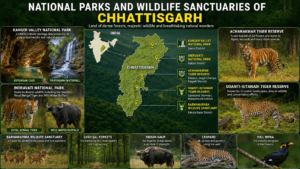
Chhattisgarh is one of India’s most biodiverse states, with nearly 44% of its geographical area covered by forests. The state is home to several national parks, tiger reserves, wildlife sanctuaries, and biosphere reserves that protect rare flora, fauna, and tribal ecosystems. These protected areas provide habitat for endangered species such as the Royal Bengal Tiger, Wild Water Buffalo, Indian Leopard, Sloth Bear, Indian Gaur, Dhole (Wild Dog), Chital, Sambar, and Hill Myna.
One of the most famous protected areas is Kanger Valley National Park, located in Bastar district. Known for its dense Sal forests, limestone caves, underground rivers, waterfalls, and rich biodiversity, the park is home to the famous Kutumsar Cave, Kailash Cave, and Tirathgarh Waterfall. It is also an ideal destination for birdwatching and eco-tourism.
The Indravati National Park, situated in Bijapur district, is one of the most important tiger habitats in central India. It forms part of the Indravati Tiger Reserve and is known for its population of Royal Bengal Tigers, Wild Water Buffaloes, Leopards, Gaur, Nilgai, and numerous bird species.
The Achanakmar Tiger Reserve, located in Mungeli and Bilaspur districts, is part of the Achanakmar–Amarkantak Biosphere Reserve, recognized by UNESCO. The reserve protects diverse wildlife and dense tropical forests while serving as an important ecological corridor.
Other important protected areas include the Udanti-Sitanadi Tiger Reserve, known for conserving the endangered Wild Water Buffalo, the Barnawapara Wildlife Sanctuary, famous for its scenic forests and wildlife safaris, and the Guru Ghasidas National Park, one of the newest national parks in India.
Chhattisgarh’s protected forests support hundreds of species of mammals, reptiles, amphibians, butterflies, medicinal plants, and migratory birds. Eco-tourism initiatives, wildlife conservation programmes, anti-poaching measures, and community participation continue to strengthen biodiversity conservation across the state.
Major National Parks & Wildlife Sanctuaries of Chhattisgarh
| Protected Area | District | Famous For |
|---|---|---|
| Kanger Valley National Park | Bastar | Limestone Caves, Waterfalls, Biodiversity |
| Indravati National Park | Bijapur | Tiger Reserve & Wild Water Buffalo |
| Guru Ghasidas National Park | Koriya & Surajpur | Forests & Wildlife |
| Achanakmar Tiger Reserve | Mungeli & Bilaspur | Tigers & UNESCO Biosphere Reserve |
| Udanti-Sitanadi Tiger Reserve | Gariaband | Wild Water Buffalo Conservation |
| Barnawapara Wildlife Sanctuary | Baloda Bazar | Leopards, Deer & Birdlife |
| Gomarda Wildlife Sanctuary | Raigarh | Gaur, Sloth Bear & Herbivores |
| Badalkhol Wildlife Sanctuary | Jashpur | Dense Forests & Wildlife |
Culture & Traditions of Chhattisgarh
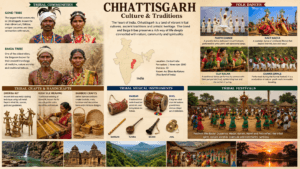
Chhattisgarh is a land of rich tribal heritage, ancient customs, colourful festivals, folk music, traditional dances, handicrafts, and vibrant cultural diversity. The state is home to more than 40 tribal communities, including the Gond, Baiga, Maria, Muria, Halba, Oraon, Bhatra, Abhuj Maria, Kamar, and Kanwar tribes. Their unique traditions, art forms, rituals, and lifestyles have been preserved for centuries, making Chhattisgarh one of India’s most culturally distinctive states.
The culture of Chhattisgarh is deeply connected with nature, forests, agriculture, and tribal life. Folk songs, dances, and music are an integral part of celebrations, harvests, marriages, and religious ceremonies. Traditional musical instruments such as the Mandar, Dhol, Nagara, Timki, Mohan Baja, and Bansuri (Flute) are widely used during festivals and cultural performances.
Among the state’s most famous folk dances are Panthi, Raut Nacha, Sua Nacha, Karma, Gendi, and Saila Dance. Panthi Dance, performed mainly by followers of Guru Ghasidas, is known for its energetic movements and spiritual themes. Raut Nacha, performed by the Yadav community during Diwali, celebrates the legendary life of Lord Krishna. Sua Nacha, performed by women, symbolizes harmony, prosperity, and the harvest season.
Chhattisgarh is also renowned for its traditional handicrafts. The state is famous for Bell Metal (Dhokra) Art, Bamboo Crafts, Wood Carving, Terracotta Pottery, Wrought Iron Crafts, Tribal Jewellery, and Kosa Silk Weaving. These handicrafts reflect the creativity and craftsmanship of tribal artisans and are popular across India and abroad.
Traditional attire varies among different communities. Men commonly wear dhoti and kurta, while women wear colourful sarees, often adorned with traditional silver jewellery and tribal ornaments. During festivals and weddings, people dress in vibrant costumes and perform folk dances accompanied by music.
The cuisine of Chhattisgarh also reflects its cultural heritage. Staple foods include rice, lentils, leafy vegetables, millet-based dishes, Mahua products, and traditional delicacies such as Chila, Faraa, Angakar Roti, Bafauri, Dubki Kadhi, and Thethri-Khurmi.
Today, the Government of Chhattisgarh actively promotes tribal culture through cultural festivals, museums, handicraft exhibitions, tribal tourism, and heritage conservation programmes, ensuring that the state’s unique traditions continue to flourish for future generations.
Major Cultural Highlights of Chhattisgarh
| Cultural Element | Famous For |
|---|---|
| Major Tribes | Gond, Baiga, Maria, Muria, Halba, Oraon |
| Folk Dances | Panthi, Raut Nacha, Sua Nacha, Karma, Gendi, Saila |
| Folk Music | Mandar, Dhol, Nagara, Timki |
| Handicrafts | Dhokra Art, Bamboo Crafts, Wrought Iron, Kosa Silk |
| Traditional Dress | Dhoti-Kurta, Sarees with Tribal Jewellery |
| Traditional Foods | Chila, Faraa, Angakar Roti, Bafauri |
| Cultural Identity | Tribal Heritage & Folk Traditions |
Festivals of Chhattisgarh
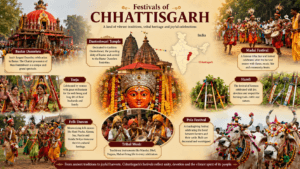
Chhattisgarh is known for its vibrant festivals that beautifully reflect the state’s tribal heritage, agricultural traditions, religious beliefs, and cultural diversity. Throughout the year, people celebrate numerous festivals with great enthusiasm through folk dances, traditional music, colourful processions, community feasts, and religious rituals. Many festivals are closely associated with the harvest season, forests, tribal customs, and local deities.
One of the most famous festivals is the Bastar Dussehra, celebrated in Jagdalpur. Unlike the traditional Dussehra celebrated elsewhere in India, Bastar Dussehra is a unique 75-day-long festival, making it one of the world’s longest festivals. Dedicated to Goddess Danteshwari, the presiding deity of Bastar, the festival features grand chariot processions, tribal rituals, cultural performances, and the participation of numerous tribal communities.
Another important festival is Madai Festival, celebrated across several districts including Kanker, Bastar, Kondagaon, Narayanpur, and Dantewada. It is a travelling tribal festival where local deities are worshipped, and people gather for folk dances, music, handicraft exhibitions, traditional markets, and cultural programmes.
Hareli Festival is one of the oldest agricultural festivals of Chhattisgarh. Celebrated during the monsoon season, farmers worship agricultural tools, cattle, and nature, praying for a prosperous harvest. Traditional games, folk songs, and community celebrations are an important part of Hareli.
Other major festivals include Pola, dedicated to bulls and farming traditions; Teeja, celebrated mainly by women for family well-being; Navratri, Diwali, Holi, Govardhan Puja, Cherchera, and Goncha Festival. Tribal communities also celebrate festivals linked to forests, crops, and seasonal changes, preserving their centuries-old customs.
These festivals showcase Chhattisgarh’s rich cultural identity and strengthen social harmony by bringing together people from different communities to celebrate tradition, spirituality, and nature.
Major Festivals of Chhattisgarh
| Festival | Celebration | Famous Location |
|---|---|---|
| Bastar Dussehra | 75-day Tribal Festival | Jagdalpur |
| Madai Festival | Tribal Fair & Cultural Festival | Bastar Region |
| Hareli | Agricultural Festival | Across Chhattisgarh |
| Pola | Festival of Bulls | Rural Areas |
| Teeja | Women’s Festival | Statewide |
| Goncha Festival | Chariot Festival | Jagdalpur |
| Navratri | Worship of Goddess Durga | Statewide |
| Diwali | Festival of Lights | Statewide |
| Holi | Festival of Colours | Statewide |
| Cherchera | Harvest Festival | Rural Chhattisgarh |
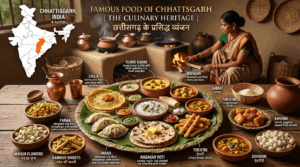
Famous Food of Chhattisgarh
Chhattisgarh offers a unique culinary experience that reflects its tribal traditions, agricultural heritage, and locally available ingredients. Rice is the staple food of the state, and most traditional dishes are prepared using rice, millets, pulses, leafy vegetables, forest produce, and seasonal ingredients. The cuisine is simple, nutritious, and known for its natural flavours rather than excessive spices.
One of the most popular dishes is Chila, a thin pancake made from rice flour or gram flour, commonly served with spicy chutney. Another traditional favourite is Faraa, steamed rice flour dumplings stuffed with lentils or spices, considered one of the healthiest foods of Chhattisgarh.
Angakar Roti, made from rice flour and cooked over a traditional clay stove, is a staple in many rural households. Bafauri, prepared from soaked and steamed chickpea paste, is another nutritious snack rich in protein.
The state’s traditional curry dishes include Dubki Kadhi, Bore Baasi, Muthiya, and Aamat, a mixed vegetable curry prepared using bamboo shoots and seasonal vegetables. During the summer, Bore Baasi—cooked rice soaked overnight in water—is widely consumed as a refreshing and nutritious meal.
Chhattisgarh is also famous for its traditional sweets and snacks. Thethri, Khurmi, Dehrori, Tilgur, Anarsa, and Pidiya are commonly prepared during festivals and family celebrations. These delicacies are made using rice flour, jaggery, sesame seeds, wheat flour, and ghee.
Forest produce plays a significant role in tribal cuisine. Mahua flowers, Tamarind, Bamboo Shoots, Mushrooms, Chironji, Honey, and various wild leafy vegetables are widely used in everyday cooking.
The cuisine of Chhattisgarh perfectly represents the state’s rich agricultural resources and tribal lifestyle, offering healthy, wholesome, and authentic flavours that continue to attract food lovers from across India.
Famous Foods of Chhattisgarh
| Dish | Specialty |
|---|---|
| Chila | Rice or Gram Flour Pancake |
| Faraa | Steamed Rice Dumplings |
| Angakar Roti | Traditional Rice Bread |
| Bafauri | Steamed Chickpea Snack |
| Dubki Kadhi | Gram Flour Curry |
| Bore Baasi | Fermented Rice Dish |
| Aamat | Mixed Vegetable Curry |
| Thethri | Traditional Crispy Snack |
| Khurmi | Sweet Festival Snack |
| Dehrori | Traditional Rice Dessert |
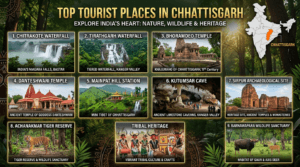
Top Tourist Places in Chhattisgarh
Chhattisgarh is a hidden gem in Central India, offering a perfect blend of waterfalls, caves, forests, wildlife sanctuaries, ancient temples, tribal heritage, and historical monuments. The state’s breathtaking landscapes and rich cultural diversity make it an ideal destination for nature lovers, wildlife enthusiasts, pilgrims, and adventure seekers.
One of the most famous attractions is Chitrakote Waterfall, located on the Indravati River near Jagdalpur. Often called the “Niagara Falls of India,” it is the widest waterfall in India and is especially spectacular during the monsoon season.
Another popular destination is Tirathgarh Waterfall, situated inside Kanger Valley National Park. Surrounded by dense forests, the waterfall cascades down multiple rocky steps, creating a picturesque setting perfect for nature photography and eco-tourism.
The Kutumsar Cave, one of India’s longest natural limestone caves, is another major attraction. Located inside Kanger Valley National Park, the cave features stunning stalactites, stalagmites, and rare cave-dwelling species. Nearby Kailash Cave and Dandak Cave also attract geology enthusiasts and tourists.
For wildlife lovers, Kanger Valley National Park, Indravati National Park, Achanakmar Tiger Reserve, and Barnawapara Wildlife Sanctuary offer opportunities to spot tigers, leopards, gaur, sloth bears, wild buffaloes, and numerous bird species.
Chhattisgarh is also home to several important religious sites. The Danteshwari Temple in Dantewada is one of the Shakti Peethas and a major pilgrimage centre. The Bhoramdeo Temple, often called the “Khajuraho of Chhattisgarh,” is famous for its intricate stone carvings. Other notable temples include Rajim Temple, Laxman Temple (Sirpur), and Mahamaya Temple (Ratanpur).
History enthusiasts can explore the ancient archaeological site of Sirpur, renowned for its Buddhist monasteries, temples, and inscriptions. The scenic hill station of Mainpat, known as the “Shimla of Chhattisgarh,” offers waterfalls, valleys, Tibetan monasteries, and pleasant weather throughout the year.
With its untouched natural beauty, rich tribal culture, sacred temples, and abundant wildlife, Chhattisgarh provides unforgettable travel experiences for visitors throughout the year.
Top Tourist Attractions in Chhattisgarh
| Tourist Place | Famous For |
|---|---|
| Chitrakote Waterfall | Widest Waterfall in India |
| Tirathgarh Waterfall | Multi-tiered Waterfall |
| Kanger Valley National Park | Forests, Caves & Wildlife |
| Kutumsar Cave | Limestone Cave |
| Danteshwari Temple | Shakti Peetha |
| Bhoramdeo Temple | Ancient Temple Architecture |
| Sirpur | Buddhist & Hindu Heritage |
| Mainpat | Hill Station |
| Achanakmar Tiger Reserve | Wildlife Safari |
| Barnawapara Wildlife Sanctuary | Wildlife & Birdwatching |
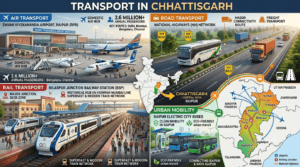
Transport in Chhattisgarh
Chhattisgarh has a well-developed transportation network that connects its major cities, industrial centres, tourist destinations, and rural regions. The state offers excellent connectivity through national highways, state highways, railways, airports, and public transport systems, making travel convenient for residents and visitors alike.
Road Transport
Road transport is the primary mode of travel in Chhattisgarh. The state has an extensive network of National Highways (NHs) and State Highways (SHs) connecting important cities such as Raipur, Bilaspur, Durg, Bhilai, Jagdalpur, Korba, Raigarh, Ambikapur, and Rajnandgaon.
The National Highway Authority of India (NHAI) has significantly improved road infrastructure, providing better connectivity with neighbouring states including Madhya Pradesh, Maharashtra, Telangana, Odisha, Jharkhand, and Uttar Pradesh.
The Chhattisgarh State Road Transport Corporation (CGSRTC) and private bus operators provide regular bus services throughout the state as well as to nearby states.
Rail Transport
Chhattisgarh has one of the busiest railway networks in central India. The state falls under the South East Central Railway (SECR) zone, headquartered in Bilaspur, one of India’s highest freight-earning railway divisions.
Major railway stations include:
- Bilaspur Junction
- Raipur Junction
- Durg Junction
- Bhilai Power House
- Korba
- Raigarh
- Jagdalpur
These stations provide direct train services to major Indian cities including Delhi, Mumbai, Kolkata, Chennai, Hyderabad, Bengaluru, Nagpur, Bhopal, and Visakhapatnam.
Air Transport
The primary airport of the state is Swami Vivekananda Airport (Raipur Airport), located approximately 15 km from Raipur city. It is the busiest airport in Chhattisgarh and offers regular flights to major cities including Delhi, Mumbai, Hyderabad, Bengaluru, Chennai, Kolkata, Pune, Ahmedabad, and Indore.
The state government is also improving regional air connectivity through smaller airports and airstrips in Jagdalpur, Bilaspur, and Ambikapur under the UDAN (Ude Desh ka Aam Nagrik) scheme.
Public Transport
Public transportation in Chhattisgarh includes:
- City buses
- Electric buses (Raipur)
- Auto-rickshaws
- Taxis
- App-based cab services
- Shared taxis
These services provide affordable and convenient transportation for daily commuters and tourists.
With continuous investments in highways, railways, airports, and urban transport, Chhattisgarh is steadily strengthening its transportation infrastructure to support tourism, trade, and economic development.
Transport Network of Chhattisgarh
| Mode | Major Facilities |
|---|---|
| Road | National Highways, State Highways, CGSRTC Buses |
| Railway | Bilaspur, Raipur, Durg, Korba, Raigarh, Jagdalpur |
| Airport | Swami Vivekananda Airport (Raipur) |
| Major Highway Connections | MP, Maharashtra, Telangana, Odisha, Jharkhand, Uttar Pradesh |
| Public Transport | City Buses, Auto-rickshaws, Taxis, Electric Buses |
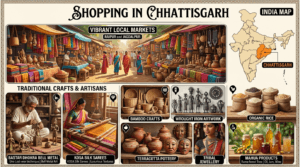
Shopping in Chhattisgarh
Shopping in Chhattisgarh offers visitors a wonderful opportunity to explore the state’s rich tribal heritage, traditional handicrafts, handloom products, forest-based goods, and local markets. From beautifully handcrafted metal artifacts to elegant silk sarees and bamboo crafts, Chhattisgarh is famous for its unique craftsmanship that reflects the creativity and cultural traditions of its tribal communities.
One of the state’s most renowned handicrafts is Dhokra (Bell Metal) Art, an ancient metal casting technique practiced by tribal artisans for centuries. These handcrafted sculptures, figurines, lamps, jewellery, and decorative items are highly valued across India and internationally.
Another famous product is Kosa Silk, produced mainly in Korba, Janjgir-Champa, Raigarh, and surrounding districts. Kosa silk sarees, dress materials, scarves, and shawls are known for their natural golden sheen, durability, and elegant texture.
Chhattisgarh is also famous for Bamboo Crafts, Wrought Iron Art, Terracotta Pottery, Wood Carvings, and Tribal Jewellery. These handmade products make excellent souvenirs for tourists visiting the state.
Popular shopping destinations include Pandri Market and Gol Bazaar in Raipur, Sadar Bazaar in Bilaspur, Gol Bazaar in Jagdalpur, and local tribal markets held during festivals such as the Madai Festival. These markets offer authentic handicrafts, textiles, forest products, spices, organic honey, tamarind, Mahua products, medicinal herbs, and traditional ornaments.
Visitors can also purchase locally produced Tendu leaf products, Lac crafts, Chironji, Sal leaf products, organic rice varieties, and various tribal handmade items that showcase the state’s rich natural resources and traditional skills.
Shopping in Chhattisgarh not only provides memorable souvenirs but also supports local artisans, tribal communities, and small-scale industries that preserve the state’s cultural heritage.
Famous Shopping Items in Chhattisgarh
| Product | Famous Location |
|---|---|
| Dhokra (Bell Metal) Art | Bastar |
| Kosa Silk Sarees | Korba, Raigarh, Janjgir-Champa |
| Bamboo Crafts | Bastar, Kanker |
| Wrought Iron Crafts | Bastar |
| Terracotta Pottery | Raipur & Rural Areas |
| Tribal Jewellery | Bastar |
| Organic Rice | Raipur, Dhamtari |
| Tamarind & Mahua Products | Bastar Region |
| Honey & Chironji | Forest Areas |
| Sal Leaf Products | Tribal Regions |
Best Time to Visit Chhattisgarh
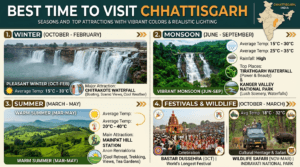
Chhattisgarh can be visited throughout the year, but the best time to explore the state is from October to March, when the weather is cool, pleasant, and ideal for sightseeing, wildlife safaris, temple visits, trekking, and exploring waterfalls. During these months, temperatures remain comfortable, making it the perfect season for tourists to experience the state’s natural beauty and cultural heritage.
Winter (October to February) – Best Season
Winter is considered the best time to visit Chhattisgarh. Temperatures generally range between 10°C and 28°C, providing pleasant weather for outdoor activities. Popular attractions such as Chitrakote Waterfall, Tirathgarh Waterfall, Kanger Valley National Park, Mainpat, Sirpur, and Danteshwari Temple are most enjoyable during this season.
Wildlife enthusiasts can enjoy safaris in Indravati National Park, Achanakmar Tiger Reserve, Barnawapara Wildlife Sanctuary, and Udanti-Sitanadi Tiger Reserve, where animals are easier to spot in the cooler climate.
Summer (March to June)
Summer temperatures range from 30°C to 45°C, with some districts experiencing intense heat. While sightseeing during the daytime can be challenging, early morning and evening visits to forests, waterfalls, and hill stations such as Mainpat remain enjoyable. This season is less crowded, making it suitable for travellers looking for peaceful experiences.
Monsoon (June to September)
The southwest monsoon transforms Chhattisgarh into a lush green paradise. Rivers, forests, and waterfalls become exceptionally beautiful during this period. Chitrakote Waterfall, Tirathgarh Waterfall, and Kanger Valley National Park look spectacular after heavy rainfall. However, occasional heavy rains may affect travel to remote forest areas.
Festivals and Cultural Experiences
Visitors planning a cultural trip should consider visiting during Bastar Dussehra, Madai Festival, Hareli, or Pola, when the state comes alive with colourful tribal traditions, folk dances, music, and religious celebrations.
Whether you are interested in wildlife, waterfalls, tribal culture, photography, adventure, or spirituality, Chhattisgarh offers memorable experiences in every season.
Best Time to Visit Chhattisgarh
| Season | Months | Ideal For |
|---|---|---|
| Winter | October – February | Sightseeing, Wildlife Safari, Festivals |
| Summer | March – June | Hill Stations, Early Morning Travel |
| Monsoon | June – September | Waterfalls, Green Landscapes, Nature Photography |
How to Reach Chhattisgarh
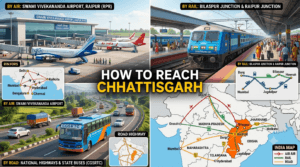
Chhattisgarh is well connected to all major parts of India through an efficient network of airways, railways, and roadways. Its central location makes it easily accessible from neighbouring states such as Madhya Pradesh, Maharashtra, Telangana, Odisha, Jharkhand, and Uttar Pradesh. Whether travelling by air, train, or road, visitors can conveniently reach the state’s major cities and tourist destinations.
By Air
The primary airport in Chhattisgarh is Swami Vivekananda Airport (Raipur Airport), located about 15 km from the city centre. It is the busiest airport in the state and offers regular domestic flights to major Indian cities including Delhi, Mumbai, Bengaluru, Hyderabad, Chennai, Kolkata, Ahmedabad, Pune, Indore, and Visakhapatnam.
Regional airports at Jagdalpur, Bilaspur, and Ambikapur are also being developed under the Government of India’s UDAN (Ude Desh ka Aam Nagrik) scheme to improve regional connectivity.
By Train
Chhattisgarh has an extensive railway network operated mainly by the South East Central Railway (SECR), with its headquarters at Bilaspur. Major railway stations include:
- Bilaspur Junction
- Raipur Junction
- Durg Junction
- Bhilai Power House
- Korba
- Raigarh
- Jagdalpur
These stations are connected to major cities such as New Delhi, Mumbai, Kolkata, Chennai, Hyderabad, Bengaluru, Nagpur, Bhopal, and Visakhapatnam through numerous express and superfast trains.
By Road
An extensive network of National Highways (NHs) and State Highways (SHs) connects Chhattisgarh with neighbouring states. Well-maintained highways make road travel comfortable and convenient.
The Chhattisgarh State Road Transport Corporation (CGSRTC) and several private operators provide regular bus services between major cities and nearby states. Luxury buses, sleeper coaches, and Volvo services are also available on popular routes.
Local Transportation
Within the state, travellers can use:
- City buses
- Electric buses (Raipur)
- Auto-rickshaws
- Taxis
- App-based cab services
- Rental cars
These transport options provide convenient access to tourist attractions, hotels, railway stations, and airports.
Thanks to its modern transport infrastructure and central location, Chhattisgarh is one of the most accessible states in Central India for both business and leisure travellers.
Connectivity to Chhattisgarh
| Mode of Transport | Major Facilities |
|---|---|
| By Air | Swami Vivekananda Airport (Raipur), Jagdalpur, Bilaspur & Ambikapur Airports |
| By Train | Bilaspur, Raipur, Durg, Korba, Raigarh & Jagdalpur Railway Stations |
| By Road | National Highways, State Highways & CGSRTC Bus Services |
| Local Transport | City Buses, Auto-rickshaws, Taxis, App-based Cabs |
Travel Tips for Visiting Chhattisgarh
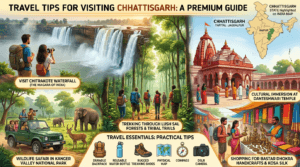
Chhattisgarh is a beautiful destination known for its waterfalls, dense forests, wildlife sanctuaries, ancient temples, tribal heritage, and scenic landscapes. Proper planning helps visitors enjoy a safe, comfortable, and memorable trip. Whether you are exploring the forests of Bastar, visiting historical sites in Sirpur, or witnessing the magnificent Chitrakote Waterfall, following a few essential travel tips will enhance your experience.
The best time to visit Chhattisgarh is between October and March, when the weather is pleasant for sightseeing, wildlife safaris, trekking, and outdoor activities. During the monsoon season, waterfalls become spectacular, but travellers should remain cautious while visiting slippery trails and forest areas.
When visiting national parks and wildlife sanctuaries, always follow forest department guidelines. Maintain a safe distance from wild animals, avoid feeding wildlife, and never litter inside protected areas. Hiring authorised local guides is recommended for jungle safaris, cave exploration, and trekking.
Many attractions in Bastar and other tribal regions are culturally sensitive. Visitors should respect local customs, traditions, and tribal communities. Always ask permission before photographing local people, cultural performances, or religious ceremonies.
Carry comfortable clothing, trekking shoes, sunscreen, insect repellent, drinking water, hats, and basic medicines, especially if you plan to visit forests, waterfalls, caves, or remote villages. Mobile network coverage may be limited in certain forested areas, so it is advisable to plan your journey in advance.
Local cuisine is one of Chhattisgarh’s highlights. Don’t miss traditional dishes such as Chila, Faraa, Angakar Roti, Bafauri, Dubki Kadhi, and Thethri-Khurmi. Shopping for Bastar Dhokra handicrafts, Kosa silk, bamboo products, and tribal artwork is also highly recommended.
By travelling responsibly, respecting nature, and supporting local artisans and communities, visitors can enjoy the authentic beauty and cultural richness of Chhattisgarh while contributing to sustainable tourism.
Essential Travel Tips
| Tip | Details |
|---|---|
| Best Season | October to March |
| Clothing | Light cotton in summer, light woollens in winter |
| Wildlife Safety | Follow park rules and avoid disturbing animals |
| Local Culture | Respect tribal traditions and customs |
| Photography | Seek permission before photographing local people |
| Health | Carry water, medicines, sunscreen, and insect repellent |
| Shopping | Buy authentic Dhokra crafts, Kosa silk, and bamboo products |
| Responsible Tourism | Avoid plastic waste and protect natural habitats |
Interesting Facts About Chhattisgarh
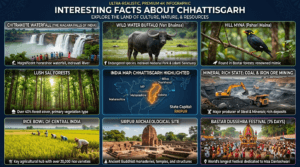
Chhattisgarh is one of India’s most fascinating states, known for its rich tribal heritage, dense forests, spectacular waterfalls, ancient temples, mineral wealth, and unique cultural traditions. From being one of the country’s leading mineral-producing states to preserving centuries-old tribal customs, Chhattisgarh offers many interesting facts that make it truly unique.
The state is popularly known as the “Rice Bowl of Central India” because rice is the principal crop cultivated across its fertile plains. Agriculture remains the primary occupation for a majority of the population, supported by the fertile Mahanadi River basin.
Nearly 44% of Chhattisgarh’s geographical area is covered by forests, making it one of India’s greenest states. These forests are home to diverse wildlife, including the Royal Bengal Tiger, Wild Water Buffalo, Indian Gaur, Leopard, Sloth Bear, and the Hill Myna, which is the state bird.
One of the state’s greatest natural attractions is Chitrakote Waterfall, located on the Indravati River. It is the widest waterfall in India and is popularly known as the “Niagara Falls of India.”
Chhattisgarh is the only state in India where the Wild Water Buffalo is the official State Animal. The state is also famous for the Hill Myna, a bird known for its remarkable ability to imitate human speech.
The Bastar Dussehra is one of the world’s longest festivals, lasting approximately 75 days. Unlike the traditional Dussehra celebrated elsewhere in India, this unique festival is dedicated to Goddess Danteshwari and showcases the vibrant traditions of Bastar’s tribal communities.
Chhattisgarh is one of India’s richest states in mineral resources and is a leading producer of coal, iron ore, limestone, dolomite, bauxite, and tin ore. The state plays a vital role in India’s steel, aluminium, and power industries.
The ancient archaeological site of Sirpur is internationally known for its magnificent Buddhist monasteries, Hindu temples, Jain monuments, and centuries-old inscriptions, reflecting the state’s glorious historical heritage.
With its combination of untouched forests, ancient caves, tribal traditions, and rapidly growing industries, Chhattisgarh has become one of India’s most unique destinations for tourism, culture, and investment.
Interesting Facts at a Glance
| Fact | Description |
|---|---|
| Popular Nickname | Rice Bowl of Central India |
| Formation Date | 1 November 2000 |
| Widest Waterfall | Chitrakote Waterfall |
| State Animal | Wild Water Buffalo |
| State Bird | Hill Myna |
| Largest Festival | Bastar Dussehra (75 Days) |
| Major Archaeological Site | Sirpur |
| Major Mineral Wealth | Coal, Iron Ore, Bauxite, Limestone |
| Forest Cover | Around 44% of the State |
| Famous Tribal Region | Bastar |
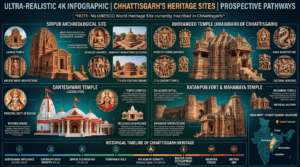
UNESCO World Heritage Sites of Chhattisgarh
Chhattisgarh is renowned for its ancient temples, archaeological remains, Buddhist heritage, and rich tribal culture. Although the state currently has no UNESCO World Heritage Site officially inscribed, it possesses several monuments and archaeological sites of exceptional historical and cultural importance. Some of these sites have been recognized at the national level and hold strong potential for future UNESCO recognition.
The most significant heritage destination is Sirpur, located in Mahasamund district on the banks of the Mahanadi River. Sirpur was a flourishing centre of Buddhism, Hinduism, and Jainism between the 6th and 10th centuries CE. Archaeological excavations have revealed magnificent temples, monasteries (Viharas), stupas, sculptures, inscriptions, and ancient residential complexes, making it one of India’s most important archaeological sites.
The famous Laxman Temple at Sirpur is considered one of the finest examples of early brick temple architecture in India. Built during the 7th century CE, the temple is dedicated to Lord Vishnu and is admired for its intricate carvings, beautifully sculpted doorway, and remarkable architectural design.
Another important heritage monument is the Bhoramdeo Temple in Kabirdham district, often referred to as the “Khajuraho of Chhattisgarh.” Constructed between the 11th and 12th centuries, the temple is renowned for its exquisite stone carvings, Nagara-style architecture, and historical significance.
The Danteshwari Temple in Dantewada, one of the Shakti Peethas, is a major religious and cultural landmark. Other historically significant sites include Ratanpur Fort, Mahamaya Temple, Rajim Temple, and ancient cave complexes found in various parts of the state.
The Archaeological Survey of India (ASI) and the Government of Chhattisgarh continue to conserve these valuable heritage sites while promoting archaeological research, cultural tourism, and heritage preservation.
Although Chhattisgarh does not yet have an officially designated UNESCO World Heritage Site, its rich archaeological legacy and ancient monuments make it one of India’s most culturally significant states.
Major Heritage Sites of Chhattisgarh
| Heritage Site | District | Importance |
|---|---|---|
| Sirpur Archaeological Site | Mahasamund | Ancient Buddhist, Hindu & Jain Centre |
| Laxman Temple | Sirpur | 7th Century Brick Temple |
| Bhoramdeo Temple | Kabirdham | “Khajuraho of Chhattisgarh” |
| Danteshwari Temple | Dantewada | Shakti Peetha |
| Rajim Temple | Gariaband | Ancient Pilgrimage Centre |
| Mahamaya Temple | Ratanpur | Historic Temple |
| Ratanpur Fort | Bilaspur | Kalachuri Heritage |
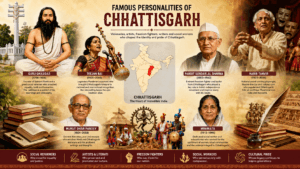
Famous Personalities of Chhattisgarh
Chhattisgarh has produced many distinguished personalities who have made remarkable contributions to politics, literature, social reform, education, spirituality, sports, arts, music, and public service. These eminent individuals have played an important role in shaping the state’s cultural identity and contributing to India’s development.
One of the most respected spiritual leaders associated with Chhattisgarh is Guru Ghasidas Ji, the founder of the Satnami movement. He preached the values of truth, equality, non-violence, social justice, and humanity, inspiring millions of followers. His teachings continue to influence the social and cultural life of the state.
Pandit Sundarlal Sharma is remembered as one of Chhattisgarh’s greatest freedom fighters and social reformers. He actively participated in India’s independence movement and worked tirelessly for the upliftment of tribal communities, education, and social equality.
The state has also produced renowned literary figures such as Mukut Dhar Pandey, a celebrated Hindi poet and writer whose works enriched modern Hindi literature. Chhattisgarh’s folk artists, musicians, and performers have preserved traditional art forms including Panthi Dance, Raut Nacha, Karma Dance, and Pandavani.
Among the most famous artists is Teejan Bai, the internationally acclaimed Pandavani folk singer. She has received several prestigious honours, including the Padma Shri, Padma Bhushan, and Padma Vibhushan, for promoting Chhattisgarh’s folk traditions across the world.
In sports, Purnima Hembram, Amandeep Drall, and several athletes from the state have represented India in national and international competitions. Chhattisgarh has also produced notable administrators, scientists, educationists, and entrepreneurs who continue to contribute to the nation’s progress.
Today, these personalities inspire future generations through their achievements in public service, literature, culture, education, social reform, and the arts, strengthening Chhattisgarh’s reputation both nationally and internationally.
Famous Personalities of Chhattisgarh
| Personality | Field | Contribution |
|---|---|---|
| Guru Ghasidas | Spiritual Leader | Founder of the Satnami Movement |
| Pandit Sundarlal Sharma | Freedom Fighter & Social Reformer | Social Equality & Independence Movement |
| Teejan Bai | Folk Artist | Internationally Renowned Pandavani Singer |
| Mukut Dhar Pandey | Literature | Eminent Hindi Poet & Writer |
| Habib Tanvir | Theatre | Legendary Playwright & Theatre Director |
| Minimata | Politics & Social Service | Tribal Welfare and Women’s Empowerment |
| Balbir Singh Juneja | Public Service | Former Governor and Civil Servant |
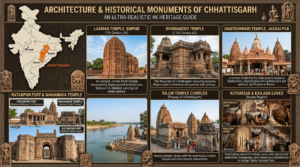
Architecture & Historical Monuments of Chhattisgarh
Chhattisgarh is home to a remarkable collection of ancient temples, forts, archaeological sites, caves, and historical monuments that reflect the rich cultural and architectural heritage of Central India. Influenced by the Maurya, Panduvamshi, Kalachuri, Maratha, and later dynasties, the state’s monuments showcase exceptional craftsmanship, intricate stone carvings, and unique architectural styles.
One of the finest architectural masterpieces is the Bhoramdeo Temple, located in Kabirdham district. Built between the 11th and 12th centuries, this temple is dedicated to Lord Shiva and is popularly known as the “Khajuraho of Chhattisgarh” due to its beautifully carved sculptures and Nagara-style architecture. Surrounded by forests and hills, the temple is one of the state’s most important heritage monuments.
The ancient town of Sirpur is another architectural treasure. Flourishing between the 6th and 10th centuries CE, Sirpur was an important centre of Buddhism, Hinduism, and Jainism. The famous Laxman Temple, built entirely of brick, is regarded as one of India’s finest examples of early temple architecture. Excavations have also uncovered monasteries, stupas, sculptures, and inscriptions that reveal the town’s historical significance.
The Danteshwari Temple in Dantewada, dedicated to Goddess Danteshwari, is one of the 52 Shakti Peethas and attracts thousands of pilgrims every year. Another important religious monument is the Rajiv Lochan Temple at Rajim, renowned for its elegant pillars and ancient stone carvings.
The historic Ratanpur Fort, once the capital of the Kalachuri Dynasty, and the nearby Mahamaya Temple reflect the grandeur of medieval Chhattisgarh. Other notable monuments include Madan Mahal, Malhar Archaeological Site, Deorani-Jethani Temple, and the natural limestone caves of Kutumsar and Kailash Cave, which combine geological wonders with historical significance.
Today, these monuments are preserved by the Archaeological Survey of India (ASI) and the Government of Chhattisgarh. They continue to attract historians, archaeologists, photographers, pilgrims, and tourists from across the world, showcasing the state’s glorious architectural and historical legacy.
Major Historical Monuments of Chhattisgarh
| Monument | Location | Famous For |
|---|---|---|
| Laxman Temple | Sirpur | Ancient Brick Temple |
| Bhoramdeo Temple | Kabirdham | Nagara Architecture |
| Ratanpur Fort | Bilaspur | Kalachuri Dynasty |
| Mahamaya Temple | Ratanpur | Historic Hindu Temple |
| Danteshwari Temple | Dantewada | Shakti Peetha |
| Rajim Temple | Gariaband | Ancient Pilgrimage Centre |
| Malhar Archaeological Site | Bilaspur | Ancient Sculptures & Temples |
| Kutumsar Cave | Bastar | Natural Limestone Cave |
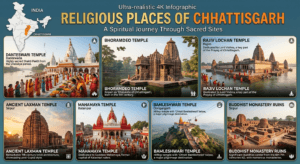
Religious Places of Chhattisgarh
Chhattisgarh is home to many ancient temples, sacred caves, mosques, churches, and Jain pilgrimage sites. The state is especially known for the revered Maa Danteshwari Temple, one of the 52 Shakti Peethas, attracting millions of devotees every year. These religious sites reflect the state’s rich spiritual heritage and architectural beauty.
| Religious Place | Location | Importance |
|---|---|---|
| Danteshwari Temple | Dantewada | One of the 52 Shakti Peethas and the most sacred temple in Chhattisgarh. |
| Bhoramdeo Temple | Kabirdham (Kawardha) | Known as the “Khajuraho of Chhattisgarh” for its beautiful carvings. |
| Rajiv Lochan Temple | Rajim | Ancient temple dedicated to Lord Vishnu and an important pilgrimage centre. |
| Laxman Temple | Sirpur | One of India’s oldest surviving brick temples, dedicated to Lord Vishnu. |
| Mahamaya Temple | Ratanpur | Famous Shakti temple attracting thousands of devotees. |
| Champaran | Raipur District | Birthplace of Saint Vallabhacharya and an important Vaishnav pilgrimage site. |
| Bamleshwari Temple | Dongargarh, Rajnandgaon | Popular hilltop temple dedicated to Goddess Bamleshwari. |
| Sirpur Buddhist Monastery | Sirpur | Historic Buddhist pilgrimage site with ancient monasteries and stupas. |
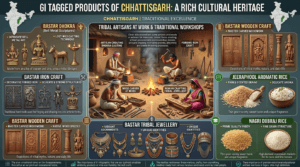
GI Tagged Products of Chhattisgarh
Chhattisgarh is known for its unique traditional crafts, agricultural products, and textiles that have received Geographical Indication (GI) tags. These products represent the state’s cultural identity, skilled craftsmanship, and regional heritage while helping preserve traditional knowledge and supporting local artisans.
| GI Tagged Product | Category | Famous For |
|---|---|---|
| Bastar Dhokra | Handicraft | Traditional bell metal craft made using the ancient lost-wax casting technique. |
| Bastar Iron Craft | Handicraft | Unique wrought iron tribal artwork, decorative items, and sculptures. |
| Bastar Wooden Craft | Handicraft | Hand-carved wooden idols, masks, home décor, and tribal artefacts. |
| Bastar Tribal Jewellery | Handicraft | Traditional handmade jewellery reflecting Bastar’s tribal culture and heritage. |
| Jeeraphool Rice | Agricultural Product | Premium aromatic indigenous rice variety known for its distinctive fragrance. |
| Nagri Dubraj Rice | Agricultural Product | High-quality fragrant rice cultivated mainly in the Dhamtari region. |
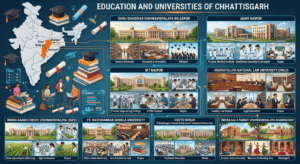
Education and Universities of Chhattisgarh
Chhattisgarh has made significant progress in higher education with several central, state, and private universities. The state is home to premier institutions offering courses in engineering, medicine, agriculture, management, law, and tribal studies. These institutions contribute to research, innovation, and skilled workforce development.
| Institution | Location | Specialization |
|---|---|---|
| Guru Ghasidas Vishwavidyalaya (Central University) | Bilaspur | Arts, Science, Commerce, Engineering, Management, and Research |
| Indira Gandhi Krishi Vishwavidyalaya | Raipur | Agriculture, Horticulture, Forestry, and Allied Sciences |
| Hidayatullah National Law University (HNLU) | Raipur | Law, Legal Studies, and Judicial Research |
| All India Institute of Medical Sciences (AIIMS) | Raipur | Medical Education, Healthcare, and Research |
| National Institute of Technology (NIT) | Raipur | Engineering, Technology, and Scientific Research |
| Pt. Ravishankar Shukla University | Raipur | Higher Education, Arts, Science, Commerce, and Research |
| Chhattisgarh Swami Vivekanand Technical University (CSVTU) | Bhilai | Engineering, Pharmacy, Architecture, and Management |
| Indira Kala Sangit Vishwavidyalaya | Khairagarh | Music, Fine Arts, Dance, Theatre, and Performing Arts |
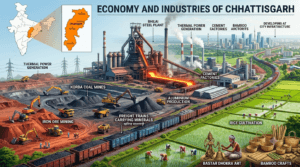
Economy and Industries of Chhattisgarh
Chhattisgarh is one of India’s fastest-growing industrial states and is rich in minerals, forests, and water resources. It is a leading producer of steel, cement, electricity, coal, and iron ore. Agriculture also plays a major role, with rice being the principal crop, earning the state the title “Rice Bowl of Central India.” Industrial hubs such as Bhilai, Raipur, Korba, and Raigarh drive the state’s economic growth.
| Sector | Major Products/Activities | Key Regions |
|---|---|---|
| Steel Industry | Steel production and allied manufacturing | Bhilai, Raipur |
| Mining | Coal, Iron Ore, Bauxite, Limestone, and Dolomite extraction | Korba, Dantewada, Kanker, Surguja |
| Power Generation | Thermal, Hydroelectric, and Solar Power | Korba, Janjgir-Champa |
| Cement Industry | Cement manufacturing | Baloda Bazar, Raipur, Durg |
| Agriculture | Rice, Maize, Wheat, Pulses, Oilseeds, and Vegetables | Across the State |
| Forest-Based Industry | Tendu Leaves, Bamboo, Lac, Mahua, and Herbal Products | Bastar, Kanker, Kondagaon |
| Aluminium Industry | Aluminium production and processing | Korba |
| Handicrafts | Dhokra Bell Metal Craft, Iron Craft, Wooden Craft, and Bamboo Products | Bastar Region |
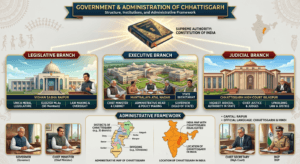
Government and Administration of Chhattisgarh
Chhattisgarh follows a parliamentary system of government as prescribed by the Constitution of India. The state is headed by the Governor, while the Chief Minister leads the elected government. Raipur serves as the state capital, and Nava Raipur (Atal Nagar) is the planned administrative capital. The state is divided into districts for efficient governance and public administration.
| Administrative Feature | Details |
|---|---|
| Capital | Raipur |
| Planned Administrative Capital | Atal Nagar (Nava Raipur) |
| Formation Date | 1 November 2000 |
| Governor | Constitutional Head of the State |
| Chief Minister | Head of the State Government |
| High Court | Chhattisgarh High Court, Bilaspur |
| Legislature | Unicameral Legislative Assembly |
| Legislative Assembly Seats | 90 |
| Lok Sabha Seats | 11 |
| Rajya Sabha Seats | 5 |
| Official Language | Hindi |
| Additional Official Language | Chhattisgarhi |
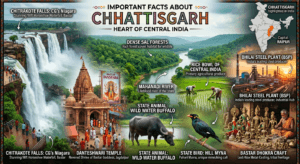
Important Facts About Chhattisgarh
Chhattisgarh is one of India’s youngest states and is renowned for its rich tribal heritage, abundant mineral resources, dense forests, magnificent waterfalls, and ancient temples. Often called the “Rice Bowl of Central India,” the state plays a vital role in India’s agriculture, mining, steel production, and biodiversity conservation.
| Fact | Details |
|---|---|
| State Formation | 1 November 2000 (carved out of Madhya Pradesh) |
| Capital | Raipur |
| Planned Administrative Capital | Atal Nagar (Nava Raipur) |
| Nickname | Rice Bowl of Central India |
| Largest City | Raipur |
| State Animal | Wild Water Buffalo |
| State Bird | Hill Myna |
| State Tree | Sal (Shorea robusta) |
| State Flower | Rhynchostylis retusa (Foxtail Orchid) |
| Largest National Park | Indravati National Park |
| Famous Waterfall | Chitrakote Falls, popularly known as the “Niagara of India” |
| Famous Temple | Danteshwari Temple, Dantewada |
| UNESCO Tentative Site | Ramgarh Theatre |
| Major Industry | Steel, Mining, Power Generation, and Cement |
| Famous Craft | Bastar Dhokra Bell Metal Craft |
| Major River | Mahanadi River |
| Main Crop | Rice |
| Largest Steel Plant | Bhilai Steel Plant |
| Major Mineral Resource | Coal |
FAQs About Chhattisgarh
Here are some of the most frequently asked questions about Chhattisgarh. These questions are useful for students, competitive exam aspirants, travelers, and anyone interested in learning about the state.
Frequently Asked Questions
1. When was Chhattisgarh formed?
Chhattisgarh was formed on 1 November 2000 after being carved out of Madhya Pradesh.
2. What is the capital of Chhattisgarh?
Raipur is the capital city, while Atal Nagar (Nava Raipur) serves as the planned administrative capital.
3. Why is Chhattisgarh called the Rice Bowl of Central India?
Because it is one of India’s leading rice-producing states with vast paddy cultivation.
4. Which is the largest river in Chhattisgarh?
The Mahanadi River is the largest and most important river in the state.
5. Which is the highest waterfall in Chhattisgarh?
Chitrakote Falls is the widest and one of the most spectacular waterfalls in India, popularly known as the “Niagara of India.”
6. What is the state animal of Chhattisgarh?
The Wild Water Buffalo is the official state animal.
7. What is the state bird of Chhattisgarh?
The Hill Myna is the official state bird.
8. Which is the most famous temple in Chhattisgarh?
The Danteshwari Temple in Dantewada is the most revered temple and is considered one of the 52 Shakti Peethas.
9. Which is the largest national park in Chhattisgarh?
Indravati National Park is the largest national park in the state.
10. What are the major industries of Chhattisgarh?
Steel, mining, power generation, cement, aluminium, agriculture, and forest-based industries are the major sectors.
Conclusion
Chhattisgarh is a land of rich natural resources, vibrant tribal culture, ancient temples, breathtaking waterfalls, dense forests, and remarkable biodiversity. Since its formation on 1 November 2000, the state has emerged as one of India’s leading producers of steel, coal, electricity, and rice while preserving its unique cultural traditions and heritage. From the majestic Chitrakote Falls and the sacred Danteshwari Temple to the world-famous Bastar Dhokra craft and lush wildlife sanctuaries, Chhattisgarh offers a perfect blend of history, spirituality, nature, and modern development.
Whether you are a traveler exploring its scenic landscapes, a student preparing for competitive examinations, or a researcher interested in India’s cultural and economic diversity, Chhattisgarh has something valuable to offer. Its warm hospitality, traditional festivals, historical monuments, rich wildlife, and growing industrial economy make it one of the most fascinating states in Central India. As the state continues to develop while protecting its cultural and natural heritage, Chhattisgarh remains a shining example of sustainable growth and timeless tradition.
Internal links
Explore more detailed state guides on DealKart Market:
Andhra Pradesh – https://dealkartmarket.in/andhra-pradesh/
– Telangana – https://dealkartmarket.in/telangana/
– Odisha – https://dealkartmarket.in/odisha/
– Bihar – https://dealkartmarket.in/bihar/
– Uttar Pradesh – https://dealkartmarket.in/uttar-pradesh/
– Uttarakhand – https://dealkartmarket.in/uttarakhand/
– Haryana – https://dealkartmarket.in/haryana/
– Punjab – https://dealkartmarket.in/punjab/
– Himachal Pradesh – https://dealkartmarket.in/himachal-pradesh/
– Madhya Pradesh – https://dealkartmarket.in/madhya-pradesh/
– Rajasthan – https://dealkartmarket.in/rajasthan/
– Gujarat – https://dealkartmarket.in/gujarat/
– Goa – https://dealkartmarket.in/goa/
– Maharashtra – https://dealkartmarket.in/maharashtra/
– Kerala – https://dealkartmarket.in/kerala/
– Tamil Nadu – https://dealkartmarket.in/tamil-nadu/
– Karnataka – https://dealkartmarket.in/karnataka/
– Chhattisgarh – https://dealkartmarket.in/chhattisgarh/
Reference
1. Government of Chhattisgarh (Official State Portal)
2. Chhattisgarh Tourism Board
https://tourism.cgstate.gov.in/
3. Ministry of Tourism, Government of India
4. National Portal of India
5. Census of India
6. Forest Survey of India (FSI)
7. Geological Survey of India (GSI)
8. Archaeological Survey of India (ASI)
9. Ministry of Environment, Forest and Climate Change (MoEFCC)
10. National Tiger Conservation Authority (NTCA)
11. University Grants Commission (UGC)
12. Ministry of Statistics and Programme Implementation (MoSPI)