
Introduction
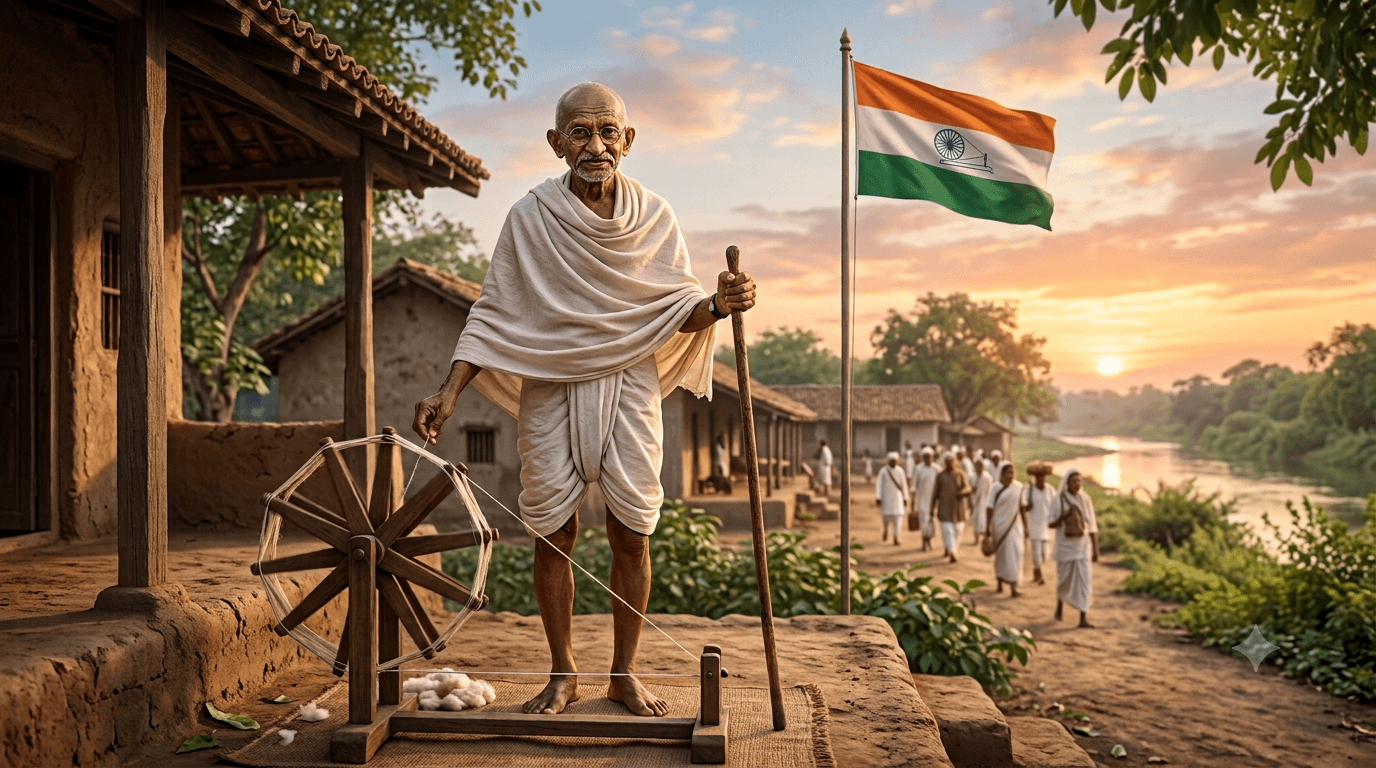
Mahatma Gandhi was one of the greatest leaders of India’s freedom movement and a global symbol of peace, truth, and non-violence. Through his philosophy of Satyagraha (truth-force) and Ahimsa (non-violence), Gandhi transformed India’s struggle for independence into a mass movement involving millions of ordinary people.
Unlike many political leaders of his time, Gandhi believed that moral strength was more powerful than physical force. His campaigns against injustice in South Africa and later in India inspired oppressed people around the world.
Gandhi’s leadership extended beyond political freedom. He worked for the upliftment of the poor, eradication of untouchability, communal harmony, women’s participation, village self-reliance, and ethical living. His ideas continue to influence political leaders, social reformers, and peace activists worldwide.
For competitive examinations such as UPSC, APPSC, TSPSC, SSC, and State PSCs, Mahatma Gandhi is one of the most important personalities in Modern Indian History. Questions are frequently asked about his life, philosophy, movements, writings, and contribution to the freedom struggle.
Quick Facts
| Particular | Details |
|---|---|
| Full Name | Mohandas Karamchand Gandhi |
| Popular Name | Mahatma Gandhi, Bapu, Father of the Nation* |
| Birth | 2 October 1869 |
| Birth Place | Porbandar, Kathiawar, Gujarat |
| Father | Karamchand Gandhi |
| Mother | Putlibai |
| Wife | Kasturba Gandhi |
| Children | Harilal, Manilal, Ramdas, Devdas |
| Education | Law, Inner Temple, London |
| Profession | Lawyer, Freedom Fighter, Social Reformer |
| Political Guru | Gopal Krishna Gokhale |
| Major Principles | Truth (Satya), Non-violence (Ahimsa), Satyagraha, Swaraj, Swadeshi |
| Death | 30 January 1948 |
| Place of Death | Birla House, New Delhi |
| Assassin | Nathuram Vinayak Godse |
| Samadhi | Raj Ghat, New Delhi |
Exam Fact:
Officially, the Government of India has not conferred the title “Father of the Nation.” However, Mahatma Gandhi is popularly known by this title across India.
Birth and Family
Mohandas Karamchand Gandhi was born on 2 October 1869 at Porbandar in present-day Gujarat. At the time, Porbandar was a princely state in the Kathiawar region.
His father, Karamchand Gandhi (Kaba Gandhi), served as the Diwan (Chief Minister) of Porbandar and later Rajkot. He was known for his administrative ability and honesty.
His mother, Putlibai, was deeply religious and belonged to the Pranami Vaishnava tradition. She observed regular fasts, practiced compassion, and followed strict moral discipline. Gandhi later acknowledged that his mother’s influence shaped his lifelong commitment to truth, simplicity, vegetarianism, and self-control.
Growing up in a religious yet culturally diverse environment, Gandhi was exposed to Hindu, Jain, and Islamic traditions. The Jain principle of non-violence had a profound impact on his thinking.
UPSC Facts
- Birth: 2 October 1869
- Birthplace: Porbandar, Gujarat
- Father: Karamchand Gandhi
- Mother: Putlibai
- Religion: Hindu (Vaishnava tradition)
- Childhood and Early Education
Gandhi spent his childhood in Porbandar and later moved to Rajkot, where his father took up administrative responsibilities.
He was an average student but was known for his honesty, punctuality, and disciplined behaviour. He rarely participated in mischief and avoided conflicts with classmates.
One incident from his school days left a lasting impression. During an inspection, a teacher asked Gandhi to copy the correct spelling of a word from another student’s notebook. Gandhi refused because he believed copying was dishonest. Though he lost marks, he remained truthful. This incident later became a symbol of his lifelong commitment to truth.
As a child, Gandhi was deeply inspired by the stories of King Harishchandra, who sacrificed everything for truth, and Shravana Kumar, who devoted his life to serving his parents. These stories strengthened his moral values and sense of duty.
Marriage
According to the customs of the time, Gandhi married Kasturba Makhanji in 1883, when he was only 13 years old.
The couple had four sons:
- Harilal Gandhi
- Manilal Gandhi
- Ramdas Gandhi
- Devdas Gandhi
Over time, Kasturba Gandhi became an active participant in the freedom struggle and accompanied Gandhi during several movements. She was imprisoned multiple times by the British authorities and played an important role in social reform activities.
Exam-Oriented Key Points
Prelims Facts
- Birth: 2 October 1869
- Birthplace: Porbandar
- Wife: Kasturba Gandhi
- Political Guru: Gopal Krishna Gokhale (covered in next part)
- Profession before politics: Lawyer
- Studied Law in: London
Mains Answer Keywords
- Truth
- Non-Violence
- Moral Leadership
- Mass Mobilisation
- Social Reform
- Village Economy
- Inclusive Nationalism
Mahatma Gandhi Biography
Education in England (1888–1891)
After completing his schooling, Gandhi wished to become a barrister. Although some members of his community opposed the idea of crossing the sea (Kala Pani), he decided to pursue legal education in England with the support of his family.
On 4 September 1888, Gandhi sailed to England and joined the Inner Temple, London, one of the four Inns of Court that train barristers.
Before leaving India, he promised his mother, Putlibai, that he would:
- Remain a vegetarian.
- Avoid alcohol.
- Stay away from immoral activities.
- Follow a disciplined lifestyle.
He faithfully kept these promises throughout his stay in England.
Life in London
Initially, Gandhi tried to adapt to English society by wearing fashionable clothes and learning dancing, French, and public speaking. However, he soon realized that such pursuits were unnecessary and chose a simple lifestyle.
He joined the London Vegetarian Society, where he met many intellectuals and reformers. His involvement strengthened his belief in vegetarianism and introduced him to discussions on ethics, religion, and social justice.
During his stay, Gandhi also studied several religious texts, including:
- Bhagavad Gita (which became his spiritual guide)
- The Bible, especially the Sermon on the Mount
- The Quran
- Writings of Leo Tolstoy
- Works of John Ruskin
These writings deeply influenced his ideas on truth, equality, simplicity, and non-violence.
Becoming a Barrister
On 10 June 1891, Mahatma Gandhi qualified as a barrister and was called to the Bar. He returned to India shortly afterward and began practicing law.
UPSC Facts
- Left for England: 4 September 1888
- Institution: Inner Temple, London
- Qualified as Barrister: 10 June 1891
- Returned to India: 1891
Early Legal Career in India
After returning to India, Mahatma Gandhi first attempted to practice law in Bombay. However, he lacked confidence in cross-examining witnesses and struggled to establish himself as a successful lawyer.
He later moved to Rajkot, where he drafted legal petitions for clients. In 1893, he accepted a one-year legal assignment from an Indian merchant, Dada Abdulla, in South Africa. This journey completely changed the course of his life.
Journey to South Africa (1893)
In April 1893, Mahatma Gandhi arrived in South Africa to handle a legal dispute involving Dada Abdulla’s business.
At that time, Indians in South Africa faced severe racial discrimination. They were treated as second-class citizens, denied equal rights, and subjected to discriminatory laws.
Mahatma Gandhi soon experienced this discrimination personally.
Pietermaritzburg Railway Incident (1893)
One of the most significant turning points in Gandhi’s life occurred at Pietermaritzburg Railway Station.
Although he possessed a valid first-class ticket, a European passenger objected to his presence in the compartment. Gandhi refused to move to a lower class. As a result, railway officials forcibly removed him from the train and threw him onto the platform on a cold winter night.
That night, Mahatma Gandhi reflected deeply on the injustice he had suffered. Instead of returning to India, he resolved to fight against racial discrimination through peaceful means.
This incident is widely regarded as the beginning of Mahatma Gandhi’s public struggle for justice.
Exam Fact
Pietermaritzburg Incident (1893) is considered the turning point that transformed Gandhi from a lawyer into a public leader.
Struggle Against Racial Discrimination
During his stay in South Africa, Gandhi witnessed numerous discriminatory practices against Indians, such as:
- Restrictions on voting rights.
- Separate residential areas.
- Pass laws requiring Indians to carry identity documents.
- Denial of equal legal rights.
- Discrimination in transport, employment, and public facilities.
Rather than responding with violence, Mahatma Gandhi believed that injustice could be defeated through moral courage, truth, and disciplined resistance.
Natal Indian Congress (1894)
To unite the Indian community and defend their civil rights, Gandhi founded the Natal Indian Congress (NIC) in 1894.
Its objectives included:
- Protecting the rights of Indians.
- Fighting discriminatory legislation.
- Creating political awareness.
- Promoting unity among Indians regardless of religion or caste.
- Representing Indian grievances before the authorities.
The Natal Indian Congress became the first organized political platform for Indians in South Africa.
UPSC Fact
- Founded: 1894
- Organization: Natal Indian Congress
- Founder: Mahatma Gandhi
Birth of Satyagraha
While fighting unjust laws in South Africa, Gandhi developed a unique method of resistance called Satyagraha.
The term combines two Sanskrit words:
- Satya – Truth
- Agraha – Firm insistence
Thus, Satyagraha means holding firmly to truth or truth-force.
Its principles include:
- Non-violence (Ahimsa)
- Truth (Satya)
- Self-sacrifice
- Civil resistance
- Fearlessness
- Willingness to accept punishment without hatred
Unlike passive resistance, Satyagraha required moral courage and active resistance to injustice while refusing to use violence.
This philosophy later became the foundation of India’s freedom movement.
Exam-Oriented Key Points
Prelims Facts
- England journey: 1888
- Institution: Inner Temple, London
- South Africa arrival: 1893
- Pietermaritzburg Incident: 1893
- Natal Indian Congress: 1894
- Founder of Satyagraha: Mahatma Gandhi
Mains Keywords
- Racial discrimination
- Civil rights
- Truth-force
- Non-violent resistance
- Moral courage
- Political awakening
- Organized protest
Gandhi During the Boer War (1899–1902)
The Boer War was fought between the British Empire and the Boer Republics (Transvaal and Orange Free State) in South Africa.
Although Mahatma Gandhi opposed violence, he believed that Indians should demonstrate loyalty to the British Empire in the hope of securing equal civil rights. He organized the Indian Ambulance Corps, a volunteer medical unit that treated and transported wounded soldiers from the battlefield.
For this humanitarian service, Gandhi received recognition from the British authorities. However, he later realized that despite the Indians’ loyal service, the British government continued its discriminatory policies.
UPSC Facts
- War: Second Boer War (1899–1902)
- Gandhi organized: Indian Ambulance Corps
- Role: Medical and humanitarian service
Zulu Rebellion (1906)
In 1906, the Zulu Rebellion (also called the Bambatha Rebellion) broke out in Natal.
Once again, Mahatma Gandhi organized an Indian Stretcher-Bearer Corps to provide medical assistance to injured soldiers and civilians.
Witnessing the brutality of war reinforced Mahatma Gandhi’s conviction that violence could never be a permanent solution to human problems. This experience further strengthened his commitment to Ahimsa (Non-Violence).
Exam Fact
The Boer War and the Zulu Rebellion played an important role in shaping Mahatma Gandhi’s philosophy of non-violence.
Indian Opinion Newspaper (1903)
To spread awareness among Indians and highlight racial discrimination, Gandhi started a weekly newspaper called Indian Opinion in 1903.
The newspaper was published in multiple languages, including:
- English
- Gujarati
- Hindi
- Tamil
Objectives
- Unite the Indian community.
- Educate people about their legal rights.
- Oppose discriminatory laws.
- Promote truth and non-violence.
- Encourage social reform.
Indian Opinion became the principal medium through which Mahatma Gandhi communicated his ideas during his South African struggle.
UPSC Fact
- Newspaper: Indian Opinion
- Started: 1903
- Place: South Africa
Phoenix Settlement (1904)
In 1904, Gandhi established the Phoenix Settlement near Durban, South Africa.
Inspired by John Ruskin’s book Unto This Last, Gandhi believed that:
- All forms of labour are equally dignified.
- A simple life is superior to material wealth.
- Self-reliance is essential for society.
At Phoenix Settlement, residents:
- Lived simple lives.
- Practised farming.
- Shared work equally.
- Printed the Indian Opinion newspaper.
- Followed discipline and community living.
This became Gandhi’s first practical experiment in communal living and self-sufficiency.
UPSC Facts
- Established: 1904
- Place: Near Durban
- Inspiration: Unto This Last by John Ruskin
Asiatic Registration Act (Black Act), 1906
In 1906, the Transvaal Government passed the Asiatic Registration Act, popularly known as the Black Act.
The Act required all Indians to:
- Register with the government.
- Carry registration certificates at all times.
- Submit fingerprints.
- Produce documents whenever demanded by police.
Indians considered the Act insulting and discriminatory.
Gandhi called upon the Indian community to resist the law peacefully rather than submit to injustice.
First Satyagraha Campaign (1906)
On 11 September 1906, a mass meeting of Indians was held at the Empire Theatre, Johannesburg.
Thousands of people pledged before God that they would refuse to obey the unjust law, even if it meant imprisonment.
This marked the first organized Satyagraha movement in history.
Principles Followed
- Refuse to obey unjust laws.
- Never use violence.
- Accept imprisonment willingly.
- Remain truthful under all circumstances.
- Respect opponents without hatred.
Many volunteers, including Gandhi, were arrested and imprisoned.
Exam Fact
11 September 1906 is regarded as the beginning of Satyagraha as a mass political movement.
Burning of Registration Certificates (1908)
When the government failed to honour its promises, Mahatma Gandhi and his followers publicly burned their registration certificates in 1908.
This peaceful act of civil disobedience became one of the earliest examples of non-violent resistance in modern history.
Gandhi was arrested several times and sentenced to imprisonment, but he remained firm in his commitment to truth and non-violence.
Tolstoy Farm (1910)
In 1910, with the support of his close friend Hermann Kallenbach, Mahatma Gandhi established Tolstoy Farm near Johannesburg.
The farm was named after the famous Russian writer Leo Tolstoy, whose ideas greatly influenced Gandhi.
Features of Tolstoy Farm
- Communal living.
- Equality among all residents.
- Manual labour for everyone.
- Basic education for children.
- Religious tolerance.
- Self-discipline and self-reliance.
Tolstoy Farm became an important training centre for Satyagrahis before they participated in peaceful protests.
UPSC Facts
- Established: 1910
- Location: Near Johannesburg
- Named after: Leo Tolstoy
- Supported by: Hermann Kallenbach
Indian Relief Act (1914)
After years of peaceful struggle, negotiations between Gandhi and General Jan Smuts resulted in the Indian Relief Act of 1914.
The Act provided several concessions to Indians, including:
- Recognition of Indian marriages.
- Abolition of the poll tax imposed on former indentured labourers.
- Relaxation of certain discriminatory restrictions.
Although it did not remove all inequalities, it was considered Gandhi’s first major political success through Satyagraha.
Return to India (1915)
After spending 21 years in South Africa, Gandhi returned to India on 9 January 1915.
His achievements in South Africa had already made him well known among Indian nationalists.
Today, 9 January is celebrated as Pravasi Bharatiya Divas in India to commemorate Gandhi’s return from South Africa.
Reception in India
On his return, Mahatma Gandhi was warmly welcomed by national leaders.
Among them, Gopal Krishna Gokhale played a crucial role in guiding Gandhi. Gokhale advised him not to enter active politics immediately but to travel across India and understand the lives, problems, and aspirations of ordinary people.
Mahatma Gandhi followed this advice and spent nearly a year touring villages, towns, and cities. This experience helped him understand the realities of poverty, social inequality, peasant distress, and colonial exploitation, laying the foundation for his future leadership in the Indian freedom movement.
Exam-Oriented Key Points
Prelims Facts
- Indian Opinion – 1903
- Phoenix Settlement – 1904
- Asiatic Registration Act (Black Act) – 1906
- First Satyagraha – 11 September 1906
- Tolstoy Farm – 1910
- Indian Relief Act – 1914
- Returned to India – 9 January 1915
- Political Mentor – Gopal Krishna Gokhale
Mains Keywords
- South African Experiment
- Satyagraha
- Civil Disobedience
- Non-Violent Resistance
- Communal Living
- Moral Leadership
- Political Apprenticeship
Gandhi’s Entry into Indian Politics
After returning to India in 1915, Mahatma Gandhi did not immediately join active politics. Following the advice of Gopal Krishna Gokhale, he travelled extensively across the country to understand the social, economic, and political conditions of the people.
During these tours, Gandhi observed:
- Extreme rural poverty
- Exploitation of peasants by landlords and the British
- Poor working conditions in industries
- Untouchability and caste discrimination
- Lack of sanitation and education
- Dependence on foreign goods
These experiences convinced him that India’s freedom movement should involve ordinary people, especially peasants, workers, women, and the poor, rather than remaining limited to educated elites.
Sabarmati Ashram (1917)
After initially establishing the Satyagraha Ashram at Kochrab near Ahmedabad in 1915, Gandhi shifted it to the banks of the Sabarmati River in 1917. It became popularly known as the Sabarmati Ashram.
The Ashram served as the headquarters for many of Gandhi’s national movements.
Objectives of the Ashram
- Practice truth and non-violence.
- Promote communal harmony.
- Eliminate untouchability.
- Encourage manual labour and self-reliance.
- Popularize spinning and khadi.
- Train volunteers for Satyagraha.
Eleven Vows (Ekadash Vratas)
Residents of the Ashram followed eleven vows, including:
- Truth (Satya)
- Non-violence (Ahimsa)
- Non-stealing (Asteya)
- Celibacy (Brahmacharya)
- Non-possession (Aparigraha)
- Bread labour (Sharir Shram)
- Swadeshi
- Fearlessness (Abhaya)
- Removal of untouchability
- Control of the palate (Asvada)
- Equal respect for all religions (Sarva Dharma Samabhava)
UPSC Facts
- Kochrab Ashram: 1915
- Sabarmati Ashram: 1917
- Location: Ahmedabad, Gujarat
Champaran Satyagraha (1917)
The Champaran Satyagraha was Gandhi’s first successful Satyagraha in India and marked the beginning of mass Gandhian politics.
Background
Champaran, in present-day Bihar, was a major indigo-growing region. British planters forced farmers to cultivate indigo under the Tinkathia System, which required them to grow indigo on 3/20th (15%) of their land.
Farmers suffered because:
- Indigo cultivation reduced soil fertility.
- Prices paid by planters were very low.
- Heavy taxes and illegal levies were imposed.
- Peasants had little legal protection.
Raj Kumar Shukla
A peasant named Raj Kumar Shukla persistently requested Gandhi to visit Champaran. Gandhi agreed and reached Champaran in April 1917.
Gandhi’s Method
Instead of using violence, Gandhi:
- Collected evidence from thousands of farmers.
- Conducted detailed surveys.
- Mobilized public opinion peacefully.
- Refused to obey the government’s order to leave Champaran.
When summoned to court, Gandhi accepted responsibility for disobeying the order but refused to leave. Public support forced the government to withdraw the case.
Champaran Agrarian Committee
The government appointed a committee to investigate the issue, with Gandhi as a member.
Results
- Tinkathia System abolished.
- Illegal taxes reduced.
- Compensation granted to farmers.
- Better protection for peasants.
- Gandhi emerged as a national leader.
Significance
- First successful Gandhian movement in India.
- Demonstrated the effectiveness of Satyagraha.
- Brought peasants into the freedom movement.
UPSC Facts
- Year: 1917
- State: Bihar
- System opposed: Tinkathia System
- Leader who invited Gandhi: Raj Kumar Shukla
- First successful Satyagraha in India.
Ahmedabad Mill Strike (1918)
The Ahmedabad Mill Strike was Gandhi’s first major movement involving industrial workers.
Background
Textile mill workers demanded a 35% wage increase due to rising prices during World War I.
Mill owners refused to meet their demands.
Gandhi’s Role
Gandhi advised workers:
- Remain peaceful.
- Avoid violence.
- Continue the strike with discipline.
When negotiations stalled, Gandhi undertook his first hunger strike (fast unto death) in support of the workers.
Result
An arbitration tribunal was appointed, which awarded a 35% wage increase to the workers.
Importance
- Demonstrated Gandhi’s leadership among industrial workers.
- Popularized fasting as a moral weapon.
- Showed that labour disputes could be resolved peacefully.
UPSC Facts
- Year: 1918
- Place: Ahmedabad
- Demand: 35% wage increase
- Gandhi’s first political fast.
Kheda Satyagraha (1918)
The Kheda Satyagraha was Gandhi’s first major peasant movement in Gujarat.
Background
Due to crop failure caused by floods and drought, farmers were unable to pay land revenue.
According to British rules, tax should be suspended if crop production fell below a certain level. However, the government insisted on collecting full revenue.
Leaders
The movement was led by:
- Mahatma Gandhi
- Sardar Vallabhbhai Patel
- Shankarlal Banker
- Indulal Yagnik
- Mahadev Desai
Demands
- Suspension of land revenue.
- Cancellation of penalties.
- Relief for poor farmers.
Method
Farmers collectively refused to pay taxes but remained completely non-violent.
Result
The government agreed to:
- Suspend tax collection from poor peasants.
- Return confiscated property in many cases.
- Release several arrested volunteers.
Importance
Strengthened Gandhi’s leadership in rural India.
Brought Sardar Patel into national prominence.
Reinforced the effectiveness of non-violent tax resistance.
UPSC Facts
- Year: 1918
- State: Gujarat
- Issue: Land Revenue
- Important Leader: Sardar Vallabhbhai Patel
Rowlatt Act (1919)
After World War I, instead of granting greater political freedoms, the British government enacted the Rowlatt Act in 1919, officially known as the Anarchical and Revolutionary Crimes Act, 1919.
It was based on the recommendations of the Rowlatt Committee, headed by Justice Sir Sidney Rowlatt.
Main Provisions
The Act empowered the government to:
- Arrest individuals without a warrant.
- Detain people without trial.
- Conduct secret trials.
- Restrict freedom of the press.
- Suppress political activities.
Because it violated fundamental civil liberties, Indians called it the “Black Act.”
Gandhi’s Response
Gandhi strongly opposed the Act and described it as an attack on justice and individual freedom.
He called for a nationwide Rowlatt Satyagraha, marking the first all-India mass protest under his leadership.
Rowlatt Satyagraha (1919)
To protest against the Rowlatt Act, Gandhi launched the Rowlatt Satyagraha in 1919.
Methods
- Hartals (general strikes)
- Peaceful demonstrations
- Public meetings
- Prayer gatherings
- Boycott of unjust laws
Although Gandhi insisted on strict non-violence, violence broke out in some areas. This deeply saddened him and reinforced his belief that people needed greater discipline before launching nationwide movements.
Exam-Oriented Key Points
Prelims Facts
- Kochrab Ashram – 1915
- Sabarmati Ashram – 1917
- Champaran Satyagraha – 1917
- Raj Kumar Shukla invited Gandhi to Champaran.
- Tinkathia System – 3/20th of land under indigo cultivation
- Ahmedabad Mill Strike – 1918
- Gandhi’s first political fast – Ahmedabad Mill Strike
- Kheda Satyagraha – 1918
- Leader associated with Kheda – Sardar Vallabhbhai Patel
- Rowlatt Act – 1919
- Rowlatt Committee Chairman – Justice Sir Sidney Rowlatt
- The Rowlatt Act was popularly known as the Black Act.
Mains Keywords
- Peasant Movements
- Industrial Labour Movement
- Satyagraha
- Civil Liberties
- Colonial Repression
- Non-Violent Resistance
- Mass Mobilisation
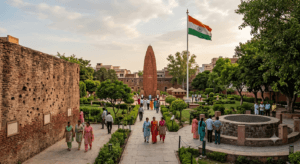
Jallianwala Bagh Massacre (13 April 1919)
The Jallianwala Bagh Massacre is one of the darkest events in India’s freedom struggle. It transformed Indian public opinion against British rule and became a major turning point in Mahatma Gandhi’s political life.
Background
The Rowlatt Act (1919) had triggered widespread protests across India. In Punjab, the British government arrested two popular leaders:
- Dr. Saifuddin Kitchlew
- Dr. Satyapal
Their arrest angered the people of Amritsar.
On 13 April 1919, thousands of people gathered peacefully at Jallianwala Bagh, Amritsar. The gathering coincided with the Baisakhi festival, and many villagers had come to the city unaware of the restrictions imposed by the British.
The Massacre
Brigadier General Reginald Edward Harry Dyer, without warning the crowd to disperse, ordered his troops to open fire on the unarmed gathering.
The only main exit of the ground was blocked, leaving people trapped. Soldiers continued firing until almost all their ammunition was exhausted.
Many people:
- Died on the spot.
- Jumped into a well inside the garden to escape bullets.
- Were injured and left without medical assistance.
Casualties
- Official British figure: 379 deaths and about 1,200 injured.
- Indian National Congress estimate: More than 1,000 deaths.
Consequences
- Gandhi lost faith in British justice.
- Public anger spread across India.
- The massacre strengthened the demand for complete independence.
- Rabindranath Tagore renounced his Knighthood in protest.
- Gandhi returned the Kaiser-i-Hind Medal, which had been awarded to him by the British.
UPSC Facts
- Date: 13 April 1919
- Place: Jallianwala Bagh, Amritsar
- Ordered by: Brigadier General R. E. H. Dyer
- Lieutenant Governor of Punjab: Sir Michael O’Dwyer
- Occasion: Baisakhi
- Tagore renounced: Knighthood
- Gandhi returned: Kaiser-i-Hind Medal
Exam Tip: Do not confuse General Dyer (who ordered the firing) with Michael O’Dwyer (the Lieutenant Governor of Punjab who supported Dyer’s actions).
Hunter Commission (1919)
The British Government appointed the Disorders Inquiry Committee, popularly known as the Hunter Commission, to investigate the Jallianwala Bagh incident.
Findings
- The Commission criticized General Dyer for using excessive force.
- However, it did not recommend severe punishment.
- Indians were dissatisfied with the report because it failed to deliver justice.
Congress Inquiry Committee
The Indian National Congress conducted its own investigation under leaders including:
- Mahatma Gandhi
- Motilal Nehru
- Chittaranjan Das
Their report condemned the massacre and exposed the brutality of British rule.
UPSC Fact
- Official Inquiry: Hunter Commission (1919)
Khilafat Movement (1919–1924)
The Khilafat Movement emerged after World War I to protect the position of the Ottoman Caliph, who was regarded by many Muslims as the spiritual head of the Islamic world.
Background
Following the defeat of the Ottoman Empire, the victorious Allied Powers proposed harsh peace terms that threatened the authority of the Caliph.
Indian Muslim leaders feared that the institution of the Caliphate would be abolished.
Major Leaders
- Maulana Mohammad Ali
- Maulana Shaukat Ali
- Maulana Abul Kalam Azad
- Hakim Ajmal Khan
Gandhi’s Support
Gandhi believed that supporting the Khilafat cause would:
- Promote Hindu-Muslim unity.
- Strengthen the national movement.
- Expand mass participation in the struggle for freedom.
Therefore, he extended full support to the movement.
Importance
The Khilafat Movement became closely linked with the Non-Cooperation Movement.
End of the Movement
In 1924, Mustafa Kemal Atatürk abolished the Caliphate in Turkey, bringing the movement to an end.
UPSC Facts
- Period: 1919–1924
- Main Leaders: Ali Brothers
- Supported by: Mahatma Gandhi
- Ended due to: Abolition of the Caliphate by Mustafa Kemal Atatürk (1924)
Non-Cooperation Movement (1920–1922)
The Non-Cooperation Movement was the first nationwide mass movement led by Mahatma Gandhi.
It united peasants, workers, students, women, merchants, and professionals across India in a common struggle against British rule.
Causes
- Rowlatt Act (1919)
- Jallianwala Bagh Massacre
- Khilafat Issue
- Repressive British policies
Launch
The movement was approved at the Calcutta Special Session of the Indian National Congress (September 1920) and formally adopted at the Nagpur Session (December 1920).
Objectives
- Attain Swaraj through peaceful means.
- Boycott British institutions.
- Promote Swadeshi.
- Encourage national education.
- Strengthen Hindu-Muslim unity.
Programme of the Movement
Boycott
- Government schools and colleges.
- Law courts.
- Legislative councils.
- Foreign cloth.
- British goods.
- Government functions.
Promotion
- Khadi.
- Charkha (spinning wheel).
- National educational institutions.
- Village industries.
- Panchayats.
Thousands of students left government schools, lawyers gave up legal practice, and people publicly burned foreign clothes.
Important Leaders
- Mahatma Gandhi
- C. R. Das
- Motilal Nehru
- Lala Lajpat Rai
- Vallabhbhai Patel
- Rajendra Prasad
- Jawaharlal Nehru
- Maulana Abul Kalam Azad
- Ali Brothers
Significance
- Converted the freedom struggle into a true mass movement.
- Increased political awareness among ordinary Indians.
- Strengthened the Swadeshi movement.
- Popularized Khadi as a symbol of self-reliance.
UPSC Facts
- Started: 1920
- Ended: 1922
- Adopted at: Nagpur Session (1920)
- Symbol: Charkha
- Main Objective: Swaraj through Non-Cooperation
Nagpur Session of the Indian National Congress (1920)
The Nagpur Session (December 1920) was a landmark in the history of the Indian National Congress.
Major Decisions
- Approved the Non-Cooperation Movement.
- Reorganized Congress on a linguistic basis.
- Increased membership to involve ordinary people.
- Adopted the goal of achieving Swaraj through peaceful and legitimate means.
The session transformed the Congress into a mass-based political organization.
Chauri Chaura Incident (5 February 1922)
The Chauri Chaura Incident occurred in Gorakhpur district of present-day Uttar Pradesh.
What Happened?
During a protest, clashes broke out between demonstrators and the police.
An angry mob set the police station on fire.
As a result:
- 22 policemen were killed.
This violent incident deeply shocked Gandhi.
Gandhi’s Decision
Believing that the country was not yet ready for disciplined non-violent struggle, Gandhi decided to withdraw the Non-Cooperation Movement.
Many leaders, including Subhas Chandra Bose and Jawaharlal Nehru, disagreed with this decision. However, Gandhi maintained that non-violence was more important than immediate political success.
UPSC Facts
- Date: 5 February 1922
- Place: Chauri Chaura, Gorakhpur (Uttar Pradesh)
- Policemen killed: 22
- Result: Withdrawal of the Non-Cooperation Movement
Withdrawal of the Non-Coope.ration Movement (1922)
On 12 February 1922, Mahatma Gandhi officially called off the movement.
Soon afterward, he was arrested on charges of sedition and sentenced to six years’ imprisonment in March 1922. Due to ill health, he was released in 1924 after serving about two years.
Although many people were disappointed by the withdrawal, Gandhi believed that maintaining the moral foundation of the movement was essential for the long-term success of India’s freedom struggle.
Exam-Oriented Key Points
- Prelims Facts
- Jallianwala Bagh Massacre: 13 April 1919
- General Dyer: Ordered firing
- Michael O’Dwyer: Lieutenant Governor of Punjab
- Hunter Commission: Investigated the massacre
- Tagore: Renounced Knighthood
- Gandhi: Returned Kaiser-i-Hind Medal
- Khilafat Movement: 1919–1924
- Ali Brothers: Mohammad Ali and Shaukat Ali
- Mustafa Kemal Atatürk: Abolished the Caliphate (1924)
- Non-Cooperation Movement: 1920–1922
- Nagpur Session: December 1920
- Chauri Chaura Incident: 5 February 1922
- Movement Withdrawn: 12 February 1922
Mains Keywords
- Colonial Repression
- Mass Nationalism
- Hindu–Muslim Unity
- Swadeshi
- Non-Cooperation
- Moral Politics
- Non-Violence
Political Developments After the Non-Cooperation Movement
After the withdrawal of the Non-Cooperation Movement in 1922, many national leaders were disappointed. Some believed that the freedom struggle should continue through participation in the legislative councils, while Mahatma Gandhi emphasized strengthening society from the grassroots through constructive work.
This period witnessed important political developments that eventually led to the Civil Disobedience Movement.
Swaraj Party (1923)
After Mahatma Gandhi’s imprisonment, a group of Congress leaders decided to enter the legislative councils to oppose British policies from within.
The Swaraj Party was founded on 1 January 1923.
Founders
- Chittaranjan (C.R.) Das
- Motilal Nehru
Objectives
- Enter legislative councils.
- Obstruct colonial administration from within.
- Expose the limitations of British constitutional reforms.
- Demand self-government for India.
The members of the Swaraj Party were popularly known as Pro-Changers, while those who supported Gandhi’s constructive programme outside the councils were called No-Changers.
UPSC Facts
- Founded: 1 January 1923
- Founders: C.R. Das and Motilal Nehru
- Also known as: Congress-Khilafat Swarajya Party
Gandhi’s Constructive Programme
While many leaders focused on political agitation, Gandhi believed that India could achieve true freedom only by transforming society.
His Constructive Programme included:
- Promotion of Khadi.
- Removal of Untouchability.
- Promotion of Village Industries.
- Basic Education (Nai Talim).
- Women’s Empowerment.
- Communal Harmony.
- Prohibition of Alcohol.
- Rural Sanitation.
- Adult Education.
- Promotion of National Language.
- Upliftment of Tribal Communities.
According to Mahatma Gandhi, political freedom without social reform would remain incomplete.
Exam Note
UPSC Mains: Mahatma Gandhi’s Constructive Programme is often asked as a separate topic because it reflects his vision of nation-building beyond political independence.
Khadi and Charkha
One of Mahatma Gandhi’s most powerful symbols was the Charkha (Spinning Wheel).
He encouraged every Indian to spin cotton and wear Khadi instead of imported British cloth.
Objectives
- Boycott foreign textiles.
- Promote Swadeshi.
- Create rural employment.
- Reduce dependence on British industries.
- Encourage self-reliance.
Khadi became not just a fabric but a symbol of India’s struggle for freedom and economic independence.
UPSC Facts
- Symbol of Swadeshi: Charkha
- Hand-spun cloth: Khadi
Simon Commission (1927)
The British Government appointed the Simon Commission in 1927 to review the working of the Government of India Act, 1919.
Chairman
- Sir John Simon
Why Was It Opposed?
The Commission had seven members, and none of them were Indians.
This led to nationwide protests.
The slogan:
“Simon Go Back!”
became famous throughout India.
Protest
At Lahore, the police brutally lathi-charged demonstrators.
Lala Lajpat Rai was seriously injured during the protest and died a few weeks later due to his injuries.
His death inspired revolutionaries like Bhagat Singh, Rajguru, and Sukhdev.
UPSC Facts
- Appointed: 1927
- Arrived in India: 1928
- Chairman: Sir John Simon
- No Indian members.
- Protest slogan: Simon Go Back
Nehru Report (1928)
In response to the Simon Commission, an All Parties Conference appointed a committee under Motilal Nehru.
The committee prepared the Nehru Report (1928).
Main Recommendations
- Dominion Status for India.
- Parliamentary system.
- Fundamental Rights.
- Responsible Government.
- Joint electorates with reservation where necessary.
Importance
It was the first constitutional framework prepared by Indians for India.
UPSC Facts
- Chairman: Motilal Nehru
- Published: 1928
- Demanded: Dominion Status
Lahore Session of the Indian National Congress (1929)
The Lahore Session was held in December 1929.
President
Jawaharlal Nehru
Historic Decisions
The Congress rejected Dominion Status and adopted the goal of Purna Swaraj (Complete Independence).
It also resolved that:
26 January 1930 would be celebrated as Independence Day throughout India.
Civil Disobedience would be launched if British demands were ignored.
Significance
This marked a turning point because the Congress formally demanded complete independence instead of limited self-government.
UPSC Facts
- Session: Lahore
- Year: 1929
- President: Jawaharlal Nehru
- Resolution: Purna Swaraj
Purna Swaraj Declaration
On 26 January 1930, Indians across the country celebrated Independence Day for the first time.
People gathered in villages, towns, and cities to take the Pledge of Independence, promising to continue the struggle until complete freedom was achieved.
This date later inspired the adoption of 26 January as Republic Day in 1950, when the Constitution of India came into force.
Exam Fact
- First Independence Day celebrated: 26 January 1930
- Republic Day: 26 January 1950
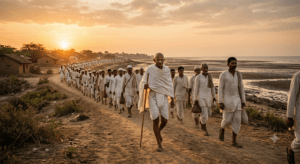
Dandi (Salt) March (1930)
The Salt March was one of the greatest examples of peaceful mass protest in world history.
Background
The British imposed a tax on salt, an essential commodity used by every Indian, including the poorest.
Gandhi believed that challenging the Salt Law would unite people from all sections of society.
Beginning
- Start Date: 12 March 1930
- Starting Point: Sabarmati Ashram
- Destination: Dandi (Gujarat)
- Distance: About 390 km (241 miles)
- Initial Volunteers: 78 Satyagrahis
- Reached Dandi: 5 April 1930
On 6 April 1930, Mahatma Gandhi picked up a handful of natural salt from the seashore, symbolically breaking the British Salt Law.
This simple act became a powerful challenge to colonial authority.
Significance
- Inspired nationwide civil disobedience.
- Massive participation by women, students, peasants, and workers.
- Drew international attention to India’s freedom struggle.
- Demonstrated the strength of non-violent resistance.
UPSC Facts
Started: 12 March 1930
Reached Dandi: 5 April 1930
Salt Law broken: 6 April 1930
Distance: 390 km
Initial participants: 78
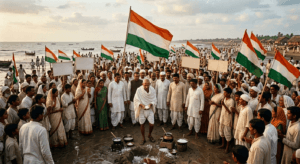
Civil Disobedience Movement (1930)
Following the Salt March, Mahatma Gandhi launched the Civil Disobedience Movement.
Unlike the Non-Cooperation Movement, people were now encouraged to openly violate unjust laws while remaining completely non-violent.
Main Activities
- Breaking the Salt Law.
- Boycott of foreign goods.
- Refusal to pay certain taxes.
- Boycott of liquor shops.
- Picketing.
- Promotion of Khadi.
- Peaceful demonstrations.
Thousands of volunteers courted arrest.
Women, under leaders like Sarojini Naidu and Kamaladevi Chattopadhyay, played an active role in the movement.
British Response
The government responded with:
- Mass arrests.
- Lathi charges.
- Censorship.
- Confiscation of property.
- Ban on public meetings.
Gandhi himself was arrested in May 1930.
Exam-Oriented Key Points
Prelims Facts
- Swaraj Party – 1923
- Founders – C.R. Das & Motilal Nehru
- Simon Commission – 1927
- Chairman – Sir John Simon
- Simon Commission had no Indian member.
- Nehru Report – 1928
- Chairman – Motilal Nehru
- Lahore Session – 1929
- President – Jawaharlal Nehru
- Purna Swaraj Resolution – 1929
- First Independence Day – 26 January 1930
- Dandi March – 12 March to 6 April 1930
- Distance – 390 km
- Initial Satyagrahis – 78
- Civil Disobedience Movement – 1930
Mains Keywords
- Purna Swaraj
- Civil Disobedience
- Salt Satyagraha
- Swadeshi
- Economic Nationalism
- Symbolic Politics
- Mass Mobilisation
- Non-Violent Protest
Dharasana Salt Works Satyagraha (1930)
After Mahatma Gandhi’s arrest on 5 May 1930, the Civil Disobedience Movement continued under other leaders.
One of the most significant events was the Dharasana Salt Works Satyagraha in Gujarat.
Leadership
Initially, Mahatma Gandhi planned to lead the protest, but after his arrest, the movement was led by:
- Abbas Tyabji
- Sarojini Naidu
- Imam Saheb Abdul Kadir Bawazir
- Thousands of Satyagrahis
The Protest
On 21 May 1930, peaceful volunteers marched towards the Dharasana Salt Works.
The British police brutally lathi-charged the unarmed protesters.
Despite severe injuries, the volunteers did not retaliate, demonstrating Gandhi’s principle of Ahimsa (Non-Violence).
International Impact
American journalist Webb Miller reported the incident to newspapers around the world.
His reports shocked international public opinion and exposed the brutality of British rule in India.
Significance
- Strengthened global sympathy for India’s freedom struggle.
- Demonstrated the power of disciplined non-violent resistance.
- Increased pressure on the British Government.
UPSC Facts
- Place: Dharasana, Gujarat
- Date: 21 May 1930
- International journalist: Webb Miller
- Leader after Gandhi’s arrest: Sarojini Naidu
First Round Table Conference (1930)
To discuss constitutional reforms in India, the British Government convened the First Round Table Conference in London.
Duration
12 November 1930 – 19 January 1931
Participants
- British Government
- Representatives of Indian Princes
- Muslim League
- Depressed Classes
- Other minority groups
Congress Boycott
The Indian National Congress did not participate because many of its leaders, including Gandhi, were imprisoned during the Civil Disobedience Movement.
Outcome
No significant agreement was reached due to the absence of the Congress.
UPSC Facts
- Held in: London
- Period: 1930–31
- Congress: Boycotted
- Gandhi: Did not attend
Gandhi-Irwin Pact (5 March 1931)
To reduce political tensions, negotiations took place between Mahatma Gandhi and Lord Irwin, the Viceroy of India.
These talks resulted in the Mahatma Gandhi-Irwin Pact, signed on 5 March 1931.
British Government Agreed To
- Release political prisoners who had not committed violent crimes.
- Return confiscated property in many cases.
- Permit peaceful picketing.
- Allow people living near the coast to make salt for personal use.
Congress Agreed To
- Suspend the Civil Disobedienc.e Movement.
- Participate in the Second Round Table Conference.
- Boycott violent methods.
Criticism
Many young revolutionaries criticized the agreement because it did not secure:
- Complete Independence.
- Cancellation of the death sentence of Bhagat Singh, Rajguru, and Sukhdev.
Significance
Although limited in scope, the pact recognized the Congress as an important political force and paved the way for further constitutional negotiations.
UPSC Facts
- Date: 5 March 1931
- Parties: Mahatma Gandhi & Lord Irwin
- Congress agreed to: Suspend Civil Disobedience
- Gandhi agreed to attend: Second Round Table Conference
Karachi Session of the Indian National Congress (1931)
The Karachi Session was held in March 1931 under the presidency of Sardar Vallabhbhai Patel.
Importance
The Congress adopted two landmark resolutions:
1. Fundamental Rights
Included:
- Freedom of speech
- Freedom of religion
- Equality before law
- Universal adult franchise
- Protection of civil liberties
2. National Economic Programme
Focused on:
- Living wages
- Labour welfare
- State ownership of key industries
- Protection of peasants
- Universal education
Significance
The Karachi Resolution later influenced the Fundamental Rights and Directive Principles of State Policy (DPSPs) in the Constitution of India.
UPSC Facts
- Session: Karachi
- Year: 1931
- President: Sardar Vallabhbhai Patel
Second Round Table Conference (1931)
Following the Mahatma Gandhi-Irwin Pact, Gandhi attended the Second Round Table Conference in London.
Duration
- 7 September – 1 December 1931
Gandhi’s Role
Mahatma Gandhi attended as the sole representative of the Indian National Congress.
- Major Issues Discussed
- Constitutional reforms
- Federal structure
- Minority representation
- Separate electorates
- Responsible government
Why Did It Fail?
The conference failed because:
- There was disagreement over minority representation.
- The British refused to accept Congress demands.
- Separate electorates became a major point of conflict.
Gandhi returned to India disappointed.
UPSC Facts
- Year: 1931
- Place: London
- Gandhi represented: Indian National Congress
Civil Disobedience Movement Resumed (1932)
After returning from London, Mahatma Gandhi found that the British Government had resumed repressive policies.
Consequently, the Civil Disobedience Movement was restarted in 1932.
The British responded by arresting Gandhi and many Congress leaders.
Communal Award (1932)
On 16 August 1932, British Prime Minister Ramsay MacDonald announced the Communal Award.
Main Provision
It introduced separate electorates for several communities, including the Depressed Classes (Scheduled Castes).
Gandhi’s Opposition
Mahatma Gandhi believed that separate electorates for the Depressed Classes would permanently divide Hindu society.
While imprisoned in Yerwada Central Jail, Pune, he began a fast unto death on 20 September 1932.
UPSC Facts
- Announced by: Ramsay MacDonald
- Date: 16 August 1932
- Gandhi’s fast began: 20 September 1932
- Jail: Yerwada Central Jail
Poona Pact (24 September 1932)
To end Mahatma Gandhi’s fast, negotiations took place between:
- Dr. B. R. Ambedkar
- Mahatma Gandhi
- Other Hindu leaders
The agreement signed on 24 September 1932 became known as the Poona Pact.
Main Features
- Separate electorates for the Depressed Classes were abandoned.
- Reserved seats for the Depressed Classes in provincial legislatures were increased.
- Elections would be held through the joint electorate system with reserved seats.
Significance
The Poona Pact became an important milestone in the political representation of Scheduled Castes and remains highly relevant for constitutional and social justice discussions.
UPSC Facts
- Date: 24 September 1932
- Parties: Dr. B. R. Ambedkar & Mahatma Gandhi
- Replaced: Separate Electorates with Joint Electorates + Reserved Seats
Exam Tip: UPSC frequently asks about the difference between the Communal Award and the Poona Pact.
Harijan Movement
After the Poona Pact, Mahatma Gandhi intensified his campaign against untouchability.
He referred to the oppressed castes as “Harijans”, meaning “Children of God.” (Note: In contemporary usage, many people prefer the terms Scheduled Castes (SCs) or the specific community name, and “Harijan” is generally avoided in official contexts.)
Objectives
- End untouchability.
- Open temples to all Hindus.
- Improve education for marginalized communities.
- Promote social equality.
- Encourage dignity of labour.
Mahatma Gandhi travelled extensively across India to spread awareness and raise funds for this cause.
Harijan Sevak Sangh (1932)
To institutionalize the campaign against untouchability, Gandhi established the All India Anti-Untouchability League in 1932.
It was later renamed the Harijan Sevak Sangh.
Objectives
- Promote education among marginalized communities.
- Remove caste-based discrimination.
- Support temple-entry movements.
- Improve sanitation and living conditions.
- Encourage social equality.
UPSC Facts
- Founded: 1932
- Original Name: All India Anti-Untouchability League
- Later Name: Harijan Sevak Sangh
Exam-Oriented Key Points
Prelims Facts
- Dharasana Salt Satyagraha – 21May1930
- Webb Miller publicized the Dharasana incident internationally.
- First Round Table Conference – 1930–31 (Congress boycotted)
- Gandhi-Irwin Pact – 5 March 1931
- Karachi Session – 1931, President: Sardar Vallabhbhai Patel
- Second Round Table Conference – 1931
- Communal Award – 16 August 1932
- Announced by – Ramsay MacDonald
- Poona Pact – 24 September 1932
- Parties – Gandhi & Dr. B. R. Ambedkar
- Harijan Sevak Sangh – 1932
UPSC Mains Keywords
- Constitutional Negotiations
- Civil Disobedience
- Fundamental Rights
- Minority Representation
- Social Justice
- Poona Pact
- Anti-Untouchability Movement
- Gandhian Social Reform
Wardha Scheme of Basic Education (Nai Talim), 1937
Mahatma Gandhi believed that education should develop the head, heart, and hand of a child. He opposed an education system that produced clerks and emphasized one that promoted self-reliance, character, and practical skills.
In October 1937, at the Wardha Conference in Maharashtra, Gandhi proposed the Basic Education Scheme, popularly known as Nai Talim (New Education) or the Wardha Scheme of Education.
Main Features
- Free and compulsory education for children aged 7–14 years.
- Education through the mother tongue.
- Learning through productive handicrafts and manual work.
- Development of moral values and character.
- Equal importance to intellectual and physical labour.
- Promotion of self-reliance.
Zakir Husain Committee
A committee headed by Dr. Zakir Husain was appointed to prepare the detailed framework for implementing the scheme.
Significance
The Wardha Scheme laid the foundation for activity-based learning and influenced later educational policies in India.
UPSC Facts
- Year: 1937
- Popular Name: Nai Talim / Basic Education
- Committee Chairman: Dr. Zakir Husain
- Medium of Instruction: Mother Tongue
Government of India Act, 1935
The Government of India Act, 1935 was the most comprehensive constitutional reform introduced by the British before Independence.
Although Mahatma Gandhi criticized many of its provisions, the Act significantly influenced the future Constitution of India.
Important Features
- Provincial Autonomy.
- Proposed an All-India Federation (never fully implemented).
- Division of powers between the Centre and Provinces.
- Establishment of the Reserve Bank of India (RBI) under the Act’s framework.
- Creation of the Federal Court (1937).
- Expanded the electorate.
Importance
Many administrative features of the Indian Constitution were adapted from this Act.
UPSC Facts
- Enacted: 1935
- Federal Court established: 1937
- RBI established: 1 April 1935
Provincial Elections (1937)
The first provincial elections under the Government of India Act, 1935 were held in 1937.
Results
The Indian National Congress formed ministries in several provinces, including:
- Madras
- Bombay
- United Provinces
- Bihar
- Central Provinces
- Orissa
Later, the North-West Frontier Province
Importance
The elections demonstrated the Congress’s popularity and gave Indian leaders practical experience in governance before independence.
UPSC Fact
- Elections held: 1937
Second World War (1939) and Gandhi’s Response
The Second World War began on 1 September 1939 when Germany invaded Poland.
Without consulting Indian leaders, the British Government declared India to be at war.
The Congress strongly opposed this unilateral decision.
Gandhi’s Position
Mahatma Gandhi opposed fascism and Nazism but maintained that India could not support the British war effort without being granted freedom.
As the British refused to transfer power, Congress ministries resigned from office in 1939.
UPSC Facts
- World War II: 1939–1945
- Congress Ministries resigned: 1939
August Offer (1940)
On 8 August 1940, the Viceroy Lord Linlithgow announced the August Offer.
Main Proposals
- Expansion of the Viceroy’s Executive Council.
- Promise to establish a representative body after the war to frame a constitution.
- Recognition that Indians would participate in constitution-making after the war.
Why Was It Rejected?
The Congress rejected the offer because:
- It did not promise immediate self-government.
- It failed to establish a national government.
- It gave minorities an effective veto over constitutional changes.
UPSC Facts
- Date: 8 August 1940
- Announced by: Lord Linlithgow
Individual Satyagraha (1940–1941)
Since Mahatma Gandhi did not want to launch a mass movement during wartime, he started the Individual Satyagraha.
Objectives
- Assert the right to freedom of speech.
- Oppose India’s forced participation in World War II.
- Demonstrate non-violent resistance.
First Three Satyagrahis
- Acharya Vinoba Bhave – First Individual Satyagrahi.
- Jawaharlal Nehru – Second prominent Satyagrahi.
- Brahma Datt – Among the early Individual Satyagrahis.
Thousands of volunteers later joined the campaign and were arrested.
Significance
The movement maintained political pressure on the British while remaining peaceful.
UPSC Facts
- Started: 1940
- First Individual Satyagrahi: Acharya Vinoba Bhave
Cripps Mission (1942)
To secure Indian cooperation during World War II, the British Government sent the Cripps Mission to India in March 1942.
Leader
Sir Stafford Cripps
Main Proposals
- Dominion Status after the war.
- Right of provinces to opt out of the proposed Union.
- Constituent Assembly to frame the Constitution.
Why Was It Rejected?
The Congress rejected the proposals because:
- No immediate transfer of power.
- The Viceroy retained overriding authority.
- The provision allowing provinces to opt out threatened India’s unity.
Gandhi famously described the offer as:
“A post-dated cheque on a crashing bank.”
UPSC Facts
- Year: 1942
- Leader: Sir Stafford Cripps
- Gandhi’s description: “A post-dated cheque on a crashing bank.”
Quit India Movement (1942)
The failure of the Cripps Mission convinced Mahatma Gandhi that the British must leave India immediately.
The Quit India Movement became the final mass movement under Gandhi’s leadership.
Launch
The movement was launched after the All India Congress Committee (AICC) meeting held at Gowalia Tank Maidan (now August Kranti Maidan), Bombay, on 8 August 1942.
Historic Resolution
The famous Quit India Resolution was passed, demanding an immediate end to British rule in India.
Gandhi’s Call
Gandhi gave the historic slogan:
“Do or Die.”
He urged Indians to continue the struggle peacefully until independence was achieved.
Arrest of Leaders
In the early hours of 9 August 1942, Mahatma Gandhi and almost all top Congress leaders were arrested.
Despite the arrests, spontaneous protests erupted across the country.
Features of the Movement
- Students participated actively.
- Workers organized strikes.
- Parallel governments emerged in some areas.
- Underground resistance developed.
- Women played a significant role.
Parallel Governments
Important examples include:
- Ballia (United Provinces)
- Tamluk (Bengal)
- Satara (Maharashtra – Prati Sarkar)
Significance
- Demonstrated the determination of Indians to achieve complete independence.
- Made British rule increasingly difficult to sustain.
- Strengthened international support for India’s freedom.
UPSC Facts
- Resolution passed: 8 August 1942
- Mass arrests: 9 August 1942
- Place: Gowalia Tank Maidan, Bombay
- Slogan: “Do or Die.”
Aga Khan Palace Imprisonment
After the Quit India Movement, Mahatma Gandhi was imprisoned at the Aga Khan Palace in Pune.
During his imprisonment:
- Mahadev Desai, Mahatma Gandhi’s secretary, died on 15 August 1942.
- Kasturba Mahatma Gandhi passed away on 22 February 1944.
- Gandhi himself suffered from ill health and was released on 6 May 1944.
These personal losses deeply affected him but did not weaken his commitment to India’s freedom.
Exam-Oriented Key Points
Prelims Facts
- Wardha Scheme (Nai Talim) – 1937
- Zakir Husain Committee – 1937
- Government of India Act – 1935
- RBI – 1 April 1935
- Federal Court – 1937
- Provincial Elections – 1937
- World War II – 1939–1945
- August Offer – 8 August 1940
- Individual Satyagraha – 1940
- First Satyagrahi – Acharya Vinoba Bhave
- Cripps Mission – 1942
- Leader – Sir Stafford Cripps
- Quit India Resolution – 8 August 1942
- Slogan – “Do or Die”
- Mass arrests – 9 August 1942
- Gandhi imprisoned at – Aga Khan Palace, Pune
- Kasturba Gandhi died – 22 February 1944
UPSC Mains Keywords
- Nai Talim
- Constitutional Reforms
- Provincial Autonomy
- World War II
- Individual Satyagraha
- Quit India Movement
- Mass Civil Resistance
- Do or Die
- National Unity
- Final Phase of Freedom Struggle
Wavell Plan (1945)
As World War II came to an end, the British Government sought to resolve the constitutional deadlock in India. The Viceroy, Lord Wavell, proposed a plan in June 1945, known as the Wavell Plan.
Main Proposals
- Reconstitute the Viceroy’s Executive Council.
- Include more Indian members in the Executive Council.
- Ensure equal representation for caste Hindus and Muslims.
- Keep the Viceroy and the Commander-in-Chief as the only British members.
Gandhi’s View
Although Gandhi welcomed discussions, he believed that India deserved complete independence, not limited constitutional reforms under British control.
UPSC Facts
- Year: 1945
- Proposed by: Lord Wavell
Shimla Conference (1945)
To discuss the Wavell Plan, the British Government convened the Shimla Conference.
Duration
25 June – 14 July 1945
Participants
- Indian National Congress
- Muslim League
- Lord Wavell
Why It Failed
The main disagreement was over the Muslim League’s demand that it alone should nominate all Muslim members of the Executive Council. The Congress rejected this claim.
As a result, the conference ended without any agreement.
UPSC Facts
- Place: Shimla
- Year: 1945
- Result: Failed
Cabinet Mission (1946)
In March 1946, the British Government sent the Cabinet Mission to India to propose a constitutional settlement.
Members
- Lord Pethick-Lawrence
- Sir Stafford Cripps
- A. V. Alexander
Objectives
- Transfer power peacefully.
- Frame a Constitution for India.
- Preserve the unity of India.
Main Recommendations
- Formation of a Constituent Assembly.
- Creation of an Interim Government.
- A three-tier federal structure.
Gandhi’s Position
Mahatma Gandhi supported a united India and hoped that constitutional negotiations would prevent partition.
UPSC Facts
- Arrived: March 1946
- Members: Pethick-Lawrence, Stafford Cripps, A. V. Alexander
Direct Action Day (16 August 1946)
After disagreements over the Cabinet Mission Plan, the Muslim League, led by Muhammad Ali Jinnah, observed Direct Action Day on 16 August 1946.
Large-scale communal violence broke out in Calcutta and later spread to several parts of India.
Gandhi’s Response
Mahatma Gandhi strongly condemned communal violence and appealed for:
- Peace
- Religious harmony
- Mutual respect
- Non-violence
He personally visited violence-affected areas to restore peace.
UPSC Facts
- Date: 16 August 1946
- Called by: Muslim League
- Leader: Muhammad Ali Jinnah
Interim Government (1946)
The Interim Government was formed on 2 September 1946.
Vice President of the Executive Council
Jawaharlal Nehru
Later, members of the Muslim League also joined the Interim Government.
Although Gandhi held no official position, he remained the moral guide of the national movement.
UPSC Facts
- Formed: 2 September 1946
- Head: Jawaharlal Nehru (Vice President of the Executive Council)
Mountbatten Plan (3 June 1947)
On 3 June 1947, the last Viceroy, Lord Louis Mountbatten, announced the plan for the transfer of power.
Main Features
- Partition of British India.
- Creation of India and Pakistan.
- Transfer of power before June 1948 (later advanced to August 1947).
- Princely States were given the option to join either India or Pakistan.
Gandhi’s Position
Mahatma Gandhi strongly opposed the partition of India. He believed that Hindus and Muslims could live together peacefully.
However, as communal violence intensified and political negotiations reached a deadlock, partition became unavoidable.
UPSC Facts
- Date: 3 June 1947
- Proposed by: Lord Mountbatten
Independence of India (15 August 1947)
India became an independent nation on 15 August 1947.
First Leaders
- Governor-General: Lord Mountbatten
- First Prime Minister: Jawaharlal Nehru
Gandhi on Independence Day
Unlike many national leaders who participated in the celebrations in Delhi, Gandhi spent 15 August 1947 in Calcutta, working to stop communal violence and promote peace.
This reflects his lifelong commitment to communal harmony over personal recognition.
UPSC Facts
- Independence: 15 August 1947
- First Prime Minister: Jawaharlal Nehru
- Gandhi spent the day in: Calcutta
Gandhi’s Peace Mission During Partition
The partition of India led to one of the largest migrations in history and widespread communal violence.
Mahatma Gandhi travelled to:
- Noakhali (present-day Bangladesh)
- Bihar
- Calcutta
- Delhi
He organized prayer meetings, met community leaders, and undertook fasts to restore peace.
His efforts helped reduce violence in several places, especially in Calcutta, where many leaders credited his intervention with calming communal tensions.
Gandhi’s Assassination (30 January 1948)
On 30 January 1948, Gandhi was on his way to the evening prayer meeting at Birla House (now Gandhi Smriti), New Delhi.
At approximately 5:17 PM, Nathuram Vinayak Godse fired three bullets at Gandhi from close range.
According to many historical accounts, Mahatma Gandhi’s last words were:
“Hey Ram.”
(Note: While “Hey Ram” is widely associated with Gandhi’s final moments, historians differ on whether these were his exact last words.)
Mahatma Gandhi died shortly afterward at the age of 78.
Funeral and Samadhi
Mahatma Gandhi’s funeral procession was attended by millions of people.
His mortal remains were cremated on the banks of the Yamuna River in New Delhi.
His memorial is known as:
Raj Ghat
Today, Raj Ghat is one of India’s most important national memorials.
UPSC Facts
- Date of Death: 30 January 1948
- Place: Birla House, New Delhi
- Assassin: Nathuram Vinayak Godse
- Memorial: Raj Ghat
Legacy of Mahatma Gandhi
Mahatma Gandhi’s influence extends far beyond India’s freedom struggle.
His principles inspired global leaders such as:
- Martin Luther King Jr.
- Nelson Mandela
- César Chávez
- The 14th Dalai Lama.
His ideas on non-violence, civil disobedience, truth, and social justice continue to guide democratic movements around the world.
The United Nations observes 2 October, Gandhi’s birthday, as the International Day of Non-Violence.
Exam-Oriented Key Points
- Prelims Facts
- Wavell Plan – 1945
- Shimla Conference – 1945
- Cabinet Mission – 1946
- Direct Action Day – 16 August 1946
- Interim Government – 2 September 1946
- Mountbatten Plan – 3 June 1947
- Independence – 15 August 1947
- Gandhi in Calcutta on Independence Day.
- Assassination – 30 January 1948
- Assassin – Nathuram Vinayak Godse
- Memorial – Raj Ghat
- UN International Day of Non-Violence – 2 October
UPSC Mains Keywords
- Partition
- Communal Harmony
- Cabinet Mission
- Peace Mission
- Nation Building
- Ahimsa
- Constitutional Transition
- Moral Leadership
Gandhian Philosophy
Gandhi’s philosophy was not merely a political strategy but a comprehensive way of life. It emphasized truth, morality, self-discipline, non-violence, and social justice.
1. Satya (Truth)
Mahatma Gandhi believed that Truth is God. He held that truth should guide every aspect of life, whether personal, social, or political.
Key Ideas
- Always speak the truth.
- Truth requires courage and honesty.
- Means are as important as ends.
UPSC Fact: Gandhi later changed his famous statement from “God is Truth” to “Truth is God.”
2. Ahimsa (Non-Violence)
Ahimsa means avoiding violence not only in actions but also in words and thoughts.
According to Mahatma Gandhi:
- Violence creates hatred.
- Non-violence creates lasting peace.
- Real courage lies in forgiving and resisting injustice peacefully.
3. Satyagraha
Satyagraha literally means “holding firmly to truth.”
Its principles include:
- Truth
- Non-violence
- Fearlessness
- Self-suffering
- Civil disobedience
- Refusal to cooperate with injustice
4. Swaraj
For Gandhi, Swaraj meant more than political independence.
It included:
- Self-rule
- Self-discipline
- Moral responsibility
- Democratic participation
- Village self-government
5. Swadeshi
Swadeshi encouraged Indians to:
- Use locally made goods.
- Boycott foreign products.
- Support village industries.
- Promote economic self-reliance.
6. Sarvodaya
Sarvodaya means “Welfare of All.”
Gandhi envisioned a society where development benefits every individual, especially the poorest.
7. Trusteeship Theory
According to Gandhi:
- Wealth should be used for public welfare.
- Rich people should act as trustees of society.
- Economic inequality should be reduced through moral responsibility rather than violent revolution.
Social Reforms
Gandhi worked for:
- Removal of untouchability.
- Women’s empowerment.
- Hindu-Muslim unity.
- Rural development.
- Adult education.
- Sanitation.
- Village industries.
- Temperance (prohibition of alcohol).
Economic Ideas
Gandhi supported:
- Cottage industries.
- Khadi production.
- Decentralized economy.
- Labour-intensive production.
- Self-sufficient villages.
- Sustainable development.
He opposed uncontrolled industrialization if it displaced workers or increased inequality.
Environmental Thought
Although Gandhi was not an environmental activist in the modern sense, many of his ideas align with sustainable development.
His principles included:
- Limited consumption.
- Conservation of natural resources.
- Sustainable living.
- Respect for nature.
- Simple lifestyle.
His famous idea:
“The Earth provides enough to satisfy every man’s need, but not every man’s greed.”
Major Books Written by Mahatma Gandhi
| Book | Year |
|---|---|
| Hind Swaraj | 1909 |
| An Autobiography: The Story of My Experiments with Truth | 1927–1929 |
| Satyagraha in South Africa | 1928 |
| Constructive Programme: Its Meaning and Place | 1941 |
| Key to Health | 1942 |
Newspapers Edited by Gandhi
| Newspaper | Language |
|---|---|
| Indian Opinion | English, Gujarati, Hindi, Tamil |
| Young India | English |
| Navajivan | Gujarati |
| Harijan | English |
| Harijan Sevak | Hindi |
| Harijan Bandhu | Gujarati |
Important Quotes
“My life is my message.”
“Be the change that you wish to see in the world.” (Widely attributed to Gandhi, though this exact wording does not appear in his writings.)
“An eye for an eye makes the whole world blind.” (Commonly attributed to Gandhi, though the exact phrasing is debated.)
“Live as if you were to die tomorrow. Learn as if you were to live forever.” (Often attributed to Gandhi, attribution is uncertain.)
“The best way to find yourself is to lose yourself in the service of others.”
Exam Tip: In competitive exams, use quotes that are reliably associated with Gandhi. In academic writing, avoid attributing disputed quotations without noting the uncertainty.
Important Timeline
| Year | Event |
|---|---|
| 1869 | Born at Porbandar |
| 1883 | Married Kasturba Gandhi |
| 1888 | Went to London |
| 1891 | Returned to India as Barrister |
| 1893 | Went to South Africa |
| 1894 | Founded Natal Indian Congress |
| 1903 | Started Indian Opinion |
| 1904 | Phoenix Settlement |
| 1906 | First Satyagraha |
| 1910 | Tolstoy Farm |
| 1915 | Returned to India |
| 1917 | Champaran Satyagraha |
| 1918 | Kheda & Ahmedabad Movements |
| 1919 | Rowlatt Satyagraha & Jallianwala Bagh |
| 1920 | Non-Cooperation Movement |
| 1930 | Dandi March |
| 1931 | Gandhi-Irwin Pact |
| 1932 | Poona Pact |
| 1937 | Wardha Scheme |
| 1940 | Individual Satyagraha |
| 1942 | Quit India Movement |
| 1947 | Independence of India |
| 1948 | Assassinated |
Frequently Asked UPSC/PSC Facts
Remember These
- Birth – 2 October 1869
- Birthplace – Porbandar
- Political Guru – Gopal Krishna Gokhale
- First Satyagraha in India – Champaran
- First Political Fast – Ahmedabad Mill Strike
- First Mass Movement – Non-Cooperation Movement
- Dandi March – 12 March 1930
- Gandhi-Irwin Pact – 5 March 1931
- Poona Pact – 24 September 1932
- First Individual Satyagrahi – Acharya Vinoba Bhave
- Quit India Resolution – 8 August 1942
- Slogan – Do or Die
- Death – 30 January 1948
- Samadhi – Raj Ghat
Previous Year Question Areas
UPSC and State PSC examinations frequently ask questions on:
- Champaran Satyagraha
- Kheda Satyagraha
- Ahmedabad Mill Strike
- Rowlatt Act
- Jallianwala Bagh
- Non-Cooperation Movement
- Civil Disobedience Movement
- Dandi March
- Gandhi-Irwin Pact
- Poona Pact
- Harijan Movement
- Wardha Scheme
- Individual Satyagraha
- Quit India Movement
- Gandhian Philosophy
Conclusion
Mahatma Gandhi transformed India’s freedom struggle into one of the largest non-violent mass movements in world history. His leadership united millions of Indians across regions, religions, and social backgrounds. Beyond political independence, he emphasized truth, non-violence, self-reliance, social equality, and ethical public life.
His ideas continue to influence democratic movements, peace initiatives, and human rights campaigns across the world. For UPSC, APPSC, TSPSC, SSC, CDS, CAPF, and other competitive examinations, Gandhi remains one of the most important personalities in Modern Indian History. A clear understanding of his life, movements, philosophy, writings, and social reforms is essential for both Prelims and Mains.
Internal links
Andhra Pradesh
https://dealkartmarket.in/andhra-pradesh/
Telangana
https://dealkartmarket.in/telangana/
Odisha
https://dealkartmarket.in/odisha/
Bihar
https://dealkartmarket.in/bihar/
Uttar Pradesh
https://dealkartmarket.in/uttar-pradesh/
Uttarakhand
https://dealkartmarket.in/uttarakhand/
Haryana
https://dealkartmarket.in/haryana/
Punjab
https://dealkartmarket.in/punjab/
Himachal Pradesh
https://dealkartmarket.in/himachal-pradesh/
Madhya Pradesh
https://dealkartmarket.in/madhya-pradesh/
Rajasthan
https://dealkartmarket.in/rajasthan/
Gujarat
https://dealkartmarket.in/gujarat/
Goa
https://dealkartmarket.in/goa/
Maharashtra
https://dealkartmarket.in/maharashtra/
Kerala
https://dealkartmarket.in/kerala/
Tamil Nadu
https://dealkartmarket.in/tamil-nadu/
Karnataka
https://dealkartmarket.in/karnataka/
Odisha
https://dealkartmarket.in/odisha/
Chhattisgarh
https://dealkartmarket.in/chhattisgarh
Reference
NCERT – Themes in Indian History Part III (Class XII)
NCERT eBooks (Official)
NCERT – Mahatma Gandhi and the Nationalist Movement (Theme 11)
Collected Works of Mahatma Gandhi (CWMG) – Gandhi Heritage Portal
https://www.gandhiheritageportal.org
Mahatma Gandhi: An Autobiography – The Story of My Experiments with Truth (Gandhi Heritage Portal)
https://www.gandhiheritageportal.org/
Hind Swaraj (1909) – Gandhi Heritage Portal
https://www.gandhiheritageportal.org/
Young India, Harijan & Indian Opinion Archives – Gandhi Heritage Portal
https://www.gandhiheritageportal.org
NCERT Chapter – Mahatma Gandhi and the Nationalist Movement