Introduction
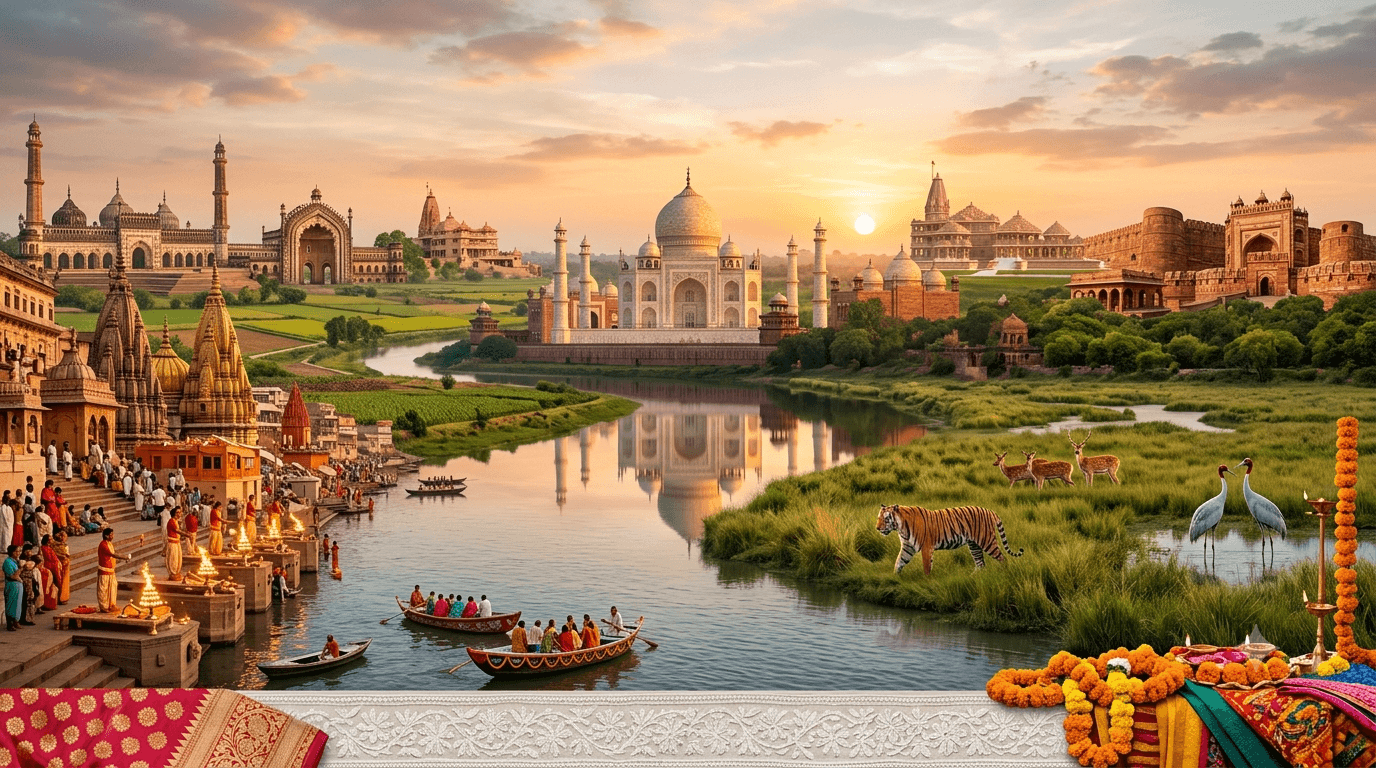
Uttar Pradesh (UP) is India’s most populous state and one of the country’s most historically, culturally, and spiritually significant regions. Located in northern India, Uttar Pradesh is often referred to as the “Heartland of India” because of its rich heritage, political importance, and major contribution to Indian civilization.
The state was formed on 24 January 1950, after being renamed from the United Provinces. Lucknow is the capital, while Prayagraj serves as the judicial capital, housing the Allahabad High Court. With an area of approximately 240,928 square kilometres, Uttar Pradesh is the fourth-largest state in India by area.
Uttar Pradesh is internationally famous for its magnificent monuments, ancient cities, and sacred pilgrimage centres. It is home to the Taj Mahal in Agra, one of the Seven Wonders of the World and a UNESCO World Heritage Site. The state also includes the holy cities of Varanasi, Ayodhya, Mathura, Vrindavan, and Prayagraj, making it one of the world’s most important religious destinations.
The fertile plains of the Ganga, Yamuna, and Ghaghara rivers make Uttar Pradesh one of India’s leading agricultural states. It is a major producer of wheat, rice, sugarcane, potatoes, and pulses, while industries such as textiles, leather, handicrafts, electronics, tourism, and food processing contribute significantly to its economy.
Uttar Pradesh is also known for its vibrant festivals, classical music, dance, handicrafts, delicious cuisine, wildlife sanctuaries, and diverse cultural traditions. It has produced numerous national leaders, freedom fighters, writers, artists, scientists, and sports personalities who have shaped India’s history.
With its unique blend of history, spirituality, architecture, culture, and economic importance, Uttar Pradesh remains one of India’s most influential and fascinating states.
Uttar Pradesh at a Glance
| Category | Details |
|---|---|
| State | Uttar Pradesh |
| Formation | 24 January 1950 |
| Capital | Lucknow |
| Judicial Capital | Prayagraj |
| Largest City | Kanpur |
| Area | 240,928 sq km |
| Population | Over 240 million |
| Official Language | Hindi |
| Additional Official Language | Urdu |
| Famous For | Taj Mahal, Varanasi, Ayodhya & Kumbh Mela |
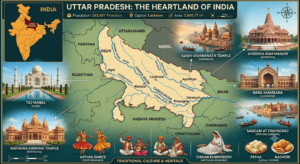
India Map Showing Uttar Pradesh
Uttar Pradesh is located in northern India and occupies a strategic position in the country’s heartland. On the map of India, it is bordered by Uttarakhand and Himachal Pradesh to the north, Haryana, Delhi, and Rajasthan to the west, Madhya Pradesh and Chhattisgarh to the south, Jharkhand and Bihar to the east, and shares an international border with Nepal to the northeast.
With an area of approximately 240,928 square kilometres, Uttar Pradesh is the fourth-largest state in India by area and the most populous state in the country. Its central location and extensive transport network make it an important hub for trade, tourism, culture, and administration.
The India map highlighting Uttar Pradesh helps visitors understand the state’s geographical location and its connectivity with neighbouring states. Major cities such as Lucknow (capital), Kanpur, Agra, Varanasi, Prayagraj, Ayodhya, Meerut, and Ghaziabad are spread across the state, while the Ganga and Yamuna rivers flow through its fertile plains, supporting agriculture and civilization for thousands of years.
An India map with Uttar Pradesh highlighted is especially useful for students, travellers, and competitive exam aspirants to quickly identify the state’s location, neighbouring states, and geographical importance.
History of Uttar Pradesh
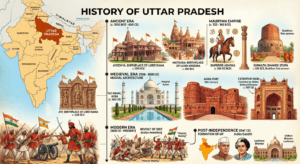
Uttar Pradesh has one of the richest and oldest histories in India, with a legacy spanning thousands of years. Often regarded as the cradle of Indian civilization, the region has been the centre of ancient kingdoms, great empires, religious movements, and the Indian freedom struggle. Many events that shaped India’s history took place in present-day Uttar Pradesh.
During the Vedic Period (c. 1500–600 BCE), the fertile plains of the Ganga and Yamuna became centres of early civilization. Powerful kingdoms known as the Mahajanapadas, including Kosala, Kashi, Vatsa, and Panchala, flourished in this region.
Uttar Pradesh is closely associated with the two great Indian epics. Ayodhya is revered as the birthplace of Lord Rama in the Ramayana, while Mathura is the birthplace of Lord Krishna and Vrindavan is where he spent his childhood, making the state one of the most sacred regions in Hinduism.
During the 6th century BCE, the region became an important centre of Buddhism and Jainism. After attaining enlightenment in Bodh Gaya (present-day Bihar), Gautama Buddha delivered his first sermon at Sarnath near Varanasi, where he established the Buddhist Sangha. Several Jain Tirthankaras are also associated with Uttar Pradesh.
Under the Maurya Empire, especially during the reign of Emperor Ashoka, Buddhism spread across the region. Later, the Gupta Empire (4th–6th century CE) ushered in a golden age of Indian culture, science, literature, mathematics, and art.
During the medieval period, Uttar Pradesh came under the rule of the Delhi Sultanate and later the Mughal Empire. The Mughal emperors built magnificent monuments such as the Taj Mahal, Agra Fort, and Fatehpur Sikri, which remain among India’s greatest architectural masterpieces.
The state also played a pivotal role in the Indian Rebellion of 1857, often called the First War of Indian Independence. Major centres of the uprising included Meerut, Kanpur, Lucknow, Jhansi, and Bareilly. The revolt marked a turning point in India’s struggle against British rule.
After India gained independence in 1947, the United Provinces was officially renamed Uttar Pradesh on 24 January 1950. On 9 November 2000, the northwestern hill districts were separated to form the new state of Uttarakhand.
Today, Uttar Pradesh continues to preserve its remarkable historical heritage through its ancient temples, forts, palaces, mosques, monuments, archaeological sites, and UNESCO World Heritage Sites, making it one of India’s most historically significant states.
History at a Glance
| Period | Historical Significance |
|---|---|
| Vedic Period | Rise of early civilization and Mahajanapadas |
| Ancient Kingdoms | Kosala, Kashi, Vatsa & Panchala |
| Buddhist Era | Buddha’s first sermon at Sarnath |
| Maurya Empire | Rule of Emperor Ashoka |
| Gupta Empire | Golden Age of Indian civilization |
| Mughal Period | Taj Mahal, Agra Fort & Fatehpur Sikri |
| Revolt of 1857 | Major centres at Meerut, Lucknow & Kanpur |
| State Formation | Renamed Uttar Pradesh on 24 January 1950 |
| Uttarakhand Formation | 9 November 2000 |
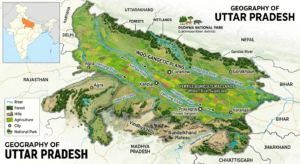
Geography of Uttar Pradesh
Uttar Pradesh is located in northern India and is the country’s fourth-largest state by area, covering approximately 240,928 square kilometres. The state is characterized by its fertile Indo-Gangetic Plains, extensive river systems, forests, wetlands, and the Vindhya Hills in the southern region. Its geographical diversity supports agriculture, industry, tourism, and biodiversity.
Uttar Pradesh shares its borders with Uttarakhand and Himachal Pradesh to the north, Haryana, Delhi, and Rajasthan to the west, Madhya Pradesh and Chhattisgarh to the south, Jharkhand and Bihar to the east, and the international border with Nepal to the northeast.
The Indo-Gangetic Plain occupies nearly 90% of the state’s area, making Uttar Pradesh one of the most fertile agricultural regions in the world. The southern part of the state includes the Vindhya Range and rocky plateaus, which contrast with the flat northern plains.
The state is traversed by several major rivers, including the Ganga, Yamuna, Ghaghara, Gomti, Sarayu, Rapti, Betwa, Ken, Chambal, Son, and Ramganga. These rivers provide water for irrigation, drinking, hydroelectric projects, and support rich biodiversity.
The climate of Uttar Pradesh is generally subtropical, with hot summers (April–June), a monsoon season (July–September), and cool winters (November–February). Summer temperatures can exceed 45°C, while winter temperatures may fall below 5°C in some areas.
Uttar Pradesh is also home to important wetlands, forests, and wildlife habitats. Protected areas such as Dudhwa National Park, Katarniaghat Wildlife Sanctuary, and National Chambal Sanctuary conserve rare species including the Bengal tiger, Gharial, Gangetic dolphin, and Sarus crane.
With its fertile plains, major rivers, rich biodiversity, and strategic location, Uttar Pradesh plays a vital role in India’s agriculture, economy, and cultural heritage.
Geography at a Glance
| Category | Details |
|---|---|
| Area | 240,928 sq km |
| Major Landform | Indo-Gangetic Plains |
| Southern Region | Vindhya Hills & Plateaus |
| Major Rivers | Ganga, Yamuna, Ghaghara, Gomti & Chambal |
| Highest Point | Sonkar Peak (approx. 1,121 m) |
| Climate | Subtropical |
| Forest Cover | Around 6% of geographical area |
| Famous National Park | Dudhwa National Park |
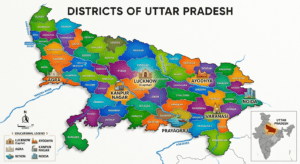
Districts of Uttar Pradesh
Uttar Pradesh is administratively divided into 75 districts, making it one of India’s largest states in terms of administrative divisions. These districts are grouped into 18 administrative divisions to ensure efficient governance, law and order, and regional development. Each district is headed by a District Magistrate (DM) and plays a crucial role in implementing government policies and public welfare schemes.
The districts of Uttar Pradesh vary greatly in terms of population, geography, culture, economy, and historical significance. Major districts such as Lucknow, Kanpur Nagar, Agra, Varanasi, Prayagraj, Meerut, Ghaziabad, Noida (Gautam Buddha Nagar), Ayodhya, Gorakhpur, Jhansi, Bareilly, Mathura, and Aligarh are important centres of administration, education, industry, tourism, and commerce.
Lucknow, the state capital, is known for its Nawabi heritage and administrative importance. Agra is world-famous for the Taj Mahal, while Varanasi is one of the oldest continuously inhabited cities in the world and a major spiritual centre. Prayagraj is renowned for the Triveni Sangam and the Kumbh Mela, whereas Ayodhya is revered as the birthplace of Lord Rama.
The western districts, including Meerut, Ghaziabad, Gautam Buddha Nagar (Noida), and Muzaffarnagar, are highly industrialised and urbanised. In contrast, the eastern districts such as Gorakhpur, Deoria, Ballia, and Azamgarh are known for agriculture and cultural heritage. The Bundelkhand region, comprising districts like Jhansi, Lalitpur, Mahoba, Banda, Chitrakoot, Hamirpur, and Jalaun, is recognised for its historical forts and unique landscape.
Together, the 75 districts contribute significantly to Uttar Pradesh’s agriculture, industry, tourism, education, and economic growth, making the state one of India’s most diverse and influential regions.
Districts at a Glance
| Category | Details |
|---|---|
| Total Districts | 75 |
| Administrative Divisions | 18 |
| Capital District | Lucknow |
| Largest City | Kanpur |
| Major Tourist Districts | Agra, Varanasi, Prayagraj, Ayodhya & Mathura |
| Industrial Districts | Gautam Buddha Nagar, Ghaziabad & Kanpur |
| Famous Religious Districts | Ayodhya, Varanasi, Prayagraj & Mathura |
| Bundelkhand Districts | Jhansi, Banda, Chitrakoot & Mahoba |
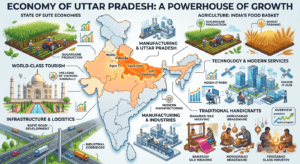
Economy of Uttar Pradesh
Uttar Pradesh has one of the largest state economies in India, driven by agriculture, manufacturing, services, tourism, handicrafts, information technology, and infrastructure development. As India’s most populous state, Uttar Pradesh plays a vital role in the country’s economic growth and contributes significantly to the national Gross Domestic Product (GDP).
Agriculture remains the backbone of the state’s economy, employing a large share of the population. Uttar Pradesh is India’s leading producer of sugarcane and among the top producers of wheat, rice, potatoes, pulses, mangoes, milk, and vegetables. The fertile Indo-Gangetic Plains, supported by the Ganga, Yamuna, and Ghaghara rivers, make the state one of the country’s most productive agricultural regions.
The industrial sector has expanded rapidly over the past decade. Major industries include textiles, leather products, food processing, sugar mills, handloom, carpets, glassware, brassware, electronics, pharmaceuticals, cement, and automobile manufacturing. Cities such as Kanpur, Noida, Greater Noida, Ghaziabad, Agra, Lucknow, Moradabad, Aligarh, and Varanasi are major industrial and commercial hubs.
Uttar Pradesh is internationally famous for its traditional handicrafts and Geographical Indication (GI) products. These include Banarasi silk sarees, Moradabad brassware, Firozabad glassware, Bhadohi carpets, Lucknow Chikankari embroidery, Kannauj perfume (Attar), and Aligarh locks, which are exported worldwide.
The service sector contributes the largest share to the state’s economy. Banking, education, healthcare, retail, transport, tourism, hospitality, and information technology are rapidly growing industries. The Noida–Greater Noida region has emerged as one of India’s leading IT, electronics, and startup hubs.
Tourism is another major source of revenue. Millions of domestic and international tourists visit iconic destinations such as the Taj Mahal, Ayodhya Ram Mandir, Kashi Vishwanath Temple, Prayagraj, Mathura, and Vrindavan, generating employment across the hospitality and service sectors.
With large-scale infrastructure projects such as the Purvanchal Expressway, Bundelkhand Expressway, Ganga Expressway, Jewar International Airport, and dedicated industrial corridors, Uttar Pradesh is steadily emerging as one of India’s fastest-growing economic powerhouses.
Economy at a Glance
| Sector | Major Contribution |
|---|---|
| Agriculture | Sugarcane, Wheat, Rice & Potatoes |
| Major Industries | Textiles, Leather, Glass, Brass & Food Processing |
| IT Hub | Noida & Greater Noida |
| Famous GI Products | Banarasi Silk, Chikankari, Brassware & Attar |
| Tourism | Taj Mahal, Ayodhya, Varanasi & Prayagraj |
| Major Industrial Cities | Kanpur, Noida, Ghaziabad, Agra & Lucknow |
| Major Infrastructure | Purvanchal, Bundelkhand & Ganga Expressways |
| Key Economic Strength | Agriculture, Manufacturing, Services & Tourism |
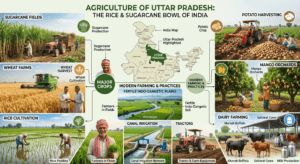
Agriculture of Uttar Pradesh
Agriculture is the backbone of Uttar Pradesh’s economy, employing a large share of the state’s population and making it one of India’s leading agricultural producers. Blessed with the fertile Indo-Gangetic Plains, abundant river systems, and favourable climatic conditions, Uttar Pradesh contributes significantly to India’s food security.
The state is India’s largest producer of sugarcane and one of the top producers of wheat, rice, potatoes, mangoes, milk, pulses, and vegetables. The fertile alluvial soil deposited by the Ganga, Yamuna, Ghaghara, Gomti, and other rivers provides ideal conditions for agriculture.
The major food crops include wheat, rice, maize, barley, bajra, jowar, pulses, and oilseeds. Important cash crops are sugarcane, potatoes, mustard, and tobacco. Uttar Pradesh is also India’s leading producer of mangoes, particularly the famous Dasheri and Langra varieties grown in Malihabad and Varanasi.
The state has a strong horticulture sector, producing fruits such as mangoes, guavas, amla, bananas, papayas, and litchis, along with vegetables like potatoes, onions, tomatoes, peas, and cauliflower.
Extensive irrigation through canals, tube wells, and rivers has made Uttar Pradesh one of the most irrigated states in India. Major irrigation projects and modern farming techniques have helped improve agricultural productivity.
Animal husbandry is another important part of the rural economy. Uttar Pradesh is India’s largest producer of milk, with dairy farming, poultry, fisheries, and livestock rearing providing additional income to farmers.
The state government promotes organic farming, precision agriculture, crop diversification, farm mechanisation, and food processing industries to improve farmers’ incomes and ensure sustainable agricultural development.
With its fertile land, extensive irrigation network, and diverse crop production, Uttar Pradesh continues to play a crucial role in India’s agricultural economy.
Agriculture at a Glance
| Category | Details |
|---|---|
| Main Occupation | Agriculture |
| Major Food Crops | Wheat, Rice, Maize & Pulses |
| Major Cash Crops | Sugarcane, Potato & Mustard |
| Major Fruits | Mango, Guava, Banana & Amla |
| Largest Producer | Sugarcane & Milk |
| Famous Mango | Dasheri & Langra |
| Irrigation Sources | Canals, Rivers & Tube Wells |
| Allied Activities | Dairy, Poultry & Fisheries |
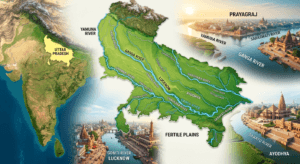
Rivers of Uttar Pradesh
Uttar Pradesh is blessed with one of the most extensive river systems in India. The state is traversed by the Ganga, Yamuna, Ghaghara, Gomti, Sarayu, Rapti, Ramganga, Chambal, Betwa, Ken, Son, and several other rivers. These rivers are the lifeline of the state, supporting agriculture, drinking water supply, irrigation, hydroelectric projects, fisheries, transportation, tourism, and religious activities.
The Ganga River, India’s most sacred river, enters Uttar Pradesh from Uttarakhand and flows through major cities such as Bijnor, Kannauj, Kanpur, Prayagraj, Varanasi, Ghazipur, and Ballia before entering Bihar. It is the state’s longest and most important river.
The Yamuna River, originating from the Yamunotri Glacier in Uttarakhand, flows through Mathura, Agra, Etawah, and Prayagraj, where it joins the Ganga at the sacred Triveni Sangam.
The Ghaghara River, one of the largest tributaries of the Ganga, enters Uttar Pradesh from Nepal and flows through Bahraich, Ayodhya, Ballia, and several eastern districts. Other important rivers include the Gomti, which originates near Pilibhit and flows through Lucknow before joining the Ganga, and the Sarayu River, which is closely associated with the holy city of Ayodhya.
The Chambal, Betwa, and Ken rivers flow through the Bundelkhand region and are important for irrigation and water conservation. The Ramganga, Rapti, and Son rivers also contribute significantly to agriculture and biodiversity across the state.
The Triveni Sangam at Prayagraj, where the Ganga, Yamuna, and the mythical Saraswati rivers meet, is one of Hinduism’s holiest pilgrimage sites and hosts the world-famous Kumbh Mela.
With its vast network of rivers, Uttar Pradesh enjoys fertile agricultural land and holds immense cultural, religious, and economic importance.
Major Rivers at a Glance
| River | Origin | Importance |
|---|---|---|
| Ganga | Gangotri Glacier | India’s holiest river |
| Yamuna | Yamunotri Glacier | Major tributary of the Ganga |
| Ghaghara | Tibet via Nepal | Largest tributary in Uttar Pradesh |
| Gomti | Pilibhit | Flows through Lucknow |
| Sarayu | Himalayan region | Sacred river of Ayodhya |
| Ramganga | Kumaon Himalayas | Irrigation & Agriculture |
| Chambal | Vindhya Range | Wildlife & Irrigation |
| Betwa | Vindhya Hills | Bundelkhand Irrigation |
| Ken | Kaimur Hills | Agriculture & Water Supply |
| Son | Amarkantak Plateau | Tributary of the Ganga |
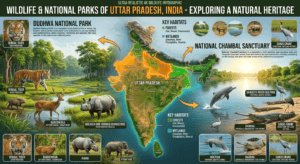
Wildlife & National Parks of Uttar Pradesh
Uttar Pradesh is home to a rich variety of wildlife, forests, wetlands, and protected areas, making it an important state for biodiversity conservation in India. Despite having a relatively small forest cover, the state supports numerous species of mammals, birds, reptiles, and aquatic animals through its national parks, wildlife sanctuaries, tiger reserves, and bird sanctuaries.
The most famous protected area is Dudhwa National Park, located in the Terai region of Lakhimpur Kheri district near the Nepal border. Established in 1977, the park forms part of the Dudhwa Tiger Reserve and is renowned for its Bengal tigers, Indian rhinoceroses, Asian elephants, swamp deer (Barasingha), leopards, sloth bears, and over 450 species of birds.
The National Chambal Sanctuary, shared with Madhya Pradesh and Rajasthan, is one of India’s most important riverine wildlife habitats. It protects endangered species such as the Gharial, Gangetic river dolphin, Mugger crocodile, Indian skimmer, and several migratory birds.
Another major protected area is the Katarniaghat Wildlife Sanctuary, known for its dense forests, wetlands, and rich biodiversity. It is home to tigers, leopards, elephants, gharials, Gangetic dolphins, and numerous bird species.
Birdwatchers visit Nawabganj Bird Sanctuary (Shaheed Chandra Shekhar Azad Bird Sanctuary), Sandi Bird Sanctuary, Okhla Bird Sanctuary, and Samaspur Bird Sanctuary, which attract thousands of migratory birds during winter.
The state animal of Uttar Pradesh is the Barasingha (Swamp Deer), while the Sarus Crane, the world’s tallest flying bird, is the state bird and can be seen in wetlands and agricultural fields across the state.
With its diverse ecosystems, tiger reserves, wetlands, and protected forests, Uttar Pradesh plays a significant role in conserving India’s wildlife and promoting eco-tourism.
Wildlife at a Glance
| Category | Details |
|---|---|
| National Park | Dudhwa National Park |
| Tiger Reserve | Dudhwa Tiger Reserve |
| Famous Sanctuary | National Chambal Sanctuary |
| State Animal | Barasingha (Swamp Deer) |
| State Bird | Sarus Crane |
| Famous Mammals | Bengal Tiger, Leopard, Elephant & One-horned Rhinoceros |
| Famous Reptiles | Gharial & Mugger Crocodile |
| Aquatic Animal | Gangetic River Dolphin |
| Popular Bird Sanctuaries | Okhla, Sandi & Nawabganj Bird Sanctuaries |
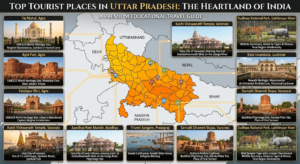
Top Tourist Places in Uttar Pradesh
Uttar Pradesh is one of India’s most visited states, attracting millions of domestic and international tourists every year. The state is renowned for its UNESCO World Heritage Sites, ancient temples, historical monuments, wildlife sanctuaries, spiritual destinations, and cultural heritage. From the iconic Taj Mahal to the sacred cities of Varanasi and Ayodhya, Uttar Pradesh offers unforgettable experiences for every traveller.
The Taj Mahal in Agra, one of the Seven Wonders of the World and a UNESCO World Heritage Site, is the state’s most famous attraction. Nearby, visitors can explore the Agra Fort and Fatehpur Sikri, both UNESCO World Heritage Sites showcasing magnificent Mughal architecture.
Varanasi, one of the world’s oldest continuously inhabited cities, is famous for the Kashi Vishwanath Temple, Dashashwamedh Ghat, Ganga Aarti, and Sarnath, where Gautama Buddha delivered his first sermon.
Ayodhya, revered as the birthplace of Lord Rama, has become one of India’s most important pilgrimage destinations with the Shri Ram Janmabhoomi Mandir. Mathura and Vrindavan, associated with Lord Krishna, attract millions of devotees during festivals such as Janmashtami and Holi.
Prayagraj is known for the Triveni Sangam, the sacred confluence of the Ganga, Yamuna, and the mythical Saraswati rivers. It hosts the world-famous Kumbh Mela, the largest religious gathering on Earth.
Nature lovers can visit Dudhwa National Park, while Lucknow is famous for the Bara Imambara, Rumi Darwaza, and its rich Nawabi heritage. Other popular destinations include Jhansi Fort, Chitrakoot, Kushinagar, Shravasti, Vindhyachal, and Noida.
With its blend of spirituality, history, architecture, wildlife, and culture, Uttar Pradesh remains one of India’s premier travel destinations.
Top Tourist Places at a Glance
| Tourist Place | Famous For |
|---|---|
| Taj Mahal (Agra) | UNESCO World Heritage Site |
| Agra Fort | Mughal Architecture |
| Fatehpur Sikri | UNESCO World Heritage Site |
| Varanasi | Kashi Vishwanath Temple & Ganga Aarti |
| Ayodhya | Shri Ram Janmabhoomi Mandir |
| Prayagraj | Triveni Sangam & Kumbh Mela |
| Mathura & Vrindavan | Birthplace of Lord Krishna |
| Lucknow | Bara Imambara & Nawabi Heritage |
| Dudhwa National Park | Wildlife & Tiger Reserve |
| Sarnath | Buddha’s First Sermon |
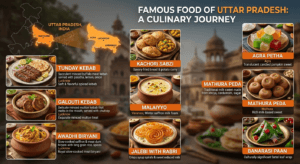
Famous Food of Uttar Pradesh
Uttar Pradesh is famous for its rich and diverse cuisine, reflecting the traditions of the Awadh, Braj, Purvanchal, and Bundelkhand regions. The state’s food culture is known for its royal Mughlai dishes, delicious street food, traditional sweets, and authentic vegetarian delicacies. From the world-famous Awadhi Biryani to the iconic Banarasi Paan, Uttar Pradesh offers an unforgettable culinary experience.
Lucknow, the capital city, is renowned for its Awadhi cuisine, featuring dishes such as Galouti Kebab, Kakori Kebab, Tunday Kebab, Awadhi Biryani, Nihari, and Sheermal. These dishes are celebrated for their rich flavours and aromatic spices.
Agra is famous for its delicious Agra Petha, a sweet made from ash gourd, while Mathura is known for its traditional Mathura Peda. Varanasi is world-famous for Banarasi Paan, Kachori Sabzi, Malaiyyo (winter delicacy), Tamatar Chaat, and Lassi.
Popular vegetarian dishes across the state include Bedai Puri with Aloo Sabzi, Tehri (vegetable rice), Baati Chokha, Dal, Kadhi Chawal, and Aloo Rasedar. Street food lovers enjoy Samosa, Chaat, Dahi Bhalla, Papdi Chaat, Golgappa (Pani Puri), Aloo Tikki, and Chole Bhature.
Uttar Pradesh is also famous for traditional sweets such as Jalebi, Rabri, Imarti, Balushahi, Khurchan, Ghevar, Peda, Gujiya, and Revri, especially during festivals like Diwali, Holi, and Raksha Bandhan.
The state’s rich culinary heritage combines Mughlai, Nawabi, and traditional North Indian flavours, making Uttar Pradesh one of India’s top food destinations.
Famous Foods at a Glance
| Food | Famous Place |
|---|---|
| Tunday Kebab | Lucknow |
| Galouti Kebab | Lucknow |
| Awadhi Biryani | Lucknow |
| Agra Petha | Agra |
| Mathura Peda | Mathura |
| Banarasi Paan | Varanasi |
| Kachori Sabzi | Varanasi |
| Malaiyyo | Varanasi |
| Bedai Puri | Agra & Mathura |
| Jalebi & Rabri | Across Uttar Pradesh |
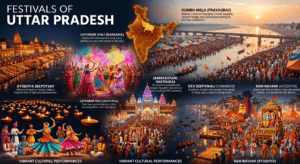
Festivals of Uttar Pradesh
Uttar Pradesh is a land of vibrant festivals that reflect its rich cultural heritage, religious diversity, and ancient traditions. Throughout the year, the state celebrates numerous Hindu, Muslim, Buddhist, Jain, Sikh, and Christian festivals with great enthusiasm. These celebrations attract millions of pilgrims and tourists from across India and around the world.
The most famous festival is the Kumbh Mela, held in Prayagraj every 12 years at the sacred Triveni Sangam. It is the largest religious gathering in the world, where millions of devotees take a holy dip in the confluence of the Ganga, Yamuna, and the mythical Saraswati rivers.
Diwali is celebrated across the state with great devotion, especially in Ayodhya, where the grand Deepotsav festival illuminates the city with millions of earthen lamps to commemorate the return of Lord Rama. This spectacular celebration has earned international recognition.
Holi is another major festival, particularly famous in Mathura, Vrindavan, and Barsana. The unique Lathmar Holi of Barsana and Nandgaon attracts visitors from around the world with its colourful traditions and cultural performances.
Janmashtami, celebrating the birth of Lord Krishna, is observed with great devotion in Mathura and Vrindavan, featuring temple decorations, devotional music, and traditional dance performances.
Other important festivals include Ram Navami in Ayodhya, Dev Deepawali in Varanasi, Makar Sankranti, Navratri, Dussehra, Mahashivratri, Buddha Purnima in Sarnath and Kushinagar, Eid-ul-Fitr, Eid-ul-Adha, Muharram, Christmas, and Guru Nanak Jayanti.
These festivals showcase Uttar Pradesh’s unity in diversity and strengthen the state’s cultural, spiritual, and social traditions.
Festivals at a Glance
| Festival | Famous Place |
|---|---|
| Kumbh Mela | Prayagraj |
| Deepotsav | Ayodhya |
| Holi | Mathura, Vrindavan & Barsana |
| Janmashtami | Mathura & Vrindavan |
| Dev Deepawali | Varanasi |
| Ram Navami | Ayodhya |
| Mahashivratri | Varanasi |
| Buddha Purnima | Sarnath & Kushinagar |
| Eid-ul-Fitr | Across Uttar Pradesh |
| Dussehra | Across Uttar Pradesh |
Culture of Uttar Pradesh
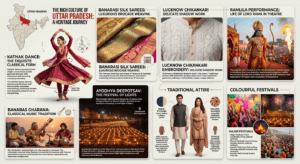
Uttar Pradesh is one of India’s richest cultural regions, known for its ancient traditions, spiritual heritage, classical arts, literature, music, dance, architecture, and colourful festivals. Often regarded as the cultural heart of India, the state has played a significant role in shaping Indian civilization for thousands of years.
The culture of Uttar Pradesh is deeply influenced by the traditions of Awadh, Braj, Bundelkhand, Purvanchal, and Rohilkhand, each with its own unique customs, cuisine, language, folk arts, and festivals. The state is home to sacred cities such as Varanasi, Ayodhya, Mathura, Vrindavan, Prayagraj, and Sarnath, making it one of India’s most important centres of religion and spirituality.
Uttar Pradesh is the birthplace of the Kathak dance form, one of India’s eight classical dances. The state is also famous for Raslila, Ramlila, Nautanki, Kajri, Birha, Chaiti, and Qawwali, which are performed during festivals and cultural events.
The state’s musical heritage includes the Banaras Gharana, known for Hindustani classical music, tabla, sitar, and vocal performances. Varanasi has produced many legendary musicians and artists who have contributed to Indian classical music.
Traditional attire reflects the state’s rich heritage. Men commonly wear Kurta-Pyjama, Dhoti-Kurta, and Sherwani, while women wear Sarees, Salwar Kameez, and Lehengas. Lucknow Chikankari embroidery is internationally renowned for its elegant craftsmanship.
Uttar Pradesh is also famous for its traditional handicrafts, including Banarasi Silk Sarees, Lucknow Chikankari, Moradabad Brassware, Firozabad Glassware, Bhadohi Carpets, Kannauj Attar (Perfume), and Aligarh Locks, many of which have Geographical Indication (GI) status.
The people of Uttar Pradesh celebrate major festivals such as Diwali, Holi, Janmashtami, Ram Navami, Kumbh Mela, Dev Deepawali, Eid, Buddha Purnima, and Christmas, reflecting the state’s rich cultural diversity and communal harmony.
With its ancient traditions, classical arts, sacred heritage, and world-famous handicrafts, Uttar Pradesh continues to preserve one of India’s most vibrant cultural identities.
Culture at a Glance
| Category | Details |
|---|---|
| Cultural Regions | Awadh, Braj, Bundelkhand, Purvanchal & Rohilkhand |
| Classical Dance | Kathak |
| Folk Theatre | Ramlila, Raslila & Nautanki |
| Classical Music | Banaras Gharana |
| Traditional Dress | Saree, Salwar Kameez, Kurta-Pyjama & Sherwani |
| Famous Handicrafts | Banarasi Silk, Chikankari, Brassware & Glassware |
| Famous Perfume | Kannauj Attar |
| Major Festivals | Kumbh Mela, Holi, Deepotsav & Janmashtami |
| Cultural Hub | Varanasi & Lucknow |
Transport of Uttar Pradesh
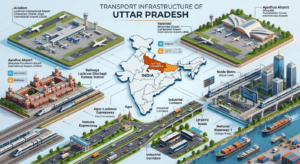
Uttar Pradesh has one of the largest and most developed transportation networks in India, connecting its major cities, pilgrimage centres, industrial hubs, and tourist destinations through an extensive system of roads, railways, airways, metro rail, and inland waterways. Its strategic location in northern India makes it a major transportation hub for the country.
Road transport is the backbone of connectivity in Uttar Pradesh. The state has an extensive network of National Highways, State Highways, Expressways, and rural roads. Major expressways include the Yamuna Expressway, Agra–Lucknow Expressway, Purvanchal Expressway, Bundelkhand Expressway, and Ganga Expressway (under development), which have significantly improved travel and economic connectivity.
The Uttar Pradesh State Road Transport Corporation (UPSRTC) operates thousands of buses connecting cities, towns, villages, and neighbouring states. Private buses, taxis, app-based cabs, and auto-rickshaws also provide convenient transportation.
Uttar Pradesh has one of the largest railway networks in India, operated primarily by the Northern Railway, North Central Railway, and North Eastern Railway zones. Major railway stations include Lucknow Charbagh, Kanpur Central, Prayagraj Junction, Varanasi Junction, Agra Cantt, Gorakhpur Junction, Mathura Junction, and Ghaziabad Junction. These stations are connected to almost every major city in India.
Air connectivity has expanded rapidly with major airports including Chaudhary Charan Singh International Airport (Lucknow), Lal Bahadur Shastri International Airport (Varanasi), Agra Airport, Kanpur Airport, Prayagraj Airport, Gorakhpur Airport, Ayodhya Maharishi Valmiki International Airport, and the upcoming Noida International Airport (Jewar).
Metro rail services operate in Lucknow, Noida, Greater Noida, Ghaziabad, Kanpur, and Agra, providing modern urban transportation. Uttar Pradesh is also promoting inland water transport through National Waterway-1 on the Ganga River, connecting Varanasi with other major river ports.
With world-class expressways, expanding airports, an extensive railway network, metro systems, and waterways, Uttar Pradesh has become one of India’s best-connected states
Transport at a Glance
| Mode | Major Facilities |
|---|---|
| Road Transport | National Highways, State Highways & Expressways |
| State Bus Service | Uttar Pradesh State Road Transport Corporation (UPSRTC) |
| Major Expressways | Yamuna, Agra–Lucknow, Purvanchal & Bundelkhand |
| Major Railway Stations | Lucknow, Kanpur, Prayagraj, Varanasi & Agra |
| International Airports | Lucknow & Varanasi |
| Other Airports | Ayodhya, Prayagraj, Kanpur, Gorakhpur & Agra |
| Metro Cities | Lucknow, Noida, Kanpur, Agra & Ghaziabad |
| Inland Waterway | National Waterway-1 (Ganga River) |

Sports of Uttar Pradesh
Uttar Pradesh has a rich sporting tradition and has produced numerous athletes who have represented India at the national and international levels. The state promotes both modern sports and traditional games, while its growing sports infrastructure has helped nurture talent in cricket, hockey, wrestling, athletics, badminton, shooting, kabaddi, football, and archery.
Cricket is the most popular sport in the state. The Bharat Ratna Shri Atal Bihari Vajpayee Ekana Cricket Stadium in Lucknow is one of India’s finest international cricket venues and regularly hosts international matches and the Indian Premier League (IPL). The Green Park Stadium in Kanpur is another historic international cricket ground.
Hockey has a proud legacy in Uttar Pradesh, with the state producing several Olympians and international players. Traditional sports such as Kabaddi, Kushti (Wrestling), Kho Kho, and Mallakhamb are widely played, especially in rural areas.
The state has also produced internationally renowned athletes such as Major Dhyan Chand, widely regarded as one of the greatest hockey players in history, and badminton stars Saina Nehwal and Satwiksairaj Rankireddy, who have trained at the Pullela Gopichand Academy and represented India successfully. (Note: Saina Nehwal was born in Haryana and Satwiksairaj Rankireddy is from Andhra Pradesh; they have trained nationally but are not from Uttar Pradesh.)
Uttar Pradesh has, however, produced notable sportspersons including Mohammed Kaif, Suresh Raina, Bhuvneshwar Kumar, Piyush Chawla, Praveen Kumar, and Kuldeep Yadav in cricket, along with several athletes in wrestling, shooting, and athletics.
Major sporting facilities include the Ekana Cricket Stadium (Lucknow), Green Park Stadium (Kanpur), Dr. Bhimrao Ambedkar State Sports Complex, and various sports academies across Lucknow, Noida, Varanasi, Prayagraj, and Gorakhpur.
The state government actively promotes sports through talent identification programmes, sports universities, coaching centres, and modern stadiums, encouraging young athletes to compete at national and international levels.
Sports at a Glance
| Category | Details |
|---|---|
| Most Popular Sport | Cricket |
| International Cricket Stadium | Ekana Cricket Stadium, Lucknow |
| Historic Cricket Stadium | Green Park Stadium, Kanpur |
| Traditional Sports | Kabaddi, Wrestling & Kho Kho |
| Famous Sportspersons | Major Dhyan Chand, Mohammed Kaif, Suresh Raina, Bhuvneshwar Kumar & Kuldeep Yadav |
| Popular Sports | Cricket, Hockey, Badminton, Athletics & Shooting |
| Sports Infrastructure | Stadiums, Sports Academies & Training Centres |
| Government Focus | Grassroots Sports Development |
Famous Personalities of Uttar Pradesh
Uttar Pradesh has produced some of India’s most influential personalities in the fields of politics, literature, spirituality, science, music, sports, social reform, and the freedom movement. The state’s rich cultural and educational heritage has shaped leaders and visionaries who have made significant contributions to India and the world.
One of the most respected figures associated with Uttar Pradesh is Pandit Jawaharlal Nehru, India’s first Prime Minister, who was born in Prayagraj. Another iconic leader, Lal Bahadur Shastri, India’s second Prime Minister, was born in Mughalsarai (now Deen Dayal Upadhyaya Nagar) and is remembered for the slogan “Jai Jawan, Jai Kisan.”
The state is also the birthplace of Atal Bihari Vajpayee, former Prime Minister of India, who was born in Gwalior (Madhya Pradesh) but represented Lucknow in Parliament for many years and had a deep association with Uttar Pradesh.
In literature, Uttar Pradesh has given India legendary writers such as Munshi Premchand, one of the greatest Hindi and Urdu novelists, Harivansh Rai Bachchan, the renowned Hindi poet, and Mahadevi Verma, an eminent poet and social reformer.
The state has a glorious spiritual heritage. Goswami Tulsidas, author of the Ramcharitmanas, lived in Varanasi, while Kabir Das, the great mystic poet and saint, is closely associated with Varanasi.
In music, Ustad Bismillah Khan, the legendary shehnai maestro and Bharat Ratna awardee, brought global recognition to Indian classical music through his lifelong association with Varanasi.
Uttar Pradesh has also produced renowned sportspersons such as Major Dhyan Chand, regarded as one of the greatest hockey players in history, and cricketers Mohammed Kaif, Suresh Raina, Bhuvneshwar Kumar, and Kuldeep Yadav, who have represented India internationally.
These distinguished personalities have enriched India’s political leadership, literature, music, spirituality, sports, and cultural heritage, making Uttar Pradesh one of the country’s most influential states.
Famous Personalities at a Glance
| Personality | Famous For |
|---|---|
| Jawaharlal Nehru | First Prime Minister of India |
| Lal Bahadur Shastri | Second Prime Minister of India |
| Munshi Premchand | Legendary Hindi-Urdu Novelist |
| Harivansh Rai Bachchan | Famous Hindi Poet |
| Mahadevi Verma | Poet & Social Reformer |
| Ustad Bismillah Khan | Shehnai Maestro & Bharat Ratna |
| Kabir Das | Mystic Poet & Saint |
| Goswami Tulsidas | Author of Ramcharitmanas |
| Major Dhyan Chand | Hockey Legend |
| Mohammed Kaif | Indian Cricketer |
Shopping in Uttar Pradesh
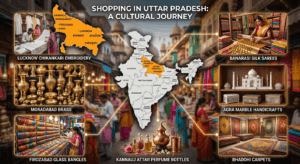
Uttar Pradesh is one of India’s best shopping destinations, offering a rich collection of traditional handicrafts, textiles, jewellery, leather products, perfumes, carpets, brassware, glassware, and wooden crafts. Every region of the state has its own unique specialty, reflecting centuries of artistic excellence and cultural heritage.
Lucknow is world-famous for Chikankari embroidery, an elegant hand embroidery style known for its intricate craftsmanship. The city is also renowned for Zardozi work, traditional jewellery, and handcrafted souvenirs.
Varanasi (Banaras) is internationally famous for its luxurious Banarasi Silk Sarees, which are among India’s finest handwoven textiles. Visitors also purchase wooden toys, brass idols, Rudraksha beads, and religious souvenirs from the city’s bustling markets.
Agra is known for exquisite marble handicrafts, leather shoes, handbags, and decorative items inspired by the Taj Mahal. Moradabad, often called the “Brass City of India,” is globally recognised for its high-quality brass handicrafts and home décor products.
Firozabad is famous for colourful glass bangles, glassware, and decorative products, while Bhadohi is known as the “Carpet City of India” for its hand-knotted carpets exported across the world.
Kannauj, often referred to as the “Perfume Capital of India,” is celebrated for its traditional Attar (natural perfume) industry, which has flourished for centuries.
Popular shopping destinations include Hazratganj Market and Aminabad in Lucknow, Godowlia Market in Varanasi, Sadar Bazaar in Agra, Nehru Place in Noida, and Kinari Bazaar in Agra.
Shopping in Uttar Pradesh offers visitors an opportunity to take home authentic Indian craftsmanship, traditional textiles, perfumes, handicrafts, and cultural souvenirs.
Shopping at a Glance
| Shopping Item | Famous Place |
|---|---|
| Chikankari Embroidery | Lucknow |
| Banarasi Silk Sarees | Varanasi |
| Marble Handicrafts | Agra |
| Leather Products | Agra & Kanpur |
| Brassware | Moradabad |
| Glass Bangles | Firozabad |
| Carpets | Bhadohi |
| Attar (Perfume) | Kannauj |
| Wooden Toys | Varanasi |
| Famous Markets | Hazratganj, Aminabad, Godowlia & Sadar Bazaar |
Best Time to Visit Uttar Pradesh
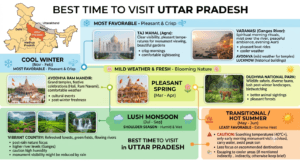
Uttar Pradesh can be visited throughout the year, but the best time to visit is from October to March, when the weather is cool and pleasant. During these months, tourists can comfortably explore historical monuments, religious sites, wildlife parks, and cultural attractions without the extreme heat of summer.
Winter (October to March)
Winter is the most popular tourist season in Uttar Pradesh. Temperatures generally range between 5°C and 25°C, making it ideal for sightseeing and outdoor activities. This is the best time to visit Agra, Varanasi, Ayodhya, Lucknow, Prayagraj, Mathura, Vrindavan, and Dudhwa National Park. Major festivals such as Dev Deepawali, Diwali, Christmas, Makar Sankranti, and Kumbh Mela (when scheduled) also take place during this period.
Summer (April to June)
Summers are generally hot, with temperatures often ranging between 30°C and 45°C. Although sightseeing can be challenging during the afternoon, early morning and evening visits to attractions such as the Taj Mahal, Kashi Vishwanath Temple, and Ayodhya Ram Mandir are still enjoyable. Indoor attractions and museums are also popular during this season.
Monsoon (July to September)
The monsoon season brings moderate to heavy rainfall, turning parks, gardens, and riverbanks lush and green. Although occasional rain may affect travel plans, destinations such as Varanasi, Lucknow, and Dudhwa National Park become especially scenic. Travellers should carry rain gear and check weather forecasts before planning outdoor activities.
Whether you are interested in heritage tourism, religious pilgrimages, wildlife safaris, cultural festivals, or local cuisine, Uttar Pradesh offers memorable experiences throughout the year. However, October to March remains the most comfortable and recommended period for visiting the state.
Best Time to Visit at a Glance
| Season | Months | Weather | Best For |
|---|---|---|---|
| Winter | October – March | Cool & Pleasant | Sightseeing, Pilgrimage & Wildlife |
| Summer | April – June | Hot | Early Morning Visits & Indoor Attractions |
| Monsoon | July – September | Rainy & Green | Nature, Photography & Scenic Views |
How to Reach Uttar Pradesh
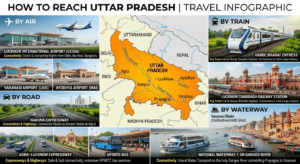
Uttar Pradesh is one of India’s best-connected states, offering excellent connectivity by air, rail, road, and waterways. Its extensive transport infrastructure makes travelling to major destinations such as Lucknow, Agra, Varanasi, Prayagraj, Ayodhya, Mathura, Kanpur, and Noida convenient from all parts of India and abroad.
By Air
Uttar Pradesh has several domestic and international airports. Chaudhary Charan Singh International Airport (Lucknow) and Lal Bahadur Shastri International Airport (Varanasi) handle both domestic and international flights. Other important airports include Ayodhya Maharishi Valmiki International Airport, Prayagraj Airport, Kanpur Airport, Gorakhpur Airport, Agra Airport, Bareilly Airport, and Hindon Airport (Ghaziabad). The upcoming Noida International Airport (Jewar) will further strengthen the state’s air connectivity.
By Train
Uttar Pradesh has one of the largest railway networks in India. Major railway stations such as Lucknow Charbagh, Kanpur Central, Prayagraj Junction, Varanasi Junction, Agra Cantt, Mathura Junction, Gorakhpur Junction, Ayodhya Dham Junction, and Ghaziabad Junction are connected to major cities across India through express, superfast, Vande Bharat, and Rajdhani trains.
By Road
A vast network of National Highways, State Highways, and world-class expressways connects Uttar Pradesh with neighbouring states and the rest of India. Important expressways include the Yamuna Expressway, Agra–Lucknow Expressway, Purvanchal Expressway, Bundelkhand Expressway, and Gorakhpur Link Expressway. The UPSRTC and private bus operators provide regular services to major cities and tourist destinations.
By Waterways
Uttar Pradesh is connected through National Waterway-1 (NW-1) on the Ganga River, linking Varanasi with other inland ports. River cruises and cargo transportation are gradually expanding, making inland waterways an emerging mode of transport.
With its modern airports, extensive railway network, expressways, and inland waterways, Uttar Pradesh is easily accessible for domestic and international travellers.
How to Reach at a Glance
| Mode | Major Connectivity |
|---|---|
| Air | Lucknow, Varanasi, Ayodhya, Prayagraj, Gorakhpur & Agra Airports |
| Rail | Lucknow, Kanpur, Prayagraj, Varanasi, Agra & Mathura Junctions |
| Road | National Highways, UPSRTC & Expressways |
| Waterway | National Waterway-1 (Ganga River) |
Travel Tips for Uttar Pradesh
📖 Content
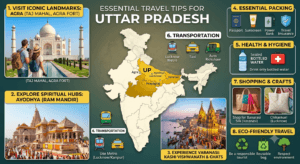
Uttar Pradesh is one of India’s most diverse travel destinations, offering a unique blend of history, spirituality, culture, wildlife, and architecture. A well-planned trip will help you enjoy the state’s famous temples, historical monuments, wildlife sanctuaries, and vibrant local culture. Following a few simple travel tips can make your journey safe, comfortable, and memorable.
The best time to visit Uttar Pradesh is between October and March, when the weather is pleasant for sightseeing and outdoor activities. During summer, temperatures can exceed 45°C, so travellers should stay hydrated, wear light cotton clothing, and avoid outdoor activities during the afternoon.
When visiting religious places such as Kashi Vishwanath Temple, Ayodhya Ram Mandir, Mathura, Vrindavan, and Sarnath, dress modestly, remove footwear where required, and respect local customs and traditions. Photography may be restricted inside certain temples and monuments, so always follow local guidelines.
Carry a valid government-issued identity card, keep emergency contact numbers handy, and use authorised taxis or app-based cab services for safe travel. Booking hotels, train tickets, and entry passes in advance is recommended during peak tourist seasons and major festivals such as Kumbh Mela, Deepotsav, and Janmashtami.
Visitors should taste local delicacies such as Awadhi Biryani, Tunday Kebab, Banarasi Paan, Mathura Peda, and Agra Petha from reputed restaurants and hygienic food outlets. Drinking bottled or purified water is advisable during travel.
Shopping enthusiasts can buy authentic Banarasi Silk Sarees, Lucknow Chikankari, Kannauj Attar, Moradabad Brassware, and Bhadohi Carpets from government-approved emporiums or trusted local markets to ensure genuine products.
Respect the environment by avoiding littering, using reusable water bottles whenever possible, and helping preserve historical monuments, rivers, wildlife, and natural attractions for future generations.
With proper planning and responsible tourism, a visit to Uttar Pradesh becomes a safe, enjoyable, and unforgettable experience.
Travel Tips at a Glance
| Tip | Recommendation |
|---|---|
| Best Season | October to March |
| Clothing | Light cotton in summer, warm clothes in winter |
| Temple Visits | Dress modestly and follow local customs |
| Drinking Water | Use bottled or purified water |
| Transport | Prefer authorised taxis, Metro & UPSRTC buses |
| Advance Booking | Hotels, trains & festival visits |
| Shopping | Buy authentic local handicrafts from trusted shops |
| Environment | Avoid littering and respect heritage sites |
Interesting Facts About Uttar Pradesh
Uttar Pradesh is one of India’s most fascinating states, known for its ancient civilization, religious heritage, iconic monuments, rich culture, and historical significance. It is home to some of the world’s most famous landmarks and has played a vital role in shaping India’s history, politics, literature, and spirituality.
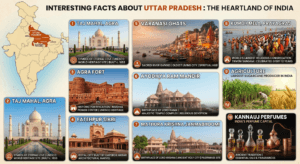
One of the most remarkable facts about Uttar Pradesh is that it is India’s most populous state, with a population of over 240 million people. If it were an independent country, it would rank among the most populous countries in the world.
The state is home to the Taj Mahal in Agra, one of the Seven Wonders of the World and a UNESCO World Heritage Site. Uttar Pradesh also has two other UNESCO World Heritage Sites—Agra Fort and Fatehpur Sikri.
Varanasi, located on the banks of the Ganga River, is one of the oldest continuously inhabited cities in the world, attracting millions of pilgrims and tourists every year.
Uttar Pradesh is considered the spiritual heart of India. Ayodhya is believed to be the birthplace of Lord Rama, while Mathura is the birthplace of Lord Krishna. Prayagraj hosts the Kumbh Mela, the world’s largest religious gathering.
The state has produced the highest number of Prime Ministers of India, making it one of the country’s most politically influential states.
Lucknow is famous for its Nawabi culture, Chikankari embroidery, and delicious Awadhi cuisine, while Kannauj is known as the “Perfume Capital of India” for its centuries-old Attar industry.
Uttar Pradesh is also India’s largest producer of sugarcane and one of the leading producers of wheat, rice, potatoes, mangoes, and milk, making it a major contributor to the country’s agricultural economy.
Interesting Facts at a Glance
| Fact | Details |
|---|---|
| Most Populous State | Over 240 million people |
| Seven Wonders of the World | Taj Mahal |
| UNESCO World Heritage Sites | Taj Mahal, Agra Fort & Fatehpur Sikri |
| Oldest Living City | Varanasi |
| Birthplace of Lord Rama | Ayodhya |
| Birthplace of Lord Krishna | Mathura |
| World’s Largest Religious Gathering | Kumbh Mela, Prayagraj |
| Perfume Capital of India | Kannauj |
| Largest Producer | Sugarcane in India |
| Political Importance | Highest number of Indian Prime Ministers |
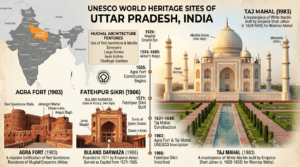
UNESCO World Heritage Sites of Uttar Pradesh
Uttar Pradesh is home to three UNESCO World Heritage Sites, all located in Agra and recognised for their outstanding historical, cultural, and architectural significance. These magnificent monuments represent the finest achievements of Mughal architecture and attract millions of visitors from around the world every year.
Taj Mahal
The Taj Mahal in Agra is one of the Seven Wonders of the World and was designated a UNESCO World Heritage Site in 1983. Built by the Mughal Emperor Shah Jahan between 1632 and 1653 in memory of his wife Mumtaz Mahal, it is regarded as one of the greatest masterpieces of Islamic architecture. Constructed from white marble, the monument is admired for its symmetry, intricate carvings, beautiful gardens, and reflecting pools.
Agra Fort
Agra Fort became a UNESCO World Heritage Site in 1983. Originally built by Emperor Akbar in 1565, the fort later served as the main residence of the Mughal emperors. The massive red sandstone fort houses several remarkable structures, including the Jahangiri Mahal, Diwan-i-Am, Diwan-i-Khas, Musamman Burj, and Moti Masjid.
Fatehpur Sikri
Located about 40 km from Agra, Fatehpur Sikri was inscribed as a UNESCO World Heritage Site in 1986. Built by Emperor Akbar as the capital of the Mughal Empire, the city is famous for its magnificent palaces, courtyards, mosques, and gateways. Major attractions include the Buland Darwaza, Jama Masjid, Panch Mahal, Diwan-i-Khas, and the Tomb of Salim Chishti.
These UNESCO World Heritage Sites preserve Uttar Pradesh’s rich architectural heritage and highlight the artistic excellence of the Mughal period, making the state one of India’s most important cultural tourism destinations.
UNESCO World Heritage Sites at a Glance
| UNESCO Site | Year | Category | Famous For |
|---|---|---|---|
| Taj Mahal | 1983 | Cultural | Seven Wonders of the World |
| Agra Fort | 1983 | Cultural | Mughal Fort & Architecture |
| Fatehpur Sikri | 1986 | Cultural | Historic Mughal Capital |
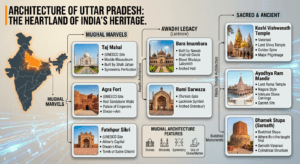
Architecture of Uttar Pradesh
Uttar Pradesh is renowned for its magnificent architecture, reflecting the legacy of ancient Hindu kingdoms, Buddhist monuments, and Mughal emperors. The state is home to some of India’s most iconic architectural masterpieces, attracting millions of tourists, historians, and architecture enthusiasts every year.
The Taj Mahal in Agra is the state’s most famous monument and one of the Seven Wonders of the World. Built by Emperor Shah Jahan in memory of Mumtaz Mahal, it is celebrated for its white marble construction, intricate carvings, beautiful gardens, and perfect symmetry.
Another architectural marvel is the Agra Fort, a massive red sandstone fortress built by Emperor Akbar. The fort contains magnificent palaces, audience halls, mosques, and royal chambers that showcase the grandeur of Mughal architecture.
Located near Agra, Fatehpur Sikri was the capital of the Mughal Empire under Akbar. The city is famous for the Buland Darwaza, Jama Masjid, Panch Mahal, Diwan-i-Khas, and the Tomb of Salim Chishti, displaying a blend of Persian, Islamic, and Indian architectural styles.
The capital city Lucknow is known for its elegant Nawabi architecture. Landmarks such as the Bara Imambara, Chota Imambara, Rumi Darwaza, Husainabad Clock Tower, and Residency reflect the artistic brilliance of the Awadh era.
Ancient temple architecture can be admired at the Kashi Vishwanath Temple in Varanasi, Shri Ram Janmabhoomi Mandir in Ayodhya, and the temples of Mathura and Vrindavan. Buddhist architecture is represented by the Dhamek Stupa at Sarnath, where Lord Buddha delivered his first sermon.
From magnificent Mughal monuments to ancient temples and Nawabi buildings, Uttar Pradesh preserves one of India’s richest architectural traditions and remains a paradise for heritage lovers.
Architecture at a Glance
| Monument | Location | Famous For |
|---|---|---|
| Taj Mahal | Agra | White Marble Mausoleum |
| Agra Fort | Agra | Mughal Fortress |
| Fatehpur Sikri | Agra | Historic Mughal Capital |
| Bara Imambara | Lucknow | Nawabi Architecture |
| Rumi Darwaza | Lucknow | Historic Gateway |
| Kashi Vishwanath Temple | Varanasi | Temple Architecture |
| Ram Janmabhoomi Mandir | Ayodhya | Modern Temple Architecture |
| Dhamek Stupa | Sarnath | Buddhist Monument |
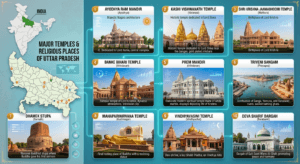
Major Temples & Religious Places of Uttar Pradesh
Uttar Pradesh is widely regarded as the spiritual heart of India, home to some of the country’s most sacred temples, pilgrimage centres, Buddhist sites, Jain shrines, and Islamic monuments. Millions of devotees and tourists visit these religious destinations every year, making the state one of the world’s most important centres of faith and spirituality.
The Shri Ram Janmabhoomi Mandir in Ayodhya is one of the most revered Hindu temples, believed to mark the birthplace of Lord Rama. It has become a major pilgrimage destination attracting devotees from across the globe.
Kashi Vishwanath Temple in Varanasi, dedicated to Lord Shiva, is one of the twelve Jyotirlingas and among the holiest temples in Hinduism. The temple, along with the famous Ganga Aarti at Dashashwamedh Ghat, offers a unique spiritual experience.
Mathura, the birthplace of Lord Krishna, and nearby Vrindavan, where he spent his childhood, are home to renowned temples such as Shri Krishna Janmabhoomi Temple, Banke Bihari Temple, Prem Mandir, ISKCON Temple, and Radha Raman Temple.
Prayagraj is famous for the sacred Triveni Sangam, where the Ganga, Yamuna, and the mythical Saraswati rivers meet. It hosts the world-famous Kumbh Mela, the largest religious gathering on Earth.
Buddhist pilgrims visit Sarnath, where Lord Buddha delivered his first sermon, and Kushinagar, where he attained Mahaparinirvana. Shravasti is another important Buddhist pilgrimage site associated with many of Buddha’s teachings.
Other important religious destinations include Vindhyachal Temple in Mirzapur, Sankat Mochan Hanuman Temple and Durga Temple in Varanasi, Naimisharanya in Sitapur, and Deva Sharif Dargah in Barabanki, reflecting the state’s rich spiritual diversity.
With its sacred temples, holy rivers, monasteries, mosques, and ancient pilgrimage centres, Uttar Pradesh continues to be one of India’s greatest spiritual destinations.
Major Religious Places at a Glance
| Religious Place | Location | Famous For |
|---|---|---|
| Shri Ram Janmabhoomi Mandir | Ayodhya | Birthplace of Lord Rama |
| Kashi Vishwanath Temple | Varanasi | Jyotirlinga of Lord Shiva |
| Shri Krishna Janmabhoomi Temple | Mathura | Birthplace of Lord Krishna |
| Banke Bihari Temple | Vrindavan | Lord Krishna Temple |
| Prem Mandir | Vrindavan | Marble Temple |
| Triveni Sangam | Prayagraj | Kumbh Mela |
| Dhamek Stupa | Sarnath | Buddha’s First Sermon |
| Mahaparinirvana Temple | Kushinagar | Buddha’s Final Nirvana |
| Vindhyavasini Temple | Mirzapur | Shakti Peetha |
| Deva Sharif Dargah | Barabanki | Sufi Pilgrimage Site |
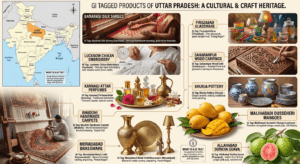
GI Tagged Products of Uttar Pradesh
Uttar Pradesh is one of India’s leading states for Geographical Indication (GI) tagged products, reflecting its rich heritage of handicrafts, textiles, traditional industries, agriculture, and craftsmanship. GI tags protect products that possess unique qualities linked to their place of origin, preserving traditional skills while promoting local artisans and boosting exports.
The world-famous Banarasi Silk Saree from Varanasi is one of India’s most iconic GI products, admired for its luxurious silk fabric, intricate gold and silver zari work, and exquisite craftsmanship. Lucknow Chikan Craft (Chikankari) is another internationally recognised GI product known for its delicate hand embroidery.
Kannauj Perfume (Attar) has been produced for centuries using traditional distillation techniques, earning Kannauj the title of the “Perfume Capital of India.” Bhadohi Handmade Carpets are exported worldwide for their exceptional quality and artistic designs.
Other famous GI-tagged products include Moradabad Metal Craft, Agra Durrie, Firozabad Glassware, Saharanpur Wood Craft, Varanasi Wooden Lacquerware and Toys, Mirzapur Handmade Durries, Allahabad Surkha Guava, Malihabadi Dashehari Mango, Banaras Gulabi Meenakari Craft, and Khurja Pottery.
These GI-tagged products preserve Uttar Pradesh’s cultural identity, generate employment for thousands of artisans, and contribute significantly to India’s handicraft exports and rural economy.
Famous GI Tagged Products
| GI Product | Famous Place | Category |
|---|---|---|
| Banarasi Silk Saree | Varanasi | Textile |
| Lucknow Chikan Craft | Lucknow | Hand Embroidery |
| Kannauj Perfume (Attar) | Kannauj | Perfume |
| Bhadohi Handmade Carpet | Bhadohi | Carpet |
| Moradabad Metal Craft | Moradabad | Handicraft |
| Firozabad Glassware | Firozabad | Glass Craft |
| Saharanpur Wood Craft | Saharanpur | Wood Craft |
| Khurja Pottery | Khurja | Pottery |
| Allahabad Surkha Guava | Prayagraj | Fruit |
| Malihabadi Dashehari Mango | Malihabad | Mango |
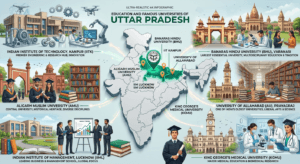
Education & Famous Universities of Uttar Pradesh
Uttar Pradesh is one of India’s leading centres of education, research, science, technology, medicine, and higher learning. The state is home to several prestigious universities, Indian Institutes of Technology (IITs), Indian Institutes of Management (IIMs), central universities, medical colleges, and research institutions that attract students from across India and abroad.
One of the most renowned institutions is Banaras Hindu University (BHU) in Varanasi, established in 1916 by Pandit Madan Mohan Malaviya. BHU is one of Asia’s largest residential universities and is internationally recognised for excellence in medicine, engineering, arts, science, and research.
The Indian Institute of Technology (IIT) Kanpur, established in 1959, is among India’s premier engineering institutes and is globally respected for innovation, technology, artificial intelligence, aerospace engineering, and scientific research.
Aligarh Muslim University (AMU), founded in 1920, is one of India’s oldest and most prestigious central universities. It is well known for higher education in humanities, law, medicine, engineering, and social sciences.
University of Allahabad, established in 1887, is one of India’s oldest modern universities and is often referred to as the “Oxford of the East.” It has produced many distinguished scholars, judges, civil servants, and political leaders.
The state also hosts IIM Lucknow, one of India’s top management institutes, along with institutions such as King George’s Medical University (Lucknow), Dr. A.P.J. Abdul Kalam Technical University (Lucknow), Babasaheb Bhimrao Ambedkar University (Lucknow), and Dr. Ram Manohar Lohia National Law University (Lucknow).
With thousands of schools, colleges, technical institutes, and research centres, Uttar Pradesh continues to play a vital role in shaping India’s educational and scientific development.
Famous Educational Institutions at a Glance
| Institution | Location | Famous For |
|---|---|---|
| Banaras Hindu University (BHU) | Varanasi | Higher Education & Research |
| IIT Kanpur | Kanpur | Engineering & Technology |
| IIM Lucknow | Lucknow | Management Education |
| Aligarh Muslim University (AMU) | Aligarh | Central University |
| University of Allahabad | Prayagraj | One of India’s Oldest Universities |
| King George’s Medical University | Lucknow | Medical Education |
| Dr. A.P.J. Abdul Kalam Technical University | Lucknow | Engineering & Technology |
| Babasaheb Bhimrao Ambedkar University | Lucknow | Central University |
| Dr. Ram Manohar Lohia National Law University | Lucknow | Legal Education |
| Integral University | Lucknow | Higher Education |
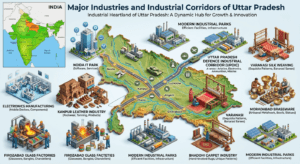
Major Industries & Industrial Corridors of Uttar Pradesh
Uttar Pradesh is one of India’s fastest-growing industrial states, with a diversified economy driven by manufacturing, textiles, leather, food processing, electronics, information technology (IT), defence manufacturing, handicrafts, agriculture-based industries, and MSMEs. The state plays a significant role in India’s industrial production and exports due to its strategic location, excellent connectivity, abundant workforce, and modern infrastructure.
The Noida–Greater Noida–Yamuna Expressway Industrial Region is the state’s largest industrial and IT hub. It hosts leading companies in electronics manufacturing, mobile phone production, software development, automobiles, and information technology. The upcoming Noida International Airport (Jewar) is expected to further boost industrial growth and global trade.
Kanpur is known as the “Leather City of India” and is famous for its leather products, footwear, textiles, engineering goods, chemicals, and defence manufacturing. The city has been an important industrial centre for over a century.
Lucknow has developed into a major centre for IT services, biotechnology, pharmaceuticals, food processing, handicrafts, and small-scale industries. The city is also famous for its Chikankari embroidery industry.
Other important industrial cities include Agra (leather products, footwear, marble handicrafts), Varanasi (Banarasi silk weaving and handicrafts), Moradabad (brassware), Firozabad (glass industry), Bhadohi (handmade carpets), Saharanpur (wood carving), Aligarh (locks and hardware), and Kannauj (traditional perfume manufacturing).
The state government is promoting industrial development through projects such as the Delhi–Mumbai Industrial Corridor (DMIC), Defence Industrial Corridor, Eastern Dedicated Freight Corridor (EDFC), Western Dedicated Freight Corridor (WDFC), and industrial parks across the state. These initiatives are attracting investments and creating employment opportunities.
With its strong manufacturing base, world-famous handicrafts, modern industrial corridors, and expanding infrastructure, Uttar Pradesh continues to emerge as one of India’s leading industrial economies.
Major Industries at a Glance
| Industry | Major City |
|---|---|
| IT & Electronics | Noida & Greater Noida |
| Leather Industry | Kanpur & Agra |
| Banarasi Silk | Varanasi |
| Brassware | Moradabad |
| Glass Industry | Firozabad |
| Carpets | Bhadohi |
| Wood Carving | Saharanpur |
| Lock Industry | Aligarh |
| Perfume (Attar) | Kannauj |
| Defence Corridor | Lucknow, Kanpur, Aligarh, Agra, Jhansi & Chitrakoot |
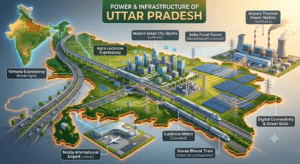
Power & Infrastructure of Uttar Pradesh
Uttar Pradesh is one of India’s fastest-growing states in terms of power generation, transport infrastructure, urban development, industrial corridors, expressways, airports, and digital connectivity. The state government has invested heavily in modern infrastructure to improve economic growth, industrial development, tourism, and the quality of life for its citizens.
The state meets its electricity demand through a combination of thermal power, hydropower, solar energy, and renewable energy projects. Major thermal power plants include Anpara Thermal Power Station, Obra Thermal Power Station, Rihand Thermal Power Station, Harduaganj Thermal Power Station, and Rosa Thermal Power Plant. Solar parks and rooftop solar projects are also expanding rapidly under clean energy initiatives.
Uttar Pradesh has developed one of India’s largest expressway networks, including the Yamuna Expressway, Agra–Lucknow Expressway, Purvanchal Expressway, Bundelkhand Expressway, Gorakhpur Link Expressway, and the Ganga Expressway, which is under construction and will become one of India’s longest expressways.
The state’s railway infrastructure is among the best in the country, with Vande Bharat Express, dedicated freight corridors, and modern railway stations improving passenger and freight movement. The Eastern Dedicated Freight Corridor (EDFC) and Western Dedicated Freight Corridor (WDFC) enhance industrial logistics and trade.
Air connectivity has improved significantly with Chaudhary Charan Singh International Airport (Lucknow), Lal Bahadur Shastri International Airport (Varanasi), Ayodhya Maharishi Valmiki International Airport, and the upcoming Noida International Airport (Jewar), which is expected to become one of Asia’s largest airports.
Metro rail systems in Lucknow, Noida, Greater Noida, Ghaziabad, Kanpur, and Agra have transformed urban transportation. The state is also promoting smart cities, digital governance, industrial parks, logistics hubs, and high-speed internet connectivity.
With world-class infrastructure, expanding power capacity, modern transport systems, and digital development, Uttar Pradesh is emerging as one of India’s leading destinations for investment, business, and sustainable growth.
Power & Infrastructure at a Glance
| Infrastructure | Major Facilities |
|---|---|
| Major Thermal Power Plants | Anpara, Obra, Rihand, Harduaganj & Rosa |
| Renewable Energy | Solar Parks & Rooftop Solar |
| Major Expressways | Yamuna, Agra–Lucknow, Purvanchal, Bundelkhand & Ganga |
| International Airports | Lucknow, Varanasi & Ayodhya |
| Upcoming Mega Airport | Noida International Airport (Jewar) |
| Metro Rail | Lucknow, Noida, Kanpur, Agra & Ghaziabad |
| Freight Corridors | Eastern & Western Dedicated Freight Corridors |
| Smart Cities | Lucknow, Agra, Varanasi, Prayagraj, Kanpur, Aligarh, Jhansi, Bareilly, Moradabad & Saharanpur |
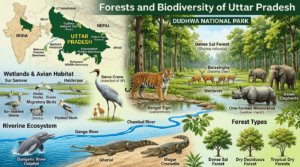
Forests & Biodiversity of Uttar Pradesh
Uttar Pradesh is home to diverse forests, wetlands, grasslands, rivers, and wildlife habitats, making it an important state for biodiversity conservation in India. Although forests cover a relatively small portion of the state’s geographical area, they support a wide variety of plants, mammals, birds, reptiles, and aquatic species. The Terai region along the Nepal border is especially rich in biodiversity and forms part of the globally significant Terai Arc Landscape.
The forests of Uttar Pradesh are broadly classified into Tropical Moist Deciduous Forests, Tropical Dry Deciduous Forests, Thorn Forests, and Riverine Forests. Common tree species include Sal, Teak, Shisham, Khair, Bamboo, Neem, Arjun, Mahua, and Palash, which play a vital role in maintaining ecological balance.
The state’s most important protected area is Dudhwa National Park, which, along with Kishanpur Wildlife Sanctuary and Katarniaghat Wildlife Sanctuary, forms the Dudhwa Tiger Reserve. These protected forests provide habitat for Bengal tigers, leopards, Asian elephants, one-horned rhinoceroses, swamp deer (Barasingha), sloth bears, and over 450 species of birds.
The National Chambal Sanctuary is internationally recognised for protecting endangered aquatic wildlife such as the Gharial, Gangetic River Dolphin, Mugger Crocodile, and the Indian Skimmer. Wetlands such as Nawabganj Bird Sanctuary (Shaheed Chandra Shekhar Azad Bird Sanctuary), Sandi Bird Sanctuary, Okhla Bird Sanctuary, and Samaspur Bird Sanctuary attract thousands of migratory birds every winter.
Uttar Pradesh is committed to environmental conservation through afforestation programmes, river conservation projects, wetland protection, tiger conservation initiatives, and biodiversity management plans. These efforts help preserve the state’s natural heritage while promoting eco-tourism and sustainable development.
With its forests, wetlands, tiger reserves, and rich wildlife, Uttar Pradesh remains one of India’s important biodiversity conservation regions.
Forests & Biodiversity at a Glance
| Category | Details |
|---|---|
| Major Forest Types | Moist Deciduous, Dry Deciduous, Thorn & Riverine Forests |
| Largest Protected Area | Dudhwa Tiger Reserve |
| Famous National Park | Dudhwa National Park |
| Major Wildlife Sanctuaries | Katarniaghat & Kishanpur |
| Important River Sanctuary | National Chambal Sanctuary |
| State Animal | Barasingha (Swamp Deer) |
| State Bird | Sarus Crane |
| Famous Aquatic Species | Gangetic River Dolphin & Gharial |
| Common Trees | Sal, Teak, Shisham, Neem, Bamboo & Mahua |
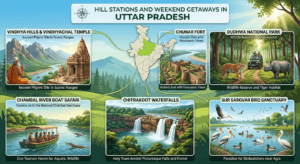
Hill Stations & Weekend Getaways in Uttar Pradesh
Although Uttar Pradesh is primarily known for its fertile plains, historical monuments, and spiritual destinations, the state also offers several beautiful hill-like landscapes, nature retreats, wildlife destinations, waterfalls, and weekend getaway spots. These places are ideal for family vacations, nature lovers, photographers, pilgrims, and adventure enthusiasts.
One of the most popular nature destinations is Dudhwa National Park, located in Lakhimpur Kheri near the Nepal border. It is famous for jungle safaris, birdwatching, Bengal tigers, one-horned rhinoceroses, and lush forests.
The Vindhya Hills in Mirzapur provide scenic landscapes, waterfalls, temples, and trekking opportunities. Vindhyachal, situated in this region, is both a pilgrimage centre and a peaceful weekend destination.
Chunar, located near Varanasi, is known for the historic Chunar Fort, panoramic views of the Ganga River, and its peaceful surroundings. The area is rich in history and natural beauty.
The Nawabganj Bird Sanctuary (Shaheed Chandra Shekhar Azad Bird Sanctuary) near Unnao, Sandi Bird Sanctuary in Hardoi, and Sur Sarovar Bird Sanctuary (Keetham Lake) near Agra are excellent destinations for birdwatching and eco-tourism, especially during the winter migration season.
For adventure lovers, the Chambal River offers boat safaris where visitors can spot Gharials, Gangetic River Dolphins, crocodiles, and migratory birds. Other relaxing weekend destinations include Chitrakoot, known for its religious significance and waterfalls, and Bithoor near Kanpur, famous for its historical and spiritual importance.
While Uttar Pradesh does not have traditional Himalayan hill stations, its forests, wildlife parks, river valleys, waterfalls, bird sanctuaries, and heritage towns offer excellent weekend escapes throughout the year.
Best Weekend Getaways at a Glance
| Destination | Famous For |
|---|---|
| Dudhwa National Park | Wildlife Safari & Tiger Reserve |
| Vindhyachal | Hills & Temple |
| Chunar | Fort & Ganga River Views |
| Chitrakoot | Pilgrimage & Waterfalls |
| Sur Sarovar Bird Sanctuary | Birdwatching |
| Nawabganj Bird Sanctuary | Migratory Birds |
| Sandi Bird Sanctuary | Wetlands & Birdwatching |
| Chambal River | Boat Safari & Gharials |
| Bithoor | Historical & Spiritual Tourism |
| Mirzapur Waterfalls | Nature & Trekking |
7-Day Uttar Pradesh Travel Itinerary
Uttar Pradesh is a perfect destination for travellers interested in history, spirituality, culture, architecture, wildlife, and cuisine. A well-planned 7-day itinerary allows visitors to explore the state’s most iconic attractions, including UNESCO World Heritage Sites, sacred temples, ancient cities, wildlife reserves, and vibrant local markets.
Day 1 – Lucknow
Begin your journey in Lucknow, the City of Nawabs. Visit Bara Imambara, Chota Imambara, Rumi Darwaza, and Hazratganj Market. Enjoy authentic Tunday Kebab and Awadhi Biryani in the evening.
Day 2 – Ayodhya
Travel to Ayodhya and explore the Shri Ram Janmabhoomi Mandir, Hanuman Garhi, Kanak Bhawan, and Saryu River Ghats. Experience the evening Saryu Aarti.
Day 3 – Prayagraj
Visit Triveni Sangam, Anand Bhavan, Allahabad Fort (view from outside where applicable), and Khusro Bagh. If visiting during the Kumbh Mela, enjoy the grand spiritual gathering.
Day 4 – Varanasi & Sarnath
Explore the Kashi Vishwanath Temple, Dashashwamedh Ghat, enjoy the spectacular Ganga Aarti, and visit Sarnath, where Lord Buddha delivered his first sermon.
Day 5 – Mathura & Vrindavan
Visit Shri Krishna Janmabhoomi Temple, Banke Bihari Temple, Prem Mandir, ISKCON Temple, and witness the beautiful evening light show at Prem Mandir.
Day 6 – Agra
Discover the world-famous Taj Mahal, Agra Fort, Itmad-ud-Daulah (Baby Taj), and shop for marble handicrafts and Agra Petha.
Day 7 – Fatehpur Sikri & Dudhwa National Park (Optional Extension)
Visit the historic Fatehpur Sikri before departure. If you have additional time, extend your trip to Dudhwa National Park for an unforgettable wildlife safari.
This itinerary covers the best of Uttar Pradesh’s heritage, religion, architecture, cuisine, shopping, and wildlife, offering a memorable travel experience.
7-Day Itinerary at a Glance
| Day | Destination | Major Attractions |
|---|---|---|
| Day 1 | Lucknow | Bara Imambara, Rumi Darwaza & Hazratganj |
| Day 2 | Ayodhya | Ram Mandir, Hanuman Garhi & Saryu Aarti |
| Day 3 | Prayagraj | Triveni Sangam & Anand Bhavan |
| Day 4 | Varanasi & Sarnath | Kashi Vishwanath Temple, Ganga Aarti & Dhamek Stupa |
| Day 5 | Mathura & Vrindavan | Krishna Janmabhoomi, Banke Bihari & Prem Mandir |
| Day 6 | Agra | Taj Mahal, Agra Fort & Baby Taj |
| Day 7 | Fatehpur Sikri | Buland Darwaza, Jama Masjid & Panch Mahal |
Major Cities of Uttar Pradesh
Uttar Pradesh is home to several major cities that serve as important centres of administration, education, industry, culture, religion, tourism, and commerce. Each city has its own unique identity, contributing significantly to the state’s economy and cultural heritage.
Lucknow, the capital of Uttar Pradesh, is known as the City of Nawabs. It is famous for its Bara Imambara, Rumi Darwaza, Chikankari embroidery, and Awadhi cuisine. The city is also an important centre for education, healthcare, information technology, and administration.
Kanpur, the state’s largest city by population, is one of India’s major industrial hubs. Popularly known as the Leather City of India, it is renowned for leather products, textiles, engineering industries, and educational institutions such as IIT Kanpur.
Agra is internationally famous for the Taj Mahal, Agra Fort, and Fatehpur Sikri, attracting millions of tourists every year. The city is also known for marble handicrafts, leather goods, and the famous Agra Petha.
Varanasi, one of the oldest continuously inhabited cities in the world, is a global spiritual centre. The city is famous for the Kashi Vishwanath Temple, Ganga Aarti, Banarasi Silk Sarees, and Sarnath.
Prayagraj is known for the Triveni Sangam, Kumbh Mela, Anand Bhavan, and the historic University of Allahabad. It is one of India’s most important religious and educational cities.
Other major cities include Ayodhya, famous for the Shri Ram Janmabhoomi Mandir; Mathura, the birthplace of Lord Krishna; Noida, India’s leading IT and electronics hub; Ghaziabad, an important industrial city in the National Capital Region; Meerut, known for sports goods and musical instruments; Aligarh, famous for locks and Aligarh Muslim University; and Gorakhpur, an important religious and commercial centre.
These cities together make Uttar Pradesh one of India’s most diverse and economically significant states.
Major Cities at a Glance
| City | Famous For |
|---|---|
| Lucknow | Capital, Nawabi Culture & Chikankari |
| Kanpur | Leather Industry & IIT Kanpur |
| Agra | Taj Mahal & Agra Fort |
| Varanasi | Kashi Vishwanath Temple & Ganga Aarti |
| Prayagraj | Triveni Sangam & Kumbh Mela |
| Ayodhya | Shri Ram Janmabhoomi Mandir |
| Mathura | Birthplace of Lord Krishna |
| Noida | IT & Electronics Hub |
| Ghaziabad | Industrial City & NCR |
| Meerut | Sports Goods & Musical Instruments |
| Aligarh | Lock Industry & AMU |
| Gorakhpur | Gorakhnath Temple & Trade Centre |
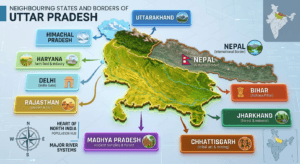
Neighbouring States & Borders of Uttar Pradesh
Uttar Pradesh is strategically located in northern India and shares its borders with eight Indian states, the National Capital Territory of Delhi, and the neighbouring country of Nepal. This central location makes Uttar Pradesh an important hub for trade, transportation, tourism, agriculture, and cultural exchange.
To the north, Uttar Pradesh shares an international border with Nepal, facilitating trade, tourism, and cultural ties. The state is bordered by Uttarakhand in the north, while Himachal Pradesh touches it through a very short boundary near the Yamuna River.
To the west, Uttar Pradesh shares borders with Haryana, Delhi, and Rajasthan, providing excellent connectivity to the National Capital Region (NCR). Agra, Noida, Ghaziabad, and Meerut are among the major cities located in western Uttar Pradesh.
To the south, the state is bordered by Madhya Pradesh and Chhattisgarh, while Jharkhand lies to the south-east. In the east, Uttar Pradesh shares its boundary with Bihar, connecting the fertile Gangetic plains.
The state’s geographical position has made it one of India’s most important transport corridors, with several national highways, expressways, railway routes, and inland waterways passing through it. Uttar Pradesh serves as a gateway between North India, Central India, and Eastern India, contributing significantly to commerce, tourism, and logistics.
With international and interstate connectivity, Uttar Pradesh plays a crucial role in India’s economy, culture, and transportation network.
Neighbouring States at a Glance
| Direction | Neighbour |
|---|---|
| North | Nepal & Uttarakhand |
| North-West | Himachal Pradesh (short boundary) |
| West | Haryana & Delhi |
| South-West | Rajasthan |
| South | Madhya Pradesh |
| South-East | Chhattisgarh & Jharkhand |
| East | Bihar |
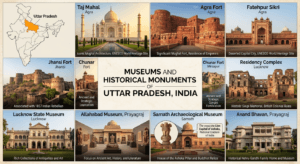
Museums & Historical Monuments of Uttar Pradesh
Uttar Pradesh is home to numerous museums, forts, palaces, memorials, archaeological sites, and historical monuments that preserve the state’s rich cultural and historical legacy. These attractions showcase the heritage of ancient kingdoms, the Mughal Empire, the Nawabs of Awadh, the Buddhist era, and India’s freedom movement.
The Taj Mahal, Agra Fort, and Fatehpur Sikri are the state’s most famous historical monuments and UNESCO World Heritage Sites. These architectural masterpieces reflect the grandeur of Mughal art and continue to attract millions of visitors every year.
The Lucknow State Museum, located in Nawab Wajid Ali Shah Zoological Garden, houses ancient sculptures, coins, paintings, manuscripts, archaeological artifacts, and historical exhibits related to Uttar Pradesh’s rich heritage.
The Allahabad Museum in Prayagraj is one of India’s premier museums. It displays archaeological findings, Mughal miniature paintings, Buddhist sculptures, freedom movement memorabilia, and personal belongings of Jawaharlal Nehru.
The historic Chunar Fort, Jhansi Fort, Residency Complex (Lucknow), Anand Bhavan, Khusro Bagh, and Sarnath Archaeological Museum are among the state’s most significant heritage sites. The Sarnath Museum preserves rare Buddhist relics, including the famous Lion Capital of Ashoka, which is the National Emblem of India.
These museums and monuments offer visitors a fascinating journey through the history, culture, architecture, and artistic achievements of Uttar Pradesh.
Museums & Historical Monuments at a Glance
| Place | Location | Famous For |
|---|---|---|
| Taj Mahal | Agra | UNESCO World Heritage Site |
| Agra Fort | Agra | Mughal Fort |
| Fatehpur Sikri | Agra | Historic Mughal City |
| Lucknow State Museum | Lucknow | Art & Archaeology |
| Allahabad Museum | Prayagraj | History & Freedom Movement |
| Sarnath Archaeological Museum | Sarnath | Lion Capital of Ashoka |
| Jhansi Fort | Jhansi | Rani Lakshmibai |
| Chunar Fort | Mirzapur | Historic Hill Fort |
| Residency Complex | Lucknow | Revolt of 1857 |
| Anand Bhavan | Prayagraj | Nehru Family Museum |
Frequently Asked Questions (FAQs) About Uttar Pradesh
Uttar Pradesh is one of India’s most popular tourist, religious, and historical destinations. Visitors often have questions about its attractions, culture, transportation, weather, food, and travel planning. Here are some of the most frequently asked questions about Uttar Pradesh.
1. Why is Uttar Pradesh famous?
Uttar Pradesh is famous for the Taj Mahal, Ayodhya Ram Mandir, Kashi Vishwanath Temple, Varanasi, Mathura, Prayagraj Kumbh Mela, rich history, Mughal architecture, and cultural heritage.
2. What is the capital of Uttar Pradesh?
Lucknow is the capital of Uttar Pradesh and is known for its Nawabi culture, Chikankari embroidery, and Awadhi cuisine.
3. Which is the best time to visit Uttar Pradesh?
The ideal time to visit is October to March, when the weather is pleasant for sightseeing and pilgrimage.
4. What are the top tourist attractions?
The top attractions include Taj Mahal, Agra Fort, Fatehpur Sikri, Ayodhya, Varanasi, Prayagraj, Mathura, Vrindavan, Lucknow, and Dudhwa National Park.
5. What is the famous food of Uttar Pradesh?
Popular dishes include Awadhi Biryani, Tunday Kebab, Agra Petha, Banarasi Paan, Mathura Peda, Kachori Sabzi, and Jalebi with Rabri.
6. How many UNESCO World Heritage Sites are there in Uttar Pradesh?
Uttar Pradesh has three UNESCO World Heritage Sites:
- Taj Mahal
- Agra Fort
- Fatehpur Sikri
7. Which languages are spoken in Uttar Pradesh?
Hindi is the official language, while Urdu is the second official language. Regional dialects such as Awadhi, Braj, Bhojpuri, Bundeli, and Kannauji are also widely spoken.
8. Which is the largest city in Uttar Pradesh?
Kanpur is the largest city by population, while Lucknow is the capital city.
9. What is the state animal and bird?
- State Animal: Barasingha (Swamp Deer)
- State Bird: Sarus Crane
10. Is Uttar Pradesh safe for tourists?
Yes. Uttar Pradesh is generally safe for tourists. Visitors should follow normal travel precautions, use authorised transport, and respect local customs.
FAQs at a Glance
| Question | Answer |
|---|---|
| Capital | Lucknow |
| Largest City | Kanpur |
| Best Time to Visit | October–March |
| UNESCO World Heritage Sites | 3 |
| Famous Monument | Taj Mahal |
| Official Language | Hindi |
| Second Official Language | Urdu |
| State Animal | Barasingha (Swamp Deer) |
| State Bird | Sarus Crane |
| Tourist Safety | Generally Safe with Normal Precautions |
Conclusion
Uttar Pradesh is one of India’s most remarkable states, offering an extraordinary blend of history, spirituality, culture, architecture, wildlife, festivals, cuisine, education, and economic growth. From the majestic Taj Mahal in Agra to the sacred ghats of Varanasi, from the divine Shri Ram Janmabhoomi Mandir in Ayodhya to the holy city of Mathura, every destination reflects the state’s rich heritage and timeless traditions.
The state is home to UNESCO World Heritage Sites, ancient temples, Mughal monuments, renowned educational institutions, diverse wildlife, vibrant festivals, world-famous handicrafts, and delicious cuisine. Whether you are a pilgrim, history enthusiast, nature lover, student, photographer, or traveller, Uttar Pradesh offers unforgettable experiences for every visitor.
With excellent connectivity through air, rail, road, and waterways, along with rapidly developing infrastructure, expressways, metro systems, and tourism facilities, Uttar Pradesh continues to emerge as one of India’s leading travel and cultural destinations.
If you are planning a journey through India, Uttar Pradesh deserves a place at the top of your travel list. Its unique combination of ancient traditions, architectural marvels, spiritual significance, and modern development makes it a destination that leaves every visitor with unforgettable memories.
Whether you seek peace, history, adventure, culture, or devotion, Uttar Pradesh truly represents the heart of India’s timeless heritage.
Internal links
Andhra Pradesh – https://dealkartmarket.in/andhra-pradesh/
Telangana – https://dealkartmarket.in/telangana/
Karnataka – https://dealkartmarket.in/karnataka/
Tamil Nadu – https://dealkartmarket.in/tamil-nadu/
Kerala – https://dealkartmarket.in/kerala/
Maharashtra – https://dealkartmarket.in/maharashtra/
Goa – https://dealkartmarket.in/goa/
Madhya Pradesh – https://dealkartmarket.in/madhya-pradesh/
Rajasthan – https://dealkartmarket.in/rajasthan/
Himachal Pradesh – https://dealkartmarket.in/himachal-pradesh/
Haryana – https://dealkartmarket.in/haryana/
Punjab – https://dealkartmarket.in/punjab
References
Government of Uttar Pradesh – https://up.gov.in/
Uttar Pradesh Tourism – https://uptourism.gov.in/
Incredible India – Uttar Pradesh – https://www.incredibleindia.gov.in/
India Portal – https://www.india.gov.in/
Census of India – https://censusindia.gov.in/
UNESCO World Heritage Centre – https://whc.unesco.org/
Archaeological Survey of India (ASI) – https://asi.nic.in/
National Tiger Conservation Authority – https://ntca.gov.in/
Ministry of Tourism, Government of India – https://tourism.gov.in/
Ministry of Culture, Government of India – https://indiaculture.gov.in/
Uttar Pradesh Forest Department – https://upforest.gov.in/
Uttar Pradesh State Road Transport Corporation (UPSRTC) – https://upsrtc.up.gov.in/
Indian Railways – https://indianrailways.gov.in/
Airports Authority of India – https://www.aai.aero/