
Introduction
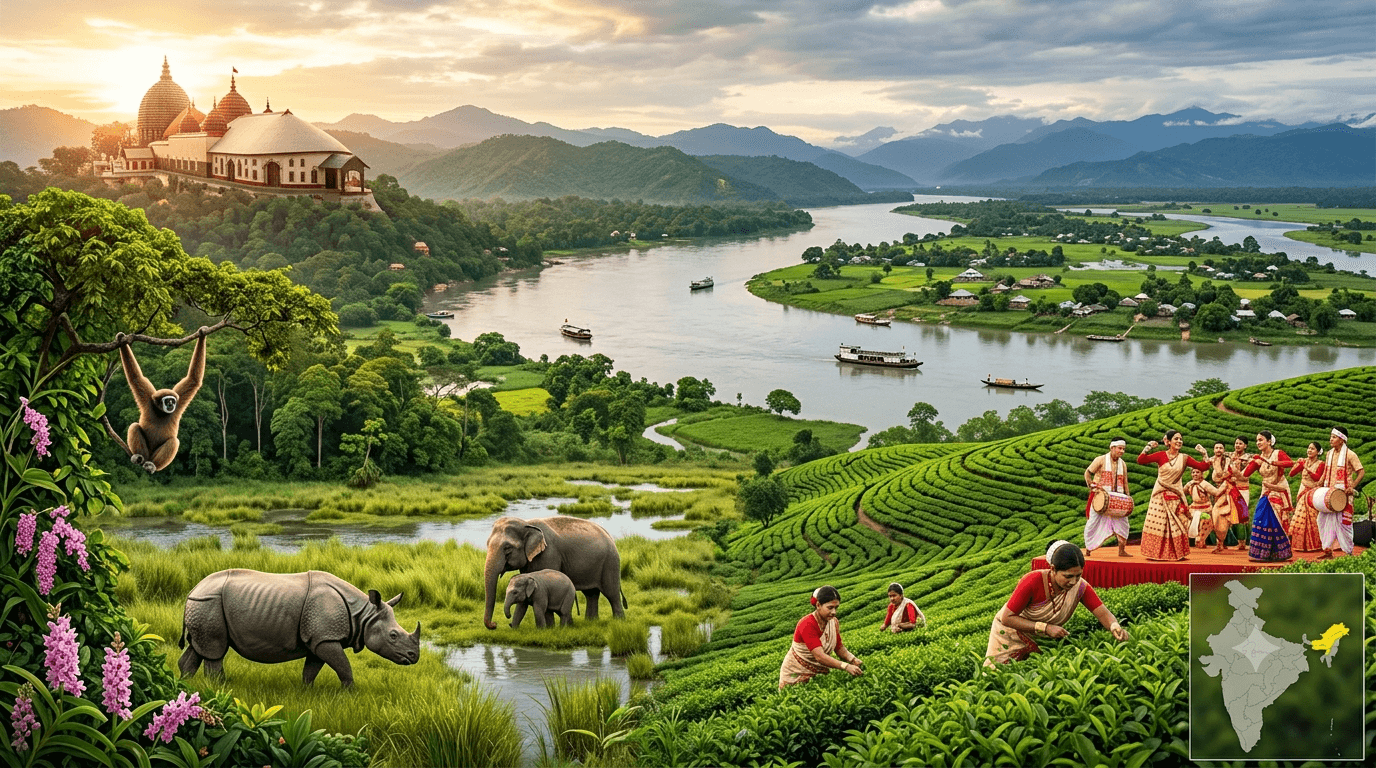
Assam is one of the most vibrant and culturally rich states in Northeast India, renowned for its lush tea gardens, mighty Brahmaputra River, rich biodiversity, ancient temples, and colorful festivals. Surrounded by scenic hills and fertile plains, Assam serves as the gateway to the northeastern states of India and plays a vital role in the region’s economy, culture, and connectivity.
The state shares international borders with Bhutan and Bangladesh, while it is bordered by the Indian states of Arunachal Pradesh, Nagaland, Manipur, Mizoram, Tripura, Meghalaya, and West Bengal. Its strategic location makes Assam the commercial and transportation hub of Northeast India.
Dispur, a suburb of Guwahati, is the capital of Assam, while Guwahati is the state’s largest city and an important center for trade, education, tourism, and culture. Covering an area of approximately 78,438 square kilometres, Assam is famous worldwide for producing premium-quality Assam Tea, one of the most popular black teas in the world.
The mighty Brahmaputra River, one of Asia’s largest rivers, flows through the heart of the state, creating fertile floodplains that support agriculture and rich ecosystems. Assam is also home to Kaziranga National Park, a UNESCO World Heritage Site famous for the Great One-Horned Rhinoceros, as well as Manas National Park, another UNESCO-listed wildlife reserve.
The state’s cultural identity is deeply rooted in traditions such as Bihu, Assam’s most celebrated festival, along with classical Sattriya Dance, Vaishnavite monasteries (Satras), handloom weaving, and vibrant tribal cultures. Assam is also known for its silk production, especially the world-famous Muga Silk, which has received Geographical Indication (GI) status.
With its breathtaking landscapes, tea estates, wildlife sanctuaries, rivers, temples, and warm hospitality, Assam offers visitors a perfect blend of natural beauty, history, spirituality, and adventure.
Quick Facts About Assam
The state is one of the most important states in Northeast India and serves as the gateway to the region. Known for its world-famous tea gardens, the mighty Brahmaputra River, rich biodiversity, and vibrant culture, the state is also home to two UNESCO World Heritage Sites and the world’s largest inhabited river island. The following table provides a quick overview of the state’s key facts and official information.
Quick Facts at a Glance
| Particular | Details |
|---|---|
| State Name | Assam |
| Capital | Dispur |
| Largest City | Guwahati |
| Region | Northeast India |
| Formation Day | 26 January 1950 |
| Total Area | 78,438 sq km |
| Population | 31,205,576 (Census 2011) |
| Number of Districts | 35 |
| Official Language | Assamese |
| Additional Official Languages | Bodo, Bengali (Barak Valley) |
| Literacy Rate | 72.19% (Census 2011) |
| Sex Ratio | 958 females per 1,000 males (Census 2011) |
| State Animal | Great One-Horned Rhinoceros |
| State Bird | White-winged Wood Duck |
| State Flower | Foxtail Orchid (Kopou Phool) |
| State Tree | Hollong |
| Highest Peak | Laike Peak (1,959 m) |
| Major River | Brahmaputra River |
| Time Zone | Indian Standard Time (IST, UTC +5:30) |
| Vehicle Registration Code | AS |
Assam on the Map of India
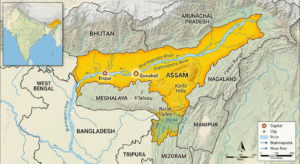
The state is located in the northeastern region of India and serves as the gateway to the Seven Sister States. The state occupies a strategic position in the Brahmaputra Valley and is surrounded by hills, fertile plains, and international borders. The state is one of the most important states in Northeast India due to its geographical location, transportation network, economic significance, and cultural diversity.
The state shares international borders with Bhutan to the north and Bangladesh to the south. Within India, Assam is bordered by Arunachal Pradesh in the north and northeast, Nagaland and Manipur to the east, Mizoram and Tripura to the south, Meghalaya to the southwest, and West Bengal to the west.
Covering an area of approximately 78,438 square kilometres, The state is the second-largest state in Northeast India after Arunachal Pradesh. The state’s landscape is dominated by the Brahmaputra Valley in the north and the Barak Valley in the south, both of which support fertile agricultural lands and diverse ecosystems.
The capital city, Dispur, is located within Guwahati, the largest city and the commercial hub of Northeast India. The Brahmaputra River, one of Asia’s largest rivers, flows across the state from east to west, shaping Assam’s geography, economy, agriculture, and culture.
Quick Facts
| Particular | Details |
|---|---|
| State | Assam |
| Region | Northeast India |
| Capital | Dispur |
| Largest City | Guwahati |
| Area | 78,438 sq km |
| Major Rivers | Brahmaputra, Barak |
| International Borders | Bhutan, Bangladesh |
| Neighboring States | Arunachal Pradesh, Nagaland, Manipur, Mizoram, Tripura, Meghalaya, West Bengal |
| Time Zone | Indian Standard Time (IST, UTC +5:30) |
Districts of Assam
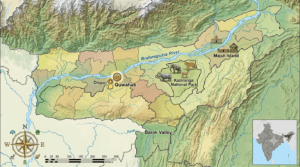
The state is administratively divided into 35 districts, ensuring efficient governance across its diverse geographical regions. These districts are spread across the fertile Brahmaputra Valley, Barak Valley, and the hilly regions bordering neighboring states and countries. Each district has its own unique history, culture, economy, and natural attractions.
The state’s largest city, Guwahati, is located in the Kamrup Metropolitan district and serves as the commercial, educational, and transportation hub of Northeast India. Dispur, the capital of the state, is also situated within this district.
The districts of Golaghat and Nagaon are home to the world-famous Kaziranga National Park, a UNESCO World Heritage Site known for the Great One-Horned Rhinoceros. Baksa, Chirang, Kokrajhar, and Udalguri together form the Bodoland Territorial Region (BTR), which has a distinct administrative and cultural identity.
Southern the state includes the Barak Valley districts of Cachar, Hailakandi, and Sribhumi (formerly Karimganj), where Bengali is widely spoken. The river island district of Majuli is globally renowned as the largest inhabited river island in the world and serves as a major center of Assamese culture and Vaishnavism.
In recent years, the Government of the state has created new districts to improve administration, public service delivery, and regional development.
List of Districts of Assam
| S.No. | District | Headquarters |
|---|---|---|
| 1 | Bajali | Pathsala |
| 2 | Baksa | Mushalpur |
| 3 | Barpeta | Barpeta |
| 4 | Biswanath | Biswanath Chariali |
| 5 | Bongaigaon | Bongaigaon |
| 6 | Cachar | Silchar |
| 7 | Charaideo | Sonari |
| 8 | Chirang | Kajalgaon |
| 9 | Darrang | Mangaldoi |
| 10 | Dhemaji | Dhemaji |
| 11 | Dhubri | Dhubri |
| 12 | Dibrugarh | Dibrugarh |
| 13 | Dima Hasao | Haflong |
| 14 | Goalpara | Goalpara |
| 15 | Golaghat | Golaghat |
| 16 | Hailakandi | Hailakandi |
| 17 | Hojai | Hojai |
| 18 | Jorhat | Jorhat |
| 19 | Kamrup | Amingaon |
| 20 | Kamrup Metropolitan | Guwahati |
| 21 | Karbi Anglong | Diphu |
| 22 | Kokrajhar | Kokrajhar |
| 23 | Lakhimpur | North Lakhimpur |
| 24 | Majuli | Garamur |
| 25 | Morigaon | Morigaon |
| 26 | Nagaon | Nagaon |
| 27 | Nalbari | Nalbari |
| 28 | Sivasagar | Sivasagar |
| 29 | Sonitpur | Tezpur |
| 30 | South Salmara-Mankachar | Hatsingimari |
| 31 | Sribhumi | Karimganj |
| 32 | Tamulpur | Tamulpur |
| 33 | Tinsukia | Tinsukia |
| 34 | Udalguri | Udalguri |
| 35 | West Karbi Anglong | Hamren |
Demographics of Assam
The state is the most populous state in Northeast India and is known for its rich ethnic, linguistic, and cultural diversity. The state is home to numerous indigenous communities, tribal groups, and people from different parts of India who have lived together for centuries.
According to the 2011 Census of India, the state had a population of 31.21 million, making it one of the largest states in eastern India by population. The state has a population density of 398 people per square kilometre and a literacy rate of 72.19%.
The state has a sex ratio of 958 females per 1,000 males, which is above the national average recorded in the 2011 Census. Most of the population lives in rural areas, where agriculture and allied activities remain the primary source of livelihood, while cities such as Guwahati, Dibrugarh, Silchar, Jorhat, and Nagaon serve as major urban centers.
Assamese is the principal official language of the state. Bodo is also an official language, while Bengali is an official language in the Barak Valley districts. In addition, several tribal and regional languages, including Karbi, Mishing, Dimasa, Rabha, Deori, and Tiwa, are widely spoken.
The state’s population includes people belonging to various religious communities, with Hinduism being the largest religion, followed by Islam, Christianity, Buddhism, Sikhism, and Jainism.
Demographic Profile of Assam
| Particular | Details |
|---|---|
| Population | 31,205,576 (Census 2011) |
| Population Density | 398 persons per sq km |
| Literacy Rate | 72.19% (Census 2011) |
| Sex Ratio | 958 females per 1,000 males (Census 2011) |
| Urban Population | Approximately 14.1% |
| Rural Population | Approximately 85.9% |
| Official Language | Assamese |
| Additional Official Languages | Bodo, Bengali (Barak Valley) |
| Major Religions | Hinduism, Islam, Christianity, Buddhism, Sikhism, Jainism |
| Major Tribal Communities | Bodo, Mishing, Karbi, Dimasa, Rabha, Tiwa, Deori, Sonowal Kachari |
Government and Administration of Assam
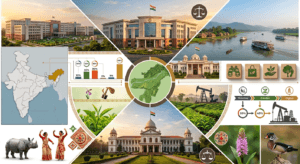
The state follows a parliamentary system of government, similar to other Indian states, with executive, legislative, and judicial branches functioning under the Constitution of India. The Governor serves as the constitutional head of the state, while the Chief Minister is the head of the elected government and leads the Council of Ministers.
The capital of the state is Dispur, located within Guwahati, which houses the state Legislative Assembly, the State Secretariat, and most government departments.
The state Legislative Assembly consists of 126 elected members, representing constituencies from across the state. The state also sends representatives to both houses of the Parliament of India, with 14 Lok Sabha seats and 7 Rajya Sabha seats.
The Gauhati High Court, established in 1948, is the principal judicial authority of the state. It is one of the oldest High Courts in Northeast India and also has jurisdiction over the states of Nagaland, Mizoram, and Arunachal Pradesh.
For administrative convenience, the state is divided into 35 districts, which are further subdivided into subdivisions, revenue circles, development blocks, municipalities, and village panchayats. These administrative units help ensure efficient governance and delivery of public services throughout the state.
Government and Administrative Profile
| Particular | Details |
|---|---|
| Capital | Dispur |
| Largest City | Guwahati |
| Governor | Governor of Assam |
| Chief Minister | Chief Minister of Assam |
| Legislative Assembly | 126 Seats |
| Lok Sabha Seats | 14 |
| Rajya Sabha Seats | 7 |
| High Court | Gauhati High Court |
| Number of Districts | 35 |
| Administrative Divisions | Districts, Sub-Divisions, Revenue Circles, Development Blocks, Municipalities, and Gram Panchayats |
| Official Language | Assamese |
History of Assam
The state has one of the oldest and richest histories in India, dating back thousands of years. Ancient texts, archaeological discoveries, and historical records reveal that the region was once known as Pragjyotisha and later as Kamarupa, which emerged as a powerful kingdom in Northeast India. The state’s history reflects a unique blend of indigenous traditions, Hinduism, Buddhism, and later Islamic and colonial influences.
According to Hindu mythology, Pragjyotisha was ruled by the legendary king Naraka (Narakasura), whose son Bhagadatta fought on the side of the Kauravas in the Mahabharata. The famous Kamakhya Temple in Guwahati, dedicated to Goddess Kamakhya, has been one of India’s most important Shakti Peethas for centuries.
The Kamarupa Kingdom flourished between the 4th and 12th centuries CE under rulers such as Pushyavarman, Bhaskaravarman, and their successors. During this period, Assam became an important center of Hindu culture, learning, trade, and diplomacy. Chinese traveler Xuanzang (Hiuen Tsang) visited Kamarupa during the reign of Bhaskaravarman in the 7th century and praised its prosperity.
A defining chapter in Assam’s history began with the arrival of the Ahom dynasty in 1228 CE, when Sukaphaa, a Tai prince, entered the Brahmaputra Valley. The Ahoms ruled Assam for nearly 600 years, making them one of the longest-ruling dynasties in Indian history. They successfully resisted several invasions, including repeated attacks by the Mughal Empire.
One of the greatest victories in Assamese history was the Battle of Saraighat (1671), where the Ahom forces led by Lachit Borphukan defeated the Mughal army commanded by Raja Ram Singh I. This historic battle is celebrated as a symbol of courage, leadership, and Assamese pride.
Following the Treaty of Yandabo (1826), Assam came under British rule, marking the beginning of colonial administration. During this period, the British developed the tea industry, expanded railways, and modernized infrastructure, transforming Assam into one of the world’s leading tea-producing regions.
After India gained independence in 1947, Assam became an important state in the Indian Union. Over the following decades, several new northeastern states, including Nagaland, Meghalaya, Mizoram, and Arunachal Pradesh, were carved out of the original territory of Assam. Today, Assam remains the political, cultural, and economic gateway to Northeast India.
Timeline of Assam History
| Year / Period | Historical Event |
|---|---|
| Ancient Period | The region was known as Pragjyotisha and is mentioned in ancient Hindu scriptures. |
| Mythological Era | Kingdom of Narakasura and his son Bhagadatta, who fought in the Mahabharata. |
| 4th–12th Century CE | Rise and prosperity of the Kamarupa Kingdom, a major center of Hindu culture and learning. |
| 7th Century CE | Chinese traveler Xuanzang (Hiuen Tsang) visited Kamarupa during the reign of King Bhaskaravarman. |
| 1228 CE | Sukaphaa founded the Ahom Kingdom, beginning nearly 600 years of Ahom rule. |
| 1671 CE | Battle of Saraighat – Ahom forces led by Lachit Borphukan defeated the Mughal army. |
| 1826 CE | Treaty of Yandabo brought Assam under British rule. |
| 1830s | The British established and expanded the Assam tea industry. |
| 1947 | Assam became part of independent India. |
| 1963–1987 | Formation of Nagaland, Meghalaya, Mizoram, and Arunachal Pradesh from the erstwhile Assam region. |
Geography of Assam
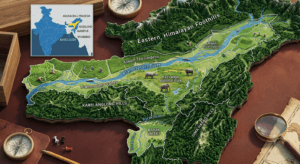
The state is located in the northeastern part of India and covers an area of approximately 78,438 square kilometres. The state is renowned for its fertile river valleys, rolling hills, dense forests, wetlands, and abundant wildlife. Its unique geographical features make Assam one of the most ecologically significant states in the country.
The state lies between 24°08′ N and 28°02′ N latitude and 89°42′ E and 96°01′ E longitude. Assam shares international borders with Bhutan to the north and Bangladesh to the south. Within India, it is bordered by Arunachal Pradesh, Nagaland, Manipur, Mizoram, Tripura, Meghalaya, and West Bengal.
The geography of Assam is dominated by two major river valleys—the Brahmaputra Valley in the north and the Barak Valley in the south. The mighty Brahmaputra River, one of Asia’s largest rivers, flows from east to west across the state, creating fertile floodplains that support agriculture, biodiversity, and human settlements. The Barak River flows through southern Assam before entering Bangladesh.
The state is surrounded by several hill ranges, including the Karbi Anglong Hills, North Cachar Hills (Dima Hasao), and the foothills of the Eastern Himalayas. These landscapes support dense tropical forests, tea plantations, wildlife sanctuaries, and rich biodiversity.
The state experiences seasonal flooding, particularly along the Brahmaputra River, which replenishes fertile agricultural lands but also causes erosion and displacement in many areas. Despite these challenges, the river remains the lifeline of the state.
The state is famous for its tea gardens, Kaziranga National Park, Manas National Park, wetlands, and river islands such as Majuli, the world’s largest inhabited river island. These geographical features make Assam one of India’s most scenic and ecologically diverse destinations.
Geographical Highlights
| Particular | Details |
|---|---|
| Total Area | 78,438 sq km |
| Region | Northeast India |
| Major River | Brahmaputra River |
| Second Major River | Barak River |
| Highest Peak | Laike Peak (1,959 m) |
| Major Hill Ranges | Karbi Anglong Hills, Dima Hasao Hills |
| International Borders | Bhutan and Bangladesh |
| Neighboring States | Arunachal Pradesh, Nagaland, Manipur, Mizoram, Tripura, Meghalaya, West Bengal |
| Latitude | 24°08′ N – 28°02′ N |
| Longitude | 89°42′ E – 96°01′ E |
Climate of Assam
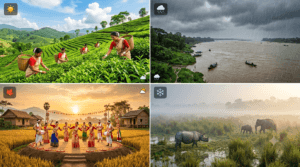
The state experiences a humid subtropical climate, characterized by warm summers, a heavy monsoon season, and mild winters. The state’s climate is greatly influenced by the Brahmaputra and Barak river valleys, the surrounding hills, and the Southwest Monsoon, making it one of the wettest regions in India.
Summer (March to May)
Summers in Assam are generally warm and humid, with temperatures ranging from 25°C to 35°C. Frequent thunderstorms, locally known as Bordoisila, occur during this season and often bring heavy rain and strong winds. These pre-monsoon showers are beneficial for the state’s famous tea plantations and agricultural activities.
Monsoon (June to September)
The monsoon season brings heavy rainfall, with annual precipitation ranging between 2,000 mm and 3,500 mm in most parts of the state. The Brahmaputra River and its tributaries often overflow, causing seasonal floods that enrich the fertile plains but also affect villages, roads, and agriculture. Despite the challenges, the rains support Assam’s forests, wetlands, and biodiversity.
Autumn (October to November)
After the monsoon, the state enjoys pleasant weather with clear skies and lush green landscapes. This season is considered one of the best times to visit the state, as rivers recede, wildlife becomes more visible, and major festivals like Kati Bihu are celebrated.
Winter (December to February)
Winters are cool and comfortable, with temperatures generally ranging from 8°C to 25°C. Morning fog is common in many districts, especially along the Brahmaputra Valley. This is the peak tourist season, ideal for exploring Kaziranga National Park, Manas National Park, Majuli, and the state’s tea gardens.
The pleasant climate, abundant rainfall, and fertile soil make Assam one of India’s leading producers of tea, rice, fruits, and other agricultural products.
Season-wise Climate Overview
| Season | Months | Temperature | Characteristics |
|---|---|---|---|
| Summer | March – May | 25°C – 35°C | Warm and humid weather with frequent thunderstorms (Bordoisila), ideal for tea plantations. |
| Monsoon | June – September | 24°C – 32°C | Heavy rainfall, seasonal floods, lush greenery, and abundant river flow. |
| Autumn | October – November | 20°C – 30°C | Pleasant weather, clear skies, post-monsoon beauty, and major festivals like Kati Bihu. |
| Winter | December – February | 8°C – 25°C | Cool and dry climate with morning fog, perfect for wildlife tourism and sightseeing. |
Major Rivers of Assam
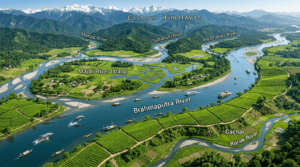
The state is often referred to as the “Land of Rivers” because of its extensive network of rivers that shape the state’s geography, economy, agriculture, biodiversity, and culture. The fertile plains of Assam are formed by two major river systems—the Brahmaputra Valley in the north and the Barak Valley in the south.
The Brahmaputra River is the lifeline of the state and one of the largest rivers in Asia. Originating from the Angsi Glacier in Tibet, it enters India through Arunachal Pradesh as the Siang River before flowing across Assam from east to west. The river supports agriculture, inland navigation, fisheries, tourism, and wildlife while also creating the world-famous Majuli River Island.
The Barak River is the second-largest river system in Assam. It flows through the Barak Valley districts of Cachar, Hailakandi, and Sribhumi, before entering Bangladesh. The river plays a vital role in irrigation, agriculture, and transportation in southern Assam.
Several tributaries enrich the Brahmaputra River, including the Subansiri, Manas, Jia Bharali, Dhansiri, Kopili, Beki, Burhi Dihing, and Dibang rivers. These rivers originate in the Himalayas or surrounding hills and support fertile farmlands, forests, wetlands, and diverse ecosystems.
Assam’s rivers are also home to rare aquatic species such as the Ganges River Dolphin, the state aquatic animal, and numerous migratory birds. However, seasonal flooding and riverbank erosion remain major environmental challenges due to the immense flow of the Brahmaputra during the monsoon season.
Major Rivers of Assam
| River | Origin | Importance |
|---|---|---|
| Brahmaputra | Angsi Glacier, Tibet | Lifeline of Assam; supports agriculture, inland navigation, fisheries, tourism, and forms Majuli River Island. |
| Barak | Manipur Hills | Major river of southern Assam, supporting irrigation, agriculture, and the Barak Valley. |
| Subansiri | Tibet | Largest tributary of the Brahmaputra in Assam with significant hydropower potential. |
| Manas | Bhutan Himalayas | Flows through Manas National Park and supports rich biodiversity and wildlife. |
| Jia Bharali | Arunachal Pradesh | Known for river rafting, tourism, irrigation, and scenic landscapes. |
| Dhansiri | Nagaland Hills | Important for agriculture, fisheries, and local livelihoods. |
| Kopili | Meghalaya Hills | Supports hydropower generation, irrigation, and agriculture. |
| Beki | Bhutan | Provides water for agriculture and sustains forests and wildlife habitats. |
Agriculture of Assam
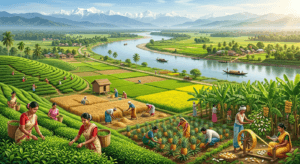
Agriculture is the backbone of Assam’s economy, providing livelihood to a large percentage of the state’s population. Blessed with fertile alluvial soil, abundant rainfall, and the mighty Brahmaputra and Barak river systems, Assam has ideal conditions for cultivating a wide variety of crops throughout the year.
Rice is the principal food crop and is grown extensively across the state. Farmers cultivate different varieties such as Ahu, Sali, and Boro rice according to seasonal conditions. Assam is among the leading rice-producing states in Northeast India.
The state is globally famous for Assam Tea, one of the world’s finest black teas. Tea cultivation is the most important commercial agricultural activity, with vast plantations spread across districts like Dibrugarh, Tinsukia, Jorhat, Sivasagar, and Golaghat. The state contributes more than half of India’s total tea production.
Apart from rice and tea, farmers cultivate mustard, jute, sugarcane, maize, pulses, and a variety of fruits and vegetables. Horticulture has expanded rapidly, with crops such as banana, pineapple, orange, lemon, arecanut, coconut, and black pepper becoming important sources of income.
Assam also produces high-quality Muga Silk, Eri Silk, and Pat Silk, making sericulture an important agricultural allied sector. Fisheries, dairy farming, poultry, and livestock rearing further support the rural economy.
The Government of Assam promotes organic farming, modern irrigation, mechanization, high-yield seed varieties, and sustainable agricultural practices to improve farmers’ income and food security.
Major Agricultural Products
| Crop | Importance |
|---|---|
| Rice | Staple food crop and the most widely cultivated crop in Assam. |
| Tea | World-famous Assam Tea and the state’s leading commercial and export crop. |
| Mustard | Major oilseed crop used for edible oil production. |
| Jute | Important fibre crop used for making bags, ropes, and textiles. |
| Sugarcane | Used for the production of sugar, jaggery, and ethanol. |
| Maize | Grown for human consumption, poultry feed, and livestock fodder. |
| Pulses | Rich source of protein and helps improve soil fertility through nitrogen fixation. |
| Banana | One of the leading horticultural fruit crops cultivated across the state. |
| Pineapple | Commercial fruit crop known for its sweetness and quality. |
| Muga Silk | World-famous golden silk unique to Assam and an important sericulture product. |
Flora and Fauna of Assam
The state is one of India’s richest biodiversity hotspots, blessed with lush tropical forests, vast grasslands, wetlands, river islands, and fertile floodplains. Located within the Eastern Himalayan Biodiversity Hotspot, the state supports an extraordinary variety of plant and animal species, many of which are rare, endemic, and endangered.
Nearly 36% of Assam’s geographical area is covered by forests, including tropical evergreen, semi-evergreen, moist deciduous, and bamboo forests. These forests are home to valuable timber species such as Sal, Hollong (the state tree), Teak, Nahor, and numerous medicinal plants, orchids, and bamboo species.
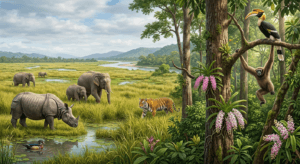
The state is internationally renowned for its rich wildlife. The state is home to the Great One-Horned Rhinoceros, the state animal, which is primarily protected in Kaziranga National Park and Pobitora Wildlife Sanctuary. Assam also supports large populations of Asian Elephants, Royal Bengal Tigers, Wild Water Buffaloes, Clouded Leopards, Leopards, Hoolock Gibbons (India’s only ape), and Golden Langurs.
The state’s wetlands and forests provide habitat for more than 900 bird species, including the White-winged Wood Duck (state bird), Great Hornbill, Lesser Adjutant Stork, Bengal Florican, and numerous migratory birds.
The state is equally famous for its floral diversity. The state is home to thousands of flowering plants, including the Foxtail Orchid (Kopou Phool), the state flower, which plays an important role in Assamese culture and the Bihu festival. Numerous species of orchids, lilies, medicinal herbs, and bamboo flourish across the state.
The Government of Assam, along with conservation organizations, continues to protect its rich biodiversity through national parks, wildlife sanctuaries, biosphere reserves, anti-poaching initiatives, and eco-tourism programs.
State Symbols and Wildlife
| Category | Symbol / Species |
|---|---|
| State Animal | Great One-Horned Rhinoceros |
| State Bird | White-winged Wood Duck (Deo Hanh) |
| State Tree | Hollong (Dipterocarpus macrocarpus) |
| State Flower | Foxtail Orchid (Kopou Phool) |
| Famous Mammals | Asian Elephant, Royal Bengal Tiger, Hoolock Gibbon, Wild Water Buffalo, Clouded Leopard |
| Famous Birds | Great Hornbill, Bengal Florican, Lesser Adjutant Stork, White-winged Wood Duck |
| Biodiversity Region | Eastern Himalayan Biodiversity Hotspot |
National Parks and Wildlife Sanctuaries of Assam
The state is one of India’s premier wildlife destinations, renowned for its rich biodiversity, dense forests, vast grasslands, wetlands, and river ecosystems. Located within the Eastern Himalayan Biodiversity Hotspot, the state is home to several nationally and internationally recognized protected areas that conserve endangered species and unique ecosystems.
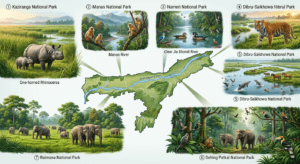
The most famous protected area is Kaziranga National Park, a UNESCO World Heritage Site and home to the world’s largest population of the Great One-Horned Rhinoceros. The park also shelters Royal Bengal Tigers, Asian Elephants, Wild Water Buffaloes, Swamp Deer, and hundreds of bird species.
Another UNESCO World Heritage Site is Manas National Park, located along the foothills of the Himalayas near the Bhutan border. It is also recognized as a Project Tiger Reserve, Elephant Reserve, and Biosphere Reserve. The park is home to rare species such as the Golden Langur, Pygmy Hog, Hispid Hare, and Clouded Leopard.
Orang National Park, often called the “Mini Kaziranga,” is famous for its one-horned rhinoceroses and rich birdlife. Nameri National Park is known for river rafting, birdwatching, and the endangered White-winged Wood Duck.
Dibru-Saikhowa National Park is one of India’s most important riverine ecosystems, protecting rare migratory birds, feral horses, and wetland habitats. Assam also has several important wildlife sanctuaries, including Pobitora, Hollongapar Gibbon, Deepor Beel, Bornadi, Laokhowa, and Sonai Rupai, which play a crucial role in conserving the state’s remarkable flora and fauna.
These protected areas make Assam one of the best destinations in India for wildlife safaris, birdwatching, photography, and eco-tourism.
Major National Parks of Assam
| National Park | Famous For |
|---|---|
| Kaziranga National Park | UNESCO World Heritage Site, Great One-Horned Rhinoceros, Royal Bengal Tiger, Asian Elephant |
| Manas National Park | UNESCO World Heritage Site, Tiger Reserve, Biosphere Reserve, Golden Langur, Pygmy Hog |
| Orang National Park | Known as the “Mini Kaziranga”, famous for the One-Horned Rhinoceros and rich birdlife |
| Nameri National Park | White-winged Wood Duck, birdwatching, river rafting, and eco-tourism |
| Dibru-Saikhowa National Park | Riverine ecosystem, migratory birds, wetlands, and feral horses |
| Dehing Patkai National Park | Tropical rainforest, elephants, clouded leopards, and exceptional biodiversity |
| Raimona National Park | Golden Langur, dense forests, butterflies, and rich Himalayan foothill biodiversity |
Culture and Traditions of Assam
The state is one of India’s most culturally vibrant states, known for its rich traditions, colorful festivals, classical arts, indigenous communities, and centuries-old heritage. The state’s culture is a harmonious blend of Assamese, tribal, and Vaishnavite traditions that have evolved over thousands of years. More than 20 major tribal communities and several ethnic groups contribute to Assam’s diverse cultural identity.
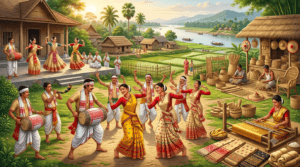
The most celebrated cultural festival of Assam is Bihu, which symbolizes the agricultural cycle and Assamese way of life. The three major Bihu festivals—Rongali (Bohag) Bihu, Bhogali (Magh) Bihu, and Kongali (Kati) Bihu—are celebrated with traditional music, dance, feasts, and community gatherings.
Bihu Dance is the state’s most famous folk dance, performed with energetic movements accompanied by the Dhol, Pepa, Gogona, and Taal. Assam is also the birthplace of Sattriya, one of India’s eight classical dance forms, introduced by the great saint and social reformer Srimanta Sankardeva.
Traditional handloom weaving is an essential part of Assamese culture. The famous Mekhela Chador, woven from Muga Silk, Eri Silk, and Pat Silk, represents the elegance of Assamese craftsmanship. Bamboo and cane handicrafts, pottery, mask-making at Majuli, and bell-metal crafts are also important cultural traditions.
The state is home to diverse communities such as the Bodo, Mishing, Karbi, Rabha, Dimasa, Tiwa, Deori, Sonowal Kachari, and Tai Ahom, each preserving its own language, customs, festivals, and traditional attire.
The state cultural heritage reflects harmony between nature, spirituality, agriculture, and community life, making it one of India’s most fascinating cultural destinations.
Cultural Highlights
| Cultural Element | Description |
|---|---|
| Bihu | The most important festival of Assam, celebrated in three forms: Rongali (Bohag), Bhogali (Magh), and Kongali (Kati). |
| Bihu Dance | Traditional Assamese folk dance performed with energetic movements and vibrant music. |
| Sattriya | One of India’s eight classical dance forms, introduced by Srimanta Sankardeva. |
| Mekhela Chador | Traditional Assamese attire for women, woven from Muga, Eri, and Pat silk. |
| Muga Silk | World-famous golden silk unique to Assam and recognized with a GI Tag. |
| Majuli Satras | Vaishnavite monasteries preserving Assamese culture, art, dance, and literature. |
| Bamboo & Cane Crafts | Traditional handicrafts including baskets, furniture, mats, musical instruments, and decorative items. |
| Major Communities | Bodo, Mishing, Karbi, Rabha, Dimasa, Tiwa, Deori, Sonowal Kachari, and Tai Ahom. |
Festivals of Assam
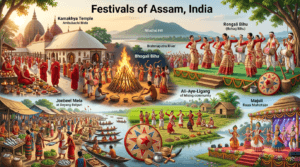
The state is known for its vibrant festivals that reflect the state’s agricultural traditions, spiritual heritage, and cultural diversity. Celebrated with music, dance, traditional attire, community feasts, and religious rituals, these festivals strengthen social harmony and preserve Assamese customs that have been passed down through generations.
The most famous festival is Bihu, which is celebrated in three different forms throughout the year. Rongali (Bohag) Bihu, observed in April, marks the Assamese New Year and the beginning of the agricultural season. It is celebrated with energetic Bihu Dance, folk music, traditional games, and community gatherings.
Bhogali (Magh) Bihu, celebrated in January, is the harvest festival of Assam. People prepare traditional delicacies, organize community feasts, and celebrate around Meji bonfires. Kongali (Kati) Bihu, observed in October, is associated with prayers for a good harvest and the protection of crops.
The Ambubachi Mela, held annually at the Kamakhya Temple in Guwahati, is one of India’s most significant Hindu religious festivals. Thousands of devotees, saints, and pilgrims from across the country visit the temple during this sacred event.
Other important festivals include Baishagu of the Bodo community, Ali-Aye-Ligang of the Mishing tribe, Jonbeel Mela, Raas Mahotsav in Majuli, Dehing Patkai Festival, and Tea Festival, each showcasing Assam’s unique cultural traditions.
These festivals highlight the state’s deep connection with agriculture, religion, music, dance, and community life, making Assam one of India’s most colorful cultural destinations.
Major Festivals of Assam
| Festival | Celebrated By | Significance |
|---|---|---|
| Rongali (Bohag) Bihu | Assamese Community | Assamese New Year and spring festival marking the beginning of the agricultural season. |
| Bhogali (Magh) Bihu | Assamese Community | Harvest festival celebrated with community feasts, Meji bonfires, and traditional delicacies. |
| Kongali (Kati) Bihu | Assamese Community | Festival dedicated to prayers for a prosperous harvest and protection of crops. |
| Ambubachi Mela | Hindu Devotees | Annual religious festival held at the Kamakhya Temple in Guwahati. |
| Baishagu | Bodo Community | Traditional New Year and harvest festival of the Bodo people. |
| Ali-Aye-Ligang | Mishing Tribe | Agricultural festival marking the beginning of paddy cultivation. |
| Jonbeel Mela | Various Indigenous Communities | Traditional fair famous for its centuries-old barter trade system. |
| Raas Mahotsav | Vaishnavite Community | Celebrates the life and teachings of Lord Krishna through devotional performances. |
| Dehing Patkai Festival | Government & Tourists | Promotes Assam’s culture, adventure tourism, and biodiversity. |
| Tea Festival | Tea Industry & Visitors | Celebrates Assam’s world-famous tea heritage and tea tourism. |
Famous Food of Assam
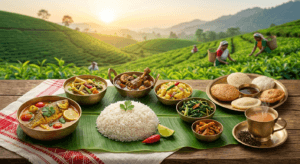
Assamese cuisine is known for its simple yet flavorful dishes prepared with fresh local ingredients, aromatic herbs, river fish, bamboo shoots, and unique traditional spices. Unlike many other Indian cuisines, Assamese food uses minimal oil and spices, allowing the natural taste of ingredients to stand out. Rice is the staple food and is served with a variety of vegetarian and non-vegetarian dishes.
One of the most famous dishes is Khar, a traditional Assamese preparation made using raw papaya, pulses, or vegetables cooked with an alkaline extract prepared from sun-dried banana peels. It is usually served at the beginning of a traditional Assamese meal.
Another popular delicacy is Masor Tenga, a light and tangy fish curry prepared with tomatoes, lemon, elephant apple (Ou Tenga), or other souring agents. It is especially enjoyed during the summer months.
Duck Meat Curry (Hanhor Mangxo) is a festive favorite, often cooked with ash gourd, sesame seeds, or bottle gourd during special occasions and Bihu celebrations.
Pitha, a traditional Assamese rice cake, is widely prepared during Bihu festivals. Varieties such as Til Pitha, Ghila Pitha, and Sunga Pitha are popular across the state.
Other famous Assamese foods include Aloo Pitika (mashed potatoes with mustard oil), Xaak Bhaji (stir-fried leafy greens), Bamboo Shoot Pickle, Black Rice Kheer (Bora Saul Payas), and Assam Tea, which is internationally renowned for its strong flavor and rich aroma.
Popular Dishes of Assam
| Dish | Main Ingredients | Specialty |
|---|---|---|
| Khar | Banana peel extract, raw papaya, pulses or vegetables | Traditional Assamese alkaline dish served at the beginning of a meal. |
| Masor Tenga | Fresh fish, tomatoes, lemon or elephant apple (Ou Tenga) | Light and tangy fish curry, one of Assam’s signature dishes. |
| Duck Meat Curry (Hanhor Mangxo) | Duck meat, ash gourd, sesame seeds or bottle gourd | Popular festive delicacy served during Bihu and special occasions. |
| Pitha | Rice flour, sesame seeds, coconut, jaggery | Traditional Assamese rice cake prepared during Bihu festivals. |
| Aloo Pitika | Mashed potatoes, mustard oil, onions, green chilies | Simple and flavorful side dish enjoyed with steamed rice. |
| Xaak Bhaji | Fresh leafy vegetables | Healthy stir-fried greens commonly served in Assamese meals. |
| Bamboo Shoot Pickle | Fermented bamboo shoots, spices | Traditional tribal delicacy with a distinctive flavor. |
| Assam Tea | Premium black tea leaves | World-famous strong black tea known for its rich aroma and bold taste. |
Tourist Places in Assam
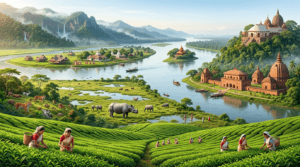
The state is one of the most beautiful travel destinations in Northeast India, offering a perfect blend of wildlife, spirituality, history, tea gardens, rivers, and vibrant culture. From the mighty Brahmaputra River and the sacred Kamakhya Temple to UNESCO World Heritage Sites and scenic hill stations, the state attracts millions of visitors every year.
The most famous attraction is Kaziranga National Park, a UNESCO World Heritage Site renowned for the world’s largest population of the Great One-Horned Rhinoceros. Visitors can enjoy jeep safaris and elephant safaris while spotting tigers, elephants, wild buffaloes, and numerous bird species.
Another iconic destination is the Kamakhya Temple in Guwahati, one of the 51 Shakti Peethas in India. The temple is an important pilgrimage site and hosts the famous Ambubachi Mela, attracting devotees from across the country.
Majuli, the world’s largest inhabited river island, is known for its Vaishnavite Satras, traditional mask-making, scenic landscapes, and vibrant Assamese culture. It is one of the state’s most unique tourist attractions.
Nature lovers can visit Manas National Park, another UNESCO World Heritage Site, famous for its rich biodiversity, tiger reserve, and rare wildlife. Sivasagar, the former capital of the Ahom Kingdom, is home to magnificent historical monuments such as Rang Ghar, Talatal Ghar, and Kareng Ghar.
Other must-visit destinations include Haflong, Assam’s only hill station; Pobitora Wildlife Sanctuary; Umananda Temple on Peacock Island; Hajo, a multi-faith pilgrimage center; and the sprawling Assam Tea Gardens, which offer breathtaking landscapes and tea tourism experiences.
Top Tourist Attractions
| Tourist Place | District | Famous For |
|---|---|---|
| Kaziranga National Park | Golaghat & Nagaon | UNESCO World Heritage Site, Great One-Horned Rhinoceros, wildlife safaris. |
| Kamakhya Temple | Kamrup Metropolitan (Guwahati) | One of the 51 Shakti Peethas and the famous Ambubachi Mela. |
| Majuli | Majuli | World’s largest inhabited river island, Satras, and Assamese culture. |
| Manas National Park | Baksa & Chirang | UNESCO World Heritage Site, Tiger Reserve, and rich biodiversity. |
| Sivasagar | Sivasagar | Historic Ahom monuments including Rang Ghar, Talatal Ghar, and Kareng Ghar. |
| Haflong | Dima Hasao | Assam’s only hill station, scenic hills, and Haflong Lake. |
| Umananda Temple | Kamrup Metropolitan (Guwahati) | Ancient Shiva temple located on Peacock Island in the Brahmaputra River. |
| Pobitora Wildlife Sanctuary | Morigaon | Highest density of Great One-Horned Rhinoceroses in the world. |
| Hajo | Kamrup | Multi-faith pilgrimage center for Hindus, Buddhists, and Muslims. |
| Assam Tea Gardens | Dibrugarh, Jorhat & Tinsukia | World-famous tea plantations, tea tourism, and scenic landscapes. |
Transport in Assam
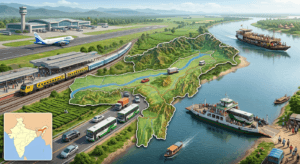
The state has the most developed transportation network in Northeast India and serves as the gateway to the northeastern states. The state is well connected by road, rail, air, and inland waterways, making travel convenient for residents, tourists, and businesses. Its strategic location also makes it a major logistics and trade hub for the entire Northeast region.
Road Transport
Roadways are the primary mode of transport in the state. The state is connected by several important national highways, including NH-27, NH-17, NH-15, NH-37, and NH-715, linking major cities such as Guwahati, Dibrugarh, Jorhat, Silchar, Tezpur, Nagaon, Tinsukia, and Bongaigaon.
The State Transport Corporation (ASTC) operates bus services across the state and to neighboring states. Private buses, taxis, and app-based cab services are also widely available.
Rail Transport
The state has one of the largest railway networks in Northeast India. Guwahati Railway Station is the state’s busiest railway station and an important junction connecting Assam with major Indian cities such as New Delhi, Kolkata, Mumbai, Chennai, Bengaluru, and Hyderabad.
Other major railway stations include Dibrugarh, Tinsukia, Silchar, Lumding, Jorhat Town, and New Bongaigaon.
Air Transport
The state has several airports providing excellent domestic connectivity. The largest airport is Lokpriya Gopinath Bordoloi International Airport (Guwahati), which offers regular flights to major Indian cities and selected international destinations.
Other airports include Dibrugarh Airport, Jorhat Airport, Silchar Airport, Tezpur Airport, Lilabari Airport, and Rupsi Airport.
Water Transport
The Brahmaputra River is designated as National Waterway-2 (NW-2), making the state one of the few Indian states with an important inland water transport system. Passenger ferries and cargo vessels operate between several river ports, including services to Majuli, the world’s largest inhabited river island.
Transport at a Glance
| Mode of Transport | Major Facilities |
|---|---|
| Road | NH-27, NH-17, NH-15, NH-37, NH-715, ASTC buses, private buses, taxis |
| Railway | Guwahati, Dibrugarh, Tinsukia, Silchar, Lumding, Jorhat Town, New Bongaigaon Railway Stations |
| Airport | Lokpriya Gopinath Bordoloi International Airport (Guwahati), Dibrugarh, Jorhat, Silchar, Tezpur, Lilabari, Rupsi Airports |
| Water Transport | National Waterway-2 (Brahmaputra River), Inland Water Transport (IWT), ferry services to Majuli and other river islands |
| Major Transport Hub | Guwahati – Gateway to Northeast India with integrated road, rail, air, and water connectivity |
Shopping in Assam
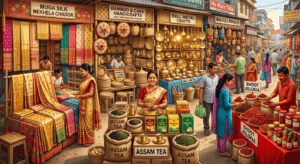
Shopping in the state is a delightful experience that reflects the state’s rich cultural heritage, traditional craftsmanship, and agricultural excellence. Visitors can explore colorful local markets, handicraft emporiums, tea estates, and artisan villages to purchase authentic Assamese products that make perfect souvenirs.
The most famous shopping item is Assam Tea, renowned worldwide for its bold flavor, rich aroma, and premium quality. Visitors can buy fresh tea directly from tea estates and specialty stores in Guwahati, Jorhat, Dibrugarh, and Tinsukia.
The state is also famous for its luxurious Muga Silk, Eri Silk, and Pat Silk fabrics. Traditional garments such as the Mekhela Chador, scarves, stoles, and handwoven textiles are crafted by skilled artisans and are highly valued across India.
Handicrafts made from bamboo and cane are another major attraction. Beautiful baskets, furniture, lamps, trays, mats, decorative items, and household products are handmade using eco-friendly materials. Traditional bell-metal crafts from Sarthebari, wood carvings, and mask-making art from Majuli are also popular among tourists.
Food lovers can purchase local specialties such as Assam Tea, Bhoot Jolokia (Ghost Pepper), organic spices, bamboo shoot pickles, honey, black rice, and traditional sweets.
Best Shopping Places
Fancy Bazaar (Guwahati) – Assam Tea, textiles, handicrafts, local markets.
Pan Bazaar (Guwahati) – Books, handicrafts, souvenirs, traditional products.
Jorhat Tea Market – Premium Assam Tea.
Sualkuchi – Famous for Muga Silk, Eri Silk, Pat Silk, and Mekhela Chador.
Majuli – Handmade masks, pottery, bamboo crafts, and cultural souvenirs.
Popular Shopping Items
| Item | Specialty |
|---|---|
| Assam Tea | World-famous premium black tea known for its strong flavour, rich aroma, and excellent quality. |
| Muga Silk | Exclusive golden silk of Assam with GI Tag, famous for its natural golden sheen and durability. |
| Eri & Pat Silk | Traditional handwoven silk fabrics widely used for Assamese garments and textiles. |
| Mekhela Chador | Traditional Assamese attire for women, beautifully woven using Muga, Eri, and Pat silk. |
| Bamboo & Cane Crafts | Eco-friendly handmade baskets, furniture, mats, trays, lamps, and decorative items. |
| Bell Metal Crafts | Traditional handcrafted utensils, religious items, and decorative artifacts, especially from Sarthebari. |
| Majuli Masks | Handmade cultural masks crafted by artisans of Majuli Satras for traditional performances. |
| Bhoot Jolokia (Ghost Pepper) | One of the world’s hottest chilies, widely used in Assamese cuisine and pickles. |
Best Time to Visit Assam
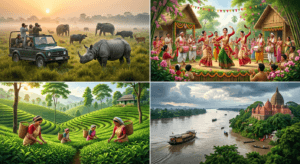
The state is a year-round destination, but the best time to visit is from October to April, when the weather is pleasant, rainfall is minimal, and most tourist attractions are easily accessible. During these months, visitors can enjoy wildlife safaris, river cruises, tea gardens, festivals, and cultural experiences.
Winter (October to February) – Peak Tourist Season
Winter is considered the ideal season for exploring Assam. Temperatures range from 8°C to 25°C, providing comfortable conditions for sightseeing and outdoor activities. This is the best time to visit Kaziranga National Park, Manas National Park, Majuli, Kamakhya Temple, and the famous tea gardens.
Spring (March to April)
Spring is another excellent time to visit, as the weather remains pleasant and the state comes alive with the celebration of Rongali (Bohag) Bihu, Assam’s biggest cultural festival. Tea gardens become lush green, making it a perfect season for photography and cultural tourism.
Monsoon (May to September)
The monsoon brings heavy rainfall across Assam due to the Southwest Monsoon. While the landscape becomes exceptionally green and beautiful, frequent floods in the Brahmaputra Valley may disrupt travel. Wildlife safaris in national parks are often suspended during this period. However, this season is ideal for nature lovers and photographers who wish to experience Assam’s lush landscapes.
Season-wise Travel Guide
| Season | Months | Travel Experience |
|---|---|---|
| Winter | October – February | Best season for wildlife safaris, sightseeing, tea gardens, river cruises, and festivals. Ideal for visiting Kaziranga National Park, Manas National Park, Majuli, and Kamakhya Temple. |
| Spring | March – April | Pleasant weather, blooming tea gardens, and vibrant Rongali (Bohag) Bihu celebrations. Excellent for photography and cultural tourism. |
| Monsoon | May – September | Heavy rainfall, lush green landscapes, and the majestic Brahmaputra River. Wildlife safaris may be limited due to seasonal flooding. |
How to Reach Assam
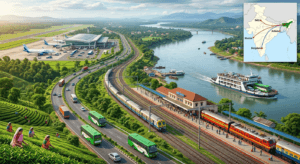
The state is the gateway to Northeast India and enjoys excellent connectivity through airways, railways, roadways, and inland waterways. The state is easily accessible from major cities across India, making it one of the most convenient destinations in the northeastern region.
By Air
The fastest way to reach Assam is by air. The state’s primary airport is Lokpriya Gopinath Bordoloi International Airport (GAU) in Guwahati, which offers regular flights from Delhi, Mumbai, Kolkata, Bengaluru, Chennai, Hyderabad, and several other cities. Other important airports include Dibrugarh, Jorhat, Silchar, Tezpur, Lilabari, and Rupsi.
By Train
The state has an extensive railway network connecting it to the rest of India. Guwahati Railway Station is the state’s busiest rail hub and is served by major trains such as the Rajdhani Express, Saraighat Express, and numerous long-distance trains. Other major railway stations include Dibrugarh, Tinsukia, Silchar, Lumding, and New Bongaigaon.
By Road
A well-developed network of National Highways connects the state with neighboring states and the rest of India. Major highways such as NH-27, NH-17, NH-15, NH-37, and NH-715 provide smooth road connectivity. The Assam State Transport Corporation (ASTC) and private operators run regular bus services between major cities.
By Waterways
The Brahmaputra River, designated as National Waterway-2 (NW-2), plays an important role in inland water transport. Ferry services connect Guwahati with Majuli and several river islands, offering both transportation and scenic travel experiences.
Connectivity Overview
| Mode of Transport | Major Entry Points |
|---|---|
| Air | Lokpriya Gopinath Bordoloi International Airport (Guwahati), Dibrugarh Airport, Jorhat Airport, Silchar Airport, Tezpur Airport, Lilabari Airport, Rupsi Airport |
| Rail | Guwahati, Dibrugarh, Tinsukia, Silchar, Lumding, New Bongaigaon Railway Stations |
| Road | NH-27, NH-17, NH-15, NH-37, NH-715, ASTC buses, private buses, taxis, and cab services |
| Waterways | National Waterway-2 (Brahmaputra River), Inland Water Transport (IWT), ferry services connecting Guwahati, Majuli, and other river ports |

Travel Tips for Visiting Assam
The state is a safe and welcoming destination known for its natural beauty, wildlife, tea gardens, and rich cultural heritage. Planning your trip well will help you enjoy a comfortable and memorable experience.
Before visiting Kaziranga National Park, Manas National Park, or other wildlife reserves, check safari timings and seasonal park closures, as many parks remain closed during the monsoon season due to heavy rainfall and flooding.
The best time to visit the state is between October and April, when the weather is pleasant and ideal for sightseeing, wildlife safaris, river cruises, and tea garden tours.
Carry lightweight cotton clothing during the warmer months and light woolen clothes if traveling in winter, especially to places like Haflong or during early morning safaris. Comfortable walking shoes, sunscreen, sunglasses, insect repellent, and a reusable water bottle are highly recommended.
Respect local traditions while visiting religious sites such as Kamakhya Temple and Majuli Satras. Dress modestly and follow temple guidelines. Always avoid littering and help preserve the state’s natural beauty and wildlife habitats.
When exploring tea estates, tribal villages, or rural areas, seek permission before photographing local people. Support local artisans by purchasing authentic Assam Tea, Muga Silk, Eri Silk, bamboo handicrafts, and traditional souvenirs.
Essential Travel Tips
| Travel Tip | Details |
|---|---|
| Best Season | Visit between October and April for pleasant weather, wildlife safaris, sightseeing, and festivals. |
| Clothing | Wear light cotton clothes during summer and light woollen clothes during winter. Comfortable walking shoes are recommended. |
| Wildlife Safari | Book jeep or elephant safaris in advance and check park opening dates, especially for Kaziranga and Manas National Parks. |
| Local Transport | Use ASTC buses, taxis, app-based cab services, auto-rickshaws, and ferry services for convenient travel. |
| Shopping | Purchase authentic Assam Tea, Muga Silk, Eri Silk, bamboo handicrafts, bell metal crafts, and Majuli masks. |
| Temple Etiquette | Dress modestly and follow the rules while visiting Kamakhya Temple and other religious sites. |
| Photography | Seek permission before photographing local people, monasteries, and tribal communities. |
| Eco-Friendly Travel | Avoid plastic waste, do not disturb wildlife, and help preserve Assam’s forests, rivers, and national parks. |
Interesting Facts About Assam
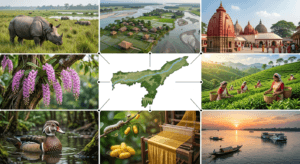
The state is a land of remarkable natural beauty, rich cultural traditions, and fascinating history. From the mighty Brahmaputra River to the world-famous Assam Tea, the state is home to many unique attractions and records that make it one of India’s most extraordinary destinations.
The state is internationally famous for producing Assam Tea, one of the finest and strongest black teas in the world. Assam contributes more than half of India’s total tea production, making it the country’s leading tea-producing state.
One of the state greatest treasures is Kaziranga National Park, a UNESCO World Heritage Site that protects the world’s largest population of the Great One-Horned Rhinoceros. The state is also home to Manas National Park, another UNESCO World Heritage Site renowned for its exceptional biodiversity.
The state is home to Majuli, recognized as the world’s largest inhabited river island, located on the mighty Brahmaputra River. The island is famous for its Vaishnavite monasteries (Satras), mask-making traditions, and vibrant cultural heritage.
The sacred Kamakhya Temple in Guwahati is one of the 51 Shakti Peethas in Hinduism and hosts the internationally renowned Ambubachi Mela every year.
The state is also famous for producing the luxurious Muga Silk, a naturally golden silk found only in Assam. It is one of the rarest silks in the world and has received a Geographical Indication (GI) Tag.
The state is home to the Hollong, Assam’s state tree; the Foxtail Orchid (Kopou Phool), the state flower; the White-winged Wood Duck, the state bird; and the Great One-Horned Rhinoceros, the state animal.
Amazing Facts About Assam
| Fact | Details |
|---|---|
| Tea Capital | Assam produces more than half of India’s total tea and is world-famous for its premium black tea. |
| Famous River | The Brahmaputra River, one of Asia’s largest rivers, flows through the heart of Assam. |
| UNESCO World Heritage Sites | Kaziranga National Park and Manas National Park are UNESCO World Heritage Sites. |
| Largest River Island | Majuli is recognized as the world’s largest inhabited river island. |
| Famous Temple | Kamakhya Temple is one of the 51 sacred Shakti Peethas in Hinduism. |
| State Animal | Great One-Horned Rhinoceros. |
| State Bird | White-winged Wood Duck (Deo Hanh). |
| Famous Silk | Muga Silk, a rare naturally golden silk with a Geographical Indication (GI) Tag. |
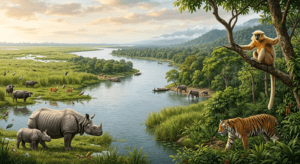
UNESCO World Heritage Sites in Assam
The state is home to two UNESCO World Heritage Sites, both internationally recognized for their exceptional biodiversity and ecological significance. These protected areas attract wildlife enthusiasts, researchers, photographers, and nature lovers from around the world.
The most famous is Kaziranga National Park, inscribed as a UNESCO World Heritage Site in 1985. Located along the floodplains of the Brahmaputra River, Kaziranga is renowned for protecting the world’s largest population of the Great One-Horned Rhinoceros. The park is also home to Royal Bengal Tigers, Asian Elephants, Wild Water Buffaloes, Swamp Deer, and more than 500 species of birds.
The second UNESCO World Heritage Site is Manas National Park, recognized in 1985. Situated at the foothills of the Himalayas along the India–Bhutan border, Manas is also a Tiger Reserve, Elephant Reserve, and Biosphere Reserve. The park protects several endangered species, including the Golden Langur, Pygmy Hog, Hispid Hare, and Clouded Leopard.
Both parks play a vital role in conserving the unique ecosystems of the Eastern Himalayan region while promoting eco-tourism, wildlife research, and environmental education.
UNESCO World Heritage Sites in Assam
| UNESCO World Heritage Site | Year Inscribed | Significance |
|---|---|---|
| Kaziranga National Park | 1985 | Famous for the world’s largest population of the Great One-Horned Rhinoceros, rich biodiversity, Royal Bengal Tigers, Asian Elephants, and diverse birdlife. |
| Manas National Park | 1985 | UNESCO World Heritage Site, Tiger Reserve, Biosphere Reserve, Elephant Reserve, and home to endangered species such as the Golden Langur and Pygmy Hog. |
Famous Personalities of Assam
The state has produced many outstanding personalities who have made significant contributions to literature, music, cinema, politics, sports, social reform, and India’s freedom movement. Their achievements have brought national and international recognition to the state.
The most revered figure in Assamese history is Srimanta Sankardeva, the 15th-century saint, scholar, poet, playwright, social reformer, and founder of the Neo-Vaishnavite movement in Assam. He introduced Sattriya, one of India’s eight classical dance forms, and established Satras, which continue to preserve Assamese culture and traditions.
Another legendary personality is Lachit Borphukan, the Ahom military commander who led the Assamese forces to victory against the Mughal Empire in the historic Battle of Saraighat (1671). He is remembered as one of India’s greatest military heroes.
In literature, Lakshminath Bezbaroa is regarded as one of the pioneers of modern Assamese literature. His writings played a crucial role in shaping the Assamese language and literary tradition.
The state has also made remarkable contributions to Indian music and cinema through Dr. Bhupen Hazarika, the legendary singer, lyricist, composer, filmmaker, and Bharat Ratna awardee. His songs continue to inspire generations across India.
In sports, Hima Das, popularly known as the “Dhing Express,” became the first Indian athlete to win a gold medal in a track event at the IAAF World U20 Championships. Another renowned sportsperson is Lovlina Borgohain, an Olympic bronze medal-winning boxer who brought pride to Assam and India.
Famous Personalities of Assam
| Personality | Field | Contribution |
|---|---|---|
| Srimanta Sankardeva | Religion & Literature | Neo-Vaishnavite saint, poet, playwright, social reformer, founder of the Sattriya dance tradition and Satras. |
| Lachit Borphukan | Military History | Legendary Ahom commander who led Assam to victory in the Battle of Saraighat against the Mughal Empire in 1671. |
| Dr. Bhupen Hazarika | Music & Cinema | Legendary singer, lyricist, composer, filmmaker, and Bharat Ratna awardee. |
| Lakshminath Bezbaroa | Literature | Pioneer of modern Assamese literature and an influential writer, poet, and playwright. |
| Hima Das | Athletics | First Indian athlete to win a gold medal in a track event at the IAAF World U20 Championships. |
| Lovlina Borgohain | Boxing | Olympic bronze medal-winning boxer and one of India’s leading women athletes. |
| Gopinath Bordoloi | Politics | First Chief Minister of Assam, freedom fighter, and Bharat Ratna awardee. |
| Ananda Ram Baruah | Judiciary & Civil Service | First Assamese and one of the earliest Indians to join the Indian Civil Service (ICS). |
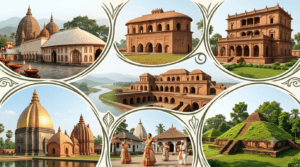
Architecture and Historical Monuments of Assam
The state possesses a remarkable architectural heritage shaped by the Kamarupa Kingdom, the Ahom Dynasty, Vaishnavite traditions, and later colonial influences. The state’s monuments include ancient temples, royal palaces, archaeological ruins, forts, and monasteries that reflect more than a thousand years of history.
The most iconic monument is the Kamakhya Temple in Guwahati, one of the 51 Shakti Peethas in Hinduism. Originally built during the Kamarupa period and later reconstructed by the Koch kings in the 16th century, the temple is renowned for its distinctive Nilachal-style architecture and spiritual significance.
The Ahom Dynasty, which ruled Assam for nearly 600 years, left behind magnificent architectural masterpieces in Sivasagar. The Rang Ghar, often regarded as Asia’s oldest surviving amphitheatre, was built in 1746 and served as a royal pavilion for watching traditional games and cultural performances.
Another important monument is Talatal Ghar, a seven-storeyed palace famous for its underground tunnels and military architecture. Nearby Kareng Ghar (Garhgaon Palace) served as the royal residence of the Ahom kings and remains one of the state finest historical structures.
The Sivasagar Tank (Borpukhuri) and Shiva Dol, one of the tallest Shiva temples in India, are also significant architectural landmarks built during the Ahom period.
The state is also known for its Majuli Satras, Vaishnavite monasteries established by Srimanta Sankardeva. These Satras preserve Assamese culture, classical dance, manuscripts, mask-making, and religious traditions.
Major Historical Monuments
| Monument | Location | Significance |
|---|---|---|
| Kamakhya Temple | Guwahati | One of the 51 Shakti Peethas and Assam’s most important Hindu pilgrimage site. |
| Rang Ghar | Sivasagar | Asia’s oldest surviving amphitheatre built by the Ahom kings in 1746. |
| Talatal Ghar | Sivasagar | Historic Ahom palace famous for its underground tunnels and military architecture. |
| Kareng Ghar | Sivasagar | Royal palace of the Ahom dynasty and an important historical monument. |
| Shiva Dol | Sivasagar | One of the tallest Shiva temples in India, built during the Ahom period. |
| Sivasagar Tank (Borpukhuri) | Sivasagar | Historic man-made tank constructed by the Ahom rulers for water conservation. |
| Majuli Satras | Majuli | Vaishnavite monasteries preserving Assamese culture, Sattriya dance, manuscripts, and traditional arts. |
| Charaideo Maidams | Charaideo | Royal burial mounds of the Ahom dynasty and a UNESCO World Heritage Site. |
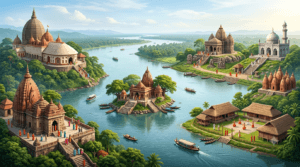
Religious Places in Assam
The state is one of India’s most spiritually significant states, home to ancient Hindu temples, Vaishnavite monasteries, Buddhist sites, Islamic shrines, and Christian churches. The state’s religious diversity reflects centuries of peaceful coexistence among different faiths and communities.
The most famous religious destination is the Kamakhya Temple in Guwahati, one of the 51 Shakti Peethas in Hinduism. Situated atop the Nilachal Hill, the temple is dedicated to Goddess Kamakhya and attracts millions of devotees every year, especially during the Ambubachi Mela.
Another major pilgrimage site is the Umananda Temple, located on Peacock Island in the middle of the Brahmaputra River. Dedicated to Lord Shiva, it is one of the smallest inhabited river islands in the world and offers breathtaking river views.
Hajo, located near Guwahati, is a unique multi-faith pilgrimage town revered by Hindus, Buddhists, and Muslims. It is home to the Hayagriva Madhava Temple, Poa Mecca Mosque, and several other sacred sites.
The Majuli Satras, established by Srimanta Sankardeva, are important Vaishnavite monasteries preserving Assamese spirituality, classical dance, literature, music, and culture. They continue to play a central role in religious and cultural life.
Other notable religious places include the Navagraha Temple, Basistha Ashram, Mahabhairab Temple in Tezpur, and Sukreswar Temple, each holding immense historical and spiritual significance.
Major Religious Places
| Religious Place | Location | Religion |
|---|---|---|
| Kamakhya Temple | Guwahati | Hinduism |
| Umananda Temple | Peacock Island, Guwahati | Hinduism |
| Hayagriva Madhava Temple | Hajo, Kamrup | Hinduism |
| Poa Mecca Mosque | Hajo, Kamrup | Islam |
| Navagraha Temple | Guwahati | Hinduism |
| Basistha Ashram | Guwahati | Hinduism |
| Mahabhairab Temple | Tezpur, Sonitpur | Hinduism |
| Majuli Satras | Majuli | Vaishnavism |
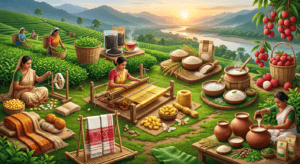
GI Tagged Products of Assam
The state is internationally renowned for its unique agricultural products, traditional textiles, handicrafts, and food items that reflect the state’s rich cultural and natural heritage. Several products from Assam have received the Geographical Indication (GI) Tag, recognizing their unique origin, traditional production methods, and exceptional quality.
The most famous GI-tagged product is Assam Tea, one of the world’s finest black teas. Grown in the fertile Brahmaputra Valley, the state Tea is known for its strong flavor, bright color, and rich aroma. It is exported to countries across the globe and is one of India’s most valuable agricultural products.
Another prestigious GI product is Muga Silk, a naturally golden silk produced only in Assam. It is celebrated for its natural shine, durability, and luxurious texture. Along with Muga Silk, Eri Silk and Assam Gamosa have also received GI recognition for their cultural significance and traditional craftsmanship.
The famous Joha Rice, known for its distinctive aroma and soft texture, is another GI-tagged agricultural product. It is widely used in Assamese cuisine during festivals and special occasions.
The state is also famous for Boka Chaul (soft rice), Tezpur Litchi, and Judima, a traditional rice-based fermented beverage produced by the Dimasa community, all of which have received GI status.
These GI-tagged products preserve Assam’s traditional knowledge, support local artisans and farmers, and promote the state’s identity in national and international markets.
Major GI Tagged Products of Assam
| GI Product | Category | Famous For |
|---|---|---|
| Assam Tea | Agricultural Product | World-famous premium black tea known for its strong flavour, bright liquor, and rich aroma. |
| Muga Silk | Textile | Rare natural golden silk unique to Assam, prized for its durability and luxurious sheen. |
| Eri Silk | Textile | Soft, eco-friendly silk popularly known as “Ahimsa Silk”. |
| Assam Gamosa | Handloom | Traditional handwoven cloth symbolizing Assamese culture, respect, and hospitality. |
| Joha Rice | Agricultural Product | Premium aromatic rice widely used during festivals and traditional Assamese cuisine. |
| Boka Chaul | Agricultural Product | Unique soft rice that becomes edible after soaking without cooking. |
| Tezpur Litchi | Fruit | Sweet, juicy, and high-quality litchi grown in the Tezpur region. |
| Judima | Traditional Beverage | Traditional rice-based fermented beverage prepared by the Dimasa community. |

Education and Universities in Assam
The state is one of the leading educational hubs of Northeast India, with a well-developed network of universities, engineering colleges, medical institutions, research centers, and professional institutes. The state has played a significant role in promoting higher education, scientific research, and technical training in the northeastern region.
The premier university of the state is Gauhati University, established in 1948 at Jalukbari, Guwahati. It is one of the oldest and most prestigious universities in Northeast India, offering undergraduate, postgraduate, and doctoral programs in numerous disciplines.
Another renowned institution is Dibrugarh University, founded in 1965, which serves Upper Assam and is recognized for its academic excellence, research, and professional education.
The state is also home to the prestigious Indian Institute of Technology Guwahati (IIT Guwahati), established in 1994. It is one of India’s leading engineering and research institutions, attracting students from across the country.
The state has a premier management institute, Indian Institute of Management Shillong (IIM Shillong)? Actually, IIM Shillong is located in Meghalaya. Within Assam, Assam University, located in Silchar, is a Central University serving southern Assam and neighboring states.
Medical education is provided by institutions such as Assam Medical College (Dibrugarh), the oldest medical college in Northeast India, Gauhati Medical College and Hospital (GMCH), and Silchar Medical College.
Other notable institutions include Tezpur University, Assam Agricultural University, National Institute of Technology (NIT) Silchar, and several government and private colleges contributing to quality education and research.
Major Educational Institutions
| Institution | Location | Specialization |
|---|---|---|
| Gauhati University | Jalukbari, Guwahati | Higher education, postgraduate studies, doctoral research, and multidisciplinary programs. |
| Dibrugarh University | Dibrugarh | Higher education, research, professional, and technical courses. |
| Indian Institute of Technology (IIT) Guwahati | Guwahati | Engineering, technology, innovation, and advanced scientific research. |
| Tezpur University | Tezpur | Central University offering science, humanities, management, engineering, and research programs. |
| Assam University | Silchar | Central University providing higher education in arts, science, commerce, and professional studies. |
| Assam Agricultural University | Jorhat | Agriculture, veterinary science, fisheries, and agricultural research. |
| Assam Medical College | Dibrugarh | Medical education, healthcare, and clinical research; the oldest medical college in Northeast India. |
| National Institute of Technology (NIT) Silchar | Silchar | Engineering, technology, architecture, and applied sciences. |
Economy and Industries of Assam
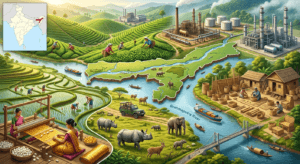
The state has the largest economy in Northeast India and serves as the region’s commercial, industrial, and financial hub. The state’s economy is driven by agriculture, tea production, petroleum and natural gas, tourism, handloom and handicrafts, forestry, fisheries, and manufacturing. Rich natural resources, fertile river valleys, and a strategic location have contributed significantly to Assam’s economic development.
Agriculture remains the backbone of the state’s economy, employing a large share of the population. Rice is the principal crop, while tea, mustard, jute, sugarcane, pulses, maize, fruits, and vegetables are also cultivated extensively.
The state is internationally renowned for its tea industry, producing more than half of India’s total tea. The state’s tea gardens, especially in Dibrugarh, Jorhat, Tinsukia, Sivasagar, and Golaghat, are among the largest and oldest in the world.
The state is also rich in petroleum and natural gas. Assam is home to Digboi, the site of Asia’s oldest operating oil refinery, and major oil and gas fields operated by Oil India Limited (OIL) and Oil and Natural Gas Corporation (ONGC).
Industries such as petrochemicals, fertilizer production, paper manufacturing, cement, food processing, bamboo products, silk weaving, and handicrafts also contribute significantly to the economy.
Tourism has emerged as another important sector, with destinations such as Kaziranga National Park, Manas National Park, Kamakhya Temple, Majuli, and the state’s famous tea gardens attracting visitors from around the world.
The Government of Assam continues to promote industrial development through infrastructure expansion, investment, skill development, digital initiatives, and sustainable tourism.
Major Economic Sectors
| Sector | Major Activities |
|---|---|
| Agriculture | Rice, mustard, jute, sugarcane, maize, pulses, fruits, vegetables, and horticulture. |
| Tea Industry | Production, processing, and export of world-famous Assam Tea from major tea estates. |
| Petroleum & Natural Gas | Oil exploration, natural gas production, Digboi Oil Refinery, Numaligarh Refinery, and petrochemical industries. |
| Tourism | Wildlife tourism, tea tourism, eco-tourism, pilgrimage tourism, river cruises, and cultural tourism. |
| Handloom & Handicrafts | Muga Silk, Eri Silk, Assam Gamosa, bamboo & cane crafts, bell metal crafts, and traditional weaving. |
| Fisheries | Inland fisheries, aquaculture, fish farming, and river-based livelihoods. |
| Manufacturing | Petrochemicals, fertilizers, cement, paper, food processing, and bamboo-based industries. |
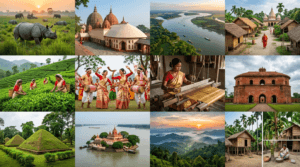
Photo Gallery of Assam
The state is one of India’s most photogenic destinations, offering breathtaking landscapes, wildlife, tea gardens, rivers, temples, historical monuments, and vibrant cultural traditions. From the lush Brahmaputra Valley to the famous Kaziranga National Park, every corner of the state provides spectacular photographic opportunities.
The following gallery highlights some of the most iconic attractions of Assam. These images help visitors explore the state’s natural beauty, rich heritage, and cultural diversity.
Suggested Photo Gallery
| Image | Alt Text | Caption |
|---|---|---|
| Assam Tea Gardens | Assam Tea Gardens in Dibrugarh | World-famous tea plantations producing premium Assam Tea. |
| Kaziranga National Park | Great One-Horned Rhinoceros in Kaziranga National Park | UNESCO World Heritage Site renowned for its rich wildlife and biodiversity. |
| Kamakhya Temple | Kamakhya Temple on Nilachal Hill, Guwahati | One of the 51 sacred Shakti Peethas and Assam’s most famous pilgrimage site. |
| Brahmaputra River | Brahmaputra River flowing through Assam | The lifeline of Assam and one of Asia’s largest rivers. |
| Majuli River Island | Majuli, the world’s largest inhabited river island | Famous for Vaishnavite Satras, culture, and scenic beauty. |
| Manas National Park | Wildlife at Manas National Park | UNESCO World Heritage Site and Tiger Reserve. |
| Rang Ghar | Historic Rang Ghar in Sivasagar | Asia’s oldest surviving amphitheatre built by the Ahom kings. |
| Bihu Dance | Traditional Bihu Dance performance in Assam | The most popular folk dance celebrating Assamese culture and festivals. |
| Muga Silk Weaving | Traditional Muga Silk weaving in Assam | Assam’s world-famous golden silk and handloom heritage. |
| Umananda Temple | Umananda Temple on Peacock Island | Ancient Shiva temple located in the Brahmaputra River. |
| Haflong | Scenic landscape of Haflong Hill Station | Assam’s only hill station, known for its natural beauty. |
| Charaideo Maidams | Charaideo Maidams UNESCO World Heritage Site | Royal burial mounds of the Ahom dynasty and a UNESCO World Heritage Site. |
Frequently Asked Questions (FAQs)
1. Where is Assam located?
Assam is located in Northeast India. It shares international borders with Bhutan and Bangladesh, and is bordered by Arunachal Pradesh, Nagaland, Manipur, Mizoram, Tripura, Meghalaya, and West Bengal.
2. What is the capital of Assam?
Dispur, located within Guwahati, is the capital of Assam.
3. Why is Assam famous?
Assam is famous for Assam Tea, the Brahmaputra River, Kaziranga National Park, Kamakhya Temple, Majuli River Island, Muga Silk, and its vibrant Bihu festival.
4. What is the best time to visit Assam?
The best time to visit Assam is October to April, when the weather is pleasant and ideal for sightseeing, wildlife safaris, tea tourism, and festivals.
5. Which is the most famous national park in Assam?
Kaziranga National Park, a UNESCO World Heritage Site, is the state’s most famous national park and is renowned for the Great One-Horned Rhinoceros.
6. Which is the largest river in Assam?
The Brahmaputra River is the largest and most important river in Assam, playing a vital role in the state’s agriculture, transport, and ecology.
7. What is the famous festival of Assam?
Bihu is the most famous festival of Assam. The three major Bihu festivals are Rongali (Bohag) Bihu, Bhogali (Magh) Bihu, and Kongali (Kati) Bihu.
8. What is Assam’s famous silk?
Muga Silk, a naturally golden silk produced only in Assam, is the state’s most famous silk and has received a GI Tag.
9. What are the official state symbols of Assam?
State Animal: Great One-Horned Rhinoceros
State Bird: White-winged Wood Duck
State Tree: Hollong
State Flower: Foxtail Orchid (Kopou Phool)
10. What is the world’s largest inhabited river island in Assam?
Majuli, located on the Brahmaputra River, is recognized as the world’s largest inhabited river island and is famous for its Vaishnavite Satras and Assamese culture.
Conclusion
Assam, the gateway to Northeast India, is a land of breathtaking natural beauty, rich cultural heritage, ancient history, and extraordinary biodiversity. From the mighty Brahmaputra River and the world-famous Assam Tea to the sacred Kamakhya Temple and the globally renowned Kaziranga National Park, every corner of the state offers a unique and unforgettable experience.
The state’s vibrant traditions are reflected in the colorful Bihu festivals, elegant Muga Silk, classical Sattriya Dance, and centuries-old Vaishnavite Satras. Assam’s diverse tribal communities, delicious cuisine, historic Ahom monuments, lush tea gardens, and wildlife sanctuaries together create a cultural landscape unlike any other in India.
Nature lovers can explore UNESCO World Heritage Sites such as Kaziranga National Park and Manas National Park, while history enthusiasts can admire the architectural legacy of the Ahom Dynasty at Sivasagar. Pilgrims visit the sacred Kamakhya Temple, and travelers enjoy the peaceful beauty of Majuli, the world’s largest inhabited river island.
With excellent connectivity, warm hospitality, diverse attractions, and year-round tourism opportunities, Assam continues to be one of India’s most fascinating destinations for travelers, researchers, wildlife enthusiasts, and cultural explorers.
Whether you are seeking adventure, spirituality, history, wildlife, tea tourism, or authentic cultural experiences, Assam promises memories that will last a lifetime.
Internal links
Chhattisgarh – https://dealkartmarket.in/chhattisgarh/
Odisha – https://dealkartmarket.in/odisha/
Bihar – https://dealkartmarket.in/bihar/
Uttar Pradesh – https://dealkartmarket.in/uttar-pradesh/
Uttarakhand – https://dealkartmarket.in/uttarakhand/
Haryana – https://dealkartmarket.in/haryana/
Punjab – https://dealkartmarket.in/punjab/
Himachal Pradesh – https://dealkartmarket.in/himachal-pradesh/
Madhya Pradesh – https://dealkartmarket.in/madhya-pradesh/
Rajasthan – https://dealkartmarket.in/rajasthan/
Gujarat –https://dealkartmarket.in/Gujarat/
Goa – https://dealkartmarket.in/goa/
Maharashtra – https://dealkartmarket.in/maharashtra/
Kerala – https://dealkartmarket.in/kerala/
Tamil Nadu – https://dealkartmarket.in/tamil-nadu/
Karnataka – https://dealkartmarket.in/karnataka/
Andhra Pradesh – https://dealkartmarket.in/andhra-pradesh/
Telangana – https://dealkartmarket.in/telangana/
Arunachal Pradesh – https://dealkartmarket.in/arunachal-pradesh/
Reference
Government of Assam
Assam Tourism
India.gov.in
Census of India
UNESCO World Heritage Centre
Tea Board India
Forest Survey of India (FSI)
Ministry of Environment, Forest and Climate Change (MoEFCC)
National Tiger Conservation Authority (NTCA)
Archaeological Survey of India (ASI)
National Portal of India – States
Survey of India