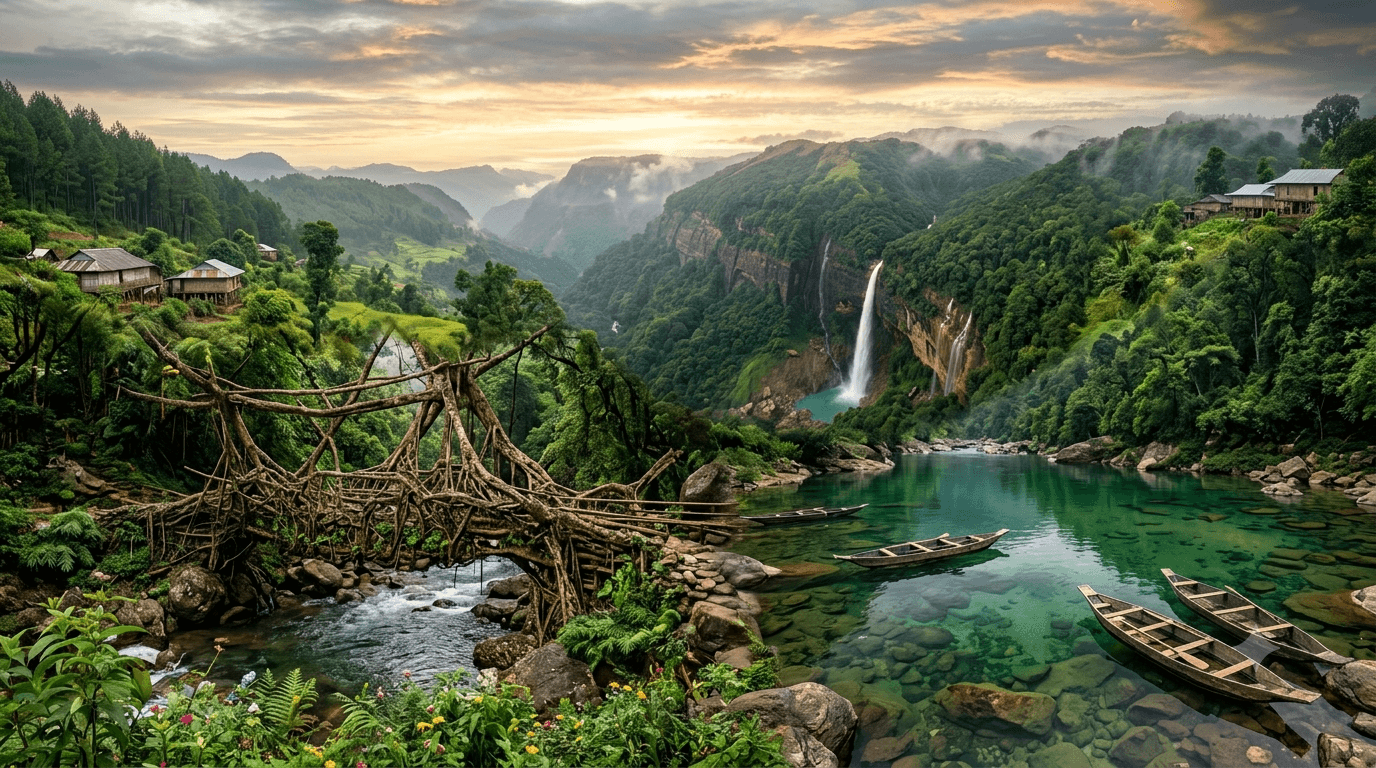
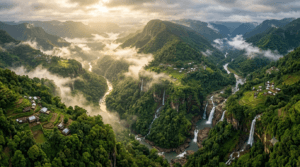
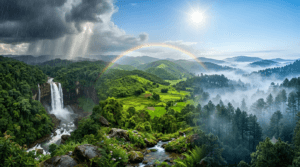
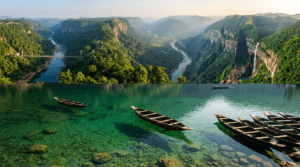
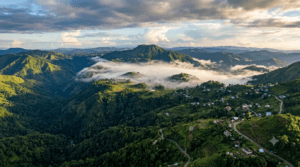
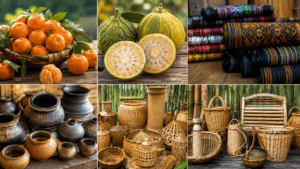
Meghalaya, meaning “The Abode of Clouds,” is one of the most beautiful states in Northeast India. It was formed on 21 January 1972 after being separated from Assam and is known for its mist-covered hills, lush green forests, crystal-clear rivers, breathtaking waterfalls, mysterious caves, and unique living root bridges. The state shares its borders with Assam to the north and east and Bangladesh to the south and west, making it an important part of India’s northeastern region.
The capital city, Shillong, is often called the “Scotland of the East” because of its pleasant climate, rolling hills, and colonial charm. Meghalaya is home to three major hill regions—the Khasi Hills, Jaintia Hills, and Garo Hills—each with its own language, traditions, festivals, and cultural heritage. The state is also famous for receiving some of the highest rainfall in the world, with places like Mawsynram and Cherrapunji (Sohra) attracting visitors from across the globe.
Nature plays a central role in the identity of Meghalaya. Dense forests, rare wildlife, limestone caves, clean rivers, and spectacular waterfalls make it one of India’s top eco-tourism destinations. Traditional Khasi, Garo, and Jaintia communities have preserved their customs, music, dance, handicrafts, and indigenous knowledge for generations. Meghalaya is also known for its matrilineal society, where family lineage and inheritance are traditionally passed through women.
The state’s economy is supported by agriculture, horticulture, tourism, forestry, mining, and small-scale industries. Crops such as rice, maize, ginger, turmeric, black pepper, broom grass, and a variety of fruits are widely cultivated. In recent years, Meghalaya has also focused on sustainable tourism, infrastructure development, education, digital connectivity, and environmental conservation.
With its unique culture, extraordinary natural beauty, rich biodiversity, and warm hospitality, Meghalaya offers visitors an unforgettable experience while showcasing the incredible diversity of India.
Meghalaya at a Glance (Quick Facts)
Meghalaya is one of India’s most scenic northeastern states, known for its cloud-covered hills, heavy rainfall, rich tribal heritage, and exceptional biodiversity. It became a full-fledged state on 21 January 1972 after being carved out of Assam. The state is home to the Khasi, Garo, and Jaintia communities, each with its own language, customs, festivals, and traditional governance systems.
Shillong serves as the capital and the largest city, acting as the administrative, educational, and cultural hub of the state. Meghalaya covers an area of approximately 22,429 square kilometres and has 12 districts. Agriculture, horticulture, tourism, mining, and forestry are among the key sectors supporting the state’s economy.
The state is internationally recognised for natural wonders such as the living root bridges, limestone caves, spectacular waterfalls, and the world’s wettest places—Mawsynram and Cherrapunji (Sohra). Its forests support remarkable biodiversity, making Meghalaya one of India’s most important ecological regions.
Feature
Details
State Name
Meghalaya
Capital
Shillong
Formation Date
21 January 1972
Region
Northeast India
Area
22,429 sq km
Number of Districts
12
Largest City
Shillong
Official Language
English
Major Regional Languages
Khasi, Garo, Pnar (Jaintia)
State Animal
Clouded Leopard
State Bird
Hill Myna
State Tree
Gamhar (Gmelina arborea)
State Flower
Lady’s Slipper Orchid
Highest Peak
Shillong Peak
Major Rivers
Simsang, Umngot, Myntdu, Kynshi, Umiam
Famous For
Living Root Bridges, Waterfalls, Caves, Heavy Rainfall, Tribal Culture
Legislative Assembly Seats
60
Lok Sabha Seats
2
Rajya Sabha Seats
1
High Court
High Court of Meghalaya (Shillong)
Time Zone
IST (UTC +5:30)
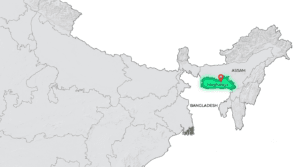
Meghalaya is located in Northeast India, bordered by Assam to the north and east and Bangladesh to the south and west.
Meghalaya on the India Map
Meghalaya is located in the northeastern region of India, forming part of the country’s scenic hill states. It is surrounded by Assam on the north, east, and west, while the international border with Bangladesh stretches along its southern boundary. This strategic location has influenced Meghalaya’s trade, culture, and historical connections with neighbouring regions for centuries.
The state lies between approximately 25°1′ N and 26°5′ N latitude and 89°47′ E and 92°47′ E longitude. Covering an area of 22,429 square kilometres, Meghalaya occupies an important position in Northeast India despite being one of the smaller states by area. Its landscape is dominated by the Khasi Hills, Jaintia Hills, and Garo Hills, which together create a plateau known for its cool climate, deep valleys, caves, waterfalls, and evergreen forests.
Shillong, the state capital, is centrally located in the Khasi Hills and serves as the administrative, educational, commercial, and cultural centre of Meghalaya. The state’s road network connects it with Assam, particularly through Guwahati, which serves as the primary gateway for visitors travelling by air, rail, or road.
Meghalaya’s southern escarpment overlooks the plains of Bangladesh, creating dramatic cliffs and panoramic viewpoints. Moist winds from the Bay of Bengal rise along these hills, resulting in exceptionally high rainfall that has made places like Mawsynram and Cherrapunji (Sohra) globally famous. The state’s geographical position also supports remarkable biodiversity, making it one of India’s most ecologically significant regions.
Its location provides easy access to neighbouring northeastern states such as Assam, Tripura, Mizoram, and Nagaland through regional road networks. Together with its rich natural landscapes and strategic international border, Meghalaya plays an important role in tourism, environmental conservation, and regional connectivity in Northeast India.
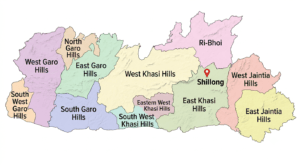
Meghalaya is divided into multiple administrative districts, each with its own unique geography, culture, and administrative headquarters.
Districts of Meghalaya
Meghalaya is divided into 12 administrative districts, each governed by a Deputy Commissioner appointed by the state government. These districts ensure efficient administration, development planning, public services, and law enforcement across the state. Every district has its own headquarters and reflects the unique geography, culture, and traditions of the Khasi, Garo, and Jaintia regions.
The districts vary significantly in terms of population, terrain, economic activities, and tourism potential. While Shillong in East Khasi Hills serves as the state’s capital and administrative centre, districts such as West Garo Hills, West Jaintia Hills, and South West Khasi Hills are known for agriculture, natural attractions, and tribal heritage. Several new districts have also been created over the years to improve governance and bring government services closer to local communities.
Together, these districts contribute to Meghalaya’s cultural diversity, ecological richness, and balanced regional development.
List of Districts of Meghalaya
S. No.
District
Headquarters
Region
Known For
1
East Khasi Hills
Shillong
Khasi Hills
State capital, Shillong Peak, Elephant Falls
2
West Khasi Hills
Nongstoin
Khasi Hills
Hills, forests, agriculture
3
South West Khasi Hills
Mawkyrwat
Khasi Hills
Scenic landscapes, rural tourism
4
Ri Bhoi
Nongpoh
Khasi Hills
Umiam Lake, horticulture, industries
5
Eastern West Khasi Hills
Mairang
Khasi Hills
Heritage villages and natural beauty
6
West Jaintia Hills
Jowai
Jaintia Hills
Culture, Nartiang Monoliths, agriculture
7
East Jaintia Hills
Khliehriat
Jaintia Hills
Limestone, coal reserves, caves
8
East Garo Hills
Williamnagar
Garo Hills
Nokrek landscape, forests
9
West Garo Hills
Tura
Garo Hills
Tura Peak, trade and commerce
10
South Garo Hills
Baghmara
Garo Hills
Siju Caves, Simsang River
11
North Garo Hills
Resubelpara
Garo Hills
Agriculture and forest resources
12
South West Garo Hills
Ampati
Garo Hills
Border region, farming and horticulture
Administrative Overview
The districts are grouped into three major cultural and geographical regions.
Khasi Hills – East Khasi Hills, West Khasi Hills, South West Khasi Hills, Ri Bhoi, and Eastern West Khasi Hills.
Jaintia Hills – West Jaintia Hills and East Jaintia Hills.
Garo Hills – East Garo Hills, West Garo Hills, South Garo Hills, North Garo Hills, and South West Garo Hills.
This regional division reflects the traditional homeland of the Khasi, Jaintia (Pnar), and Garo communities while also helping in administrative planning and local governance.
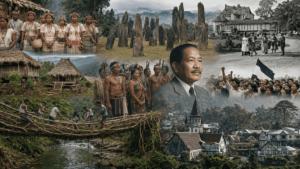
Meghalaya’s history reflects the rich heritage of the Khasi, Garo, and Jaintia tribes, colonial influences, and the peaceful movement that led to statehood in 1972.
History of Meghalaya
Meghalaya has a rich and fascinating history that stretches back thousands of years. Long before the formation of the modern state, the region was inhabited by the indigenous Khasi, Jaintia, and Garo tribes, who developed unique cultures, governance systems, and traditions closely connected with nature. Over time, the region witnessed the rise of tribal kingdoms, interaction with neighbouring kingdoms, British colonial expansion, and eventually a peaceful movement that led to the creation of Meghalaya as a separate state on 21 January 1972.
Early History
Archaeological discoveries indicate that Meghalaya has been inhabited since prehistoric times. Ancient stone monuments, megaliths, burial sites, and traditional settlements found across the Khasi and Jaintia Hills provide evidence of early human civilisation. The famous Nartiang Monoliths are among the largest collections of megalithic structures in India and demonstrate the engineering skills and cultural traditions of the early inhabitants.
The Khasi, Jaintia, and Garo communities established permanent settlements in the hills because of the favourable climate, abundant forests, fertile valleys, and reliable water sources. Agriculture, hunting, fishing, animal husbandry, and forest resources formed the foundation of their economy. Communities also developed traditional village councils to administer justice, resolve disputes, and manage common resources.
Unlike many other regions of India, Meghalaya’s tribal societies evolved independently and preserved their distinct languages, customs, festivals, and social institutions for centuries. The matrilineal system of inheritance, still practised among many Khasi, Garo, and Jaintia families, became one of the defining characteristics of the region’s social structure.
Khasi, Jaintia and Garo Kingdoms
Before British rule, Meghalaya was divided among several independent tribal kingdoms and chiefdoms. The Khasi Hills were governed by numerous small Khasi states, each headed by a traditional chief known as a Syiem. These states enjoyed considerable autonomy while maintaining cultural and trade relations with neighbouring regions.
The Jaintia Kingdom, with its capital at Jaintiapur (now in present-day Bangladesh), emerged as one of the most influential kingdoms in the region. The Jaintia rulers controlled trade routes connecting the hills with the plains and encouraged agriculture, commerce, and cultural development. The kingdom remained an important political power until it was annexed by the British in the nineteenth century.
In the western hills, the Garo Hills were inhabited by different Garo clans led by traditional Nokmas (village heads). Rather than forming a single centralised kingdom, the Garos followed a community-based system of governance that emphasised local leadership, customary law, and collective decision-making.
Trade between the hills and the neighbouring plains flourished through the exchange of agricultural products, forest resources, limestone, spices, textiles, and handicrafts. Despite occasional conflicts among neighbouring rulers, the tribal kingdoms largely preserved their independence until the arrival of British colonial forces.
Anglo-Khasi War and British Expansion
The arrival of the British East India Company in Northeast India during the early nineteenth century marked a major turning point in Meghalaya’s history. Following the Treaty of Yandabo in 1826, the British gained control over Assam and sought to establish a road connecting the Brahmaputra Valley with Sylhet. This proposed route passed through the Khasi Hills, bringing the British into direct contact with the Khasi chiefs.
Many Khasi leaders viewed British expansion as a threat to their political independence and traditional way of life. Among the most prominent leaders was U Tirot Sing Syiem, the chief of Nongkhlaw. Initially, discussions took place between the Khasi chiefs and British officials regarding the construction of the road. However, disagreements over British military presence and growing interference in local administration led to increasing tensions.
In 1829, U Tirot Sing launched an armed resistance against British forces, beginning the Anglo-Khasi War. Khasi warriors used their deep knowledge of the rugged hills and dense forests to carry out guerrilla attacks against British troops. Although the British possessed superior weapons and military resources, the resistance continued for several years and became one of the earliest organised struggles against British colonial expansion in Northeast India.
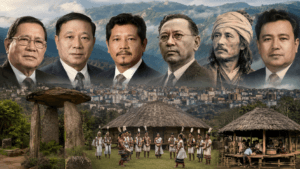
After prolonged fighting, U Tirot Sing was captured in 1833. He was later exiled to Dhaka, where he died in 1835. Today, he is remembered as one of Meghalaya’s greatest freedom fighters, and his courage remains a symbol of the state’s resistance against colonial rule.
British Rule and Colonial Administration
Following the suppression of the Khasi resistance, the British gradually extended their administrative control over the Khasi, Jaintia, and Garo Hills. In 1835, the Jaintia Kingdom was annexed by the British after disputes over governance and administration. During the second half of the nineteenth century, British authority expanded across the Garo Hills as well.
The colonial administration introduced new systems of governance, taxation, policing, and judicial administration. Roads, administrative centres, schools, and missionary institutions were established, improving communication and access to education. Christian missionaries played a significant role in promoting modern education, healthcare, and the development of written forms of Khasi and Garo languages.
Shillong gradually developed into an important administrative centre because of its pleasant climate and strategic location. In 1874, when the Province of Assam was created, Shillong became its capital. Over time, the town emerged as a centre for education, governance, and commerce in Northeast India.
Although colonial rule brought improvements in infrastructure and public services, many tribal communities continued to safeguard their customary laws, traditional institutions, and cultural identity. The unique social systems of the Khasi, Garo, and Jaintia people remained largely intact despite administrative changes.
Freedom Movement and Political Developments
During India’s freedom movement, the people of Meghalaya actively participated in social and political reforms while continuing to protect their traditional customs and tribal identity. After India gained independence in 1947, the Khasi Hills, Jaintia Hills, and Garo Hills became part of the state of Assam. Although the Sixth Schedule of the Constitution provided Autonomous District Councils to safeguard tribal rights, many people believed that a separate state would better protect their unique culture, language, and administrative interests.
In the 1950s and 1960s, several political organisations and community leaders demanded greater autonomy for the hill regions. The movement remained largely peaceful and democratic, with public meetings, discussions, and constitutional negotiations playing a major role in achieving their objective.
Formation of Meghalaya
An important milestone was achieved on 2 April 1970, when Meghalaya became an Autonomous State within Assam under the Assam Reorganisation (Meghalaya) Act, 1969. This arrangement granted limited legislative and administrative powers but did not provide complete statehood.
Following continued public support and constitutional reforms, Meghalaya became the 21st state of India on 21 January 1972 under the North-Eastern Areas (Reorganisation) Act, 1971. The new state was formed by combining the Khasi Hills, Jaintia Hills, and Garo Hills, while Shillong was declared the capital.
The creation of Meghalaya marked the successful culmination of a peaceful constitutional movement and provided the people with greater administrative independence while preserving their tribal identity, customary laws, and traditional institutions.
Modern Meghalaya
Since attaining statehood, Meghalaya has made significant progress in education, healthcare, tourism, infrastructure, environmental conservation, and economic development. Shillong has emerged as an important educational, cultural, and administrative centre in Northeast India.
The state is internationally recognised for its Living Root Bridges, abundant rainfall, rich biodiversity, sacred groves, caves, waterfalls, and vibrant tribal heritage. Sustainable tourism, organic farming, digital governance, renewable energy, and skill development have become important priorities for the Government of Meghalaya.
Today, Meghalaya successfully combines modern development with the preservation of its unique cultural traditions, matrilineal society, and ecological wealth, making it one of India’s most distinctive and environmentally significant states.
Historical Timeline of Meghalaya
Year
Historical Event
Prehistoric Period
Early tribal settlements and megalithic culture developed.
Ancient–Medieval Period
Rise of the Khasi, Jaintia, and Garo kingdoms.
1826
Treaty of Yandabo increased British influence in the region.
1829–1833
Anglo-Khasi War led by U Tirot Sing.
1835
British annexed the Jaintia Kingdom.
1874
Shillong became the capital of the newly created Province of Assam.
2 April 1970
Meghalaya became an Autonomous State within Assam.
21 January 1972
Meghalaya became the 21st state of India.
Freedom Movement and Political Developments
During India’s freedom movement, the people of the Khasi, Jaintia, and Garo Hills actively participated in social and political reforms while continuing to preserve their traditional customs and tribal identity. After India gained independence on 15 August 1947, the hill regions became part of the state of Assam.
Although the Sixth Schedule of the Constitution of India provided special administrative safeguards through Autonomous District Councils, many tribal leaders believed that a separate state was necessary to protect their distinct language, culture, customs, and administrative interests. During the 1950s and 1960s, several organisations, including the All Party Hill Leaders’ Conference (APHLC), led a peaceful democratic movement demanding a separate hill state.
Unlike many political movements elsewhere, the demand for Meghalaya was achieved through constitutional discussions, public support, negotiations, and democratic processes rather than violent conflict.
Formation of Meghalaya
An important milestone was reached on 2 April 1970, when Meghalaya became an Autonomous State within Assam under the Assam Reorganisation (Meghalaya) Act, 1969. This arrangement granted limited legislative and executive powers but did not provide full statehood.
The movement for complete statehood continued, and under the North-Eastern Areas (Reorganisation) Act, 1971, Meghalaya officially became the 21st state of India on 21 January 1972. The new state was formed by combining the Khasi Hills, Jaintia Hills, and Garo Hills, with Shillong declared as its capital.
Statehood marked a historic achievement for the people of Meghalaya by ensuring greater administrative autonomy while preserving tribal customs, traditional institutions, and constitutional safeguards.
Modern Meghalaya
Since becoming a separate state, Meghalaya has made significant progress in education, healthcare, infrastructure, tourism, environmental conservation, and economic development. Shillong has emerged as one of Northeast India’s leading educational and administrative centres.
Today, Meghalaya is internationally recognised for its Living Root Bridges, Mawsynram, Nohkalikai Falls, Umngot River, rich biodiversity, sacred groves, caves, and vibrant tribal traditions. Sustainable tourism, organic farming, digital governance, renewable energy, and skill development continue to shape the state’s future.
Despite rapid modernisation, Meghalaya has successfully preserved its matrilineal society, indigenous languages, traditional governance systems, and rich cultural heritage, making it one of India’s most distinctive states.
Historical Timeline of Meghalaya
Year
Historical Event
Prehistoric Period
Early tribal settlements and megalithic culture developed.
Ancient–Medieval Period
Rise of the Khasi, Jaintia, and Garo kingdoms.
1826
Treaty of Yandabo increased British influence in the region.
1829–1833
Anglo-Khasi War led by U Tirot Sing.
1835
British annexed the Jaintia Kingdom.
1874
Shillong became the capital of the Province of Assam.
2 April 1970
Meghalaya became an Autonomous State within Assam.
21 January 1972
Meghalaya became the 21st state of India.
Meghalaya’s geography is defined by its rolling hills, dense forests, deep valleys, rivers, waterfalls, and one of the wettest climates in the world.
Geography of Meghalaya
Meghalaya is located on the Shillong Plateau in Northeast India and is one of the country’s most geographically diverse hill states. Covering an area of 22,429 square kilometres, the state is characterised by rolling hills, deep valleys, steep escarpments, dense forests, fertile plateaus, and numerous rivers. It shares its borders with Assam to the north, east, and west, while Bangladesh lies along its southern boundary.
The state’s landscape is broadly divided into three major physiographic regions—the Khasi Hills, Jaintia Hills, and Garo Hills. These hill ranges form the backbone of Meghalaya’s terrain and influence its climate, biodiversity, agriculture, and settlement patterns. The plateau gradually rises from the western Garo Hills toward the central Khasi Hills before extending eastward into the Jaintia Hills.
The elevation across Meghalaya ranges from around 150 metres above sea level in the low-lying river valleys to over 1,900 metres at its highest points. The higher elevations experience a cool and pleasant climate throughout much of the year, while the lower valleys remain comparatively warmer. The southern slopes descend sharply towards the plains of Bangladesh, creating spectacular cliffs, waterfalls, and scenic viewpoints.
Meghalaya is internationally known for its remarkable geological features. Thick limestone formations have resulted in the development of hundreds of caves, many of which are among the longest and deepest in India. The state’s rugged terrain also supports numerous waterfalls, underground streams, natural springs, and river valleys that contribute to its unique landscape.
The fertile plateau supports agriculture, horticulture, and extensive forest cover. Rain-fed farming is common because of the state’s exceptionally high rainfall. The natural environment provides suitable conditions for a wide variety of plant and animal species, making Meghalaya one of India’s important biodiversity hotspots.
Natural resources such as limestone, coal, granite, clay, and silica are found in several parts of the state and have contributed to industrial development. At the same time, increasing emphasis is being placed on sustainable resource management and environmental conservation to protect Meghalaya’s fragile ecosystems.
The state’s geography has played a significant role in shaping its history, culture, economy, and tourism. Its mountains, forests, caves, rivers, and waterfalls have influenced the lifestyle of local communities for centuries while making Meghalaya one of India’s most attractive eco-tourism destinations.
Note: This section provides only a geographical overview. Detailed information about mountains, rivers, forests, waterfalls, caves, flora, fauna, and tourist attractions is covered in their respective dedicated sections to avoid repetition.
Meghalaya experiences a cool subtropical highland climate with heavy monsoon rainfall, mist-covered hills, pleasant summers, and mild winters.
Climate of Meghalaya
Meghalaya experiences a subtropical highland climate, characterised by pleasant temperatures, abundant rainfall, and high humidity. Due to its elevated terrain and proximity to the Bay of Bengal, the state receives some of the highest rainfall in the world. The climate supports dense forests, perennial rivers, waterfalls, rich biodiversity, and productive agriculture throughout the year.
Summer Season (March to May)
Summers in Meghalaya are generally mild and pleasant compared to many parts of India. Daytime temperatures usually range between 20°C and 28°C, making it an ideal season for sightseeing and outdoor activities. The hill stations remain cool, while occasional pre-monsoon showers refresh the landscape.
Monsoon Season (June to September)
The southwest monsoon transforms Meghalaya into a lush green paradise. Heavy rainfall occurs across the state, especially in Mawsynram and Sohra (Cherrapunji), which are among the wettest places on Earth. During this season, waterfalls flow at their fullest, rivers swell with fresh water, and forests become vibrant. However, continuous rainfall may occasionally cause landslides and travel disruptions in hilly areas.
Winter Season (October to February)
Winter is considered the best time to visit Meghalaya. The weather remains cool, dry, and comfortable, with temperatures generally ranging from 4°C to 18°C. Clear skies, pleasant sunshine, and reduced rainfall make this season ideal for trekking, sightseeing, boating, and exploring the state’s natural attractions.
Factors Influencing the Climate
High elevation of the Khasi, Garo, and Jaintia Hills
Moisture-laden southwest monsoon winds from the Bay of Bengal
Dense forests and rich vegetation
Numerous rivers, valleys, and waterfalls
Mountainous terrain creating orographic rainfall
Climate and Agriculture
The abundant rainfall and moderate temperatures support the cultivation of rice, maize, fruits, vegetables, spices, tea, coffee, and medicinal plants. Meghalaya has also become one of India’s leading producers of organic agricultural products due to its favourable climatic conditions.
Climate Overview
Season
Months
Temperature
Characteristics
Summer
March–May
20°C–28°C
Pleasant and mild weather
Monsoon
June–September
18°C–25°C
Heavy rainfall and lush greenery
Winter
October–February
4°C–18°C
Cool, dry, and ideal for tourism
The rivers of Meghalaya, including the famous Umngot River, support biodiversity, agriculture, tourism, and the livelihoods of local communities.
Major Rivers of Meghalaya
Meghalaya is blessed with numerous rivers that originate in its hills and flow through deep valleys, forests, and plains before joining larger river systems in India and Bangladesh. These rivers play a vital role in supporting agriculture, drinking water supply, hydroelectric power generation, fisheries, tourism, and biodiversity. The state’s heavy monsoon rainfall ensures that most rivers remain perennial throughout the year.
Umngot River
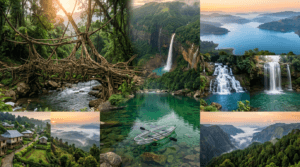
The Umngot River, flowing through Dawki, is the most famous river in Meghalaya. It is internationally renowned for its crystal-clear water, where boats appear to float on glass due to exceptional water transparency. The river forms part of the international boundary between India and Bangladesh and is one of the state’s most popular tourist attractions.
Simsang River
The Simsang River, also known as the Someshwari River after entering Bangladesh, is the longest river in Meghalaya. Originating in the Nokrek Hills of the Garo Hills, it flows through Tura and supports agriculture, fisheries, and local livelihoods before entering Bangladesh.
Myntdu River
The Myntdu River originates in the Jaintia Hills and flows near Jowai. It provides water for irrigation and domestic use while contributing to hydroelectric power generation. The river also enhances the scenic beauty of the surrounding valleys.
Kynshi River
The Kynshi River flows through the West Khasi Hills and is known for its picturesque valleys, rapids, and rich biodiversity. It supports local agriculture and has significant potential for eco-tourism and adventure activities.
Umiam River
The Umiam River is famous for the Umiam Reservoir (Barapani Lake), one of Meghalaya’s largest artificial lakes. The reservoir is an important source of hydroelectric power, drinking water, fisheries, and water sports.
Other Important Rivers
Ganol River
Umiew River
Digaru River
Jadukata River
Wah Umkhrah
Wah Umshyrpi
Importance of Rivers
Drinking water supply
Irrigation and agriculture
Hydroelectric power generation
Fisheries and aquaculture
Tourism and boating
Biodiversity conservation
Groundwater recharge
Livelihoods of rural communities
Major Rivers of Meghalaya
River
Origin
Importance
Umngot
Khasi Hills
Tourism, boating, India–Bangladesh border
Simsang
Nokrek Hills
Longest river, irrigation, fisheries
Myntdu
Jaintia Hills
Irrigation, hydropower, domestic water
Kynshi
West Khasi Hills
Agriculture, eco-tourism
Umiam
Khasi Hills
Reservoir, hydropower, water supply
Ganol
Garo Hills
Agriculture and local water supply
The Khasi, Garo and Jaintia Hills shape Meghalaya’s breathtaking landscape, rich biodiversity, pleasant climate, and unique tribal heritage.
Mountains and Hills of Meghalaya
Meghalaya is a predominantly hilly state in Northeast India, forming part of the Meghalaya Plateau, an extension of the ancient Peninsular Plateau. The state’s landscape is characterised by rolling hills, deep valleys, limestone caves, forests, waterfalls, and scenic plateaus. These hills not only shape Meghalaya’s climate but also influence its rivers, biodiversity, agriculture, and tribal settlements.
The three major hill ranges—Khasi Hills, Jaintia Hills, and Garo Hills—divide the state into distinct geographical and cultural regions. Their high elevation attracts moisture-laden monsoon winds, resulting in heavy rainfall and making Meghalaya one of the wettest places on Earth.
Khasi Hills
The Khasi Hills, located in central Meghalaya, are among the most famous hill ranges in the state. They are known for their mist-covered mountains, pine forests, waterfalls, caves, and scenic landscapes.
Shillong, the state capital, is situated in the Khasi Hills. The region is home to popular tourist destinations such as Shillong Peak, Sohra (Cherrapunji), Mawsynram, Laitlum Canyons, and the famous Living Root Bridges.
Jaintia Hills
The Jaintia Hills lie in the eastern part of Meghalaya. This region is known for its limestone formations, caves, rivers, monoliths, and rich cultural heritage.
The district headquarters, Jowai, serves as an important cultural and commercial centre. Attractions such as Krang Suri Falls, Nartiang Monoliths, and numerous limestone caves make the Jaintia Hills an important tourism destination.
Garo Hills
The Garo Hills occupy the western part of Meghalaya and are covered by dense forests, rolling hills, and wildlife-rich landscapes.
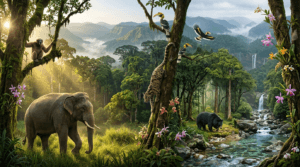
The region is home to Nokrek National Park, Balpakram National Park, and the Nokrek Biosphere Reserve, which support diverse wildlife including elephants, clouded leopards, hoolock gibbons, and hornbills. Tura is the largest town in the Garo Hills.
Shillong Peak
At an elevation of approximately 1,965 metres (6,447 feet) above sea level, Shillong Peak is the highest point in Meghalaya. It offers spectacular panoramic views of Shillong city, the surrounding Khasi Hills, and, on clear days, the plains of Bangladesh.
Shillong Peak is one of the state’s most visited viewpoints and is considered an important natural landmark.
Importance of the Hills
Influencing climate and rainfall.
Supporting dense forests and biodiversity.
Giving rise to numerous rivers and waterfalls.
Promoting eco-tourism and adventure tourism.
Supporting agriculture and horticulture.
Preserving the traditional lifestyle of tribal communities.
Major Hills and Peaks of Meghalaya
Hill / Peak
Region
Significance
Khasi Hills
Central Meghalaya
Tourism, waterfalls, Living Root Bridges
Jaintia Hills
Eastern Meghalaya
Monoliths, caves, rivers
Garo Hills
Western Meghalaya
National parks and biodiversity
Shillong Peak
East Khasi Hills
Highest peak in Meghalaya
Laitlum Hills
East Khasi Hills
Scenic viewpoints and trekking
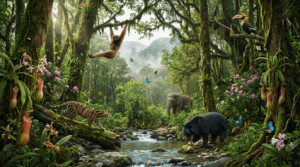
Meghalaya’s forests are home to exceptional biodiversity, including rare orchids, sacred groves, unique pitcher plants, and diverse wildlife species.
Forests of Meghalaya
Meghalaya is one of India’s greenest states, with forests covering nearly three-fourths of its geographical area. The state’s abundant rainfall, fertile soil, and pleasant climate support a wide variety of forest ecosystems that are rich in biodiversity. These forests play a crucial role in maintaining ecological balance, regulating the climate, conserving soil and water, and providing livelihoods for local communities.
The forests of Meghalaya are home to thousands of plant species, rare orchids, medicinal plants, bamboo, cane, and numerous wildlife species. Many forest areas are protected as national parks, wildlife sanctuaries, biosphere reserves, and sacred groves that preserve the state’s unique natural heritage.
Types of Forests
Meghalaya has diverse forest types due to variations in altitude, rainfall, and climate.
Tropical Evergreen Forests
These forests are found in areas receiving heavy rainfall throughout the year. They are characterised by tall evergreen trees, dense vegetation, rich biodiversity, and numerous epiphytic plants such as orchids and ferns.
Tropical Semi-Evergreen Forests
Semi-evergreen forests contain a mixture of evergreen and deciduous tree species. They provide important habitats for birds, mammals, reptiles, and insects.
Moist Deciduous Forests
Moist deciduous forests are mainly found in the lower elevations of the Garo Hills. Trees shed their leaves during the dry season while supporting diverse wildlife and local communities.
Subtropical Pine Forests
Subtropical pine forests dominate many parts of the Khasi Hills, especially around Shillong. These forests are easily recognised by their tall Khasi Pine trees and scenic landscapes.
Rich Flora
Important plant species include:
Khasi Pine
Bamboo
Cane
Oak
Rhododendron
Wild Banana
Orchids
Ferns
Nepenthes khasiana (Pitcher Plant)
Meghalaya is internationally known for its rare orchids and is the only natural home of the insectivorous Pitcher Plant (Nepenthes khasiana) in India.
Ecological Importance
Conserving biodiversity
Preventing soil erosion
Protecting river catchments
Maintaining groundwater
Regulating climate
Absorbing carbon dioxide
Supporting eco-tourism
Sustaining tribal livelihoods
Conservation Efforts
The Government of Meghalaya and local communities work together to conserve forests through protected areas, sacred groves, community forest management, afforestation programmes, wildlife conservation initiatives, and sustainable eco-tourism.
Major Forest Types of Meghalaya
Forest Type
Major Location
Characteristics
Tropical Evergreen
Khasi & Garo Hills
Dense evergreen vegetation
Tropical Semi-Evergreen
Central Meghalaya
Mixed forest ecosystem
Moist Deciduous
Garo Hills
Seasonal leaf-shedding forests
Subtropical Pine
Khasi Hills
Khasi Pine forests
Sacred Groves
Khasi & Jaintia Hills
Community-protected forests
Meghalaya’s forests are home to exceptional biodiversity, including rare orchids, sacred groves, unique pitcher plants, and diverse wildlife species.
Flora and Fauna of Meghalaya
Meghalaya is one of India’s richest biodiversity hotspots, supporting an extraordinary variety of plant and animal species. Its dense forests, high rainfall, diverse landscapes, and favourable climate create ideal habitats for numerous endemic, rare, and endangered species. The state’s flora and fauna play a vital role in maintaining ecological balance while supporting tourism, scientific research, and the livelihoods of local communities.
Flora of Meghalaya
Meghalaya is home to more than 3,000 species of flowering plants, making it one of the most botanically diverse states in India. The state is particularly famous for its orchids, medicinal plants, bamboo, cane, and sacred groves that have been protected by indigenous communities for centuries.
Some of the important plant species found in Meghalaya include:
Khasi Pine
Bamboo
Cane
Oak
Rhododendron
Wild Banana
Orchids
Ferns
Nepenthes khasiana (Pitcher Plant)
Medicinal herbs and aromatic plants
The Pitcher Plant (Nepenthes khasiana) is the only naturally occurring insectivorous pitcher plant species found in India.
Fauna of Meghalaya
Meghalaya’s forests provide habitat to a wide range of mammals, birds, reptiles, amphibians, and butterflies.
Mammals
Clouded Leopard
Asian Elephant
Hoolock Gibbon
Himalayan Black Bear
Leopard
Barking Deer
Sambar Deer
Wild Boar
Indian Pangolin
Slow Loris
Birds
Great Indian Hornbill
Oriental Pied Hornbill
Hill Myna
Kalij Pheasant
Green Pigeon
Sunbirds
Eagles
Kingfishers
Reptiles and Amphibians
Indian Rock Python
King Cobra
Monitor Lizard
Tree Frogs
Toads
Freshwater Turtles
Conservation of Biodiversity
Meghalaya protects its biodiversity through Nokrek National Park, Balpakram National Park, Nongkhyllem Wildlife Sanctuary, Siju Wildlife Sanctuary, Sacred Groves, community-managed forests, and wildlife conservation programmes.
Biodiversity at a Glance
Category
Notable Species
State Animal
Clouded Leopard
State Bird
Hill Myna
State Tree
Gamhar
State Flower
Lady’s Slipper Orchid
Famous Plant
Nepenthes khasiana (Pitcher Plant)
Important Mammals
Asian Elephant, Hoolock Gibbon, Himalayan Black Bear
Famous Birds
Great Indian Hornbill, Hill Myna
Meghalaya’s protected areas conserve rare wildlife, dense forests, unique biodiversity, and fragile ecosystems of Northeast India.
National Parks and Wildlife Sanctuaries of Meghalaya
Meghalaya has a well-developed network of protected areas that safeguard its exceptional biodiversity, unique landscapes, and fragile ecosystems. These protected forests preserve evergreen woodlands, grasslands, limestone caves, wetlands, rivers, and mountain habitats that support many rare and endangered species.
The state’s protected areas are home to iconic wildlife such as the Clouded Leopard, Asian Elephant, Hoolock Gibbon, Gaur, Himalayan Black Bear, Great Hornbill, and numerous orchid species. They also protect important watersheds that supply water to rivers, villages, and agricultural land.
Along with government conservation programmes, local tribal communities play a significant role in protecting forests through traditional customs and community-managed conservation practices.
Nokrek National Park
Located in the West Garo Hills, Nokrek National Park is one of Meghalaya’s most important protected areas. It forms the core of the Nokrek Biosphere Reserve, which is recognised under UNESCO’s Man and the Biosphere Programme.
The park contains dense tropical forests, rolling hills, streams, and rich biodiversity. It is famous for protecting the wild citrus gene pool, which has great scientific and agricultural importance.
Wildlife found here includes:
Clouded Leopard
Asian Elephant
Hoolock Gibbon
Gaur
Leopard
Himalayan Black Bear
Slow Loris
Hornbills
Numerous butterfly species
The park is also a paradise for birdwatchers, botanists, and wildlife photographers.
Balpakram National Park
Situated in the South Garo Hills, Balpakram National Park is often called the “Land of Eternal Winds.” The park is known for its dramatic cliffs, deep gorges, waterfalls, caves, grasslands, and dense forests.
Local Garo folklore considers Balpakram a sacred landscape associated with ancestral spirits, adding cultural significance to its ecological importance.
Important wildlife includes:
Bengal Tiger
Clouded Leopard
Asian Elephant
Gaur
Barking Deer
Wild Boar
Hoolock Gibbon
Rare birds and reptiles
Balpakram is also famous for its medicinal plants and unique geological formations.
Nongkhyllem Wildlife Sanctuary
Located in Ri Bhoi District, the Nongkhyllem Wildlife Sanctuary covers tropical forests, grasslands, and riverine habitats.
It is recognised as one of Meghalaya’s best birdwatching destinations.
Important species include:
Leopard
Asian Elephant
Himalayan Black Bear
Gaur
Civets
Hornbills
Woodpeckers
Eagles
Kingfishers
The sanctuary also protects numerous orchid species and medicinal plants.
Narpuh Wildlife Sanctuary
The Narpuh Wildlife Sanctuary, located in the East Jaintia Hills, protects one of Meghalaya’s most important limestone forest ecosystems.
The sanctuary is famous for:
Dense evergreen forests
Limestone caves
Underground streams
Rare orchids
Rich butterfly diversity
Wildlife includes hoolock gibbons, civets, macaques, hornbills, reptiles, and amphibians.
Baghmara Pitcher Plant Sanctuary
This unique sanctuary in the South Garo Hills was established to protect the Pitcher Plant (Nepenthes khasiana), India’s only native pitcher plant species.
The insect-eating plant grows naturally in nutrient-poor soils and attracts researchers, botanists, and eco-tourists from around the world.
Besides the pitcher plant, the sanctuary supports orchids, butterflies, reptiles, and several forest bird species.
Siju Wildlife Sanctuary
Located near the famous Siju Caves in the Garo Hills, Siju Wildlife Sanctuary protects evergreen forests along the Simsang River.
The sanctuary is known for:
Rich birdlife
Fruit bats
Primates
Elephants
Butterflies
Riverine ecosystems
Its proximity to the caves makes it an attractive destination for wildlife enthusiasts and nature photographers.
Community-Conserved Forests
Apart from officially protected areas, Meghalaya has numerous community-managed forests and sacred groves that play a crucial role in biodiversity conservation.
These forests preserve:
Ancient trees
Rare orchids
Medicinal plants
Amphibians
Insects
Birds
Small mammals
Community conservation has helped Meghalaya retain many forest ecosystems that have disappeared from other regions.
Importance of Protected Areas
The protected areas of Meghalaya contribute significantly to biodiversity conservation, wildlife protection, watershed management, scientific research, environmental education, eco-tourism, climate regulation, and sustainable livelihoods.
They also provide opportunities for trekking, birdwatching, wildlife photography, and nature education while promoting responsible tourism.
Major Protected Areas of Meghalaya
Protected Area
District
Type
Known For
Nokrek National Park
West Garo Hills
National Park
UNESCO Biosphere Reserve, wild citrus, clouded leopard
Balpakram National Park
South Garo Hills
National Park
Cliffs, wildlife, sacred landscape
Nongkhyllem Wildlife Sanctuary
Ri Bhoi
Wildlife Sanctuary
Birds, elephants, orchids
Narpuh Wildlife Sanctuary
East Jaintia Hills
Wildlife Sanctuary
Limestone forests and caves
Siju Wildlife Sanctuary
South Garo Hills
Wildlife Sanctuary
River ecosystem and birdlife
Baghmara Pitcher Plant Sanctuary
South Garo Hills
Plant Sanctuary
Nepenthes khasiana conservation
Did You Know?
Meghalaya is the only Indian state where the Pitcher Plant (Nepenthes khasiana) grows naturally in the wild. This remarkable carnivorous plant traps insects to obtain nutrients, making it one of India’s most fascinating native plant species.
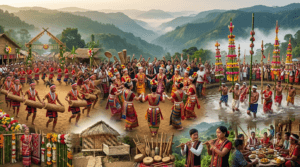
Meghalaya’s vibrant culture reflects the traditions, festivals, music, dances, crafts, and matrilineal heritage of the Khasi, Garo, and Jaintia tribes.
Culture and Traditions of Meghalaya
Meghalaya is a land of vibrant traditions, indigenous knowledge, and rich cultural diversity. The state’s cultural identity is shaped mainly by the Khasi, Garo, and Jaintia (Pnar) communities, each of which has its own language, customs, folklore, music, dances, traditional attire, and social institutions. Despite their differences, these communities share a deep respect for nature, strong family values, and a close connection with their ancestral heritage.
One of the most distinctive features of Meghalaya is its matrilineal social system, where family lineage and ancestral property are traditionally passed down through the youngest daughter. Children usually inherit their mother’s clan name, and women play an important role in preserving family traditions. However, village administration and traditional institutions often involve both men and women in different capacities, reflecting a balance between cultural customs and community governance.
Khasi Culture
The Khasi people primarily inhabit the Khasi Hills and are known for their strong community bonds and traditional governance through village councils headed by Syiems and local elders. The Khasi language belongs to the Austroasiatic language family and is widely spoken across the region.
Traditional Khasi houses were built using locally available materials such as bamboo, wood, cane, and stone. Although modern construction has become common, many rural villages continue to preserve traditional architectural styles.
Music and dance are central to Khasi culture. Traditional musical instruments include drums, flutes, cymbals, and string instruments, which accompany community celebrations and ceremonial performances.
Garo Culture
The Garo community mainly lives in the western part of Meghalaya. They refer to themselves as A’chik and have preserved many traditional customs despite modern influences.
Agriculture has traditionally been the backbone of Garo society, and many cultural practices are linked to farming cycles and community cooperation. Traditional Garo houses are often built on raised platforms using bamboo, timber, and thatch to suit the hilly terrain and heavy rainfall.
Garo folk music, rhythmic dances, and colourful traditional attire remain an important part of weddings, harvest celebrations, and community gatherings.
Jaintia (Pnar) Culture
The Jaintia or Pnar community mainly inhabits the eastern part of Meghalaya. They possess a rich cultural heritage influenced by ancient kingdoms, indigenous traditions, and local customs.
Stone monoliths, sacred groves, traditional markets, and village institutions reflect the historical legacy of the Jaintia Hills. The community is also known for its skilled artisans, agricultural practices, and vibrant oral traditions passed down through generations.
Music, storytelling, handicrafts, and community celebrations continue to preserve the cultural identity of the Pnar people.
Matrilineal Society
Meghalaya is internationally recognised for its matrilineal system, one of the most distinctive social traditions in India.
Key features include:
Family lineage is traced through the mother.
The youngest daughter traditionally inherits ancestral property.
Children belong to their mother’s clan.
Maternal relatives play an important role in family life.
Clan identity remains central to social organisation.
This centuries-old system has helped preserve family traditions and social stability while giving women a unique place in society.
Traditional Dress
Khasi Dress
Khasi women traditionally wear the Jainsem and Dhara, often made from colourful fabrics and paired with elegant gold and silver jewellery. Men wear traditional garments during cultural ceremonies and festivals.
Garo Dress
Garo women commonly wear the Dakmanda, a beautifully woven wraparound cloth, along with decorative ornaments. Men traditionally wear garments suited to agricultural life and ceremonial occasions.
Jaintia Dress
Jaintia women wear colourful traditional dresses similar to Khasi attire but with distinct regional designs. Traditional jewellery, shawls, and woven fabrics are important parts of ceremonial dress.
Handicrafts and Weaving
Handicrafts are an important expression of Meghalaya’s cultural heritage. Skilled artisans produce:
Bamboo crafts
Cane furniture
Handwoven textiles
Baskets
Mats
Traditional musical instruments
Wood carvings
Traditional Music and Dance
Music and dance are inseparable from community life in Meghalaya. Folk performances accompany social gatherings, religious ceremonies, harvest celebrations, and cultural events.
Traditional musical instruments include:
Drums
Flutes
Cymbals
Buffalo horn trumpets
String instruments
Bamboo percussion instruments
Each community has its own distinctive dance forms performed in colourful traditional attire.
Living Traditions
Even with rapid urbanisation and modern education, Meghalaya has successfully preserved much of its indigenous heritage. Traditional village councils, community forests, sacred groves, oral storytelling, local markets, handicrafts, and customary laws continue to play an important role in everyday life.
The people of Meghalaya have achieved a remarkable balance between cultural preservation and modern development, making the state one of India’s finest examples of living tribal heritage.
The festivals of Meghalaya celebrate harvests, spirituality, community life, and the rich cultural traditions of the Khasi, Garo, and Jaintia tribes.
Festivals of Meghalaya
Festivals are an integral part of life in Meghalaya and reflect the state’s deep connection with nature, agriculture, community traditions, and indigenous beliefs. The Khasi, Garo, and Jaintia communities celebrate a variety of colourful festivals throughout the year, many of which mark the agricultural cycle, express gratitude for a good harvest, or honour ancestral customs. These celebrations feature traditional dances, folk music, rituals, colourful attire, indigenous sports, and community feasts, attracting both local participants and tourists.
Shad Suk Mynsiem
Shad Suk Mynsiem, meaning “Dance of the Joyful Heart,” is one of the most important festivals of the Khasi community. It is celebrated every year in Shillong and other Khasi regions after the sowing season.
Men and women dressed in beautiful traditional attire perform graceful dances accompanied by drums and traditional wind instruments. The festival is a thanksgiving celebration for peace, prosperity, and a successful agricultural season. It also reflects the Khasi community’s respect for cultural values and social harmony.
Nongkrem Dance Festival
The Nongkrem Dance Festival is one of Meghalaya’s best-known cultural events and is celebrated at Smit Village near Shillong.
This five-day festival is organised by the Khasi community to thank the Almighty for a good harvest, peace, and the well-being of society. Young women dressed in elegant silk costumes and gold ornaments perform traditional dances, while men participate carrying ceremonial swords and traditional headgear. The festival beautifully showcases Khasi music, rituals, and cultural heritage.
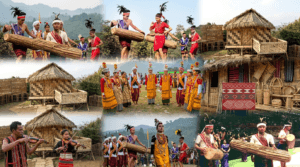
Wangala Festival
The Wangala Festival, often called the “100 Drums Festival,” is the most significant harvest festival of the Garo community. It is celebrated after the harvest season to honour Misi Saljong, the Sun God and giver of agricultural prosperity.
The highlight of Wangala is the rhythmic beating of one hundred traditional drums accompanied by colourful folk dances, songs, and ceremonial performances. The festival also includes indigenous games, cultural exhibitions, and community feasts that strengthen social unity.
Behdienkhlam Festival
The Behdienkhlam Festival is the most important traditional festival of the Jaintia (Pnar) community and is celebrated mainly in Jowai.
The name “Behdienkhlam” means “Driving Away the Plague.” The festival is observed with traditional rituals, beautifully decorated wooden structures, music, dances, and community participation. It symbolises the removal of diseases, evil, and misfortune while praying for good health, prosperity, and abundant harvests.
Chad Sukra
Chad Sukra is another important agricultural festival celebrated by the Pnar community before the sowing season. It marks the beginning of cultivation and seeks blessings for fertile land and successful farming.
Traditional dances, folk songs, and community gatherings are organised during the celebration, highlighting the close relationship between agriculture and cultural life in Meghalaya.
Christmas
Christianity is widely practised across Meghalaya, making Christmas one of the state’s largest celebrations. Churches, homes, and public spaces are beautifully decorated with lights and festive ornaments.
Special prayers, choir performances, community meals, music concerts, and cultural programmes are organised throughout the Christmas season, particularly in Shillong and other major towns.
Easter
Easter is another important Christian festival celebrated with religious services, prayer meetings, family gatherings, and charitable activities. Churches across the state organise special worship programmes commemorating the resurrection of Jesus Christ.
Importance of Festivals
The festivals of Meghalaya preserve indigenous traditions while strengthening community relationships across generations. They encourage the continuation of traditional music, dance, handicrafts, oral history, and local customs. Many festivals also promote tourism by offering visitors an opportunity to experience the state’s unique cultural heritage.
Today, these celebrations continue to play an important role in preserving the identity of the Khasi, Garo, and Jaintia communities while contributing to Meghalaya’s reputation as one of India’s most culturally vibrant states.
Major Festivals of Meghalaya
Festival
Community
Time of Celebration
Significance
Shad Suk Mynsiem
Khasi
April
Thanksgiving and cultural celebration
Nongkrem Dance Festival
Khasi
October–November
Harvest thanksgiving and traditional dances
Wangala
Garo
October–November
Harvest festival honouring Misi Saljong
Behdienkhlam
Jaintia (Pnar)
July
Prayer for health, prosperity, and good harvest
Chad Sukra
Jaintia (Pnar)
April–May
Beginning of the agricultural season
Christmas
Christian Communities
December
Birth of Jesus Christ
Easter
Christian Communities
March–April
Resurrection of Jesus Christ
Meghalaya’s cuisine combines fresh local ingredients, traditional tribal recipes, smoked meat, bamboo shoots, and aromatic spices to create unique regional flavours.
Famous Food of Meghalaya
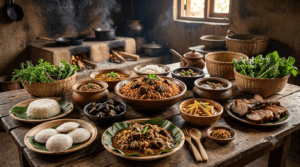
Meghalaya’s cuisine reflects the traditions of the Khasi, Garo, and Jaintia communities, who have developed distinctive culinary practices using fresh local ingredients, seasonal produce, and age-old cooking techniques. Rice is the staple food across the state and is commonly served with meat, fish, vegetables, bamboo shoots, fermented soybeans, and locally grown herbs. Most traditional dishes are lightly spiced, allowing the natural flavours of the ingredients to stand out.
The state’s abundant forests, rivers, and agricultural lands provide a rich variety of vegetables, fruits, mushrooms, spices, and freshwater fish. Pork, chicken, beef (among communities that consume it), and fish are widely used in traditional cooking. Bamboo shoots, black sesame, ginger, turmeric, and chilli are common ingredients that give Meghalaya’s cuisine its unique character.
Jadoh
Jadoh is the most famous traditional dish of the Khasi community and is often considered the signature food of Meghalaya. It is prepared by cooking rice with pork, aromatic spices, ginger, onions, and local herbs. Different regional variations of Jadoh are served during festivals, family gatherings, and community celebrations.
The dish is commonly accompanied by fresh chutneys, pickles, or vegetable side dishes, making it one of the most popular meals for both locals and visitors.
Dohneiiong
Dohneiiong is a traditional Khasi pork curry prepared using roasted black sesame seeds, onions, garlic, ginger, and local spices. The roasted sesame gives the curry a rich, nutty flavour and a distinctive dark colour.
It is usually served with steamed rice and is widely enjoyed during festivals and family meals.
Tungrymbai
Tungrymbai is a nutritious Khasi delicacy made from fermented soybeans cooked with pork, ginger, garlic, onions, and local spices. The fermentation process gives the dish its characteristic aroma and flavour.
It is considered a traditional comfort food and is often eaten with plain rice.
Nakham Bitchi
Nakham Bitchi is a famous Garo soup prepared from dried fish, chillies, pepper, and traditional herbs. It has a mildly spicy and smoky flavour and is usually served before the main meal.
The soup is valued for its warming qualities and is especially popular during the rainy and winter seasons.
Pumaloi
Pumaloi is a traditional Khasi steamed rice dish made from powdered rice. It has a soft, fluffy texture and is commonly served with meat curries, vegetable dishes, or spicy chutneys during festivals and religious ceremonies.
Dohkhlieh
Dohkhlieh is a refreshing Khasi pork salad made with boiled pork, onions, green chillies, coriander, and lemon juice. Some regional variations include tomatoes or roasted peanuts for additional flavour.
This light and healthy dish is commonly served as a side dish or appetiser.
Minil Songa
Minil Songa is a traditional Garo dish in which sticky rice is cooked inside bamboo tubes over an open fire. The bamboo imparts a distinctive smoky aroma, making it a favourite during festivals, picnics, and community gatherings.
Bamboo Shoot Dishes
Fresh and fermented bamboo shoots are widely used in Meghalaya’s cuisine. They are cooked with pork, chicken, fish, or vegetables to create flavourful dishes that are enjoyed across the Khasi, Garo, and Jaintia regions.
Bamboo shoots also add nutritional value and a unique taste to traditional recipes.
Local Beverages
Traditional beverages made from rice, millet, and locally available ingredients are part of Meghalaya’s cultural heritage. Herbal drinks prepared using indigenous plants are also consumed in many rural communities during festivals and social occasions.
Traditional Sweets
Although Meghalaya is better known for savoury dishes, several homemade sweets prepared from rice flour, jaggery, coconut, sesame, and seasonal fruits are enjoyed during festivals and family celebrations.
Culinary Heritage of Meghalaya
The cuisine of Meghalaya reflects the state’s close relationship with nature and sustainable living. Fresh ingredients, minimal processing, traditional cooking methods, and locally grown produce remain central to everyday meals.
Today, traditional foods continue to attract visitors seeking authentic tribal cuisine, while modern restaurants across Shillong and other towns have introduced these dishes to a wider audience.
Popular Foods of Meghalaya
Dish
Community
Main Ingredients
Specialty
Jadoh
Khasi
Rice, pork, spices
Signature rice dish
Dohneiiong
Khasi
Pork, black sesame
Traditional curry
Tungrymbai
Khasi
Fermented soybeans
Nutritious fermented dish
Nakham Bitchi
Garo
Dried fish, herbs
Traditional soup
Pumaloi
Khasi
Steamed rice flour
Festival food
Dohkhlieh
Khasi
Boiled pork, onions
Traditional salad
Minil Songa
Garo
Sticky rice, bamboo
Bamboo-cooked rice
Bamboo Shoot Dishes
All Communities
Bamboo shoots, meat, vegetables
Everyday traditional cuisine
Meghalaya offers spectacular natural attractions, including living root bridges, crystal-clear rivers, majestic waterfalls, scenic lakes, picturesque villages, and breathtaking hill landscapes.
Tourist Places in Meghalaya
Meghalaya is one of India’s most spectacular travel destinations, offering a perfect combination of mist-covered hills, crystal-clear rivers, majestic waterfalls, limestone caves, living root bridges, dense forests, wildlife, and vibrant tribal culture. Every region of the state has unique attractions that appeal to nature lovers, adventure seekers, photographers, and cultural explorers. From the bustling hill city of Shillong to the peaceful villages of Mawlynnong and Dawki, Meghalaya provides unforgettable experiences throughout the year.
Shillong
Known as the “Scotland of the East,”Shillong is the capital and largest city of Meghalaya. Situated at an elevation of about 1,496 metres, it is famous for its pleasant climate, colonial-era charm, pine-covered hills, vibrant markets, educational institutions, and lively cultural scene.
Popular attractions in Shillong include:
Ward’s Lake
Police Bazaar
Shillong Peak
Lady Hydari Park
Don Bosco Museum
Cathedral of Mary Help of Christians
Golf Course
Elephant Falls
Shillong also serves as the primary gateway for travellers exploring other parts of Meghalaya.
Cherrapunji (Sohra)
Cherrapunji, officially known as Sohra, is one of the world’s rainiest places and one of Meghalaya’s most famous tourist destinations.
The region is renowned for:
Nohkalikai Falls
Seven Sisters Falls
Mawsmai Cave
Arwah Cave
Eco Park
Dainthlen Falls
Living Root Bridges
Its dramatic cliffs, mist-covered valleys, caves, waterfalls, and monsoon landscapes attract visitors from around the world.
Mawsynram
Located about 60 kilometres from Shillong, Mawsynram holds the distinction of being the wettest place on Earth based on average annual rainfall.
Apart from its remarkable climate, the village offers:
Green hills
Limestone caves
Scenic viewpoints
Rural tourism
Traditional Khasi villages
Heavy rainfall transforms the surrounding landscape into a lush green paradise throughout much of the year.
Dawki
Dawki is internationally famous for the crystal-clear Umngot River, whose transparent waters create the illusion of boats floating in the air during winter.
Major attractions include:
Boating on the Umngot River
Dawki Suspension Bridge
India–Bangladesh border viewpoint
Camping
Kayaking
Riverside photography
The annual Shnongpdeng Adventure Festival has further increased Dawki’s popularity among adventure tourists.
Mawlynnong
Recognised as one of Asia’s Cleanest Villages, Mawlynnong is admired for its cleanliness, eco-friendly practices, flower-filled pathways, bamboo dustbins, and community-based tourism.
Important attractions include:
Sky View Tower
Living Root Bridge at Riwai
Traditional Khasi houses
Village gardens
Scenic walking trails
The village demonstrates how community participation can successfully promote sustainable tourism.
Laitlum Canyons
The Laitlum Canyons are among Meghalaya’s most breathtaking viewpoints. Located near Shillong, the canyons offer panoramic views of deep valleys, rolling hills, dramatic cliffs, and picturesque villages.
The area is particularly popular for:
Sunrise and sunset photography
Trekking
Nature walks
Landscape photography
Adventure tourism
The peaceful surroundings make Laitlum an ideal destination for visitors seeking solitude and natural beauty.
Umiam Lake
Umiam Lake, also known as Barapani Lake, is a large man-made reservoir located about 15 kilometres from Shillong.
Surrounded by pine-covered hills, the lake offers:
Boating
Kayaking
Water scooters
Camping
Lakeside resorts
Birdwatching
The reservoir also plays an important role in hydroelectric power generation and water supply while serving as one of Meghalaya’s most visited recreational destinations.
Double Decker Living Root Bridge
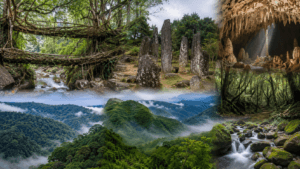
The Double Decker Living Root Bridge at Nongriat Village is one of Meghalaya’s most iconic attractions and a remarkable example of bioengineering by the Khasi community. Instead of using concrete or steel, local people have trained the aerial roots of rubber fig trees for generations to create strong natural bridges across streams.
The bridge can only be reached after a scenic trek through forests, stone stairways, and traditional Khasi villages. Its unique construction, natural surroundings, and cultural significance make it one of the most photographed destinations in Northeast India.
Nohkalikai Falls
Standing at about 340 metres (1,115 feet), Nohkalikai Falls is the tallest plunge waterfall in India. Located near Sohra (Cherrapunji), the waterfall plunges into a turquoise pool surrounded by steep cliffs and dense greenery.
The waterfall is named after a local Khasi legend associated with a woman named Likai, making it not only a natural wonder but also an important cultural landmark. The viewpoint offers spectacular panoramic views throughout the year, especially after the monsoon.
Elephant Falls
Located a short distance from Shillong, Elephant Falls is one of the state’s most accessible and popular waterfalls. The waterfall cascades in three distinct tiers, each surrounded by lush vegetation and rocky landscapes.
Well-maintained walkways and viewing platforms allow visitors to enjoy the beauty of the falls from different angles, making it a favourite destination for families and photographers.
Krang Suri Falls
Situated in the West Jaintia Hills, Krang Suri Falls is famous for its crystal-clear blue water and picturesque surroundings. The waterfall is fed by mountain streams and is ideal for swimming during suitable weather conditions.
Wooden walkways, viewing platforms, and nearby picnic areas have made Krang Suri one of Meghalaya’s fastest-growing tourist destinations.
Siju Caves
The Siju Caves, located in the South Garo Hills, are among India’s longest natural limestone cave systems. Formed over thousands of years by underground rivers, the caves feature impressive limestone formations, stalactites, stalagmites, and large underground chambers.
The caves are also home to several species of bats and attract geologists, researchers, and adventure enthusiasts from across the country.
Mawphlang Sacred Grove
The Mawphlang Sacred Grove is one of the finest examples of community-based forest conservation in India. Protected for centuries by traditional Khasi beliefs, the grove contains ancient trees, rare orchids, medicinal plants, mosses, fungi, and unique biodiversity.
Guided nature walks provide visitors with insights into the ecological and cultural importance of these sacred forests.
Balpakram National Park
Located in the South Garo Hills, Balpakram National Park is renowned for its dramatic plateaus, deep gorges, dense forests, waterfalls, and exceptional biodiversity.
Apart from wildlife viewing, visitors come here to experience scenic viewpoints, trekking trails, and the rich folklore associated with the landscape. The park is often referred to as the “Land of Eternal Winds.”
Nokrek National Park
Nokrek National Park in the West Garo Hills is part of the Nokrek Biosphere Reserve, recognised under UNESCO’s Man and the Biosphere Programme.
The park is home to clouded leopards, Asian elephants, hoolock gibbons, hornbills, and numerous endemic plant species. It is also famous for conserving wild citrus varieties of global scientific importance.
Jowai
Jowai, the headquarters of West Jaintia Hills, is known for its pleasant climate, cultural heritage, and beautiful natural surroundings. The town serves as an excellent base for exploring nearby waterfalls, rivers, caves, and traditional villages.
Popular attractions around Jowai include:
Thadlaskein Lake
Krang Suri Falls
Tyrshi Falls
Myntdu River
Nartiang Monoliths
Nartiang Monoliths
The Nartiang Monoliths form one of the largest collections of monolithic stones in India. These ancient stone structures were erected by the Jaintia rulers and are believed to commemorate important historical events and respected leaders.
Today, the site is an important archaeological and cultural attraction that offers valuable insights into Meghalaya’s early history.
Other Popular Tourist Attractions
Seven Sisters Falls – A spectacular multi-tiered waterfall near Sohra.
Mawsmai Cave – A well-lit limestone cave with fascinating rock formations.
Arwah Cave – Known for fossil remains and geological formations.
Dainthlen Falls – A scenic waterfall associated with Khasi folklore.
Ward’s Lake – A peaceful lake in Shillong ideal for boating.
Shillong Peak – The highest point in Meghalaya offering panoramic views.
Police Bazaar – Shillong’s main shopping and dining hub.
Don Bosco Museum – One of Northeast India’s finest museums showcasing tribal culture.
Tourism in Meghalaya
Tourism plays a vital role in Meghalaya’s economy by generating employment, supporting local businesses, and encouraging the preservation of cultural and natural heritage. Eco-tourism, adventure tourism, cave exploration, trekking, birdwatching, camping, photography, and cultural tourism continue to attract visitors from India and around the world.
The state government and local communities are promoting sustainable tourism practices to ensure that Meghalaya’s forests, rivers, wildlife, and cultural traditions remain protected for future generations.
Did You Know?
Meghalaya is home to the world’s famous Living Root Bridges, created by guiding the aerial roots of rubber fig trees across streams. Some of these bridges are estimated to be several hundred years old and continue to grow stronger with time.
Major Tourist Attractions of Meghalaya
Tourist Place
District
Famous For
Shillong
East Khasi Hills
Hill station, colonial charm
Sohra (Cherrapunji)
East Khasi Hills
Waterfalls, caves, rainfall
Mawsynram
East Khasi Hills
Wettest place on Earth
Dawki
West Jaintia Hills
Crystal-clear Umngot River
Mawlynnong
East Khasi Hills
Clean village, eco-tourism
Double Decker Living Root Bridge
East Khasi Hills
Natural root bridge
Nohkalikai Falls
East Khasi Hills
India’s tallest plunge waterfall
Krang Suri Falls
West Jaintia Hills
Blue waterfall
Siju Caves
South Garo Hills
Limestone cave system
Balpakram National Park
South Garo Hills
Wildlife and scenic landscapes
Nokrek National Park
West Garo Hills
Biosphere Reserve
Nartiang Monoliths
West Jaintia Hills
Ancient monolithic structures
Transport in Meghalaya
Despite its rugged hills and mountainous terrain, Meghalaya has developed a well-connected transportation network that links major cities, towns, tourist destinations, and neighbouring states. Road transport is the backbone of the state’s connectivity, while air and rail services are supported through nearby transport hubs. Continuous investment in highways, bridges, and public transport has improved accessibility and promoted tourism, trade, and economic development.
Road Transport
Roads are the primary mode of transportation in Meghalaya. A network of National Highways, State Highways, district roads, and rural roads connects almost every part of the state.
National Highway 6 (NH-6) is the most important highway, connecting Shillong with Guwahati in Assam and extending towards eastern Meghalaya. Other highways provide connectivity to Tura, Jowai, Dawki, Baghmara, Nongstoin, Mawkyrwat, and several border regions.
The Meghalaya Transport Corporation (MTC) and private operators run regular bus services connecting Shillong with Guwahati, Silchar, Agartala, Aizawl, Dimapur, and major towns within the state. Shared taxis, maxi cabs, tourist vehicles, and rental cars are also widely available.
Rail Transport
Meghalaya currently has a limited railway network. The state’s first railway station is located at Mendipathar in the North Garo Hills district, which is connected to the Indian Railways network through Assam.
However, most visitors travelling by train use Guwahati Railway Station in Assam, located approximately 100 kilometres from Shillong. Guwahati is one of Northeast India’s largest railway junctions and provides direct train services to Delhi, Kolkata, Mumbai, Chennai, Bengaluru, Hyderabad, and many other cities.
Air Transport
Shillong Airport (Umroi Airport), located about 30 kilometres from Shillong, provides domestic flight connectivity to selected cities. The airport mainly serves regional flights and continues to expand its infrastructure.
For broader domestic and international connectivity, travellers generally use Lokpriya Gopinath Bordoloi International Airport in Guwahati, which is approximately 120 kilometres from Shillong. It offers regular flights to major Indian cities and a few international destinations.
Local Transport
Local transportation within Meghalaya is convenient and widely available.
Common modes of local transport include:
Shared taxis
Local taxis
Tourist cabs
Rental cars
Two-wheelers on rent (in selected locations)
Auto-rickshaws (limited to certain towns)
Inter-town buses
Shillong has an extensive shared taxi system that is both affordable and popular among residents and tourists. Rental vehicles are commonly used for sightseeing, especially for destinations such as Sohra, Dawki, Mawlynnong, and Laitlum Canyons.
Border Connectivity
Meghalaya shares an international border with Bangladesh, and several border trade points facilitate trade and cross-border movement under government regulations. The Dawki–Tamabil border crossing is one of the most important international trade routes connecting India and Bangladesh.
Future Transport Development
The Government of Meghalaya continues to invest in road widening, bridge construction, airport expansion, rural connectivity, and tourism infrastructure. Proposed improvements in rail connectivity and highway development are expected to further strengthen the state’s transportation network and support sustainable economic growth.
Transport Overview
Mode of Transport
Major Facilities
Importance
Road
NH-6, State Highways, MTC buses, taxis
Primary mode of transport
Rail
Mendipathar Railway Station
State’s only railway station
Nearby Railway Hub
Guwahati Railway Station
Major rail gateway to Meghalaya
Air
Shillong Airport (Umroi)
Domestic air connectivity
Nearby International Airport
Lokpriya Gopinath Bordoloi International Airport, Guwahati
Domestic and international flights
Local Transport
Shared taxis, buses, rental cars
Daily commuting and tourism
International Border
Dawki–Tamabil Border
Trade with Bangladesh
Shopping in Meghalaya
Shopping in Meghalaya offers visitors an opportunity to explore the state’s rich tribal heritage, traditional craftsmanship, and locally produced goods. Markets across the state sell handmade bamboo and cane products, handwoven textiles, organic spices, fresh fruits, forest products, traditional jewellery, and unique souvenirs. Most shopping centres combine modern retail outlets with vibrant local markets, allowing travellers to experience the authentic culture and daily life of Meghalaya.
The handicrafts of Meghalaya are largely produced by the Khasi, Garo, and Jaintia communities using sustainable natural materials such as bamboo, cane, wood, and natural fibres. These products are valued for their durability, artistic designs, and eco-friendly nature.
Police Bazaar, Shillong
Police Bazaar is the most popular shopping destination in Meghalaya and serves as the commercial heart of Shillong. The market is lined with shops, shopping complexes, restaurants, cafés, bookstores, handicraft outlets, and souvenir stores.
Visitors can purchase:
Traditional handicrafts
Bamboo and cane products
Handwoven shawls
Local spices
Organic honey
Handmade jewellery
Woollen garments
Souvenirs
The lively atmosphere and wide variety of products make Police Bazaar a must-visit destination for tourists.
Bara Bazaar (Iewduh)
Bara Bazaar, locally known as Iewduh, is one of the oldest and largest traditional markets in Northeast India. Managed primarily by Khasi women traders, it reflects Meghalaya’s matrilineal social structure and vibrant local economy.
The market offers:
Fresh vegetables
Fruits
Spices
Medicinal herbs
Bamboo products
Local fish and meat
Traditional household items
Indigenous handicrafts
It is an excellent place to experience the everyday lifestyle and trading traditions of the Khasi community.
Lewduh Handicraft Shops
Several handicraft stores around Shillong specialise in authentic products made by local artisans. Popular items include bamboo baskets, cane furniture, decorative pieces, handwoven textiles, wooden carvings, traditional musical instruments, and eco-friendly home décor.
These purchases directly support rural artisans and help preserve traditional craftsmanship.
Local Products to Buy
Meghalaya is famous for a variety of locally produced goods that make excellent souvenirs.
Popular products include:
Bamboo handicrafts
Cane furniture
Handwoven shawls
Traditional Khasi baskets
Organic turmeric
Ginger
Black pepper
Cinnamon
Wild honey
Pineapple products
Orange-based products
Handmade soaps
Herbal products
Many of these items are produced using sustainable farming and traditional manufacturing techniques.
Traditional Textiles
The Khasi, Garo, and Jaintia communities produce beautiful handwoven textiles featuring colourful patterns and traditional designs.
Visitors can buy:
Jainsem fabric
Dakmanda cloth
Shawls
Scarves
Stoles
Handwoven bags
Traditional garments
These textiles showcase the artistic heritage of Meghalaya and are popular among domestic and international tourists.
Organic Food Products
Meghalaya is increasingly recognised for its organic farming practices. Local markets sell a wide range of naturally grown agricultural products, including spices, fruits, tea, coffee, medicinal herbs, pickles, fruit preserves, and homemade snacks.
These products are appreciated for their freshness, quality, and authentic flavours.
Shopping Tips
Purchase handicrafts from government-approved emporiums or trusted local artisans.
Compare prices before buying expensive handicrafts.
Carry reusable bags while shopping in local markets.
Support locally made products to encourage sustainable livelihoods.
Visit traditional markets during the morning for the freshest produce.
Popular Shopping Destinations and Products
Shopping Destination
Famous For
Recommended Purchases
Police Bazaar, Shillong
Shopping complexes and souvenirs
Handicrafts, spices, clothing
Bara Bazaar (Iewduh)
Traditional market
Local produce, herbs, bamboo crafts
Lewduh Handicraft Shops
Artisan products
Cane furniture, baskets, textiles
Government Emporiums
Authentic tribal handicrafts
Certified handmade products
Local Village Markets
Organic produce
Honey, spices, fruits, handmade goods
Best Time to Visit Meghalaya
Meghalaya is a year-round destination, with each season offering a unique travel experience. The state’s pleasant climate, mist-covered hills, waterfalls, forests, rivers, caves, and vibrant tribal culture attract visitors throughout the year. However, the best time to visit depends on the type of experience you are looking for, whether it is sightseeing, adventure activities, photography, wildlife exploration, or witnessing the famous monsoon landscapes.
Winter (October to February) – Best Overall Season
Winter is widely considered the best time to visit Meghalaya. After the monsoon, the weather becomes cool, dry, and comfortable, with temperatures generally ranging between 4°C and 18°C.
During this season:
Skies remain mostly clear.
Waterfalls continue to flow beautifully after the rains.
Trekking routes become safer.
Crystal-clear rivers such as the Umngot River are at their best.
Wildlife watching and birdwatching conditions improve.
Outdoor activities become more enjoyable.
Popular destinations such as Shillong, Dawki, Mawlynnong, Sohra (Cherrapunji), Laitlum Canyons, and Umiam Lake receive a large number of visitors during winter.
Summer (March to May)
Summer in Meghalaya is mild compared to most parts of India, making it an excellent escape from the heat. Temperatures usually range between 15°C and 25°C.
This season is ideal for:
Sightseeing
Nature walks
Cave exploration
Camping
Photography
Family vacations
Flowering plants and lush green landscapes add to the beauty of the state during these months.
Monsoon (June to September)
The monsoon transforms Meghalaya into one of the greenest places on Earth. Heavy rainfall fills rivers, waterfalls, caves, and forests with life, creating breathtaking scenery.
This season is perfect for visitors who wish to experience:
Nohkalikai Falls at full flow
Seven Sisters Falls
Mawsynram’s record-breaking rainfall
Mist-covered valleys
Monsoon photography
Cloud-filled landscapes
However, continuous rainfall may lead to landslides, slippery trekking trails, and temporary road closures in some areas. Travellers should check weather forecasts before planning their journey.
Best Season for Different Activities
Activity
Best Time
Sightseeing
October – April
Trekking
October – March
Living Root Bridge Trek
October – April
Boating at Dawki
November – February
Waterfalls
June – October
Cave Exploration
November – April
Wildlife Watching
November – March
Birdwatching
October – March
Photography
October – April
Adventure Sports
October – March
Seasonal Travel Tips
Winter: Carry light woollen clothing for mornings and evenings.
Summer: Pack comfortable cotton clothing and a light jacket.
Monsoon: Carry waterproof footwear, umbrellas, raincoats, and waterproof bags for electronic devices.
Book accommodation in advance during the peak tourist season and major festivals.
Check weather forecasts and road conditions before travelling to remote destinations during the rainy season.
Which Season Should You Choose?
If you are visiting Meghalaya for the first time, October to February is the most recommended period because it offers pleasant weather, excellent road conditions, clear views, comfortable sightseeing, and opportunities to enjoy almost every major tourist attraction.
Travellers who enjoy dramatic landscapes, waterfalls, and monsoon photography may prefer the rainy season despite occasional travel disruptions. Meanwhile, summer offers a quieter and more relaxed experience with comfortable temperatures and fewer crowds.
Overall, Meghalaya remains one of India’s finest year-round travel destinations, with every season showcasing a different aspect of its natural beauty and cultural heritage.
How to Reach Meghalaya
Meghalaya is well connected to the rest of India through a combination of road, rail, and air transport. Although the state has limited railway connectivity, excellent highways and nearby transport hubs make travelling to Meghalaya convenient. Shillong, the state capital, serves as the main gateway for visitors exploring different parts of the state. Most tourists enter Meghalaya through Guwahati in neighbouring Assam before continuing their journey by road.
By Air
Air travel is the fastest way to reach Meghalaya.
Shillong Airport (Umroi Airport)
Shillong Airport, also known as Umroi Airport, is located about 30 kilometres from Shillong. It operates domestic flights connecting the state with selected Indian cities. Taxis and buses are available from the airport to Shillong and nearby destinations.
Lokpriya Gopinath Bordoloi International Airport, Guwahati
Many travellers prefer using Lokpriya Gopinath Bordoloi International Airport in Guwahati, Assam, which is approximately 120 kilometres from Shillong. It is the nearest major airport and offers frequent domestic and limited international flights.
From Guwahati Airport, visitors can reach Shillong by:
Shared taxis
Private taxis
State transport buses
Tourist coaches
Self-drive rental vehicles
The journey usually takes 3 to 4 hours, depending on traffic and weather conditions.
By Train
Rail connectivity within Meghalaya is limited, but travellers can easily access the state through nearby railway stations.
Mendipathar Railway Station
Mendipathar Railway Station, located in the North Garo Hills, is Meghalaya’s first railway station. It connects the state with Assam and the wider Indian Railways network.
Guwahati Railway Station
Most visitors travelling by train use Guwahati Railway Station, one of Northeast India’s largest railway hubs. It offers direct train services to major cities, including:
New Delhi
Kolkata
Mumbai
Chennai
Bengaluru
Hyderabad
Patna
Lucknow
Regular taxis and buses operate between Guwahati Railway Station and Shillong.
By Road
Road travel is the most common and convenient way to reach Meghalaya.
From Guwahati
Shillong is connected to Guwahati by National Highway 6 (NH-6). The highway is well maintained and offers scenic views of hills, forests, and valleys.
Approximate travel time:
Guwahati to Shillong – 3–4 hours
Guwahati Airport to Shillong – 3–4 hours
Interstate Bus Services
Regular buses connect Meghalaya with several neighbouring states, including:
Assam
Tripura
Mizoram
Nagaland
Both government-operated and private buses run daily services to major towns such as Shillong, Tura, Jowai, Nongstoin, and Baghmara.
Taxi and Self-Drive Options
Visitors can also travel using:
Shared taxis
Private taxis
Tourist cabs
Self-drive rental cars
Motorcycle rentals (available in selected tourist locations)
These options are particularly popular for exploring destinations such as Sohra, Dawki, Mawlynnong, and Laitlum Canyons.
Distance from Major Cities
City
Approximate Distance to Shillong
Estimated Travel Time
Guwahati
100 km
3–4 hours
Kaziranga
270 km
6–7 hours
Silchar
330 km
8–9 hours
Agartala
500 km
11–12 hours
Dimapur
290 km
7–8 hours
Aizawl
460 km
10–11 hours
Travel Tips
Book flights and accommodation early during the peak tourist season.
Start road journeys early in the morning to avoid traffic and enjoy better weather conditions.
Keep some cash while travelling to remote villages, as digital payment facilities may be limited in certain areas.
During the monsoon season, check weather forecasts and road conditions before travelling to hilly destinations.
Carry valid identity proof while visiting border areas such as Dawki.
With its improving transport infrastructure and scenic road network, Meghalaya is easily accessible for both domestic and international travellers, making it one of the most rewarding destinations in Northeast India.
Travel Tips for Meghalaya
A trip to Meghalaya offers unforgettable experiences, from exploring living root bridges and limestone caves to enjoying crystal-clear rivers, waterfalls, and vibrant tribal culture. Proper planning can help visitors travel safely, comfortably, and responsibly while protecting the state’s fragile environment and respecting local traditions. The following tips will help you make the most of your visit.
Plan Your Trip According to the Season
The ideal time to visit Meghalaya is October to February, when the weather is cool, dry, and pleasant for sightseeing and outdoor activities.
If you plan to visit during the monsoon season (June to September), be prepared for heavy rainfall, slippery roads, and occasional landslides. Although the waterfalls and landscapes are at their most spectacular during this period, always check weather updates before travelling.
Carry Suitable Clothing
Weather conditions can change quickly in Meghalaya.
It is advisable to carry:
Comfortable walking shoes
Light woollen clothes during winter
Raincoat or waterproof jacket
Umbrella
Quick-drying clothes
Hat and sunglasses during sunny days
Waterproof footwear is especially useful during the rainy season and while visiting waterfalls or trekking routes.
Respect Local Culture
Meghalaya is home to the Khasi, Garo, and Jaintia communities, each with unique customs and traditions.
Visitors should:
Dress modestly while visiting villages and religious places.
Ask permission before photographing local people.
Respect local customs, festivals, and sacred sites.
Follow the instructions of local guides and community members.
Responsible behaviour helps preserve the state’s rich cultural heritage.
Travel Responsibly
Meghalaya’s forests, rivers, caves, and mountains are environmentally sensitive.
Avoid littering.
Carry reusable water bottles.
Do not damage living root bridges or natural formations.
Avoid using single-use plastics whenever possible.
Stay on designated trekking trails.
Dispose of waste responsibly.
Eco-friendly tourism helps preserve these attractions for future generations.
Safety During Adventure Activities
Many visitors participate in trekking, caving, boating, kayaking, and camping.
For a safe experience:
Hire authorised local guides for difficult treks and cave exploration.
Wear appropriate safety equipment.
Avoid entering caves or rivers during heavy rainfall.
Follow all instructions provided by adventure operators.
Inform someone about your travel plans before visiting remote areas.
Health and Connectivity
Carry a basic first-aid kit containing essential medicines, insect repellent, sunscreen, and personal prescriptions.
Mobile network coverage is generally good in cities such as Shillong but may be limited in remote villages and forest areas. Download offline maps before travelling to less-connected regions.
Cash and Digital Payments
Digital payment facilities are available in major towns, hotels, and restaurants. However, some remote villages and local markets may accept only cash.
It is advisable to keep sufficient cash for:
Local transport
Small shops
Village markets
Entry tickets
Parking fees
Responsible Wildlife Tourism
When visiting national parks, wildlife sanctuaries, and sacred groves:
Do not feed wild animals.
Maintain a safe distance from wildlife.
Avoid making loud noises.
Never remove plants, rocks, or natural objects from protected areas.
Follow the instructions of forest officials and guides.
Emergency Preparedness
Before travelling:
Save important emergency contact numbers.
Keep photocopies or digital copies of identity documents.
Inform family members about your travel itinerary if visiting remote locations.
Monitor local weather forecasts, especially during the monsoon season.
Quick Travel Checklist
Item
Recommendation
Best Travel Season
October to February
Clothing
Comfortable shoes, light woollens, rain gear
Payment
Carry both cash and digital payment options
Documents
Valid ID proof and travel bookings
Health
First-aid kit, medicines, insect repellent
Connectivity
Download offline maps for remote areas
Environment
Avoid littering and use reusable bottles
Adventure
Hire authorised local guides
By travelling responsibly and respecting local communities, visitors can enjoy Meghalaya’s extraordinary natural beauty while contributing to the conservation of its environment and cultural heritage.
Interesting Facts About Meghalaya
Meghalaya is one of India’s most fascinating states, known for its extraordinary natural wonders, unique cultural traditions, and remarkable environmental conservation practices. From record-breaking rainfall to living root bridges and a matrilineal society, the state offers many features that are rarely found elsewhere in the world.
Fascinating Facts
1. Home to the Wettest Place on Earth
Mawsynram, located in the East Khasi Hills, is widely recognised as the wettest place on Earth based on its average annual rainfall. Moist monsoon winds from the Bay of Bengal strike the Khasi Hills, resulting in exceptionally heavy rainfall almost every year.
2. Cherrapunji is Among the World’s Rainiest Places
Sohra (Cherrapunji) has long been famous for its record-breaking rainfall and spectacular waterfalls. Although Mawsynram now records a slightly higher annual average, Cherrapunji remains one of the rainiest inhabited places in the world.
3. Living Root Bridges Grow Stronger with Time
Unlike ordinary bridges that weaken as they age, Meghalaya’s Living Root Bridges become stronger over time. These remarkable structures are created by carefully guiding the aerial roots of rubber fig trees across streams, a process that may take several decades.
4. One of India’s Largest Matrilineal Societies
The Khasi, Garo, and Jaintia communities follow a matrilineal system, where family lineage is traced through the mother and ancestral property is traditionally inherited by the youngest daughter. This centuries-old social structure makes Meghalaya unique within India.
5. Crystal-Clear Umngot River
The Umngot River at Dawki is internationally famous for its exceptionally clear water. During winter, the transparency is so remarkable that boats appear to float in the air, making it one of the most photographed rivers in India.
6. Rich Cave Systems
Meghalaya contains hundreds of natural limestone caves, many of which rank among the longest cave systems in India. These caves feature impressive stalactites, stalagmites, underground streams, and unique geological formations.
7. Community-Protected Sacred Groves
Many forests in Meghalaya have been protected for centuries through traditional community practices. Sacred groves such as Mawphlang Sacred Grove preserve rare plants, orchids, fungi, insects, birds, and medicinal species that have disappeared from many surrounding areas.
8. Exceptional Orchid Diversity
Meghalaya is home to hundreds of orchid species and is regarded as one of India’s important orchid-growing regions. The state’s cool climate and high rainfall create ideal conditions for these beautiful flowering plants.
9. A Biodiversity Hotspot
The state forms part of the Indo-Burma Biodiversity Hotspot, supporting rare mammals, birds, reptiles, amphibians, butterflies, and countless plant species within its forests and protected areas.
10. Scotland of the East
Shillong is popularly known as the “Scotland of the East” because of its rolling green hills, cool climate, colonial architecture, and picturesque landscapes.
Did You Know?
Meghalaya became the 21st state of India on 21 January 1972.
The state shares an international border with Bangladesh.
Nohkalikai Falls is the tallest plunge waterfall in India.
Mawlynnong gained worldwide recognition as one of Asia’s Cleanest Villages.
The Double Decker Living Root Bridge is one of the world’s most extraordinary examples of natural engineering.
Nokrek Biosphere Reserve protects one of the world’s richest collections of wild citrus species.
Traditional village institutions continue to play an important role in local governance across many parts of the state.
Quick Facts at a Glance
Fact
Details
Wettest Place
Mawsynram
Rainiest Historic Town
Sohra (Cherrapunji)
Highest Peak
Shillong Peak
Tallest Waterfall
Nohkalikai Falls
Famous River
Umngot River
Famous Village
Mawlynnong
UNESCO Biosphere Reserve
Nokrek Biosphere Reserve
Unique Feature
Living Root Bridges
Social System
Matrilineal
Biodiversity Region
Indo-Burma Biodiversity Hotspot
Meghalaya is home to internationally significant natural and cultural heritage, including the UNESCO Tentative Living Root Bridges and the UNESCO-recognised Nokrek Biosphere Reserve.
UNESCO World Heritage Sites in Meghalaya
Although Meghalaya does not currently have any UNESCO World Heritage Site, the state possesses several places of outstanding natural and cultural importance. Some of these sites are included in UNESCO’s Tentative List, while others are internationally recognised for their ecological, geological, and cultural significance. Their unique landscapes, biodiversity, and traditional conservation practices make Meghalaya one of India’s most valuable heritage regions.
UNESCO Tentative World Heritage Site
Living Root Bridges
The Living Root Bridges of Meghalaya are among the state’s most remarkable cultural and ecological treasures. They were added to the UNESCO Tentative List because of their outstanding example of sustainable engineering and harmonious interaction between humans and nature.
For centuries, the Khasi and Jaintia communities have guided the aerial roots of rubber fig trees (Ficus elastica) across streams and rivers. Instead of constructing bridges using wood, stone, or steel, they patiently train the roots over several decades until they become strong enough to support people.
Some bridges are more than 100 years old, while others continue to grow naturally and become stronger with age. The famous Double Decker Living Root Bridge at Nongriat is one of the finest examples of this remarkable tradition.
The Living Root Bridges represent:
Indigenous engineering skills
Sustainable construction techniques
Traditional ecological knowledge
Community-based conservation
Harmony between people and nature
Their inclusion on the UNESCO Tentative List highlights their global cultural significance and the need for long-term conservation.
UNESCO Biosphere Reserve
Nokrek Biosphere Reserve
Although it is not a UNESCO World Heritage Site, the Nokrek Biosphere Reserve is internationally recognised under UNESCO’s Man and the Biosphere (MAB) Programme.
Located in the Garo Hills, the reserve protects:
Tropical evergreen forests
Wild citrus species
Clouded leopards
Asian elephants
Hoolock gibbons
Rare orchids
Rich bird diversity
The reserve plays an important role in biodiversity conservation, scientific research, environmental education, and sustainable development.
Other Heritage Attractions of International Importance
While not officially recognised as UNESCO World Heritage Sites, several places in Meghalaya possess exceptional heritage value.
Mawphlang Sacred Grove
The Mawphlang Sacred Grove is one of India’s best-preserved sacred forests. Protected for centuries by traditional Khasi beliefs, it conserves ancient trees, medicinal plants, orchids, fungi, and diverse wildlife.
The grove demonstrates how indigenous conservation practices can successfully preserve biodiversity over many generations.
Nartiang Monoliths
The Nartiang Monoliths represent one of the largest collections of monolithic stones in India. These ancient stone structures were erected by the Jaintia rulers and continue to provide valuable evidence of Meghalaya’s historical and cultural heritage.
Siju Caves
The Siju Caves are among India’s longest limestone cave systems and are internationally recognised for their geological significance. Their underground chambers, stalactites, stalagmites, and unique cave ecosystems attract researchers and adventure enthusiasts from around the world.
Importance of UNESCO Recognition
UNESCO recognition helps promote:
Heritage conservation
Scientific research
Sustainable tourism
Community participation
International awareness
Cultural preservation
Environmental protection
The Government of Meghalaya and local communities continue working to conserve these valuable natural and cultural assets for future generations.
UNESCO and International Heritage Sites of Meghalaya
Site
Status
Importance
Living Root Bridges
UNESCO Tentative List
Bioengineering and cultural heritage
Nokrek Biosphere Reserve
UNESCO MAB Programme
Biodiversity conservation
Mawphlang Sacred Grove
Heritage Conservation Site
Sacred forest and traditional conservation
Nartiang Monoliths
Archaeological Heritage
Ancient monolithic structures
Siju Caves
Geological Heritage
Limestone cave system
Note: As of now, Meghalaya has no UNESCO World Heritage Site officially inscribed on the World Heritage List. However, the Living Root Bridges remain on UNESCO’s Tentative List, while Nokrek Biosphere Reserve enjoys international recognition under UNESCO’s Man and the Biosphere (MAB) Programme.
Meghalaya has produced influential leaders, musicians, historians and social reformers who have contributed significantly to the state and the nation.
Famous Personalities of Meghalaya
Meghalaya has produced many distinguished personalities who have made significant contributions to politics, literature, music, sports, public service, education, social reform, and the arts. These individuals have not only brought recognition to the state but have also played important roles in shaping modern India. Their achievements continue to inspire future generations and reflect Meghalaya’s rich cultural and intellectual heritage.
P. A. Sangma
Purno Agitok Sangma (P. A. Sangma) was one of Meghalaya’s most respected political leaders and among the most influential figures from Northeast India. He served as the Speaker of the Lok Sabha, Chief Minister of Meghalaya, and held several important positions in the Union Government.
Known for his leadership, administrative skills, and advocacy for the development of the northeastern states, P. A. Sangma made a lasting contribution to Indian politics.
Conrad K. Sangma
Conrad Kongkal Sangma is the current Chief Minister of Meghalaya and has played an important role in promoting infrastructure development, tourism, education, digital governance, and sustainable economic growth in the state.
Under his leadership, Meghalaya has focused on improving road connectivity, healthcare, entrepreneurship, and eco-tourism.
Captain Williamson A. Sangma
Captain Williamson Ampang Sangma is regarded as the founder of modern Meghalaya. He played a crucial role in the peaceful movement that led to the creation of Meghalaya as a separate state in 1972.
He later became the first Chief Minister of Meghalaya and is remembered for his vision, leadership, and dedication to protecting the identity and interests of the state’s indigenous communities.
Salil Shetty
Salil Shetty, born in Shillong, is an internationally recognised human rights activist. He served as the Secretary General of Amnesty International and has worked extensively on issues related to human rights, social justice, poverty reduction, and sustainable development.
His work has earned international recognition and brought global attention to humanitarian causes.
Lou Majaw
Lou Majaw is one of India’s most celebrated rock musicians and a cultural icon from Meghalaya. Popularly known as the “Bob Dylan of India,” he has spent decades promoting rock music and inspiring young musicians across the country.
Shillong’s reputation as India’s “Rock Capital” owes much to artists such as Lou Majaw.
U Tirot Sing Syiem
U Tirot Sing Syiem was a legendary Khasi freedom fighter who courageously resisted British expansion during the early nineteenth century. His leadership, bravery, and sacrifice have made him one of Meghalaya’s most respected historical figures.
His legacy is commemorated every year through cultural programmes, memorials, and educational events.
Bah Rishotam Sangma
Bah Rishotam Sangma was a respected educationist and social worker who contributed significantly to educational development and community welfare in Meghalaya. His efforts helped strengthen educational institutions and encourage social progress.
Hamlet Bareh
Hamlet Bareh was a distinguished historian, scholar, and author from Meghalaya. He wrote extensively on the history, culture, geography, and tribal traditions of Northeast India.
His books remain valuable references for researchers, students, and historians studying the region.
Emerging Achievers
In recent decades, Meghalaya has produced many talented individuals in sports, entrepreneurship, music, literature, civil services, science, and environmental conservation. Young athletes, artists, researchers, and innovators continue to enhance the state’s reputation at national and international levels.
Contributions to Meghalaya
The achievements of these personalities have contributed to:
Political leadership
State formation
Literature and education
Music and performing arts
Human rights
Social service
Historical research
Youth inspiration
Cultural preservation
Prominent Personalities of Meghalaya
Personality
Field
Major Contribution
P. A. Sangma
Politics
Former Speaker of Lok Sabha
Conrad K. Sangma
Politics
Chief Minister of Meghalaya
Captain Williamson A. Sangma
Politics
First Chief Minister and founder of Meghalaya
Salil Shetty
Human Rights
International human rights activist
Lou Majaw
Music
Rock musician and cultural icon
U Tirot Sing Syiem
History
Khasi freedom fighter
Hamlet Bareh
Literature
Historian and author
Bah Rishotam Sangma
Education
Educationist and social worker
Architecture and Historical Monuments of Meghalaya
The architecture of Meghalaya reflects the state’s unique geography, indigenous traditions, and centuries-old cultural heritage. Unlike many parts of India that are known for grand forts and palaces, Meghalaya is famous for its traditional tribal settlements, sacred monoliths, living root bridges, colonial-era buildings, churches, and community-built structures that blend harmoniously with nature.
The Khasi, Garo, and Jaintia communities have traditionally used locally available materials such as bamboo, cane, timber, stone, and thatch to construct durable homes suited to the region’s heavy rainfall and hilly terrain. These architectural traditions demonstrate practical engineering, environmental sustainability, and deep respect for nature.
Living Root Bridges
The Living Root Bridges are the most extraordinary architectural heritage of Meghalaya. Created by guiding the aerial roots of rubber fig trees (Ficus elastica), these bridges are living structures that continue to grow stronger over time.
The famous Double Decker Living Root Bridge at Nongriat is one of the finest examples of indigenous bioengineering. Some living root bridges are believed to be more than a century old and continue to serve local communities while attracting visitors from around the world.
These bridges represent:
Sustainable construction
Indigenous engineering
Community knowledge
Eco-friendly architecture
Harmony between humans and nature
Nartiang Monoliths
The Nartiang Monoliths in the West Jaintia Hills form one of the largest collections of monolithic stones in India. Built during the rule of the Jaintia Kingdom, these massive stone structures were erected to commemorate kings, important leaders, and significant historical events.
The site provides valuable insight into the political, religious, and cultural traditions of the Jaintia people.
Colonial Architecture of Shillong
Shillong retains many beautiful examples of colonial-era architecture dating back to the British period. Several government buildings, educational institutions, churches, and heritage residences feature sloping roofs, wooden construction, large windows, and elegant European design adapted to Meghalaya’s climate.
These buildings continue to add historical charm to the capital city.
Cathedral of Mary Help of Christians
The Cathedral of Mary Help of Christians in Shillong is one of the most prominent religious landmarks in Northeast India. Completed in the twentieth century, the cathedral features impressive Gothic-inspired architecture, colourful stained-glass windows, spacious interiors, and beautifully maintained gardens.
It serves as both an important place of worship and a major tourist attraction.
Traditional Khasi Houses
Traditional Khasi houses are designed to withstand heavy rainfall and cool climatic conditions. They are typically built using bamboo, timber, stone, and locally available materials, with sloping roofs that allow rainwater to drain quickly.
Many villages continue to preserve these architectural traditions while incorporating modern building materials where necessary.
Traditional Garo Houses
Garo houses are generally constructed on raised platforms using bamboo, wood, and thatch. Elevated construction helps protect homes from moisture, insects, and uneven terrain while allowing proper ventilation.
The design reflects centuries of adaptation to Meghalaya’s environment.
Traditional Jaintia Architecture
The Jaintia community is known for its stone structures, monoliths, traditional village layouts, and sacred spaces. Ancient pathways, ceremonial sites, and stone memorials continue to preserve the architectural heritage of the former Jaintia Kingdom.
Sacred Groves and Cultural Landscapes
Although they are not monuments in the conventional sense, Meghalaya’s sacred groves are among its most important cultural landscapes. Protected for generations through traditional beliefs, these forests represent a unique combination of ecological conservation and cultural heritage.
Architectural Heritage of Meghalaya
The architecture of Meghalaya stands apart because it emphasises sustainability, community participation, natural materials, and environmental harmony rather than monumental stone structures. Living root bridges, sacred groves, monoliths, and traditional tribal houses collectively showcase one of India’s most distinctive architectural traditions.
Major Architectural and Heritage Sites
Heritage Site
Location
Importance
Double Decker Living Root Bridge
Nongriat
Living bioengineering structure
Nartiang Monoliths
West Jaintia Hills
Ancient monolithic heritage
Cathedral of Mary Help of Christians
Shillong
Gothic-inspired church
Colonial Buildings
Shillong
British-era architecture
Traditional Khasi Villages
Khasi Hills
Indigenous architecture
Traditional Garo Houses
Garo Hills
Elevated bamboo architecture
Mawphlang Sacred Grove
East Khasi Hills
Cultural landscape and conservation
Religious Places in Meghalaya
Religion plays an important role in the cultural life of Meghalaya. The state is home to a variety of religious traditions, including Christianity, indigenous tribal beliefs, Hinduism, Islam, and Sikhism. Churches, temples, mosques, sacred groves, and traditional places of worship reflect Meghalaya’s rich spiritual heritage and its long history of religious harmony. Many religious sites are also popular tourist attractions because of their architecture, historical significance, and peaceful surroundings.
Cathedral of Mary Help of Christians
Located in Shillong, the Cathedral of Mary Help of Christians is one of the largest and most beautiful churches in Northeast India. Built in a Gothic-inspired architectural style, the cathedral features elegant stained-glass windows, spacious prayer halls, and beautifully landscaped gardens.
The cathedral serves as the seat of the Roman Catholic Archdiocese of Shillong and welcomes thousands of worshippers and visitors throughout the year, especially during Christmas and Easter.
All Saints’ Church
All Saints’ Church is one of Shillong’s oldest Anglican churches. Originally constructed during the British colonial period, the church is known for its wooden architecture, peaceful atmosphere, and historical significance.
Its beautiful interiors and well-maintained surroundings make it an important religious and heritage landmark.
Nartiang Durga Temple
Situated in the West Jaintia Hills, the Nartiang Durga Temple is one of Meghalaya’s most important Hindu temples. It is believed to have been established during the rule of the Jaintia Kingdom and is closely associated with the ancient Shakti tradition.
The temple attracts devotees from Meghalaya and neighbouring states, particularly during Durga Puja.
Mahadev Khola Dham
Mahadev Khola Dham, located near Shillong, is a respected Hindu pilgrimage site dedicated to Lord Shiva. The temple is surrounded by natural beauty and receives large numbers of devotees during Maha Shivaratri and other important Hindu festivals.
Laitlum and Sacred Groves
Several sacred groves across Meghalaya, especially the Mawphlang Sacred Grove, are deeply connected with the traditional spiritual beliefs of the Khasi community. These forests have been protected for centuries because they are regarded as sacred, and many local customs prohibit the removal of plants, stones, or other natural objects.
These sacred landscapes demonstrate the close relationship between spirituality and environmental conservation.
Mosques and Other Places of Worship
Meghalaya is also home to several mosques, Sikh gurdwaras, and prayer halls serving different religious communities. Prominent mosques are located in Shillong and other major towns, reflecting the state’s religious diversity and communal harmony.
Indigenous Faith and Traditional Worship
Many Khasi, Garo, and Jaintia families continue to preserve elements of their traditional indigenous beliefs alongside modern religious practices. Traditional ceremonies honour ancestors, nature, sacred forests, and community deities, reflecting the deep cultural roots of Meghalaya’s tribal society.
Religious Harmony in Meghalaya
One of Meghalaya’s greatest strengths is the peaceful coexistence of different faiths. Festivals, community celebrations, and social activities often bring together people from diverse religious backgrounds, creating an atmosphere of mutual respect and cultural understanding.
This spirit of harmony has contributed significantly to the state’s social unity and cultural richness.
Major Religious Places in Meghalaya
Religious Place
Location
Religion
Importance
Cathedral of Mary Help of Christians
Shillong
Christianity
Major Catholic cathedral
All Saints’ Church
Shillong
Christianity
Historic Anglican church
Nartiang Durga Temple
West Jaintia Hills
Hinduism
Ancient Shakti temple
Mahadev Khola Dham
Shillong
Hinduism
Shiva temple
Mawphlang Sacred Grove
East Khasi Hills
Indigenous Faith
Sacred forest
Major Mosques of Shillong
Shillong
Islam
Community worship
Sikh Gurdwaras
Shillong
Sikhism
Religious and community service
Meghalaya’s GI-tagged products preserve the state’s agricultural excellence, traditional craftsmanship and cultural identity.
GI Tagged Products of Meghalaya
Geographical Indication (GI) tags recognise products whose quality, reputation, or unique characteristics are closely linked to a specific geographical region. Meghalaya’s diverse climate, fertile soils, traditional farming methods, and indigenous knowledge have resulted in several unique agricultural and handicraft products. GI recognition not only protects these products from imitation but also supports local farmers, artisans, and rural livelihoods while promoting the state’s cultural heritage.
Khasi Mandarin
Khasi Mandarin is one of Meghalaya’s most famous GI-tagged agricultural products. Grown mainly in the Khasi Hills, this citrus fruit is known for its bright orange colour, thin peel, rich aroma, high juice content, and naturally sweet flavour.
The favourable climate, fertile soils, and traditional cultivation methods contribute to its exceptional quality. Khasi Mandarin is widely consumed as fresh fruit and is also used to prepare juices, jams, marmalades, and processed food products.
Memang Narang
Memang Narang is a traditional citrus variety cultivated primarily in the Garo Hills. It is valued for its distinctive flavour, aroma, and nutritional qualities. The fruit is an important source of income for local farmers and forms part of Meghalaya’s rich horticultural heritage.
Garo Dakmanda
The Garo Dakmanda is a beautifully handwoven traditional garment worn by Garo women. Crafted using indigenous weaving techniques and colourful designs, the Dakmanda reflects the artistic skills and cultural identity of the Garo community.
GI recognition helps preserve traditional weaving practices while creating better market opportunities for local artisans.
Lyrnai Pottery
Lyrnai Pottery, produced in traditional pottery-making villages of Meghalaya, is known for its handcrafted quality and distinctive local techniques. Skilled artisans prepare earthen pots, utensils, decorative items, and household products using locally available clay and age-old firing methods.
The craft represents an important aspect of Meghalaya’s traditional village economy and cultural heritage.
Importance of GI Tags
GI registration provides several benefits:
Protects authentic regional products.
Prevents unauthorised commercial use.
Supports farmers and artisans.
Promotes exports and tourism.
Preserves traditional knowledge and craftsmanship.
Generates rural employment.
Enhances product value in domestic and international markets.
Future Potential
Meghalaya has many other products with the potential to receive GI recognition in the future, including bamboo handicrafts, cane products, traditional textiles, spices, medicinal plants, organic agricultural products, and indigenous food items. Continued efforts to document and promote these products can strengthen rural livelihoods and encourage sustainable economic development.
GI Tagged Products of Meghalaya
Product
Category
Region
Speciality
Khasi Mandarin
Fruit
Khasi Hills
Sweet, juicy citrus fruit
Memang Narang
Fruit
Garo Hills
Traditional citrus variety
Garo Dakmanda
Textile
Garo Hills
Handwoven traditional garment
Lyrnai Pottery
Handicraft
Meghalaya
Traditional earthen pottery
Agriculture and Horticulture of Meghalaya
Agriculture is the backbone of Meghalaya’s rural economy and provides livelihoods to a large section of the state’s population. The fertile valleys, abundant rainfall, favourable climate, and rich natural resources support the cultivation of a wide variety of food crops, fruits, vegetables, spices, and plantation crops. Traditional farming methods continue to be practised in many areas, while modern agricultural techniques and organic farming are gradually gaining importance.
Horticulture has emerged as one of the fastest-growing sectors in Meghalaya. The state is well known for producing high-quality citrus fruits, pineapples, spices, ginger, turmeric, and medicinal plants that are marketed across India and exported to several countries.
Major Food Crops
Rice is the principal food crop and staple diet of the people of Meghalaya. It is cultivated extensively in valleys and terraced fields across the Khasi, Jaintia, and Garo Hills.
Other important food crops include:
Maize
Millets
Wheat
Pulses
Oilseeds
Potatoes
These crops support food security and contribute significantly to the rural economy.
Horticulture
Meghalaya enjoys ideal climatic conditions for horticulture and is recognised as one of Northeast India’s leading fruit-producing states.
Major horticultural crops include:
Khasi Mandarin
Pineapple
Banana
Jackfruit
Orange
Lemon
Passion Fruit
Plum
Peach
Pear
Many of these fruits are processed into juices, jams, pickles, squashes, and other value-added products.
Spice Cultivation
The state produces several high-value spices that are in demand across domestic and international markets.
Major spices include:
Ginger
Turmeric
Black Pepper
Cinnamon
Bay Leaf
Chillies
Organic spice cultivation is expanding rapidly with government support and improved farming practices.
Plantation Crops
Plantation agriculture contributes to Meghalaya’s agricultural economy.
Important plantation crops include:
Tea
Coffee
Arecanut
Betel Leaf
Rubber
Organic Farming
Meghalaya is promoting sustainable and organic farming practices to reduce chemical use and improve environmental conservation. Many farmers cultivate crops using traditional organic methods, making the state’s produce attractive in premium markets.
Government programmes encourage certification, value addition, and better market access for organic products.
Livestock and Fisheries
Animal husbandry is an important supplementary occupation in rural areas.
Major livestock includes:
Cattle
Pigs
Goats
Poultry
Ducks
Freshwater fisheries are also developing in ponds, reservoirs, and rivers, providing additional livelihood opportunities and improving food security.
Agricultural Challenges
Despite its strengths, agriculture in Meghalaya faces several challenges:
Fragmented landholdings
Soil erosion in hilly areas
Dependence on monsoon rainfall
Limited irrigation facilities
Difficult transportation in remote regions
Post-harvest losses
The state government is addressing these issues through improved infrastructure, farmer training, irrigation projects, and agricultural modernisation.
Future Prospects
The future of agriculture in Meghalaya is promising due to increasing demand for organic produce, improved road connectivity, food processing industries, and better access to national and international markets. Expansion of horticulture, spice cultivation, and value-added agricultural products is expected to strengthen the state’s rural economy in the coming years.
Major Agricultural and Horticultural Products
Category
Major Products
Food Crops
Rice, maize, millets, wheat, pulses
Fruits
Khasi Mandarin, pineapple, banana, orange, passion fruit
Spices
Ginger, turmeric, black pepper, cinnamon
Plantation Crops
Tea, coffee, arecanut, rubber
Livestock
Cattle, pigs, goats, poultry
Fisheries
Freshwater fish farming
Economy and Industries of Meghalaya
Meghalaya has a diversified economy supported by agriculture, horticulture, tourism, mining, forestry, small-scale industries, handicrafts, and the service sector. Over the years, the state has focused on sustainable development, infrastructure improvement, entrepreneurship, and value-added industries to generate employment and improve living standards. While agriculture continues to employ a large share of the population, tourism and service-based industries are becoming increasingly important contributors to economic growth.
Agriculture-Based Economy
Agriculture remains one of the largest contributors to Meghalaya’s economy. The state’s favourable climate and fertile soils support the cultivation of rice, maize, fruits, vegetables, spices, tea, coffee, and plantation crops.
Organic farming, food processing, and horticulture have expanded rapidly in recent years, creating new opportunities for farmers and rural entrepreneurs.
Horticulture Industry
Meghalaya is recognised as one of Northeast India’s leading horticultural states. High-quality products such as Khasi Mandarin, pineapple, ginger, turmeric, black pepper, and passion fruit are supplied to markets across India.
Processing industries producing fruit juices, pickles, jams, spices, and packaged food products have added value to agricultural production and increased farmers’ incomes.
Tourism Industry
Tourism has emerged as one of the fastest-growing sectors of Meghalaya’s economy. Popular destinations such as Shillong, Sohra (Cherrapunji), Dawki, Mawlynnong, Mawsynram, and the Living Root Bridges attract visitors from across India and abroad.
Tourism supports hotels, transport services, restaurants, handicrafts, adventure sports, eco-tourism, and local businesses while generating employment in both urban and rural areas.
Mining and Mineral Resources
Meghalaya possesses significant mineral resources, including:
Coal
Limestone
Granite
Clay
Quartz
Silica
Limestone mining supports cement manufacturing, while other minerals contribute to construction and industrial activities. Sustainable mining practices are increasingly being promoted to reduce environmental impacts.
Forest-Based Industries
The state’s forests provide raw materials for several small-scale industries.
Important forest products include:
Bamboo
Cane
Medicinal plants
Honey
Resin
Wild fruits
Bamboo and cane-based industries produce furniture, handicrafts, baskets, decorative items, and household products that are marketed throughout India.
Small-Scale Industries
Small and medium enterprises play a vital role in Meghalaya’s economy.
Major industries include:
Food processing
Handloom and textiles
Bamboo handicrafts
Cane furniture
Pottery
Woodcraft
Honey processing
Spice processing
Government support for entrepreneurship has encouraged the growth of many local businesses.
Service Sector
The service sector has expanded significantly due to improvements in education, healthcare, banking, information technology, trade, hospitality, and tourism.
Shillong serves as the state’s commercial and administrative centre, contributing substantially to economic activity.
Future Economic Growth
The Government of Meghalaya is promoting infrastructure development, digital connectivity, renewable energy, tourism, start-ups, organic agriculture, and skill development to strengthen the state’s economy.
Improved highways, better market access, value-added industries, and sustainable resource management are expected to create new employment opportunities and accelerate long-term economic growth.
Major Economic Sectors of Meghalaya
Sector
Major Activities
Agriculture
Rice, maize, fruits, spices
Horticulture
Khasi Mandarin, pineapple, ginger
Tourism
Eco-tourism, adventure tourism, hospitality
Mining
Coal, limestone, granite
Forest Products
Bamboo, cane, medicinal plants
Industries
Food processing, handicrafts, textiles
Services
Trade, education, healthcare, IT
Education in Meghalaya
Education plays a vital role in the social and economic development of Meghalaya. The state has made steady progress in improving literacy, expanding educational infrastructure, and increasing access to quality education. Schools, colleges, universities, technical institutes, and research centres across Meghalaya contribute to the development of skilled human resources while preserving the state’s rich cultural and linguistic heritage.
Shillong, the state capital, is regarded as the educational hub of Northeast India because of its large number of reputed educational institutions.
School Education
School education in Meghalaya is administered by the Department of Education, Government of Meghalaya, with support from national education programmes.
The school system consists of:
Pre-primary education
Primary education
Upper primary education
Secondary education
Higher secondary education
Both government and private schools operate throughout the state. English is widely used as the medium of instruction, while Khasi, Garo, Hindi, and other regional languages are also taught in many schools.
Higher Education
Meghalaya has several universities and higher educational institutions offering undergraduate, postgraduate, doctoral, and professional programmes.
Major universities include:
North-Eastern Hill University (NEHU), Shillong
University of Science and Technology Meghalaya (USTM)
Captain Williamson Sangma State University
Martin Luther Christian University
These institutions offer courses in arts, science, commerce, engineering, management, law, education, social sciences, environmental studies, and other disciplines.
Technical and Professional Education
The state has expanded technical and professional education through engineering colleges, polytechnic institutes, nursing colleges, teacher training institutes, and skill development centres.
Students also pursue higher education in medicine, agriculture, information technology, hospitality, and management both within Meghalaya and in other parts of India.
Research and Innovation
Educational institutions in Meghalaya actively promote research in biodiversity, environmental science, tribal studies, agriculture, geology, climate change, renewable energy, and sustainable development.
Research conducted in the state contributes to the conservation and scientific understanding of Northeast India’s unique ecosystems and indigenous knowledge systems.
Literacy and Educational Development
Meghalaya has made steady progress in improving literacy through government initiatives, community participation, expanded school infrastructure, and increased enrolment. Various programmes focus on improving access to education, especially in rural and remote areas, while encouraging equal educational opportunities for girls and disadvantaged communities.
Scholarship schemes, digital education initiatives, teacher training programmes, and infrastructure development projects continue to strengthen the state’s education sector.
Challenges
Despite considerable progress, education in Meghalaya continues to face several challenges:
Difficult terrain affecting access to remote schools.
Teacher shortages in some rural areas.
Infrastructure gaps in educational institutions.
Limited digital connectivity in remote villages.
Need for greater vocational and technical education.
The Government of Meghalaya is addressing these challenges through school modernisation, digital learning initiatives, improved internet connectivity, teacher capacity-building programmes, and skill development projects.
Future Outlook
The future of education in Meghalaya is promising with continued investment in higher education, research, innovation, digital classrooms, vocational training, and industry collaboration. These initiatives are expected to improve employability, encourage entrepreneurship, and support the state’s long-term socio-economic development.
Major Educational Institutions in Meghalaya
Institution
Location
Type
North-Eastern Hill University (NEHU)
Shillong
Central University
University of Science and Technology Meghalaya (USTM)
Ri-Bhoi
Private University
Captain Williamson Sangma State University
Tura
State University
Martin Luther Christian University
Shillong
Private University
Shillong Polytechnic
Shillong
Technical Institute
Various Nursing and Teacher Training Colleges
Across Meghalaya
Professional Education
Healthcare in Meghalaya
Healthcare is an important pillar of Meghalaya’s social development. The state has expanded its healthcare infrastructure over the years by improving hospitals, primary health centres, community health centres, medical education, disease prevention programmes, and emergency healthcare services. The Government of Meghalaya continues to focus on providing accessible, affordable, and quality healthcare to both urban and rural populations while strengthening public health systems.
Healthcare Infrastructure
Meghalaya has a network of government and private healthcare institutions serving people across the state.
The healthcare system includes:
Government hospitals
District hospitals
Community Health Centres (CHCs)
Primary Health Centres (PHCs)
Urban Health Centres
Sub-centres
Private hospitals and clinics
These facilities provide preventive, diagnostic, emergency, maternity, and specialised healthcare services.
Major Hospitals
Several hospitals in Meghalaya provide advanced medical care and specialised treatment.
Important healthcare institutions include:
Shillong Civil Hospital
North Eastern Indira Gandhi Regional Institute of Health and Medical Sciences (NEIGRIHMS), Shillong
Ganesh Das Government Maternal and Child Health Hospital
Tura Civil Hospital
Nazareth Hospital, Shillong
These hospitals offer services in general medicine, surgery, paediatrics, obstetrics and gynaecology, orthopaedics, cardiology, and other specialties.
Medical Education
Medical education in Meghalaya has expanded significantly with institutions offering education and training in medicine, nursing, pharmacy, and allied health sciences.
NEIGRIHMS is one of Northeast India’s leading medical institutions, providing medical education, postgraduate training, research, and advanced healthcare services.
The state also has nursing colleges, paramedical institutes, and healthcare training centres that support the development of skilled healthcare professionals.
Public Health Programmes
The Government of Meghalaya implements various national and state health programmes focusing on:
Maternal and child health
Immunisation
Nutrition
Tuberculosis control
Malaria prevention
HIV/AIDS awareness
Non-communicable diseases
Mental health
Sanitation and hygiene
Emergency and Rural Healthcare
Providing healthcare in remote hilly regions remains a priority. Mobile medical units, ambulance services, telemedicine initiatives, and outreach programmes help extend healthcare services to rural communities where access may be limited.
Government efforts continue to strengthen emergency response systems and improve healthcare delivery in difficult terrain.
Healthcare Challenges
Despite continuous progress, Meghalaya faces several healthcare challenges:
Difficult geographical terrain.
Limited availability of specialist doctors in remote districts.
Healthcare access in isolated villages.
Infrastructure gaps.
Seasonal transportation difficulties during heavy rainfall.
The government is addressing these issues through infrastructure development, digital health services, recruitment of healthcare professionals, and expansion of medical facilities.
Future Outlook
Healthcare in Meghalaya is expected to improve further through investments in modern hospitals, digital health technologies, medical education, telemedicine, preventive healthcare, and community health programmes. Strengthening primary healthcare and expanding specialised medical services remain important priorities for the state’s future development.
Major Healthcare Institutions in Meghalaya
Institution
Location
Speciality
NEIGRIHMS
Shillong
Medical education and super-speciality care
Shillong Civil Hospital
Shillong
Multi-speciality government hospital
Ganesh Das Government Maternal and Child Health Hospital
Shillong
Women and child healthcare
Tura Civil Hospital
Tura
District healthcare services
Nazareth Hospital
Shillong
Multi-speciality healthcare
Sports in Meghalaya
Sports play an important role in the lifestyle and culture of Meghalaya. The state’s pleasant climate, hilly terrain, and enthusiastic youth have contributed to the growth of several sports, especially football, archery, athletics, boxing, badminton, and indigenous games. Meghalaya has produced talented athletes who have represented India at national and international competitions, bringing recognition to the state.
Football – The Most Popular Sport
Football is the most widely followed and played sport in Meghalaya. The game enjoys immense popularity across urban and rural areas, particularly among the Khasi, Garo, and Jaintia communities.
Shillong is often regarded as one of the football capitals of Northeast India. Local leagues, school tournaments, and community competitions help nurture young talent from an early age.
The state has produced several renowned footballers, including Eugeneson Lyngdoh and Aiborlang Khongjee, who have represented India and played in top domestic football leagues.
Meghalaya Games
The Meghalaya Games is the state’s premier multi-sport event. It brings together athletes from different districts to compete in various disciplines and serves as an important platform for identifying and developing sporting talent.
The event also promotes fitness, sportsmanship, and community participation.
Archery
Archery has a long tradition in Meghalaya and continues to be both a competitive sport and a cultural activity. Traditional archery competitions are popular in many parts of the state, particularly among the Khasi community.
Modern archery training programmes have also helped athletes compete successfully at national competitions.
Athletics
Athletics is steadily growing in popularity with increasing participation in track and field events, long-distance running, and cross-country competitions. Schools, colleges, and sports academies actively encourage young athletes through regular training and tournaments.
Boxing and Martial Arts
Boxing has gained considerable popularity in Meghalaya, inspired by the success of athletes from Northeast India. Young boxers regularly participate in district, state, and national championships.
Martial arts such as karate, taekwondo, and wushu are also becoming increasingly popular among school and college students.
Indoor and Other Sports
Apart from outdoor sports, Meghalaya has witnessed growing participation in several indoor and recreational games.
Badminton
Table Tennis
Basketball
Volleyball
Cricket
Chess
Improved sports infrastructure, coaching facilities, and school-level competitions have encouraged greater participation in these disciplines.
Sports Infrastructure
The Government of Meghalaya has invested in sports infrastructure to nurture young talent across the state.
Major sports facilities include:
Jawaharlal Nehru Stadium, Shillong
Shillong Sports Complex
District sports grounds
Indoor stadiums
Football training centres
Community playgrounds
These facilities regularly host state-level tournaments, coaching camps, and national sporting events.
Future of Sports
Meghalaya continues to promote sports through youth development programmes, talent identification, coaching initiatives, and improved infrastructure. With increasing investment in sports education and professional training, the state is expected to produce more national and international athletes in the coming years.
Did You Know?
Shillong is widely recognised as one of the football hubs of Northeast India, and football enjoys immense popularity across Meghalaya, with thousands of young players participating in local leagues and community tournaments every year.
Major Sports of Meghalaya
Sport
Popularity
Highlights
Football
Very High
Most popular sport in the state
Archery
High
Traditional and competitive sport
Athletics
Growing
Track and field competitions
Boxing
Growing
National-level participation
Badminton
Moderate
School and state tournaments
Basketball
Moderate
Popular in educational institutions
Volleyball
Moderate
Community competitions
Cricket
Growing
Increasing participation among youth
Government and Administration of Meghalaya
Meghalaya follows a parliamentary system of government based on the Constitution of India. The state has a democratic administrative structure consisting of the Executive, Legislature, and Judiciary. The Government of Meghalaya is responsible for maintaining law and order, implementing development programmes, managing public services, protecting natural resources, and promoting the welfare of its people.
Shillong serves as the capital of Meghalaya and is the administrative headquarters of the state.
Executive
The executive branch is headed by the Governor, who is the constitutional head of the state and is appointed by the President of India.
The Chief Minister is the head of the elected government and leads the Council of Ministers. The Chief Minister and ministers are responsible for policy-making, governance, implementation of development schemes, and day-to-day administration.
Major departments of the state government include:
Home
Finance
Education
Health
Agriculture
Tourism
Forest and Environment
Public Works
Rural Development
Industries and Commerce
Legislature
Meghalaya has a unicameral legislature known as the Meghalaya Legislative Assembly.
Legislative Assembly with 60 elected members (MLAs).
Members are elected through direct elections.
The normal term of the Assembly is five years, unless dissolved earlier.
The Assembly makes laws on subjects listed under the State List and Concurrent List of the Constitution.
Judiciary
The judiciary in Meghalaya functions under the High Court of Meghalaya, located in Shillong.
The judicial system includes:
High Court
District and Sessions Courts
Civil Courts
Magistrate Courts
Family Courts
Consumer Courts
The judiciary ensures the rule of law, protects constitutional rights, and delivers justice to citizens.
Administrative Divisions
For efficient governance, Meghalaya is divided into districts, which are administered by Deputy Commissioners and other district-level officials.
Each district is further divided into:
Sub-divisions
Community and Rural Development Blocks
Villages
Municipal and local administrative bodies
These administrative units help deliver government services and implement development programmes effectively.
Local Self-Government
Meghalaya has a unique system of local governance that combines constitutional institutions with traditional tribal administrative bodies.
Urban areas are administered through:
Municipal Boards
Town Committees
In many tribal areas, Autonomous District Councils (ADCs) established under the Sixth Schedule of the Constitution exercise legislative, administrative, and judicial powers on matters relating to tribal customs, land, forests, and local governance.
The three Autonomous District Councils are:
Khasi Hills Autonomous District Council (KHADC)
Jaintia Hills Autonomous District Council (JHADC)
Garo Hills Autonomous District Council (GHADC)
Law and Order
The Meghalaya Police maintains law and order throughout the state. Police stations, district police offices, specialised units, disaster management authorities, and emergency response services work together to ensure public safety and security.
Governance Initiatives
The Government of Meghalaya has introduced various initiatives to improve governance, including:
Digital government services
E-governance platforms
Rural development programmes
Women’s empowerment initiatives
Skill development schemes
Tourism promotion
Environmental conservation projects
These efforts aim to enhance transparency, improve public service delivery, and promote sustainable development.
Administrative Structure of Meghalaya
Institution
Role
Governor
Constitutional Head
Chief Minister
Head of Government
Council of Ministers
Executive Administration
Meghalaya Legislative Assembly
Law-making
High Court of Meghalaya
Judiciary
Deputy Commissioners
District Administration
Autonomous District Councils
Tribal self-governance
Municipal Boards
Urban local administration
Demographics of Meghalaya
Meghalaya is one of India’s most culturally diverse states, with a population made up of several indigenous tribal communities and people from different religious, linguistic, and cultural backgrounds. The state is known for its matrilineal social system, high literacy, rich tribal traditions, and peaceful coexistence among different communities. Most of the population lives in rural areas, while Shillong serves as the largest urban centre and the state’s capital.
Population
According to the 2011 Census of India, Meghalaya had a population of 2,966,889. Since then, the population has continued to grow steadily due to natural population growth and urban development.
The population is distributed across the state’s districts, with East Khasi Hills being the most populous district because it includes Shillong.
Major Communities
The three principal indigenous tribal communities are:
Khasi
Garo
Jaintia (Pnar)
Together, they form the majority of Meghalaya’s population. Each community has its own language, customs, traditional dress, festivals, music, dance, and cultural identity.
Other communities from different parts of India also live in Meghalaya, contributing to its multicultural society.
Languages
English is the official language of Meghalaya and is widely used in government, education, administration, and business.
Other widely spoken languages include:
Khasi
Garo
Pnar (Jaintia)
Hindi
Bengali
Nepali
Assamese
English serves as a common language that connects people from different linguistic backgrounds.
Religion
Christianity is the largest religion in Meghalaya and is followed by the majority of the population.
Other religions practised in the state include:
Indigenous tribal faiths
Hinduism
Islam
Sikhism
Buddhism
Religious harmony and mutual respect are important characteristics of Meghalaya’s society.
Literacy
Meghalaya has a literacy rate of around 75% (2011 Census), with continuous improvement through educational development and government initiatives. Schools, colleges, and universities across the state have played a significant role in expanding access to quality education.
Urban and Rural Population
Most people in Meghalaya live in rural villages where agriculture, horticulture, livestock farming, and forest-based activities remain the primary sources of livelihood.
Urban centres such as Shillong, Tura, Jowai, Nongstoin, and Williamnagar continue to grow due to improvements in education, healthcare, trade, tourism, and government services.
Social Characteristics
Meghalaya is internationally recognised for its matrilineal society, particularly among the Khasi, Garo, and Jaintia communities.
Some notable social features include:
Family lineage is traced through the mother.
Traditional inheritance is often passed to the youngest daughter.
Strong community participation in local governance.
Respect for traditional customs and village institutions.
Rich cultural festivals and indigenous traditions.
These practices make Meghalaya socially unique within India.
Meghalaya’s demographic diversity, strong tribal identity, linguistic richness, and harmonious multicultural society contribute significantly to its unique character and cultural heritage.
Frequently Asked Questions (FAQs) About Meghalaya
1. Where is Meghalaya located?
Meghalaya is a state in Northeast India. It shares its northern and eastern borders with Assam and its southern and western borders with Bangladesh. The state is known for its scenic hills, waterfalls, caves, forests, and rich tribal culture.
2. What is the capital of Meghalaya?
Shillong is the capital and largest city of Meghalaya. Often called the “Scotland of the East,” Shillong is famous for its pleasant climate, colonial architecture, educational institutions, music culture, and beautiful natural surroundings.
3. Why is Meghalaya famous?
Meghalaya is famous for:
Living Root Bridges
Mawsynram (the wettest place on Earth)
Sohra (Cherrapunji)
Nohkalikai Falls
Umngot River at Dawki
Mawlynnong (one of Asia’s cleanest villages)
Rich tribal culture
Sacred groves
Limestone caves
Eco-tourism and adventure tourism
4. Which are the major tribes of Meghalaya?
The three major indigenous tribes are:
Khasi
Garo
Jaintia (Pnar)
Each community has its own language, traditions, festivals, dances, and cultural identity.
5. Which languages are spoken in Meghalaya?
The official language is English.
Other commonly spoken languages include:
Khasi
Garo
Pnar (Jaintia)
Hindi
Bengali
Nepali
Assamese
6. What is the best time to visit Meghalaya?
The best time to visit Meghalaya is October to February, when the weather is cool and pleasant for sightseeing, trekking, boating, and exploring waterfalls, caves, and forests.
7. What are the most popular tourist places in Meghalaya?
Some of the top tourist attractions are:
Shillong
Sohra (Cherrapunji)
Mawsynram
Dawki
Mawlynnong
Double Decker Living Root Bridge
Nohkalikai Falls
Umiam Lake
Laitlum Canyons
Krang Suri Falls
8. What is the main occupation of the people of Meghalaya?
Agriculture is the primary occupation. Major economic activities include agriculture, horticulture, tourism, mining, handicrafts, forestry, small-scale industries, and the service sector.
9. Does Meghalaya have a UNESCO World Heritage Site?
No. Meghalaya currently does not have an officially inscribed UNESCO World Heritage Site.
The Living Root Bridges are included in the UNESCO Tentative List.
Nokrek Biosphere Reserve is recognised under UNESCO’s Man and the Biosphere (MAB) Programme.
10. Why is Meghalaya called the “Abode of Clouds”?
The name Meghalaya comes from the Sanskrit words “Megha” (Clouds) and “Alaya” (Abode or Home). Therefore, Meghalaya literally means “The Abode of Clouds,” a name that perfectly describes its mist-covered mountains and heavy monsoon rainfall.
Quick FAQ Summary
Question
Answer
Capital
Shillong
Largest Tribe
Khasi
Official Language
English
Highest Peak
Shillong Peak
Famous River
Umngot River
Famous Waterfall
Nohkalikai Falls
Best Travel Season
October–February
Famous For
Living Root Bridges, rainfall, waterfalls
UNESCO World Heritage Site
None (Living Root Bridges are on the UNESCO Tentative List)
State Formation
21 January 1972
Conclusion
Meghalaya, aptly known as the “Abode of Clouds,” is one of India’s most captivating states, where breathtaking natural beauty blends seamlessly with vibrant tribal traditions and rich cultural heritage. From the mist-covered Khasi, Jaintia, and Garo Hills to the world-famous Living Root Bridges, crystal-clear Umngot River, spectacular waterfalls, sacred groves, and diverse wildlife, the state offers an unforgettable experience for travellers, nature enthusiasts, and researchers alike.
Beyond its scenic landscapes, Meghalaya stands out for its matrilineal society, colourful festivals, traditional music and dance, organic agriculture, and strong commitment to environmental conservation. The state’s national parks, biosphere reserves, and community-protected forests play a crucial role in preserving its exceptional biodiversity for future generations.
Whether you are planning an adventurous trek, exploring ancient caves, discovering unique tribal cultures, or simply enjoying the peaceful beauty of its hills and valleys, Meghalaya promises an enriching and memorable journey. With its harmonious balance of tradition, sustainability, and modern development, the state continues to be one of India’s finest destinations for eco-tourism, cultural exploration, and responsible travel.